For my next alphabetical visit to unsung suburbs we're off to Grove Park, not the well-known one in Lewisham but the less well-known one in Chiswick. Indeed if you head to Chiswick station, that's precisely where Grove Park is.
Modern Chiswick covers the inside of a double bend in the Thames between Brentford and Hammersmith. It once comprised a scattering of villages and a lot of fields and orchards, nobody being particularly keen to live on land that regularly flooded. But a couple of large houses broke the mould, most notably Palladian wonder Chiswick House but also Grove House, a Georgian mansion further to the southwest. It had extensive river-facing gardens once described as some of the finest in England, and its owners included Earl of Grantham and the Duke of Devonshire. Then came the railways, specifically the Hounslow loop which cut across the Thames from Barnes in 1849, adding a very lonely-looking station initially called Chiswick and Grove Park. This triggered the building of a hotel and some well-to-do housing, but not too much, thus most of the land to the south remains as playing fields of one kind or another. And it's still a really nice place to live.
It's hard to define Grove Park's boundaries so let's start at the station and wander around a bit. The southern side boasts an elegant shopping parade, brief enough to be imposing, and whose parking spaces were recently half-filled to create a nicer place to sit. Perhaps grab a frothy coffee from Café Grove, or else some paracetamol from Busby's, a pharmacy which flags its independence with a stripy awning. Across the road is the Old Station House, Grove Park's original hotel, whose upstairs rooms have just been transformed into luxury apartments and whose downstairs mayor may not reopen as a pub. If your cat's sick or you want the Co-op, try the even shorter parade opposite the London-bound platform.
The first housebuilders had little imagination when it came to street names, hence we have Grove Park Gardens, Grove Park Road and Grove Park Terrace. Other streets got named after the Duke of Devonshire, his wife, his son's title and a Yorkshire abbey they collectively owned. Grove Park Road still boasts several chunky Victorian villas, gracefully spaced, but its most characterful house is probably the vicarage at number 64. This is where the poet Dylan Thomas lived from 1938 to 1941, roughly coincident with the publication of his Portrait of the Artist as a Young Dog, at least according to those who compiled the ChiswickWriters Trail. John Thaw and Sheila Hancock used to live at number 70 before they skedaddled to Wiltshire.
St Paul's Church was built from Kentish ragstone, has a pleasing symmetry and is topped by a teensy steeple and a fake belfry. The Duke funded it so that his new estate could become a parish in its own right, with other benefactors including Baroness Rothschild and the future Edward VII. I'm not sure if it's usually unlocked or whether I squeaked in while the weekly Coffee Club was clearing up, but I can confirm they have a wide range of jigsaws for sale by the rear pew at £5 a time. As for the super-streamlined Art Deco block opposite that's Hartington Court and it replaced the only other mansion to precede the railway. The even older Grove House was dismantled in 1928, some say to be shipped to America, and in its place are the dazzling white semis on Kinnaird Avenue.
It's quite hard to see the Thames in Grove Park because the waterfront was subject to a landgrab by the first wealthy homeowners. Walk far enough north and you reach the enchanting tidal riverside at Strand-on-the-Green, but that's one of Chiswick's original component villages so out of scope for a Grove Park post. I did however discover a permissive path alongside Redcliffe Gardens, a former missionary training college, which residents permit the public to walk down between 7am and dusk. At the far end eight steps lead down to a rock-strewn tidal strand, pleasingly exposed on my visit, but alas further access was along an absolute mudbath of a footpath so I decided to back off. That's private footpaths for you.
Grove Park Terrace is split by a rarity in residential London, a full-on level crossing. It's a fairly essential traffic connection hereabouts so uncloseable, and with Victorian houses on all sides entirely unbypassable too. But there is just room for a footbridge, which is just as well because Network Rail lower the barriers long before any train appears, indeed I watched three cyclists get so bored waiting that they headed off elsewhere. Closer to the station enough space was found for a proper viaduct, again funded by the benevolent Duke of Devonshire, which is just as well because without Grove Park Bridge TfL would never be able to send a bus here.
These days the Grove Park name also spreads north of the railway, and this is where the suburb's swishest row of shops can be found. Nominal proof comes courtesy of the Grove Park Deli, purveyors of Norbiton Fine Cheese, picnic quiches and balsamic olives. I can imagine Time Out running a gushing feature back in the day, also focusing on Nuka's Thai, Halo salon and the snug ambience of The Copper Cow. Checking the newspaper rack outside Budgens, they've reassuringly placed broadsheets on the top row, tabloids on the second and the Times Literary Supplement at the bottom. But this is probably as far as Grove Park goes because the church a tad closer to the A4 is St Michael Sutton Court, Little Sutton being another of the constituent villages from which Chiswick coalesced.
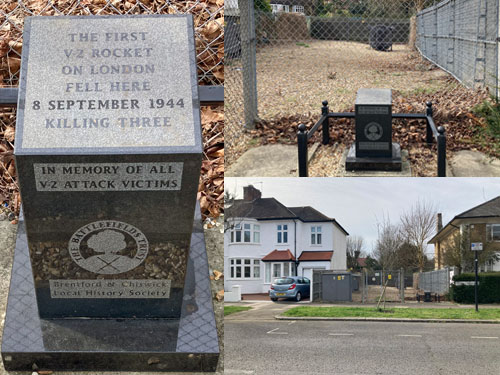
For leisure purposes, residents of Grove Park are fortunate to have the grounds of Chiswick House on their doorstep, with the Western Wilderness accessed up an alleyway from Staveley Road. But this street also has its place in history as the site of the first V2 bomb to land in London. The supersonic missile debuted without warning on the evening of Friday 8th September 1944, destroying eleven houses and leaving a crater 30 feet wide and 8 feet deep. Three people died; a toddler asleep in a cot in her front bedroom, her 68 year-old neighbour who ran three local sweet shops and an army engineer walking to the station to see his girlfriend. 60 years later a granite memorial was placed at the site, or rather squeezed into a gap beside an electricity sub-station because the actual landing spot was in the middle of the road, but it's none the less respectful for that.
Heading south Grove Park ends abruptly on the edge of Quintin Hogg Memorial Sports Ground, originally the playing fields for the Central London Polytechnic. Full marks to them for never replacing the original sign. Closer to the river Grove House's former ornamental lake has been repurposed as Chiswick Quay Marina, the nucleus of an exclusive nautical enclave. And if you continue to the far end of Hartington Road be sure to look out for the green gates by the traffic lights on the approach to Chiswick Bridge. The metal panels feature a hugely distracting plug for Dukes Meadows (Pay & Play - Golf, Tennis & Ski) and also a much smaller sign saying 'Ibis Cottage', this being the name of the incredibly famous property concealed down the drive. For this is the location of the Taskmaster House, Alex Horne's comedian-testing hideaway, which you have far more chance of seeing on Channel 4 than through the gates in real life.
I did however find a gap marginally wide enough to peek through and was thrilled to see that something challenging was underway. Two balloons were resting on pedestals in the driveway, one blue and one yellow, but the slit was really narrow so heaven knows what they were for. I did spot a couple of people wandering about, by the looks of them technicians rather than comedians, so most likely setting something up rather than filming. But look out for these coloured balloons when series 22 screens in the autumn, whatever task they were mastering, because the tip of Grove Park is much better known than you thought.