In December 2024 the government announced that it intended to replace all England's two-tier systems with unitary authorities. There'd no longer be local councils AND county councils, just the one authority locally, mainly to save money. It was also suggested that the new authorities should have a population of at least half a million.
All affected councils were encouraged to come together to discuss what should replace them, then suggest proposals to the Secretary of State who would make the final decision. So let's see how that's going.
One council was way ahead of the game and that was SURREY. They submitted final plans in May last year, five months ahead of anyone else. The county council suggested a 2-authority split, supported by two of the existing boroughs. The other nine boroughs supported a 3-way split. The government responded in October by officially selecting the 2-authority option. That decision was made law three weeks ago through the Surrey (Structural Changes) Order 2026. And this means Surrey's existing district and county councils will be abolished on 1 April 2027 to be replaced by two new councils, West Surrey Council and East Surrey Council.
West Surrey: Guildford + Runnymede + Spelthorne + Surrey Heath + Waverley + Woking (population 685,000)
East Surrey: Elmbridge + Epsom and Ewell + Mole Valley + Reigate and Banstead + Tandridge (population 565,000)
Elections to the two new councils are taking place in May. Each will 'shadow' the existing authorities before taking over in 2027. No decision has yet been made on the seat of government for each new council. There has been a request from throwback obsessives to name the western authority "West Surrey and South Middlesex", this on the basis that Spelthorne was dragged screaming into Surrey in 1965. The Secretary of State has agreed to discuss the proposal, but will hopefully reject this ridiculously long name given 95% of the new authority was never in Middlesex.
Four further counties had their futures confirmed this week.
ESSEX will be moving to a five authority model in 2028. There had also been proposals for three authorities and for four, but these had less support. Thurrock and Rochford were the sole supporters of a 4-authority version, in both cases keen not to be lumped in with Basildon and Southend.
West Essex: Uttlesford + Harlow + Epping Forest (population 330,000)
North East Essex: Braintree + Colchester + Tendring (population 520,000)
Mid Essex: Brentwood + Chelmsford + Maldon (population 340,000)
South West Essex: Thurrock + Basildon (population 370,000)
South East Essex: Castle Point + Southend + Rochford (population 370,000)
The five councils are based around the key local centres of Harlow, Colchester, Chelmsford, Basildon and Southend. Each will have a population of around 350,000 apart from NE Essex which'll exceed half a million. Thurrock and Southend are already unitary authorities and will be absorbed into larger ones. Two of the new authorities are estuarine, three are coastal and three are London-adjacent. Havering remains firmly in the capital. All council names are indicative and subject to change.
SUFFOLK is going three-way. This one's messier.
Western Suffolk: West Suffolk + parts of Babergh + parts of Mid Suffolk
Central and Eastern Suffolk: East Suffolk + parts of Mid Suffolk
Ipswich and South Suffolk: Ipswich + parts of Babergh + parts of East Suffolk
The intention is to coalesce around Bury St Edmunds, Ipswich and Lowestoft although detailed boundaries are still to be finalised. It's thus not possible to give precise populations but each will have approximately 250,000 residents (rather fewer than Essex or Surrey). The 3-way split was the preferred option for all six existing borough councils, but not the county council which wanted one county-wide unitary instead. Well of course they did.
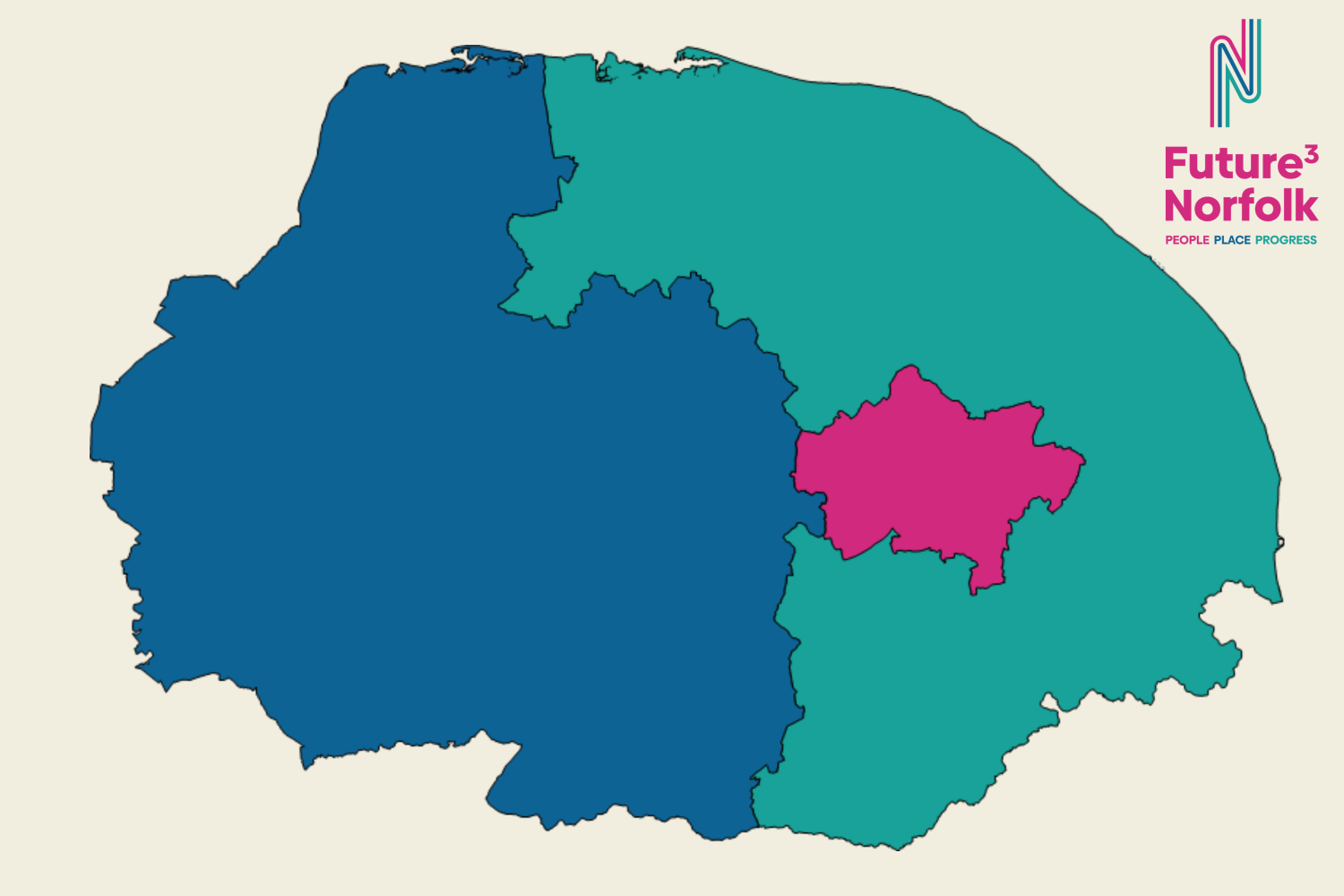
West Norfolk: Breckland + King’s Lynn + West Norfolk + a bit of South Norfolk (population 300,000)
Greater Norwich: Norwich + parts of Broadland + parts of South Norfolk (population 280,000)
East Norfolk: Great Yarmouth + North Norfolk + parts of Broadland + parts of South Norfolk (population 330,000)
Norwich's boundaries will expand to take in surrounding suburbs and towns, a move that's long overdue. The rest of the county will be split west/east, probably administered from King's Lynn and Great Yarmouth. East Norfolk is a strategically unhelpful shape and feels very much like the leftovers. All three authorities have a similar population, well below the half million minimum the government originally proposed. This is apparently deliberate, creating similar structures across Norfolk and Suffolk to fit the devolution footprint of their future strategic authority.
As for HAMPSHIRE, this complex coastal county will shift from 14 authorities to just five.
North Hampshire: Basingstoke + Hart + Rushmoor (population 410,000)
Mid Hampshire: New Forest + Test Valley + Winchester + East Hampshire (population 480,000)
South West Hampshire: Southampton + Eastleigh (population 510,000)
South East Hampshire: Portsmouth + Havant + Gosport + Fareham (population 580,000)
Isle of Wight (population 150,000)
This reorganisation will also include boundary changes designed to strip Mid Hampshire of several city suburbs. SW Hampshire thus gains seven parishes around Southampton Water and SE Hampshire gains four parishes north of Havant. Again expect name changes before the new authorities go live, given SW Hampshire is essentially Southampton and SE Hampshire is essentially Portsmouth. Also North Hampshire contracts to North Hants which is very nearly the name of a completely different county, so I bet that gets changed. The Isle of Wight gets the rare luxury of being left unaltered.
Fifteen counties haven't yet had their administrative futures confirmed. Chief amongst these is SUSSEX where the Secretary of State announcedthis week he wasn't quite convinced by any of the proposed options. Instead he'll be starting a further technical consultation wherein Brighton & Hove expands from its current footprint and Chichester switches sides. If this goes through there'd then be four authorities: an enlarged Brighton & Hove, a coastal strip from Littlehampton to Shoreham, the rest of West Sussex and the rest of East Sussex.