Local government reorganisation update (because we now have fourteen more decisions)
In December 2024 the government announced that it intended to replace all England's two-tier systems with unitary authorities. There'd no longer be local councils AND county councils, just the one authority locally, mainly to save money. It was also suggested that the new authorities should have a population of at least half a million.
All affected councils were encouraged to come together to discuss what should replace them, then suggest proposals to the Secretary of State who would make the final decision. So let's see how that's going.
Surrey was settled first and will be replaced on 1st April 2027 by two new councils, West Surrey Council and East Surrey Council. Both will have populations exceeding half a million.
In March the government announced its decisions for four more counties:
• Essex will be divided into five unitary authorities based around the nuclei of Harlow, Colchester, Chelmsford, Basildon and Southend. Only North East Essex (around Colchester) will exceed the half million target.
• Suffolk will be split into threeunitary authorities, currently with the non-catchy names Western Suffolk, Central and Eastern Suffolk and Ipswich and South Suffolk. Each will have a population close to 250,000.
• Norfolk will have three unitary authorities. One will be Greater Norwich, and the rest of the county will be divided into West Norfolk and East Norfolk. Populations will be approximately 300,000.
• Hampshire will become five unitary authorities, three of them based around Basingstoke, Portsmouth and Southampton. Four will have a population of around half a million while the Isle of Wight remains a much smaller special case.
I wrote about those five changes back in March so if you want further details, maps and links it's here.
Yesterday the government confirmed the futures of fourteen more counties. They are Derbyshire, Devon, East Sussex, Gloucestershire, Hertfordshire, Kent, Lancashire, Leicestershire, Lincolnshire, Nottinghamshire, Oxfordshire, Staffordshire, Warwickshire and Worcestershire. Final decisions on West Sussex, Cambridgeshire and Peterborough will follow once ministers have had more time to consider options.
Let's take a closer look at the three counties closest to London.
HERTFORDSHIRE will be moving to a four-authority model in 2028. This is surprising because a simple east-west split looked on the cards with each half having just over half a million people. Instead the government has plumped for four smaller quarters to allow for more local cohesion.
Northwest Hertfordshire: Dacorum + St Albans (population 310,000)
Southwest Hertfordshire: Three Rivers + Watford + Hertsmere (population 310,000)
Central Hertfordshire: Stevenage + most of Welwyn Hatfield + most of North Hertfordshire (population 320,000)
Eastern Hertfordshire: East Hertfordshire + Broxbourne + some of Welwyn Hatfield + some of North Hertfordshire (population 280,000)
The two western authorities are the most cohesive. One will comprise the three existing districts closest to London, creating an arc through Rickmansworth, Watford and Borehamwood with strong links to the capital. The other merges Hemel Hempstead with St Albans. Central Hertfordshire will follow the A1 corridor through Letchworth, Hitchin, Stevenage, Welwyn and Hatfield. The eastern slice includes the county town and will additionally absorb Royston to the north and Cuffley to the south. It has to be called Eastern Hertfordshire not East Hertfordshire to avoid confusion with the existing authority of the same name.
Changes take place on 1st April 2028, with a directly elected Mayor for Hertfordshire following "as soon as possible".
KENT will also move to a four-authority model, each with a population of approximately half a million people. One will be an estuary-side authority from Dartford to Medway. Another covers the historic tip of Kent including Canterbury, Dover and Thanet. Meanwhile Sevenoaks, Tunbridge Wells and Maidstone will fold into a well-to-do western authority. This leaves a peculiar stripe down the middle, seemingly the leftovers, an authority that'll collect the bins both at Dungeness and on the Isle of Sheppey.
This wasn't one of the original options but was proposed by councillors in Dover, Swale and Thanet. Kent County Council had instead proposed a single unitary authority, essentially preserving themselves, and have been rightly thwarted. The precise names of the new authorities are not set in stone and could be changed.
EAST SUSSEX
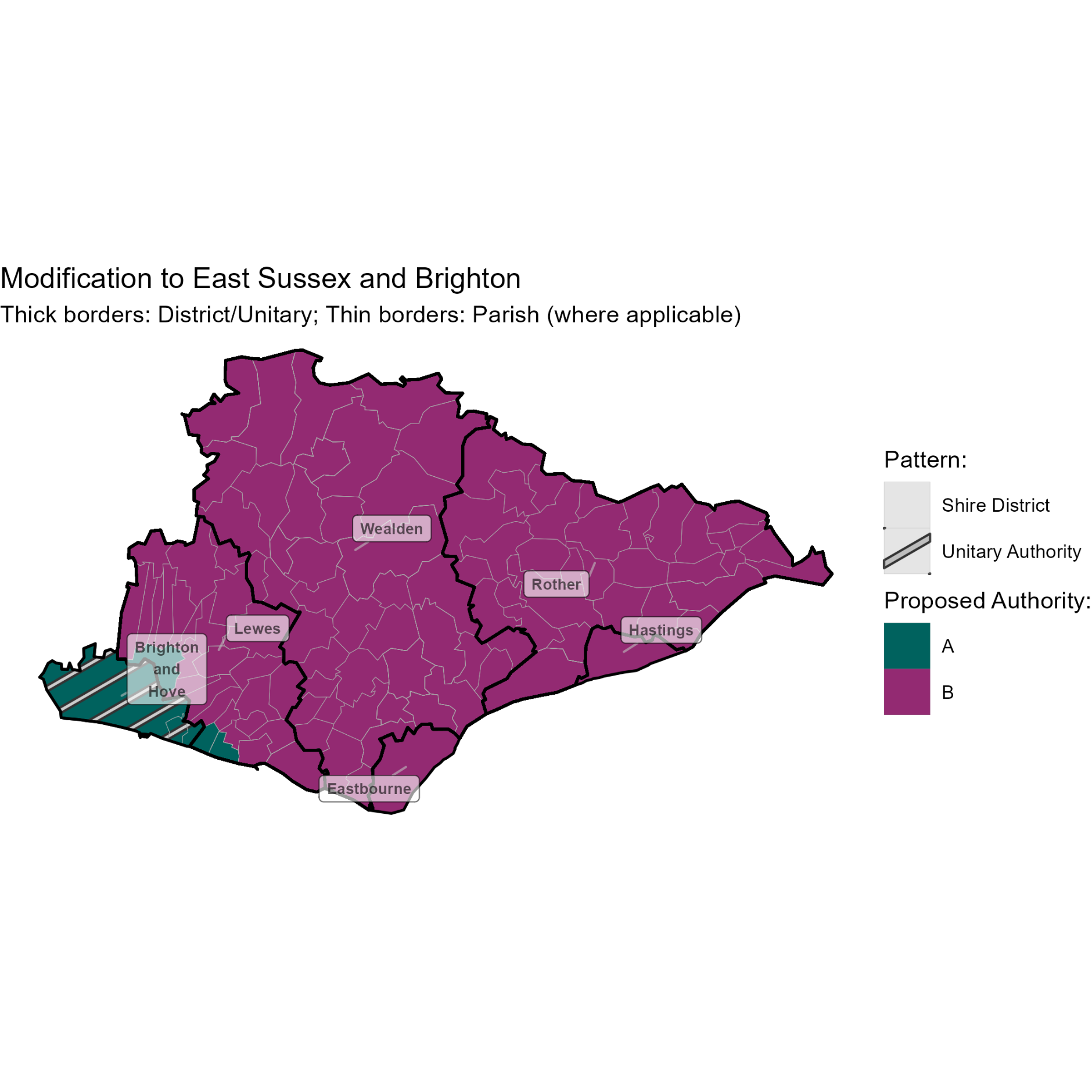
Sussex has proved problematic, so much so that a decision on West Sussex is still in abeyance while ministers pick the least worst option. The government's already had to run an additional consultation for East Sussex, confirming a minor variation on what all sides wanted anyway. This'll see the existing unitary authority of Brighton and Hove expand slightly along the coast by taking over four neighbouring wards - three in Peacehaven, also Saltdean and Telscombe Cliffs. Everything else in East Sussex, i.e. the other five existing districts, becomes a mostly rural authority that might as well be called East Sussex.
The two new districts will be of very different sizes but nothing in this government revamp is especially consistent, and the aspiration for 'a population of 500,000 or more' appears to have gone out the window.
Here's a quick summary of the other eleven announcements. You can read all the Secretary of State's letters to council leaders here.
• Derbyshire:Two new unitaries, Northern and Southern, one around Derby and one spanning Chesterfield and the Peak District.
• Devon:Four unitaries, three expanding out from Plymouth, Exeter and Torbay, the other the much larger remainder.
• Gloucestershire:One unitary, the simplest change yet.
• Lancashire:Four unitaries, notionally called North Lancashire, South Lancashire, Pennine Lancashire and Fylde Coast.
• Leicestershire: A much-enlarged city of Leicester, then everything else (known as Leicestershire & Rutland).
• Lincolnshire: Lincoln City (expanded from current limits) and 'Rural Lincolnshire'. No changes are proposed to the existing unitaries of N Lincs and NE Lincs.
• Nottinghamshire:Two unitaries, one in the southwest around Nottingham, then everything else. Nice map here.
• Oxfordshire:Three unitaries, a messy break-up forming Greater Oxford, Northern Oxfordshire and Ridgeway.
• Staffordshire:Two unitaries, North Staffordshire (around Stoke) and the un-catchy Southern and Mid-Staffordshire.
• Warwickshire:Two unitaries, North and South, snapping the existing county along a line between Rugby and Warwick.
• Worcestershire:Two unitaries, North and South, coalescing around Bromsgrove/Redditch and Worcester respectively.
There are a lot of furious local and county councillors out there today, all fuming that their option wasn't selected and their administrative realm is about to vanish. Some are convinced it's a political stitch-up by the Labour government, not an efficiency drive, while others are already plotting how to get back into power in shadow elections next May. Whatever, it's a profound change to local government across England and it's coming soon as two-tier local government inexorably fades away.