Isn't Spring late this year? The vernal equinox may have passed and BritishSummerTime may officially have begun, but the naturalworld seems not to have noticed. Normally by the end of March the trees are budding, the bumblebees are stirring and golden daffodils are fluttering and dancing in the breeze. Not this year, with a blocking anticyclone lumbering the UK with a cold, late winter. But temperatures are finally lifting, not a moment too soon, and Spring may (possibly) be just around the corner. Yesterday I visited London's two largest Royal Parks to see if I could spot Spring for myself. [photos here]
Richmond Park A vast expanse of green and brown, muddy grass and bare branches. A moving tribe of beige and fawn, deer cower in the undergrowth. A steady stream of lime and pink, cyclists and joggers panting by. A distant view of gold and blue, St Paul's is framed between the trees. A hilltop garden of yellow and mauve, daffs and crocuses struggle through.
Richmond Park is enormous. You could cover it with a town the size of Watford, but thankfully nobody's ever tried. Most of the park is rough undulating grassland, sprinkled liberally with ancient forest and thick plantations. I saw little evidence of approaching springtime yesterday, just a lot of trees with empty branches and a few dead brown leaves underfoot. Herds of fallow deer eyed me suspiciously as they nibbled on stumpy bracken. Large numbers of cyclists and joggers were out parading in their finest lycra - I was very definitely in a pedestrian minority. From King Henry's Mound I enjoyed one of London's protectedviews - ten miles eastward towards St Paul's Cathedral. No tower blocks are permitted anywhere along this very special line of sight, and a treeless corridor cut through nearby Sidmouth Wood ensures that Wren's dome remains visible. And it was only here beneath the mound, within the cultivated gardens of Pembroke Lodge, that any evidence of Spring was visible. Formal flowerbeds brimmed with soggy primroses, while scattered daffodils and crocuses pushed bravely through the surrounding slopes. Give it a few weeks, and the rest of the park might catch up.
Bushy Park The second largest Royal Park is far less well known, tucked away beside the meandering Thames between Hampton Court and Kingston. BushyPark is an odd mix of formal and informal, with stretches of open grassland surrounding a fenced-off woodland core. Yesterday the park displayed little evidence of budding Spring. The deer-stalked common looked more early January than late March. Dog walkers hurried along bare paths, out from the car park and back again beneath the invisible sun. Cars queued under leaden skies around the Diana Fountain water feature (that's a towering 17th century block of sculpture depicting the Roman goddess, not Hyde Park's farcical granite trough for a Disney Princess). Only in the central landscaped gardens had a few bulbs braved the winter frost, not so much a carpet of daffodils as a threadbare strip of lino. A few premature rhodedendrons were semi-opened up, providing welcome nectar for a handful of lethargic bumblebees. Two rabbits scampered out of the brambles, perhaps surprised to see their first human intruder of the day. There were also plenty of paired-off birds to be seen, including amorous ducks and a couple of screeching yellow parakeets nesting high in a silver birch. I felt I'd come visiting too early in the season. Spring may not yet have sprung in Bushy Park, but there was clear evidence that it's trying ever so hard to break out.
I should qualify that statement, and say that it only applies to fertile heterosexual couples engaging in penetrative intercourse without the use of contraception. If you should fall into this category, I'd like to assure you that today's warning is based on sound scientific fact. Please read the following information very carefully. It could save a life.
Please do not have sex today
Spring is (at last) in the air, and young couples' thoughts are turning more and more to love, romance and shagging. A bit of warmth and sunshine can have strange effects on the human libido, making it all too easy to get carried away by carnal thoughts. Just one unplanned kiss can lead to full-on sexual arousal and, before you know where you are, you've ended up in the bedroom engaged in intimate physical contact. So I'm told. Should you find yourself in this situation today, stop immediately.
If you engage in penetrative intercourse today without the use of contraception, one of you risks getting pregnant. If you get pregnant today, you'll probably give birth to a baby in nine months time. If you give birth to a baby in nine months time... well, just look at the calendar. Work it out for yourself. Think before you shag.
No child deserves to be born on Christmas Day. Nobody wants their birthday to be overshadowed by the biggest national celebration of the year. Nothing is more guaranteed to give a child major personality problems later in life than to share their birthday with the baby Jesus. Is five minutes of horizontal ecstacy today worth the lifetime of personal trauma to follow? Don't do it.
Jesus is particularly appropriate as a role model for the child with a Christmas birthday because He only received a miserable total of three birthday presents. No doubt each of the wise men told him "I've brought you one big combined present, honest", even though they were secretly relieved at not having to bring more. Any child with a Christmas birthday has to survive 364 days gift-free, with merely the promise of something meagre and average at the end of the present-drought. Meanwhile for the rest of the year they get to watch siblings and friends receiving double the presents, double the attention, and thereby double the love. A Christmas birthday also means a birthday party amalgamated with the festive celebrations. There may be a large birthday cake but, by the time everyone's stuffed themselves with turkey and pudding, nobody can ever face eating even a small slice of it. This is enough to scar any impressionable child for life, and all because you failed to consider the consequences of having sex today. It's inconceivable.
Children born on Christmas Day are also at serious risk of being given an embarrassingly festive name. Just think of all the people you know called Noel. Yes, him for example. Are children born in August ever called Carol, or Holly, or Robin? I think not. All these poor unfortunate individuals are highly likely to exhibit some signs of personal trauma caused by resentment towards inconsiderate parents. You don't want to risk your child suing you for emotional scarring in later life do you? Abstain today.
If you have a Christmas baby, you're also responsible for bringing another Capricorn into the world. Stubborn, inflexible and goal oriented, they often jump to conclusions and miss the big picture. Is this what you want in your family? Cross your legs for a few weeks and have a nice well-adjusted Aquarian instead. Hold it in.
So, there you have it. Unprotected sex today will mean an unhappy and maladjusted life for your son or daughter in the future. Please remember this important advice should spring fever strike today and you find yourself rampaging towards the bedroom whilst ripping one another's clothes off. You may feel like getting stuck in and reaching orgasm, but for one sperm and one egg there'll be a lifetime of psychologists' bills to pay. Please do not have sex today.
This has been a public service announcement. Thank you for listening.
I bet you've seen this meme doing the rounds. It's great isn't it? Really clever. I love reading this sort of stuff. Anyway, Mibbytagged me so I thought I'd better join in because it'll be fun. And illuminating. I love a good meme, me.
Name seven things in your fridge: a carton of milk (I'm afraid it's the really unhealthy full cream stuff), some new potatoes (presumably shipped in from abroad at great expense to the environment), a bottle of four-year-old champagne (which I've never quite had a good enough reason to open), a big steak and kidney pie (because I've got an all-day meeting at work today and they'll only serve up crap sandwiches so I'll be hungry later), a carton of value orange juice (dead cheap, I hate to think how few oranges are in it), a slab of cheese (mmmmm, cheese) and a strange mysterious green stain which probably once oozed out of a cucumber.
When was the first time you went abroad? I guess the Isle of Wight doesn't count!!! So in that case it was thirty years ago when I was 11 we flew to Canada. Flying was a really big thing in those days - almost nobody travelled abroad for their holidays at the time. And I saw Niagara Falls and I went up the CN Tower in Toronto in the year it opened and I got my fingers shut in a big American car door and it hurt.
Who were the last five people to send you a spam message? Northwest B. Ghoul, Sterling Talley, Jeffery Reese, Hobnails P. Fellini, Demetrius Mclain
If you were a type of chocolate biscuit, what type of chocolate biscuit would you be and why? Probably a Jaffa Cake, because they're soft and round but a bit tangy and all orangey inside and you can pick the chocolate off. Not that I'm like that, but I do really like Jaffa Cakes. Although they might not be a biscuit, they might be a cake.
Describe your best friend using only Madonna song titles: Like A Prayer, Causing A Commotion, Gambler, Another Suitcase In Another Hall, Lucky Star, Take A Bow
What's the funniest thing you've ever seen a kitten do? Aww there was this one time when this kitten I had she was well cute she went missing one day it was a Saturday and she was nowhere to be seen so I spent all day looking for her I hunted round the house and found nothing not a thing so I went round the local estate looking for her twice I think and into the woods too but she wasn't there either and I didn't know where she was and she was only little really tiny and I thought maybe she'd run away so I went home and waited and later that evening I looked in the cupboard under the sink in the kitchen and there she was on a shelf she'd been there asleep she'd been in the house all that time and I hadn't noticed I'd even looked in that cupboard earlier and I hadn't seen her and I couldn't get angry about it but what a waste of a Saturday and I know it doesn't sound funny and it wasn't at the time but I can laugh about it now.
LOL that was fun. And it saved me thinking up something original of my own to write about today. So now I'm going to tag Brad, littlegreenpea and Mr Squiggles to try this meme on their blogs. Because they like this sort of thing too. And because, like me, they've clearly run out of blogging inspiration. Come on everybody, why not join in? Let's meme!!!!
Do you have a local free newspaper? One that keeps you in touch with what's going on round your way? A weekly freesheet poked through your letterbox packed with stabbings, golden weddings and lost dogs? Because I don't any more, and I sort of miss it.
For years, a free newspaper was a regular part of my life. If planning permission was sought for a lean-to shed down my road, I knew about it. If an old schoolmate hit fifty runs in a weekend league cricket match, I knew about it. If roadworks at a nearby mini-roundabout threatened major traffic congestion, I knew about it. The local paper was a window on my immediate environment, keeping me in touch with what my neighbours were up to. Even if it was only a coffee morning or an unmuzzled dog on the rampage, it was better than hearing nothing. And now I live in London I have nothing. And I think I'm missing out.
I may live in a densely populated patch of the largest city in Western Europe, but nobody seems to think that my letterbox merits a local freesheet. No thick supplement of houses for sale or rent ever wings my way. Heartbreaking local crime stories pass me by. Local council initiatives go unannounced. There's a captive audience of hundreds of thousands of eager citizens round my way, but if I want a local paper I have to pay for it. I could buy the East London Advertiser and Tower Hamlets Recorder every week (I'm discounting the Evening Standard because that only feels local if you live in Putney or Notting Hill), but I was brought up on free local news and somehow paying for my weekly mugging update feels wrong.
Was it the internet that killed off the local free paper? I can now read about joyriders on the A13 online. I can find local houses for sale online. I can discover which dodgy student band is playing in the pub down the road online. I have no need to wait until Friday evening for a hastily-assembled wad of newsprint to be thrust into my letterbox, because I can find out what's going on right here right now via my computer. Except that I can't usually be bothered to look. The great joy of the local freesheet was that it reported on the commonplace and the mundane whether I wanted to hear it or not. And now I'm not hearing anything. Am I the only person living under this unfair local information embargo, or is free-paper-lessness now a nationwide phenomenon?
Silver discs(March 1981)
A monthly look back at the top singles of 25 years ago
Something highly prophetic happened on Top of the Pops in mid-March 1981. A technicians' strike (or something similar) meant that no live acts could appear, and the whole show featured nothing but new-fangled pop videos from end to end. I'd never seen anything like it. How times change.
The three best records from the Top 10 (17th March 1981) KimWilde - Kids In America: She was only 19 at the time - no longer a kid, and had never even been to America. But we didn't care, we loved the record, and we loved Kim. As the daughter of 60s rocker Marty Wilde music was in her blood, which did at least mean she could sing. This, her debut record, sounded both angry and glamorous (but in a very approachable Home Counties style). Kim's reinvented herself recently, flogging cod liver oil for Holland & Barrett and standing knee-deep in manure on daytime gardening programmes, whilst still somehow keeping her credibility. She may have moved on, but they played Kids In America on daytime Radio 1 last month and to my ears it still sounded just as fresh and sparkling and lovely as ever (although sandwiching it between two R&B dirges probably helped).
"Outside a new day is dawning, outside suburbia's sprawling everywhere, I don't want to go baby. New York to East California, there's a new wave coming I warn you." Toyah - It's A Mystery: At the opposite end of the pin-up scale to pouting Kim came post-punk Toyah. Across the country copycat girls tried to tease their hair into extreme shades of red and daubed their faces with suburban warpaint. Leaping into the chart for the first time, perhaps more through hard graft than pure musical talent, Ms Willcox offered us her 'Four From Toyah' EP in the hope that we might like one of them. Thankfully we did, and an endearing pop (and acting) career followed. And she's still going strong, as anyone at (ahem) Butlins in Minehead or Skegness last weekend can testify.
"It's a mystery, oh it's a mystery, I'm still searching for a clue, It's a mystery to me. A shot in the dark, the big question mark in history - is it a mystery to you?" TeardropExplodes - Reward: Bang! This song punched you in the face with its perky brass opening, then hurtled onward without pausing for breath. Three minutes of uplifting joy from the pen of musical maestro Julian Cope, although none of his later musical masterpieces managed to reach the same giddy chart heights. One of my schoolfriends was absolutely convinced that this song kiched off with the lyrics "Bless my cotton socks I'm in the nude". I hate to disappoint him, but...
"Bless my cotton socks I’m in the news, The king sits on his face but it's all assumed. All wrapped up the same, All wrapped up the same. They can’t have it, you can’t have it, I can’t have it too until I learn to accept my reward"
My favourite three records from March 1981 (at the time) DepecheMode - Dreaming Of Me (reached number 57): I didn't realise when I taped this single off the radio that this was the beginning of a 25-year love affair. Casio drumbeats and a synth siren, followed by plinkety keyboards with a teenage bedroom vibe - it was an inauspicious start for the four lads from Basildon. Nobody yet really knew what the band looked like, or even how to pronounce their name properly [see debut NME article here]. But I was instantly attracted by the unique close harmony vocals and alluring melody, and I adored it. The single may not have reached the Top 40, but various careers spanning teenypop, Yazoo, leather shorts, Erasure, near-fatal overdoses and stadium rock all began here. I'm just chuffed that I noticed.
"So we left, understanding, cleancut so we're sounding fast. Talked of sad, I talked of war, I laughed and climbed the rising cast" B Movie - Remembrance Day (reached number 61): Perhaps not great timing to release a song about November 11th in March, but hey, I'll still happily replay this gorgeously atmospheric single even in May or August. The Mansfield band had just featured on Stevo's seminal Some Bizarre album (alongside the equally unknown Soft Cell, Blancmange, The The and Depeche Mode), but alas their music never really captured the public imagination. If you remember B Movie you'll want to visit their tune- & nostalgia-packed website, and you might even want to head down to the Metro club in Oxford Street this Saturday for a (very) rare gig. And yes, they all look like bank managers now.
"Hailstones and epitaphs, mourning bells and half mast flags, in the cemetery where they fell all those many years ago, now it's just a memory eroded by the years" Small Ads - Small Ads (reached number 63): You won't remember this, I bet. A bunch of chirpy geezers, cooler than Chas & Dave and more tongue in cheek than Madness, singing a song about local newspaper classified advertising. Wholly appropriate, then, that you can now buy a copy on eBay. I'm tempted.
"This year's registration with a slightly dented wing, only down in Finchley, think I'll give the bloke a ring"
20 other hits from 25 years ago (and this is easily the best list yet): Jealous Guy (Roxy Music), Kings Of The Wild Frontier (Adam and the Ants), This Ole House (Shakin Stevens), Can You Feel It (Jacksons), You Better You Bet (The Who), Star (Kiki Dee), Ceremony (New Order), Something 'Bout You Baby I Like (Status Quo), Intuition (Linx), It's A Love Thing (Whispers), What Becomes Of The Broken Hearted (Dave Stewart and Colin Bluntstone), Walking On Thin Ice (Yoko Ono), I Missed Again (Phil Collins), Lately (Stevie Wonder), Mind Of A Toy (Visage), St Valentine's Day Massacre EP (Headgirl), Can You Handle It (Sharon Redd), Capstick Comes Home (Tony Capstick), Slow Motion (Ultravox), Up The Hill Backwards (David Bowie) ...which hit's your favourite? ...which one would you pick?
Yesterday the Government announced that Britain's first car share lane will open next year on the M62 between Bradford and Leeds. Any vehicle containing more than one occupant (or a very convincing inflatable doll) will be able to use the lane, shaving eight minutes off a typical morning commute. Research suggests that only one in every six vehicles using this stretch of motorway during peak hours currently contain two or more occupants. They'll be in for a treat next year, then, speeding past all the lonely singletons queued nose to tail in the bog-standard lanes alongside. I do hope those evil individuals are feeling appropriately guilty as they commute passengerless to work, murdering the planet as they do so.
They've had carpoollanes in other countries for some time. In California, for example, they're sometimes called "diamond lanes" (which is the only reason I stopped to take this photograph, honest). As you can see, this diamond lane in San Francisco is a huge success, completely empty of any traffic whatsoever. Maybe that's not surprising in a country where only 7% of vehicles have multi-person occupancy, or maybe it was just a very quiet Sunday afternoon. Whatever the case, carpoollanes haven't been universally popular in the States, seen by some as a chronic waste of valuable roadspace and by others as creating new forms of risk and congestion.
Our Transport Secretary, Darling, says that car share lanes are "a sensible measure to try and encourage people where they can to share lifts, especially if they're going to work maybe in the same place or same area." But I have my doubts as to just how feasible car-sharing really is.
The major flaw with car sharing is surely the unpredictability of most people's journeys. It's great if you always go into work at eight and always return on the dot of five, but most of us don't lead such rigid lives. What if one day you want to go into work early, or divert along the way to pick up a prescription or some dry cleaning? And how much time would you end up wasting each month if your carshare partner always finished work half an hour after you, or decided to stay late one night to complete an urgent project. And what about spontaneous leisure journeys, or shopping trips? Even by using a carpoolingwebsite it's still nigh impossible to find the perfect partner whose journey requirements perfectly match your own. Car share lanes are likely to prove too impractical for the majority of road users, benefitting only those who already drive around accompanied by friends or family. The rest of Britain's solo drivers are unlikely to be able to change their existing behaviour, even if they'd like to.
And anyway, the Department of Transport already has a fully-trialled 100%-effective road congestion solution whereby several road passengers share the same vehicle. It's called a bus. A few more of those running regularly and reliably around the country and we might be able to cut road congestion without spending the odd £2½million on one mile of new road.
Sorry, after 10 days of consecutive posts about London I was planning to talk about something, anything else today. But no. Sorry...
Why is it so difficult to find out what's going on in London? There's so much going on in fact, so much background noise, that often the big events can slip past unnoticed. I was lucky yesterday - I noticed one twenty minutes before it began and was able to head along without missing much. But all too often the first I find out about a fascinating event is reading a review afterwards, too late. Damn you London.
So, where do you go to find out about this kind of event in advance?Time Out's useful, but expensive, and you only get a few days advance notice. Visit London, the capital's official tourist site, is comprehensive but it's hard to find the special events in amongst the Lion Kings and Mary Poppins. No, what I need is a list of upcoming "big free events", far enough in advance that I can plan to attend them (or not). And I can't find one. So I'm having a go at making my own...
Here's the diamond geezer clickable list of the next ten upcoming "big free events"* in London. Except it's not yet especially comprehensive, or upcoming. Can you help me to improve on the current ten? Please help.
* that's "big", as in not your local church hall jumble sale * that's "free", as in not something you pay to enter * that's "event", as in not some three month art exhibition
I SPY LONDON the definitive DG guide to London's sights-worth-seeing Part 7:Imperial War Museum
Location: Lambeth Road, SE1 6HZ [map] Open: 10am - 6pm Admission: free (some exhibitions cost) 5-word summary: military might and reflective remembrance Website:www.iwm.org.uk Time to set aside: at least an afternoon
Just down the road from Lambeth North station, just that little bit further than the original Bakerloo line ventured, stands the imposing Imperial War Museum. The jingoistic name probably deters a lot of more sensitive souls from visiting, wrongly expecting that the place is full of guns, artillery and body armour. Which is a shame, because that's only partially true. I was in the area, so I thought I'd pay the formerlunaticasylum a visit.
Once you get past the queue at the cash desk (which always strikes me as strange in a free museum, but I guess they need the opportunity to flog you a £3.50 audio guide) you enter into a tall airy entrance hall packed with the machinery of war. Mighty rockets rise up from the floor (that's a V2, that's a Polaris). Field guns and tanks are scattered around for intimate perusal (that's a Howitzer, that's a Sherman). A selection of classic warplanes hang across the ceiling (that's a Sopwith Camel, that's a Focke and yes, that's a Spitfire). There's nothing here over 100 years old because the museum concentrates on 20th century conflicts, from trench warfare to more modern genocide. But for me the jewels in the collection aren't these large objects of military strength, they're the exhibitions spread across the six floors behind.
As you might expect, the majority of the museum is given over to remembering the First and Second World Wars. Downstairs is a traditional glass-cased walkthrough of the history of each, complete with a fibreglass WW1 trench to shuffle down and a blacked-out WW2 air raid shelter experience. There's a special area devoted to D-Day, in some depth, as well as a skim through some of the later global conflicts of the 20th century. I was especially impressed by The Children'sWar, an extensive exhibition recounting the experiences of evacuees and those left to fight WW2 on the Home Front. Like all the best history it's delivered as much through written and spoken testimony as through collections of appropriate artefacts. Best of all was the chance to walk through a full size mocked-up 1930s semi-detached house, peering into the period kitchen, austere bedrooms and gadget-free parlour. It's hard to remember that for most of the children being taken around the exhibition this is a glimpse back into the long lost past, whereas I could easily imagine my parents and grandparents sitting down at the dining room table for a rationed meal or hiding inside the steel cage of a squat MorrisonShelter during an air raid.
But you have to ascend to the third floor to enter the most thought-provoking galleries of all - the Holocaust Exhibition. Two floors of the museum have been given over to detailing the Nazis' so-called Final Soulution, starting with an in-depth exploration of the politics and propaganda which allowed mass genocide to sneak up almost unnoticed. Due attention is paid to the creeping tide of oppression as Hitler's borders expanded, notably across eastern Europe, and it's chilling to hear genuine first person testimony every step of the way. The journey to (and through) Auschwitz is remembered in graphic detail, and the inhumanity of this place of extinction is brought home by the tales of a handful fortunate enough to survive. You won't leave unmoved. And if a few gung-ho Playstation addicts visit the museum expecting bloody war but discover instead this heartfelt plea to peace and tolerance, the museum has done its job well. by tube: Lambeth North
Baker100 Here endeth my journey along the 100-year-old Bakerloo Line. I'm always fascinated by following lines across London to see where they lead, and the Bakerloo didn't disappoint. I hope you found the trip interesting too (assuming I have any readers left, that is). And watch out, because yet another tube line has a centenary later this year. I wonder whether Hammersmith to Finsbury Park is quite so absorbing...
At the far eastern end of Waterloo mainline station, just that little bit further than most commuters usually venture, there's an exit out into nothingness. OK, so it's not quite nothing, particularly if you turn left up towards Westminster Bridge Road, but I turned right. A long straight pavement stretches the full length of platform 1, but on the opposite side of a stark brick wall [photo]. Alongside is a rat run for buses and queueing taxis, shielded behind some grey functional railings with a view downhill across the wastes of North Lambeth. And the highlight of 'Station Approach Road' is a small mini-roundabout. Sorry, it's not exactly a heritage hotspot like Regent Street, is it? At the far end the pavement descends into a roadside subway that's even bleaker. I stopped to take a photograph of this unappealing hole, only to be laughed at by an incredulous passer-by. He may have had a point [photo].
But my exit was into one of the area's more characterful and historic streets - LowerMarsh. The name's a hint to its origin - a road cutting across extensive marshy land to the south of the Thames and once the quickest way to walk between Westminster Bridge and Blackfriars Bridge without getting your boots wet. Lower Marsh has been a shopping street for centuries and retains a charming run-down retail look today. The buildings are a higgledy-piggledy ragbag of mixed-height terraces, selling nothing overly corporate [photo]. I arrived in the middle of a Saturday afternoon when you might have expected trade to be at its height, but instead the street was unexpectedly quiet and market-free. I guess that weekday office workers now form the mainstay of local business. Otherwise I'd undoubtedly have popped into independent bookshop Crockatt & Powell, being the only blogging booksellers I know. Alas, like the Golf Sale earlier in my walk, I find the prospect of a solo browsing experience somewhat uncomfortable, so I passed by.
With just a few hundred yards of my Bakerloo line walk remaining, I finally located something I'd been searching for in vain for the last three miles - a bakery. Admittedly it was nothing truly local, just an identikit blue Greggs outlet selling all the usual cakes and savouries, but this was the first building on my journey where I could actually have bought a loaf baked on the premises. Except unfortunately they'd sold out of bread and were down to the last few leftover pastries, so I made do with a sausage, cheese and bean melt while the ladies cleaned up behind the counter. I'd found a baker but I couldn't find a loo, so I decided against purchasing an accompanying beverage. By the look of the street outside, however, I bet some of the side alleys get used as an extremely public convenience every now and then. Lambeth North station was now just around the corner, and I felt a world away from my starting point on the edge of leafy genteel Regent's Park.
Baker100 - Lambeth North station Station opened: Saturday 10th March 1906 Station originally called:Kennington Road, but changed to Westminster Bridge Road after just five months, then changed to Lambeth (North) in 1917 (and lost the brackets in 1927) Distance from previous station: 900m End of the line: Not any more, obviously, but it was when the line opened. The tracks to Elephant & Castle were opened five months later. Nearby depot: There's room for 10 Bakerloo trains in the London Road depot, just off St George's Circus. It's hard to believe that railway sidings still take up so much prime land so close to central London, but they do. Apparently the depot is haunted by the ghost of a nun. Most outstanding feature outside the station: Tall-spired Christ Church, once home to William Wilberforce's anti-slavery campaign, now home to an ultra-progressive ministry called (ouch) church.co.uk (the sort of place that has a TV vicar and a Sunday evening service called "headspace") Thrilling fact: There are 84 steps down to platform level Below ground: A proper old-style tube station with curvy platforms, creaking lifts and genuine old ivory and brown tiling, mercifully free of the ravages of a wholesale Metronet upgrade. [photo][photo][photo] Proper history of the station:here Local Bakerloo book: Geoff Ryman's unique novel 253, in which a packed Bakerloo line train hurtles southward towards Elephant & Castle, and we learn in detail about each of the 253 characters on board. Just before the train crashes. Not only is it a great book, but it started out online so you can read the whole thing here. Recommended.
Until a few years ago, the best way to cross the Thames from Charing Cross to Waterloo was by train. You wouldn't have wanted to walk across the old Hungerford footbridge, a narrow confined passageway on stilts hemmed in beside the old iron railway bridge. Not unless you were a beggar or a mugger, anyway. There's been a footbridge here since 1845 when Isambard Kingdom Brunel built the first to connect southern shoppers to bustling HungerfordMarket on the north bank. Structurally it was gorgeous. As a pedestrian tollbridge crossing a stinking river, however, it was a financial disaster. In 1859 the South Eastern Railway bought up Brunel's bridge and promptly demolished it, replacing it with a sturdy box girder rail bridge designed by John Hawkshaw. Commuter trains still rumble through his iron lattice today, crawling slowly across the river into Charing Cross station (built on the site of the old Hungerford Market). The desolate red footbridge endured far longer than it should, but the demolition order finally came and the new HungerfordBridges are its replacement. They were tough to build, not least because the fragile Bakerloo line passes only a few metres beneath the riverbed, but they were finally opened in 2002.
Aaah that's better. Not just one footbridge but two. Not a narrow walkway but a broad span. Not a boxy iron tube but an elegant wave of supsended steel cables. Not a criminal paradise but a busy thoroughfare. Not a shortcut to scurry down but a tourist destination in its own right. Not a grim view of passing trains but an open vista across the Thames. Walk across the eastern side and there's St Paul's rising above Blackfriars Bridge. Walk across the western side and there's the London Eye looming above the Houses of Parliament. The GoldenJubileeBridges were clearly meant to be photographed and to photograph from. So my apologies to any passing couples whose path I blocked while I was busy snappingaway, but there was no need to be in such a hurry, OK?
The new bridges have increased pedestrian access to the SouthBank, at least for us northerners. Most of the arty buildings here grew up as part of the 1951 Festival of Britain - an event a bit like the Millennium Dome except that it was an enormous success. Closest to the bridge is the RoyalFestivalHall, recently buried beneath a shroud of boards and sheeting awaiting concrete rebirth. Architecturally it's not to everybody's taste but inside the auditorium, where it counts, the acoustics in are spot on. Well, I thought so when I performed here as a spotty 12-year-old, one of hundreds of Hertfordshire schoolchildren press-ganged into singing some worthy Vaughan Williams oratorio to a packed audience of devoted parents and grandparents. You might remember me - I was the well-scrubbed short kid seated stage right who felt distinctly faint just after the interval and had to sit down mid-performance. Sorry. I've not been back inside since, just in case somebody official recognises me. Quick, let's hurry onward, along to Waterloo. Meet you under the clock?
Baker100 - Waterloo station Station opened: Monday 8th August 1898 Distance from previous station: 500m (beneath the River Thames) You are now entering: the London borough of Lambeth Named after: That big battle in 1815 where we whopped the French. No connection whatsoever to Abba. Change here for: Waterloo & City line (arrived 1898), Northern line (arrived 1926), Jubilee line (arrived 1999) and mainline services (arrived 1848) Thrilling fact: Waterloo station has 24 escalators, more than any other underground station. Bakerloo line platforms: sort-of ordinary tiling, but with medieval-looking mosaic panels spaced out close to most of the exits Nearest baker: There are plenty of food outlets on the concourse of Waterloo mainline station which pretend to be bakers. Upper Crust promise 'delicious baguettes baked all day long', Delice de France reheat croissants to order, and Krispy Kreme churn out something almost, but not quite, like a genuine doughnut. There's even a kiosk called 'Daily Bread', except that they only serve sandwiches, not still-warm cottage bloomers. Most disappointing. Nearest loo: Opposite mainline platform 18, except that I wasn't paying 20p to spend a penny!
There are several ways to walk the (very) short distance between Charing Cross and Embankment tube stations. You can follow the Bakerloo line and stroll down Northumberland Avenue, once home to a most grand Turkish Baths, now flanked by grim Government offices. You can follow the Northern line down narrow Villiers Street, lined with endless eateries and a monstrous block of accountants. You can walk through Charing Cross station itself, taking the raised walkway south through a piddling little tourist market. Or you can take the route I took, inbetween the lot of them, along quaint quiet Craven Street. Here, tucked away out of sight from most passing tourists, I stopped off to visit an unique slice of Americana...
I SPY LONDON the definitive DG guide to London's sights-worth-seeing Part 6:Benjamin Franklin House
Location: 36 Craven Street, WC2N 5NF [map] Open: 10am - 5pm (Wednesday - Sunday) Admission: £8 5-word summary: American diplomat's dramatic walk-through experience Website:www.benjaminfranklinhouse.org Time to set aside: an hour
I'd never paid cash before to spend time shut away alone in a private house with a histrionic woman. Neither was that my plan when I went to visit one of London's newest tourist attractions, opened in January this year on the 300th anniversary of its most famous resident's birth. But that's how things turned out.
You probably think of Benjamin Franklin as a quintessential American, battling for freedom against the British and signing his name at the bottom of the Declaration of Independence. But what's far less well known is that Franklin spent more than fifteen years of his life living in London. He spent a year in his late teens learning the printing trade (residing in Little Britain, no less) before returning home to set up the Pennsylvania Gazette. In 1757 he came back to London as a fifty-year-old international diplomat, staying considerably longer and taking up lodgings with the Stevenson family in a terraced townhouse in Craven Street [photo].
I found the door to 36 Craven Street without too much difficulty, but had far more trouble trying to work out how to pay to get in. A sign on the iron railings directed me round the corner to Craven Passage (ooh, atmosphericarchedtunnel) beneath Charing Cross station where I eventually found the New Players Theatre. A girl behind the counter in the musty box office cheerily sold me an entrance ticket before revealing that I was the only person signed up for the 1pm tour. A tour earlier that morning had been sold out, she assured me, but her tally chart suggested business had been very slow since. Still, there was no point in complaining, a solo tour would clearly be the ultimate in heritage value for money. I was led back to Franklin's terraced house in Craven Street, ushered into the creaking hallway and taken down to the basement. Here I sat alone and watched a short film about Franklin's London life, edited with a clear nod to any parties of American tourists who might have been visiting. But they weren't, it was just me.
And then Polly made a dramatic entrance. Polly was the daughter of Ben Franklin's London landlady - and this was definitely either her or a very convincing actress in a big powdered wig. With the distant ringing of a bell from upstairs she bade me follow her up to the drawing room where virtual tea was being served. A highly ingenious interactive audio-visual presentation was underway, with the wood-panelled walls of each room being used to screen a different tableau from Franklin's London biography. Voices and period music played over hidden speakers, with Polly narrating her part of the story to perfection during each narrative pause, live to the audience. Which was just me. Polly's professionalism shone through as she delivered a bravura performance without ever looking me directly in the eye, or blushing all red and embarrassed at being shut in the same room with one single male vistor. I couldn't help but be impressed as she led me through the house with as much energy as she would a party of 12, and Franklin's story unfolded from a very human angle.
I don't think I'd previously fully appreciated the broad diversity of Franklin's genius. Not content with being a newspaper baron and civic-minded statesman, Ben was also a talented scientist. His particular interest was the new-fangled study of electricity, including that legendary kite-flying lightning experiment and a lot of playing around with coils and magnets. He kept busy during his voyages across the Atlantic by taking readings which established the path of the Gulf Stream. And in the tiny rear study upstairs at Craven Street he entertained the great thinkers of his day andinvented bifocals. Here Polly's emotional parting scene recalled the day in March 1775 when ambassador Ben, disgraced in British eyes as a whistleblower, finally packed his bags and returned to revolutionary America. The special relationship he established between our two countries remains today (twat presidents notwithstanding). And Franklin's London life has been, I think, beautifully remembered here at Craven Street in unique and dramatic fashion. If you don't mind risking forming another minimalist audience, I know Polly would be delighted to show you round.
Baker100 - Embankment station Hang on, isn't this station called Charing Cross? It used to be when it opened, but since 1974 it's been called Embankment. I warned you yesterday that this was complicated. Station opened: Monday 30th May 1870 Change here for: District and Circle lines Quick history: The District line got here first, running alongside a sewer inside the newly-constructed Victoria Embankment. The Bakerloo and Northern lines burrow underneath. Distance from previous station: 370m That's not far! No, Charing Cross to Embankment is one of the shortest inter-station journeys on the entire tube network. And the Northern line journey between these stations is 100m shorter still! Surely it would be quicker to walk? You'd think so, wouldn't you? So I did an experiment to find out. I timed how long it took me to get from the Trafalgar Square entrance [photo] to the Embankment exit [photo] by train, and then timed how long it took me to walk back again. First, by tube. It took a minute to descend to the foot of the escalator, another to get to the platform, a third to wait for a train, a fourth to ride to Embankment, a fifth to mount the first escalator and a sixth to climb the final escalator and exit. My walk back up Northumberland Avenue took only four minutes and 45 seconds. So yes, it's definitely quicker to walk. Station layout: Fairly simple, all things considered - see 3D cross-section here Bakerloo platforms: white tiles, decorated with fluttering red, blue and brown ticker tape Thrilling fact: Immediately before World War Two giant steel floodgates were built here (and at Waterloo) to prevent innundation by the Thames should a German bomb ever penetrate the tunnel beneath the river. I've been here before: The construction of the Victoria Embankment(August 2005)
Baker100 walk: Piccadilly Circus to Trafalgar Square
The Bakerloo line runs beneath Haymarket on its way to Trafalgar Square. I think the underground train has the right idea - it's not missing much above the surface. There's no longer a great deal of visual interest down this once historic street, just a few tourist tat shops, grim restaurants, archaic offices, the Sports Cafe and a seen-better-days cinema. But a handful of buildings still really stand out.
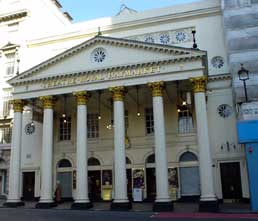
With its six tall Classical columns, the Theatre Royal is probably the most impressive building in the street. The present building was designed by (who else?) John Nash in 1820, although the original theatre dates back a century earlier. HerMajesty'sTheatre across the road is even older, and has changed name (and gender) five times since 1705 to match with the reigning monarch. Early in its history, as the King's Theatre, it became renowned as the home of London opera under the musical directorship of George Frideric Handel (yes, really, him). The current building, opened in 1897, has a tradition of hosting long running musicals, including Chu Chin Chow(opened 1916, for 2238 performances), Fiddler On The Roof(opened 1967, for 2030 performances) and The Phantom Of The Opera(opened 1986, now over 7500 performances, and no sign of giving up the ghost). Perhaps most memorably of all, for some, Tommy Cooper suffered a fatal heart attack live on ITV whilst performing on stage here in 1984.
On the corner with Pall Mall stands New Zealand House, the official presence of the Kiwi government in the UK. The building is a 15-storey early-1960s tower block, which you might therefore expect to be a concrete monstrosity but actually it's nothing of the sort. Architect Robert Matthew hoped to create a 'romantic silhouette' on London's skyline and successfully created an elegant tower, now Grade II listed. The view's not quite so impressive at ground level, however, and the multilayered glass effect is now somewhat ruined by the need to hang billowing curtains in every window. New Zealand timbers were used for some of the interior decor, and there's a mighty tall Maori totem pole erected in the atrium. Post-war planners were particularly worried by the potential security risk created by the view from the top floor penthouse, and they were right to be. I've been right up to the outdoor roof terrace as part of London Open House weekend a few years ago (oooh, spectacular), and I'm sure if I'd taken a pair of binoculars I could have seen right into the gardens of Buckingham Palace. It's a great pity that the roof is so rarely open to the public. [photos & history here]
From here it's a short walk along either Pall Mall (past the National Gallery's carbuncle extension) or Cockspur Street (past the Scottish tourist office) to the edge of Trafalgar Square [photos]. And you may remember I wrote about Trafalgar Square in enormous detail last October, so I have no intention of repeating myself here. Onward to the station...
Baker100 - Trafalgar Square station Station opened: Saturday 10th March 1906 Distance from previous station: 500m Hang on, there isn't a tube station called Trafalgar Square: No, not any more. But there used to be when the Bakerloo line opened. Station renamed Charing Cross: Sunday 4th August 1974 Incredibly complicated 'renaming' history of this and neighbouring stations: I've written about this in some depth before, or read about it all here Brief summary of the above: Trafalgar Square and Strand stations were combined to create Charing Cross station in readiness for the completion of the Jubilee line. Subterranean station cross-section here. Change here for: Northern line, but only if you want a very long walk because the two halves of the station really aren't very close together at all. Line maps on board Bakerloo line trains don't show this station as an interchange, recommending that you change at Embankment instead. Exit: You emerge from the ticket hall directly into the southeast corner of Trafalgar Square [photo]. It's about as convenient as any tube station gets. Bakerloo line platforms: A 1970s brown vinyl makeover, featuring murals inspired by Trafalgar Square and the National Portrait Gallery above. The panels were designed with integral litter bins, but the threat of terrorism means that these are now inelegantly blocked. Cardinal Wolsey now has a featureless white rectangle across his chest, for example [photo] I've been here before:All about Trafalgar Square(October 2005)
Very little of the layout of central London was ever consciously planned - most of it just evolved. RegentStreet, underneath which the Bakerloo line runs, is a rare exception. Along with Portland Place (see yesterday) this was part of the processional route carved through the West End by John Nash for the benefit of the Prince Regent. How often the prince rode this way is not recorded, but Nash's broad boulevard soon became a fashionable magnet for the well-to-do of Georgian London. The very finest section of the road was the sweeping curve to the south - the Quadrant - whose shadowy colonnades were later removed to stop prostitutes gathering there after dark. Initially the two major road junctions at either end were called "Regent's Circus North" and "Regent's Circus South", but the need for clarity following the introduction of omnibus services caused conductors to rename them "Oxford Circus" and "Piccadilly Circus", and so they remain today. None of Nash's grand terraces still stand - the individual shops were too small for modern business needs so they were all demolished between 1902 and 1927. The replacement façades do still look pretty damned impressive, however [photo], and the street continues to take its heritage very seriously. Perhaps that's not surprising when the Crown is your landlord.
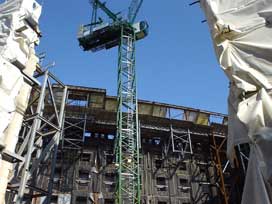
Walk down Regent Street today and what strikes you, apart from the grandeur, is the huge amount of scaffolding on show. In some parts of the street the majority of buildings appear to be boarded up, shielded behind poles and sheeting, while major reconstruction work takes place behind. Modern businesses have different needs to old, and some degree of rebuilding and inconvenience is needed while new retail outlets move in. It's all an illusion, though. The façades may stay intact but everything behind gets gutted - as you can see in this photo taken from Swallow Street, round the back of the main Regent Street curve. When the cranes finally move out and the new businesses and luxury penthouses move in, only a historical veneer will remain. So much of London's history, alas, is but skin deep.
Many of Regent Street's shops are world famous. Hamleys, for example, has to be the favourite destination for generations of toy-seeking children. It gets a bit crowded in there at weekends and school holidays, but you'll be glad to know that they still demonstrate pocket-money bubble-blowing machines and mini looping aeroplanes on the ground floor. Another traditional favourite is Liberty, its Tudor building constructed in 1924 from the timbers of two ships: HMS Impregnable and HMS Hindustan. Aquascutum and Austin Reed are also Regent Street staples, and there's a distinctly upmarket flavour to many of the other retailers here. Maybe that's why I've never properly appreciated this street - it's always seemed to be pitched somewhere over my head, more about excessive style than any sense of value. Not even the new AppleStore has encouraged me to change my mind. One recent Regent Street casualty was department store Dickins & Jones, closed for business in January after more than two centuries of trading. I hate to think who'll move in and replace it. After all, who now remembers Swan & Edgar at the foot of the street, closed in 1982 and now ignominiously replaced by a Virgin Megastore?
But one retail legend shows no sign of fading away. As long as I can remember there's been a bloke standing in Regent Street with a big arrowed sign saying GOLF SALE. I don't think it's been the same bloke every time, and the sign itself has also evolved (was yellow on black, now black on fluorescent yellow), but the campaign continues. Westminster Council tried to ban this board-borne advert a few years ago, but discovered that the relevant legislation didn't seem to extend to pavements and so the board remains. It's multiplied as well, with several feeder boards pointing towards the main sign pointing down Maddox Street. This isn't a sidestreet you'd otherwise choose to walk along, but on this occasion I thought I'd follow the pointing arrow to see what was there - something I've studiously avoided in the past (not least because I am so very definitely not a golfer). And there, just beyond the burger restaurant and the slightly rundown tanning salon, was the notorious Golf Sale. I was expecting more, perhaps, not just an ordinary shop with an array of golf bags and clubs lined up on the pavement. The big yellow sign at Oxford Circus may have read 'Walk In', but it seemed that nobody had. Two sales assistants stood chatting close to the door in a shop packed with golf equipment but no customers. I would have gone in, but I always feel very uncomfortable in any shop where the staff outnumber the visitors so I walked swiftly past and continued on my way. Even world renowned marketing campaigns, it seems, don't always deliver successful results.

In search of Spring
A vast expanse of green and brown,
The second largest Royal Park is far less well known, tucked away beside the meandering Thames between Hampton Court and Kingston. Bushy Park is an odd mix of formal and informal, with stretches of open grassland surrounding a fenced-off woodland core. Yesterday the park displayed little evidence of budding Spring. The deer-stalked common looked more early January than late March. Dog walkers hurried along bare paths, out from the car park and back again beneath the invisible sun. Cars queued under leaden skies around the Diana Fountain water feature (that's a towering 17th century block of sculpture depicting the Roman goddess, not Hyde Park's farcical granite trough for a Disney Princess). Only in the central landscaped gardens had a few bulbs braved the winter frost, not so much a carpet of daffodils as a threadbare strip of lino. A few premature rhodedendrons were semi-opened up, providing welcome nectar for a handful of lethargic bumblebees. Two rabbits scampered out of the brambles, perhaps surprised to see their first human intruder of the day. There were also plenty of paired-off birds to be seen, including amorous ducks and a couple of screeching yellow parakeets nesting high in a silver birch. I felt I'd come visiting too early in the season. Spring may not yet have sprung in Bushy Park, but there was clear evidence that it's trying ever so hard to break out.
Silver discs (March 1981)
Kim Wilde - Kids In America: She was only 19 at the time - no longer a kid, and had never even been to America. But we didn't care, we loved the record, and we loved Kim. As the daughter of 60s rocker Marty Wilde music was in her blood, which did at least mean she could sing. This, her debut record, sounded both angry and glamorous (but in a very approachable Home Counties style). Kim's reinvented herself recently, flogging cod liver oil for Holland & Barrett and standing knee-deep in manure on daytime gardening programmes, whilst still somehow keeping her credibility. She may have moved on, but they played Kids In America on daytime Radio 1 last month and to my ears it still sounded just as fresh and sparkling and lovely as ever (although sandwiching it between two R&B dirges probably helped).
They've had carpool lanes in other countries for some time. In California, for example, they're sometimes called "diamond lanes" (which is the only reason I stopped to take this photograph, honest). As you can see, this diamond lane in San Francisco is a huge success, completely empty of any traffic whatsoever. Maybe that's not surprising in a country where only 7% of vehicles have multi-person occupancy, or maybe it was just a very quiet Sunday afternoon. Whatever the case, carpool lanes haven't been universally popular in the States, seen by some as a chronic waste of valuable roadspace and by others as creating new forms of risk and congestion.
Yesterday's jewel of an event was the London Maze, an annual free 'local history' fair devoted to London and its past, which somehow I'd never heard of before. The fair takes place at the Guildhall in the City, and attracts stallholders from small museums, libraries and local history societies. I missed Peter Ackroyd's opening ceremony, but arrived in time to collect my free carrier bag and fill it with leaflets. Where else could you find the Association of London Pumping Heritage Attractions, the Lambeth Local History Forum, Barking & Dagenham Heritage Services, The London Topographical Society and the Old Operating Theatre Museum, all under one roof? And what a roof, by the way. There was also free admission to the Guildhall Art Gallery (whose latest exhibition London Now - City of Heaven, City of Hell was small but unexpectedly brilliant). Best of all, though, was the chance to pop down to the basement and view the remains of London's Roman Amphitheatre. Somewhere along the gladiators' entrance passage I took this rather dark photograph of a genuine AD120 wall. Coincidentally the London Flickr Meetup group were there too, flashing their giant lenses, and cowfish got a much better shot here. You can normally get in to see the ruins for £2.50, but I'd have been gutted to miss this opportunity to step back two millennia for free.
I SPY LONDON
Location: Lambeth Road, SE1 6HZ [map]
Once you get past the queue at the cash desk (which always strikes me as strange in a free museum, but I guess they need the opportunity to flog you a £3.50 audio guide) you enter into a tall airy entrance hall packed with the machinery of war. Mighty rockets rise up from the floor (that's a V2, that's a Polaris). Field guns and tanks are scattered around for intimate perusal (that's a Howitzer, that's a Sherman). A selection of classic warplanes hang across the ceiling (that's a Sopwith Camel, that's a Focke and yes, that's a Spitfire). There's nothing here over 100 years old because the museum concentrates on 20th century conflicts, from trench warfare to more modern genocide. But for me the jewels in the collection aren't these large objects of military strength, they're the exhibitions spread across the six floors behind.
Baker100
But my exit was into one of the area's more characterful and historic streets - Lower Marsh. The name's a hint to its origin - a road cutting across extensive marshy land to the south of the Thames and once the quickest way to walk between Westminster Bridge and Blackfriars Bridge without getting your boots wet. Lower Marsh has been a shopping street for centuries and retains a charming run-down retail look today. The buildings are a higgledy-piggledy ragbag of mixed-height terraces, selling nothing overly corporate [photo]. I arrived in the middle of a Saturday afternoon when you might have expected trade to be at its height, but instead the street was unexpectedly quiet and market-free. I guess that weekday office workers now form the mainstay of local business. Otherwise I'd undoubtedly have popped into independent bookshop Crockatt & Powell, being the only blogging booksellers I know. Alas, like the Golf Sale earlier in my walk, I find the prospect of a solo browsing experience somewhat uncomfortable, so I passed by.
Station opened: Saturday 10th March 1906
Aaah that's better. Not just one footbridge but two. Not a narrow walkway but a broad span. Not a boxy iron tube but an elegant wave of supsended steel cables. Not a criminal paradise but a busy thoroughfare. Not a shortcut to scurry down but a tourist destination in its own right. Not a grim view of passing trains but an open vista across the Thames. Walk across the eastern side and there's St Paul's rising above Blackfriars Bridge. Walk across the western side and there's the London Eye looming above the Houses of Parliament. The Golden Jubilee Bridges were clearly meant to be photographed and to photograph from. So my apologies to any passing couples whose path I blocked while I was busy snapping away, but there was no need to be in such a hurry, OK?
Station opened: Monday 8th August 1898
You probably think of Benjamin Franklin as a quintessential American, battling for freedom against the British and signing his name at the bottom of the Declaration of Independence. But what's far less well known is that Franklin spent more than fifteen years of his life living in London. He spent a year in his late teens learning the printing trade (residing in Little Britain, no less) before returning home to set up the Pennsylvania Gazette. In 1757 he came back to London as a fifty-year-old international diplomat, staying considerably longer and taking up lodgings with the Stevenson family in a terraced townhouse in Craven Street [photo].
I don't think I'd previously fully appreciated the broad diversity of Franklin's genius. Not content with being a newspaper baron and civic-minded statesman, Ben was also a talented scientist. His particular interest was the new-fangled study of electricity, including that legendary kite-flying lightning experiment and a lot of playing around with coils and magnets. He kept busy during his voyages across the Atlantic by taking readings which established the path of the Gulf Stream. And in the tiny rear study upstairs at Craven Street he entertained the great thinkers of his day and invented bifocals. Here Polly's emotional parting scene recalled the day in March 1775 when ambassador Ben, disgraced in British eyes as a whistleblower, finally packed his bags and returned to revolutionary America. The special relationship he established between our two countries remains today (twat presidents notwithstanding). And Franklin's London life has been, I think, beautifully remembered here at Craven Street in unique and dramatic fashion. If you don't mind risking forming another minimalist audience, I know Polly would be delighted to show you round.
Hang on, isn't this station called Charing Cross? It used to be when it opened, but since 1974 it's been called Embankment. I warned you yesterday that this was complicated.
With its six tall Classical columns, the Theatre Royal is probably the most impressive building in the street. The present building was designed by (who else?) John Nash in 1820, although the original theatre dates back a century earlier. Her Majesty's Theatre across the road is even older, and has changed name (and gender) five times since 1705 to match with the reigning monarch. Early in its history, as the King's Theatre, it became renowned as the home of London opera under the musical directorship of George Frideric Handel (yes, really, him). The current building, opened in 1897, has a tradition of hosting long running musicals, including Chu Chin Chow (opened 1916, for 2238 performances), Fiddler On The Roof (opened 1967, for 2030 performances) and The Phantom Of The Opera (opened 1986, now over 7500 performances, and no sign of giving up the ghost). Perhaps most memorably of all, for some, Tommy Cooper suffered a fatal heart attack live on ITV whilst performing on stage here in 1984.
Station opened: Saturday 10th March 1906
Walk down Regent Street today and what strikes you, apart from the grandeur, is the huge amount of scaffolding on show. In some parts of the street the majority of buildings appear to be boarded up, shielded behind poles and sheeting, while major reconstruction work takes place behind. Modern businesses have different needs to old, and some degree of rebuilding and inconvenience is needed while new retail outlets move in. It's all an illusion, though. The façades may stay intact but everything behind gets gutted - as you can see in this photo taken from Swallow Street, round the back of the main Regent Street curve. When the cranes finally move out and the new businesses and luxury penthouses move in, only a historical veneer will remain. So much of London's history, alas, is but skin deep.
But one retail legend shows no sign of fading away. As long as I can remember there's been a bloke standing in Regent Street with a big arrowed sign saying GOLF SALE. I don't think it's been the same bloke every time, and the sign itself has also evolved (was yellow on black, now black on fluorescent yellow), but the campaign continues. Westminster Council tried to ban this board-borne advert a few years ago, but discovered that the relevant legislation didn't seem to extend to pavements and so the board remains. It's multiplied as well, with several feeder boards pointing towards the main sign pointing down Maddox Street. This isn't a sidestreet you'd otherwise choose to walk along, but on this occasion I thought I'd follow the pointing arrow to see what was there - something I've studiously avoided in the past (not least because I am so very definitely not a golfer). And there, just beyond the burger restaurant and the slightly rundown tanning salon, was the notorious Golf Sale. I was expecting more, perhaps, not just an ordinary shop with an array of golf bags and clubs lined up on the pavement. The big yellow sign at Oxford Circus may have read 'Walk In', but it seemed that nobody had. Two sales assistants stood chatting close to the door in a shop packed with golf equipment but no customers. I would have gone in, but I always feel very uncomfortable in any shop where the staff outnumber the visitors so I walked swiftly past and continued on my way. Even world renowned marketing campaigns, it seems, don't always deliver successful results.


 They've had
 I SPY LONDON


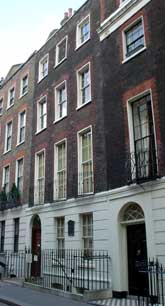 You probably think of Benjamin Franklin as a quintessential American, battling for freedom against the British and signing his name at the bottom of the Declaration of Independence. But what's far less well known is that Franklin spent more than fifteen years of his life
 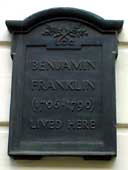 I don't think I'd previously fully appreciated the broad