This weekend's two other new bus routes were the 218 and 306. They overlap.
North
Acton
Acton
Acton
Vale
Hammer
smith
Fulham
218
306
formerly 440
formerly 266
formerly 391
I say new, but the North Acton end of the 218 used to be served by the 440, the Acton to Hammersmith core used to be served by the 266 and the Fulham end of the 306 used to be served by the 391. These aren't genuinely new routes, this is just TfL shortening three other routes and joining up the leftovers.
Also the 218 and 306 could have been one new bus route, but no. Instead TfL have constructed two shorter overlapping routes, at five miles apiece, because shorter routes are more reliable. It also enables them to use single deckers at one end and double deckers at the other, and to run an increased frequency in the middle.
Let's ride both.
[NEW] Route 218: North Acton to Hammersmith Location: London west Length of journey: 5 miles, 45 minutes
The 218 begins its journey alongside North Acton Square, a windswept piazza which workmen are attempting to evacuate before Christmas. Here we find a shelter and two bus stop poles, bafflingly organised. Bus Stop Z has a 218 timetable but not a 218 tile. The other stop has a 218 tile but is actually a bus stand, so clearly states "Buses do not pick up passengers here". But in reality they do, because the driver can't reverse back to stop Z and start there, indeed there's likely another vehicle parked behind. This is exactly the kind of contradictory cock-up we have come to expect from TfL's Bus Stop Team in recent years, and I bet they can't be arsed to come back and fix it.
North Acton is an increasingly highrise hotspot, as in "Aha, here's a station with good connections to central London, let's build lots of tall apartment blocks around it." The odd old building hangs on, like the turreted Castle pub, but otherwise the multi-coloured boxy towers are winning. It's good to escape, even if queuing to cross the A40 takes some time. Anyone heading for Acton shouldn't be taking the 218 - we're going all round the houses - but boarding route 440 instead. Until last week it was the 440 which went all round the houses, but that's now been switched to the main road to provide a better bus service at future Crossrail station Acton Main Line. I do hope local residents are keeping up.
And it's not just round the houses, it's round the recreation ground. North Acton Playing Fields are a giant green rectangle, upon which children are bouncing tennis balls and kicking footballs, and we'll be deviating around three sides of it. The road gets a bit narrow at times, but our driver's persistence is appreciated by local residents who flag us down on each flank. In the distance the towers of North Acton erupt incongruously above a row of semis. But the true attraction on the northwest corner is sight of the official coffeestop from The Apprentice, the legendary Bridge Cafe, where the losing team gather to debate failure and pass blame. A stack of souvenir You're Fired mugs is on display, and up for sale, in the window.
Back on Noel Road we pass an abundance of palm trees on street corners and a cluster of Japanese businesses outside West Acton station. Negotiating past another 218 coming the other way takes some doing. And just when I think the journey's going uneventfully an old lady boards, with questions, and attempts to engage the driver in conversation. He has to open his door to hear her, but seems unable to provide all the reassurance she needs. Unsatisfied she works her way up the now busy bus, her eyes seeking out a spare seat next to a passenger she can moan to as the ride progresses. She selects me.
It's always been the 440 along here, she says, which was good because that went to Chiswick and she likes shopping there. They used to have a Clarks shoe shop in Chiswick, but it's gone now, the high street's not the same. She's very cross about the 218 because that doesn't go to Chiswick, and that means she'll have to change and she's not sure where. She tells me how she's fought several local campaigns before on diverse topics, and how good the local schools are, and how two of her 93 year-old friends died recently, and how good the Christmas decorations are at Chiswick Business Park. Like Lego, that's what they remind her of, like blocks of Lego. I don't risk telling her it hasn'talways been the 440 along here, but I do suggest she gets out by the marketplace. She gets out by the Old Town Hall instead, and I wish her luck.
It's now quite busy aboard, this being the stop where the 266 newly terminates, so anyone who's Hammersmith-bound has to cram into our 29-seater. Folk in Christmas jumpers are spilling out of several pubs. A dozen mopeds are lined up on the pavement outside McDonalds. The Art Deco cinema building now contains a climbing wall. And beyond Acton Central station hurrah, TfL's Bus Stop Team have totally mucked up the tiling again. What they should have done is remove the 266 tiles and put up 218 tiles instead, but instead they've added the 218s and left the 266s in place, ensuring that passengers may continue waiting for a bus that's never coming. I've got a list of the seven consecutive bus stops along The Vale at which this error has been made (VQ VP VR VN VS VM and VT), in case anyone's ever interested.
[NEW] Route 306: Acton Vale to Fulham, Sands End Location: London west Length of journey: 5 miles, 50 minutes
I could have stayed aboard the 218 to Hammersmith bus station, and rest assured I have, but for narrative purposes let's switch to the alternative 306. It's a double decker so has a better view of its surroundings, plus it's less crowded, mainly because it's going somewhere nobody around here has heard of. My driver decides to stir things up by failing to change the destination on the display so it still says Acton Vale. I can hear the blinds whirring after we set off.
The first stop is called Second Avenue and the second stop is called First Avenue, just for a laugh. After this comes the painfully slow right turn into Askew Road, the traffic lights only allowing through a dribble at a time. But Askew Road is a meandering middle class delight, the kind of quirky Zone 2 neighbourhood Time Out goes crazy for, mixing Georgian terraces with bijou outlets like Monkey Temple, Happy Sky and Ginger Pig. If you live close by, you've done well. We appear to be running just ahead of a 218 so are picking up plenty of passengers. Last week Askew Road was only served by the 266, but now it has two new routes going the same way at increased total frequency, so everyone's a winner.
Top marks to our driver for pausing to let a blind man cross the road ahead of us, even before he's stepped onto the other half of the zebra crossing. Paddenswick Road is perhaps even more pleasant, though lacking in shops (if that's your measure of desirability). Ravenscourt Park (the park) is accessible alongside one of the older houses, and Ravenscourt Park (the station) hidden somewhere beneath the viaduct at the far end. Because King Street is one-way we have to approach Hammersmith via the backstreets, past a lot of cosy-looking pubs and the rear end of a Christmas market. Everyone in the know gets out beside the Hammersmith & City line station rather than enduring an extra stop across the gyratory and a lengthy twiddle round the bus station.
This is where the 218 terminates, at the lower bus station, whereas the 306 continues via the upper bus station. This divergence is only truly annoying for passengers heading back the other way, who have to decide whether to wait at the Upper or Lower for half the buses to Askew Road, and no way of knowing which is best.
Now for the bit of the 306 that used to be the 391 - initially heading east, then making a break for the Thames. Hammersmith Road has become an odd mishmash of glassy offices, mansion blocks and redbrick Victorian. The 21st century appears to be winning. Before we get to Olympia it's time to turn off down North End Road and follow it for just over a mile down to Fulham. This will take twenty minutes, thanks to bad traffic, especially the queue to cross the A4 which takes six attempts because the yellow box is never quite empty enough. There is much honking.
I spot one lady checking the posters @LDNBusUpdates have taped to a bus shelter, because they've been busy here too. She's ultimately not interested, but the family waiting outside West Kensington station are, and up they come to join me on the upper deck. Daughter wants the front seat so she can pretend to drive the bus, so Daddy sits alongside and humours her, then Mummy shuffles in next to me so as not to be left out. "Have you been drawing on your hand again?" she asks. "Pink label Christmas trees are better than yellow label." "I don't think we've got time to go back for your glasses." "Daddy's being silly now, isn't he?"
North End Road is an eye opener for those who think Fulham's upmarket. It starts posh, with billboards advertising designer handbags, but eventually descends into pawnbrokers, jerk chicken and those minimarkets with colourful plastic containers stacked outside, before finally returning to creperie respectability. Iceland is packed, the cake boutique with ice-white decor dazzlingly empty. At the end of the street Daddy guesses wrongly which stop the family should alight at, and the trio face a hike back across the Broadway. Meanwhile our 306 is proceeding unhindered riverward, into the mean streets beyond the New Kings Road.
Welcome to the moneyed world of Chelsea Harbour and Imperial Wharf, luxury Thameside bastions built upon former gasworks and industrial powerhouses. We pass several recently demolished zones awaiting transformation into prime real estate, and Laura Ashley's Head Office, and signs listing the byelaws of the pseudo-public promenades beyond. Most residents take taxis if they need to get anywhere, or hop onto a train at the Overground station the developers gifted. But the 306 is always there if they feel like slumming it, finally pulling up at a temporary stop opposite a two-floor Sainsbury's, and does anyone fancy a slow haul back to Hammersmith?
[NEW] Route 278: Heathrow to Ruislip Location: London west, outer Length of journey: 11 miles, 60 minutes
Of this weekend's four new bus routes, only the 278 could truly be described as new. It links Heathrow Airport to Ruislip for the first time, and creates a fresh north-south connection across the borough of Hillingdon. When the Mayor promised to boost services in the suburbs to make up for culling those in central London, this is the kind of thing he meant. It's also being operated with brand new vehicles, each USB-enabled, but for my journey they wheeled out an old (unplugged) one so I had to survive on battery power alone.
Heathrow Central bus station is a frenetic place, and also poorly signed. The bus shelter displays two nightbus maps and only one of daytime routes, which contains at least one spelling mistake and is now out of date. Stop 19 has an N140 timetable but not an N140 tile, and a 278 tile but not a 278 timetable. Indeed I never spotted a 278 timetable at any stop anywhere along the entire route, possibly because TfL's Bus Stop Team are overstretched or possibly because they're inept, you decide. My 278, when it arrives, is not mobbed*.
* An important fact about Heathrow airport is that it's surrounded by a Freeflow zone within which all public transport is free. That meant the 140, when it started here, used to be packed with passengers boarding (legally) without paying. Officially travel was only free as far as Harlington Corner, but usually nobody checked, so once passengers were on board it was perfectly possible to ride all the way to Harrow for nothing. The X140 express closes that loophole because, like the X26, it's been excluded from the Freeflow zone. This means the scroungers option is now the 278, at least as far as Hayes, and will be once everyone's sussed the new system.
"Ooh this is new", says one lady to her friend. "I normally catch the A10 but let's give this a try." They sit downstairs and I sit alone on the upper deck, having held back fifteen minutes to give the Young New Bus Route Chroniclers an undisturbed run. The 278 ploughs into the tunnel beneath the runway, then turns left onto the perimeter road so that it can eventually turn right. I have a particularly fine view of a Delta Air Lines Boeing taking off. At several stops along the Bath Road potential passengers mutter with the driver before boarding, having never seen a 278 before and having no idea which route it takes. Some are willing to take the chance.
We reach Harlington Corner in twelve minutes, whereas the express X140 managed it in more like five. A trio of Jehovah's Witnesses are standing on the corner holding out religious pamphlets to non-existent passers-by, and drinking coffee. When we pull up at West End Lane a teenage girl squints up at the blind, mouths "Whaaaaat!" and opens up her phone to check what this apparition might be. By the time she works it out we've driven on. Another group of five are similarly untempted further up Harlington High Street. When there are no timetables and no updated maps, and all it says on the front of the bus is 'Ruislip', who'd risk it?
We reach Hayes and Harlington station after twenty minutes, our duty as the 140's replacement now complete. Temporary traffic lights force us to wait by the canal, between an Oxfam and a burger joint, before progressing along the oh-so-'30s high street. Shoppers are blindly walking in the cycle lanes, these being irregular and hard to distinguish, while a cyclist rides merrily down the white line in the centre of the traffic. I finally gain company on the upper deck when a married couple take the other front seat, she ringing a friend and yakking for the next two miles, he sitting stoicly mute.
Church Road contains the HQ of the Hayes and Harlington Conservative Association, but front gardens only display Labour election posters, because the Shadow Chancellor isn't at risk in this safe seat. The Fountain House Hotel proudly displays a plaque stating that George Orwell lived here, but only when it was a private school and he was Senior Master, and only for a year. Nearby St Mary's church is of 12th century origin, and a reminder that the heart of Hayes has been dragged irrevocably south since the arrival of the railway. We're not picking up many passengers, nor indeed stopping much at all.
Next it's time to slog up a couple of miles of the Uxbridge Road. This is not London's most inspiring experience. Its flanks are a hotchpotch of minor shops and businesses, occasionally interspersed by flats and houses, but mostly the former. I spy used cars for sale, and pubs flogging Christmas trees, and kebab shops waiting for custom, and a scrap of a park, and repair shops stacked with tyres, and a dozen hydraulic platforms awaiting hire, and a peeling Chinese laundry, and a silver office block resembling a disused grain silo. We are not the only bus up the Uxbridge Road, nor yet a bus local residents require.
n.b. When I said the 278 was an entirely new route, this wasn't strictly true. For the last four paragraphs, i.e. since Harlington Corner, it's been following the route of the H98, and only at this point does this break away and terminate. Before 1990 the H98 was of course the 98, connecting Hounslow to Uxbridge, and until the 1960s it followed exactly the route we're about to use towards Ruislip. The 278 is essentially the fifty-year old 98 with Hounslow switched for Heathrow, but I'm sure I didn't need to have to tell you that.
Without fanfare the 278 has passed from John McDonnell's constituency to Boris Johnson's, because my bus tale is nothing if not topical. It's soon time to turn off up Long Lane, a much more salubrious corner of Hillingdon with large semis and leafy gardens, and the point at which the 278 starts to offer something properly new. There are bus stops along Long Lane that've seen nothing more than school buses for decades, the only other local service twiddling around the backstreets instead, then turning back at the station. Imagine the shock of waking up one morning to find proper double deckers down your street... before hopping into your car and driving to the shops as normal.
One side of the shopping parade at Hillingdon Circus is redbrick and the other is Mock Tudor, as if the architects couldn't make up their mind. The long footbridge spanning the chasm to Hillingdon station is no longer as white as it should be. And by crossing the A40 we create that new link the area's been crying out for, connecting Hillingdon to Ickenham by bus. The U10 runs hourly nearby, but the 278 is the first half decent bus service hereabouts. It's great news for anyone attempting the Tube Challenge - your chances of catching a ride between West Ruislip and Ickenham just multiplied.
This part of London is packed with pubs prioritising food over beer - I hesitate to call them gastro. HS2 also have a massive building site up the side of the existing Chiltern railway, with scores of yellow cones encroaching on what used to be golf course. We're nearly home, but first we have to join the queue of traffic on Ruislip High Street. The windows of John Sanders' department store are bedecked with gifts, numerous Christmas trees and a lot of sensible knitwear. And sadly there isn't room for the 278 to stand outside the tube station so we have to terminate an annoying distance away outside an off licence, where someone's extended a normal bus stop using yellow paint, wiping out a parking space. It's OK, the return journey does start somewhere more useful... and the bus is now quicker than taking the tube.
The 10 lowest numbers that aren't London bus routes
Now
A year ago
10 unused since 24th Nov 2018 48 unused since 12th Oct 2019 82 renumbered 13 on 1st Apr 2017 84(the 84 Barnet - St Albans doesn't count) 239 unused since 16th Feb 2008 304 unused since 27th Mar 1995 305 unused since 1st Sep 2018 310(the 310 Hertford - Waltham Cross doesn't count) 311(new route rejected after consultation in 2018) 334(never used)
10 82 84 218 [reused 7th Dec 2019] 239 278 [reused 7th Dec 2019] 301 [reused 13th Jul 2019] 304 305 306 [reused 7th Dec 2019]
[NEW] Route X140: Harrow to Heathrow Location: London west, outer Length of journey: 11 miles, 50 minutes
In 2008 Boris Johnson's first Mayoral manifesto promised to "commission a trial of orbital express bus routes for outer London". A decade later, his successor has finally introduced one.
The 140 is one of London's top five busiest bus routes, a proper orbital big-hitter, at last count carrying over 13 million passengers a year. It runs roughly north-south from Harrow Weald to Heathrow Airport with a direct hit on the Crossrail station at Hayes and Harlington which it needs to serve as efficiently as possible. And that's why yesterday TfL split the original 140 into three manifestations — the 140, X140 and N140 — a cunning plan to use exactly the same number of vehicles in a somewhat different way.
Harrow
Weald
Harrow
Northolt
Hayes &
Harlington
Heathrow
Airport
140
X140
N140
The N140 is precisely what the 140 used to be, but only runs at night. The new 140 has been curtailed at the Heathrow end so now only runs as far as Hayes and Harlington, almost as frequently as before. The real gamechanger is the X140, TfL's fourth express bus route, which runs from Harrow bus station to Heathrow Central bus station stopping only eleven times inbetween. You can bet this confused a number of passengers yesterday, and delighted many others.
Harrow Bus Station is a bustling hub, conveniently situated for the shops and the station, and the point of departure for the X140 express. Not that you'd know. The X140 hasn't been added to the list of routes above the entrance to Stop B, nor have any of Harrow's spider maps been updated. The X140 also fails to appear on the bus station's live departure screen (although arrivals are shown, pointlessly, at their final stop). The only clue is a single timetable stating that "buses only serve the stops shown", that buses run five times an hour and proposing a 48 minute running time to Heathrow Airport. Apparently staff were handing out leaflets earlier, but I never saw one.
Passengers shouldn't be able mistake the express bus for its X-less namesake - its blinds are blue, it has a fairly prominent X and it says Limited Stop on the front. Nevertheless people will, and do. A goodly crowd pour into the double decker when it arrives, with the upper deck front seats promptly taken by the Young New Bus Route Chroniclers. One of the teenagers has a notebook and will be jotting down whether we're running early or late, while the other has a cracked tablet pinned up against the window to record every minute of our upcoming journey.
The advantages of an express bus route are immediately evident. The normal 140 veers off into West Harrow, as it always has, but we don't need to serve those four stops so we head to South Harrow direct. Playing fields and semi-detached houses spread to either side, plus the occasional crooked cottage and grim office block. It's already going well.
South Harrow Station(5 mins) is our first stop, alongside the market hall under the railway. A quick check confirms that the X140 tile on the bus stop is white with the word 'Express' written in small type above the route number. One of the Young New Bus Route Chroniclers stands and takes a photo of the iBus display in an attempt to collect the full placename set. The other reaches for a bag of crisps and a bottle of water to sustain him as we progress onwards through Roxeth.
Station Parade(9 mins) is an unhelpfully mysterious name because it's never made clear precisely which station this is (obviously it's Northolt Park, with its hourly service into Marylebone, but you'd never know). Then it's on past the fire station and... ah, road works. A sign announces "Use bus lane when chevrons lit", and today they are, a succession of lamps pulsating in the tarmac. We join the queue waiting at the temporary lights, which thankfully keeps moving, and one of the Young New Bus Route Chroniclers instinctively reaches for a packet of biscuits. The other, of course, daren't eat for fear of his tablet slipping.
Northolt Station(14 mins) is next, indeed so far we're only stopping every time we hit a railway. Not very many passengers have been tempted aboard so far, perhaps because they want to alight at one of our intermediate stops, or perhaps because they've not yet worked out who we are. It's relentlessly 1930s along here, indeed the entire journey feels like a safari through sub-Metroland suburbs. The shop window at Jedi Robe features a stormtrooper in a Father Christmas outfit. Beyond the A40 we catch up with a real 140, and promptly overtake.
It's then that something entirely predictable happens - a passenger wants to alight at a bus stop we're not serving. They ding for Sycamore Close but we don't slow down, so they ding again but we don't stop, so they ding several times and we continue, then they ding for Northolt Library but we don't stop there either, so they ding again and eventually end up three stops past where they wanted to be. A route diagram stuck up inside the bus might have helped. Impressively, nobody else makes the same mistake later.
Yeading/White Hart Roundabout(21 mins) isn't the best name for a gyratory, given that the White Hart pub which overlooks it has been shuttered and is fenced off. Beyond that we get to follow Yeading Lane, with its fifty year-old church that looks disturbingly like a power station. We don't even bother to stop at Dilston Close because a 140 just hoovered up its queue.
Shakespeare Avenue(24 mins) is a different matter - it's busy because the 140 hasn't got here yet. Several passengers enquire of the driver where he's actually going ("Are you stopping at The Grapes?"), then board in numbers. They are more fortunate than the single woman waiting at the next non-stop. She waves at the bus as it approaches, then mouths "Whaaaaaat!" at the driver, then shrugs like a demon possessed.
The Grapes(27 mins) is better known as a Beefeater than a pub these days. The sun has come out, dazzling the video still being shot from the tablet propped up against the front window. We pass an assortment of minor shops selling used furniture, chicken and accumulators, plus the first of several hotels optimistically named after Heathrow. Approaching Hayes we pass three successive stops at which someone has their arm outstretched, expecting us to stop, and is left disconsolate.
Hayes Town(33 mins) is up next, thoughtfully serving the shops rather than the station. Six of the tiles on the bus stop have coloured stripes across the top, but not the 140 or X140, confirming that the rainbow branding TfL introduced in Hayes two years ago isn't being carried forward. (It also means those ghastly non-geographical spider maps aren't the future, and thank heavens for that).
Hayes and Harlington Station(36 mins) is the reason the route's been tweaked, even if it won't see a Crossrail through-service until maybe 2022. The rebuilt station is still very much incomplete. I'm expecting a pile-on of passengers because this is where the non-express 140 now terminates, but it seems nobody wants to use our X140 to piggyback on to Heathrow. We pass the 140's new stand near Asda, then rise up to cross the M4 at rooftop level.
Manse Close(42 mins) isn't helpfully named for a stop on an express route. It is in fact in the middle of Harlington, a former village nowhere near the station of half the same name. The mystery team from @LDNBusUpdates have been here earlier and stuck two of their helpful laminated sheets on top of the timetable panel. It says much about the paucity of TfL's Bus Stop Team that they've decided to leave the guerilla information in place.
Harlington Corner(45 mins), on the fringes of the airport, is our penultimate stop. A fair few people are still on board, though none with suitcases. We flit past the Marriott, Radisson and Novotel, before breaking off to join the ramp down to the roundabout into the tunnel. It's creepy knowing there could be a plane taking off immediately above your head.
Heathrow Central Bus Station(50 mins) is our last and final stop, where a dozen or so passengers alight. We've got here in fifty minutes flat, which feels fast, but is actually two minutes slower than scheduled. This time last week the ordinary 140 was timetabled to do the journey in fifty-nine minutes, so maybe it's not as impressive an express journey as it seems. But I know which bus I'd rather ride, and perhaps these orbital express routes should be something the rest of the capital gets to sample and enjoy.
The Mayor's four year fare freeze famously means that bus and tube fares at the end of his first term will be the same as on the day he entered office. But that doesn't mean tube users won't be paying more, potentially 12% more.
Even though individual fares have remained the same, daily and weekly caps have continued to rise. They have to increase at the same rate as other National Rail fares across the country because a zone 6 journey might be on a train rather than the tube. This is how those caps have risen.
All-day cap (Oyster/contactless)
2016
2017
2018
2019
2020
2016-20
Z1-2
£6.50
£6.60
£6.80
£7.00
£7.20
↑11%
Z1-3
£7.60
£7.70
£8.00
£8.20
£8.50
↑12%
Z1-4
£9.30
£9.50
£9.80
£10.10
£10.40
↑12%
Z1-5
£11.70
£11.20
£11.60
£12.00
£12.30
↑12%
Z1-6
£11.80
£12.00
£12.50
£12.80
£13.20
↑12%
A small increase of 2-3% every year soon mounts up, and is equivalent to an increase of approximately 12% over four years. And this 12% rise might well apply to you, even if you only ever ride on tubes and buses where fares haven't risen. Here's how.
If your daily commute consists of a tube journey into town and another out, you never hit the cap, so that's fine. But suppose your commute involves a bus to the tube, i.e. two bus journeys and two tube journeys every day, then you're one of those losing out.
Example: A Z1-5 bus→tube/tube→bus commute
In 2016 the journey cost £1.50+£4.70+£4.70+£1.50=£12.40, but capped at £11.
In 2020 it'll still cost £1.50+£4.70+£4.70+£1.50=£12.40, but capped at £12.30.
A cap which once saved you £1.40 a day, now only saves 10p.
That's £1.30 worse off, every day, compared to four years ago.
Here's how the same calculation varies across all zones.
Daily cost of a bus→tube/tube→bus commute
2016
2020
now
paying
fares
cap
saving
fares
cap
saving
Z1-2
£8.80
£6.50
£2.30
£8.80
£7.20
£1.60
70p more
Z1-3
£9.60
£7.60
£2.00
£9.60
£8.50
£1.10
90p more
Z1-4
£10.80
£9.30
£1.50
£10.80
£10.40
£0.40
£1.10 more
Z1-5
£12.40
£11.00
£1.40
£12.40
£12.30
£0.10
£1.30 more
Z1-6
£13.20
£11.80
£1.40
£13.20
£13.20
£0.00
£1.40 more
In zone 6 we have now reached the stage where the daily cap is the cost of two tube journeys and two bus journeys, it isn't actually a cap at all.
Any other journey that breaks the daily cap will of course also cost you more in 2020 than 2016, not just the commute I've mentioned. Weekly capping has also risen similarly, again in the order of 12%.
It does mean TfL aren't losing out on quite so much fare revenue as they could be, which is good news for investment. But when you hear the 'fare freeze' being bandied about in the upcoming Mayoral election, remember that for many tube users it hasn't been a fare freeze at all.
Doesn't the Trafalgar Square Christmas tree look sparse this year?
Someone on Twitter mentioned how sparse it was looking, and the BBC and othernationalmedia picked up on it, and this made the tree's sparseness a proper bona fide news story. Calum reckoned it was the most anaemic tree possible, and another troll reckoned if it were any more sparse it'd be a twig. Absolute definitive truth from the armchair critics there.
I went down to Trafalgar Square specially, purely to be appalled, and was faced by the sight of a tree that looked nothing like I thought it should. I mean, just look at the size of those gaps between the branches! If this tree were propped up outside a garden centre absolutely nobody would take it home. Why is taxpayers' money being wasted on inadequate specimens like this? What was the Mayor of London thinking?
Apparently the tree is a gift from Norway, for heaven's sake, and they've been foisting one of their threadbare conifers on us every year since 1947. How embarrassing to send a stunted 79 foot specimen and expect us to make it the centre of attention in Trafalgar Square, a place of pure national pride. I have no idea why Norway send it, it didn't occur to me to check, but it's not like we owe them or anything. Typical EU.
I wasn't going to hang around for the official switching-on of the lights, because no way the would the tree look any better after dark. What's more they couldn't even get a proper celebrity to press the button, only the Mayor of Oslo, and for entertainment all they had was a brass band and a church choir singing carols. It's hardly Christmassy.
So obviously I went to the Olympic Park for their Christmas switch-on event instead. You can't beat the festive combination of an E20 housing estate and a live performance from a similarly postcoded boy band. At the heart of the East Village, a proper Nineties Christmas was about to kick off.
They said to be there at half six, in the apartment canyon between the Athletes Village and the newest block of flats. A line of food stalls had been set up alongside some squidgy grass, plus some late-opening dodgems, plus a central stage to host all the main action. An amateur choir of local residents stepped up to sing some poorly amplified carols, an experience surely better than enduring the St Martin-in-the-Fields crew in Trafalgar Square.
The organisers had promised "a *free hot chocolate and free festive sweet treats on arrival", admittedly with an asterisk saying subject to availability, but we Britons love a queue so I tagged on anyway. The girls in front of me drifted away once it became apparent there wasn't an oat milk option, because millennials have no backbone. Alas the free drink and tiny brownies ran out just before I got to the front, but that was fine because it had filled fifteen minutes and there wasn't much else to do.
The wind was whipping up something rotten, but with true British pluck we struggled on. Two of the sound engineers hung onto the gazebo above their control deck to stop it flying away, while the crew from Clownfish Events packed away their Wii and Snowcube because they couldn't withstand atmospheric conditions. I passed another quarter of an hour in a queue for the free mulled wine, a dribble of which was served up by a local bar in a non-recyclable coffee cup. A proper yuletide treat.
Events on stage were led by an East Villager whose favourite phrase was "we're only a few moments away from...". He introduced a steel band, then whipped the crowd into a muted frenzy for a countdown from ten to zero. Like magic the lights on the East Village Christmas tree burst into life, their cord wound tightly around the bulky conifer. It may have been significantly shorter than Trafalgar Square's whopper, but at least it was a British tree and had proper branches.
A 24 year-old singer-songwriter padded out the event further, being sure to mention his name a few times so we'd be able to find him on Spotify, until eventually it was time for the main act to take the stage. And wow, the East Village organisers had only gone and booked one of the greatest pop acts of the late 20th century, the legendary East 17. They bounded on in massive anoraks, looking very much like the middle aged uncles of the original band, and launched into a lively House of Love.
The crowd adored them, despite many being too young to have remembered them first time round, and showed their love by raising their phones to record the performance for posterity. I was having trouble trying to work out which band member was which, and why there were now only three of them. Only later was it revealed that 'East 17' now contains just one of the original band members (neither Brian nor Tony), plus some bloke who once had a hit with the Artful Dodger, plus someone else.
After all but one of the big hits, and several backflips, the lads nipped off and returned in pure white anoraks. The only possible encore was Stay Another Day, belted out with gusto and a splattering of fake snow, the crowd responding by raising dozens of recording devices into the air. It had been a dreamlike evening, the spirit of Christmas very much in evidence throughout, and no way could you describe it as sparse.
Six years ago, in a 125th anniversary series, I visited the sites of Jack the Ripper's five murders. They form an intriguing, if gruesome, cross-section of the East End. Yesterday I went back to see what's changed, and how they've been holding out against the developers. If you'd rather read about the murders, click on the titles to go back and read the old stuff.
"So infamous were Jack's murders that Buck's Row got a name change, becoming Durward Street in 1892. That's still its name, although the street itself is vastly altered. Its cottages survived until the 1970s but were then demolished. The only surviving building from Victorian times is the four-storey Board School overlooking the station, opposite which is the Whitechapel Sports Centre. And then there's the latest demolition agent, currently barring all through traffic, which is Crossrail." [photo 2013]
Crossrail are still here, still blocking the street, indeed it's been impossible to walk past the site of Mary Ann's murder for years. Back in 2013 I thought they'd be gone by 2017, but no, trucks still rumble in, hard-hatted men still operate the barriers and construction workers still swarm the surrounding streets because Whitechapel is one of the two most-behind-schedule Crossrail stations. When everything's eventually unwrapped, I don't expect much of pre-purple mid-Durward Street to have survived. The closest the public can get for now is inside the station, on the lesser used footbridge linking the Overground platforms, but eventually a massive new concourse will be sweeping through.
What we find on Durward Street today is the 'temporary' entrance to the station, opened four years ago, with its stack of free papers out front, a steady stream of scurrying passengers and a man in a Santa hat playing Jingle Bells on a trumpet to minimal acclaim. On the opposite side of the obstruction is the back entrance to Swanlea School, normally a quiet cul-de-sac, but I accidentally managed to turn up at chucking-out time so it was awkwardly crowded. A few children dribbled out, chatting and smiling, but the main presence was parents and grandparents, waiting in far larger numbers than you'd expect outside a secondary school. Security is still high on the agenda hereabouts.
"In 1970 an entire block on one side of Hanbury Street was demolished and swallowed up by the Truman Brewery. The site of Annie Chapman's death is now an indoor car park, six days of the week, hidden behind a long brick wall, topped by a hangar-stepped roof which extends the length of an entire block. Part of the frontage is taken up by modern boutiques, but the section where 29 stood is almost featureless, except for a locked fire exit beneath a row of square windows." [photo 2013]
Hanbury Street hasn't changed much in six years, still at the heart of Spitalfields, a naan's throw from Brick Lane. The two streets cross a few doors down, where tourists mingle with locals and traders, and the hipster vibe is strong. Every shade of woolly hat seems to be represented, even the ill-advised, and I spotted one brave soul striding through flaunting a braided admiral's jacket. The pole announcing parking restrictions is covered with stickers in various languages. A fresh layer of graffiti adorns the brickwork. Through the windows the ground floor car park includes several vans and an ambulance, and appears to be an astonishing waste of space.
Across the road it's not the 1970s, it's still the 18th century. Hanbury Street is one of Spitalfields' glorious Georgian survivors, a long terrace of unexpectedly prime real estate and occasionally non-vertical brickwork. Some houses retain painted shutters and potentially residential occupants. Others are Sichuan restaurants, religious centres and niche retail, catering for all things temporal and spiritual. There's a duplex office for rent above one of them, if you'd like a room with a murderous view while you work. Of all five sites, this is the one you're most likely to have walked past without realising.
"At number 40 was the International Working Men's Educational Club, beside which was a gated yard, nine feet wide, then two cottages occupied by cigarette makers and tailors, then a corner shop. The club became a shop a few years later, then in 1909 it and several neighbouring buildings were demolished to make way for a school. That building survives as Harry Gosling Primary, a very typical three-storey LCC school, which means (somewhat inappropriately) that the precise murder site lies somewhere in the playground." [photo 2013]
Berner Street, since renamed Henriques Street, has become the least loved of the Ripper's locational quintet. Little traffic turns off the busy Commercial Road into this half-cobbled sidestreet, many of whose buildings have yet to be touched by the property whirlwind that's touched down close by. The old warehouse at the top end stands out, not just because it's painted orangey-brown but because original doors for hoisted delivery have survived at first floor level. Its shutters are closed, various windows are boarded up and the suspicion must be that it risks being transformed into a bland cuboid of flats... which is precisely what's happened nextdoor since I was last here. The short parade of shops I noted in 2013 has given up - the local flats no longer need a travel agent and a tailor - but the primary school still thrives, the sole focus of playful endeavour hereabouts.
"Mitre Square, a gaslit quadrangle on the edge of the City, is today a shadow of its former self. Every building that used to stand around its perimeter has been knocked down, the last major redevelopment being in 1980, and today only the cobbles remain. Even these have been moved and realigned, but it's possible that some are originals that the Ripper fled across. The site of Catherine's murder is in the southern corner, beneath the tree, on the kerb close to the flower bed." [photo 2013]
In 2019 even the last few cobbles have gone. Mitre Square has been a building site for several of the past few years, or at least a holding pen for the supplies needed to rebuild an entire block closer to Aldgate. One Creechurch Place is as contemporarily monolithic as a 17-storey City office needs to be these days, and has an Illy coffee outlet out back because that's a 21st century priority. The footprint of Mitre Square remains as a uniformly-tiled grey space, its former flower beds replaced by a couple of relocated grassy patches. These have concrete rims for perching on when the weather's better, and some dwarf shrubs that magically flower in December though not in an uplifting way.
New to the Square is a sculpted obelisk called Climb by artist Juliana Cerqueira Leite. She filled a wooden column with clay then dug fitfully up the centre, casting the negative space in plaster to reveal her work. It is not a comment on past historical proclivities. The rear gates to Sir John Cass's Foundation school occasionally open, for staff cars rather than pupil egress. And the spot where Catherine's bloody body was found appears to be marked by... a small drain cover, which is neither intentional nor appropriate.
"Dorset Street took many years to shed its unsavoury reputation. In 1928 all the houses on the north side were knocked down and in their place rose the London Fruit and Wool Exchange. This Portland stone edifice housed traders selling fruit and veg sourced from countries all around the world, conveyed onwards via fourteen loading bays still visible round the back. The slums on the southern side of the street lasted much longer, but in 1971 were replaced by the White's Row multi-storey car park." [photo 2013]
Go away for six years and some places change completely and utterly. The Fruit and Wool Exchange has been hollowed out, much to the despair of the GentleAuthor, leaving a thin facade in front of an all-too modern office development. Its many trading rooms have been replaced by a stack of brightly lit offices, atop giant receptions where suited security guards silently glower. Its fine central staircases were ripped out to create a square outdoor atrium, featureless other than a few metal strips I almost slipped on and a pair of very corporate-looking Christmas trees. Most of the Divisible Retail Space remains unlet. Nothing about the place sparks joy.
As for White's RowCar Park, that's made way for a smaller block and what architects excitedly describe as 'public realm'. In this case it's a terrace for smoking on, a large patch of greenery screening the ventilation for whatever's in the basement, and some properly ostentatious brunch. That spiky glass and zinc pavilion on the corner contains a cafe/restaurant called Crispin, the kind of outlet which offers "rotating guest filters", "low-intervention wines", "three cheese toasties" and "wild boar ragu". The afternoon crowd looked set and cosy at their tiny elevated tables. The journey from murderous slum to prestige business schmoozerama is pretty much complete.
It's that time of the year again. A new tube map has emerged.
It's not up in stations yet, nor on the website, nor available in folded form, because the big new thing it showcases hasn't happened yet. But Geoff tweeted a copy yesterday, and now Ian's blogged it, so we can all have a premature look.
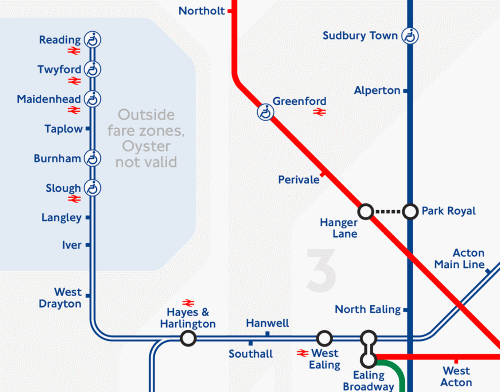
The big new thing is 'Berkshire', specifically that TfL are taking over stopping trains to Reading in a week and a half's time. Sunday 15th December was always supposed to be the day that Shenfield and Abbey Wood were finally connected to Reading, but we all know what a hole Crossrail's in, so TfL Rail taking over suburban services is the next best thing. Hence the new map.
The extra nine stations had to go somewhere, so have been shoved into a thin gap to the west of the Central Line. Beyond Hayes and Harlington the new line bends sharply north, whereas Reading's really 23 miles west... but the tube map's always taken huge liberties with direction and distance, so that's fine.
Things to note
» Reading looks like it's near Northolt, whereas in real life it'd be a ten hour walk.
» Stations from Reading to Iver are outside TfL's usual zonal structure.
» Oyster cannot be used beyond West Drayton.
» Residents of Taplow, Burnham, Langley, Iver and West Drayton no longer have National Rail services.
» Stations between Slough and Paddington are not yet step-free, because installation is running late.
» Southall and Hanwell are the most-squished-together stations on the entire tube map.
» In real life, Reading, Twyford and Maidenhead stations are on the other side of the River Thames.
Things you didn't note because the map didn't hint at them
» Contactless works fine all the way to Reading.
» A single fare from Paddington to Reading will set you back more than £20.
» Burnham and West Drayton will be served by a few GWR trains in the rush hour.
» Trains to/from Reading won't stop at West Ealing, Hanwell and Acton Main Line (only Heathrow trains will).
There are now six stations on the tube map where trains to certain destinations stop and others don't. TfL's diagrammatic cop-out at West India Quay, Cambridge Heath and London Fields is a red dagger... with no other explanation given. Inexplicably West Ealing, Hanwell and Acton Main Line don't even get that.
While we're here let's just clarify how fares will work, because the rules change twice over the next four weeks. None of this is simple.
The most important thing to remember is not to go beyond West Drayton with your Oyster card because you won't be able to touch out and it could get expensive.
Meanwhile, the other big change on the map is yet more dotted lines.
TfL introduced dotted lines in December 2018, meaning "less than 10 minutes walk between stations".
This time last year there were 23.
In May they upped the total to 26.
On the new map there are 37.
It's all because the tube map has suddenly got very excited about river piers. TfL launched a Passenger Pier Strategy last month hoping to better promote river services, "including looking into ways of better representing river services on the Tube map". Four weeks later, here they are.
Piers previously appeared as little red boat symbols beside the name of the station. Now they have their own blobs on the riverbank, joined to the nearest station by a dotted line.
Hence we see Westminster linked to Westminster pier, Waterloo linked to London Eye pier, Embankment linked to Embankment pier, Blackfriars linked to Blackfriars pier, London Bridge linked to London Bridge City pier, and Tower Hill and Tower Gateway linked to Tower pier. Piers are not named, which is probably just as well otherwise the map would be crawling with extra words.
Not every pier appears. The "less than 10 minutes walk" rule still applies, so Greenland pier in Rotherhithe is missing, ditto the new pier at Battersea Power Station, and Millbank pier is not quite close enough to Pimlico to count.
TfL's definition of 10 minutes is a walking distance of 700 metres. I reckon Putney pier is fractionally less than that from Putney Bridge, and Royal Wharf is borderline from Pontoon Dock, but I guess they've got to draw the line somewhere.
The most intriguing omission is Canary Wharf pier, which is definitely less than 700m from Canary Wharf DLR but not from the Jubilee line, and it seems dots can't be used to distinguish that particular technicality. A separate link to Westferry DLR might have solved it, because that's only 500m away, but that's not been included either.
Another oddity is that there's no dotted line connecting North Greenwich pier to the Dangleway, only to the tube station, which is actually further away. But let's not suggest adding even more dotted lines, because there are quite enough already.
Personally I think adding extra lines to river piers is a bloody stupid idea and only serves to make the tube map look even more cluttered than it already is. It smacks of TfL including icons simply in the hope you'll notice them and go for a ride, at £7 a time, in much the same way that the Dangleway's red line is solely of interest to tourists. These additional intrusions serve only as a distraction from the map's core focus, a battle which admittedly was lost some years ago. Where will it all end? Please make it stop.
As the general election approaches, have you read the party manifestos? They contain a much broader statement of intent than a few soundbites in the media and soapbox sloganeering. Admittedly they're also quite dull, so you're unlikely to make it past page 10, let alone reach page 48. But they also set the agenda for the next five years, which is a significant portion of your lifetime, so it pays to take note.
Jeremy Corbyn's socialist blueprint can be discounted because his best hope is coalition, and that'd swiftly dilute his plans. Likewise all thesmallerparties are merely signalling a negotiating position rather than anticipating power. Which means the only manifesto that truly matters at this election is the Conservatives', because they're the only party with a realistic chance of majority government. Let's see what's tucked away near the back of theirs.
Page 48 is where we find a section titled Protect our democracy. It asserts that Parliament is broken, having failed to deliver on the referendum result, and that a damaging rift exists between politicians and people. You may not see things that way, but the Tories claim what's needed is to put obstructive Members of Parliament in their place because that would have helped a minority government to get Brexit done.
First up, scrapping the pesky Fixed Term Parliaments Act.
The FTPA seemed like such a good idea back in 2010, a safety catch to prevent the Liberal Democrats from scuppering the Coalition, but has since proved to have unforeseen restrictive ramifications. Despite this the UK has somehow managed to shoehorn in two additional general elections before 2020, when the next was originally scheduled, by twice circumventing the Act with a two-thirds Parliamentary majority. But the current Prime Minister would rather regain the ability to call an election whenever it best suits, and a Conservative majority after this election will see his strategic power restored.
Next up, reshaping constituencies.
We've been here before, indeed equalising our constituencies should already have happened, twice, since it was first proposed in 2011. The background to the proposed change was the expenses scandal, a time when having fewer MPs sounded like a way to "cut the cost of politics". Hence the proposal to slim down their numbers from 650 to 600, an undertaking which couldn't be achieved without entirely redrawing the political map of Britain... and various existing constituencies falling through the cracks.
At the same time the Conservatives proposed making UK constituencies roughly the same size, a property they currently lack. English electorates vary from 55,377 in Wirral West to 110,697 in the Isle of Wight (average 74,000). Scottish electorates vary from 21,769 in the Outer Hebrides to 86,955 in Linlithgow and East Falkirk (average 69,000). Welsh electorates vary from 40,492 in Snowdonia to 76,006 in Cardiff South and Penarth (average 57,000). Scotland and Wales, proportionally, have a greater Parliamentary representation than England. Urban areas tend to have smaller electorates than the shires. It's no surprise the Conservatives would rather change that, and Labour would rather leave well alone.
Figures based on the December 2010 electoral register set the proposed size for a UK constituency at 76,641, with a wriggle room of 5% allowed either way. Only the remoter corners of Scotland and the Isle of Wight would be exempt, for geographical reasons, ending up with smaller electorates than everywhere else. The Boundary Commission set to work with the rules they'd been given, but the 5% limit proved tricky to implement as local government wards didn't always combine conveniently. When proposals were published various areas complained, for example east Cornwall really didn't want to be coupled with west Devon, despite mathematics dictating otherwise. But in the end Nick Clegg scrapped the process in response to David Cameron dropping proposals to reform the House of Lords, and the entire review was closed.
The 2015 election was held on existing boundaries, after which David Cameron restarted the process. This time the December 2015 electoral register was the baseline and the new target quota was 74,769. Again the Boundary Commission set to work, in each of the home nations, publishing their proposals and working through two rounds of feedback before submitting final proposals in September 2018. Again they were hamstrung by the 5% rule, so some of their constituencies looked administratively peculiar, but that's equality for you. A private members bill suggesting a leeway of 10% instead got nowhere, indeed the implementation process has since gone unexpectedly quiet, and that's why we're still fighting the 2019 election based on 2008 boundaries.
If the Conservatives gain a majority on the existing boundaries, expect full steam ahead towards implementing new ones. It's not clear whether the Boundary Commission will have to start again, using up-to-date data from the December 2019 electoral register, or whether the government will stick to existing plans. Areas with fast-growing populations and high numbers of unregistered voters, like Tower Hamlets, could end up missing out. Whatever, the opportunity to cut the proportion of MPs elected from Scotland by 10% and from Wales by 28% won't be missed, because increasing the influence of the English to 'fair' levels can only entrench a Conservative future.
The manifesto's next promise is Voter ID.
At present all you do is turn up at your polling station, give your address and receive your ballot paper. That's except in Northern Ireland where photo ID is required, and has been since 2002. Passports and driving licences are acceptable, as are railway SmartPasses, and an Electoral Identity Card has been introduced to plug any gaps. These contain a photo but not an address, so don't need regular updating as long as the photograph remains "a good enough likeness". It sounds watertight, but as well as deterring voter fraud it also deters voting, with the disadvantaged most likely to fail to clear the additional hurdle. In a multi-format ID trial at this year's local elections, 100 times more voters were turned away (and didn't come back) than were convicted of electoral fraud across the entire country last year.
And finally, there's this.
This is a constitutional biggie, with the relationship between government, Parliament and the judiciary coming into question. Over the last few months the Prime Minister's plans have been thwarted by MPs (and the Speaker) in the House and by judges in the courts, and just imagine where the country could be right now if that hadn't happened. Boris reckons the Brexit-voting public will be on his side if he makes changes that enable "effective government" and prevent "needless delays", hence his intention to set up a Constitution, Democracy & Rights Commission - a body which could have a very wide remit. Others might prefer that current checks and balances remain in order to prevent potential abuse by an increasingly authoritarian government, but they may not get a say.
An election manifesto doesn't have to contain everything a party intends to do, indeed some things it's better to keep quiet about. But if something potentially controversial is included, it's easy to argue afterwards that people "knew what they were voting for", even if they never realised. This is why reading manifestos is important. Whether you agree or disagree with what's proposed, it pays to know what the victor intends to impose.
I remember butterscotch Angel Delight, and power cuts, and the way cassette tapes used to spool out and you had to wind them back in with a pencil, and rolls of shiny Izal toilet paper, and waiting by the letterbox for the evening newspaper to arrive, and watching the football results on Ceefax, and Woolworths, and Abbey Crunch biscuits, and briefly making contact with schoolfriends on Friends Reunited, and having to include a fax number in your email signature, and MacFisheries, and flipping back and forth through Choose Your Own Adventure books, and sheets of plastic hole reinforcers, and writing tedious letters to penpals, and always following the Green Cross Code, and Wombles, and Singing Together, and the Junior Jet Club, and packets of Opal Fruits, and pools coupons, and clackers, and trying to keep your tamagotchi alive, and phonecards, and waiting for your photos to come back from the chemists, and the burble when connecting to dial-up, and the thickness of telephone directories, and going on genuinely blind dates, and storing floppy discs in special boxes, and locating books in libraries by flicking through drawers full of index cards, and pushing Parker Royal Blue ink cartridges into fountain pens, and the noise that meant one of your MSN Messenger buddies had come online, and having to lick stamps, and politicians being expected to tell the truth, and date stamps in library books, and using a typewriter to write an important letter, and Girobank, and listening to the music that accompanied the testcard, and shillings, and Pong, and pogs, and cola cubes in sticky paper bags, and watching Robinson Crusoe on television every school holiday, and elm trees, and discovering new music on MySpace, and Buzby, and Findus Crispy Pancakes, and Junior Choice, and photo albums held in place with sticky corners, and cutting stories out of newspapers, and aniseed Spangles, and writing out the track listing on mixtapes, and United bars, and receiving a new cheque book through the post, and It's a Knockout, and school dinner ladies serving up scoops of mashed potato, and Windows 95, and Big Ted, and overhead projectors, and Reliant Robins, and the clunking noise when you pushed a video tape into a video recorder, and flash bulbs on cameras that only worked four times, and lolly sticks with jokes on, and hot cheese oozing out of the side of a sandwich toaster, and Noodle Doodles, and replacing the ribbon on dot matrix printers, and Global Hypercolor t-shirts, and being bored on Sundays, and Rentaghost, and Stylophones, and scuffed shoulderbags with your gym kit festering inside, and pinning down a Spirograph, and Edd the Duck, and music centres in cabinets, and Dymo labels, and Knightmare, and those square plastic tags they used to keep bread fresh (a different colour every day of the week), and cleaning cassettes, and Minesweeper, and Lynx Africa, and discovering the true lyrics to your favourite song in Smash Hits, and Livestrong wristbands, and burning your own CDs, and Tippex, and The Weakest Link, and satchels, and salt and vinegar crisps in blue packets, and Napster, and discussing Big Brother, and the Tufty Club, and Peter and Jane, and Janet and John, and transistor radios with extendable aerials, and Casey Jones, and Humberside, and Brookside, and having to get up off the sofa to change channel, and posters for rabies at Channel ports, and medium wave, and car tax discs, and cheque guarantee cards, and football shirts without adverts on, and ringing the Speaking Clock, and cursive handwriting, and slide rules, and storing your Post Office Savings account book somewhere safe, and electricity showrooms, and cathode ray tubes, and the Ronco Fuzz-Away, and winning a goldfish in a bag, and drapery stores with everything stored inside stacks of wooden drawers, and free milk at breaktime, and the Nimble hot air balloon, and Challenge Anneka, and fingerspaces, and bottles of frothy Cresta, and rubbers with a blue end which could erase ink, and C&A, and recording the chart new entries off the radio, and storing things in empty film canisters, and not being able to buy milk on Sundays, and shell suits, and waiting for the television to warm up, and distressed denim, and Denim, and smoking in pubs, and lemon-flavoured alcopops, and custom ringtones, and party lines, and Eye Of The Tiger, and yesterday, and green anoraks with snorkel hoods, and majority government, and putting your chair up on the desk at the end of the day, and plastic-wrapped boxes of Meltis Berry Fruits, and Record Mirror, and Safeway, and Moon landings, and circling programmes in the double issue Christmas Radio Times, and polyester bedsheets, and Lemmings, and not knowing what your classmates did over the weekend, and 4:3, and using Letraset to give your lettering a professional touch, and Ready Steady Cook, and going on holiday without taking a phone charger, and puffing away on a candy cigarette, and flared trousers, and ringpulls, and saving up for a Christmas hamper from the milkman, and medallions, and the Britannia Music Club, and getting the deposit back on a bottle of Corona, and opening up a webpage without being asked about cookies, and Puffa Puffa Rice, and cars without seatbelts, and CDs in jewel cases, and cinema double features, and the importance of knowing where your nearest payphone was, and student grants, and Disney Time on bank holiday afternoons, and the Dairy Book of Home Management, and Donkey Kong, and plugging in extra RAM, and flicking through the Littlewoods catalogue, and four star petrol, and religiously checking your biorhythms, and sending chain letters to five other people, and Tupperware parties, and changing the battery in your Walkman, and the poll tax, and ITV Digital, and the Puffin Club password, and punched computer cards, and collecting Smurfs from National garages, and never quite being able to see Magic Eye pictures but being too afraid to admit it, and the Stratford Olympics, and sitting in the dark watching your holiday snaps using a slide projector, and sending text messages, and Rupert the Bear annuals, and Pacman, and Eurovisions where the voting took less than an hour, and buying a comic every week with your pocket money, and Mr Benn, and Tony Benn, and The Bionic Woman, and pickled onion Space Raiders, and log tables, and remembering to put your carbon paper the right way round, and Chef's Square Soups, and two-bar electric fires, and black and white, and working nine to five, and Blockbuster video, and free discs on the front cover of magazines, and Skips, and adverts for K-Tel gadgetry, and the Avon Lady calling, and corduroy jackets, and having to buy refills for your Filofax, and iron-on transfers, and 12 inch remixes, and watching Saturday's football results revealed on the Grandstand vidiprinter, and redeeming Green Shield stamps, and reaching down inside the cereal packet to find a random toy in a plastic packet, and nobody's desperately interested if you remember them too.
Route 718: Morden to Rose Hill Location: London southwest Length of journey: 2 miles, 12 minutes (×2)
A new London bus route started yesterday. The most interesting thing about the 718 is that it has a route number in the seven hundreds. This is extremely unusual, indeed several people will be keen to tell us precisely when this last happened in the comments. The 718 isn't permanent, it's temporary while a bridge is repaired. It has a very short route and only runs every half an hour. You will never need to ride it, nor should you go out of your way to try, so there is no need to read any of what follows.
The problem is Bishopsford Road Bridge, an old arched span above the Wandle on the main road between Mitcham and Sutton. Merton council closed it for three months of repairs back in April, which required the temporary diversion of two bus routes, the 118 and 280. But flooding in June caused significant damage to the bridge, undermining the foundations and causing the northern arch to partially collapse, which forced those route diversions to continue for a lot longer than planned. In July the council removed a traffic island to allow the 280 to return to Bishopstone Road, via a tireseome wiggle, but the 118 couldn't follow suit. Hence the 718, which exists to give residents of Wandle Road (and adjacent streets) a link to Morden station. [map]
Only one vehicle is being provided. Nobody's forked out any cash to display 718 on the blind, so instead the driver has to place a small yellow card inside the window. On the outward journey it says 718 Rose Hill and on the way back it says 718 Morden. This labelling is at odds to the timetable and the route's digital presence, both of which insist that the 718 is a circular route starting and finishing at Morden. In fact it's two miles out and two miles back along almost exactly the same roads, with a spin round the Rose Hill roundabout at the far end, so in reality it's only a circular in the minds of those at TfL Towers.
Each 'loop' takes just under half an hour, allowing TfL to run what they're describing as a half-hourly service. Unfortunately at certain times of day the loop takes fractionally longer, due to traffic, which means the "every 30 minutes" interval falls inexorably out of sync. For example buses depart Morden station at 10 and 40 minutes past the hour on weekdays, except between seven and nine in the morning and two and six in the afternoon when it's every 35 minutes instead, which makes remembering what time to go out and catch your bus a bit trickier.
I arrived at Morden station just in time for a 718, which was fortunate because if you just miss one it's probably quicker to walk. I was not the only passenger. We followed the normal 118 route past Morden Hall Park before turning off down Wandle Road, where the other passenger got off. We reached Bishopsford Road Bridge with a minimum of fuss. In an ideal world the 718 would turn round here and go back but it can't, so it has to turn right and continue for an extra mile to the Rose Hill roundabout. This is great news for residents of Bishopsford Road who don't normally have a bus to Morden but now suddenly do. I alighted at the roundabout rather than stay on and come back the same way. It was not an exciting ride.
In good news, all the 718's bus stops appear to have 718 timetables. All the bus stops also have 718 tiles, which you'd think would be good but a peculiar jobsworth foible intrudes. Tiles on bus stops heading towards Morden just say '718', but tiles on bus stops heading towards Rose Hill say '718 towards Morden', because technically it's a circular and they are. At the farthest bus stop the 280 and 718 have to share a tile and it looks like they might both go to Morden, which the 280 utterly doesn't, but that's what happens when rules are applied religiously. Never mind, it won't affect you, and the 718 should be gone by August anyway.