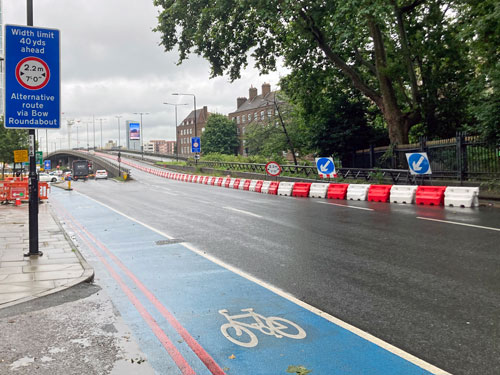
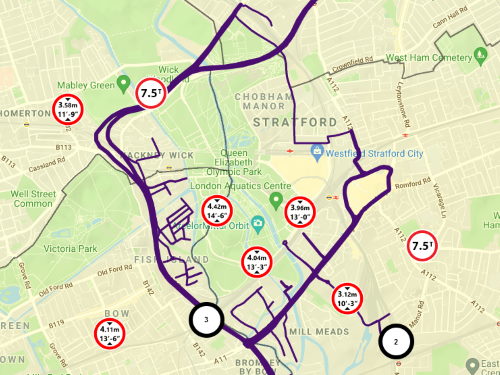
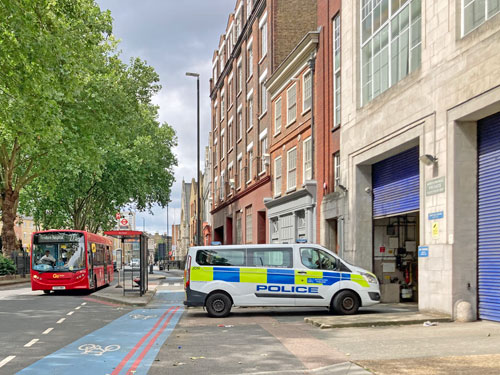
Over the weekend a lot of Weak Bridge signs have appeared along Stratford High Street due to imminent roadworks. Unusually the bridge in question isn't over a river or a railway, it's over a sewer. And annoyingly for anyone affected, the diversion's really long and expected to last for 30 months. [details]
The Northern Outfall Sewer is over 150 years old but still utterly crucial for spiriting away north London's effluent. Eight pipes 1.6m high and 2.4m wide pass underneath the High Street on their way to Beckton sewage works but are now in need of repair, hence the need for lengthy engineering works beneath the roadway. A weight limit of 7.5 tonnes has been introduced, which is good news for cars and vans but seriously bad news for trucks and lorries. Rest assured that fire engines, TfL buses and the A9 coach to Stansted Airport have been given an official exemption, otherwise bus travel in East London might have been seriously buggered.
This is a really awkward spot for a road closure because the River Lea has ridiculously few crossing points, especially for drivers of HGVs. Block off Stratford High Street and you create a three mile long gap, all the way from Temple Mills Bridge (north of the Olympic Park) to East India Dock Road (at Canning Town). As a result the official diversion for those trying to drive a heavy load from the Bow Roundabout to Stratford town centre (pictured above) is 4½ miles long rather than the usual not-quite-one, and looks likely to be in place until 2024.
Heading east along Bow Road, big blue signs now warn HGV drivers to go via the roundabout and not over the flyover. To make the point the flyover has been narrowed using plastic barriers to introduce a superfluous width restriction. This is bad news for cyclists who choose to use the flyover to skip the dangerous roundabout because the flyover's probably now more dangerous... and will be for the next 30 months. Once you reach the slip road the wording on the blue sign changes to advise you to travel via the A12 instead, and eventually a yellow sign tells you to turn left onto the A12 rather than right.
Should you choose to ignore the first signs and enter Stratford High Street anyway, or in case you arrived via a different route, further blue warning signs appear. No width restriction can be added here because HGVs need to be able to access building sites, waste depots and aggregate mountains on this side of the Greenway, of which there are several. Also the blue signs can no longer advise you to take the A12 (because that's behind you) so the next tells you to take Marshgate Lane and the next advises you to take the A112 (which I genuinely don't understand because it's all on the other side of the sewer). Expect a penalty from the cameras if you decide to ignore the lot and plough on.
Mention of Marshgate Lane piqued my interest because it is the only other possible road across the Lea hereabouts. Drive your HGV up Marshgate Lane past Pudding Mill Lane DLR, turn right into Sidings Street and you could be back at Stratford High Street in only a mile. That's what I believed anyway, but when I walked round and checked I discovered no right turn is allowed into Carpenters Road and there's a 7.5t limit under the railway, so no. An even more contorted wiggle via the Aquatics Centre would do it, but I can see why nobody wants to divert HGVs round here. The Greenway roadworks really are in an astonishingly awkward location.
In the process of researching all this I discovered that Newham council's website has a really useful roadworks page with a map showing all the latest lane closures, utility incursions, LTN blockages, diversions, one-way streets and nasty incidents. These even come with dates, where known, which in the case of the weak bridge extends to 30th April 2023. Tower Hamlets has one too and so does Waltham Forest, and it turns out they're all piggybacking on a service provided by one.network, a road disruptions start-up headquartered in London and Lisbon. They also provide information for Google and TomTom, which is how their 12-step Stratford diversion ends up in the cabs of affected lorries and sends them like sheep on a 4½ mile safari. I also note that the new Non-Executive Director of one.network is Leon Daniels, former Managing Director of TfL Surface Transport, so this is very much a company intending to go places (even if you can't).
TfL host a separate site called London's register of roadworks, which I tried out to see if it recognised the Stratford gap and it didn't. It also presented me with a streetmap circa 2006, which in Stratford's case meant it still had the original pre-Olympic road network so was utterly incomprehensibly useless. Much more promising if you're a trucker is the London Lorry Control Scheme map on the London Councils website which shows the Excluded Route Network, a set of roads along which vehicles over 18 tons can travel without seeking permission. I note that the Stratford High Street diversion is the shortest possible ERN route, accommodating loads of all sizes, hence why everyone gets sent via Hackney Wick and the heart of the East Village.
Anyway, if you are in charge of a large vehicle try not to nip between Bow and Stratford for the next 30 months because you won't be able to. Just be warned that when Thames Water repaired the section of sewer immediately to the north in 2016 it took three years before the Greenway was reopened rather than the anticipated two, so this mess might still be creating a fuss beside the Olympic Park when the next Olympics come round.
Twenty years ago today I urgently needed to find somewhere to live in London.
I'd just landed a new job here, indeed just signed the contract, and it seemed ludicrous to commute in every day from East Anglia when I could live far closer. This was the moment, this was the time to finally relocate to the greatest city on earth. But where to live?
I had a heck of a lot of London to choose from and was worried I might end up in the wrong bit. I came down a few times and explored, not the usual sights in the centre but several of the inner suburbs. I ventured down to Kennington and quickly decided against. I quite liked Camden but not enough to enquire further. I considered commuting in from Croxley but that felt like a copout. I even checked into the 16th floor accommodation office at the Barbican only to discover that their properties were entirely beyond my reach, and put that dream on the backburner forever.
Instead I decided to head east. I can't quite remember why but I suspect it was because I already lived that side of town, or maybe because the east had character and heritage, or most likely because it was cheap. This was 2001 when property wasn't quite so utterly unaffordable because turbo-gentrification had yet to happen. I was only looking to rent because I had to move fast and because there was no guarantee I'd still be around in a decade's time. I needed to find somewhere acceptable for two hundred and something pounds a week and then I could be a proper Londoner at last.
I put myself at the mercy of whatever Thursday 9th August had to offer. A week earlier and I might have been shown an entirely different selection of properties - a week later and they might all have gone. That day I met three estate agents who'd lined up six flats to show me, any of which I could have ended up living in. Twenty years later I've gone back to the five I turned down to see how different things might have been if I'd chosen to rent there instead.
My first estate agent escort was David, a cheery rotund bloke in a suit. He started by taking me to a property in Bow where the toilet was a disgrace, the kitchen windowless and the sofa was so retro-hideous it wouldn't have been out of place at Abigail's Party. Then he drove me to Hackney Road on the boundary between Hackney and Tower Hamlets where he showed me what initially looked like a row of single-storey shops. We entered down a narrow corridor, increasingly squished, to where the existing tenant was waiting in midday gloom. All I can remember is how dreary it was, and how terribly small, and how quickly I decided this absolutely wasn't for me.
Heading back I have trouble reconciling that memory with how things look now. The flats behind the shops look taller and a lot more pleasant, so maybe they weren't there at the time or maybe the flat I was shown was in fact the back of one of the shops. The parade's astonishingly gentrified now, including two artisanal coffee shops (for vegan croissants and acai bowls), a heavy metal vinyl store (notice on door: "Wear Mask, Spray Hands, Hail Satan"), a sustainable fashion pop-up and a carver of cutlery. The latter is the legendary BarntheSpoon, a bearded whittler who's devoted his life to functional sculpture and woodwork workshops. I very much doubt that this is somewhere I would still be living. Nearest station: Shoreditch (until 2006), Hoxton (from 2010)... bad choice
My second estate agent was Ben, a sharply-dressed Arsenal fan, who was based in Stratford back when this was the grim end of town and not an up-and-coming Olympic neighbourhood. He said he had two very different flats to show me and he wasn't kidding. The first was one of east London's earliest bespoke apartment blocks which had been planted between Woodgrange Park station and an Esso garage with ultra-convenient Tesco Express. The flat was halfway up on the 6th floor so had great views, but I remember being concerned it was rather small and wondering where I'd store my stuff. It also had a concierge, which in those days I thought an unnecessary novelty, so this was another to cross off my list.
Twenty years later the Lumiere Building is half-shrouded with scaffolding because it's got caught up in the cladding scandal. The exterior contains five different types of cladding that fail to conform to building regulations, only one of which (Aluminium Composite Material) the government is willing to compensate. The estimated replacement cost is £30,000 per leaseholder, and running late, and I can't imagine what it must be like to be living inside with a sheath of netting blocking all your natural light. A lucky escape. Nearest station: Woodgrange Park ...unreliably marginal
Ben's next target was in the heart of Canning Town. We drove there keeping up the football banter (yeah, we were so unlucky in the Cup this year), headed deep into an estate and pulled up at the end of a cul-de-sac. I remember thinking surely it can't be that, a ground floor terrace with a skip outside and a ropey-looking front door, and it was even worse inside. That was not a kitchen I ever hoped to call my own. In my diary I described the flat with the single word "horrid". It was almost as if Ben was testing me out at both ends of the rental spectrum to see which way I jumped.
Alas I have no recollection precisely where this flat was, having been driven there through unfamiliar streets. I've been back this week and walked round the locality trying to relocate my mental picture and the best I can do is this terrace at the end of Golden Plover Close. It's probably wrong, and what's more it's a lot closer to Custom House than Canning Town, although if I was an estate agent I might have overstated its location anyway. Glad I skipped it. Nearest station: Canning Town (cracking) or Custom House (not cracking yet)
My third estate agent was based on the Isle of Dogs and was called Jason, which is a true millennial estate agent's name and no mistake. He too had two divergent properties to show, starting with a flat round the back of a parade of shops on Manchester Road. It looked very council, as in unloved, although it was of a decent size inside. My verdict this time was "big but nasty", and very much not a reflection of my hoped-for go-getting London lifestyle. I declined.
The shopping parade still looks much the same, indeed the pharmacy, dry cleaners and newsagent (Confectionery Tobacco Travel Cards Bus Passes Cold Drinks Wine News & Mags) could easily be stuck in a timewarp. But the flats behind have had a considerable makeover since including the appearance of a fully accessible staircase extension, not to mention several adjacent smart new housing blocks that definitely weren't here in 2001. I'm not even sure the flat I looked round still exists, so it's just as well I didn't end up here. Nearest station: Island Gardens ...a bit peripheral
Jason's trump card was a gated development almost overlooking Greenwich. The flat I saw didn't have a river view, more a close-up over the car park, but it did have a very smart kitchen, wood flooring and plenty of space. It was alas too good, more the sort of flat a financial whizzkid on the up might have started out in. Also I had absolutely no need of a second bathroom, and it was £70 a week more than I could afford, and this was very much not for me.
I've walked past the back of Langbourne Place dozens of times during lockdown, and resented the railings that divide the smug within from us lowly souls on the promenade. On this occasion I walked round the front just in time to see the gates close after a resident drove out, and considered sneaking inside but wasn't certain I'd ever get out again. I'm glad I didn't end up somewhere shut away, not to mention shut away at the foot of the Isle of Dogs. Nearest station: Island Gardens ...ditto
In the end I went back to the very first flat David had taken me to, the one with the dodgy toilet, dark kitchen and horrid sofa, and put down a deposit. I knew I liked the area, although I hadn't realised I'd be living in what was once a medieval village so there was proper history to the place. The toilet turned out just to need a good clean, the kitchen I've learned to live with and although it took several years I did eventually persuade the landlord to replace the orange sofa. In terms of location, size, value and long-term stability I definitely picked the right flat to move into twenty years ago. The fact that the Olympics would be turning up on my doorstep a few years later was just the cherry on the cake, and this blog might well have died an early death had I plumped for E2, E7, E14 or E16. Nearest stations: Bow Church and Bow Road ...ideal
Ten years ago today I went for a job interview and didn't get it.
I should have got it. It was a specialist role and I was ideally qualified with ten years of relevant experience. Careerwise it would have been a major step up, much closer to the heart of things. I'd also been alerted to the existence of the vacancy by the organisation in question, which I took to be a positive sign. I filled in all the paperwork diligently, taking seriously all the faff about person specs, motivations and key skills. I gave what I thought was a decent interview, backed up by several carefully chosen examples of successful personal behaviours. And then I waited for notification I was the successful candidate.
It didn't happen. The envelope that arrived in the post was a thin one, the signal that it contained a single rejection letter rather than the anticipated thick wodge of information. I sighed and readjusted my horizons.
I knew who'd got it. As I was walking out of the interview I'd unexpectedly bumped into the only other person with a similar level of competence, someone who'd worked alongside me several years previously. They'd always been the sort of person who changed jobs to further their career, and here they were stepping back into my world a couple of rungs higher than before. I deduced they must have got the job instead because they'd done a better interview than me. Admittedly there had been one question I'd not been entirely happy about, the one I should have predicted but instead blundered into giving an answer that probably invalidated my application. Ah well.
I rate that failed job interview as one of the most important turning points in my life. If I'd got the job I'd have gained responsibility, better achieved my potential and ended up somewhere inherently fascinating. I'd also have ended up travelling a lot more, faced astronomical deadlines and - the way things turned out - been allocated a suboptimal portfolio. Instead I continued in my existing job which had a lot more independence, a far easier workload and a much better redundancy policy. I'm only where I am today because I had the good fortune to mess that interview up.
Which got me wondering what have been the other key turning points in my life. Days which ended on an entirely different path to the way they'd started. I made a list.
Jun 1964 Mar 1965 Feb 1967 Nov 1969
Jul 1973 Apr 1974 Mar 1976 Jan 1977 Aug 1977 Nov 1977 Nov 1979
Jun 1981 Dec 1982 Mar 1983 Jun 1983 Jun 1984 Aug 1986 Oct 1986 Jun 1987
May 1991 Aug 1991 Oct 1991 Nov 1991 May 1993 Aug 1997 Jan 1998 Dec 1998 Nov 1999
Apr 2001 Jul 2001 Aug 2001 Sep 2002 Mar 2004 May 2007 Mar 2008 Dec 2009
Aug 2011 Jan 2016 Jun 2016 Apr 2017
Mar 2020
It was too long a list. It included days like the first time I learned to use a computer, the day I was told I needed glasses, the day I passed my driving test, the day my parents confirmed they were moving to Norfolk, five job interviews, Brexit and the pandemic. I thought it was interesting how the key dates clustered in the centre of the list, roughly between the ages of 10 and 45, and how things have become more set in their ways since. But it was clearly a list in need of slimming down.
I tried to pick out the really significant bifurcation points. I managed to get it down to twelve.
Jun 1964
Dec 1982 Jun 1984 Aug 1986
May 1991 Jan 1998
Apr 2001 Jul 2001 Aug 2001 May 2007
Aug 2011 Apr 2017
I started with the most important date of all, nine months before I was born, when a ridiculously unlikely set of circumstances conspired to make me who I am today. The next truly significant date is the one where I got my university place, then there's the day I finally settled on a career. Three of the other dates are job interviews - two successful, one not - and one's the day my last job let me go. The day I met the Ex has to be in there - undoubtedly my biggest roll of the dice - thankfully balanced by the day I met BestMate. All twelve of these moments conspired to send my life in a different direction, I think successfully... even if it didn't look like it at the time.
I'm intrigued to see that 'years ending in 1' are very much over-represented, specifically the middles of 1991, 2001 and 2011. It makes me a bit nervous that summer 2021 might conspire to continue the pattern, but thus far nothing's cropped up to knock me off course. The most concentrated burst comes in spring and summer 2001 when a change of job propelled me to London, a moment which very much divides my life into 'Before' and 'After'. And the fact there's another August in that list means, sorry, tomorrow's going to be yet another introspective anniversary blogpost.
I can slim it down even further to five key years that divide up my life into six distinct chunks.
19
86 19
91 19
98 20
01 20
17
I look at that list and it's like looking at my lottery numbers, a high level summary of my life to date, defined by the years when fate showed its hand.
I don't expect you to be especially excited by this, nor inordinately interested in the minutiae of my life choices.
But I wonder if you've ever sat down and looked at your own life in the same way, identifying the key moments everything changed and wondering what might have happened if they hadn't. We are none of us entirely in control, even if we like to think we are.
• Lewis Hamilton thinks he has Long Covid
• NHS app tweaked to ping less
• plans for 'amber watchlist' dropped
• Scotland & Wales drop almost all restrictions
• jabs to be offered to 16 & 17 year-olds
• NY requires restaurant diners to be vaccinated
• Germany → green, France no longer 'amber plus'
• significant drop in number of pings
• Italy introduces Covid passport
• PM will not isolate after staffer tests +ve
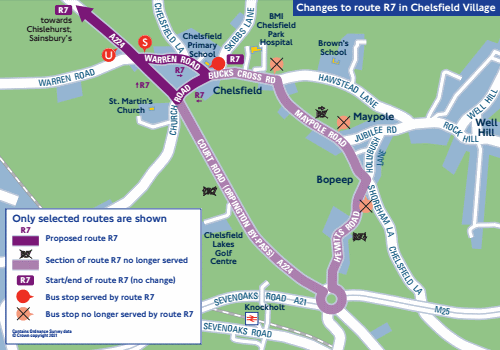
Plans are afoot to end the bus service to one of London's smallest villages. The unlucky residents are in Maypole, a tiny hamlet in the southeastern corner of the capital on the boundary with Kent (which I've blogged about in detail before). They receive an astonishingly good bus service for a tiny hamlet thanks to route R7 which runs half-hourly from 6am to midnight (and hourly on Sundays). The plan is to reduce this to no buses whatsoever all week, starting in November, because the problem with London's bus network is it's all or nothing.
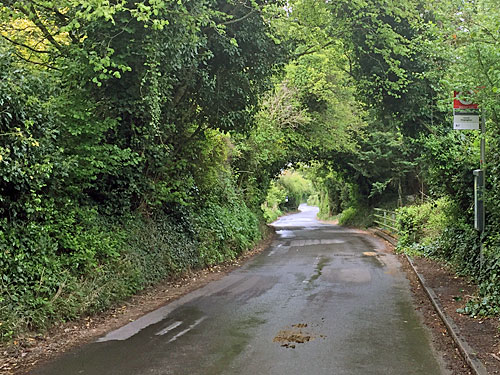
Maypole's misfortune is to be served on a one way loop, part of which is along some very narrow country lanes and part of which is along a busy main road, adding 6 minutes to journey times. Unfortunately other parts of the R7's route through Orpington, Petts Wood and Bickley suffer from "delays and unreliable journey times", and it seems the best way to solve this is to miss out the loop entirely. Instead buses will terminate in Chelsfield Village and then turn back, leaving residents of Maypole (and patrons of the Bopeep pub) to walk up to 1.1km along entirely unsuitable roads.
TfL's consultation reads like it was written by a disingenuous soul intent on one inevitable conclusion. It claims TfL "extended the route from Orpington to Chelsfield Village" in 2017, whereas in reality they swapped over several termini and the R3 had been going this way for years. It proposes "to keep the extension but miss out the loop that is causing delays", whereas in fact the sections with timetabling difficulties are elsewhere. And it says "some bus users will need to travel further for their nearest bus stop while gaining improved/faster journey times and improved reliability/better predicted travel times", whereas in fact the users needing to travel further are gaining nothing.
Every bus consultation requires a Equality Impact Assessment form to be completed, and this one's particularly poor, incuding 'facts' like "547% of day bus passengers are women". It correctly notes that vulnerable passengers at the three doomed bus stops will face long walks along roads with no footways, but justifies the cut despite negative impacts by saying "No alternative option has been identified". It does point out that only 40 journeys per day should be affected, because Maypole is a very tiny hamlet, but decades ofpublictransportconnection are about to be ditched because the rest of route R7 doesn't run reliably. All my readers who live in the area will doubtless be concerned.
This post has been hidden to improve your diamond geezer experience.
Our algorithms have determined that you wouldn't have enjoyed the content, so far better you don't waste your valuable time by reading it.
It's not on a topic of interest to you.
You're never going to visit the place.
Contains opinions you disagree with.
The narrative style lacks elegance.
Reads like a guest blog.
Uncomfortable content.
It's problematic.
New dynamic technology now allows us to determine your interests and prejudices in advance, protecting you from unwelcome engagement by shielding it from your view.
Rest assured you're not missing anything you would have appreciated.
The first time you have sex is quite an event. You're about to find out what it's like, you've never done it before and while it's happening you know it's happening for the very first time.
The last time you have sex is very different. It generally only becomes obvious it was the last time some time later, so while it's happening you don't realise you won't be doing this again.
I didn't realise it would be the last time, I just got on with the business at hand.
I hadn't been expecting it when I went out that day so was more engaged with the enjoyable unplannedness of it all. Then after it had finished I got on with putting all my clothes back on again and going down the pub, rather than standing there wistfully and mulling over the fact that a chapter of my life was over. Only later did I start thinking "it's been a while" and then "no, it really has" and twig that maybe it had been my final sexual encounter.
It might not be my last time, of course. The future is an unwritten book so it's perfectly possible a future chapter will contain a further liaison, maybe even several, potentially loads. It's all still very much under my control, so I'm not taking any particular outcome for granted. But that could have been it, I really don't know, and as the interval extends the probability inexorably increases.
Whether it's already happened or whether it's yet to come there will always be a last time. It might come early or it might come late but there has to be a final shag after which it never happens again. Every further sexual encounter simply resets the clock, but eventually for one reason or another the clock stops and for the rest of your life sex is just a memory.
Age is one factor. There comes a time, possibly quite late in life, after which your body may be unwilling to respond. I'm not there yet. But it's not just about the mechanics, it's also about whether someone else still finds you attractive enough to get involved, whoever they may be. Looks tend to go downhill after an early peak, and eventually you cross a threshold below which hardly anyone is going to give you a second look. My 50s feel quite seminal in that respect, in that I'm pretty sure I was above the line at the start of the decade but suspect I might not be by the end.
Generally it's easier to get sex if you're in a relationship of some kind (I'm aware this is an appalling generalisation, and no degree of certainty is implied). Having a partner under the same roof plainly helps, even a partner living elsewhere because geography isn't the issue. As part of a couple the last time you had sex might well have been this month, yesterday or even this morning, assuming you still do that kind of thing, rather than the longer timeframe many single people face. Going out looking is always harder, or at least it is in my experience - the vast majority of my sexual encounters have been while (notionally) coupled.
The last time you have sex, I'd like to suggest, comes down to
Willingness + Opportunity
The first part of this equation is down to you. If you really want sex you can get it, be that by paying for it, settling for second best or pursuing it at every opportunity. Alternatively your sex drive might be lower, even pretty much non existent, in which case you're less likely to be troubled by never having intercourse again.
The second part of the equation is down to other people. Someone else has to be interested, available and sufficiently eager, otherwise consensual behaviour isn't going to take place. You can be as keen as you like, even pop a little blue pill in readiness, but it takes (a minimum of) two to tango.
The past eighteen months have been appalling for 'opportunity', with lockdown legislation preventing coupling up outside your bubble. Some will have been champing at the bit to get back out there once restrictions eased, while others may still be relatively unwilling to get up close and personal. I suspect the pandemic will have significantly delayed the first time that millions of people have sex, and for others hastened the last time too.
Assuming you've had sex at least once you will at some point have a last time, and it may be several decades in the future or it may already have passed. You might think you know when it was, and you might be right, but likely the significance passed you by while it was happening.
I could have gone out on worse. We're still in touch.
You'll never forget the first time, but you won't notice it's the last time.
Last week I wrote about the new bridge in the Olympic Park and described it as "for now very much a pristine waste of money". An anonymous reader got in touch and said...
"If 'very pristine waste of money' is something you're interested in seeing more of, may I suggest taking a walk up to the junction of Northwall Road and Temple Mills Lane."
They're not wrong. I've been watching the reworking of this road junction at the other end of the Park with increased incredulity over the past few months, and the end result is both pristine and wasteful, not to mention inexplicably unnecessary.
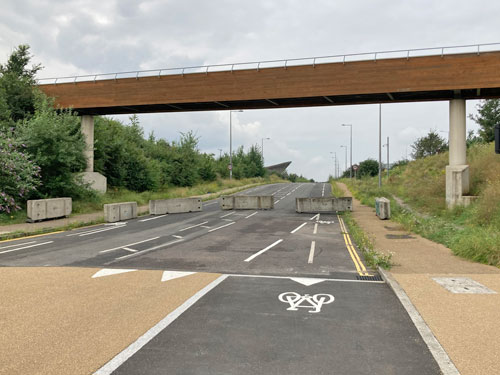
Northwall Road was added for the Olympics so that back-of-house would have private access around the north of the site. It was also built to a highstandard, a lengthy swoop with its own private cutting beside the Velodrome, and looked like it would become an integral part of the legacy road network. Not so.
For almost a decade concrete blocks have been used to keep both ends of the road blocked off, one barrage up by Here East and the other here at Temple Mills Lane. No other junctions exist, because that's how good a shortcut this might have been. The road instead gets used by not many pedestrians, a few cyclists and the occasional film crew. See my in-depth post from April 2020.
So it was a surprise to see workmen busy at the eastern end a few months ago ripping up the road and creating something new. Perhaps they're opening up the road to traffic, I thought. But they were not.
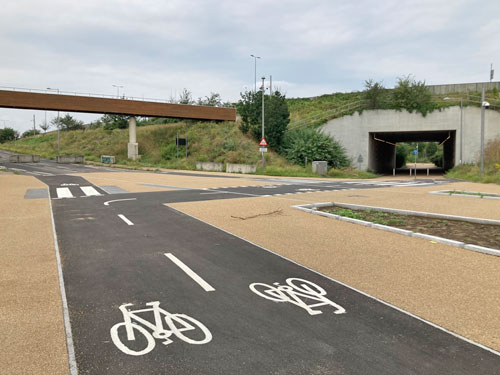
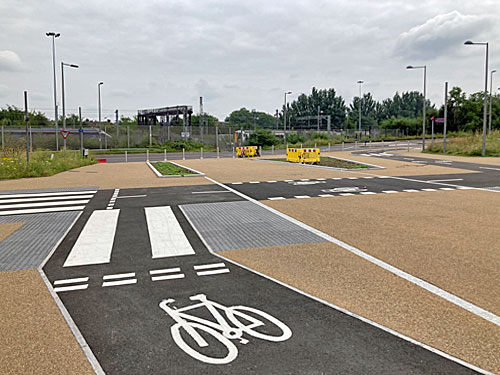
Instead they were removing the original road surface and any pretence that vehicles were ever supposed to pass through. In its place they laid a broad flat surface suitable for walking, and across the middle an unusually complicated cycle path with mini zebra crossings. I simply cannot comprehend why.
The original mundane cycle lane alongside Temple Mills Lane now swerves onto pristine tarmac to cross zebra number 1, laid to assist hardly anyone crossing the street. It then bends sharp left into Northwall Road, where an additional obstacle is a new line of metal posts installed to keep vehicles at bay. Almost immediately it crosses zebra number 2, then veers right across what could be a proper road if only that too hadn't been bollarded off. This section looks very much like a toucan crossing except there are no road markings, no lights and no vehicles.
The two-way cycle path continues across zebra 3 towards the subway under the A12 at which point the infrastructure abruptly stops and everyone gets to share the path instead. Meanwhile zebras 4 and 5 help to guide pedestrians across perpendicular spurs of cycle lane heading up (and down) Northwall Road. All five crossings have tactile paving on either side, because no expense has been spared, except there's no rational reason for any of this segregation to have taken place.
Zebra 3 assists almost nobody to cross a stream of cyclists that's rarely more than an intermittent dribble. Zebras 4 and 5 assist a few more pedestrians to avoid even fewer cyclists, because Northwall Road is not a destination which invites regular access. This point is proven a few metres up the road where the new cycle lane abruptly stops and the old narrow one is obstructed by a row of concrete blocks.
I bet it looked good on the drawing board and I bet it complies with all relevant junction-based best practice. It's just that in its current state it's entirely unnecessary, there being no vehicles to avoid nor any serious risk of collision. Pedestrians and cyclists could easily have shared this enormous space in perfect safety without the need for an isolated island of lanes and crossings created by months of civil engineering works.
It's perfectly possibly that this is not the junction's end state, for example if vehicles are eventually to be allowed along Northwall Road as a shortcut, but the narrowing of the entrance very much suggests that's not the case. It may be that in a few years time I'll look back and think "ah, OK, so that's why they did it". But when there are so many other corners of E20 where inadequate cycling infrastructure needs a proper safety upgrade, this does look very much like a pristine waste of money.
Which London postcode area has the most stations? Which London postcode district has the most stations? Which London postcode districts have no stations?
These are questions requiring a lot of spreadsheet bashing, but thankfully I have one listing the locations of every station in London including their postcodes so I can find an answer.
I'm also going to vary the definition of station, starting with tube stations only, then adding DLR, Overground etc, and working up to all stations including National Rail.
For clarity, Greater London has over 20 postcode areas, the most central of which are E, N, NW, SE, SW, W, EC and WC. It has over 200 postcode districts, for example E3, N22, TW14 and UB10.
n.b. Official postcodes are sometimes a bit brutal, for example North Acton station lies precisely on the boundary between NW10 and W3 but officially its postcode is W3 6UP so NW scores nothing.
Before we start I invite you to guess which postcode area and which postcode district will come out on top. Estate agents may be particularly interested in the results.
Which London postcode area has the most tube stations?
You probably know from the (old school) tube map that tube stations are particularly concentrated in north, west and central London, with rather fewer to the east and not many south of the Thames. This is reflected in the postcode area spread which is a runaway victory for W.
W
NW
HA
SW
N
E
EC
SE
IG
TW
49
34
30
29
25
21
13
13
11
11
W scores highly by including a lot of the western half of the Circle line and a wedge out to Acton and Ealing. NW takes second place, sweeping as it does from Euston up the Edgware Road. The big surprise in third place is HA (for Harrow), because that's how powerful Metro-land was in shaping the tube network. SW is close behind (and will overtake HA later this year when the Northern line extension opens). The eastern half of the capital doesn't get a look in until E in sixth place. Two other strongly performing outer London postcode areas are IG (thanks to the Hainault Loop) and TW (mostly Hounslow and Heathrow).
Which London postcode district has the most tube stations?
That'd be NW1 with 9 stations (including Marylebone, Warren Street and Camden Town). The more-central W1 takes second place with 8 stations, then there's a tie on 6 stations for SE1, SW1, W2, WC2, W12 and NW10.
Let's see what happens if we add the DLR...
Which London postcode area has the most tube & DLR stations? Which London postcode district has the most tube & DLR stations?
The DLR provides a massive boost for East London, with E leaping from sixth to first place. Not much else changes because the DLR is a very E-based network.
E
W
NW
HA
SW
N
SE
EC
IG
TW
54
49
34
30
29
25
18
14
11
11
We also have a new top postcode district which is E14. This scores a massive 14 thanks to the closely-packed DLR stations around Canary Wharf and the Isle of Dogs. Second place now goes to E16 with 10 stations along the Royal Docks. Both E14 and E16 have only one tube station, the remainder is all thanks to the DLR.
Now let's add all the other TfL stations, specifically Overground and TfL Rail...
Which London postcode area has the most TfL stations? Which London postcode district has the most TfL stations?
Including the Overground makes a big difference to certain postcode areas, especially in a loop around central London.
E
W
NW
N
SE
SW
HA
EC
IG
RM
80
52
44
38
34
34
32
14
14
12
Station totals for N, NW and SE all increase by at least 10. But the biggest beneficiary is again E which adds an extra 26 stations... from Wapping to Dalston, Hackney to Chingford and a lot of the Goblin, not to mention a bit of Crossrail. In terms of TfL stations the E postcode area is unbeatable.
Ditto there's no change in the best served postcode district - still E14 followed by E16 followed by NW1 - because the additional Overground and TfL Rail stations are pretty well spread out.
But add trams...
Which London postcode area has the most TfL stops and stations? Which London postcode district has the most TfL stops and stations?
Technically tram stops aren't stations which is why I haven't included them before. But the vast majority of them are in Croydon, which kicks CR into the top 10 for the first time. SE is creeping up - it was 7th in my first table and now it's 4th. Still nothing dislodges E, though.
E
W
NW
SE
N
SW
HA
CR
EC
IG
80
52
44
40
38
37
32
26
14
14
The tram network might look large but it serves only five postcode districts, that's BR3, CR0, CR4, SE25 and SW19. More than half of London's tram stops are in central Croydon, that's 23 in total, which means CR0 easily leapfrogs E14 to become the postcode district appearing most often on the tube map.
Finally let's add National Rail (and take out the trams) to ask the definitive question...
Which London postcode area has the most stations? Which London postcode district has the most stations?
There are a heck of a lot of non-TfL stations across South London, most notably in SE which has more than 30. Other postcode areas with more than 10 National-Rail-only stations include SW, BR, KT, TW, N and SM. It's enough to nudge Twickenham and Bromley into the Top 10.
E
SE
W
SW
N
NW
HA
TW
BR
EC
81
69
55
52
51
48
35
25
21
16
The relentless rise of SE continues - it turns out to be the second best served postcode area by train. But nothing can beat E which retains pole position. It may only have one National-Rail-only station, which is Lea Bridge, but it has so many DLR and Overground stations that its lead is untouchable.
In my first table, looking only at tube stations, the eastern half of London didn't get a look in. But now we've considered all kinds of trains to all kinds of stations it turns out the top two best-connected postcode areas are both to the east.
Also E14 remains the postcode district with the most stations. Even with National Rail thrown in, the only postcode districts to reach double figures are still NW1 (11) and E16 (10).
Which just leaves my last question...
Which London postcode districts have no stations?
I'm ignoring postcode districts on the edge of the capital that do have a station but it's outside London. I'm also ignoring postcode districts with a station on their boundary but allocated to somewhere else (for example E20 which includes an exit from Stratford station even though its official postcode is E15 1AZ).
In which case these are the London postcode districts unserved by rail...
» N10: Muswell Hill (too hilly, but nearly includes Highgate)
» SE28: Thamesmead (never reached by any project)
» DA6: Bexleyheath (Bexleyheath station is in DA7)
» IG5: Clayhall (in the middle of the Hainault Loop)
» RM4/RM5: Havering-atte-Bower/Collier Row (wholly isolated)
» RM7: Rush Green (an annoyingly big gap between TfL Rail stations)
» TN16: Biggin Hill (not even a tram)
» TW4/TW5: Heston/Hounslow West (the Piccadilly line just misses)
» TW10: Richmond Park (obviously)
» UB4: Yeading (a long way from Hayes & Harlington)
» UB11: Stockley Park (but this is a teensy new district)
If you want to be better connected, E and specifically E14 are where it's at.
My 22nd random ward is the last of the big three out west. I haven't coloured it in wrong on the map, it really is in two parts (technically linked by a short stretch of road passing St Bartholomew's Hospital). Councilmen refer to them as Northside and Southside. The ward's size means I can't do it justice in a single post, but I can offer you John Betjeman's flat, the Old Bailey and the site of the notorious Fleet Prison. [pdf map]
First a word about the name of the ward. It's named after Sir Nicholas de Faringdon, the ward's alderman in the early 14th century and four-time mayor of London. In 1394 it was split into the part inside the City wall (Farringdon Within) and the much larger part outside (Farringdon Without). Neither ward contains Farringdon station, which was instead named after Farringdon Street, now Farringdon Road. The City's idiosyncratic boundary changes in 2003 recast Farringdon Within into two smaller segments, neither of which aligns with the old City wall. None of this is especially satisfying, sorry.
The northernmost bulge of Farringdon Within faces - but doesn't include - Smithfield Market, Charterhouse Square and the Barbican. What it does include is Barbican station, which if you walk round to Hayne Street and peer over the parapet you can see in all its cut and cover glory. This would not have been possible before 1955 when the bomb-damaged glass roof was removed. On the other side of the street is a shiny new entrance to the station, with all gates and signage in place but mothballed and waiting for Crossrail to open. It's also particularly well defended thanks to a ring of 44 freshly-planted bollards wrapped in a protective ring around the ticket hall. The City has been getting really bollardy of late.
St Bartholomew The Great claims to be London's oldest parish church, established as a priory by a courtier of Henry I. It had the good fortune to be undamaged by the Great Fire and the Blitz so boasts a fair wodge of Norman interior and an impressive Tudor gatehouse. Visitors are welcome (and no longer charged for the privilege), except on Sundays when you might instead bump into two cassocked celebrants on a bench in the garden waiting for their parishioners to turn up. John Betjeman so loved the church that he rented a tiny flat opposite in Cloth Fair between 1954 and 1973, and so loved Princess Margaret's lady-in-waiting that he regularly entertained her here. If you fancy a few nights away in a Laureate's lovenest, it's available to hire as a holiday home through The Landmark Trust.
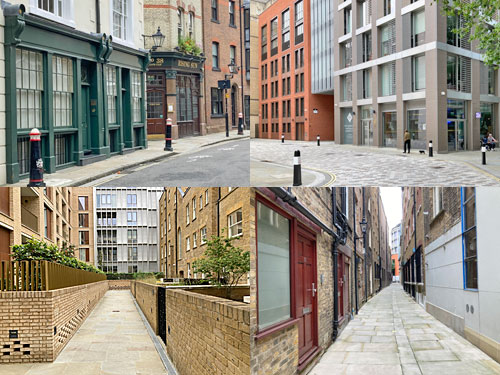
Cloth Fair and some of the adjacent alleyways still have a feel of ye olde London. But although Bartholomew Close starts out cobbled it quickly morphs into a very modern district of office blocks, brick apartments and plant-based superfood restaurants. The latest interloper is Barts Square, three acres of dense luxury livingspace creating "a new urban quarter" across what used to be redundant parts of Barts Hospital. It's impeccably done, so long as you like gold railings, but most of the million and a half you'll be paying for your two bed bolthole is for the location rather than the facilities. Look out too for the livery halls of the Worshipful Company of Butchers and the Worshipful Company ofInformation Technologists, two charitable organisations bookending a millennium of City commerce.
Switching to Southside, the first street corner features a ruined church reimagined as a rose garden. This was Christchurch Greyfriars, a Wren rebuild that didn't survive the Blitz, firebombed the very night neighbouring St Paul's was miraculously reprieved. Greyfriars was originally a Franciscan monastery, and in the 13th century its lofty steeple made it the second tallest building in London. Wren's tower survives as a private home, fitted out circa 2006, while the adjacent Vestry House is now a dental practice. The graveyard is less of a draw, more a large lawn with benches down the centre where employees of Merrill Lynch can go to escape their financial fortress.
Newgate was one of the Roman city's six entrances and later, after cells above the arch developed into a fully-fledged prison, a site of public execution. Hangings were hidden away inside the walls in 1868. In 1902 the Central Criminal Court of England and Wales opened instead, better known as the Old Bailey, this being the name of the road running alongside. Lady Justice holds her scales aloft at the top of the dome. If you fancy seeing who's up in front of the beak today you can check the list of cases posted outside the public entrance, which is part of the less ostentatious 1970s extension.
Apologies for the jogging dog, but my visit at the weekend coincided with the London Landmarks Half Marathon, a charity-focused event triply postponed since Easter 2020. Ten thousand runners thronged the streets, including unfortunates dressed as Big Ben, the Gherkin and the Cheesegrater who seemed to be suffering more than most. What with the cheering supporters and numerous pumped-up music performers it was easily the biggest crowd I've mingled in for absolutely ages. The course looped round most of the City so I was fortunate that Farringdon Within was generally untouched, and that where it did intrude the split-level Fleet Valley made it easy to cross the endless stream.
Three-quarters of Holborn Viaduct lies within Farringdon Within (and the rest within Farringdon Without). The construction of London's first flyover transformed cross-valley travel, ending the need to cart your horse up (or down) Snow Hill. The staircases at each corner would only start to reek of urine at a much later date. Farringdon Road passes underneath following the course of the Fleet, a lost waterway I blogged forensically in 2005 so won't revisit here. Today one side of the road is mostly chunky office blocks and the other is dotted with lanes that once reached the top of the slope but are now severed dead ends.
The interloper on the eastern side is City Thameslink station, a cut and cover job opened in 1990 when north-southrail travel restarted, practically little more than a pair of very long platforms with escalators at each end. It's no architectural triumph, and neither are the bevy of generic office blocks that have muscled in since. Follow the station 'lid' down Fleet Place and you pass a pair of nude 11 ton granite torsos, a sign warning you that images are being taken "for advertising purposes" and a wine bar disguised as a chalet. The notorious Fleet Prison lingered here until 1846, and I like the fact that Sky Business News now broadcasts from offices on this site.
South of Ludgate Hill a labyrinthine street pattern has survived. Carter Lane has restaurants and a family-owned pub whose chalkboard invites you to Come Upstairs for a Good Roast & a Good Stuffing. Ireland Yard is thought to be where William Shakespeare lived when he was a successful playwright, close to the site of his theatre in Playhouse Yard. Halfway along the delightfully-named Church Entry is the last remaining chunk of the original Blackfriars monastery (its monks being Dominican in black cloaks, whereas the aforementioned Franciscans at Greyfriars wore grey). And Apothecaries' Hall is the oldest surviving livery hall in the City, blessed with significant 13th century elements, confirming there's always been a lot of money in peddling drugs.
The railway continues to form a barrier as it rises up from City Thameslink towards Blackfriars station. In the middle of Waithman Street you can only cross it by climbing two flights of steps on one side and descending four on the other (via a glum trainspotting vantage point up top). Waithman Street also boasts what may be the City's most inappropriately patronising notice - "This wall has artistic importance. Please do not park your motorcycles in this area". For proper art step back and admire the elegant wedge of The Black Friar pub, whose facade includes mosaic infill and wooden panels depicting drinking and devilry. Farringdon Within extends no further.
August is LocalHistoryMonth at diamond geezer, which generally means a major psychogeographical challenge. Today I'm launching a transport-related series tracking all of London's numbered bus routes in alphabetical order. Numerical order is usually the norm, obviously, but I'm going to add an extra frisson by tracking through the route numbers from A to Z.
That means seven comes before six, twelve comes before two, three hundred comes before two hundred and ninety-nine and ninety-two comes immediately before one. Perhaps more intriguingly, while we're near the start of the alphabet, is that 18 beats 11 beats 15 beats 50 beats 5 beats 40 beats 4 beats 400 beats 14.
I'm not planning to ride each of the routes because that would involve a fair amount of repetition, but instead to visit one of its termini - again the one that comes first in alphabetical order.
I can tell you now that my quest is due to end with the 202, because nothing comes later than two hundred and two, which means a final trip to Blackheath, Royal Standard. But I'm pleased to say that the start of the challenge has deposited me somewhere considerably more random and ordinary, and all because no numbers start with an A, B, C or D.
London's Bus Routes in Alphabetical Order EIGHT: Bow Church
This is Bus Stop M at Bow Church, the unlikely starting point of London's first bus route in alphabetical order. For those who aren't familiar it's just west of the Bow Roundabout (and the River Lea) at the very edge of Tower Hamlets. Although it's called Bow Church it should not be confused with the bus stop outside Bow Church station, which is called Bow Church Station. Instead this is the bus stop opposite St Mary's church, the medieval place of worship on an island in the middle of the A11, after which Bow Church station is named.
Eight different bus routes serve the stop, which is well above average. One is the mighty 25, until recently London's busiest bus route, plus its slightly longer overnight version. Most buses are going to Stratford. Three, inexplicably, have come from Homerton Hospital. The 108 has already been through the Blackwall Tunnel. The 488 is only going one more stop to Tesco. The 205 annoyingly terminated one stop earlier, whereas the N205 ploughs straight through. And of course the 8 begins here, which is what makes this the first stop on the first London bus route in alphabetical order.
Let's dispense with the technicalities. The bus stop number on the underside of the flag is 348. The SMS number, for anyone old school enough to need it, is 55457. But nobody should need the SMS number because Bus Stop M has its very own countdown display, a luxury afforded when nearby Bus Stop E was removed in 2015. It's a very useful display, what with six bus routes potentially on their way to diverse locations including Westfield, Ilford and Very-Central London. Bus stop J on the opposite side of Bow Church is alas not similarly blessed.
The bus shelter is numbered 0130 1045. It's a 3-bay Insignia shelter fully compliant with BSI structural standards and regulations, although that doesn't mean the benches are especially comfortable. There are no adverts at either end of the shelter which is good because that means you can see your bus arriving while still sitting down. Before the pandemic the two poster spaces inside the shelter were occupied by a nightbus map and a spider map, but these were inexplicably removed last spring and have only recently been replaced by a map of the local area (copyright 2015) and a generic 'how to pay' poster. The current spider map would be considerably more useful than the latter, but rational thought is not in play here.
All necessary timetables are present. They appear in numerical order (rather than alphabetical order) on the first two panels of the timetable cluster, with both nightbuses on the third. The oldest timetable is for the 108 (published 13th May 2017) and the most recent is for the 25 (published 8th August 2020). One corner of the 276 timetable has been folded over so it looks like the timetable is for the '6'. During the day as many as 40 buses per hour are timetabled to stop here, on each occasion reducing the width of the carriageway from two lanes to one. Here's a 488 in front of an 8 in front of a 276 in front of a 25.
For this reason it's just as well that the bus stop is very very long. It's so long that it crosses the driveway of one of the residential buildings behind which results in the bus stop island being awkwardly divided into two parts. This is annoying if you arrive in the second bus and have mobility issues because it's a big step down from the middle doors, so best hope you arrive on the first or third bus instead because they never face this intractable design fault.
Perhaps the bus stop's most significant feature is the blue bus stop bypass that cuts behind it, a safety feature introduced by the last Mayor after it turned out a blue stripe painted on the road was fatally inadequate. The raised hump with the tactile paving and zebra stripes was added at a later date after it turned out dawdling pedestrians and whizzy cyclists shouldn't mix. The blue channel now only occasionally floods. A more present danger is from Uber Eats riders with a backpack of Big Macs heading the wrong way up the cycle lane because the official westbound cycle lane is inconveniently sited on the far side of the church.
Immediately behind the bus stop, somewhat unexpectedly, is a Grade II listed building. This is 199 Bow Road, a late 17th century three-storey redbrick house with sash windows, radial fanlight and part-original staircase. Workmen recently blasted the graffiti off the replica 18th century shopfront and it's all scrubbed up nicely. But it's not the only listed building adjacent to the bus stop. St Mary's Church is literally the other side of the road, but behind listed railings so you can only access the 14th century interior by diverting up the road past the listed urinals beneath the listed statue of William Gladstone beside the listed bollards.
Also overlooking the bus stop is the Metropolitan Police's Grove Hall Garage, whose shutters go up and down on a regular basis releasing branded and very much unbranded vehicles. Look out for their bags of rubbish dumped on the pavement first thing in the morning, close to the metal stump that marks where the bendy bus ticket machine used to be. Or if it's coffee you seek try the cafe up the alley on the original Bow Arts campus, which is where the bus stop's closest tourist attraction can be found. The Nunnery Gallery is open daily (except Mondays), often with a fascinating exhibition within, although the latest empathy-based show hasn't exactly been packing them in.
So there you have it, the first bus stop on the first London bus route in alphabetical order is a very ordinary bus stop, potentially with an extraordinary backstory but I don't have time to go into that here. I hope you're looking forward to my next report which'll be from Euston station on route 18, which sounds almost as ordinary as Bow Church, and after that the similarly un-noteworthy Downview and Highdown Prisons on route 80.
Also I should point out that yes, I know the first London Bus Route in Alphabetical Order is really the A10. London has lots of lettered bus routes, several of which come before eight, which is why I included the caveat about only visiting numbered bus routes in my introduction. Officially the A10, B11, B14, B13, B12, C11, C1, C10, C3, D8, D7, D6, D3, E8, E11 and E5 all precede eight in the alphabetical stakes, but that list kicks off with Heathrow Airport and a lot of Bexleyheaths and I didn't want to subject you to that. I will not apologise for the massive alphabetical coincidence which meant I got to subject you to Bus Stop M instead.
Thu 1: In numberplate-spotting news: a) today I finally spotted a 'suffix A' which means I've completed my Reverse Chronological sequence from 2021 back to 1963 and it only took 11 weeks, twice as fast as last time. b) yesterday I finally spotted an E2 registration in the E2 postcode, and somehow that took six months. c) tomorrow I'm finally going to spot an H18, which means after four months there are only three initial pairs left (W20, X16 and Y13). Fri 2: I checked and yes, it turns out my first jab was from one of the three AstraZeneca batches sourced in India which the EU doesn't currently recognise, so that's continental travel potentially scuppered. Sat 3: There are still signs in the Blackwall roundabout subway directing pedestrians towards 'Jubilee line replacement boat services to North Greenwich and the O2'. These last operated in 2010.
Sun 4: If you had a go at my Guess the US states quiz, the 11th state was spelt out by the first letters of the answers to the other 10, which was California, and that was the real question. Mon 5: A visitor entered my flat who wasn't a workman come to fix something - my first since 2019. We had tea and jaffa cakes. Tue 6: My headphones and iPhone have started playing up, suddenly switching off or reverting to the start of the programme I'm listening to, repeatedly. I understand it's a known problem whereby a dodgy connection makes Voice Control kick in even if you've got it switched off. It's very annoying. Wed 7: Jeppe Hein's marvellous MirrorLabyrinth at the East Village has been fenced off and padlocked because "there are edges to the installation that could cause injury" and because "running is not advisable" and because the maze can "confuse and disorientate"... but mostly because obsessive health and safety trumps art.
Thu 8: I am not a fan of squeezy bottles of tomato ketchup, particularly after several weeks of use when the deformed plastic's gone all concave and won't squeeze any more, and OK glass wasn't exactly brilliant either but at least you could bash it out. Fri 9: This is where I was going to tell you the story of the Dangleway's two misleading queues, but then I went and wrote about it just before the end of the month so it isn't unblogged. Sat 10: The latest addition to my weekly BBC Sounds playlist is Grant Stott's Vinyl Collective from BBC Radio Scotland, a two hour show where everything's on vinyl. Last night's programme opened with the 12 inch of Dr Mabuse by Propaganda, and not many shows dare do that. Sun 11: I took a look round some of this year's Sculpture in the City exhibits and, although it had its moments, the fact you haven't read a post about it is indicative of my overall lack of enthrallment. Mon 12: My electricity company have sent me a letter saying they haven't had a meter reading since November, like it's now my fault.
Tue 13: In Maryland I spotted a red Hyundai with bЯO⅃ ƎHT ƧI ƧUƧƎႱ on the sun visor, and JESUS IS COMING SOON REPENT NOW on the bonnet, and even smaller print Your Choice Heaven or Hell Don't Forget on the doors, and I cannot imagine this ever having the desired missionary effect. Wed 14: I was at the checkout in Tesco when the fire alarm sounded, and my cashier looked somewhat agitated but kindly gave me a few seconds to finish paying, and she was out of the door on her way to the muster point in the car park before I'd bagged up. The person behind me in the queue wasn't so lucky and had to abandon her groceries on the belt. Thu 15: I tried inserting £20 into a TfL ticket machine which said it took notes, and it very much didn't. The same thing happened at another station. It's like they don't want my money. Fri 16: Following a frozen pea spillage I thought I'd better clear out the U-bend under my kitchen sink, and other than the peas it was surprisingly clear, so that was good. Sat 17: I see the platforms at Canning Town station now have giant Thunderbirds-sized numbers on them.
Sun 18: Moorgate's new Crossrail entrance has opened... essentially a bank of a dozen ticket gates under a new office block, so nothing special. So far you can only turn right, but maybe in six months they'll let you descend into the purple depths down the escalators on the left. Mon 19: I celebrated 'Freedom Day' with a walk up the Olympic Park and back, and not many other people had chosen this option. Tue 20:5 things I threw away while tidying the spare room: a 3D photo of the Eiffel Tower cut from the back of a cereal box, 'Position Changing for the Violin' by Neil Mackay, a paper cup from Walt Disney World, a pack of werewolf postits free with Sugar Puffs, a 'Bacon and Sweetcorn Jacket' recipe card from the Safeway Recipe Collection. Wed 21:5 things I kept: a Charles & Di wedding silver crown (estimated value £1), 'My Recorder Tune Book' by Freda Dinn, a plastic stencil for drawing the outline of Great Britain, the studio script for 'Houseparty' featuring Bunty James (transmitted on ITV 9th December 1968), a fingerprint kit received free in exchange for wrappers from Double Agents sweets.
Thu 22: While out exploring the 50 year-old stations on the Victoria line I also dropped by Stockwell Bus Garage to worship at the postwar concrete temple, and it's impressive how much of the ribbed interior you can see from outside. Fri 23: I watched the Tokyo Olympic Opening Ceremony, because you only get to watch 20-ish in your life, and far too much of it was the athletes' parade despite there being far fewer athletes, and I was only intermittently wowed. The pictograms were the best bit. Sat 24: Our week-long heatwave has broken and it's time to put the shorts away and maybe that was summer. [last week 32°C max, 6mm of rain and 85 hours of sun; next week 24°C, 60mm, 24hrs]
Sun 25:Seven things I saw in Beckenham Place Park: a fibreglass squirrel, freshly mown hay on Crab Hill, a ridiculously long queue for bacon & egg brioche, copious new directional fingerposts, a 55 million-year-old outcrop of flinty bedrock, bee-bedecked lavender, a new lake that's had to be fenced off because otherwise the council couldn't charge people to swim in it. Mon 26: If I'd walked past Pudding Mill Lane station five minutes later I could have been in the background of the live BBC London lunchtime news report. Tue 27: I stood in the middle of Wanstead Flats beside the bit they've fenced off to protect the skylarks, and listened to the skylarks, and that was glorious. Wed 28: The arcade round the back of Liverpool Street station (tube, not rail) is the place to go if you need a shirt dry-cleaned, a watch repaired, a key cut or a box of lunchtime nosh. It is also ridiculously quiet. The ramen restaurant is called Shitamachi which probably isn't helping.
Thu 29: My iPhone has now suddenly decided to refuse to recognise that any headphones are plugged in, and no amount of twiddling will convince it otherwise. Sound only plays out of the loudspeaker which makes it useless for listening while out walking. Maybe now is the time to fork out £100+ for bluetooth earbuds, but I'll probably buy a replacement £9 adapter instead. I miss the simple non-expensive days of the 'headphone jack'. Fri 30: The Newspoint kiosk on the ground floor of Westfield Stratford no longer sells newspapers, because it only takes ten years for your raison d'être to become obsolete. Sat 31: I received my NHS Covid pass in the post this morning (a sheet of paper confirming which vaccines I've had and when). They said it might take five working days but it only took three. I have nowhere to wave it yet, but it might be useful.