I didn't want to go to the gym, I was coerced. I hated PE at school and always thought there were better things to do on a Saturday morning than exercise. I felt uneasy at the front desk, uncomfortable in the changing room and unfit in the big room with the equipment. I wasn't trusted to use any of the serious heavy stuff, instead I got to sit on a static bike and pedal for ten minutes while watching some cable rubbish on the screen in front of me. Nobody explained how the machine worked or invited me to tackle any of the other equipment afterwards. Then I stood in a corridor mulling over my life choices and hoping my exercise partner would be finished soon. The tuna sandwich we had in the bar afterwards probably undid any good the experience had done. A few months later we got up at stupid o'clock and went back and some trainer called Lisa got us to do a circuit involving steps and weights. I felt weak, feeble and demeaned. It was never suggested that we go back and I vowed I never would, indeed I never have. I'm fine not having pumped arms and a six-pack, I don't want a personalised cardio program and sweaty shorts, and if I wanted to burn money monthly I would go down the cashpoint with a lighter.
My cinema journey
I'm not sure what the first film was my parents took me to see but it was probably Disney, possibly Fantasia or the Aristocats. In those days you might have got three minutes of The Jungle Book on Disney Time or a snippet of Bedknobs and Broomsticks on Screen Test but you'd only get the whole thing at the cinema. A visit was always an awesome experience, from eagerly awaiting that first curtain swish to queueing in the interval for an ice cream. I was particularly glad of the break during The Sound of Music. But cinema visits were usually rare, mainly for blockbusters and birthday treats (or in the case of Close Encounters both). At university we'd sometimes go and see something arty together, but later I'd learn to enjoy my personal choice of film alone. I prefer near-empty auditoria to packed-out stalls so gravitate towards midweek daytime when I can, and always with a packet of Minstrels smuggled in my pocket. But I've not yet been back to the big screen since the pandemic, not because of the coughing but because if you wait three years all the films turn up on TV anyway, even if they don't have the same impact The Towering Inferno once had.
My yoghurt journey
As a child I was always a mousse person, not a yoghurt person, because I didn't like the look of the bits in tubs of Ski. But my mum liked yoghurt so we always bought them, and then she progressed onto a strange yellow machine that made DIY yoghurt in three separate plastic cups. I never tried any of the artificial white gloop, I only got to wash up the empties afterwards and if anything that put me off even more. Fermented bacteria, ugh. I'd always avoid yoghurt at school and later when it was served up at work events because I was sure it tasted foul but this wasn't based on physical experience. Much later when it was suggested I should lose weight I saw yoghurt was on the acceptable list so bought a pot and it was alright. Some of the flavoured stuff was indeed lovely, especially the lemon version and I'd happily wolf down a multi-serving tub of that. Then I noticed the sugar content on the label and was so aghast I dropped my Onken and Yeo Valley habit almost overnight. Now I just eat a small pot of own-brand low fat fruit yoghurt most nights, but what hasn't changed is that the lemon and lime variant is the best, and the cherry version the least attractive because of all the bits in it.
My political journey
The first time I remember being aware of politics, as opposed to just politicians, is when my parents put a poster up in their window. It was white with a big red cross on it and I remember thinking "oh that's interesting, they vote Labour". This would have been the first half of the 1970s, either for a local ballot or the first General Election of 1974, and given the recent chaos of the three-day week didn't seem an improper stance to take. Labour were in power throughout the years where I was starting to take notice of the wider world, and despite their inadequacies I remember being disappointed when they finally lost a vote of confidence and Margaret Thatcher got elected instead. Her agenda cemented a feeling that the right's way was the wrong way, that society should be more important than enterprise, so when I got the chance to cast my first vote in 1983 I gave the new-fangled SDP a try. They burned. I've voted on every occasion since, not always for the Labour party but never for the Conservatives, because although there are bastards, idiots and liars in all parties there are far more with a blue rosette. The Tories only ever make me cross, I will never give them one.
My flapjack journey
BestMate introduced me to these nutritious packaged treats. We were in Canterbury on a day trip and popped into Holland and Barratt, ostensibly for some cough sweets, but he suggested we grab an own brand flapjack for our lunch. "These are nice," I said, "and tasty and cheap and they come in such a wide variety of flavours." These oaty slabs soon became my preferred midday snack when I was out and about, there being an H&B in most high streets, and only occasionally did I get stuck at the till behind someone buying pointless vitamins. Their Bakewell flavour was my favourite, occasionally swapped for something deliciously chocolate-coated, and I reassured myself that because they were being sold in a health shop they couldn't be overly unwholesome. But the price kept going up, from comfortably under 50p to much closer to a pound, and then they shrunk the weight and it didn't seem so much of a bargain. So I don't buy Holland & Barrett flapjacks any more, I either go without or I plan ahead and carry something from a supermarket multipack with me. Perhaps I need to learn how to bake and slice traybakes of my own.
My news journey
The TV news has always been there in my life, indeed we invariably stayed on to watch Kenneth Kendall after the Magic Roundabout finished. On teenage weekdays our lunch was invariably timed to match The One O'Clock News, and the evening's washing-up often waited until after the regional programme. We also got the local evening paper until it folded, but not a morning daily until I managed to persuade my parents otherwise. At university I upgraded to a broadsheet, partly lured in by the crossword, and maintained a daily purchase until I wasn't commuting any more. The advance of the internet means I can now keep tabs on stories as they break, aided and abetted by an oft-checked RSS feed, but there's still nothing quite like a printed compendium of news curated by an editor. I also still trust the BBC to attempt to be fair and balanced, unlike the biased spin some media channels spew out, and have settled into a twice-daily pulse of lunchtime TV and midnight radio. I choose to be informed rather than ignorant, to absorb rather than cherrypick, to reflect rather than be lectured and to hope rather than despair. But I still often nip out during the sport.
My journey journey
I can't remember when someone first described something mundane as a 'journey'. It wouldn't have been during Job One or Job Two because things were much more straightforward then - no objectives, no mission statements and no corporate gobbledegook. It might have been Job Three because the bosses introduced team building awaydays and needed something to talk about. But I bet it was Job Four, specifically when they brought in a CEO with no knowledge of the business, only jargon and managementspeak. At the time we sat at the back of the room and mocked her, but before long everyone in the top slot talked like this. They wanted us to commit to key service indicators, to live the brand and to embrace the journey, and we just wanted to get back to our desks and do some actual work. These days 'journey' is one of those red flag words like synergy and wellness, which if used means I will stop taking you seriously and assume you're talking bolx. And that's my journey journey.
When the Mayor announced the ULEZ would be expanding to cover the whole of London he also promised a million extra kilometres of bus services to help mitigate the effects. Yesterday TfL announced what 400,000 of those extra million would be, and let me tell you, they won't be mitigating anything.
For a start...
• 40% of the proposed expansion is being gifted to just four locations, nowhere near where most drivers live.
• One of those four locations is inside the existing unextended ULEZ, helping nobody new.
• Most changes are relatively minor, connecting to new housing developments.
• In fact no routes are getting more frequent services.
• Two routes are to be withdrawn.
And also...
• One million km of bus services sounds a lot but it isn't. Over 180 TfL routes already run more than 1,000,000 km in a year, so what's being promised is ultimately no more than one fairly average extra bus route.
This is good news for some Brent residents, sending more buses past the Grand Union development where Berkeley are slotting in 3300 homes. It also a restores a link to Wembley which TfL lopped off in a previous consultation when shortening route 224. It's bad news for anyone who used to catch the 79 to Alperton Sainsbury's because it won't be going there any more, but the lost two stops will now be made up by route 83 extending there instead. [map]
839 homes are being built here on a site only marginally served by the meandering G1. This is a significant seven-stop extension, additionally boosting frequency between Balham and Tooting Bec. But unless you happen to live in this corner of Wandsworth it's not going to solve your ULEZ woes. [map]
The uber-massive Brent Cross Cricklewood development was always going to be served by bus, so this smacks of "we were going to make these changes anyway but we've shoehorned them into a ULEZ press release". Routes 102, 210, 232, 266 and C11 will be diverted on their approach to Brent Cross shopping centre, inconveniencing very few through travellers. Meanwhile routes 316 and 326 will be extended to the new Brent Cross West station, one on either side of the tracks, likely arriving long after the station opens. The 189 will additionally pass the station along roads as yet unfinished. And all of this occurs just inside the North Circular, i.e. within the current ULEZ, so go figure. [map]
How great this sounds, unless that is you've ever ridden the two buses being scrapped and the one bus being extended, which hardly anybody does. This is TfL faffing around with three of the least used routes in London and attempting to build something more resilient from the ashes. It has its upsides but it has its downsides too. [map]
Currently... 346: A brief arc out of Upminster linking the outer reaches of Cranham to the tube. Runs every 15 minutes. The 10th shortest bus route in London and the 19th least used. 347: London's least frequent bus route. Runs only four times a day (and never on Sundays). Connects Romford to Ockendon via Harold Wood and Upminster. Gets a bit rural. Exits Greater London. The only bus to run north or east of Upminster. The kind of bus where the driver knows their regulars. The 7th least used bus route in London. 497: A runty route from Harold Wood to Harold Hill. Introduced to connect to Crossrail, two months before lockdown. Never took off. Runs every 30 minutes. Services a new estate within easy walking distance of Harold Wood station. Has always been nigh empty every time I've used it. Economically suspect. Has already been the subject of a consultation asking 'should we scrap it or should we extend it?' Was subsequently extended a mile to the driver's loo stop. The 11th least used bus route in London.
The plan is to withdraw the 346 and 347 and to extend the 497.
The 497 currently turns round awkwardly at Harold Wood station. In future it'll extend south along the 347's route via the delightfully-named Cockabourne Bridge and speed down Hall Lane. A handful of residents will see a massive boost in frequency from every two hours to twice an hour. A mile short of Upminster station the 497 will divert off into Cranham to follow the 346's peripheral route. Residents here will see a nasty cut in frequency from every 15 minutes to every 30. The bus will terminate at Upminster station having accessed the high street from the south via St Mary's Lane.
The death of the 346 and its replacement by the less frequent 497 creates a poorer service for folk living on the very eastern edge of the capital. They could always catch the much more frequent 248 and walk the last bit, collateral suggests, but only if they're up for walking.
The death of the 347 throws up far more issues, although as London's least frequent bus they apply to very few passengers.
• It's all fine between Romford and Harold Wood because three other bus routes do that.
• It's more than fine between Harold Wood and the edge of Upminster because frequency will quadruple.
• It's less good approaching Upminster station because the bus suddenly goes off on a 15 minute detour.
(TfL have thought about this. The consultation includes a suggestion that the 497 might head to Upminster station before Cranham, tagging the existing 346 route onto the end. But this would require highway changes and the installation of a drivers' toilet on the Upminster Park estate so don't count on the better option happening)
• It's very bad on the exclusive 347 section between Cranham railway bridge and North Ockendon because the intention is that six bus stops will never see a TfL service again. Some residents on the Cathedrals estate will suddenly find themselves 600m from a bus stop. TfL's impact assessment notes that the footway to the nearest stop "is a pedestrian only connection with currently no lighting". I don't think I'd risk walking it from Franks Cottages after dark. As for the stops beyond the M25 on Clay Tye Lane these are additionally served by Essex bus service 269 but this operates with even longer gaps than the 347 and doesn't take you to Upminster, only Brentwood and Grays. These remote stops "generate less than 10 trips per day" so you could argue who cares, but a lot of that is down to the 347's incredibly infrequent service, and we are still within Greater London at this point.
• And it's all fine between North Ockendon and South Ockendon because the 370 runs that way regularly, admittedly not to the station but onwards to the much more useful Lakeside shopping centre.
The current bus network on the edge of Havering is a bit weird so the introduction of a regular 497 should simplify things. It'll also create a reliable link between Harold Wood and Upminster, a screaming gap in current provision, so it'll be interesting to see how many people want to make use of it. But the lengthy twiddles may not be attractive, parts of Cranham are being royally stuffed and hundreds of London taxpayers are being explicitly abandoned.
Whether the sacrifice of the 346 and 347 encourages modal shift remains to be seen. It certainly won't do so in any significant numbers, ditto the other bus proposals announced this week which are really part of a smokescreen to make it look like the Mayor is doing something. If you own a non-compliant vehicle then across 99% of outer London he's as yet doing nothing.
In my quest to visit every postcode district in Greater London this year, I'm down to those that only marginally qualify. Today's pair make RM4 in Havering-atte-Bower look easy because both have tiny overlaps. Both are in southwest London because that's where the Twickenham postcode area is, either close or extremely close to Heathrow. TW15 seeps into London only once but TW19 crosses twice so you're about to get three visits for the price of two. I'll write about them in decreasing order of accessibility.[map]
Drive from Feltham to Ashford and there's a point where Ashford Road morphs into Feltham Road, bang on the London/Surrey border, and that's where we're heading. Alight the 117 bus at Field View and you've not gone far enough but alight at the next stop and you've gone too far, because this sliver of TW15 is really thin. It contains just three roads, all of them dead ends and only one of them residential. This means fewer than 30 London houses boast a TW15 postcode, all of them up The Clumps, which is no longer the rustic cluster of villas it once was.
Shield Road leads to the Ashford Industrial Estate, which technically isn't quite in Ashford and which used to be the site of a gravel extraction works. But it has a stripy barrier so you won't be getting up there, whereas Challenge Road only frightens off visitors with signs about CCTV and flytipping. It's somewhere to get your car serviced or windows tinted, including one garage which displays a Christian fish symbol on every possible sign as if this were 2nd century Judea. A lot of the businesses are freight-related so watch out for lumbering lorries, and several are unoccupied and supposedly watched over by guardians. The fence along one side is quite severe because Feltham Young Offenders Institution is on the other side. Thank heavens TW15 also has a nice bit.
Bedfont LakesCountry Park comes in two parts separated by a railway. The northern TW13 chunk is much larger, much better known and seasonally alluring. The southern TW15 chunk is nigh invisible unless you know it's there and entirely inaccessible from the other side because nobody's ever paid for a footbridge. The locked car park and seriously faded signs can't be helping either. Instead squeeze in past the spiky gates to discover a somewhat artificial landscape of scrubby willowy woodland. None of the trees are especially tall and there's a uniformity to their height because they were planted when this area of former gravel pits and landfill was turned over to the public in 1991. It's come on in leaps and bounds since.
Pick from the all weather track or a grassy clearing, perhaps even the perimeter path which lets you graze the edge of Surrey. Look out for the community orchard with its 40 apple trees (including a couple of rare Hounslow Wonders). Sooner rather than later you'll come across an extensive lake because not all the gravel pits got filled in. A set of wooden steps leads down into the water, this being where the Chattern Hill posse go open water swimming in scrupulously organised sessions on Saturday mornings and Tuesday and Thursday evenings. They even have a cabin by the lakeside stocked with floats and a kettle, although it's not for changing because you have to do that outside, plus the lake's temperature is currently 7°C so best bring your own wetsuit.
Bedfont Road runs parallel to Heathrow's Southern Perimeter Road for the best part of a mile, the two kept apart by the Duke of Northumberland's River. One's in London and the other's in Surrey, right up to the triple point where Hillingdon meets Hounslow meets Spelthorne. But the TW6/TW14/TW19 triple point is a bit further east by the roundabout, hence a brief stripe of TW19 makes landfall in the capital and a right unattractive stripe it is too. The chief tenant is Esso's West London Oil Terminal, because however much aviation companies greenwash they can't avoid using silofuls of fuel. The 25 tanks here are fed by a pipeline that runs all the way from Fawley refinery near Southampton and has done since 1972. It's so old and so critical that a 90km replacement pipeline is currently being constructed between SO45 and TW19, a carbon-thumping project which is due to be completed this year. Meanwhile Extinction Rebellion turned up here last April and tried locking themselves to a couple of oil tankers, hence the court injunction now bolted to the entrance which only adds to the general ambience of fckoffness.
Nextdoor is a huge new cargohandling facility which opened last spring and has a roof like a very long bar of Aero chocolate. It's been built by an Emirati company called dnata and services imports for both Virgin Atlantic and Delta Airlines because cohabiting saves money. A heck of a lot of land on this south side of Heathrow has been given over to enabling the transfer of cargo, indeed the neighbouring field could easily be turned into another 50 acres of sprawled warehousing if the economy dictates, but that'd be in TW14 so can be ignored for now.
Greater London continues for about half a mile to the west of Heathrow Airport across a buffer that's almost entirely undeveloped, mainly because of the noise. Much of it forms part of the HeathrowBiodiversitySite, an important ecological zone which the airport often crows about (but which they were perfectly willing to sacrifice to the gods of Runway Three). Only one minor road intrudes, a throwback to the days when a quiet country lane meandered through fields and orchards, and that'd be Spout Lane. Its eastern end is long swallowed by the airport's southern runway and its western end has been severed by a link road to the M25. But Spout Lane North somehow lives on, a scrappy runt it's not at all easy to walk to even though Terminal 5 is very close indeed. I braved two perimeter roads and a dual carriageway just so that I could say I'd been.
One end of Spout Lane North has a few bungalows plus one detached house, in various states of repair. These are the closest homes to the Heathrow flightpath by some margin so you must need to be ultra-resilient to live here. A pillar box has been provided plus a trio of litter bins, not that you'd guess from the state of the verges. One securely locked gate leads to Robb's Nursery and another to Spout Lane Lagoon which is part of the airport's drainage system. And at the other end of the lane is the Heathrow Animal Lounge, an extensive facility owned by a company called Airpets who've been answering the question "how do I relocate my pet internationally?" since 1966. I didn't hear any barking from their Airkennels™, even during the quieter overhead interludes, but I did meet one pampered poodle out for a walk. The extremities of Greater London can be extremely strange.
Next time you visit Westfield in Stratford please be aware of their new dress rules.
And don't you dare wear a hoodie.
These signs have sprung up at every entrance to the shopping mall.
They're on all the doors and often repeated inside.
And they're immensely questionable.
For a start, grammatically it should be "is not" permitted, not "are not".
Secondly, where do you draw the line between covered and uncovered faces?
Thirdly, why the obsession with covered faces anyway?
But mainly, are they seriously attempting to ban the wearing of hoodies?
Thousands of visitors to Westfield wear hoodies, they're an immensely popular form of clothing. Several of the shops in the centre sell hoodies, even allow you to try them on before you buy, so this is insane. What they must mean is not to wear a hoodie with the hood up, which would be pretty draconian all in itself, but that's not what they've written, they've written clumsy rubbish.
A number of the UK's shops, banks and other buildings have rules about not wearing skimasks or helmets inside their property, generally for fear-of-crime-related reasons. It's unusual and perhaps sinister to find such a requirement outside a building, although admittedly within an enclosed shopping mall. Such are the downsides of Privately Owned Public Spaces - commercial fiefdoms where management can apply whatever rules they like. Stratford's Westfield was even designed to make it difficult to get around the local area without walking through the mall so it's a bit rich to be funnelled through the shops and then told what you can't wear.
Westfield's obsession with covered faces must be ID related. If you walk around their mall with too much of your face covered they can't identify you from CCTV footage should you misbehave... and they are recording your image, it says so in their privacy policy. It's all part of the surveillance society we're stumbling into, at least when we enter private spaces where everyone is now deemed potentially guilty and must therefore dress accordingly.
And what a hole they've dug by attempting to define acceptable and unacceptable face coverings. Ski mask no, hijab yes, because you can't discriminate against religion only fashion. The bottom row on the poster is only there because the top row begs the question 'where do you draw the line?', unnecessarily dragging patently-acceptable coverings into the whole murky affair. I posted this photo on Twitter and attracted dozens of comments, several of them dubious dogwhistle bleating, so please let's not sleepwalk into that tedious debate here.
The smallprint on the poster says "See website for more details and our code of conduct". It took me a while to find the code of conduct because it's not immediately signposted... and oh look, it turns out they're not banning the wearing of hoodies after all.
Well if that's what you meant why didn't you say that on the poster, you idiots, rather than writing a generic regulation which wasn't what you intended at all. We can still argue that having to keep your hood down is a ridiculous draconian over-reaction, but at least it'd be clearer what's being argued about.
"such as" is doing a lot of heavy lifting there. I wouldn't want to be the security guard by the entrance who has to rule over what is and isn't acceptable. I assume that an anorak with snorkel hood or bridal gown with veil would also fall foul of the rules, had they been more comprehensively stated, which does suggest hoodies were chosen mainly for their cultural associations.
Of course they're permitted, Westfield would be taken to court if they tried to ban those. Also it sounds like you can request a hijab from guest services, not just a face covering, because this whole regulatory blurb has been really badly written.
If you're going to introduce a dubious policy do try to phrase it properly, otherwise you're just piling uncertainty on top of controversy and it becomes very hard to take your silly rules seriously.
And if you do want to go shopping with your hood up then the Westfield at Shepherd's Bush doesn't have a similar code of conduct, not yet, perhaps because west London's teenagers are still deemed better behaved.
When I go to Birmingham for a bloggable day trip I invariably buy my rail ticket first and decide what to do later. Last time my visit coincided with a lovely spring day so I visited a National Trust property and climbed to the highest point in the West Midlands. This time my pre-selected day dawned grey and damp so I stuck to riding up and down the Metro.
I've not yet got another trip planned but when I do go back I was wondering what's left to explore. Here's where I've been and blogged before.
Any suggestions for future visits gratefully received. n.b. I'm not interested in places to eat or drink, more places to go and see.
n.b. Cheap/free things usually win out over attractions that cost more than my rail ticket.
n.b. It doesn't have to be the thrillingest place in the West Midlands, given I can even get 500 words out of a random tram stop.
n.b. I'm aware I've not yet visited the Black Country Museum, so take that as read.
n.b. I can cram a lot into a day trip but don't get too adventurous.
n.b. Please check my map before suggesting something obvious.
Random Tram Stop: BLACK LAKE
Metropolitan Borough of Sandwell West Midlands Metro, zones 2 & 3
Most of what people think of as Birmingham is continuous urban sprawl crisscrossed by canals. This exciting new feature is an opportunity to take a snapshot of the city's undistinguished suburbs by alighting the tram at a random stop and exploring the everyday environs. Welcome to Black Lake, the ultimate in niche content.
Black Lake is an unremarkable pause on the Metro midway between West Bromwich and Wednesbury. It has two very typical tram shelters, a slew of overhead wires and space to lock five bikes, not that anybody does. But not everything about this tram stop isn't atypical. It's the invisible borderline between fare zones 2 and 3, which in a four-zone system makes it the cheapest place from which to travel to everywhere else - no more than £2.90 single. It's one of the Metro's five Park and Ride stations, with 148 spaces available free (free!) for those wishing to decrease their carbon emissions. And Black Lake also has a level crossing, a peculiarity common to only two other locations on the metro's trackbed section.
Perhaps the most unusual thing about this tram stop is that it sits in a cutting. Only at the southern tip, to be fair, but the embankment climbs steadily with a footpath on one side affording fine views over the platforms. The cutting broadens towards the hilltop settlement of Hill Top and then plunges into the Swan Village Tunnel, opened by the Great Western Railway in 1854, which at 412 yards is the longest tunnel on the Midland Metro network. 4G wi-fi has yet to be installed in the tunnel because this is Birmingham and residents can cope with a sub-1-minute drop in their phone conversations.
Pre-tram (and pre-Beeching) the station hereabouts was Swan Village Junction a short distance to the south, where trains towards Dudley bore off down the Great Bridge Branch. Much of this arc was reused in the 1990s to divert the A41 along a dual carriageway called Black Country New Road. If that sounds familiar it's because it's also the name of a contemporary rock band, although they're not local, they're from Cambridge and selected their name using the 'Random article' button on Wikipedia. Construction of Black Country New Road severed one end of the local canal, the Ridgeacre branch of the Wednesbury Canal, whose broad silted-up channel runs atmospherically by. I wouldn't follow the towpath to the bus stop after dark.
As names go, Black Lake conjures up an etymology much darker than most. It's actually the name of the local colliery circa 1855, where a black lake amid the Black Country might well have inspired such a downbeat title. The mine gained notoriety in 1871 when a fire underground led to the suffocation of eight men and severe burns to several rescuers, likely after a horse fettler allowed a candle to fall among the hay. The colliery lay disused until the 1950s when a housing estate was built on top, a three-looped dead end now accessible to the northwest of the tramstop. Local housing is certainly varied, from proper Victorian along the main road to interwar semis, sloppy townhouses and just-built commuter cul-de-sacs.
The finest sight hereabouts is Shree Krishna Mandir on Old Meeting Street, Europe's only Hindu temple with separate sacred areas dedicated to the five Vedic gods. The mandir is the culmination of 17 years of fundraising after the original temple, opened in a Victorian chapel in 1974, was substantially destroyed by fire. Less memorable buildings locally include The Halfway House pub, the food packing factory by the crossroads, Darlaston Builders Merchants and the Premier Inn on New Gas Street. All of these can be experienced simply by alighting the tram at Black Lake, which you never will unless you live here, or unless a random number generator improbably broadens your horizons.
London hasn't expanded its tram network in two decades.
Meanwhile Birmingham has three extensions on the go.
to Wolverhampton station
This one's been on the cards for ages and somehow still isn't finished. It's at the northern tip of the existing line, a brief 500m extension to connect to Wolverhampton's bus and railway stations thereby creating a proper multimodal nexus. The tracks up Piper Row were completed in 2019, indeed the shelters for the new stop by the bus station are already in situ and plugged in, but an orange-jacketed workforce is currently out digging, shovelling and generally getting in the way of traffic. The tracks swooshing past the station were laid last year but again multiple bursts of paving and edging are underway, plus more serious linkage works inbetween.
The new tram terminus awaits boxfresh behind hoardings. It's a short distance past the station so passengers will need to retrace the tracks to catch their train. Pipers Row will be much closer to the shops, but still a not particularly pleasant walk away. Plans for a loop around the city centre alas appear to have been shelved. Instead the intention is to send most trams to the station and a few to the current terminus at St George's, which is likely to peeve anyone heading south because there'll be two possible departure points 200m apart and mutually invisible. July is currently being put forward as the starting date, after all the latest mess has been cleared away, but Wulfrunians will believe it when it happens.
to Brierley Hill
This gamechanger will finally introduce Metro Line Two and, more importantly, link the centre of Dudley to Birmingham by rail for the first time since 1964. As anyone who's alighted at Dudley Port over the years knows, it's really nowhere near. The nine-stop extension makes use of the trackbed of the disused South Staffordshire line before veering off into Dudley, ticking off the castle, zoo and bus station along the way. The intention is then to continue to for another three miles to Merry Hill shopping centre and Brierley Hill, but funding issues mean that's on hold and "will be completed at the earliest opportunity".
The extension bears off the existing line close to Wednesbury Great Western Street, the tram stop closest to the main Metro depot. A delta junction needs to be constructed and last month reached the "expansive concrete pour" stage. You can't see any of this from the ground, hence the useless photo, but you do get a brief oversight of multiple rods emerging from a grey worksite as you speed by on the tram. What's entirely missing is the embankment needed to bring the line down from bridge height to ground level, only an army getting on with the job, so the current completion date of 'late 2024' still feels optimistic.
to Digbeth
If Edgbaston was Metro's Westside extension then this is Eastside. It'll be a mile long and weave out of the city centre in very much not a straight line to target the creative quarter at Digbeth. The penultimate stop will be between Birmingham Coach Station and The Custard Factory, which'll be useful, and the line will terminate a short distance ahead in the formerly unsung district of Deritend. As of March 2023 a connecting junction has already been constructed in the middle of Bull Street and hi-vis hordes are hard at work readying the lower end of the street for trams. They've already lowered the surface, have nearly finished laying the tracks, and then all they have to do is refill the road around them.
To enable forward progress Kings Parade has had to be demolished, taking with it a much-mourned McDonalds. The tram extension eschews Moor Street station in favour of a much greater railway prize, Birmingham's HS2 terminus on Curzon Street. Businesspeople who speed here from Euston will swiftly discover they've been dropped outside the city centre, hence the need for the tram, but valuable minutes will still be wasted. That said HS2 isn't due here before 2033 so at least the tram will be ready when it arrives, although as yet nobody's committing to a date. Just remember, unless you're seriously immobile never choose take the tram from Moor Street to New Street, it'll be much quicker to walk direct.
When the West Midlands Metro launched in 1999 it ran from Wolverhampton to Snow Hill station on the edge of Birmingham city centre. Since then it's been incrementally extended at its southern end - in December 2015 to Bull Street, in May 2016 to Grand Central (alongside New Street station) and in December 2019 to Library (in Centenary Square). The most recent extension was in July last year - an additional three stops out to Edgbaston Village - so I thought I'd give that a ride. It's less than a mile in length but the character of the cityscape changes dramatically from the previous terminus to the new. [12 photos]
Library
That's the new golden library in Centenary Square, not the brutalist concrete library in Chamberlain Square which has now been demolished and comprehensively redeveloped. If you catch the tram from the previous stop, Town Hall, you can see where it used to squat, now replaced by office blocks, chain dining and a sweeping piazza. The tram skips all this and weaves from the Victorian civic centre into something much more modern, as the very name Centenary Square correctly suggests. It dates back to the late 1980s when the International Conference Centre and Symphony Hall were built, a concrete and glass combo that blockade the western end of the square. Centenary Square is a vast open space, occasionally filled by Christmas markets, festivals or angry demonstrations, but mostly the tramstop sits isolated in the middle.
The surrounding buildings include corporate towers, civic throwbacks and a gap where mixed-use development is planned to erupt. The A38 burrows unseen to the east. One chief anchor is Birmingham Rep, home to a popular and innovative theatre company (whose latest production is Spitting Image 'live on stage'). Recently returned to the square following the tram upgrade is the gilded bronze statue of Boulton, Watt and Murdoch, a reminder that Birmingham cut its teeth on worldbeating industrial innovation. They're consulting plans for a steam engine, not selling a roll of carpet as a popular nickname has it. Someone round here must really like gold because that's also the colour that screams out when you look at the new library, the nine storey bookstack that's turned learning into Birmingham's top tourist attraction. Arguably the city overreached because they now have to close it at 5pm most days to save money, but that's open plan design for you.
I blogged about the Library of Birmingham ten years ago when it opened but I couldn't resist another explore because the ascent to the summit is quite an adventure. First head up three sets of electric blue escalators into the dark heart of the beast, then past the broken glass elevator through the city archives, then up an unbroken flight of 90 stairs. At the 7th floor landing you can visit The Secret Garden, a clearly-signed roof terrace with dazzling views of an undazzling skyline. Then two further flights weave you up to a small viewing gallery and finally, within the gold rotunda, to the civic jewel that is the Shakespeare Memorial Room. This woodpanelled Victorian depository has now been located in three different buildings and is itself a replacement for a previous library that burned. Should you be less adventurous, or less mobile, you can also reach the top by lift.
Brindleyplace
Let's head canalside. This major 1990s development straddles a key canal junction and is named after James Brindley the pioneering waterway engineer. It features several office blocks with generic names like Three Brindleyplace and a variety of public spaces designed to get you to linger, perhaps with a coffee from the Costa rotunda. Stick to the towpaths and the place has real character, plus a variety of refreshment opportunities more geared to warmer months. The National Sea Life Centre has the corner plot overlooking the water, should you fancy encountering sharks, sea turtles and excitable children, while the backalleys contain fewer chain restaurants and more financial types.
The chief cultural draw is the Ikon Gallery, which is housed inside a neo-Gothic pile the developers sensibly kept. The art is spread across two floors above the obligatory cafe and shop, with all the access cunningly bolted onto the exterior. Sure the stairs are cute but the optimum route to the top is via the lift, not least because it includes one of Martin Creed's ascendant choral works. Press, listen, smile. The Ikon's current exhibition is called Horror in the Modernist Block, a somewhat sparse collection of works reflecting modern architecture, where I was politely told not to stand under the trapdoor because the carpet was part of the art. I didn't stay long.
The tram arrives at Brindleyplace by crossing Broad Street Bridge, or as it's been known since 2019 Black Sabbath Bridge. This unlikely renaming commemorates the locally-sourced heavy metal band, who did indeed turn up for the opening and sat obligingly on the Black Sabbath Bench where their cutouts now rest. I decided against sitting in the seat marked Geezer and using the QR code on the bench to trigger a selfie, but the less paranoid are welcome to give that a try. Birmingham isn't shy of embracing its mainstream cultural heroes, hence the Walk of Stars along Broad Street includes plaques for Noddy Holder, Ian Lavender, Toyah Willcox and Chris Tarrant, plus I even spotted a tram named after Ozzy Osbourne.
Five Ways
If you're a tourist and you get this far up Broad Street you've gone too far, unless that is it's where they shoved your boxy hotel. The tram has now nudged out into evening entertainment territory, hence the appearance of a casino, IMAX cinema, axe-throwing venue and a nightclub called Pryzm. I imagine it gets quite messy on a Saturday but midweek it's fairly dead. In nominatively exciting news, yes there is a Five Guys at Five Ways. Once upon a time five ordinary streets met here at a toll gate on the very edge of town. Today it's a mammoth roundabout on Birmingham's Middleway ring road and not especially close to the tramstop of the same name, just like it's not especially close to Five Ways station.
Only one of the surrounding wedges is prewar, the other four house chunky highrises in characteristically unsexy Brummy style. Pedestrians are funnelled down broad subways into the heart of the roundabout where planners have attempted to lighten the mood with benches, beds of pansies and a sculpture of splayed stainless steel pipes erected by Tube Investments Limited. A couple of central stalls dispense meaty halal snacks at prices that would make streetfood buyers in London jealous. Meanwhile the tramlines duck invisibly underneath, which didn't help my sense of direction when trying to work out which exit to take, a decision further challenged by none of the wayfinding maps yet including the extension.
Edgbaston Village
First things first, Edgbaston Village is not a village, it's a premier mixed-use retail andleisure hub rapidly establishing itself as a vibrant lifestyle destination, because even Birmingham has those now. It's invisible from the tramstop so they've had to erect upbeat signage directing you on a minor hike through a wall of Flexible Grade A Office Space. Neither the village nor the tramstop are anywhere near Edgbaston's chief attractions, the University and the cricket ground, although the Botanical Gardens are only a ten minute walk and Spearmint Rhino's barely two.
Instead trams draw to a halt on a stripe of grass beside the busy Hagley Road, prevented from continuing further by a small red Stop sign (and the fact the tracks run out). The most striking nearby office block is Tricorn House, which with its three concave concrete flanks creates a monolithic presence only Birmingham's planners would have risked. Behind it lies yet another nighttime destination, the reliably generic Broadway Plaza, where bowling, gambling, cinemagoing and chain restaurants collide. I think mainly what I'm saying is don't bother coming out this far, unless perhaps you're a fan of Lord of the Rings.
Among the few remaining prewar buildings at this end of Hagley Road is the Plough and Harrow hotel, originally a coaching inn, whose claim to fame is that JRR Tolkien stayed here in 1916. It turns out it was only for a night as a belated honeymoon before joining a troop transport to the French trenches, but that's been deemed sufficient for a blue plaque by the door. JRR spent four years living in this corner of Edgbaston, in various plaqued buildings, before gaining a place at Oxford and never coming back. The view from outside the hotel notably contains two towers of a gothic bent which may perhaps have been inspirational, as you can discover if you follow the Birmingham Tolkien Trail (previously blogged).
Trams depart Edgbaston Village every ten minutes heading for Wolverhampton, or W'ton St Georges as the garbled destination on the front of some trams has it. Alternatively you could catch the express X8 bus from the stop immediately alongside, although that only runs every twenty minutes and takes much longer to get there - 1hr 20 best case scenario whereas the tram takes 55 minutes. If you have more time a sign at the canal junction by Brindleyplace notes that Wolverhampton is just 13 miles away by narrowboat, but that's via several locks so yes perhaps best take the extended tram.
Sometimes you wake up and discover that the road outside your house has changed because of a consultation you'd overlooked. So it was on Monday morning when the speed limit on Bow Road dropped by 10mph.
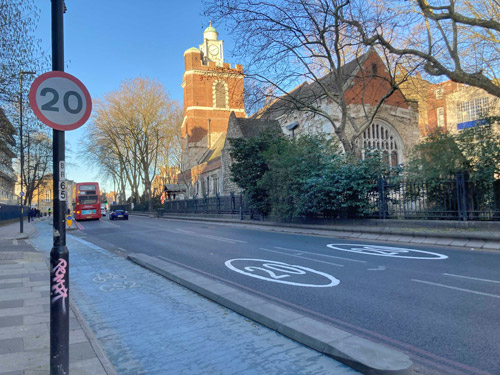
On Sunday, and for many previous decades, you could drive along Bow Road at 30mph. But on Monday, without so much as a whimper other than the emergence of much signage overnight, the maximum speed was suddenly 20mph.
Bow Road is part of the A11, the main road from London to Norwich. It's also part of the Transport for London Route Network, or TLRN for short, as are many of London's main roads and red routes. This gives TfL jurisdiction over maintenance, parking restrictions and speed limits, no matter what the local council thinks, so if TfL wants to set the speed limit at 20mph they are perfectly within their rights. In this case Tower Hamlets had already decreed that its roads should have a 20mph limit so TfL is merely catching up.
The relevant consultation, entitled 'Lowering speed limits', was launched in September 2021. We've already introduced a 20mph speed limit on all our roads within the central London Congestion Charging Zone, they said, and in early 2023 we intend to introduce a further 28km of such limits within the boroughs of Camden, Islington, Hackney, Haringey and Tower Hamlets. We're also coming for the Gants Hill roundabout, Ruislip Road in Ealing, Upper Richmond Road in Wandsworth and West Wickham. We've made some maps, now brace yourselves.
In Tower Hamlets it turns out 'early 2023' meant 27th February. One road affected was The Highway through Wapping and the other was the A11. The affected stretch runs from the edge of Whitechapel (which had already been twentied) along Mile End Road and Bow Road to the start of the Bow Flyover. It doesn't continue up Stratford High Street because that's not a TfL road, that's still under Newham control.
The newly-restricted section of the A11 is 2 miles long. At 30mph two miles would be a 4 minute journey whereas at 20mph it's 6 minutes instead. That's quite an impediment to free-flowing travel, potentially delaying cars, lorries and buses by multiple cumulative hours. But in reality few drivers get up to 30mph anyway, not least because there are at least a dozen traffic signals between Whitechapel and Bow and they slow down the traffic far more than any speed limit ever could.
The widespread introduction of new lower speed limits is part of TfL's Vision Zero Action Plan, a long term strategy with the laudable aim of eliminating deaths and serious injuries from London's transport network. Reaching zero deaths by 2041 is a ridiculously tough target given the everlasting potential for human stupidity, but TfL are trying to design risk out of our highways wherever they can. If they were truly serious they'd drop the speed limit even lower (why not 19mph? why not 18? why not 10?) but the need to keep people moving thankfully rules out the ultimate mitigatory option.
A lot of 20s now smother various parts of Bow Road and its approaches. Some are actual signs, for example at the point beside St Mary's Church where traffic coming off the Bow Flyover is now expected to slow down. Others have been painted on the road as intermittent reminders or at entrances from sidestreets, in that elongated way geometry decrees when attempting to resemble circles from the driver's seat.
It's all got a bit messy in places, especially where previous 30s and 20s were needed to demarcate the change from red route to sidestreet. Technically no signs are now required here because every road hereabouts has an identical 20mph limit. However the sign painters have been busy adding 20s anyway, and because they've been unable (or unwilling) to delete the 30s, some junctions now have multiple messy numbers.
Here on Addington Road they've added a 20 next to a 30 so good luck picking the correct number. They've also painted the 20 across a lane nobody drives down because it's immediately adjacent to a motorbike park. This is not the work of geniuses.
It's worse on Kitcat Terrace. Here the approach to Bow Road is already occupied by a 30 so the White Brush Crew have simply drawn a 20 in front and hoped for the best. This means traffic approaching the A11 first encounters a 20 and then a 30, which might be legally suspect were it not for a 20 sign on the pavement. Worse they've scrawled 20 in fresh paint all over historic cobbles because they couldn't be arsed to paint over the 30 at the end of the road. A few months ago a utility company drilled a long trench down Kitcat Terrace and painstakingly returned the cobbles afterwards to retain the illusion of Victoriana. However TfL's contractors have just blundered in, scrawled and buggered off.
And here's an impressively futile sign on Albert Road. 20mph ahead, it says, because you're exiting a 20 zone. It used to say 30mph ahead so the sign made sense, but for some reason somebody's kept the old 20 while adding a new 20.
Main roads in Greenwich, Lewisham, Lambeth, Southwark, Wandsworth, Merton and Kensington and Chelsea are next in line for lowered speeds, apparently by the end of the year, so you too may wake up one day and discover somebody's plastered 20s all over your street. Let's hope the contractors have learned how to paint properly by then.
Wed 1: I don't know what happens when you walk out of a shop without paying, but if it's The Village Deli in Highgate and your card didn't go through then the nice lady behind the counter walks out into Pond Square and gets you to swipe again on her mobile terminal before you can bite into your baguette-based snack. (n.b. This didn't happen to me, I just watched) Thu 2: I made the rookie mistake of entering a tube carriage occupied by a school party heading to the Natural History Museum. All was well until a second school party boarded at the next station bound for the Science Museum. It could have been hell, but instead the children just looked politely at each other's worksheets (and in one case wished they were going to the other museum). I slipped out long before they got there. Fri 3: You hopefully didn't notice but this blog's entire underlying platform for dealing with your comments upgraded this morning - long overdue I'm told. A little bit of beta-testing with the fine folk at Tridentscan swiftly smoothed out any wrinkles and even the Apple apostrophe issue is sorted now, hurrah. Sat 4: ...but OMG what's happened to IP addresses? They used to all be simple four combinations of four numbers (e.g. 82.253.44.165) but now increasingly they're complex combinations of eight hexadecimals (e.g. 2a00:2c35:4028:c01:d1b1:d2ee:5a8a:3fec). I know this is IPv4 being replaced by IPv6 and it's all about safeguarding the future, but it's not exactly person-friendly.
Sun 5: While I was walking up New Road in Croxley I stopped to take a photo of the house I grew up in, instinctively, and because it's been massively tweaked over the last couple of years. A minute later the new owner arrived, walked up her new steps into her new porch and let herself in, and I was quite glad not to have to have an awkward conversation about what on earth I'd been doing. Mon 6: I considered going for a very long bus ride today, taking advantage of this winter's amazing £2 flat fare offer, until I realised I already had and when I wrote about it you weren't interested, so I didn't. Tue 7: I logged into itvX for the first time to watch Nolly, the Russell T Davies docudrama about Crossroads icon Noele Gordon. It was of course excellent (the drama, not the streaming service), although I enjoyed episode 1 more than episode 2 more than episode 3 which is probably the wrong way round. Wed 8: Aww, the pre-Worboys road sign on Brownlow Road in Bounds Green has disappeared... well, has been replaced by a proper modern easily-readable sign. Thu 9: It's always a pleasure to peruse the travel books along the upstairs gallery at Daunt Books in Marylebone. I was not however tempted by the title '111 Places in Coventry That You Shouldn't Miss'. Other places in the series include New York, Denver, Seattle, Singapore, Iceland, Turin, Liverpool, Bradford, Hadrians Wall, Essex, Poole and Greenwich.
Fri 10: At the end of my walk round Rotherhithe, while waiting for the bus to whisk me away, I spotted the local vicar heading for the Overground carrying a bottle of wine. He waved a friendly wave of recognition and I smiled back, and that's how you know you've been in a place too long. Sat 11: My Dad's operation went well and he's adjusting nicely, and you have already made so many incorrect assumptions about the first half of this sentence that I wouldn't even risk leaving a comment. Sun 12: The Twitter app on my phone pre-dates the Musk era, because I never update it unless I absolutely have to. Alas today he turned off the live feed in an attempt to force retrograde users to upgrade, so it's now permanently mid-morning on the 12th February. However he hasn't turned off lists, direct messages and the ability to tweet, so up yours Elon. Mon 13: Down by the Grand Union an unsupervised pug stared me off, then came charging towards me, and I yelled so loud that the owners eventually emerged from the towpath and wondered how their coochyickledoggie could ever have alarmed anyone that much. Tue 14: I posted my brother's birthday card yesterday afternoon and I'm pleased to say that first class mail still works, even overnight before Valentine's Day. Wed 15: The 385 may be London's friendliest bus route. The driver was so chirpy and chatty, not just with her regulars but also with me who she'd never seen before. When I dinged the bell to alight I was surprised when she pulled up 20 metres short, but it was all to ensure that one very special passenger could alight immediately outside her front door. "Nobody else gets that privilege," she said. Thu 16: Hi Joseph, sorry it took me so long to notice. That is quite someevaluation, although I'd disagree with four of your presumptions. BestMate nodded along throughout. Given where we met I'd say touché.
Fri 17: There's a Portuguese restaurant on the edge of Willesden called Dollis Grill, only a few steps from the obvious tube station, and I presume the location came before the name. Other London suburbs should follow suit. Sat 18: A 2007 spider map is still posted up outside Hounslow station and it may be the oldest bus map in London. I'd like to report that it remains correct but no, one of the routes was massively tweaked five years ago so by rights it really should have been replaced by now. The modern alternative, alas, is probably no map at all. Sun 19: My nephew has just got engaged. If you remember his first appearance on this blog, visiting the capital for the first time, the evolution from 'can we go to Hamleys?' to 'living with fiancée on the 18th floor' is quite unnerving. Huge congratulations both. And so it begins... Mon 20: My tweet about the closed shops on Hackney Walk has subsequently inspired a ten minute segment on BBC Radio London (which you can listen to here) and also a story on the BBC News website. They wanted to interview me but Nick was a much better choice. Tue 21: Today I met The Shrieking Woman of Sydenham. She walks up to you outside the shops, asks for money in a loud voice and if you refuse screams at you to f*** off. She does this repeatedly, despite her behaviour plainly encouraging nobody to contribute, and you can hear her vituperative shrieking as she progresses down the street. (I assume she's a fixture, but if not then I must've just got unlucky) Wed 22: You always know the battery in your smoke alarm is going to fade away, just not when. So I'd like to thank it for starting to beep at 7.05am and not one, two or even worse three hours earlier. Thu 23: Nobody commented on the fact that I published a carbohydrates wordsearch just before my review of Apprentice cafes, but if you check the top left corner of the grid hopefully you'll see why.
Fri 24: I remembered to walk down to Three Mills at spring tide to watch the waters of the river Lea flooding across the towpath. But I hadn't remembered stout footwear so decided it was best to walk back the way I came. Sat 25: Spring update: In the Isabella Plantation in Richmond Park only the camellias have so far burst forth, indeed many of their pinky-white flowers have already fallen. Elsewhere across London this has been the week the cherry trees erupted, so it's a shame that temperatures have dropped and the sun's barely been out because no bees will be going anywhere near that blossom for the foreseeable. Sun 26: A year ago when I renewed my annual z1-3 Travelcard I added £20 Pay As You Go. I still haven't spent all of it. Mon 27: It was lovely to meet one of you at the opening of the new Bank station entrance, and I'm sorry if I got in the way in one of your photos. My photos have so far been seen by about 300 people on Flickr, 3000 people on the blog but 300,000 people on Twitter, so that was a useful morning's work.
Tue 28: I dropped in at Swiss Cottage library to see the exhibition Like Gods. Artist Ruth Beale has been down in the stacks interviewing her dad about his science fiction collection, some of which is on display, plus all the library's sci-fi books have been relocated to eight letter-shaped shelves. It's a fifteen minuter at most but intriguing, and with the added bonus if you've never been of poking round Swiss Cottage library, the interior of which somehow resembles a Sixties space liner.