Today's post is about the words you see on small convenience stores and how they've changed.
I was inspired by this sign I saw outside a shop in Swiss Cottage.
Newsagents • Cigarettes • Ice Cream
You don't see combinations like that any more.
Newspapers aren't the daily draw they used to be, Cigarettes have been leapfrogged by a selection of fragrant vapes and Ice Cream is no longer an occasional treat. If you've only got space to advertise three things your shop sells, you'd no longer choose newspapers, cigarettes and ice cream. If I were trying to date this old sign I'd probably suggest the 1980s, give or take a decade.
The National Lottery makes an appearance underneath, another corner shop staple, and even that's 30 years old this year.
But still not very recent. Mobile Topups are way past their heyday, ditto Phone Cards, and although some punters still buy them they're pretty archaic as the wider public goes. Even Frozen Food is nothing you'd boast about these days given most stores have at least a chiller cabinet. If I were trying to date this sign I'd probably suggest the turn of the century, maybe a couple of years after.
This next shop, which has a suspiciously similar name, is just around the corner.
This time they've repeated the list on the shopfront and the awning, although on the latter Toiletries has been replaced by a repetition of Cold Drinks. Note how there's much more of an emphasis on consumables bought on impulse, something for eating now, and on items you might need to top up your larder or cleaning cupboard. If I were trying to date this sign I'd probably suggest sometime in the last decade (and having checked on Streetview it's actually 2021).
Jumping to Arnos Grove, here's another convenience selection.
Off Licence • Grocery • Newspapers • Oyster • Paypoint
Oyster is an awning staple on many a London shop, or would have been during its heyday, and Paypoint is another minor financial service targeting money-conscious punters. Newspapers are still mentioned even though the shop no longer sells them, indeed I've lost count of the number of times I've gone into a so-called newsagent to discover they're now paper-free. Having checked on Streetview this awning is actually from 2014, and previously said Continental Food • Off Licence • Newspapers • Bus Pass • Pay Zone.
This shop's just round the corner from me and looks somewhat dated.
Confectionery • Tobacconist • Oyster • Convenience Store Fruit & Veg • Lottery • Oyster • PayPoint • Newspapers
Here's the classic Confectionery, a word that's tempted many a sweet tooth inside a corner shop, probably for over a century. These days you'd just write Sweets because it's an easier word and not everyone speaks good English. Tobacconist is another longstanding retail term that's increasingly fallen out of favour. But the list here is full of popular classics repeated on shop frontages across the capital, if not especially current. If I were trying to date this shopfront I'd probably suggest sometime around twenty years ago (and having checked on Streetview it's actually 2010).
Up at Turnpike Lane, this is more typical of many a modern shop.
Off Licence • Groceries • Fruit & Veg • Cash Machine Bulgarian • Romanian • Polish Food • Off Licence • Grocery • Vegetable
Non-English food is always a draw for a particular clientele, here eastern European but could be South Asian, Turkish, whatever. Also if your shop's an Off Licence always plug it prominently because that triggers many a passer-by to drop inside. The fascia looks very new, indeed it's post pandemic, but note the prominent mention of a Cash Machine because many Londoners aren't card wavers and phone swipers, they still rely on hard notes. The awning is older, and if you're niggled by the singular appearance of Vegetable rest assured it's much better than the 2008 version which said Buss Pas.
Finally here's a shop which opened a year ago by the Bow Roundabout.
It's all gone a bit gentrified, unapologetically so, with pride of place now given to organic and vegan offerings. There isn't really a Bakery inside the store but that single word will have attracted many locals seeking a mass-produced croissant for breakfast or a goo-filled pastry snack. Older corner shops would never have mentioned Dairy Products - milk would have been a given - but these days it's all about helping you stock up your fridge between online supermarket deliveries.
The words on small convenience stores have evolved over many decades, and will continue to do so, and I suspect there's a thesis in this somewhere.
But TfL said no. They didn't have a problem with Underground stations because they've already published data for the depth of Underground stations, they did that in 2022 (and indeed in 2011). If you want confirmation that the platforms at Pinner are 53m above sea level and at Covent Garden 14m below, they're perfectly happy to tell you. As obscure spreadsheets go, that one's nerd level. But they won't add the Overground or Crossrail to the list, they point blank refuse.
TfL are quite within their rights to restrict this under Section 38(1)(b) of the Freedom of Information Act, and they're doing it because Crossrail is regulated differently to London Underground.
They say they don't believe the purpose of the FoI was in any way terrorist-related, but minimising risk takes precedence over "the interests of a select few individuals or transport enthusiast groups".
But this is hardly top secret information, the data must be out there somewhere. So I asked myself "OK, how deep are all the Crossrail stations? I'm sure I can work this out."
I started by going for a ride on a purple train. I started at Stratford where the station is above ground, and used an app on my phone to display the height above sea level. It told me the Crossrail platforms were 8.8m above sea level, then 8.9m, then 8.6m - the number never really settled down. Also I was holding my phone in my hand which technically wasn't at platform level, maybe almost a metre above, so the actual result was more like 8m. Then I realised I could check in the official TfL Underground spreadsheet because Central line trains stop immediately alongside, and that said 7.2m instead. So my app wasn't very accurate.
Also once my train entered the tunnel at Pudding Mill my phone stopped being able to register heights and just stuck on the number it had said when we entered the portal. This continued all the way through to Paddington and beyond, even when I managed to get 4G or a wifi signal, so I realised measuring it myself wasn't going to work. No GPS, no data.
So I searched on Google instead. Things were a lot less secretive during Crossrail's construction process, back when press coverage was all about amplifying how amazing the engineering was. But TfL have summarily deleted the Crossrail website since, every last page of it, so I had to rely on other websites and how they reported things during the years of construction. It proved surprisingly difficult.
The most useful webpage I found was an opinion piece from the Architects Journal published in May 2016. The author was mostly unimpressed by the station architecture but ended with a list of facts including the depth of every central station below ground level. So this sounds definitive.
Severalwebsitesconfirm that Liverpool Street is indeed the deepest Crossrail station below ground level, because superlatives are more widely publicised than individual figures. Woolwich is the subterranean station closest to the surface, and yes those escalators at Whitechapel and Bond Street really are really long.
But that isn't the data the FoI petitioners requested. They didn't want distances below ground level because these are very much at the mercy of contours on the surface which may have no correlation to the tunnels below. What they actually asked for was distance below sea level, and that's even harder to Google for. You can't even calculate it from the depth below ground level without knowing the elevation of the station with some degree of precision.
I didn't manage to find a table or a list of distances below sea level, or even a convincing individual statistic. I did find a good cross section of the route showing all the ups and downs, but it didn't have a vertical scale so it was no use for measurement. Eventually I found a proper schematic cross section on the learninglegacy.crossrail.co.uk site, which is a massive info dump left behind in the hope future civil engineers would find it useful. Here's a jpg of the cross section and here's an enormous pdf.
This cross section shows the tunnel passing through the bedrock, plus the various station boxes and a vertical scale measuring mATD, or 'metres Above Tunnel Datum'. Crossrail (and TfL) set sea level as 100 mATD, because this helps avoid working with negative numbers. Using this scale 120 mATD is 20 metres above sea level and 80 mATD is 20 metres below. No official platform measurements are given on the diagram so all I could do with the map was get a virtual ruler out. I measured the vertical distance between 100 mATD and the station platform and these are the results I got.
Distance above or below sea level
Paddington: 5m above
Bond Street: 3m below
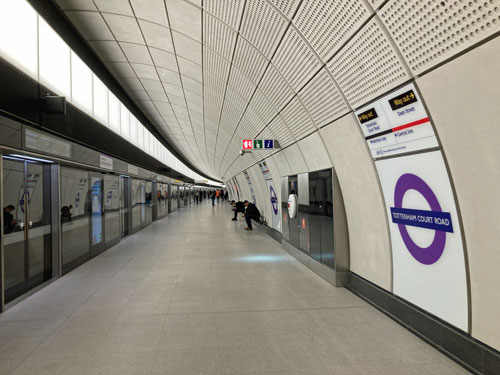
Tottenham Court Road: 2m above
Farringdon: 15m below
Liverpool Street: 23m below
Whitechapel: 14m below
Canary Wharf: 19m below
Woolwich: 7m below
This confirms Liverpool Street is the deepest Crossrail station below sea level, as well as the deepest below ground level. Canary Wharf is unexpectedly second. Meanwhile Tottenham Court Road turns out to be just above sea level, not below, because the West End is quite a lot higher than the Thames. Only six Crossrail stations are in fact below sea level, assuming I've got this right. None of this materially affects national security.
The smallprint on the cross section says "Do not scale off these drawings. The information shown is only indicative and should not be relied upon." Also there's no guarantee my measuring or calculations are correct, so don't take this as gospel. But it looks right, unless you tell me different, and in the absence of a successful FoI it's the best data we've got. If TfL won't tell you something, work it out for yourself.
There was once an A2024 heading east out of Chichester, but a WW2 airfield severed that so the B2024 is now all we have.
It's 3½ miles long, starts in Kent, ends in Surrey and comes within a mile of Greater London... twice. It's also a climber, tackling the scarp of the North Downs to terminate at its highest summit. Which is not bad for a B road.
It kicks off in the middle of Westerham, a proper Wealden town with a coaching inn, tea rooms and a historic high street lined by independent traders. This road doubles up as the A25, which used to be dreadful for traffic until the M25 whisked most of it away, of which more later. Much of Westerham's charm is because it never gained a convenient rail connection to London so never fully expanded, but you can get there by London bus from Bromley so I sped in without much difficulty.
The B2024 bears off to the north at the end of Market Place, just past the Co-Op and opposite the slightly pretentious apothecary. It's signposted towards Croydon although the road has no intention of getting that far, instead merging into the B269 at the top of Titsey Hill. The road's immediately residential, and also turns out to be the place where shoppers driving to Westerham park their vehicles, dropping at least 50p into a machine for the privilege. A few nice old houses start things off, the most striking being a converted oast house called The Oast House, but things swiftly get more suburban. Raise your eyes above the rooftops and as the road gently descends it reveals a distant green escarpment above a thick stripe of woodland.
The first point of interest is the town's fire station, a postwar brick building hosting a single vehicle, where I observed the crew engaged in some kind of minor exercise around the back. On the second bend things gets a bit bungalowy, and after that a clear social divide sets in with a few lucky souls in rambling detacheds on the right and the general hoi polloi on the left. Before long the road passes the town sign ("twinned with Bonneval") and the speed limit rises from 20 to 30 to do what you like. The last structure of any significance is the Westerham Pressure Reducing Installation, now an ugly mess of pipes but for almost a century the site of the Westerham Gas and Coke Company which supplied gas to the town. And then the pavement runs out.
I like a country walk but three miles along a semi-busy B road didn't appeal. There was at least a verge but it was a bit mushy and I wasn't sure how far it might continue. Fortunately I'd planned for this in advance and was ready to ride the only bus route that runs the length of the B2024, Metrobus's 595. It runs only three times a day, one of which is early evening, so I made sure I was in town for the first journey at noon. I had to ask for a ticket to Titsey, which I managed with a straight face, and yay it's still only £2 to take an out-of-London bus. We reached the gasworks on the outskirts of town in a jiffy and there, just around the next bend, was the M25. Westerham wasn't gifted a junction of its own so from down here to up there would require at least an 8 mile drive.
Beyond the motorway are recently clipped hedges, sodden fields and insufficient farm cottages to keep a bus service in profit. As the road bends briefly to the north two things happen. On the right-hand side a vineyard appears taking advantage of the lower downland slopes. It's owned by the Squerryesestate, the local Westerham landed gentry, whose brut and rosé have won a number of awards and whose Champagne Experiences are advertised as being helicopter-accessible. The field on the left-hand side looks less interesting but is actually the first field in Surrey because we're about to switch counties. The precise crossover point is at the junction with the Pilgrims Way, a track that was once a walking route to Canterbury following the spring line at the foot of the chalk ridge.
And then the climb steepens, but not too severely because whoever first laid this road had the sense to send it diagonally up the scarp. One further farm puts in an appearance, and another can then be seen down below surrounded by a swirl of muddy tracks. Being winter the view through the trees was increasingly impressive, looking far across the M25 towards the High Chart, but my fellow passengers were nonplussed and continued to stare ahead or down at their phones. The next single track road to join us is called Rectory Lane, but within a few hundred metres becomes Clacket Lane, the minor road after which the M25's southernmost service station is named. There are no other McDonalds within a five mile radius.
The 595 bus runs the full length of the B2024, pausing near the end to make break for a double run to Tatsfield. This is the chief reason why it operates, to provide these Surrey villagers with a link to Westerham or Oxted, not to serve the sparse folk inbetween. I rode the bus to the very end of the road where I was kindly dropped off, but then walked back to the foot of Church Lane enabling me to describe the remainder of the road in pedestrian detail. I recognised this minor junction, and you might too because it's where the North Downs Way long distance footpath crosses the B2024. A few steps led me down through a wood to a chalky footpath along the top of a ploughed field where I disturbed an unflappable pheasant. But I was most taken by the landscape, indeed a shaft of light though showery skies made me audibly gasp.
This is why following an insignificant B road with the same number as the calendar year into the middle of nowhere is in fact an excellent idea, because why else would anyone find themselves beside a circle of stones as the midwinter sun illuminated the rolling Weald? If you need a better excuse to visit try the Titsey Tap Room across the road, a microbrewery of five years' standing offering IPA, pale ale and rotisserie chicken. I fear the Titsey branded hoodies sell well, and I'm mildly suspicious that the head brewer's name is truly Chris Vroom, but alas the big shed is only open to the public from Thursday to Sunday so I missed out. Looks tempting though. And onwards up the hill.
It looks gentle but it's quite some hill - higher than anywhere in Greater London despite being only half a mile from the boundary. A radio mast has been plonked in the middle of a field at the point where the contours hump, and marks the location of the BBC's former shortwave-friendly Tatsfield Receiving Station. At the nearby crossroads is an old wooden bus shelter for the use of people who, because absolutely nobody lives here, must've walked a very long way to reach it. For the road's last half mile a broad verge offers respite from the traffic, or you could take a lower footpath through the trees but after recent weather that demanded intermittent wellies and I'd only brought walking boots.
The B2024 terminates at a mini roundabout on the B269 which is the main road from Oxted to Croydon. A small car park welcomes walkers to the TitseyPlantation and also marks the top of the most breathless climb on the North Downs Way. The trig point which officially marks Botley Hill's 269m above sea level is a short distance along an unclassified road, and a farmhouse inn (welcoming mostly drivers) can be enjoyed just up the Croydon Road. Being here in spring or summer offers more options, to be honest, but the peak of the North Downs is a fascinating spot to have been deposited by the ridge-climbing B2024. The B2025 lurks at the foot of Titsey Hill, a brief connector within the village of Limpsfield, but looks to be a complete disappointment in comparison so I doubt I'll bother B roading next year.
Only one London postcode area reaches the heady heights of 24 (because N tops out at N22). Come with me to Herne HillSE24.
24 things to see in SE24
1) Visit Brockwell Park
This is the obvious place to start, one of London's finestparks perfectly plonked on a small hill with commanding views across much of central London. It covers 125 acres and surrounds Brockwell Hall which used to be the country seat of glass merchant John Blades. Don't come to see the house right now because it's undergoing major renovations to make it more accessible to the wider community, for which read "a building Lambeth council can hire out". As a result the normal cafe has been temporarily replaced by a couple of trailers and while the burgers may be cheap it's really not the same. In the summer this is a popular spot for festivals including the iconic Lambeth Country Show, but even when Chucklehead is not available the park is always a lovely spot for a proper perambulation.
2) Enter Brockwell Park's Walled Garden
Forgive me if I mention Brockwell Park more than once, but somehow I have to stretch this list out to 24 things. The walled garden is proper lovely though, an oasis of calm and also the ideal place to hide away on a bowery bench and vape with your hoodied mates. Do look out for the assortment of model-village-style houses on your way in which are of wartime vintage. Also I can confirm that at least one pink rose is still in bloom.
3) Dip in Brockwell Lido
This is a much-loved Art Deco facility where outdoor swimming is enjoyed all year round by hardy folk and during the summer months by more normal people. A swim will set you back £8, or you can pay £340 for an annual season ticket which is an even better deal in a leap year. The Lido Cafe is firmly under the control of Four Hundred Rabbits, a sourdough specialist, so I hope you like pizzas.
4) Ride the Brockwell Park Model Railway
At just 220m in length this is even shorter than the minimal tube journey between Leicester Square and Covent Garden. But here you get to sit inside tiny carriages open to the weather, plus they haven't raised the fares since 2003 so it's still only £1 return. Just don't turn up unless it's a Sunday and don't come before the start of March because it'll still be closed for the winter.
5) Explore the Rosendale Estate
This is an extraordinary 20 acre residential backwater just behind the railway near the southern end of Brockwell Park. It was built in 1901 as one of Peabody's early 'garden city' social housing experiments, and is half large mansion blocks and half rustic gabled cottages. The cupola off the top of the original hall was relocated at ground level when the estate was spruced up in 2012 and a new community centre added. It definitely merits a wander, if only to see how cohesive social housing used to be created. Walk out the back and you suddenly find yourself climbing a small summit into Peabody Hill Wood, and I suspect there's an entire post to be written about the utter unusualness of all this.
6) Zoom round Herne Hill Velodrome
The velodrome is another of SE24's top treasures, a raised loop where keen bicycle riders have been going round and round in ovals since 1891. In 1948 the cycling events at the London Olympics were held here and good old Reg Harris stormed to win the silver medal in the 1000m matched sprint. I was pleased to be able to walk straight in for a gawp, and that is a very impressive new grandstand. Bradley Wiggins learned to race here and Michael Crawford was also a keen visitor during his schooldays.
7) Meet Michael Crawford
But to meet him you'd need to have been here in the 1950s when Michael Crawford was a schoolboy and living in a flat above number 16 Half Moon Lane. It's because his dad was a grocer and had moved from Bexley to run the David Greig store underneath. It's now a vegan restaurant called Peachy Goat, and because this is Herne Hill it's Italian-themed to boot. Again there's no plaque although a Southwark Heritage version has recently been proposed.
8) See where Sam Mussabini lived
If you've ever watched the film Chariots of Fire and wondered where Harold Abrahams' athleticscoach lived, that would be here at blue-plaqued 84 Burbage Road. His real name was Scipio Africanus Mussabini and 100 years ago he was responsible for training our team for the Paris Olympics. I learnt all this backstory from a seriously informative information board under the Burbage Road railway bridge because the Dulwich Estate is very good at that kind of thing.
9) Explore Delawyk Crescent
If postwar housing is your thing, and for a lot of readers I suspect it is, you'll be wanting to make a pilgrimage to Delawyk Crescent. It's a Radburn Estate, i.e somewhere that pedestrians and vehicles are kept separate, so the cars go round the edge and the centre is a maze of 107 dwellings interspersed with staggered walkways. It's not must-visit, just peculiar in a mid Sixties manner, and I bet its layout particularly annoys the Deliveroo bikers.
10) See where a Prime Minister lived
It's only James Callaghan so not in the upper half of the premier premiers, and he wasn't actually PM at the time, indeed it was 1967 and he'd just resigned as Chancellor. Forced to leave 11 Downing Street in a hurry he hunkered down at a rather less exciting address, 7 Carver Road, a prim semi just off Half Moon Lane. There's no plaque but if you've never seen a house with a diagonal-facing porch I guess that's something.
11) Sail a boat to the Half Moon pub
Admittedly you can only do this if a particularly large water main has burst, as happened in 2013 flooding dozens of properties at the west end of Half Moon Lane. But best it never happens again because the pub took three years to reopen, which suggests serious damage, so if you did ever come by boat you'd probably find your usual tipple was unavailable.
12) View SE24 from the railway viaduct
You get a great view from up there, especially over Brockwell Park.
13) Go bijou shopping
For this you'll be wanting the street outside the station where the shops are a super lovely mix of street cafes for grazing, arty types, haberdashery, prime meats, little gift things and cobblers. For a significant proportion of SE24 residents the existence of a Gail's Bakery on their doorstep justifies their mortgage payments.
14) Go Effra-hunting
South London's most lost river once ran through SE24, partly along the line of the railway and partly along the northern edge of the park. For evidence of this look for the stinkpipe opposite the lido which now emits noxious smells above the Dulwich Road, and at its foot you should find one of the gorgeous swirly Effra plaques added along the former watercourse in 2016. The information board on the grass alongside is properly informative too, particularly if you've ever wanted to see an Effra map.
15) Find Winifred Atwell's plaque
It's not an official blue plaque but it is blue and it's located at the top of Chaucer Road. You'd think it'd be for her piano playing but no, it says Multimillion Disc Selling Impresario Winifred Atwell 1914-1983 Opened The UK's First Black Hair And Beauty Salon On This Site In 1956. A fabulous first to celebrate, but unless you like housing association flats there is no longer anything to see.
16) Hang out at Dexters SE24 is a ridiculously complicated shape and includes all sorts of railwayside slivers and tentacle-like protuberances, one of which is a tongue of Railton Road stretching almost to Brixton. After the riots in 1981 a vacant space was created on the site of a demolished row of terraced houses, and the rubble was eventually repurposed as a community-based adventure playground aimed at giving local youth something better to occupy their time. Prince Charles visited a couple of years ago but didn't avail himself of the swings, ropes, big slides and monkey bars.
17) Admire the postbox toppers
An anonymous crocheter nicknamed postboxhappy goes out around Herne Hill and covers the tops of pillarboxes with colourful woollen creations. I found Spongebob Squarepants, a bed of roses and an oddly shaded pigeon, the latter facing Sunray Gardens. I was going to include the mini park at Sunray Gardens in this list, but to be fair the pigeon was more interesting.
18) Borrow a book from the Carnegie Library
This is a gorgeous building, all ornate Edwardian with terracotta frontage, and opened as a public lending library in 1906. Lambeth council did their best to kill it off in 2016 for austerity reasons, triggering massive kickback, celebrity endorsements and an enraged sit-in. A reduced service restarted in 2018 with the occasional librarian supervising, and arguments continue as to which group of trusted overseers should take it in hand. Still looks gorgeous though.
19) Find the Red Post
There really is a red post at the top of Red Post Hill and it's known to have existed since 1768. The current fingerpost only dates from 2010, however, and points towards farflung destinations like Sydenham 3 and London 4. It's also London's only entirely red signpost, but you probably guessed that.
20) Visit Sunray Gardens
I know I said I wasn't including this but I'm getting near the end of the list now. Sunray Gardens has grass, a playground and a lake, and the lake used to be a fishpond in the grounds of Casino House, a local mansion.
21) Down a pint at the Tulse Hill Hotel
It may be a genuine hotel with nine boutique rooms but it also has a public bar underneath which you could pop into if your train from Tulse Hill station is delayed. SE24 has many pubs and this one isn't necessarily recommended, but I've included it to prove I walked all the way down to the southern end of the postcode and this is all I found.
22) Walk the length of Shakespeare Road
This single long road beside the railway viaduct is inexplicably in SE24 whereas everything beyond it is in SW9. Admittedly it's quite isolated, even more so since they closed the southern end to traffic and painted poems across the street. Apparently Sinead O'Connor died in a block of flats at the Loughborough Junction end near the Coldharbour Works, and I've only included it to prove I walked all the way up to the northern tip of the postcode and this is all I found.
23) Go back to Brockwell Park and don't set your watch by the clocktower
It was 52 minutes fast when I checked.
Yesterday I attempted to buy a pint in the 24th pub on the A24. Let's see how I did.
The A24 is a major trunk road linking London to Worthing in Sussex. It starts outside Clapham Common tube station and follows the Northern line down to Morden, then continues through Cheam, Epsom, Leatherhead, Dorking and Horsham.
The big question is, how far down the A24 do you have to go to find the 24th pub?
This is the start of the A24 where it bears off from the A3 at the top of Clapham Common.
1) The Windmill(Clapham Common South Side, SW4 9DE)
The first pub on the A24 is named after a windmill that no longer exists. It's a big freestanding pub on the actual common, just before the Eagle Pond. It makes a big thing of its Ginger Pig-sourced Sunday roasts. It doubles up as a hotel with 42 boutique rooms, but it's still definitely a pub...
2) The Rookery(69 Clapham Common South Side, SW4 9DA)
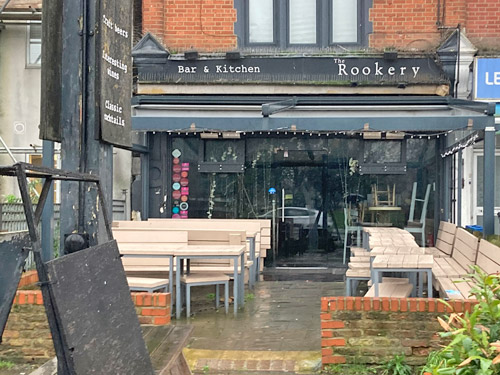
...whereas this might not be a pub. It describes itself as a 'bar and kitchen' and has sit-down tables rather than cosy seating. But it has an old pub sign outside, it offers craft beers and if you look through the window it has a bar which looks very publike. I decided it counted as a pub, but I now had a new question - "What exactly is a pub anyway?"
Where do they get these names? This pub claims to be dog-friendly, party-friendly and is currently hosting après ski fondue parties on Saturday nights. It faces the southern end of the common and is very Clapham. I'm glad it wasn't my 24th pub else I'd have had to go in for a pint.
These two fill the gap between Clapham South and Balham stations. The Avalon is a free-standing redbrick boozer with a huge awning out front. It looked more like a restaurant but I stood by the door and it definitely smelt of pub. Meanwhile The Devonshire looked like a more standard pub-on-a-corner and was the second Young's of the journey. It offers doggy roasts, carefully curated cocktails and its chosen hashtag is #BevAtTheDev. A bit cringe, but nice windows.
These are the two pubs by Balham station. Neither looks much like a pub, more a converted shop. The first was acquired by Antic in 2013 who gave it a cosy vintage vibe, and a long garden hides out back. Its website is a bit smug though, claiming "Your favourite pub? Probably." Meanwhile the Cyclist used to be a Wetherspoons until 2019 and is now a lot more gastropub. Seven pubs in just over a mile - we're going well...
...but there are no pubs between Balham and Tooting Bec stations, none at all. If you want a coffee, some chicken or a haircut you're spoilt for choice but a pint? No. The Wheatsheaf is an imposing chimneyed pub on the corner outside Tooting Bec station. It's owned by the same company that owns The Cyclist so it's also gone a bit gastro. The King's Head is a splendid Victorian confection, rebuilt in 1896, and is supposed to look even more amazing on the inside. Alas it's only pub number 9, not pub number 24.
The exterior says 'established 1832' but the current building's much more 1932. In its time it's been a music hall venue and a blues club attracting some big names. It's the third Young's of the journey and you'll find it just before Tooting Broadway station. Claims to have "the best beer garden in SW London". I didn't check out back but I bet this is a lie. Also claims "the best food in SW17", ditto.
And here's my problem - I missed both of these. I had them on my draft list but I walked straight past without noticing either of them. I blame the fact that the weather yesterday morning was atrocious and I was battling with an umbrella, but all the same I should have spotted them. Instead I assumed they'd closed, and I didn't check this on my phone because it was raining. And what this omission of course means is that my count was incorrect from this point onwards so I was always destined to enjoy my pint in the wrong 24th pub.
This really is the 13th pub (but I was assuming it was the 11th). It's another corner pub but with a somewhat faded exterior. It describes itself as "a warm and casual Gastro Sports Pub" so is ideal if what you want is baby squid light bites and a game of shuffleboard. We're now three miles into my quest, and if we really are over halfway this bodes well.
14) The Royal Standard(180 High Street Colliers Wood, SW19 2BN) 15) The Charles Holden(198 High Street Colliers Wood, SW19 2BH)
The Royal Standard is the first pub on this journey not to have its own website. It's a one-room old school boozer where the advertised highlights are "TVs and music". They're advertising for staff if you fancy dropping off your CV at the bar. The Charles Holden has a good reputation, having been renamed in 2013 after the architect who designed Colliers Wood station. On its website, however, it says "we are primarily a rugby pub", then adds "if you're not a rugby fan, don’t worry - we show many other sporting events" so if you're expecting tube nostalgia think again.
At Colliers Wood the A24 deviates from its original course by following an old railway alignment along Merantum Way. This takes it away from old roads with pubs and diverts it past a retail estate and the Merton Abbey Mills complex. The latter contains the William Morris pub, which is too far from the road to count, and The Watermill grill. This might better be described as a restaurant but it promotes its alcohol offering very prominently and is already full of grizzled drinkers by 11am. You could argue it's neither a proper pub nor quite on the A24, but it's near enough so I'm counting it.
17) The Prince of Wales(98 Morden Rd, SW19 3BP)
This looks pretty basic, but if that means it's not full of yummy couples and sourdough-seeking tipplers perhaps that's for the best. The chalkboard outside says you can buy three pints of Fosters or Strongbow for £10 between 7pm and 9pm Monday to Thursday, so more fool you if you normally fork out £7 a pint elsewhere.
18) The Royal Surrey(1-9 Abbotsbury Road, SM4 5LH) 19) Ganley's(43-47 London Rd, SM4 5HP)
We've finally reached the end of the Northern line at Morden. The Royal Surrey sits beneath a Snooker, Darts and Social Club and has a silvery Wetherspoons feel. It also has four grumpy notices on the door about dogs, bikes, scooters and "please note toilets are for paying customers only" so I'd give the place a miss. Ganley's is an Irish bar with blazing green frontage and Celtic patterns, so naturally offers punters Guinness and the craic. We're five miles down, and five more pubs will finish this.
But now suburbia begins and the pubs start thinning out. The next two miles bring just two more drinking establishments and one of these is a Harvester. But it does have a proper pub name - The George - and apparently it's the UK's very first Harvester and was opened in 1983. At the foot of Stonecot Hill is the The Lord Nelson, a 200 year-old coaching inn, at least in name, although the current building is a 1936 modernisation of an 1859 rebuild. Don't rush to see it.
I missed this pub too, first time round. I'd finally given up walking in the rain and was aboard a bus with very steamed up windows so I never spotted it from the upper deck. This meant I was now three pubs adrift from the correct total, which isn't going to be good news for how this story ends. I only spotted this Wetherspoons on the bus home, just behind a giant lorry unloading fresh New Year stocks. You'd think 2nd January might be the least busy day for pubs nationwide but this one had multiple smokers spilling out onto the street.
After 8 miles and 22 pubs I'd finally reached the Greater London boundary. I could have given up at this point but the 293 bus continues all the way to Epsom so I carried on. Alas there were no new pubs. The bus passed four in the middle of Ewell - The Spring Tavern, The Star, the Green Man and the Ewell Tap - but unfortunately by this point the A24 had been sent off round a new bypass past no pubs at all. Even a return to populated streets didn't help and it was ultimately three whole miles before pub number 23 appeared, just before the railway bridge in Epsom.
23) The Rifleman(5 East Street, KT17 1BB)
This one's house-sized and a Greene King hostelry. I wondered if it had closed but then I saw two ladies walking out with smiles on their faces so I assumed not. I fully expected Epsom High Street would swiftly deliver pub number 24 but alas it was not to be. The Faraday looked promising but was marginally on the B284, and three other town centre pubs were only on the A24 gyratory if travelling in the opposite direction. Instead I had to continue past beyond the entire shopping centre almost as far as Epsom General Hospital and there, finally, was my destination.
24) The Haywain(2-4 St Margaret Drive, Dorking Rd, KT18 7LB)
And it was a bloody Brewers Fayre, a pseudo-pub restaurant attached to a Premier Inn. This is not the hostelry you want to find at the end of a damp, exhausting 12 mile journey, especially if you've promised yourself a refreshing pint.
However you may remember I'd failed to spot three pubs on the way down so I actually thought this was pub number 21 and had no intention of going inside. I scanned ahead on a map and decided pubs 22 and 23 were in the village of Ashtead on the outskirts of Leatherhead, another two miles ahead, that's The Brewery Inn and the delightfully named Leg of Mutton and Cauliflower. Pub 24 would then have been The Lincoln Arms outside Dorking station, six miles beyond that, and I really couldn't be bothered to catch the train all the way down there. So I threw in the towel outside The Haywain thinking it was pub number 21, when in fact I was outside pub number 24 and had in fact achieved my goal.
Such was the uselessness of my "24th pub on the A24" challenge. I went home and made myself a cup of tea instead.
A New Year means new digits, and new digits mean a series of posts about the number 24. I've chosen to start with London's oldest unchanged bus route, the 24's north/south run from Hampstead down to Pimlico. Rest assured I won't be writing a full travelogue because I did that back in 2012 when the route celebrated its centenary. Even if you're no enthusiast, bear with me through this write-up because it takes an unexpected seasonal turn in the middle.
Route 24: Hampstead Heath to Pimlico Length of bus journey: 7 miles, 50 minutes
Welcome to South End Green near the Royal Free Hospital. This is where you end up if you arrive in Hampstead by Overground rather than by tube, near the foot of the Heath surrounded by some quite nice cafes. Bus drivers have their own Victorian shelter to hide inside plus convenient underground conveniences, while their empty vehicles loiter on the cobbled stand. I was inordinately pleased to get this doubled-up photograph, although I see it's essentially exactly the same as I took last time only with newer buses.
It's not a busy spot early-ish on New Year's morning, not this soon after thousands of collective hangovers, but the sober and the elderly are already out jogging, walking their dogs or buying their daily paper. Absolutely nobody is keen on heading into town at this time so I get the entire bus to myself for the first four stops. Some of the more over-optimistic residents of Agincourt Road have forgotten that today's bins aren't being collected until tomorrow. On Southampton Road Camden's streetsweepers are out clearing up the night's excesses. How is this bus still playing that bloody Hold the handrails message six years after that misguided project was aborted?
This ride is noticeably downhill, courtesy of the former river Fleet, descending all the way to the Chalk Farm Road. Here the doors of Camden Market are already flung open but few takers have yet arrived, and locally it's mainly only the coffee shops that've bothered to open. Southbound through Camden the 24 alas takes the dull backstreets route, skipping the normally busy shopping extravaganza, eventually re-emerging onto the main drag at Mornington Crescent. HS2 cuts across the Hampstead Road like a massive scar, a broad diagonal building site where as yet not enough building has taken place. Routes 27 and 29 also come this way and I fear there may be little more to blog about in three or five New Years' time.
As central London approaches the top of the BT Tower is wishing everyone a happy and peaceful new year, should anyone think to look up. There are, briefly, more people queueing to get into Lidl than are camped on dirty mattresses outside. At Tottenham Court Road a tourist with a giant red case and a Lego branded carrier bag alights to catch the fast train to the airport. This is also where the driver presses the This bus is on diversion message, even though that's not happening for another four stops. Flustered passengers alight early, then watch as the 24 continues gaily down the Charing Cross Road towards the actual obstruction at Trafalgar Square.
For today is the day of the annual London's New Year's Day Parade, a dazzling mile-and-a-half-long stream of floats and marching bands. Its mendacious website claims it's "more fondly known by Londoners as LNYDP", although what most Londoners would actually say if asked is "what is that I have never heard of it". This may be because it takes place while many are comatose, or perhaps because it's only screened locally on TV channel London Live, another concept wildly unfamiliar to the population. But here it is anyway, flooding from Piccadilly down to Whitehall and entirely blocking the path of any undiverted bus.
The parade is an explosion of sheer American razzamatazz, populated predominantly by high school and college pupils flown across the Atlantic especially for the event. Most are brightly costumed with a musical instrument in hand, or armed with pom poms and grinning from ear to ear. Inbetween come the open topped buses, the Pearly Queens and the costumed donkeys, plus a handful of outer London boroughs attempting to fit in and generally missing the vibe. A giant inflatable policeman usually appears, this year held aloft by members of the D'Evelyn High School Tour Choir, because that's the kind of thing foreign audiences associate with London. But mostly it's marching bands with chocolate box plumage and twirly flags, delighting the many millions of earlybird Americans watching on PBS.
2024's weather proved dry enough for the costumes to dazzle without drooping and just warm enough for spandex to be a practical possibility. But not everyone had dressed flamboyantly. The performers on one float were all in black, which it turned out was because one of them was the one and only Chesney Hawkes, doomed to sing The One And Only on repeat all the way from Hyde Park to Horseguards. This is not the kind of thing you normally get to enjoy on the route of the number 24 bus. But after he'd gone it was back to the coloured hats, the spangled banners and the bracing brass as the saccharine pageant continued. If the USA ever chooses to invade London it needn't be with tanks, it could be with tubas on a post-hangover bank holiday.
And yes there are crowds, particularly tourists who happen to be in town anyway and families for whom the LNYDP is a free spectacle which'll occupy the kids for a couple of hours. Branded puffer jackets and Gryffindor scarves are a common sight. Those who've planned ahead and paid up can sit in the grandstands, for which read rows of seats on trailers, which line an improbable proportion the length of Whitehall. Here MCs attempt to keep the watchers entertained, a pop-up shop sells unnecessary souvenirs and the parade participants offer an extra special flourish as they enter the final funnel. Here an inflatable Mayor marks the end of the pizazz, adding precisely zero gravitas to the Cenotaph setting.
With Parliament Square sealed off a horde of New Year visitors were taking advantage of the lack of vehicles to wander willy nilly and take photos, mostly selfies with Big Ben. Westminster Abbey seemed to have a decent tourist throughflow even though Coronation year is now officially over. Even Victoria Street was half closed, with the parade's organisers taking advantage by using it as an official coach park. At least fifteen executive coaches were lined up on either side, each with a sheet in the window denoting high school of origin and a resting driver up front awaiting the buglers' return. And after all that seasonal chaos, just before Westminster Cathedral, the displaced 24 was back on route and I was able to jump back on board.
I joined the poor sods who'd stayed aboard since Soho and been taken on a lengthy joyride over Lambeth Bridge, most of whom alighted almost immediately at Victoria station. From here the 24 is mainly a local bus taking residents and hotel guests back to the environs of Pimlico. After the nice restaurants and an Argos come the capacious stucco terraces and anonymous guest houses, plus a cabman's shelter whose drinks offer has upgraded to include lattes, smoothies and iced tea. The route terminates in a one-way loop around a giant postwar council estate called Churchill Gardens, which feels a world away from the iconic heritage of bustling Westminster.
Drivers lay over in a leafy slot on the Thames embankment, immediately opposite the landmark towers of Battersea Power Station... and blimey that's changed since I last rode the 24 in 2012. Now the parade's over you could safely take a ride yourself, and appropriately it's a 24-hour route so come anytime.
My 2020 niggle arrived during lockdown. It started small. It wasn't much of a niggle to start with, it just came on. They say it happens to most people so I shouldn't have been surprised. It was still a bit of a shock though. The first inkling was several years ago. It's got more pronounced as time's gone on. I was probably lucky to get this far before it happened. It won't ever be going back to how it was. It's probably going to get worse. I've found ways to mitigate it. I've been very fortunate there. I ought to do something about it. I really should have done something about it by now. I assume at some point I'll have to do something about it. You might notice it. It doesn't make me happy. It doesn't worry me. It's going to be annoying though, probably forever.
My 2021 niggle arrived in late summer. It started small. It wasn't much of a niggle to start with, it just came on. It was still a shock though. It wasn't as bad as I assumed it was. They say it happens to a lot of people so I shouldn't have been surprised. I was always setting myself up for it. I was probably lucky to get this far before it happened. It got a lot more pronounced as time went on. It could have been a lot worse. It won't ever be going back to how it was. It's probably going to get worse. I've found ways to mitigate it. I ought to do something about it. I assume at some point I'll have to do something about it. You'd never notice it. It doesn't make me happy. It doesn't worry me too much but it might later. It's going to be annoying though, probably forever.
My 2022 niggle arrived without me noticing. It started small. It wasn't much of a niggle to start with, it just came on. They say it happens to most people so I shouldn't have been surprised. It was still a bit of a shock though. The first inkling was several years ago. It's got more pronounced as time's gone on. I was probably lucky to get this far before it happened. It would be impractical to undo it. It won't ever be going back to how it was. It's probably going to get worse. I haven't bothered finding ways to mitigate it. You'd never notice it. It doesn't make me happy but it doesn't make me unhappy either. I could do something about it but I don't see the point. It doesn't worry me. It's going to be annoying though, probably forever.
My 2023 niggle arrived early in the year. It started small. It wasn't much of a niggle to start with, it just came on. They say it happens to most people so I shouldn't have been surprised. It was still a bit of a shock though. I was probably unlucky it happened this early though. It doesn't feel right. The first inkling was three years ago. It's not got more pronounced as time's gone on. I doubt it'll ever be going back to how it was. It's probably going to get worse. I've found ways to mitigate it. I assume at some point I'll have to do something about it. You'd probably notice it but only in the right circumstances. It doesn't make me happy. It concerns me rather than worries me. It's going to be annoying though, probably forever.
My 2024 niggle is yet to be confirmed. I hope it starts small, can be mitigated, doesn't make me unhappy and isn't too annoying forever. If it could hold off until 2025 that'd be even better.
Jan: Londoners ignore the New Year Parade; the popular blog diamond geezer publishes a New Year quiz but in the afternoon when regular readers aren't expecting it; this year's Apprentice candidates are grating smug muppets Feb: new London bus routes include the SL3 and SL5; it's the year of the Dragon; Pancake Tuesday is followed by Valentine Wednesday; oh it's quite cold Mar: new London bus routes include the 439, 443, S2 and SL2; fares go up; everybody hates the new names for the Overground lines; damn, Easter's in March again Apr: Rishi considers holding an election; Creme Eggs have vanished already; I wish I hadn't started that blog series in January; oh it's quite wet May: Rishi considers holding an election; Sadiq wins his third Mayoral election, Susan does better than expected but not well enough; Doctor Who's back but @Jack4521785 on Twitter isn't impressed; back to the bottom of the Eurovision scoreboard Jun: Rishi considers holding an election; all the football teams lose the FA Cup except one of them; that war gets worse; oh it's quite hot Jul: the Euros AND Wimbledon AND the Olympics (the first two simultaneously); global warming kills lots of people but somewhere abroad; someone online says something you disagree with Aug: another council goes bust; everything's still more expensive; bills are ridiculous; mortgage rates are high but savings rates are low; waiting lists are too long; the rest of your life could be like this Sep: mince pies are back; Hallowe'en erupts prematurely; first poppy spotted Oct: Rishi considers holding an election; the Oxford Street decorations are up; nobody has yet manufactured a pint of wine; it's a shame she's died, I liked her Nov: Rishi considers holding an election; Arsenal really shouldn't have lost that; oh god what if Trump wins again? Dec: Rishi considers holding an election; Sir Keir issues his first Christmas message as PM; everyone publishes multiple tedious predictions about 2025

2024 anniversary quiz