Today I invite you join me on a hill-walking challenge in Kensington. The most well-known hill locally is Notting Hill, but that's a mere bump whereas I'll be tackling a proper summit and taking you to the very top of Campden Hill, a full 42 metres above sea level. Here it is on a topographic map, a raw bruise to the east of Holland Park, entirely untroubled by public transport. [1872 map][2024 map]
Campden Hill rises to the south of Notting Hill Gate, slotted inbetween Holland Park (the park) and Kensington Church Street. It's named after a baronet from Chipping Campden, Baptist Hicks, who built himself a house on open farmland here in the early 17th century. The land was sold off for housing in the 1820s, generally very grand housing with several acres of estate, and has been redeveloped much more densely over the years without ever losing its exclusivity. Thus on today's walk we'll be passing the former houses of poets, philosophers, photographers and detective novelists, even a bouffant Sixties chanteuse, as we climb up to the roof of Kensington.
The best place to set up base camp is on Kensington High Street, a mere 21m above sea level, where you can stock up on vital provisions before striking out for the summit. The nearest food outlet to the start of the ascent is the Orée boulangerie where a small strawberry tartlet will set you back £6.40, or if you prefer something sturdier for your backpack Holland and Barratt do a varied line in oaty flapjacks. I planned carefully and found Kensington Farmers' Market in full flow beside the Central Library, brimming over with sourdough loaves, shiitake trays and bone broth options, not to mention gourmet delights from the Tiny Fungi Wellness Shop. Come on a Sunday if you want to mingle with the smartly-dressed locals.
The mountain trail we seek is called Campden Hill Road, appropriately enough, and wends half a mile uphill from an access point between Santander and Amazon Fresh. Clues to the relative poverty of the local population can be found in the window of Dexters estate agents where the cheapest property starts at £1½m and weekly rents range from £692 to £8000. The path ahead is clear, a steady climb between three-storey stucco villas and the brick bulwarks of Kensington and Chelsea Town Hall, all overshadowed by a line of luscious plane trees. Poet Sir Henry Newbolt is the walk's first recipient of a blue plaque, perhaps best known for "Play up! play up! and play the game!" and less so for dying here in 1938.
The first significant point of interest is a peculiar five-way road junction at the apex of the Phillimore Estate. Several benches have been provided, allowing you to take a well-earned break after six metres of breath-taking ascent, and perhaps to look back down towards the foothills of lower Kensington. Overseeing all this is Campden Hill Court, a cupola-topped redbrick Victorian monster and one of the first steel-framed mansion blocks to be built in central London. It sprawls across the former gardens of Sir James South, a reclusive astronomer who invited Isambard Kingdom Brunel to help supervise the building of a dome to house his twelve-inch telescope, hence named his home Observatory House. After his death the house was replaced by an utterly elegant curve of villas called Observatory Gardens, although in the 1990s everything behind the facade was hollowed out to create luxury flats with underground parking and everyone now has much nicer taps than you've got.
The further you climb the posher it gets. 1 Campden Hill is an Edwardian Arts and Crafts mansion formerly occupied by the Uruguayan ambassador and then put on the market for £75m because, unusually for up here, it has architectural panacheand a huge back garden. Nextdoor to this current building site is the Nigerian High Commission with limos and diplomatic vehicles crammed in out front, and admittedly we are now following the contours of the hill rather than climbing it but if you've never seen infamous comprehensive Holland Park School in the flesh, look there it is. Sheffield Terrace on the hill's eastern flank is also worth a brief visit because Agatha Christie lived at number 58 between 1934 and 1941, tapping away at the manuscript for Death On The Nile in her sparse ground floor workroom. One of her many blue plaques marks it out.
We're nearly at the summit now, the weary climb approaching its end, and as the road finally levels out the housing becomes more diverse. Some are quaint old things, others monstrous thin villas, some modern white confections with squared-off sun terraces and others looks like someone let a bunch of Seventies architects loose. The block of flats where the Grand Junction Waterworks, its reservoir and its chimney used to be is called Kensington Heights, because prosaically that's what this is. Another nod to our lofty elevation is the Windsor Castle pub, supposedly named because it had sight of that royal residence when it was built in 1826, before mass intermediate development concealed Berkshire for good. Feel free to nip in for a beer and a bowl of Timperley Rhubarb & Apple Crumble with vanilla creme anglaise to celebrate your conquest of the hilltop.
But the precise summit is a tad further away along Aubrey Walk, the ridgetop road. This is delightful, or at least the side that wasn't the waterworks is delightful because the other's been infilled with deluxe gated hideaways. What stands out is St George's, a lofty Gothic pile in polychrome brick, which stands pretty much where the Ordnance Survey trig point would be if only there was one. I note they host immersive French lessons for babies on Wednesday mornings, which perhaps says a lot about the disposable income of the local parish. Keep walking and there are late Georgian terraces, cute cottages, repurposed workshops, even a K2 phone kiosk with a ceramic rabbit in it, also the white-fronted townhouse where Dusty Springfield lived at the end of the 60s. It's easy to see why people would pay a fortune to live here - and AubreyHouse at the far end was indeed the most expensive house ever to be sold in London when it was bought by a publisher in 1997.
To end the walk we need to return to the flatlands again, and this is done via a single short descent of Aubrey Road. You could alternatively descend via Campden Hill Square nextdoor, skirting its central verdant rectangle because that's strictly off-limits to mere non-residents, but Aubrey Road'll get you down in just a couple of minutes. Several of its properties are being reimagined by new wealthy owners (one by a company called Basement Force), others boast private parking along a squeezed sliproad, and this is not what you expect to find a stone's throw from busy Holland Park Avenue. At the foot of the hill turn right for Notting Hill Gate, aim straight ahead for Ladbroke Grove or (for the quickest escape by tube) turn left for Holland Park, the lowest of them all. I hesitate to say Campden Hill is hiding in plain sight, but its residents sorely hope ramblers and climbers will never notice it's there.
Like millions of Britons I have the BBC News app on my phone, and like millions of Britons I get Breaking News alerts flashed to me on my screen when something happens. But all too often I find myself thinking "That's not breaking news", or even "that's not news", as another journalistic non-event whizzes by. So I thought I'd do some proper research to try to see what the app is actually pumping out, because facts are always better than supposition.
What I did was keep track of every Breaking News alert on the BBC News app for a week. I picked the first week of September - that's the seven days just completed - and attempted to count and log them all.
For example these are Tuesday's seven Breaking News alerts (or at least the gist of them):
I may have missed a couple of alerts during the week because the notification soon disappears if you're not watching carefully, but I'm hopeful I got (almost) the full set. And here's what I found.
1) Last week the BBC News app sent out 43 Breaking News alerts.
That sounds like quite a lot. But on average it's six a day, or one every four hours.
2) Not all days are equal, because news doesn't work like that.
A typical weekday, it seems, does see about six alerts. Maybe this is deliberate, in that the team who send out the alerts have a nominal daily limit and try not to overwhelm us. Weekends seem to be quieter, mainly because workplaces, court rooms and the Houses of Parliament are closed.
But some days are special, in this case Wednesday because that's the day the Grenfell Tower report was published. I received as many as five alerts about the Grenfell report that day (which interestingly left six alerts for everything else).
3) Some news stories generate multiple alerts.
In Grenfell's case the first three alerts were "Grenfell Tower final report published..." followed a few minutes later by "Damning Grenfell Tower final report published...", followed shortly afterwards by "Grenfell: Tower's path to disaster". After lunch came Sir Keir's apology, "It should never have happened", and later in the afternoon a link to a much more detailed response in "Merry-go-round of buck passing". On the same day there were also two alerts about a US school shooting, one to say it'd happened and another to say a 14 year-old had been arrested. That's a lot of alerts for just two stories, but on a day like Wednesday probably justified.
4) The alerts are broadly focused.
About 60% of this week's alerts have been about UK news while about 40% were on foreign affairs. The foreign stories included four on Israel/Gaza, two on Ukraine and seven from the USA. Two were even about events in Africa. In UK news only five alerts were specifically about politics, five about what I might describe as 'police matters' and three about sport. Education, consumer affairs and prison overcrowding also got a look in. You may not be interested in all of these, but it's hard to argue any one topic predominated.
5) The alerts aren't obviously biased.
Looking at this week's list of 43 alerts they are not pushing a certain agenda or explicitly skewing the narrative, indeed they were generally very factual.
6) Not all the Breaking News is breaking.
If a story's been on the BBC News website for several hours, I always think it's a bit cheeky when it pops up as a Breaking News alert. This week we had "Has Starmer's bleak message for voters gone too far?", a political opinion piece suddenly blurted out hours after publication. There was also a lengthy report comparing cladding issues at two tower blocks in London and Margate, plus on Tuesday that in-depth analysis of Joe Biden's economic record. All of these were exemplary journalism and likely well worth reading, but not in any way 'breaking'.
7) Not all the Breaking News is news.
Sometimes the Breaking News alert is merely a blatant plug for another BBC programme. On Monday we had "How social media algorithms show violence to boys" which was a summary of that evening's Panorama, and yesterday we had "Starmer's 'blame the Tories' strategy will not hold forever" which was essentially Laura Kuenssberg trailing her big Sunday interview. That's two in a week - arguably too many, but perhaps not excessive.
8) Not all the Breaking News is genuinely important.
I don't know who decided "John Lewis brings back 'Never knowingly undersold' pledge" was worthy of Breaking News treatment but I think they over-reached. That's the most egregious of this week's alerts, the vast majority being far more justifiable. But it's a shame you can't turn off some of the topics you're not interested in (in my case the sport), or indeed opt for a Top Stories only option.
9) In summary...
It's hard to judge, but I'd say about 20% of this week's alerts were neither properly 'breaking' nor properly 'news'.
10) If it really annoys you, you can always turn it off.
You might then be last to hear the King's died, Sir Keir's resigned or that aliens have landed. But on the whole BBC Breaking News alerts aren't that over-frequent, ill-judged or over-needy. You just have to count them to see that.
Roadworks have yet to start at the Bow Roundabout but buses on route 8 have already been curtailed so they no longer start at Bus Stop M. Unfortunately nobody's told the passengers yet. They're still standing around waiting for buses that aren't coming, some for ages until the penny finally drops. They're checking their phones, they're double checking the timetable and they're looking at the Countdown display and thinking "hang on, it says no 8s are due for the next 20 minutes", before eventually wandering off. Normal procedure is that someone official adds a yellow poster at the bus stop advising passengers of the change, in this case "no buses until February, please catch an alternative bus from the other side of the church". But in this case nobody official has bothered and the end result is dozens of confused and inconvenienced passengers, maybe hundreds by the end of the day, and this is piss poor.
Things are equally poor at Bus Stop OL, which is normally the penultimate stop on route 8 but has suddenly become the final stop instead. Eastbound passengers are all being dumped here, as the blind on the front of the bus suggests, but without any indication of how to make the jump to Bow Church. In fact it's easy, you just board a 276 or 488 and it'll take you there, but again there's no yellow poster advising of this. What tends to happen is that one astute soul announces this to their fellow waiting passengers, so the old lady with the walking stick doesn't look too distraught, but it is pretty unforgiveable to chop a bus for five months and not tell anyone you've done that.
The London borough of Redbridge has boasted a solid mid-tablemuseum since 2000, housed in a bespoke corner on the second floor of Ilford's main library. But it's needed a bit of a refresh for a while so they used lockdown as a chance to start updating it with lottery money and it's been closed ever since. Until now. Originally the plan had been to reopen the museum space in 2022, then early 2023, then late 2023, and it finally reopened last month. Inexplicably there's been zero publicity - not even the museum's Facebook, Instagram and Twitter accounts have yet noticed - but the earliest date in the visitors book is 30th August so it seems to be a very recent reopening indeed.
Don't head in through what looks like the main entrance off the lift lobby or you'll enter mid-story. Instead advance into the reference section and immediately turn right where you'll find the prehistorical introduction. Ilford, it turns out, is one of the most important Ice Age sites in Britain thanks to the discovery of hundreds of animal bones in the Roding gravels. These include a nationally significant example of a mammoth's skull, although that's in the Natural History Museum so you'll have to make do with smaller bits of jaws and tusk or nip down to the first floor to see a replica. Roman and Saxon remains are much thinner on the ground, this because most of Redbridge was forest at the time, so don't expect to see much more than tiles from a villa in Wanstead and a burial urn excavated near the Redbridge roundabout.
What changed the area from a potato-growing backwater to full-on suburbia were the railways, transforming Ilford into a busy town centre and the fields outside Woodford into crisscrossed avenues. Some rather nice maps show all the old farms your house might have been built on, also the chunk of Hainault Forest the City of London bought up to rein in development, also the line of what became Eastern Avenue snaking across an ill-prepared landscape. Out-of-borough visitors might be more excited by the enamel sign showing the Hainault Loop and the Ongar shuttle, rescued from Chancery Lane station during a refit. Many large country mansions consequently disappeared and these are comprehensively catalogued, along with major institutions like Claybury asylum which were merely repurposed. The level of historic detail is both comprehensive and accessible.
Rooms recreating home life are a staple of many a local museum - here it's Victorian and 30s suburbia - but generally the focus is on explicitly local history. The famous Fairlop Oak is here, at least in spirit, also memories of civic provision like parks, pools and libraries. If you've ever wanted to see the leather gaiters worn by Wanstead Park's parkkeeper or the ceremonial key that commemorated the opening of Ilford Swimming Baths, they're here. I think a lot of these artefacts were in the former incarnation of the museum - my archive of old photos suggests similar themes - just not so well explained or displayed. Two former local persons of note are Winston Churchill, who gets an entire cabinetful, and suffragette Sylvia Pankhurst (whose section you can enjoy from home on a lovely bespoke website knocked up by the curators to spread the word).
Former local businesses very much get the nod, including electrical manufacturer Plessey and instrument makers Kelvin & Hughes. The display of Ilford photographic equipment is both evocative and a masterclass of graphic design, and I learnt that after their factory fled to Basildon in 1976 it was replaced by an enormous Sainsbury's (still present alongside Roden Street). The last sequence of cases brings the Redbridge story up to date, particularly regarding the arrival of other cultures, as is most appropriate in what the census confirms is the UK's 3rd most ethnically diverse district. I particularly liked the spiral-bound books providing additional background detail for each display, for example the DVD of Grandma's House is backed up by the fact that author Simon Amstell and actor Rebecca Front once lived in the same Gants Hill street.
If you live in the borough you really should make the effort to drop in, and everyone else should remember that population-wise Redbridge is larger than Newcastle, Derby or Brighton and Hove, so if you'd make an effort to visit a museum there you should make an effort to visit this one. Opening hours are from 11am five days a week, as befits the upper floor of a flagship library. It's been a terribly long wait but the outcome is well worth it.
And while we're talking Ilford...
Until the end of next week there's a small display downstairs at the National Portrait Gallery inspired by the photographic heritage of Ilford Limited. Redbridge Museum invited hip hop photographer Eddie Otchere to lead a group of young people (for which read 'born in the 21st century') in digging into the archives and shooting photos in the local area. Four portraits of former employees take pride of place, also a stack of film packaging and cameras, though alas there's very little on how the youngsters got to grips with non-digital imaging. The exhibition's only small so you'd get most of the flavour from its webpage, but turning up in person brings the bonus of being able to sit on an Ilford-branded box. I had the whole room to myself, despite the rest of the museum being busy, but then I'd had the whole of Redbridge Museum to myself earlier and I thought both were better that way. One temporary, the other permanent, so take your pick.
Two years ago today Liz Truss became Prime Minister. That went well.
With the country in a state of political flux I took the opportunity to ask who you thought would win the next General Election. I offered four options and asked you to "pick the outcome you expect, not the outcome you want". 83 of you had a go.
I'm not sure if you'd count that as a success or not.
Only 16 people, that's 20%, correctly predicted a Labour majority.
Given that the eventual majority was 174, not a narrow squeak, that seems quite a miss.
At least 70% of you predicted a Labour Prime Minister, so the correct direction of travel was forecast.
But equally 60% of you predicted a hung parliament which absolutely didn't happen.
It's interesting to look at some of the comments some of you left with your predictions.
LABOUR Majority
• But only by a hair's breadth.
• Landslide time
• SNP collapse, Labour boost, mark my words!
• A big swing needed for this but Truss's (lack of) popularity and the effect of the increased cost of living on people may be enough for it to happen.
No Majority Labour PM
• Labour supported by lib-dems in coalition or confidence/supply.
• Labour *should* get an easy majority, which is why they’ll somehow find a way not to. They’ve never quite grasped the idea that political parties mainly exist to win elections.
• Labour's total loss of Scotland makes a UK majority just about impossible.
• It should be a walk in for Labour. But with Starmer's Labour so weak, timid and uninspiring, I'm guessing few people will feel motivated to get out to vote for them.
No Majority Tory PM
• Think they will just about survive, sadly, despite the last however many years and all the scandals and incompetence.
• Dear God no. But with our broken electoral system I can't see any other outcome.
• Can see Starmer imploding, Lib Dems or someone being second largest party.
• Can see the Tories doing enough to lose the next election, but am not convinced Labour will do anything that lets them win it unless the expected impending crisis is really on an extremely large scale.
TORY Majority
• Devastatingly inevitable, I feel.
• Labour do not look electable in their current form.
• Truss will play the populist card, which in turn will go down well with a lot of voters. I can't see anything other than this realistically happening.
• All my adult life the tories have snuck in against the interests of the country. I'd love it to be different, but have lost faith that's the kind of country we live in.
Some of those look really perceptive, others ridiculous, but only with the benefit of hindsight.
A heck of a lot happened between autumn 2022 and the election, indeed a heck of a lot happened in the three weeks after I asked you the question, so a lot of your initial assumptions proved ultimately incorrect.
To be fair I asked you again three months later, at Christmas 2022, and you were a lot better then.
This time 43% of you correctly predicted a Labour majority, a big boost since September, such was the impact of Liz Truss's calamitous premiership. But many of the associated comments were still insistent it'd be a small majority, and 50% of you still thought there'd be a hung parliament, so even this much better prediction wasn't entirely indicative of Sir Keir's thumping win.
And what all this shows is that we're generally very bad at making long-term predictions because timescales are hard to judge and events get in the way.
For example...
» At Christmas 2021 I asked who you thought would be Prime Minister in a year's time - only 16% of you picked Rishi Sunak.
» At the start of 2021, with lockdown about to be imposed for the third time, I asked when you thought households would be allowed to mix indoors again. Half of you picked 2022 or 2023, and 88% of you picked a later date than the eventual release in July 2021.
» Midway through 2020 I asked you to predict where we'd be at the end of the year regarding Covid, Brexit and Trump. 60% of you correctly guessed Biden would beat Trump, but only 30% of you foresaw Christmas lockdown restrictions and only 30% of you predicted Boris would get a Brexit deal.
It's all too easy to look back and think "how were we ever so stupid?", whereas in fact the future we ended up in wasn't in any way obvious at the time.
And I mention all this because it's still very much the case that the future isn't obvious, indeed it pretty much always isn't, and perhaps we should remember this when sticking our neck out and making predictions with undue certainty.
So today would be a good day to ask you to look into the future one more time.
Who do you think will be the next American President?(poll closed)
London's next dead bus 549: Loughton to South Woodford Location: outer London/Essex Length of journey: 5 miles, 30 minutes
The 549, which dies tomorrow, is one of London's weirder bus routes. It was transferred to TfL control from Essex in 2003, hence the unusual opening digit. It has the highest number of any regular TfL service. Most of the route lies outside the Greater London boundary. It runs only every 90 minutes. It's one of a tiny handful of routes to be operated by a single vehicle. It's in the top ten of London's least used buses. It serves the least used tube station. It doesn't bother running after 8pm. Perhaps it's not entirely surprising it's being killed off.
The 549 sets off nine times a day from the forecourt of Loughton station. Its number doesn't look quite so odd when other bus stop tiles include the 16C, the 418B and the 542A, but that's deregulated Essex for you. The driver's probably had a nice rest before you board because the timetable has been stretched to allow 45 minutes for what's usually a 30 minute journey, i.e. there's a lot of padding, hence the rockbottom frequency. Don't expect a new vehicle, not least because the 549 was formerly run by Sullivan Buses and they threw in the towel six weeks ago so it's being operated by a stand-in company who don't need to try too hard. But it still has its loyal customers, especially those who like to nip up to M&S Food or the big Sainsbury's and can't use their OAP passes on the tube. The first stop is called Sainsbury's, just Sainsbury's, because they like their bus stop names literal out here in Essex.
On my farewell trip the bus was decently loaded, not just with the grey-haired, including what looked like a sleeping vagrant but turned out to be a bus company operative hitching a ride. We turned left at Tom, Dick and Harry's, the TOWIE-friendly brasserie, and headed deep into the unpopulated heart of Epping Forest. Further bus stops with prosaic names include Cricket Ground and The Green, so you wouldn't know you were now in Buckhurst Hill unless you were a regular (which everybody is). Two other TfL buses head this way from Loughton but only the 549 turns off to make the connection to the centre of the village down Palmerston Road. You'd like it here, if you could afford it. The bus does a cute little turn into the forecourt of the tube station, like it's still the 1950s, although it wouldn't have looped round an Indian restaurant in those days, nor would the bakery have offered a Sourdough Sunday.
The 549 now enters its chief raison d'être, serving a long thin stripe of housing sandwiched between the Central line and the river Roding. The first half is still in Essex, an estate of unexciting Forties houses that look like semis but are squished rather closer together. The most peculiar feature is a sequence of short lollipop-shaped cul-de-sacs, each named after a tree, which exist because the railway stops them being any lengthier. Passengers with shopping baskets alight intermittently, and board intermittently, all along this stretch. The last bus stop before the railway bridge is called Monkhams Inn, despite the pub alongside being called The Monkhams (a Greene King with a very "...and onion rings" vibe). This is the alighting point for Roding Valley, the aforementioned least used tube station with its little-used shopping parade, and on ducking beneath the railway bridge this London bus finally enters London.
It all looks much the same, another relentless suburban avenue with banjo closes to either side, but far more of them and each considerably shorter. The next three sets of bus stops are all that really justify the 549's cost to London's ratepayers, and would be even more useful if only a cut-through existed to allow hundreds of Londoners in the parallel street to use it. A speedy whizz brings the 549 to Woodford station, still just 15 minutes into the journey, and deeper into more ordinary swathes of Redbridge. Thankfully we don't need to use the four-lane railway bridge closed for the last year due to cracking concrete, that's the 275's problem, instead heading down to the banks of the Roding and the allure of the council tip. If the bus is going to lose time it generally starts losing it here on the approach to Charlie Brown's Roundabout, and all that then remains is a hopefully brief dog leg to draw up outside the tanning shop by South Woodford Station. The 549 stops doing all of this at close of play tomorrow.
But the route itself doesn't die, because what's happening is that TfL are renumbering it W14 instead. It'll also be extended to travel a few more miles to Whipps Cross, along sections of route that aren't currently served by the W14 either, because what's happening here is a supremely complicated alteration to four different routes in Redbridge and Waltham Forest. It still confuses me, and I wrote a post trying to simplify the whole situation last year, so I hate to think how the local bus-riding population is going to cope. Here's TfL's supposedly helpful map they've posted up at all affected bus stops, and see if you can make head or tail either.
They've done what they like to do these days which is to combine all the changes onto a single map, because this saves money. This includes all four existing routes and also all three resulting routes so you don't get a before and after, you get both. To add to the complexity existing sections have solid lines, withdrawn sections have dashed lines and new sections have tramlines, so you won't work out what you're looking at until you've unravelled the key. To complicate things further they've also used dotted lines for Hail & Ride sections, but red dots for new Hail & Ride, black dots for withdrawn Hail & Ride and embedded dots for unchanged Hail & Ride. Then for completeness they've decided to include a minor loop at Woodford Bridge, a one-way system in Leytonstone and an imminently-irrelevant deviation at Whipps Cross Hospital, while ignoring most of route 549 because it would extend off the edge of an A4 sheet. It is an utter masterclass of cartographic bafflement, and presumably someone at TfL Towers is very pleased with it.
There was a much simpler summary map in the consultation for these changes...
...and wow it would have been much more helpful if they'd used that for the implementation phase as well, people might actually have got their heads around it. Come Saturday what people really want to know is "where are the buses going now?", not "where don't they go any more?", information which becomes instantly redundant. It's particularly important here because the W12 and W14 have essentially been chopped into bits and recombined to create completely new routes bearing little relation to the old (as you can see in the before and after maps in the consultation). I think I explained it quite well last summer, if you're interested.
• The W14 will be technically withdrawn.
• The W13 will be extended to take over the W14's southern end between Leytonstone and Leyton ASDA.
• The W12 will no longer serve Walthamstow Village, instead skirting it to the north. Between Whipps Cross and Snaresbrook it'll no longer take the direct route, instead deviating south via Leytonstone and Wanstead. In Wanstead it'll also no longer serve Nightingale Lane, extending instead to Woodford Bridge to make up for the loss of the W14.
• The 549, renumbered W14, will be extended from South Woodford to Whipps Cross. First it'll head south via Nightingale Lane, picking up one lost section of the W12, then take the direct route from Snaresbrook to Whipps Cross picking up another.
There's more, which is that two of the buses are significantly changing their frequency. The W12 will now run every 15 minutes rather than every 30 minutes, which is great, whereas the W14 will now run only every hour rather than every 15 minutes. This is excellent if you're a former 549 passenger because its much better than every 90 minutes, plus you get a Sunday service, but terrible news if you live on one of the two former W12 sections being downgraded. To be fair TfL have posted the new frequencies at every affected bus stop, and also that bloody complicated map, but that's all you're getting. Some bespoke local advice would be nice, like telling folk at Leyton ASDA to board the W13 or folk at the Orchard Estate to cross the road or folk in Loughton that the W14 will do everything the 549 used to, but printing bespoke advice costs employee time so each stop gets the same overcomplicated summary instead.
In short, TfL don't generally do bus maps and when they do they do them badly. Good luck to everyone who's about to be baffled.
(and if you do want to ride a dead bus before Saturday, don't ride the 549 because technically that lives on, go ride the W12 through Walthamstow Village because that's really what's being killed off)
(it's quite short because I had to set up my new laptop first)
(that's never easy, there's always a lot of unfamilar faff)
(also so many old logins to remember, or to dig out)
(I have now managed to connect the new laptop to the old)
(unfortunately I haven't managed to connect the old laptop to the new)
(Windows 11 remains very unfamiliar - a lot's changed since 7!)
(the menus are differently labelled and the scroll bars are so narrow)
(I was almost happy with the setup after six hours)
I'm still trying to work out what's going on with the imminent roadworks at the Bow Roundabout. I keep checking the Causeway one.network map where everything's supposed to be summarised and I still can't be sure precisely which bit of the interchange is closing. There are two pins saying 'Blackwall Tunnel Northern Approach', one saying Road closure and one saying Lane closure, but both stuck in the centre of the interchange which would suggest the underpass rather than the roundabout or flyover. There's also a pin at the end of Bow Road outside McDonalds, this one saying Lane closure, and if that's true it'll really slow everything down. The scariest part is the duration which is "Sep 9, 2024 - Jan 16, 2025", that's 18 weeks, which suggests a depressingly lengthy snarl-up. The TfL bus news page instead says February 2025 so it might be even worse.
The only thing they've done so far is come along and spray a lot of yellow paint on the pavement all around the roundabout. There are yellow squares in all sorts of places, some with Xs in the middle, and also yellow lines and yellow arrows. The yellow squares are often a short distance away from an existing traffic light, suggesting part of the works might involve shifting all the traffic lights to slightly different locations. What I can't work out is if this'll also involve remodelling the roads or maybe the entire junction, or perhaps what's being done here is long-overdue repairs to a junction that's now over 50 years old. Whatever, it sounds like my neck of the woods is going to be best avoided for several months, maybe even until Donald Trump returns to the White House, but best wait and see.
(that all felt quite unfamiliar)
(the new screen's quite wide so the layout looks quite different)
(what I've had most trouble with so far is selecting text for cut and paste)
(also Paint's now a bit rubbish so I've had to download paint.net)
(I'm sure I'll get the hang of it eventually)
(but bear with)
(it's quite short because I wrote it while waiting for my new laptop to arrive)
(they gave me a 10am-2pm window so I assumed midday but it arrived early)
(I spent the rest of the day trying to set up the new laptop)
(that took a while)
I'm still trying to work out what's going on with the imminent roadworks at the Bow Roundabout. Last weekend TfL introduced temporary timetables on bus routes 25, 205, 276, 277 and 425 "to help with reliability during roadworks at the Bow Roundabout and displacement of traffic onto local roads". For example buses on route 25 usually run every 7-8 minutes, but now they run every 8-9 minutes to make up for upcoming delays on the E3/E15 border. That might sound like nothing but it's a minute longer to wait for everyone up and down the route, just because a roundabout's being seriously fiddled with for a few months.
That's bad, especially for passengers at Bus Stop M. They won't see a number 8 for five months, if this is correct, and will instead have to cross to the other side of the church for a less frequent bus to reach the new first stop. As yet nobody's put up any signs at Bus Stop M to warn anyone, so it could all come as a bit of a shock on Saturday. It also suggests a serious problem for those operating route 8, because buses can only exit Bow Garage by going round the Bow Roundabout thanks to a very awkwardly placed low bridge, so how's that going to work?
We wait to see what happens. But just how bad are these roadworks going to be?
(it's served me well this old laptop, since 2015, but it's definitely ageing)
(it took over 15 minutes from turning it on to be able to start writing this post)
(sometimes the browser's like treacle after it's been running a while)
(eventually the time comes to swap familiarity for efficiency, I realised)
(some of the first posts written on this laptop were about the Bus Stop M debacle)
(it's quite appropriate really, to go out as it came in)
(farewell old friend)
And so to the yellows, the 'entertainment' corner of the Monopoly board. One theory has it that their ordered sequence represents a tip-top West End night out (film in Leicester Square, cocktail in Coventry Street, hotel in Piccadilly) but this may merely be millennial supposition. The trio kicks off with a famous piazza that isn't actually square, more kite-shaped, and which has its roots in the 17th century long before the invention of celluloid, bottomless brunch and LEGO. I intend to focus solely on Leicester Square itself, not its environs, starting in the centre and working outwards to focus on each flank separately.
Leicester Square started out as part of the grounds of Leicester House, a large townhouse built for the Earl of Leicester in 1635, approximately on the site of modern Chinatown. Local parishioners resented the loss of common land so it was agreed that a squarish patch to the south would retain public access and this became Leicester Fields, on pretty much exactly the same footprint as today. Smart houses encircled the square in the 18th century, whose allure gradually declined as shops, entertainment venues and the inevitable brothels took their place. Many of these were ultimately replaced by some of London's most prestigious cinemas, and this week all three are screening Alien Romulus and It Ends With Us accompanied by pic'n'mix and nachos.
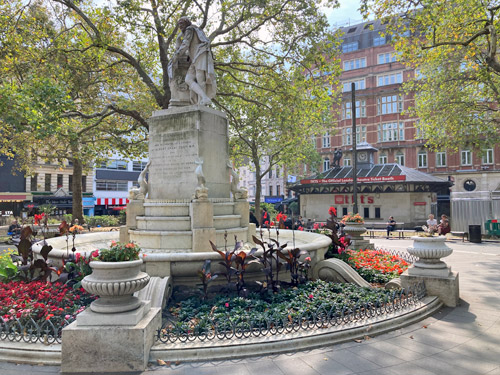
A statue of George I used to stand in the centre of the square but this proved troublesome when a Victorian entrepreneur wanted to build The Great Globe instead, a huge lamplit sphere designed to showcase the geographical wonders of the planet. He built it anyway, burying George's statue 12 foot deep underground, only for his globular attraction to fail commercially and end up being sold for scrap. This provided the impetus for a complete renovation of the central gardens in 1874, so the centrepiece is now a marble fountain topped with a statue of William Shakespeare. The surrounding circular flowerbed is easily the prettiest part of the square, not that tourists' cameras generally seek it out.
The central gardens had a spruce-up around the time of the Olympics, which also introduced a lockable perimeter allowing this area to be sealed off for film premieres, gingerbread chalets or any other LSQ events. Look up and the plane trees are old enough to be sensational, but look down and the shabbiness of a lawn created from matted squares of threadbare grass is all too apparent. If you're ever caught short in the West End be aware that steps in the two northern corners lead down to public conveniences, although the real subterranean secret is hinted at by the temporary UK Power Networks hoardings to the south. One of central London's largest electricity substations was installed beneath Leicester Square in 1991, its three 132,000-volt transformers recently in need of replacement, and the remediation works are finally due to end next month.
What truly delights the average family visiting the square are the bronze statues of nine Hollywood icons, most of which can be found in the gardens or around the perimeter shrubbery. Here Gene Kelly swings from a lamppost, Bugs Bunny emerges from a burrow and Mary Poppins has just landed with her umbrella raised, while Mr Bean and Paddington Bear sit alone on a bench silently urging you to sit alongside. The most popular of the lot is Harry Potter on a broom, from quite early in the franchise, where snappers may have to bide their time while a queue of offspring take their turn to grin in front. But look around more carefully and you may also spot Laurel and Hardy on the roof of the tickets kiosk, Batman standing high above everything on the roof of the Odeon and Wonder Woman whirling her magic lasso on a wall in Leicester Court (so technically out of scope of this post). If you're genuinely interested, Alex Zane narrates an audio walking tour on Spotify.
North side
Let's start our outer circumnavigation on the north side because that's where the official numbering begins, with 1 Leicester Square being home to a very recent very popular Greggs. The largest building is the Empire Theatre, built in 1884 to host variety shows and ballet, then rebuilt in 1927 as a massive cinema auditorium. As the Empire Leicester Square it still boasts the UK's widest cinema screen, now IMAXed, even if the stalls have been increasingly hollowed out to create projection booths, teensier auditoria and a former dance hall that's now a casino. The security guards positioned out front are probably most concerned about the latter. Neighbouring outlets flog things like souvenir snowglobes, flavoured vapes and bland waffles squirted with froth, whereas obviously the culinary apotheosis hereabouts was when Baskin Robbins sold 31 flavours.
East side
The unmissable building on the eastern flank is the Odeon cinema, or the Odeon Luxe Leicester Square as they insist on calling it these days, built in 1937 on the site of the Alhambra Music Hall. Its Art Deco tower acts as a local landmark, its facade is fronted with black polished granite and its interior ambience has been lessened somewhat by a succession of insensitive modernisations. That said it still seats 800 making it officially the UK's largest single-screen cinema (so long as you ignore screens 2-4 which are tiny boxes squeezed later into a former alleyway). The ground level units to either side of the Odeon are almost all restaurants, from lowly Burger King to juicy wagyu, plus the ultimate tourist pile-in, a TGI Fridays. But look out for the small doorway at the far end which once led just to the studios of Capital Radio and now acts as HQ for Global, the predatory media company inexorably consuming UK commercial radio.
South side
This side is rather less interesting, sequential redevelopment having merged several buildings into just two. The most recent is the square's other Odeon, the Odeon Luxe West End, though not the 1930 original because a hotel company bought that in 2014 and promptly demolished it so they could plonk a garish ribbed abomination on top. Many's the time I trooped down to the basement for a PG or 15 presentation, but I must confess I don't feel the need to revisit the two-screen Dolby replacement. I have however spent a very interesting afternoon in the Radisson nextdoor, specifically on the fourth floor, too preoccupied to realise that the surrounding architecture was essentially Edwardian. If you're considering a visit to the tkts cut-price ticket booth opposite, be aware that their best price for The Mousetrap is still a whopping £42.50 whereas you might get into both halves of The Cursed Child for £15 apiece.
West side
The portrait painter Joshua Reynolds lived and died here at number 47, as a plaque on All Bar One attests. The building now on site is Fanum House, built in 1923 as the Automobile Association's HQ and designed by cinema architect Andrew Mather. The AA scarpered to Basingstoke in 1972 and their reception area is now occupied by the world's largest LEGO store, a brickfest dozens of families are happy to queue for if it means getting a proper glimpse of the giant landmark models within. Outside is a 'Cantonal Tree' supported on a antique inn sign gifted by the Swiss government to the Queen on the occasion of her Silver Jubilee. The adjacent glockenspiel clock with 27 bells was instead a gift to Westminster council in 1985 and never performs its chimes before noon, nor after 8pm, nor at 1pm. Alas the Swiss Centre was demolished in 2008 and on its site arose London's most vacuous tourist destination, the inexplicable M&M's World, whose address I see isn't officially in Leicester Square which is great because it means I can ignore it and end my circuit there.
Route 310: Golders Green - Stamford Hill Length of journey: 7 miles, 45 minutes
London's newest bus route, which launched yesterday, is a proper oddity. It was promised during the Mayoral election. It shadows two existing bus routes. It's being delivered on a twelve-month trial basis. It runs every day but not all of the day. It tackles one very specific instance of anti-semitism. It exists solely because of a low bridge at Finsbury Park. And it was introduced on a Sunday, which is unheard of. So there's lot to unpack here.
For over 15 years Jewish community leaders have beencampaigning for a bus route to connect Golders Green and Stamford Hill, two of London's largest strictly Orthodox populations. Travelling by train is convoluted and no existing direct bus route exists, hence the request for a new link. The previous best option was to take route 210 from Golders Green to Finsbury Park, walk under the railway bridge and board a 253 or 254 to Stamford Hill on the other side. But the road beneath the station is unpleasant and, more importantly, passengers making the journey have suffered antisemitic abuse while waiting for the next bus. Hence the introduction of new route 310 which goes all the way, this because it's a single decker so can nip safely under the bridge... and now the only question is "is it worth it?"
The thing about the 310 is that it's essentially exactly the same as the existing 210 for five whole miles - every stop identical. The 310 isn't even attempting to be an express, like the Superloop, it's just three extra journeys every hour along an existing route. Its only unique section is the 100m beneath the low bridge, which it turns out it does very inefficiently, before continuing to Stamford Hill along an already well served corridor. Other than the new connection it's strategically pointless, but that new connection is potentially important.
Brent Cross
Golders Green
Highgate
Archway
Finsbury Park
Stamford Hill
210
double decker (every 10 mins)
310
single decker (every 20 mins)
1½ miles
5 miles
1½ miles
If you plan to take a ride from Golders Green, TfL are keen to tell you about the new bus. There's a poster in the ticket hall, a poster by the bike rack and a poster by the assistance window, all saying a new route starts on Sunday 1 September and runs every 20 minutes from 7am to 7pm. But what the muppets haven't said is where it leaves from, because it turns out there are ten possible bus stops scattered across a wide area and no clue has been provided as to which one you want.
Excuse me while I have a bit of a rant.
Golders Green is one of London's busiest bus interchanges, served by a phenomenal sixteen different routes. Some depart from the bus station, some behind the cafe, some round the corner and some even further away by the railway bridge. And yet if you arrive off a train there's nothing to say which bus leaves from where, not for the 310 nor any other route, because the bus/train interface is apparently unimportant. Once upon a time a spider map was provided but inexplicably it was scrapped by a pennypinching managerial bastard without considering the befuddling informational desert its absence would create. Even the recently-blogged insignificant suburb of Poverest still has a spider map, but not Golders Green station because it doesn't meet some miserable jobsworth's set of 'criteria', so if you don't already know that the 460 leaves from the other side of the bridge nobody's going to tell you. A lot of bus stations instead display less helpful summary maps merely matching stops to termini, but here only one out-of-date copy exists and that's in a supplementary bus shelter beyond the toilets, whereas the ticket hall and all ten bus stops are mapless. Route 310, it turns out, departs from bus stop GJ outside the bus station, as I eventually discovered after much traipsing, and basically Golders Green is a bus signage disaster zone because somebody somewhere at TfL doesn't give a damn about the passenger wayfinding experience.
In good news the 310 was being well used when I took a ride along the route yesterday. At least a dozen people boarded at the first stop, most of whom appeared to be genuine passengers rather than spods who'd turned up out of curiosity. A proper timetable had been posted on the bus stop panel, indeed this looked to be the case all along the route, and I was pleased to see The Men Who Switch The Tiles had done an equally comprehensive job. The vehicle we boarded looked like it had been out of service for a while because the only adverts were for a Netflix movie released in 2021 and a missive about 'Why You Must Wear A Face Covering On Public Transport', but it was perfectly serviceable and off we sped up the hill towards Jack Straw's Castle.
A few passengers risked flagging us down, not always because they'd seen the 310 notice at the bus stop, more a cautious wave and then pleasure when they discovered we were going to the same places as the 210. Peculiarly the announcements aboard the bus all said "route three one oh" whereas on the parallel bus it's always been "route two ten" so make of that what you will. The most pleasant part of the route is the zip across the top of Hampstead Heath and the squeeze at The Spaniards Inn before weaving between the lovely shops of Highgate Village, although you get a much better view if you catch the 210 instead because that's a double decker.
At the foot of the long descent into Archway the driver pulled over and played the dreaded "the driver has been told to wait at this stop to even out the service" message, because this is a plague even on day one of an untested operation. Technically we were indeed two minutes early, but if the rationale is to deliver folk from Golders Green to Stamford Hill then this wasn't actually helping. A couple of young lads hopped off at this point, one pausing his recording of the journey and then kneeling to get a better shot of the bus pulling away, the other clearly wishing his brother wasn't quite such a massive nerd.
The lucky folk who live near Elthorne Park are also the beneficiaries of a 50% boost to their local bus service, even if not yet keen to embrace it. But as we bore off down Hornsey Rise another group of young aficionados boarded with Zip cards in hand, such is the Day 1 allure of a brand new route. One passed round the Pringles and another reminded his protégés that the 310 used to run from Enfield to Hertford but was cut back to Waltham Cross in 2006 freeing up the route number to be used again inside Greater London. If your mental picture of bus enthusiasts is greying men with no fashion sense, perhaps you should be thinking instead of Air Jordans, noise-cancelling headphones and back to school on Tuesday.
Now for the low bridge bit, which as I've already hinted is suboptimal. The last stop before the low bridge is at Tollington Park, over 500m from Finsbury Park station, where one poor lady lugging two very heavy bags boarded expecting to be dropped off by the station entrance. No such luck, because the 310 can't do what every other double decker does and pull in at the Wells Terrace bus station because that's laid out as a terminus. Neither is there a bus stop by the railway bridge because there's never needed to be, plus the cycle lane would get in the way, so instead she had to stay aboard until we reached the gates to Finsbury Park (the park) and then lug her bags back.
It's arguably worse in the opposite direction as the 310 has to do a big loop round the one-way system, then can't take a short cut through the bus station, and all because the roads round here have never been laid out with the expectation that a bus would ever go under the bridge. The important thing, it turns out, is never to board the 310 if you actually want to go to Finsbury Park station because it sails past, a lesson I suspect a lot of passengers will learn the hard way.
For the final 1½ miles the 310 is just another bus to Stamford Hill, and because it actually says 'Stamford Hill' on the blind this makes it quite popular. Along the way it ticks off Manor House station, the New River and all those new flats that've shot up at Woodbury Down before drawing to a halt in the heart of Stamford Hill. It was very busy here yesterday because Sunday's not a day of rest for an Orthodox Jewish community, indeed I wonder if the 310 was launched on a Sunday rather than the usual Saturday because a Sabbath debut would have been gauche.
I can confirm that my journey took a few minutes longer than the timetable panel at the the start of the journey had suggested, and a few minutes less than the timetable the driver was trying to stick to. I can also confirm that not a single passenger other than me travelled all the way from Golders Green to Stamford Hill, suggesting that the need for a bus service connecting the two locations might have been exaggerated... or else it's very early days. Route 310 is only running as a 12 month trial, so if it turns out not to have been a success TfL can always say "well look, we tried" before ultimately scrapping it. But if it helps to bridge the gap at Finsbury Park and boost safe travel then this peculiar route may become a permanent fixture across North London.
Thu 1: A new coffee shop has opened just inside the gateline at Whitechapel station (or at least I assumed it was new because it didn't have a name displayed anywhere, whereas apparently it opened in June). It turns out they're called Yellow Ladder Coffee and their lattes cost 3.7 (unless you order them online where it seems they can do prices properly). Fri 2: The boundary stone between Herts and Middlesex on Bushey High Road is topped by a crusty bread roll (which I suspect may be temporary).
Sat 3: Tonight BBC4 repeated an edition of Noel's House Party from 1994, and it's amazing everyone used to watch this like it was the best show ever, but perhaps we forget how innovative its interactive elements (like NTV and Grab a Grand) were at the time. Sun 4: Dammit, I had to turn my lights on before 9pm for the first time since midsummer (and by the end of the month it'll be 8pm, sigh) Mon 5: In my alphabetical odyssey through classic authors at my local library, I was enlightened by VS Naipul's Booker-winning In A Free State, wished I hadn't bothered with Ben Okri and was astonished how Edgar Allan Poe managed to invent the modern detective story in the first half of the 19th century. The locked room mystery in The Murders In The Rue Morgue has a proper Jonathan Creek vibe, right down to the gobsmackingly unlikely simian reveal. Tue 6: The member of staff sat outside the Upside Down House at Lakeside shopping centre looked very very bored. Intriguingly admission to Lakeside's Upside Down House is £1 cheaper than an identical UDH in Bournemouth and £2 cheaper than Liverpool, Shepherd's Bush and Brighton, but £1.45 more expensive than the UDH in Clacton. There's market forces for you.
Wed 7: In Stoke Newington I stumbled across the Princess May Road Community Parklet, which is essentially a former parking space replaced by decking and a few planters. Originally it also had wooden benches and without them it feels less of a social focus (indeed the space might have been more useful as another cycle store). Thu 8: As part of Newham History Month (which is long finished) I spotted a self-guided walk called ‘A Mile of Memories: Life, Work and Leisure in Stratford’ which links Angel Lane to Sugar House Island and includes old photos and audio. Fri 9:Bluesky would be better if it wasn't awash with puritans repeatedly sermonising about the other place. Sat 10: If you ever visit the 13th century church of St Margaret The Queen in Buxted, East Sussex, not only does the chancel arch have semi-octagonal responds with a double-chamfered head but they also sell a very good range of jams and pickles.
Sun 11: Britain's Olympic medal performance has been deemed unsatisfactory because although we got tons of medals (the third highest total) we didn't get 'enough' golds so only came 7th overall, and some people are never happy but that's sport for you,, so much emphasis on winning that anything less is considered a disappointing failure. See also 'being the FA Cup runner up'. Mon 12: My savagely-pruned rosebush has produced two more deep ruby blooms, which is a nice surprise a couple of months after the first minor display. Tue 13: The official advice in Richmond Park is to stay at least 50m away from the deer at all times, but I suspect most people encountering antlered clusters have no idea precisely how far that is. I'm sure I got too close. Wed 14: I received an unusual email from a civil engineering company asking if I had any photos of the Croydon Canal in Betts Park during the installation of rock baskets, and I replied saying no obviously not, but then I checked and amazingly I had four photos taken during the right few weeks in 2017 and it turned out these were exactly what they wanted.
Thu 15: I thought I spotted Amol Rajan on the Piccadilly line heading home from the Today studio, but he got off at the wrong stop and his watch wasn't expensive enough and he didn't have an earring and it turned out it was Justin Webb and Emma Barnett on duty this morning anyway. Fri 16: I've enjoyed reading Walking the Bones of Britain by Christopher Somerville, a highly descriptive account of a twisty walk from the (very old) Isle of Lewis to the (very young) Thames Estuary focusing throughout on the influence of the underlying geology. Sat 17: My quiet carriage on the train to Havant was invaded at East Croydon by a bunch of boisterous middle-aged Luton fans, all effin and jeffin and base chatter. When they displayed a total inability to work out if they were in the right half of the train I snapped back condescendingly, which surprised me and peeved them, but they were at least a bit quieter after that. By a terrible coincidence they'd booked the same train home so I very nearly ran into them again at the station but sensibly dodged into another carriage, leaving them to empty an entire multipack of Stella and several packets of Wotsits. Instead I found myself sitting beside some of their shaven-headed Luton mates, who proceeded to slag the bastards off and I felt much better after that.
Sun 18: Manchester-based Mill Media have joined forces with a south London substack called The Wimble to create a weekly newsletter for residents of SW19 or thereabouts. It's all put together by a journalist called Zak, and it's a bit like hyperlocal blogging used to be but in a smarter typeface and emailable. Mon 19: FFS there is nothing special about a 'blue supermoon', it looks no different to an ordinary supermoon, which isn't especially rare and exciting either, especially when if you'd bothered to check the weather forecast there was no chance of anyone seeing it anyway. Tue 20:Posters at c2c stations are advertising "London to Southend by train for £9.20", which sounds great but if you read the small print that's from West Ham, not from Fenchurch Street (and if you want to come back again it's £18.40). Wed 21: In Mostyn Gardens NW10 is a fibreglass bear looking up at a cockerel on a pole, which is a mighty strange thing to find on an ordinary suburban pavement. I think it's part of Brent's pandemic-aborted year as Borough of Culture.
Thu 22: If you remember that old tumbledown warehouse on the Grand Union towpath in Brentford (part of Capital Ring section 7) alas it's been demolished and a slew of new housing is encroaching outwards from the bus depot. Apparently phase 3 of the development will includes the sanitised struts of the warehouse, pretentiously elevated. Fri 23: Sheila, who's been working for Tesco since 1983, is retiring next month, so I made a special point of thanking her at the checkout, which I doubt they'll bother opening early on a Friday any more after she's gone. Sat 24: St Swithin's Day was exceptionally wet this year, but 40 days later my annual folklore check confirms that only 14 of the subsequent days were wet, so dead 9th century bishops know nothing. Sun 25: While I was at Theobalds Grove I diverted up to Cheshunt to see my grandparents, both of whom have spent the best part of 50 years in a leafy corner of the cemetery watched over by an Enfield Highway Cooperative Society headstone. The plot beside them is still empty but umpteen other grandparents have slowly encroached, including one whose epitaph is all lower case and references egg sandwiches and "milkey tea". Mon 26: I do not recommend spending your Bank Holiday Monday in Poyle (especially when the next is 25 weeks away). However on the way back I did get this rather nice photo of Hounslow West, one of only two seven-sided tube stations.
Tue 27: In the latest edition of the South East Walker I read... "At their last meeting TfL's Leisure Walking Plan Delivery Group committed to the creation of two more walking routes by the end of 2027, adding to the Green Link Walk unveiled in March. One of these will be the Forgotten Rivers Walk that is planned to run from the London Loop at Borehamwood down to Blackfriars. This journey will take in the Silk Stream at Burnt Oak, the Dollis Brook in Barnet and the hidden River Fleet rising on Hampstead Heath." The second route (which is still to be finally decided) will include parts of south London and may follow alongside less well-known rivers like the Quaggy. Wed 28: The Lioness line sign at Kensal Green has indeed been covered over by another vinyl, because the official unveiling isn't for four more weeks, but I see someone naughty's already started peeling off one corner. Thu 29: Sometimes you get an email that utterly unexpectedly realises a dream, thanks. Fri 30: Sometimes you get a text message that reminds you of the unpredictable fragility of life, dammit. Sat 31: A new coffee shop/juice bar called Posted opened a few months ago in the former betting shop on Stroudley Walk. I'm glad they finally cleared the pigeons out. It's quite smart for this end of E3, but in a cool rather than pretentious way. I've never seen it busy until this week when a flock of e-bike delivery riders descended and hung out. I tell you all this because today I held a gate open for a random woman on the street and afterwards she urged me to go to Posted and to tell everyone about it. I have done one of these things.