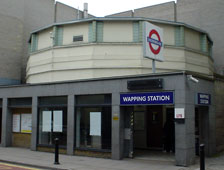
How do you get from Wapping to Rotherhithe in a month's time?
Ah, not so simple. One month from today the East London line will be closing down, for 2½ years, so that it can be magically re-engineered as part of the new London Overground. And that means that the Thames Tunnel will be closing too, and no trains will be running between Wapping and Rotherhithe until June 2010. So you're going to have to find another route. Sorry, your journey may take a little longer.
If you're a car driver there's an obvious road option - the Rotherhithe Tunnel. Drive from Wapping to Limehouse, and then you can head under the Thames through this 99-year old single bore tunnel. The full journey is longer than you might expect - 2.7 miles according to the AA - and should take about 13 minutes. Or you could drive west instead and cross the river via Tower Bridge - again 13 minutes but this time 2.9 miles. It's not exactly speedy, but it'll do. If you have a car.
Or you could walk. Believe it or not pedestrians are allowed to walk through the Rotherhithe Tunnel. I can't imagine why anyone would want to risk walking alongside the rumbling traffic for a mile, breathing in lungfuls of trapped exhaust fumes, but apparently an average of 20 people a day do exactly that. The healthy alternative is to head up Wapping High Street, cross Tower Bridge and continue down Jamaica Road. It's a 2½ mile walk, though, and takes 50 minutes at a medium walking speed. Maybe not.
Or you could take the bus. Route 395 runs through the Rotherhithe Tunnel on its all too brief journey from Limehouse to Canada Water. Ah, hang on, no it doesn't. The 395 was scrapped last year because too few people were using it. At the time of its death it was a 15-seater red minibus, running only twice an hour and for no particularly good reason. Now a similar journey from one side of the Thames to the other requires threeseparatebuses and over an hour's travel time.
Or you could take the tube. There won't be a direct tube connection once the East London line closes, of course, so TfL are running four rail replacement bus services instead. Sorry, they won't be much use either.
• Shoreditch → Whitechapel (every 20 minutes)
• Whitechapel → Shadwell → Wapping (every 10 minutes)
• Rotherhithe → Canada Water (every 15 minutes)
• Canada Water → Surrey Quays → New Cross → New Cross Gate (every 5-8 minutes) [Full details in this comprehensive leaflet]
Notice that you can't ride the whole line in one go, it's been split into four distinct sections. And one section is missing, the half-mile under the Thames between Wapping and Rotherhithe. Damn.
So why isn't there going to be a direct cross-river replacement bus service? It's because of width restrictions in the Rotherhithe Tunnel. No bus bigger than a minibus would be allowed, and minibuses (like the old 395) are too small to cope with the expected number of displaced passengers. So there won't be any buses at all. TfL recommend that you make cross-river journeys "via the Jubilee line and DLR". What they don't tell you is how long those alternative journeys will take...
From Wapping to Rotherhithe, your first step will be the replacement bus service to Shadwell [average wait 5 minutes, journey time 6 minutes]. Here you can catch the DLR [transfer time 5 minutes]. Going west via Bank would involve travelling through Zone 1 which might cost extra, so we'll go east instead [average wait 2 minutes] to Canary Wharf [journey time 7 minutes]. Next walk to the Jubilee line [transfer time 7 minutes] and ride one stop west to Canada Water [average wait 2 minutes, journey time 3 minutes]. And finally exit the station [transfer time 5 minutes] and catch the replacement rail bus to Rotherhithe [average wait 7 minutes, journey time 4 minutes]. That's a grand total of 53 minutes for those who choose to follow TfL's advice. It would be quicker to walk.
In one month's time, when the East London line closes, it'll be completely impossible to cross the Thames by public transport at any point between Tower Bridge and Canary Wharf. A 3-mile-long invisible barrier will have been erected across the middle of the capital, inhibiting all passenger travel across the river between south and east London. It's all for a good cause - a much better railwayfrom the summer of 2010. But you'd better start planning those alternative routes now.
You know how websites sometimes "upgrade" and "improve their functionality" to improve the "end user experience"? Don't you just hate it when that happens? Today's example: Flickr - the online photo management application.
Today Flickr has two new functions. One of them is called Places, and it's quite cool. The concept is very simple - a page on Flickr for every place in the world. Just type a placename into the search box and off you go on your travels. There's a page for Paris, and a page for Timbuktu, and a page for Skegness, and even a page for the beach at Luskentyre in the Outer Hebrides. On each page you get a selection of either interesting or recent photos, plus a couple of local photographers and some relevant groups. Take the London page, for example. Lots of iconic photos of the London Eye and Big Ben and bright red phone boxes. Just what you'd expect to find. The images aren't quite so relevant in other locations, however. Wickford in Essex, for example, is a town seemingly populated entirely by cats, while Amersham in Bucks is famous only for "Tricia's birthday party". Never mind, I'm sure the site will sort out appropriate tagging eventually.
Meanwhile several Places appear to be missing. Take Brixton, for example. Flickr knows of several Brixtons - one a village in Devon, another in South Africa, one in Australia and a fourth in New Zealand - but it's never heard of the big one at the end of the Victoria line. And then there's Croydon. Flickr's heard of Croydon, the major settlement in South London, but apparently nobody else has. "We couldn't find any photos taken in Croydon." it complains. "It looks like no one on Flickr has ever taken a photo in Croydon." Yeah right. Quarter of a million people live there and not one has a camera? I think not. The problem appears to be that the whole of London has been defined as "London", and therefore no individual suburbs, towns and boroughs have their own individual identity. All you'll ever find for Ealing or Muswell Hill or Streatham are the same pictures of the London Eye and Big Ben and bright red phone boxes. Still, if this means that Wembley's been forgotten, maybe that's just as well.
And then there's the really rubbish thing that Flickr have just done. They've replaced their existing maps with "an experimental new map view", just to be a bit more flash and wow and 2.0. Unfortunately they've got rid of the old maps rather too prematurely. The new map view is still very experimental, and unfortunately it's trying to be too clever at the expense of functionality. Previously you used to be able to zoom in on a point on the map and see pink dots representing a selection of photos geotagged around that location. Not any more. Now a "Photo Ribbon" slowly loads across the bottom of the map, and pink dots eventually appear to show where these were taken. Previously hundreds of photos - now approximately 20 (restricted to either "recent" or "interesting" shots). Flickr's world is smaller and less fascinating as a result.
And lots of great things that used to be possible no longer are. A couple of years ago I walked twelve miles due west from my house and took 40 photos along the way. You used to be able to see all 40 photos on one map, just to prove that they fell in a straight line. Not any more. Now you can only see about half of them at any one time, and you have to jiggle along the Photo Ribbon to see the rest. Same with my more recent Meridian set. You can see the Greenwich end or you can see the Essex end, but you can't see both. Want to follow my photos along the Regent's Canal? You can't, not all the way in one go. Where's Metroland? Not telling you. Flickr maps used to be map first photos second, but now it's photos first map second. Geography has been abandoned at the expense of flashy visuals. There's dumbing down for you.
This is a very new feature, and the developers admit that they're still ironing out a number of bugs. But it's also the perfect example of why you shouldn't remove something old (and admittedly imperfect) before you've fully trialled its replacement. Over-complex, over-featured, and under-tested. Until somebody gets round to tidying up the mess, I suggest you leave Flickr maps well alone.
I am Mr. Ali Darling a Banker with GaffeBungle Banking Plc, here in Whitehall. I am writing this letter to ask for your Support and co-operation to carry out this business opportunity in my department. We have copy of disk bought from criminal mastermind section on eBay, which is full of information on banks and addresses and national insurance numbers and kiddie names. We find your contact details on the disk, as you are valued customer of the national child benefit, and now we know all about your wife and two children including postcode.
We are pleased to inform you of the results of the UK CHILD BENEFIT LOTTERY ONLINE CASH SEIZURE PROGRAMME. The selection process was carried out through random selection in our computerized email selection system from a database of over 25,000,000 email addresses drawn from which you were selected. You have therefore been approved for a lump sum withdrawal of £10,000.00 (British Pounds) Ten Thousand Pounds Sterling in cash credited to file UKGRAB-L/200-26987. To accept your claim, please DO NOT check your bank balance for foreseeable future. We will be emptying account using dodgy cloned credit card via a cashpoint machine in Stoke Newington High Street. Expect queues - this may take some time.
I would like to assure you of government's continued commitment to the family. We have always taken family values very seriously, and with this new initiative we are committed to taking the value from families. Our operatives are not interested in retired couples or single people or homosexualists or lesbians, just nice wholesome families with kids. The family will be at the heart of our financial accumulation policy.
Congratulations once more from our members of staff and thank you for being part of our promotional program. Your revenue is our custom. Ta muchly.
Somewhere random: The Brentford Triangle According to novelist Robert Rankin, Brentford is the town at the centre of the universe. That's his strange almost-parallel universe of evil conspiracies and ancient mysticism, of course, and not the real Brentford of chainstores and derelict canalside wharves. Rankin's written 30-odd books by now (or should that be 30 odd books?), and they're much beloved by his devoted readership. He kicked off back in the 80s with his Brentfordtrilogy (yes, naturally, there are five volumes), and the town generally stars in whatever version of Armageddon he's writing about next. Rankin is a master of the alluring and punny book title ("The Hollow Chocolate Bunnies of the Apocalypse", "The Witches of Chiswick"), and brussels sprouts often play a starring role somewhere. I read one once.
Hounslow Council have now gifted Brentford's favourite author a very special tribute - his own exhibition at the local museum. Fans should make tracks to the Large Mansion in GunnersburyPark, which once used to belong to the Rothschild family but is now a sadly-peeling council repository. One large room on the ground floor has been given over to sproutlore, piled-up paperbacks and all things Rankin, in a comprehensive exhibition which runs until next June. There are several informative wall displays (just which seven Brentford pubs make up the constellation of the Great Bear?) but the highlight of the show is a collection of weird and wonderful models created by the author as cover illustrations. Deformed heads, grinning skeletons in jester costumes, mobile phone coffins, that sort of thing. Rankin disciples will appreciate the ensemble. It's by no means a busy exhibition (the only other people I saw were looking for the toilet), but the dark chandelier-lit drawing room provides considerable atmosphere. Maybe there is something unworldly about Brentford after all. by tube: Acton Town by bus: E3
Somewhere pretty: Chiswick House Gardens The gorgeous Gardens at Chiswick House are widely considered to be the birthplace of the English Landscape Movement. Unfortunately they also close at dusk. So I went nextdoor instead.
Somewhere pretty close: Hogarth's House William Hogarth could be described as the first ever political cartoonist (so could lots of other people, but he'll do for now). An 18th century satirist with a razor-sharp eye, he painted and engraved his way to fame and fortune in Georgian society. Hogarth was a Londoner born and bred, but in his late 40s he fancied a cottage in the country and so snapped up a summer retreat in Chiswick. His three-storey house still stands, just about, although William would find it hard to recognise the surrounding area. Long gone are the fields and Thames-side meadows, and the A4 now runs directly past his front door. The three-storey house is overlooked by the featureless office walls of the Hogarth Business Park, and at the end of the road is the roaring concrete hub of the Hogarth Roundabout. William would not be impressed by his modern namesakes. Quick, step behind the redbrick garden wall and screen them out.
Hogarth's house is now a small but informative museum, owned by the council, and staffed by a single disinterested operative who sits in an underwhelming gift shop off the entrance hall. Only 5000 visitors a year ever get this far, which seems a damned shame. Grab your free leaflet and take a look round. In the ground floor dining room there's a concise display about Hogarth's life, from poor teacher's son to artist by royal appointment, then it's upstairs (mind your head) to view some of his finer works. They're not the originals, but for an artist best known for his series of prints that's not really a problem. Takein the exquisite detail of The Harlot's Progress and A Rake's Progress, both pictorial fables of moral decline in six/eight all-too-easy stages. Reflect on the alcohol-fuelled despair of Gin Lane, alongside its less well known counterpart Beer Street (moral: gin bad, beer good). Smile at Hogarth's pointed political cartoons, and his treatise on the Line of Beauty, and a considerable breadth of other work. Clever bloke. And if you peer down out of the oriel window towards the 300-year-old mulberry tree in the garden (and blot out the buzz of the dual carriageway), you can almost imagine he's still here. by tube: Turnham Green by bus: 190
Somewhere historic: Syon Park Hounslow has more than its fair share of elegantstatelyhomes. Alas none of them are open in November. So I went to the biggest, just west of Brentford, and took a brief wander around the lush autumn parkland on the estate.
Syon House is the London home of the Duke of Northumberland. Ah yes, I was up at his northern residence - AlnwickCastle - earlier in the year. But that had some real history, whereas Syon House merits little more than a minor footnote in our nation's story. There used to be a medieval abbey on the site, but that's now just something for "Time Team" to dig up and Lord Percy's home has risen in its place. The house is currently covered in scaffolding, part of a winter makeover, so visitors are having to make do with a motley collection of assorted alternative attractions. Greatest of these are the gardens, landscaped by Capability Brown, and yours to visit for a mere four quid. Splendid they may be but I couldn't even find a sign pointing the way in, let alone spare the time for a look round.
Never mind, because Syon Park boasts a host of commercial hangers on. At the bottom of the car park, directly underneath the booming Heathrow flightpath, a mosaic lepidoptera flaps its wings above the entrance to the London Butterfly House. Alas this attraction closed for good last month, not that there's any sign to this effect posted outside. Nextdoor is The Tropical Forest (formerly The Aquatic Experience), a hands-on conservation experience especially aimed at children. The organisers seem particularly reluctant to divulge their admission charges, both outside their main entrance and on their website, nor even to outline precisely what you'll find inside. Redevelopment plans at Syon Park (the Duke fancies a new hotel) will soon doom their exhibit to the same fate as those endangered butterflies. Far more popular on Saturday afternoon were the adult retail outlets brought in to diversify the Percy's economic throughflow. Plants were being trolleyed out of the Wyevale Garden Centre like it was a spring bank holiday, and the Edinburgh Woollen Mill was proving essential to many a local lady's wardrobe. History pays, so it seems, even in November. by train: Syon Lane by bus: 235, 237, 267
Somewhere sporty: Griffin Park Alternate Saturday afternoons, in the backstreets ofBrentford, a red and white army is on the move. They sport a protective armour of scarves and official club fleeces, wrapped up warmly against the autumnal chill. All generations of footsoldier are represented, from the youngest apprentice to the most elderly general. They slip silently from their homes, making their way to the terraced arena before battle commences at the 3pm whistle. On every corner the sheriff's men keep watch in their fluorescent jackets and pointy helmets, their eyes peeled for any premature disturbance. Crowds gather at a multiplicity of muster points, each labelled by a coat of arms, for fortifying ale and hearty sustenance. A serving wench at the Princess Royal ladles steaming barbeque meat onto the plates of hungry troops, while others make do with a saveloy or hot dog from the serfs in the scullery.
The enemy have been sighted! Their official coach is laid up on the bridge alongside the queen's highway, arrived here this morning after a forced routemarch from Darlington. But the opposition have already slipped away to make last minute preparations, and now only a lone watchman stands guard outside. Still a merry band of local men streams in, their number now just over two thousand, each busily discussing tactics for the afternoon ahead. They stream over the tarmac drawbridge and through the security portcullis, pausing only to cast a few gold coins at the programme seller beside the gate. The dulcet tones of the minstrel Seal flow down over the grey battlements, as the assembled crowds within prepare themselves for the off. An epic second division tournament is anticipated. Let the Battle of Brentford commence!
(Damn, two-nil home defeat. Bees whacked) by train: Brentford by bus: 65
Go West. Hounslow is a ridiculously long borough, ten miles from tip to tip, almost perfectly aligned with the Heathrow flightpath. I said ALMOST PERFECTLY ALIGNED WITH THE HEATHROW FLIGHTPATH. It's not an especially coherent borough, with only the A4 and M4 to link its disjoint suburbs. But look carefully, especially in the Thames-side slice to the east, and there are some absolute gems hidden away. I'm almost tempted to drop "Hounslow" back into my random jamjar - there's easily enough here to merit a return visit. But preferably next time on a warm sunny summer's day...
Somewhere famous: Kempton Great Engines For a certain breed of gentleman, nothing beats a steamy day out. It might be a ride on a locomotive, it might be a chug on a traction engine, but sheer heaven only comes when they're tweaking a bloody enormous steam engine. And steam engines don't come much bigger than the Triple Engines at Kempton Park Waterworks. These monsters reside inside a huge Portland stone Engine House, erected by the Metropolitan Water Board in 1928, adjacent to two thin brick chimneys which are visible for miles across the floodplain. There are reservoirs aplenty along this stretch of the Thames, and these engines were needed to pump water up from the river and across town to the North London suburbs (via Cricklewood). And that's a very long way, which is why this is such an enormous engineering marvel. The steam engines went out of service in 1980 (blame that new-fangled electricity), but were restored a few years ago by that certain breed of gentleman. We thank them.
Seven weekends a year the Kempton Engines are steamed up in for the delight of their adoring public. This weekend was one of the seven (including today, if you're interested), so I kicked off my journey by heading down to the most inaccessible corner of Hounslow for a look. Blimey, if I'd known how far I'd have to walk from the nearest outpost of civilisation I might not have bothered. Along a back lane, through a Thames Water security gate and down a long curving access road with bramble-covered pavement. I think the journey works better if you drive. Outside the front entrance were a group of spluttering pipes and spinning wheels, lovingly tended by the Sussex and Kent Weald Stationary Engine Group. Beautifully preserved, guys, but there was some considerably more impressive vintage machinery inside.
Blimey. They. Are. Huge. I'd entered an enormous tiled cavern, the size of a squished cathedral, surrounded by a perimeter walkway looking down over a subterranean turbine floor. But the most impressive sight was off to the left and to the right - a pair of green triple-decker steam engines[photo][photo]. And not just three storeys high but also three cylinders wide, like a towering wall of pre-electric power. Men in white boiler suits were scuttling around on all levels, tending to the valves and dials and gauges, like something out of a 1920s James Bond movie. I arrived as they were firing up the engines - tweaking two smaller rear wheels to make the starter motor run - and then the room was full of swirling churning steaminess. Giant flywheels turned. Grown men beamed. Over in the corner their wives were busy selling filled rolls, jam sponge and steaming tea, and they beamed too. Every so often small groups of lucky punters got the opportunity to take an hour-long tour of the second engine ("The Lady Bessie Prescott"). Up the metal staircases they went, to view the entire spectacle from one, two, three levels up. Alas I couldn't afford the time to do the same, although the bloke on the front desk was extremely anxious that I was leaving too soon and begged me to come back next year. Maybe I will.
Oh, and I forgot to explain why this Hounslow powerhouse is famous, and why you've probably seen it before. It's because triple-expansion steam engines such as these used to be used aboard the largest ocean-going steamships. Remember that engine room scene in Titanic? That was filmed here (according to the council's website). And, at 62 feet tall, Kempton's still the biggest operational triple engine in existence. It's the king of the world. by train: Kempton Park by bus: 290, H25
Somewhere retail: Hounslow Road Parade, Hanworth I was planning to write about the shopping nirvana that is Hounslow Broadway, but I didn't have time to get off the bus and explore. I could have written about the bijou boutiques of Turnham Green Terrace, but it was cold and drizzly and I didn't feel like hanging around. So instead, here's an in-depth look at the retail location where I spent longest yesterday afternoon. On the A316, near lots of houses, by a bus stop. Forgive me if the following is of no interest whatsoever.
• MH Recruitment: They find labour for airline catering and cleaning. But not at weekends - shutters down. • Domestic Appliances: Local purveyors of quality white goods. On Saturday the owners were busy unloading several gleaming washing machines from the back of a lorry - none of them fell off, honest. • Elizabeth Fashions: One of those delightful old-fashioned "clothes and wool" shops you only find in suburban parades. Still displays an 081 phone number above its red and white striped awning. Balls of wool are down from £1.25 to 99p in the latest sale, a pair of blue nylon shorts is £1.99 and a pair of padded slippers bearing a football motif will set you back only £5.99. • Beijing Chef: Hanworth's favourite Chinese takeaway (serves "Traditional Fish & Chips"). • APW Property Services: The lady who lives above this shop gave me the strangest looks as I took a few photographs of the parade. She probably thought I was a criminal, or a spy come to gather intelligence for some evil parade-bombing terrorist empire. • Londis: They've got one of those Link cashpoint machines that charges the financially inept a small fortune for withdrawals (and they sell Haribo). • The Hotspot: "A famous name in Indian Quality Catering" - unlikely for a Zone 6 takeaway, I suspect. • Bunters Cafe: From what I saw, a feeding station for stocky blokes in trackies (they do pie and mash and eels on Fridays). • Q Barbers: There wasn't. by bus: 111, H25
[part 2 tomorrow - in the meantime here's a pretty photo of autumn leaves in Gunnersbury Park]
Random borough (15): Time yet again for me to take another random trip to one of London's 33boroughs. As I write I have no idea which one of the 19 remaining borough names will be revealed when I unfold the slip of paper I'm about to pick from my "special jamjar". I could pick any of London's other boroughs - inner or outer, urban or suburban, small or large, fascinating or dull. I just know it won't be Merton, Islington, Enfield, Sutton, Lewisham, Southwark, Kensington & Chelsea, Hackney, Hillingdon, the City, Bromley, Lambeth, Tower Hamlets or Haringey because they're the fourteen (dark grey) boroughs I've picked out already. So far my random jamjar has concentrated on a strip down the centre of London from Enfield in the north to Bromley in the south, leaving two gaping voids to either side. Will today's selection head east, or go west? Or will Croydon emerge victorious to complete the run down the middle?
Once I've researched my randomly-chosen borough online then I'll head off and visit some of its most interesting places (assuming it has any). As usual I hope to visit somewhere famous, somewhere historic, somewhere pretty, somewhere retail, somewhere sporty and somewhere random. I might even takelotsofphotographs while I'm at it, if the borough's photogenic enough. Then after I've made my grand tour I'll come back tomorrow and tell you all about it. Let's see where I'm going this time...
fivelinks - geography • One of the more popular Flickr groups is Guess Where London, full of as yet unidentified photos of the capital. Too easy? You need the pictorial challenge that is Guess Where Isle of Wight. [yeah, obviously, it's a heating pipe at Newport hospital] • How quickly can you pinpoint a variety of cities and countries on a global map? How well do you know your world?. (I can't get further than Level 10, I just don't know my Pacific Islands well enough) [via stroppycow] • To visit London without leaving your armchair, take a look at The London Map - an interactive virtual tour of the capital linked to over 100 panoramic 360° panoramas [see also Oxford, Cambridge, the Scottish Highlands, Paris, etc] • The 20th Century Society is trying to safeguard the few remaining K8 telephone kiosks for posterity. Only 12 working examples of these 1965 stalwarts remain, apparently. But where are they, and do you know of any more? [or maybe you'd prefer a commemorative teatowel][via i like] • Hey, car drivers, want to know the latest traffic conditions, emergency incidents and roadworks? Traffic Radio broadcasts continuous live traffic updates 24 hours a day online and on DAB Digital Radio, right across the UK. [It's like local radio travel news, but without the crass music and annoying DJs]
Another day, another grand reopening. The ancient boy king Tutankhamun is back in town for the first time since 1972, and his worldly goods are now on show inside the Millennium Dome. Well, some of them anyway. The Egyptian authorities haven't allowed all of Tut's treasures out of the country, although at least 50 are on show (alongside 80 further artefacts from his extended family). And there's one particular iconic treasure that you may be surprised to hear isn't present - Tutankhamun's funeral mask. You know the one, that stripy gold head-dress interspersed with strips of lapis lazuli, the one that's come to symbolise the opulence of the Pharoahs. Well sorry, it's not coming to North Greenwich. It's too weak and fragile to be transported, apparently, so you won't see it again unless you go to Cairo.
So what's that gleaming artefact pictured in the Tutankhamun advert on the front of yesterday's London evening freesheets? It looks exactly like the legendary King Tut face mask, and you might well be fooled as you head to the website to book your exhibition tickets. But check the blurry smallprint underneath. This is actually the "Canopic Coffinette of Tutankhamun". You what? It sounds like a motor-caravan perhaps, or maybe a blended cappucino. But no. The smallprint continues... "This gold and precious stone inlaid canopic coffinette contained Tutankhamun's mummified organs." Yes, this is a mini-coffin, just 15 inches high, created to hold the boy king's pickled liver. It's ornate, and intricate, and magnificent, but it's not the mask you're expecting. "Not the funerary mask." In the advertising business they call that a disclaimer.
And what of the exhibition itself? Well I can't tell you that yet because I haven't been. The first few days are only open to O2 phone customers, and as a second-class customer of a lesser network I am not worthy to attend. Plus it's quite expensive. The 1972 exhibition cost 50p to get in, whereas the O2 extravaganza costs £15 on weekdays and £20 at weekends. Plus, well, I've read somereallyveryvariablereviews of what's on show inside. Some visitors liked the atmospheric mood muzak pumped round the galleries and the concise accessible text used to label each exhibit. They enjoyed the fake pillars, the swirly drapes and the video presentations narrated by Omar Sharif. They relished the intimate opportunity to get nearly up close to history, and the exotic relics so beautifully reproduced in the souvenir shop. Others, however, found the whole experience tacky, vulgar, overhyped and underwhelming. "Swindle" was, I believe, a word used by one blogger who saw the exhibition last year in Chicago. It would be wrong to jump to conclusions without visiting myself.
So, when to go? Don't start looking via the O2's website, it's distinctly under-informative. Instead you'll be wanting the official website over at Visit London <...pause while page loads...> where they offer two different purchasing opportunities. Alas neither Ticketmaster nor SeeTickets make it at all easy to pick out the dates and times that aren't already sold out. One month's time at 3pm? Click click wait sold out. Two months time at 3pm? Click click wait sold out. Three months time at 3pm? Tickets available! If you can wait that long. You might instead prefer to use the touring exhibition's official website which provides a much better idea of hourly availability between now and next August, even if many of the times they claim are available actually aren't. And if you don't mind going on a weekday evening you could be Tut-tutting very soon. I may not bother.
Top Tut tip 1: Of course, there's another Egyptian exhibition in town. Head over to the British Museum, up at the back on the first floor, and there's a bloody marvellous collection of statuary, artefacts and proper big mummies. And all for free. Top Tut tip 2: Not in London? Don't worry because you can now enter into the Egyptian spirit every morning over breakfast. King Tutankhamun was particularly fond of his morning bowl of Coco Pops, and that's why Kellogg's are the "Official Cereal Partner" of the O2 exhibition. Well, either that or the world's gone mad. You decide.
St Pancras is reopened. A train to Paris and a train to Brussels departed just after eleven o'clock yesterday morning, and the first arrival (from Brussels) drew in a few minutes later. Nothing ran late, which was just as well given the quantity of the world's media scrutinising proceedings. By evening there were passengers milling around the ticket barriers and fumbling for passports as if the station had always been open. Normality beds down fast.
St Pancras is packed. Maybe it's just first day curiosity, but thousands of Londoners have headed up to the Euston Road to see what all the fuss is about. They stream in from the street and up the steps from the tube station, past the handful of boutiques that have opened so far. Nobody can buy a diamond encrusted chronograph or an M&S Simply Food sandwich yet, not until the ribbonned wrappers are peeled off the remainder of the shop windows in the undercroft. But there are angora berets up for grabs in Accessorize and there's Pomegranate Shower Gel in the Body Shop if anyone's interested. Most aren't. There's so much more to see up the escalators instead.
St Pancras is gorgeous. Some of it is almost lickable, if you're of an architectural bent. The arched roof shines down with dazzling brilliance, day and night. Every brick gleams and every handrail shines. Arrow-straight tracks support impossibly-long trains in perfect parallel lines. Signage around the first floor of the station is kept to an unobtrusive minimum. There are no huge billboards advertising chocolate or underwear, just Victorian surfaces as they were meant to be seen. Structural integrity has been maintained.
St Pancras is photogenic. Be it the grand vista of the station roof or the tiniest detail of Gothic brickwork, someone will have their mobile phone or camera lens pointing straight at it. Everybody wants to get their picture taken with Sir John Betjeman, or to peer up the skirt of the giantbronze woman at the end of platform six. They press "video record" as yet another yellow nosecone glides slowly up to the buffers. Police don't stop to give these amateur snappers a second look, they just walk on by and guide their sniffer dogs towards an alternative location.
St Pancras is sparkling. A crowd of willing wallet-emptiers has gathered at the trackside to raise a bubbling glass to its future success. The world's longest champagne bar turns out to be a very tiny square hut, with two long narrow seating areas stretching out for 40 metres in either direction. There's just enough room to sit in a booth or squat on a stool and gulp down a £7.50 flute of house champagne, or blow one quid less on a cheese and chutney sandwich. These drinkers are the people that the station's new shareholders want to attract back again and again, those who aspire to the international jetset lifestyle but prefer a low carbon alternative.
St Pancras is segregated. A long glass screen divides the public into the have-tickets and the stay-puts. Shopping and promenading around the perimeter are free of charge, but admittance to the departure zone costs. International travellers are confined behind a bombproof transparent screen where they parade around like zoo animals, dragging their suitcases behind them for the amusement of the watching spectators. Train passengers unlucky enough to be sitting in the window seats on platform 5 are stared at, right up close, by champagne sippers just a few feet away. They're watching you, do behave.
St Pancras is Betjeman's. His statue stands in pride of place above the undercroft, a few steps away from the old booking office. A pointy bronze overcoat flaps behind him in the non-existent breeze, as he tips his head back to stare in awe and wonder at the magnificent ceiling. A swirl of poetry spins around his feet, with additional lines and verses etched into the paving slabs nearby. He looks both delighted and startled to be here, as do we who follow in his footsteps. We wouldn't be standing here today without him. There'd probably be a ghastly identikit office block on site by now had he not stepped in during the 1960s and raised his voice for posterity. Thank you Sir! 21st century London will be forever in your debt.
When I lived in Bedford, St Pancras was my gateway to London. Trains from the East Midlands would crawl to a halt beneath its grimy roof and out we'd pour, dwarfed and overshadowed by the dark arched ceiling above. There was nothing much to see beyond the buffers, just a few destination boards, a ticket office and a WH Smiths. And a choice of exits. Either out via a grim twisty staircase in the far corner down to Kings Cross tube station, or else depart through the main arched entrance, dodging the black cabs nipping out onto the Euston Road. And there was all of London spread out before us - a traffic jam, a bureau de change and a McDonalds. Not the greatest welcome to the capital.
Today's first international arrivals at St Pancras will get a very different experience. They'll glide in to gleaming new platforms between freshly scrubbed Victorian brickwork. They'll alight from their carriages beneath a freshly-restored sky-blue roof. They'll exit down gently-sloping escalators into the undercroft where they'll be growled at by wand-waving security guards. And then they'll exit into an upmarket shopping centre selling diamond jewellery, cufflinks and croissants. There's still a traffic jam and a McDonalds outside, that much hasn't changed. But give it time.
The first Eurostar train from St Pancras to Paris is due to set off just after 11:00 this morning. Expect a host of celebs and CIPs to be on the inaugural service, followed by some real people on the first timetabled train a few minutes later. But half the station is open already. Passengers for Bedford and beyond have been using the glassy first floor extension at the rear of the station for a couple of years (and suffering a terribly long walk in the process). I climbed the Midland Mainline escalator last weekend to take a few photos of the new station, and to gawp appreciably at the spectacular engineering work that has brought this old station back to life. That enormous roof, it really is something else. That ornate orangey-brown brickwork, it looks more like 140 days old than 140 years. Those glass interior walls, they really do bring a sense of openness and space. All that was really missing on Saturday were the trains. Now that they've arrived, the wooden barriers have come down and the remainder of the station has finally reopened to the public, I'm sure that London and the rest of Europe will be duly impressed.
A new dawn at St Pancras is not good news if you're used to travelling to the continent from the South Bank. WaterlooInternational closed down for good last night, and is now being mothballed in readiness for its rebirth as suburban commuter overflow. It must be really galling to South Londoners who used to have "Europe's destination station" on their doorstep to find that they now have to traipse across town to start their undersea journey. Indeed, the following piece of bluster on Eurostar's website must have them seething.
Now I don't know about you, but that phrase "it couldn't be easier" sounds like a downright lie. It's not in any way easy to lug your suitcases down into the tube at Waterloo, nor to squeeze with them into a tiny Bakerloo line carriage. The cross-platform change at Oxford Circus may be a doddle, but escaping up more escalators at the Kings Cross end is hardly a piece of cake. And this particular tube journey takes 16 minutes, according to TfL's journey planner, even for luggage-free travellers. Given that relocating to St Pancras has only shaved 15 minutes off Eurostar travel times, sorry South Londoners, you're the losers here.
Half an hour. That's how long the Journey Planner suggests that this particular bus ride takes. Over Waterloo Bridge, round Aldwych, across various Holborn crossroads, detouring into the forecourt at Euston and finally queueing to join a bus lane to St Pancras. Exactly what sort of "quick and easy" do these Eurostar marketeers think this journey is? Yes, a terminal north of the Thames will benefit far more of the UK's population than did the old, but let's not pretend that it's good news for everyone.
It used to be called the ChannelTunnelRail Link, but that wasn't exciting enough. So now it's High Speed 1, the UK's very first high-speed railway line. Two-thirds of it opened in 2003, shortening Eurostar journey times to the continent by 20 minutes. And tomorrow the remaining track between North Kent and St Pancras will finally enter service, yanking London another quarter of an hour closer to Paris and Brussels. No more crawling along congested Bromley commuter lines, thank goodness, not once Section 2 is up and running. Tomorrow's promotional focus may be on one gloriously restored Victorian station, but it's these 39km of track that are actually going to make all the difference. Starting at Southfleet Junction, just off the A2...
Ebbsfleet International: Sorry Ashford, this ancient Anglo-Saxon valley is about to nab most of your international passengers. There's a good view of the new station from any passing Gravesend train, a big glass box sitting in the middle of a field surrounded by car parks [aerial map]. Not many people live round here, not yet, but the M25 is nearby and there's no nasty Congestion Charge to deter four-wheeled independent business travellers. Oh, and there's a "hi-tech bus service" too, for those slumming it via Dartford station. The local development group have very big plans for this area. In 2009 proper fast commuter services will begin (Kentish Wilderness to Kings Cross in 17 minutes). And within 20 years there'll be ten thousand new homes on Ebbsfleet's doorstep in a brand new Prescott-friendly Thames Gateway community. Expect each house to cost close to a million quid by then, such is the pulling power of trains to Paris.
Thurrock → Dagenham: Forget the rolling countryside of the Garden of England - Eurostar's passengers are about to be treated to the flat estuarine greyness of sub-Essex. Mmm. The high speed line ducks below the Thames to emerge in an industrial estate close to Lakeside, with gorgeous views of tall chemical silos, piled-up containers and infinite lorry parks. Tilbury Docks is nearby, as is the grand curving QE2 Bridge which carries M25 traffic across the river. The new railway whizzes reassuringly rapidly past the lot. There's brief visual respite along a viaduct overlooking Rainham MarshesRSPB sanctuary, with High Speed 1 now running above the local c2c line from Grays (pictured). The two lines run parallel for several miles, a jarring contrast of sleek and shambling. They're joined partway by the elevated A13 - Billy Bragg's Trunk RoadTo The Sea. The two lines then pass through Ford's Dagenham car works where two giant wind turbines dominate the boxy metal landscape. Heaven knows what French passengers will be thinking of our capital's cityscape by this point. But Barking is one step too far, and High Speed 1 rattles nervously back down beneath the surface. Out of sight, out of mind.
Stratford International: Ten kilometres later and this subterranean engineering marvel re-emerges blinking into the daylight. Back in the 1990s it had seemed such a good idea to build a station at Stratford, even if this meant spending millions digging an enormous empty "box" 24 metres deep into awkward clay and sandy soils [aerial map]. Oh how we locals would relish the chance to do our weekly shopping in Lille rather than Lidl. But this is not to be. No Eurostar trains are planned to stop at this white elephant station, none whatsoever, and not for several years to come either. Nobody wants to slow down for a miserable East End commuter halt just seven minutes out of St Pancras, not when they could be sipping champagne beneath a vaulted central London roof instead. In which case the photographs I took on a recent "Open House" visit might be the only chance you get to take a look inside.
Hackney → King's Cross: It's back below ground for the last few miles, slicing into the Olympic Park almost exactly beneath the site of yesterday's mammoth blaze. Fortunate that this Olympic flame wasn't lit two days later, eh? High Speed 1 then follows the path of the North London line (under the Overground), which avoids doing too much damage to the foundations of the Hackney and Islington terraces beneath which it passes. And finally, triumphantly, it emerges out of what looks like a giant grey hoover nozzle, built across the mainline railway north from King's Cross. The surrounding Rail Lands look bleak and empty at present but they won't be for long. This whole area will shortly be colonised by officesand boutiques and blocks of flats and coffee shops and other essentials of modern inner city living. And it's all thanks to a couple of parallel rails, some overhead cables and a lot of concrete sleepers.
One day of TfLOverground integration, and what's happened so far? (Sorry if you're a bit sick of posts about railways. I was originally planning to write about the Lord Mayor'sShow instead, but the tube map furore sort of overtook things. There'll be some non-railway stuff along later in the week, honest)
Trains: Still just as rubbish. Still too short, still too infrequent, still too old. But there are new network maps (and tube maps) up in every carriage. And someone appears to have been very busy early on Sunday morning ripping the "Silverlink Metro" stickers off the outside of all the carriages.
Stations: Still just as rundown, because you can't deep-clean 50-odd stations in 24 hours flat (although TfL hope to have them all spruced up by Easter). Sunday saw all the Silverlink posters on the platforms removed and lots of London Overground posters put up instead - "Under new management" "Penalty fares introduced" etc. There are newly operational ticket barriers at some stations (eg West Hampstead, Homerton), allowing Pay As You Go along the entire network. You might be lucky and find a bright orange information leaflet - London's new train set - which contains a voucher for a free Oyster card (no deposit required). And you should be able to pick up a new timetable...
Timetable: ...which is exactly the same as the old timetable (at least in substance, if not design). Nothing changes until a properly-new timetable begins in four weeks time, which means that TfL have just spent lots of money on thousands of full colour 44-page booklets purely as a very-short-term rebranding exercise. You can expect more trains come 9th December, but only at the start and end of the day when services will start earlier and finish later. Train frequency will not increase for the foreseeable future, sorry.
Website: All relevant timetables, service disruptions and engineering work used to be available on the Silverlink website. No longer. The Silverlink website has been killed off, and now redirects to London Midland. TfL's London Overground website is, by comparison, a bit useless. It's all press releases and future plans, rather than information to help you travel today. Timetables are hidden in a completely different part of the site, unlinked. Engineering work is hidden on the "Rail" tab of the Live Travel News page. But as for current disruptions to train services, not a sign. There's just a link to a JourneyCheck page that no longer exists. And sorry, but this REALLY isn't good enough. When London Overground trains are 20 or 30 minutes apart, it's important to be able to find out when one's running late or not running at all. Day 1 and, in this respect at least, the service is already significantly worse.
Tube map: Yes, at last, London has a new tube map. TfL finally put the new version up on their website around 5pm on Sunday afternoon (even though we'd all seen it before). Yes, it's just as ugly and overcrowded as we feared. Pity the poor Zone-1-centric tourists attempting to use this mess to get around London. But, even though it's less than 24 hours old, it's not the most up to date London tube map. The version that appears on Overground trains and on the new Overground leaflet, that's fractionally newer. I've been playing spot the difference...
i) Clapham Junction was wrongly-marked as step-free on the website map. This has been corrected on the new new map. ii) West Hampstead was one interchange on the website map, but is two linked interchange blobs on the new new map. Damned ugly, but probably more consistent. iii) Waterloo station now has some extra-tiny text informing us that "International rail services depart from Kings Cross St Pancras from 14 November". Well worth including for three days, eh? iv) The Overground tracks leading west out of Willesden Junction have been tidied up. v) Highbury & Islington station no longer says " no weekend service" (which is good!), even though Moorgate and Old Street still do (which is bad!). Come on TfL, make your mind up and be consistent.
I wonder which version they'll use on the new pocket-size paper tube map?
So, that's the new London Overground. It's nigh exactly the same as Silverlink Metro except slightly more orange and you can no longer tell when it isn't running. Way to go.
Noon update: Hurrah, there is now a page of real-time running information for the Overground - here. 1pm update: ... just in time for a serious trackside fire to disrupt services through the Olympic Park!
Going Overground - Riding the Goblin Barking → Gospel Oak
10:38 My District line train is pulling into Barking station, platform 2. As I watch from the window, a two-carriage purple runt of a train chugs out from platform 1 and disappears up a nearby branch line. Bugger, I've missed my Overground connection. It's going to be a 29½ minute wait. 10:39 Barking I am not alone. A dad and two kids cross the platform with me and slump dejectedly onto a bench. An elderly lady completes her slow walk down the stairs from the ticket hall and sits beside them. She's seen it all before. We hang around in the sunshine between the pink-painted pillars as a small crowd slowly gathers. And gathers. 10:58 The next train rattles up the single track and halts in front of the gloomy buffers beneath the station building. A horde of northeast Londoners ooze out of the jam-packed carriages, and we stand back as they outpour. With only two two-carriage trains an hour, even Saturday morning is rush hour. 10:59 I have a seat, squashed in between a motley assortment of old couples with shopping, oversized blokes in trackies and yawning migrants. I also appear to have picked the seat in front of the nutter. "Ya me so solid me can hear ya rok," he yells into his mobile phone. "Serious serious serious!" The wait isn't over yet. 11:08 A panting mother with a double buggy just manages to climb aboard the train before it departs. She beams with unspoken relief. The growling diesel paws its way out from the platform... over a wiggly river, under a roaring arterial road and off into the suburban wilderness. 11:11 Woodgrange Park When I moved to London I nearly bought a flat next to this unloved pair of bleak platforms. Lucky escape, I think. Two Oyster ticket readers stand shrouded beneath bright blue covers, waiting for the dawn of a new era. 11:14 Wanstead Park We're gliding on an elevated Victorian viaduct at chimney-pot level across a Mary Poppins skyscape. If only this were Putney, these rather pleasant residential terraces would sell for at least half a million. 11:17 Leytonstone High Road Two-thirds of this platform lies crumbling and abandoned beyond a cost-cutting barrier. The other third of the platform, decorated with plastic-flowered hanging baskets, is sufficiently long for our little train. 11:20 Leyton Midland Road The nutter is still in full flow... "well safe safe safe safe, yeah, ring me back ring me back." Shame, because otherwise this has been an unexpectedly scenic ride across the rooftops of Newham and Waltham Forest. 11:22 Walthamstow Queens Road Blimey, somebody's (very recently) built a gleaming new waiting room on the eastbound platform. It looks like a weatherproof glass portakbin and it has push-button sliding doors, one of which appears to have jammed open. Two glum local residents are waiting next to it. 11:25 Blackhorse Road This is the only other station on the line with a tube connection, so half the train escapes and switches to the Victoria line. Hurrah, the nutter gets off! Boo, a smelly woman sits behind me instead. 11:26 And now for a scenic interlude. The line slips between two raised reservoirs and over several braided streams as it crosses the Lea valley. Look, there's the Gherkin and Canary Wharf in the distance, seemingly light years away. A goods train rumbles slowly by on the opposite track. 11:29 South Tottenham The peace and quiet is shattered by two freshly-boarded toddlers who proceed to bounce and sing as we progress westwards. Haringey fades from view behind a leafy screen. 11:33 Harringay Green Lanes Only a stubby platform remains here, along with a forest of concrete pillars that once supported a structure suited to lengthier trains. And then, as the contours rise around us, we enter the first deep cutting of the entire journey. 11:35 Crouch Hill Blimey, aren't the passengers different all of a sudden? We've entered the muesli-eating organic/yoga zone, and the clientele heads distinctly upmarket. The latest toddler on board has a rather super pushchair and is called Oscar. He's wearing a brown corduroy coat and stripy woollen hat, and is clutching a teddy bear named Bear. Mum has a sharp black bob and a buttoned scarlet overcoat, and probably lives in one of those very smart terraces backing down to the railway. 11:38 Upper Holloway Even the council blocks look posher round here. The station sits at the bottom of a red-leaved autumnal bank beneath a tall church tower- we're a world away from the concrete and grime of distant Barking. 11:42 Gospel Oak And slowly, finally, the train veers round a curve at the foot of Hampstead Heath into platform 3 at Gospel Oak station. It's all change here if you fancy going further, but it's a damned long walk down the narrow stairs to street level and back up again on the other side of the tracks. There'll be a Richmond train along in ten minutes, if you can squeeze aboard, and then only another 12 stations to go. Say what you like about this new-fangled London Overground, it's still going to be a long time before you can get to nowhere fast.

How do you get from Wapping to Rotherhithe?
Ah, not so simple. One month from today the East London line will be closing down, for 2½ years, so that it can be magically re-engineered as part of the new London Overground. And that means that the Thames Tunnel will be closing too, and no trains will be running between Wapping and Rotherhithe until June 2010. So you're going to have to find another route. Sorry, your journey may take a little longer.
From Wapping to Rotherhithe, your first step will be the replacement bus service to Shadwell [average wait 5 minutes, journey time 6 minutes]. Here you can catch the DLR [transfer time 5 minutes]. Going west via Bank would involve travelling through Zone 1 which might cost extra, so we'll go east instead [average wait 2 minutes] to Canary Wharf [journey time 7 minutes]. Next walk to the Jubilee line [transfer time 7 minutes] and ride one stop west to Canada Water [average wait 2 minutes, journey time 3 minutes]. And finally exit the station [transfer time 5 minutes] and catch the replacement rail bus to Rotherhithe [average wait 7 minutes, journey time 4 minutes]. That's a grand total of 53 minutes for those who choose to follow TfL's advice. It would be quicker to walk.
Hounslow Council have now gifted Brentford's favourite author a very special tribute - his own exhibition at the local museum. Fans should make tracks to the Large Mansion in Gunnersbury Park, which once used to belong to the Rothschild family but is now a sadly-peeling council repository. One large room on the ground floor has been given over to sproutlore, piled-up paperbacks and all things Rankin, in a comprehensive exhibition which runs until next June. There are several informative wall displays (just which seven Brentford pubs make up the constellation of the Great Bear?) but the highlight of the show is a collection of weird and wonderful models created by the author as cover illustrations. Deformed heads, grinning skeletons in jester costumes, mobile phone coffins, that sort of thing. Rankin disciples will appreciate the ensemble. It's by no means a busy exhibition (the only other people I saw were looking for the toilet), but the dark chandelier-lit drawing room provides considerable atmosphere. Maybe there is something unworldly about Brentford after all.
William Hogarth could be described as the first ever political cartoonist (so could lots of other people, but he'll do for now). An 18th century satirist with a razor-sharp eye, he painted and engraved his way to fame and fortune in Georgian society. Hogarth was a Londoner born and bred, but in his late 40s he fancied a cottage in the country and so snapped up a summer retreat in Chiswick. His three-storey house still stands, just about, although William would find it hard to recognise the surrounding area. Long gone are the fields and Thames-side meadows, and the A4 now runs directly past his front door. The three-storey house is overlooked by the featureless office walls of the Hogarth Business Park, and at the end of the road is the roaring concrete hub of the Hogarth Roundabout. William would not be impressed by his modern namesakes. Quick, step behind the redbrick garden wall and screen them out.
Syon House is the London home of the Duke of Northumberland. Ah yes, I was up at his northern residence - Alnwick Castle - earlier in the year. But that had some real history, whereas Syon House merits little more than a minor footnote in our nation's story. There used to be a medieval abbey on the site, but that's now just something for "Time Team" to dig up and Lord Percy's home has risen in its place. The house is currently covered in scaffolding, part of a winter makeover, so visitors are having to make do with a motley collection of assorted alternative attractions. Greatest of these are the gardens, landscaped by Capability Brown, and yours to visit for a mere four quid. Splendid they may be but I couldn't even find a sign pointing the way in, let alone spare the time for a look round.
Alternate Saturday afternoons, in the backstreets of Brentford, a red and white army is on the move. They sport a protective armour of scarves and official club fleeces, wrapped up warmly against the autumnal chill. All generations of footsoldier are represented, from the youngest apprentice to the most elderly general. They slip silently from their homes, making their way to the terraced arena before battle commences at the 3pm whistle. On every corner the sheriff's men keep watch in their fluorescent jackets and pointy helmets, their eyes peeled for any premature disturbance. Crowds gather at a multiplicity of muster points, each labelled by a coat of arms, for fortifying ale and hearty sustenance. A serving wench at the Princess Royal ladles steaming barbeque meat onto the plates of hungry troops, while others make do with a saveloy or hot dog from the serfs in the scullery.
Go West. Hounslow is a ridiculously long borough, ten miles from tip to tip, almost perfectly aligned with the Heathrow flightpath. I said ALMOST PERFECTLY ALIGNED WITH THE HEATHROW FLIGHTPATH. It's not an especially coherent borough, with only the A4 and M4 to link its disjoint suburbs. But look carefully, especially in the Thames-side slice to the east, and there are some absolute gems hidden away. I'm almost tempted to drop "Hounslow" back into my random jamjar - there's easily enough here to merit a return visit. But preferably next time on a warm sunny summer's day...
For a certain breed of gentleman, nothing beats a steamy day out. It might be a ride on a locomotive, it might be a chug on a traction engine, but sheer heaven only comes when they're tweaking a bloody enormous steam engine. And steam engines don't come much bigger than the Triple Engines at Kempton Park Waterworks. These monsters reside inside a huge Portland stone Engine House, erected by the Metropolitan Water Board in 1928, adjacent to two thin brick chimneys which are visible for miles across the floodplain. There are reservoirs aplenty along this stretch of the Thames, and these engines were needed to pump water up from the river and across town to the North London suburbs (via Cricklewood). And that's a very long way, which is why this is such an enormous engineering marvel. The steam engines went out of service in 1980 (blame that new-fangled electricity), but were restored a few years ago by that certain breed of gentleman. We thank them.
Blimey. They. Are. Huge. I'd entered an enormous tiled cavern, the size of a squished cathedral, surrounded by a perimeter walkway looking down over a subterranean turbine floor. But the most impressive sight was off to the left and to the right - a pair of green triple-decker steam engines [photo] [photo]. And not just three storeys high but also three cylinders wide, like a towering wall of pre-electric power. Men in white boiler suits were scuttling around on all levels, tending to the valves and dials and gauges, like something out of a 1920s James Bond movie. I arrived as they were firing up the engines - tweaking two smaller rear wheels to make the starter motor run - and then the room was full of swirling churning steaminess. Giant flywheels turned. Grown men beamed. Over in the corner their wives were busy selling filled rolls, jam sponge and steaming tea, and they beamed too. Every so often small groups of lucky punters got the opportunity to take an hour-long tour of the second engine ("The Lady Bessie Prescott"). Up the metal staircases they went, to view the entire spectacle from one, two, three levels up. Alas I couldn't afford the time to do the same, although the bloke on the front desk was extremely anxious that I was leaving too soon and begged me to come back next year. Maybe I will.
• MH Recruitment: They find labour for airline catering and cleaning. But not at weekends - shutters down.
Random borough (15): Time yet again for me to take another random trip to one of London's 33 boroughs. As I write I have no idea which one of the 19 remaining borough names will be revealed when I unfold the slip of paper I'm about to pick from my "special jamjar". I could pick any of London's other boroughs - inner or outer, urban or suburban, small or large, fascinating or dull. I just know it won't be Merton, Islington, Enfield, Sutton, Lewisham, Southwark, Kensington & Chelsea, Hackney, Hillingdon, the City, Bromley, Lambeth, Tower Hamlets or Haringey because they're the fourteen (dark grey) boroughs I've picked out already. So far my random jamjar has concentrated on a strip down the centre of London from Enfield in the north to Bromley in the south, leaving two gaping voids to either side. Will today's selection head east, or go west? Or will Croydon emerge victorious to complete the run down the middle?
St Pancras is reopened. A train to Paris and a train to Brussels departed just after eleven o'clock yesterday morning, and the first arrival (from Brussels) drew in a few minutes later. Nothing ran late, which was just as well given the quantity of the world's media scrutinising proceedings. By evening there were passengers milling around the ticket barriers and fumbling for passports as if the station had always been open. Normality beds down fast.
St Pancras is photogenic. Be it the grand vista of the station roof or the tiniest detail of Gothic brickwork, someone will have their mobile phone or camera lens pointing straight at it. Everybody wants to get their picture taken with Sir John Betjeman, or to peer up the skirt of the giant bronze woman at the end of platform six. They press "video record" as yet another yellow nosecone glides slowly up to the buffers. Police don't stop to give these amateur snappers a second look, they just walk on by and guide their sniffer dogs towards an alternative location.
When I lived in Bedford, St Pancras was my gateway to London. Trains from the East Midlands would crawl to a halt beneath its grimy roof and out we'd pour, dwarfed and overshadowed by the dark arched ceiling above. There was nothing much to see beyond the buffers, just a few destination boards, a ticket office and a WH Smiths. And a choice of exits. Either out via a grim twisty staircase in the far corner down to Kings Cross tube station, or else depart through the main arched entrance, dodging the black cabs nipping out onto the Euston Road. And there was all of London spread out before us - a traffic jam, a bureau de change and a McDonalds. Not the greatest welcome to the capital.
Today's first international arrivals at St Pancras will get a very different experience. They'll glide in to gleaming new platforms between freshly scrubbed Victorian brickwork. They'll alight from their carriages beneath a freshly-restored sky-blue roof. They'll exit down gently-sloping escalators into the undercroft where they'll be growled at by wand-waving security guards. And then they'll exit into an upmarket shopping centre selling diamond jewellery, cufflinks and croissants. There's still a traffic jam and a McDonalds outside, that much hasn't changed. But give it time.
The first Eurostar train from St Pancras to Paris is due to set off just after 11:00 this morning. Expect a host of celebs and CIPs to be on the inaugural service, followed by some real people on the first timetabled train a few minutes later. But half the station is open already. Passengers for Bedford and beyond have been using the glassy first floor extension at the rear of the station for a couple of years (and suffering a terribly long walk in the process). I climbed the Midland Mainline escalator last weekend to take a few photos of the new station, and to gawp appreciably at the spectacular engineering work that has brought this old station back to life. That enormous roof, it really is something else. That ornate orangey-brown brickwork, it looks more like 140 days old than 140 years. Those glass interior walls, they really do bring a sense of openness and space. All that was really missing on Saturday were the trains. Now that they've arrived, the wooden barriers have come down and the remainder of the station has finally reopened to the public, I'm sure that London and the rest of Europe will be duly impressed.
A new dawn at St Pancras is not good news if you're used to travelling to the continent from the South Bank. Waterloo International closed down for good last night, and is now being mothballed in readiness for its rebirth as suburban commuter overflow. It must be really galling to South Londoners who used to have "Europe's destination station" on their doorstep to find that they now have to traipse across town to start their undersea journey. Indeed, the following piece of bluster on Eurostar's website must have them seething.
"It couldn't be easier to reach St Pancras International from Waterloo International... hop on the Bakerloo line from Waterloo International to Oxford Circus, then the Victoria line straight to Kings Cross St Pancras."Now I don't know about you, but that phrase "it couldn't be easier" sounds like a downright lie. It's not in any way easy to lug your suitcases down into the tube at Waterloo, nor to squeeze with them into a tiny Bakerloo line carriage. The cross-platform change at Oxford Circus may be a doddle, but escaping up more escalators at the Kings Cross end is hardly a piece of cake. And this particular tube journey takes 16 minutes, according to TfL's journey planner, even for luggage-free travellers. Given that relocating to St Pancras has only shaved 15 minutes off Eurostar travel times, sorry South Londoners, you're the losers here."Or you could even catch the bus – the number 59 goes all the way from Waterloo International to St Pancras International. Whichever way you choose, it's quick and easy to get to St Pancras International."Half an hour. That's how long the Journey Planner suggests that this particular bus ride takes. Over Waterloo Bridge, round Aldwych, across various Holborn crossroads, detouring into the forecourt at Euston and finally queueing to join a bus lane to St Pancras. Exactly what sort of "quick and easy" do these Eurostar marketeers think this journey is? Yes, a terminal north of the Thames will benefit far more of the UK's population than did the old, but let's not pretend that it's good news for everyone.Thurrock → Dagenham: Forget the rolling countryside of the Garden of England - Eurostar's passengers are about to be treated to the flat estuarine greyness of sub-Essex. Mmm. The high speed line ducks below the Thames to emerge in an industrial estate close to Lakeside, with gorgeous views of tall chemical silos, piled-up containers and infinite lorry parks. Tilbury Docks is nearby, as is the grand curving QE2 Bridge which carries M25 traffic across the river. The new railway whizzes reassuringly rapidly past the lot. There's brief visual respite along a viaduct overlooking Rainham Marshes RSPB sanctuary, with High Speed 1 now running above the local c2c line from Grays (pictured). The two lines run parallel for several miles, a jarring contrast of sleek and shambling. They're joined partway by the elevated A13 - Billy Bragg's Trunk Road To The Sea. The two lines then pass through Ford's Dagenham car works where two giant wind turbines dominate the boxy metal landscape. Heaven knows what French passengers will be thinking of our capital's cityscape by this point. But Barking is one step too far, and High Speed 1 rattles nervously back down beneath the surface. Out of sight, out of mind.
Stratford International: Ten kilometres later and this subterranean engineering marvel re-emerges blinking into the daylight. Back in the 1990s it had seemed such a good idea to build a station at Stratford, even if this meant spending millions digging an enormous empty "box" 24 metres deep into awkward clay and sandy soils [aerial map]. Oh how we locals would relish the chance to do our weekly shopping in Lille rather than Lidl. But this is not to be. No Eurostar trains are planned to stop at this white elephant station, none whatsoever, and not for several years to come either. Nobody wants to slow down for a miserable East End commuter halt just seven minutes out of St Pancras, not when they could be sipping champagne beneath a vaulted central London roof instead. In which case the photographs I took on a recent "Open House" visit might be the only chance you get to take a look inside.
Stations: Still just as rundown, because you can't deep-clean 50-odd stations in 24 hours flat (although TfL hope to have them all spruced up by Easter). Sunday saw all the Silverlink posters on the platforms removed and lots of London Overground posters put up instead - "Under new management" "Penalty fares introduced" etc. There are newly operational ticket barriers at some stations (eg West Hampstead, Homerton), allowing Pay As You Go along the entire network. You might be lucky and find a bright orange information leaflet - London's new train set - which contains a voucher for a free Oyster card (no deposit required). And you should be able to pick up a new timetable...
no weekend service" (which is good!), even though Moorgate and Old Street still do (which is bad!). Come on TfL, make your mind up and be consistent.
Going Overground - Riding the Goblin
11:08 A panting mother with a double buggy just manages to climb aboard the train before it departs. She beams with unspoken relief. The growling diesel paws its way out from the platform... over a wiggly river, under a roaring arterial road and off into the suburban wilderness.
11:35 Crouch Hill Blimey, aren't the passengers different all of a sudden? We've entered the muesli-eating organic/yoga zone, and the clientele heads distinctly upmarket. The latest toddler on board has a rather super pushchair and is called Oscar. He's wearing a brown corduroy coat and stripy woollen hat, and is clutching a teddy bear named Bear. Mum has a sharp black bob and a buttoned scarlet overcoat, and probably lives in one of those very smart terraces backing down to the railway.