• goes south of the river: 1 (Tottenham Court Road → Canada Water)
• operates with a Boris Bus: 3 (Trafalgar Square → Crystal Palace)
• doesn't run overnight: 4 (Waterloo → Archway)
• crosses central London: 4 (Waterloo → Archway)
• doesn't enter central London: 5 (Canning Town → Romford)
• doesn't go south of the river: 5 (Canning Town → Romford)
• leaves London: 20 (Walthamstow → Debden)
• runs every 15 minutes: 20 (Walthamstow → Debden)
• spends most of its time outside London: 20 (Walthamstow → Debden)
• runs on diesel: 20 (Walthamstow → Debden)
• runs more than 10 miles: 25 (Oxford Circus → Ilford)
• is a single decker: 33 (Hammersmith → Fulwell)
• crosses the Thames twice: 33 (Hammersmith → Fulwell)
• doesn't go north of the river: 37 (Putney Heath → Peckham)
• doesn't serve a tube station: 51 (Woolwich → Orpington)
• serves only one borough 61 (Chislehurst → Bromley)
• goes to Surrey: 80 (Hackbridge → Belmont)
• crosses the M25: 81 (Hounslow → Slough)
• doesn't exist: 82 (recently renumbered 13)
• goes to Kent: 96 (Woolwich → Bluewater)
• runs less than 5 miles: 100 (Shadwell → London Wall)
• goes to Herts: 107 (Edgware → New Barnet)
• leaves London twice: 107 (Edgware → New Barnet)
• runs every 20 minutes: 110 (West Middlesex Hospital → Hounslow)
• only has one set of doors: 124 (Catford → Eltham)
• runs less than 3 miles: 129 (Greenwich → North Greenwich)
• has a Hail and Ride section: 138 (Bromley → Coney Hall)
• is operated by only one vehicle: 146 (Bromley → Downe)
• runs every hour: 146 (Bromley → Downe)
• is electric: 153 (Moorgate → Finsbury Park)
• runs every 30 minutes: 246 (Bromley → Westerham)
• runs a Summer service: 246 (Bromley → Westerham/Chartwell)
• operates as a school bus: 313 (Chingford → Potters Bar)
• is a circular: 327 (Waltham Cross → Waltham Cross)
• doesn't run on Sundays: 327 (Waltham Cross → Waltham Cross)
• runs every 2 hours: 347 (Romford → Ockendon)
• was most recently introduced: 483 (Harrow → Ealing Hospital)
• doesn't run on Saturdays: 521 (Waterloo → London Bridge)
• is an express: 607 (White City → Uxbridge)
n.b. Numbered TfL routes only - no lettered routes.
I've probably got some of these wrong, but I'm sure you'll let me know.
Eurovision, it's in Portugal this year, did you see it, although so far it's only the first semi-final, the hosts were a bit Sex in The City weren't they, what were they wearing, I mean, you could have hidden an army under one of those dresses, mind you, it had nothing on Estonia, wow, opera doesn't normally get through of course, so the special effects definitely swung it, it's all about the gimmick, I mean why did Ireland need two blokes on a snowy bench, mind you it worked didn't it, they haven't got through for years, they'll be pleased, unlike Azerbeijan, that was a surprise, they always qualify, except this time they didn't, and how utterly bonkers was Israel, a-mazing, it seems you can't go wrong with Björk and chicken noises, so that could be the wild card, or there's always Finland, plus they're genuinely European which always helps, she had plenty of vim and vigour, very much a mainstream performance, but is it really fair to allow X Factor runners-up into the competition, I guess it is, but there was nothing like that from Bulgaria, and perhaps we lost Belgium too quickly, the world needs more Alanis Morissettes, ironically, though Switzerland should never have risked that hat, and weren't the postcards fun, all those doors on clifftops, but perhaps they'll pall by the time we see them again on Saturday, that's the problem with the semi-finals, it makes the real thing look like a repeat, still, it's just as well the UK gets a pass into the finals, not that there's anything wrong with our song, I reckon it's the strongest for a good few years, but they just don't like us do they, never have, I understand Moldova will be one to watch tomorrow, and I can't remember whether we've had Norway yet, actually I think I'd have remembered, he's in it again isn't he, him and his violin, and you know Iceland have never won yet, and this won't be the year that changes, it's always brave to go with a ballad, I see all the money is on Cyprus, rightly so, their song could actually be in the current hit parade, I bet millennials would stream it, and she had all the warbly notes and proper hip action, though I'm not sure how a tiny country like Cyprus would be able to afford to stage next year's competition, so maybe they shouldn't win, I just hope it's not Greece, I couldn't stand Greece, and the Czech guy should put some socks on, he reminded me of a Thunderbirds puppet, and you know which well-known popstar the Albanian looked like, winking emoji, and let's hope the interval act is good this year, plus I wish Scott Mills would shut up, but really it's all about Lithuania, or was it Estonia, to be fair they all merge into one after a while, in fact there was nothing that overly impressed, I definitely wouldn't buy any of it, but oh my God I love Eurovision, love it.
Where to spend the warmest Early May Bank Holiday on record?
A couple of hundred people have had the same idea, streaming off the hourly train at Tring station and dispersing into the Chiltern countryside down forking tracks and pathways.
The villagers of Aldbury are setting up their annual May Fair in the churchyard and on the green. The maypole awaits tangling and untangling. Someone has coned off the pond. Ladies with clingfilm-wrapped cakes dash into the street. The Lost Children tent is primed. The Ridgeway Scout Group are setting up their coconut shy in front of the stocks (Ancient Monument Please Do Not Touch). The village bobby is looking forwards to one of the easiest beats of his year.
The Ashridge Estate is awash with families, fanning out from the central clearing by the visitor centre and spilling into the trees. "One circuit of the Meadow Walk should be enough, and then we'll have an ice cream." All ages and cultures are represented. "Hang on while Gran catches up." Tiny faces wave down from the top of the Bridgewater Monument. "I think we should join the National Trust, dear." A small child sobs on a scooter. "It must be this way for the bluebells."
The bluebells are at their bobbing blue best, not yet on the turn, and best seen by wandering off the main tracks into the shady beechwood. They seem to go on, and on, intermittently illuminated in sunlit splendour. There are plenty to go round. Families wander in awe before arranging themselves in front of a prime mauve backdrop, usually with reverence but sometimes crushing the little beauties obliviously underfoot.
Opposite the space-less car park and the ice cream van, Dockey Wood has the very finest display. The National Trust have it fenced off, and for just two weekends a year charge a nominal fee to enter. The central densely-packed carpet is mesmerising, safely protected from trampling by a ring of protective branches. A handful of encircling paths provide the ideal opportunity for blokes with SLRs on tripods and friends with shaky iPhones to capture the perfect purple portrait.
Up on the Chiltern Ridge, from the jutting heights of Stepps Hill, the Aylesbury Vale spreads out in a patchwork of whites and yellows and vivid greens.
Ivinghoe Beacon is the end of the quest for many, now sat on the edge of the escarpment around the trig point nibbling picnics or turning lobster red. Dad's brought his drone, but is having trouble with his gimbal clamp so the battery's run down, and today's panoramic flight will be much shorter than planned. High above, orange-bodied Easy jets whine their way into Luton. The distant haze shimmers. Whipsnade's chalk lion dazzles.
Pitstone Windmill, one of Britain's earliest, is alas closed. This year's opening dates: Sundays from May 20 to Aug 26
Back down at river level, Ford End Watermill is holding one of its dozen annual open days. A trestle table out front sells tickets, cut-out models and bags of wholemeal home-milled flour. Take the path across the millstream to see the old sheepdip, and the millpond gently draining to keep the buckets of the waterwheel spinning, and the emergency plank which stops the flow if ever the worst happens. A red kite circles low and ostentatiously above the neighbouring meadow.
A goodly crowd has turned up, and the car park is almost full. They head inside to hear the history of the mill from a chap in a bowler hat, and climb the steep ladders from the Meal Floor to the Stone Floor to the Bin Floor. As the stones turn the brushes sweep the milled grain down a chute into a series of paper bags, the use-by date already stamped on the front. Down the road the ladies at St Mary The Virgin are doing teas and cakes. This year's opening dates: Apr 2, 15. May 7, 13, 28. Jun 17. Jul 15, 29. Aug 12, 27. Sep 16. Oct 14.
In the neighbouring village, Pitstone Green Museum has been packing them in. The Heritage Park opens nine days a year, its sheds flung wide as a window into rural days gone by. It's much bigger than you'd expect, a repository of farm machinery and forgotten crafts, including a well-stocked blacksmiths and a monster racksaw. In many rooms it looks like the widows of men who died 20 years ago simply handed over their entire collection of 'stuff', including old radios, glass bottles and wartime magazines. The contents of several defunct local shops have wormed their way here. This year's opening dates: Apr 2. May 7, 28. Jun 10. Jul 8. Aug 12, 27. Sep 9. Oct 14.
Visitors can have a go at throwing pots or join in with the ladies making lace. The orchard is full of classic vehicles, and their owners. Model trains run back and fro on the tracks at Much Hammering. The last tractor ride is at 4pm. Glum couples sit behind tables of knitted toys, unsold jam and glazed bowls. Keith is ever so keen to demonstrate the inked-up Adana letterpress. The ladies in the cafe have run out of ice cream.
And yes, it being May Day, obviously the Whitchurch Morris Men are waving handkerchiefs and thwacking sticks in the courtyard, and even encouraging visitors to join in.
Threading to the southwest, the Marsworth Reservoirs are used to keep the summit of the Grand Union Canal topped up. Courting couples walk the perimeter, faces (and occasionally torsos) glowing. All the litter bins are overflowing with bottles and cans. Nobody is buying framed art from the Mobile Canal Gallery. A birdwatcher focuses his binoculars on the far side of the water, completely missing the great crested grebe I can see diving through the rushes.
The Grand Union reaches its highest point near Tring, for a three mile stretch starting where the Wendover Arm branches off. At the top of the Marsworth flight an artist sits on a lock gate sketching Watermans Cottage. The garden at the Grand Junction Arms is full of families quaffing, and smells of barbecue. A bearded old man with a garland of green leaves around his head cycles past and grins. It's unclear who's had the better bank holiday.
The Coffin Works Location: Fleet Street, Birmingham B3 1JP [map] Open: first tour 11am, last tour 3pm (closed Monday, Tuesday) Admission: £6.00 Website:coffinworks.org [Twitter: @coffinworks] Five word summary: getting a handle on funerals Time to allow: tours last an hour
There aren't many museums about the end of life, and the Coffin Works in Birmingham isn't even particularly depressing. That's because, although it is indeed about coffins, it's not about the act of filling them with bodies and carting them off for burial. Instead it's about the decorative side, specifically engineering the metal handles and ornaments once a key part of every good send-off. Newman Brothers used to make coffin furniture for all the best funerals, including some stonkingly important ones, and their factory survives thanks to a tenacious rescue attempt by the final boss.
In 1894 Newman Brothers opened a factory in Birmingham’s Jewellery Quarter, the industrial hub of the City Of A Thousand Trades. They'd toyed with other products, but decided there was money in brass, and focused the business on making handles, crucifixes, nameplates and other funerary trimmings. They also chose to focus solely on the very top end of the market, rich Victorians being only too willing to pay a fortune for metalwork which would be seen just once and then buried. Newman's soon earned a reputation as the best in the world, and ended up supplying handles for the funerals of George V, George VI, Sir Winston Churchill and Princess Diana, the latter a few months before they ceased trading.
To join a tour head for Fleet Street, a few roads north of the city centre, almost overlooking the canal. If you're early there's a small shop to hang around, and don't be worried by some of the stock, you're not about to be sent round a tacky London Dungeon style experience. Instead a tour guide, possibly even a former employee, will take you through to the courtyard where the horse was stabled, and where 12 year-old boys risked their lungs in the acid bath sheds. A lot of the former workshops are now used as offices, which was part of the financial deal necessary for getting the museum open, and one room had to have a foot of its floor dug out to remove all trace of a century of noxious chemicals. You won't be going in there.
The one ground floor workshop to be retained is the Stamping Room, with all its terribly dangerous machinery still in place. Your guide will demonstrate how to smash out a small brass plaque by yanking a chain on one side of the room, then how to thump the letters RIP into it by spinning a handle on the other. When employees were on piecework speed was of the essence, so very occasionally a finger got in the way, but profit was always more important than health and safety back then and the bosses simply got a new bloke in. You will get to handle the resulting stamped plaque, but don't make the faux pas of thinking you can keep it... it'll be on sale for 75p in the shop at the end of the tour.
Upstairs is the warehouse where all the finished metalwork was boxed and stored ready for delivery. All of the unsold merchandise from 1998 is still here, behind evocative labels indicating which are coffin screws and which are nickel plated handles. When the Queen Mother died Newman's had officially closed, but someone still found sufficient Gothic handles for her coffin (alas they have no more left for when the next major Royal goes). Nextdoor is the office of Joyce Green, the final owner, a nostalgic garret packed with order books and old typewriters. It's her persistence which led to the factory being saved and, eventually, the museum being opened, but sadly she never (quite) lived to see it.
The top floor is the shroud room, opened when Newman's realised they could make money from fancy material as well as metal. A row of ladies sat at sewing machines along one wall, knocking up shrouds for the wealthy, and ultimately for anyone willing to fork out extra for an Aston Villa special in claret and blue. But the tour also focuses on Dolly the tea lady, and her sinktop realm, and that time she led the employees out on strike for longer tea breaks... because this isn't really a museum about death at all. It's a reminder of the trades which made Birmingham prosper, and a celebration of the minutiae of a long-standing small business, and a tribute to the people who kept the whole thing ticking over. Making a good life out of death, that's the Coffin Works.
Notes from Boring2018 A conference at Conway Hall, Holborn, 5th May 2018
Organiser James Ward welcomed us to the eighth Boring Conference, a celebration of the mundane and the overlooked, with his two traditional housekeeping jokes. He also apologised for the lack of a notebook in our goodie bags, because these had been delayed by the supplier and would be arriving on Monday. Had I arrived unprepared this would have scuppered my plans for detailed note-taking, but thankfully last year's notebook still had sufficient empty pages.
11.04James Ward@iamjamesward: The Day Before You Came
James kicked off with a Venn Diagram highlighting his personal sweet spot at the intersection of Mundane Daily Rituals and Songs By Abba. The song by Abba which best exemplifies this overlap is of course The Day Before You Came, a masterpiece of insignificance from 1982, which James was unable to play for copyright reasons. He wondered what news the morning and evening papers could possibly have contained given how tedious 1982 was locally, noted that Dallas had indeed been shown on Swedish (but not Norwegian) television by that time, and confirmed that smoking in the workplace wasn't outlawed in Sweden until 1993. But mostly he focused on murderous conspiracy theories relating to the differing durations of the singer's journeys to (08.00→09.15) and from (17.00→20.00) work, and whether stopping along the way to buy some Chinese food to go could possibly have provided an alibi for the missing hour and three quarters. Hello all. It's nice here isn't it? I can't think of a better way to spend a sunny day in London than sitting in a warm hall listening to James Ward.
11.20Greg Stekelman@manatboring: @manatboring
Conference stalwart Greg weaned himself off Twitter a few years ago, but returned to the medium for a special one-day-only account, offering a Stekelman's-eye view of proceedings from a corner of the stage as Boring VIII progressed. @manatboring started the conference with 18 followers, and crept up to 164 during the day, as Greg provided sideswiping commentary on the talks and, more specifically, the audience. Considerable interaction ensued, resulting in a grand total of 139 tweets, all of which have since been lost because Greg deleted the account in the early evening. All that remains is the reaction of others, the occasional photo, and a few example tweets which I shall drop into what follows. I feel very much like a court stenographer, but one that is blatantly ignoring what the judge is saying and instead focusing on which member of the jury has been paid off by the media.
11.22Hannah Cameron@hancam14: China's Fake Architecture
Hannah is a freelance 3D print designer who used to be a landscape architect, including stints in China where she was minimally responsible for the Shanghai Wonderland Hotel, an underwater groundscraper in a former quarry. Many Chinese buildings are designed to be wilfullyout of context, such as the Ren Building which resembles a Chinese character, the national television centre nicknamed The Big Pants and the People's Daily media HQ widely known as the Giant Penis. Those commissioning new buildings often ask 'Where's the dragon?', for reasons of feng shui, but a panda-obsessed structure proved one step too far. Shanghai's One City Nine Towns planning policy led to the construction of several Europe-obsessed ghost towns, including Hollandtown, a fake Venice, and Thamestown, whose skeletal mock England streets are often used as wedding photo backdrops. Meanwhile Suzhou's double-width dual carriageway Tower Bridge may look impressive, but alas doesn't open. Incredible that the Chinese managed to accidentally create Basingstoke.
11.38Kathryn Ferry@SeasideFerry: Cover Girls
Dr Kathryn is a seaside historian, but chose to focus instead on the mid 20th century phenomenon of the Crinoline Ladies, a nostalgic crafts movement popular from the 1920s to the 1950s. While the middle classes were obsessed by Art Deco, the wider populace preferred cottage style decor, often featuring Victorian ladies with huge hooped skirts and a bonnet. Quality Street was launched at the height of the affection in 1936 with a Crinoline Lady on the tin. Craft magazines offered housewives the opportunity to knit Crinoline Lady teacosies, and even the Betterwear catalogue included a Crinoline Lady Crumb Brush and Tray. A unexpected late revival in the 1970s saw the advent of frilly toilet roll covers, the so-called Cover Girls, as the last gasp of this decorative trend, several of which Kathryn keeps in a cupboard at home shut out of sight of her husband. Crinoline Lady would make a good Suede song. A b-side, really. but these days most Suede songs sound like b-sides.
11.55Paul Squires@paulsq: British Leyland brand identity 1970-1987
Paul first learned to read using brand names on the backs of cars, so it's perhaps no surprise that he became a car-obsessed digital strategist. He ran us through two decades of highly questionable rationalisation decisions by British Leyland, who in 1970 engineered motor vehicles with no parent brand. There was no car called the Mini, only the Mini by British Leyland, with the Maxi and the Princess suffering similarly. The ubiquitous Sherpa, as the Leyland van from Austin Morris, somehow managed to combine three brands in one vehicle. But the British Leyland marque was always tarnished by poor quality and industrial unrest, so perhaps Graham Day's obfuscation strategy in 1987 proved wise. Masterbrands need strength, Paul concluded, so always be unrelentingly constant. It's good that people are raising awareness of cars with no parent brand. It's so tragic and yet it's still happening today in 2018. Shameful.
12.14Sophie Scott@sophiescott: The Watergate Gap - an acoustic analysis
This rigorous audio analysis proved a conference highlight. Professor Scott works just up the road at the UCL Institute of Cognitive Neuroscience, and was last year's Royal Institution Christmas lecturer. She has a Richard Nixon obsession, and recently dragged her family to his Presidential library for helicopter selfies. Her key interest is the Watergate tapes, specifically the 18 minute gap created when secretary Rose Mary Woods "accidentally" erased a significant chunk of a presidential interview on her Uher 5000 recorder. The 'blank' gap includes overlapping Loud Buzz and Soft Buzz sections, both caused by a faulty bridge rectifier, spectral analysis of which suggests at least 10 separate erasures in at least two different rooms. No way could Rose have knocked both record buttons with her toes, however agile she may have claimed to be. I look forward to a museum dedicated to finding out who Photoshopped Jeremy Corbyn's hat.
12.30Mikey Georgeson@mistersolo: Wall stains/Acheiropoieta
Who hasn't stared at a damp patch on a wall and pondered whether it might have a deeper significance? Mikey has accumulated several, usually as photographs sent in by members of the public, and believes they represent drops of experience beyond conceptual cognition. Acheiropoieta means 'made without hand', and yet these amorphous embellishments somehow remain imbued with cultural significance. Dina Osinski's stain somehow resembled a lion man, or perhaps De Loys' Ape. Elizabeth's irascible ceiling mark appeared when a neighbour in Brighton refused to update their guttering. Emily Jones' aesthetic blotch was perhaps not specifically enhanced by writing 'Etc.' on top of it 36 times, but it was almost lunchtime so nobody minded too much. This is very much like the Gallery section in Take Hart.
LUNCH
2.05Louise Ashcroft@louiseashcroft1: On Hold
Making her third Boring appearance, after previously eulogising about the Stratford Centre and the Argos catalogue, Louise turned her attention to all aspects of the call centre experience, despite being the only member of her family never to have worked in one. She drew parallels between supervisors lording over desks of employees and angels overseeing the classical vision of purgatory, each a mass ritual with rewards dished out for compliant behaviour. We each spend 40 days of our lives on hold, on average, a period of time with significant resonance in many major religions, but with the phone version compartmentalised into numerous moments of reflection. For research purposes Louise attended a recent Call Centre Expo at ExcEl, where industry leaders promoted chatbot solutions because they never ring in sick. When we ring a call centre, she argued, we really want to talk to a more knowledgeable version of ourselves, hence the lengths employees in south Asia go to absorb European mannerisms. Louise ended her marathon talk with an attempted singalong to Opus Number 1, Cisco's ubiquitous hold music, written by a 16 year-old in his garage in 1989. I can't remember a time in my life when this speech wasn't happening. That's not a complaint. I am lost in a web of call centres.
2.40Alexander Baxevanis@futureshape: Doormats
Returning home and stepping out of the lift on the wrong floor inspired Alex to take a closer look at the minor differences between flats in his 22-storey block. Specifically he walked round photographing all the doormats, then compiled a database of his findings and undertook both quantitative and qualitative analysis. 53% of flats had a doormat, he found, intriguingly skewed towards the top half of the building. Only 47% of the 1-bed flats had doormats, but 56% of the 2-bed flats, and 100% of the (only) 3-bed flat. Comparing his data to Land Registry figures revealed that doormats were more likely outside the more expensive properties, so perhaps buying a doormat is a cheap way to add thirty thousand pounds to the value of your home. More intriguing was Alex's classification of doormat design, his taxonomy dividing up into geometric, representational and textual (the second category further subdivided into abstract and figurative). 10 doormats simply stated "Welcome", but only one welcomed visitors to the Batcave. Three pairs of flats unexpectedly had matching doormats (but in one case rotated through 180°, forcing the question, what is the correct orientation for a doormat?). You can download Alex's data and investigate for yourself here (and read his full illustrated speech here). If I had a million pounds for a flat, I would line every wall with doormats. Each one larger than the last.
2.58Hayley Stevens@Hayleystevens: Insects caught on CCTV
Hayley is a real life ghostbuster, a sceptic who delights in debunking hokum with science. She listed some of the warning signs to look out for when presented with spooky evidence, include an urge by the narrator to shoehorn in local folklore, and completely ignoring all inconsistencies. Most filmed hauntings are usually badly focused people, floating dust, trees or insects - all misinterpreted by the human need to see meaning in the random. Hayley showed us a selection of videos lauded by the gullible, including Casper the friendly ghost 'cleaning tables' in an empty pub in Penrith (really an insect on the camera) and a ghost child 'jumping over a car' in Nottingham (really an insect on the camera). Americans in gas stations, it seems, get more excited about these sightings than most. An insect caught on CCTV often looks like Adam Woodyatt, who plays Ian Beale on Eastenders.
3.15Giles Rhys Jones@gilesrhysjones: 3 Words To Address The World
Britain has 42 different Acacia Roads, only one of which was the notional address of 80s cartoon character Bananaman. Meanwhile Mexico City has as many as 632 Juarez Streets. But other parts of the world have a far more serious locational problem, because 4 billion humans have no form of street address whatsoever. It's hard to send an ambulance to a specific point in a shanty town, for example, and lives can be lost as a result. Ex-adman Giles's solution has been to divide the planet up into millions of 3m squares, and to give each a unique three word address. My seat in Conway Hall turned out to be 'urgent.stuff.dogs' when I checked, while a row or two away were 'punk.entry.parent' and 'hopes.alarm.brief'. The what3words system is currently available in 26 languages, with Chinese and Japanese to follow, and is particularly big in Mongolia where nomadic people use it to open bank accounts or to get Pizza Hut to successfully deliver. Unambiguous location will become ever more important with the advent of autonomous vehicles, and your next Mercedes Benz already has the w3w system fitted. I didn't even know it was legal to make a speech while wearing a baseball cap.
Break: Followed by an audience participation game of Snap, using oversized cards, which might have worked except that at no point were two identical cards consecutively revealed.
3.59John Grindrod@grindrod: Hook - The Brutalist Hampshire Town That Never Was
If the LCC had had their way in the 1960s, 100000 people would have found a home in Hook New Town in Hampshire. Instead these plans exist solely in a book drawn up to showcase the project - John sourced his rare copy from the University of Wisconsin. Dozens of appealing line drawings illustrate features of the proposed high-density settlement, from its 1-mile-long town centre to the raised pedestrian decks of the hyper-urban suburbs. Cars (invariably Citroën DSs) were restricted to ground level, or hidden out of sight. This was middle class housing for the John Wyndham generation, where blurry humanoids interacted socially on concrete highwalks beneath a black sun. But in the end Hook fell through, because it proved cheaper to expand Basingstoke and Andover instead, and various design elements were shifted off to enhance Thamesmead. The 7000 homes built in Hook since have none of the heroic modernist charms of these gestural illustrations. Their loss, our gain.
4.14Peter York@PeterPeteryork: Peter York's Storage Unit
The conference climaxed with a lengthy bravura speech by style guru Peter York, impeccably dressed in navy jacket, pink shirt and green tie. He led us inside his Edge City storage unit, far more capacious than your average Big Yellow lockup, to see the stacks of possessions he no longer has space to house at home, but one day might. Peter's parallel repository includes a substantial amount of rectory furniture, dapper clothing, kitchen implements, unwatchable VHS tapes and innumerable wood-effect document boxes. Where, he mused, does this place him on the continuum? At one end are the pathological hoarders who die unnoticed in their overrun homes, and at the other the decluttering gurus who urge us all to live in fashionably bleak homes devoid of meaningful objects. Peter admits to being driven by The Joy Of Things, whilst recognising that for today's hypermobile rental generation, Stuffocation is alas never likely to be a problem. A generous round of applause, fractionally before five o'clock, rounded off what was surely the most consistently interesting Boring Conference yet.
One suburb of Birmingham is synonymous with chocolate, and that's Bournville, home to the Cadbury manufacturing dynasty. Their original factory was in central Birmingham, but expansion in the 1870s forced a move to somewhere bigger, and boss George Cadbury eyed up a bunch of fields four miles south. It was right beside the railway and the canal, ideal for getting ingredients in and the finished product out, plus there was a small stream to provide water for the manufacturing process. That stream was The Bourn, so Cadbury named the area Bournville, because that'd give his confectionery a fashionable French slant. His factory is still there, as is the 'model village' built for his workers, now one of the more desirable parts of the city to live and visit.
As a Quaker, George Cadbury was keen for his workers to have somewhere decent to live, so Bournville is a spacious suburb. Most of the houses are semi-detached with a cottage-y vibe, almost Arts and Crafts, and include a decent sized garden. Several parks and recreation grounds are interspersed throughout, but there are no pubs, because the only unhealthy thing George believed in being was the chocolate his factory churned out. The entire site covers 14 acres, but you can get a good idea of what made the place tick by following the Bournville Village Heritage Trail, a sub-1-mile trek around the triangular village green. It's all very green and pleasant, and a doddle to walk.
Most of the surrounding buildings are educational or religious in character, with The Friends Meeting House a couple of decades older than the church. The bells that ring on the hour come from Britain's largest carillon in a tower on the roof of the primary school. The Day Continuation School was an early example of a vocational college, and specialised in evening classes for self-betterment, but is now overrun by university students. The peculiar elfin pavilion in the centre of the green was based on a Somerset yarn market, and purports to be a visitor centre, but the interior better resembles a gift shop. The half-timbered parade of shops on Sycamore Road supports an old school bakery, florists and wool shop, but the former Lloyds Bank has been taken over by a private dentist, which is ironic as the business closest to the entrance to a chocolate factory.
As the harbinger of a totally new town, George was keen that his new residents retained a sense of local history. He therefore uprooted a medieval house from a couple of miles away, before it collapsed through ill-repair, and plonked it on a street corner opposite the shops behind a pristine suburban hedge. He also rescued a cruck-framed hall from a village near Sutton Coldfield and placed it nextdoor. The end result is an impressive nucleus of timber buildings, imbuing the neighbouring streets with a little more architectural veracity... and now open to the public as a small museum.
Selly Manor is a £4-to-enter kind of place, which feels right for half a dozen period rooms. If you've wandered round a medieval wooden cottage before you'll know what to expect, but what sets this one apart is the abundance of period furniture conscientiously collected for the museum by George's son Laurence Cadbury. Rich wooden chairs and chests proliferate, along with dark wonky tables and carved bedsteads. I was most impressed by the bound books in each room chock-full of illustrated information about the furniture plus background detail - far above your normal museum fodder. I also rated the 'spice chest', a small cabinet with nine drawers to sniff - dead simple, but very effective. The gardens may be tiny, but are perfectly maintained. The only poorly used space is the second wooden building - Minworth Greaves - which is where you buy your ticket but aren't really encouraged to look at.
For the vast majority of visitors, Selly Manor plays second fiddle to the major tourist attraction looming above the rooftops, the Cadburyfactory itself.
You can't go round the production line but you can visit Cadbury World, a tubthumping visitor centre which welcomes over half a million chocoholics each year. Bolted onto the side of the production complex, it provides a family-friendly educational experience in 15 themed chunks, including rather a lot of special effects cinema presentations, green screen photo opportunities and interactive video stations. A couple of the stages are historical, and at one point some chocolatiers give a live demo, but be warned there's also a 4D Adventure hosted by Freddo and the Caramel Bunny which features a virtual ride down a Dairy Milk river. I think it'd be fair to say that the verdict on TripAdvisor is split.
I decided against wasting £17 to find out for myself. But I did wonder whether I'd be allowed to nip inside the building to visit the shop and cafe, and answer turned out to be yes. The cafe does lots of chocolatey things but also soup and Hunters chicken, in a somewhat dazzly environment, so I gave that a miss too. Instead I aimed for The World's Biggest Cadbury Shop, which isn't a difficult claim, where numerous punters who'd been round Cadbury World properly were picking over the treats. The stock includes mugs and pencils and more expensive branded souvenirs, such as cuddly toys in the shape of the Mini Eggs parrot, but obviously it's mostly chocolate. Yes, they have bags of Misshapes (£3.99). Yes they have job lots of Curly Wurlys (48 for £8). And hell yes, they're brimming over with Creme Eggs.
I could, had I been so minded, have walked away with a Creme Egg apron, a Creme Egg cushion, a Creme Egg oven glove, a Creme Egg notebook and a Creme Egg Corgi delivery van. But I'm not that much of an addict, plus I already have a much better promotional Creme Egg mug from the 1980s, thank you very much. Instead I watched happy punters grabbing plastic bags containing ten loose Creme Eggs for £3.50, and taking them to the till convinced they'd got themselves a bargain, having completely failed to do the maths. Had they flicked their eyes over to the ordinary boxes of five alongside they'd have seen that these were going for £1.25, or in other words ten for £2.50, because in the post-Easter period appearances are deceptive. The assistant smiled as I handed over my coins.
A map outside the main entrance points Cadbury World visitors towards Bournville's many other heritage delights, which I suspect most of them completely overlook. At least the walking route back to the station includes a goodly number, following the on-brand purple signposts past the on-brand purple lampstands. You pass the Chocolate Block where they make Bournville, and where you might get a brief Willy Wonka whiff. You pass the wharf where the Bourn stream runs through the heart of the complex. You pass the recreation ground with its turreted clubhouse, and the swimming pool, and the staff shop, not to mention numerous employees heading on or off shift. Only at the main office block does the mask slip, as the screen behind reception also features the logo of Mondelēz International, the parent American multinational set up when Kraft swallowedCadbury back in 2010. Nobody would pay to visit Mondelēz World, so it pays to maintain the purple Quaker sheen at Bournville's heritage heart.
Let's count from 1 to 10 using British railway stations...
1)MarylebONE
Sorry, I'm cheating already. There are no railway stations in Britain called One Something. There was Heathrow Terminals 1, 2 & 3, but that lost its 1 in 2016, and I'm really looking for words rather than numbers. So in this list I'm making do with Marylebone, the glorious London terminus of Chiltern Railways. There are 34 other National Rail stations containing the letters 'one', the vast majority of which are Somethingstone or Stonesomething. Examples include Folkestone West, Harrow & Wealdstone and Stonehaven. The only non-rocky names are Honeybourne and Spooner Row.
2)BrenTWOod
I'm still cheating. But the only station names containing the letters 'two' are all woods of some kind. Specifically that's Brentwood, Hartwood and Outwood. Brentwood, Essex, is the first Crossrail station in this countdown. Hartwood's between Glasgow and Edinburgh. Outwood's between Wakefield and Leeds.
3)THREE Bridges
At last, a proper number. Three Bridges is the first station south of Gatwick Airport, where the line to Horsham splits off from the line to Brighton. The adjacent town is named after three crossings over tributaries of the River Mole. The only other station with a three in it is Three Oaks, a minor halt between Hastings and Ashford. And speaking of oaks...
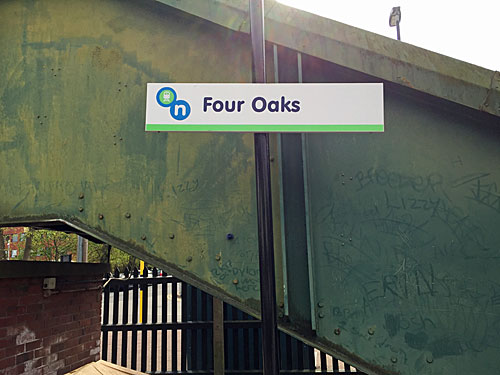
4)FOUR Oaks
Yesterday I visited the only station with a four in it. Four Oaks is a suburb of Sutton Coldfield. Apparently it's one of the poshest bits of the West Midlands, although I couldn't tell that from the station. A lot of the land beside the station is car park. A Grade II listed Methodist church can be easily seen a short distance away. The station has three platforms, one of which is for terminating trains that aren't going all the way to Lichfield. Unusually the ticket office is in the middle of the island platform. In a fantastic quirk of fate, trains run direct from the only station with a four in it to the only station with a five in it.
5)FIVE Ways
Yesterday I visited the only station with a five in it. Five Ways is the first station out of Birmingham New Street on the line to Redditch. It's named after the nearby road junction, now a mega-roundabout, but the name actually dates back to 1565. These days the junction is loomed over by several tall buildings, mostly hotels and offices, in an blandly undistinguished way. At the heart of the roundabout is a large, surprisingly green space, abuzz with people, complete with fast food shack. The station is in a cutting, with platforms accessed down lengthy winding staircases with brightgreen trim. It's the closest station to Edgbaston cricket ground.
6)SIXmilebridge
There are no 'six' stations in the UK, so I've had to pop over to Ireland. Sixmilebridge is the last station before Limerick in County Clare, serving a small village of the same name. It's the closest station to Shannon airport, although not usefully close. The station opened in 1859, closed in 1963 and reopened in 2010.
7)SEVENoaks
We're back to counting oaks again. Sevenoaks is in Kent, and was named after a set of trees in the 8th century. Two other 'seven' stations exist, both in London, namely Seven Sisters (named after seven elm trees) and Seven Kings (the other Crossrail station in this list). Severn Beach and Severn Tunnel Junction don't count.
8)LEIGHTon Buzzard
Unsurprisingly there are no proper Eights, so I've had to make do with Leighton Buzzard in Bedfordshire. I could also have picked Deighton or Sleights, but my guess was you'd not have heard of them. Deighton's a suburb of Huddersfield, thanks for asking, and Sleights is on the Esk Valley line between Middlesbrough and Whitby.
9)SherburN-IN-Elmet
No British railway station contains the word Nine, nor the letters 'nine'. But if you're OK with hyphens then Sherburn-in-Elmet in North Yorkshire passes the test, a 9-trains-a-day kind of station on the line between Selby and York, serving a large village on one side of the tracks and a huge trading estate and airfield on the other.
10)ChelTENham Spa
There are eight National Rail stations including the letters 'ten', of which Tenby is perhaps the most obvious, but I've gone with Cheltenham Spa in Gloucestershire instead. Other tens include Attenborough, Sampford Courtenay, Tattenham Corner and Westenhanger, plus in London a couple of Tottenhams. Later this year Tottenham Court Road will become a National Rail station, which'll put Crossrail on the list yet again.
I think the only other numbered National Rail station is Chafford Hundred... unless of course you know better.
It's election day in Tower Hamlets, which means 95% of you can now go and read something else instead.
Not only are we voting for 45 councillors, but we're also voting for a Mayor, and they get to take all the important decisions no matter which party the other councillors represent.
It's our fourth Mayoral election. The first was triggered by a suspicious referendum, the second was declared void, and the third was a re-run. Our first Mayor was found guilty of electoral fraud and has been debarred from standing for office. Our second Mayor is a former council leader who's been picking up the pieces, and he's standing again. It's always complicated in Tower Hamlets. [Mayoral booklet]
John Biggs (Labour)
The current Mayor. Lives in Wapping. Wants to carry on doing the things he's currently doing. Promises integrity, ambition and shaking his fist at government cuts. Plans to make the borough safer, cleaner, greener and fairer. Specifically, 10 new pocket parks, 2000 new council homes and 1000 apprenticeships. Likely to win, but the bookies have said that before.
Dr Anwara Ali MBE (Conservative)
Former councillor, and currently a GP. Lives in Limehouse. The owner of www.dr-anwaraali-mbe.com. Promises a Great and United Tower Hamlets, and making best use of council reserves. Plans to make the borough safer, more secure and more sustainable. Specifically, new CCTV cameras, renegotiating council contracts and the introduction of a 'Health and Well-being Shuttle'. Long odds.
Ciaran Jebb (Green)
Sustainability Officer at UCL. Lives in Bethnal Green. Also standing as a councillor, in case his mayoral ambitions fail. Promises a radical and honest approach. Plans to hashtag #airpollution, #youngpeople, #localhousing, #smallbusiness and #greenspaces. Specifically, enforcing 20mph zones, introducing drug-safe zones and funding for threatened nurseries. No chance.
Rabina Khan (People's Alliance of Tower Hamlets)
Former cabinet member, now on her third ex-Labour splinter group. Lives in Stepney. Came second last time. Unhappy about service decline under the current administration. Plans to fight for the vulnerable and disadvantaged, and against discrimination. Specifically, 2500 new council homes, free social care and freezing council tax. Likely the runner-up, again.
Abul Monsur Ohid Ahmed (Aspire)
Former Deputy Mayor. Running for the party founded by the former (disgraced) Mayor. Lives on the Aberfeldy. Promises a fresh new vision and a safer, fairer future. Plans additional funding for youth services, an annual Communities Festival and the creation of a thriving faith sector. Specifically, 10000 new jobs, 10000 new homes (by 2026) and 50 electric charging points. Wild card.
Hugo Pierre (Trade Unionist and Socialist Coalition)
Works for Unison in Camden. Lives in Stepney. Says Let's Turn Jeremy Corbyn's Words Into Action In Our Town Hall. Standing on a no cuts agenda. Specifically, railing against the rich, rent caps, restoration of the student maintenance allowance and stopping nursery privatisations. Would donate half his Mayoral salary to the cause. I doubt the momentum is behind him.
Elaine Bagshaw (Liberal Democrat)
Qualified Business Change practitioner. Candidate for Poplar and Limehouse at the last General Election. Lives in Poplar. Has a 'Six To Fix' plan. Plans to focus on homes, crime and Making It Easier To Do Things With The Council. Specifically, reusing 559 empty houses, reducing fly-tipping, and going back to delivering pink recycling bags to your doorstep. TH's LD heyday is long gone.
Friday lunchtime update: Mayoral election results 1) John Biggs (Labour) 37619 (48%) [+7246 second choices = 66%] ELECTED 2) Rabina Khan (PATH) 13113 (17%) [+3765 second choices = 34%] 3) Abul Ahmed (Aspire) 11109 (14%) 4) Anwara Ali (Conservative) 6149 (8%) 5) Elaine Bagshaw (Lib Dem) 5598 (7%) 6) Ciaran Jebb (Green) 3365 (4%) 7) Hugo Pierre (TUSC) 728 (1%)
That's an impressive win for the current Mayor, almost taking half the votes on the first round of counting. The two splintered local opposition parties managed 30% between them, suggesting the days of offbeat Tower Hamlets politics may now be firmly behind us. None of the other main parties really got a look in.
Saturday morning update: Council electionresults
» Labour 42 councillors (46% of the vote)
» Conservative 2 councillors (10%)
» PATH 1 councillor (6%)
After four years of 'no overall control', Labour have stormed back with their cleanest sweep since 1974. The only Conservative representation is on the Isle of Dogs (after Wapping and Limehouse switched back to Labour). The sole independent candidate is Rabina Khan, the Mayoral runner-up, as the diaspora of ex-Lutfur supporters slumps from 18 councillors to 1. Aspire got 15% of the votes but no seats. Tower Hamlets almost looks like a normal East London borough again.
Londoners don't ride open-topped sightseeing buses, partly because they already know what London looks like, but mainly because they're not stupid. Why fork out £25, £29 or £31 to see buildings you could see from a normal London bus for a fraction of the cost?
But a new entrant has just entered the market, offering open-topped two hour trips for a pound. Is the megasightseeing.com option any good, or is it simply a spoiler to damage the competition? I coughed up the price of half a cup of coffee and went to find out.
Seriously, one quid?
Actually there's a 50p booking fee, so £1.50. But that's still the same as a normal London bus, and even with a Hopper you couldn't see all these sights for a single fare.
No but really, one pound fifty?
Well, not always. This is a Megabus promotion after all, and they specialise in offering a minimum number of tickets at the lowest price, then upping the cost as more people come on board. Weekday fares are more likely to be £3 or £5, and at weekends you'll be lucky to get on board paying less than £7. I've seen £14 demanded for one trip next Sunday. But why pay that much, when with a bit of forethought you can grab a seat for a pound?
How do you pay?
The driver can't sell you a ticket, so you have to pay in advance online. That said, you can use your phone to buy a seat right up until the moment of departure.... which I guess Stagecoach are keen for you to do, as you'll probably pay over the odds.
How does the service work?
There are three starting points - one by the Tower of London, one by the London Eye and one on Park Lane. One bus departs each of these every hour, on the hour, and makes its way round a 14 mile circuit. It's a non-stop trip, so you end up back where you started two hours later. Best not drink too much before you board.
Do the buses run to a timetable?
The start time's fixed, but after that there are no other stops, so a timetable doesn't matter. Be warned that my bus turned up five minutes early, but I saw another depart quarter of an hour late.
I like buses. Tell me about the buses.
They're blue double deckers and they have no roof. They're also named after historic Londoners, for example King William I, Queen Victoria or King Charles II. Every morning Winston Churchill and King Henry VIII roll out of Bow Garage and glide past my front door.
I really like buses. Tell me about the buses.
They're 12 year-old Alexander ALX400s on a Dennis Trident chassis, repurposed for use as open-topped buses. King Henry VIII used to operate on ordinary bus routes in theRomford area before he had his top chopped off and waterproof seats fitted. The seats aren't too uncomfortable, thankfully.
What's the route?
It depends where you get on, but it's a one way loop. From the Tower of London you head west up the Embankment as far as Big Ben, return up Whitehall to Trafalgar Square and Piccadilly Circus, reel back to do Pall Mall and The Ritz, nip up to Marble Arch and back, skirt Buckingham Palace to the South Bank, then finally wiggle over Waterloo, London and Tower Bridges via St Paul's and City Hall. According to the publicity you pass 50 points of interest. Technically there are considerably more.
Is there a map?
Yes, here. There's also a free printed map available on board, in a rack at the bottom of the stairs, but nobody points this out until you're sat in your seat and the commentary mentions it and by then it's too late to pick one up.
Is there a commentary?
Indeed there is. Don't expect a human being to stand on the top deck and tell you things, this is all electronic and pre-programmed. That said, the GPS system works pretty well, so the relevant commentary generally kicks in at an appropriate time when you can see what's being talking about. The volume from the speakers is usually audible, although sometimes passing traffic or road works blanks it out. It's all in English. Sid is more annoying than Marilyn.
Who are Sid and Marilyn?
They're the characters who do the commentary. Marilyn's a Blue Badge tour guide and she does most of the factual stuff. Her input is short but informative, and even I learned a few things. That said, the target audience is definitely out-of-towners, with foreign tourists very much in mind. Sid represents the mascot on the side of the bus, and he's a bit more slow and patronising. Thankfully he doesn't chip in too often.
How up to date is the commentary?
Given the service only started last week, very. The commentary even recognises that the Houses of Parliament are sheathed in scaffolding so you can't see much at the moment. Florence Nightingale, the Pankhursts and the women who built Waterloo Bridge all get a mention, so it's not as sexist as the naming of the buses appears to be.
Was it cold?
I didn't think so, but the other four people on board all put their hoods up. Do watch the weather forecast before you book, because there's no shelter whatsoever upstairs. You definitely wouldn't have wanted to be riding around in Monday's wind and rain for two hours (and I note the fares didn't drop to reflect that).
How bad was the traffic?
We endured some bad jams on the way round, including three of at least ten minutes. It's not too bad being stuck in traffic when your view is the Houses of Parliament or Trafalgar Square. It's rather less enthralling to be idling behind a lorry round the back of the National Theatre. Our trip was so delayed that it lasted ten minutes over the allotted two hours, despite the driver taking a bit of a shortcut at one point.
Is the tour any good?
Come on, how often do you normally get to ride round London upstairs in an open-topped vehicle? Heading across Tower Bridge was an obvious highlight. I also enjoyed the opportunity to ride down roads normal London buses don't get to follow, like the long tunnel on Upper Thames Street. But mainly it was simply a good excuse to stare at central London for two hours - the famous bits and the not so famous bits inbetween. On a more practical level, if you ever have any friends in town keen to see the sights, this'd cover it without breaking the bank.
Can Stagecoach be making any money out of this?
The combined fares taken on the tour I went on wouldn't even cover the minimum wage, let alone the driver's actual pay, fuel costs and wear and tear. But there are 45 seats on the top deck, and if they were all full even at the £7 rate, that's a nice little earner.
What are the downsides?
It's cheap and cheerful, as you could tell when one of the competitors' £30 tour buses pulled up alongside with a uniformed host recounting anecdotes in real time. The twenty minutes from Marble Arch back to Westminster Abbey were a bit dull. Because it's an open topped vehicle, I suspect I've inhaled more exhaust fumes than my lungs would have preferred. Certain sights are only seen from a distance, or from the side, or glimpsed briefly as the bus turns away from them. Nobody gets off until the end, so tourists can't use the service as a way to hop round town. But you get what you pay for.
Was it worth the money?
Obviously it was a worth a quid, yes. It would definitely have been worth three quid, and probably five quid, and maybe seven quid, but I wouldn't rush to pay more. Book ahead, and you need never do that.
Across the UK the first of May has long been a day for celebrations and festivities, often with a bit of ribboned pole-dancing thrown in for good measure. London too has a long history of springtime frolics and debauchery, often spread over several days, although the focus of these mass celebrations has shifted somewhat over the years. Up until the 17th century the capital's main spring gathering was held in the Haymarket, just up the road from Charing Cross. It's certainly wide enough.
As the name suggests, Haymarket was once the place where Londoners came to buy hay. In Tudor times it had been a country lane on the edge of town, bordered by hedgerows and fields, before becoming the unofficial spot for lining up carts loaded with hay and straw for sale [map]. It also proved the ideal spot for an annual spring cattle market, plus associated rowdy merrymaking, which became known as Saint James's Fayer. Slowly the surrounding area became built up and Haymarket was paved over, after which the hay vendors were required to pay fees for their thrice-weekly pitches. The first theatres came a little later, but this broad, busy thoroughfare was already unsuitable for a fortnight of lewd drunken activity. A less central location was sought, and in 1686 the May Fair moved on. You can probably guess where to.
During the reign of James II, most of the area northwest of St James's Park was muddy pasture alongside the lowly Tyburn brook [map]. At the time there were no local people to complain about London's annual May Fair moving in, save the residents of a few grand houses backing onto what is now Piccadilly. This sprawling sideshow took over Great Brookfield meadow each year on May 1st and continued for a full fifteen days. It attracted wild revellers from all over London and the home counties, as well as countless thieves, charlatans and lewd women, keen to escape the bounds of the city and indulge in raucous excess. Over the course of a fortnight much ale was quaffed, much money was wagered, much flesh was feasted upon and much seed was sown.
As London continued to spread westward, the new inhabitants of north Piccadilly became resentful of the fair on their doorstep. They feared for the morals of their wives, servants and children, threatened by corruption in this iniquitous "nursery of vice". Rich residents petitioned the courts for the fair's removal, initially without success. Then, as the suburbanisation of the area continued, landowners moved in to erect new houses on these riverside fields. Edward Shepherd laid out a densely populated warren of streets - Shepherd Market - at the heart of the old fairground site in 1735. But it was not until 1764 that the Earl of Coventry successfully used legal means to force the entire bacchanalia to move elsewhere. [meaty lost river thesis]
With the May Fair's departure the area headed rapidly upmarket to become the exclusive aristocratic neighbourhood of Mayfair we know today [map]. Shepherd Market ended up as one of the poorer areas, relatively speaking. It's never quite shaken off its reputation as a haunt for shady backhand deals and prostitutes, but now thrives as a backstreet enclave of restaurants, pubs and galleries. Narrow taxi-choked lanes weave off Piccadilly past grimy buildings which look like part of the set of Oliver, leading to a hodgepodge of bollarded alleyways where hedgefunders buy lunchtime gifts for their partners and well-groomed socialites dine alone behind plastic sheeting, while delivery vans unload in the tiny square where Edward Shepherd once sank his duck pond. All that remains as a historical hint of former overindulgence is a blue plaque above the back door of a Lebanese restaurant.
In 1764 the May Fair moved on, five miles eastward, re-establishing itself in a field just outside the small village of Bow [map]. Here it amalgamated with the existing Bow Fair, a long-standing booze-fuelled shindig held a few days after Whitsun. The event had previously been nicknamed the Green Goose Fair, not only because of the spit-turned meat on offer, but because 'green goose' was a slang term for women of ill repute.
The crowd's behaviour here was just as atrocious, with Londoners arriving in their droves by road and river to take out their frustrations on this tiny rural backwater. But as Bow's population grew so too did the number of complaints from local residents, as before, until in 1823 the fair was banned altogether "due to rowdyism and vice".
Today the site of Bow's 'Fair Field' is marked by a plaque on the corner of where else but Fairfield Road [map]. Once little more than a grassy track on the edge of the village , the lower end was soon lined by some tidy Georgian terraces, several of which survive. But as for the plot of the Fair Field itself, its somewhat downbeat legacy is as a town hall that's no longer a town hall, a nightclub that's no longer a nightclub, a school that's no longer a school and a station that's no longer a station.
This striped building partially resembling an ocean liner is Poplar Town Hall, one of the first examples of modernist civic architecture, opened in 1938 by former mayor and Labour Party leader George Lansbury. It was downgraded to mere offices in the mid 60s, when Tower Hamlets council was created, but still provides an impressive (if slightly shabby) presence facing Bow Road. In 1957 Fair Field's reputation for vice and criminal activity was rekindled briefly when the Kray Brothers opened their very first club, the Double R, nextdoor. Barbara Windsor and Jackie Collins came round a few times, as did the police. Today only a car hire portakabin marks this doubly notorious location.
As for Bow School, which is the secondary Ashley Cole went to, that's been empty since 2014 when the pupils moved out to a shiny newbuilding beside the Lea. Their old classrooms are supposed to be turning into a much-needed primary, but peering through the railings at the mothballed playground suggests that legal or financial encumbrance has crippled the project. Which just leaves the ex-station, Bow's first, whose platforms were carved across the former Fair Field about a decade after the May Fair ceased [map] [map]. Its razed cutting has since been used by the DLR for maintenance and storage, presenting a somewhat bleak panorama on the trackside immediately to the north of Bow Church station. Peer through the railings from Kitcat Terrace, and what was once a field of dreams is now an inaccessible mostly-vacant hole.
As a resident of Bow Road I'm both saddened and relieved that London's premier spring festival no longer takes place so close to home. Whilst it would be really convenient to have a major fairground a couple of hundred yards up the street, I really wouldn't want drunken merrymakers urinating on my doorstep, nor do we need countless prostitutes hanging around outside the Co-op. But it's a shame that London no longer delivers a full-on springtime festival to which we're all invited. These days London's only long-term drunken revel is Winter Wonderland - a tame commercial affair at the wrong end of the year, in the park facing the posh estate that evicted the May Fair 250 years ago.

Notes from Boring 2018