As you'll know if you've been to Oxford Street recently it has a heck of a lot of sweetshops these days, specifically selling imported American candy.
It had at least six before the pandemic and somehow they survived the lack of tourists and multiplied and now there are eleven. I thought I'd visit them all, starting at the Marble Arch end.
Candy Surprise: This is located slap bang on the corner facing Marble Arch and used to be a Crest of London souvenir shop. It also sells luggage, vapeware and tins of English Breakfast Tea, but mostly it's sweets.
If you've not been inside one of these candy stores they're essentially an Aladdin's cave of sugary treats, most (but not all) originating on the other side of the Atlantic. That means shelves of Oreos, Hersheys and funky flavoured Pop Tarts as well as racks of Cheetos, Milk Duds and assorted Nerds. There's often a entire wall of sugary cereals like Apple Jacks, Cocoa Pebbles and French Toast Crunch, plus all sorts of chewy options like Hubba Bubba, Millions and Dots. Expect to face flavours like blueberry, bubblegum and watermelon which are less familiar in the UK, and if there's a chiller unit the likes of Kool-Aid, Mountain Dew and Fanta Berry. You might even grab yourself a packet of Sour Jawbreakers, a bag of Chile Limón Lay's Potato Chips, a selection of Mike & Ikes or a box of Nabisco Grahams. But what you won't see anywhere is a price.
Tales are told of people who went in for a bar of chocolate, a bag of sweets and a packet of cereal, waved their contactless card and discovered later they'd been charged over £20. I can't confirm this because, as I said, all the goods are unpriced and I had no intention of buying any. What I did do in Candy Surprise is ask if they had any Cinnamon Tic Tacs because I know they've been discontinued, and all they did was direct me to some Lime and Orange by the till which I could have bought in my local corner shop. Tremendously polite, but no thanks.
American Sweet Dreams: This one used to be Holland and Barrett. It's quite lightly stocked, being mostly wallspace and a few free-standing units. American Lolli & Pops: This one seems to be a partner to the one a few doors up the road and if anything is emptier. One of the shopworkers was standing just outside the entrance, less to welcome visitors but more as if he was acting as a lookout. Candylicious: This one's bright and welcoming so long as you're not frightened off by M&M's characters in party hats. It used to be a shoe shop. Have you noticed how every one of these has either the word 'Candy' or the word 'American' in its title? American Candy Shop: This one has both. It used to be Boots the Chemist but during the pandemic there wasn't much call for that so now it sells sweets. In its defence this is the only shop that actually puts price labels on some of its stock, so well done to them, even if the inevitable effect is "£6.99 for a box of Pop Tarts! No thanks."
That's five of these shops in the short section between Marble Arch and Bond Street stations. There's no way Oxford Street needs this level of candy competition, you'd think, and yet all of these stores had customers so maybe it is what people want to browse. If you're up from the provinces with the family or on a trip abroad with your mates, a quirky sweet shop might be a lot more fun to dip into than the surrounding alternatives. Half the department stores have gone and most of the clothes shops too, so checking out Jolly Ranger candies and Jelly Belly beans does at least pass the time.
Candy World: This is the big one, both in terms of floor space and in terms of who it replaced. That's because this is the former HMV flagship store at 363 Oxford Street, now emptied out and replaced with racks of empty calories. Head to the rear and you can see the mothballed escalators, the lowest access point now hemmed in behind a selection of generic suitcases and other luggage. If this is where you came to buy your classical LPs or new wave CDs, it's sad to see walls of Hostess Twinkies, Cookie Dough and Goldfish Crackers instead.
A shop where you could buy long-forgotten British sweets would be excellent, a nostalgic treasure trove of Spangles, Toffos, Pacers, Pyramints, Fuse bars and the like. But you'd never interest the young consumer, which is where Oxford Street's audience is, plus some company would actually have to manufacture them again, whereas these American treats can simply be imported and everyone goes ooh how exotic, I'll buy two bags.
Americandy: This wins the prize for the best name, but is also one of the smallest shops. It used to be an Accessorize but is now emblazoned with candy canes and Wonka bars. Kingdom Of Sweets: This is the odd one out, as the use of 'sweets' instead of 'candy' in the name suggests. It's been here 10 years now, the business having originally evolved from a pick ’n’ mix stand in a Barnsley shopping centre, and its selection isn't as American as elsewhere. It's also the only store where I saw a woman employed, the only store with a basement and the only store with a selfie screen for customers to use as an Insta background. Marshmallow fluff, Swedish Fish and six kinds of Snickers remain available, however. Candy Shop: Easily the dullest name of the bunch, inside a large unit where JD Sports used to be. I was part surprised and part impressed to see an employee dusting the rack of crisps just inside the entrance. (Candy Corner): ...but this one's closed. It had everything going for it - a location close to Oxford Circus, the usual stock of transatlantic goodies and the Stars and Stripes on full display - but instead a sign in the window says 'Everything Must Go' and the shutters are down.
There are those who say these shops are a front for dubious trading, maybe even money laundering, and that some overlord is repeatedly opening and closing a selection of outlets to keep on the right side of business legislation. It does seem unlikely that a dozen half-empty sweet shops could support the exorbitant rents that the heart of the West End demands, however overpriced the Twinkies, Twizzlers and Sour Patch Kids might be. All I'll say is that in certain stores the stooge by the door did seem more interested in watching the street than any potential shoplifting within, and I never quite felt comfortable enough inside to take photos of the colourful displays up close.
American Candy Shop: This is the first repeat, indeed a matching shop to the one near Bond Street station. There are considerably fewer candy outlets on the run-up to Tottenham Court Road, indeed just these two. American Sweets & Souvenirs: This final shop had a poor selection of candy, as you might expect when half the store is about flogging hoodies, key rings and plastic Big Bens. But a box of Pop Tarts was only £5.99 here, i.e. a full pound cheaper than at American Candy Shop, so it pays to shop around.
It's no good tutting, these candy stores aren't aimed at you, neither are they occupying units that'd be selling something you were interested in either. But you do have to wonder why what used to be the most prestigious shopping street in the country is now infested with tacky outlets fleecing visitors with unlabelled racks of foreign confectionery. Priceless? Sadly yes.
Gerrards Cross is a commuter town in south Buckinghamshire, although last time I went it was a commuter village in South Bucks, which just goes to show how much can happen in six years. It's comfortably wedged between the M40 and the M25, conveniently linked to Marylebone by train and regularly tops lists of Most Desirable Places For Broadsheet Readers To Live. Before the railway arrived there wasn't much here, just a hamlet round the common and a few houses on the Oxford Road, but after 1906 came a sprawl of private housing estates aimed at London’s upper-middle class. It's no tourist trap, more an extensive dormitory with nice shops, but this never stops me going gadabout.
The jewel of Gerrards Cross is the Common, a 60 acre triangle that early property developers sensibly left alone. Wander down the high street and a grassy fringe suddenly opens up, then beyond that a deep expanse of thick beechy woodland. This is criss-crossed by desire line footpaths that over the years have become well-trodden tracks, so is never especially wild but ideal for a good long dog-walk. Stumble the right way and you might find a small pond, but more likely Jasper on his bike or Lady on her lead. I stumbled out by the Lutyens war memorial. A very GX sight: The owners of several convertibles absolutely loving getting the opportunity to drive round with their tops down in March.
Sir Edwin Lutyens designed 40 war memorials, the most famous of which is the Cenotaph, but only here in Gerrards Cross did his structure have a dual purpose. The vicar donated his stable block and Lutyens duly transformed it into a community centre for the new village, fronted by a pillared portico where the names of the local dead are inscribed and wreaths are laid. Today the building houses the offices of the local branch of the Royal British Legion and/or a gym, it was hard to tell, and the surrounding buildings form the town's social hub. Today they're putting on eco-puppetry for children, whereas yesterday an arch of Friesian-coloured balloons welcomed little princesses bearing gifts to Riya's farm-based birthday party. A very GX sight: The party caterers firing up their burger grill in the back of a horsebox.
Stumble off the common another way and you're met by the fine sight of the Church of St James with its octagonal dome and campanile tower. It was built by two sisters in 1859, long before it had a parish worth serving, in memory of their brother who died while serving as a non-local MP. Had you been here in 1969 you might have witnessed the wedding of Lulu to Maurice Gibb - somewhat of a drunken whirlwind I understand - or in 1972 the burial of screen great Margaret Rutherford. I found her pink granite headstone round the back, almost in pride of place, amid a whirl of primroses and daffodils. A very GX sight: A red kite circling in the sky, like it was the most normal bird to be flying above a Home Counties town.
Beyond the church is Buckinghamshire's largest hillfort, Bulstrode Camp. It's thought to have been built between 500BC and 50AD and consists of a double rampart earthwork surrounding a large oval space up to 300m in diameter (which thus far has delivered little of archaeological substance). The middle's quite featureless (and mostly full of exercising dogs), while the encircling ditch proved much harder to walk round than I assumed it would be. This being Gerrards Cross the camp has subsequently been surrounded on all sides by private housing, so must be quite the feature to have at the bottom of your garden. A very GX sight: A poster campaign decrying Network Rail's proposal to replace the high level Edwardian footbridge because "half of the adult female population will not be able to see over the bridge parapets."
The most infamous shop in the high street is the Tesco superstore built on top of the railway cutting in 2005. During construction the tunnelcollapsed and dropped thousands of tonnes of backfill onto the tracks below, thankfully missing an approaching train, and halted all traffic on the line for several weeks. Locals pledged never to use the store, but were busy flooding into it yesterday afternoon for groceries and Mothers Day treats. That said there is a Waitrose round the corner for true refuseniks... but no longer an M&S Simply Food because that's being transformed into a pub. A very GX sight: The owner of a 1949 open-topped Bentley parking by the trolleys and disappearing into Waitrose.
The high street is partly coffee shops, partly interior design boutiques and partly in flux. The town's longstanding jewellers is currently morphing into a barbershop, Lisa's ladies clothes shop is pivoting to dog grooming and the Post Office appears to be housed in a former Thorntons. Gerrards Cross's children are fortunate enough to have somewhere they can buy Lego, and their parents spoiled for choice regarding silver and grey objets d'art to decorate their homes. As for Lighting Matters, purveyors of Total Lighting Solutions, its owner was inexplicably standing in his shop doorway wearing a bowler hat with a lightbulb on it and playing Molly Malone on the accordion... attracting nobody. A very GX sight: A one-man band sporting a top hat, drumkit, purple vuvuzela, plastic chicken and bucket of champagne, walking across Packhorse Road bridge.
But Gerrards Cross is mostly houses, great big lovely ones up leafy avenues. They don't all have high laurel hedges and entrance gates, many are just four-bedroomed detached piles with a magnolia and multiple parking spaces out front, but they do all scream 'comfortably off' from their gabled rooftops. If you live in a semi in Gerrards Cross you've done very badly for yourself, relatively speaking. Gardens are often extensive, and homes generally named (Beechwood, Silver Birches, The Dells) rather than numbered. It all means housing density is remarkably low - barely 8000 people live here - and the encircling Green Belt means hardly any new homes are being added anywhere. A very GX sight: A delivery driver with a luxury bouquet buzzing on the intercom at the top of the drive while being yapped at by a chocolate labrador.
If you keep walking north and keep your eyes open, it doesn't take long before the bins change. The boundary between South Bucks and Chiltern districts cuts across several residential streets, being a leftover from when all this was fields and it didn't matter, but then the village of Chalfont St Peter spread south towards the railway and merged to create a suburban megaplex. Administratively it's a ridiculous state of affairs, or was until April 2020 when all the former local councils were subsumed into a new Buckinghamshire unitary council, and if you keep your eyes open you can see their bins starting to appear too.
Gadabout: CHALFONT ST PETER
This is the ancient one, the Chalfont that's neither Little nor St Giles, and now a similarly desirable suburban bolthole. The heart of the village must have been charming in its day, as the parish church and a couple of very old pubs suggest, and the parade of shops rising up towards Goldhill Common has full Metroland charm. But check out the plaques on the heritage trail and a lot of them show prettier views along with the caption "...demolished in the 1960s to make way for the bypass", which'd be Amersham Way. This wiped out a significant chunk of the high street and has also despoiled the river valley all the way down to Gerrards Cross, so has been a wider success and a local disaster. Whoever plonked a row of flats on stilts beside the old coaching inn didn't help either.
On Saturday afternoon the shops were busy, every outside table was taken and the counter staff at Mr Crusty were winding down after the lunchtime rush. In the Market Place a group from the Rotary Club wearing yellow jackets and blue trousers were waving to traffic and collecting for Ukraine. The sorriest sight was the River Misbourne because it wasn't there, just a dry shallow channel weaving across the park and disappearing under the high street. I checked it out again a bit further downstream and found a few disjoint puddles but nothing more, which might be because this is what chalk streams do in dry weather or might be evil water companies draining the aquifers. All in all CSP felt a tad more affordable than GX, but the longer trek to the station probably cancels that out.
I know some of you turn up at 7am each morning to see if I've written about something that interests you. Well, you can go off and enjoy your Saturday because today's post is for committed omnivores (and MWLB) only.
My journey yesterday
Train 1: So long as I leave the house early enough I can just turn up without needing to check departure times, whereas if I leave it any later I might be waiting around for up to 10 minutes like it was still the bad old days. The guard said they should be opening up the front seats again soon. Train 2: Please remember to stand on the right hand side of the escalator. I got past eventually and hit the second escalator just as the train was pulling in, but I still caught it.
Bus 1: I forgot they'd changed the stop this bus leaves from - I still don't understand why - so walked the wrong way and nearly missed it. The Next Bus Indicator Screen was disconnected so provided no useful information. I need to write a post called "Revealed - all the buses that travel over a mile between stops" before Callum beats me to it. Bus 2: I didn't need to catch this bus, it was an entirely gratuitous changeover. My bad, the next bus I wanted pulled out in front of us at the station and we never caught up. I was surprised nobody else got off by the cafe with the clocks that isn't there any more. Bus 3: There were three buses to my next destination but no more than two of them left from the same stop, so that was a pain. I almost picked correctly. Not Bus 4: I don't know about you but if there's a long gap until the next bus I always like to walk ahead along the route until just before it eventually catches up. In this case there was supposedly a 12 minute gap, so I set off (down a road I'd never walked before) and traipsed for over a mile before it eventually caught up, by which time I didn't need to catch it any more. Bus 4: Blimey this one rattled a lot. It was also quite busy, so much so that the ginger bloke with the sports kit signalled to me to nudge over on the back seat. I travelled two stops more than almost all the other passengers. Because the bus only had one door I hadn't quite reached the front before the first young passenger came leaping aboard, but they were very polite about it.
(interlude with bluebells...
...seriously bluebells, I wondered if I might see one or two but this was a veritable carpet under the trees by the river downstream from the waterfall, and it's March for heaven's sake, what is up with the weather?)
Bus 5: I caught this one just as it was arriving thanks to Citymapper (which I still prefer to the TfL Go app, mainly because it's not obsessed by only showing buses nearby). We rode past the bus stop that still makes me smile because over here it's a street name not a place name. Then a road closure sent us off on diversion which was mostly traffic jam, dammit, so I missed my onward connection. Not Bus 6: I can never remember if you're allowed to ding to alight while a bus is on diversion... but it wouldn't have helped. This bus sailed past in the opposite direction and then there was a 27 minute gap before the next one - much worse than normal - so I gave up and went a different way. Bus 6: Being at a bus stop with a Countdown display is usually very helpful but this bus was '2 min' away for the best part of five minutes. I grabbed the top front seat and enjoyed the unfamiliar ride and the blossom and eventually the topiary. Then I forgot to get off and ended up too near the shops.
(interlude with just the two bluebells, both runty and premature, which was more like it)
Bus 7: This was rammed and I actually had to sit next to someone on the upper deck. They weren't happy. Almost immediately we got stuck in traffic - this town always seems to be Jam Central - so I gave up and hopped off after two stops (and of course the bus then sped up and got there first). Bus 8: This was mostly empty - I never understand why it needs to be a double decker. I admired the driver's patience in negotiating past parked cars on a not quite wide enough residential road. Blimey, I'd not been here for over 10 years. Bus 9: OK, I'd had enough by now so it was time to catch the long distance bus halfway home. I need to write a post called "Revealed - all the buses that travel along the same road twice" before Callum beats me to it. The driver enjoyed the speedy roads with hardly anyone to pick up, and so did I until he suddenly stopped by the common and waited for five minutes 'to even out the service'. Not Bus 10: I spotted this bus just behind us as we approached the terminus so hopped off one stop early and flagged it down. The damned bus driver drove straight past, despite my very obvious signal, and I had to wait 7 minutes for an alternative. Bus 10: One last top front seat, but the view round here was so dull that I whipped my book out and read that instead. If you're counting, all today's bus routes were different and their numbers added up to 2152.
Train 3: I could have gone either way but chose this way because there'd be a more frequent service on Train 4. I should have read the disruptions board before plunging underground. Not Train 4: Hang on, what, no trains? The announcer was being borderline sarcastic and telling all those waiting for an eastbound train to find alternative routes or be stuck here for hours, but I stayed put because the Next Train indicator showed a westbound train in 7 minutes. Unfortunately this turned out to be an eastbound train coming in on the 'wrong' track, so those who'd ignored the announcer caught that and I had to find an alternative route. FFS announce things better, sarky staff. Train 4: I don't normally catch this one. Still, all the stair climbing had been keeping me fit. Train 5: Bored now. I could have been at home with a cup of tea if I'd caught the alternative Train 3. I wish someone would fix the beep on the Oyster pad, you always have to look to check it's registered. If you're counting, I was last here seven hours ago.
B-Road quiz
Here are clues to 30 five-letter words beginning with B.
Half of each clue defines the whole word, and the other half defines the word with the 'B' missing.
How many can you name?
For example, BROAD could be 'wide street', and BLAST could be 'final explosion'.
1) idle fire 2) loan mix 3) slow hoe 4) bold gush 5) carry loop 6) empty limp 7) peruse loaf 8) every shore 9) fast chance 10) glorify fewer 11) extra burden 12) attack pigtail 13) castle stream 14) cocky disease 15) chase support
And that's where I'm going to end my B Road safari.
I've walked all of Britain's lowest-numbered B Roads over the last five months, in sequence, from the B100 in the City to the B142 in Bow. I've also forced you to read about them, so if you've enjoyed them that's brilliant and if you haven't the good news is there won't be any more.
But this is the ideal place to stop, and for several reasons.
• B Roads aren't always very interesting. There is a limit to how many times I can write "look, there are flats", and nobody wants to hear ultra-fine-detail about shopfronts and lampposts on a road they've never been to.
• There are a heck of a lot of B Roads, indeed enough to fill every post on this blog for the rest of the decade, and you really wouldn't want that.
• So far all the B Roads have had pavements, and this is very much not the case later on.
• So far the B Roads have been quite short, none longer than three miles, but some of those coming up are considerably longer and I really can't be bothered.
• Indeed so far I've walked a total of 26 miles but the B184 is longer than that all by itself, which'd be entirely impractical.
• The last B Road I walked was the closest to home, so ending here would draw this feature to a natural close.
But the main reason I'm stopping now is because the first 26 B Roads were all in London but the next one is 250 miles away.
For reasons best known to the road planners, the B143 is in North Shields. It was originally part of the A192 but when that got diverted they needed a new B number and 143 was free so they gave it that. No matter that all the neighbouring B Roads were the Thirteen Hundred And Something because it's not about logic, more availability.
What's more the B143 is less than half a mile long, and it would be ridiculous to go all that way to walk such a short road for no sane reason.
But the main reason I'm not going to visit the B143 is because, by an enormous coincidence, I already have.
I holidayed in Newcastle in the summer of 2017 and travelled all over, including one afternoon when I took the Shields Ferry and walked from there to the Metro station. I was only in North Shields for 15 minutes and only walked four roads, but one was Railway Terrace and that turns out to have been part of the B143. I didn't realise it was of numerical significance at the time, I was just trying to find the quickest way uphill. Even better I only took three photos while I was in North Shields but two of them were of the B143. This is one (and you can click to see the other).
Both photos show the bend where Nile Road turns into Railway Terrace, which is just outside North Shields station. It's one way only - the bus stop markings should tell you which. The town's shopping centre is off to the right, which is not on the B143, whereas Charlie's Bar and Chez Hair Boutique are off to the left which is. The ferry terminal is down the hill, but sadly not via the route I walked.
There is no way I'm going back to Tyneside to walk a road I've already walked 10% of, particularly when it was the best 10%. But if I'll never walk the other 90% then I'll never walk all of Britain's B Roads, only all of those up to this point, so it's North Shields that sinks the project.
Which is a shame because the B144 is a good one, following the gorgeous Shepherdess Walk in Hoxton, then the B146 is Friday Hill in Chingford. But the B147 turns out to be a distributor road in Basildon, the B149 is the Chadwell bypass near Tilbury and when I said the B142 was a good place to stop I wasn't joking.
My apologies to all those of you who've been sitting there waiting for me to reach your provincial B Road because it isn't going to happen. At a rate of one road a week, even Terry who only wanted me to do the B515 in Islington would have had five years to wait. And if your local B Road is four digits long, as most B Roads are, I was obviously never going to get past the B999 (which is 16 miles into deep countryside north of Aberdeen).
Instead let me summarise what I've learned about B Roads over the last five months.
• They're very easy to overlook, at least here in London, because they're generally unsigned.
• They can be really short, especially in built-up areas (but in the countryside can be up to 61 miles long).
• They're often undriveable because someone has introduced a one-way system, a modal filter or even full-on pedestrianisation along the way - sometimes all three.
• Inner London B Roads are generally backroads of local significance, not critical connectors.
• Inner London has a heck of a lot more B Roads than Outer London. Camden has 19. Harrow has 2.
• Classifying a B Road is a very inexact art, and changes on maps sometimes lag way behind reality.
• It's up to local authorities to reclassify B Roads and often they don't even when it's blindingly obvious they should.
• The place to go to find out if something is a B Road or not is the National Street Gazetteer (although this won't confirm which B Road it is).
• The B116 ought to be the B166, and probably once was, but a likely administrative error means the Ordnance Survey thinks it's the B116 so it is the B116.
• Roadclassification was first introduced in 1922, which makes the original B Roads 100 years old this year.
• There may have been a geographical rationale to the numbering of B Roads back then but subsequent amendments usually mucked that up.
And let me illustrate that last point by showing you this map.
These are all the B roads in Tower Hamlets - thirteen of them current (in black) and seven of them obsolete (in red). You can sort-of see patterns in consecutively numbered roads if you look, suggesting some kind of initial sense, but the end result is a complex seemingly-random mess. At least they all start with 1, as they should do because Tower Hamlets lies in the road-numbering wedge between the A1 and the Thames.
Best just fire up your satnav and drive, I suspect. And let us never speak of B Roads again.
This, finally, is the last of Tower Hamlets' thirteen B Roads. It's also the closest to where I live and, because I've walked it hundreds of times, not exactly a voyage of discovery. Bear with me as I walk the fine line between parochial and familiarity.
The B142 starts at the end of the B118, indeed if they were trying to save numbers they could merge the two. It runs south (away from Victoria Park) towards the A11, with an extra spur halfway down linking to the A12. It also has that rarest of things for a London B Road, a sign confirming that the B142 exists, because this minor road was once the exit from a motorway.
Originally the B142 followed Lefevre Road until they redeveloped that into greenspace and flats, so now it follows parallel Parnell Road instead. Forgive the squinty photo below but that's spring sunshine for you. You're not missing much, this is an underwhelming start with one lonely street tree, two bus stops and some lampposts that look older than they are. For those who like to know which bus routes we're following it's the 8, 276 and 488 (and later we'll get a dash of 339).
It's not far to the end of the B119, which is Roman Road, which means I've already written about that too. A large black gateway gives the road some municipal oomph. It hasn't taken long for the former Percy Ingle bakery on the corner to become a dessert parlour. The Hand and Flower pub has been a Turkish restaurant for rather longer. The fire station that Boris closed in 2014 has been replaced by a shiny five-storey University Technical College. Even the row of sheltered housing bungalows opposite has recently been knocked down and replaced by flats, because history does not hang heavy on Parnell Road.
It's now time for the B142 to skip across a railway that's no longer there. The North London Railway ran between Bow and Old Ford until 1984 (as previously described) and ducked beneath Tredegar Road at a minor bridge. Today the tracks to either side are covered by housing but the hump remains and that's the only way through so that's the way we're going. A special mention to Pelican Cottage by the mini-roundabout, which is the first house we've passed that's more than 50 years old and is in fact more than 200 years old (and you can read more about it here).
Each of the three roads at the mini-roundabout is the B142, which is unusual, and has been the case since the A102(M) ploughed through in 1973. An extra bit of Tredegar Road was classified to link up with the Old Ford exit, not that it's a very interesting bit and often consists of little more than a traffic jam. The flats on the left are almost 20 years old and the flats on the right more like 10, and pig ugly, like someone stuck scarlet cladding on a warehouse. I did walk all the way across the A12 and then all the way back again, just for completeness sake.
Which just leaves Fairfield Road, and that's (eventually) more interesting. We've first got to get past the hideous orange balconies on Bellasina Court and then the former Caledonian Arms pub, but voila these are the turretsandchimneys of Bow Quarter. This is the former Bryant & May match factory, Bow's most famous employer by half, and venue for the groundbreaking Matchgirls strike of 1888. These days it's a very large gated community, indeed one of the first, so don't expect to get past the security staff in the gatehouse unless you're delivering a takeaway.
The road drops to pass beneath two low bridges, one for trains to Liverpool Street, the other for the DLR. This is bad positioning because BowBusGarage is located on the other side and so all the double deckers which emerge can only turn left. This was formerly a trolley bus depot and before that the site was Grove Hall asylum, and before that the field where London's May Fair was held, hence 'Fairfield Road', and forgive me for rushing through this local stuff but you'll have heard it all before.
In good news for estate agents we finally have some lovely old houses, including an early Victorian terrace and two proper villas, plus infill where the Germans left some gaps. The biggest detached house used to be the rectory of St Mary's church, and that's likely a hearse parked nextdoor because the former Nat West on the corner has been taken over by a proper East End funeral director, indeed you might even spot a feathered horse. The chunky Modernist trapezoid opposite is Poplar Town Hall, or was for three decades before it became superfluous, and hey presto that's the B142 done.
It's only a couple of minutes to walk home for a cup of tea... and that might be a good place to leave it.
Today I'm having another go at enlarging my My London clickbait portfolio.
I rode the secret rail replacement bus to the tube's least used station
I'm aware that previously I claimed the tube's least used station was Roding Valley and today I'm claiming it's Kensington Olympia, but that's because I'm picking and choosing my data to fit my headline. I'm aware that officially it's a tube replacement bus, but that's not as alliterative. And I'm aware that normally when journalists say "secret" they mean "something I know but you don't, please click", but in this case I intend to put forward a coherent argument that this is indeed a secret bus, and therein lies the problem.
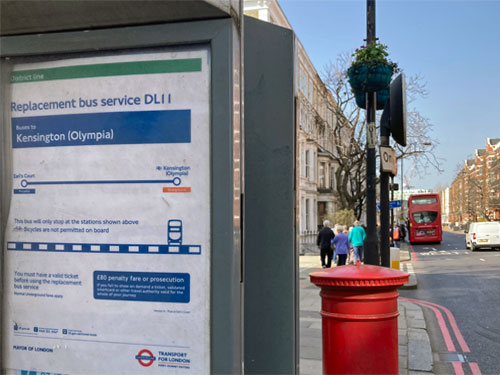
TfL withdrew weekday District line trains to Kensington (Olympia) in 2011, other than seven outlying services at very unhelpful times. This'll make the rest of the line more reliable, they said, and you can always take the Overground instead. But TfL can occasionally be persuaded to run a weekday service if Olympia's holding a big enough event, a list which these days has thinned down to just the Ideal Home Show. That's been cancelled for the last two years but this March it's back... except the trains aren't, hence the need for a rail replacement bus. Not that they want to tell you about it.
The thing about the Ideal Home Show, especially on weekdays, is that it's attended by a lot of retired couples from the shire counties. Not for nothing did the Daily Mail create the show and sponsor it for several decades. And if there's one thing people from outside London know, it's that if you want to go to Olympia you need to aim for Kensington Olympia station. And so they head to Earl's Court, like they always have, and attempt to catch the special shuttle service... except it isn't running, and there are no signs directing them to the replacement bus.
There is a tannoy announcement, but not terribly often and only on one pair of platforms and barely audible if you're standing anywhere else. There are permanent signs around the station saying "Take the first Wimbledon train and change at West Brompton for the Overground" but that's quite complicated for out-of-towners, plus you don't need to this week because there's a bus. There are also lovely staff who'll tell you about the bus if you ask them, but only up at the ticket gates. One dear old bloke asked the staff at the eastern exit how to get to Olympia and was duly directed all the way across the station to the western exit, which he could have gone to directly if only there were signs, which there were not.
On reaching the Warwick Road exit I noticed a surprisingly high number of people trying to catch a secret bus. They can't all have asked the station staff, I thought, maybe they knew in advance. The Ideal Home Show website knows nothing of buses, I checked, it merely says that the tube runs a limited service at weekends. The Olympia website is similarly tight-lipped, and the TfL website merely says that the District line is running a Good service. It's possible that attendees received travel advice with their tickets, but far more people were heading for Bus Stop C than I was expecting. "Look, it's over there," they said, crossing at the lights and walking up the road.
And at Bus Stop C the secretness continued. "Rail replacement bus service stops here" flag - good. Replacement bus service panel above the timetables - yes. But on the electronic Countdown display there was nothing at all, just the arrival times of the four normal buses ticking down, which were the only services that ever turned up. And this turned out to be because the rail replacement bus didn't actually stop here, it stopped 100m up the road.
There's no room to park a bus at Bus Stop C, especially when it might be hanging around for several minutes, so instead a separate bus stand operates the other side of Philbeach Gardens. All that potential passengers see is the bus sail by and park up the road with its hazard warning lights flashing, then not go anywhere. Do they risk walking up to it, given it could drive off at any time, or do they carry on waiting at the bus stop where they were told to wait? A notice in the shelter might have made it obvious, but of course there wasn't one.
In good news a blue-jacketed steward was waiting at Bus Stop C directing everyone up the road. In less good news the steward also got to dispatch the bus, which he could only do while standing next to it, and this left Bus Stop C unmanned for several minutes at a time. And from my personal experience sometimes there was no steward at all, just an ever-growing crowd by the shelter and a distant bus that nobody knew was theirs. What's in operation here is a sign-free system that only works if helpful people are in the right place, and creates a secret bus whenever they're not.
And then I rode the secret bus to the least used tube station. It was surprisingly full. My fellow passengers weren't used to this kind of thing, they looked like they drove everywhere, and only deigned to use the seats upstairs when those downstairs were full. "I haven't been on a bus in ages," said one silver fox, and I don't think he was looking forward to eventually getting another one back again. The traffic lights were on our side, it only took five minutes.
My word the Olympia exhibition centre is in a mess. They're rebuilding most of it at present, including gaping voids and extensive worksites and flappy sheeting and hi-vis armies and seriously, it's amazing there's any room left inside to host any kind of major exhibition. We were turfed off the bus under some scaffolding and the assembled retirees headed towards the entrance, unfolding their printed out tickets as they went. I checked around the corner and yes, those who'd thought to come by Overground had a much easier time of it.
I also caught the bus back, which surprised the driver because normally nobody's ready to come home until early afternoon. It was a much longer return journey thanks to the vagaries of the local one-way system, first passing West Kensington station, then West Brompton station and finally reaching Earl's Court station after 12 minutes. Any tube traveller with any sense would have got out at West Kensington, but provincial retirees would probably have stuck to what they know and hung on to the end. I bet it takes hugely longer in the rush hour.
It turns out the secret bus is operated by at least four vehicles going round in a big anti-clockwise loop, starting two hours before the exhibition opens and finishing two hours after it closes, and departs eight times an hour. That's a phenomenally good service for a bus route nobody can be bothered to advertise, and which seems to rely on word of mouth to attract its clientele. If you've decided to save money by not running trains to Olympia, maybe spend a tiny fraction of that cash pointing the right way out of the station, directing people to the correct boarding point and essentially telling them the secret bus exists.
Admittedly the station's a lot older than that, having originally opened in 1848, but it was only ever meant to be a temporary terminus while the London and South Western Railway drove on into the City. By the turn of the century it was clear that no further extension would be permitted so the company bought up six acres of land, rehoused 1750 people and started work on a much grander station building. It took many years to complete but on Tuesday 21st March 1922 was finally ready for its official opening by Queen Mary. She turned up mid-afternoon (without her husband who was indisposed), received a bouquet of roses from the chairman's daughter, cut a royal blue ribbon and was shown the main concourse and buffet. "What a splendid piece of architecture,” she said, before being driven off in the royal car.
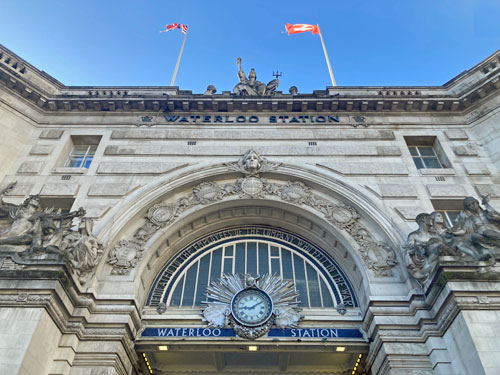
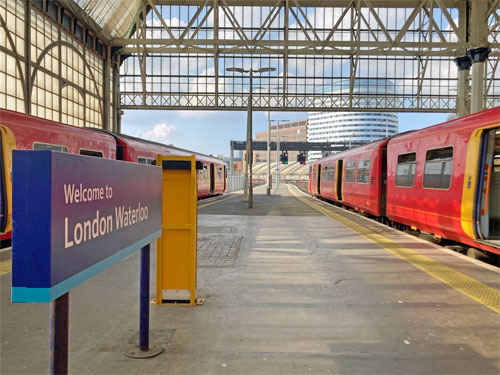
This is the splendid Victory Arch at the York Road entrance to Waterloo station. It hadn't been in the original plans but World War One interrupted construction so it seemed only right to commemorate the conflict, most especially the 585 L&SWR railwaymen who'd lost their lives. That'll be why there are four Rolls of Honour in pride of place at the top of the steps (and only cursory mention of WW2, added later, and nothing about the actual Battle of Waterloo). It's also why the laurel garland around the arch namechecks Belgium, Italy, France, Mesopotamia, Egypt and the Dardanelles - only some of which have ever been genuine destinations served. The entrance beneath is via a long flight of steps, which was very much the thing in 1922 but has been a right pain for anyone requiring level access ever since.
I could relate Waterloo's history in a lot more detail but Wikipedia's pretty good for that, and I could tell you more about the royal visit but David Turner has that covered on his blog, plus there's a scrap of old Pathé newsreel you can watch here. Instead I intend to show you a dozen photos and tell you about the station 100 years later (plus there are 20 photos altogether over on Flickr).
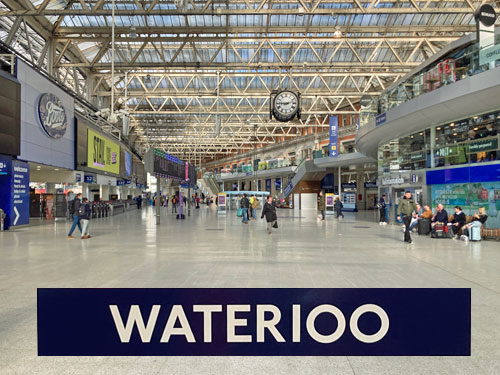
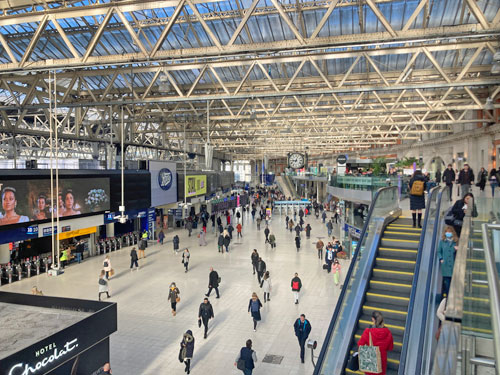
The concourse is enormous, indeed Waterloo is England's largest station (and also its most platformed and usually the busiest). It has plenty of room for rush hour hordes and curves gently round from one end to the other. At the centre is the famous four-facedclock, manufactured by Gents of Leicester, which has become the quintessential meeting point for locating an acquaintance or a romantic rendezvous. Station bosses have even marked out a blue circle on the floor underneath to save anyone from having to crick their neck while checking they're in the right spot. Please note that little paper timetables are no longer available in the racks by the ticket office, and may never be again, but someone has a heck of a lot of December 2019 tube maps to get rid of.
A very long line of ticket gates now separates punters from their trains, broken only by a central gap providing access to Boots the Chemist (whose grey box is the station's ugliest feature). Most of the space above is now taken up by giant animated adverts, ensuring that passengers can't fail to be aware of the latest pension app or Netflix's new costume drama. Dot matrix destination boards are slotted in only at each end, which is where the crowds gather, or else in front of the swish new electronic boards by platform 12. These have colour coded headings - green for trains ready to board and blue for "we'll tell you roughly where to stand but you'll have to wait for confirmation of the actual platform".
There are 19 platforms to choose from here, down from 21 when the rebuilt station opened (because two were sacrificed for Eurostar). You really only get a sense of the huge 100 year-old ridge-and-furrowroof once you've passed through the barriers and set off up the long finger-like platform of your choice. The overall ambience isn't as stunning as St Pancras or Marylebone, but very much nicer than Victoria or Euston. I like to walk to the far end of the platform to duck back outside and catch sight of the London Eye and all the trains feeding in and out, and because I'm much more likely to get a seat in carriage 1 of 12.
As regular commuters know, a subway connects all these platforms and is unlocked during the rush hour when it provides easy access to onward connections. "This is ridiculously quiet," I thought, "these staff down here must get very bored," and then the train from Woking arrived and a flood of passengers pulsed down and funnelled towards the Underground. If the passageway's clear look out for the plaque on the wall between platforms 7 and 8 recalling when these vaults hosted a free buffet for soldiers and servicemen passing through during WW1, catering for eight million meals in total. A lot of Waterloo's arteries are hidden initially out of sight, but are critical for keeping the station moving during its busiest hours.
The retail mezzanine is now ten years old and provides an excellent opportunity to get up close to some of the original stonework and stained glass. Several L&SWR county destinations are highlighted, including one that no longer exists and one that trains from Waterloo no longer reach. The chief boon of this upper storey is providing better access to Waterloo East, plus the chance to squeeze in several more cafes to sell you a baguette you'll probably have finished before your train reaches Clapham Junction. Travellers from 100 years ago would probably only recognise WH Smith down below, and be shocked to see that the National Provincial Bank now sells Bang Bang Cauliflower salad.
After Eurostar shifted north of the river in 2007 its platforms were mothballed and only reopened in 2018 for local services. Passengers for platforms 20-24 get to depart from beneath a swooping roof clearly designed to impress those heading to Paris, not Putney. Access is up a long sloping ramp that wasn't there when everyone needed to pass through customs, or via a lengthy undercroft that's only open at peak times. I thought they'd been intending to hide a whole load more shops down there but none have opened and my word it was empty, with just a few engineers in hi-vis wandering around and escalators whirring away for nobody, as if Waterloo finally over-reached itself.
And don't forget that anyone can walk properly underneath the station, or rather the platforms, by following the extraordinary Leake Street subway. This used to be grim and grimy until the graffiti artists moved in and now it's a colourfultunnel with street art on every surface, and yours to admire until someone paints yet another new layer over the top. It goes on a bit too, as you'd expect at Britain's broadest station, being much more cavernous at the Eurostar end. But it's quite a hike from here to the station proper, because Waterloo does not prioritise access from the west or south, indeed it's not especially well connected to the local area. I look forward to the day the South Bank entrance eventually reopens.
In summary Waterloo is a station well worth exploring, indeed next time you're 20 minutes early for your advance ticket maybe go for a wander rather than slumping with a coffee. It has its mundane corners and its spectacular bits, plus several bolt-ons since the current building opened 100 years ago, creating an impressively labyrinthine whole. I doubt our present Queen will be popping in to deliver a celebratory telegram, even though she's only a train ride away, but if you walk up the steps under the Victory Arch this afternoon you'll be following in her grandmother's footsteps on this most significant of birthdays. [20 photos]
Sometimes we enjoy nothing better than a good moan, especially if someone hasn't done something the way we would have done it. All we need are appropriate targets.
So here are four TfL signs for you to grumble over, or maybe even whip out in the pub tonight if the conversation starts flagging after you've slagged off what everyone's wearing, how the beer's off, the terrible background music and the awful driving you saw on the way here.
These signs are all over the tube network these days at most station entrances as if TfL somehow has a big problem with e-scooters. I won't say I've never seen one on the tube but hardly ever, only generally on pavements where they shouldn't be either, so this poster campaign does feel like major overkill. Obviously you don't want someone e-scooting down a platform because that's really dangerous but that isn't the reason why these posters are everywhere, it's because e-scooters occasionally catch fire. Lithium-ion batteries can be defective, and defective batteries can rupture, and ruptured batteries sometimes catch fire, and fires in confined space on public transport can be very bad... but that is a very unlikely chain of events especially given how few e-scooters there are on the tube in the first place.
And there are even fewer e-unicycles, I mean seriously, I can go weeks without seeing one, so why the hell do they have equal billing on this notice? Also, how bloody stupid does that one-wheeled stickman look? I understand some smartass e-unicyclist could go "oh no this is not an e-scooter therefore I must be allowed to ride it QED", but it does feel like the signwriter is being insufferably over-specific. Also these rules banning e-scooters and e-unicycles were first introduced last December so do we really need all these posters three months later announcing a change all relevant miscreants should have read by now? Tell us something we need to know or shut up.
If you've ever passed through West Ham station you've probably seen these posters denying the existence of toilets. A lot more people pass through the station than exit, which is one reason why so many people would love there to be a toilet except there isn't. The poor staff on the gateline must therefore be pig sick of being asked if there is a toilet, or even where the toilet is, so they've erected this onslaught of notices to say there isn't one... and if you read the smallprint there isn't one outside either.
Their latest wheeze is an exasperated whiteboardful of handwritten text asking you not to ask them to let you out for a wee, a smoke or a trip to the shops because they won't let you. The message is titled "Please read", and "do not ask" has been angrily underlined. Instead they insist you have to tap on the gates, and what they don't mention is that if you tap back in you might be charged double or even a maximum fare because the TfL system is extremely intolerant of nipping out and then back in. I understand there were toilets here when the Jubilee line extension was opened, located just outside the ticket barriers, but they were much too small to cope with current footfall and were closed ages ago to save money anyway.
The most aggressive thing about all these signs is the way they seem to say "Desperate? Well there's nothing here so piss off!" I know it's not the staff's fault the station is toilet-free, but it does grate to see them stood behind a protective shield of signs and barriers while they stand there checking their phones and ignoring passengers. What a sad and uncivilised society we live in when there's no money to help provide comfort for passengers, even at a major interchange, and absolutely no attempt to say sorry.
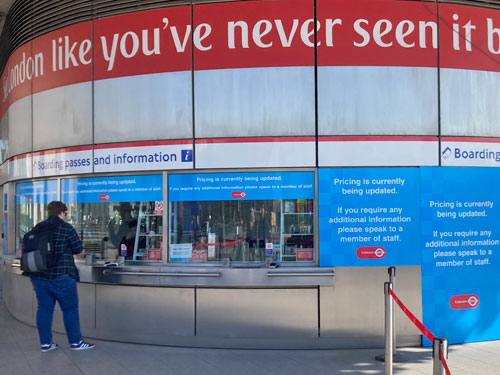
This is the terminal at Dangleway South, the launchpoint for those seeking unobstructed aerial views of the Silvertown Tunnel construction site. Unusually there are no fares on display at the moment because all the posters that normally tell punters how much a ride costs are covered over. The excuse is "Pricing is currently being updated. Please speak to a member of staff", which is what it says on four separate panels and also on three stickers across the ticket window. This means there's no way of knowing that a single dangle will set you back £5, or £6 if you're contactless-less, nor the price of any of the alternative experience packages unless you queue and ask. I thought there might be details on a small laminated sign in the window but no, that was just a price list for personalised gifts.
What's really bad is that fares changed over a fortnight ago, indeed the new fares have been known for over a month, but still nobody's managed to print something with the updated prices. And what's appalling is that they did print something, they printed seven apologies, whereas they could have printed the headline fares instead. Far be it from me to suggest that this is a devious scam designed to entice ignorant passengers onto an expensive cablecar, and just after fares have risen by 25% too, but at best it's a miserably incompetent way to run a dangleway.
Remember the days when Wembley Park station was a bottleneck, especially after an event, with queues of punters waiting to buy a ticket for their return journeys? No me neither, it's been a while, indeed the ticket office closed in 2015 and Oyster was the default way to make a journey long before that. So it's a bit surprising that this corridor still has signs advising arriving passengers to buy their return ticket now, indeed there are eight consecutive identical overhead panels.
It's by no means the worst signage fail on the network, indeed there's a certain heritage charm in what's only become an anachronistic message in relatively recent years, but once you get into the habit of moaning about unhelpful signs it's all too easy to get carried away. Do keep an eye out for further grumblefodder while you're out travelling, it can really help support a flagging conversation, and unnecessarily elevate your blood pressure too.

B-Road quiz