Random borough (18): Time yet again for me to take another random trip to one of London's 33boroughs. As I write I have no idea which one of the 16 remaining borough names will be revealed when I unfold the slip of paper I'm about to pick from my legendary (and as-yet unseen) "special jamjar". I could pick any of London's other boroughs - inner or outer, urban or suburban, small or large, Boris or Ken, fascinating or dull. I just know it won't be Merton, Islington, Enfield, Sutton, Lewisham, Southwark, Kensington & Chelsea, Hackney, Hillingdon, the City, Bromley, Lambeth, Tower Hamlets, Haringey, Hounslow, Brent or Redbridge because they're the seventeen (dark grey) boroughs I've picked out already.
I'm now embarking upon the second half of my haphazard capital odyssey. There's a fair chunk of East London still to visit, and a few stragglers in southwest London, and a ring of untouched boroughs surrounding Brent, but that's all. Which of these leftovers will be my destination for the day? Will I be treated to the cultural highlights of somewhere central and important, like Westminster or Camden? Or will I be dispatched somewhere rather more peripheral and off-radar, like Harrow or Havering? And will I need to make use of my TfL tube closures leaflet? Watch this space.
Once I've researched my randomly-chosen borough online then I'll head off and visit some of its most interesting places (assuming it has any). As usual I hope to visit somewhere famous, somewhere historic, somewhere pretty, somewhere retail, somewhere sporty and somewhere random. I might even take lots of photographs while I'm at it, if the borough's photogenic enough. Then after I've made my grand tour I'll come back tomorrow and tell you all about it. Let's see where I'm going this time...
Random borough (16): Time yet again for me to take another random trip to one of London's 33boroughs. As I write I have no idea which one of the 18 remaining borough names will be revealed when I unfold the slip of paper I'm about to pick from my "special jamjar". I could pick any of London's other boroughs - inner or outer, urban or suburban, small or large, fascinating or dull. I just know it won't be Merton, Islington, Enfield, Sutton, Lewisham, Southwark, Kensington & Chelsea, Hackney, Hillingdon, the City, Bromley, Lambeth, Tower Hamlets, Haringey or Hounslow because they're the fifteen (dark grey) boroughs I've picked out already. What London delights will I get to inflict upon to my new international audience of Bloggie-voting readers? Will they be treated to the cultural highlights of somewhere central and important, like Westminster or Camden? Or will I be dispatched somewhere rather more peripheral and off-radar, like Harrow or Havering? Watch this space.
Once I've researched my randomly-chosen borough online then I'll head off and visit some of its most interesting places (assuming it has any). As usual I hope to visit somewhere famous, somewhere historic, somewhere pretty, somewhere retail, somewhere sporty and somewhere random. I might even take lots of photographs while I'm at it, if the borough's photogenic enough. Then after I've made my grand tour I'll come back tomorrow and tell you all about it. Let's see where I'm going this time...
Kensington and Chelsea is probably London's poshest borough. It's also one of the smallest - a thin strip about four miles long and a mile wide to the west of the West End. To the south Sloane Square and super suave Chelsea, across the centre cosmopolitan Kensington and to the north the multicultural carnivalstreets of Notting Hill. It's familiar territory for many Londoners, even if most haven't the money to live here. I've scoured the borough from top to bottom, even managing a couple of places I hadn't visited before, and here's my report. Part one (Kensington) today, parts two and three (Chelsea) to follow.
Somewhere retail: Portobello Road Normally when I do these random borough visits, 'somewhere retail' is the hardest of the six categories. Not so in Kensington and Chelsea, a borough absolutely overflowing with famous shopping locations like the King's Road, Kensington High Street and that big store in Knightsbridge. Maybe everybody round here has loads of disposable income or something. But I took my life in my hands and went instead to the capital's most famous Saturday market, up the Portobello Road, along with half of the rest of London.
Portobello Road is a mile long, almost all of it lined by market stalls, which makes for one hell of an extended retail experience. I started at the Notting Hill end, down where the road is residential with just a smattering of t-shirt vendors and herbal emporia. The market stalls kick in big time as the road heads downhill after Chepstow Villas, and so do the crowds. Maybe they're here for some fancy crockery or bone-handled cutlery, or perhaps they're after some old maps or antique silverware. God knows why, but perhaps they are. I watched as someone stopped off to buy a £45 bowler hat from an impassive old lady with suspiciously blonde hair sat in a deckchair [photo]. Beside her a bored husband stroked a Russian army balaclava hanging from a stall selling army fatigues and gasmasks. An un-self-conscious young couple sporting felt fairytale hats paused briefly to stare at some trinket in the window of one of the many boutiques lining the street. Everyone was in search of that special bargain, or else resting awhile with a cup of something caffeinated before heading off round some other arcade or side alley.
After Elgin Crescent, past the armchair luxury of the Electric Cinema (to which I must go back one day), Portobello evolves into a more normal London market. There's fruit and veg, there's a greasy caff, there are cheap t-shirts, and there's a much higher proportion of local shoppers. Are those DVDs and Calvin Klein undies genuine, do you think, and how can that washing powder be so inexpensive? The stalls continue beneath the Westway (jackets, handbags, reggae, etc) and the Caribbean influence becomes more apparent. And eventually, at Golborne Road, the stalls of cheap tat finally peter out and the final few hundred yards of Portobello Road head northward into obscurity. A few fashionable boutiques linger, just because the address is so desirable, but few if any tourists reach this far. Certainly not as far as the northernmost retail outlet - AK Foods (News Agents & Grocery) - which is frequented only by teenagers on bikes and residents of the surrounding bleak apartment blocks. And I bet they never pop down the southern end of the road for some Art Nouveau porcelain either. by tube: Notting Hill Gate, Ladbroke Grove, by bus: 7, 70
Somewhere pretty: Kensal Green Cemetery Right up at the top of Kensington and Chelsea, sandwiched between the Harrow Road and the Grand Union Canal, lies London's oldest public burial ground. KensalGreenCemetery was established by a local barrister, inspired by the success of the Père Lachaise cemetery in Paris, and in 1833 the first of several thousands of Londoners were buried here. The garden cemetery was an immediate (and fashionable) success, and they've been packing them in ever since. Two of King George III's children are buried here, as are novelists Trollope and Thackeray, tightrope walker Jean Blondin and engineering double act Sir Mark and Isambard Kingdom Brunel. Not that I found any of their graves during my hour-long wander, because this place is vast. The cemetery today is a ramshackle mix of old and new, with modern jet black headstones scattered alongside crumbling tombs and weathered mausoleums as part of a kind of funereal nature reserve. The self-importance of many of the ornate Victorian memorials is astonishing, although many of the more modern graves are just as ostentatious. Granny Collins in particular, you may indeed have been much loved by your adoring family, but the over-ambitious granite shrine they've erected in your memory, guarded by an army of alabaster angels, concrete frogs and smiling gnomes, is quite frankly tasteless in the extreme [photo]. A few of the other plots are well tended with fresh flowers (and even helium 'happy birthday' balloons), but most of the old stones now lay crooked, illegible and forgotten. Somehow a silent autumn day with dying leaves underfoot seemed the most appropriate, evocative time for a visit. by tube: Kensal Green, by bus: 18
Somewhere sporting: Princess Di's gym You might have thought it would be easy to find somewhere famously sporting in Kensington and Chelsea. I mean, the last word of the borough's name is a big enough hint. But no, it turns out that Stamford Bridge is just over the other side of the boundary in Hammersmith and Fulham, and that Kensington and Chelsea is almost completely devoid of stadia and sporting venues. So I ended up instead where many of the borough's fitness obsessed residents appear to end up - visiting a gym. But this is no ordinary gym, oh no. It may look like two floors of a converted building above Boots the chemist in the Earl's Court Road, but this is where Lady Diana Spencer came to sweat. She'd nip through the doorway beside Burger King, pop up the stairs and take her turn with the weights and treadmills, no doubt smiling wistfully as she did so. She was living in ColeherneCourt at the time, a surprisingly bland residential development above a nearby health centre, all before she moved into the rather more impressive Kensington Palace up the road (which presumably had its own gym somewhere inside). Alas the railings in front of the palace have been cleared of all the gobsmacking poetry I saw last time I passed by, but I'm sure the thought of Princess Diana panting breathlessly after a heavy workout could inspire several more verses. by tube: Earl's Court, by bus: 74, 328
(more to follow, including yet more Diana, an old dinosaur and a riverside walk)
Somewhere retail: Southall Somewhere retail? I must admit I was tempted to visit the shop on Acton Hill that was the site of the first Waitrose (but alas it's now a garish pizza takeaway marked only by a gum-splattered plaque set into the pavement). And there was a pet shop in Greenford with a dodgy sign that I quite liked. But no, the only obvious destination was a shopping strip in the west of the borough that's slowly evolved to become part of the subcontinent.
Southall used to be a fairly ordinary suburb, grown up beside the canal and railway, with a High Street full of all the usual grocers, butchers and bakers. The first South Asians arrived in the 1950s, attracted by employment opportunities at Heathrow and nearby, and now more than half of the local population is Indian or Pakistani. Over the years Southall Broadway has changed to match. Very few national chain stores bother to have an outpost here. There's a Woolworths and an Abbey, but no Starbucks or WH Smiths. Instead the street bustles with hundreds of independent shops, catering to the more important needs of local clientele - food, clothing, jewellery and music.
Fruit and vegetables are sold from shops that resemble labour-intensive market stalls. Mangoes are everywhere (a bit like weed on the streets of Brixton but rather more legitimate). Brightly coloured fabrics and saris spill out onto the pavement, picked over by elegantly dressed mothers and daughters. Racks of shiny sandals are a big draw for some, while younger women seem more interested in window displays dripping with gold bangles and chains - why settle for sparkle when you can gleam? And the music pumping from passing cars was no doubt purchased in one of the many specialist stores along the Broadway (your one-stop shop for everything bhangra and Bollywood).
It's a harmonious high street, with hundreds of people busily buying and browsing, but I've rarely felt quite so out of place in London as I did here. On one occasion I walked through busy crowds for two whole minutes without seeing a single other white face (and when I did, she was an old lady collecting for the St John's Ambulance). No complaints - indeed many Southall residents must feel the same when they travel to other more monocultural parts of the UK - but I'm afraid I resisted the urge to dip my wallet into Punjabi culture. I didn't stop to watch a Bollywood classic at the astonishingHimalaya Palace Theatre, nor treat myself to a bulging bag of Royal Sweets, nor even grab a mango. In fact I'd better not tell you where I finally stopped off for lunch, you'd be terribly disappointed. by train: Southall by bus: 95, 120, 195, 207, 427, 607
It had to happen sooner or later. I spent Saturday trawling around my own backyard, in the historic borough of Tower Hamlets. This is the traditional East End of London, stretching from the City to the River Lea and from the Regent's Canal down to the Thames. It's been the slum end of town for several centuries - where the poor have always lived and where immigrants have always settled. Much of this multicultural borough remains locked in relative poverty, although there are also several pockets of great wealth, especially in the modern financial powerhouse of Docklands. Tower Hamlets may no longer be full of Cockneys, Pearly Queens and people who go round saying "cor blimey guv'nor" all the time, but at least there's still room for a diamond geezer. Ahh, there's no place like home.
Somewhere historic: The Tower of London Despite what you may have thought, the Tower of London isn't in the City of London, it's in Tower Hamlets. How else did you think the borough got its name? William the Conqueror built his great White Tower just outside the walls of the City, in a defensive position beside the Thames. This was London's first highrise building, standing nearly 30 metres tall, and dominating the medieval skyline. Over subsequent centuries the scale of the castle was enlarged, first with one high surrounding wall and then another, until eventually the structure contained a full 20 towers encircled by a deep protective moat [photo]. In Tudor times the Tower became less of a fortress and royal residence and more of a prison and armoury. But only seven prisoners were ever executed here - two of them wives of Henry VIII, and another the unfortunate nine-day queen Lady Jane Grey. Other, less high-profile, prisoners were executed in full public view up on the grassy hump of Tower Hill. And yes, that's (just) in Tower Hamlets too.
Visiting the Tower used to be a one-way ticket - shipped in at high tide through Traitors Gate and locked away in a dingy castle turret to await your fate. Now they let you out again afterwards, but you have to pay £16 for the privilege. Unless you're a Tower Hamlets resident, that is. We're allowed in for a quid, but only during the winter months and only on production of a library or leisure centre card. I didn't have time to go in yesterday, but I did pay up and venture inside 18 months ago if you're interested, and I enjoyed my visit far more than I was expecting. [top tip: arrive early and go straight to the Crown Jewels display - you won't have to queue]
For the cheapskates amongst us, the only way to see the Tower is from the outside. Start on the new sloping concrete plaza leading down to the entrance, where you can watch a genial Beefeater conducting bag searches and rifling through French schoolkids' rucksacks. The souvenir shop is probably best avoided, unless you have a burning desire to own a Beefeater Toby Jug or a Crown Jewels tea towel. You can walk along the riverside cobbles right beside the Tower, peering up at the paying customers on the ramparts inside, although you do at least get to see Traitors Gate for nothing [photo]. Nip up onto Tower Bridge but don't expect a decent view from the centre, not once the riverside avenue of trees is in full leaf. Instead head away from the river and join the hordes of tourists taking photographs from the raised pavement, across the moat to the castellated rooftops beyond. And don't forget to look down into the moat itself, where you should see the Tower seesaw, the Tower roundabout, the Tower climbing frame and the Tower swings [photo]. There's even a neglected Tower tennis court down there, presumably used by the Beefeaters and their families when they think nobody's looking [photo]. Those who've paid £16 don't get to see these gems, oh no, they just get eight ravens with clipped wings, some armour and a few big diamonds.
Plan in advance and it's even possible to visit the Tower for free. There's a catch - you have to arrive at 9:30pm and you can only stay for 35 minutes. But you do get to see the famous Ceremony of the Keys, performed nightly every single day for the last 700 years, before gruff Yeoman Warders eject you from the premises. One day I really must send in my name (and a stamped addressed envelope) and see if they'll allow me to attend. After all, I am local. by train: Tower Hill by bus: 15
Somewhere pretty: The Pergola One thing I love about these random jaunts around London is that there's always somewhere I haven't been before, often that I wasn't even aware of until the random borough's name appeared. A locations that's somehow always been off my radar, or that I've seen mentioned but never really engaged with. The Pergola at Inverforth House is one such place. It's a beautiful spot, as it turns out, yet so incredibly easy to have overlooked. And it's all thanks to soap flakes and detergent.
William Lever, the 1st Viscount Leverhulme, was responsible for starting the grocery business that eventually became Unilever. His industrial base was around Port Sunlight in Merseyside, but he also wanted his own house in London. In 1904 he bought up a large family residence on the northern flank of Hampstead Heath, naming it Hill House. And then he set about remodelling the back garden, courtesy of Thomas Mawson the celebrated landscape gardener. Several extensive terraces were laid (using surplus earth from the tunnelling of the Northern line extension to Golders Green, no less). A new ornamental Hill Garden was constructed a short distance from the house. But there was a pesky public footpath inbetween, whose closure Leverhulme couldn't force, so instead he extended a small pergola across it. And extended, and extended, until the mammoth twisted walkway was the dominant feature hereabouts. It still is.
I approached the Hill Garden from the Golders Hill Park Café, which looked a delightful eaterie (but was in the London borough of Barnet so I'm not allowed to tell you about it). Footpaths led up onto the gated heath, where a series of wooded ascents felt somehow more like mid-Wales than north London. Apart from a few preoccupied dog walkers somewhere in the distance, I had the slopes pretty much to myself. And at the top of the hill, with only minor fanfare, was the entrance to the formerly secret garden. This was lovely enough even in January, with twisting contoured paths and a green lawn leading down to an ornamental pool. The latter had a cement mixer and orange cones at one end, which I'm guessing weren't part of the original plans, but added a little midwinter colour. My apologies to the snogging couple on an upper bench whose amorous activities I disturbed.
Then came steps up to the western end of the pergola (that's a shady pillared passageway entwined with woody plants, for non-horticulturalists). This one's elevated, apart from a single hilltop gate where a path heads out onto the Heath, and it's unexpectedly long. A series of classical columns led off along a red-tiled pavement, topped off by a lattice of timber beams. The structure's now old enough that the wisteria looks properly gnarled, if currently leafless. It all made for a charming Romanesque setting - and this was just the first section. A right-angled turn lay ahead, across the footbridge, where there was the clearest view of the house's formal gardens. It's all luxury flats now of course, but with the top of the raised walkway and outer garden still somehow open to full public access. The pergola meandered on and on to a final spiral staircase, interrupted occasionally by a dome or trellis in the roof overhead. I can confirm that the entire structure's Cassiopeia-shaped (now that I've seen it on Google maps) and that, if straightened out, the pergola would be as long as Canary Wharf tower is tall. A shame that Lord Leverhulme died shortly after it was completed - complications from pneumonia prematurely curtailed his pleasure.
Somewhere historic: Keats House A small house in Hampstead is responsible for one of Britain's most prolific outbursts of romantic poetry. John Keats moved in when Wentworth Place was almost new, in 1818, to lodge with his friend Charles Armitage Brown. They shared the semi-detached two-up two-down, relatively uneventfully, until the Brawne family moved in nextdoor the following year. John became increasingly smitten by eldest daughter Fanny, and she inspired a more amorous undertone to his output. Her and the nightingale which used to sing in the garden "...in some melodious plot of beechen green, and shadows numberless". Tuberculosis cut John's life short. He fell sick in 1820, setting up a bed in the downstairs parlour so that he could still view the house's garden. Doctors eventually suggested recuperation in warmer climes, so he sailed to Rome, thereby prematurely ending his burgeoning relationship with Fanny. Keats was only 25 when he died, in a villa on the Spanish Steps, but left behind a lyrical canon acclaimed to this day.
The two houses passed to actress Eliza Jane Chester in 1839, and she knocked down the intervening wall and added a conservatory alongside. It's this enlarged house that visitors get to see today, ninety years after it was first opened to the public. You can't miss it, it's in Keats Grove, appropriately right next to the local library. And it's owned not by Camden Council but the City of London, who own most of the adjacent Heath too. Five pounds paid to the nice ladies round the back will gain you entrance, and for as many subsequent visits as you fancy over the next year.
The gift shop and first rooms are in Fanny's house, and contain period furnishings as well as a glass case of Keatsobilia. Crossing the hallway then brings you to the poet's lodgings. One really nice touch is a portrait of Keats hung in the room where it was painted, with two replica chairs set out on the carpet in precisely the spot they appear in the painting. Very little of the original furniture survives - John was only here for 18 months, and few back then would have thought to conserve his landlord's fixtures and fittings. But you'll certainly absorb the atmosphere of the place, from the upper bedrooms to the cellar kitchen, brought to life by several laminated letters and poems left waiting for visitors to read. Take a look here for a virtual tour around the house, which hopefully will encourage you to see the place for real. And be aware that your annual ticket also allows you to attend a surprisingly varied selection of cultural events. Next Saturday they're reading Keats' epic "The Eve of St Agnes" (two days early), and the following weekend it's card games, dice and dominoes with tea and crumpets. Sounds charming. "Beauty is truth, truth beauty, – that is all ye know on earth, and all ye need to know." by tube: Hampstead by bus: 46, 268
Somewhere pretty: Hoover Building People don't usually get excited by vacuum cleaner factories. But this is no ordinary industrial warehouse, this is the legendary Art Deco HooverBuilding, and it's gorgeous. It's 75 years old this year, constructed in response to a 1930s boom in labour-saving appliances. It was designed by Wallis, Gilbert and Partners, and built as the manufacturing hub of Hoover UK's suction empire. Hitler somehow managed to miss its gleaming white stonework, and travellers along the A40 Western Avenue are still wowed by its monumental pillared frontage.
I arrived just as the sun was about to disappear behind a giant grey showercloud, and had to run along the pavement in front of the building to make the most of the light. Quickly I snapped my distance shot, then strode through the angular ornamental gates for a close-up of the fan-windowed entrance. I was impressed by easy it was to gain access to the lawn at the front of the building - this is no locked-away mothballed treasure. Slowly the shadows cast by the bold serif lettering faded away and the bright facade faded to a less vibrant grey. Damn. A few stray streaks illuminated the canteen block to the west and the office pile to the east, but that was my lot. My attempts at intimate arty-angledabstracts were, alas, dulled by approaching cumulonimbus. So I went shopping instead.
From the front it's not immediately obvious, despite some ugly signage, that the bulk of the building is now a cavernous Tesco supermarket. But a slow stroll round to the rear revealed a trolley-ful car park, some fake Art Deco walls and the extraordinary entrance to a very ordinary shopping experience. Where once stood a factory floor, now the people of Perivale purchase ready meals and earn Clubcard points. I don't think the store sells Hoover bags, but I did succumb to some Earl Grey teabags and a bottle of wine. Meanwhile if you're the boss of a medium sized company seeking to relocate, you might like to know that 31000 square feet of office space in the main Hoover Building is currently up for grabs. Imagine the smile on the face of your employees if they ended up working here. by tube: Perivale by bus: E5, 95, 297
Ah, Ealing, Queen of the Suburbs. This broad swathe of pleasant commuterland lies at the very heart of West London. It's the third most populous borough in the capital (I have yet to visit the top two). It's home to a broad mix of nationalities and cultures. It's strung out along the A40 Western Avenue and the Uxbridge Road. And it's not somewhere I'd previously spent a lot of time. I may have been missing out. Let's start today in Ealing itself, formely fields, now a major metropolitan centre.
Somewhere historic: Pitzhanger Manor-House Sir John Soane left his architectural mark on London. He designed the Bank of England (since redeveloped), the House of Lords (since burnt down), various churches and the Dulwich Picture Gallery, amongst others. He's best remembered, perhaps, for the house in Lincolns Inn Fields that now houses an eclectic museum in his name. But there's a less well known outpost of his Neo-Classical empire, out in Ealing, just south of the Broadway. It's easily overlooked. Shoppers pass by through Walpole Park, straight past the front door, without a second look. Staff inside the villa have a series of blue boards labelled "Open today, Free entry" with which they attempt to lure the public within. I'm not sure it works as frequently as they'd hope. But blimey, what a great little manor thisis. Because nobody shows off quite so much as an architect designing their own home.
Soane snapped up Pitzhanger in 1800, aiming to transform it into a country retreat where he could impress clients. He succeeded. The facade is bold and striking, with four classical columns topped off by appropriately goddesslike statues. The entrance hall is narrow but unexpectedly tall, with decorative marble and plasterwork above. And... ah, hello, no I've never been here before, and yes I would like an audio wand tour, is it only a pound, that's a bargain, thankyou. The breakfast room is amazing, just a small wood-panelled chamber but with the most fantastically over-the-top ceiling . Clouds swirl around within a central elliptical disc, surrounded by snaking geometric lines and the occasional cherub. The room nextdoor has a ceiling depicting leafy trelliswork, positioned above a compass-style rug and sandwiched between an infinite panorama of twin reflecting mirrors. Very playful, very ornate, very Soane.
Downstairs, in the oldest wing of the house, is a rather larger pair of rooms linked by three tall archways. The walls of the Eating Room are duckegg blue, there's very little furniture bar a mahogany table and some statues, and again the ceiling tugs at your eyes screaming "admire me". 100 years ago this became the reading room of Ealing Library, and it's now available for hire for weddings, civil partnerships and other ostentatious events. There are further rooms to explore, both up and down the central marble staircase, each with their own lengthy audio wand description. Really, you get your money's worth from this one. By the time you leave the house you'll know all there is to know about Soane, and particularly his troubled relationship with his two sons. John hoped Pitzhanger would inspire them both to become architects, but he was sorely and heartbreakingly disappointed. However, it might just inspire you.
See also: the arty PM Gallery nextdoor, free and with a modern nod to the community. See also: the walled rose garden, once Sir John's vegetable patch. Don't see also: the house's collection of Martinware (it's a special type of pottery), part of which was nicked by thieves earlier in the year, so the remainder is now off-limits. by train/tube: Ealing Broadway by bus: 207, 65, 83
Somewhere famous: Ealing Studios The Ealing name is synonymous with comedy. Not your modern sitcom or your Shakespearean knockabout, but a series of British film classics knocked out in the 1940s and 1950s which may well have had you/your parents/your grandparents rolling in the aisles. I can't say they've ever had that effect on me. Passport to Pimlico, Kind Hearts and Coronets, Whisky Galore (and that was just 1949), they're an acquired taste these days. But they were all produced in a back lot off Ealing Green, courtesy of film producer Michael Balcon. He tapped into a postwar feelgood vibe, brightening up the austerity years with such classics as The Lavender Hill Mob and The Ladykillers. The BBC took over the studios in 1955, producing dramas (such as Colditz) rather than comedies. And more recently Ealing's been bought up by a consortium intent on restoring the town's good name in the film business. The latest St Trinian's movie came from here, as well as bits of Notting Hill and Shaun of the Dead. But also Ant'n'Dec's Alien Autopsy, so Ealing's reputation still has a long way to go.
The original White House office building looks its age these days, and gives no hint (bar a blue plaque) that 4 acres of cinematic powerhouse lies behind. But take a short walk up the street and there, beside some rather dull modern offices, is the hotchpotch of buildings and workshops that make up the current studios. You get a semi-decent view through the railings - a chimney, a bland 50s block, a car park, and the door leading to miniature wizards The Model Unit. Somewhere in the near distance is the big stepped hangar where most of the filming happens. But you won't get far because security already have their beady eye on you, so there'll be no gatecrashing the soundstage thankyou very much. Just believe that somewhere in there is an understated plaque, pinned up by Michael Balcon just before he left, which commemorates the site's quintessential Ealing-ness: "Here during a quarter of a century many films were made projecting Britain and the British character." by train/tube: Ealing Broadway by bus: 65
Newham's not your typical London borough. It has an extremely diverse population, most of whom aren't white and 40% of whom were born overseas. It's packed with young people. It's significantly economically deprived. It used to be the bottom left corner of Essex, although it looks irrevocably urban today. And it's hosting the Olympics in two years time. Don't worry, I gave the stadium a wide berth on my Newham day out.
Somewhere both retail and sporty: Green Street, Upton Park If there's one street in Newham which sums up the borough's diversity, it's the street down the middle. That's Green Street, and on Saturday afternoons a few steps is all it takes to cross continents. [Walk Green Street - audio tour]
There's no hint of what's to come at the northern end of Green Street, this could be any residential Newham street lined by Victorian terraces. And then the shops start. These shops cater very specifically to the Asian community, and they ramp up in importance the further south you walk. Tailors and sweet shops and restaurants to begin with, then more luxurious boutiques catering especially for loaded ladies. The window displays are dazzling - the store contents even more so [photo]. An entire wall of golden necklaces, perhaps, or a glittering parade of sparkly handbags. As for the high-heeled shoes, these are some of the gaudiest totteriest I've ever seen. Many of the shops stretch back quite some distance, giving space for women, couples, even entire families to stand around and select some object of innate gorgeousness for that next special occasion. I suspect a lot of bridal jewellery is peddled here, although the ladies wandering home with bulging carrier bags are more likely to have bought a special sari for that big night out. Not a single UK chainstore intrudes for a good half-mile, and the street clearly caters well for the everyday and not-so-everyday needs of its local population. Outside Southall, I've seen nothing else quite like it in London.
Queen's Market: Pass south of Upton Parktube station and Green Street has shopping of a very different kind. Queen's Market is a traditional East London market with a hundred years of history, although it hasn't always been housed in a concrete bunker beneath a first floor car park. It opens four days a week, including Saturdays, selling a wide variety of 'stuff' to an appreciative clientèle. Many of its 80 stalls sell fruit and veg, some in those ubiquitous plastic bowls, others more lovingly arranged. Spelling isn't always the stallholders' speciality ("corrianda", anyone?), but whether it's British, Caribbean or specialist Asian you want you'll find it here. There's not quite such a focus on meat or fish, but the longest queue I saw in the place was for the (non-halal) butchers. Blouses for two quid, hi-vis jackets for five, and well below salon prices for a restyle and blowdry. As markets go it's unpretentious and friendly, without ever feeling like it's stacked full of cheap nasty tat.
Unthinkable, then, that there were long-term plans to knock Queen's Market down and replace it with an 18-storey apartment block with an Asda supermarket underneath. Don't worry, the developers said, we'll make available some first floor market space which the displaced stallholders can move into, but not until three years of building work are complete. Normally these stories have an unhappy ending (for the public at least), but in this case the public protested very loudly indeed and were heard. The project was kicked into touch by the Mayor last year, which then led to the developers falling out with the council and the entire scheme being scuppered. Hurrah! Some other change will surely come along - the existing facilities aren't perfect enough to survive untampered. But in credit crunch times, in a community that's permanently credit crunched anyway, Queen's Market is an essential survivor.
Upton Park: Half past two on a Saturday afternoon, and the southern end of Green Street is a completely different country. Here the demographic is most definitely white, and very distinctly male, as West Ham's latest home match against Fulham approaches. Crowds of blokes pour out of the tube station and throng the pavements, many (but by no means all) dressed in telltale claret and blue [photo]. The Boleyn pub, across the road from the famous Bobby Moore statue [photo], has been rammed since noon and is slowly starting to empty. Other supporters have been downing pints at pubs in the surrounding neighbourhood, from Plaistow to East Ham, and now make their beery way through the backstreets to join the others. A chant of "Irons, Irons" goes up, but only from a few. Far more popular are the burger stalls lined up at the roadside facing the stadium, because it helps to be full of processed meat and ketchup before a good roar on the terraces. The Boleyn Ground's two fairytale castle turrets are calling the faithful to worship, and still they come.
Anyone for a West Ham garden gnome? There are plenty for sale in the stadium megastore, along with eggcups, shower gel and some "only a fan would want one" nodding dogs. For those who'd arrived much earlier, there was an opportunity to get members of the first team to sign their merchandise. The players' car park is alongside, and they're well accustomed to fans calling them over to scrawl their signatures on whatever's thrust their way. I spotted Portuguese defender Manuel da Costa exiting from his Bentley, shortly after tens of excited children yelled his name through the fence, then watched as he politely signed banners, programmes, even a rather grotty looking football [photo]. This exemplary behaviour alas didn't stop him elbowing Fulham's striker in the head later that afternoon, as a lively one-all draw played out.
Should West Ham succeed in taking ownership of the Olympic Stadium after 2012, this matchday hubbub will shift two miles west to the concrete piazzas of Stratford City. It's hard to imagine the Westfield shopping centre permitting a line of burger vans along the walk from the station, and I can't believe there'll be sufficient pubs in the locality either. The new stadium might be cutting edge, but it'll tear the heart out of a traditional Saturday afternoon in Upton Park.
See also (just round the corner, in Barking Road) The Who Shop: There's only one Doctor Who shop in the world, and it's in Upton Park. These are fairly new premises, which means more space to display books and CDs and Dalek miniatures and Torchwood 2011 calendars and all the other essential ephemera the true Who geek demands. Even better, they have a museum round the back, accessed through a plywood Tardis in the corner of the store. It's bigger on the inside than on the outside, naturally, but the single room isn't exactly huge given the £3 entrance fee. What makes it worth a visit, if you're so minded, is that the staff member who shows you round is a true enthusiast. She'll know where that Cyberman costume was last used, and why her husband was wearing it. She'll be able to identify the silky black dress as Jean Marsh's sorceress costume from Battlefield (Sept 1989) and the cheap wooden tube as a Drahvin gun from Galaxy 4 (Sept 1965), and know the story behind each. Me, I was most excited to come face to face with the actual blue crystal from Metebelis 3 that finally despatched Jon Pertwee, and to see the genuine mask of Sutekh that scared the willies out of me in Tom Baker's Pyramids of Mars. But then I'm sad like that. If you're sad like that too, then Who's for a visit? Newham Bookshop: There are too few proper independent bookshops left in the UK, especially on the eastern side of London. So three cheers for the proper independent Newham Bookshop, which survives an thrives in an area where it economically shouldn't. New books are crammed into every available space, often piled horizontally to get more titles in. And they're interesting books too - this isn't a Richard & Judy or Katie Price's memoirs kind of place. History, politics and sociology get a good look in, as well as a whole room of children's and teenagers' books in a separate room nextdoor. I bought the most relevant book I could find, given that I was on a random borough tour, and snapped up a light tome on psychogeography. [list of upcoming events and signings]
Somewhere un-famous: Sudbury & Harrow Road station London's most useless railway station is in Brent. It has fewer paying passengers than any of the other 300-or-so stations in the capital. According to official statistics it's used by only 2500 passengers a year. It's no remote halt in the middle of a field, it's in a proper urban location on a busy high street. It's served by trains only during the weekday rush hour, and then only in one direction at a time. It has just nine trains a day - four into town in the morning and five back again in the evening. It is a sorry apology for a station and owners Chiltern Railways clearly treat it with complete indifference. It is Sudbury & Harrow Road. And yes, of course I had to pay a visit.
I wonder if it's a coincidence that the number 18 bendy bus terminates on the Harrow Road precisely outside the entrance to this forlorn station [photo]. Catch the nasty evil articulated bus from here and you could be in Marylebone in less than an hour. Wait for a train and you could be waiting for up to three days. A lone British Rail sign and a tiny purple nameplate mark the station entrance for any would-be passengers. There's no ticket office, just a "Permit to Travel" machine and a pair of freshly-installed Oyster readers [photo]. I suspect that just the one reader would have been sufficient. The bike rack has just four spaces (don't all fight at once). Turn left to enter the dark concrete passage beneath the railway embankment. In a busier station this might smell of urine and sicked-up curry, but not at Sudbury & Harrow Road. I stepped inside, and headed up the central staircase to the station proper [photo].
There are two parallel platforms, a few metres apart, with the top of the stairs forming a small island between the two. If it's raining you can hide beneath the red arched plastic roof, or maybe take a seat on the single central bench. There's room for two, maybe three if you squeeze up close. To the right I spotted a padlocked cupboard containing "Adverse Weather Equipment", and to the left a yellow box labelled "Passenger Help Point" (singular, not plural). Oh, and also a couple of TV display screens transmitting flickering information from Chiltern HQ. These informed me that, not only were there no trains stopping today, there were also no trains running due to planned engineering work. Fantastic, I had this entire remote outpost completely to myself, with no interruptions.
I took a silent stroll from one end of the station [photo] to the other [photo]. Each platform was little more than a long wooden boardwalk, about a metre off the ground, with a spiky slatted fence rising up behind. Between the two lay a forgotten grassy trench, littered with discarded bottles, cans and the odd deflated football. A handful of thin blue lampposts broke the emptiness, on which were stuck scrappy stickers warning the occasional patron not to smoke [photo]. From Platform 1 I had a fine view down into the back gardens of Sudbury, towards rickety sheds and washing lines pegged out with damp undergarments. And down in Harrow Road were scores of people rushing around, buying this and that, rushing hither and thither, and queueing to catch a bus to somewhere else.
It's a shame that so few local residents look up to the embankment for a means of escape, but perhaps not surprising given that this station merits such a pitifully irregular service. 45 trains a week is no way to build up a regular clientèle, and so the vicious underfunded circle of transport decline continues. "The next train to London Marylebone will depart in 2500 minutes." I headed back down the stairs to the bus stop, and the station returned to timetabled hibernation. by tube: Sudbury Town[photo] by bus: 18, 92, 182, 245
Twenty years ago today I brought you my very first Random Borough report from the London borough of Merton. But it was fairly brief - most of my posts were back then - so two decades on I'm having another go to do Merton justice. Yesterday somewhere sporty and somewhere pretty, tomorrow somewhere famous and somewhere random, and today somewhere retail and somewhere historic.
Somewhere retail: Colliers Wood
I can't do Merton Abbey Mills again because that was 2004's choice. I was going to do Wimbledon's main shopping mall, Centre Court, but I see they've changed the name to Wimbledon Quarter and that's lost all the magic. So instead I went to the ultimate Wandleside shopping cluster.
The Colliers Wood retail hub is massive, sells everything the big chains offer and comes in three separate chunks. You could easily walk between the car parks but I suspect most people drive.
Biggest of all is the Sainsbury's/M&S megastore, which was a SavaCentre when it opened in 1989 and the largest hypermarket in the UK. It sits beside the Wandle on the site of the William Morris Printworks where carpets, tapestries, wallpaper and stained glass were manufactured to the highest Arts and Crafts standards. Think on that as you cross the footbridge over the river preparing to buy absolutely nothing so erudite. The two conjoined stores are built on stilts, partly to prevent flooding but mainly to be able to fit the car park underneath, so there's an escalator to ride on the way in and a proper travelator on the way out. The upper balcony round the atrium is mostly pointless since the Fresh Kitchen cafe closed in 2022 so the security guard at me looked suspiciously as I walked a full circuit.
Not many shopping centres include a medieval chapter house, but if you head out the back to the subway under the flyover you'll find one lurking there. It's all that's left of Merton Abbey (1114-1538), despoiled first by Henry VIII, then by a railway station and most recently by the A24. Judging by how close a pylon stands to the site, it seems destructive infrastructure has really got it in for the poor old Chapter House. Normally you can visit every Sunday from April to September, and one day you should, but be aware the season's starting late this year while they get the drains fixed and fit brighter lighting. [report from 2015]
The Priory Retail Park lies just across the Pickle Brook, a minor braid of the Wandle, on the site of former watercress beds. I did find an information board on the walk over which I hoped would tell me more, but sadly the panel had almost entirely eroded, the legs had toppled and the whole thing was retreating into a bush. The big shed here is bookended by a Currys and a Dunelm, but the big draw for Sainsbury refuseniks is the Aldi in the middle. Fine dining is not supported but if you want something with onion rings there's a Hungry Horse called Kiss me Hardy (named after former local resident Admiral Nelson). Best not linger here.
Beyond the crossroads is the third part of the retail triptych, the Tandem Centre. Think of it as a U-shaped warehouse with a vast car park in the middle and a ring of bollards around the edge to prevent anyone driving through the glass frontage. Pedestrians are afforded a single narrow path across the middle. The units include Next, New Look and Nando's, plus a Lidl for even greater supermarket choice, indeed enough big chains for uninspired families to enjoy a proper till-feeding afternoon out. I realise I'm only writing about this in a surprised way because I live in inner London and we don't drive to sheds, everywhere else does, but Colliers Wood is out on a limb even for the suburbs. by tube: Colliers Wood; by bus: 57, 131, 152, 200, 219, 470
Somewhere historic: Surrey Iron Railway
One thing about Merton is that it has properly dense industrial heritage. The Wandle Valley was a crucible of early manufacturing thanks to watermill power, with calico works, tanneries, gunpowder factories and paper mills amongst the early arrivals. The Wandle Industrial Museum (open on Wednesday and Sunday afternoons) keeps these stories alive. Many such businesses were linked by the Surrey Iron Railway - arguably Britain's first significant railtrack, although more accurately a horse-drawn "plateway" used to transport minerals, building materials and farm produce.
The Surrey Iron Railway ran for nine miles between Wandsworth and Croydon and was commercially successful for all of seven years before the Croydon Canal opened in 1809 and swiped its business. Here's a map of the route, here's a detailed old school website and here's an 18 page historical treatise from 1995. 200 years on pretty much nothing of the SIR remains bar its alignment, so I thought I'd try walking that south from Colliers Wood to the edge of the borough. The first mile was quite dull, running invisibly parallel to Church Road, so I won't bore you with that. Instead let's pick up the trail at Mitcham Parish Church, a fine building from a similar era (although best not linger on the fact they knocked down a 13th century church to build it).
To follow the railway take Church Path south past two attractive old terraces, one from 1865 and the other from 1904. But that's it for 'pretty' on this walk because the two long paths that lie ahead are far from attractive. The first is Baron's Walk, and as you survey the fingerpost at the first fork yes I'm sorry, that is the miserable-looking alleyway to the right. It bends unloved around the outside of a waste processing centre, with hundreds of skips and bales visible on the far side of a line of spiked railings... and smellable too thanks to the unmistakable sub-citrus whiff of decay. To the left a crumbly green fence shields the recreation ground you probably should have walked through instead, and eventually a much older brick wall hems you in too. The path doesn't precisely track the original alignment of the railway, merely very near enough, but we're coming up on a modern means of transport that follows it precisely.
Yes it's the Croydon trams, which from 'just after Belgrave Walk' to 'just before Waddon Marsh' replace the actual railway which replaced the SIR. You can't walk along the tram tracks, obviously, but you can follow a parallel footway called Tramway Path for most of what follows. Above Mitcham tram stop it has proper semi-detached houses and parking, then swings across and traces the northern side of the tracks instead. I arrived at school-chucking-out time so had to fight against a flow of fussing mums, independent ten year-olds and scooter riders emerging from the back of Cranmer Primary. The path then narrows somewhat past the backs of several gardens before reaching a narrow bridge across the tracks. The tram in my photo has just departed Mitcham Junction, whereas Tramway Path now veers off to the right (past that lone lamppost) following the SIR's branch line to Hackbridge.
This isn't much more pleasant, to be honest, again between the backs of houses and something semi-industrial but at least with a stripe of woody undergrowth to act as a distraction. Also the smell wafting over the fence is now briefly baked goods, not rotting refuse, so that's a plus. Folk who live on Carshalton Road can't park out front because that's Mitcham Common so instead they have garages back here, a long chain of them in not always the best condition. The depot hidden behind the barbed wire on the right is briefly revealed as a construction company's Consolidation Centre, i.e. where they store their materials, and quite frankly it's a relief when this back alley eventually curves out onto the common beside a Chinese fusion restaurant. I was saved from following the final mile because the borough boundary intruded and I'm not allowed to write about Sutton, and what I think I've learnt is don't try to walk the Surrey Iron Railway, just ride the tram. by tram: Mitcham
Somewhere sporty: Bow Industrial Park
The 2012Olympic Park straddles the corner of four London boroughs. The lion's share of the stadia, including the Aquatic Centre and the main Olympic Stadium, will be in Newham. Hackney gets the hockey and the handball. Waltham Forest gets a few specialist Paralympic facilities. And Tower Hamlets? We get the basketball. We're 'aving 'oops.
Only a tiny sliver of Tower Hamlets falls within the boundaries of the Olympic Park. The borough only has to sacrifice a thin strip of land, sandwiched inbetween two branches of the River Lea and the Silverlink railway (with the old C4 Big Breakfast house surviving unscathed at the southern tip [photos]). The majority of the land needed for 2012 is covered by the Bow Industrial Park - a very ordinary row of metal warehouse sheds like those you might find on the outskirts of any major town. I'd not dared to venture here before but, spurred on by my random-picked borough duties, I strolled brazenly past the security barrier and was promptly ignored by the guard. There wasn't much to see down the back of the warehouses - just a corrugated metal wall with tiny rear access doors, into which the occasional weekend employee disappeared. Across the road, behind another fence, lay the distribution centre for a nationwide wrought iron supplier. And round the front 30 major industrial units, each doomed to no more than three months of continued business. I spotted newspaper printers, timber merchants, glass manufacturers along with various other unidentifiable companies. Plus one quite surprising upmarket inhabitant - the Royal Opera House. A long pink lorry trailer was parked up outside unit 18, and on its side the Opera House's official gold logo [photo]. Presumably this is where the company's ballet costumes are stored, or where their operatic scenery is constructed and assembled. I hope they have somewhere else to go. Olympic shutdown begins in July, then five years of remediation and rebuilding before a brand new basketball stadium opens its doors on this site. Thirty industries relocated for the sake of a sport you probably won't even be watching come 2012. But hey, it's enough to make Tower Hamlets an Olympic borough. Slamdunk. by train: Hackney Wick by bus: 276
Camden's a rum mix. It stretches from bustling Holborn to the heights of Hampstead Heath. It includes cultured Bloomsbury and hip, youthful Camden Town. Its housing stock combines exclusive avenues with Modernist council blocks. Its MPs are called Frank and Glenda. And it's also somewhere I've written about a heck of a lot over the years, because it's one of my favourite boroughs. Here are six more reasons to visit.
Somewhere retail: Camden Markets Something about the Chalk Farm Road draws Europe's youth here in great numbers. It could be the music, what with famous venues like the Roundhouse along its length. It could be the canal, and the opportunity for a waterside slouch. But it's probably the endless succession of outlets selling edgy accessories and offbeat tat. Throw in a wok-load of sizzling ethnic food and you have the perfect post-adolescent mooch zone. Boots on, piercings tweaked, and let's go.
I pity the visitors who discover 'The Camden Market' a few yards north of the tube station and decide to spend all their money there. This is actually Buck Street Market, and its warren of 200 tightly-packed stalls is nothing special. Clothes and jewellery, mostly, plus alleyways narrow enough to persuade even the hardiest shopper to turn round and try somewhere else. The good stuff, relatively speaking, is all to the north of the canal. The renamed Camden Lock Village Market, for a start, hemmed in between the railway viaduct and the towpath. This was ravagedby fire three years ago and has since reopened in a more sanitised style, although at least this makes it easier to walk round. Bit of art for your bedsit wall, maybe? T-shirt splashed with comic character or witty slogan? Or perhaps one of those plastic shoulder bags I used to stuff with gym kit in the 1970s which are suddenly inexplicably trendy. One nice touch is the row of decapitated scooters overlooking the canal, used as somewhere to sit by folk who've just purchased a tray of food.
Camden Lock Market's the famous one. It started in 1974 as a temporary outlet on threatened land, and soon grew into the biggest Sunday attraction for miles. Nowadays it's busy most of the rest of the week too, courtesy of foreign visitors who don't need to skip college to attend. I was expecting crowded mayhem on my visit, but was pleasantly surprised how manageable the place was (Saturday in January? perfect timing). Plenty of space on the quayside, room to circulate on the upper walkway, and circulatory ease in the indoor market halls. Nothing here I felt I had to own, however. Most of the over-40s wandering around still had a trace of alternative youth about them, be that rocker hair, vintage jacket or clompy boots. They still need somewhere to buy Clash artwork and candles, and I guess I don't.
But it was the Stables Market which amazed me. I though Camden already had enough market space but seemingly not. Since I was last here this place has expanded to almost theme-park size, with fibreglasshorses and fake red phone boxes littered around a multi-level maze. Dig deep enough and there are antique stalls, even a second-hand bookstore. But most are here to browse for something they could wear, or carry, or poke through an available orifice. Retro-clothing's big, like those 2003 trainers you can't get any more, as well as accessories for every leftfield occasion. And food. The markets' entire economic model revolves around the fact that everyone stops for food eventually. If you yell hello at enough passers-by and wave a fork of indeterminate gloop in their face, they may just stop and give you cash for noodles. Incidentally "The Best Shop In The World" isn't - no shop that smells of incense could be in my book.
The Stables is probably as far north as most visitors dare to tread. Go much further and you reach Morrisons, which isn't really where the average beardyteen or mohawkgirl wants to end up. No need, there's plenty of room to hang out and be seen in the newly-expanded markets - or at least there is in mid-January. by tube: Camden Town, Chalk Farm
Somewhere random: Where Kenneth Williams lived I wonder how Kenneth Charles Williams would react to the news that his local council have set up a walking trail linking together his former homes. Desperately proud, yet simultaneously hideously embarrassed, I expect (but that's Camden for you, a borough so hip that the Mayordid a DJ setat the Barfly last night). Misunderstood egomaniac Kenneth grew up in the backstreets south of King's Cross, and carried on living there or thereabouts for the rest of his life despite moving house several times. He grew up in Cromer House - a brick tenement which would have been new at the time, and still looks far more appealing than the shiny glass apartments on the opposite side of Cromer Street. It's still a very residential area, though families have more than one room to themselves these days, and it's not quite the poverty-stricken backwater it was pre-war. KW's first school is round the corner - now Argyle Primary. It's very Edwardian, and five storeys high to cram in as many classrooms as possible in a restricted space. Kenneth's first public performance was from the roof, apparently.
The Williams clan later moved 'up in the world' to Marchmont Street, close to what's now the Brunswick Centre in Bloomsbury. Dad Charlie had bought the barber shop at number 57, so the family moved into the rooms above with Kenneth on the top floor. It's still a hairdressers today... but they do waxing, threading and male grooming, which wouldn't have been the Williams style at all. A blue plaque was unveiled above the shampoo-stacked window last autumn, with much pizazz, and with Nicholas Parsons amongst the invited guests. Kenneth's successful radio career enabled him to move out (circa 1956), returning first to Argyle Square and its environs, then further along the Euston Road towards Baker Street. From 1972 onwards he lived alone at 8 Marlborough House, Osnaburgh Street, close to the eastern edge of Regent's Park. There used to be a plaque here too, marking the flat where the manic depressive actor was found dead in 1988, but you won't find it today. The entire block's been knocked down as part of the Regent's Place development - a major landgrab for "office, retail and leisure space", almost but not yet fully complete. On the Osnaburgh Street side there's a new community theatre where a replacement commemorative plaque has been installed, but it's not one that many people will ever see. The entire 18 acre site looks uninspiring and bland, in my opinion, but I guess that's the way Central London's going. Kenneth wouldn't have been impressed, not bona at all. by tube: King's Cross St Pancras, Great Portland Street
Kenneth's south Camden stomping ground isn't an especially well known part of town, so I was relying on my special Camden map to guide me around. Mistake, because the map turned out to be a fairly useless way of working out where the hell I was going, even in conjunction with two pages of written instructions. I think that's because it's merely a snapshot of a guided walk which took place last October, led by actor David Benson. He's written about the walk here, and you can watch snippets in this YouTube summary. Looks informative, looked wryly amusing. There are several more 'Love Camden' walks here, and their associated videos here. Puts your council's website to shame, doesn't it?

Random borough (18): Time yet again for me to take another random trip to one of London's 33 boroughs. As I write I have no idea which one of the 16 remaining borough names will be revealed when I unfold the slip of paper I'm about to pick from my legendary (and as-yet unseen) "special jamjar". I could pick any of London's other boroughs - inner or outer, urban or suburban, small or large, Boris or Ken, fascinating or dull. I just know it won't be Merton, Islington, Enfield, Sutton, Lewisham, Southwark, Kensington & Chelsea, Hackney, Hillingdon, the City, Bromley, Lambeth, Tower Hamlets, Haringey, Hounslow, Brent or Redbridge because they're the seventeen (dark grey) boroughs I've picked out already.
Random borough (16): Time yet again for me to take another random trip to one of London's 33 boroughs. As I write I have no idea which one of the 18 remaining borough names will be revealed when I unfold the slip of paper I'm about to pick from my "special jamjar". I could pick any of London's other boroughs - inner or outer, urban or suburban, small or large, fascinating or dull. I just know it won't be Merton, Islington, Enfield, Sutton, Lewisham, Southwark, Kensington & Chelsea, Hackney, Hillingdon, the City, Bromley, Lambeth, Tower Hamlets, Haringey or Hounslow because they're the fifteen (dark grey) boroughs I've picked out already. What London delights will I get to inflict upon to my new international audience of Bloggie-voting readers? Will they be treated to the cultural highlights of somewhere central and important, like Westminster or Camden? Or will I be dispatched somewhere rather more peripheral and off-radar, like Harrow or Havering? Watch this space.
Portobello Road is a mile long, almost all of it lined by market stalls, which makes for one hell of an extended retail experience. I started at the Notting Hill end, down where the road is residential with just a smattering of t-shirt vendors and herbal emporia. The market stalls kick in big time as the road heads downhill after Chepstow Villas, and so do the crowds. Maybe they're here for some fancy crockery or bone-handled cutlery, or perhaps they're after some old maps or antique silverware. God knows why, but perhaps they are. I watched as someone stopped off to buy a £45 bowler hat from an impassive old lady with suspiciously blonde hair sat in a deckchair [photo]. Beside her a bored husband stroked a Russian army balaclava hanging from a stall selling army fatigues and gasmasks. An un-self-conscious young couple sporting felt fairytale hats paused briefly to stare at some trinket in the window of one of the many boutiques lining the street. Everyone was in search of that special bargain, or else resting awhile with a cup of something caffeinated before heading off round some other arcade or side alley.
Right up at the top of Kensington and Chelsea, sandwiched between the Harrow Road and the Grand Union Canal, lies London's oldest public burial ground. Kensal Green Cemetery was established by a local barrister, inspired by the success of the Père Lachaise cemetery in Paris, and in 1833 the first of several thousands of Londoners were buried here. The garden cemetery was an immediate (and fashionable) success, and they've been packing them in ever since. Two of King George III's children are buried here, as are novelists Trollope and Thackeray, tightrope walker Jean Blondin and engineering double act Sir Mark and Isambard Kingdom Brunel. Not that I found any of their graves during my hour-long wander, because this place is vast. The cemetery today is a ramshackle mix of old and new, with modern jet black headstones scattered alongside crumbling tombs and weathered mausoleums as part of a kind of funereal nature reserve. The self-importance of many of the ornate Victorian memorials is astonishing, although many of the more modern graves are just as ostentatious. Granny Collins in particular, you may indeed have been much loved by your adoring family, but the over-ambitious granite shrine they've erected in your memory, guarded by an army of alabaster angels, concrete frogs and smiling gnomes, is quite frankly tasteless in the extreme [photo]. A few of the other plots are well tended with fresh flowers (and even helium 'happy birthday' balloons), but most of the old stones now lay crooked, illegible and forgotten. Somehow a silent autumn day with dying leaves underfoot seemed the most appropriate, evocative time for a visit.
You might have thought it would be easy to find somewhere famously sporting in Kensington and Chelsea. I mean, the last word of the borough's name is a big enough hint. But no, it turns out that Stamford Bridge is just over the other side of the boundary in Hammersmith and Fulham, and that Kensington and Chelsea is almost completely devoid of stadia and sporting venues. So I ended up instead where many of the borough's fitness obsessed residents appear to end up - visiting a gym. But this is no ordinary gym, oh no. It may look like two floors of a converted building above Boots the chemist in the Earl's Court Road, but this is where Lady Diana Spencer came to sweat. She'd nip through the doorway beside Burger King, pop up the stairs and take her turn with the weights and treadmills, no doubt smiling wistfully as she did so. She was living in Coleherne Court at the time, a surprisingly bland residential development above a nearby health centre, all before she moved into the rather more impressive Kensington Palace up the road (which presumably had its own gym somewhere inside). Alas the railings in front of the palace have been cleared of all the gobsmacking poetry I saw last time I passed by, but I'm sure the thought of Princess Diana panting breathlessly after a heavy workout could inspire several more verses.
Fruit and vegetables are sold from shops that resemble labour-intensive market stalls. Mangoes are everywhere (a bit like weed on the streets of Brixton but rather more legitimate). Brightly coloured fabrics and saris spill out onto the pavement, picked over by elegantly dressed mothers and daughters. Racks of shiny sandals are a big draw for some, while younger women seem more interested in window displays dripping with gold bangles and chains - why settle for sparkle when you can gleam? And the music pumping from passing cars was no doubt purchased in one of the many specialist stores along the Broadway (your one-stop shop for everything bhangra and Bollywood).
Despite what you may have thought, the Tower of London isn't in the City of London, it's in Tower Hamlets. How else did you think the borough got its name? William the Conqueror built his great White Tower just outside the walls of the City, in a defensive position beside the Thames. This was London's first highrise building, standing nearly 30 metres tall, and dominating the medieval skyline. Over subsequent centuries the scale of the castle was enlarged, first with one high surrounding wall and then another, until eventually the structure contained a full 20 towers encircled by a deep protective moat [photo]. In Tudor times the Tower became less of a fortress and royal residence and more of a prison and armoury. But only seven prisoners were ever executed here - two of them wives of Henry VIII, and another the unfortunate nine-day queen Lady Jane Grey. Other, less high-profile, prisoners were executed in full public view up on the grassy hump of Tower Hill. And yes, that's (just) in Tower Hamlets too.
For the cheapskates amongst us, the only way to see the Tower is from the outside. Start on the new sloping concrete plaza leading down to the entrance, where you can watch a genial Beefeater conducting bag searches and rifling through French schoolkids' rucksacks. The souvenir shop is probably best avoided, unless you have a burning desire to own a Beefeater Toby Jug or a Crown Jewels tea towel. You can walk along the riverside cobbles right beside the Tower, peering up at the paying customers on the ramparts inside, although you do at least get to see Traitors Gate for nothing [photo]. Nip up onto Tower Bridge but don't expect a decent view from the centre, not once the riverside avenue of trees is in full leaf. Instead head away from the river and join the hordes of tourists taking photographs from the raised pavement, across the moat to the castellated rooftops beyond. And don't forget to look down into the moat itself, where you should see the Tower seesaw, the Tower roundabout, the Tower climbing frame and the Tower swings [photo]. There's even a neglected Tower tennis court down there, presumably used by the Beefeaters and their families when they think nobody's looking [photo]. Those who've paid £16 don't get to see these gems, oh no, they just get eight ravens with clipped wings, some armour and a few big diamonds.
William Lever, the 1st Viscount Leverhulme, was responsible for starting the grocery business that eventually became Unilever. His industrial base was around Port Sunlight in Merseyside, but he also wanted his own house in London. In 1904 he bought up a large family residence on the northern flank of Hampstead Heath, naming it Hill House. And then he set about remodelling the back garden, courtesy of Thomas Mawson the celebrated landscape gardener. Several extensive terraces were laid (using surplus earth from the tunnelling of the Northern line extension to Golders Green, no less). A new ornamental Hill Garden was constructed a short distance from the house. But there was a pesky public footpath inbetween, whose closure Leverhulme couldn't force, so instead he extended a small pergola across it. And extended, and extended, until the mammoth twisted walkway was the dominant feature hereabouts. It still is.
Then came steps up to the western end of the pergola (that's a shady pillared passageway entwined with woody plants, for non-horticulturalists). This one's elevated, apart from a single hilltop gate where a path heads out onto the Heath, and it's unexpectedly long. A series of classical columns led off along a red-tiled pavement, topped off by a lattice of timber beams. The structure's now old enough that the wisteria looks properly gnarled, if currently leafless. It all made for a charming Romanesque setting - and this was just the first section. A right-angled turn lay ahead, across the footbridge, where there was the clearest view of the house's formal gardens. It's all luxury flats now of course, but with the top of the raised walkway and outer garden still somehow open to full public access. The pergola meandered on and on to a final spiral staircase, interrupted occasionally by a dome or trellis in the roof overhead. I can confirm that the entire structure's Cassiopeia-shaped (now that I've seen it on Google maps) and that, if straightened out, the pergola would be as long as Canary Wharf tower is tall. A shame that Lord Leverhulme died shortly after it was completed - complications from pneumonia prematurely curtailed his pleasure.
A small house in Hampstead is responsible for one of Britain's most prolific outbursts of romantic poetry. John Keats moved in when Wentworth Place was almost new, in 1818, to lodge with his friend Charles Armitage Brown. They shared the semi-detached two-up two-down, relatively uneventfully, until the Brawne family moved in nextdoor the following year. John became increasingly smitten by eldest daughter Fanny, and she inspired a more amorous undertone to his output. Her and the nightingale which used to sing in the garden "...in some melodious plot of beechen green, and shadows numberless". Tuberculosis cut John's life short. He fell sick in 1820, setting up a bed in the downstairs parlour so that he could still view the house's garden. Doctors eventually suggested recuperation in warmer climes, so he sailed to Rome, thereby prematurely ending his burgeoning relationship with Fanny. Keats was only 25 when he died, in a villa on the Spanish Steps, but left behind a lyrical canon acclaimed to this day.
The two houses passed to actress Eliza Jane Chester in 1839, and she knocked down the intervening wall and added a conservatory alongside. It's this enlarged house that visitors get to see today, ninety years after it was first opened to the public. You can't miss it, it's in Keats Grove, appropriately right next to the local library. And it's owned not by Camden Council but the City of London, who own most of the adjacent Heath too. Five pounds paid to the nice ladies round the back will gain you entrance, and for as many subsequent visits as you fancy over the next year.
People don't usually get excited by vacuum cleaner factories. But this is no ordinary industrial warehouse, this is the legendary Art Deco Hoover Building, and it's gorgeous. It's 75 years old this year, constructed in response to a 1930s boom in labour-saving appliances. It was designed by Wallis, Gilbert and Partners, and built as the manufacturing hub of Hoover UK's suction empire. Hitler somehow managed to miss its gleaming white stonework, and travellers along the A40 Western Avenue are still wowed by its monumental pillared frontage.
Slowly the shadows cast by the bold serif lettering faded away and the bright facade faded to a less vibrant grey. Damn. A few stray streaks illuminated the canteen block to the west and the office pile to the east, but that was my lot. My attempts at intimate arty-angled abstracts were, alas, dulled by approaching cumulonimbus. So I went shopping instead.
Sir John Soane left his architectural mark on London. He designed the Bank of England (since redeveloped), the House of Lords (since burnt down), various churches and the Dulwich Picture Gallery, amongst others. He's best remembered, perhaps, for the house in Lincolns Inn Fields that now houses an eclectic museum in his name. But there's a less well known outpost of his Neo-Classical empire, out in Ealing, just south of the Broadway. It's easily overlooked. Shoppers pass by through Walpole Park, straight past the front door, without a second look. Staff inside the villa have a series of blue boards labelled "Open today, Free entry" with which they attempt to lure the public within. I'm not sure it works as frequently as they'd hope. But blimey, what a great little manor this is. Because nobody shows off quite so much as an architect designing their own home.
Downstairs, in the oldest wing of the house, is a rather larger pair of rooms linked by three tall archways. The walls of the Eating Room are duckegg blue, there's very little furniture bar a mahogany table and some statues, and again the ceiling tugs at your eyes screaming "admire me". 100 years ago this became the reading room of Ealing Library, and it's now available for hire for weddings, civil partnerships and other ostentatious events. There are further rooms to explore, both up and down the central marble staircase, each with their own lengthy audio wand description. Really, you get your money's worth from this one. By the time you leave the house you'll know all there is to know about Soane, and particularly his troubled relationship with his two sons. John hoped Pitzhanger would inspire them both to become architects, but he was sorely and heartbreakingly disappointed. However, it might just inspire you.
The Ealing name is synonymous with comedy. Not your modern sitcom or your Shakespearean knockabout, but a series of British film classics knocked out in the 1940s and 1950s which may well have had you/your parents/your grandparents rolling in the aisles. I can't say they've ever had that effect on me. Passport to Pimlico, Kind Hearts and Coronets, Whisky Galore (and that was just 1949), they're an acquired taste these days. But they were all produced in a back lot off Ealing Green, courtesy of film producer Michael Balcon. He tapped into a postwar feelgood vibe, brightening up the austerity years with such classics as The Lavender Hill Mob and The Ladykillers. The BBC took over the studios in 1955, producing dramas (such as Colditz) rather than comedies. And more recently Ealing's been bought up by a consortium intent on restoring the town's good name in the film business. The latest St Trinian's movie came from here, as well as bits of Notting Hill and Shaun of the Dead. But also Ant'n'Dec's Alien Autopsy, so Ealing's reputation still has a long way to go.
There's no hint of what's to come at the northern end of Green Street, this could be any residential Newham street lined by Victorian terraces. And then the shops start. These shops cater very specifically to the Asian community, and they ramp up in importance the further south you walk. Tailors and sweet shops and restaurants to begin with, then more luxurious boutiques catering especially for loaded ladies. The window displays are dazzling - the store contents even more so [photo]. An entire wall of golden necklaces, perhaps, or a glittering parade of sparkly handbags. As for the high-heeled shoes, these are some of the gaudiest totteriest I've ever seen. Many of the shops stretch back quite some distance, giving space for women, couples, even entire families to stand around and select some object of innate gorgeousness for that next special occasion. I suspect a lot of bridal jewellery is peddled here, although the ladies wandering home with bulging carrier bags are more likely to have bought a special sari for that big night out. Not a single UK chainstore intrudes for a good half-mile, and the street clearly caters well for the everyday and not-so-everyday needs of its local population. Outside Southall, I've seen nothing else quite like it in London.
Queen's Market: Pass south of Upton Park tube station and Green Street has shopping of a very different kind. Queen's Market is a traditional East London market with a hundred years of history, although it hasn't always been housed in a concrete bunker beneath a first floor car park. It opens four days a week, including Saturdays, selling a wide variety of 'stuff' to an appreciative clientèle. Many of its 80 stalls sell fruit and veg, some in those ubiquitous plastic bowls, others more lovingly arranged. Spelling isn't always the stallholders' speciality ("corrianda", anyone?), but whether it's British, Caribbean or specialist Asian you want you'll find it here. There's not quite such a focus on meat or fish, but the longest queue I saw in the place was for the (non-halal) butchers. Blouses for two quid, hi-vis jackets for five, and well below salon prices for a restyle and blowdry. As markets go it's unpretentious and friendly, without ever feeling like it's stacked full of cheap nasty tat.
Upton Park: Half past two on a Saturday afternoon, and the southern end of Green Street is a completely different country. Here the demographic is most definitely white, and very distinctly male, as West Ham's latest home match against Fulham approaches. Crowds of blokes pour out of the tube station and throng the pavements, many (but by no means all) dressed in telltale claret and blue [photo]. The Boleyn pub, across the road from the famous Bobby Moore statue [photo], has been rammed since noon and is slowly starting to empty. Other supporters have been downing pints at pubs in the surrounding neighbourhood, from Plaistow to East Ham, and now make their beery way through the backstreets to join the others. A chant of "Irons, Irons" goes up, but only from a few. Far more popular are the burger stalls lined up at the roadside facing the stadium, because it helps to be full of processed meat and ketchup before a good roar on the terraces. The Boleyn Ground's two fairytale castle turrets are calling the faithful to worship, and still they come.
The Who Shop: There's only one Doctor Who shop in the world, and it's in Upton Park. These are fairly new premises, which means more space to display books and CDs and Dalek miniatures and Torchwood 2011 calendars and all the other essential ephemera the true Who geek demands. Even better, they have a museum round the back, accessed through a plywood Tardis in the corner of the store. It's bigger on the inside than on the outside, naturally, but the single room isn't exactly huge given the £3 entrance fee. What makes it worth a visit, if you're so minded, is that the staff member who shows you round is a true enthusiast. She'll know where that Cyberman costume was last used, and why her husband was wearing it. She'll be able to identify the silky black dress as Jean Marsh's sorceress costume from Battlefield (Sept 1989) and the cheap wooden tube as a Drahvin gun from Galaxy 4 (Sept 1965), and know the story behind each. Me, I was most excited to come face to face with the actual blue crystal from Metebelis 3 that finally despatched Jon Pertwee, and to see the genuine mask of Sutekh that scared the willies out of me in Tom Baker's Pyramids of Mars. But then I'm sad like that. If you're sad like that too, then Who's for a visit?
London's most useless railway station is in Brent. It has fewer paying passengers than any of the other 300-or-so stations in the capital. According to official statistics it's used by only 2500 passengers a year. It's no remote halt in the middle of a field, it's in a proper urban location on a busy high street. It's served by trains only during the weekday rush hour, and then only in one direction at a time. It has just nine trains a day - four into town in the morning and five back again in the evening. It is a sorry apology for a station and owners Chiltern Railways clearly treat it with complete indifference. It is Sudbury & Harrow Road. And yes, of course I had to pay a visit.
There are two parallel platforms, a few metres apart, with the top of the stairs forming a small island between the two. If it's raining you can hide beneath the red arched plastic roof, or maybe take a seat on the single central bench. There's room for two, maybe three if you squeeze up close. To the right I spotted a padlocked cupboard containing "Adverse Weather Equipment", and to the left a yellow box labelled "Passenger Help Point" (singular, not plural). Oh, and also a couple of TV display screens transmitting flickering information from Chiltern HQ. These informed me that, not only were there no trains stopping today, there were also no trains running due to planned engineering work. Fantastic, I had this entire remote outpost completely to myself, with no interruptions.
Somewhere sporty: Bow Industrial Park
Only a tiny sliver of Tower Hamlets falls within the boundaries of the Olympic Park. The borough only has to sacrifice a thin strip of land, sandwiched inbetween two branches of the River Lea and the Silverlink railway (with the old C4 Big Breakfast house surviving unscathed at the southern tip [photos]). The majority of the land needed for 2012 is covered by the Bow Industrial Park - a very ordinary row of metal warehouse sheds like those you might find on the outskirts of any major town. I'd not dared to venture here before but, spurred on by my random-picked borough duties, I strolled brazenly past the security barrier and was promptly ignored by the guard. There wasn't much to see down the back of the warehouses - just a corrugated metal wall with tiny rear access doors, into which the occasional weekend employee disappeared. Across the road, behind another fence, lay the distribution centre for a nationwide wrought iron supplier. And round the front 30 major industrial units, each doomed to no more than three months of continued business. I spotted newspaper printers, timber merchants, glass manufacturers along with various other unidentifiable companies. Plus one quite surprising upmarket inhabitant - the Royal Opera House. A long pink lorry trailer was parked up outside unit 18, and on its side the Opera House's official gold logo [photo]. Presumably this is where the company's ballet costumes are stored, or where their operatic scenery is constructed and assembled. I hope they have somewhere else to go. Olympic shutdown begins in July, then five years of remediation and rebuilding before a brand new basketball stadium opens its doors on this site. Thirty industries relocated for the sake of a sport you probably won't even be watching come 2012. But hey, it's enough to make Tower Hamlets an Olympic borough. Slamdunk.
I pity the visitors who discover 'The Camden Market' a few yards north of the tube station and decide to spend all their money there. This is actually Buck Street Market, and its warren of 200 tightly-packed stalls is nothing special. Clothes and jewellery, mostly, plus alleyways narrow enough to persuade even the hardiest shopper to turn round and try somewhere else. The good stuff, relatively speaking, is all to the north of the canal. The renamed Camden Lock Village Market, for a start, hemmed in between the railway viaduct and the towpath. This was ravaged by fire three years ago and has since reopened in a more sanitised style, although at least this makes it easier to walk round. Bit of art for your bedsit wall, maybe? T-shirt splashed with comic character or witty slogan? Or perhaps one of those plastic shoulder bags I used to stuff with gym kit in the 1970s which are suddenly inexplicably trendy. One nice touch is the row of decapitated scooters overlooking the canal, used as somewhere to sit by folk who've just purchased a tray of food.
I wonder how Kenneth Charles Williams would react to the news that his local council have set up a walking trail linking together his former homes. Desperately proud, yet simultaneously hideously embarrassed, I expect (but that's Camden for you, a borough so hip that the Mayor did a DJ set at the Barfly last night). Misunderstood egomaniac Kenneth grew up in the backstreets south of King's Cross, and carried on living there or thereabouts for the rest of his life despite moving house several times. He grew up in Cromer House - a brick tenement which would have been new at the time, and still looks far more appealing than the shiny glass apartments on the opposite side of Cromer Street. It's still a very residential area, though families have more than one room to themselves these days, and it's not quite the poverty-stricken backwater it was pre-war. KW's first school is round the corner - now Argyle Primary. It's very Edwardian, and five storeys high to cram in as many classrooms as possible in a restricted space. Kenneth's first public performance was from the roof, apparently.
The Williams clan later moved 'up in the world' to Marchmont Street, close to what's now the Brunswick Centre in Bloomsbury. Dad Charlie had bought the barber shop at number 57, so the family moved into the rooms above with Kenneth on the top floor. It's still a hairdressers today... but they do waxing, threading and male grooming, which wouldn't have been the Williams style at all. A blue plaque was unveiled above the shampoo-stacked window last autumn, with much pizazz, and with Nicholas Parsons amongst the invited guests. Kenneth's successful radio career enabled him to move out (circa 1956), returning first to Argyle Square and its environs, then further along the Euston Road towards Baker Street. From 1972 onwards he lived alone at 8 Marlborough House, Osnaburgh Street, close to the eastern edge of Regent's Park. There used to be a plaque here too, marking the flat where the manic depressive actor was found dead in 1988, but you won't find it today. The entire block's been knocked down as part of the Regent's Place development - a major landgrab for "office, retail and leisure space", almost but not yet fully complete. On the Osnaburgh Street side there's a new community theatre where a replacement commemorative plaque has been installed, but it's not one that many people will ever see. The entire 18 acre site looks uninspiring and bland, in my opinion, but I guess that's the way Central London's going. Kenneth wouldn't have been impressed, not bona at all.

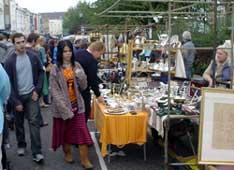 Portobello Road is a mile long, almost all of it lined by market stalls, which makes for one hell of an extended retail experience. I started at the Notting Hill end, down where the road is residential with just a smattering of t-shirt vendors and herbal emporia. The
 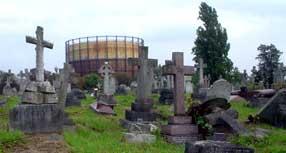 Right up at the top of Kensington and Chelsea, sandwiched between the Harrow Road and the Grand Union Canal, lies London's oldest public burial ground.
 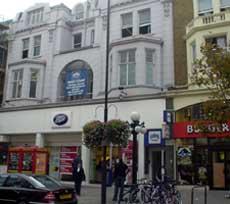 You might have thought it would be easy to find somewhere famously sporting in Kensington and Chelsea. I mean, the last word of the borough's name is a big enough hint. But no, it turns out that