Seaside postcard: Bexhill To celebrate SussexDay (which is today), I've just taken a day trip to this fine and historic county. To Bexhill-on-Sea, no less, an Edwardian resort on the south coast between Eastbourne and Hastings. Two hours from London by train, it's not anywhere you'd visit without good reason. But, thankfully, there's a damned good reason perched on the seafront...
The De La Warr Pavilion was the result of a civic competition to build a brand new entertainment venue on the Bexhill shoreline. 230 entries were received, and the winning design came from architects Erich Mendelsohn and Serge Chermayeff. They came up with an elegant modernistsolution, all bold horizontal lines and curving glass stairwells. The pavilion was the very first major building in Britain to have a welded steel frame, and when it opened in December 1935 it was the talk of the nation. Unfortunately wartime bomb damage cut short its cultural life, and the building wasted away until recently revived by an £8m Arts Council grant. The De La Warr Pavilion finally reopened in 2005 as Bexhill's cultural heart, and it's gorgeous. Running that competition was the best money the town council ever spent.
On entering the building through the main entrance I made a fundamental and embarrassing error - I asked to pay for a ticket. Er no, it turned out that admittance is completely free. Oops. And hurrah! Obviously it costs to see a show in the main auditorium, but I wasn't joining the elderly audience for an amateur dramatics matinee, I was here to see the architecture. Starting with the main staircase. It's the staircase that makes this building special, spiralling up inside a glass cylinder with a series of silver discs suspending a lampshade at the centre. There's a silverplaque at the bottom commemorating the opening of the building by its main benefactor, Earl De La Warr, and also some red seats where you can sit and read the paper. The entire staircase just begs to be photographed (with or without mobility scooter) which is why several of my Flickr contacts havealreadyhadago. I could have walked up and down all day, but probably best that I didn't.
On the first floor there was a choice of culture or cappucino. There were definitely more people in the cafe/restaurant than there were sitting in the dark watching a multimedia presentation about mental disability. I, as usual, went for the cheaper option. Up on the second floor landing the options were fewer - essentially either returning to earth down the northern stairwell or strolling out onto the roof terrace. This is a mostly-featureless open space, hard to convey in a photograph, where you can imagine Thirties socialites standing around sipping martinis during the interval of a summertime concert. Look south towards the sea and there's the striking winged bandstand, a marvellous 21st century addition, looking more like a pair of ivorylips than a performance space. Really, it's hard to to justice to the De La Warr Pavilion in words, so I took lots of photos instead.
Unpopular Culture (curated by Grayson Perry) And on the ground floor, in the gallery which used to be the restaurant and dance floor, another treat. The Arts Council have asked potter Grayson Perry to flick through their archived collection and pick out a few of his favourite works. He's done so by selecting an unsung period in British art (from the 1940s to the 1980s) and curating a fascinating little exhibition of nostalgic austerity. There's quite a bit of brown and grey on show, be it a dour watercolour of some industrial heartland or the lumpen bronze of a misshaped humanoid figure. Plenty of evocative photographs too, recalling the less than glamorous side of living on an estate, the bleak optimism of a seaside holiday or just general low-key grittiness. There's a pleasing mix of image and sculpture, and no one artist dominates - just the one Lowry and only a couple of Frinks. One wall is taken up by what looks like a striking photo of a net-curtained tower block, but on closer inspection turns out to be clever brushwork. And Grayson himself has contributed two signature works, one a pierced bronze skull embellished with symbols of Britishness, the other a large glazed urn emblazoned with portraits of the artist in a fetching headscarf. He likes headscarves almost as much as dresses, does our Grayson, which is why there's also a limited edition silk headscarf available from the pavilion shop for (cough) £45. This is a refreshinglydown-to-earthexhibition, reassuringly retro and rather more accessible than many. It's open at the De La Warr until July 6th, and then touring the UK (Preston, Durham, Southampton, Aberystwyth, Scarborough, Wakefield and Bath) until 2010. For once, it's Londoners who are missing out.
It is the dream of every gallery curator to come up with an exhibition that everyone will want to visit.
"So, how about Ladybird books, then?"
And that's the majority of Britons over 40 hooked. We grew up on Ladybirdbooks, either reading them or reading them to our children, and they represent something safe and cosy from our past. So the De la Warr Pavilion in Bexhill is onto a winner, aspirationally at least, between now and the middle of May.
If you've never visited the De la Warr before, it's gorgeous, a sleek Art Deco swoosh on the East Sussex coast. As well as an auditorium (coming soon, Alan Davies and Rick Wakeman) there are three galleries, with the largest on the ground floor current devoted to the humble Ladybird. I mean, what's not to love? [8 photos of the DLWP]
The introductory section of Ladybird by Design is brief, but includes the hand-drawn mock-up for the very first ornithological tome and an example of the single printed sheet that was chopped and folded to make each 56-page book. There's also a video, not the same as the recent BBC4 documentary, plus a terribly nice exhibition guide, fully illustrated. At £1 it's eight times more expensive than a Ladybird book used to be, but a delightful keepsake of your visit.
Along the main corridor are approximately 500 Ladybird books, cover by cover, from the curators' personal collection. This is a proper step back in time, with titles of books I once owned jumping out with a smile. Understanding Maps, Play with us, The Night Sky, Flight Four India, 'How It Works' Television, oh yes oh yes oh yes.
The main part of the exhibition, however, features over 200 original illustrations used across the series. These are the illustrators' final works, in enlarged size, with scribbled notes around the edges in the guillotine zone. And each is very much its own work of art. The wildlife scenes in What to Look for in Spring/Summer/Autumn/Winter are intricate, the characterisation in Well-Loved Tales: Cinderella accomplished, and blimey did they really use Letraset to label the diagrams in The Public Services: Electricity? As a representation of mid-to-late 20th century Britain, and middle class sensibilities, the Ladybird images are unparalleled social documents.
Three books have been selected for the full treatment, with each of their 24 illustrations presented sequentially. First up is Shopping with Mother, its sequential panels detailing a trip along Every-High-Street circa 1958. This is a retro treat, with a Julie Andrews-esque mother cajoling her perfect offspring from one generic shop to the next until they return home heavily laden to share their treasures with Dog and Cat. Wonderfully evocative of an era of drapers, grocers and ironmongers, it's hard not to imagine how tedious a hypermarket edition fifty years later would be.
From the early seventies we get every page of People at Work: In a Big Store. This visual trawl through a very different consumer experience features shopfloors and canteens, cashiers and storemen. Although only the pictures are present it's all too easy to imagine the words that would have accompanied them, so well drilled are we in Ladybird style. And the third volume to be so honoured is Tricks and Magic, from 1969, which was one of my very favourite books at the time. Many of these images are imprinted deep on my memory - how to switch two matchsticks, how to trace a magic square, and how to shake a wand to create a highly unconvincing wobble.
It being midweek, most of yesterday's audience was well past retirement age. The gallery was also relatively empty, which I doubt will be the case at weekends when nudging through to view the full sweep of images may be more difficult. The shop at the pavilion is very good, currently with a wide range of Ladybird-related stock, and the curator's £20 tome already out of print before the first week of the exhibition is up. If a trip to the De la Warr is always a pleasure, for the next few months upgrade that to a delight.
And OK, so Bexhill is a long way from London, if that's where you are - almost two hours by train. A ticket's not cheap either, more than £30 even for an off-peak return, perhaps putting this free exhibition out of reach. But I got there for only £17.90 by buying a Southern OffpeakDaySave. This can only be used after 10am (or any time at weekends), and has to be booked online at least three days in advance. But the ticket then allows you to wander anywhere on Southern's network, which is how I visited Bexhill and Eastbourne and Brighton yesterday before heading home. Plan ahead and the south coast is nearer, and cheaper, than you think.
Seaside postcard: Bexhill Most fading south coast resorts can only dream of having a cultural magnet like the De La Warr Pavilion in their midst. Margate is trying to follow suit with the construction of the Turner Contemporary, and Folkestone this week launched a triennial arts festival in a bold attempt to raise the profile of the town. Brighton's the place to beat, obviously. But Bexhill has one or two other treats up its sleeve, including another national first. Let's go racing...
Motor Racing Heritage Centre: British motor racing began in 1902, here on the promenade at Bexhill-on-Sea. The event was the idea of the 8th Earl De La Warr (yes, him again), in conjunction with the Automobile Club of Great Britain. He wanted somewhere appropriate to drive his new fangled motor car in competition with others, and decided that the private road he owned along the seafront would fit the bill perfectly. Approximately 200 vehicles drove to Bexhill for the day, avoiding the police speed traps set up on surrounding roads ("Oi, you're exceeding 12mph, you're nicked!"). No such worries on the kilometre run down from the top of Galley Hill to the finishing line outside the Sackville Hotel, and so the "Petrol Derbies" were born. Lord Northcliffe, the founder of the Daily Mail, took part and the day also saw the first public appearance of a Wolseley racing car. And the winning speed? An amazing 54mph, courtesy of Frenchman Leon Serpollet in his steam driven "Easter Egg".
The Frenchman's victory is commemorated by what looks like a car-shaped metal climbing frame on the promenade outside the Sackville, as well as a none too exciting rock to mark the finishing line. Plus, according to the brown sign on a lamppost, there's a 'Motor Racing Heritage Centre' nearby. I walked round the block without finding anything, then asked the Eastern European lady in an ice cream van where it might be. She smiled, vaguely, and pointed at the hotel opposite. Nothing whatsoever at the hotel entrance indicated I was on the right track but, turning right down a corridor inside, I discovered the so-called Heritage Centre. It was the corridor itself, a fusty off-peach back alley zigzagging round the back of the ground floor, leading to the hotel's hairdressers and launderette. So long as the washeteria is open (daily, 9am-5pm) then this delightfully underwhelming attraction is also open. As I viewed the handful of display cases and evocative sepia photographs hung from the wall (for at least four minutes) I was given a curious look from the salon manager, as if to say "we don't get many tourists in here". I'm not surprised, dear, I'm not surprised.
Bexhill Museum: [website] Apparently this long arched building near the wetstern seafront "gives incredible insight into the history of Bexhill, its famous residents and visitors, and the important historic milestones that have made Bexhill famous." Unfortunately it's also closed for refurbishment until 2009, so I can't tell you any more. Bexhill Museum of Costume and Social History: [website] Now here's a quaint curio. This tiny museum in a barn boasts "a rare collection of lace and embroidery samples, dolls, costumes and accessories from the 18th Century, through to the 1960's." Unfortunately a sign on the door offered sincere apologies that they were unable to open the museum due to a shortage of volunteer staff, so I can't tell you any more. Manor Gardens: [website] These picturesque gardens in the hilltop Old Town were a riot of colour, and I was indeed "dazzled by the dense, colourful borders, planted with the season's best blooms." At least until I noticed an entire wedding reception staring out from what's left of the 13th century Manor House, wondering what the hell I was doing wandering around on the lawns outside their window. So I left, and I can't tell you much more. John Logie Baird's House: [website] The inventor of television moved to a semi in Bexhill in 1945, only to die eighteen months later following a stroke. I had hoped to view the plaque on the wall, but "the old house was acquired by a property company and, despite some public objections, it was demolished in August 2007." A modern block of flats is being built on the site, which must be why there was a big yellow crane blocking the road outside, so I can't tell you any more. The Promenade: Ah, you can't beat a goodpromenade. No need to say more.
One of the highest profile victims of Storm Eunice was the roof of the Millennium Dome, part of which failed to stand up to the gusty blast. Six of the panels ripped and tore, some flapping away across the Thames, leaving a large vertical gash on the northwestern flank. It's plainlyvisible from the river and from Blackwall on the opposite bank, but fortunately can't be seen from the main entrance because the hole is round the back. The affected section houses the outlet mall and leaves shoppers partly open to the elements, should there be any, whilst leaving the hospitality and entertainment sectors unaffected. It's a sorry sight.
The roof of the Dome is made of teflon-coated glass fibre and is just one millimetre thick. It was originally going to be flimsier PVC but the incoming Labour government decided the building needed a longer legacy, a change which delayed installation by three months. Altogether there are 144 linear panels, 72 of them in a ring around the base and another 72 above which converge at the top of the dome. All those that failed are from the lower half, which means they're 75m long and weigh a tonne. Construction required cranes and a team of abseilers and was halted if wind speeds ever went above 35mph. Alas Eunice's worst gusts were double that and so a structure that'd stood firm since June 1998 finally gave way.
When you see the damage in situ it's very apparent that the failed section is immediately alongside the only other nearby tall building, a 24 storey apartment block & hotel combo. This was completed in 2016 and created a deep notch which, unfortunately for the Dome, appears to have perfectly aligned with the direction of Eunice's southwesterly winds. I imagine a model in a wind tunnel would have demonstrated the potential risk in advance but the hotel wasn't there when the Dome was built so instead we've had to wait for the full-scale experiment. Prolonged gusty turbulence must have weakened first one panel and then its neighbours, with one of the 12 tall yellow masts providing the only significant resistance.
It's bad news for fans of Simply Red whose performance this evening has been postponed, and also for any families hoping to dine out in a chain restaurant because the entire O2 is closed for the day. It's not clear when it'll reopen, with reports in the media that employees have been told the venue may have to close "for a few months". However it remains possible to book a seat in the cinema tomorrow or to buy a £37 ticket to walk across the roof on Wednesday so the newspapers' bluster may have been an exaggeration. Indeed the gash may look bad but only one-twelfth of the Dome's circumference is affected so I suspect most activities will be able to continue unaffected.
Another of Storm Eunice's millennial casualties was thebandstand at the De La Warr Pavilion in Bexhill. Thisgorgeousstructure first appeared on the seafront terrace in 2001 to provide an outdoor performance focus, and resembled a whale's tail, a nun's wimple or a giant pair of white lips depending on your artistic interpretation. But in storm force winds it snapped and smashed beyond repair and now looks more like a broken seashell. Within hours the DLWP published what amounts to an In Memoriam post, an upbeat invitation for past visitors to share memories and remember the good times because it's not coming back. Neither the bandstand nor the Millennium Dome were built the last time winds of this strength hit southeast England, and sadly neither passed their sternest test unscathed.
It being a bank holiday yesterday, I went to the Sussex seaside. I went to as much of it as possible, nine different resorts in all. I took the train, and walked from each station to the seafront and back. It was all a bit knackering, and a bit bonkers, but a grand day out.
Eastbourne: short sleeves, bags of town centre shopping, grey rinse, seagulls on the Grand Parade, art at the Towner #sussexseaside [photo]
Newhaven: ferry-free docks, silence at the ghost station, tidal silt, industrial hum, kites aloft on the shingle #sussexseaside [photo]
Brighton: the town's buzzing, stripey deckchairs and gelato on the beach, slots on the pier, preening teens, dads in sandals #sussexseaside [photo]
Shoreham: a first shower of rain, the smell of seaweed, kitesurfers eye the waves, shops shut, houseboats beached at low tide #sussexseaside [photo]
Worthing: an expanse of damp pebbles, afternoon tea on the pier, extra vinegar on whelks, nan & mum & the kids, no tan today #sussexseaside [photo]
Littlehampton: a heavy shower, yachts and cruisers, Look & Sea, dipping lines in the harbour and storing crabs in a bucket #sussexseaside [photo]
Bognor Regis: postponed due to inclement weather, poor rail connections and tired feet. But next time... #sussexseaside
I would tell you more, but I only spent about 40 minutes in each location, which is long enough to get a flavour but not long enough to enjoy in depth. Plus I've been to most of these places before, and told you about them then. What was different this time was how I got there, which was using a rail rover ticket.
All of these resorts, and several more besides, are served by the Southern railway network. And they do a special one day e-ticket called the All Network Downlander, which allows you to use any Southern train for the princely cost of £12.50. You have to buy it at least two days in advance, and it's only valid off-peak (that's after 10am on weekdays, or any time weekends and bank holidays). You have to print it out yourself, and you have to carry round some ID like a driving licence or utility bill to prove you're not a fraud. I had to wave my print-out a lot yesterday, especially to get through ticket gates, but then I did travel on 12 different trains to get about from one end of Sussex to the other. My journey would have cost a fortune on umpteen separate tickets, so the rail rover is an absolute bargain. For those of you who live along or near the Sussex coast there's an even cheaper version, the South Coast Downlander, which costs only £10 so long as you stray no further north than Haywards Heath. You don't have to do the madcap 12 hour bank holiday marathon, but if you fancy a varied day out, bear this bargain in mind.
This is the sixth year that the Bulldog Trust has opened up Two Temple Place for an exhibition assembled from local collections around the country. This time they've gone to Sussex and selected a hundred-or-so items which illustrate creativity in the county in the early 20th century. Maybe it was the Downs, or perhaps the coastal air, but something here attracted well- and less-well-known names from the world of art and inspired a characteristically modern slant on their work.
The Bloomsbury Group had roots here, their members writing and/or painting with a distinctively bohemian slant. The De La Warr Pavilion graced the seafront at Bexhill, a pre-construction scale model of which is one of the highlights upstairs. Surrealist Edward James was based at West Dean and sponsored Salvador Dali to create, amongst other things, a red sofa in the shape of lips - seen here at the foot of the stairs. And Eric Gill was one of those to be found at Ditchling, hence some of his erotic sculptures are on display in the Lower Gallery for your perusal, and to scare more prudish visitors.
I particularly enjoyed this year's exhibition and would put it on a par with 2015's Lancashire-themed showcase (perhaps I just love a good regional focus). But the building was also as busy as I've ever seen it, so I feel I ought to go round again when things are a bit quieter. Or, as the exhibition intends, I should be inspired to go and visit the nine contributory institutions in Sussex, from the Pallant House Gallery in Chichester to the Jerwood in Hastings. A special website sussexmodern.co.uk lists them all, with a more useful (less blocky) version here. Oh, and next year's theme at 2TP is jazz, so there's something else to look forward to.
Whilst some nipped out and reviewedthisexhibition when it opened, it's my job to remind you it's almost at an end. The British Library has dug into its not inconsiderable archive and pulled out a fantastic variety of cartographic treasures, less for their beauty or value and more for the story they tell. The 20th century was a time of often turbulent change, and many of the maps chosen depict a world in transition, or at war, or rebuilding after conflict. Although the exhibition is themed room by room, what shines through is an inspired curatorial selection, with every map having some fresh perspective to offer rather than simply more of the same.
From the trenches at Ypres to Midwest women's suffrage, and from postwar Berlin demarcation to North Sea oilfield carve-ups, a full social and economic history is being told. Yes Harry Beck's initial sketch for the tube map is here, but the exhibition has a refreshingly national and global spread, so London gets no special treatment and you're just as likely to see representation of Sunderland town centre or the outskirts of Glasgow, even a forest on the Vietnam border. Look out too for three of Sir John Betjeman's Ordnance Survey maps, with his scribblings on the cover, and JRR Tolkien's graph paper sketchmap which ensured his tales of Mordor had an underlying spatial rationale.
A few electronic maps get the nod, plus the odd aerial tile, but the vast majority of those on show are painstakingly hand-compiled and works of art in themselves. I was struck going round by how much of my early understanding of the world was based on a few maps in school atlases, whereas today's children have digital maps zoom-in-able to coffee shop level. There's also so much more to be read from a detailed map on a large sheet of paper than a scrolling online summary, which helps to explain how I spent two hours walking round and poring over the most intricate details.
There's not much time left to see the exhibition for yourself, barely one week, and only one weekend... which is likely to be rather busy. That said, none of the half-hourly segments between now and next Wednesday are yet sold out, if you don't mind jostling for a look at these treasures with dozens of others. One good thing about the last week is that the book of the exhibition is going cheap - at least 20% off the paperback - should you be tempted to take away a permanent illustrated reminder. If you can't get here in time, the new Maps section on the British Library's website may act as a welcome taster. But ideally you'll want to have enjoyed this inspiringly geography-tastic exposition in person, sheet by sheet, symbol by symbol, line by line.
Tunnel Museum of London Docklands (10th February – 3rd September) [free]
Meanwhile, trains meet history. Crossrail isn't just a transport link, it's a pair of 13 mile holes cut through the soil under central London, plus a number of stations acting as sampling points along the way. Archaeologists were on hand at sensitive sites to make sense of what came out of the substrata, and made some eclectic and astonishing discoveries. A representative selection of what they found is now on display at the Museum of London Docklands, in their downstairs exhibition gallery (behind the main desk, turn left at the counter dispensing cakes and coffee).
It's not a huge space, but big enough, and I spent over half an hour zigzagging around the screens and labelled cases. All of the finds are laid out by station, kicking off with the tunnel portals and shafts on the eastern forks of the new railway. At Plumstead a Bronze Age axe was unearthed, at Canary Wharf one of the largest chunks of amber ever found in the UK, and at Pudding Mill the remains of medieval fish weirs on the River Lea. The worksite at Stepney Green proved an almost direct hit on a moated Tudor manor house, and four tonnes of resurrected bricks have been gifted to English Heritage to assist with period restoration elsewhere.
Liverpool Street proved the richest site, not unexpectedly given its City location, with the deepest finds a pair of 2nd century Roman wooden gates laid flat as a platform over the River Walbrook. On top of this layer came rubbish dumped in medieval Moorfields Marsh, and above that the burial ground of Bedlam Hospital, which archaeologists had been expecting to find on site. In total over 3000 skeletons were respectfully exhumed, including those from a plague pit which should finally provide epidemiologists with an sample of 1665's deadly virus. Meanwhile a grout shaft at Farringdon unearthed two dozen victims of the Black Death... which is something to try not to think about as you speed through on a train next year.
Not all the discoveries were so old, or as gruesome. The demolition of the Astoria at Tottenham Court Road revealed a vault full of discarded pottery from the Crosse and Blackwell pickle factory previously on the site, and at Bond Street they found one of the channels from the lost river Tyburn. Step up to Royal Oak, however, and the bones of bison and a reindeer were uncovered, preserved by the permafrost of a previous Ice Age. You can uncover more about each station's treasures in the index here.
The whole series of excavations reads like a timeline of London, linear but jumbled into unchronological order, and would merit an exhibition several times the size. Throw in some videos showing how certain bits of the new railway were built and there is a sense of Crossrail patting themselves on the back for how well they've done. Nevertheless this is a fascinating display, already justifiably popular, and demonstrates how much can be learned when archaeology and engineering go hand in hand. If the subject interests you, a £10 heavily-illustrated book is available, and several more scholarly tomes have been published looking into the individual discoveries. Ian can tell you more.
Walking the England Coast Path Eastbourne → Bexhill (10 miles)
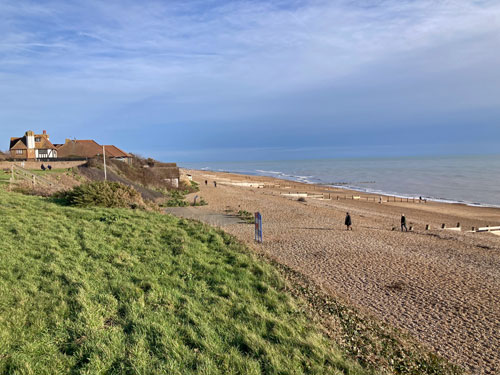
The England Coast Path is a massive project to open up and waymark a right of way around the country, as yet incomplete. In most cases you could have walked it anyway but the signposts are a reassuring sight in areas where the route isn't as simple as merely walking along a cliff or beach. The most recent section is the 28 miles from Eastbourne to Rye Harbour which gained official status last month, creating a continuous path from Chichester Harbour to the Medway Towns. I chose to walk from Eastbourne to Bexhill because it's one of the longest stretches of the Sussex coast I've never walked before and because rail tickets to the towns at each end were briefly £3.50 apiece. These ten miles follow the shingle arc of Pevensey Bay where William the Conqueror landed in 1066 and are virtually all beachside walking, there being nothing resembling a cliff until you reach the Bexhill end. [14 photos]
Normally when I arrive in Eastbourne I head west to cross the Seven Sisters, the finest walk in southern England, so it was a bit of a wrench to stand on the pier and look east instead. My destination seemed very distant at the end of a long low curve, substantially undeveloped, with none of the excessive chalk undulations I was more used to. The start of the walk was all typical seaside resort, a promenade faced by elegant vanilla-toned Victorian buildings, not many of which are still operating as hotels or guest houses. One modern intrusion is a rotatable beach hut based on a telescope, the Spy Glass, though it's looking somewhat shabby ten years on with its colourful cladding missing. Being January it's hard to tell whether kiosk-owner Jon has stopped selling fish tacos or whether he's just closed for the winter.
The first significant building is Eastbourne Redoubt, a circular Napoleonic fortress 68m in diameter, which for many years has been used as a military museum but is now closed pending longstanding repairs. Disappointed visitors may end up in the Glasshouse restaurant newly-opened in the bandstand gardens, or more likely in the less pretentious Splashpoint cafe on the far side. We're now far enough from the town centre to find a few sailing boats and fishing boats at the top of the shingle, which'll be Fisherman's Green, plus enterprising sheds selling the catch of the day. Eastbourne's bowls clubs also have to go somewhere, as does the town's last financially-endangered swimming pool, and of course the Wastewater Treatment Works which in this case have been cunningly disguised as a postmodern seafort with unnecessary crenelations. Best keep walking.
On Eastbourne's eastern outskirts is Sovereign Harbour, a luxury marina development begun in 1990 and now (checks notes) northern Europe's largest composite marina complex. The outer harbour is all you see properly on this walk, a gouged-out tidal rectangle fronted by flats on three sides, not the three inner harbours and the inevitable retail park. Pedestrian passage is shortened if the lock gates are closed allowing you to walk across the top. I imagine residents pay a premium to live here but the apartment blocks are relentlessly unimaginative, a full mile of stacked boxes each with their own sea-facing balcony and a strip of communal shingle in front laughingly described as a private beach, so it's a relief to finally leave all that behind.
And then everything changes, an abrupt switch from serviced real estate to a strand lined with fearlessly individual homes. The promenade stops too and those who wish to continue are cast out onto the shingle. The Coast Path appropriates a brief unkempt back lane past a caravan called Scuzzy's but then it too admits defeat and points towards a bank of pebbles because it's that or nothing. It was at this point I realised my onward progress might not be as fast as I'd intended and regretted having had to book a timed train home. I scrunched along the upper ridge, flattened by some vehicle with thickly ridged tyres, while to my right the pebbles sloped down semi-steeply to the sea's edge. There are only seven places on the South East England Coast Path with warnings that the path sometimes vanishes at high tide and six of them are on this next stretch.
Ahead is the linear village of Pevensey Bay, not to be mistaken for the historic settlement of Pevensey with its Norman castle a mile inland (been there, blogged that). Here a long flank of cottages and newbuilds faces the sea while less hardy souls live a street or two back with the A259 as a spine road and a proper parade of shops including Rose's Fish Bar, the Ocean View Bakery and the 16th century Castle Inn. Scattered along this stretch are three Martello Towers repurposed for residential development, ideal if you want to live inside what looks like a fortified sandcastle with a glass rotunda on top and limited illumination below. Only about 50 such defences survive on England's coasts and this walk boasts half a dozen of them, including two derelict towers back by Sovereign Harbour and one more to come at Normans' Bay.
For the next couple of miles I stepped down onto the lower beach and walked along that, it being substantially less pebbly, so started to make up time. I'd been careful to check it was low tide when I booked my train tickets and was now reaping the rewards. This was more like it, the English Channel lapping to one side and ahead a seemingly endless sequence of groynes to stride between. So steep was the shingle that I could only see the upper storeys of the beachfront houses, this because the bank of stones had been piled here as part of a massive multimillion pound flood preventionscheme... hence the caterpillar tracks I'd seen along the upper ridge. I passed very few other people, mostly those exercising dogs, and noted how the incoming waves gradually grew stronger as the bay curved round to face the prevailing wind.
Initially I was thrilled to think that somewhere along here I'd be passing the point where the Norman armies landed, then thought again and realised not. This shingle beach didn't exist in 1066, the coastline instead indented to form a considerable inlet stretching all the way back to Herstmonceux. Only after longshore drift inexorably blocked the entrance with an arc of pebbles did this sheltered haven silt up to create the Pevensey Marshes, so now if you walk along the top of the beach and look inland you can see vast areas of lush grazing (and the inevitable golf course) beyond the railway. The hamlet of Normans' Bay is perhaps at greatest risk from rising sea levels, an isolated cluster of residential defiance whose beach huts and red phonebox may one day be unfooted by the waves.
The longest uninhabited section crosses two sluices, their outfalls passing beneath the shingle and marked with red warning markers. It's so remote that two motorbikers had parked up on the coast road and walked down to the water's edge to unzip their leathers for relief, perhaps unaware it's Southern Water's job to discharge into the Channel. Eventually a finger of beach huts reappeared signalling the approach to Cooden and the tyre tracks in the shingle wall became deeper, this because one plank of the flood prevention scheme is to scoop up lorryloads of pebbles from here and drive them back to the foot of the cliffs in Eastbourne. Beyond the station a gentle cliff edge begins to emerge, an elevation which inevitably encouraged developers to build houses on top, so best stick to the beach if you want to follow Bexhill's promenade which starts abruptly beneath someone's back garden.
I confess to speeding up at this point because I still had two miles to go and a train to catch, edging past well-wrapped retirees, determined families and dozens and dozens of dogwalkers on the promenade. I skipped past the illuminated stage where they were setting up for Bexhill After Dark, the town's annual winter lights festival, and strode on to the finest building in TN40, the artsy modernist De La Warr Pavilion. Alas I only really had time to walk up the spectacular staircase, inhale the grandeur, wait for cafegoers to get out of shot and takesomephotos before heading off to the station for my timed train. My walk might have been flat but I'd underestimated the effects of shingle underfoot, so I'd suggest allowing six hours if you try Eastbourne to Bexhill for yourself.
Achievement unlocked: I've now walked all the way from Littlehampton to Hastings, approximately 60 miles
Littlehampton →2024→ Shoreham →2011→ Brighton →2011→ Newhaven →2018→ Seaford →2009→ Eastbourne →2025→ Bexhill →2018→ Hastings

On entering the building through the main entrance I made a fundamental and embarrassing error - I asked to pay for a ticket. Er no, it turned out that admittance is completely free. Oops. And hurrah! Obviously it costs to see a show in the main auditorium, but I wasn't joining the elderly audience for an amateur dramatics matinee, I was here to see the architecture. Starting with the main staircase. It's the staircase that makes this building special, spiralling up inside a glass cylinder with a series of silver discs suspending a lampshade at the centre. There's a silver plaque at the bottom commemorating the opening of the building by its main benefactor, Earl De La Warr, and also some red seats where you can sit and read the paper. The entire staircase just begs to be photographed (with or without mobility scooter) which is why several of my Flickr contacts have already had a go. I could have walked up and down all day, but probably best that I didn't.
And on the ground floor, in the gallery which used to be the restaurant and dance floor, another treat. The Arts Council have asked potter Grayson Perry to flick through their archived collection and pick out a few of his favourite works. He's done so by selecting an unsung period in British art (from the 1940s to the 1980s) and curating a fascinating little exhibition of nostalgic austerity. There's quite a bit of brown and grey on show, be it a dour watercolour of some industrial heartland or the lumpen bronze of a misshaped humanoid figure. Plenty of evocative photographs too, recalling the less than glamorous side of living on an estate, the bleak optimism of a seaside holiday or just general low-key grittiness. There's a pleasing mix of image and sculpture, and no one artist dominates - just the one Lowry and only a couple of Frinks. One wall is taken up by what looks like a striking photo of a net-curtained tower block, but on closer inspection turns out to be clever brushwork. And Grayson himself has contributed two signature works, one a pierced bronze skull embellished with symbols of Britishness, the other a large glazed urn emblazoned with portraits of the artist in a fetching headscarf. He likes headscarves almost as much as dresses, does our Grayson, which is why there's also a limited edition silk headscarf available from the pavilion shop for (cough) £45. This is a refreshingly down-to-earth exhibition, reassuringly retro and rather more accessible than many. It's open at the De La Warr until July 6th, and then touring the UK (Preston, Durham, Southampton, Aberystwyth, Scarborough, Wakefield and Bath) until 2010. For once, it's Londoners who are missing out.
It is the dream of every gallery curator to come up with an exhibition that everyone will want to visit.
From the early seventies we get every page of People at Work: In a Big Store. This visual trawl through a very different consumer experience features shopfloors and canteens, cashiers and storemen. Although only the pictures are present it's all too easy to imagine the words that would have accompanied them, so well drilled are we in Ladybird style. And the third volume to be so honoured is Tricks and Magic, from 1969, which was one of my very favourite books at the time. Many of these images are imprinted deep on my memory - how to switch two matchsticks, how to trace a magic square, and how to shake a wand to create a highly unconvincing wobble.
Motor Racing Heritage Centre: British motor racing began in 1902, here on the promenade at Bexhill-on-Sea. The event was the idea of the 8th Earl De La Warr (yes, him again), in conjunction with the Automobile Club of Great Britain. He wanted somewhere appropriate to drive his new fangled motor car in competition with others, and decided that the private road he owned along the seafront would fit the bill perfectly. Approximately 200 vehicles drove to Bexhill for the day, avoiding the police speed traps set up on surrounding roads ("Oi, you're exceeding 12mph, you're nicked!"). No such worries on the kilometre run down from the top of Galley Hill to the finishing line outside the Sackville Hotel, and so the "Petrol Derbies" were born. Lord Northcliffe, the founder of the Daily Mail, took part and the day also saw the first public appearance of a Wolseley racing car. And the winning speed? An amazing 54mph, courtesy of Frenchman Leon Serpollet in his steam driven "Easter Egg".
Bexhill Museum: [website] Apparently this long arched building near the wetstern seafront "gives incredible insight into the history of Bexhill, its famous residents and visitors, and the important historic milestones that have made Bexhill famous." Unfortunately it's also closed for refurbishment until 2009, so I can't tell you any more.
Hastings: red flag flying, blue sky now clouded over, beach mostly empty, pier bereft #sussexseaside [photo]
1) Eltham Palace: Oh my word, the Courtauld's suburban hybrid of Art Deco and the medieval is an utter delight. Do go.
1) Shivering Sands: The four-legged Maunsell Forts, eight miles off the north Kent coast, are best visited by speedboat from Herne Bay. Desolate, startling and wonderfully atmospheric. [photos]