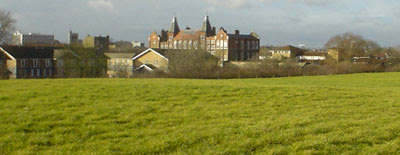
MK: Campbell Park
Parks planned by modern architects don't always work. They're often bland, contrived and characterless, indeed utterly devoid of any charm that might encourage you to spend some time therein. Campbell Park in Milton Keynes is different. It may be artificial but a lot of thought has been given to establishing a sense of beauty and place, especially through judicious use of public art[photo][photo]. If the 2012 Olympic Park ends up half as good as this I shan't complain. The park's now a third of a century old, just long enough to for the trees to have matured, and the golden yellow maple woodland provides a magnificent autumn spectacle at this time of year [photo].
The key to the park's success is a contouredlandscape - not easy to come by when the area is naturally flat, but most of the earth and spoil from construction of the town centre ended up here. The best views come from the tip of a tongue of elevated grassland, the Belvedere, from which the eastern suburbs are clearly visible with Bedfordshire beyond. It's not a busy park, though, not in November. I had the labyrinth [photo] all to myself, and the forlorn looking ornamental fountain, and most of my Redway walk too (bar the occasional bouncy dog walker). The area might throb more if strips of scrubland to north and south are developed, as planned, into high-density residential neighbourhoods [photo]. For now these sloping plots are protected only by ineffective signs stating "Private land, no public access or right of way", plus one solitary locked gate in a non-existent fence.
MK: Willen Lake There's something innately athletic about Milton Keynes. Sure you could spend your entire life driving everywhere, but there are plenty of opportunities scattered around the town to get out there and get physical. One such location is WillenLake, a two-chambered artificial reservoir which helps to regulate drainage across the city. This is a watersports hotspot, no doubt thronging during the summer months with sailors, canoers and windsurfers. Even in late autumn I noted baggy boys and beardy blokes aplenty headed down to the lakeside with boards and wetsuits in hand. Wakeboarding's the new big thing here, with a 5-cornered cable rig set up in the water to tug riders around a wired circuit at 30mph [photo]. Sooner them than me. According to the organisers "We currently have 5 sliders in the water, a 90ft flat bar, a new staked in A-frame, a pipe slider with a kick off the end, a large m rail with fun box attached and also a large aframe to flatbar." I'm assuming those are the ramps I saw which looked like a fleet of half-submerged cars and lorries, and the idea is to aim for those on the way round for a bit of an aerobaticthrill.
For the more lethargic visitor there's still plenty to see. Birds for a start, with a hide for viewing the more elusive species (although seagulls were plentiful enough from the lakeside path [photo]). There's what looks like an ancient stone henge, but which is actually a millennialmonument based on a North American medicine wheel. Set into a sodden grass bowl is an acre of tortuouslabyrinth, which has no dead ends or junctions and must therefore be terribly tedious to walk around. And higher on the hillside is a peacepagoda[photo], the first to be built in the western hemisphere, now associated with a Japanese temple on the hilltop. The story of Buddha is shown in pictorial format around the circumference, and at the centre a serene golden god stares down past guardianlions across the water [photo]. A full circumnavigation of the lake would no doubt reveal further unexpected delights.
MK: Bancroft And finally a pilgrimage to a northwestern neighbourhood, threaded through by the LoughtonValley and tucked close to the London to Birmingham railway line. I was in search of the city's most notorious farmyard residents, the ConcreteCows. They're not signposted, nor waymarked, but thankfully they are marked on an Ordnance Survey map so I knew where to head. From Bradwell Abbey[photo] beneath the mainline, then turn left up the first forked footpath beneath the A422 overpass. There they are beside the river, a herd of six angular friesians [photo]. They've been here (on and off) since 1978, constructed by community artist Liz Leyh with the help of local school children. Each cow has its own character [photo][photo], and the group's boggle-eyed demeanour is immensely endearing. Being concrete they're all perfect for sitting on, which must be why health & safety bods have been along and scattered the grass beneath with impact-absorbing woodchips [photo]. It should be the cows themselves in need of protection. Over the years they've been repainted, graffitied, vandalised, even beheaded, while one particularly ill-advised relocation to the MK Dons football ground saw them seriously assaulted by fork-lift trucks. But the cows have always been repaired and reborn, and now the council keeps a spare set in case of future trauma.
Even on a grey afternoon they're intensely photogenic [photo], and I wandered around the group for a good quarter of an hour checking angles and close-ups. During that time several car drivers pulled up briefly at the roadside nearby, wound down their window and attempted to capture the group on their mobile. When one car hung around for ages it took me a while to deduce that they were waiting to photograph just six beasts, not seven. I took my cue and hurried out of shot, leaving the cows to their solitary grazing [photo].
Day out:Milton Keynes Once upon a time, in toppermost Buckinghamshire, there was a small medieval village called Milton Keynes. Then one day the government came along and said "verily, let us transform twenty-two thousand acres of surrounding countryside into the biggest new city England has ever seen." And so it came to pass that a grid of vertical and horizontal roads criss-crossed the landscape, and various housing estates popped up in the gaps inbetween, and the overspill of the southeast did move in lock stock and barrel. Not somewhere you might think to go for a sightseeing day out, but then I never did pick obvious places to visit. Report follows.
» MK Web(official website, both useful and very detailed)
» Destination Milton Keynes(glib froth aimed at cappuccino tourists)
» Discover Milton Keynes(newly established preservers of local heritage)
» interactive Milton Keynes map quiz(how well do you know your neighbourhoods?)
Central Milton Keynes Non car-drivers usually arrive in MK at the station[photo]. It's not the most delightful introduction to the city. Stepping out into the windswept piazza I'm always reminded of a Communist square bounded by blank office blocks - not a place to hang around. Taxis queue expectantly outside, hoping you'll ignore public transport and ride with them to your far-flung neighbourhood destination. The bus station's no better [photo]. It's an echoing concrete monstrosity, no longer used for public service but somewhere for drivers to park up their minibuses and wolf down a fry-up in the cafe inside. Avoid... unless you're a teenageskateboarder, in which case it's a well wicked hangout for blading and tricks innit.
If it's the shops you're heading for, be brave and start walking uphill through the business district. It won't take more than 15 minutes, and there are a few interesting mini-parks and water features along the way. Parking spaces line every roadside, and planners have recently decided that some of these might make better foundations for new buildings. Various high-rises are going up in the surrounding area in an attempt to give MK a skyline, although nothing especially huge [photo]. One such recent development is The Hub, which describes itself as "the venue of choice" with "spectacular water features and pavement cafes", although I thought it looked like a dull square with fountains where empty people go to drink coffee. More spiritually fulfilling is the mouthfully-named Church of Christ the Cornerstone, Britain's first purpose-built ecumenical city church. Think of it as the sustainable future of urban religion, topped off with a striking dome half the height of St Paul's Cathedral [photo].
I never quite got the hang of walking in Milton Keynes. There are separate walk/cycleways called Redways all across the town, threaded above and below the road system, designed to keep us undrivers safe. But I kept trying to take the most direct route between places, across verges and up embankments and over undesignated crossings, often finding myself in the path of non-stopping traffic. Not a major problem, cars and pedestrians seem to coexist in MK far better than in the majority of unplanned UK conurbations [photo]. The best view of the town's public art was on foot (or on two wheels). There are scores of sculptures all over the central district, some realistic [photo][photo], most uncompromisinglyabstract. They make a bold and innovative addition to the town, and if only I'd thought to print out the Art Trail before I arrived I might have enjoyed a few more of them.
The shoppingmall's the part of Milton Keynes I know best. I've spent many a December Saturday here attempting to buy gifts the rest of my family wouldn't stick in a January cupboard, and I'd still far rather shop here than Brent Cross or Westfield. Centre:MK is one of the UK's oldest American-style malls, opened in 1979, and also probably the longest. The external design is pleasantly minimalist, and the two interior streets are airy, tree-filled and daylit[photo]. Part of the secret of its success is being single-storey, there was no need to build upwards when land was freely available. When expansion was required they built the decidedly non-retroMidsummer Place to the south, blocking off the central spine road to through traffic. The famous concrete cows can be found here, in OakCourt, although as I later discovered these are just counterfeit imitations for the benefit of lazy shoppers [photo]. Just outside is The Point, MK's unique pyramidalcinema and the first multi-screen multiplex in the country [photo]. It's had a rough economic time of late, and it shows, but seemingly survives as an unwelcoming Odeon.
The Point's commercial nemesis looms on the horizon to the southeast - an enclosed skislope and entertainment complex called Xscape[photo]. It's solarge that it takes up one entire city block, a long silverridge poking up out of the earth and an alluring magnet for the town's youth. They throng in large numbers to scoff, bowl and glide, and it's not unusual to see a snowboard stuffed under the arm of a warm padded jacket. The changing area's at the back, and here less daring souls can drink and dine whilst staring at the downhill action through a long glass wall. There are proper ski-lifts in there, and icy gradients, and padded red cushions on every supporting pillar in case you come a cropper and tumble on the way down. It looks a load of fun, if you like that sort of thing, and so much more convenient than flying off to the Alps once a year.
Close by, and rather less well frequented, is the Milton Keynes Gallery. It's outer walls are decorated to reflect the exhibition inside, which can mean plastered posters or overbearing pinkness, but currently involves a sticking-out canoe. The interior's not big, just three over-staffed galleries, although I enjoyed a few minutes with Gilberto Zorio's giant stellate installations. One in particular mutated suddenly into an intense stroboscopic lightshow - goodness knows how the friendly gallery attendant puts up with that throughout the day. I escaped, intent on seeing more of the non-central bits of town, of which more tomorrow.
"You're too late," said the lonely-looking man stood at the entrance desk. "It takes a good two hours to look around the museum, and I'm locking up in half an hour." He handed me a leaflet to show me what I was missing - street of shops, telephone museum, tramcar, lawnmowers! - and suggested I arrive rather earlier next time. But there won't be a next time. His no-doubt delightful museum isn't easily accessible to the car-free and I'd had to endure a lengthy cross-estate yomp to get here. Opportunity lost. So now I'm sat on a dusky not-so-nearby station, awaiting wheeled deliverance. Fifty years ago, in the age of steam, this was a major inter-city refreshment stop where I could have rested awhile with a slice of battenberg and a cuppa. Today not one single original station building remains, let alone an institutional tea shop. So Alix, if you're still around, mine's milk no sugar, cheers.
I'm glad I wore my walking boots. There may be paved paths aplenty but I keep wandering off onto sodden verges and muddy grassland like the mischievous pedestrian I am. There are trees everywhere so I've picked the perfect time to visit - the entire town is golden yellow. From the shops I've headed east through miles of open parkland, mostly empty apart from herds of untamed hounds and their less bouncy owners. There's a lot of water about, and more than one hardy soul is out waterskiing with his shaggy baggy mates. And I swear that the local magpie count is far higher than the national average - there are joyful couples everywhere. Now to hunt down a bus stop. See how long it takes me to ride back from autumn to midsummer.
Always visit the shopping centre first. It may be a bit of a trek from the station, but that's where all the people are. I'd never have stumbled across the tourist information office otherwise, hidden away in an unlet retail unit, unless I'd heard it announced over the mall's loudspeaker system. Now I have my free maps of town, I'm ready to explore outside. I wasn't expecting to find a famous artwork in here either, "on loan" to the shopping centre where the residents might actually see it. Saves me a parkland detour later. I've wandered through the business district, utterly deserted at weekends, and now I'm sat outside the coolest place in town, the hillock where all the youth hang out. Even better, the rain's stopped and the sun's shining. So far, so good.
dg's Moblogged Mystery Tour: I'm sat on a train at a central London terminus, about to set off on a journey of discovery to an anonymous English town. My journey should take less than an hour, which is a relief because the heating's on full and I'm sweating already. I've been to this particular town many times before, but never really explored it properly on foot because it's not your usual sightseeing hotspot. I hope the tourist information office is up to speed, because my printer ran out of ink last night and all I have with me are some streaky illegible maps. With a bit of luck I'll still find the interesting bits, old-ish and newer, in the busy centre and around the periphery. On a damp grey day in November. I must be mad. I'll report back from various locations along the way, via my mobile phone, to let you know how I'm getting on. But I'm not going to tell you where I am, because it wouldn't be a mystery tour otherwise. See if you can guess...
I've started up a tumblr page. For the uninitiated a tumblelog is a sort of "online discoveries" blog, a place to showcase links and pictures and stuff with minimal commentary. Might be something I've spotted, might be something I've taken, might be something fact-packed, might be something to visit, might just be something quirky or unusual. If you're interested, there's a permanent link in my sidebar, or you could always subscribe to the RSS feed. If you're not interested, you're missing out on a Birmingham-based psychogeographical art endurance expedition, a dead useful London Events Calendar and a photograph of a sick spelling mistake at Holborn tube. Amongst other stuff. So far.
Hmm, anybody else out there got a Tumblr page too?
After Bonfire Night came Bonfire Day. TfL's latest business plan(pdf) has incinerated several slow-burning transport projects, each liberally doused with car-friendly petrol by our beloved Mayor. A few important projects that Boris inherited, such as Crossrail and (most of) the East London line, will be prioritised. And their funding will be secured by sacrificing varioussmaller projects, generally at the expense of residents in boroughs that voted for Ken. TfL's emphasis will be on upgrading existing networks, not branching out into new areas, no matter how great the local need. Boris refuses to raise taxes to pay for anything, including it seems investment in London's future. There'll be no new transport projects in the pipeline for his successor to open, but never mind, eh?
So, what's Boris shelved?
Cross River Tram A rail map of Inner London reveals one big blind spot, one great inaccessible desert through which no existing tracks run. The Zone 2 Gap is centred on Burgess Park, around the Aylesbury Estate and Camberwell, and it's through these mean streets that the Cross River Tram was due to pass. Sorry Southwark residents, you'll have to carry on taking the bus instead. Look, TfL haven't quite removed all their CRT plans from the internet yet, so it's still possible to see what you're missing. No more frivolous thoughts of running a tram service on-street between Camden and Peckham, because you can just imagine how many car drivers that might have inconvenienced. Of all the schemes to hit the buffers today, this one's probably the greatest loss. CRT, RIP.
Thames Gateway Bridge This project's rather more controversial. It's been on the drawing board for aaaa-ages, and would have linked Beckton to Thamesmead across a not-terribly accessible stretch of the Thames. The river's a huge barrier to movement in East London, far more so than out west, and this major bridge would have greatly increased accessibility. Unfortunately it would also have brought more traffic (and nasty concrete feeder roads) to the area immediately around it, so the bridge was never popular with local residents. Now they can live happily in their residential cul-de-sac, and everyone else can drive upriver to the nearest tunnel (3 miles) or downriver to the nearest bridge (10 miles). Or there's always the Woolwich Ferry, still a 19th century solution for a 21st century problem. Boris is apparently looking into constructing another tunnel near Silvertown, but that needs to be planned from scratch and so is unlikely to be built in the next 20 years. In the meantime, the output of a lengthy public inquiry goes in the bin.
DLR Dagenham Dock extension Who'd live on Barking Reach? Acres of new boxy dwellings are erupting all over the Thames estuary around Creekmouth, and yet at the moment there's only a weedy bus service to link residents to the main transport network. The DLR extension to Dagenham Dock was meant as a long-term solution to this problem - a bold attempt to give Thames Gateway property some value. In a recent consultation 95% of local residents were in favour of the new branch line, planned to open in 2017. Stuff them. If you want to live here now, get a car.
Oxford Street tram scheme Let's be honest, shopping in Oxford Street could be nicer. We'll see that on December 6th when traffic is banned for a 5 hour festive retail blowout and pedestrians rule the tarmac. Boris is clearly keen on ousting the red tide of buses from the street more permanently, but that won't now mean installing a mile-long tramway to ferry weary shoppers from bargain to bargain. My bet's on him decapitating a few bus services so that they no longer run along the entire street, they terminate earlier at Marble Arch or Centre Point. It may not be convenient for all travellers, but it'd be damned cheap.
CroydonTramlinkextension This is the biggest surprise on the to-kill list. It's relatively inexpensive, it follows an existing rail corridor, it's already quite well planned, and it's in part of Outer London that's natural Boris-supporting territory. It was also due to interchange with the new East London Line spur to Crystal Palace, which is still on the to-survive list. Not enough to save the tramlink link, alas.
East London Transit and Greenwich Waterfront Transit These sound much more exciting than they really are. Priority segregated bus lanes with a frequent service, one over Barking way and the other between Thamesmead and Greenwich. Now only some preliminary tidying up is scheduled before the funding runs out, and oh look, that's Barking and Thamesmead buggered again. Do vote more carefully next time, folks.
High Street 2012 Hang on, that's my local project on the scrapheap! You'll remember that I spent most of August walking up and down the A11 telling you of great transformative plans to improve the public realm along this historic and strategically important corridor. All cancelled, apparently, along with plans to improve Parliament Square and the Victoria Embankment. We're told that these schemes "did not have a strong rationale" (which is political speak for "making places look nice is not cost effective"). And they also "had the added disbenefit of restricting traffic flow and potentially increasing congestion" (which is political speak for "it's more important to be able to drive through somewhere than to live in it"). So it's what-a-shame Whitechapel and bad luck Bow. When the London 2012 marathon comes plodding this way, global TV cameras will see an unchanged and uninspiring hotchpotch of metropolitan backwater architecture. As for the millions that English Heritage were due to plough into my neighbourhood as part of HS2012, they're presumably now lost too and we'll see nothing. Thank you Boris, thank you for nothing.
Phrases to be found in Boris Johnson's newly-launched and slightly unusual 36-page transport strategy document » "chuntering and roaring" » "packed to the gunwales with perspiring passengers" » "roads and pavements are cratered with enigmatic holes, coned, fenced, deserted, as though the city were still recovering from a series of unexpected Scud attacks" » "the colossal new Cloaca Maxima called the Thames Tideway tunnel" » "a holy war against holey streets" » "kerbs seem to have sprouted traffic-throttling excrescences" » "It does not mean that City Hall has been captured by J Bonington Jagsworth of the Motorists' Liberation Front"
Hmmm, what might this mean, eh? » "It is absolutely essential for TfL to bear down on costs" [We're going to publish a major "efficiencies" initiative tomorrow] » "Oxford Street is still bisected by a panting wall of red metal. Can we really leave it as it is?" [Expect the removal of lots of those bloody annoying bus things from Oxford Street] » "We are considering a tunnel under Park Lane, releasing land for development and green space, which could be funded from the development it produces." [Some rich friends of mine, who own hotels and sports car showrooms, would like to increase pedestrian footfall outside their premises] » "the day is surely not far off when passengers will swipe through the turnstiles with their mobiles or other hand-held device" [We used to tell you not expose your mobile in a public place in case it got stolen, but our new technological partners would rather we didn't mention that any more]
Is this really a good idea, Boris? » "We need to make sure that all London's transport infrastructure is fully wheelchair accessible." [Only 200 astonishingly expensive tube station upgrades to go! Why not rip out the entire Victorian-built underground network and start again?] » "Create dedicated routes that give nervous cyclists the confidence they need." [Great, because most Londoners won't go cycling so long as they fear they might end up under a lorry] » "A couple of extra seconds on green can cumulatively make a huge difference to traffic flow" [And never mind the two second delay to pedestrians] » "Think how magical it would be to pick up a boat from central London, and take a day trip downriver to see the Games at Stratford." [Erm, you could get as far as Greenwich, but sailing up the tidal River Lea is going to be bloody difficult at low tide unless the boat's no deeper than a kayak]
Did he really say that? » "in many parts of London a feeling of oppression is compounded by the thought that public transport is the only option." [How awful that some Londoners feel they can't own their own car] » "Free travel for kids has brought a culture where adults are too often terrified of the swearing, staring in-your-face-ness of the younger generation." [Bloody kids, they should be driven around by their parents, or start walking] » "The motor car is not intrinsically evil." [It's only polluting and dangerous when there's a human behind the wheel] » "I have asked GLA and TfL officials to produce an initial report into an island airport in the Thames estuary" [yes, he really did say that]
Good news: "London has secured a budget of £39 billion for the period 2007 to 2017, and this will be spent on major projects for the improvement of mass transit: Crossrail, the tube upgrades, the expansion of the Overground rail network." Bad news: "One thing we cannot do is spend tens of millions keeping projects alive, for political reasons, when there is simply no government funding to deliver them."
Statistics gleaned from the document » Total tube ridership is about 1.1 billion journeys per year » The average number of passengers on a London bus is 16 » It is not raining in London 94 per cent of the time
Translate the following... » "if we are going to buy these new tunnelling machines, as we are, why not see if we can use them to dig south of the river, and expand the Tube network there?" [We may have no money, but I don't want Bromley and Bexley to lose faith in me yet] » "Why is it that so many buses seem half-empty? Passengers may like it, but it is expensive in subsidy." [We intend to thin out London's bus network to save money] » "The new vehicle will have some of the advantages of the old Routemaster" [The new vehicle will not be a Routemaster in anything but name] » "I will encourage – with my policing hat on – whatever steps are possible and necessary to crack down on aggressive cycling." [Arrest the red-light-jumping bastards!]
The GunpowderPlot may have played out in cellars beneath the Palace of Westminster, but one key location in the drama was a small manor house in humble Hoxton. Four centuries ago its main thoroughfare, just north of ShakespeareanShoreditch, was home to many noblemen seeking domestic sanctuary close to the bustling City. One such rich resident was Henry Parker, better known as Lord Monteagle, and the brother-in-law of one of the Plot's Catholic conspirators. It was while dining at home in Hoxton one October evening in 1605 that history came knocking. One of Henry's footmen approached the table bearing a mysterious letter which he'd been given anonymously in the street, and Monteagle duly read the contents out loud to his assembled dining companions.
Was this a dire warning of imminent regicide, or just some prankster's sick joke? Playing safe, Lord Monteagle dashed off to Whitehall and delivered the letter in person to the Earl of Salisbury, the King's principal secretary. The threat was dismissed publicly, but taken more seriously in private. Consequently the cellars beneath Westminster were searched on the night before the state opening of Parliament and bingo, Guy Fawkes and his barrels of explosive were discovered. The Gunpowder Plot rapidly unravelled.
That's the official story, anyway. Many historians suspect that the "anonymous letter" was a sham, and that the entire "plot" was a set-up to give Catholicism a very bad name. Monteagle normally dined at his country home, and yet on this one day the messenger knew to seek him out in Hoxton. The letter was clearly a confidential warning aimed at Monteagle alone, and yet he immediately disclosed its contents in public company. The authorities needed to make an example of Fawkes and friends, and Monteagle's convenient revelation gave them the excuse they needed. Whatever the underlying reasons, Parliament and the monarchy survived greatly strengthened and Monteagle was hailed as a national hero. Hoxton Street's most renowned resident was rewarded with an annuity equivalent to £700 a year - not bad for a single evening's work.
No trace of Monteagle's manor house exists today. Indeed very little of any historic value exists in this part of Hoxton - the non-trendy northern end into which the meeja set rarely venture. Any housing stock of note has long since been razed, replaced by acre after acre of non-descript blocks of post-war council flats. If Hackney rehoused you here you'd be grateful, but you'd not be pleased. One such development lies between Myrtle Walk and Crondall Street, a bold brick edifice with lateral chimney attached like the key on a giant brown sardine can. Rear access is via a tall blue door with keypad combination, close to a fenced off patch of grass which passes for a communal garden. From the top balcony, or even up at 'penthouse' level, there's an unobstructed view of the bus shelter below where spirited youths gather to snarl at passing photographers. And on the wall at the Hoxton Street end there's a small brown plaque which confirms that, yes, it's this very building which now stands on the site of Lord Monteagle's historic property. I fear no nobleman would consider living anywhere around here these days, not unless he was filming a secret documentary for Channel 4.
There are a fair number of other brown plaques scattered across thispart of Hoxton, each attached to a very ordinary block of flats. Pollock'sToy Theatre Shop, purveyor of kiddie playhouses, that was here, now flats. The Britannia Theatre, greatly loved by Dickens, that was here, nowflats. Hoxton Hall, intimate Victorian saloon, that was here, now intimateperformance space. Ah, so it's not all vanished yet. But most of Hoxton's history exists only in memories, or photographs, or stories. Remember remember.
Are you a cheerful soul or a miseryguts? Do you bear up to the challenges the world throws at you, or do you see the bad in everything? Is life a good place really, or is it a bit rubbish? Your emotional state can be defined by a number - a score between one and ten - with ten representing "damned satisfied with life" and one representing "utterly dissatisfied". This value is called the Happiness Index, and it's been the subject of much international research. I've had a think about what my HI is, and I've come to the unavoidable conclusion that I may be unusual. Because I'm permanently eight.
I chug through life at HI8. I'm a happy bloke, all told. I smile a lot, even when other people can't work out why. I look on the bright side, at least until events confirm otherwise. I don't wake up in the morning and sigh, and I don't go to bed at night depressed. I try to see the amusing side of everything, even when it's not supposed to be funny. I enjoy my job, and I don't give a damn that I might be earning twice as much somewhere else. When things don't quite go to plan, I don't wind myself up about it. Even though the world is full of moaning idiots, I try to ignore their bigoted wittering. I don't take offence, I don't do unnecessary guilt, and I try to make the most of what I have. All in all, I think life's pretty good really. I'm permanently eight.
OK then, I admit, I'm occasionally HI7. Not very often, but my eightness sometimes dips slightly. Will this pointless meeting never end? Why have the neighbours started smoking outside my window again? What do you mean, I need two fillings? Is all the food on this menu vegetarian? Why is that TV programme I missed not on iPlayer? When will this train start moving? What am I doing in the back of an ambulance? Just sometimes, just for a short time, my Happiness Index can drop to seven. But these comedowns are merely temporary blips, quickly past, because deep down life is still generally fine. Deep down I'm still permanently eight.
I very rarely do HI9. When I have a fortnight off work, I'm still eight. When I meet up with friends for a night out on the town, I'm still eight. When I'm about to take off for a fantastic holiday abroad, I'm still eight. When someone gives me an unexpected gift, or pays me an unsolicited compliment, or even hands me a Creme Egg, I'm still eight. It takes something rare and special, like a successful job application or an amazing out-of-the-blue email or a highly evocative dancefloor choon, to give me a brief burst of nine. And even then I only experience a temporary uplift of pleasure, and then I'm straight back down to normal again. I'm a natural eight.
I never do HI10. But I know that some of you do. Some of you leap off the sofa when Arsenal win. Some of you leap off the sofa when Arsenal lose. Some of you yelp with pleasure on securing an elusive eBay bid. Some of you bounce around on dancefloors with grinning teeth. Some of you are fired up by religious certainty. Some of you raise clenched fists at every PlayStation win or Wii victory. Some of you find cricket climactic, or rugby rapturous, or motor racing messianic. Sorry, but that's not behaviour that I understand. I'm not swung by sporting victories, nor moved by nationalistic passion, nor elated by political triumph. I don't do, can't do, won't do, ecstatic. I never experience higher than nine. I'm a solid and unyielding eight.
There was a time, about nine years ago, when I did HI2. Feelings of two-ness would creep up, for no obvious reason, and cast a shadow across my very existence. I'd be listening to the radio, or mulling over recent experiences, or even just sitting around doing nothing much, and suddenly my situation would seem very two indeed. I knew my two-ey thoughts were wholly irrational, but that didn't make them any easier to ignore, or to control. At least these two-ish troughs were only temporary, in a generally four-or-five-ish existence, although it took a few months of water under the bridge to claw my way back as far as six. And thankfully I soon found myself back where I've been for most of my life, restored to my happy plateau, at my consistent eight.
I'm very happy to be HI8, no more, no less. I don't care that I never experience the excitement and euphoria of HI10, not if that's balanced out by never again feeling the misery of HI2. I value stability, and optimism, and knowing precisely where I stand. Because life may not be perfect, but at least it's damned good.
If it's quarter past seven on the morning of the third of November then I've been single for exactly nine years. (Yes, I know I post this particular post atthesametimeeveryyear, but I have updated it a bit, and I intend to keep posting it every year on this date until my situation changes. Not that I care if it doesn't, you understand.) Some might say that we single people are missing out on the joys of coupledom, and maybe we are, but I'm convinced that there are equally many positive points to being single:
Single: You get the whole duvet to yourself. Coupled: You don't need a hot water bottle.
Single: There's half as much ironing to do. Coupled: There's twice as much ironing to do but somebody else might do it.
Single: You can hoover the carpet when you think it needs doing. Coupled: Somebody else hoovers the carpet before you think it needs doing.
Single: Nobody ever tells you that the kitchen must be repainted and the bathroom must be retiled. Coupled: Two people can repaint the kitchen or retile the bathroom far more quickly than one.
Single: You never have to waste a Saturday doing what somebody else wants. Coupled: You never sit around on a Saturday wondering what the hell to do.
Single: You can play your music collection really loud, even the track that nobody else likes. Coupled: Your music collection is twice the size.
Single: You can watch whatever TV channel you like, without arguments. Coupled: There's someone else on the sofa to snuggle up to.
Single: Nobody complains when you burp, belch or fart. Coupled: Somebody points out when you have dandruff on your shoulder.
Single: You don't have to put up with somebody else's niggly annoying habits. Coupled: Somebody else puts up with your niggly annoying habits.
Single: The toilet seat is always where you left it. Coupled: The toilet seat isn't always freezing cold.
Single: You never come home to a blazing row. Coupled: You sometimes come home to a cooked meal.
Single: You get to eat the whole ready meal for two yourself. Coupled: It takes just as long to cook for two as it does for one.
Single: You can spend all your money on yourself. Coupled: There are two salaries coming in and only one set of bills.
Single: You can walk away from a flatshare, any time. Coupled: You can afford a mortgage, together.
Single: There are no important birthdays or anniversaries to accidentally forget. Coupled: Somebody actually remembers your birthday.
Single: You never have to buy useless presents for your partner, just for the sake of it. Coupled: Somebody buys you presents occasionally, and it's the thought that counts.
Single: You're allowed to flirt with people in the street. Coupled: You don't need to flirt with people in the street.
Single: You never have to spend entire weekends being polite to the in-laws. Coupled: Your in-laws are always ready to provide advice on your faults and shortcomings.
Single: You can still have a riotous social life in your 30s. Coupled: You can still have a riotous social life in your 60s.
Single: You have no friends to go out with because they've all partnered off and are staying in. Coupled: You don't have to go out with those annoying friends you had while you were single.
Single: You don't catch every sniffle, cold and flu bug off your partner. Coupled: When you suffer a major cardiac arrest, somebody actually notices and dials 999.
Single: You never get left all alone and desolate because your life partner's just passed away. Coupled: When you get old and infirm, you don't end up in a care home because there's nobody to look after you.
Single: If you meet the partner of your dreams, it's not too late to marry them. Coupled: Nobody ever meets the partner of their dreams, so better to get married before it's too late.
Single: Being coupled is restrictive, stifling and a sign of personal weakness. Coupled: Being single is unnatural, lonely and a sign of personal failure.
Single: You never get your heart broken. Coupled: You sometimes feel your heart leap.
Single: You can have sex with anyone you like. Coupled: You can have sex whenever you like.
Single: The bathroom is always free. Coupled: The bedroom is always full.
Single: You can lie in bed in the morning for as long as you like. Coupled: There's a very good reason for lying in bed in the morning.
Single: Nobody sees what you look like first thing in the morning. Coupled: Somebody loves you despite what they see first thing in the morning.
Single: You never discover that your partner took another bloke to the company's (very expensive) Christmas party, having insisted to you that "plus one" on the invitation was a misprint. Not that I'm in any way bitter, you understand...
Bus 16: Victoria - Cricklewood (Bus Garage) Location: London northwest Length of journey: 6 miles, 40 minutes
Our capital's first coherent system of bus route numbering was introduced on Monday 2nd November 1908. Only one London bus still plies the same route as it did 100 years ago, and that's the 16. Its route has been stretched and tweaked and contracted over the years, but the current journey from central London to the suburbs is identical (one-way-systems excepted) to the Edwardianomnibus original. I've been for a centenary ride on its modern double decker equivalent, just to see if anything else about the journey is still the same. Destination Cricklewood.
Nobody queues for buses any more. Not in the street outside Victoria anyway. The 16's not allowed in the shiny bus station, there's no room, so each service kicks off in gridlocked Wilton Road beneath a picture of a musical witch. Passengers attempt to guess precisely where the driver will stop, then charge willy nilly for the door in an attempt to grab the least worst seat for the journey ahead. I wanted upper deck front left - alas no longer an open-topped pleasure, but at least now glassed in to protect me from passing branches. And off through the one-way streets of Belgravia, peering down through autumnal leaves into the Queen's back garden (I bet Edward VII never had a tennis court). Hyde Park Corner was well named in 1908, not a four-lane gyratory, and there was still space around the Wellington Arch for memorials to wars as yet unimagined. "16 to Cricklewood Bus Garage". "Marble Arch."
I'd been fortunate to catch a bus running a few minutes behind the previous service, so we sailed past most of the early bus stops without pausing. My top deck solitude was only broken as we started up the EdgwareRoad. Most of the pensioners and pushchairs and veiled ladies stayed downstairs, but one gentleman ascended to claim the other front seat where he proceeded to read his exotic newspaper. It's a bit of Arabian bazaar up this stretch of road, full of shisha cafés and Maroush restaurants, and even 1908 travellers would have noted Middle Eastern migrants settled in the area. They'd probably not have recognised the casino or the multi-storey drum-likeprimary school, however, and they'd have been surprised at the scale of the Waitrosesupermarket preparing to open here later in the month.
More passengers. A young boy scampered up the stairs, closely followed by his Dad, and noted with visible disappointment that both of the front seats were taken. The pair of them tucked into the seat immediately behind me, and I felt warm breath on my ear as the youngster leaned forward to peer out of the front window. Fat mum squeezed in beside me shortly afterwards, chewing relentlessly beneath her pink headscarf and keeping firm hold on a plump leather clutch bag. I tried hard to cut out the chatter, knowing full well that all three of them wished I wasn't here. And at the next stop, they were gone.
There are some mighty high route numbers these days. A century ago anything above 20 would have been unheard of, and here I was sandwiched between a 332 and 414. My 16 chugged on into more residential territory, beneath a red-piped tower block and into the leafy suburb of Maida Vale. They've championed apartment living here for decades, and the wealthy eight-storey brick courts are far more desirable than any Thames Gateway newbuild. But the upmarket ambience didn't last long. Kilburn High Road was up next, a much more characterful mix of cultures and classes. Some of the buildings alongside have survived the century - the Cock Tavern declared itself 1900 vintage, while the Black Lion proudly displayed 1635 (ah no, hang on, that's the phone number). But the majority of the retail infill is newer and blockier and uglier. Even the lampposts were strange - thin and curved inwards like an intermittent ribcage. Kilburn's somewhere to sightsee, but more than attractive enough to local shoppers.
The traffic in the opposite direction was horrendous, backed up as far as the eye could see, with much of the congestion created by single cars attempting in vain to turn right. An illegally parked vehicle narrowed the road outside Stephens Menswear. As we attempted to pass, the car driver emerged from the sports shop nextdoor and strode out in the road to unlock her door. Fumble, key, fumble, poke, fail. With an apologetic stare she retreated to the pavement, no doubt reacting to an appropriately stern glare from our driver. He gave the brush off to another old woman lugging her basket on wheels slowly behind her down the middle of the bus lane. We couldn't move until her minute-long procession was over, and because she didn't reach the bus stop in time she was left behind.
On past a variety of Kilburn stations and the odd theatre, to ascend Shoot Up Hill. I was joined on the top deck by Gary Salisbury and his wife, easily identified from the name, address and telephone number written for all to see on a luggage tag hanging from his rucksack. If you ever meet Gary, please do try hard not to giggle at his fedora. The happy couple were heading for Cricklewood Broadway, a long shopping parade which would have been new when the first route 16 passed this way. It's now showing its age. Here cheap furniture shops sell piled-up sofas to cost-cutting landlords, and the Quick Clean Coin Operated Laundry still boasts of its featured Frigidaire Washers. The CrownHotel still maintains a certain Victorian grandeur, if you like giant pubs with Irish hospitality and don't mind the ultra-modern extension attached nextdoor. Not for me thanks. By the time we reached Cricklewood Lane, two stops from the end of the ride, I was the only passenger left aboard.
The 16 terminates beneath a railway bridge, virtually the only local feature which might be familiar to Edwardian travellers. The rest of the area's ugly and modern, from two vast Wickes and Matalan warehouses across the car park to the bland premises of newly-relocated Saxon College plonked beside a Lidl shed. Even the bus garage isn't what it was. The old buildings have been knocked down and replaced by a four-storey office block, which manages to be simultaneously eco-sustainable and architecturally vacuous. It's not quite finished yet, and neither is replacement parking for 200 buses, so all terminating services currently park up across the road on floodlit wasteland beside the Midland mainline.
100 years on, route 16's changed out of all recognition. The buses have a roof and talk to you. The streets are full of competing private transport. Shops sell barely-imagined goods at vastly-inflated prices. Children ride alone and shout rude words from the back seat. But there's still only one sensible way to get from central London to Cricklewood, and that's straight up Watling Street. The 16 follows in Roman footsteps, and its long history continues with every journey.
100 years ago, in 1908, London's streets were served by several bus companies. Some of these used numbers to designate their services, some used letters and some just listed the destination and hoped their passengers would cope. In July of that year the largest bus operator, the London GeneralOmnibus Company, gobbled up its two largest rivals to create a virtual monopoly. Rationalisation ensued, and on Monday 2nd November 1908 the routes of all three companies were consolidated and numbered. The basis of the new numbering system was that already in use by the Vanguard Motorbus Company, itself inspired by a system one of their managers had seen used on trams in Berlin.
Initially only route numbers up to 20 were used, with 5 and 12 omitted, creating a new bus network which criss-crossed the capital. Some of these eighteen routes were rapidly withdrawn, but others proved considerably more resilient and are still recognisable today. Here's a list of the LGOC's original bus routes, launched exactly a century ago, along with an indication of how much of each survives.
1: Cricklewood - Elephant & Castle [northwest half cut, southeast half extended] 2: Child's Hill - Ebury Bridge [has slid substantially south over the years] 3: Camden Town - Brixton [north end cut, south end extended] 4: Shepherd's Bush - Herne Hill [withdrawn 1909] 6: Kensal Rise Station - Liverpool Street [City service withdrawn 1992] 7: Wormwood Scrubs - Liverpool Street [City service withdrawn 1970] 8: Shepherd's Bush - Seven Kings [switched eastern end with route 25 in 1912] 9: Kew Green - Shoreditch Church [cut back at both ends to current route in 1993] 10: Leytonstone - Elephant & Castle [withdrawn 1988] 11: Liverpool Street - Barnes [cut back a bit, but still damned similar] 13: Shoreditch Church - Hammersmith [withdrawn 1909] 14: Stratford Broadway - Putney Station [Stratford end withdrawn 1911, Putney end remains] 15: Shepherd's Bush - East Ham [withdrawn 1909] 16: Victoria Station - Cricklewood [still going strong] 17: Ealing - Plaistow [withdrawn 1958] 18: Leyton - Oxford Circus [withdrawn 1909] 19: Highbury Barn - Clapham Junction [tweaked at each end, still pretty much identical in the middle] 20: Hammersmith - Tulse Hill [withdrawn 1917]
London's bus numbering system is now considerably more complex, including route numbers running up into the 600s and a variety of almost-logical lettered prefixes. You can read more about the system's evolution at some of the links below. And tomorrow I'm going to take you on a centenary journey along the longest surviving numbered London bus route, just to see how much has changed since 2nd November 1908.
Just in time for Hallowe'en, a retail vampire has arisen. It's set up shop in the wastes of White City, sinking its teeth into the local economy and sucking dry the surrounding neighbourhood. Many's the innocent punter already lured deep into its clutches, their purchasing habits transformed, their conscience drawn over to the dark side. And the name of this merchandising monster is Westfield. London's lifeblood may never be the same again.
Oh my word, it's big. You get some sense of scale from outside, as if some vast aircraft hangar has been erected amongst the backstreets of Shepherd's Bush. But only from inside is it possible to take on board how huge the Westfield development really is. Just when you think there can't possibly be even more shops tucked away up some passageway, more appear. It's as if some ferocious tornado has whisked away the full length of Oxford Street and New Bond Street, lifting them three miles to the west and coiling each up beneath a vastundulatingglassroof. Lakeside and Bluewater may give you some idea of what to expect, but in truth London's seen nothing quite like this before. So long as anyone in town still has any money to spend, Westfield threatens retail domination.
I headed over to W12 just before sunset on opening day. The initial mad rush was over and the crowd control monkeys weren't having to be quite so heavy-handed in their funnelling. My southern approach was up a deep concrete canyon, with not-yet-open restaurants to one side and a long deep Waitrose on the other [photo]. Towering above was one of the four "anchor" department stores, this one a House of Fraser (Wood Lane approachees get Next first instead). Quite a trudge already, and still not yet inside the mall proper. Up that escalator, maybe, or through the main doors up ahead. Getting inside was easy, but leaving might prove rather harder.
Sheesh, big big big, busy busy busy. I'd stumbled on the main central atrium, a vast space where the glass roof appeared to be supported by an artificial frosty forest [photo]. Most of the mall's cafes and restaurants are based around here, and sometimes it was hard to avoid walking through their outer seating fringes. No fried burger takeaways here. The management want you to sit down to eat, partly because it adds an air of cultured refinement but mostly because you'll spend more. A pink-lit stage provided the entertainment focus, with a small crowd already gathered to await the quarter to six fashion show. I moved on quickly.
Turning right, I discovered the first of the 250-or-so stores to have opened their doors within Westfield's virgin portals. Most boasted smart glass frontage, two storeys high, revealing brightly-lit cavernous but thin interiors. These were no ordinary high street shops, these were a little more aspirational. Or, if I turned right again into TheVillage, a lot more aspirational. I can't ever imagine wanting to slip inside De Beers or Louis Vuitton or Versace, and I'm such a shopping pleb I'd never even heard of Daniel Hersheson or Fratelli Rossetti or Zadig & Voltaire. But I'm sure the well-heeled of nearby Holland Park will be super-chuffed to find such top-brand luxury on their doorstep, and they won't be the only upmarket purchasers to be drawn into Westfield's unashamedly luxurious web. The rest of us, we can just gawp at the pink chandeliers hanging from the ceiling like a shoal of alien jellyfish. [photo]
Enough gawping, and on with my tour of the upper mall. No, I'm not interested in shopping in there, or in that, or with them. I'm really not target audience for Westfield at all, am I? I'm the wrong gender for a start, and my fascination for showy accessories never really ignited. Instead I took a chance on the flagship Marks & Spencer, bypassing the lingerie and blouses to explore the store's food-based options. A small cafe out front allowed weary shoppers to sit fenced inside a curved corral and nibble M&S comestibles [photo]. Descending to the basement I entered an enormous supermarket, shelves fully stocked, but not yet rammed with discerning shoppers. Three fast-checkout till staff competed for my single purchase, then returned to gossip to pass the time. I exited across the cavernous underground car park, not yet busy enough to be a danger to short-cutting pedestrians. Saturday might be different, I suspect.
Back up in the main mall there were still three quarters of Westfield's shops to discover. On and on I trudged, down and round and up, negotiating the busy first day crowds [photo]. Half-term families were out in force, as were the local baseball-capped youth (who were especially interested in one particular window display boasting three pouting bikini-clad models). There were plenty of happy shoppers with carrier bags, although outnumbered by first day sightseers without carrier bags. At HMV a queue of excited Saturdays fans spilled out far along the concourse (Westfield will be big on 'event' shopping, I think). Thank goodness for Foyles, otherwise I might have wandered around forever without even the slightest flicker of interest in buying anything. Again the staff seemed under-busy, so heaven knows how tedious their lives will become once the initial rush wears off. Tuesday mornings in February, they're going to be the acid test of this building's long-term potential.
It took a while to notice, but Westfield has been arranged very carefully to separate out different classes of customer. The Shepherd's Bush corner with its jellyfish Village is for aspiring Mayfair types. The upper mall with its photogenic glass ceiling is for the middle classes with money to spend [photo]. And the lower mall, particularly in the Wood Lane corner, is for ordinary folk more used to High Street chains and bog standard outlets. You won't find a Disney Store or a Barratts upstairs, and you won't find a Habitat or a Crabtree & Evelyn down. Westfield is several different malls merged into one, because that way there's bound to be somewhere you'll feel at home.
After my circuit I headed back outside into the chilly damp October evening. How skilfully Westfield had made me forget about the world outside, a bit like a Las Vegas casino but without the garish tack. As I walked back along Restaurant Canyon there were still hordes of first-time visitors streaming the other way, keen to experience their Westfield debut. But I wanted to see the effect on Shepherd's Bush's original shopping mall, the desperately ordinary West 12 centre. Business was not brisk [photo]. Admittedly the place has been fading gently for years, but the paint shop, newsagents and pool hall weren't proving anywhere near as magnetic as their northern counterparts. Were it not for Morrisons at the rear, still by far the most affordable supermarket hereabouts, the place might have gone down the plughole already. And when Westfield's cinema opens next year, the Vue in West 12 may not be quite so successful at putting bums on seats.
I hope the shops and market stalls and cafes and restaurants around Shepherd's Bush Green survive the arrival of an over-sized cuckoo in their nest. They fully deserve to, because they're catering to an entirely different clientèle to Westfield's target footfall. Some of us need value more than pampering, and want personal service more than a personal shopper. And it would be a criminal waste if local livelihoods were extinguished solely to pay the shareholders of some global investment company. But will Westfield be a success? Undoubtedly, because hundreds of thousands of people are going to want to spend their time and money regularly in this cutting edge shopping cathedral. East London be warned - there's something disturbingly similar already being erected on the wasteland behind Stratford station, and it opens in March 2011. I think I can wait.
Olympics: First chance to see Pop down to the 2012 Olympic Park every month, as I do, and the pace of change can be dizzying. Especially this month. This is no longer merely the site of the Olympic Stadium, it is the Olympic Stadium. One corner, at least, has sprung from the flattened building site, and it's possible to imagine where you might be sitting in four years time. These steel rakers will support the stadium bowl, the permanent part of the structure which might one day be sold off to Leyton Orient or Harlequins or any sporting enterprise that still has disposable income come 2013. Hundreds of spectators will be perched here during the Games, waving flags and guzzling burgers and watching our athletes going out in the first heats. There's a lot more to be added before the seating goes all the way round, but it won't be long before the metal skeleton of the structure is entirely evident. Then a temporary ring of seating will be installed up top around the circumference, ideal for vertigo-resistant spectators, and the Lea Valley skyline will have been permanently altered. Quite impressive to go from fish processing factory to Olympic Grandstand in fifteen months flat, I think you'll agree. And one thing's for sure - this stadium won't be delivered late. First floor, going up.
Olympics: Last chance to see This photo shows a concrete footbridge over the River Lea at Hackney Wick, just south of the A12. It's not an elegant structure, more like a long grey prison cell suspended across the water. The glass in the stairwells is smashed, and there's spiked security fencing at each end to prevent unwelcome guests from gaining entrance. To be honest the bridge hasn't got much going for it these days, although I've always rather liked its stark abandoned ambience. It was built for Gainsborough School, a Victorian pile on the west bank, to allow pupils to cross to the grassy expanse of Arena Fields on the opposite side. But there's no point crossing here any more, not now that Arena Fields has been levelled, razed and despoiled to become part of a rather large Olympic Building site. Pity the residents of neighbouring Leabank Square, beset by dust and construction noise from dawn until dusk for the foreseeable future, and denied access to their favourite (deceased) recreation space. And there'll be even more noise today, sort of noon-ish, as Olympic Delivery Authority workers remove the obsolete bridge using a massive crane, and then deposit it on their site for demolition. That's one more chunk of this area's industrial heritage which'll soon exist only in photographs. Ultimately there'll be a new river crossing which will allow full public access from Hackney Wick's residential estates into the new Olympic Park, but that won't be for years yet. Until then residents can only keep their windows closed and remember what their green view used to look like.

There's something innately athletic about Milton Keynes. Sure you could spend your entire life driving everywhere, but there are plenty of opportunities scattered around the town to get out there and get physical. One such location is Willen Lake, a two-chambered artificial reservoir which helps to regulate drainage across the city. This is a watersports hotspot, no doubt thronging during the summer months with sailors, canoers and windsurfers. Even in late autumn I noted baggy boys and beardy blokes aplenty headed down to the lakeside with boards and wetsuits in hand. Wakeboarding's the new big thing here, with a 5-cornered cable rig set up in the water to tug riders around a wired circuit at 30mph [photo]. Sooner them than me. According to the organisers "We currently have 5 sliders in the water, a 90ft flat bar, a new staked in A-frame, a pipe slider with a kick off the end, a large m rail with fun box attached and also a large aframe to flatbar." I'm assuming those are the ramps I saw which looked like a fleet of half-submerged cars and lorries, and the idea is to aim for those on the way round for a bit of an aerobatic thrill.
And finally a pilgrimage to a northwestern neighbourhood, threaded through by the Loughton Valley and tucked close to the London to Birmingham railway line. I was in search of the city's most notorious farmyard residents, the Concrete Cows. They're not signposted, nor waymarked, but thankfully they are marked on an Ordnance Survey map so I knew where to head. From Bradwell Abbey [photo] beneath the mainline, then turn left up the first forked footpath beneath the A422 overpass. There they are beside the river, a herd of six angular friesians [photo]. They've been here (on and off) since 1978, constructed by community artist Liz Leyh with the help of local school children. Each cow has its own character [photo][photo], and the group's boggle-eyed demeanour is immensely endearing. Being concrete they're all perfect for sitting on, which must be why health & safety bods have been along and scattered the grass beneath with impact-absorbing woodchips [photo]. It should be the cows themselves in need of protection. Over the years they've been repainted, graffitied, vandalised, even beheaded, while one particularly ill-advised relocation to the MK Dons football ground saw them seriously assaulted by fork-lift trucks. But the cows have always been repaired and reborn, and now the council keeps a spare set in case of future trauma.
Non car-drivers usually arrive in MK at the station [photo]. It's not the most delightful introduction to the city. Stepping out into the windswept piazza I'm always reminded of a Communist square bounded by blank office blocks - not a place to hang around. Taxis queue expectantly outside, hoping you'll ignore public transport and ride with them to your far-flung neighbourhood destination. The bus station's no better [photo]. It's an echoing concrete monstrosity, no longer used for public service but somewhere for drivers to park up their minibuses and wolf down a fry-up in the cafe inside. Avoid... unless you're a teenage skateboarder, in which case it's a well wicked hangout for blading and tricks innit.
I never quite got the hang of walking in Milton Keynes. There are separate walk/cycleways called Redways all across the town, threaded above and below the road system, designed to keep us undrivers safe. But I kept trying to take the most direct route between places, across verges and up embankments and over undesignated crossings, often finding myself in the path of non-stopping traffic. Not a major problem, cars and pedestrians seem to coexist in MK far better than in the majority of unplanned UK conurbations [photo]. The best view of the town's public art was on foot (or on two wheels). There are scores of sculptures all over the central district, some realistic [photo][photo], most uncompromisingly abstract. They make a bold and innovative addition to the town, and if only I'd thought to print out the Art Trail before I arrived I might have enjoyed a few more of them.
The Point's commercial nemesis looms on the horizon to the southeast - an enclosed skislope and entertainment complex called Xscape [photo]. It's so large that it takes up one entire city block, a long silver ridge poking up out of the earth and an alluring magnet for the town's youth. They throng in large numbers to scoff, bowl and glide, and it's not unusual to see a snowboard stuffed under the arm of a warm padded jacket. The changing area's at the back, and here less daring souls can drink and dine whilst staring at the downhill action through a long glass wall. There are proper ski-lifts in there, and icy gradients, and padded red cushions on every supporting pillar in case you come a cropper and tumble on the way down. It looks a load of fun, if you like that sort of thing, and so much more convenient than flying off to the Alps once a year.
High Street 2012
The Gunpowder Plot may have played out in cellars beneath the Palace of Westminster, but one key location in the drama was a small manor house in humble Hoxton. Four centuries ago its main thoroughfare, just north of Shakespearean Shoreditch, was home to many noblemen seeking domestic sanctuary close to the bustling City. One such rich resident was Henry Parker, better known as Lord Monteagle, and the brother-in-law of one of the Plot's Catholic conspirators. It was while dining at home in Hoxton one October evening in 1605 that history came knocking. One of Henry's footmen approached the table bearing a mysterious letter which he'd been given anonymously in the street, and Monteagle duly read the contents out loud to his assembled dining companions.
My lord out of the love i beare to some of youere frends i have a caer of youer preservacion therfor i would advyse yowe as yowe tender youer lyf to devys some excuse to shift of youer attendance at this parleament for god and man hath concurred to punishe the wickednes of this tyme and think not slightlye of this advertisment but retyre youre self into youre contri wheare yowe may expect the event in safti for thowghe theare be no appearance of anni stir yet i save they shall receyve a terrible blowe this parleament and yet they shall not seie who hurts them...Was this a dire warning of imminent regicide, or just some prankster's sick joke? Playing safe, Lord Monteagle dashed off to Whitehall and delivered the letter in person to the Earl of Salisbury, the King's principal secretary. The threat was dismissed publicly, but taken more seriously in private. Consequently the cellars beneath Westminster were searched on the night before the state opening of Parliament and bingo, Guy Fawkes and his barrels of explosive were discovered. The Gunpowder Plot rapidly unravelled.No trace of Monteagle's manor house exists today. Indeed very little of any historic value exists in this part of Hoxton - the non-trendy northern end into which the meeja set rarely venture. Any housing stock of note has long since been razed, replaced by acre after acre of non-descript blocks of post-war council flats. If Hackney rehoused you here you'd be grateful, but you'd not be pleased. One such development lies between Myrtle Walk and Crondall Street, a bold brick edifice with lateral chimney attached like the key on a giant brown sardine can. Rear access is via a tall blue door with keypad combination, close to a fenced off patch of grass which passes for a communal garden. From the top balcony, or even up at 'penthouse' level, there's an unobstructed view of the bus shelter below where spirited youths gather to snarl at passing photographers. And on the wall at the Hoxton Street end there's a small brown plaque which confirms that, yes, it's this very building which now stands on the site of Lord Monteagle's historic property. I fear no nobleman would consider living anywhere around here these days, not unless he was filming a secret documentary for Channel 4.
I chug through life at HI8. I'm a happy bloke, all told. I smile a lot, even when other people can't work out why. I look on the bright side, at least until events confirm otherwise. I don't wake up in the morning and sigh, and I don't go to bed at night depressed. I try to see the amusing side of everything, even when it's not supposed to be funny. I enjoy my job, and I don't give a damn that I might be earning twice as much somewhere else. When things don't quite go to plan, I don't wind myself up about it. Even though the world is full of moaning idiots, I try to ignore their bigoted wittering. I don't take offence, I don't do unnecessary guilt, and I try to make the most of what I have. All in all, I think life's pretty good really. I'm permanently eight.
Bus 16: Victoria - Cricklewood (Bus Garage)
Nobody queues for buses any more. Not in the street outside Victoria anyway. The 16's not allowed in the shiny bus station, there's no room, so each service kicks off in gridlocked Wilton Road beneath a picture of a musical witch. Passengers attempt to guess precisely where the driver will stop, then charge willy nilly for the door in an attempt to grab the least worst seat for the journey ahead. I wanted upper deck front left - alas no longer an open-topped pleasure, but at least now glassed in to protect me from passing branches. And off through the one-way streets of Belgravia, peering down through autumnal leaves into the Queen's back garden (I bet Edward VII never had a tennis court). Hyde Park Corner was well named in 1908, not a four-lane gyratory, and there was still space around the Wellington Arch for memorials to wars as yet unimagined. "16 to Cricklewood Bus Garage". "Marble Arch."
More passengers. A young boy scampered up the stairs, closely followed by his Dad, and noted with visible disappointment that both of the front seats were taken. The pair of them tucked into the seat immediately behind me, and I felt warm breath on my ear as the youngster leaned forward to peer out of the front window. Fat mum squeezed in beside me shortly afterwards, chewing relentlessly beneath her pink headscarf and keeping firm hold on a plump leather clutch bag. I tried hard to cut out the chatter, knowing full well that all three of them wished I wasn't here. And at the next stop, they were gone.
The traffic in the opposite direction was horrendous, backed up as far as the eye could see, with much of the congestion created by single cars attempting in vain to turn right. An illegally parked vehicle narrowed the road outside Stephens Menswear. As we attempted to pass, the car driver emerged from the sports shop nextdoor and strode out in the road to unlock her door. Fumble, key, fumble, poke, fail. With an apologetic stare she retreated to the pavement, no doubt reacting to an appropriately stern glare from our driver. He gave the brush off to another old woman lugging her basket on wheels slowly behind her down the middle of the bus lane. We couldn't move until her minute-long procession was over, and because she didn't reach the bus stop in time she was left behind.
The 16 terminates beneath a railway bridge, virtually the only local feature which might be familiar to Edwardian travellers. The rest of the area's ugly and modern, from two vast Wickes and Matalan warehouses across the car park to the bland premises of newly-relocated Saxon College plonked beside a Lidl shed. Even the bus garage isn't what it was. The old buildings have been knocked down and replaced by a four-storey office block, which manages to be simultaneously eco-sustainable and architecturally vacuous. It's not quite finished yet, and neither is replacement parking for 200 buses, so all terminating services currently park up across the road on floodlit wasteland beside the Midland mainline.
Oh my word, it's big. You get some sense of scale from outside, as if some vast aircraft hangar has been erected amongst the backstreets of Shepherd's Bush. But only from inside is it possible to take on board how huge the Westfield development really is. Just when you think there can't possibly be even more shops tucked away up some passageway, more appear. It's as if some ferocious tornado has whisked away the full length of Oxford Street and New Bond Street, lifting them three miles to the west and coiling each up beneath a vast undulating glass roof. Lakeside and Bluewater may give you some idea of what to expect, but in truth London's seen nothing quite like this before. So long as anyone in town still has any money to spend, Westfield threatens retail domination.
Sheesh, big big big, busy busy busy. I'd stumbled on the main central atrium, a vast space where the glass roof appeared to be supported by an artificial frosty forest [photo]. Most of the mall's cafes and restaurants are based around here, and sometimes it was hard to avoid walking through their outer seating fringes. No fried burger takeaways here. The management want you to sit down to eat, partly because it adds an air of cultured refinement but mostly because you'll spend more. A pink-lit stage provided the entertainment focus, with a small crowd already gathered to await the quarter to six fashion show. I moved on quickly.
Back up in the main mall there were still three quarters of Westfield's shops to discover. On and on I trudged, down and round and up, negotiating the busy first day crowds [photo]. Half-term families were out in force, as were the local baseball-capped youth (who were especially interested in one particular window display boasting three pouting bikini-clad models). There were plenty of happy shoppers with carrier bags, although outnumbered by first day sightseers without carrier bags. At HMV a queue of excited Saturdays fans spilled out far along the concourse (Westfield will be big on 'event' shopping, I think). Thank goodness for Foyles, otherwise I might have wandered around forever without even the slightest flicker of interest in buying anything. Again the staff seemed under-busy, so heaven knows how tedious their lives will become once the initial rush wears off. Tuesday mornings in February, they're going to be the acid test of this building's long-term potential.
After my circuit I headed back outside into the chilly damp October evening. How skilfully Westfield had made me forget about the world outside, a bit like a Las Vegas casino but without the garish tack. As I walked back along Restaurant Canyon there were still hordes of first-time visitors streaming the other way, keen to experience their Westfield debut. But I wanted to see the effect on Shepherd's Bush's original shopping mall, the desperately ordinary West 12 centre. Business was not brisk [photo]. Admittedly the place has been fading gently for years, but the paint shop, newsagents and pool hall weren't proving anywhere near as magnetic as their northern counterparts. Were it not for Morrisons at the rear, still by far the most affordable supermarket hereabouts, the place might have gone down the plughole already. And when Westfield's cinema opens next year, the Vue in West 12 may not be quite so successful at putting bums on seats.
Pop down to the 2012 Olympic Park every month, as I do, and the pace of change can be dizzying. Especially this month. This is no longer merely the site of the Olympic Stadium, it is the Olympic Stadium. One corner, at least, has sprung from the flattened building site, and it's possible to imagine where you might be sitting in four years time. These steel rakers will support the stadium bowl, the permanent part of the structure which might one day be sold off to Leyton Orient or Harlequins or any sporting enterprise that still has disposable income come 2013. Hundreds of spectators will be perched here during the Games, waving flags and guzzling burgers and watching our athletes going out in the first heats. There's a lot more to be added before the seating goes all the way round, but it won't be long before the metal skeleton of the structure is entirely evident. Then a temporary ring of seating will be installed up top around the circumference, ideal for vertigo-resistant spectators, and the Lea Valley skyline will have been permanently altered. Quite impressive to go from fish processing factory to Olympic Grandstand in fifteen months flat, I think you'll agree. And one thing's for sure - this stadium won't be delivered late. First floor, going up.
This photo shows a concrete footbridge over the River Lea at Hackney Wick, just south of the A12. It's not an elegant structure, more like a long grey prison cell suspended across the water. The glass in the stairwells is smashed, and there's spiked security fencing at each end to prevent unwelcome guests from gaining entrance. To be honest the bridge hasn't got much going for it these days, although I've always rather liked its stark abandoned ambience. It was built for Gainsborough School, a Victorian pile on the west bank, to allow pupils to cross to the grassy expanse of Arena Fields on the opposite side. But there's no point crossing here any more, not now that Arena Fields has been levelled, razed and despoiled to become part of a rather large Olympic Building site. Pity the residents of neighbouring Leabank Square, beset by dust and construction noise from dawn until dusk for the foreseeable future, and denied access to their favourite (deceased) recreation space. And there'll be even more noise today, sort of noon-ish, as Olympic Delivery Authority workers remove the obsolete bridge using a massive crane, and then deposit it on their site for demolition. That's one more chunk of this area's industrial heritage which'll soon exist only in photographs. Ultimately there'll be a new river crossing which will allow full public access from Hackney Wick's residential estates into the new Olympic Park, but that won't be for years yet. Until then residents can only keep their windows closed and remember what their green view used to look like.