St Swithun's day if thou dost rain For forty days it will remain St Swithun's day if thou be fair For forty days 'twill rain na mair
Because if it rains today it's due to rain every day until August 24th. And we'll have a Dark Ages bishop to blame. Perhaps. (anniversary: )
St Swithun was Bishop of Winchester between 852 and 862. He wasn't even a very noteworthy bishop, at least not until after his death. Swithun had requested to be buried outside the West Door of the Old Minster, and so he was, but a century later the cathedral authorities changed their minds and moved his bones inside the building instead. The ceremony was on 15th July 971, and legend tells that saintly anger caused it to rain for the next 40 days. Legend is almost certainly wrong. The ceremony may well have been interrupted by very heavy rain, but the 40 days thing is probably a much more recent bit of myth-making. Swithun's skeleton was no miracle worker, but by medieval times his shrine had become a site of popular pilgrimage second in importance only to Canterbury. (history: )
Visitors to Winchester Cathedral can still see St Swithun's shrine to this day. Or rather they can see a modern replica based on what the final version probably looked like before it was destroyed (in 1538). It's not in the original location, either. The old Minster was knocked down in 1093, and Swithun's remains had to be moved (again) into its new-build Norman neighbour. This time no stormy tempests ensued, but his legend grew all the same. The cathedral's retroquire (the paved area behind the High Altar) had to be extended in the 13th century to accommodate the number of spiritual tourists heading Wessex-ward, and a tiny arched gateway was provided so that pilgrims could crawl into a space beneath the saintly relics. Squeezing into Swithun's Holy Hole is, alas, no longer encouraged. (on-site visit: )
It's tempting to believe that the "40 days of rain" legend might be true. British summers are renowned for being relentlessly wet, aren't they, obviously, because it's been quite showery recently, you remember, QED. And there is a grain of truth to all this, and it's all to do with the jetstream. These high level westerly winds tend to get stuck into a groove around mid-July and then stay there for a while, so we often end up with 40-ish days of sort-of similar weather sometimes. If the jetstream's running to the north we get mostly settled anticyclonic conditions and lots of ice cream sales. And if the jetstream's to the south we get an endless stream of depressions dumping Atlantic showers onto our garden fetes and barbecues. Be very afraid, because we're in the latter state at the moment. (meteorology: )
But to get 40 consecutive days of rain, that's really something. Even if the probability of rain on any particular day were as high as 95%, and even if we were only interested in a fortnight, then there'd only be a (0.95 × 0.95 × 0.95 × 0.95 × 0.95 × 0.95 × 0.95 × 0.95 × 0.95 × 0.95 × 0.95 × 0.95 × 0.95 × 0.95 = 0.49) fifty-fifty chance of a complete washout. In fact the probability of a rainy summer's day in the north Hampshire area is rather smaller than that - much closer to one third. And the probability of 40 consecutive days being wet (0.33 × ... × 0.33) works out at less than one in 12 million million million. It's never going to happen. (mathematics: )
So today is the 1038th anniversary of a dead bishop's bones being moved indoors, a man with no control whatsoever over long-term meteorological conditions. But we all like a good myth-based anniversary, so never mind. And keep your brolly handy. (reality: )
Last night should've been Michael Jackson's first concert at the O2. Tragically he couldn't make it, which has left the Dome's owners with a rather large hole in their financial canvas. So I thought I'd pop down to North Greenwich to report on the echoing emptiness of the opening night, and maybe take a few shots of tumbleweed in front of the MJ memorial before they cleared it all away. How wrong I was.
I missed the call to action. I'm not on Facebook, and I don't spend the day glued to entertainmentnewsfeeds, so I never saw the invite. I was therefore surprised, on arrival, to discover a rather large crowd milling around in Peninsula Square. They were massing by the makeshift Jackson shrine, over in the corner by the big spike, beneath a videoscreen showing a sequence of images of the dead singer. Not enough to start a revolution, but several hundred all the same.
Many of the crowd had come dressed in at least one item of MJ apparel. Black hats were especially popular, although I looked around in vain for the street vendor knocking them off at a fiver a time. One or two wore white gloves, a couple sported rather more sparkly gems than is socially acceptable, and there was even one red satin tour jacket circa 1984. But the main item signifying membership of the Jackson cabal was the commemorative t-shirt. Be it respectful, exuberant or a bit cheap - the message was more important than the material. My favourite was the plain white t-shirt with the slogan "I HATE MARTIN BASHIR". Martin, thankfully, had had the sense not to turn up.
One girl had brought a single red rose wrapped in petrol station cellophane, which she laid respectfully within the fenced-off tribute zone. Others added their comments in marker pen to the wall of whiteboards behind - "King of Pop Forever", "This girl is yours", "Micheal We Luv U", "Thank you for making me want to dance". There was no intense grief on display, more a feeling of muted celebration, and nothing especially emotional or coherent either [see Darryl's report here]. I was surprised to see how many of the crowd appeared far too young to remember Michael Jackson in his heyday. Most would still have been at infant school the last time he had a number 1 record, although there were a fair few older souls and parents dotted about who'd probably moonwalked back in the day and bought Thriller on vinyl.
So, having travelled far and wide to be here, what were the crowd to do? Most gravitated towards the stage, or indeed onto it, and stood in proud solidarity occasionally chanting or bursting into song. Few seemed to have brought candles to wave, and it was too light for that anyway, but some had photos of Michael on inkjet paper and wielded those above their head instead. As 7pm approached a countdown began, ending in an uncoordinated silence, a few waved arms and a fizzled-out cheer [photo]. Had things worked out differently and last night's concert taken place, the yelling would no doubt have been rather more hysterical.
As the on-stage teens held hands and filed off round the square in a celebratory crocodile, I edged out of the crowd to take a look inside the Dome proper. I was expecting bleak emptiness, given that the O2's website was announcing "No Events found on this Date". Not at all. A steady stream of entertainment seekers were filing past security, not all of them MJ fans on the lookout for something to do. Many of the restaurants (notably Pizza Express) were doing good trade, although others (yes Wasabi, I'm looking at you) remained stubbornly empty on a night they might have hoped would be a takings bonanza.
A medley of Michael Jackson hits accompanied the Roller Disco in the London Piazza, although few of the evening's special visitors had taken up the offer to don wheels and enter the rink. Maybe the £7.50 charge had put them off. Few showed any interest either in the Body Worlds exhibition (£12) or the British Music Experience (£15). I was struck by how little there is within the O2 to keep cash-poor teens occupied, bar a single newsagents at the far end selling chocolate and Coke. Owners AEG have deliberately targeted a more discerning crowd to keep the riffraff out - there's no McDonalds or KFC here - but most youthful visitors seemed happy to stroll up and down Entertainment Avenue all the same.
The first night of the "This Is It" tour therefore passed off with rather more incident and enterprise than I'd expected. Not all of the remaining 49 lost concert nights may be quite so busy.
When is a flight not a flight? It's hard to pinpoint the precise date of Britain's first ever aeroplane flight because the dividing line between a brief 'hop' and a proper 'flight' is hard to judge. But the first confirmed flight in a British-built plane took place exactly 100 yearsago today. On Walthamstow Marshes, where else?
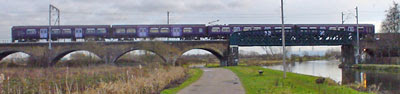
Sir AlliottVerdon-Roe was born in Manchester in 1877. He wasn't a Sir at the time, obviously, merely a merchant seaman with unseemly interest in model gliders. Alliott constructed his first biplane in a shed at the Brooklands racing circuit, powered by a two-cylinder motorbike engine, and on 8th June 1908 it flew a bit (maybe) watched by insufficient witnesses. Not good enough, so he packed his toolbag and relocated from Surrey to the Walthamstow Marshes. There's a low brick viaduct where the Stansted railway crosses the river Lea, and here Roe rented two of the arches - one to live in and one to build in. The Avro 1 triplane was the result, and on 13th July 1909 it managed a proper non-hop a few feet above the marshy grassland. With that singular 30-metre leap Roe became the first Briton to make a powered flight in an all British built aircraft. A glittering career in aeronautical engineering was to follow.
Yesterday afternoon a celebratorycentenaryevent was held on the grass outside AV's workshop arch. It's normally completely inaccessible, hidden away behind fences and shoulder-high undergrowth, but somebody had been very busy with strimmers and lawnmowers to ensure that we'd be able to get inside [photo]. Nothing to see except a big display board, but here was the space inside which Alliott assembled, tweaked (and repeatedly repaired) his prototype. A brand new blue plaque had been unveiled above the entrance to the arch by one of his descendants, presumably to balance out the original blue plaque bolted onto the opposite side by the GLC several decades ago. All this plus yet another new plaque on the side of the viaduct above the riverside footpath. Fourth arch in from the Lea - Roe's workshop is now unmissable.
A white marquee had been set up on the grass nearby, possibly on the spot from which AV took off, but probably not. Inside tea and cakes were on sale, and there were also several stalls from localhistoricalgroups. But most people weren't looking at those, they were looking at the plane. A proper replica of the Avro 1 triplane, no less, recently reconstructed by a team of volunteers at the Manchester Museum of Science and Industry. It had been trailered down from its usual resting place in the Air & Space Hall, and here it was at the scene of its greatest triumph. It seemed astonishing that anything so fragile could ever have lifted off the ground, let alone with a chirpy Edwardian pilot on board. Everybody clustered around for a good stare, taking particular interest in the engine, propeller and associated intricate bits. This made it nighimpossible to take a photograph of the complete plane unobstructed, but several people tried repeatedly nonetheless [half-decent photo]. There'll be a far better view once the triplane is back in the North West, but I doubt that many of the Walthamstow crowd visit Manchester too often.
A second marquee was pegged out alongside, inside which visitors could sit for a series of three half-hour presentations. First up was Eric Verdon-Roe, who read out an entertaining script about his grandfather's life and early flying experiences. A surprising number of black and white photographs illustrated the talk, fluttering on the screen as the digital projector hung from the ceiling swung gently in the wind. A famous shot from 1909 showed Alliott and his assistants setting up the triplane outside the arch ready for another pioneering flight. After Walthamstow he went on to establish Avro, one of the world's first aircraft builders, providing thousands of biplanes for a new aerial battleground during World War One. Sir Alliott moved on, but his company expanded to build Lancaster bombers for WW2 and even the legendary Vulcan. And it all started underneath the arches, down Walthamstow way. UK air travel's come a heck of a long way since.
I take a lot of photos. I stick a handful of them on Flickr. And yesterday afternoon, somewhere around 4pm, they were looked at for the millionth time. I'm very humbled.
Those are my five most interesting photos, according to Flickr's mysterious "interestingness" algorithm. I'm not quite sure what this proves, but I think it means that my viewers have good taste. Top of the pile are the seaforts at Shivering Sands in the Thames Estuary. I took 60 photos bobbing about in a speedboat, and posted six, but it's this particular one that seems to have captured the imagination. Then there's the fireworks at the London Eye for New Year 2006 (top of the list until last week), followed by the now-being-demolished platforms at Blackfriars. Number four is the very last Routemaster chugging through Piccadilly Circus, and the fifth is a gas storage tank in Canvey Island. Some I planned carefully, but most I just got lucky.
And those are the next five. That curvy one in the middle is my favourite. It's a meander on the River Cuckmere, snapped at the end of a long walk along the coast from Beachy Head, and discovering it was like being back on a school field trip. The photo's been published in a book, thanks to appearing on Flickr, and it's also being used by the BBC to help the nation's 16 year olds to revise for their Geography GCSEs. I am well chuffed. And it beats the old days where I'd have taken a photo, collected the prints from the local chemist and hidden the results away in an album. These days everyone's a communal photographer, and our images are available for almost instant consumption via a myriad of webpages, feeds, and streams.
I'm fortunate, being a blogger, that my photos get rather more exposure than they might do otherwise. I can write a sentence like "I was watching the sheep on London Bridge yesterday" and almost guarantee that 100 of you will be curious enough to click through and take a look. I can mention a new Flickr pic on Twitter and entice scores of you across to see what I'm talking about. I can even trick you into looking at something I know you're not interested in (look, it's a photograph of me), which rather demeans the photo statistics a bit. Even so, I'm honoured that every single one of my photos (bar one posted last week) has been viewed more than 50 times, even the shots I've never mentioned here.
A lot of my 1000000 views have come from people surfing in via search engines. For some reason a lot of Googlers are interested in what the Harrods Food Hall looks like, and the 80s council houses on the site where the Krays grew up, and the Hogwarts Quidditch lawn. But the majority of views are from you lot taking a look at somethingextra to illustrate a post of mine, which is immensely reassuring. Oh yes it's been quite a journey, from the ten-year old me taking dire photos with a cheap plastic instamatic to today's multi-megapixel online uploads. Thanks a million.
• Big Ben is the bell, not the clock (which is the Great Clock) nor the tower (which is the Clock Tower) (not St Stephen's Tower). • Officially Big Ben is called the Great Bell. • Big Ben first tolled the time on Monday 11th July 1859, which makes today its sesquicentenary.
• Big Ben is thought to be named after Sir Benjamin Hall, First Commissioner for Works 1855-1858, whose name is inscribed on the bell (or maybe after Benjamin Caunt the 17 stone Victorian boxer, nobody's quite sure). • The first Great Bell, cast near Stockton-on-Tees, cracked during testing at Westminster and had to be melted down. • It was recast at the Whitechapel Bell Foundry(yes, I've been) (yes, I've seen the mould they cast Big Ben from, that's it on the wall, top left, in this photo). Casting took place on Saturday 10th April 1858, and the molten metal took 20 days to cool down. • Big Ben weighs 13 tons 10 cwts 3 qtrs 15 lbs. It's 7½ feet high and is 9 feet in diameter. • Big Ben strikes an E (a note-able pub quiz fact, that) • Big Ben was so big that it had to be winched up the clock tower sideways, taking 30 hours to reach the top. • Big Ben cracked after two months use because its hammer was too heavy, and remained silent for four years. Rather than lug the cracked bell back down the tower and recast it again, the Astronomer Royal eventually came up with a better (cheaper) plan. The bell was rotated (through a quarter turn), a small square was cut out of the soundbow (to prevent the crack from spreading further) and a smaller hammer was installed (weighing 'only' 200kg). The crack gives Big Ben its distinctive (but less-than-perfect) tone.
• The clock's central mechanism is the world's first Double Three-Legged Gravity Escapement, invented especially for the Great Clock by Edmund Beckett Denison QC MP. It's still dead accurate. • Approximately two seconds before each hour a one ton strike weight is released, pulling a wire which rotates a barrel which operates a lever which pulls a second wire which causes the bell hammer to fall. • If you'd like to see how the Great Clock's mechanism works, there's a particularly fine animation here. • The clock's pendulum is 14 feet long and weighs 321kg. Adding or removing a penny to the top of the pendulum changes the clock's speed by 2/5 of a second per day.
• The clock's only serious breakdown was on 5th August 1976 when a speed regulator broke causing serious damage to the chiming mechanism. • The tune of the Westminster Chimes originated at the church of St Mary the Great in Cambridge. The chimes were composed in 1793 and are said to be based on the fifth bar of the aria "I know that my Redeemer liveth" from Handel's Messiah. • A verse inscribed on the wall of the clock room provides words for each quarter chime - "All through this hour, Lord be my guide, And by Thy power, No foot shall slide". • At 12 o'clock, the time from the first chime to the last is approximately 45 seconds. (You can watch Big Ben chiming twelve here)
• The Clock Tower is 11 storeys high. There are 334 steps up to the belfry. There is no lift. • Each clock face is made up of 312 pieces of opal glass. • Each dial is just over 7m in diameter, and is cleaned once every five years by abseilingtechnicians. • The tip of the minute hand travels approximately 190km each year. • Above the belfry, at the top of the tower, is the Ayrton light. This shines at night when either House is sitting, and is extinguished upon the House rising.
• There are tours of the clock tower on weekdays at 9.30am, 10.30am, 11.30am and 2.30pm. Only UK residents may visit, and you have to be aged over 10, and you must be fit enough to climb stairs, and the ascent's not recommended for those with vertigo, and you have to apply through your MP, and it's currently fully booked until October. • If you're 10, or unfit, or foreign, or just never likely to visit for yourself, there's a fantastic flash video tour here. (no, really, it's very good indeed)
For even more facts (and some of the same ones), you can celebrate Big Ben's 150th year on its official website here (or unofficial website here).
And now a message to East Londoners who travel on the District line a lot. Bad luck, it's buggered this weekend. There's no service between Whitechapel and Barking/Upney due to track replacement work, which means the reappearance of the rail replacement buses. They were out in force a few weeks ago, chugging out to Newham and beyond, and they'll be back again in equally scary numbers tomorrow. Slight problem - the District line crosses the Lea Valley at a point where there are no parallel roads, so the buses are taking some major twirly detours to get from one side to the other. "Journey times may be increased by up to 45 minutes." Oh joy.
But it's worse than that. The eastern end of the District line is buggered every single weekend for the next three months. It's our turn to suffer, like Londoners on the Jubilee line have been suffering for the last umpteen months. Not quite so relentless perhaps, but a lot of extra inconvenience attempting to get here, there and back again until at least the middle of autumn.
Here's a fuller list of District line weekend closures, according to the pdf list provided on the TfL website. If a stretch of line is marked in green it's open, if it's red/italic it's closed. And yes, if the District line's closed then the Hammersmith & City is too. There is no escape.
11/12 Jul
Tower Hill → W'chapel → Plaistow → Barking → Dag'm East → Upminster
18/19 Jul
Tower Hill → W'chapel → Plaistow → Barking → Dag'm East → Upminster
25/26 Jul
Tower Hill → W'chapel → Plaistow → Barking → Dag'm East → Upminster
1/2 Aug
Tower Hill → W'chapel → Plaistow → Barking → Dag'm East → Upminster
8/9 Aug
Tower Hill → W'chapel → Plaistow → Barking → Dag'm East → Upminster
15/16 Aug
Tower Hill → W'chapel → Plaistow → Barking → Dag'm East → Upminster
22/23 Aug
Tower Hill → W'chapel → Plaistow → Barking → Dag'm East → Upminster
29/31 Aug
Tower Hill → W'chapel → Plaistow → Barking → Dag'm East → Upminster
5/6 Sep
Tower Hill → W'chapel → Plaistow → Barking → Dag'm East → Upminster
12/13 Sep
Tower Hill → W'chapel → Plaistow → Barking → Dag'm East → Upminster
19/20 Sep
Tower Hill → W'chapel → Plaistow → Barking → Dag'm East → Upminster
26/27 Sep
Tower Hill → W'chapel → Plaistow → Barking → Dag'm East → Upminster
3/4 Oct
Tower Hill → W'chapel → Plaistow → Barking → Dag'm East → Upminster
10/11 Oct
Tower Hill → W'chapel → Plaistow → Barking → Dag'm East → Upminster
17/18 Oct
Tower Hill → W'chapel → Plaistow → Barking → Dag'm East → Upminster
It's the District line between Whitechapel and Barking that's going to suffer the most. My local station at Bow Road will be closed on nine out of the next eleven weekends. There'll be no interchange with the Central line at Mile End on those same nine weekends (and no trains through Mile End at all on Sunday 18th October). Further out there are nine imminent weekends with no District line service through West Ham (three of those with no Jubilee line either). There'll be no trains at Upton Park when West Ham play their first weekend home match of the season against Tottenham on 23rd August. There's no alternative escape route at Barking because the Overground's closed every weekend for the rest of the year. And there are fifteen consecutive weekends where it's impossible to get from Dagenham to Tower Hill on one train. Thank goodness for c2c services which should still speed passengers through with no delays whatsoever... so long as you actually live near one of their stations.
Yes, I know the work's essential and it's got to be carried out some time. And yes, I know those of you living elsewhere don't really care, because you rarely feel the need to nip from Stepney to Becontree or from Plaistow up to town. But for those of us out East it means added hassle and wasted time, wiping the shine off our weekends for weeks to come. You wait until they start on your local tube line for months at a time, see how you like it then. May there be plenty of rail replacement buses to go round.
Oh, and one bit of good news. I've been moaning for ages that TfL don't have a single page on their website listing all of the forthcoming weekend's engineering works and station closures. Turns out that they do, it's just that it's hidden and nothing links to it. So let me link to it for you. It's http://www.tfl.gov.uk/tfl/livetravelnews/realtime/tube/tube-all-weekend.html. Go on, bookmark it now, you may be glad you did.
14 June update: TfL have now released further details about track closures for the next few months, so I've updated the table above to take these into account. More track closed, not less, obviously.
You may not remember the last project to appear on the fourth plinth in Trafalgar Square. It was a red, yellow and blue glass sculpture resembling the floors of a building, entitled Model for a Hotel, and it was up there for a full 18 months. You can't fail to have noticed the latest project on the fourth plinth in Trafalgar Square. It's one person an hour, dumped on top of the stone platform by a JCB and left to do whatever they choose. It's One and Other. And I know which of the two projects I prefer.
I've been along to Trafalgar Square twice since Anthony Gormley's latest presentation began, and on both occasions I've got absolutely drenched. You might have seen me on the webcam, shirt dripping wet, looking up at the better-prepared umbrella-carrier on the plinth above. I bet they had visions of a delightful sunny summer's afternoon in the centre of London, but instead they got the windswept drowned rat option. That's the danger of agreeing to take part in a public-facing art raffle - you never quite know what weather you're going to get.
On my first visit I got to see Rupert, a "symbolic modeller" from Derby, standing in his three-quarter length trousers doing nothing much. I only discovered he was called Rupert when I got home, because there's no hour-by-hour schedule or scrolling Twitterfeed in the Square. His 60 minute slot was typical of one particular type of plinther - those that are up there for the experience. Rupert just wanted to soak up the atmosphere, while others have simply chosen to sit and sketch, or sit and read, or stand and stare. Great for them, but not so thrilling for the rest of us. "Is that all he's going to do?" asked one disappointed lady passer-by who'd paused to watch. Yes, that was all, and how selfish of us to expect to be entertained throughout. Not every piece of individualistic art has to be a performance.
On the opposite side of the square, closer to Nelson's lions, is a large green two-storey portakabin. This project doesn't run itself, and all the organisers, crew and technical boffins have to be housed nearby. This is also where the participants await their turn, and presumably where they get a jolly good rub-down with a dry towel afterwards. Every hour, on the hour, a yellow truck with an extendable platform scoops up the next volunteer, chugs across the piazza and raises them to plinth-top level to be exchanged. If you need something while you're up there, be it a placard, a cup of tea or a spare raincoat, better make sure you're carrying it with you when you go.
On my second visit I got to see Bobbie, a former headteacher and a Lancashire lass. She was being rather more interactive, having brought copious notes to read from, and peered down from on high through half-rimmed reading glasses. It was rather like being back in school assembly, but without the hymn singing and sports notices (and rather more interesting too). Bobbie was an example of the other category of plinther - those with a message to get across. Not all deliver it as eloquently as she, and not all use words. Some resort to actions (Tai Chi, anyone?) or costumes (did you see that man in a cow suit over breakfast) or blatant advertising (no, just no), whichever they think best tells the world why they're here.
One and Other is two very different experiences. For those watching in real life it's an unlikely intrusion into the everyday, high above and very real. It's also very difficult to hear a word the plinther is saying. Trafalgar Square's a fairly noisy spot, not least because of the nearby fountain, so better to make your point visually or to utilise some form of portable amplification. Meanwhile for those watching elsewhere via the webcam, microphones ensure that every mumbled platitude can be overheard. Viewers also get the opportunity to watch the crowd interacting with the action - some staring up intently, others walking by without even stopping to look. And everybody's hour will be archived for posterity, all 3-months-worth of them. Maybe online is the more complete experience.
Last night I sat at home and watched Fran, a doctor from the West Midlands. She arrived on the plinth with a blue holdall within which her entire 60 minutes was carefully plotted. First a Shelter t-shirt and a stand to hang it from, then an oversized pack of playing cards. She fought the wind to attempt to construct a house of cards, utilising a handy grabber when some blew over the edge into the netting. The online crowd was critical... "can't believe she didn't think of tape before building a playing card sculpture OUTSIDE. #oneandother" At which point Fran produced some tape from her bag and set about constructing a rather sturdier habitation - all planned, all part of the charitable allegory. Quite the best use of an on-plinth hour I've yet seen (but then I've not seen many).
There are more than 2300 on-plinth hours still to go. Some participants will give it everything they've got, others will be there solely for themselves. Some will make you cringe, others may draw you in. Some will get the nightmare pub-chucking-out slot and struggle against London's finest hecklers, others will be up there at dawn performing to two pigeons and a roadsweeper. One could even be you, because they haven't selected the participants for August to October yet. Being a Londoner is a distinct disadvantage here, there's far too many of us chasing our allocation of places, whereas Northern Irish souls are currently "almost guaranteed" a spot. You might even get allocated a time well after the rest of us have lost interest, weeks after we've all stopped watching, months after the Twitterbuzz has died down. But somehow I doubt it. I think this one will run and run. Hope the rain holds off for you.
Random borough: Wandsworth(mopping up) Blimey, there was far more in Wandsworth than I expected. I may have written too much about the place, but I omitted even more. Here are a few additional delights I didn't get round to mentioning.
• The De Morgan Centre: Ooh, now this was a gorgeous surprise. Housed in the old West Hill Reference Library above Wandsworth Town Centre, this tiny museumette holds the decorative artwork of a most talented Victorian couple. Husband William De Morgan was one of William Morris's Arts and Crafts collaborators, and was the most wonderful ceramicist. The museum holds cabinetsful of lustrous glazed dishes and brightly tiled panels, often decorated with something natural, fantastical or maritime. Wife Evelyn De Morgan was a pioneering artist, and her classical and allegorical paintings are interspersed between the pottery around the gallery walls. Lovely. Small, but lovely. Update (thanks Hedgie): The De Morgan Centre will be closing to the public on 25th July 2009. This is to prepare for the relocation of the collection to a new site, as yet to be confirmed. So hurry. • The Wandle Trail: There's nothing quite so Wandsworthy as a walk/cycle along the banks of the River Wandle. But I did that three years ago, with photos, so not this time. • Young's Ram Brewery: Opened in the 1500s in the heart of Wandsworth, closed in 2006, still looking pretty much intact at the moment, destinedto become some ghastly twin tower shopping/office complex. More butchery than brewery. • Clapham Junction: It's not in Clapham, it's in Battersea. It's not the busiest station in the world, passenger-wise, but it does see more trains than any other station in Europe. • The Putney Sculpture Trail: Nine life-size bronze sculptures by Alan Thornhill, along the banks of the Thames, either side of Putney Bridge. Here's Punch & Judy (entwined outside a bankrupt restaurant). • London Heliport: The only approved spot to land your chopper in the capital is on the banks of the Thames in Battersea. Beware Noel Edmonds. • Balham (gateway to the south): Listen to Peter Sellers' 1958 travelogue tribute to Bal-Ham here.
Somewhere historic: The Putney Debates In 1647, during a lull in the English Civil War, the New Model Army bedded down in Putney for a few months. Amongst other things their thoughts turned to representative democracy, like you do, and an unlikely series of debates took place. Should every soldier, every land owner or even every free citizen, have the right to vote? Did the King have a divine right, or should the people demand equality under the law? Pretty basic stuff today, but ideas unrehearsed at the time. A manifesto was put forward entitled The Case of the Armie Truly Stated, and the voice of the common man was put forward by a disparate pressure group called the Levellers.
Day 1 of the debates kicked off in St Mary's Church on the banks of the Thames. Arguments were heard for both sides under the chairmanship of Oliver Cromwell, and continued for a fortnight. In the end nothing really changed - a resurgence of the Civil War saw to that. But the Putney Debates have come to represent an early outbreak of modern constitutional thinking because of one lucky coincidence - their transcripts survived. The paperwork was uncovered in Worcester College Library in the 1890s, and the stenographer's shorthand eventually deciphered allowing historians to look back at the thoughts and arguments of an underclass whose thoughts were not normally heard. A new exhibition in St Mary's continues to tell their story today.
I made the mistake of attempting to enter the church via the west door. Wrong, this is a church you enter via the café. They're rightly proud of their newextension at St Mary's, paid for out of a bequest by two dear old parishioners called Olive and Nora, enabling the church to reach out into the community via the medium of frothy caffeine. Past the tables and comfy sofas, past the orders of service and parish notices, and into the main body of the church itself. OK, so this is no normal ancient church. It was badly damaged by an arson attack in 1973 and subsequently remodelled, so the interior feels more like a theatre in the round than a place of worship. There's a particularly fine view from the new gallery down onto the central dais, from which the rector holds forth every Sunday. You may have heard Giles on Thought For The Day, he's a forthright cheery progressive, and he leaves St Mary's this month to take up a new post at St Paul's Cathedral.
The Putney Debates exhibition is crammed into a tiny alcove close to the entrance. There are several fact-packed display boards to read, plus an hour's worth of video to watch. Don't worry, there's also a seat, because this could take some time. I pressed button 1 to hear more about Putney's constitutional legacy from various luminaries including Tony Benn, Lady Antonia Fraser and our Giles. I wasn't quite convinced that the debates lay the foundations for modern civil liberties, but as an early symbol of emerging democracy they remain unmatched. A quotation from a Roundhead army captain has been inscribed in gold on the south wall where you might expect to find a line from scripture. "I think that the poorest he that is in England hath a life to live, as the greatest he". How very apposite. And plenty to ponder over a caramel milkshake in the café on the way out. by tube: Putney Bridge
Somewhere pretty: The Alton Estate, Roehampton When the London County Council sought to rehouse ten thousand inner London slum dwellers in the late 1950s, their eyes alighted on what was then the westernmost tip of the capital. Beyond Roehampton Lane, in the parkland grounds of several former Georgian mansions, they plotted the construction of a vast council estate to the very latest architectural specifications.The Alton Estate was designed in two contrasting halves. Alton East was softly Modernist with a mixture of low- and high-rise housing, and nothing particularly extraordinary. But Alton West was built to a more Brutalist functional agenda, reflecting Le Corbusier's recent success in Marseille with l'Unitéd'Habitation. The first Alton residents loved it.
Alton West is spread across the banks of a wooded hollow beyond the edge of Richmond Park. Into this landscape were dropped zonal clusters of identikit habitation - cuboid apartment blocks, flat-roofed terraced maisonettes, even meandering rows of prefab bungalows. Each provides a distinct neighbourhood identity within the wider community, with a more rural feel the further west along Danebury Avenue you go.
Rising above them all, along the brow of the hill, are five imposing eleven-storey slab-blocks. They're aligned in parallel, staggered diagonally, each perched up on matchstalk pillars to provide residents with a grandstand view. Grade II* listed, obviously, although I'd be surprised if anyone from English Heritage would choose to live here.
The estate's got its problems. Stairwells and corridors have seen better days. The rolling grassland setting is ideal for a summer picnic (so long as you check carefully for dogmess before you sit down), but far less attractive on a dark winter's evening. The far end of Danebury Avenue is fairly remote, and residents wait expectantly at the central bus stop for carriage up to civilisation and beyond. The library, added as an afterthought in 1961, had to be squeezed in beneath an austere apartment block. And Wandsworth planners recently decided that the shopping parade and eastern flats need to be replaced by something more modern, more regenerative, less 'council'. Maybe a mistake. Alton will never be Arcadia, but this pioneering architectural experiment has laid down strong communal foundations. by bus: 170, 430 on film: Fahrenheit 451
Somewhere retail: The London Sewing Machine Museum When I mentioned the London Sewing Machine Museum in passing last week, little did I imagine I'd be walking through its hallowed portal over the weekend. The museum's only open for three hours a month, so the chances of ever finding myself in the vicinity were quite frankly minimal. But when eleven-to-one shot Wandsworth emerged from my random jamjar on the first Saturday of the month, I decided I had to visit. It took two attempts to get inside because the website doesn't reveal any precise opening times (two til five, as it turned out). But I'm so glad I made the effort, because the experience was unforgettable.
To Tooting Bec station, then a brief stroll north along the Balham High Road. There are two large sewing-machine related buildings to pick from (I know, what are the chances?) but ignore the Sewing and Craft Superstore at number 300. You want the premises of the Wimbledon Sewing Machine Company Limited at 312, a very ordinary-looking two-storey block industrial block [photo]. The ground floor houses the workshop, still very much a going concern, with scores of tabletop machines laid out amid shelves piled high with thread and spare parts [photo]. The working week ends Saturday lunchtime, and once a month manager Ray hangs around afterwards to welcome visitors to his upstairs collection. It's a whopper.
Even in the downstairs lobby there's a strong hint that somebody around here is obsessed with sewing machines. A variety of old machines and assorted ephemera litter the floor, balcony and stairwell, each lovingly presented. An antique industrial machine spooled-up and ready to sew, a metal advertising panel for the French branch of Singer, even a 1981 receipt for spaceprobe insulation. Climb higher, because you ain't seen nothing yet.
On the first floor I entered a room filled with more sewing machines than I'd ever seen in my life [photo]. Shelf after shelf, with more laid out on tables across the floor, every space filled, every machine dutifully labelled. This room's home to the more workaday machines, mostly black, once commonplace in homes and factories across the country. Before all our clothes arrived via imported sweatshops, Britons were clothed only thanks to these machines and the skill of their operators. I looked in vain for the precise model my Mum used to own, although the Silko reels and coffin-top carrying cases seemed eminently familiar. A brief video in the far corner told the story of the museum, information which was also detailed in a 13-page stapled handout freely available to take away.
One of the curators wandered over for a chat - friendly but intense - and his devotion to the cause shone through. Much of the collection has been sourced from closed-down businesses and household clearouts, and it was clear that the loss of even a single chucked-away machine hurt him deeply. He directed me through to the second room at the rear (ohmigod, a second room) where the antique machines were housed (blimey, hundreds more). Glass cases this time, in front of plush curtained walls to emphasise the rarity of their contents. Many of these were delicate machines for delicate Victorian ladies, the highlight being one especially ornate Wheeler & Wilson device given to Queen Victoria's eldest daughter as a wedding present [photo]. Members of the International Sewing Machine Collectors' Society would be so overwhelmed they'd need several visits to take everything on board.
The collection has breadth and diversity - it's not all sewing machines. Threads and needles and pattern books, obviously, plus a delightful wind-up marionette merrily sewing away beneath a glass belljar. One corner has been given over to recreating Ray's dad's sewing machine shop along the Merton Road, a poignant display of labelled merchandise from an era I can almost remember myself [photo]. There are antique clocks too, plus a proper barrel organ that plays music hall tunes which the curator willingly demonstrated to the watching crowds. Not terribly large crowds, admittedly, but the Australian trio and myself were duly appreciative.
I learnt several things during my hour in the museum. Firstly not to take my clothes for granted - somebody somewhere sweated to put all those seams in my trousers, and my great-grandparents would have thought nothing of doing it themselves. Secondly that anything can be made interesting if presented with sufficient love and flair - even a floorful of domestic appliances. Thirdly that the museum's owners are enormously generous of their time and resources - admission is free, but owner Ray still popped in with a tray of chilled wine glasses mid-way through the afternoon. And finally that you really ought to visit, especially if handicrafts, technology or the quirkier side of London float your boat. 2pm, Saturday 1st August - start forming the queue now. by tube: Tooting Bec by bus: 155, 249, 355
Somewhere sporty: Tooting Bec Lido Perfect day for it. A dip in Britain's largest freshwater swimming pool, all one million gallons of it, was packing them in on Saturday at the eastern end of Tooting Bec Common. Opened as the Tooting Bathing Lake in 1906, this outdoor pool evolved into a lido in the Thirties and is a notable survivor of Wandsworth council's relentless cutbacks. The public are allowed in between May and September, while the South London Swimming Club have exclusive access during the often-freezing winter months. One 100 yard-longswimming pool, one much smaller paddling pool, a café and a bit of grass for sunbathing on - these are simple pleasures. Not that I was getting inside for a look. The lido's deliberately screened behind an earth bank and various rows of trees, so that snooping is pretty much impossible. Turnstiles bar the way at the entrance, as well as a sulky guard, and on Saturday morning additional security was being called in to cope with the burgeoning crowds. Alas I hadn't brought a towel or my trunks (do swimmers still wear trunks or is everything baggy Speedos these days, I wouldn't know), so getting inside would have been pointless. All I could see through the gap was the bright blue shallow end and a gushing weddingcakefountain. A walk around the perimeter proved difficult, not least because the lido was built right up close to the East Croydon mainline. But I did eventually catch sight of a few of the Lido's trademark primary-colouredchanging booths through the trees, across the railway. Sorry, I wasn't attempting too look like a pervy stalker lurking in the undergrowth. But why should swimmers have all the fun? by train: Streatham by bus: 249, 319
Wandsworth is in southwest London, close enough in parts to feel distinctly metropolitan, far enough in others to be proper suburbia. Much of its Thames-side fringe has recently been overtaken by a string of vulgar apartment blocks, whereas the interior is generally of solid Victorian stock. Wandsworth's also renowned for its extremely low council tax, usually amongst the very lowest in the country, which is one reason why the borough museum closed a few years back. Frugality might also explain why the council's website was bugger-all help in planning my whistlestop tour around the borough yesterday. But I found plenty of interest all the same.
Somewhere famous: Battersea/Nine Elms Several of the things for which Battersea is famous aren't necessarily in Battersea proper. They're in Nine Elms, a dreary slice of industrial riverside named after a line of trees (what else?). To investigate I took a walk along sun-baked Nine Elms Lane, starting at the edge of the borough just beyond Vauxhall. Some of the places I passed are famous, some could have been, and one will be. And hurrah, there were even kittens.
New Covent Garden Flower Market: To enable Covent Garden to become a central London tourist trap, all the flowersellers had to move out. And its to Nine Elms that they fled, to a new 1970s market building blessed with chilled air conditioning and an isometric roof. The site had previously been a locomotive works, but go back even further and it was almost one of the most important stations in London. In 1838 the services of the London & Southampton Railway terminated here, and passengers had to continue into the centre of town by boat or road. Damned inconvenient, so the company extended their tracks to a new inner terminus and shut Nine Elms down. You've probably heard of Waterloo station, it's quite busy these days.
The US Embassy: Ah, this hasn't arrived yet. But Uncle Sam's new home is at the planning stage already, and everyone should eventually be moving out of Grosvenor Square to this unassuming Wandsworth location. It's a seemingly odd choice. At the moment the chosen spot is part of a relatively inaccessible industrial estate that's seen far better days. There are several anonymous warehouses, and a Bentley dealership, and an imposing 80s office block now boarded up with weeds growing across an extensive courtyard. My photo shows Ponton Road, which is to be diverted so that the new embassy building can be built slap bang across its former carriageway. Current plans feature "consular pavilions", "earth sculptures" and "public art opportunities", but expect an expensive hi-tech fortress within which visas will be denied and potential immigrants will be belitted. Happy future Independence Day.
Battersea Power Station: A 1930s coal-fired shouldn't gladden the heart but, even in its derelict state, this towering workhorse still has a special place in Londoners' hearts. It must be the chimneys, visible for miles around, and still mighty impressive from almost-up-close. Sir Giles Gilbert Scott's templeof power generated mega-megawatts for London before the off switch was finally flicked in 1983. Proposals for the building's rebirth have been many - a theme park, offices, a shopping mall - but planning dissent and failed funding have left the building roofless and decaying. The latest residential plan even selfishly suggests a short spur off the Northern line to serve tenants and shoppers, and bugger anyone living further west in Wandsworth or Battersea proper. Most worrying is the idea that the chimneys are in a precarious state and may have to be replaced, because I'd have no faith that once demolished they'd ever be rebuilt. Instead I cherish my memories of a tour of the interior in 2006 for a Chinese art exhibition, and I fear I may never get the opportunity again.
Battersea Dogs Home: And Cats, these days, before anyone adds a comment to correct me. The nation's favourite pet dispensary moved to Battersea in 1871, at which time it was known as The Temporary Home for Lost and Starving Dogs. Its operations have expanded somewhat since, and the Battersea site now includes kennels for nearly 300 dogs and even a suite of "Cat Socialising Rooms". The current building resembles a cross between a small prison and a Travelodge, but is (one suspects) slightly more comfortable inside. Passers-by along Battersea Park Road are still met by the unmistakable sound of hopeful barking attempting to tempt them inside. Late afternoon I watched as a smiling family emerged into the sunlight with a new addition, the lady of the house clutching a fragile puppy in her arms. Once across the road and into the car, a new home beckoned. Buster, Pippin and Beetroot still await their happy ending.
Battersea Park: And finally, one of London's very finest parks. It's blessed by a riverside location, and it's huge, and yesterday it was the perfect spot for thousands of Wandsworthians to strip down and toast their flesh. Unlike many other London parks, it's hard to get bored here. Take a look inside the Pump House Art Gallery, go for a pedal around the boating lake, or maybe potter around the children's zoo. My choices included watching the sun glinting on the 25-year-old PeacePagoda, going for a wander along the Tea Terrace, and enjoying a bit of cooling spray around the central fountains. Back in 1951 these synchronised gushers were a centrepiece of the park's contribution to the Festival of Britain, advertised as the "Festival Gardens" and boasting a large number of whimsical attractions. Most were swiftly withdrawn afterwards, but the Battersea funfair survived into the 1970s until doomed by a fatal Big Dipper accident. Traces of past glories remain, but these days the park's simpler pleasures are perfectly attractive.
Somewhere infamous: Wandsworth Prison The second biggest prison in the UK (after Liverpool, if you must know) is tucked away inside a pocket of suburbia to the southeast of Wandsworth town centre. The prison opened in 1851 as The Surrey House of Correction, arranged radiallly with six cellblock wings that still house prisoners to this day. In total 135 inmates have experienced irreversible 'correction' at Wandsworth, most of these on the gallows located in "The Cold Meat Shed". Many renowned miscreants have spent time within the prison's walls, including Oscar Wilde, Charles Bronson and Pete Docherty, although most inmates are only here before being packed off to somewhere else. One convict who refused to hang around was train robber Ronnie Biggs, who escaped from the exercise yard in an audacious breakout in 1965 and rapidly swapped South London for South America.
From the front in Heathfield Road the prison looks more like a Victorian brick castle, complete with turrets and central portcullis. The facade is brightened up by an unfeasibly high number of blooming flowers in black boxes, no doubt planted (but not watered) by the prisoners inside. Even the security cameras are bedecked by colourful hanging baskets, as if to soften up the reality of what goes on inside. If you're visiting a prisoner, entrance is up a small staircase to the left, whereas staff enter via a separate set of steps to the right of the cycle racks. There's also a (very) small museum, officially opened last year inside what looks like an old shed up the road. Entrance is by appointment only, so I wasn't able to look inside, but you might be more tenacious. Just be careful where you leave your car - a sign in the staff car park warns "no parking against wall after 5:30pm". They'll try anything to get out of Wandsworth, some people. by train: Wandsworth Common, Earlsfield by bus: 77, 219

Is that the sound of rain I can hear? Damn.
St Swithun's day if thou dost rainBecause if it rains today it's due to rain every day until August 24th. And we'll have a Dark Ages bishop to blame. Perhaps. (anniversary: )Visitors to Winchester Cathedral can still see St Swithun's shrine to this day. Or rather they can see a modern replica based on what the final version probably looked like before it was destroyed (in 1538). It's not in the original location, either. The old Minster was knocked down in 1093, and Swithun's remains had to be moved (again) into its new-build Norman neighbour. This time no stormy tempests ensued, but his legend grew all the same. The cathedral's retroquire (the paved area behind the High Altar) had to be extended in the 13th century to accommodate the number of spiritual tourists heading Wessex-ward, and a tiny arched gateway was provided so that pilgrims could crawl into a space beneath the saintly relics. Squeezing into Swithun's Holy Hole is, alas, no longer encouraged. (on-site visit: )
But to get 40 consecutive days of rain, that's really something. Even if the probability of rain on any particular day were as high as 95%, and even if we were only interested in a fortnight, then there'd only be a (0.95 × 0.95 × 0.95 × 0.95 × 0.95 × 0.95 × 0.95 × 0.95 × 0.95 × 0.95 × 0.95 × 0.95 × 0.95 × 0.95 = 0.49) fifty-fifty chance of a complete washout. In fact the probability of a rainy summer's day in the north Hampshire area is rather smaller than that - much closer to one third. And the probability of 40 consecutive days being wet (0.33 × ... × 0.33) works out at less than one in 12 million million million. It's never going to happen. (mathematics: )
I missed the call to action. I'm not on Facebook, and I don't spend the day glued to entertainment newsfeeds, so I never saw the invite. I was therefore surprised, on arrival, to discover a rather large crowd milling around in Peninsula Square. They were massing by the makeshift Jackson shrine, over in the corner by the big spike, beneath a videoscreen showing a sequence of images of the dead singer. Not enough to start a revolution, but several hundred all the same.
One girl had brought a single red rose wrapped in petrol station cellophane, which she laid respectfully within the fenced-off tribute zone. Others added their comments in marker pen to the wall of whiteboards behind - "King of Pop Forever", "This girl is yours", "Micheal We Luv U", "Thank you for making me want to dance". There was no intense grief on display, more a feeling of muted celebration, and nothing especially emotional or coherent either [see Darryl's report here]. I was surprised to see how many of the crowd appeared far too young to remember Michael Jackson in his heyday. Most would still have been at infant school the last time he had a number 1 record, although there were a fair few older souls and parents dotted about who'd probably moonwalked back in the day and bought Thriller on vinyl.
Yesterday afternoon a celebratory centenary event was held on the grass outside AV's workshop arch. It's normally completely inaccessible, hidden away behind fences and shoulder-high undergrowth, but somebody had been very busy with strimmers and lawnmowers to ensure that we'd be able to get inside [photo]. Nothing to see except a big display board, but here was the space inside which Alliott assembled, tweaked (and repeatedly repaired) his prototype. A brand new blue plaque had been unveiled above the entrance to the arch by one of his descendants, presumably to balance out the original blue plaque bolted onto the opposite side by the GLC several decades ago. All this plus yet another new plaque on the side of the viaduct above the riverside footpath. Fourth arch in from the Lea - Roe's workshop is now unmissable.
A white marquee had been set up on the grass nearby, possibly on the spot from which AV took off, but probably not. Inside tea and cakes were on sale, and there were also several stalls from local historical groups. But most people weren't looking at those, they were looking at the plane. A proper replica of the Avro 1 triplane, no less, recently reconstructed by a team of volunteers at the Manchester Museum of Science and Industry. It had been trailered down from its usual resting place in the Air & Space Hall, and here it was at the scene of its greatest triumph. It seemed astonishing that anything so fragile could ever have lifted off the ground, let alone with a chirpy Edwardian pilot on board. Everybody clustered around for a good stare, taking particular interest in the engine, propeller and associated intricate bits. This made it nigh impossible to take a photograph of the complete plane unobstructed, but several people tried repeatedly nonetheless [half-decent photo]. There'll be a far better view once the triplane is back in the North West, but I doubt that many of the Walthamstow crowd visit Manchester too often.
• Big Ben is thought to be named after Sir Benjamin Hall, First Commissioner for Works 1855-1858, whose name is inscribed on the bell (or maybe after Benjamin Caunt the 17 stone Victorian boxer, nobody's quite sure).
• The clock's central mechanism is the world's first Double Three-Legged Gravity Escapement, invented especially for the Great Clock by Edmund Beckett Denison QC MP. It's still dead accurate.
• The Clock Tower is 11 storeys high. There are 334 steps up to the belfry. There is no lift.
And now a message to East Londoners who travel on the District line a lot. Bad luck, it's buggered this weekend. There's no service between Whitechapel and Barking/Upney due to track replacement work, which means the reappearance of the rail replacement buses. They were out in force a few weeks ago, chugging out to Newham and beyond, and they'll be back again in equally scary numbers tomorrow. Slight problem - the District line crosses the Lea Valley at a point where there are no parallel roads, so the buses are taking some major twirly detours to get from one side to the other. "Journey times may be increased by up to 45 minutes." Oh joy.
On my first visit I got to see Rupert, a "symbolic modeller" from Derby, standing in his three-quarter length trousers doing nothing much. I only discovered he was called Rupert when I got home, because there's no hour-by-hour schedule or scrolling Twitterfeed in the Square. His 60 minute slot was typical of one particular type of plinther - those that are up there for the experience. Rupert just wanted to soak up the atmosphere, while others have simply chosen to sit and sketch, or sit and read, or stand and stare. Great for them, but not so thrilling for the rest of us. "Is that all he's going to do?" asked one disappointed lady passer-by who'd paused to watch. Yes, that was all, and how selfish of us to expect to be entertained throughout. Not every piece of individualistic art has to be a performance.
On my second visit I got to see Bobbie, a former headteacher and a Lancashire lass. She was being rather more interactive, having brought copious notes to read from, and peered down from on high through half-rimmed reading glasses. It was rather like being back in school assembly, but without the hymn singing and sports notices (and rather more interesting too). Bobbie was an example of the other category of plinther - those with a message to get across. Not all deliver it as eloquently as she, and not all use words. Some resort to actions (Tai Chi, anyone?) or costumes (did you see that man in a cow suit over breakfast) or blatant advertising (no, just no), whichever they think best tells the world why they're here.
Last night I sat at home and watched Fran, a doctor from the West Midlands. She arrived on the plinth with a blue holdall within which her entire 60 minutes was carefully plotted. First a Shelter t-shirt and a stand to hang it from, then an oversized pack of playing cards. She fought the wind to attempt to construct a house of cards, utilising a handy grabber when some blew over the edge into the netting. The online crowd was critical... "can't believe she didn't think of tape before building a playing card sculpture OUTSIDE. #oneandother" At which point Fran produced some tape from her bag and set about constructing a rather sturdier habitation - all planned, all part of the charitable allegory. Quite the best use of an on-plinth hour I've yet seen (but then I've not seen many).
2400 people on a plinth.
• The De Morgan Centre: Ooh, now this was a gorgeous surprise. Housed in the old West Hill Reference Library above Wandsworth Town Centre, this tiny museumette holds the decorative artwork of a most talented Victorian couple. Husband William De Morgan was one of William Morris's Arts and Crafts collaborators, and was the most wonderful ceramicist. The museum holds cabinetsful of lustrous glazed dishes and brightly tiled panels, often decorated with something natural, fantastical or maritime. Wife Evelyn De Morgan was a pioneering artist, and her classical and allegorical paintings are interspersed between the pottery around the gallery walls. Lovely. Small, but lovely.
In 1647, during a lull in the English Civil War, the New Model Army bedded down in Putney for a few months. Amongst other things their thoughts turned to representative democracy, like you do, and an unlikely series of debates took place. Should every soldier, every land owner or even every free citizen, have the right to vote? Did the King have a divine right, or should the people demand equality under the law? Pretty basic stuff today, but ideas unrehearsed at the time. A manifesto was put forward entitled The Case of the Armie Truly Stated, and the voice of the common man was put forward by a disparate pressure group called the Levellers.
The Putney Debates exhibition is crammed into a tiny alcove close to the entrance. There are several fact-packed display boards to read, plus an hour's worth of video to watch. Don't worry, there's also a seat, because this could take some time. I pressed button 1 to hear more about Putney's constitutional legacy from various luminaries including Tony Benn, Lady Antonia Fraser and our Giles. I wasn't quite convinced that the debates lay the foundations for modern civil liberties, but as an early symbol of emerging democracy they remain unmatched. A quotation from a Roundhead army captain has been inscribed in gold on the south wall where you might expect to find a line from scripture. "I think that the poorest he that is in England hath a life to live, as the greatest he". How very apposite. And plenty to ponder over a caramel milkshake in the café on the way out.
When the London County Council sought to rehouse ten thousand inner London slum dwellers in the late 1950s, their eyes alighted on what was then the westernmost tip of the capital. Beyond Roehampton Lane, in the parkland grounds of several former Georgian mansions, they plotted the construction of a vast council estate to the very latest architectural specifications.The Alton Estate was designed in two contrasting halves. Alton East was softly Modernist with a mixture of low- and high-rise housing, and nothing particularly extraordinary. But Alton West was built to a more Brutalist functional agenda, reflecting Le Corbusier's recent success in Marseille with l'Unité d'Habitation. The first Alton residents loved it.
Rising above them all, along the brow of the hill, are five imposing eleven-storey slab-blocks. They're aligned in parallel, staggered diagonally, each perched up on matchstalk pillars to provide residents with a grandstand view. Grade II* listed, obviously, although I'd be surprised if anyone from English Heritage would choose to live here.
When I mentioned the London Sewing Machine Museum in passing last week, little did I imagine I'd be walking through its hallowed portal over the weekend. The museum's only open for three hours a month, so the chances of ever finding myself in the vicinity were quite frankly minimal. But when eleven-to-one shot Wandsworth emerged from my random jamjar on the first Saturday of the month, I decided I had to visit. It took two attempts to get inside because the website doesn't reveal any precise opening times (two til five, as it turned out). But I'm so glad I made the effort, because the experience was unforgettable.
On the first floor I entered a room filled with more sewing machines than I'd ever seen in my life [photo]. Shelf after shelf, with more laid out on tables across the floor, every space filled, every machine dutifully labelled. This room's home to the more workaday machines, mostly black, once commonplace in homes and factories across the country. Before all our clothes arrived via imported sweatshops, Britons were clothed only thanks to these machines and the skill of their operators. I looked in vain for the precise model my Mum used to own, although the Silko reels and coffin-top carrying cases seemed eminently familiar. A brief video in the far corner told the story of the museum, information which was also detailed in a 13-page stapled handout freely available to take away.
The collection has breadth and diversity - it's not all sewing machines. Threads and needles and pattern books, obviously, plus a delightful wind-up marionette merrily sewing away beneath a glass belljar. One corner has been given over to recreating Ray's dad's sewing machine shop along the Merton Road, a poignant display of labelled merchandise from an era I can almost remember myself [photo]. There are antique clocks too, plus a proper barrel organ that plays music hall tunes which the curator willingly demonstrated to the watching crowds. Not terribly large crowds, admittedly, but the Australian trio and myself were duly appreciative.
Perfect day for it. A dip in Britain's largest freshwater swimming pool, all one million gallons of it, was packing them in on Saturday at the eastern end of Tooting Bec Common. Opened as the Tooting Bathing Lake in 1906, this outdoor pool evolved into a lido in the Thirties and is a notable survivor of Wandsworth council's relentless cutbacks. The public are allowed in between May and September, while the South London Swimming Club have exclusive access during the often-freezing winter months. One 100 yard-long swimming pool, one much smaller paddling pool, a café and a bit of grass for sunbathing on - these are simple pleasures. Not that I was getting inside for a look. The lido's deliberately screened behind an earth bank and various rows of trees, so that snooping is pretty much impossible. Turnstiles bar the way at the entrance, as well as a sulky guard, and on Saturday morning additional security was being called in to cope with the burgeoning crowds. Alas I hadn't brought a towel or my trunks (do swimmers still wear trunks or is everything baggy Speedos these days, I wouldn't know), so getting inside would have been pointless. All I could see through the gap was the bright blue shallow end and a gushing weddingcake fountain. A walk around the perimeter proved difficult, not least because the lido was built right up close to the East Croydon mainline. But I did eventually catch sight of a few of the Lido's trademark primary-coloured changing booths through the trees, across the railway. Sorry, I wasn't attempting too look like a pervy stalker lurking in the undergrowth. But why should swimmers have all the fun?
Wandsworth is in southwest London, close enough in parts to feel distinctly metropolitan, far enough in others to be proper suburbia. Much of its Thames-side fringe has recently been overtaken by a string of vulgar apartment blocks, whereas the interior is generally of solid Victorian stock. Wandsworth's also renowned for its extremely low council tax, usually amongst the very lowest in the country, which is one reason why the borough museum closed a few years back. Frugality might also explain why the council's website was bugger-all help in planning my whistlestop tour around the borough yesterday. But I found plenty of interest all the same.
New Covent Garden Flower Market: To enable Covent Garden to become a central London tourist trap, all the flowersellers had to move out. And its to Nine Elms that they fled, to a new 1970s market building blessed with chilled air conditioning and an isometric roof. The site had previously been a locomotive works, but go back even further and it was almost one of the most important stations in London. In 1838 the services of the London & Southampton Railway terminated here, and passengers had to continue into the centre of town by boat or road. Damned inconvenient, so the company extended their tracks to a new inner terminus and shut Nine Elms down. You've probably heard of Waterloo station, it's quite busy these days.
The US Embassy: Ah, this hasn't arrived yet. But Uncle Sam's new home is at the planning stage already, and everyone should eventually be moving out of Grosvenor Square to this unassuming Wandsworth location. It's a seemingly odd choice. At the moment the chosen spot is part of a relatively inaccessible industrial estate that's seen far better days. There are several anonymous warehouses, and a Bentley dealership, and an imposing 80s office block now boarded up with weeds growing across an extensive courtyard. My photo shows Ponton Road, which is to be diverted so that the new embassy building can be built slap bang across its former carriageway. Current plans feature "consular pavilions", "earth sculptures" and "public art opportunities", but expect an expensive hi-tech fortress within which visas will be denied and potential immigrants will be belitted. Happy future Independence Day.
Battersea Power Station: A 1930s coal-fired shouldn't gladden the heart but, even in its derelict state, this towering workhorse still has a special place in Londoners' hearts. It must be the chimneys, visible for miles around, and still mighty impressive from almost-up-close. Sir Giles Gilbert Scott's temple of power generated mega-megawatts for London before the off switch was finally flicked in 1983. Proposals for the building's rebirth have been many - a theme park, offices, a shopping mall - but planning dissent and failed funding have left the building roofless and decaying. The latest residential plan even selfishly suggests a short spur off the Northern line to serve tenants and shoppers, and bugger anyone living further west in Wandsworth or Battersea proper. Most worrying is the idea that the chimneys are in a precarious state and may have to be replaced, because I'd have no faith that once demolished they'd ever be rebuilt. Instead I cherish my memories of a tour of the interior in 2006 for a Chinese art exhibition, and I fear I may never get the opportunity again.
Battersea Dogs Home: And Cats, these days, before anyone adds a comment to correct me. The nation's favourite pet dispensary moved to Battersea in 1871, at which time it was known as The Temporary Home for Lost and Starving Dogs. Its operations have expanded somewhat since, and the Battersea site now includes kennels for nearly 300 dogs and even a suite of "Cat Socialising Rooms". The current building resembles a cross between a small prison and a Travelodge, but is (one suspects) slightly more comfortable inside. Passers-by along Battersea Park Road are still met by the unmistakable sound of hopeful barking attempting to tempt them inside. Late afternoon I watched as a smiling family emerged into the sunlight with a new addition, the lady of the house clutching a fragile puppy in her arms. Once across the road and into the car, a new home beckoned. Buster, Pippin and Beetroot still await their happy ending.
Battersea Park: And finally, one of London's very finest parks. It's blessed by a riverside location, and it's huge, and yesterday it was the perfect spot for thousands of Wandsworthians to strip down and toast their flesh. Unlike many other London parks, it's hard to get bored here. Take a look inside the Pump House Art Gallery, go for a pedal around the boating lake, or maybe potter around the children's zoo. My choices included watching the sun glinting on the 25-year-old Peace Pagoda, going for a wander along the Tea Terrace, and enjoying a bit of cooling spray around the central fountains. Back in 1951 these synchronised gushers were a centrepiece of the park's contribution to the Festival of Britain, advertised as the "Festival Gardens" and boasting a large number of whimsical attractions. Most were swiftly withdrawn afterwards, but the Battersea funfair survived into the 1970s until doomed by a fatal Big Dipper accident. Traces of past glories remain, but these days the park's simpler pleasures are perfectly attractive.
The second biggest prison in the UK (after Liverpool, if you must know) is tucked away inside a pocket of suburbia to the southeast of Wandsworth town centre. The prison opened in 1851 as The Surrey House of Correction, arranged radiallly with six cellblock wings that still house prisoners to this day. In total 135 inmates have experienced irreversible 'correction' at Wandsworth, most of these on the gallows located in "The Cold Meat Shed". Many renowned miscreants have spent time within the prison's walls, including Oscar Wilde, Charles Bronson and Pete Docherty, although most inmates are only here before being packed off to somewhere else. One convict who refused to hang around was train robber Ronnie Biggs, who escaped from the exercise yard in an audacious breakout in 1965 and rapidly swapped South London for South America.