Yesterday I set out from Mill Hill East along a railway line that's no longer there. It used to run to Edgware via the heart of Mill Hill, but plans to turn it into a tube line floundered. A few freight trains shuttled up and down, but in 1964 the line closed and now it's possible to walk along much of it. But only about half of it. As a potential transport link this line is dead and buried. As we're about to see.
The first mile from MHE, a pleasant woodland walk, continues a little further past the arenas of Copthall. Leaves are slowly browning, nuts are falling, and squirrels are still the busiest creatures hereabouts. But up ahead very soon is a gate, and a road, and a tunnel. It's not an original railway tunnel, the circular cross section is too narrow even for a tube train. What it is is a subway, a means of crossing under Page Street, installed by town planners for the non-existent hordes passing along this footpath. Eventually this tube became an unsavoury damp hideaway beneath the road and some council employee came along and shut it off. On the western side at present you'll find crisp packets and a discarded printer. But cross the road (up top, it's easy) and descend past the 'Subway closed' sign and, ooh, the opposite door is open. Peer inside to spot a pair of fetid shoes and what might be other belongings, suggesting a shelter of last resort for one Mill Hill resident. A housing estate has arisen here, with flats swarming along minor cul-de-sacs, and a later infill of more flats along the precise line of the railway. The street signs are labelled 'Private Development', so there's no point in entering because there's no longer anything to follow.
So yes, in the absence of disused railway track we get to follow a nearby road instead. It's Bunn's Lane, initially a residential road, whose most interesting feature is probably its name. That or the two major roads which career across it halfway down, the first the A1 'Watford Way', the second the M1. Metal steps lead up to pavements on either side of the A-road dual carriageway, should anyone want to walk this way, although I saw no evidence. What I did see was an overgrown road running underneath, one lane wide, and assumed perhaps it might be the old railway. And so it was, up until 1964 when it was converted into an entirely different form of transport. This was an old M1-to-A1 slip road, originally the southern end of the motorway until the current terminus at Staples Corner was opened in 1977. If you were trespass-minded you could easily hop through or over a fence and explore further. I walked on instead towards the parallel M1 overpass, a tediously featureless construction, at some point crossing the path of the old railway inbetween. It's not a lovely spot, this, but some speculator has it earmarked for flats, because even a noisy polluted scrap of wasteland can be home one day.
Bunn's Lane continues north towards Mill Hill Broadway station, somewhere you might know. Along the way it crosses an entirely unnecessary bridge, which is a telltale sign that the original east/west railway ran underneath. Indeed there was a station down below, with the none-too-snappy title of Mill Hill (The Hale), which would have been a familiar name on the tube map if only the Northern Heights plan had come to fruition. Nowadays a line of car parking spaces and several more flats fill the space, which'd mean umpteen evictions if anyone ever planned to recreate the railway. But that's pretty much the final residential blockage. Cross into Lyndhurst Park and you can step off the path into the undergrowth to see some bricked up railway bridge arches. The entire northern edge of the park is the old railway trackbed, but you'd only notice if you deliberately walked into the trees and spotted some old posts. This is proper urban safari stuff, a 1000-foot strip of untended land that's all mounds and thickets and groundcover and discarded cans and adventure. I can well imagine if you're a local pre-teenager this being your secret woodland hideout (or if a little older your drinking den), and all within convenient stepping distance of the park proper should Mum and Dad call out. Passing through felt like exploring uncharted territory, so this was my favourite bit of the entire walk.
Very well hidden in the northwest corner of the park, really very well hidden indeed, is a locked gate. This is one entrance to the Mill Hill Old Railway Local Nature Reserve, a linear enclave owned by the London Wildlife Trust. They've preserved the line of the old railway for half a mile ahead, a pleasant green footpath sandwiched between the backs of houses, occasionally opening out to broader spaces. But yes, a locked gate, which a notice announced was only unlocked every Sunday between 10am and 3pm. I'd gone on the wrong day, which was sad, so I made a superhuman effort to return to the same part of the back of beyond the following Sunday to gain access. Damn, still locked. OK, so it was chucking down with rain so no sane naturalist would have been out hunting slow-worms, waxwings and saxifrage. And OK, maybe the keyholder had slept in, or was ill, or was on holiday or something. But when a sign says "Open every Sunday" and you come bang in the middle of the appointed time and it's shut, that's a huge disappointment.
Instead I had to divert through the roads of Burnt Oak, which wasn't quite the same. The WatlingEstate was a grand London County Council project of the 1920s to rehouse inner city dwellers, my great grandmother included. The area now sees taxi drivers and Asian pensioners living side by side, all part of the capital's generally unseen suburban hinterland. My detour included a stretch along the landscaped Burnt Oak Brook, gushing with rainfall runoff, then some more ordinary residential streets to, yes, another locked gate at the other end. It's easy to see where the railway went next - along a road that's now the entrance to a Northern line facility. "Tube Lines Welcomes You To Edgware Track Depot", says the sign, but not if you're an urban rambler, so I had to divert again elsewhere. A series of streets and alleyways led eventually to the existing Edgware station, which isn't where the old railway ended up at all. That terminated a little closer to Edgware village, on a site now covered by the Broadwalk shopping centre. For a last peek at the old trackbed check the far corner of Sainsbury's car park for an alternative entrance to the Edgware Track Depot. And should you ever want to ride from here to Mill Hill East by train today, it's all the way back down to Camden Town and change.
There is a reason why the Mill Hill East branch of the Northern line stops suddenly, one stop from Finchley Central. It's because this was once the main line, part of a pre-tube railway linking Finsbury Park to Edgware, with tracks to High Barnet a later addition. There were plans in the 1930s and 1940s to revive the old line as part of London Underground's NorthernHeights plan, but these fell through when wartime austerity burst ambition. The eastern end of the old railway, from Finsbury Park to Highgate, is now the Parkland Walk and a lovely place for a stroll. The middle of the old railway, close to Finchley Central, is now part of the Northern line. And the western end of the old railway, from Mill Hill East to Edgware, that's unexpectedly mostlywalkable. And that's where we're going today.
The single track at Mill Hill East runs a few yards beyond the station and then halts at some buffers. Alight here and you head out to a bus stop, where if you turn right you'll end up at Waitrose. But turn left, then left again into Bittacy Road, and the old railway's much easier to follow than you'd imagine. A broad embankment rises up between rows of flat-roofed houses, a blatant continuation of the old route exiting the station through a fence. OK, so it continues into a house and backyard almost immediately, but there's plenty of green space on either side... ideal for a kickabout if only this wasn't "No Ball Games Allowed". And straight ahead through the trees is what can only be a railway bridge. Two open arches carry Sanders Lane over the old tracks, with a line of black on the brickwork above marking what looks like years of funnel-soot. Lower down comes more modern decoration from a wall of graffiti, more scrawl than art, there are no Banksys here.
And then, blimey, it looks like we're off out into the country, but that's an illusion brought about by entering a cutting. In fact there are still houses up there, but the wooded slopes and earthy track camouflage them well. Oak and sycamore rise to either side, indeed there are acorns scattered everywhere at this time of year, and squadrons of squirrels cavorting in the trees with their treasure. Look carefully at the edge of the undergrowth and you'll spot rows of posts, the sort they use on the tube to hold the lineside cables up. These were installed along the entire line in readiness for its post-war upgrade, but that never came so now they decay slowly in situ, overrun by ivy or with bits of concrete falling off. It's quite pothole-y here, and potentially muddy. It's also really quiet. I bumped into absolutely nobody at all along the entire mile ahead, with the exception of two retired cyclists pedalling and splashing through. Occasionally a large hole has been dug, with red barriers all around, and the smell of gas suggesting some utilities project is exploiting the railway corridor. And just once there's a deep dip down that couldn't possibly have been part of the original trackbed, unless perhaps this was a rollercoaster ride.
The railway runs beneath Pursley Road, permitting the opportunity for walkers to pop up and peek. And then more greenery beyond, which turns out to be Copthall - the sporting heart of Barnet. It's like some council planner once got out a thick pen and coloured in umpteen acres north of the A1 as a recreational zone. First up is one proper golf course, then a ladz-friendly Golf Centre that's all driving range, equipment shop and par 3s. On the opposite side of the footpath those shouts you can hear are soccerblokes kicking a ball around on 14 resolutely artificial pitches. This isn't jumpers for goalposts, this is "Lucozade Powerleague Mill Hill", offering special packages for lonely players who can't live without mini-tournaments. Barnet have one of their main leisure centres ahead, a short jog from the footpath, for racket sports and pilates and whatever other activities might need such a big car park. And beyond that, somewhere almost famous.
Saracens are currently the top performing Rugby Union side in England. Until earlier this year they ground-shared Watford's pitch at Vicarage Road, a crumbling pile that's seen considerably better days. More recently they've relocated to their own ground at Copthall, a more modern athletics track conversion, and much more open to view. Step through the leisure centre car park and you can walk right up to the fence at Allianz Park, named after the insurance company willing to fork out the most. One minor ancient grandstand faces one giant modern one, its seats grouped artistically in blocks of autumn colour. The team plays on artificial turf in the centre of an athletics track, but now with permanent trappings (like a team shop in a trailer) dotted around. If only the railway still stopped at the top of the drive supporters might get here more easily, but it's 49 years since this wooded footpath last saw even a freight train (and anyway, that house back at Mill Hill East now blocks the way).
If you've had a rotten day, or are having a rotten day, here are 30 depressing things to make you feel worse...
1) The clocks go back in ten days. 2) Tomorrow is the last day that sunset in London is after 6pm... until March 13th. 3) People who try to get onto trains before anyone's got off, bastards. 4) When your new boss has a smile like sandpaper. 5) Global warming is on its way, because our generation is too self-centred to care about the next-but-one generation. 6) The American import of commercialised Halloween (no apostrophe) isn't going away. 7) People who turn left without indicating, then wave their fist because they almost ran you over, eejits. 8) When your new boss ignores you for four months. 9) There are still 81 weeks to go until the next General Election. 10) Cycle Superhighways not actually being super, in "blue paint" shock. 11) Mince pies in supermarkets in October, not because anybody needs them but because our society is broken. 12) When your new boss signs you up for something mega without telling you. 13) The X Factor won't crown its winner for another two agonising months. 14) Our collective future is one where everyone whose job can be replaced by a machine gets sacked, and is then told they're not trying hard enough. 15) Boris could be going places. 16) When your new boss announces a desk move in which you'll end up sitting much closer to them. 17) The "walking slowly down the pavement with your head in your mobile phone" event horizon is approaching. 18) Easter is still over six months away. 19) Inexorable rises in the cost of heating, just as the cold half of the year is imminent. 20) When your new boss turns up unannounced at your desk so that they can look very disappointed in public. 21) For every London cafe serving mugs of tea there are now ten chain coffee shops. 22) Our collective future is one where there's only enough work to go round if lots of us work part time, on half the money. 23) Java updates, and Flash Player updates, full of bloated additional features nobody needs. 24) When your new boss knows nothing of your workload, only their workload. 25) Miley Cyrus is number one. I blame Simon Cowell. And Twitter. 26) Someone put the idiots in charge at Flickr. 27) We live in a world where those in charge of services propose cuts to save money, and the masses nod blindly and say "yes, we must make cuts to save money". 28) When your new boss fails to get the answer they want in person so sends you an email instead (and copies in their boss). 29) The sidebar on the Daily Mail website, sigh. 30) The average life contains only 4000 Saturdays, and there aren't enough left.
Perusing a newsletter pinned up outside Embassy Gardens in Nine Elms at the weekend, I was intrigued to read about a sister development in Tower Hamlets. That's London City Island. How had I never heard of it before?
"We are creating 1,706 apartments across a series of 19-storey buildings. Residents will benefit from high design standards, a feature café, a private residents’ club and outstanding health facilities including a swimming pool, gym, boxing club and athletics. City Island will become a cultural epicentre for the local area and feature an arts centre, gallery, restaurants and shops on an island like site at the mouth of the River Lea."
Ah, right... the Leamouth peninsula. A thin tongue of land formed by a really sharp meander where the Lea enters the Thames - watch out for it on the opening credits of Eastenders. There have been residential plans for this area ever since the previous industrialtenants were summarily demolished about five years ago, but nothing's ever come to fruition. It's appallingly located for a start, bang opposite Canning Town station but requiring a very long walk to get there, or anywhere really. Why would anyone want to live on what's almost an island? Unless, well, unless isolation was the main selling point of living there.
City Island is a Ballymore project. They're building a "dramatic new cityscape" which they describe as a "mini-Manhattan", or in other words a lot of tall buildings. They claim it's "inspired by the landscape and heritage of the area", by which they mean the buildings will use colours that used to exist round here when there were shipyards. They plan "a swimming pool which will glow red", and so many gingko trees that "City Island will be a lush, almost exotic presence." And of course it's surrounded by water on almost all sides, which means it'll be all the more exclusive and easier to keep the riffraff out. Fancy buying in?
There's a website for potential purchasers, as you'd expect. A video leads viewers from central London to Leamouth where a swarm of coloured boxes land to create a stack of towers. We're offered a glimpse of the exclusive services that residents will be able to enjoy and take a glimpse inside a furnished apartment. City Island's location is showcased with a map that shows several local highlights, although most of Newham appears to be entirely attraction-free. The Driftwood Cafe and Fatboys Diner at Trinity Buoy Wharf appear high up the list, and righly so, although the photos fail to depict their less than luxurious surroundings. I laughed when I saw Chrisp Street Market in the top 10 - the photo shows a well-to-do woman buying vegetables, whereas the reality is considerably more downmarket. And there's a 144 page brochure you can flick through, either online or in glossy thick hardback form. A series of Shoreditch-style couples pose in effortlessly urban locations. The heritage, connectivity and creativity of the area are emphasised. Apartments are modern and spacious. Somebody can't spell "Trinity Bouy Wharf". By the end of the brochure you're being invited to pick your fixtures and fittings. And up front in chapter 1, Ballymore's chairman offers "A private island in London to call your own."
Because this isn't a development for local people. There's nothing for residents struggling on the nearby Aberfeldy Estate, nor will those on Newham's housing list be encouraged to move in. You discover this when you click on the tab to "register your interest". Five national options are presented, the first of which is a sales office in London UK. But none of the others is in Europe. There's Kuala Lumpur, there's Hong Kong, there's Singapore and there's Beijing, because Ballymore have made a very deliberate decision to target Far East purchasers. They started last weekend in Malaysia, with a three day exhibition at the Mandarin Oriental Hotel. Here are some photos Henry took as the moneyed of Malaysia dropped in to consider buying in downtown Tower Hamlets. And here's UK sales and marketing director Richard Oakes saying "We want to try something new and give Malaysians the opportunity to buy into this exciting project first." That's "open for sale exclusively to Malaysians", or "first dibs", according to The Edge Financial Daily. Best hope there are still some flats left by the time the international roadshow returns home.
You'd think, from all the glitzy hullabaloo, that the construction of City Island must be coming on nicely. Not so. As seen from passing DLR trains, the Leamouth peninsula is virtually entirely empty. Almost all of its 12 acres are blank and grassy, awaiting action - there are no cranes or diggers here. Only in two small areas, where the first two tower blocks are planned, have a few metal poles sprung up, sticking out of the ground at sapling height. Indeed there's nothing whatsoever on site to tempt investors to purchase, so the publicity material is entirely reliant on artists impressions, not current photographs, which saves airbrushing out the pylons.
The gaping chasm of Bow Creek is very evident in real life, which isn't always attractively high-tide-full as in the brochure. This natural barrier is why a footbridge will be needed to link the City Island development to transport nirvana at Canning Town. A footbridge has been planned here since 2003, but at least four different designs have fallenthrough, the last for being over-complex. The latest (simple) bridge will cross from the northern tip of the peninsula to Canning Town station, entering the upper concourse via the 'rotunda' entrance on the foreshore. That's good news if you want to catch a train, you'll have direct access, but bad news if you want to cross to Newham when the station's shut because the gate will be locked. Instead you'll have to walk to the southern end of the peninsula and from there to East India DLR, which is a fair way. Because City Island isn't an island, it's very much attached to the mainland. And it isn't really going to be part of the East End, more another enclave of privilege like the area round Nine Elms. Here we go again, London, building much-needed housing and then offering it up as an investment to overseas buyers. Will our next Mayor fight against, or lead the headlong rush for profit?
Like any major transport project, the Northern Line Extension to Battersea is to be subject to a public inquiry. This is scheduled to start on Tuesday 19 November 2013 and is expected to last around four weeks. If all goes to plan the decision to go ahead could be taken next autumn, with construction kicking off in the spring of 2015. The public inquiry has its own website, which is already stocked with all the relevant planning documentation you could possibly imagine. There's also a page detailing Statements of Cases from over 60 interested parties, mostly objectors, from the Heart of Kennington Residents Association to Battersea Dogs and Cats Home. If you're Mr J S Nixon BSc(Hons) DipTE CEng MICE MRTPI MCIHT, the Inspector, you'll have to plough through the lot. I've merely skimmed through Transport for London's 125-page Statement of Case, and here are some of the things I've discovered.
Some facts about the development
"The primary aim of the NLE is to encourage economic growth in London and the wider UK economy by facilitating the sustainable regeneration and development of the Vauxhall Nine Elms Battersea (VNEB) Opportunity Area. This includes the creation of a major new sustainable residential, business and leisure district in London’s Central Activities Zone."
"The regeneration of VNEB offers a unique opportunity: the BPS site alone is the largest and last remaining significant development site in central London. The Mayor’s vision for the Opportunity Area is clearly set out and the potential for up to 16,000 new homes and 20,000-25,000 new jobs identified. From an assessment of planning consents, it is clear that the full level of growth is only achievable with the NLE in place."
The Northern line extension is being built because the VNEB development requires a major new transport link and won't be a success without one. According to documentation, TfL explored every possible alternative (Extend the Waterloo and City line? No) (Extend the DLR? No) (New trams? No) (New station on the Overground? Not close enough) (Add a branch from the District line? Very no) and decided that a Northern line extension was the only viable option.
"Within the OA lies the Battersea Power Station building, out of use since 1983, and a Grade II* listed building in need of extensive repairs. A number of attempts have been made to redevelop the site over the intervening years. The most recent planning consent, from LB Wandsworth in August 2011, states that the development cannot proceed beyond Phase 1 without the NLE and commits the applicant to substantial actions to seek to bring it forward, including an infrastructure contribution of £211.6million to the scheme."
We're only getting a Northern line extension because the London borough of Wandsworth has insisted on it. No tube line, no development. This has extracted a lot of cash from the developer, but has also forced TfL's hand.
"The 15% affordable housing option is considered the most appropriate for the majority of the opportunity area’. Policies within the Core Strategies of Lambeth and Wandsworth set affordable housing targets at least 40% and 33% respectively. This reduction in affordable housing is to specifically allow those schemes to make tariff contributions at the higher rate of £20,000 per unit, rather than £15,000 if 40% affordable housing were to be provided."
That's an interesting insight into housing policy. Normally at least a third of housing in new developments has to be affordable. At Battersea there'll be less than half that, because this brings more money to council coffers.
Some facts about the railway
"The two new stations will both be in Zone 2 (as is Kennington station), and are provisionally named ‘Battersea’ and ‘Nine Elms’. There will be a 5-6 minute journey time between Kennington station and Battersea Power Station."
"The NLE will be approximately 3,150 metres long northbound and approximately 3,250 metres long southbound including overrun/stabling tunnels west of the terminus at Battersea, a crossover east of the terminus and junctions serving each of the tunnels to link with the existing railway at the Kennington loop."
The overrun tunnels to the west of Battersea station are important because they allow for a future extension to Clapham Junction. These tunnels will run directly underneath Battersea Dogs and Cats Home, which will be forced to relocate some of its services during construction (including all its operating theatres).
"The NLE is primarily considered as an extension of the Charing Cross branch of the line (rather than of the Bank branch) because:
• connection for the extension can be made from the Kennington loop (which is used by Charing Cross branch trains to turn round), allowing trains to continue to Battersea, or terminate at Kennington and then return northwards from the loop;
• the Charing Cross branch enables construction and operation of the NLE with relatively minor disruption to other train services;
• the Charing Cross branch is less crowded (and forecast to remain so) than the Bank branch;
• the Charing Cross branch allows step-free access to Crossrail at Tottenham Court Road as well as the Central line."
So now you know.
"In the construction phase, a number of short term closures of the Kennington loop will be required, reducing service frequency on both branches of the Northern line. TfL has considerable experience of managing this type of work and it is expected that these will take place over weekends. Additionally there will be some limited disruption to interchange at Kennington station during the construction of the new cross-passages."
There are no clues here to quite how many Northern line closures will be required, but expect the closures at Kennington to break a lot of journeys. Throw in all the upgrade work that's planned at Bank during the same period, and you can expect considerable disruption if you live or work down the Northern line.
Some facts about train services
"It is assumed that the NLE opens in 2020. The second phase of the Northern line upgrade is scheduled to be completed by 2022. This will deliver an additional 38% capacity on the Bank branch and an additional 25% on the Charing Cross branch in the peak direction during the peak hour (8am-9am). The service levels for the NLE are planned to be compatible with this upgrade. In the opening year, this will mean 16 trains per hour in the morning peak hour rising to up to 28 tph after 2022. On the Charing Cross branch of the Northern line, 30 tph are proposed after 2022, with 28 of these to go Battersea and 2 to terminate at Kennington."
This is the long-promised permanent split of the Northern line, at the southern end, with Charing Cross branch trains going to Battersea and City branch trains going to Morden. But do Battersea and Nine Elms stations really deserve a train every two minutes?
Forecast patronage on the NLE, 2031 (am peak period, 7am-10am)
Northbound: Battersea → Nine Elms 4200 passengers; Nine Elms → Kennington 8300 passengers Southbound: Kennington → Nine Elms 6300 passengers; Nine Elms → Battersea 4200 passengers
If these forecasts are correct, there'll be an average of 300 passengers on every train running north into Kennington, and nearer 200 passengers on every train running south. That's quite busy. But not too busy...
"Our forecasts also show that the additional passengers generated by the NLE will not have a significant impact on the Underground network."
TfL reckon that the impact of the Battersea extension will be "minor crowding impacts (imperceptible for an individual passenger)". An extension all the way to Clapham Junction would have been much more useful, but alas much more crowded, so we're not getting one.
Some facts about the benefits
"The economic appraisal has valued the overall benefit of the NLE in terms of transport benefits and its role in delivering additional economic productivity and jobs to London and the UK as a whole. The NLE has a benefit to cost ratio (BCR) of over 8:1, meaning that every £1 spent will deliver at least £8 in benefits."
8:1 is a very impressive benefit to cost ratio. Most public projects deliver considerably less.
"The BCR presented above demonstrates excellent value for money, but does not distinguish between public and private costs. When only the costs borne by the public sector are considered, the NLE represents exceptional value for money. As set out in the following chapter, the NLE is being financed and delivered by the public sector, but the up-front costs will be recouped from the development. Under this scenario, the BCR for the NLE is 196:1."
A ratio of 196:1 is unheard of. Essentially the public cost of the Northern line extension is peanuts compared to the perceived economic benefits it'll bring. It would, therefore, be stupid not to build it. Thank you, developers, for your cash.
"With the NLE, passengers travelling between VNEB and central London will benefit from reduced travel time between 10 and 20 generalised minutes.
(Generalised time is a standard measure of accessibility which includes the perceived impedance associated with walk, wait times and crowding)"
Some parts of Nine Elms and Battersea currently have relatively poor transport connections (for central London), and the Northern line extension will significantly improve this. Battersea is the big important station for all the new development, but the intermediate station at Nine Elms has been sited very deliberately nearer to the existing community so that they don't lose out.
"The estimated outturn cost of the Northern Line Extension has undergone a number of reviews since the project was transferred to TfL. Currently, the NLE scheme is estimated to cost £868m in 2012/13 prices, which includes a contingency of 22% of the prime cost. The outturn cost, which adds forecast inflation to this figure, is estimated to be £998.9m, and represents the amount that will need to be financed."
I think we can assume that the public inquiry into the Northern line extension will come out in favour. Come back in 2020 and we'll see how much the extension actually cost, and how many passengers really want to travel this way.
One day maybe, even probably, the Northern line will be extended west from Kennington to Battersea. All sorts of government and commercial pressure is coming to bear to ensure that the line gets built, with the earliest date of operation now 2020. The entire project is inextricably linked to the development of the Vauxhall Nine Elms Battersea Opportunity Area (or VNEB OA as the official documents have it), a swathe of riverside along the southern bank of the Thames. It's rare to have so large a development zone so close to central London (less than a mile from the Houses of Parliament), so a radical transformation is planned. Acres of warehouses and industrial units will be (or have been) swept away, and in their place will rise a new district of enterprise, diplomacy and high rise accommodation. I thought I'd go for a walk (from V to B via NE) to see how it's coming along.
Vauxhall: Or Vauxhall Cross, as estate agents know the area between the bridge and the station. The major development here is St George Wharf, its owl-like apartments having stared down the Thames for many a year now. This is now firmly embedded into the neighbourhood, with offices, health/fitness facility, restaurant units and a Tesco Express helping to ensure its residents don't have to walk too far to do stuff. Expect many more such mixed-use complexes, with very similar facilities, to spring up over the kilometre between here and Battersea over the next few years. Already up is The Tower, a 52-storey cylindrical pillar of glass that's wildly out of scale with existing local buildings, but much more in tune with what's coming next. The crane on the top's come down now - the crane a helicopter flew into back in January remember - but the interior's not yet complete and the ground floors remain behind hoardings. Sorry pedestrians, you'll have to cross the road until they're done. Meanwhile, that new-ish swooping bus station everyone likes is destined for demolition if plans for Lambeth's "Heart of Vauxhall" come to fruition. They want to "transform Bondway into a two sided high street, with new buildings on the west side and regenerate the existing buildings on the east", then "activate with shops, cafes, restaurants and other town centre uses." There'd still be a transport interchange but more a boulevard with bus stops, and long-term even the surrounding gyratory might be swept away. The Northern line extension will not be stopping here.
Nine Elms Road: Two roads head southwest from Vauxhall Cross, one on either side of the Flower Market. Head away from the river, as I did last year, and you'll soon reach an existing community down the Wandsworth Road. The new Nine Elms tube station is due to be built here, at the foot of Sainsbury's car park, requiring the demolition of the petrol station and the head office of burglar alarm company Banhams. But on this occasion I'm heading down the other side of the railway viaduct, down Nine Elms Lane, which is a completely different prospect. Few people live here, yet, apart from a couple of riverside courts that squeezed in over a decade ago. Instead this is most definitely a building site corridor, with cranes poking up all along the left-hand side. In case you're thinking of buying property, a brightly illuminated set of letters beneath some trees announces "Embassy gardens" "By Ballymore". This is the largest development opportunity hereabouts, covering 15 acres surrounding the new US Embassy. At the moment all there is to see is a concrete lift shaft, not yet 19 storeys high, and of course an Eg: Marketing Suite (if sir and madam would like to come this way, thank you). Later a linear park will swish through, running all the way from New Vauxhall to New Battersea, but picturing that takes a considerable leap of imagination at present.
As for the US Embassy itself, nothing's poking up above the hoardings but a lot of cranes and lifting equipment, plus a sign (with a US seal) announcing this as the domain of "Overseas Buildings Operations". Liz from builders Sir Robert McAlpine provides a monthly newsletter update, pasted into a frame on the wall, with news that they're busy continuing the main piling work to the Diaphragm Wall. A photo reveals what passers-by can't see, which is that the security moat has been dug, and the foundations of Obama's Cuboid are rising on the island within. A new road has appeared, named "Private Road" according to the street sign, which can only get less welcoming as development continues. And Ponton Road has been relocated to make way, continuing to provide access to the Royal Mail and Yodel depots behind, but soon to be lined by a canyon of glass with stacked balconies. Ultimately this'll lead to Nine Elms station, pedestrians only, through "an arcade of retail/commercial units" beneath the railway viaduct. Lambeth and Wandsworth councils are already rather excited.
Back on Nine Elms Lane, up next is the Royal Mail's main South London sorting office, employing over 1000 staff. But maybe not for long because this site's earmarked for 1900 new homes - undoubtedly nothing the existing posties will be able to afford, but ideal pied-à-terres for foreign investors. Meanwhile on the Thames-side flank, six octagonal blocks are already rising under the brand name Riverlight. This is "an exciting new residential development", "an architectural classic of the future" with "exclusive residents' clubhouse" featuring "private cinema and virtual golf". On the edge of the site is a Sales and Marketing Office, probably bigger than your house, resembling the prow of a liner with an electric blue hull. You can't just turn up and request a look, oh no, visits are "by appointment only". I watched yesterday as the salesman welcomed a chauffeured Mercedes bearing potential customers, then ushered the group inside before securely closing the car park gate behind them. If the new Northern line extension benefits the existing community on the other side of the viaduct, all well and good, but the project is really being driven through for wealthy residents such as these.
Battersea: One concentrated pocket of rundown industrial units remains. Follow Cringle Street to discover gated yards, empty warehouses and the hideaway HQ of combustible London Duck Tours. Thames Water are eyeing up one plot as a Thames Tunnel worksite - nobody would complain - while at the far end is the none too fragrant Cringle Dock Solid Waste Transfer Station. I've not seen any mention of this in any of thepromotionalvideos praising the ideal location of the Nine Elms site. And there, beyond a locked gate, stands Sir Giles Gilbert Scott's magnificent power station. It still looks forlorn and at risk, but its brickwork awaits transformation into "the real estate investment opportunity of a lifetime". A cluster of planning notices are tied to lampposts on Cringle Street requesting alcohol licences for the final flurry of events to take place before construction begins. But what's planned for Battersea puts the rest of Nine Elms in the shade, as a Malaysian consortium hopes (finally) to build 3500 homes, 157,777m2 of office space and 14,681m2 of retail. You might well get to work here, they'll need waitresses and cleaners, but the majority of the influx will be the already-rich and foreign investors.
Forgive me if I state my case a little more strongly than usual, but what the hell is happening to London's property market? The city's crying out for affordable places to live, and yet we seem hellbent on building high-end apartments and then flogging them abroad. Great for profits, if you're a shareholder in the construction company, but a lunatic policy for the future wellbeing of London's existing residents. The Vauxhall Nine Elms Battersea Opportunity Area could work wonders for the local area and its surroundings, but threatens instead to create an exclusive enclave of privilege in SW8. And the proposed Northern line extension is merely stoking the flames, a runty two-stop diversion created solely to link an investment opportunity to the West End. All hail the New London... assuming, that is, you can afford to stay living here while it's built.
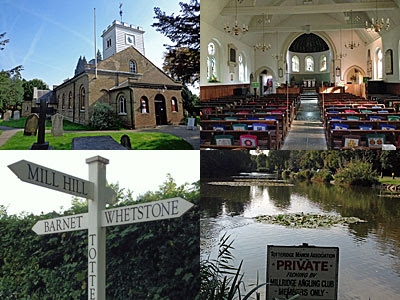
Up at the northern end of the Northern line, one stop before High Barnet, lie Totteridge and Whetstone. One is a commuter settlement built around a coaching inn on the great North Road. That's Whetstone, with its Waitrose and its Griffin pub, a pleasant enough place to live. But the other is something else, a medieval village made good and a bolthole for millionaires. That's Totteridge, the last syllable of its name describing its position on a crest between two valleys. Part of Hertfordshire until 1965, it was swallowed up somewhat grudgingly by the new borough of Barnet. An aspirational location surrounded by rolling farmland, it's easily the most rural place in Greater London to be served by the Underground.
For Totteridge turn right, not left, outside the station. The road leads down to the Dollis Brook, the main watercourse hereabouts and (further upstream) the northern perimeter of Totteridge proper. One day I'll walk the Greenwalk from source to Hampstead, but on this occasion let's continue on up the other side past the Totteridge Garden Chinese takeaway. That's it for shops, this short parade, they don't sully the village proper with a retail outlet. Totteridge Lane climbs slowly from the affordable end to the less-so, past multi-car households and a defunct library. In a nice touch, the larger houses announce their names and numbers via a series of curved posts dug into the verge - not always easy to read but consistent and cohesive.
Entry into the village proper is signalled on a wooden board labelled "Manor of Totteridge", because it once was. Some of the luckier houseowners reside around the triangular village green, blessed with just enough trees to make a game of cricket impractical. A glance at a satellite photo of the immediate neighbourhood reveals a majority of back gardens boast gleaming blue swimming pools - unseen from the front drive, but always hinted at. Divert up Pine Grove or Northcliffe Drive to enjoy a run of Tudorbethan detached houses, the very pinnacle of suburbia, oh so very Chorleywood. Or more likely stop at The Orange Tree by the pond, the sort of pub that has "Sparkling Thursdays" rather than "Curry Wednesdays", and maybe enjoy a pint outside on the lawn.
For a glimpse into why folk like to live round here, divert off behind the pub to explore the valley below. No public footpath sign is obvious, because this isn't one, but keep the faith and stroll brazenly through the gate into The Close Private Estate No Parking Warning High Speed Crime Response Force. And don't be put off by the lamppost further down, with three security cameras, two motion detectors and a reversing mirror. A path leads straight on to the edge of a field, and from here a 30 metre descent with woody views to the south. Much of London might look this glorious had suburban sprawl not covered it with streets and gardens. Indeed the valley slopes in neighbouring Woodside Park have suffered precisely this fate, but Totteridge's golden grassland provides a pointed reminder of the swallowed past.
At the foot of the hill is Darlands LakeNature Reserve, a ring of green around a shallow dammed pool. A footbridge leads across the Folly Brook, the minor stream marking Totteridge's southern edge, then a circuitous path heads off around the lake. Only rarely does it scrape the water's edge, but the vegetation is lush and brimming (in places) with wild pink orchids. To return to Totteridge proper a path leads northwest up the feeder stream - a minor earthy channel for much of the year, but enough to make mudbaths of the adjacent ground at others so choose your footwear with care. Pass fields recently-harvested, follow tracks rarely trod, to complete the optimum Totteridge dog-walking loop.
You'll emerge opposite Totteridge's white-towered church, which you could alternatively have reached via a short stroll from the pub. St Andrew's goes back 750 years, while the yew in the churchyard is said to date back over 1000, making it (reputedly) London's oldest tree. Inside is a broad lofty space, with bright hand-sewn kneelers hanging from the back of four ranks of pews. Outside are the remains of the village pound, built for 16th century miscreants, marked by a small plaque. And just round the corner, on a triangle of grass that's the nearest Totteridge comes to a roundabout, stands a slender cross-topped war memorial.
To find the most expensive homes in the village, continue west along the ridgetop. There would be excellent views of central London, less than ten miles distant, except a string of properties along the southern side of the road hog the panorama for their own. Ditto views of Barnet to the north, the fields beyond blocked by cottages, then villas, then mansions. Arsene Wenger lives in Totteridge, and Cliff Richard and Des O'Connor once did, it's that kind of place. The only gap in the fences and high hedges comes at the Long Pond, an appropriately named artificial pool located at the highest point in the village, where the fishing is Private Members only. And that's probably as far as you need to walk, as this linear village finally peters out after two long miles. Best catch the regular 251 bus back to the station... not, one suspects, that Totteridge's genuine residents use it much.
» Didn't join much at the Freshers Fair (I didn't join enough at all, but failed to realise that at the time)
» Had a bowl of Coco Pops using St Ivel Five Pints because I'd run out of real milk (it wasn't pleasant)
» Went to a reception at the boathouse where the rowers tried to encourage me to get up at stupid o'clock daily (not a chance)
» Won a game of pool in a pub (I'm not convinced this ever happened again)
» Went to the best disco I would ever attend, at the student bar (helped by it being 1983, how does it feel, to treat me like you do?)
» Had a slice of my Mum's emergency fruitcake for breakfast because I couldn't face Coco Pops with powdered milk again (I bought a real pint later)
» Read aghast what Cecil Parkinson had been up to with his mistress (and giggled as he resigned)
» Received a Girocheque cheque card through the post (and went to the Post Office to draw out £20)
» Went to my very first student lecture (the only one ever to be standing room only)
» Went to my very second student lecture, which thankfully I already knew all of (it didn't last)
» Went round the local museum because there wasn't much work to do yet (it wouldn't last)
» Invited some new friends round to my room because I was the only one with a portable TV (and one of them wanted to watch themselves on Blockbusters with Bob Holness)
» Had a bowl of Coco Pops using real milk (kept cool by storing the carton on the ledge outside my window)
» Taped Safety Dance and Kissing With Confidence off the Radio 1 Top 40 (still got the cassette, still play it)
» Went to the communal student TV room to watch Omen 2 (seen it already) and Omen 3 (wished I hadn't)
» Bumped into some old school friends outside the lecture hall (said hello, then never saw them again)
» Posed for a strip of passport photos in a booth so I could get my library card (and my student union card)
» Wrote a letter to my Mum telling her what a typical day at university was like (because blogging hadn't been invented yet)
» Went to Huckleberry's for lunch and had a Huckleburger (a short-lived national brand of Wimpy-like restaurants - you missed nothing)
» Struggled to do my first assignment (then discovered, thankfully, that everyone else was struggling to do it too)
» Paid £283.17 to cover my first term's accommodation (I hate to imagine what the equivalent cost is today)
» Watched Play School and Superted(hell, I was a student now, you try and stop me)
» Forgot to take my glasses to a lecture (and ended up on the back row where I couldn't read anything)
» Invited new friends round to my room because I was the only one with a portable TV (and one of them wanted to watch their Brownie pack on Crackerjack with Stu Francis)
» Went to a sex debate with Mary Whitehouse and Tracey Ullman (except Mary Whitehouse and Tracey Ullman didn't turn up)
» Invaded Derek's room for late night coffee (or rather tea) (and stayed up until, gasp, half past one)
» Met Mel Smith and Griff Rhys Jones (who signed a copy of The Smith and Jones World Atlas for me)
» Watched Mel Smith later the same day on the Late Late Breakfast Show(this passed for entertainment in the 1980s)
» Put off trying to understand how the washing machines worked until things got serious (which'd be the following week)
» Wrote my diary every evening (because it's always interesting looking back, especially to a week like that)
Remember record shops? Back in the 20th and early 21st centuries these were street-based retail outlets selling music and other entertainment media in physical formats. They were once very popular, but became steadily less profitable as people turned instead to cloud-based audio-visual solutions delivered via rental streaming. Today only a few of these archaic disc repositories survive, supported by a rump of consumers who've not yet embraced their digital future. I've been to visit one, simultaneously very old and very new, because I suspect you haven't been yet.
HMV opened its first shop on London's Oxford Street in 1921. "His Master's Voice" was the record label of the Gramophone Company, purveyors of spiral vinyl, which would later evolve into EMI. Their flagship store was at number 363, with a recording studio upstairs where the Beatles' first demo disc was cut, and an increasingly large stock of LPs as the decades rolled by. A much bigger store opened later at number 150, a cavernous space on several levels, and the two coexisted successfully for some time. Later the original shop closed in favour of a new bigger store across the road, but this Oxford Street duopoly lasted barely ten years before the newbie shut. Administration beckoned, but the store at 150 survived as part of a slimmed-down rump nationwide. And now, about a fortnight ago, the original HMV at 363 has reopened to sell its wares again.
They've done a nice bit of branding outside. The modern 'hmv' logo is muted, appearing at lintel height and also on a thin vertical perpendicular sign. But in dominant position across the entrance are the words "His Master's Voice" in imitation neon, alongside an illuminated Nipper the dog staring into a gramophone. The design is deliberately reminiscent of fifty years ago, indeed it looks like a fairly convincing copy of way back then, but without the words "Home Entertainment and Electrical Housekeeping" emblazoned underneath. Enough to tempt customers old and new back inside, it seems.
I'm sure I remember the store being bigger. Maybe that's because last time it covered more than three floors, or maybe I'm just thinking back to Footlocker which was mostly empty space. The front's all chart albums and film racks, as you'd expect, with the usual two for £10s and prominent back selection. If all you do is wander in off the street and back out again, your chance of spotting One Direction is maximised. Here too are a suspicious number of sideline offers, things like t-shirts, mugs and calendars, generally grouped by theme such as Doctor Who or Twilight. Why sell just the video if there's considerably more mark-up in ceramics? And then the whole of the back of the store is for games, because they're the future, plus they have a hefty cover price. And racks of headphones, obviously, should you want to walk the streets of London looking like a Shoreditch Cyberman.
The two escalators aren't well labelled, so it may be pot luck that takes you to the "film and tv" basement. People still want DVDs, it seems, and Blu-rays of films they've already bought once on other formats. World cinema gets a wall, and musicals a third of a rack, with a fair-to-middling chance of finding the film you want (but best ignore Sharknado, £9.99). Down at the television end of the floor the big thing these days is box sets, in greater bulk than I remember seeing before. Waste away your weekend by watching something you could have taped off the telly if only 'series record' had worked, or avoid paying a Netflix subscription by forking out £50 for four-fifths of Breaking Bad. If HMV manages to stay financially afloat into the future, our appetite for long term sofa marathons will have assisted.
And then there's the real HMV, the record department, upstairs. It's almost all CDs these days, which isn't bad for a generation-old format. All your actual chart records and cut-price compilations are at the top of the escalator (can you believe we're now onto Now 85?). Rock and pop from A to Z gets the lion's share of the space (although it'd have to be a lion cub to live comfortably here). One long rack features the back catalogue of the Beatles, Clash and Led Zeppelin, a direct appeal to the wallets of tourists and middle-aged fifty-quid-men. Classical is diminished to one corner, now with a rather limited Naxos-heavy selection. Specialist genres such as heavy metal, soul and dance also have their place, with enough obscure new artistes amongst the classics, although not the in-depth catalogue of old. If what you're after's not obvious, the pink t-shirted staff hurrying around should be able to help - there are certainly enough of them.
What happens next, of course, is that the HMV megastore at 150 Oxford Street closes down. Sports Direct have their eye on its prime retail space, swapping entertainment deals for budget footie strip and hoodies. And then HMV's sole presence down this key West End Street will the modest building in which they first started, holding out against the barrage of fashion shops that now thrive here. It's encouraging to see a 90 year-old business reborn, holding out against the inexorable rise of Amazon et al. And those of us who like to own our music, rather than rent it out, still have longer to browse and buy before His Master's Voice falls silent.
TfL are considering going cashless on buses. You may remember they launched a consultation back in August to ask Londoners what they thought of the idea. I mention this because the consultation ends tomorrow. And I think it's a fair bet that, unless the consultation comes out strongly against, TfL will be going cashless on buses some time next year.
I can't remember the last time I used cash on a bus. I've had an Oyster card for ten years now, so I'm perfectly used to flashing my plastic. More importantly, I have an annual travelcard on my Oyster. A travelcard means I can ride any London bus on any route for no additional fare, no matter which zones it passes through, so I never ever need to Pay As You Go on buses. It doesn't matter to me whether TfL goes cashless on buses because I went cashless a decade ago. But I'm not everyone.
Earlier this year my niece and three of her friends came down from Norfolk to London for the weekend. I met them in North Greenwich, after some musical event at the O2, with the intention of heading back to Bow to kip down for the night. It was close to midnight so we caught the bus, a quick and simple journey under the Thames on the 108. Three of us waved our Oyster cards, because we'd come prepared, even those from the farthest parts of East Anglia. But one friend had no card, only a high value note which she waved somewhat ineffectively at the driver. We cobbled together the cash fare between us, and sped on our way shortly afterwards. But if buses had gone cashless, as TfL plan, I'm not sure how we'd have managed. The WH Smith in the bus station was long closed, and they don't do Oyster anyway. There is an Oyster Ticket Stop at a newsagents inside the O2, but I wouldn't have thought of going there, and they were probably closed too. The second nearest Oyster Ticket Shop is a mile away, in the wrong direction, on the Woolwich Road. And the ticket office at North Greenwich station closes before 8pm on a Saturday, so that's a fat lot of good. We couldn't have walked home, because there's a river in the way. We might have got the tube, assuming it was still running, but that would have cost more and taken longer. Or we could have got a taxi, but can you imagine the fare charged to muggins departing the O2 late at night? Cash, it turned out was the ideal solution.
I'm intrigued by the main argument TfL is putting forward in support of going cashless.
First they tell us only 1% of passengers make cash journeys, as if to suggest that making this change won't affect many people. Then they claim that going cashless will lead to faster journey times, except they just said very few journeys involve paying cash, so that's not much of a time benefit for the rest of us. You can't argue it both ways, not and appear credible.
But I take TfL's point that going cashless will save them money. If bus drivers never have to deal with cash then cash never needs to be collected and banked, and those savings will add up. In a time of austerity, every squeezed outlay helps. But is an extra £24m worth the hassle? By my calculations that's roughly enough to buy 60 New Buses for London, enough to convert the whole of route 25. It's less than half of the cost of building the cablecar. And interestingly it's less than half of the amount those 1% of cash passengers are paying annually in fares.
It's also interesting to see who's still paying in cash.
The great majority of cash users have an Oyster card, but it's either empty or elsewhere. And it's not obvious your Oyster card is empty until you try it, at which point in future the driver will chuck you off the bus.
It's not difficult to get an Oyster card, although the £5 deposit puts some people off. Some aren't chuffed that Oyster means TfL can track their progress round London, whereas cash is entirely anonymous. But cash users are paying £1 over the odds compared to Pay As You Go, so you have to wonder why the refuseniks hold out.
This figure seems significant. A very small proportion of all bus journeys in London will be on night buses, but 10% of the cash fares are taken here. It's not usually possible to pop into a local newsagent after midnight to top up your card, and tube stations are shut, so what's a traveller to do? TfL are proposing that skint Oyster users be allowed one free journey (to be paid back later), which is good mitigation, but not alas if it takes more than one bus to get home.
And this figure seems significant too. There aren't many buses that cross the boundary, certainly not many busy ones, and yet 10% of the cash fares are taken here. When Oyster isn't an integral part of your life, of course you're going to want to use cash instead.
TfL are keen to point out that contactless payment cards can now be used to pay on bus services. Apparently 23000 trips per day are made using CPCs, which might sound a lot but is actually a pitiful amount, and less than half of the 1% using cash. Plus we don't all have contactless cards, do we? My bank sent me a bog standard debit card earlier this year, so I won't be CPC-enabled before 2016 at least.
It's clear that London's buses will go cashless one day. The world seems hellbent on moving from cash to plastic, so the change on public transport is inevitable. But I'd argue that 2014 is too early. There are still too many this will inconvenience, even put at risk, because even 1% of a very large population is a lot of people. I think TfL should wait a few years longer, that's my opinion. And if you want to make your cashless opinion heard, be that pro or con, you have one more day to tell the people who matter.
Shall we just talk about stations? You like it when we talk about stations.
Morden: We started here on a journey last week (Charles Holden, yadda yadda). This wasn't supposed to be the terminus, the Northern line was hoped to extend to Sutton (I'm reading this off Wikipedia, you could do that, all by yourself). Merton Council have a major consultation up and running at the moment for their Morden Masterplan which'll see the area around the station redeveloped (but with Holden's facade remaining "a visual focal point and strengthened"). But let's step back a bit and walk up the long footpath beside the station to the point where the Northern line plunges into tunnel. Because it doesn't plunge very deep, not for the first 500 metres, and certainly not deep enough to build houses on top. And so the authorities did what any good developer would do, they slapped a park on top. That's Kendor Gardens, a linear park just wide enough to cover the two tunnels below, and then some. It's nothing hugely special, indeed it's devoid of all amenities (bar a few benches in memory of John Innes). But the council gardeners have done a fine job with the flowerbeds, with one variegated rosebush still ablaze even in October. And then there's the vibrations. Stand (or sit) here long enough and the ground briefly rumbles, a wholly unexpected tremble, as a Northern line train passes directly beneath. If you're at the southern end of the park you might then hear that train whistle as it emerges from its tunnel a few seconds later and brakes to enter the station. But further north there's just a peculiar judder underfoot, and then the ordinary dogwalking parkspace returns. [photo]
South Wimbledon: It's not in Wimbledon, more in Merton. They were going to call it Merton Grove, but eventually they didn't (that's Wikipedia again). Charles Holden did the station (he did all these really) (there's going to be a lot of photos of the same style of Holden station today, but a bit varied depending on what the shape of the street corner was) [photo] Colliers Wood: We did this place yesterday, remember. The station's near the tower block that's regularly voted the ugliest in London (in years when the Archway one doesn't win). Across the road is a pub called The Charles Holden - the ideal drinking spot for tube architecture aficionados (although they seemed to be going for more of the rugby crowd, I thought) (until April this was the Colliers Tup, and before that The Victory, so one senses they're just jumping on the Tube150 bandwagon) [photo]
Tooting Broadway: This is the busiest station down this section of the line, in terms of its location, that is. Its curving frontage faces a teeming crossroads, bustling with shoppers and snarled up with traffic (or it was at the weekend). Outside the entrance, a colourful flower stall, plus a mirrored cross propped up against the statue of Edward VII with a keen-looking vicar sitting alongside. You don't get this in Balham. [photo] Tooting Bec: Blimey don't the shops change as you walk along the Upper Tooting Road. At the Broadway end are more major chains like Sainsbury's, then slowly the retail offering evolves into almost-entirely Asian outlets. Tooting Bec station has entrances on two opposite corners of a crossroads, one extremely narrow, and boasting three glass roundels (plus a chandelier ring light if you venture inside). Holdenesque, obviously, in spades. [photo] Balham: An actual interchange, this with the tube station in dominant position and the less characterful National Rail platforms tucked behind. By this point, to be frank, the façades of al these Holden stations are starting to look a bit samey (but then most people don't deliberately walk past half a dozen of them in a row) [photo]
Clapham South: The final Holden bastion (or the first if you're travelling the other way). Was nearly named Balham North (which would at least have evened out the Balhams and Claphams somewhat). Sort-of alongside, on the corner of Clapham Common, are the surface buildings of a deep-level wartime air-raid shelter (but we did those on this blog in 2007, so you're not getting them again). Clapham Common: For a start, much love for the domed entrance on an island in the street. And for the "To the trains" sign pointing down into the ticket hall. But mostly for the island platform down below (unbelievably once the southern terminus of the line). This is the straight one, and most people don't walk all the way down to the end (unless they have a camera) [photo][photo] Clapham North: This one's none too thrilling on the surface, at least not in comparison with what's gone before. But the uplighters on the escalator have character. And then there's the tube's other island platform, this the curved one (which means you can get a slightly different photo at the end from the tip of the hockey stick). South London may not have many Underground stations, but it has more than its fair share of splendid ones. [photo][photo]
Come with me to Colliers Wood, two stops from the southern end of the Northern line. This historic corner of Merton (William Morris, Admiral Nelson, etc) lies on the Wandle, one of London's non-lost rivers. A 14 mile foot- and cycle-path, the Wandle Trail, follows the stream all the way from Croydon to the Thames at Wandsworth. But in some places, due to inadequate access, the path is forced to deviate from the river along less appropriate routes. And one of these is in Colliers Wood, at Wandle Meadow Nature Park, thanks to the Bridge To Nowhere.
I rather like Wandle Meadow Nature Park. It's not a landscaped beauty, more a patch of scrubby flood plain on the site of a former sewage works with pylons running up the centre. But it's got a bit of character, a splash of unkempt charm, and it's also where I met my very first urban fox in a sudden footpath face-off. The Wandle Trail passes through, but away from the river, forced to deviate on approach from the south up the side of a pumping station. There ought to be a path along the edge of the concrete culvert, indeed there is initially, it's the pavement of a road called Wandle Bank. A row of terraced houses leads downstream to the site of Merton Mill, once one of the largest corn mills in London, now more flats. But then beyond Byegrove Road comes a new estate, built quite recently on the site of the Connolly Leatherworks, and that's where the riverside path runs out. At the Bridge To Nowhere.
The plan was for Bewley Homes to build a footbridge over the Wandle as part of their Section 106 obligation. This bridge would allow the Wandle Trail to pass through the new estate and across the river, entering the foot of Wandle Meadow Nature Park without the need for a diversion. They designed a bridge that sloped down from the estate bank to the park bank, there being a 2m drop from one to the other. But the Environment Agency said no, the low bridge might obstruct the flow in flood conditions, so go away and think again. The housing company took their time, then returned with revised drawings showing the level structure that's in place today. They stated they'd be installing it with "the access being blocked off as we will not be constructing an access ramp", leaving this for the local authority to complete. And somebody at the council signed these plans off, so on 20th June 2007 a Bridge To Nowhere was installed.
It does look bloody stupid today. A wooden footbridge heads off from the riverbank opposite number 15 Bewley Street, part chained-off to prevent non-existent kids from running into the road. Walk part-way across and the Wandle flows beneath, relatively swiftly, then disappears behind a curtain of foliage. Step further and the trees part to reveal a scrubby corner of Wandle Meadow Nature Park. But you can't get down there, the bridge stops in mid-air, reduced in function to little more than a viewing platform. If you stood in this corner of the park you'd see a wooden structure flying in at about head height, supported on a concrete plinth. But there's no way of clambering up or down, not unless you're an urban monkey, this is a split-level dead end.
Merton Council got cross and accused the builders of going back on their legal obligation. The builders waved their planning permission document, finished their houses and moved on. And so the bridge remains incomplete, a pointless missing link requiring a sinuous detour. The Colliers Wood Residents Association recognised the absurdity of the situation early on, in 2008 creating an 'art installation' to draw media attention. On 20th June 2009 they held a birthday party, inviting local residents and the media to turn up for a singsong and cake on the bridge, and they've been holding one annually ever since. [full backstory]
Alas the residents of Bewley Street have never been supportive. They like living in a cul-de-sac on their own private waterfront, and they're happy for the bridge to stay blocked. The estate's builders laid a narrow footpath alongside their parking spaces, wiggling north along the Wandle, but someone's erected a laminated sign saying "Footbridge closed" in an attempt to keep speculative ramblers out. Attempt to walk past the footbridge towards North Road and you're met by an impenetrable fence labelled "Private Road" and "Private Keep Off". There used to be through access here before the new houses came, but no more, and a detour is required for anyone attempting to continue to the north. Inaccessibility is what local homeowners expected when they moved in, and it's how they'd like things to stay.
But maybe not for long. I spotted two unexpected signs attached to the footbridge when I visited at the weekend, one on the Bewley Street side, the other dangling above the park. Each sign announces that "an application has been submitted" for "completion of footbridge via completion of DDA compliant ramp and steps. Hallelujah! The ramp will have a scissor turn at one end where those with pushchairs or wheelchairs can double back, while those more able can head straight down via a flight of ten steps. This steel-framed timber structure will take up a fair bit of space, all to ensure 100% accessibility, but this is a very quiet corner of the park where hopefully a few square metres of vegetation won't be missed. [Elevations][Location plans][Artists impression]
The money's come from TfL, who've funded a local government grant to improve various parts of the Wandle Trail for walkers and cyclists alike. If you'd like to look up the fine detail of this particular footbridge scheme you can - it's Merton Council planning application13/P2573. This went live on 4th September and interested parties had 21 days to submit support or opposition, a period which ended just over a week ago. Merton's planning portal reveals that nobody stood up and spoke in favour - how would they have noticed when the signs went up on two ends of a dead-end bridge? But three residents of Bewley Street noticed, and felt strongly enough to email their objections...
"We are concerned that many people would use this as a short cut through the Nature Park rather than having to go over the main bridge and would bring more people into Bewley Street, with all the subsequent problems that can bring."
"Kindly note that the nature park opposite Bewley Street is a local gathering area for anti-social behaviour. The current incomplete footbridge is the only element preventing much of this anti-social behaviour from spilling over into Bewley Street."
"Furthermore there is only a small number of non-residence petitioning for the completion of the footbridge. It would not seem to make sense to invite additional crime and anti-social behaviour onto Bewley Street and potentially put the safety of the residence (including a number of young families) at risk just so that a handful of non-residence don't have to walk a small extra distance around the block to access Wandle Meadow Nature Park."
I met some of this anti-social element when I walked down, along, back up and across to reach the parkside end of the Bridge To Nowhere. A bunch of kids on bikes rode in from the estate opposite, gabbling in some Eastern European language, to hide away in the thicket and perch atop some logs. To be honest they looked like they were having a great time exploring their own local wilderness, as if taking part in some nostalgic Enid Blyton adventure. But evidence elsewhere suggested not every visitor to the park behaves so well, indeed I spotted enough used tinfoil discarded by the end of the footbridge to wrap a brace of Christmas turkeys.
The council initially demanded a footbridge to complete a missing link along the Wandle Trail, and to give residents of the new estate access to their nearest recreational amenity. Merton's planners have already declared the status quo "unfit for purpose", so I'd expect the voices of the three Bewley Street complainants to be outgunned by the needs of the wider community. If all goes to plan construction could begin next month, with completion due in spring 2014. And by next summer there'll be ramblers and cyclists passing through, and a valuable shortcut provided for nearby residents, and a brand new circuit those kids on bikes will be able to enjoy. Because the Wandle shouldn't be a private river, it's for everyone, and what's needed here is clearly a Bridge To Somewhere.

City Island is a Ballymore project. They're building a "dramatic new cityscape" which they describe as a "mini-Manhattan", or in other words a lot of tall buildings. They claim it's "inspired by the landscape and heritage of the area", by which they mean the buildings will use colours that used to exist round here when there were shipyards. They plan "a swimming pool which will glow red", and so many gingko trees that "City Island will be a lush, almost exotic presence." And of course it's surrounded by water on almost all sides, which means it'll be all the more exclusive and easier to keep the riffraff out. Fancy buying in?
Like any major transport project, the Northern Line Extension to Battersea is to be subject to a public inquiry. This is scheduled to start on Tuesday 19 November 2013 and is expected to last around four weeks. If all goes to plan the decision to go ahead could be taken next autumn, with construction kicking off in the spring of 2015. The public inquiry has its own website, which is already stocked with all the relevant planning documentation you could possibly imagine. There's also a page detailing Statements of Cases from over 60 interested parties, mostly objectors, from the Heart of Kennington Residents Association to Battersea Dogs and Cats Home. If you're Mr J S Nixon BSc(Hons) DipTE CEng MICE MRTPI MCIHT, the Inspector, you'll have to plough through the lot. I've merely skimmed through Transport for London's 125-page Statement of Case, and here are some of the things I've discovered.
Vauxhall: Or Vauxhall Cross, as estate agents know the area between the bridge and the station. The major development here is St George Wharf, its owl-like apartments having stared down the Thames for many a year now. This is now firmly embedded into the neighbourhood, with offices, health/fitness facility, restaurant units and a Tesco Express helping to ensure its residents don't have to walk too far to do stuff. Expect many more such mixed-use complexes, with very similar facilities, to spring up over the kilometre between here and Battersea over the next few years. Already up is The Tower, a 52-storey cylindrical pillar of glass that's wildly out of scale with existing local buildings, but much more in tune with what's coming next. The crane on the top's come down now - the crane a helicopter flew into back in January remember - but the interior's not yet complete and the ground floors remain behind hoardings. Sorry pedestrians, you'll have to cross the road until they're done. Meanwhile, that new-ish swooping bus station everyone likes is destined for demolition if plans for Lambeth's "Heart of Vauxhall" come to fruition. They want to "transform Bondway into a two sided high street, with new buildings on the west side and regenerate the existing buildings on the east", then "activate with shops, cafes, restaurants and other town centre uses." There'd still be a transport interchange but more a boulevard with bus stops, and long-term even the surrounding gyratory might be swept away. The Northern line extension will not be stopping here.
As for the US Embassy itself, nothing's poking up above the hoardings but a lot of cranes and lifting equipment, plus a sign (with a US seal) announcing this as the domain of "Overseas Buildings Operations". Liz from builders Sir Robert McAlpine provides a monthly newsletter update, pasted into a frame on the wall, with news that they're busy continuing the main piling work to the Diaphragm Wall. A photo reveals what passers-by can't see, which is that the security moat has been dug, and the foundations of Obama's Cuboid are rising on the island within. A new road has appeared, named "Private Road" according to the street sign, which can only get less welcoming as development continues. And Ponton Road has been relocated to make way, continuing to provide access to the Royal Mail and Yodel depots behind, but soon to be lined by a canyon of glass with stacked balconies. Ultimately this'll lead to Nine Elms station, pedestrians only, through "an arcade of retail/commercial units" beneath the railway viaduct. Lambeth and Wandsworth councils are already rather excited.
Battersea: One concentrated pocket of rundown industrial units remains. Follow Cringle Street to discover gated yards, empty warehouses and the hideaway HQ of combustible London Duck Tours. Thames Water are eyeing up one plot as a Thames Tunnel worksite - nobody would complain - while at the far end is the none too fragrant Cringle Dock Solid Waste Transfer Station. I've not seen any mention of this in any of the promotional videos praising the ideal location of the Nine Elms site. And there, beyond a locked gate, stands Sir Giles Gilbert Scott's magnificent power station. It still looks forlorn and at risk, but its brickwork awaits transformation into "the real estate investment opportunity of a lifetime". A cluster of planning notices are tied to lampposts on Cringle Street requesting alcohol licences for the final flurry of events to take place before construction begins. But what's planned for Battersea puts the rest of Nine Elms in the shade, as a Malaysian consortium hopes (finally) to build 3500 homes, 157,777m2 of office space and 14,681m2 of retail. You might well get to work here, they'll need waitresses and cleaners, but the majority of the influx will be the already-rich and foreign investors.
NORTHERN: Totteridge (and Whetstone)
They've done a nice bit of branding outside. The modern 'hmv' logo is muted, appearing at lintel height and also on a thin vertical perpendicular sign. But in dominant position across the entrance are the words "His Master's Voice" in imitation neon, alongside an illuminated Nipper the dog staring into a gramophone. The design is deliberately reminiscent of fifty years ago, indeed it looks like a fairly convincing copy of way back then, but without the words "Home Entertainment and Electrical Housekeeping" emblazoned underneath. Enough to tempt customers old and new back inside, it seems.
Morden: We started here on a journey last week (Charles Holden, yadda yadda). This wasn't supposed to be the terminus, the Northern line was hoped to extend to Sutton (I'm reading this off Wikipedia, you could do that, all by yourself). Merton Council have a major consultation up and running at the moment for their Morden Masterplan which'll see the area around the station redeveloped (but with Holden's facade remaining "a visual focal point and strengthened"). But let's step back a bit and walk up the long footpath beside the station to the point where the Northern line plunges into tunnel. Because it doesn't plunge very deep, not for the first 500 metres, and certainly not deep enough to build houses on top. And so the authorities did what any good developer would do, they slapped a park on top. That's Kendor Gardens, a linear park just wide enough to cover the two tunnels below, and then some. It's nothing hugely special, indeed it's devoid of all amenities (bar a few benches in memory of John Innes). But the council gardeners have done a fine job with the flowerbeds, with one variegated rosebush still ablaze even in October. And then there's the vibrations. Stand (or sit) here long enough and the ground briefly rumbles, a wholly unexpected tremble, as a Northern line train passes directly beneath. If you're at the southern end of the park you might then hear that train whistle as it emerges from its tunnel a few seconds later and brakes to enter the station. But further north there's just a peculiar judder underfoot, and then the ordinary dogwalking parkspace returns. [photo]
Tooting Broadway: This is the busiest station down this section of the line, in terms of its location, that is. Its curving frontage faces a teeming crossroads, bustling with shoppers and snarled up with traffic (or it was at the weekend). Outside the entrance, a colourful flower stall, plus a mirrored cross propped up against the statue of Edward VII with a keen-looking vicar sitting alongside. You don't get this in Balham. [photo]
Come with me to Colliers Wood, two stops from the southern end of the Northern line. This historic corner of Merton (William Morris, Admiral Nelson, etc) lies on the Wandle, one of London's non-lost rivers. A 14 mile foot- and cycle-path, the Wandle Trail, follows the stream all the way from Croydon to the Thames at Wandsworth. But in some places, due to inadequate access, the path is forced to deviate from the river along less appropriate routes. And one of these is in Colliers Wood, at Wandle Meadow Nature Park, thanks to the Bridge To Nowhere.
It does look bloody stupid today. A wooden footbridge heads off from the riverbank opposite number 15 Bewley Street, part chained-off to prevent non-existent kids from running into the road. Walk part-way across and the Wandle flows beneath, relatively swiftly, then disappears behind a curtain of foliage. Step further and the trees part to reveal a scrubby corner of Wandle Meadow Nature Park. But you can't get down there, the bridge stops in mid-air, reduced in function to little more than a viewing platform. If you stood in this corner of the park you'd see a wooden structure flying in at about head height, supported on a concrete plinth. But there's no way of clambering up or down, not unless you're an urban monkey, this is a split-level dead end.
But maybe not for long. I spotted two unexpected signs attached to the footbridge when I visited at the weekend, one on the Bewley Street side, the other dangling above the park. Each sign announces that "an application has been submitted" for "completion of footbridge via completion of DDA compliant ramp and steps. Hallelujah! The ramp will have a scissor turn at one end where those with pushchairs or wheelchairs can double back, while those more able can head straight down via a flight of ten steps. This steel-framed timber structure will take up a fair bit of space, all to ensure 100% accessibility, but this is a very quiet corner of the park where hopefully a few square metres of vegetation won't be missed. [Elevations] [Location plans] [Artists impression]