THE UNLOST RIVERS OF LONDON Dollis Brook Edgware → Barnet → Hendon (10 miles)
[Dollis Brook + Mutton Brook → Brent → Thames]
The Dollis Brook is essentially the first ten miles of the River Brent under a different name, running east from Edgware to Barnet, then bending south through Finchley to Hendon. If you're looking to walk one of outer London's unlost rivers it's also one of the best. At the top end it's proper pastoral, while further down it flourishes through suburbia within a thick strip of green, and very rarely are you forced away to traipse down parallel streets instead. For this we should thank Alfred Pike, Finchley's Mayor in 1937, who worked tirelessly to create a riverside walk down the western edge of his borough, and whose foresight has held back further development to this day. His Brookside Walk has since become the DollisValleyGreenwalk, a comprehensively signposted ramble from source to mouth, which I walked for pleasure at the weekend. [official DV Greenwalk guide]
Getting to the start of the Dollis Valley Greenwalk is only easy if you live in Borehamwood and arrive by public transport. In this case the 292 bus will drop you off right at the start, whereas if you arrive from the south you'll have to get off one stop early to cross the A1 dual carriageway via a subway. Drivers are stymied because Barnet Council have inexplicably closed the Moat Mount Open Space car park at the beginning of the route, but that suited me because I met nobody whatsoever for the first half mile, and otherwise the place would no doubt have been thronging with dogwalkers, doggers and the like. The first section of the walk was uphill, which was a clue that the damp notch beside the footpath wasn't the river proper. But the leafy climb swiftly topped out beside open pasture, the fenced-off path edged by spring flowers - a proper pleasant start.
It was at the summit that I met my first fellow walkers, a mixed group of ramblers studying a printed-out map and trying to work out which path to take. I considered making the Londonista secret sign, but chickened out through embarrassment, so decided that further along the walk I'd simply listen out for the key phrase ‘fine day for it’. A broad path continued downhill and into ancient woodland, a proper rural getaway and yet somehow still within the confines of Greater London. To one side a small pond marked the source of the Dollis Brook, fenced off behind a notice warning of deep water, with a prominent red canister attached containing an emergency line lest anyone should get carried away. The first of three road walks followed, along a half-residential lane lined with terribly desirable homes, as befits the north Totteridge environs. At one point the fledgling stream was seen, nothing special, before the lane headed south to meet up with the Dollis Brook's alternative headwaters.
A private track past a sports ground (they close it every year on 28th February) led back to the river, via what was the only unavoidable metre of mud on the whole walk. But the next mile was lovely, even gorgeous at the right time of year, which is now. The meadows of the upper Dollis Brook are lush and verdant in late spring, a riot in white, pink and green, and bursting with blossom and buttercups. They're also remarkably remote, the nearest mansions some distance up the valley slopes, and the only prominent sounds those of chirpy birdsong. Ahead lay Totteridge's ancient hay meadows, which are mown just once a year to maintain the butterfly-friendly wildflower mix. Every so often a small brook trickled down from the south, crossed via a plank, or rather would have trickled if only we'd had enough rain of late. And the main stream flowed crystal clear behind a screen of green undergrowth, occasionally visible through an overhanging indentation, as fluffy seeds drifted from the hedgerow in the breeze.
"Morning." Damn, I'd been enjoying the isolation, and suddenly a lady with two small dogs was bustling past. I received a "Hi there" from two joggers too, their jogging route almost certainly better than your jogging route, for what it's worth. I noted that neither of these parties had opened their conversation with Londonist's secret phrase, neither were they wielding their thumb and forefinger in the special 'L' formation, but that's local residents for you. Indeed unexpectedly local residents, as after six successive meadows the official footpath suddenly crossed to the opposite bank of the stream. Here behind a screen of trees were the backs of houses on the outer outskirts of Barnet, specifically Ducks Island, with a municipally mown lawn separating them from the river. The landscaping wasn't unpleasant, indeed the grass was impeccably maintained, yet all felt somewhat bland after the previous unspoilt mile.
The Dollis Brook was now a shallow stream a metre wide with pebbly bed, wiggling gently in a slightly deeper channel. Every now and then I heard laughs and activity on the other side of the stream, which I assumed must be bucolic youth enjoying screened-off meadows, but which later turned out to be a couple of sports grounds. On my side the land rose up to a broad river terrace used as parkland, with the first tarmac footpath of the walk snaking across the brow. From this point onwards you'll be fine in trainers, even during a muddy winter. The occasional footbridge broke off to carry a public path up the hill to Totteridge, which if I've not hinted already is one of the nicest (for which read 'most expensive') villages in London. But here on the Barnet side we got lads in hoodies, kids on pink scooters, and an invasion of crows flapping off with bounty from a freshly dumped loaf of bread.
Every so often the trappings of city life were visible on the skyline, in particular an Odeon cinema, the Northern line and Barnet FC's former Underhill Stadium. There was also a brief stretch where the river ran deep below what I could almost describe as a cliff, broached at one point by stairs down to three flat stepping stones, providing access to a field on the opposite bank. I considered crossing to enjoy less artificial surroundings but didn't risk it, foolishly as it turned out, as the dog walkers I later saw emerging onto Barnet Lane confirmed. This was only the second road I'd encountered in four miles of walking, so underdeveloped is this part of outer North London. And having followed London Loop section 16 for all that time, this was also the point where that more well-known walking trail broke off to head for Cockfosters, while we Dollis Brook devotees veered south along the riverside.
I'll write about the more urban half of the unlost river tomorrow, and whether perhaps the Londonist reader count was any higher here.
And there's another reason why what we call the Overground matters. When part of it isn't working, how do we know which part that is?
These rainbow boards are everywhere across the TfL network. They tell us whether or not a line is disrupted, then allow us to dig below the headlines to see the detail. And this works well on a simple line like the Bakerloo or Victoria, and pretty well on a more complicated line like the Central or District. But it works much less well on a complex collection of lines like the DLR or Overground, where large chunks can be working perfectly even when other parts are borked. And at the end of this month, when a clutch of fresh branch lines join the Overground family, that informations's going to get more complicated still.
To illustrate this let's jump ahead to the first full weekend of extended Overground services, specifically to Sunday 7th June, to see what track closures TfL have planned.
District
DISTRICT LINE: Saturday 6 and Sunday 7 June, no service between South Kensington and Aldgate East.
Yes, fine, I can picture that.
Circle
CIRCLE LINE: Saturday 6 and Sunday 7 June, no service between Gloucester Road and Aldgate (via Victoria). The Circle line service operates in two sections: Hammersmith - Aldgate and Gloucester Road - Edgware Road (via High Street Kensington)
A bit tougher to follow, but the severed Circle line service is all there in plain English.
Waterloo & City
WATERLOO & CITY LINE:- Does not operate on Sundays.
That's good to know, to prevent me from turning up when the line's closed.
And then there's this.
London Overground
LONDON OVERGROUND: Sunday 7 June, until 1000, no service between Liverpool Street and Chingford. Use local buses via all reasonable routes between Liverpool Street, Hackney Downs and Chingford. Replacement buses operate between Walthamstow Central and Chingford.
Replacement buses operate Service L3: Walthamstow Central - Wood Street - Highams Park - Chingford First trains will operate as follows: 0955 Chingford to Liverpool Street 1018 Liverpool Street to Chingford
LONDON OVERGROUND: Sunday 7 June, until 1000, no service between Liverpool Street and Enfield Town / Cheshunt (via Seven Sisters). Use local buses via all reasonable routes between Liverpool Street and Seven Sisters. Replacement buses operate between Seven Sisters and Enfield Town / Cheshunt.
Replacement buses operate Service L1: Seven Sisters (for London Underground Victoria line) - Bruce Grove - White Hart Lane - Silver Street - Edmonton Green - Bush Hill Park - Enfield Town; Service L2: Seven Sisters (for London Underground Victoria line) - Bruce Grove - White Hart Lane - Silver Street - Edmonton Green - Southbury - Turkey Street - Theobalds Grove - Cheshunt Note: First trains will operate as follows: 1000 Liverpool Street to Enfield Town 1015 Liverpool Street to Cheshunt, via Seven Sisters 1022 Enfield Town to Liverpool Street 1031 Cheshunt to Liverpool Street, via Cheshunt
LONDON OVERGROUND: Sunday 7 June, until 1230, no service between Gospel Oak and Highbury & Islington due to Network Rail track works. Replacement buses operate between Hampstead Heath and Highbury & Islington, please interchange between trains and buses at Hampstead Heath.
Replacement buses operate Hampstead Heath - Gospel Oak (Agincourt Road / Southampton Road) - Kentish Town West - Camden Road - Holloway Road (for London Underground Piccadilly line and Caledonian Road & Barnsbury) - Highbury & Islington
LONDON OVERGROUND: Sunday 7 June, no service between Clapham Junction and Kensington (Olympia) due to Earl's Court redevelopment works. Please use local London Buses services via any reasonable
And that's much, much harder to pull apart.
Four different sections of the Overground have engineering works that Sunday, and they've all been crammed in together under the same umbrella title. If you scan through the list for LONDON OVERGROUND in capital letters you'll see where each separate announcement starts, but it's still not easy to determine precisely which announcement, if any, applies to the line you want to travel on. As a quick check, see how long it takes you to work out whether the Overground line from Gospel Oak round to Walthamstow is open or not. Unless you have a map of the disruption to help you, this isn't easy.
The first disruption in the tangle involves one of the brand new Overground lines, that from Liverpool Street out to Chingford. It'll be closed before ten o'clock, and there are rail replacement buses. The second disruption involves another of the brand new Overground lines, or possibly two, this time from Liverpool Street out to Enfield and Cheshunt. These'll also be closed before ten o'clock, and the rail replacement bus situation is more complicated, but by half past ten everything mentioned so far will be back to normal. The third break in service involves the middle section of the line that goes round the north of London, more normally called the Stratford to Richmond line, but that name doesn't get a mention here. And the fourth section of line to close is across the Thames from Olympia down to Clapham, this time all day, and you should go catch a normal bus if you can.
First I'm going to argue that these four disruptions are in the wrong order. The one that runs all day is at the bottom where it's most easily overlooked, which is unhelpful, while the two that might be over before you're out of bed are given the most prominent position at the top. Secondly I'm going to argue that which line is which isn't nearly prominent enough, with each disruption defined by the stations it disrupts, not the name of the line it's on. And thirdly I'm going to argue that the whole thing's horribly inconsistent. The Overground's other new line runs from Upminster to Romford and has no Sunday service whatsoever, but this isn't mentioned. The Waterloo & City is in a similar situation, and it gets a big 'Planned closure' flag in the rainbow list because it's a proper tube line, whereas Upminster to Romford gets bugger all. If you were planning a Sunday ride between these two outer stations, there's nothing whatsoever here to tell you not to try.
Wouldn't these disruptions be much, much clearer if each of the Overground's constituent lines were given their own separate identity? The Chingford line is closed before 10am, the Enfield Town and Cheshunt lines ditto. The North London line is closed all morning between Gospel Oak and Highbury & Islington. The West London line is closed south of Olympia all day. The Emerson Park line is closed on Sundays. And the Watford line, the East London line and the Goblin are all open and unobstructed.
Except maybe separate lines wouldn't be better after all. The London Overground has swiftly become one of TfL's strongest brands, a watchword for reliability and success, so the last thing they'd want to do is dilute their brand into seven separate silos. And rainbow boards are long enough as it is, without needing six new shades of orange for the Overground and four more blues for the DLR crammed in. Indeed it's telling that three years ago TfL chose not to give the cablecar its own row on the capital's rainbow boards, presumably either because there wasn't room or because they didn't think enough people would be interested.
Identifying track closures is a lot easier with a map, of course, and there's usually one of those nearby. The brand new over-Overgrounded tube map is due to arrive in stations on Friday week, and the online version on the TfL status webpage has updated today. It should also be remembered that commuters on the newly transferred lines are about to see information about their disruptions broadcast far more widely than before, which can only be good news. But the multiplicity of Overground lines is a naming problem that isn't going to go away, indeed is about to get a whole lot more complicated at the end of the month. And the next time you go to ride the Overground at the weekend only to find it's not running because you didn't understand the closure list properly, you may wish that somebody had finally come up with a solution.
1) It'll be both a garden and a bridge. 2) It'll have plants and trees where currently there aren't any. 3) It'll won't have any nasty cars on it. 4) It could be open by the summer of 2018. 5) People will fall back in love with travelling by foot, solely because of it. 6) Imagine a morning commute through a peaceful garden. 7) Unlike the Dartford Bridge, it'll be free to cross. 8) Some nice trees are definitely prettier than St Paul's Cathedral. 9) If you come first thing in the morning, it won't be too crowded. 10) If you come too early in the morning, it won't be open. 11) They've made room on both banks for queueing, which is forward planning. 12) It'll improve views of the new apartment blocks on the South Bank. 13) Thank goodness picnics will be banned - horrible impromptu things. 14) It'll look prettier than the test borehole that's there at the moment. 15) What central London needs is an ecologically sustainable corridor. 16) It'll improve air quality in the middle of the Thames where it's most needed. 17) More trees will be planted on the bridge than will be cut down to make way for it. 18) Our friends in the corporate sector are helping to pay for it. 19) It'll be even more iconic than the cablecar. 20) It'll win awards, Heatherwicks always do. 21) It's not like East London needs a bridge instead. 22) It's not like West London needs a bridge instead. 23) It'll only be closed for fundraising on twelve days a year. 24) If you have the cash, you'll be able to hire it for your company's do. 25) It'll have security guards everywhere, so crime will be minimal. 26) There'll be no trains at Temple for months while they rebuild the place. 27) Afterwards, they can rename Temple station 'Garden Bridge'. 28) The soil will go down inches, so several species of tree might survive. 29) It'll be closed overnight, which'll keep undesirables out. 30) In this age of austerity, people need bread and circuses. 31) Cyclists have plenty of other bridges they can use, some of them even safe. 32) It'll bring more much-needed tourists to the South Bank. 33) Absolutely everybody wants it, apart from those with a hatred of beauty. 34) Joanna Lumley wants it, and she was in Absolutely Fabulous. 35) Nobody looks lovingly at St Paul's any more, so the view won't be missed. 36) The bridge'll be named after a sponsor, because that's cool. 37) They could sponsor the tube station too if they liked. 38) It'll be a model for all future pseudo-public infrastructure projects. 39) Where are London's bees going to go otherwise? 40) On the South Bank, access will be via a new commercial building. 41) They could put a coffee stall at the other end, ideally several. 42) You can picture a 007 action scene on it even now, can't you? 43) You'll be able to take photos with only a few dozen other people in. 44) TfL'd only waste the £30 million on public transport otherwise. 45) The podium will host exciting branded events every summer weekend. 46) When the big crowds come, it's not like the flowerbeds will get in the way. 47) We can flog the 'Garden Bridge' concept to cities worldwide. 48) This is about how we want the London of the future to be. 49) It'll be a private garden. On a bridge. 50) It'll be a private bridge. With a private garden.
You'll find Harwich in the top right corner of Essex, at the end of a peninsula overlooking the River Stour. It boasts the finest natural harbour between the Humber and the Thames, hence has a long and esteemed maritime history, although today is overshadowed by the container port of Felixstowe across the estuary. You get there via the A120 or up the branch line from Manningtree (from which, if you look out of the window for the right couple of seconds, you can see Grayson Perry's A House for Essex at Wrabness). And Harwich turns out to be a bit of a jewel, overflowing with old streets, pubs and museums, plus as a vantage point it's hard to beat. [Visit Harwich][Visit Harwich][Harwich Society][24 photos]
Harwich Maritime Trail: One good way to explore the town is via a Discovering Britain audio walk, where you can listen to your history on the way round with the added bonus of an accompanying 36 page booklet from the Royal Geographical Society. Or there's the Harwich Pub Trail, if that's more your thing, and assuming you have no need to remember the rest of the day. But I plumped for the Harwich Maritime Trail, picking up a leaflet courtesy of the seemingly ubiquitous Harwich Society, which weaved for a mile and a bit through the old streets. Including the following...
• Redoubt Fort This Napoleonic fortress was built just over 200 years ago, in case the French came calling. A two-storey circular building, it now sits inside a moat, inside a ring of allotments, inside a housing estate, so is nigh impossible to see from the rest of the town. Restored and staffed by volunteers, it was the best value three quid of the day. Circuit one takes you round the ramparts past the big guns, then you descend to view the ring of damp arches within which the soldiers slept, worked, exercised and ate. Today these arches contain an eclectic museum which tells the fort's story but also that of the town, including a collection of Sealink memorabilia, a second hand bookstall, and lots of old objects that Harwich Society members were reluctant to throw away. Make sure you get the 50p leaflet to explain stuff on the way round. (entrance £3, open daily)
• Low Lighthouse A squat 200-year-old wooden light by the riverside, now home to the town's Maritime Museum. (entrance £1)
• High Lighthouse Visible across town, its light lined up with the Low Lighthouse to guide sailors into the harbour. It also marks the end of the 81 Essex Way, an 81 mile footpath from Epping. It was recently reopened to allow visitors to enjoy the view from the top (and ignore the lady who says it's more than 200 steps to the top, it's less than 100). (entrance £1, Saturdays only)
• Treadwheel Crane A 350-year-old hoist attached to big wooden hut containing a wheel operated by men walking round inside. Now there's a modern welfare idea, eh Minister?
• Lifeboat Museum The town's not short on museums, even if most are small. Thisone houses an old Clacton lifeboat, the Valentine Wyndham-Quin. (entrance £1)
• Electric Theatre Opened in 1911, closed in the 1950s and restored in the 1980s, this is one of the oldest operational cinemas in England. Its facade is glorious, and its daily film programme appropriately not-quite mainstream.
• Mayflower Project The Captain and crew for the Mayflower came from Harwich, and the captain's house still stands in Kings Head Street. There are currently plans to recreate the boat in time for the 400th anniversary of its 1620 sailing. So far they've only built the keel frame, but you can have a look at that, and their plans for the next five years, on site by the station. [website]
• Ha'penny Pier At the tip of the town, overlooking the river, this is a stumpy dog-leg jetty with a cafe and a tiny tourist information hut (where the Harwich Society will hope to sell you some of their many publications).
• Light Vessel LV18 It's big, it's red, it's the last manned lightship in the UK, and it's moored up beside the Ha'penny Pier. Oh and of course it's a museum, containing Pirate Radio memorabilia. (entrance £2) [website]
That's a lot more than most small towns have to offer. And if Harwich doesn't hold you, here are three neighbouring places to escape to.
Dovercourt: Harwich's Essex twin is a former seaside resort fractionally down the coast, now coalesced with its northern neighbour. Its long bay is dominated by two wooden lighthouses, one by the promenade and one out to sea, installed by Trinity House in 1863, again to guide in sailors through careful alignment. It's also a great place for watersports, hence the bay was thronging with windsurfers at the weekend, watched over by spouses and family while they circuited offshore. The council's attempt at a cliff garden seems somewhat worse for wear these days, with crumbling concrete and no attempt at planting, and the beach huts are a motley bunch (numbered in an entirely illogical order). A couple of hotels survive overlooking the breakers, but alas you're too late to visit Dovercourt Bay Holiday Park, once dressed up as Maplins for the filming of Hi-De-Hi, now demolished and replaced by a housing estate.
the Harwich Harbour Foot Ferry: From May to August (and weekends in April and September) a pedestrian ferry crosses the Stour linking Essex to Suffolk. It's only small, seating no more than 12 paying passengers, but that was no problem on my visit with loadings extremely light. The custard-coloured lowloader sets off from the Ha'penny Pier a few times a day (be sure to check the timetable) to negotiate the shipping lanes where there might be a yacht, there might be an ocean liner or there might be a massive container ship. You might also get a bit splashed or you might not, depending on conditions, and there's a loyalty card in case you make ten journeys (which, let's be fair, is unlikely). Oh, and there's a choice of destination...
Shotley: At the end of a tongue-shaped peninsula, sandwiched between the Stour and Orwell estuaries, lies the small village of Shotley. It's most famous as the site of the Royal Navy's training school for boys, based on the Navy's last sailing ship, with recruits numbering 500 before WW1 but 2000 after WW2. The boys lived and trained in a complex on the hill, now almost entirely demolished and awaiting rebirth as housing, but the mast of HMS Ganges (which they used for rigging practice) remains on site. Various artefacts from the naval colony are preserved in a museum by the marina, free to enter, and containing the ship's original figurehead. Or, while you're waiting for the ferry to come back, you can go for a walk up one or other arms of the estuary. The Stour side is prettier, with a strip of communal woodland atop the cliffs, an important bird habitat along Erwarton Bay, and fineviews over the peninsula from the adjacent farmland tracks. Meanwhile the Orwell side is busier, with yachts aplenty off the salt marsh, and the amazing sight of the Port of Felixstowe on the opposite bank. I couldn't take my camera off the miles of cranesand containers, so beguiling is the import/export theatre played out on the Suffolk shore. I counted 34 cranes in total, their automatic shuffling servicing a sequence of giant international ships piled high with wares from abroad. A lot of what you buy comes through here, out of mind and out of sight, unless you live in Harwich or Shotley, that is.
Felixstowe: And the ferry also runs from Harwich to Felixstowe, which I suspect is a busier run, but that's for another day.
One thing about TfL's tube and rail lines, as they appear on maps, is that they have quite short names. At present, this many letters:
3: DLR 6: Circle 7: Central, Jubilee 8: Bakerloo, District, Northern, Victoria 10: Piccadilly 12: Metropolitan 13: Waterloo & City 15: Hammersmith & City, Emirates Air Line 16: London Overground
Interestingly it's the youngest lines which have the longest names, specifically the H&C (1990), EAL (2012) and LO (2007). And yes it is officially the 'London Overground', even though its name is shortened to just 'Overground' in many places, for example on the line diagrams in tube carriages. But in only two weeks time the London Overground gets a lot bigger, and it's not just the network, it's the names.
The current London Overground comes in five orange flavours, colloquially known as the North London line, East London line, West London line, Watford DC and Goblin. But on 31st May we get two more, namely the old West Anglia lines out of Liverpool Street, and the Emerson Park shuttle. And then it'll start to get really confusing precisely which Overground is which.
Tube line diagrams are going to say 'Overground' everywhere, without making it in any way obvious which branch of the Overground it is. At the northern end of the Victoria line, for example, only one of the four orange interchanges leads to Stoke Newington, but your average Londoner isn't going to know which is which. Then there's the new Extra Complicated Tube Map, which'll have more orange lines than a plate of cheesy spaghetti, and no colour-based distinction as to which line goes where. And then there are the line diagrams in the new Overground timetables, which'll suddenly get a whole lot more complicated...
Once there are half a dozen separate Overground lines, you'll be seeing their official names more often. And their official names are unexpectedly long. The new West Anglia acquisition, for example, goes by the overloaded moniker of Liverpool Street - Enfield Town/Cheshunt/Chingford, which is hardly catchy. Meanwhile the former East London line assumes the mouthful that is Highbury & Islington - West Croydon/Clapham Junction. We should be grateful that map designers refrained from using the full name proposed in TfL's style guide, which is Overground Dalston/Highbury & Islington - West Croydon/Crystal Palace/New Cross, because that's insane. But sheesh, somebody important has clearly decided that reflecting geographical reality is more important than brevity, and stuff how difficult it for us to read.
Why don't we go back to calling Richmond/Clapham Junction - Stratford the North London Line? Why don't we simply call Willesden Junction - Clapham Junction the West London line? And why don't we call Gospel Oak - Barking the Goblin, for heavens sake, it's well established and it's fun? But portmanteau nicknames such as Bakerloo or Piccadilly are too 20th Century, it seems, and so we're lumbered with this verbose gobbledegook instead.
Imagine if geographical correctness took hold across the TfL network, how the portfolio of familiar names would change.
13: Bank - Waterloo, Bank - Lewisham 17:Romford - Upminster, Gospel Oak - Barking 18: Stanmore - Stratford 19: Hammersmith - Barking 20: Bank - Woolwich Arsenal 21:Watford Junction - Euston, Wimbledon - Edgware Road 23: Hammersmith - Edgware Road 25: Liverpool Street - Shenfield 26: Brixton - Walthamstow Central 29: Heathrow/Uxbridge - Cockfosters 30: Stratford - Canary Wharf/Lewisham 33:Willesden Junction - Clapham Junction, Harrow & Wealdstone - Elephant & Castle 34:Richmond/Clapham Junction - Stratford 38: High Street Kensington - Kensington Olympia 41: Emirates North Greenwich - Emirates Royal Docks 43: Ealing Broadway/Richmond/Wimbledon - Upminster 46: Stratford International - Beckton/Woolwich Arsenal 49: Morden/Kennington - Edgware/High Barnet/Mill Hill East 50: West Ruislip/Ealing Broadway - Hainault/Woodford/Epping 53: Amersham/Chesham/Watford/Uxbridge - Baker Street/Aldgate 63:Liverpool Street - Enfield Town/Cheshunt (via Seven Sisters)/Chingford 77:Dalston/Highbury & Islington - West Croydon/Crystal Palace/Clapham Junction/New Cross
Thankfully that's not going to happen, at least not on any of the non-orange lines. But if we can come up with simple names like Metropolitan, Jubilee and Crossrail that all Londoners understand, why can't we do the same for the impending Overground epidemic?
I remembered too late that it was Walk To Work Week, but not too late to walk home from work. So at five thirty I set off from the office and made my way back to Bow on foot, because hell why not. It's only five or so miles from door to door, and a fascinating journey of contrasts, through the heart of the City and on down the Whitechapel Road. Here, in order, are twenty of the more interesting folk I passed along the way.
1) A long-haired homeless man sits outside the bank entrance, patting his dog and gazing upwards at potential passing benefactors. Ignoring me, he tries his luck with a young ponytailed lad, who nods and walks on by. 2) A twenty-something office escapee in trendy specs, with a drooping rucksack on his back, weaves deftly between the pedestrians on his small blue scooter. He'll be home before me. 3) Stepping from the revolving doorway, laptop bag in hand, a suited lady whips out her phone, lights up her first post-work cigarette and breathes deeply. 4) Headphones on, and something inaudibly magnificent reverberating between her ears, a young woman skips and dances along the line of the pavement oblivious to all those around her. Office workers scatter. 5) Braided hair dangling down his back, the cycle messenger stands with pint in hand among a throng of lawyers and bankers in the roped-off zone outside an old City pub. 6) In her smart white apron, a waitress hovers outside the entrance to a packed bar with a fixed smile and a tray of canapés, welcoming jolly financial types to a wine-fuelled Friday evening. 7) Beside a hole in the shadow of a skyscraper, where another is slowly rising, a helmeted crane operative raises a concrete mixer from ground level to what will one day be the third floor. 8) It's mealtime on the move for a bristly bloke wrapped up in woolly hat and camouflage jacket, at least until the plastic container he's holding slips and his second sandwich falls directly onto the pavement. Curses ensue. 9) In the brief transition zone between the City and the East End, the last man I see in a suit is the middle-aged gent with straggly grey beard stood outside The White Hart with a beer and a roll-up. 10) A Sikh man is unloading a warehouseful of clothing from a large lorry blocking the Cycle Superhighway. He piles six boxes onto a low trolley and then pushes them up a covered alleyway past a car with a personalised numberplate. 11) Above the waist he could be any East End hipster - white and bearded with a trendy demeanour - but below the waist a pale cotton tunic flaps, as he crosses the street to attend mosque with the other believers. 12) Four young daughters mill around their mother, they all in pink, she in blinged-up black hijab. The presence of a tiny son in her pushchair suggests that what has been a lengthy sequence of pregnancies can now conclude. 13) As the Whitechapel market traders pack up for the day, piling unsold fish and clothes and six-packs of mangoes into stacks of plastic containers, he wheels his livelihood (two boxes, a wrap of canvas and a dozen long metal poles) towards the rear of a waiting van. 14) Is she walking the dogs, or are the two pit bulls walking her? Beaming broadly, the lady with the over-prominent teeth slows to a halt outside The White Hart (yes another one) to greet unexpected friends. 15) In thin white t-shirt and unbranded shorts, dressed for practicality rather than to impress, the sports-friendly university student jogs past the Co-Op to catch up with his teammates. 16) Short, squat and wide, the Asian woman's tummy bulge is I'm fairly certain a late-in-life child rather than the result of excessive calories. She's looking down, and looking down. We both try to avoid each other on the narrowed pavement, but instead drift into each other's path, "sorry". 17) The woman crossing the road in front of me has a bow in her blonde hair, a fur coat, and a wicker handbag dangling from her arm. From behind I can't work out whether she's nearer 19 or 79, plumping eventually for the latter, only to discover when she turns up a sidestreet that it was the former. 18) A short young woman in a dark suit, with what look like tears welling up in her eyes, wanders slowly off the pavement and stands behind a convenient hedge to mull over the very sad thing that clearly just happened. 19/20) I'm trying to work out why two old ladies are pointing disapprovingly at my front doorstep, and then I see the canoodling couple. He has his red baseball cap pulled down to hide illicit mouth action, and a home-made fag held behind his back, while she holds a glistening lollipop in her outstretched hand. Both are oblivious to my approach, and disperse with a broad grin after I've stepped inside.
I am pleased to be able to confirm your membership of London Above, the lifestyle brand for the discerning Londoner.
As a member of London Above, the capital is your oyster. You can dine in it, play in it, shop in it, even own part of it, because you're one of the privileged ones with the capability to consume. Not everyone is so fortunate.
Membership of London Above is available only to those with the wherewithal to contribute in a positive way to the economic life of the capital. Our members are defined by their ability to retain a measure of disposable income after housing costs and all the bills have been paid, leaving them free to enjoy the many delights the capital can afford. Whilst the less fortunate dream of being able to save up enough for a flat and a big night out, for you this is weekly reality.
For you a morning cappuccino is a ritual, rather than an occasional luxury. For you the property pages in the paper are for perusal, not for flicking past. For you a West End theatre ticket is always a possibility, rather having to make do with another boxset night-in. For you a cocktail can be a regular tipple, rather than making do with bargain basement lagers from the local corner shop. For you a taxi remains the better option for getting home late, rather than squeezing with everyone else onto a hellish nightbus. Because for you a cushion of money helps to lubricate your way through London, which is the way it's meant to be enjoyed.
It's reassuring to know that London Above has millions of members across many older age groups and from all walks of life. Some were born into this status, via the parental home in an inner London terrace or a semi in the outer suburbs. Others moved in from outside, landing the plum job that enabled them to take their first steps on the capital's housing ladder. Some were damned lucky, buying their own property in the days when that was actually possible and riding the rising tide of ownership ever since. And others simply married the right person, or had the right parents, or knew the right friends, but that's fine, because London Above is an unequal opportunities organisation.
To make best use of your London Above membership, we urge you to keep an eye on the special offers available in our two in-house publications. The Evening Standard is always filled with news and features for the London Above community, as well as products and services on which to spend your hard-kept cash. Meanwhile Time Out's weekly pages provide an encyclopedia of venues and locations at which paid-for entertainment can be enjoyed, and include all the latest essential must-share views on how best to support such important campaigns as Pop-Up Mexican Organic Doughnut Week.
Please be aware that your membership of London Above can be terminated at any time. A redundancy letter, the sudden breakdown of a relationship, a significant rent rise - all of these are possible reasons for overnight expulsion from the elite. One day your finances are secure, the next you're drawing together plans for budgetary survival, and suddenly that mid-afternoon sourdough pastry is starting to look unwise.
Rejected members are automatically transferred to our sister organisation London Below. This works to provide opportunities for economically challenged Londoners by offering suggestions and tips for living within one's means, be that in outright poverty or in borderline breadline conditions. Cutting back on evenings out is only the beginning, with options for struggling Londoners including downgrading your regular supermarket, reconsidering your gym membership and moving in with friends to share an overpriced/undersized apartment because that's the only way to keep your head above water these days.
Some former members prefer instead to transfer to communities outside the capital, such as Stevenage Above or Hastings Above, or more likely Hastings Below. Living standards beyond the boundaries of London are often much lower than those within, hence those left financially ineffective by the pressures of metropolitan life can often carve out a mediocre niche for themselves in the provinces. But please be aware that cultural life beyond the suburbs lacks both depth and flair, that haute cuisine dining options can be severely limited, and that hipster-operated cereal cafes are in dangerously short supply.
Thank you then for your continued membership of London Above. And let's continue to refashion the capital in our own image, welcoming those with the necessary purchasing power and casting out those no longer able to keep up. But be warned that the price of membership continues to rise with each passing year, and that one day even you may be forced to wave the flag of surrender and depart. Because we live in a divided city, an uneasy mix of Above and Below, so best hope you can cling on to your right to live here for as long as possible.
Yesterday, somewhat unexpectedly, this blog had more visitors than it's ever had in one day since it started thirteen years ago. Visitor numbers reached a five-digit total, the first time I've ever breached that ceiling, indeed only the twentieth time I've topped 3000. You might think this blog was popular, and for a blog relatively speaking it is. But my average readership is fairly lowly, a couple of trainfuls a day, apart from on days when something special happens. So I thought I'd look back through those something specials, which are generally times that someone more important has noticed one thing I've written, and then drawn in curious folk to see what's what. Here's a Top Twenty.
1) 13th May 2015(10265 visitors)
Monday's post about the election results, based on a tweet, has proven to be the most widely-shared thing I've ever written. People have been surprised/shocked/annoyed by the revelation that a mere 901 electors decided the outcome of the election, and felt the need to share this observation with their friends. It's the kind of statistic that anybody else could have come up with, but it seems nobody else did until I cobbled together the numbers from a newspaper supplement on the tube heading to the Boring Conference. Interest continued to bubble away over the weekend so I wrote up a a proper post, and was chuffed when the Daily Mirror noticed it on Tuesday, but it was a late tweet from a New Statesman journalist yesterday lunchtime that really gained traction. This reverberated around Twitter like a pinball, including mentions from Armando Iannucci and Billy Bragg, and has currently accumulated more than 600 retweets. It won't change the political system, and the thousands of one-off visitors who surfed in yesterday won't be back, but it's nice to have fed the political zeitgeist just this once.
2) 6th July 2011(8363 visitors)
This one shows the power of delayed reaction. Three years earlier I'd written a post entitled "109 journeys between Central London Tube stations that are quicker by foot than Tube", based on a map in a TfL publication, and thought it would be interesting to turn the map into a list. Roll forward to 2011 and the QI Elves linked to my list as proof that "There are 109 journeys between London’s Tube stations that are quicker to walk", and in the visitors flooded. It turned out that there actually many more than 109, and that to attempt to give a precise figure is doomed to fail, but never let the truth get in the way of a top tube statistic.
3) 3rd September 2011(6220 visitors)
A few days after TfL silently launched its bus countdown scheme online, I had lots of nice things to say about it. I also appeared to be the only blogger who'd noticed, so the BBC News website grabbed a quote from my review and linked to me. Sometimes it pays to be transparently positive, rather than critically negative.
4/5/6) 11th - 13th February 2006(5538/5614/5029 visitors)
Back in the day, when Blogger was a burgeoning force to be reckoned with, they featured a different blogspot blog on their homepage each day. I got my turn on 11th February 2006, after a shortlisting in the Bloggies (remember them?). I'm not sure what middle America made of my report on a day trip to Dover, but several new readers actually chose to keep coming back.
7) 28th July 2008(4610 visitors)
Ah yes, the day that Diamond Geezer (the jewellery company) appeared on Dragon's Den. A significant proportion of their pitch referred to its website, so thousands of TV viewers on laptops tried to Google their way in and ended up on my blog instead. I got 2500 accidental visitors in 15 minutes, but the diamond merchants got far more because their website promptly collapsed under the strain. Even years later, I could still tell when Dave was repeating this particular episode on TV by the sudden concentrated spike in visitor numbers.
8) 9th April 2013(4467 visitors)
Like all the best media outlets, I had a Margaret Thatcher obituary ready to publish the day she pegged it. Unlike theirs, mine was three obituaries in one, so appealed to whatever bias you were looking for. Twitter gold, it turned out.
9) 15th November 2012(4259 visitors)
The good folk at Reddit sometimes get very excited about things I've written, especially if they involve the Underground. They got terribly excited to discover that a Circle line train runs from Barking through Bow Road before dawn, and that I'd taken a ride on it.
10/11/12) 15th August/30th July/31st July 2012(3689/3539/4242 visitors)
Yes, obviously the Olympics make an appearance in this chart. By an accident of geography I was the local blogger on the spot, and August 2012 remains the busiest month my blog has ever had. Oddly the top day was after the Closing Ceremony, when Reddit picked up on the magenta Rio de Janeirosign TfL had hung for a laugh at Stratford station. My July peak came amid all the advice I posted for potential datrippers, with the BBC's Tom Edwards linking to my analysis of which gate was the best way in, or best way out. Thanks Tom.
13) 18th May 2012(3523 visitors)
Back to Reddit again, this time when Redditors came to read a post on trains but got sidetracked by my blog's ghastly template design. "What a terrible looking site" said one, and "not very readable" said another, topped off by "why bother publishing it online at all?" When I then blogged about their comments they came back in even greater numbers, but blimey they were well ahead of the curve with all their comments on "responsive design", which three years later has pretty much taken over how we view the web. Except here, that is, where the ghastly template lingers on.
14) 27th October 2011(3485 visitors)
Remember when the Olympics was going to be the event that ground our city to a screaming halt? At the height of the pre-hysteria, precisely nine months before the Opening Ceremony, I posted a spoof press release warning couples not to conceive their baby today. And I got the tone almost spot on, so an insider within 2012 Towers later told me.
15) 25th February 2013(3423 visitors)
I assembled all the facts I could find about London's postcodes, how they came about and why they're numbered like they are. And that went down well.
16) 6th July 2014(3418 visitors)
On the day of introduction I wrote a factual but relentlessly snarky piece about TfL's transition to cashless operation on London's buses. By exposing some of the potential iniquities of the new system in an amusing way, and hitting a nerve, the post got shared a lot. And now almost a year later obviously all those worries about passengers not being able to cope have been borne out... oh.
17) 22nd February 2015(3339 visitors)
A weekend post about the seven and a half metre difference between central London's highest and lowest tides, with pictures, brought those Redditors back again. A travelogue with a good dose of geeky science usually goes down well.
18) 29th July 2008(3117 visitors)
The day after the Dragon's Den Diamond Geezer debacle, fresh visitors were still pouring in. The same phenomenon'll probably happen today, with late fallout from that election tweet sufficient to propel 14th May 2015 somewhere into the Top Twenty too.
19) 13th January 2010(3097 visitors)
The day after we buried my Mum, a New York uber-blog quite liked the poem read out at her funeral.
20) 6th August 2012(3084 visitors)
And finally, perhaps unsurprisingly, back to the Olympics again. This was the day of the marathon that didn't come to Bow, and the day after I'd offered some advice to visitors in a useful Q&A. Numbers 21 and 22 in my Most Popular list are also from this one-off Games-time period, when East London ruled.
I hope that my Top 20 hasn't come across as over-smug, that wasn't the intention. What the list does appear to prove is that you can't control popularity, it simply sometimes happens, or more likely doesn't. But if you can write interesting, original, relevant and accessible stuff, your chances of an externally-focused visitor bonanza are occasionally greatly increased. I shall keep trying.
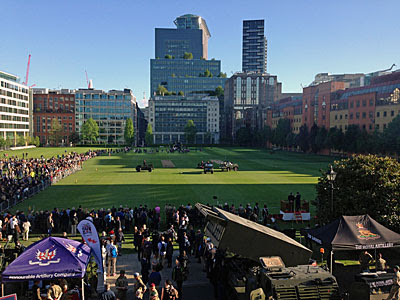
After the Swiss Guard at the Vatican, the oldest military organisation in the world is the Honourable Artillery Company, incorporated by King Henry VIII in 1537. And even though they're still based slap bang in the middle of the City of London, where you'd think there wouldn't be room, their parade ground is huge.
Actually that's not quite geographically true. The HAC's HQ lies one street beyond the City, in the borough of Islington, a mere arrow's flight across the former walls at Moorgate. But it is remarkably close to the capital's financial centre, and your eyes would water at the unimaginable sums that could be raised were its five acres ever sold for offices.
Normally you can't get beyond the gates unless you're an existing or former soldier, but once a year an open evening is held to showcase the work of the regiment and perhaps encourage folk to sign up. And that evening was last night, so if you heard cannonfire and guns reverberating around the City, that was them.
Of those who descended some were bankers, and many were kids in independent school blazers come to crawl over tanks and play with guns. But most appeared to have some sort of military connection, indeed many were in uniform, because you'd likely only think to walk through the entrance in City Road if you'd known in advance the event was taking place.
The HAC served up a free barbecue, because recruitment pays, but never come expecting any kind of garnish - their army burgers are simply a mansized hunk of meat in a bread roll. And OK so the drinks cost, and I had to wait an insultingly long time to get served at the members bar inside Armoury House, but when a beer sets you back less than three quid who's complaining?
At the far end of the field a Chinook had landed, with officers showing visitors the rough and ready conditions for those transported inside. Much of the remainder of the astroturf was ribboned off to form a display ground, upon which soldiers paraded and fired things that smoked a lot, while uniformed dignitaries and the short squat Mayor of Islington watched from a podium.
The Army's motorcycle display team the White Helmets sped round in formation, occasionally stacked up like acrobats, occasionally crisscrossing with aplomb, and just the once embarrassingly falling off. They went on a bit too, far longer than the programme had suggested, leaving the HAC's unit of ceremonial pikemen andmusketeers to wait and wait around for their turn to perform.
There were plans for a parachute drop by the RAF Falcons, which would have been spectacular beneath clear blue skies, but unfortunately this had to be cancelled "due to airspace restrictions over London". Instead the evening drew to a slightly chilly close to the sound of a military band, playing various brass favourites and ending with a bugle call at sunset.
It's one of the most abnormal nights out I've spent in central London, enjoying the slow spectacle but also feeling somewhat out of place. A privileged look inside a place of privilege, and what an amazing oasis to have survived at the heart of our great city.
The oldest purpose-built public art gallery in England isn't in central London, but in the southeasternsuburbs. The Dulwich Picture Gallery was opened in 1817, the result of a posthumous bequest by a generous benefactor. It built on the collection of Edward Alleyn, 17th century founder of the public school nextdoor, and became famous for an important range of works by Western European painters. The gallery's architect was the redoubtable Sir John Soane, who built the place for £11270 'in a plain and substantial manner', ensuring a considerable amount of hanging space within its lofty walls. Several additional small galleries have been tacked on since, and the operation gained charitable independence from Dulwich College just 20 years ago. And if you like a bit of culture, and have a bit of cash, you should go.
There are two bits to Dulwich Picture Gallery, the Permanent Collection and the special exhibition. Visiting the former costs a fiver, topped up by an optional donation of £1 (in that special slightly pleading way that many independent attractions now embrace). The special exhibition, at present a retrospective of the Sussex painter Eric Ravilious, costs £7.50 more. Mmm, Ravilious.
The Permanent Collection fills the long central atrium and a trio of side galleries. Paintings are hung by nationality, with the Italians up one end and the Dutch at the other, the majority still in their original ornate golden frames. Don't come expecting modern abstract art, these are more your Old Masters, with an abundance of pastoral scenes, prim portraits and plump cherubs. And none the worse for that. I found the collection more interesting than your average National Gallery, perhaps due to its compact variety, aided and abetted by just the right amount of text alongside each of the works. You can learn a fair amount about Greek goddesses and windmill design if you pay attention, and learn which once-popular now-overlooked continental painters most inspired our English landscape tradition.
You might have seen the DPG in themedia recently thanks to a clever stunt, or intriguing project, whereby one of the works in the Permanent Collection was deliberately replaced by a fake. Visitors were invited to guess which of a hundred-or-so works it was, which proved surprisingly difficult, and the cuckoo in the nest was revealed only a few weeks ago. It's Fragonard's portrait of a Young Woman, the replica painting sourced from an artists’ workshop in China for a trifling fee. Now the two are hung together it's easy to spot the difference - the colours are too bright, the eyes too inexpressive and the background insufficiently complex. But only one in eight visitors over the previous few months spotted the impostor, which just goes to show whatever it just goes to show.
Each weekend afternoon at 3pm a free guided tour takes place. Someone goes to fetch the member of staff with the loudest voice, and he rings a bell before inviting participants to assemble, and then a curator takes everyone round. This is no lightweight tour, the curator knows her stuff, targeting her favourite works and digging deep into their history and rationale. Equally her audience isn't always up to the challenge, sometimes failing to answer the most basic questions any History of Art student would know, even after the most blatant multiple choice hint. For other visitors not part of the slow-moving walkabout, it pays to keep one step ahead else the painting you're trying to look at is suddenly mobbed and you might as well come back later.
I should have learned the same lesson regarding the Ravilious exhibition. When I arrived at the gallery the queue was non-existent, so I thought I'd do the rest of the rooms first, only for a sudden rush of pensioners to filter in as I drew close. I'll hang on a bit longer, I thought, but alas the queue got longer and longer, due (it turned out) to the arrival of a coachload of elderly visitors from the West Midlands. Ten minutes of standing around eventually got me to the front, where I was offered an audio guide for a bank-breaking extra £3, so no thanks. And I then spent the next half hour attempting to enjoy the very special paintings while they were only part-obscured by the milling Coventrians. Don't come mid-afternoon at the weekend, is I think what I'm saying.
EricRavilious is famous for his watercolours, of which 80 are assembled here. He worked between the World Wars and into the Second, with a unique style honed in his native Sussex. Rolling landscapes were his thing, and interiors, and close-ups of boats, and even people as his career drew to a close. Chalkfigures on hillsides became a particular favourite of his to paint, and also collections of trees either verdant or with sticklike branches. Outside of watercolours he was also an accomplished illustrator and designer, and one of his woodcuts still graces the cover of Wisden Cricketers' Almanack. Eric's talents earned him a place as a War Artist, following the Royal Navy across and occasionally beneath the ocean to record the realities of 20th century combat. It was on one such assignment in Iceland in 1942 that his plane disappeared without trace, and Britain lost his talents at the young age of 39. But you'd like his oeuvre, indeed the gallery are counting on you liking their fridge magnets, notecard wallet, teatowel and silk scarf too.
And there's one more temporary exhibit to mention, this in the mausoleum where the gallery's founder and his wife are buried. Counterpoint is a lightwork by Conrad Shawcross, a twirling mechanical creation made of oak with four lightbulbs on stalks. Each marks out a particular geometric orbit which the artist has replicated for his latest intervention in neighbouring Dulwich Park, called Three Perpetual Chords. This trio of cast iron sculptures is meant to fill the void left by a sadly stolen Hepworth, and they sit on the lawns near the flowerbeds to the north of the lake. Of course, faced with three giant interlocking hoops what children really want to do is clamber all over them, so I hope Southwark council were expecting their sculpture commission to become a giant climbing frame. But then they do art properly in Dulwich, which is a damned fine reason to visit.
My most-shared tweet of the last week, by some distance, is this one.
It's an eye-catching statistic, but how could it be true? Well, I'm obliged to Ian for compiling a list of the 20 most marginal seats in the country, from which we need to consider the closest seven that are Tory-held.
Had these majorities swung to Labour instead then the Conservatives would have had only 324 seats out of 650, which is technically a minority. And for that to happen, what's needed is for half of those forming the majority to switch from Conservative to Labour. For example, the majority of 27 in Gower would have been wiped out if just 14 people who voted blue had voted red instead. Not voting one way brings the majority down to 13, and then voting the other way creates a Labour majority of 1.
Adding these seven figures gives a total of 901. OK, so that's one out from my rounded figure, but you get the idea. 901 voters choosing to back Miliband rather than Cameron would have cut Tory support sufficiently to create a minority Conservative government. And yes, that's only technically, because Sinn Féin never turn up at Westminster so the winning post is effectively 323, and yes, even with 320-ish MPs the Conservatives could have ruled from a position of effective control.
But the fact remains that there are fewer than 1000 people out there on whose choice the outcome of this election hinged. If you changed your mind in Gower, Croydon Central or Bury North, one of those people could be you. Thank goodness nobody knew who you were before the polls opened, otherwise you'd never have been left alone. Electoral reform, anyone? Or does this random selection of a handful of VIP citizens actually work rather well?
Suppose you have a peninsula-ful of flats to sell, and no community to speak of. That's the issue at North Greenwich, where a forest of new apartments are planned, and people need to be persuaded to stump up for one. You'd think that'd be no issue, what with a shortage of housing in London and no end of potential buyers abroad. But you won't keep prices high if your estate isn't firmly rooted, and the developers have recognised that even the O2 has insufficient communal foundations. So they've built a tiny art gallery in their marketing pavilion, they have plans for a 'village hall' that's really a cafe and gym, and yesterday they held their first Urban Village Fete.
They didn't ask the Parish Council to organise this May Fair, because there isn't one, so they got Wayne Hemingway in instead. He took the newly opened parkland to the south of Meridian Square and filled it with stalls, and made the hardstanding by the marketing pavilion somewhere actually worth visiting. You need a maypole at a May Fair, and this event had a hipmulticultural troupe complete with fiddlers and human beatbox, who were both lively and excellent. Less usual features were an eco-village and DJ booth, the latter with Gilles Peterson drafted in, although a stall dishing out noodles is certainly par for the course at urban events these days. A variety of child-friendly activities were bursting out all over, ensuring that the place looked good to families with deep pockets. And Richard DeDomenici turned up fresh from the Boring Conference with his swivel chair, inviting passers-by to sit in it and see how many revolutions they could manage in one spin. Bald and besuited Mark, once he'd put down his marketing brochure, managed three spins before friction took over, whereas Johan later managed a hugely impressive 19.
But the main focus of the Fete was purchase and consumption, this of course with a Wayne-inspired designer focus. Down one path was a Design Market, down another a 'curated market featuring the best of British design', and elsewhere a horticultural quarter including an urban gardening design specialist. This echoes the developers' key marketing strategy of focusing on the stylish internal design of their new apartments, be that by Conran or Tom Dixon, because it's important to plant subliminal ideas in potential purchasers' minds. I'd be surprised if most of the day's visitors lounging in the wild flower meadows are ever going to stump up and buy, they probably came simply to enjoy the fun, of which there was plenty. But it'd only have taken a couple of apartment sales to pay for yesterday's Fete, and embedding a long-term communal buzz here in North Greenwich would probably earn rather more than that.
Elsewhere there are increasing signs that the remediation of the North Greenwich is finally tipping over from post-industrial to residential. Fifteen metal masts are rising on demolished land to the west of the main road, these presumably the beginnings of cranes that will eventually form the Brickfields neighbourhood. And at the northern tip the new multi-storey Marriott hotel is nearly complete, its bland facade in regrettable contrast to the iconic spikes of the Dome behind. But then the intention of Labour's millennial tent was always to act as a catalyst for the development of the peninsula, and fifteen years later that growth spurt has finally arrived. Just be aware that what looks like culture hereabouts has been parachuted in by the developers, and don't move in expecting a genuine community to build in its wake.
11.10James Ward@iamjamesward: Top of the Tower
Conference organiser James explained his love for the Post Office Tower, initiated when he spotted an old postcard of 1965's most iconic building on eBay. His collection slowly grew, soon sufficient for a 2×3 array, then 3×5, and finally an entire framesworth. Inspired, James scanned each postcard and uploaded them to an album on Flickr, before taking the next obvious step and attempting to recreatethem in person. In Fitzrovia he discovered that a bookmakers in Cleveland Street had survived, but that trees now obscured many of the postcard views. James's collection extends to other POT memorabilia, including a jigsaw and a wallet, plus a menu (in French) for the legendary revolving restaurant. This stopped serving Les fillets de Sole and Les Petit Pois in 1980, although non-dining access had ended in 1978. But it was the IRA bomb on 31st October 1971 which had James' conspiracy antennae twitching. A firm called Coventry Scaffolding had swept in to make the upper structure safe, and their website boasts of many other occasions in the 1970s when CS were first on the scene post-detonation. Was their presence purely coincidental, James mused, or were the Goodies (whose famous Twinkle sketch aired a fortnight later) possibly responsible? Today Britain's only revolving restaurant can be found at Center Parcs in Elveden Forest, and they only do breakfast, which is scant replacement for a magnificent central London vantage point which must one day be restored.
11.29Eley Williams@GiantRatSumatra: Weazel Words
Eley introduced us to the uneasy proposition that dictionaries sometimes lie to us for copyright reasons. Webster’s Third New International, for example, included reference to the jungftak, a Persian bird with hooks for wings, to protect against the possibility any other publisher copying their collective work and passing it off as their own. A more celebrated example of deliberate spuriousness comes from the 1975 edition of the New Columbia Encyclopedia, which included a fictional mini-biography for a photographer called Lillian Virginia Mountweazel. Her alleged life story claimed a background in fountain design, a portfolio of photo essays of rural American mailboxes entitled Flags Up!, and an untimely demise in an explosion while on an assignment for Combustibles magazine. Eley's attempts at speculative philology perhaps slipped into over-analysis, but Ms Mountweazel opened our eyes to wilful lexicographical betrayal.
11.44Alex Penman: The Elevator Pitch
In a fantastic Boring debut, seven year old Alex bounded onto the stage (watched from the wings by his proud mum) and proceeded to tell us why he likes lifts. They have different names, for a start, and a long history stretching back to 236BC. Alex may have been reading from his brief Powerpoint but he delivered his presentation with confidence and aplomb, grinning and giving a big thumbs up to the gallery whenever the slide needed to move on. A slight glitch playing the soundtrack of the Wallace and Gromit lift at Bristol Children's Hospital failed to throw him, and I quite agreed that the Otis 2000 at The Deep in Hull is something special. A name to watch.
11.50Sarah O'Carroll@GasometerGal: My Year of the Gasometer
Sarah has a love for the gasometer, or gasholder as she acknowledges others often call them. These behemoths of industrial heritage were introduced by the Victorians as storage for town gas, and are now increasingly obsolete as the National Grid rationalises its property portfolio. Bitten by their ornate beauty, she compiled a map of all the gasometers within the M25 and set about visiting them, in most cases before they were dismantled. Battersea boasted a fine and varied cluster, now making way for housing, while Southall's lofty gasholder was painted with an arrow to guide Heathrow-bound pilots before the introduction of satellite navigation. Imperial number 2 at Fulham is the oldest still in existence, apparently, and Hornsey 1 remains a fine example of geodesic design. Sarah lifted the lid on what's to be found inside a gasometer (a huge pool of water surrounding a brickwork lump called the dumpling, on which the cover rests when the gas is all piped out), and suggested her collecting spree might spread further across the UK, from Norwich to Stornoway.
12.09Rachel Souhami@rachelsouhami: An Insider's Guide to Exhibition Text
Dr Rachel, once a museum curator, guided us through some of the general issues behind the panels that accompany an exhibition. These are often the last thing to be added to an exhibition before it opens, but are crucial in presenting a context for the exhibits on show. Around 70-80 words is optimal, but even so only 30% of visitors ever read the text, research has shown. As an example she compared the current exhibition at the Whitechapel Gallery, which is unnervingly text-free, with a lengthy trek along a series of text panels at the National Museum of Denmark, which is more like reading a book.
12.21Eleanor Curry@Eleanor_Curry: 12th century French Love Poetry
Scheduled presenter Joanna Biggs had to withdraw due to illness, so Eleanor was one of two comedians drafted in at the last minute to fill the gap. She recounted the peculiar tales behind two of her favourite poems by late 12th century poet Marie de France. In the runner-up a visual affair between a wife and her neighbour ended with the slaughter of garden nightingales, while the winner used lycanthrophy as a metaphor for syphilis. A woman accidentally marries a werewolf, like you do, then banishes him to the forest by stealing his clothes. Here he is discovered by the king who takes him home as 'court wolf', whereupon the wife is exiled and her female descendants cursed to be eternally nose-less. It was funnier the way Eleanor told it, indeed pitch-perfect.
12.30Matt Highton@matthighton: Good Bad Films
In a second stand-in appointment, Matt riffed his favourite films that are so bad they're good. Occasionally (and particularly pre-millennium) a film's budget, characters and dialogue combined to create a cinematographic disaster encouraging endless repeat viewings. Anaconda (1997) is one such gobsmacker, its stars J-Lo and Jon Voight unable to cover up ghastly CGI lapses including reversed footage showing a waterfall that flows upwards. King of Matt's pile however is Jaws The Revenge (1987), the fourth film in the series, in which Chief Brodie's widow and the great white's offspring engage in a blood feud off the Bahamas, and whose fees helped lead actor Michael Caine to buy a new house.
12.44Irving Finkel: The Great Diary Project
Dr Finkel is another museum curator, this time the Assistant Keeper of Ancient Mesopotamian script at the British Museum, and boasts a bushy white beard any Santa would be hugely proud of. Inspired by the Imperial War Museum's selective rejection of a soldier's 76 volume diary, he joined together with the librarian at the Bishopsgate Institute to set up a permanent repository for all things diaroid. Irving posits that diaries are the sole form of literature in which the author always tells the truth, and as such they form an invaluable record of the zeitgeist. And yet relatives often discard diaries after the writer's death, perhaps for fear of reading what's written within, so many are now enormously grateful that The Great Diary Project exists to give them somewhere to go. The Institute now holds 6000 diaries, signed over with copyright permission, and much in demand from a range of researchers. How marvellous it is when writing survives from one age to another, Irving says, and imagine the repository we'd have now if something similar had been done in the 18th century. As a diary writer myself, currently with 38 complete volumes, it's reassuring to know that they need not all end up in a binbag.
Lunch: An hour and ten minutes provided sufficient time for food, and to explore the contents of the Boring goodie envelope.
14.13Louise Ashcroft@LouiseAshcroft1: The Stratford Centre
Louise is a subversive artist, for example buying ethnic fruit in street markets and taking it to Tesco to see what the cashiers make of it. For her talk she discussed the StratfordCentre, Newham's antithesis to Westfield, whose footfall accidentally totals 21 million visitors a year. The Centre makes Louise nostalgic for the concrete shopping centres of her youth, and she has great respect for its manager Andrew Norton. As a local resident I know the place well, and I can vouch for its evening transformation into a skateboarding haven where the local youth flip and and wheel to pumped-out music. Nevertheless I felt slightly uncomfortable as Boring's generally middle class audience appeared to laugh at, rather than with, the shops and shoppers of E15, the biggest guffaw being for a bag of bacon mis-shapes. Louise stuck up for the place, however, deftly applying the Centre's marketing philosophy of "taking something negative about yourself and owning it" to a variety of London-wide interventions.
14.33James Harkin@eggshaped: Rude Words James is QI's lead elf (who you may have seen on Only Connect last season), and mused how Quite Boring a researcher from a quiz show like Quite Interesting could be. His career trajectory as a scientist began when caught at school scouring a dictionary for rude words, a subject to which he has more recently applied proper statistical methods. For this purpose he has devised a somewhat suspect integral, which utilises a 'coefficient of childishness' calculated with reference to a short list of base words. James explained that our alphabet allows for approximately 17500 possible 3-letter words, and that any dataset of sufficient words will always contain some deemed either rude or interesting. To this effect he rifled through a complete list of Catholic bishops to find Bishop Assman, and a list of British birds to find the Elegant Tit and Mrs Benson's Brush Wobbler. Perhaps more importantly he wondered why poopoo is a far more popular password than weewee, and similarly why Liverpoo outranks Liverpool.
14.47Andrew Hunter Murray@andrewhunterm: The Casio F-91W - A design classic
Andrew is another QI elf, and delighted in giving us a full contextual history of Casio's most enduring digital watch. The F-91W is a black-strapped three-button lozenge, first manufactured in 1991 but still available in Argos (rrp £8.99) to this day. This retro-wearable runs on a CR2016 battery which lasts 7 years if used responsibly - this equating to 20 seconds of alarm beep daily plus one second using the internal light. Although functionality is minimal by modern standards, users can still enjoy playing with the stopwatch, and enjoy the Easter Egg 'Casio' displayed on screen by pressing down the right-hand button for three seconds. As the proud owner of its silver sister the A158-W, which I've been wearing since the 90s, I attempted Andrew's trick but succeeded only in accidentally setting the hourly beep, which was then a nightmare to turn off. I'm in good company, seemingly, with Barack Obama a former F-91W wearer, but also Osama Bin Laden, the cheap mechanism ideal as a terrorist's countdown timer.
15.04Dan Schreiber@Schreiberland: Wheelbarrows
Dan is yet another QI elf, completing a trio of non-pointy-eared BBC2 researchers, and spoke of his Theroux-inspired passion for wheelbarrows. In particular he delved into their origination, this the subject of hotly-debated academic warfare over whether the first was in Ancient Greece or China. The former sometimes ferried women around in wheelbarrows, and occasionally their bellies too if they were fat enough. The Chinese however made the wheelbarrow their own, with large central-wheeled barrows for transporting people and possessions, even wind-assisted barrows with sails. Although modern barrows are loved by some, the wheelbarrow is by far the least popular item in a Monopoly set (but is thankfully yet to be replaced).
15.15Andy Riley@AndyRileyish: Roundabouts
Andy, the author of those cartoon books of Bunny Suicides, came to talk about experiencing the great outdoors in unusual wild places. The modern wi-fi-enabled campsite no longer provides an appropriate environment for raw outdoor activity, so Andy (and others) instead indulge in 'Wild camping' in prohibited locations, for example Boddington Hill near Wendover or the coastline of the Isle of Grain. Andy's gyratory revelation came in a Badtime Bedtime Book feature in the Monster Fun Annual 1978 which told the Louis Stevenson-inspired story of Traffic Island. He camped overnight on the Pyebush roundabout near Beaconsfield, a wooded circle almost one hectare in extent, setting up tent and campfire and foraging for blackberries and hawthorn berries for sustenance. As we enjoyed his tales, Andy reminded us that some camp out on roundabouts not for "knobby psychogeographical reasons" but out of necessity, these being some of the last unfenced unobserved public spaces. But beware of autumn, as Sharon Simpson learned while camping out on Derby's Pentagon roundabout, because falling leaves inevitably reveal your presence to the authorities.
15.34Joe Gilbert@joegilbertt: Barbican
We enjoyed Joe's elegiac short film, subtitled Urban Poetry, which I'm delighted to say you can watch in full here.
Break: Followed by an audience participation game of Guess Who, led by Greg Stekelman, which would have worked better had more of us been wearing hats.
16.25Rhodri Marsden@rhodri: A Proposal For A New Scale Of Measurement For British Earthquakes
Having apologised for the potentially inappropriate timing of his idea following the disaster in Nepal, Rhodri turned to the weighty issue of Britain's relatively feeble earthquakes. Deeming the Richter Scale inappropriate in a country that's suffered only eleven seismic fatalities since records began, he set out to use witness reports of twenty recent UK tremors to create his own more realistic index. His exposition was hindered somewhat by the dodgy Powerpoint clicker wielded by all the presenters, and more importantly by the fact the final page of his presentation hadn't printed out. But here are a selection of the descriptions on Rhodri's 20-point scale to give you a flavour of how useful it might be.
2 Right on the cusp of being felt
3 Like a cat falling off wardrobe
7 Motorbikes topple over
10 Like the Hulk jumping about
12 Like a rhino had run into the house
16 Like a big invisible tractor
19 Mugs nearly falling off shelf
16.40Keith Kahn Harris@KeithKahnHarris: The Logistics of Transgression
Subtitled 'Why the Dark Side is Hard Work', Keith's anthropological talk delved into some unusually uncomfortable subject areas. Kicking off with Black Metal, a trangressive form of heavy metal, he outlined some of the tedious procedures required to keep a malevolent music format commercially viable. He moved on to discuss kidnapper Josef Fritzl, who was only able to detain his daughter's incestuous family through a systematic programme of nappy-buying, and the Nazis' 'Banality of Evil' whereby a dull penpushing culture allowed the Holocaust to continue. Logistics and infrastructure are essential to experiencing the joys of transgression, he argued, leading to the inevitable conclusion that "evil is most effective when it is boring, and evil is most exciting when it is ineffective." With this in mind, Keith hopes that Islamic State will soon consume itself by failing to maintain an appropriately mundane bureaucratic system.
16.55Richard DeDomenici@DeDomenici: Invoices I Have Yet To Send
Returning to the Boring Conference after a short break, performance artist Richard subverted expectations by sending several overdue invoices live from the stage. He's very bad at doing his paperwork in a timely manner, hence some quite sizeable invoices had piled up for a variety of past shows and projects. A first email for 4 t-shirts was fired off from his laptop while we watched, with a photo of the audience duly attached for comic effect. With time running out Richard rushed his next invoice for Tits and Tinsel 2014, and thus accidentally sent it to the wrong contractor who should instead have received the final bill for £1586. By utilising the pressure of live performance these normally boring tasks had been completed without procrastination, proving that the mundane can sometimes be both entertainingly inspiring and financially rewarding. You can watch Richard's performance, somewhat close up, here.
17.10James Miller@jmlostboys: Quiet Evenings at the Moriglen Care Home
Author James chose to read us his e-book, or at least part of it, because time was pressing and his short story wasn't short enough. In it he imagined himself 50 years hence, elderly and immobile, resident in an American care home where the evening's entertainment is a Viagra-infused grannybang. Perhaps thankfully we never reached the octogenarian sex, instead restricted to James recounting his future bladder problems and frustrated post-erectile desires. As the conference organiser attempted to wind up the late-running show from the wings, James read on to leave us hanging after his grandson-to-be had delivered the pills and condoms, hoping that we'd then go away and purchase the remaining 4000 words. I'd be surprised if he succeeded, but then you never do know what you're going to get at the Boring Conference, and this year's offered the most eclectically satisfying box of audio-visual chocolates to date.

Once there are half a dozen separate Overground lines, you'll be seeing their official names more often. And their official names are unexpectedly long. The new West Anglia acquisition, for example, goes by the overloaded moniker of Liverpool Street - Enfield Town/Cheshunt/Chingford, which is hardly catchy. Meanwhile the former East London line assumes the mouthful that is Highbury & Islington - West Croydon/Clapham Junction. We should be grateful that map designers refrained from using the full name proposed in TfL's style guide, which is Overground Dalston/Highbury & Islington - West Croydon/Crystal Palace/New Cross, because that's insane. But sheesh, somebody important has clearly decided that reflecting geographical reality is more important than brevity, and stuff how difficult it for us to read.
Dear Londoner,
You might have seen the DPG in the media recently thanks to a clever stunt, or intriguing project, whereby one of the works in the Permanent Collection was deliberately replaced by a fake. Visitors were invited to guess which of a hundred-or-so works it was, which proved surprisingly difficult, and the cuckoo in the nest was revealed only a few weeks ago. It's Fragonard's portrait of a Young Woman, the replica painting sourced from an artists’ workshop in China for a trifling fee. Now the two are hung together it's easy to spot the difference - the colours are too bright, the eyes too inexpressive and the background insufficiently complex. But only one in eight visitors over the previous few months spotted the impostor, which just goes to show whatever it just goes to show.
Suppose you have a peninsula-ful of flats to sell, and no community to speak of. That's the issue at North Greenwich, where a forest of new apartments are planned, and people need to be persuaded to stump up for one. You'd think that'd be no issue, what with a shortage of housing in London and no end of potential buyers abroad. But you won't keep prices high if your estate isn't firmly rooted, and the developers have recognised that even the O2 has insufficient communal foundations. So they've built a tiny art gallery in their marketing pavilion, they have plans for a 'village hall' that's really a cafe and gym, and yesterday they held their first Urban Village Fete.
Notes from Boring 2015