The London postcode area that stretches to the coast
Do you share your postcode with the seaside? Some Londoners do, but how can this possibly be?
And that's proper seaside, not some miserable stretch of the Thames Estuary which is the best Becontree (RM) or Sidcup (DA) can manage. We're talking sunshine coast with beaches, piers, pavilions and cliff lifts, plus the waves of the English Channel lapping against the pebbles. Could this be where you live?
The Queen's SW postcode only reaches Wimbledon. Wembley's HA postcode barely scrapes Hertfordshire. My E postcode at least makes it into Essex. But there is a part of the capital that shares its postcode with the actual coast of actual Sussex and also actual Kent, and that is actually astonishing.
Where you need to live is Bromley, which is interesting because Bromley has its own postcode area which is BR but it turns out not all of the London borough of Bromley is covered by the Bromley postcode.
Is Crystal Palace the special place we seek? No it is not. Could it be Chislehurst? No it's not there either. Perhaps it's Orpington, but let me stop you there and tell you it isn't. We need to look deeper south than that, almost down on the border with Kent but not quite. There's even an airport.
The postcode area in question is much bigger than you might expect it to be. It crosses the London boundary and the M25, then the environs of Sevenoaks and the High Weald as far as Bodiam Castle, Ashford International and Dungeness power station. These are not addresses you want get muddled with a house in the capital, but the Royal Mail makes this potentially possible.
A lot of Kent is covered by the Medway (ME) and Canterbury (CT) postcodes. These do not reach London so Folkestone, Margate and Sheerness cannot be within the postcode area we seek. Instead we're talking about the southwestern part of the county and even quite a bit of East Sussex because that's how big it is.
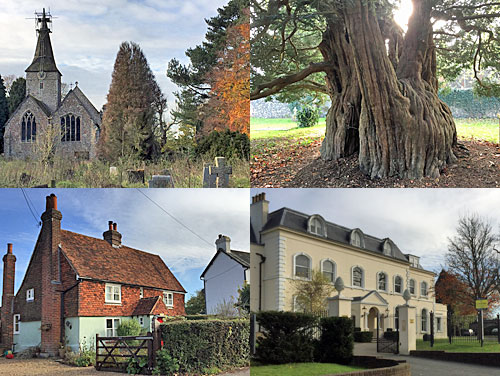
The southeast edge of London is very rural, including back lanes that get hardly any bus services or none at all. This is where we find the special postcode dribbling over the border and a few cottages getting their mail delivered from a sorting office outside London rather than within.
One such residence belongs to Nigel Farage whose bolthole on Single Street is just the right side of the dividing line, whereas slightly further up the lane in Luxted and Downe would be BR6. Our Nige may be properly peeved to live within the fiefdom of mayor Sadiq Khan but at least he shares his postcode with the Kent coast.
Another lucky location is Cudham - less a village, more a linear hamlet - whose residents also have this seaside postcode. The furthest north it goes is probably Snag Farm in Hazelwood, an even less significant settlement but somehow an amazing 40 miles from the opposite edge alongside the English Channel.
The massive postcode area in question is in fact the TN postcode area, which sounds like it ought to be named after Tonbridge but is in fact centred on Royal Tunbridge Wells. This spa town serves a relatively small part of Kent but its postal hinterland is inexplicably vast, from TN1 all the way up to TN40 for Bexhill-on-Sea.
The postcode districts that scrape the edge of London are in the low teens. One is TN14 which is officially Sevenoaks but reaches out to Knockholt, Shoreham and Otford in Kent plus the aforementioned Cudham. The other is TN16, officially Westerham, which amazingly even includes a bit of Surrey which'd be the village of Tatsfield.
Your best chance of being a Londoner with a seaside postcode comes if you live in Biggin Hill, as ten thousand people do. Its steep residential avenues all come under the TN16 remit, as does the Waitrose on Main Road and of course the whole of the airport complex. Fly from Biggin Hill to London Ashford Airport on Romney Marsh and it's TN all the way.
So there you have it, a sprawling postcode area that somehow contains Biggin Hill and Bexhill, Cudham and Camber Sands, and Hazelwood and Hastings. You might even be one of the Londoners who live in it, the mighty TN... the postcode that stretches from the capital to the coast.
My 21st random ward is essentially Cannon Street station and a few blocks either side. It's where the Walbrook once flowed into the Thames, duly defended by a barrier called the Dowgate, "dou" being the Anglo-Saxon word for water. The ward's small, slopes down to the river and the upper bits are generally more interesting than the lower. [pdf map]
CannonStreet is one of the largest stations in the City, a terminus to feed southeastern commuters into the Square Mile and not its finest architectural moment. The most recent addition is the monolithic crossbeamed office block above the station entrance, a replacement for John Poulson's controversial 1960s development. The gloomy concourse beyond is because the air rights were sold in the 1980s to make way for two office blocks above the platforms (and a sports club underneath), more with an eye to BR's bottom line than to customer experience. A Wetherspoons and a lonely WH Smiths are amongst the non-delights to be found up the steps before the barriers, and the platforms stretch all the way across Upper Thames Street as far as the water's edge.
The most interesting thing about Cannon Street station is what it used to be, which was an Anglo-German medieval trading complex. The Steelyard was a walled community built by the Hanseatic League in 1475 to smooth the export of wool and cloth between England and Cologne, and contained a chapel, weighing houses, a guildhall, wine cellars and residential quarters. Queen Elizabeth I eventually stunted their influence, but it wasn't until 1852 that the Germans sold the land to the South Eastern Railway allowing them to gain a toehold in the City. The dark riverside passage under the end of the platforms, the one that always smells of chlorine emanating from the adjacent health club pool, has been named Steelyard Passage in its honour.
At the foot of one of Cannon Street's twin brick towers, beside the Banker pub, a set of steps provides the City's best pedestrian access to the Thames foreshore. It's not the original set Samuel Pepys ran up to warn the Mayor of London about the Great Fire, more a modern safety-conscious replacement, and descends into lapping water if you turn up either side of high tide. My timing was unfortunate so instead of further sentences describing mudlarktastic exploration I can only draw your attention to a post I wrote in 2015.
The rest of Thames-side Dowgate is a textbook example of how modern development eradicates the historic street pattern. Red Bull Yard, George Alley and Old Swan Lane used to run down to a set of waterfront wharves but have since been swallowed by the footprint of two enormous office blocks, 1 Angel Lane and Riverbank House. The former replaced BT mega-switchroom Mondial House a few years ago and is home to Barclaycard and Japanese bank Nomura (who were proud enough to invite Open House-rs to their 1 acre roofterrace in 2017). The pedestrianised boulevard separating the two used to be an alley called Angel Passage but is now a stripe of sanitised public realm with benches that hardly see any direct sunlight. If you've ever wondered where the City of London's fire station is it's here, squished inbetween Nomura and Cannon Street platform 1.
An underused timber-clad footbridge provides a shortcut for Nomura employees trying to cross Upper Thames Street. It lands within a Bath stone colonnade on the northern side under a squarish office block called Governor's House (although I turned up while it was being jetwashed so wasn't allowed out). Londinium's governor lived here in what would have then been a prime riverside location, and Prudential's current HQ had to be built cautiously to avoid disturbing the foundations of the Roman palace underneath. The whorl of cobbled lanes nearby has a Georgian feel, courtesy of a few finely-decorated townhouses and a lamplit alley between two burial grounds. This is Laurance Pountney Hill, today more a ramp than any kind of contoured challenge, and belonged to yet another church that didn't survive 1666.
The District line runs just to the north under Cannon Street in a cut and cover tunnel, then swings beneath the mainline station and exits under Cloak Lane. Here in 1879 it encountered the graveyard of another Great Fire casualty, the church of St John the Baptist upon Walbrook, necessitating the collection of all the mortal remains in the railway's line of travel. Five years later they were reinterred in a vault topped with a classical monument, duly inscribed, which now finds itself in a grimy recess forming the tube station's fire exit. The view's not great but stand here for a few minutes and the sound of trains can clearly be heard not so very far below.
This part of the City is particularly densely populated with livery halls. At the top of Dowgate Hill is Tallow Chandlers Hall, home to the medieval livery company devoted to fat-based illumination, who've since reinvented themselves by embracing BP and other oil companies. Nextdoor is Skinners Hall, whose money originally came from treating skins and hides, and whose doorpost announces that the Worshipful Companies of Turners, Fuellers and Fanmakers are also based inside. Nextdoor to them is Dyers Hall, the bunch who now take responsibility for Swan Upping, and across College Street is Innholders Hall, which was originally for hostellers rather than publicans. Of these the Tallow Chandlers have the best decorated entrance, the Innholders have the best sign and the Skinners have by far the best address, which is 8½ Dowgate Hill.
Dowgate's last church standing is St Michael Paternoster Royal at the foot of College Hill, rebuilt by Wren (and again after a V1 strike). Its most famous parishioner was Richard Whittington, the panto-friendly four-time Mayor of London who the local blue plaques refuse to describe as Dick. He lived a few doors up the lane and was buried beside the altar, although last time the tomb was opened they didn't find his body, only that of a mummified cat. The parklet alongside the church, opened on a neglected bomb site in 1960, unsurprisingly bears the name Whittington Garden. This hosts a strange pair of identical statues donated by the Italian government, allegedly depicting a rider on horseback, plus a bubbling fountain... perhaps evoking when this used to be the Roman riverbank.
100 ways to boost your herd immunity on Freedom Day
(because if only 1% of the population has Covid, then 99 of these are totally safe)
1) Lick a pensioner. 2) Attend a children's party. 3) Leave the car at home and cram onto public transport this morning. 4) Ceremonially burn the face covering you haven't been wearing for the last few months anyway. 5) Unpin that "actually I'm exempt" badge from your jacket. 6) Uninstall the Test & Trace app because it's finally working properly. 7) Book a foreign holiday safe in the knowledge that quarantine can't be reimposed soon. 8) Throw all your lateral flow tests in the recycling. 9) Go to the cinema and sit immediately behind someone who looks nervous. 10) Ignore that niggling shortness of breath because it's not an official symptom. 11) Find a nightclub that opens at midnight and get yourself on the floor. 12) Reacquaint yourself with the delights of bar service. 13) Stop getting tested, because if nobody tests there won't be any cases. 14) Sit down next to a fellow rail passenger with a satisfying plop. 15) Organise an end-of-term school trip to a local care home. 16) Finally gather the entire family together for roast turkey and all the trimmings. 17) Be sure to rip down any lingering "stay 2m apart" signs you find while out and about. 18) Jog to your local supermarket, then pant a lot by the entrance. 19) Reinstall Tinder so you can get back out there and spread yourself. 20) Head into the office rather than cowering in safety in your spare room. 21) Join the mourners at a nearby funeral and elbow your way into the second row. 22) Go round and shut all the windows upstairs on the bus. 23) Assume the "please wear a mask" sign by the shop door can now be ignored. 24) Head to Chequers and jeer over the security fence. 25) Buy advance tickets for a gig repeatedly postponed since March 2020. 26) You feel really safe now, so why not spend prolonged time with a vulnerable individual? 27) Remember it's your civic duty to support local businesses now the Chancellor isn't. 28) Stop feeling so nervous about everything, you big wimp. 29) Meet all your friends indoors rather than outside in the nice sunny park. 30) Sneeze over an elderly relative so they can get sick while the hospitals are less busy. 31) Don't get vaccinated yet because the government might increase the incentives later. 32) Think how cool it would be to be patient zero for a brand new variant. 33) Stop washing your hands because that was ridiculous nanny state behaviour. 34) Remember, the economy needs you to think you're invincible. 35) Say 'yes' to everything, life's too short. 36) Support inner city hospitality because they've been waiting 16 months for you to come back. 37) Uninstall Zoom because meetings are always much more productive in person. 38) Remember you can't catch it twice, even though this in unproven. 39) Sit on the bus proudly announcing you haven't been vaccinated, even if you have. 40) Throw caution to the wind because surely things can't get any worse. 41) You're still alive, so the disease's fatality rate must have been exaggerated. 42) Let's laugh at all the hypochondriacs overseas still behaving cautiously. 43) If your chin feels empty now you're not wearing a mask, grow a beard. 44) Now we've proved Covid was a hoax, why not join the Flat Earth Society? 45) We're all going to have to lock down again in September, so get out and party now. 46) Stop worrying that everyone else might be infected because only some of them are. 47) Pledge to cheer all the big Olympic finals down the pub. 48) You must be sick of the UK by now so get on a plane out as soon as you can. 49) A trip to the cinema is a good way to find out if you really are 'extremely vulnerable'. 50) Relaxation is irreversible so book your Xmas party now. 51) If the PM can do what the hell he likes, why shouldn't you? 52) It's about time we prioritised the impatient over the incautious. 53) Freedom to overburden the NHS is at the heart of what it means to be British. 54) We can save more jobs if you stop jogging and go back to the gym. 55) When the next election comes round, remember Labour wouldn't have freed you so soon. 56) Killing off the rest of the elderly should solve the UK's social care crisis. 57) Let's put QR codes back in the Dark Ages where they belong. 58) Ending all regulations can't possibly be worse than what's gone before. 59) Lots of these people will just die of flu this winter, so why not a few months early? 60) It's much safer abroad, so protect yourself by booking a holiday there. 61) Reacquaint yourself with the thrills and smells of peak-time commuting. 62) If they haven't been vaccinated it's their own fault. 63) Follow the Health Secretary's lead by lowering your guard and attending face to face meetings. 64) We just need to learn to live with it, or die trying. 65) If herd immunity's a myth, we can only prove that by embracing it. 66) If you get pinged, claim you're on a special trial and carry on regardless. 67) Now's a great time to join a choir, the larger the better. 68) A 'request' to wear a face covering is even more easily ignored. 69) Thousands more deaths are a small price to pay for going to festivals again. 70) Make it a challenge to see how many people you can sit next to in a day. 71) They'll cut your local bus service if you don't start using it again. 72) So long as everyone else continues to exercise caution, you don't need to. 73) The risk from poor ventilation indoors must be at its lowest during a heatwave. 74) It's been too long since you interacted with 100s of random strangers daily. 75) If we all infect each other and force another lockdown, Boris will surely have to resign. 76) Best go back to the office even if you feel unwell or they'll think you're workshy. 77) What we really need is some good old-fashioned British recklessness. 78) There's no point holding big events again if nobody's going to go. 79) Long Covid is an illusion so long as it happens to someone else. 80) This country never got to be great without taking the occasional risk. 81) If we're lucky it might last long enough for us to go watch the new Bond film. 82) It's not proper freedom until you've broken a few rules. 83) Hospitalisations are still rising, so best unlock now before they reach their peak. 84) Assume you had it months ago without realising and then act accordingly. 85) The most important thing is to ease the future tax burden as quickly as possible. 86) It was only ever guidance, and now it's not even that. 87) Technically the risk from climate change is much greater, so refocus your angst. 88) The most important freedom is that the government can do whatever it likes. 89) Rip off your mask and return to the joys of shopping unmuzzled. 90) The only danger at a big wedding reception is that your suit no longer fits. 91) It is safe out there - the Prime Minister's out of circulation for a week. 92) It's finally OK to stop tutting about mask non-compliance. 93) The rabid unlockers only need a few weeks of freedom to see the folly of their ways. 94) The government didn't cause what happens next, you just weren't careful enough. 95) Everyone needs to spend every night this week down the pub. 96) If we play our cards right we could infect the entire country in a week. 97) Celebrate Freedom Day by hugging a stranger, preferably several. 98) We can't expect people to follow rules forever. 99) Use personal judgement. 100) Exercise common sense.
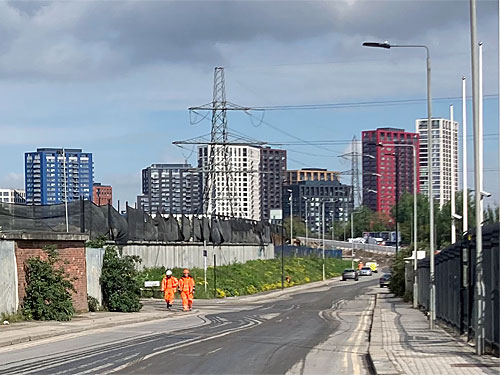
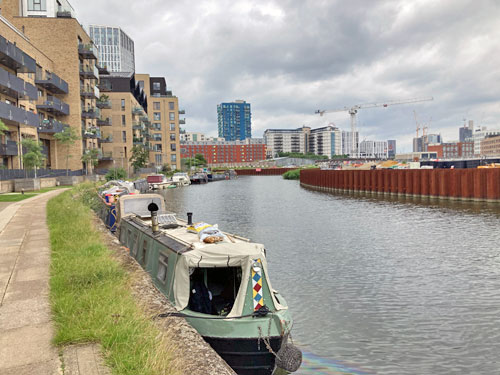
This is Blackhorse Road on the outer reaches of the Victoria line. A few years ago you'd have been hard pushed to spot it from a distance, but a cluster of highrise housing has arisen alongside and now you can't miss it. Availability of post-industrial land provided the ideal opportunity to cram in thousands of homes, and all within easy commuting distance of central London, so up it's shot.
The key to explosive upward development is a well-connected station serving an unfulfilled catchment. Here it's because only one side of Blackhorse Road has terraced streets and the other's reservoirs, playing fields and industrial units, with a paucity of residents that's helped make this the least used station on the Victoria line. But in the 21st century that's an opportunity rather than a setback, so come live in Blackhorse Mills, Blackhorse Yard or Blackhorse Point and hey presto, the skyline erupts.
It's happening near me at Bromley-by-Bow, another station stunted by the River Lea with previous development on one side only. But in the 21st century even a small brownfield footprint is a valuable thing, so a strip of land between the river and the A12 is exchanging scrappy businesses for residential accommodation. The old hospital site overlooking platform 1 was first to gain a lofty tower, creating a landmark visible from afar, and a lot more are currently going up across the road.
There ought to be a name for this kind of thing, like Station Focused Development, Highrise Transit Hubs or Modal Landmark Clusters. But where are the best examples in London? I'm thinking particularly of isolated suburban residential peaks that stand out on the horizon, where recent turbo-charged residential development is solely because they have a station at their heart. You can already spot Blackhorse Road and Bromley-by-Bow stations from afar, so where else?
Canning Town definitely qualifies. This is another backwater Lea Valley station dragged screaming into estate agent heaven when the Jubilee line arrived and opened up all that lovely brownfield alongside. It now boasts three separate residential monsters - Hallsville Quarter overlooking the A13, City Island on a bend in Bow Creek and the latest curtain wall alongside Silvertown Way branded the Brunel Street Works. Every available scrap of space matters because excellent connectivity breeds maximum massing, and it's all very obvious from a distance.
Colindale very much counts, a zone 4 outpost that's increasingly reimagined itself as a highrise neighbourhood. This image is from a TfL consultation document for a new station building, and clearly shows a sea of older housing surrounding an island of modern flats. Developers have merrily knocked down loads of old buildings to create a residential peak focused on a Northern line station, I'd say with miserably little character, but it certainly stands out.
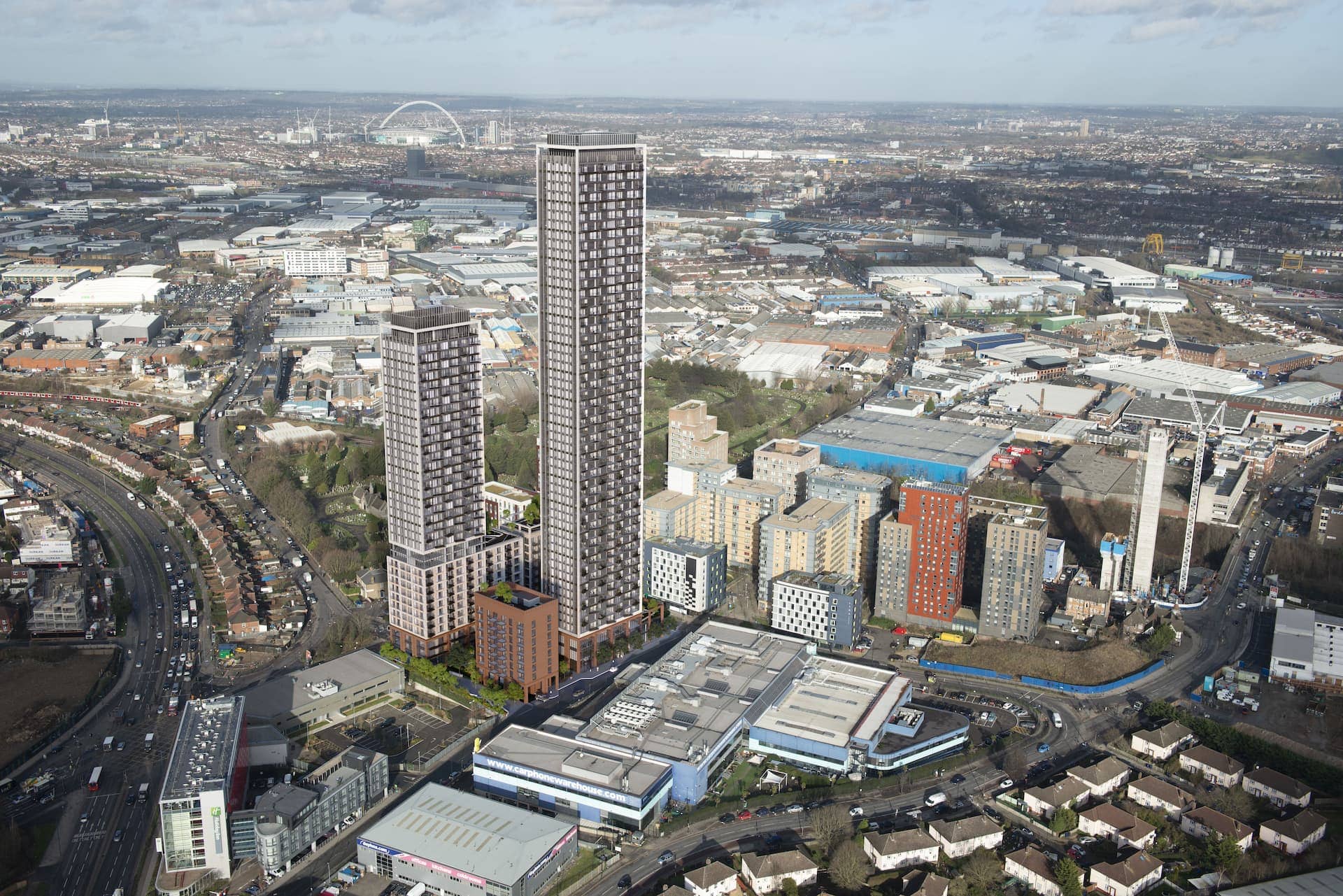
North Acton is another candidate, possibly the most demoralising cluster of upward real estate that can be blamed on proximity to a tube station. A grim canyon of flats now greets those alighting from the Central line, some of whom call a small elevated box home. The only bright spot was The Castle pub, which is now to be demolished and replaced by further student towers. The image below shows One West Point, a twin-pronged aberration currently under construction whose tallest building will have 54 storeys and exceed the height of Wembley's arch. Not all Station Focused Development is positive.
Tottenham Hale must be on the list, with an ever growing forest of flats on the Lea-ward flank of the station. Pontoon Dock DLR might also count, its car park recently transformed into taller than average towers. Stratford's sort of got it, although the cluster of mega-towers by the station is diluted somewhat by mega-towers elsewhere. Elephant & Castle's not suburban enough to be a proper example, and I won't be counting Nine Elms either. But Lewisham is very much heading this way, Ilford's trying and Abbey Wood might just tip over.
A century ago in Metro-land swathes of residential avenues were a deliberate consequence of station-building. Today we're filling in the gaps by building upwards where stations have yet to meet their full potential. If you can see it from a distance, the developers have already triumphed.
• NHS waiting list could reach 13 million
• confirmed: all restrictions withdrawn next week
• "vital to proceed with caution" (PM)
• August peak could see 1000-2000 admissions daily
• reopening plans are "reckless" (Labour)
• Scotland & Wales will still require face coverings
• ...as will public transport in London
• Balearic islands added to amber list
• over ½m asked to self-isolate in one week
• UK unlocking "poses threat to the world"
• quarantine required for all returning from France
• Health Secretary tests positive
Now that the sun has come out I have been to Canary Wharf to enjoy Summer Lights, a unique exhibition of eleven exciting new artworks that shimmer and shine in natural light. It's really a ploy to attract Londoners to all the local hospitality options, so very much like the regular Winter Lights festival but smaller, sparser, sunnier and less cold. I found it much easier to read the art blurb in daylight, and to wonder who on earth wrote it.
I started by the Thames with Ocean Rise by Aphra Shemza.
This mixed reality sculpture built using sustainable material emulates a wave in the ocean and highlights the rise in sea levels due to global warming creating a connection between the physical and the digital. Firing up a bespoke soundscape created by sound artist Mowgli accessed via a QR code would have allowed me to contemplate my role in the current climate crisis and offered a moment of calm amidst the busyness of city life, but instead I just looked inbetween the wooden slats and was underwhelmed.
A short distance along the riverside I came across Shine your Colours by Tine Bech Studio.
This multifaceted artwork consisting of 6 transparent coloured glass panels allowed me to see myself and the world through different colours. The whole environment invited me to take playful photos within a space focused on wellbeing where people can meet, relax and reflect, but I declined because it was just 6 transparent coloured glass panels and the overarching sensation was meh.
Then I went to Cabot Square to reach Circle of Light (Spectrum) by toyStudio.
This installation expresses the many colours which make up sunlight and the visual spectrum, mapping them into an arc defined by the position of the sun at sunrise and sunset, bringing something as ethereal as a rainbow to the Canary Wharf landscape in the tangible form of public art. The definition of the colours is supposed to become more or less defined depending on the angle and intensity of the sun, but only if you hang around for hours and I managed seconds.
Crossing the road I stepped into Hymn to the Big Wheel by Liz West.
By stepping playfully into this immersive sculptural work exploring the illusion and physicality of colour and natural light in space I was encouraged to reposition and align myself to differing colourways to see a changing scope of jewel-like colours mixing before my eyes, creating diverse mixes and blends in context with my surroundings. I made sure to walk round the inner octagon at least once. I thought the floor was quite mucky.
In a pedestrianised street I found Summer Cloud We Dream Of You by Tine Bech Studio.
This playful work reflecting both visitors and the world around us is the perfect metaphor for our age, evoking child-like wonder in the abstract identity created in new forms with shape-shifting qualities that can inspire hope not only representing the idea of change but symbolising the human ability to dream. They are perhaps overdoing the word 'playful', I thought.
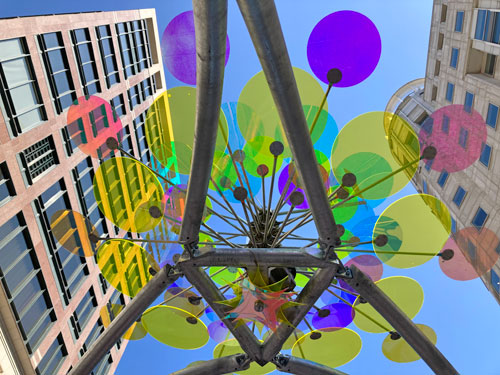
At the foot of Cubitt Steps was Whirl by Helena Doyle X Tom Cherry & Temple.
This installation aims to showcase the beauty and versatility of wind power and inspire the audience to imagine a future powered by renewable energy by transforming the wind into a dynamic dance of colour and light. I was invited to sit beneath the domed structure, relax and enjoy the mesmerising light show overhead, except there was no wind and nothing spun, let alone dazzled, so that metaphor fell flat.
In Jubilee Park I discovered Round and Round by Martin Richman.
I anticipated these discs bringing the Jubilee Park ponds to life, creating a lively space full of reflecting and refracting shapes and colours, creating moving shapes illuminating everything around them, casting visually rich patterns of coloured light responding to the weather and the artificial illuminations within its orbit... but the shadows of the trees and buildings meant the circles just rotated sometimes and that was mostly it.
Wrapped round the entrance to the shopping mall was Kaleidoscopic Prisms by Fiona Grady.
Inspired by the children’s toy yadda yadda combining a palette of rainbow transparent vinyl triangles that dance across the glass surface yadda yadda the coloured shapes interlock and follow the structure of the glass panes to create directional arrows that lead the viewer’s eyes to the central entrance yadda stained-glass effect yadda joyful palette yadda unique experience yadda yadda yadda. Never stop and read the art blurb.
It was quite a hike over to the Crossrail Place Roof Garden for Hidden Garden by Hugh Turvey.
These blown-up images, each a scientific representation of flora, use the medium of x-ray imaging to highlight their hidden architectural structures and allow visitors to engage with nature on a more intimate level, exposing just how fragile nature can be. There aren't many and they only appear at one end of the garden, scattered amongst office workers downing a tub of lunch, so don't rush. Every other display up here over the last year has been more enticing, even the cheap fluorescent one.
Finally I trudged over to Wood Wharf to see Kilpi by toyStudio.
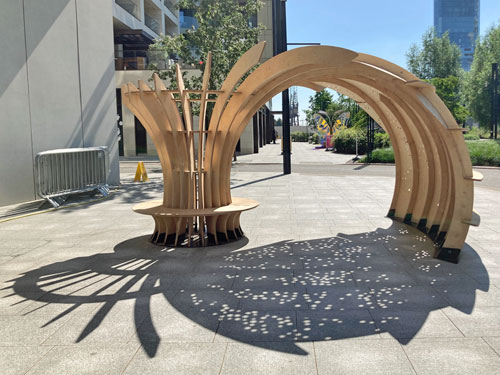
This installation is inspired by traditional Nordic Sami huts and places of shelter in their most basic form with intricate perforations based on celestial maps representing the constellations found in the skies above to create ever-changing dappled shadows, projecting the celestial map onto the city’s landscape, but only if the sun's not blocked by clouds or a skyscraper otherwise it's just a wooden shelter with holes in the roof.
A few steps away was Out of the Cocoon by Amberlights.
The accompanying text was barrel-scrapingly vacuous (a colourful, interactive seating installation that can be admired both from afar and up close) and just a tad patronising (an installation that allows the theme of metamorphosis to be understood by children and adults alike) but I rather liked the giant four-way translucent butterfly wings and if the other ten had been like this I wouldn't have walked off quite so dissatisfied, so maybe wait for Winter.
Ploughing through a stack of documentaries on iPlayer I started watching Extra Life - A Short History Of Living Longer, a four-part series called casting a spotlight on "the forgotten heroes of global health". For part 3 on Data I thought we'd get Florence Nightingale and her graphs, and we did, then when cholera came up I assumed it'd be John Snow and his famous map of cases clustered round a water pump in Soho. Not so. Instead David Olusoga popped up at Three Mills, just behind my local Tesco, and proceeded to tell the story of William Farr and London's last cholera epidemic.
Which started here...
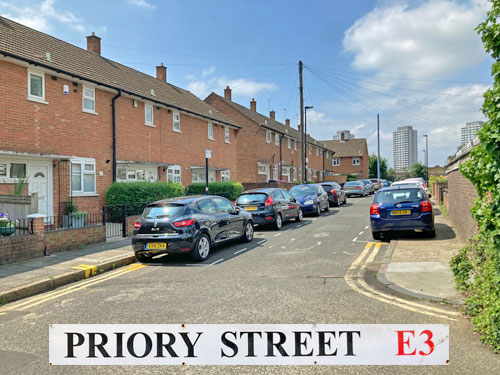
This is Priory Street in Bromley by Bow, a brief residential backwater two streets south of the Bow roundabout and very much not the sort of place you'd expect to be epidemiologically significant. Today it's lined by roomy 1970s housing built when the eastern end of the street was devoured by the Blackwall Tunnel Approach Road. Before that it was mostly prefabs, courtesy of direct hits by the Luftwaffe, and before that a closely packed Victorian terrace. London's last cholera epidemic kicked off here in June 1866.
Cholera first arrived in London in 1831 and surged with particularly nasty consequences in 1849 and 1854, killing thousands. Scientists wrongly believed it was caused by miasma, a noxious form of "bad air" emanating from rotting organic matter, and continued to believe this even after John Snow's removal of the Broad Street pump handle supposedly proved otherwise. Joseph Bazalgette's groundbreaking sewer system was actually driven by the intention to remove the smell of sewage from the capital, rather than the contaminated seeping liquid itself.
William Farr was the government's chief health registrar at the time, and was overly swung by his own pet theory that deaths were concentrated in low-lying areas because miasma was heavier than air. He even produced a graph to demonstrate this, because that's what pioneering statisticians do, entirely failing to spot that correlation does not imply causation. But during the 1866 outbreak his nose for data-collecting paid dividends, as compiling a list of deaths by area confirmed that 93% were within the area served by the East London Waterworks Company. Here's Farr's map with the first two cases circled... at 12 Priory Street.
Number 12 was the home of a labourer called Mr Hedges and his wife, both aged 46. Their water closet wasn't yet connected to Bazalgette's new sewer system because that wasn't quite finished, so all the local sewage still drained directly into the River Lea. Tidal flow meant contaminated water drifted upriver as well as down, reaching the reservoirs of the East London Water Company just beyond Bow Bridge. When Farr visited the site on 3rd August the company claimed all their water was filtered, whereas in fact the reservoirs were inadequately protected allowing river water to seep in with deadly consequences.
Farr immediately wrote to Joseph Bazalgette who set about installing two temporary pumps at Abbey Mills, and within weeks local sewage was diverted to the new Northern Outfall sewer rather than the Lea. The outbreak ceased, but not before 4000 people within the catchment area of the East London Waterworks Company had died. Of wider consequence is that Farr was now finally 100% convinced that cholera was a waterborne disease, and this swung wider medical opinion in favour of what turned out to be the truth.
The Lea is much cleaner round here these days, although swimming remains unadvised because sewage is still intermittently discharged upstream. The reservoirs that supply the capital are larger and much more carefully regulated, not to mention a lot further away. Modern day residents of Bromley-by-Bow can turn on their taps in full confidence that drinking the water will no longer kill them. And Bazalgette's Low Level Sewer still takes Priory Street's effluent away, indeed in the most astonishing coincidence it runs directly underneath... as the telltale stink pipe at the end of the road confirms.
Cholera still kills tens of thousands a year across parts of the world where sanitation and infrastructure are inadequate, but we have Victorian scientists and engineers to thank for wiping it out here. I confess I never previously realised the role my immediate neighbourhood played in that success, but sometimes local history is the most amazing history of all.
Walking down Roman Road yesterday I noticed that its Barclays branch is closing down. Come the middle of September it'll be gone.
Last bank standing, fallen.
It's a bit rich because when the Barclays on Bow Road closed in 2019 they made a big thing of the fact you could always go to the branch 0.7 miles away on Roman Road, but now they're closing that too.
Ah well, I thought, at least there's still a Nationwide.
I walked a bit further and blimey, that's closing too next month.
Which means Roman Road, Bow and indeed the entire E3 postcode will have no banks or building societies left whatsoever. Given that E3 has a population of just over 50,000, that's a lot of people to suddenly find themselves counter-free. We still have three post offices and a dozen free cash machines so the world of personal finance hasn't ended, but it's a bit of a surprise when your area goes bankless.
It's particularly rough given that Nationwide's current strapline is "Here today, here tomorrow", because they pledged to "every town and city in the UK that has a Nationwide branch that you’ll still have a branch until at least January 2023." However they've decided that promise doesn't apply in this case because Bow isn't a town or city but part of the wider community of Greater London.
Never mind, they say in their impact assessment, "in the case of Bow, we have five branches within a 3 mile radius". And while this is true the nearest of them is at Westfield and that's a 30 minute journey, or an hour's round trip, because distances in London are more about time than mileage.
Bow's 21st century problem is its proximity to Stratford, which still has two Barclays, two HSBCs, two Lloyds, two Nat Wests, a Santander, a Halifax and a Nationwide. Stratford'll be one of the very last places in London to go bank-free, so that's a local bonus. Meanwhile Canary Wharf still has seven banks/building societies, if you can get there, and the neighbourhood centre of Bethnal Green has five.
Totting up all the contenders there are still 17 banks and building societies in the borough of Tower Hamlets - population one third of a million - but mostly in two locations rather than conveniently spread.
London bank/building society closures 2021 Barclays: Acton, Brentford, Bow, Camberwell, Catford, Chadwell Heath, Cheapside, Chiswick, Deptford, East Barnet, Erith, Fleet Street, Hackney, Hainault, Hampstead Garden Suburb, Harringay, Highbury, Kentish Town, New Malden, Northwood, Park Lane, Plaistow, Ponders End, Shepherds Bush, Southampton Row, Stanmore, Strand, Surrey Docks, Temple Fortune, Welling, Westcombe Park, West Drayton, West Hampstead (33) HSBC: Barnet, Bexleyheath, Charing Cross, Eastcote, Edgware Road, Fenchurch Street, Fleet Street, Hackney, High Holborn, Kingsbury, Marylebone, Old Broad Street, Russell Square, Southgate, South Woodford, Streatham Hill, Surrey Quays, Whitechapel (18) Lloyds: Belvedere, Blackheath, East Dulwich, Gants Hill, Hendon, Kentish Town, Northwood, Regent Street (8) Nat West: Brixton, Croydon Centrale, Knightsbridge, Lambeth North, Portman Square (5) Santander: Balham, Barking, Beckenham, Bethnal Green, Bishopsgate, Camberwell, Catford, Chelsea, Chingford, Chiswick, Coulsdon, Dagenham, Dalston, Enfield Highway, Finchley, Fulham, Hanover Square, Harold Hill, Hayes, High Holborn, Hounslow Bath Road, Leytonstone, London Bridge, Mill Hill, Moorgate, New Malden, Norbury, Petts Wood, Pinner, Putney, Shepherds Bush, South Harrow, Southgate, Strand, Surbiton, Twickenham, Upper Edmonton, Welling, Wembley Preston Road, West Wickham (40) Nationwide: Bow, Clapham Junction, Crouch End, Kingsbury, Leyton, Putney, Selsdon, Sidcup, Threadneedle Street, Wanstead, Wealdstone, West Ealing (12) TSB: Acton, Barnet, Burnt Oak, Cockfosters, Eltham, Putney, Sutton (7) Halifax: Pinner, Plaistow, Upminster (3)
Nationwide tell us transactions at the Bow branch dropped 9.7% between 2015 and 2020 and that 73% of customers already have online banking. For Barclays it was a 14% fall between 2019 and 2020 and 89% using other ways of banking that triggered closure. Most customers will just sigh and go elsewhere. But a significant number of disadvantaged people are going to be significantly disadvantaged by these closures, as the threshold for keeping a bank branch open gets steadily higher and higher.
It's sad because the Nationwide on Roman Road always has always looked busy, indeed during lockdown you could tell by the sheer size of the queue outside that it was a lifesaver.
Four years ago Bow had three banks and a building society. After September it'll have none.
Conditions of carriage - TfL
You must wear a face covering when in our bus and rail stations, on our platforms, Emirates Air Line terminals and river piers and on our bus, tram, train, Emirates Air Line and Dial-a-Ride services.
For example...
• ...at Rickmansworth, which is outside London but owned by TfL so you'll have to wear a face covering even if you're waiting for a Chiltern service, but you can take it off once you step aboard.
• ...at Upminster, which is not owned by TfL so you won't need a face covering to enter the station but you will need to put on it if you step onto on a District line train or Overground service.
• ...at Finsbury Park which is not owned by TfL (so you're not "in our stations"), but has tube platforms underground where you will have to wear one (because you'll be "on our platforms").
• ...at Farringdon, which is operated by TfL but has separate Thameslink platforms where you definitely should/shouldn't wear a face covering, it's not clear.
You can probably think of other awkward regulatory interfaces...
What museums and galleries were open to Londoners in 1938? I have a pre-war A-Z with a gazetteer of Places of Interest so I can look them up. Here's a list of all the places they listed with an admission price, free or otherwise. The most intriguing sub-list is the last one.
(For the benefit of readers younger than me, 6d = 2½p, 1/- = 5p, 1/3 = 6p, 1/6 = 7½p)
Was free, still free
» Bethnal Green Museum (now the V&A Museum of Childhood)
» British Museum
» Chelsea Royal Hospital
» Geffrye Museum (now the Museum of the Home)
» Guildhall & Art Gallery
» Horniman Museum
» Imperial War Museum
» Ken Wood
» Museum of Practical Geology (now part of the Natural History Museum)
» Natural History Museum
» Royal College of Surgeons (now the Hunterian Museum)
» Royal Exchange (now shops and services)
» St Bartholomew's Hospital Museum
» Science Museum
» Soane's Museum (now Sir John Soane's Museum)
» Southwark Cathedral
» Temple Church
» Victoria & Albert Museum
» Westminster Cathedral (but lift 1/-)
» Westminster Hall
Now cheaper on Fridays than they were in 1938
» National Gallery (free except Thu, Fri 6d)
» National Portrait Gallery (free except Thu, Fri 6d)
» National Maritime Museum (free except Fri 6d)
» Wallace Collection (free except Tue, Fri 6d)
Now cheaper midweek than it was in 1938
» Tate Gallery, Millbank (free except Tue, Wed 6d)
Special access arrangements
» Buckingham Palace (permission to visit the Royal Stables can be obtained by writing to the Master of the Horse)
» Goldsmith's Hall (admission usually obtainable on written application)
» Royal Mint (written application to be made in advance to the Deputy Master, parties not to exceed six)
No longer free
» Dulwich Picture Gallery (now £16.50)
» Leighton House (now £9)
Partially free in 1938
» Royal Academy of Arts (permanent galleries free, annual exhibition 1/6) (exhibitions now £17-£22)
» St Paul's Cathedral (free, Crypt 6d, Whispering Gallery & Stone Gallery 6d, Golden Gallery 1/-, Ball 1/-) (now £17)
» Westminster Abbey (free, but ambulatory & chapels 6d) (now £18)
Admission fee has increased somewhat since 1938
» Charterhouse (was 1/-) (now £15)
» Dickens's House, 48 Doughty Street (was 6d) (now £9.50)
» Hampton Court (was 1/- weekdays, 6d Sat, free Sun) (now £25.30)
» Kew Gardens (1d, Tue and Fri 6d, bank holidays free) (now £17.50)
» Madame Tussaud's (was 1/3, Chamber of Horrors 6d extra) (now £30.50)
» The Monument (was 3d) (now £5.40)
» Tower of London (was 6d, Jewel Tower 6d, Bloody Tower 6d) (now £28.90)
» Zoological Garden (1/-, except Mon 6d) (now £29.50)
No longer open
» Cuming Museum, Walworth Road: Its relics of the Stone age and the civilisations of Babylon, Egypt, Greece, Rome and Mexico illustrate the development of man's work from prehistoric to recent times. (free)
» Duke of York's Column, Waterloo Place: View from top. (6d)
» Royal United Service Museum, Whitehall: Occupies Inigo Jones's Banqueting Hall. The museum deals with the naval and military history of Great Britain and contains a collection of arms, armour, models and relics. (1/-, soldiers & sailors free)
» Home Office Industrial Museum, Horseferry Road: Contains exhibits of methods and appliances for the promotion of safety and health amongst industrial workers. (free)
» Imperial Institute, Imperial Institute Road: In order to promote an interest in the Empire, the exhibits show the geography, resources and commercial products of each country. (free)
» India Museum, Imperial Institute Road: A branch of the Victoria & Albert Museum devoted to the portrayal of the life, art and religion of India and its surrounding countries. (free)
» London Museum, Lancaster House: Illustrates the domestic and social history of London from pre-Roman times to the present day, and includes a collection of costumes associated with the Royal Family. (free, but Tue 1/-, Wed & Thu 6d)
» Parkes Museum, 90 Buckingham Palace Road: Contains exhibits relating to modern hygiene in architectural and food values, disinfection etc for the prevention of disease. (free)
» Public Record Office, Chancery Lane: Here amongst other interesting documents are to be seen the Domesday book, papers concerning the Gunpowder Plot, a letter from George Washington to George III and the log book of the Victory.
Demand-responsive bus services are increasingly popular in certain parts of the country, especially for councils with limited budgets, but also for passengers who appreciate an almost-door-to-door service. They have to be booked via an app or a phone call, unlike normal bus services where you just turn up and go, but they're still a lot cheaper than getting a taxi or an Uber.
In 2019 TfL introduced demand-responsive minibus schemes in two London boroughs, mainly to discover if and how they worked. One of the lucky boroughs was Sutton, which entirely lacks TfL tube and rail services, and the other was better-connected Ealing. If your journey was entirely within one or the other you were in luck.
Roger French rode both, and you can check his reportage by clicking in the table above.
Both services were introduced as twelve month trials so that lessons could be learned, but in unfortunate timing the pandemic intruded so both were withdrawn in March 2020. TfL have no intention of bringing either back, which suggests the biggest lesson learned is that demand-responsive schemes are uneconomic, but they've also analysed several aspects of the trial and (silently) published a 15 page report. It's informative stuff.
Sutton
Ealing
Trial duration
10 months
4 months
Unique riders
5547
1846
Total rides
80901
16275
Rides in busiest month
10717
5183
Awareness of scheme
75%
35%
The Sutton trial had the chance to gain momentum and grow awareness, whereas Ealing never really took off. Less than half a per cent of Ealing's adult population gave it a go, whereas GoSutton managed a more impressive 3%. Sutton's total ridership was also much higher, and double that of Ealing over the busiest four week period.
But these are very low numbers compared to normal bus services. In Sutton the best comparison would be with routes S3 and S4 - small single-door buses which pootle indirectly round the backstreets two or three times an hour - and these normally each carry 60,000 passengers a month, not 10,000.
Sutton
Ealing
Freedom Pass rides
47%
31%
Wheelchair rides
13%
0.2%
Both services turned out to be a hit with the elderly, especially GoSutton where they accounted for almost half of the passengers. Those with Freedom Passes swiftly worked out this was essentially a free shared taxi, which often looked a lot more attractive than getting the car out of the garage or catching buses to their destination. Sutton's service proved especially attractive to those in wheelchairs - an astonishing one in six passengers were wheelchair users.
Older passengers weren't put off by an app-based service. Sutton dedicated hotline was only needed by 17% of Freedom Pass holders, and Ealing's by just 3%. The report notes that "phone bookings were low and proved costly for the service", and also that "the phone service did not provide the same level of customer experience... because there was no way to update customers on the vehicle location or show visual directions to the bus stops".
TfL don't reveal in the report whether their demand responsive buses made any money but I think we can safely assume not. With fewer than 100,000 passengers and so many wielding Freedom Passes the total takings must have been less than £200,000, which'd never cover eighteen vehicles, their drivers and all the backroom staff. Also fares were lowered after a few months to try to boost passenger numbers, which is a perfectly reasonable tactic to try in an information-gathering trial but will have knocked income down even further.
The big hope with DRT is usually that it'll take car drivers off the road but this didn't really happen. Only 29% of GoSutton users would have taken a car or taxi to complete their journey, whereas over half would otherwise have used the bus... so TfL were just taking passengers away from themselves.
Many people who downloaded the app and registered an account never used it to take a journey (amounting to 39% in Sutton and 25% in Ealing). One issue may have been that requesting a trip was no guarantee of being offered one. On average 12% of requests for trips on GoSutton were not met, rising to a whopping 35% for Slide Ealing... and if you can't rely on a service you're less likely to use it. Also the average wait time for a ride was about 10 minutes, and not everyone was willing to wait that long.
Sutton
Ealing
Bookings involving sharing a vehicle
56%
36%
Passengers per driver hour
3.9
2.0
In Sutton you had a roughly fifty-fifty chance of getting the minibus to yourself, whereas in Ealing two in three took solo rides. This is reflected in the fact that drivers weren't generally carrying more than four passengers an hour - way below what would be expected on a normal London bus route. We're told "both services had empty mileage on more than half the kilometres operated", which is no way to run an efficient service.
But most of those who used the service rated it very highly, particularly the helpfulness of the driver and the cleanliness of the vehicle. Even paying customers thought it was good value for money, perhaps comparing it to the cost of a taxi or the inconvenience of a bus. The key issue proved to be that only a small number of potential passengers were taking advantage...
"The service offered more direct journeys, but it proved difficult to persuade people to use it."
The report concludes by saying that TfL are already using the results of the trial to improve their Dial-a-Ride service, and are also keen to share their data with local authorities elsewhere in the country. But it seems London has such a good transport network, even in its outer reaches, that demand responsive bus services don't look like being a realistic way forward.
(I started writing this post at 4pm yesterday when anything seemed possible, indeed likely)
If you want to see three lions you can go to London Zoo because they've got five. Normally you can also go to Trafalgar Square where four Landseer lions guard the base of Nelson's Column but that's off limits as present because it's been requisitioned as a fan zone for the Euros. Thankfully the capital has thousands of other lions, mostly embellishments and statuary, so I headed off in search of three particularly interesting prides...
Lions 1) The Victoria Embankment
The Victoria Embankment was constructed between 1864 and 1870 so has been shoring up the river for a century and a half. It exists because it was the best way of shoehorning a megasewer, a road and an underground railway into the heart of the West End, but also narrowed the Thames and caused its tidal range to increase. The embankment was constructed of granite-faced battered walls topped with a moulded parapet, interrupted at intervals by pilasters topped with ‘sturgeon’ lamp standards. These are easily seen but unless you're out on the river it's harder to spot the bronze lion heads positioned underneath, one apiece, each with a mooring ring in its mouth.
There are far more than three lions, there are dozens spaced out around the bend between the Palace of Westminster and Blackfriars Bridge, designed by the sculptor Timothy Butler. They look individually splendid, each now with a greenish patina, and occasionally lean downwards if their top fastening's come away from the river wall. What they don't get used as these days is mooring rings, partly because boats are a lot heavier than they used to be but also because the tide fluctuates so much the water level's usually several metres below. Indeed there's a rhyme about that.
This rhyme isn't a Bazalgette original, more an urban legend that's grown up based on apocryphal observation. The water level gets up to the mooring rings during spring tides, particularly in spring and autumn, and heavy rainfall or a tidal surge can add a few more inches. But although the mouth is just above pavement level it's still comfortably below the level of the wall, especially since an extra foot of concrete was added after the only serious inundation. That was back in January1928 when the embankment overtopped here, but more significantly in Pimlico where ten people drowned in their basements, there being no lions to protect them.
Lions 2) The Law Society
Next we're off to Chancery Lane and the headquarters of the Law Society, the august professional body who oversee the working lives of solicitors. They've been at it since 1825, and been based here at number 113 since 1832. The building boasts an Ionic pedimented portico of four unfluted columns with recessed sash windows in shallow moulded architraves, and was augmented in 1904 by an annexe designed by Charles Holden, the bloke who did all those tube stations. What we're interested in are the railings in front of the newer bit where we find several dazzlinggolden lions sitting on their haunches, thirteen in total.
They started life across town on low posts by the entrance lodges outside the British Museum, and were designed by Dorset-born sculptor Alfred Stevens. He's the man commissioned with devising the Duke of Wellington's memorial in St Paul's Cathedral, despite only coming fifth in the competition, a monumental task which consumed most of the rest of his life. When the British Museum ditched their lions in 1896 some were placed on the railings around the Wellington monument and the rest ended up here in front of the Law Society building where it's a lot cheaper to stand and admire them. They've also been coated in something gold, whereas those guarding the Duke are bog standard iron, so you get a much blingier lion with the Law on your side.
Lions 3) The College of Arms
The monarch's heraldic experts have been based on Queen Victoria Street since 1555, long before Queen Victoria or her street existed. It's their job to grant coats of arms, record pedigrees and issue diktats on the flying of flags, as well as turning up at coronations in brightly-coloured tunics. Officially they're part of the Royal Household which'll be why the royal coat of arms takes pride of place above the steps at the main entrance. This features a crowned lion standing on a crown as the crest, plus a lion on the left (representing England) and a unicorn on the right (representing Scotland). If you're Irish you have to make do with a quarter on the shield rather than a rampant beast, and if you're Welsh bad luck.
England's three lions are also a heraldic feature, the royal arms of the Plantagenets. They were first used by Richard the Lionheart who started out with one or two lions on his shield but eventually stuck with three in 1198. The symbols of other countries (including France) subsequently found themselves incorporated into the royal arms but England has always been represented by gules, three lions passant guardant in pale or armed and langued azure. The College of Arms know these things, indeed it's their job, so this is plainly the finest place to go lion-spotting during a major tournament.
Lions are readily seen elsewhere across London.
(also, for one day only, on the comatose bodies of young men in replica shirts)
Euros final liveblog 🏴 🇮🇹 19:00 Only an hour to go. 19:10 I'm having steak and kidney pie. 20:00 Kick-off. The score is nil nil. 20:02 Goal 😀 20:49 Off for oranges at half time. 21:05 Back. 21:27 Goal 😢 21:57 There will be extra time. 22:40 There will be penalties.
😢😀😀😀😢😢😢😢😀😢 22:54 ENGLAND HAVE COME SECOND! 22:55 I'm sure everyone will be very happy with that.
Tonight England have the opportunity to celebrate their biggest triumph since 1966 when they face Italy in the Euro 2020 final at Wembley. Victory would be the country's first major tournament win in half a century and for the team the biggest moment of their professional lives so far. The England players hold their destiny in their own hands, but they'll have to be at their very best if they're to topple the Italian side and realise their European dream.
Gareth Southgate and his young team have the opportunity to become national heroes when they step out in front of 60,000 supporters at Wembley in the most important match the national side has played in a generation. This is the moment many England fans thought they would never see, a milestone in English sporting history and an unmissable opportunity to deliver the country from the gloom of the last year by embracing the prize of European glory.
As this momentous day dawns Bobby Moore remains the only male captain to have lifted silverware, but Harry Kane is just one win away from doing what no other England captain has done since that fateful July day. He has a special gift where football's concerned, plus a heartfelt drive to win it for the fans, and after scoring the goal that ended England's run of major semi-final defeats he knows he's spearheaded a team that has thrilled the nation.
The squad are all just normal lads doing a job but this'll be the biggest game in their careers so it's time to step up and grab the opportunity with both hands. A tough game lies ahead but the Three Lions know they can win it so the mood is upbeat and confident. Every one of them should be proud of the way they've represented themselves on behalf of the country, their motivation's been 100%, so it's just a case of staying calm and positive and believing they can do it.
It's now four weeks since Harry Kane led the team out for their opening game and so much has happened on the road from Wembley to Rome and back again. The players have peaked at precisely the right time, working towards a common goal and underlining their collective tactical focus. Football has dominated the national conversation with the country cheering the boys every step of the way through tears of unbridled joy. It's been an undeniably exciting time.
There's no doubt that England have reshaped the history that has weighed them down in past tournaments. We now have a national team to be proud of, overflowing with personality, pride and purpose, shepherded by a kind, intelligent and empathetic ambassador who knows the scale of the challenge. They have the confidence to step up when it matters and the self-belief to remain focused and clear-minded in the face of fierce opposition, both on and off the pitch.
This is a once in a lifetime opportunity for a new generation of down-to-earth footballers to share the stardust and write one more piece of history. Rashford, Saka and Sterling have the technique and mentality to withstand the pressure, grasp home advantage and finally end England's long-term generational shame. This must be the moment each player dreamt of as a child, lifting a trophy for their country on the steps at Wembley, not the usual agonising loss on penalties.
The final training sessions have been completed as the build-up reaches fever pitch. The road to Wembley has rarely been more passionate. There's only one place to be tonight, whether you're at home or in the pub, as excitement exceeds expected levels and hope is superseded by belief. England have never lost a major tournament final and are hoping to get their hands on the European trophy for the first time, and the team that scores the most goals will win it.
Every time England play they have an opportunity to create new memories for fans that last a lifetime. Football runs deep through the veins of this island and the team's hunger for success has already inspired a generation. These are the big moments when heroes stamp their names on footballing history as all ages come together to rally behind the flag. You don't realise you're in the moment until it's a memory, but tonight will be remembered forever whatever the final result.
Expectations are also high for Italy who are unbeaten after 33 matches, but there is pride at the school where Kane grew up and Gareth Southgate has a depth of options and the team is impatient for glory and millions of fans are managing their nerves and the question on everyone's lips is whether a team focused on passion and dedication can restore national pride and you have to believe it's possible so we'll all be cheering them on in every corner of the country.
It's a tense countdown for England supporters as they manage their nerves in advance of kick-off, tens of millions of us will be getting ready to watch the drama unfold, the focus of the world will fall on Wembley, the fans cannot wait to find out what happens on the pitch, it's a massive deal, everyone's got that butterfly feeling that we can end that 55 year-old drought, the talking is almost over, there'll be some sore heads on Monday morning.
Tonight is the toughest step of all, the very definition of a landmark experience, a unique national occasion, we're finally within touching distance of glory, it's payback for all those years of falling short, half a century of hurt, the lads have already done the whole country proud, they'll face a tough fight, they say they're ready, the ultimate goal is to finish the job, there'll be nerves, expect a fierce battle from both sides, fate will surely prevail.
England expects, it's time to deliver, echoes of 1966, a real 50-50 game, a match to remember, a scramble for silverware, a crowning moment, a huge weekend, one for the history books, it's what we live for, failure is not an option, it's coming home*!
• Duchess of Cambridge self-isolates
• Queen awards George Cross to NHS
• all legal restrictions will end at Step 4
• "if not now, when?" (PM)
• gap between jabs cut from 12 to 8 weeks
• double-jabbed won't have to self-isolate
• ... or quarantine after visiting amber countries
• surge in foreign holiday bookings
• no pupil bubbles in schools next term
• no spectators at the Tokyo Olympics
• NHS app to be desensitised
• 1 in 160 Britons has the virus

Tonight England have the opportunity to celebrate their biggest triumph since 1966 when they face Italy in the Euro 2020 final at Wembley. Victory would be the country's first major tournament win in half a century and for the team the biggest moment of their professional lives so far. The England players hold their destiny in their own hands, but they'll have to be at their very best if they're to topple the Italian side and realise their European dream.