• booster to be offered to all over-40s
• 2nd doses to be offered to 16/17 year-olds
• "storm clouds"/"new wave" gathering over Europe (PM)
• Ireland reintroduces working from home
• 4th wave hitting Germany "with full force" (Merkel)
• booster to be added to NHS Covid pass
• Netherlands may extend school Xmas holidays
• inflation tops 4%
• Austria to introduce compulsory vaccination
• Austria to go into full lockdown
Worldwide deaths: 5,090,000 → 5,140,000 Worldwide cases: 253,000,000 → 257,000,000 UK deaths: 142,835 → 143,866 UK cases: 9,524,971 → 9,806,034 1st/2nd/3rd vaccinations: 50.7m/46.1m/14.6m FTSE: down 2% (7347 → 7223)
Rather than write the usual travelogue about the Norfolk resort of Sheringham, allow me to show you a selection of interesting signs spotted around the town.
Signs of Sheringham
• The phrase 'twixt sea and pine' has been emblazoned in large blue letters across the sea wall below the east cliff. This is an inaccurate translation of the town's motto mare ditat pinusque decorat which really means "the sea enriches and the pine adorns", referencing both the North Sea and the coniferous woods inland. Sheringham is the only town in the UK with pine cones and a lobster in its coat of arms.
• The Mo turns out to be Sheringham's museum which is housed on the seafront above a storm overflow tank. It's named after Morag Pigott, the old lady who originally lived in the house on this site (but which the military destroyed for training purposes during WW2). Lifeboats are big draw at the museum, as you'd expect, but it also contains a nationally-significant collection of 40 fishermen's sweaters. Connoisseurs of salty knitwear should note that the galleries and observation tower are out of bounds at present while The Mo is closed for the winter.
• At Sheringham station, where the buffers ought to be, a panoply of stop signs warns Greater Anglia trains to proceed no further. This is because the track continues across the taxi rank, over the main street, through a small parklet and underneath a level crossing gate... where it enters the domain of the North Norfolk Railway, a popular steam-driven concern enabled by Dr Beeching, and continues all the way to Holt. Festive passengers are currently being carried aboard the Norfolk Lights Express, an illuminated service running (almost) nightly until January, and which Olivia Colman was spotted riding earlier this week.
• According to a plaque at the end of Whitehall Yard, the first bomb to be dropped on Britain landed in Sheringham on a Tuesday evening in January 1915. It was dropped from a Zeppelin by a German pilot who'd got a bit lost on the way from Hamburg to Hull, an easy mistake to make on a stormy night, and the payload failed to explode. Great Yarmouth and King's Lynn were not so lucky. Alas the plaque is incorrect, at least with regard to Sheringham being first, because a German plane had already dropped a bomb on a back garden in Dover on Christmas Eve 1914.
• You probably can't read the blue plaque on this photo of The Old Smoke House, but don't worry, you don't need to. It says "This building was formerly used as a smoke house", which may just be the most pointless blue plaque of all time.
• No mammoths have been uncovered in Sheringham thus far, but follow the arrow to discover a stretch of sea wall where a local painter has celebrated the West Runton find. David Barber's Neolithic Mural includes sabre-tooth cats and rhinos as well as tusky mammoths, plus dung beetles if you know where to look, but is already looking a little worse for wear after five years of tidal splashes.
• Those with king-sized continental quilts may wish to know that the Sheringham Launderette on Beeston Road has the largest duvet machine in North Norfolk. Those with standard-sized bedding may be still be interested to know, via another blue plaque, that it was built on the site of the town's 18th century paper mill.
• Many seaside high streets contain unusual shops, but I don't think I've ever seen one specifically devoted to bargain books and jigsaws. The puzzles at The Discount Books & Jigsaw Co Ltd didn't seem especially cheap (it was £9.99 for a 500 piece festive scene of small dogs playing by a Christmas tree) but they do offer a decent price for a Woodcraft Construction Kit of the RMS Titanic.
• Of course Sheringham has beach huts, and of course they have supposedly amusing names. Sandy Groyne is one of the better ones, and Seas The Day just about tolerable, but whoever called one of them Wine & Wives should be ashamed of themselves.
• It's time for Richard Crabtree to retire and so Major Dunn Revival, the bric a brac shop on Church Street, is shutting its doors. The shop is named after a Sheringham antiques shop called Major Dunn which Richard remembers visiting in the 1940s, and which was a high street staple for many years. Alas everything has its time and a prolonged closing down sale at Richard's store has been underway since April. Anyone needing a military helmet, grandfather clock or ceramic owl should head down fairly swiftly.
• Up a quiet sidestreet, Margaret's Hairstylists has instead slipped quietly away. A sign on the door warns that the salon will be closing on 28th June due to retirement and thanks customers for their patronage over the last 57 years, a length of time longer than I've been alive, which sounds like the kind of achievement the local paper should have celebrated but sadly didn't. Most touchingly the sign rounds off with an apology - Sorry For Any Inconvenience - and I truly hope Margaret has her feet up somewhere having a well-earned rest.
• Rumours about the complete closure of Peter's Bookshop should be ignored, according to one of a multiplicity of signs blu-tacked to its front door. Another confirms that War books are always needed, two scream that purchases must be made in cash only and another misspells the word "traitional". Most tellingly we learn that "the owner of this shop will not insist that faces must be covered" - a statement which aligns with current UK laws - before concluding that "we must learn to live with the virus not allow it to continue ruling our lives". I might stick with the jigsaw shop in the High Street.
• There can be few shops with a more grammatically questionable name than Mr. Tea's, Coffees & Cakes. The only way its central comma could be correct is if this were a three-part list, but that can't plausibly be the case because of the apostrophe in the word beforehand (and its absence in the words that follow). This grammatical tussle overshadows the additional mysteries of who Mr. Tea might be and why his coffees are plural, indeed it would instantly put me off grabbing a cuppa within, but rarely has a combination of punctuation marks been used to such devastating contrary effect.
• The Our Price store, which sadly doesn't sell vinyl records, has paired its products in such a way as to suggest it sells Pet Stationery. A quick look at the shelves inside confirms that they don't stock Basildon Bond for dogs, fountain pens for cats or anything similar. On the bright side they have at least spelt Stationery correctly... but then wrecked their credentials by getting Confectionary wrong on the next panel.
• The cafe with the roundel outside isn't called Pie Stop, it's called Norfolk's Pie Man, and sells familiar meat-based dishes to daytrippers with no sense of culinary adventure. I don't think Transport for London would be very pleased to see their brand collateral used in this way but thankfully the chance of their legal team ever venturing 120 miles north of Cockfosters is vanishingly small.
Norfolk is famously flat, except in the north of the county where it very much isn't. The upward intrusion is the Cromer Ridge, a nine mile hilly feature running approximately parallel to the coast and rising to a low peak near Sheringham. The ridge is a glacial landform dating back to the end of the last Ice Age, specifically a moraine created by debris pushed forward by (or deposited at) the snout of a glacier. This long heap remained after the ice sheet receded 15,000 years ago, along with other lesser piles of boulder clay, hence the landscape of north Norfolk looks nothing like the rest of the county.
The summit's not particularly high, indeed Norfolk has the lowest "county top" in England at a mere 103m. But that's still higher than 19 of London's boroughs can manage, so a relative challenge, and one I've now successfully completed. What's more because Beacon Hill's only a mile from the coast I was able to start my walk at sea level so can claim to have made the full ascent, and a delightful walk it was too. [11 photos]
I could have started closer but chose to kick off on the lower promenade at Sheringham, one of Norfolk's most pleasant seaside towns, where the beach is a defensive sequence of sandy slices. Eschewing the delights of the town centre I strode east past some beach huts to the point where the cliffs begin, or at least haven't been replaced by concrete bulwarks, and commenced my climb up a lengthy flight of steps. That was a quarter of the ascent completed already. Ahead lay a grassy clifftop cut by a footpath of bright orange sand, and in the near distance a large incongruous lump.
This is Beeston Bump, an isolated mound of glacial deposits known by geographers as a kame. In the 18th century it still had a neighbour, another round symmetrical hill, but coastal erosion removed that and has already made a good start on removing this. It's a proper little up and down of a hill, easily conquered via a wiggle of sandy steps, and with excellent views from the summit across town and country. Codebreakers at Bletchley Park used it as a secret listening station during the war, siting a small hexagonal hut on top for triangulating enemy craft. But although the Bump is 63m high, already, a goodly proportion of that height has to be sacrificed in order to continue.
The cliffs at West Runton are low, sandy and not especially stable. They remain fenced off where the coastal path passes by a caravan park and broadly accessible inbetween, not that standing right by the edge is wise. A cliff fall took out the steps beneath Beeston Regis Holiday Park in the spring, and in 1990 a stormy tumble revealed the largest nearly-complete mammoth skeleton ever found. The good folk of West Runton are inordinately proud of their world-beating mammoth and its image appears all over, including on the front gable of the social club and in the top-left quadrant on the village sign.
A more practical place to start an ascent on Beacon Hill is West Runtonstation, the penultimate stop on the Sheringham line. This is 30m above sea level, and by the time you've crossed the village past the puppet shop and the golf club you'll be halfway up already. There are a multiplicity of ways to continue once the full-on slope hits so pick your footpath well. I picked the narrow alley round the back of Renwick Park West, a climb with back garden fences on one side and thick squirrely forest on the other, and tried to work out when best to a make break and aim for the top.
I think I picked wrong because my scrunchy beech carpet eventually steepened and dissolved into a screen of tree trunks. It was at this point that I unintentionally startled a deer which sped off into the undergrowth with some alarm. Soon afterwards I cleared the rim of the escarpment and emerged onto a driveway beside a caravan park, because these are squeezed in everywhere around here, then proceeded a short distance along the ridgetop to the car park. It turns out by far the easiest way to reach the top of Beacon Hill is to drive, turning off Sandy Lane by the TV mast, and currently there's no need to pay 50p for the privilege because the machine's not in use.
You might never guess precisely where the highest point is if the National Trust hadn't plonked a flagpole on it. The surrounding earthworks probably aren't Roman - that's just a tale invented by Victorian horse-drawn cab drivers to try to tempt resort-goers to cadge a ride out of town. Two benches look out across the view, one dedicated to a woodsman who served up here for 42 years, the other to a Major General who didn't. The chief downside is that there isn't much of a view, just a brief gap between (and above) the trees where a sliver of North Sea is visible. It might be a bit clearer in winter, but I'm glad I saw November's golden glow.
I then spent a happy hour exploring the ridge, mostly along it but also hiking down to the lane at the bottom and back up again. The autumn colour was glorious, the steep sandy paths a meandering treat and the pine forest up top a bit of a boggy letdown. In the midst of all this a single private house hides away, its notched estate dividing the National Trust land awkwardly in two, but that just encouraged me to explore a few more charming contoured diversions. And eventually at the western end, on Beeston Regis Heath, I found a bench with the unobscured panorama I'd been seeking. It was only 90m up, so even Waltham Forest beats it, but this is why I love to reach for the top.
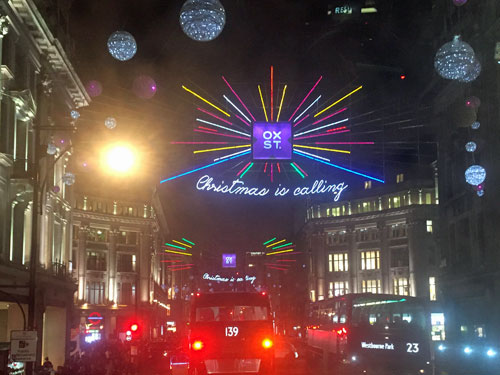
Now that mid-November is here, 'tis the season for the publication of articles about The Best Bus Routes For Seeing London's Christmas lights. Londonist gave theirs a polish on Monday and have carefully ironed out all the whimsical implausibilities which beset their first attempt at the genre. Now TfL themselves are getting in on the act (on their community blog) with an article they've called Festive bus routes. Both @TfL and the Mayor tweeted excitedly about it yesterday morning.
London’s festive lights are at full beam 💡, and what better way to see the city at its most sparkly than on the bus! 🚌 We’ve put together the best bus routes for viewing the most spectacular displays, and stopping off for a spot of festive shopping! Your sleigh awaits… ✨
I could query the tone of the article, which is liberally sprinkled with three dozen emojis, but that's just TfL social media house style. I will query the assumption that people want to go shopping, repeatedly, in the middle of their top deck bus journey. But most of all I want to debunk the claim that these are "the best bus routes" for seeing London's Christmas lights, because some of them very much are not.
"This journey starts off at Bond Street, where you can discover Christmas at Selfridges. Join the famous store for extraordinary festive experiences, from a feel-good Christmas market to magical moments with Santa himself!"
By starting at Selfridges you have already missed a goodly chunk of Oxford Street, which isn't ideal.
"Hop on the number 139 bus towards Waterloo and head down Oxford Street then Regent Street to admire the spectacular Christmas lights displays. The fun doesn’t stop there, hop off outside Hamley’s and step into an enchanting world filled with fun for all the family."
It doesn't get much better than seeing the Oxford Street and Regent Street lights from the top deck of a bus, but our journey has only lasted three stops before we've been urged to get off again. Thus far we've spent a lot more time in Selfridges and Hamley's than on the bus.
"Catch the next 139 bus to The Strand for Covent Garden. Kick off a very merry Christmas in the famous piazza, home to London’s biggest hand-picked Christmas tree, which is a huge 55 feet tall! The Apple Market lights are also not to be missed, pick up a festive drink and take a wander around all of the market stalls and stores, perfect for picking up a little something for under your own tree."
We're going five stops this time. This includes passing through Trafalgar Square where the big tree doesn't get a mention, then along the Strand where the Northbank illuminations don't get a mention either. Instead you're supposed to guess which stop to get off at for Covent Garden and end your trip looking at the same giant mistletoe that's been there since 2015.
Our trip aboard the 139 has been brief and incomplete, but at least not incorrect. However...
"Start your journey at Duke of York Square where you can admire their Christmas lights and pay a visit to Chelsea’s Christmas Grotto."
Wrong, Duke of York Square doesn't have a Christmas Grotto this year, that was a 2019 thing. Also the King's Road's lights aren't switched on until Saturday.
"Next, hop on the number 22 bus heading towards Oxford Circus where you’ll pass Harrods, a London icon all lit up for the festive season. Hop off at Knightsbridge for a spot of Christmas shopping!"
Wrong, route 22 doesn't actually go past Harrods so you won't see it all lit up.
"Continue on the number 22 to Hyde Park and embrace the Christmas spirit at Winter Wonderland."
It's only one stop from Knightsbridge to Hyde Park Corner, hardly worthy of a bus ride. More importantly Winter Wonderland is pre-book only this year, you can't just turn up mid-bus-ride and hope to get in.
"The fun doesn’t stop there, hop back on the number 22 and take a trip down Oxford Street to see the Christmas lights in action."
Wrong, route 22 doesn't go down Oxford Street, it cuts through Mayfair.
"Alight at Bond Street for Selfridges, their Christmas shop is not to be missed!"
Wrong, it doesn't stop outside Selfridges, it terminated at Oxford Circus.
That is a shockingly poor "best bus route", almost as if whoever wrote this hasn't actually taken the journey to check.
I won't cut and paste the other three bus routes in such detail but I will do you a summary of each.
• Start at "Marylebone Village" (to admire the lights and go shopping)
• Continue to Trafalgar Square (for a "tree-mendous time")
• Then along Oxford Street and Regent Street (alighting for the Carnaby Street lights)
• Back aboard to Westminster (specifically Westminster Abbey)
• Back aboard to County Hall (for the South Bank and its winter market)
But...
...there are no buses down Marylebone High Street, so admiring the lights will be on foot.
...Trafalgar Square comes after Oxford Street and Regent Street, not before.
...the 453 doesn't go along Oxford Street, it merely crosses it at Oxford Circus.
...the South Bank's winter market is nearer Waterloo Bridge than Westminster Bridge.
• Start at King's Cross (for Coal Drops Yard)
• Hop on the 390 to Tottenham Court Road (to explore Soho)
• Hop on the 390 along Oxford Street (alighting at Selfridges)
• Hop on the 390 to the Dorchester Hotel (maybe for afternoon tea)
• Hop on the 390 to Hyde Park Corner (for Winter Wonderland)
But...
...Coal Drops Yard hasn't announced any festive lights yet (as the article admits).
...it's 2 miles by bus from Coal Drops Yard to Tottenham Court Road, with no lights to enjoy.
...getting off to look round Soho and Selfridges mid-journey is so unnecessary.
...stopping for afternoon tea would wreck your chances of using a Hopper fare.
...you don't need a bus between the Dorchester and Winter Wonderland, it's across the road.
• Start at Hyde Park (for Winter Wonderland)
• Hop on the 94 which will "take you down Oxford Circus"
• Stay on the 94 down Regent Street
• "When you're all shopped out, hop back on the bus"
• Stop by Fortnum & Mason, then head to Leicester Square
But...
...the 94 takes you down Oxford Street, not down Oxford Circus.
...five buses go past Fortnum & Mason but the 94 is not one of them.
...Leicester Square is nowhere near Fortnum & Mason.
...this obsession with Winter Wonderland and going shopping is getting quite tiring.
Essentially all of this has been a list of festive West End highlights badly connected by five sub-optimal bus routes. It's not a helpful way to see London's Christmas lights, nor even an efficient way to go shopping. It's marketing rather than good advice. It's not something I'd recommend anyone tries in real life.
For cash-strapped parents who just want to show their kids the lights from the top deck of a bus, a more useful proposition would have been to suggest one decent route for them to enjoy. The 139 is probably the best choice, ticking off Oxford Street, Regent Street, Trafalgar Square and the Strand, indeed this is also the conclusion Londonist has drawn. Get on at Selfridges, get off at Somerset House and enjoy the sparkly dazzle inbetween.
And I hate to flog a dead horse, but if only TfL still published a Central London bus map then festive sightseers would be able to work out the best bus route for themselves. Instead, with the network essentially hidden, they're left to take advice from crass inaccurate marketing fodder masquerading as truth.
2pm update: TfL have made eight changes to their Festive Bus Routes post this morning 😲
22: "a visit to Chelsea’s Christmas Grotto" has been replaced by "catch a complimentary horse and carriage ride"
22: "you’ll pass Harrods" has been replaced by "you’ll reach Knightsbridge, hop off and take a short walk to see Harrods"
22: The entire paragraph about taking the 22 along Oxford Street has been deleted, because it doesn't. The resulting 22 journey is now just five stops long (and still doesn't pass Harrods, so is very much not a "best bus route")
453: The Trafalgar Square paragraph now comes after the Regent Street paragraph, not before it.
453: "The number 453 will then take you down Oxford Street" has been deleted, because it doesn't.
390: "admire their XXX – they haven’t announced this year’s Christmas theme but it’s usually arty" has been replaced by "admire their festive display"
94: "which will take you down Oxford Circus" has been replaced by "which will take you down Oxford Street"
94: "Stop by Fortnum & Mason" has been replaced by "Take a short walk to Fortnum & Mason"
It's been over a year since I last showcased a selection of inappropriate attempts at marketing outreach which have spluttered into my inbox. I don't get many these days because most PR folk have learned not to try, so consider this part of my continued attempt to deter the remainder.
Hi there :)
I'm Roland with <online pet magazine>, an online pet magazine with over 50K monthly readers. Do you offer paid mentions or sponsored posts on diamondgeezer.blogspot.com? I'd love to contribute my knowledge and expertise.
My first thought was that Roland was one of you taking the piss, but I checked and <online pet magazine> genuinely exists, if solely to hide affiliate shopping links amongst the kitty pics.
I hope this e-mail finds you well.
My name is Saffron and I work for <Agency in Runcorn>. We're often looking for bloggers to work with regularly for a variety of different brands and clients. This includes product reviews, sponsorships and collaborations. Is this something you'd be interested in?
I sent a two-letter reply in direct response to Saffron's question, and never heard from her again.
Hi,
Would you be interested in taking a look at my article that explains why now is a great time to further your education to help your small business start, run and grow? My hope is that if you like the article, you'll publish it on your website. You won't be charged for it.
Too right I won't be paying you anything Amber, or using your article, or indeed reading it.
Amber proved to be one of those over-keen reachers-out who keeps prodding after not getting a response.
Did you receive my email below? I just want to make sure it arrived correctly!
And then...
Just circling back to see that you didn't miss my email.
Other increasingly desperate follow-ups I've received this year include...
I wanted to check in and see if you got my note.
Did you check the mail which I sent you a few days ago?
Maybe you missed my earlier emails? Love to hear your thoughts.
Just wanted to check in with you briefly to make sure you got my previous email from a few days ago.
I guess things are busy at the moment but whenever you have a spare moment, I'd be happy to hear back from you.
I’m following up one last time...
I'm always relieved to hear it's the final plea and you won't be emailing again.
Good day!
I'm an avid reader of your site and I enjoy it so much! I'm wondering if you accept guest posts?
I responded to Helen by reminding her that "If you were a long time avid reader you’d know I regularly rip the piss out of appeals for sponsored content", and here I am proving just that.
I work for the research team at <leading PR platform>.
From our research of your profile online, we think that you would be a great addition to our database and would be interested in the content our customers send to members of the media. We have therefore added your public profile to our platform.
I wrote straight back to Gabi and suggested that in future she should ask before adding sites to her spam-portal, rather than adding them and only asking afterwards. No further unsolicited emails flooded through.
You're Invited to <Popular London Festive Event>
Join us for an Instagrammable evening of light displays, music and food.
We’d love to invite you and a guest along to one night on our first weekend. Doors open at 5.00pm, last entry 7.30pm. If you’d like to join us, just RSVP and we’ll see you at <Popular London Festive Event>!
Kimberley was also going to throw in a two course supper, because making the right impression on a guest blogger boosts the review they might write afterwards. Alas I didn't take up her offer because an Instagrammable freebie is not my thing. I still read plenty of reviews of what I'd missed, however, because that's how the PR game works.
Hi There,
I found your post when looking for articles about London and found a broken link under the anchor text "Hampstead". I clicked the link and it took me through to an error page so wanted to make you aware of it and make you an offer.
We've recently updated an in-depth post about Hampstead Heath and related parks which includes a map of the Hampstead Heath, key information and relevant links. I thought it would be an ideal replacement for the broken link. Do you want me to send it over?
I did not want Keenan from <Vacation Rental Website> to send it over, neither was I interested in Jennifer's Sudoku backlinking request...
Hi,
In your 2005 post about Sudoku you have a broken link to <brokenlink.com> that doesn't work anymore. As an alternative, I would like to suggest the following sudoku page, <ad-splattered-webpage.com>, which works in the browser and offers 3 difficulties.
I now get far more requests to add a replacement link to a very old post than to write a new post promoting a service or current event. It seems the main benefit of a 19 year-old blog to marketing types is taking advantage of past domain authority for SEO purposes, not trying to persuade existing readers to try something new.
Consider this a polite reminder not to try to get your website into my blog, now or whenever, because if you weren't worth linking to at the time I am not linking to you now.
Yes I'm still walking the entire length of Britain's B Roads, sequentially, starting with the lowest numbered. As yet this hasn't been the toughest physical challenge, indeed the B104 is the first to nudge (just) over a mile in length. Another minimal safari lies ahead, but because it's a gentrified dogleg through the chi-chi-est corner of Stoke Newington the B104 should be the most interesting walk so far.
Let's start at the southern end of the B104 which is the grassy gyratory of Newington Green. This has a particularly rich history (having started out as a medieval hamlet, being home to London's oldest surviving brick terrace and boasting a 300 year-old Unitarian chapel where Mary Wollstonecraft once worshipped) but alas the road which encircles the Green is the A105 so we can't go into that. Instead we're following one of the roads which bears off at the northwest corner, the one which isn't iconic Green Lanes, beside a smart Victorian building which used to be a bank but since 2017 has been nine flats. It's called Albion Road, and MWLB will know it best as the route of the number 73 bus.
Albion Road was built in the 1820s by master builder Thomas Cubitt. He bought up ten plots of farmland either side of a footpath linking Newington Green to Stoke Newington and created a new residential road lined by brick and stucco terraces. His methods were the Georgian version of mass production - quick, efficient and absolutely nothing with fussy curves - which he'd later put to good use across the new suburbs of Bloomsbury and Belgravia. Today most have been split into flats, as the multiplicity of bins confirms, but an undivided townhouse on Albion Road sells for well upwards of a million. I was struck by the long flight of steps up to each front door, which if nothing else affords the basement a decent amount of daylight, but was also forcing the street's postwoman to do a serious amount of sequential legwork.
Things to see on Albion Road
• Off to the right is a short alleyway called Town Hall Approach, which seems odd given the fact the Town Hall is an Art Deco gem half a mile away (which we'll get to later), except before 1937 the Town Hall was down here in an Italianate building on Milton Grove.
• 80 Albion Road has been home to 296 Squadron of the Air Training Corp since 1941, and was recently reprieved from closure, if you fancy spending two nights a week in uniform.
• Anyone driving up Albion Road now passes numerous yellow signs warning that Church Street is closed (I counted at least five) although these make the closure sound much worse than it is (as we'll see later).
• A mosaic of Gog and Magog brightens the small triangular parklet at the junction with Clissold Crescent, for the somewhat spurious reason that they were 'Giants of Albion'.
• n.b. If Stoke Newington's history is your thing, Jack Whitehead's website is just outstanding.
Albion Road bends in the middle to pass from one side of Church Path to the other - a direct consequence of the plots Thomas Cubitt bought all those years ago. At the focal point are the local shops, collectively known as Albion Parade, which contains Albion Kitchens, Albion Frames and Albion Food & Wine. The fast food shop on the corner must have thought they'd chosen a better name 21 years ago when they called themselves Millennium Kebabs but today it just looks a bit dated. Vegan burritos and empanadas are only available at The Muddy Puddle, should you feel the need for a meat-inspired product containing no meat.
On the remainder of Albion Road we find Cubitt's white stucco terraces, at least where they weren't bombed and replaced by something more council. One of the later coachhouse-style houses has been numbered 178½, which might be useful information for anyone attempting to compile a quirky list of 'London's Most Fractional Addresses'. The electric charging point outside Carlyle House makes a heck of a racket, which makes me wonder about its true environmental efficiency. The local secondary school can also be heard, if not seen, especially if it's playtime. And then suddenly there's Stoke Newington Town Hall straight ahead and we're turning right into Church Street and everything changes.
Stoke Newington Church Street is again medieval and is named after St Mary's, which the B104 has just skipped by arriving midway. This half is a busy shopping street and also blessed with a lot of listed buildings, some of which date back over 300 years. In perhaps the quaintest section one townhouse still looks very much like a family home, one is a doctor's surgery and one is sadly all boarded up ever since John's Garden Centre went under. It's almost possible to imagine Daniel Defoe once living here, although number 95 (where his blue plaque is) has long gone and the site is now occupied by a minicab company.
What makes Church Street truly special to modern visitors, and overexcites the good folk at Time Out, is its range of independent shops and eateries. This means florists that double as cafes, window displays arrayed with new season knitwear and bakers with pastry queues stretching down the street. It means a local butcher who also runs courses in pig husbandry, a specialist schnitzel restaurant and even a bespoke violin maker. But most of all it means little one-off boutiques stocked with gifty trinkets and decorative fluff laid out sparsely on bright shelves, far more than any local home could need, in shops with names like Nook, What Mother Made, Know & Love and Metal Crumble. There's even a specialist gift shop for dogs with a selection of balls and squeaky toys in its window, should your hound be in need of a bandana, fleece, bow tie, snood or cooling vest. All in all I counted 53 shops poncier than anything that'd dare open where I live, which admittedly is a very subjective measure but N16 is very much not E3.
The road outside the Red Lion (founded 1697) is the site of the Church Street bus gate, a brand new traffic filter marked on the road by two painted rainbows. Only 20 metres of Church Street is restricted, so the yellow signs in Albion Road were overstating things somewhat, but five other filters in neighbouring streets have had to be added to prevent all possible cut-throughs. As a pedestrian or cyclist it's a joy, and the buses also get through quicker, but the whole scheme has a cryptic labyrinthine complexity that local car owners must hate. It's also not clear whether a road that can't be driven down between 7am and 7pm can still be classified as a B Road, or whether the advance of a Low Traffic Neighbourhood has silently killed half the B104 off.
Church Street continues past a slew more Georgian buildings, a fire station and one of London's Magnificent Seven cemeteries. Abney Park is a non-denominational 19th century burial ground amid an 18th century arboretum, these days more a nature reserve where brief constitutionals are taken and local dogs get walked. It's accessed here through a narrow gate up a set of steps, close to William Booth's headstone, the main entrance being off the A10 further ahead. The final building on Church Street is The Three Crowns, a lengthy pub with a dazzling saloon, but it too has its front door on the High Street so I can legitimately skip it here. The B104 has been a cracker (but don't expect this B Road bonanza to continue).
This, I think, is the only road sign in the country to reference the A1, the A2, the A3 and the A4. It can be found on Whitechapel High Street heading west, just before you get to the inner ring road. It's probably significant that it's the last directional sign on the A11, a road which arrives from a direction very different to the other four. These A Roads are all at least a mile away (and if you go via the indicated route more like two), but all appear together on this single sign.
I thought I'd risk tweeting a photo and stating that this was the only road sign in the country with all four, despite not knowing 100% if this was the case. Someone immediately called my bluff with a photo of a similar sign on the other side of the road, dammit, except their contradiction turned out to be an old sign removed years ago when the junction was rejigged. There was also debate about roads on the Isle of Man, but this generated nothing better than an A1/A2/A5 combo. So yes, I genuinely think this sign really is the only one to mention the first four A Roads, unless of course you know better.
Saturday was the day of the Lord Mayor's Show, the annual float-ridden shebang returning to the City's streets after 2020's enforced absence. By Sunday morning all the detritus and horse poo had been cleared away and an underling was busy stacking all the gold plastic chairs on the temporary balcony in front of Mansion House. But much more interesting, just around the corner, was the rare sight of the Lord Mayor's Rolls Royce being given a polish by two flunkeys in advance of an official trip to a Remembrance service. And yes, its numberplate really is LM 0, i.e. the highly unusual combination of two letters and a zero. There's abit of a story behind that...
When Sir Rupert de la Bere became Lord Mayor of London in 1952 he acquired the numberplates LM 1 and LM 2 for his cars to commemorate the occasion. But whereas a more civic-minded grandee might have handed the plates on to his successor, Sir Rupert kept them for himself. Then in 1964 the new incumbent Sir James Miller decided that the Lord Mayor's car deserved a personalised plate and, because LM 1 was no longer available, persuaded the authorities to issue LM 0 instead. Other cities around the country have done similar for their dignitaries, especially in Scotland, where Edinburgh's Lord Provost has S 0, Glasgow's has G 0, Aberdeen has RG 0 and Inverclyde has VS 0.
Several commemorative services take place in the City of London on Remembrance Sunday, which these days means the streets are crawling with police. My perambulations took me past several road blocks, a fair few vanfuls and a surprising number of armed officers with very prominent big black rifles. They were particularly in evidence around St Paul's Cathedral - the endpoint of LM 0's official journey - where a queue of unusually well-dressed ladies and gentlemen awaited their turn to pass through security and take their seats inside. My photo shows the outdoor assembly at the Royal Fusiliers War Memorial on Holborn where an army band awaited the arrival of the massed procession lined up inside Holborn Bars, while across the road a unexplained group of at least thirty mods on scooters had gathered separately to pay their respects.
At eleven o'clock I found myself nowhere near a ceremony, nor even by a church, but in the heart of the Barbican estate. Initially I thought it wasn't the best place to be, but as I looked around me at the architectural aftermath of war I realised that loss and sacrifice were especially evident here, and the empty silence perhaps even more evocative.
The sugar content of these nine festive drinks
• Quality Street the Purple One Latte with Light Dairy Swirl: 36g
• After Eight Hot Chocolate with Light Dairy Swirl: 37g
• Quality Street Toffee Penny Latte with Light Dairy Swirl: 41g
• Terry's Chocolate Orange Hot Chocolate with Light Dairy Swirl: 45g
n.b. all drinks are medium-sized with semi-skimmed milk
n.b. a normal latte has 15g of sugar at Costa and 16g at Starbucks
n.b. a normal hot chocolate has 35g of sugar at Costa and 28g at Starbucks
n.b. a standard 51g Mars bar has 30g of sugar
Meanwhile Christmas approaches unabated. Somerset House is already in full-on ice rink mode complete with giant tree, cocktail lounge and alpine restaurant. Plenty of families were queuing to sign in, having already missed the first 10 minutes of their designated slot, but buzzing with excitement nevertheless. Two adults can expect to pay £36.95 for a weekend spin, including mandatory transaction fee, whereas après-ski wine & fondue in Jimmy's chalet is somehow £68. Spectating remains free. I also note that the Courtauld Gallery is due to reopen next Sunday, having cunningly timed most of its three year refurbishment for a period when it would have had to be closed anyway.
All the usual Christmas lights are now blazing everywhere else, even in daytime, because it's not Christmas until the Northbank illuminations are lit. Over at Covent Garden Market exactly the same giant baubles and mistletoe are up that have been here every Christmas since 2015, and yet people are still stopping and snapping them excitedly with their phones because for some people they're new and because nobody else has seen them on their feed for ten months. Basically if all you want from a pre-Christmas jolly is pretty lights and Insta-friendly spectacle and somewhere nearby that sells drinks then central London is very much back to normal and waiting for you.
Many people have contacted me over the years to ask if this blog is available by email. Today I'm delighted to announce that an email notification feature is finally available. All you have to do is sign up with your email address and you'll receive an email every time a new post appears to tell you a new post has appeared and you might like to read it.
Your email address:
Before subscribing, please select one of the ten email options to ensure you receive the most appropriate communication at 7am every morning.
A new post has been published on the diamond geezer blog.
Please click here to read it.
A new post has been published on the diamond geezer blog.
It is called "More postcards from Southend".
Please click here to read it.
A new post has been published on the diamond geezer blog.
It's about the second half of a walk across Southend.
It features 14 photos, some background history and extensive observational detail.
It mentions allotments, cheese and Abba.
It's longer than average.
Please click here to read it.
A new post has been published on the diamond geezer blog.
It's about a place outside London.
It is not about buses.
Please click here if you still want to read it.
A new post has been published on the diamond geezer blog.
It's not one of those weekly Covid updates.
Please click here to read it.
A new post has been published on the diamond geezer blog.
Please click here to see if there are any new comments.
In today's post I'm continuing my walk across the new city of Southend-on-Sea, essentially missing out all the "on-Sea" bits and focusing on some suburbanier areas inland. There are no piers and amusement arcades back here, nor many chip shops, just blocks of parallel Victorian streets across interlocking suburbs which spread when the railways came, and a few points of interest inbetween.
Prittlewell
If you've ever wondered what 'Southend' is south of, it's the historic village of Prittlewell. Only at the end of the 18th century did a few fishing huts... [n.b. Actual email continues for 1261 further words]
It's 7am again.
Guess what?
I understand I can attempt to unsubscribe at any time.
I do not refuse to not allow my email address not to be harvested by spammers.
I would prefer to receive a weekly email containing all of the past week's posts, despite the fact I could simply go to the blog and scroll down the page.
• booster jabs can now be booked after 5 months
• USA reopens to vaccinated tourists
• jab to be compulsory for NHS staff
• row over PM not wearing mask on hospital visit
• Covid pass needed for Welsh cinemas/theatres
• call for investigation into Randox contracts
• pet dog in Surrey has virus
• quarantine for the unvaccinated in Austria
• Netherlands introduces 3 week partial lockdown
• AstraZeneca to start profiting from vaccine
Worldwide deaths: 5,040,000 → 5,090,000 Worldwide cases: 249,000,000 → 253,000,000 UK deaths: 141,743 → 142,835 UK cases: 9,272,066 → 9,524,971 1st/2nd/3rd vaccinations: 50.5m/46.0m/12.2m FTSE: up ½% (7303 → 7347)
In today's post I'm continuing my walk across the new city of Southend-on-Sea, essentially missing out all the "on-Sea" bits and focusing on some suburbanier areas inland. There are no piers and amusement arcades back here, nor many chip shops, just blocks of parallel Victorian streets across interlocking suburbs which spread when the railways came, and a few points of interest inbetween.
Prittlewell
If you've ever wondered what 'Southend' is south of, it's the historic village of Prittlewell. Only at the end of the 18th century did a few fishing huts at the southern end of the village morph into a full-on bathing resort, then commuter town, ultimately engulfing the original settlement. The Romans built at least one villa here, Saxon royalty took a local interest and a medieval Cluniac Priory put Prittlewell firmly on the map. That priory somehow still exists, at least in part, alongside the small stream which made this an ideal place to settle. What remains is mostly the refectory, much altered but with a 12th century doorway, now blessed with a lottery-funded Visitor Centre nextdoor. The tomb beneath the cross outside may look ancient but in fact commemorates local benefactor Robert Arthur Jones who donated the priory and surroundingpark to a more than grateful town council in 1917. Alas what you can't do between November and February is get inside to have a look, but Southend's museum portfolio is well worth a lengthier visit during the warmer months.
Prittlewell's heritage is more readily apparent around the parish church, St Mary's, which has a Saxon doorway, a Norman nave and a 15th century tower. The timber-framed building facing the main crossroads is Swan Hall, which currently does business as Southend's only medieval estate agent. The Blue Boar pub nextdoor alas isn't the original, having been rebuilt after falling foul of a Victorian road-widening scheme, but is believed to be the hostelry in which Southend United were first formed. Their current Roots Hall stadium lies immediately behind, although the club are very keen to relocate to a site further out by the airport, a move which'll allow Sainsbury's to move in instead, although the club is currently in freefall after two successive relegations dumped them out of the Football League for the first time in a century, and if nothing else you can imagine how this sporting turbulence helps keep the local paper in business.
The chief river through the Southend conurbation, if you don't count the Thames, is called the Prittle Brook. It's not much of a river - mostly jumpable throughout - and because it's mostly culverted not especially scenic either. But the path alongside it provides a useful cross-city shortcut for bikes and pedestrians which, since it was upgraded ten years ago, is now known as the Prittle Brook Greenway. The full 3½ miles links Prittlewell to Belfairs, but I merely walked the first mile to try to get a feel for Southend-Not-By-The-Sea. I'm not sure who the wooden cowled figure at the start of the path is but I suspect they're supposed to be Priory-related.
It was nice to be following a thin strip of green rather than yet another residential street, although the PBG did mostly have the feel of a tarmac path beside an overgrown concrete trench. Among the sights to be seen were part-obscured allotments, the occasional cat, rotting fences at the rear of back gardens, a lot of brambles and the edge of a school playing field. There is a limit to what you can build on a flood plain, even in a closely-packed city. Every so often a chirpy sign encouraged me to walk for health and carry essentials like food, hats and gloves, so I soon learned to ignore those. The Greenway was absolutely nothing special and yet simultaneously, for mid-Southend, pretty much the best footpath residents have got.
Chalkwell
My inland walk had bypassed Westcliff and delivered me to Chalkwell, another extensive interwar suburb. At the turn of the 20th century there was nothing here but fields, a single row of cottages and a Georgian mansion called Chalkwell Hall which enjoyed an unbroken view down across the estuary. The Hall's estate was preserved as Chalkwell Park, now the sole greenspace hereabouts, which benefits from sloping landscaped lawns and what I assume at the right time of year must be a splendid rose garden. Meanwhile the mansion was un-derelicted in 2007 to become a cultural community hub called Metal, which describes itself as a "low carbon space for artists-in-residence, events and creative conversation". At Chalkwell they claim to have created the world's first digital art park, which I think means you can't see any of the works unless you point at a QR code and download an app. I was almost tempted to experience "a breath-taking 360˚ brass band performance" where the bandstand used to be, but quite frankly couldn't be bothered with all the hassle so carried on down the hill.
Opposite the church on Leigh Road is Iveagh Hall, which at first sight looks like it might be a Scout hut but is in fact home to the Southend West Conservative Association. Normally they inspire members with meetings and keep fit classes, offer competitively-priced refreshments and provide somewhere for a muted game of cards or darts. But times are not normal, as confirmed by the Union Flag flying at half mast out front, following the murder of local MP Sir David Amess in Belfairs last month. His contact details remain on the noticeboard alongside a black-edge portrait, and if you come down for the Beaujolaise Day lunch next Thursday you can likely pay your respects over pate, cheeses and a glass of red.
Leigh-on-Sea
I'd only previously walked through Old Leigh, the cute coastal village with the pubs, galleries and multiple opportunities to purchase fish. But on this occasion I stayed up beyond the clifftops and followed the main shopping street and blimey, that was another world entirely. It's where the good folk of Leigh come to spend their dosh, mostly in independent shops, and somehow it goes on and on almost unbroken for a full mile. A significant proportion are places to eat and drink or to help prettify your home, with 'soft furnishings' proving to be very much a Southend staple. Window displays in clothing stores prioritise smart and sensible over excessively TOWIE. The custom of older residents helps support a Wimpy, a second hand book shop and even a proper record store (clearly chuffed to be selling new vinyl from Abba and the Beatles). Top marks to the tearoom which has called itself TrueLeigh Scrumptious. This is quite some linear retail offering.
For additional interest Leigh's library is housed in an old rectory which has been here since 1838 and lies adjacent to shady clifftop gardens. The multi-storey Grand Hotel has long been surplus to requirements so is slowly being converted to luxury flats. The town also boasts that rarest of media commodities, an independent local newspaper, with offices on the Broadway. And here and there surprisingly steep footpaths slink off over the edge of Church Hill for anyone who fancies walking down to the old town for beer and fish. The views across the estuary from up here are surprisingly good, at least now a lot of the leaves have fallen. Somewhere in the distance is Leigh-on-Sea station (which it turns out is not at all well placed for the town centre) and beyond that the flat marshy sprawl of Two Tree Island.
I had hoped to walk out to the island to complete my cross-Southend walk because the city boundary somehow divides it in two, but I was knackered by this point and it was almost dark so pulled up half a mile short. There is so much more to Southend than can be seen in a day. [15 photos]
To most visitors, Southend-on-Sea is flurry of activity around the pierhead and maybe a walk along the seafront. But England's newest city is actually an amalgamation of several suburbs packed into a dense linear strip approximately eight miles long and two miles wide. So for my drizzly visit this week I decided to walk from one end of the city to the other without ever passing through the well known bits in the centre, mostly inland, starting in Shoeburyness and ending in Leigh-on-Sea. Join me on what turned out to be a twelve mile trek through the Southend only its residents normally see.
Shoeburyness
Southend's east end is somewhat of a backwater as befits the very last stop on the line. It also has the city's best beach with an actual strip of decent sand before the mud starts, plus a BBQ-friendly swathe of grass behind. It's the only beach I know with a triangular sign at the entrance with the joint warnings 'Kite surfing area" and "Caution boats"... but then warnings are very much part of the Shoeburyness experience. "Danger - Firing Range" is the most important because the Ministry of Defence own most of the land around here, indeed the next three miles of coast to the north is all theirs, not to mention the whole of Foulness Island beyond. Only if a yellow diamond's been raised on the yardarm are you allowed on the beach, but under no circumstances can you cross to the sands beyond the wire fence or pass north of the mile-long defensiveboom. I contented myself with staring out at shipping in the North Sea and, when lifting mist permitted, spotting Kent.
Even on a drear day a handful of hardy men were out doing maintenance on their beached boats, which had fancy names like Lacy Lady, Lady Alice and Liberty Belle. Because it was low tide a few dogs were being walked on the mud by owners with appropriate footwear. The offshore bathing pool looked full but seasonally inhospitable. Kitesurfers were not in evidence but I did stop to read the long list of rules outlining what they can't do and in particular where they can't go. I especially liked the fake sound mirror by the car park emblazoned with the single word Hello, installed in the spring as part of the Estuary Festival by artist Katrina Palmer. She intended it as "a sculptural message of welcome that faces out towards Europe", not that anyone in Belgium can see it, nor is a beach sandwiched between two MOD danger areas the most welcoming place to arrive.
Shoebury Ness
Follow the waterfront south through Gunners Park and you'll eventually reach Shoebury Ness, which is the name of the brief bulge where the mouth of the Thames estuary opens out into the North Sea. A military garrison was established here during the Crimean War, more for artillery practice than coastal lookout, and has subsequently been transformed into a) mostly nature reserve b) partly housing estate. Birds get most of the coastal strip, a lot of which is still fenced off in case of undiscovered ordnance, and the wealthiest residents get to live in the former commandant's house. The sea wall remains accessible throughout, but with red signs at regular intervals warning that under no circumstances should you clamber over onto the beach and foreshore. Trespassers may be prosecuted, assuming they haven't exploded first.
Once past the battery and the gun emplacement, keep an eye out for the abandoned bargepier. It's over 100 years old, marks the exact location of Shoebury Ness and is of course securely locked off. Having turned the corner we're now finally looking upstream, the mud and murk offshore technically more estuarine than maritime. On a good day it's easy to spot the Isles of Grain and Sheppey and the tip of Southend pier, whereas in low visibility you're lucky if you can see the coastguard tower and the beached wreck offshore. It's easy to see why most daytrippers head to the bright lights instead.
Thorpe Bay
Here's where the MOD finally loose their grip and the beach huts start. My award for the best name goes to 'The Old Crabzut', the most contrived to 'Avinarest' and the least imaginative I'd say was a tie between 'Our Hut' and 'By The Sea'. Lurking behind this ill-painted row is Uncle Tom's Cabin, a locally-iconic refreshment kiosk which has been here for yonks selling Mr Whippy, slush and sausage rolls. It is for some reason octagonal, and for obvious reasons currently shuttered. And that's quite enough of Southend seafront, even the unfamiliar bits, because it's time to head inland and see where people live rather than play.
Thorpe Bay was the last slice of Southend's coastline to be developed, transformed from the 1920s onwards into a genteel grid of streets. The later half is mostly bungalows with decent sized gardens, built very much with the retirement market in mind. The older half is characterfully family-sized with a Metroland vibe, and bang in the centre (on its own grassy island) is the very bricky St Augustine's Church. Priorities were very different in those days so a substantial chunk of the garden suburb is taken up by an 18-hole golf course, so exclusive that it's surrounded by a thick cypress rim ensuring non-members can't see in. And the really quiet roads seem to attract learner drivers in large numbers, by the looks of things for very early lessons when expertise and confidence are very low, and that's how exciting Thorpe Bay is.
Southchurch
How confusing is it that the suburb immediately adjacent to Southend is called Southchurch? What's more Southchurch was here first by about a millennium, but past performance is no guarantee of future results. Today its station goes by the unhelpful name of Southend East, because everywhere in this city merges into its neighbours, and the housing stock is mostly interwar with Edwardian flourishes. A lot of houses are blessed with balustraded balconies, although there's generally no chance of a sea view. The local park lurks one block back from the beach and is mostly sports pitches, bar a supposedly ornamental lake and a savagely pruned rose garden. Top marks to the hair salon on Woodgrange Road which calls itself Blonde Dye Bleach.
The jewel in Southchurch's crown is Southchurch Hall, a timbered building dating back to the 14th century and probably built on the site of a Saxon hall. It's been in council hands since the 1930s when it was substantially restored, and is normally free to wander round except during the winter (and during times of global pandemic). Instead you can explore the intimate landscaped grounds, both inside the moat and without, perhaps bumping into grandmothers nattering, workmen devouring sandwiches and schoolkids holding court during their lunchbreak. I like how the suburban grid just suddenly breaks to spare this medieval throwback, then plunges back into dense streets of bay-windowed terraces on the other side.
And that's just half of my walk, covering the neighbourhoods to the east of Southend city centre. Tomorrow I'll head north and west, and if you'd like to see some of those photos fuller size try here.
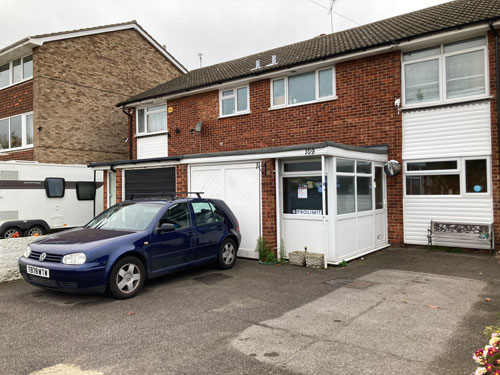
Yesterday, outside an unexpected house, I nearly saw my car.
It wasn't my car because I no longer have one, but I did have one once and this was very nearly it. It was the right make, if not the right model. It was nearly the right colour. It had a few too many doors. It was cleaner than I remembered. And it very nearly had my numberplate.
When you've only ever had one car you tend to remember what its numberplate was. This car caught my eye because its numberplate was very similar to mine, indeed so similar that it must have been sold by the same dealer at around the same time. All the letters were the same and the three-digit number was less then ten away from what mine had been. That's incredibly unlikely, I thought.
It's incredibly unlikely because there are 32 million cars in the UK, fewer than 1000 of which have the same letters as mine. It's incredibly unlikely because most of those 1000 have numbers a lot further away than a single-digit margin. And it's incredibly unlikely because I bought my car new in March 1999, back when 'T' registrations were just rolling into showrooms, which'd make it 22 years old. Any car with almost the same numberplate as mine must have been bought in the same month, which is pretty old for a car, so it probably isn't even on the road any more.
The one thing that made it a bit less unlikely is that I was back in the town where I'd bought the car. If any of its near neighbours were still in existence they'd most likely be in that same town, or not far away, and so it proved. The street I was walking down was only six miles from the showroom where I'd bought it, and likely they had too, there being a limited number of Volkswagen dealerships in the area.
I'm always on the lookout for my original car because it would be really cool to spot it again after all this time. But given that I sold it just before I moved to London, instantly putting fifty miles between myself and the new owners, I immediately reduced the chances of spotting it considerably. I never have, and I suspect never will because according to the DVLA's online tax checker it went to the great scrapyard in the sky four years ago.
But nearly seeing my car, give or take a few digits, still put a big grin on my face. I hope its owners weren't looking out of the front window at that point because it was a very big grin and they might have thought I was nuts, especially when I stopped to take a celebratory photograph.
I've since done some research and I know the car's taxed and its MOT is up to date. I also know that the house where I saw it hasn't been sold since 1999 so I suspect the car is still with the original owners. They have two cars, as I was able to deduce from the rectangular dry patch on the drive alongside, so I suspect they also own something much newer. And best of all I've discovered that the owner runs a carvalet service, indeed there was a promotional sticker in his porch window, which helps explain why this 22 year-old car still looks utterly sparkling and almost new.
When I bought my car the dealers told me they had a block of 40 numberplates and asked me which one I'd like. I obviously went for the one with the most interesting three-digit number, given there was nothing I could change about the letters.
But suddenly seeing one of those 40 yesterday has made me wonder what happened to the rest... and the DVLA's website has allowed me to find out.
cannot be found
SORN
untaxed
✔
• Of the 40 numberplates the dealership had available back in March 1999, the DVLA is now only aware of 19 of them. The other 21 all come up as "Vehicle details could not be found", which'll either be because the car's been scrapped or because the numberplate in question was never issued.
• Five of the 40 now have a SORN declaration, that's a Statutory Off Road Notification, so I won't be seeing them driving around any time soon. It looks like most of these are quite recent, likely pandemic related, because there's no point in taxing a car you're no longer driving.
• 12 of the 40 are still on the DVLA's books but are no longer taxed or under MOT. The earliest disappearance was back in 2004, and seven of the twelve stopped being used within the first ten years. I'm quite proud that my old car is the longest serving of this bunch, having continued to be driven until 2017 at the grand old age of 18.
• And only two of the original 40 are still on the road. One's an Audi whose car tax has nine months to run and one's the Volkswagen I saw up a random street yesterday. What's more the VW is the car with the closest numberplate to my own, which means I can now stop looking because I'm never going to see one better.
I very nearly didn't walk down that street, indeed it's a ridiculously unimportant residential backwater on the outer fringes of nowhere much. But I'm glad I did because it just so happened to contain a car that was very nearly mine.