Last week we had Battersea Power Station and the Bank DLR escalators. In July we had the Barking Riverside extension, then of course we had Crossrail back in May, and next Monday the much-delayed station at Bond Street finally opens. Then at the start of November we have the long-awaited joining-up of Crossrail, and at the end of the month the big reveal on new connections at Bank. December should bring the opening of Brent Cross West station, close to Staples Corner.
But from 2023 it goes very quiet.
Here's my list of big London openings in 2023 and 2024. 2023: East Bank (QEOP) 2024:
Because I can't think of many.
It doesn't have to be train-related, it could be a major London building scheme, engineering project or chunk of infrastructure. It just has to be some big opening affecting lots of people, so not a cycle lane in Barking, a shopping mall in Clapham, a step-free entrance in Haringey, a gyratory in Lewisham or a tower block in Ealing. And I'm not counting signalling upgrades or new trains on the DLR, it needs to be an actual thing.
TfL's station-opening conveyor belt is now empty, or will be in a week's time. No further London stations are under construction, let alone funded. Croydon's Whitgift redevelopment has stalled, the Bakerloo line extension is suspended and the Silvertown Tunnel isn't due to open before 2025 which is why it's not on the list. Is anything major confirmed for sooner?
The pandemic and subsequent cutbacks have slammed down the lid on optimistic expansion as London's focus shifts from what to grow to what to cull. 2022's expansive burst of infrastructure is the ultra-fortunate beneficiary of plans laid down in happier times, and may never be repeated.
2022 isn't just the year of three Prime Ministers, it's the year of three cablecars.
The year started with the Emirates Air Line, which in June became the London Cable Car and yesterday the IFS Cloud Cable Car. One sensible name and two stupid ones... and unfortunately the sensible name was the shortest-lived. At least it lasted twice as long as Liz Truss.
The AIR LINE name was finally retired on Wednesday when a bloke up a ladder stuck a CABLE CAR vinyl over the top. Further vinyls were applied to the cabins, the stairs in the terminals and various bits of signage, only one of which they installed the wrong way round.
By Thursday morning IFS Cloud was everywhere and the cablecar had a name to match the grimly overcast weather. It's a shame that the long-planned media launch was instantly overshadowed by a top-level political crisis, but it's hard to imagine punters being excited by cloud-based enterprise software even on a good day.
The cable car's new colour is a mauvey shade of purple, not quite the same purple as Crossrail but purply enough that it should fade into the background on next month's tube map. But that's what a million quid of dangleway sponsorship gets you these days, a name nobody will notice and nobody will remember.
Liz's U-turns
• 45% tax rate abolished (U-turn 3rd October)
• no economic forecast until November (U-turn 10th October)
• benefits won't match inflation (U-turn 10th October)
• in lockstep with the Chancellor (U-turn 14th October)
• no tax cuts will be reversed (U-turn 14th October)
• corporation tax rise cancelled (U-turn 14th October)
• no cuts to public spending (U-turn 14th October)
• basic rate of income tax will fall (U-turn 17th October)
• 2 years of energy subsidies for all (U-turn 17th October)
• VAT-free shopping for tourists (U-turn 17th October)
• pensions might not match inflation (U-turn 19th October)
• I'm not a quitter (U-turn 20th October)
Potential replacements
• Rishi Sunak (4/5 fav)
• Boris Johnson (5-2)
• Penny Mordaunt (4-1)
• Ben Wallace (33-1)
• Kemi Badenoch (40-1)
• Suella Braverman (100-1)
Sometimes you just want to go for a nice walk, nothing too taxing, a bit of a stroll, lots to see, great views, plenty of variety, close to public transport, multiple refreshment opportunities, won't take long. So here's a gentle two mile walk round Kew, nowhere near enough to make a day of it but a nice walk all the same.
The Kew Walk has been devised by the Kew Society and was launched last month. Their aim was to encourage people to explore the local area, discover lesser-known places of historic interest and get a bit of exercise. It ticks all three boxes. You'll need a map, indeed it was picking up a full colour fold-out map leaflet at Kew Gardens station which inspired me to do the walk. But safest to download the leaflet before you turn up in case they're out of stock, which they were when I went back this week.
The walk starts at Kew Gardens station, on the western side where all the shops are. They call this area Kew Village, even though it's not the original Kew village which we'll get to later. Kew Bookshop is another place where the map leaflet can be picked up (from a rack by the till) assuming they haven't run out too (which again they had). Before setting off you could buy a nice paperback or grab a "championship winning" pork pie from Pethers the quality butchers or take a seat outside one of the many cafes, but spending the next hour browsing and grazing would be a waste. The whole point of the Kew Circular Walk is to get out and explore, so let's go. KewNugget: The artificial fibre viscose was developed here in Kew, in a workshop down an alley beside the butchers.
Lichfield Road is lined by desirable villas and littered with horse chestnut leaves, at least at present. It's also the direct route between the station and Kew Gardens so its narrow pavements can get congested with tourists, pensioners and other horticultural types. At the main gate they go inside to look at plants and we turn right up Kew Road. A long brick wall successfully shields the contents of Kew Gardens from view, save for the odd tree and the Campanile tower built by Decimus Burton. Look out for the fingerposts showing distances to other local attractions (River Thames 0.58m 0.9km) with peculiar accuracy. For those already in need of refreshment The Original Maids of Honour is perhaps London's ultimate tearoom, a historic business whose unique selling point is that only they know the recipe for Henry VIII's favourite curd pastry tarts. KewNugget: The main gate into Kew Gardens is called Victoria Gate because it was opened on Queen Victoria's 70th birthday.
We've now reached the real Kew village, which is closer to the river and based around the impressively large Kew Green. This used to be close enough to Richmond Palace that several courtiers made their homes here and far enough from Westminster that George III made it his principal country retreat. This helps explain the motley assortment of 18th century homes and cottages around the perimeter, which make quite the backdrop if you're ever here playing cricket. There are also four fine pubs - The Botanist, Coach & Horses, Cricketers and Greyhound - should you be flagging on your walk and already in need of refreshment. What you don't read about Kew Green in your leaflet you can read about on multiple information boards because the Kew Society are nothing but thorough. KewNugget: Blue plaques around Kew Green include Hookers and Pissarro (that's botanists and a French artist, not anything dodgy).
The church in the middle of the Green is St Anne's and was, perhaps not uncoincidentally, paid for by Queen Anne. Thomas Gainsborough's grave is outside in the raised graveyard, halfway down the southern side surrounded by ironwork. I got lucky and was able to take a look inside the church, scrutinising a few funerary monuments and gold topped pillars before the keyholder apologised for chucking me out. I can confirm that there's a stack of map leaflets on the back table (alongside the postcards and the full colour guidebooks) but that's no use to you if the door's locked. At the far side of the Green is the Elizabeth Gate, the entrance to Kew Gardens favoured by coach parties, plus an impressively traditional snackvan that'll do you a cheap gloopy cheeseburger. KewNugget: The ULEZ boundary divides Kew Green in two, so the better air quality should be in the eastern half.
Keep walking round the green until you reach the pond. Parking here is at an absolute premium, but that's the peril of buying an expensive house in a historic conservation area. I'd never spotted the alleyway down the side of number 66 before, so was surprised to find a small white and blue cottage of the type you'd more normally find at the seaside. It turns out Kew's fishermen used to spread their nets just across the alley on Westerley Ware, because the Circular Walk is a learning walk. This brings us to the Thames, just downstream of Kew Bridge, for a brief but pleasant riverside stroll. Don't expect to see the bridge unless it's a month with fewer leaves. KewNugget: The eyot midstream is Oliver's Island, named after Cromwell. It used to have a tollbooth for levying passing boats.
The Thames Path is usually busy, in this case with dogs being walked, joggers and cyclists. My attention was particularly drawn by the heron in the mud, and also by a group of boys being given a rowing lesson through a megaphone. The instructor droned on and on about half slides and diagonal planes, as if re-emphasising that he was the expert, before calling out "Hugo and Felix, when you're ready!" and off they sculled. The Kew Circular only follows the river as far as the next bridge, then heads inland between the District line and a nature reserve to the fabulously brutalist concrete fortress that houses The National Archives. KewNugget: The nature reserve is home to the rare two-lipped door snail, not that you can get in to check.
You could sit out in the park and watch the swans on the lake but, so long as it's not Sunday or Monday, it's more interesting to go inside. The cafe is huge and managed by the same folk who run The Maids of Honour, and at lunchtimes is absolutely teeming with researchers. You could pause here for a Joan Sims smoothie (strawberry + banana) or, if you arrive after November 5th, look round the new Treason exhibition instead. The walk continues past the site of a wartime aircraft factory, although it's now Kew Retail Park so barely worth the detour, and concludes by returning to the station. I recommend taking the classic concrete footbridge rather than the subway. KewNugget: The bridge has unusually high sides to protect pedestrians from steam, as the plaque on the side explains.
Now might be the time for that pork pie and/or a pint at the Tap On The Line, assuming you haven't overfilled yourself at all the other refreshment stops along the way. Or you might well have a better idea where to head because the circular walk will have opened your eyes to several alternatives. Right on Kew.
In case you're missing Tube Week, here's some tube news blending seamlessly into some Crossrail news.
A new entrance opened at Knightsbridge station last week.
It's a twisty white-tiled passage. It connects the northern ticket hall to the top of Brompton Road. It replaces a previous entrance lost during redevelopment. It's oddly featureless. It starts with two flights of stairs, then three bits of corridor. A separate step-free entrance will be opening next year. Ian Visits has the full backstory with more photos.
This is the westbound Next Train Indicator at West Ham. It's incredibly slow at spotting next trains. It doesn't photograph very well, sorry.
When the time of the next train ticks over from [3 mins] to [2 mins], you might think the next train would be 2 minutes away. Not so, it'll be in the platform in 45 seconds time. Those 45 seconds go like this...
00 secs[2 mins] The display ticks down from 3 to 2 15 secs[2 mins] The next train is already clearly visible, heading towards the station 25 secs[1 min ] The display ticks down from 2 to 1 35 secs[0 mins] The display ticks down from 1 to 'Stand Back Train Approaching' 45 secs[0 mins] The next train reaches the platform
2 mins is only on display for about 25 seconds. 1 min is only on display for about 10 seconds.
It's like the Next Train Indicator suddenly catches up with reality. It's been doing this for several weeks, it's not a new thing.
There are several Next Train issues along this section of the District line, from the utter gobbledegook at Bow Road to 'Check Front of Train' appearing repeatedly on display screens. These problems should all be sorted early next year when Migration Area 6 of the Four Lines Modernisation project comes into effect. In the meantime it seems the underlying system doesn't know where the next trains are, so isn't telling us, hence the ridiculous speeding up of time at West Ham station.
Have you noticed that all the tube maps in all the tube carriages across the entire tube network are incorrect? They all show TfL Rail terminating at Paddington and Liverpool Street, with a purple gap across Central London where the Elizabeth line ought to be. And yet the line diagrams in tube carriages across the tube network are all correct. They've all been replaced and now show interchange with the Elizabeth line at all relevant stations along the line.
Slipshod inconsistency or cunning efficiency?
It's the latter. We're living in a six month interregnum when passengers have to change at Paddington and Liverpool Street, a double disconnect that'll end in three weeks time. No point slapping up a new set of maps for six months when you could wait until November and replace them just once. But the interchange stations were all correct back in May (Bond Street excepted) so it made sense to update the line diagrams right from the start.
Expect all the in-carriage tube maps to be replaced next month with the purple line threading straight through (and just one change on the line diagrams, on the Central and Jubilee lines, with a sticker slapped across Bond Street). One staggered change of maps and diagrams, a tidy sum of money saved, and a travelling population that probably never noticed the difference.
TfL published the new timetable for the Elizabeth line yesterday, a 47 page document for the period Sunday 6th November to Saturday 10th December. You can peruse the whole thing here, but it's just like I told you last week - a high frequency on the central section, fewer trains through Canary Wharf and a late start on Sundays.
But be prepared for engineering works six days after the full line opens. The Shenfield branch will be closed for engineering works on Saturday 12th November, so only the Abbey Wood to Heathrow and Reading bit will be running.
Further purple closures are as follows...
19/20 November: the Heathrow branch 26/27 December: the entire line 28 Dec - 2 Jan: the Shenfield branch 4/5 February: Paddington to Abbey Wood and Shenfield 11/12 February: the Shenfield branch 18/19 February: Paddington to Abbey Wood and Shenfield 25/26 February: the Shenfield branch 4/5 March: the Shenfield branch 11/12 March: Paddington to Abbey Wood and Shenfield 7-10 April: Paddington to Abbey Wood and Shenfield
So don't make plans to ride purple at Christmas or at Easter, and be prepared to give the line a miss at weekends in February and March.
On 18th October 1922 the British Broadcasting Company was formed. Happy centenary, Auntie.
Initially the BBC was a private company set up by six wireless manufacturers (Marconi, Metropolitan-Vickers, Radio Communication Company, British Thomson-Houston, General Electric Company and Western Electric) in an attempt to flog more sets. A growing body of amateur radio receivers had wanted something to listen to, and the GPO decided it was better to have one single body rather than numerous local licences. The plan was to fund the BBC from sales of wireless sets but people bought cheaper unlicensed sets instead, or made their own, so a 10 shilling licence was introduced the following year.
The first BBC radio broadcast was made on 14th November from Marconi House, an eight-storey building on the Strand, close to where Waterloo Bridge meets Aldwych. Previously it had housed the Gaiety Restaurant, an Edwardian adjunct to the famous Gaiety Theatre, before being taken over as the HQ for the Marconi Company. The roof of a centrally-located building proved the ideal spot to raise a transmitter, call sign 2LO, and the first BBC broadcasts were made from rooms on the 7th floor. Today only the facade of Marconi House remains, because everything behind was demolished in 2006 and transformed into luxury apartments, but the 2LO transmitter remains on display in the Information Age gallery at the Science Museum.
The BBC soon outgrew its birthplace and in 1923 rented space at Savoy Hill, the home of the Institution of Electrical Engineers. You'll find it just off the Embankment between the Savoy Hotel and Waterloo Bridge, still occupied by the IEE (and a bit of a dazzler if you ever manage to get inside). The BBC's 30 staff started with two studios, with the air of a gentleman's club, and eventually expanded into the adjoining Savoy Hill Mansions. Here famous names like HG Wells and George Bernard Shaw came to speak to the nation, and the first BBC dramas, weather forecasts and children's programmes were born. It was also here in 1927 that the BBC became a Corporation rather than a Company, public rather than private, under the leadership of its first Director General John Reith.
The BBC's third London HQ was purpose built and is still in use. That's Broadcasting House, the Art Deco edifice berthed like an ocean liner at the top of Portland Place. Outside are sculptures by Eric Gill in Portland stone, and inside is a solid core of studios muffled by a mantle of offices. I've been inside back when the BBC still ran tours, and also on an Open House visit during refurbishment when we were allowed out onto the roof terrace and got to stand in the DG's office. I've sat in the marvellous Radio Theatre for a recording several times too, because that's one joy of public service broadcasting.
BBC Television first broadcast from Alexandra Palace in November 1936. They nearly picked Crystal Palace as a location instead, and it's fortunate they didn't because that building burned down at the end of the month. Ally Pally's flickering broadcasts played to a minimal audience, with radio still king, filmed in an upstairs studio filled with humming whirry equipment. Again I'm fortunate enough to have been inside, again thanks to Open House, to see the spot where Adèle Dixon launched the service by singing 'Magic Rays of Light'. TV News remained at Alexandra Palace until the 1960s, and the Open University until the 1980s, but all studio work shifted to Lime Grove in Shepherds Bush in the 1950s. I won't show you a photo of Lime Grove because these days it's a housing estate.
The BBC's big Fifties investment was Television Centre, the question-mark-shaped campus in White City. It opened in 1960 with its swirl of offices and studio blocks, within which were recorded some of the finest television programmes ever recorded (watch out for several in a cavalcade of full-on archive classics on BBC4 all next week). Again I've done the tour, again BBC and Open House, so have stood in the Blue Peter Garden, walked through the Play School studio and met Daleks in the scenery block. Also I've sat in the audience for a sitcom, downed a bottle of Becks in the BBC Club and been for a wee in the management toilets, but that's just showing off. These days of course Television Centre is a luxury housing development, the BBC having moved out in 2013. They still hire back a few studios but mostly TVC is concierge-protected living, mainly in bland blocks out back and with convenient restaurants out front. This is what squeezing the licence fee has done.
In the mid 2000s the BBC bolted a new extension onto the side of Broadcasting House, helping to ease the pain of closing White City. It contains a massive basement newsroom, easily seen into while you wait for your seat in the Radio Theatre, plus a stack of offices lampooned in the series W1A. To the right is the studio where they record The One Show (yeah, been there) and entrances to where Radios 1 and 2 originate. People watchers enjoy sitting outside the Caffè Nero in the front courtyard - yesterday I spotted a well-known BBC weather forecaster walking past with less hair than you normally see him with on telly.
The BBC's latest London building is under construction on the Olympic Park. It's the BBC Music Studios and will be home to the BBC Symphony Orchestra and Chorus and the BBC Singers, plus various performance spaces, plus the world's largest collection of sheet music. It means the BBC gets the chance to shut down its famous studios at Maida Vale (yes, I've recorded there, thanks), but only if its new listed status doesn't scupper the sale. The East Bank alternative topped out this spring and should open in 2025, and I look forward to getting inside yet another BBC building then.
The 100 year-old BBC is a mercurial marvel, its mission to inform, educate and entertain unparalleled in the history of broadcasting. It provides a uniquely British service in an era when streaming services are trying to globalise everything, it strives to report fairly on the world around us even if you think it doesn't, and its creative output is second to none. I reckon it costs me 4p an hour, which has to be the best bargain going, and if the government ever succeeded in throttling it I'd have the biggest hole in my life. It's a given that the BBC's next century isn't going to be as successful as its first, there being far too many competitors out there now, but I trust that enough people recognise its value because Britain would be a very different country without its Broadcasting Corporation.
Immerse yourself in all things BBC 100 here, here and here, or just turn on your TV or radio over the next few weeks and escape back into a glorious century.
The antidote to Battersea Power Station's new shopping mall is less than ten minutes walk away in another famous building. It too is enormous, engaging and overcrowded, but also cheap, edgy and occasionally dubious. It's Nine ElmsSunday Market, and it's London's largest.
You'll find it at, or more accurately around, New Covent Garden Market. This is the historic fruit, vegetable and flower wholesale market which relocated here in 1974 when Nine Elms was down at heel with cheap and plentiful land. The architects left plenty of room for parking around the two long sheds, so it's here that the market sets up every Sunday morning while all the usual traders take the day off. And at 8am the swarms arrive.
Both stations on the new Northern line extension provide very good access, or you can walk in from Vauxhall, Wandsworth Road or Battersea Park Road. Just look for the stream of punters heading in or, if it's later in the day, heading out laden with tools, toys, duvets and/or multipacks of toilet roll. Expect most people coming the other way to be carrying something in a white or blue plastic bag, because single-use carrier bags are still alive and well at Nine Elms Sunday Market.
It's like a jumped-up car boot sale but with hundreds of regular traders and a firm security presence at each entrance. If you remember Dagenham Sunday Market it's on the same scale but less 'exiled Cockney' and a lot more worldly wise. All the staples are here from fashion to household goods and footwear to accessories. Workwear is commonplace, suggesting this is where tradesmen head to pick up their toolbelt, boots and Dewalt toolbox before heading off to the building site on Monday morning. Need a suitcase or sunglasses, a bottle of bleach, a pack of knickers or a new coat? There's a good chance Nine Elms Sunday Market has it on the cheap.
Of course it might not be the legitimate object. I doubt those were genuine M&S jumpers for £12, or that was really an Adidas top, or that any of the fragrances in that bagged bundle were what they said on the bottle. How that rack of kids' size t-shirts with 'Tesco' embroidered on the chest came to be on sale for £1 each is a question best not asked. But if you don't mind buying a boxed electric massager from a brand you've never heard of before, or if you're OK that your new rucksack might fall apart quicker than usual, or if your kid just wants an electric robot toy unaligned to any global franchise, come on down.
The 400-or-so stalls encircle one of the market's huge hangars and extend up additional service roads, so you can do a big elongated loop while deciding what to buy. Immediately behind are the weekday bases of traders like Bevington Salads Ltd, Mushroom Man and T&L Food Importers, and on the other side dozens and dozens of white (likely refrigerated) vans. Head into the corners of the site and it does get a lot more car boot sale, with unwanted treasures spread out across tables and blankets. Again these aren't collectibles or homely bric a brac, they're practical items like second hand electricals, emptied kitchen cupboards or something to keep the kids quiet.
The clientele is diverse and on the lookout for a bargain. English is not the most common language being spoken, you'll hear Middle Eastern, Asian and especially Eastern European tongues as you push through the shoppers. It's quite a male environment, occasionally assertively so but nothing that'd put the regulars off. A lot of the men are in baseball caps and black unbranded jackets or grey hoodies, possibly bought right here, and the women in something fleecy, clingy or padded. They rifle through goods on tables, they pore over stacks of boxes and if they have any sense they haggle, because more than likely that'll work. There's nothing middle class about Nine Elms Sunday Market.
The smell of greasy grilled meat is in the air, but only from a few stalls because here food is for sustenance, not lightly grazing. Grab a cheesy burger and a can of Fanta, rip off a couple of sheets of kitchen roll and sit down at a table alongside bottles of squeezy ketchup and squirty mayo. Other nutritional options include undercooked chips, Chinese rice and full-on shawarma, while the longest queues by far are for Carpathina, the Romanian grill. Nobody's selling artfully bottled preserves or overpriced sourdough as you might find at farmers markets elsewhere in the capital - if it isn't value for money it isn't here.
Look up and the privileged towers of Nine Elms loom down, indeed there are plans to squeeze more luxury flats onto a remodelled market site which'll likely mean dispersing this weekly grassroots bazaar. In the meantime its existence is a useful reminder that, even with ostentatious wealth on show on the other side of the railway, there are many layers to London and here at Nine Elms the disconnect runs deep.
Look, a new central London bus route...
...and, ooh, it's run by Routemasters...
...and, erm, it has a letter rather than a number.
This is Bus Route A, or more officially Tourist Bus Route A because it's not run by TfL. TfL gave up on Routemasters in 2020 because they weren't well used or making money or step-free, using the pandemic as a convenient excuse to pension them off. Now a new operation called Londoner Buses has stepped up with a fresh tourist route running between Waterloo and Piccadilly Circus, launching yesterday, and hoping to attract passengers back on board.
Wnat's the route? Waterloo to Westminster Bridge to Parliament Square to Whitehall to Trafalgar Square to Piccadilly Circus, and back again.
Is there a map? Yes, and a leaflet
How often do buses run? Every 15-20 minutes from 9am to 5pm
Where do you catch them? Hop-on/hop-off at any of 14 bus stops
How much does it cost? £5 for as many rides as you like in a day
Do they take Oyster? No, just contactless or cash
Which three Routemasters are they using? RM 871, RML 887 and RM 1941
Where's the depot? Somewhere in Wandsworth
Who's behind all this? A group called Transpora
The buses do look splendid in the sunshine rounding Trafalgar Square, crossing Westminster Bridge or wherever.
The main stopover point is in front of Waterloo station at the bus stop normally used by route 507. You won't find an 'A' on the stop, or at any of the 14 bus stops, indeed there's no information whatsoever on the ground, only on the buses. I spotted a bloke handing out leaflets at Waterloo, and a kid jumping off the bus in Whitehall trying to press info into the hands of people waiting, but to no avail. Some of the buses looked very empty, others had a dozen passengers, seemingly a mix of tourists, Men Who Like Buses and the operator's friends and family.
It's an interesting route, about a mile and a half in length, seemingly trying to tick off as many tourist attractions as possible with such a small fleet of buses. As the blind on the front says: Piccadilly Trafalgar Sq Whitehall Westminster Big Ben London Eye. No TfL bus route does exactly this, especially the twiddle round Parliament Square, although the 12, 159 and 453 all shadow the Westminster Bridge to Piccadilly Circus section. The entire route's very walkable, indeed it's about as quick to walk from Piccadilly Circus to Waterloo as it is to take the bus. But tourists aren't likely to realise this, or to want to do that, plus the £5 hop-on hop-off ticket makes this potentially good value for money.
And no I didn't actually ride route A, sorry, I rode the 159 instead because that was cheaper and offered better views of passing Routemasters. But if you're missing your heritage fix on buses in central London, bear route A in mind. And maybe soon, because past experience suggests a Routemaster operation for tourists might not be entirely viable. But good luck anyway.
Yesterday, for those in the know, the entire City of London was taken over by a free festival called The Golden Key. This day-long extravaganza featuring performance, games and immersive theatre was the first part of a grand plan to inspire more visits to the Square Mile and blimey, they threw everything but the kitchen sink at it.
The Golden Key was organised by a creative agency called Coney and funded from the City's bottomless pockets. It was loosely based on stories, legends and heritage, which when you're the City of London can include anything from dragons to Suffragettes to Roman soldiers. It was designed to be appropriate for families, groups and individuals, and to appeal to those who wanted a proper immersive challenge as well as those who just wanted something fun to watch. I wonder if you went, or whether you'd have gone if you'd known about it.
The event started at noon in 17 different locations and with over 200 performers. It was all quite overwhelming to be honest, trying to work out where to be and what to do so as not to miss out on the best bits, whatever they might turn out to be. I had a go at all three aspects of the event - the fairs, the maze and the hunt - which might have been overdoing things but when it's only on for one day you have to throw yourself in.
The Fairs: Not just one fair but three fairs - at Guildhall, outside St Paul's Cathedral and on the London Wall highwalks. I went to the Topsy Turvy Fair in the Guildhall courtyard where giant princesses posed for photos, rustic musicians strode around bugling and a big Golden Key sat ominously on a raised stage. Lots of people seemed to be queueing to walk through the Guildhall and its gallery, but I've done that before so I skipped it. Burgers, souvlaki and beer were also available, along with details of how to get involved in the other, more mobile, activities...
The Maze of Adventures: Normally the Barbican is maze enough for the City, but on this occasion the labyrinth spread much wider. 12 red doors appeared across the Square Mile, locatable on an online map, each with a door number you had to text to a special phone number. An incoming phone call then explained the rationale and sent you a weblink which you clicked to follow a themed route around that part of the City. Listen to this, now make a choice, now enter a name, now follow this map, now listen some more... and eventually you ended up at a 'key' location for a surprise finale. Thoughtfully the organisers had added a 'jump right to the end' button, which I needed on my first attempt when my (quite interesting) quest suddenly stopped working, and again on my second attempt after I grew weary of hearing about Jewish boxers. The final surprise for Maze 2 was a black history burlesque show in the subterranean Turkish bath round the back of Liverpool Street, which was brilliantly unexpected. I didn't bother with the surprise for Maze 4 because it involved joining a queue and going through a security arch. The Maze of Adventures felt very much like rolling the dice, and I scored high on one of my throws and low on the other.
The Hunt: And this, well, this was a smartphone-based treasure hunt across the City based on a bemusingbook of myths, riddles and rhymes. To start you had to find a bloke in a red hat on Tower Bridge, ask him to show you his small door, then he showed you a password which you texted to a dragon called Clessa Peltier. I'd worked out that her name was an anagram of Reptile Scales which I hoped would prove useful, but it never did. Excitingly the first destination was the seventh floor roof terrace of a hotel overlooking the Tower of London, where I joined other baffled groups in the lift, and beat them to spotting the next key word to be texted to Clessa. "What were they on when they devised this?" I thought.
Alas The Hunt never quite regained these heights, sending us on long walks only to tell us long stories when we got there, and with only the occasional online question needed to proceed. At one point the next clue required answering a payphone, which proved tricky when there was a long queue outside because the quest was so popular, but they'd thought of that in advance and rang us direct with the message instead. After a tortuous hour via the London Stone and Bow Bells I reached the end of the hunt at Mansion House, where I was supposed to use all I'd unpicked to locate 'the Heart of the City' on a map, a bit like Pin The Tail On The Donkey upgraded for the 21st century. A dozen other people were queueing to go in (ooh, inside the Mansion House), but the steward told me the next available entry slot was 40 minutes away, at which point I threw in the towel and went home. So I never did get my invite to the special 6pm celebration at which Clessa presented the golden key to one lucky custodian, but perhaps she'll eventually update her blog and tell us who won.
Full marks for ambition, City of London, if not quite for all the practicalities.
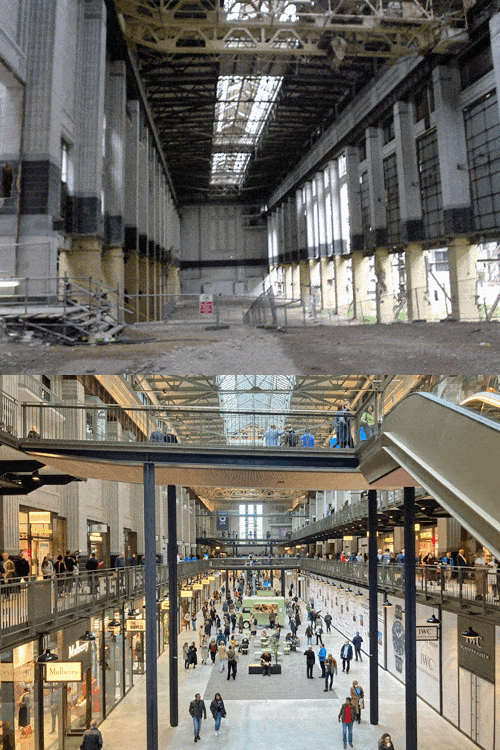
Battersea Power Station sparked back to life yesterday. [32 photos]
Since being decommissioned in 1983 the decaying building has been the subject of numerous wild and wacky regeneration schemes. It took a Malaysian consortium to finally find a viable proposal - filling the interior with shops and offices, surrounding the shell with flats and conjuring up a tube station to bring punters flocking. It's by no means an ideal solution but it has secured the future of the building, which was never a given, plus you can now buy handbags, gin and macaroons inside. It's all a bit Westfield, but Grade II* listed and with all the cheaper shops removed.
The opening ceremony was at 10am in Malaysia Square, which is the name of the (non-square) amphitheatre at the tube end of the building. All the wannabe shoppers were funnelled into Electric Boulevard, a wiggly canyon between Zara and hundreds of pricey flats, while those of us who wanted a better view stood up top by the railings. The Battersea Power StationCommunity Choir sang something suitably Malaysian, accompanied by drums, and former power station employee Rita Kelly battled her deafness to recount how she once almost ate her sandwiches on the roof.
The Mayor and Battersea's local MP demonstrated their oratory skills, bigging up South London, praising everyone who'd worked on the project and thanking "our friends from Malaysia". Then Rita pulled a lever which triggered a countdown which fired pyrotechnics and thousands of streamers into the sky. While the first shoppers dived for the doors, the streamers flapped down onto the roadway and entangled the rest of us in a swirling multi-coloured web, a bit like being attacked by an angry maypole. And when I'd finally extricated my feet, I went inside.
Which shops do you put immediately inside the main entrance? The jewellers and the luxury watch merchants, obviously, plus a Starbucks and a Pret for those who need a cup in their hand while they browse. From here you have to turn left or turn right, because although the Boiler House is vast most of it has been taken up by leisure facilities and office space, hence most of the retail offering is in the Turbine Halls to either side. Don't bother looking for a map, there are only directional arrows, the interior of the building being a three dimensional mystery tour until you finally get your bearings.
Turbine Hall A is the larger and brighter of the two. It's still recognisable from the shell it used to be because all the architects have really done is add two levels of raised walkways, plus walls to hide the shops behind. These include global brands like Lacoste, Ray-Ban and Reiss, because BPS isn't a Wilko and WHSmiths kind of place. The macaroons I promised are sold in a dozen bijou flavours from a green van parked sideways near some picnic tables. Not all the units are yet occupied, a number still have Coming Soon on their hoardings, but if your wardrobe needs a refresh you should find sufficient options.
Somewhere up on the left is Control Room A, a dazzling space still lined with the original knobs and dials, but that's the sole preserve of private bookings so all you can do is squint through the upper windows. Also off-limits at present, but not for long, is the entrance to chimney-based attraction Lift 109. For somewhere between £16 and £23 (day of week depending) you'll be able to wait for your slot on a mezzanine brimming with electrical gizmos before ascending to a circular viewpoint 109 metres up. On the way out expect to be greeted by a desk offering 'Your Power Pose', plus a gift shop selling Lift 109 t-shirts, Lift 109 chocolate bars, Lift 109 fudge, Lift 109 bricks and Lift 109 gin. All commercial opportunity is here.
Round the back of the building is the other end of the Boiler House, where there's a Searcys and a Superdry and a bookshop with limited upmarket stock. Next year the first floor will house a giant food hall but for now you can only get into the toilets - indeed there are plenty of these all over the building which is one advantage of a privately funded shopping mall over your local high street. While you're here you can pop out to the riverside and enjoy the parklet, jetty and reflective pool that have been open since 2017, plus a line of restaurants that's suddenly lost its exclusivity overnight. During this opening festival I also found a row of huts and vans selling scotch eggs for £6 and cheezy fries for 5.5, but you may not be so lucky.
Turbine Hall B glows red, a conscious lighting decision which confirms you must be in 'the other half'. Again the shell is recognisable to those of us who previouslygot inside the building, particularly the gently curved ceiling, but otherwise it's all mezzanines, escalators and rows of shops. Levi's, Calvin Klein and Abercrombie and Fitch are amongst the brandfloggers, but also Paperchase in case you have less than a fiver and need a card. The longest escalators head up to a cinema hidden in the centre of the building, best not visited by those with serious vertigo, indeed there are a few walkways like that all over.
Halfway down the hall is the other control room, that's Control Room B, which you can get into if you queue because it's been turned into a cocktail bar. Only one of its cocktails costs £52, but that's because it's designed to be slurped by three or four 'engineers'. If that's not your thing look out for the museum-style room recounting the history of the power station, a well-researched display including scale models of failed projects. Or just enjoy a good walk around the building admiring all the restored fabric, the gantry cranes, the architectural detail, the lot. But for the majority of visitors I expect Battersea Power Station will be somewhere they can come to spend their time spending money, which is the price this magnificent building has paid for its survival.
Yesterday, quietly, another bit of the Bank station upgrade opened.
It's a new bank of escalators between the Northern line and the DLR. Previously the direct connection was via a set of narrow twisty stairs, or a sightseeing tour of the catacombs if a one-way system was in operation. Now you just walk into a side passage, reaching the escalators in seconds, and up or down you go. It's transformational. The sign's enormous too.
It's a very clean connection, all white walls and with no adverts trying to sell you something. It's also very quiet, if you're used to the normal rattly escalators down to the DLR (which are still there, these new escalators are extras). They're numbered 20, 21 and 22, because 22 is indeed the current number of escalators amid the Bank-Monument station complex. Expect more soon.
If you remember the previous set-up at DLR level, a concourse ran between the two platforms with escalators at both ends leading to either Bank or Monument. That central concourse is still there, except one end's been widened and the middle has been blocked off to give the new escalators a landing space. If you're not heading up to the Northern line you may need to walk to the end of the platform to exit.
Part 1 of this transformation was back in May when the new southbound Northern line platform opened. The new escalators lead off one of the side passages and have been shielded by blue hoardings since then. They face more blue hoardings behind which will be a moving walkway(!) up to the Central line, because there's a lot more uncovering to go. This big reveal will also include step-free access to the Northern line and DLR, and is very likely to occur on Sunday 27th November because the entire station is mysteriously closed to passengers on that day.
Yesterday's unveiling was of course accompanied by a TfL press release, and one which kicked off with a very surprising claim.
...but at no point was it explained how, why or under what circumstances these escalators might lead to a nine minute time saving. I confess I'm baffled.
The stairs connecting the Northern line and DLR take one minute to negotiate, maybe two if you're slow, so there's no way of making a nine minute saving there. Things can get a bit shuffly heading off the DLR platforms at peak times, and until yesterday some semi-tortuous connections existed, but still nowhere near nine minutes worth. Even the underground switchback from Bank to Monument - the fabled escalator link - can be done in five minutes. There isn't a nine minute journey to be had within the station.
The press release actually refers to saving journey time, so perhaps there's an alternative interpretation. For example, a quicker connection from the Northern line to the DLR could mean you catch your Beckton train rather than just missing it, and that'd definitely get you home faster. But it'd be a 10 minute saving, not nine, so I guess that can't be what TfL mean either. It's baffling.
It appears to have baffled Seb Dance, Deputy Mayor for Transport, because in the press release he's quoted as saying...
None of the 'up to 9' minutes there, Seb is claiming nine minutes for everyone, and that's plainly not even slightly true.
But it's a claim that the media, who devour TfL press releases, have leapt on with some glee.
• New route at Bank station saves nine minutes off Tube journey, says TfL (Evening Standard)
• New route opens at London's 'worst tube station' cutting 9 minutes off tube journey times, TfL says (ITV News)
• TfL confirms new route will save 9 minutes off your journey at city's 'worst' and 'most confusing' station (MyLondon)
• Changing To The DLR From The Northern Line At Bank Is Now Up To Nine Minutes Faster (Londonist)
• Your Change From DLR To Northern Line At Bank Station Is Now Nine Minutes Faster (Secret London)
The first three at least had the nous to attribute the claim to TfL rather than state it as fact. Only Londonist were careful enough to say "up to" nine minutes, everyone else over-simplified. Meanwhile Secret London went with the full-on 'nine minutes for everyone' claim because accuracy is not an intrinsic part of their offering. Also see how MyLondon deliberately didn't name the station, because that's how clickbait works. Ian Visits had the wisest approach and stuck to facts...
• Bank station’s new escalators between DLR and Northern lines has opened (Ian Visits)
It's a great new connection. But it's not nine minutes of great.
Sometimes you just want to go for a nice walk, nothing too taxing, a bit of a stroll, lots to see, great views, woody streams, open fields, proper Green Belt, close to public transport, won't take long. So here's a gentle mile and a quarter following a brook in Enfield, nowhere near enough to make a day of it but a nice walk all the same.
The Merryhills Way is a recent public right of way, signed off in 2018, which crosses fields between Trent Park and Enfield. A local residents association persuaded the council that people had walked unchallenged and openly along these paths for years, reached an agreement with the landowners, added footpath markers and kissing gates, and hey presto. Only took them ten years. [leaflet pdf]
Let's start on Fairview Road, just behind The Ridgeway Tavern, not far from Chase Farm Hospital, half a mile from Gordon Hill station. If none of that made any sense this may not be the walk for you, or you could just get the 313 bus and give it a go. Don't worry, there'll be a tube station at the other end. The walk begins by plunging incongruously between two rows of houses into scrubby woodland. I managed to take the wrong path within 30 seconds - you need to keep left - but soon got back on track and enjoyed the shady solitude. The trees are only a brief interlude, though, because before long you reach a gate and ooh, won't you look at that.
Welcome to the valley of the Salmons Brook (not that salmon could live in it, there's nowhere near enough water) and the land rising on the far side is Hog Hill (ditto, no pigs). It's rural, it's quiet and it's very empty, but that's this corner of Enfield for you. You could walk direct to the far corner of the meadow but the public right of way only applies to the footpath following the hedge so please stick to that. Also I understand that this is a quagmire in the winter, indeed a lot of this walk is, but it proved perfectly solid in mid-October.
The brook's quite shallow and shielded by trees so you won't see it until the path dodges across it via a minor footbridge. Wave goodbye to the edge of Enfield's built-up area and please put your dog on a lead because the path's supposedly just entered farmland. That'll be horses because this corner of Enfield is very horsey, indeed expect to see a lot of 'Do Not Feed The Horses' signs ahead, but initially just empty scrappy paddocks. The path then enters a compound occupied by half-overgrown prefabs, which it turns out used to be part of a rifle range, encouraging "Are you sure I'm meant to be here?" vibes. Fret not, you are.
If the first half mile has been too much you can escape here down an unmade private track to the shopping parade at World's End. The Merryhills Way instead crosses into another field, which is where I saw my only horse, and here joins the lower reaches of the Merryhills Brook. This minor stream rises just behind Cockfosters station, but we won't be following it that far because a golf course gets in the way. What follows is the nicest bit of the walk, with the path and the stream tracking the foot of Hog Hill beneath broad grassy slopes. You don't get proper open fields like this in the centre of town.
Technically the footpath is the only right of way but I saw dogwalkers wandering much higher - all the way to the top of the spinney - to give their hounds a good runaround. These fields aren't cultivated, at least not any more, and one is liberally scattered with patches of Michaelmas daisies so is quite pretty at present. The stream stays mostly out of sight but I did find a half-damaged crossing which allowed me to peek across to, oh, another empty field. It wasn't clear how Vicarage Farm could be making any money. And that line of yellowing trees in the distance is where the Merryhills Way finishes, attaching itself to the midpoint of a sheltered bridleway.
Turn left for a short walk to Enfield Road, and from there to Oakwood station - you could be on the Piccadilly line in fifteen minutes. Or turn right for Trent Park, that lovely massive undulating woody country park with its historic mansion in the middle. Alas it's also got now luxury homes at its core, because that's inevitably what happens if you sell off a university campus these days, and I'd say it looks like the builders are about halfway through the project. I recommend the turning right option if you have the time, but officially the nice walk ended a paragraph ago.
Or at least it's a nice walk for now. When I got home and did some research I swiftly discovered that this entire landscape is under threat from development, which given this is Green Belt land was somewhat unexpected. A housing company bought Vicarage Farm several years ago, viewing it as 160 acres of "developable land" potentially delivering "between 3000 and 5000 quality homes". What's more Enfield council agreed with them and included the project in their draft Local Plan, officially proposing the “de-designation” of Green Belt land. They're under constant pressure to deliver more housing and smothering these fields with homes would, they argue, be a price worth paying. It's hard to find anyone else who agrees.
The proposals would cover my first photograph with homes, rising to a neighbourhood centre on the top of the ridge. They'd sanitise my second photograph as part of a green corridor retaining thin strips either side of the existing streams. They'd also cover my third photograph with homes - nothing affordable - to be marketed via the dream of living close to a tube station (whereas in reality Oakwood's a mile away so only car drivers need apply). Other weasel words in the Vicarage Farm Vision include "sustainable living in a green setting", "improved access to the wider countryside" and "good connectivity to local services". By the time I reached the end of the developer's document I had utter contempt for the sly bastard who wrote it.
It might never happen. New councillors have been elected since the draft plan was published, the Mayor says he's opposed and removing Green Belt designation doesn't come easy. The Enfield Society are battling hard, submitting a petition with over 4000 signatures which allowed them to present a deputation at last night's council meeting. It's possible to argue that what's proposed here is exactly what happened to multiple adjacent fields before Green Belt legislation halted London's outward spread, and people are happy to live in those now. But these wouldn't be homes for the masses, they'd be homes for wealthier incomers, and is it really worth sacrificing a natural landscape for them? A nice walk erased.
I'm going to my local polling station tomorrow, and if you live in Bow you might be going too. I received my polling card last month and I've decided against a postal vote so I'll be casting my mine in person. I'm just not entirely sure why.
The letter enclosed with my polling card told me it's because Tower Hamlets council are conducting a referendum on the Roman Road Bow Neighbourhood Plan. Everyone who's on the electoral register and lives in the Neighbourhood Plan Area can vote, and if a majority of voters vote in favour then the Plan will be used when deciding planning applications. What they didn't send me was a copy of the Plan, nor even a brief summary of its contents, only a sentence on the back of the letter telling me that further information could be found on the council website. Even then the landing page had no direct link to the Plan, only to another page with 24 further links where the Plan turned out to be the 5th link down. I do wonder how many potential voters got this far, let alone downloaded the 49 page pdf, let alone read it.
It's not a council document, it's been put together by a group of residents called the Roman Road Bow Neighbourhood Forum. They formed after an initial meeting in 2016, were officially designated by the council in 2017 and set about engaging the community to create an evidence base. The area in question stretches from Victoria Park to Bow Road and from the Regent's Canal to the A12. Essentially it's the northeast corner of the borough excluding any areas near the Olympic Park where the LLDC holds sway. The RRBNF consulted on their draft plan in spring last year, after which the council submitted it to an independent examiner who then proposed some changes, and hey presto, referendum-a-go-go.
n.b. A Neighbourhood Plan is a directive to be considered by the council when deciding on planning applications. It's nothing to do with Low Traffic Neighbourhoods, Liveable Streets or any of the usual stuff that gets local residents (on both sides) hot under the collar.
Despite living in the area I somehow missed all this, or at least didn't think it was important. I remember an online map of Bow where residents were asked to drop pins with comments, but I never realised there was a committee with a mission and its own dedicated website doing all this useful work behind the scenes. I also haven't received any additional information regarding the referendum by post or by email, even though apparently I was supposed to receive an RRBNF leaflet through my letterbox last week, so if I hadn't done any research I'd be walking into the polling station blind. And I'm 0.005% of the electorate.
I've always associated Neighbourhood Plans with provincial communities, not urban areas. My dad's village in Norfolk is trying to put one together and the village nextdoor had theirs ratified earlier this year, and they're a lot more community-focused than Bow. But it turns out London has 67 neighbourhood forums and 27 'made neighbourhood plans' (which I think means they've been through the referendum stage already). Pimlico's plan was voted through only a few weeks ago. Here's a map, and here's a list...
Made Neighbourhood Plans: Camley Street & Elm Village, Central Ealing, Crofton Park and Honor Oak Park, Dartmouth Park, Fitzrovia West, Fortune Green and West Hampstead, Grove Park, Hackbridge & Beddington Corner, Ham and Petersham, Hampstead, Harlesden, Highams Park, Highgate, Isle of Dogs, Kentish Town, Knightsbridge, Mayfair, Norland, Pimlico, Queen's Park, Redington Frognal, Soho, South Bank and Waterloo, St Quintin and Woodlands, Sudbury Town, West Ealing Centre, West Finchley
These areas aren't equally spread. Eight boroughs have no plans, indeed no forums, namely Barking & Dagenham, Bexley, Bromley, Croydon, Harrow, Havering, Merton and Newham. No new forums have been designated since February 2020 so momentum has been lost. And at least 15 forums have lapsed without reaching a result, for example the Greater Carpenters Neighbourhood Forum just south of the Olympic Park. They got all the way to the examination stage in 2019, but regulations restrict the lifespan of a designated Neighbourhood Forum to five years and that period expired in July 2020, so all their effort was lost.
Meanwhile in Spitalfields... well, this is Tower Hamlets so you can probably guess that something dodgy happened. Two referenda were held in November last year, one for residents (with 54% voting YES) and one for businesses (with 80% voting NO). This left the decision in the hands of the council, which is now under the control of Lutfur Rahman's Aspire Party, who last week sided with the businesses rather than the residents. The Forum are unhappy, even bitter, claiming that the split decision in the referendum was "caused mainly by widespread unlawful voting in the business referendum and other breaches of election law". On Twitter they additionally claimed "46 of the 97 business votes cast came from 91 Brick Lane, owned by property developer OTB who have tried since 2014 to sabotage the Plan." But there's no going back, so all their hard work since 2016 has been for nothing.
The policies in the Roman Road Bow Neighbourhood Plan look good, even uncontroversial, but I only know this because I opened the pdf. I wonder how many people will vote in favour tomorrow without knowing what they're voting for, and I wonder how many will vote against purely because they hate the council no matter what. It could turn out to be a referendum swung by wishful thinkers or perpetual naysayers. What I suspect is that it'll be passed with a large majority as Bow's community warriors, grassroots activists and Observer readers head to the polls while the indifferent stay at home. From what I've seen these referenda normally attract just 10-15% of the electorate, but the result is binding either way.
If Bow votes in favour of the Neighbourhood Plan tomorrow it becomes a statutory document and will guide all development within the local area alongside other planning policies. I reckon that'd be a good thing, although I haven't actually scrutinised every word on all 49 pages so I'm taking the future of my community on trust. On such blind decisions are empires won and lost.
Friday update: YES 1743 (63%), NO 736 (37%), Turnout 12%