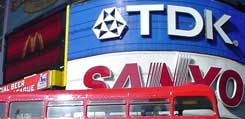
Baker100 - Piccadilly Circus station Station opened: Saturday 10th March 1906 Distance from previous station: 1km Quick history: Two brand new underground lines met beneath Piccadilly Circus in 1906 - the Baker Street & Waterloo and the Great Northern, Piccadilly & Brompton. The original station building was located on the corner of Coventry Street and Haymarket. As passenger numbers grew, a splendid new circular ticket hall was constructed beneath Eros, opening in 1928 (see cutaway diagram here). Long history: Is this long enough for you? Three things I found outside the station: half the tourists in the western world all jostling for position trying to take photographs of each other in front of Eros [photo]; two highly embarrassed men in big round pumpkin-shaped hats giving away free Mentos mints; a thin blue police telephone box (no longer functional) Change here for: Piccadilly line Bakerloo platforms: tiled with primary-coloured red, blue and greenery Thrilling fact: Because the Bakerloo platforms are slightly staggered, you can stand at the northern end of the northbound platform and watch trains curving into the southbound platform. Old photo here. Nearest baker: I don't know if it counts, but the very first Lyons Teashop opened a few doors up Piccadilly. Now a British Airways Travel Shop. Nearest loo: The subways around the ticket hall contain some pretty robust public conveniences. Many decades ago they'd no doubt have been frequented by those seeking Dilly Boys on the meatrack. Savvy? I've been here before:Piccadilly month(August 2004)
And now the Bakerloo heads south, beneath Portland Place. This is one of the most elegant streets in London, although it would have been even grander had architect John Nash had his way. He planned a processional thoroughfare for the Prince Regent, leading from Carlton House on the Mall to the prince's summer villa in Regent's Park. It was to be a straight line, but land battles with Sir James Langham and the residents of Cavendish Square forced part of the road further east than Nash would have liked, creating a distinctly imperfect kink around Langham Place (full history here). But the road remains far broader than most, like a Georgian dual carriageway, and is always a impressive place for a quiet stroll. Here are some of the architectural (and other) treats to be seen down Portland Place:
• Park Crescent: One of Nash's first crescents[photo], originally planned as a full circle (or circus). The purity of its white stone colonnades still makes me think that Mary Poppins is about to fly in at any minute.
• Several statues down the 'central reservation': A real mixed bag, including Joseph Lister (who pioneered the use of antiseptics in surgery - pictured), SirGeorge Stuart White (Boer War commander) and QuintinHogg (founder of the first polytechnic).
• RIBA: The headquarters of the Royal Institute of British Architects is a sheer stark slab of 30s brutalism [photo]. On the pavement outside there's usually a poignant one-woman protest aimed directly across the road at the Chinese Embassy (read more here).
• Lots of scientific associations: The largest of these is the Institute of Physics, but there's also the Royal College of Radiologists, the Institute of Chemical Engineers and my personal favourite, the Anaesthaesia Heritage Centre. No, really.
• BBC Broadcasting House: About which I wrote in depth when I went for a tour last year. The interior of the building is still being renovated, but it looks like they've pretty much finished the exterior at last. The Bakerloo line passes very nearly underneath the building, which used to cause all sorts of sound problems when certain radio programmes were being recorded, but the latest design features heavy soundproofing throughout. There's an outstanding history of the site here, of the original building here and of the new development here.
• The Langham Hotel: London's first purpose-built grand luxury hotel, originally with 600 rooms (now 427). Famous regular visitors included Oscar Wilde, Mark Twain, Noel Coward, Antonin Dvorak and Haile Selassie. 100 years ago a room cost 9 shillings (45p) a night - today that's merely an insulting tip. Full historical trivia here.
• All Souls, Langham Place: John Nash's signature circular church, with the famous lemon-squeezer roof and spire [photo]. Inside there's perhaps more a feeling of theatre than temple, but that's perfectly in keeping with this modern church's vibrant outreach ministry. How many other churches allow you to download their last four weeks' sermons?
Baker100 - Oxford Circus station Station opened: Monday 30th July 1900 Distance from previous station: 900m Exit: The old Baker Street & Waterloo Railway station, designed by Leslie Green, on the corner of Oxford Street and Argyll Street Entrance: steps down from the four corners of Oxford Circus, into the new ticket hall built for the opening of the Victoria line in 1969 Surroundings:northwest - H&M (smiley Swedish clothing); southwest - United Colors of Benetton (purveyor of ultra-matched separates); southwest - Shelly's Shoes (sold-out Carnaby Street bootseller); northeast - Niketown (corporate sportswear temple) Station layout: Oxford Circus station is bloody complicated beneath the surface, with long winding tunnels everywhere which seem to take forever to walk down. I could try describing the layout, but I'd rather guide you towards these fine below-surface plans and 3Dcutaways. Tell me you're not impressed. Station history: short version here, extremely detailed pdf version here Change here for: Victoria line (a very easy same-level interchange) and Central line Bakerloo platforms: tiled with a green and white maze mosaic Thrilling fact: Smoking on tube trains and underground stations was only banned in 1985 after ascaryfire at Oxford Circus station trapped 1000 late-night commuters in smoke-filled tunnels. Local character: Where Oxford Street once had Stanley Green, the Protein Man, now it has Paul Howard, the Sinner Winner Man. "Why be a sinner, when you can be a winner?" If you ever risk crossing Regent Street just north of Oxford Circus you'll probably hear Paul's dulcet tones booming out from the traffic island [photo], trying to convert passers-by to the living gospel. "If God's not the boss you're gonna suffer loss." There he stands in his orange anorak (with arctic-fur collar), politely haranguing pedestrians with his streaming megaphone monologue. "If we don't team up with God we never win." There's just a hint of a Deep South guttural aitch whenever he utters the word "je-h-esus" (which is often), but stay and listen too long and you'll realise that a lot of what he has to say is on a recycled loop. "Why be a sinner, when you can be a winner?" Read the b3ta interview with Paul here, download a signed poster here and buy the official t-shirt (honest) here.
And now to walk the entire length of the original Bakerloo line, above ground, to see what's there. It's only three miles from Baker Street to Lambeth North, but there's absolutely tons to see.
Today I'm tracing the tracks from Baker Street to Regent's Park station. Here's an old map showing the geographical route (northeast-ish), which is absolutely nothing like the fantasy route (southeast) depicted on the official London Underground tube map. Whatever today's map may say, the Bakerloo line definitely runs to the north of the Circle line between Edgware Road and Regent's Park, and not to the south.
[I would at this point show you the relevant tiny snippet of the current London Underground tube map, but it's probably best not to for scary legal reasons. And if you're a fan of strange and wonderful tube maps (like the anagram one, the sweary one and the upsidedown one) then you might want to head over to Geoff's map archive and download as many as you can before TfL's humourless solicitors move in on Monday and extinguish the lot].
The first eastward building you meet on leaving Baker Street station is one of the most famous in London - the Planetarium. Its green copper roof is instantly recognisable, as is the small ringed planet perched right on the top of the dome [photo]. As a child I remember reclining on the comfy seats inside the Planetarium and being totally overawed by the astronomical lightshow projected onto the roof above me. I quite fancied going back for another look this year, except that the show has now been dumbed down to a mere ten minutes and entrance is only available as part of a combined ticket with Madame Tussaud's nextdoor. Sorry, but there's no way I'm forking out £22 (yes, £22!) to gawp at a few waxwork celebrities, even if some are supposedly interactive and reveal a bit of greasy flesh. Tragically the owners have decided that the only stars which attract tourists nowadays are of the two-legged kind, so in June the Planetarium in its current form will be closed and transformed into the Auditorium - a new audio-visual show which promises to "get into the heart of celebrity". Sounds absolutely ghastly, but I'm sure the vacuous crowds of tourists who throng the Marylebone Road will lap it up.
From here the underground Bakerloo line skirts the southern edge of Regent's Park. This is one of the largest open spaces in central London, transformed from Tudor hunting lands into elegant parkland by John Nash. He's also responsible for the imposing terraced villas which line the edges of the park [photo], now home to the aspirationally exclusive. I passed several moneyed old couples out taking a stroll through the park, the men gnarled and grimacing, ostentatiously parading their fur-coated wives and pampered dogs. Younger visitors cycled, or jogged, or even scootered, while out on Marylebone Green a semi-serious soccer kickabout was underway. The scenic central lake [photo] is actually part of the old River Tyburn, here visible for the one and only time before plunging beneath the city of Westminster on its way to the Thames. At the moment a carpet of daffodils is pushing bravely through the winter mud, but it won't be long before this lovely park truly springs to life.
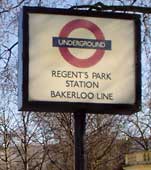
Baker100 - Regent's Park station Station opened: Saturday 10th March 1906 Distance from previous station: 900m Surroundings: The station entrance is encircled by a large area of trees and gardens which you might expect would be part of Regent's Park, but you'd be wrong. This is Park Square Gardens, a privileged enclave for the exclusive use of (very) local residents. Iron railings and padlocks segregate several acres from public access, and there's even a caretaker's cottage in one corner to ensure that all undesirables are kept at arm's length. No doubt the lawns are covered by Raybans and Riviera-tanned skin in the summer, but give me the common ground to the north any day. Station building: One of relatively few tube stations with no building on the surface [photo]. Entrance is down some steps (past a tramp) through a pair of twin bore green-tiled subways [photo]. Ticket hall: gloomy, narrow and partly wood-panelled Thrilling fact: If you choose to take the stairs rather than the lift, there are 96 steps down to the platforms. Platforms: dark and melancholy with original Edwardian tiling, including the words 'Regent's Park' picked out in brown rectangles. Change here for: Great Portland Street station, which is only 100 metres up the road. Again, you'd never tell by looking at the tube map. Don't change here for: London Zoo (which may be in Regent's Park but it's almost a mile away, and Camden Town station is rather closer). Advance warning of closure: Regent's Park station is closing for a year, starting on June 5th, so that essential maintenance work can take place. Metronet are in charge, so I wouldn't hold out much hope of them leaving all the heritage features intact or even finishing on time. I've been here before: Walking the Regent's Canal(May 2005)
It's exactly 100 years today since London Underground's Bakerloo Line opened, on Saturday 10th March 1906. Only eight stations were ready for traffic at the time, but the tuppenny tickets proved most popular and 37000 passengers packed the trains that day. To celebrate this centenary I'll be taking a virtual journey along the original line, station by station, from Baker Street to Lambeth North. It's not just an interesting underground journey, it's also a damned fine walk above ground, so there'll be plenty to see along the way over the next week. Mind the doors.
At the turn of the 20th century there were three different east-west underground lines through the centre of London (the Metropolitan, District and Central) but no lines travelling north-south. The new Baker Street & Waterloo Railway aimed to change that, allegedly inspired by the desire of certain Westminster gentlemen to reach Lord's more easily to watch the cricket after work. This was one of London's first deep level tubes, burrowing deep beneath London's streets rather than using much cheaper cut and cover methods. Initial construction was slow due to lack of funds, but inspirational American businessman Charles Yerkes stepped in with financial support and provided the impetus to complete the project. And it was an Evening News headline soon after the railway's opening which first nicknamed the line the "Baker-loo", and the name has stuck ever since.
Here's a brief Bakerloo line history (and if you need a map to follow, try here):
1906: The Bakerloo opened between Baker Street and Lambeth North (then called Kennington Road). Tunnels to Elephant & Castle opened in August of the same year. All further extensions were to the northwest. 1907: Extended westward to Marylebone (terminus of the Grand Central Railway) and then Edgware Road (not the Metropolitan station of the same name). 1913: Extended southward to Paddington - following an extremely tight curve which looks very different on a geographically accurate map compared to the usual smoothed-out Harry Beck version. 1915: Extended northwest to Queen's Park, where Bakerloo trains met up with overground trains on the London & North Western Railway. Some Bakerloo trains continued to Willesden Junction and (in 1917) to Watford Junction. 1939: The Stanmore branch of the Metropolitan line transferred to the Bakerloo. 1979: The Stanmore branch switched to the new Jubilee line (I've covered this in enormous detail before, remember...) 1982: Northernmost Bakerloo terminus cut back from Watford Junction to Stonebridge Park. 1984: Trains restored between Stonebridge Park and Harrow & Wealdstone (which is how things stand today).
The Bakerloo's a strange line. It ventures from darkest Southwark to leafy suburbia. Its squat little trains rattle and wheeze through bendy tunnels. Its underground stations remain gloomy and labyrinthine. Its overground stations feel bleak and unloved. But the Bakerloo's still a great little line, nimbly joining several key London locations, and a characterful throwback to how the underground used to be. And it's brown. Even 100 years ago, brown was cutting edge.
Baker100 - Baker Street station Station opened: Saturday 10th January 1863 Bakerloo line platforms: tiled with an ingenious Sherlock Holmes design, constructed from miniature Sherlock Holmes silhouettes [photo]. Change here for: Jubilee line (a very easy same-level interchange), Metropolitan line, Circle line, Hammersmith & City line. You'd be quicker changing here: From here to Waterloo by Bakerloo line takes 10 minutes. From here to Waterloo by Jubilee line takes 9 minutes. Thrilling fact:Baker Street was one of only seven underground stations on the world's first underground line between Paddington and Farringdon. Immediately outside the station: hundreds of tourists buying tacky souvenirs, long queues for sightseeing buses, a statue of the ubiquitous Sherlock Holmes, Transport for London's Lost Property Office (it's amazing what people lose). Nearest baker: Presumably there were once bakeries in this street, but I couldn't find one. There's a small tiled arcade above the station where you can buy pizzas, chocolate bars and nuts. There's a row of touristy gift shops and cafes in front of the station where you can buy a very artificial looking apple danish. But something traditional and baked, like a loaf of bread? Not a chance. Nearest loo: Beneath the pavement, just across the road from the station, are a pair of well-tended public conveniences. I had to pass a sleeping dog to get into the gents, then walk round a tall green pot plant to get to the urinals. The tiles above the splashback were illustrated with colourful cartoon characters, but a Westminster council CCTV watched my every move, to the last drop. I've been here before: Winding your way down on Baker Street(Gerry Rafferty, 1978)
Shoot-out at the Blind Beggar: Wednesday March 9th 1966
Forty years ago tonight one of the East End's most notorious murders took place. Ronnie Kray walked into the Blind Beggar pub on the Whitechapel Road and shot dead gangland rival George Cornell, supposedly for calling him a "big fat poof". Which of course he was, although it was highly inadvisable to mention this out loud. George may have been stupid, but his cold-blooded murder shocked the East End. And you wouldn't guess from looking at the pub today, but the BlindBeggar has quite a history...
Legend tells that the original 'blind beggar' was Henry de Montfort, a medieval nobleman. He was left disfigured following the battle of Evesham in 1265 and reduced to begging on the streets in this part of ye olde Whitechapel. Henry's daughter Bessee was a bit of a looker and soon attracted the attention of many noble suitors, but all were discouraged from marriage by her father's wretched appearance. That is until one gentleman finally had the courage to ask him for Bessee's hand in marriage, upon which Henry revealed that he was in fact heir to the Earl of Leicester, Simon de Montfort, and handed over a large sum of money to pay for the wedding. That's oneversionofthestory, anyway.
In Pepys' time Whitechapel and Bethnal Green were well-to-do country villages situated in green fields outside the City walls. However, the growth of the capital over subsequent centuries brought great poverty and slum conditions to the area. In 1865 former Methodist minister WilliamBooth arrived here from Nottingham and was shocked by what he saw. He was walking along the Whitechapel Road when he came across a religious open-air meeting taking place outside the Blind Beggar. William stepped up to preach and so impressed the organisers that they invited him to lead their small tent-based mission nearby. From this chance meeting was formed the Salvation Army, and Booth devoted the rest of his life to raising the poor of the East End out of poverty through the power of the gospel. A statue close to the pub marks the birth of this earnest international organisation (take a historical walkabout here) although I've never once seen a single tambourine waved in the vicinity.
100 years later, Reggie and Ronnie Kray ruled the roost in Whitechapel. They ran the underworld north of the river, while the Richardsons held sway over the south. George Cornell was a burly meathead with a sadistic reputation, originally a mate of the Krays but who later defected to work for the southern gang. George was rumoured to have been heavily involved in a fatal shootout at a club in Catford on 7th March 1966, a gun battle in which one of the Kray's cousins was fatally wounded. Two days later Ronnie heard that George had dared to go drinking in Kray territory, at the Blind Beggar, so he dashed round from a nearby pub to exact his revenge. George greeted Ronnie with a sarcastic comment, so Ronnie whipped out a pistol and shot George three times in the head. Like you do. To the police's dismay not one of the regulars drinking in the pub that night was willing to testify against Ronnie, and so his fearsome gangland career stuttered on unchallenged for another year.
The Blind Beggar today is just an ordinary East End pub with beer garden, conservatory and satellite TV. It still gets its fair share of curious visitors, popping in for a half of shandy as an excuse to hunt for evidence of bulletholes in the walls or bloodstains on the carpet. And there are still just enough Whitechapel residents to keep the business ticking over, though not as many as before because most of the locals these days don't drink alcohol. But you won't see any gangland villains hanging out on the comfy sofas today, nor disguised noblemen begging on the street outside. And, if anybody asks, I wasn't there on that dark March evening forty years ago, honest. I have an alibi - I was attending my first birthday party twenty miles away at the time.
Queen Quality and the Demon of Risk(a modern fairy tale)
Once upon a time, not so long ago in a country not so far away, there lived a humble carpenter called William. William was a great craftsman and carved the finest furniture you ever did see. His tables were a marvel to behold. His cupboards were masterpieces of great beauty. But it was for his magnificent chairs that William was best known. Each chair was carved from solid oak. The legs were curved and elegant. The seats were smooth and comfortable. The backs were intricate and ornate. Everything about William's chairs was exquisite, and he was duly proud of his work.
One day William was at home in his workshop when there was a knock at the door. Imagine his surprise when there, large as life on his front doorstep, stood the Queen! "Hello good citizen William," she said. "I am undertaking a new project at the castle and I am in need of fine furniture. I have heard great things of your woodworking skills, and have come to ask if you would carve me a chair for the royal bedchamber. It must be a great chair, the very finest you can create, and free from all imperfection. We must ensure quality. I'm sure you will not let me down. I bestow upon you three days in which to complete your task." William bowed low as the Queen departed.
On the first day, William set about finding the very finest wood with which to make the chair. He was just about to venture out into the forest when there was a knock at the door. It was the Queen again, holding a sheaf of parchment in her hand. "Oh William, you cannot begin your task until you have completed this Project Initiation Document. I know that you are a great carpenter, but imagine what might happen if your goal objective parameters were left undefined. I cannot allow such a threat to quality". And so William spent most of the first day preparing the Project Initiation Document, consulting with the village elders whenever he got to a particularly difficult part of the 18-page form. Just before sunset he finally found time to go out and collect some wood, but it was a bit scrappy and not up to his usual standards.
On the second day, William busied himself in his workshop ready to carve the various parts of the chair. He was just about to dig his chisel into the wood when there was a knock at the door. It was the Queen again, holding a sheaf of parchment in her hand. "Oh William, you cannot continue your task until you have completed this Risk Assessment Spreadsheet. I know that you are greatly skilled with the fretsaw and the drill, but imagine what might happen if some unforeseen disaster were to impact upon the successful delivery of project milestones. I cannot allow such a threat to quality". And so William spent most of the second day updating the Risk Assessment Spreadsheet, addressing all relevant Health and Safety protocols where necessary. Just before sunset he finally found time to make a start on carving, but the light was failing and his carpentry was not up to his usual standards.
On the third day, William prepared to assemble the chair and to sculpt tiny royal crests into the armrests. He was just about to start putting the pieces together when there was a knock at the door. It was the Queen again, holding a sheaf of parchment in her hand. "Oh William, you cannot complete your task until you have filled in this Performance Appraisal Overview. I know that you are a most talented carpenter, but I must insist on firm documentary evidence that all designated objectives have been achieved. I cannot allow such a threat to quality". And so William spent most of the third day completing the Performance Appraisal Overview, obtaining written feedback from key stakeholders as appropriate. Just before sunset he finally found time to assemble the chair, but there wasn't time to do anything fancy with the armrests or to give the wood a proper varnish.
As night fell, the Queen summoned William to the palace. Here he placed his creation in front of her Majesty, with some trepidation, and handed over the relevant paperwork. "Excellent, you've completed all the necessary forms," said the Queen, before locking them away (unread) inside an overflowing filing cabinet. "My auditors will be duly satisfied. But what kind of chair do you call this? The wood is cheap and knotted. The carving is rudimentary and rushed. The armrests are plain and undecorated. And the varnish is still damp! I don't understand what could possibly have gone wrong. After all, I ensured that you followed all appropriate quality procedures."
"With greatest respect, your Majesty," replied William, "I spent so long filling in all those forms that I didn't have the opportunity to engage properly with the project. You were reluctant to trust me to do a good job, so instead you wasted my time by requiring me to prove that I was doing a good job. Your over-bureaucratic quality procedures actually prevented me from ensuring quality. It's your own bloody fault you blinkered managerial pedant."
"Ooh excellent!" exclaimed the queen. "I think I've just invented Business Quality Management. I must initiate rollout to all organisations across the country immediately. We must ensure quality." And nobody lived happily ever after.
Thanks for voting yesterday in my readership survey - more than 300 of you were kind enough to take part. Now I know a lot more about you all, and how my readership has changed over the last two years. According to my 2006 survey results, the typical diamond geezer reader is a straight-but-coupled 30-something male blog-reader from the London area. If anyone out there reckons they could be Mr Average, please stake your claim in the comments box. And here are those results in a little more detail.
Male or female?
male (218)
72%
female (85)
28%
Hmmm, that's almost three male readers to every female. The proportion of women is slightly higher than two years ago, but not by much. Maybe cyberworld is still full of blokes, or maybe I'm just not posting enough kittens.
Age
<20 (11)
4%
20s (85)
28%
30s (94)
31%
40s (60)
20%
50s (36)
12%
60+ (17)
6%
Well over half of my readers are aged between 20 and 40, with slightly more 30- than 20-somethings. Since 2004 I've picked up rather more older readers than before, especially over the age of 50, but my attempts to attract the yoof market have clearly backfired. What I need is a diamond geezer myspace profile to get down wiv da kidz. So I started one. Well wikkid innit?
Where do you live? (pick one)
London (130)
43%
England (85)
28%
UK (15)
5%
Europe (16)
5%
World (57)
19%
OK, I know I write about London a lot, but by no means exclusively. So I continue to be amazed that my readers are increasingly far more likely to live in London (population 7 million) than anywhere else (population 6½ billion). Altogether just over three quarters of you are from the UK, but the proportion of overseas readers is gradually increasing. Heaven knows why you foreigners are interested in local London stuff, tea and nostalgic 80s TV programmes, but thanks for sticking with me.
A bit more about you
straight, single (97)
32%
straight, coupled (168)
56%
gay, single (19)
6%
gay, coupled (18)
6%
Nearly 90% of you are straight (I suspect that's just below the global average), nearly 40% of you are single (I suspect that's just over the global average), and straight readers are noticeably more likely to be in a relationship than gay readers (I suspect that's deeply meaningful and many of you could blog about the subject at great length).
Do you have your own blog?
yes (135)
44%
no (169)
56%
Although this vote ran very close, I note that the balance has tipped slightly in favour of non-bloggers over the last two years (was 47%, now 56%). Which is odd, because I thought everyone had a blog these days. Maybe your life isn't worth writing about, or maybe you have much better things to do with your time than telling the world what you had for breakfast and what you think of the Prime Minister. And that's fine because, quite frankly, I wouldn't have the time to read 300 of your blogs every day anyway.
How often do you read diamond geezer?
daily (175)
58%
often (94)
31%
occasionally (20)
7%
first visit (14)
5%
Well over half of you come back every day, eh? That's comforting, because I do try very hard to post something every day for you to read. And yes, I know that a lot of you so-called daily readers probably read from work and have the weekends off - my visitor stats would support that - but you're still showing real online commitment. And a special hello to the 14 of you who were making your very first visit yesterday (assuming you ever come back again, that is).
When was your first visit to diamond geezer?
2002 (20)
7%
2003 (37)
12%
2004 (78)
26%
2005 (88)
29%
2006 (77)
26%
And finally, a tribute to the longevity of blog readers. I started diamond geezer 3½ years ago (almost exactly), and 7% of you claim to be part of my first tiny readership trickle. Less than 20% of you were around the last time I ran this survey. Most of you are rather more recent, with about a quarter of you arriving here only within the last couple of months. Thanks to you all for sticking around, however long it's been. But I wonder if these results mean that I can get away with recycling more old posts without most of you noticing? (like this one for example...)
Readership survey(2) : Precisely two years ago I ran a readership survey to find out who was reading my blog. Fascinating the results were too. A lot's changed since then (not least in the last couple of months) so I thought I'd run the survey again. I wonder how different 2006 is to 2004. Go on, tell me about yourself...
5 linkybits • "Snakes On A Plane" may just be the best title for a film, ever. Admit it - you can immediately picture the entire plot, can't you? Samuel L Jackson stars (apparently he signed up purely on the strength of the title, and refused point blank when producers tried to rename it "Pacific Air Flight 121"). Released later this year. More here. • Depeche Mode's latest single "Suffer Well" (their 40th) has been re-recorded in Simlish - the language used in videogame The Sims. There's even a Simlish video, here. • More than 200 lesser-known London locations are lovingly catalogued at Hidden London - from Ruislip Common to Foots Cray. Refreshingly non-Zone-1-centric. • Have you ever needed to create a basic CSS stylesheet with a particular number of columns in a particular format? I know I have. Now there are 40 downloadable formats (like, for example, one liquid central space sandwiched between two fixed width columns) at Layout Gala, all ready for you to copy. Very simple, and dead useful. • Pelmanism with kittens - the Meowmory game.
I can't remember the last time I drank a Coke. Or a Pepsi, or a Tango, or a Fanta, or anything else similar for that matter. I used to drink a lot more of the stuff, but now I'll choose almost any other beverage in preference. I used to lug 2 litre bottles of sugary fizz home from the supermarket on a fortnightly basis, but I stopped doing that a few years ago. I gave up on bottles of squash at about the same time (there's still a quarter of a bottle of Robinsons left in my kitchen with a 2004 sell-by date). And I used to need a spoonful of sugar in my tea but I don't any more, so I've not bought a single bag of sugar since last century as a result. I can't claim that my life is sucrose-free, but most of my drinks are these days. And it seems I'm not alone.
UK drinks giant Britvic posted a profits warning last week saying that "the decline we have seen this year in January and February has been more severe than anything we have seen in the past." Britons are increasingly ditching colas and carbonates for what they perceive to be healthier options (such as Pepsi Max, fruit juices and bottled water). No longer do we stare at a can of Coke and think "mmm, it's the real thing and it looks delicious" because an inner 'green' voice is telling us "there's 35g of sugar in there, I'd be far better off chewing a carrot". It seems we don't want to be a bunch of obese fatties with decaying teeth any more. Fizz is on its way out.
A similar revolution is underway in the nation's schools. A governmentreportpublished last week proposes that schools should be barred from selling confectionery, bagged savoury snacks and carbonated drinks. I find it staggering that big Coca Cola vending machines were ever allowed in secondary schools in the first place, but I guess that raising revenue to pay teachers' salaries was more important than stopping kids becoming roly-poly lardbuckets. No longer - it's chilled water and unsalted nuts at breaktime if these proposals are given the go-ahead. The only junk being eaten in schools will be the stuff which ill-informed parents stuff into lunchboxes or which children buy outside in the corner shop.
Not surprisingly drinkscompanies and vending associations are up in arms. The rush towards healthy eating risks haemorrhaging their profits even further, and so some major PR campaigns are underway to try to promote fizzy drinks as part of a healthy balanced diet. I'd be proud of this stuff if I were being paid squillions as an advertising copywriter, but it's clearly drivel dressed up as fact.
Here are ten quotes lifted from press releases and other marketing blurb. Nine are genuine, and one I've made up. Can you spot the fizzy fake?
a) "Soft drinks are a good source of fluids as up to 95% of their volume is water, and keeping hydrated helps young people to maintain concentration. Offering a wide variety of soft drink types and flavours encourages fluid intake among young people." (Coca Cola)
b) "Research has shown that children are more likely to drink sufficient to replace lost fluids and maintain hydration during activity when presented with flavoured beverages." (British Soft Drinks Association)
c) "Many schools recognise and welcome the role vending can play in encouraging students to remain on site during breaks and lunch and are conscious that with schools open for longer hours and to more groups within the community, the provision of refreshment outside normal catering hours, which vending can provide, will be essential." (Automatic Vending Association)
d) "Many soft drinks provide significant nutritional and functional benefits. Some can provide one of the recommended 'five a day' servings of fruit and vegetables." (Coca Cola)
e) "Sugar is a natural and safe ingredient from which children can benefit. It is an excellent source of energy and is therefore particularly useful for active children with high energy needs." (British Soft Drinks Association)
f) "Our strategy encompasses both product responsibility as well as the promotion of active lifestyles – we’re committed to acting on both sides of the energy balance – calories in, and calories out." (Coca Cola)
g) "Replacing sugar with artificial sweeteners to assist weight loss can be counter-productive as it may, in fact, lead to increased fat intake. Allowing sugar in a low-fat diet can make it more palatable and easier to follow." (World Sugar Research Organisation)
h) "Children need to be fully informed to make educated choices about their dietary intake. Presenting them with the complete range of carbonated and still drinks helps to ensure healthy lifestyle choices which will be maintained into adulthood." (this is the fake)
i) "All soft drinks are healthy because they provide the vital fluids our bodies need with some also providing contributions to the various vitamins and minerals we need every day." (British Soft Drinks Association)
j) "The removal of such a highly efficient country-wide beverage distribution system could have an impact not only on pupils' hydration, but also on pupil behaviour as they would be more likely to buy products outside school before, during and after the school day" (Coca Cola)
Blogging from bed: One of the joys of having a new laptop is the ability to take it anywhere. No longer am I restricted to a clunking great PC on the end of a power cable - now I have wireless-enabled portability. I have yet to risk taking my laptop out of the house, for example to slouch on a Starbucks sofa to check my email, but I have made it as far as the bedroom. Horizontal blogging is a new experience for me, tucked up beneath a warm duvet rather than risking the chilly air of the living room. Normally I've not been one for hanging around in bed once I've woken up, because there never seemed to be much of interest to do whilst lying there (maybe I was missing out on something). But now I can surf, and search, and research, and chat, and generally interact, and more, from the comfort of my own pillowspace. It's really quite liberating. Maybe I need never venture out of the bedroom again (except to visit the kitchen and bathroom, and perhaps leave the house occasionally). I'm still struggling to find the most comfortable position for in-bed laptop use - is it propped up on my left elbow, or reclining flat with laptop perched on chest, or sat bolt upright resting my back against the headboard, or balancing the laptop on the duvet between knee and pillow, or something else? I wouldn't want to wreck my spine through incorrect posture just for the sake of short-term laziness. But I could get used to this.
Retail therapy: Regular readers may be wondering what's happened to my annual series of 'retail therapy' posts. Because, as you know, I'm rubbish at shopping, and every year I need your guidance to help me to spend cash on myself as my birthday approaches. Except that this year the unthinkable has happened, and I've managed to spend money all on my own. Last month, for the first time in living memory, I actually spent more than I earnt. I understand that some people do this every month (presumably because they like being in debt), whereas this is virgin territory for me. I bought some clothes, which I never normally do. I visited Oxford Street and came home with books, shoes and CDs, which is unheard of. I acquired a second-hand flatscreen monitor, but only managed four days use before my computer died. I took a financial plunge and splashed out on a brand new cutting-edge laptop. I even booked some plane tickets. Blimey. But don't worry, I've not been completely won over by spending. I've not opened an eBay account, or had a total 'brown' makeover, or started throwing money to beggars, or developed an irrational IKEA addiction. I might still need your help next year. But it's a start.
It's not every day you return home to discover that the Government plans to divert one of London's major sewers beneath your flat. Thankfully this hasn't quite happened to me, but it's come bloody close (like, within fifty metres) and that's scary enough.
Crossrail is coming. Very slowly, admittedly, but by 2013 it's hoped that rail travellers will be able to zoom underneath central London and out into the suburbs far faster than is possible today. Sounds great. And it will be, except for the unlucky few who live just that bit too close to the proposed route of the new tunnels, because you can't build a new railway without making a mess. In East London, for example, there's a bigfuss up Brick Lane about the proposed Hanbury Laneshaft which will see lorryloads of spoil being carted through the streets of Banglatown. Elsewhere Crossrail planners appear to have hunted down most of the available patches of open space directly above their tunnel route (like half of Finsbury Circus, the fountain beneath Centre Point, a Sainsbury's car park and a traveller caravan site), and plan to transform them into ventilation shafts and temporary worksites. If it can't fight back, they'll build on it.
One of the areas to be seriously affected is Bow. We're not getting a station or anything useful, but Crossrail is due to burrow within 100 metres of my house before passing underneath the River Lea (pictured) and emerging from deep tunnel just to the south of the Olympic site. Us locals are therefore promised "about four years and three months" of major building works while they construct the tunnel portal. Plans include the closure of various riverside towpaths for "a year and three months", a month-long closure of the busy A12 Blackwall Tunnel Approach road, a realigned DLR station and the eastward diversion of a major sewer. We're advised that all this work will provide "adverse visual impacts" for residents... unless we happen to like cranes and concrete mixers, that is. And this is in addition to six years of neighbouring Olympic redevelopment. Which means that my local area is about to turn into a giant building site for the forseeable future - peaking in 2010, apparently. But not quite directly affecting my house. Or so I thought.
I received a letter this week advising me that Crossrail's plans have altered slightly. That sewer they were planning to divert eastwards is going to have to curve west instead to avoid some very solid industrial foundations. And this new realignment will bring a lot of tunnelling and a stream of effluent very nearly, but not quite, underneath my flat. Delightful. The sewer diversion also requires three new permanent access shafts, so Crossrail have looked for the three least contentious patches of land round here and plan to build on those too. Residents of BowQuarter will no doubt be delighted by the construction of the new 'Manhattan Shaft' close to their esteemed apartments. The view from my window, or at least the green part of it, will be replaced by yet another grey-topped worksite, at least temporarily. And the drive-through burger restaurant down by the Bow Flyover will have to be demolished so that the third sewer shaft can be built. Hmmm, the destruction of a McDonalds restaurant and its replacement by a sewage outfall - maybe all this new development isn't quite so bad after all...
World Book Day is celebrated throughout the world on April 23rd. Everywhere except in the UK, it seems, where 'World Book Day' is being celebrated today instead. Don't ask me why. One of the reasons that UNESCO selected April 23rd in the first place is that it's Shakespeare's birthday, and also the date in 1616 on which Shakespeare, Cervantes and Inca Garcilaso de la Vega all died. But this cuts no ice in the UK where we appear to be celebrating DrSeuss's birthday instead. No doubt it all made perfect marketing sense to the publishing people who switched the date.
In London we're being invited to Get London Reading, with a special emphasis on books written in or about the capital. Here are three ways to get involved:
• Get London Reading (website): This is a really well researched and link-friendly site, packed with hundreds of eclectic book choices. Pick a London borough and this site'll offer up a selection of literary gems and accompanying anecdotes. Boroughs like Westminster and Tower Hamlets are dripping with booky goodness, whereas the poor researcher has clearly struggled in less inspirational boroughs such as Barking and Dagenham. Well worth a look.
• London by The Book (booklet): Here's a very special (and very detailed) 64-page Rough Guide, featuring literature inspired by various different parts of the capital. Highgate, for example, boasts JB Priestley, Coleridge and Betjeman, as well as the more recent memoirs of illiterate nonagerian SidneyDay. You can pick the booklet up for free in various London book stores (I found mine in Waterstones, and it's lovely), or you can download a complete pdf here. Recommended.
• London Reading Map (map): Booksellers Waterstones are giving away a free fold-up map on which they've pinpointed key locations from 100 different London books. Featured writing ranges from Zadie Smith's WhiteTeeth (west) to Monica Ali's Brick Lane (east), with a fair sprinkling of classics and lesser known novels inbetween. It's very nicely done, even if some of the locations are a bit tenuous and the cartographer can't spell 'Marylebone' properly. The map tempted me to splash out on The London Pigeon Wars (by Patrick Neate) and Foxy-T (by Tony White), and if they turn out to be any good I'll review them later. You still have a month to get hold of a copy.
What's your favourite 'London' book? So far you've suggested... London Fields (Martin Amis); London: The Biography (Peter Ackroyd); London: The Moving Metropolis (Sheila Taylor); Three Men in a Boat (Jerome K Jerome); News from Nowhere (William Morris); Roofworld (Christopher Fowler); Spanky (Christopher Fowler); Deluxe London A-Z; Little Dorrit (Charles Dickens); Confusion trilogy (Neal Stephenson); Neverwhere (Neil Gaiman); Mother London (Michael Moorcock); Borribles trilogy (Michael de Larabeiti); Hangover Square (Patrick Hamilton); 253 (Geoff Ryman); Day Of The Triffids (John Wyndham); The End of the Affair (Graham Greene); Armadillo (William Boyd); Absolute Beginners (Colin MacInnes); A Vicious Circle (Amanda Craig); The Buddha of Suburbia (Hanif Kureishi); From Here to Here; From Hell (Alan Moore); The Lonely Londoners (Sam Sevlon); City Of Spades (Colin MacInnes); Bleeding London (Geoff Nicholson); The London Nobody Knows (Geoffrey Fletcher); Di and I (Peter Lefcourt); Murphy (Samuel Beckett)
An open letter to the cow who stood in the rear doorway of the front District Line carriage at Mile End station last night
Hello. You don't know me, but we took the same train home yesterday evening. In fact you wouldn't know me if you saw me, because I was the bloke standing behind you. But that's my point.
We were both stood on the platform at Mile End station around quarter to eight last night. I was leaning against the tiled pillar reading my newspaper when you waltzed off the Central line train behind me. You were lucky, the next District Line train was just pulling into the platform, whereas I'd been waiting five minutes and I'd nearly run out of stuff to read. I don't know whether your Tuesday had been as hectic and hassle-filled as mine - somehow I doubt it. Twelve hours earlier I'd been standing on the opposite platform, yawning, on my journey into the office. There I endured a day of patronising emails, pointless admin, seven-hour meetings, marketing doublespeak and corporate backstabbing, before finally stumbling homeward ready for a quiet evening to recuperate. And then I met you.
There were scores of people standing on the platform, so we were both towards the rear of the crowd as the next train arrived. You were wearing one of those Persil-white anoraks with the big furry hood, more Girls Aloud than trainspotter, with some kind of boyfriend in tow. You seemed engrossed tapping something important into your flash electronic handset, a shiny metal pointer gripped between your ruby-tipped fingers. Then, as the train doors opened, you walked slowly forward like a blinkered automaton to join the other commuters crammed arm-to-elbow inside the carriage. Just one narrow space remained in the doorway - occupied by your big black rucksack - and just one person remained on the platform - me.
You never noticed me behind you. You didn't think to move slightly further inside the carriage in case anyone else might be queueing up behind. You didn't hear me thinking "surely she's going to move slightly forward out of the way and let me on board, isn't she?". You didn't spot me staring at you in mounting disbelief as the train prepared to depart. You didn't flinch whan I stepped up nimbly from the platform behind the imminently-closing door. You didn't feel me squeeze deftly into the remaining few centimetres of borderline floorspace. You didn't spot me spreadeagled flat against the glass as the train jolted out of the station. You didn't feel the vibrations when your rucksack bashed into my ribcage on one, two, three... eleven, twelve separate occasions. You didn't share the eyebrows-raised glances that I swapped with the woman standing beside you, equally gobsmacked by your oblivious impertinence. You didn't once realise that your unyielding self-centredness had extended your own personal space whilst violating my own. And when I nipped out of the carriage with relief at the next station to start my walk home, you never even noticed that I'd gone.
Sorry, I should have had the guts to tell you all of this face to face. Except I never saw your face, only your backside and your rucksack. Especially your rucksack. I should have told you that people with good manners sometimes think to look behind them because they consider others as well as themselves. I should have told you that you were a thoughtless bastard. But I didn't. So pray you don't pull the same trick tonight because, after the day I'm expecting to have, I may just punch you in the face this time. Or dodge in front of you so that your ego gets squashed in the closing door or, even better, left behind on the platform. But somehow I doubt you'd even notice. Cow.

Station opened: Saturday 10th March 1906
Change here for: Piccadilly line
Baker100 walk: Regent's Park to Oxford Circus
• Park Crescent: One of Nash's first crescents [photo], originally planned as a full circle (or circus). The purity of its white stone colonnades still makes me think that Mary Poppins is about to fly in at any minute.
Station opened: Monday 30th July 1900
Bakerloo platforms: tiled with a green and white maze mosaic
Today I'm tracing the tracks from Baker Street to Regent's Park station. Here's an old map showing the geographical route (northeast-ish), which is absolutely nothing like the fantasy route (southeast) depicted on the official London Underground tube map. Whatever today's map may say, the Bakerloo line definitely runs to the north of the Circle line between Edgware Road and Regent's Park, and not to the south.
The first eastward building you meet on leaving Baker Street station is one of the most famous in London - the Planetarium. Its green copper roof is instantly recognisable, as is the small ringed planet perched right on the top of the dome [photo]. As a child I remember reclining on the comfy seats inside the Planetarium and being totally overawed by the astronomical lightshow projected onto the roof above me. I quite fancied going back for another look this year, except that the show has now been dumbed down to a mere ten minutes and entrance is only available as part of a combined ticket with Madame Tussaud's nextdoor. Sorry, but there's no way I'm forking out £22 (yes, £22!) to gawp at a few waxwork celebrities, even if some are supposedly interactive and reveal a bit of greasy flesh. Tragically the owners have decided that the only stars which attract tourists nowadays are of the two-legged kind, so in June the Planetarium in its current form will be closed and transformed into the Auditorium - a new audio-visual show which promises to "get into the heart of celebrity". Sounds absolutely ghastly, but I'm sure the vacuous crowds of tourists who throng the Marylebone Road will lap it up.
Station opened: Saturday 10th March 1906
At the turn of the 20th century there were three different east-west underground lines through the centre of London (the Metropolitan, District and Central) but no lines travelling north-south. The new Baker Street & Waterloo Railway aimed to change that, allegedly inspired by the desire of certain Westminster gentlemen to reach Lord's more easily to watch the cricket after work. This was one of London's first deep level tubes, burrowing deep beneath London's streets rather than using much cheaper cut and cover methods. Initial construction was slow due to lack of funds, but inspirational American businessman Charles Yerkes stepped in with financial support and provided the impetus to complete the project. And it was an Evening News headline soon after the railway's opening which first nicknamed the line the "Baker-loo", and the name has stuck ever since.
The Bakerloo's a strange line. It ventures from darkest Southwark to leafy suburbia. Its squat little trains rattle and wheeze through bendy tunnels. Its underground stations remain gloomy and labyrinthine. Its overground stations feel bleak and unloved. But the Bakerloo's still a great little line, nimbly joining several key London locations, and a characterful throwback to how the underground used to be. And it's brown. Even 100 years ago, brown was cutting edge.
Station opened: Saturday 10th January 1863
Thrilling fact: Baker Street was one of only seven underground stations on the world's first underground line between Paddington and Farringdon.
Forty years ago tonight one of the East End's most notorious murders took place. Ronnie Kray walked into the Blind Beggar pub on the Whitechapel Road and shot dead gangland rival George Cornell, supposedly for calling him a "big fat poof". Which of course he was, although it was highly inadvisable to mention this out loud. George may have been stupid, but his cold-blooded murder shocked the East End. And you wouldn't guess from looking at the pub today, but the Blind Beggar has quite a history...
'My father,' she sayd, 'is soone to be seene;Legend tells that the original 'blind beggar' was Henry de Montfort, a medieval nobleman. He was left disfigured following the battle of Evesham in 1265 and reduced to begging on the streets in this part of ye olde Whitechapel. Henry's daughter Bessee was a bit of a looker and soon attracted the attention of many noble suitors, but all were discouraged from marriage by her father's wretched appearance. That is until one gentleman finally had the courage to ask him for Bessee's hand in marriage, upon which Henry revealed that he was in fact heir to the Earl of Leicester, Simon de Montfort, and handed over a large sum of money to pay for the wedding. That's one version of the story, anyway.In Pepys' time Whitechapel and Bethnal Green were well-to-do country villages situated in green fields outside the City walls. However, the growth of the capital over subsequent centuries brought great poverty and slum conditions to the area. In 1865 former Methodist minister William Booth arrived here from Nottingham and was shocked by what he saw. He was walking along the Whitechapel Road when he came across a religious open-air meeting taking place outside the Blind Beggar. William stepped up to preach and so impressed the organisers that they invited him to lead their small tent-based mission nearby. From this chance meeting was formed the Salvation Army, and Booth devoted the rest of his life to raising the poor of the East End out of poverty through the power of the gospel. A statue close to the pub marks the birth of this earnest international organisation (take a historical walkabout here) although I've never once seen a single tambourine waved in the vicinity.
"I went off to the Mile End Waste, where Mr Booth was preaching. Well, I think he was the most impetuous man I ever met. There he was holding forth, surrounded by the blackguards of Whitechapel, who in them days were the greatest vagabonds you could meet anywhere on God’s earth. Some were mocking, and some were laughing; but Mr. Booth he shouted at them finely, and then gave out a hymn, and led the singing till he just drowned their noises, or nearly so."100 years later, Reggie and Ronnie Kray ruled the roost in Whitechapel. They ran the underworld north of the river, while the Richardsons held sway over the south. George Cornell was a burly meathead with a sadistic reputation, originally a mate of the Krays but who later defected to work for the southern gang. George was rumoured to have been heavily involved in a fatal shootout at a club in Catford on 7th March 1966, a gun battle in which one of the Kray's cousins was fatally wounded. Two days later Ronnie heard that George had dared to go drinking in Kray territory, at the Blind Beggar, so he dashed round from a nearby pub to exact his revenge. George greeted Ronnie with a sarcastic comment, so Ronnie whipped out a pistol and shot George three times in the head. Like you do. To the police's dismay not one of the regulars drinking in the pub that night was willing to testify against Ronnie, and so his fearsome gangland career stuttered on unchallenged for another year.Yesterday I was 40.
Retail therapy: Regular readers may be wondering what's happened to my annual series of 'retail therapy' posts. Because, as you know, I'm rubbish at shopping, and every year I need your guidance to help me to spend cash on myself as my birthday approaches. Except that this year the unthinkable has happened, and I've managed to spend money all on my own. Last month, for the first time in living memory, I actually spent more than I earnt. I understand that some people do this every month (presumably because they like being in debt), whereas this is virgin territory for me. I bought some clothes, which I never normally do. I visited Oxford Street and came home with books, shoes and CDs, which is unheard of. I acquired a second-hand flatscreen monitor, but only managed four days use before my computer died. I took a financial plunge and splashed out on a brand new cutting-edge laptop. I even booked some plane tickets. Blimey. But don't worry, I've not been completely won over by spending. I've not opened an eBay account, or had a total 'brown' makeover, or started throwing money to beggars, or developed an irrational IKEA addiction. I might still need your help next year. But it's a start.
One of the areas to be seriously affected is Bow. We're not getting a station or anything useful, but Crossrail is due to burrow within 100 metres of my house before passing underneath the River Lea (pictured) and emerging from deep tunnel just to the south of the Olympic site. Us locals are therefore promised "about four years and three months" of major building works while they construct the tunnel portal. Plans include the closure of various riverside towpaths for "a year and three months", a month-long closure of the busy A12 Blackwall Tunnel Approach road, a realigned DLR station and the eastward diversion of a major sewer. We're advised that all this work will provide "adverse visual impacts" for residents... unless we happen to like cranes and concrete mixers, that is. And this is in addition to six years of neighbouring Olympic redevelopment. Which means that my local area is about to turn into a giant building site for the forseeable future - peaking in 2010, apparently. But not quite directly affecting my house. Or so I thought.
An open letter to the cow who stood in the rear doorway of the front District Line carriage at Mile End station last night


 Change here for: Piccadilly line
 • Park Crescent: One of Nash's first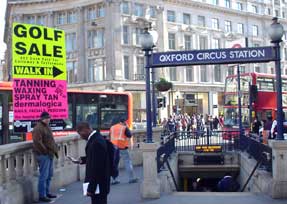
 Bakerloo platforms: tiled with a green and white maze mosaic
 Today I'm tracing the tracks from Baker Street to Regent's Park station. Here's an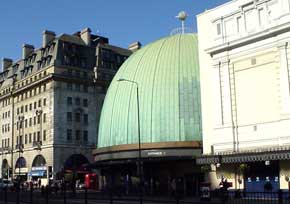
 Station opened: Saturday 10th March 1906
 At the turn of the 20th century there were three different east-west underground lines through the centre of London (the Metropolitan, District and Central) but no lines travelling north-south. The new Baker Street & Waterloo Railway aimed to change that, allegedly inspired by the desire of certain Westminster gentlemen to reach Lord's more easily to watch the cricket after work. This was one of London's first deep level tubes, burrowing deep beneath London's streets rather than using much cheaper cut and cover methods. Initial construction was slow due to lack of funds, but inspirational American businessman


 Forty years ago tonight one of the East End's most notorious murders took place. Ronnie
  In Pepys' time Whitechapel and Bethnal Green were well-to-do country villages situated in green fields outside the City walls. However, the growth of the capital over subsequent centuries brought great
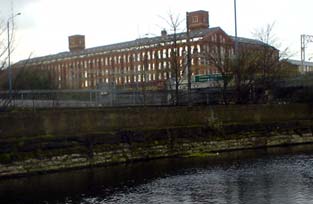 One of the areas to be seriously affected is Bow. We're not getting a station or anything useful, but Crossrail is due to burrow within 100 metres of my house before passing underneath the River Lea (