Whistlestop Manchester: Rochdale Where? 10 miles northeast of central Manchester (formerly Lancashire) Population 216,000 (approximately the same as Luton or Portsmouth) How to get there? rail (fast), tram (slow), M62 Why? Gracie Fields, cheap food and the Co-Op
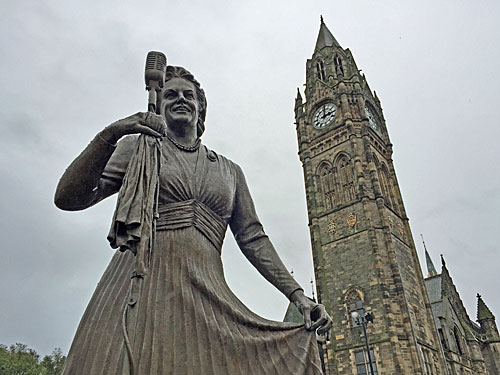
Gracie Fields: Not a park, but a Rochdale lass who became one of the world's most famous actresses in the 1930s. A trail of eight purple plaques leads round the town centre, including the sites of her demolished childhood homes, but I didn't spot any. What I did find is her statue, unveiled lastautumn in Town Hall Square, showing Our Gracie at the mike, dress-in-hand. The broodingly gothic Town Hall loomed behind, ringing out the hour with the Westminster Chimes, at one end of a recently cleared stripe of waterfront alongside the river Roch. A historic medieval bridge has been revealed, but Rochdale's centrally-cleansed zone felt achingly empty in the pouring rain.
Cheap food: All the usual eateries fill Rochdale's central lanes and shopping mall, at least by northern standards. Starbucks get no closer than a BP garage on the outskirts. At Crawshaws in Yorkshire Street, now the shopping precinct, I was impressed to see the butchers were offering a sausage roll or bacon roll and a hot drink for £1.50. Blimey I said, they know their target audience well, and that puts into perspective the prices we Londoners are prepared to pay for a brioche burger. Thankfully I resisted, because it seems Crawshaws entered into a "transformational partnership with 2 Sisters Food Group" earlier in the year, and a trip to Greggs felt pathogenically safer.
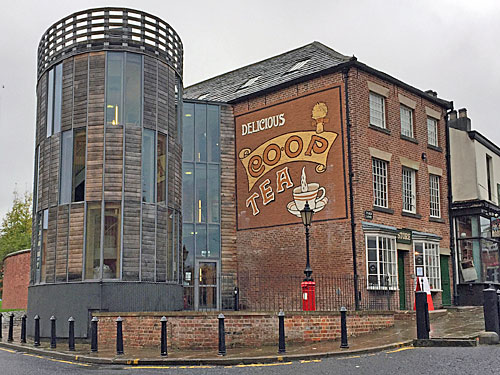
Rochdale Pioneers Museum: Rochdale is the original home of the Co-Operative movement, founded a few days before Christmas in the winter of 1844. The first store opened at 31 Toad Lane, now a museum, and has been recreated in all its simplicity in the very same downstairs room. Even though it's not obvious, remember to enter the museum through the old shop's entrance, not the fire door in the extension alongside, otherwise the nice ladies on the desk will rush outside and look at you with pity. Once within you'll find the story of the Pioneers, whose principled economics eventually grew to become a global enterprise with a over a billion members. Above the permanent gallery is a temporary exhibition, currently focusing on (99) tea and biscuits - an inspired choice. And above that, in a loft space often used by school groups, you can push a button and watch an old Co-Op-inspired film. I chose It's All Yours, a ten minute documentary from 1955 aimed at encouraging housewives to sign-up for the divi, and a reminder that the Co-Op was once Britain's biggest business. Things aren't quite so rosy these days, but the fairtrade-friendly retailer is a fine reminder that commerce doesn't have to be exploitative.
QUARRY BANK MILL Location: Styal, Wilmslow, Cheshire SK9 4HP [map] Open: 10.30am-5pm Admission: £20.00 (free for NT members) 3-hashtag summary: #cottonmill #industrial #heritage Website:nationaltrust.org.uk/quarry-bank Time to set aside: at least half a day
To learn the history of the Industrial Revolution at first hand, head north. The cotton industry helped bring our nation to global prominence, with much of the production based in the valleys around Manchester. One of the best preserved sites is at Quarry Bank near Wilmslow, opened in 1784 - a year in which cotton made up 40% of British exports. The great technological advance was centralising production, from cottages to mills, enabling efficiencies of scale and increased mechanisation. Cotton became the foundation of our international trade for over a century, until WW1 broke the export chain and other countries realised they could make cotton far more cheaply than importing it from us.
The Greg family established Quarry Bank Mill in a quiet rural valley rather than a town, getting their power from a large waterwheel in the River Bollin. They took a paternalistic attitude to their employees, providing accommodation and education but expecting long hours in return. A typical working day started at 5.30am, with a 10 minute break for breakfast and half an hour for lunch, and the day ended at 8pm unless overtime was required. Initially half of the workers were children, because their wages cost less. Loom machinery was often dangerous and could lead to loss of limbs, or in the worst cases death. The supposed miseries of your working day are mere #firstworldproblems in comparison.
Under the National Trust's stewardship, an increasing area of the estate has been opened up to the public. But the centrepiece remains the Georgian mill itself, a long brick building with very regular windows, and a single lofty chimney (which, at one memorable point on the tour, you can clamber underneath and look up to the sky). It takes about an hour to follow the warren of rooms and passageways across three floors, discovering how cotton used to be made and experiencing much of the equipment at first hand. There's quite a bit to read along the way, for example if you've ever wondered what the job of a Scutcher, Throstle Spinner, Doffer, Rover or Bobbin Winder actually entailed.
The best rooms are the long galleries full of clattering machinery - not all of which is switched on in one go. Cotton required a lot of sequential phases of spinning, hence was ideal for mechanisation, with the full-length CondenserMule at Quarry Bank still capable of pulling out 560 separate threads onto 560 separate bobbins. Upstairs I enjoyed being the only visitor in the Weaving Shed, where an earplugged volunteer gave me a personal demonstration on one of the turn-of-the-century looms (resultant teatowel available for purchase in gift shop).
Eventually the tour makes its way down to the waterwheel (not the original but a massive metal 50 tonner rescued from Scotland), which rotates in damp gloom like some dystopian hamster wheel. There's quite a bit of science to learn, if you're so minded, and a room where Men Who Like Engines can revel over greasy machines with primal pistons. Beyond all that is the cafe (a particularly popular room for Cheshire NT members to frequent on a very damp day), and above that a suite where weddings can take place (it surely can't have been a coincidence that the couple getting spliced on Saturday were Jen and Tom Weavers).
There's plenty more to see, which is just as well given the high price of admission. Upriver is an impressive horseshoe weir installed at the top of the millrace, whose hydro-electricity powers a lot of what currently takes place on site. Downstream are some splendid gardens, with rockery slopes rising steeply to an upper lawn and glasshouses - plus another cafe to hide in from the weather. The house in which the mill owners lived is also open for timed tours, or will be again later this month after significant renovation within. A lot of Quarry Bank is undergoing maintenance and renewal at the moment, so be warned that the mill building will be closing temporarily from November - best check before visiting.
Across the fields is Styal village, specifically the cottages that the Gregs built for their employees. Two rigid terraced rows face the green, one of whose cottages opened for NT guided tours just this week, but you'll need to arrive early to sign up for one of the very limited places. A small new 'visitor hub' allows unlucky souls to experience the cottage interior via a film and/or a model. All the other cottages are privately owned, and wholly desirable judging by the cars outside, although much too small to entice the nearby community of footballers' wives. Manchester Airport's runway now lies barely a mile away, so the occasional roar of jet engines must surely deter several potential buyers. [8 photos]
Getting to Quarry Bank is an interesting challenge if you don't have a car. The nearest station is Styal, which has a miserably low number of trains a day, and nothing northbound between 07:59 and 15:59. I managed to time my visit between two southbound trains instead, there being five of these a day, slightly better spaced. Alternatively there's the number 200 bus, which cash-strapped Cheshire council are consulting on scrapping, or simply bite the bullet and walk - Wilmslow, Handforth and Heald Green stations (and Shadowmoss tramstop) are each about half an hour away.
Bus Stop M has been missing most of its timetables since May. It should have seven, but it only has three. The timetables for routes 25, 276, 425 and 488 are missing.
But it's not alone. I noticed that several other bus stops in my local area have timetables missing.
So I went out and checked all the bus stops on route 25 between Mile End and Stratford, all 17 of them.
Here's a summary to show which bus stops are missing which timetables.
eastbound
westbound
bus stop
missing
present
missing
present
Mile End Station
-
4/4
25 N205
2/4
Coborn Road
-
4/4
25 425
2/4
Bow Road Station
-
4/4
25 N205
2/4
Bow Church Station
25 205 425
2/5
-
5/5
Bow Church
25 276 425 488
3/7
-
9/9
Bow Flyover
25
6/7
Marshgate Lane
-
7/7
Abbey Lane
25 108 276 425 D8 N205
1/7
Warton Road
25 108 276 N205
3/7
-
6/6
Stratford High St Stn
25 276 425 D8
1/5
25 276 425 D8 N8
0/5
10 of these 17 bus stops have timetables missing. That's a bit rubbish.
Across these 17 bus stops, 31 timetables are missing. That's about one-third of the total that should be on view.
The problem isn't that entire panels have been vandalised, just that some of the timetables which used to be inside the panels have disappeared. That's odd.
It's very hit and miss. There seems to be no obvious pattern to it.
The bus route with the biggest problem appears to be route 25. The timetable for route 25 is missing at 10 of these 17 bus stops.
I wondered what was up with the timetables on route 25. So I checked all the eastbound bus stops on route 25 between Oxford Circus and Mile End. There are 29 of them.
Nine of these 29 bus stops have some timetables missing. The timetable for route 25 is missing at six of them.
Specifically the timetable for route 25 is missing at these stops: Tottenham Court Road Station, Procter Street, King Edward Street, Bank Station/Cornhill, Bishopsgate, Aldgate East Station
Here's a lady at King Edward Street wondering where the timetables are.
Here are some possible reasons why so many route 25 timetables might be missing.
» The timetable for route 25 has changed (except, no, it hasn't)
» The timetable for route 25 is about to change so it's not efficient to print old versions
» The timetables fell out and nobody can be bothered to replace them
» The contractors who put up timetables aren't very efficient
» TfL aren't printing timetables any more
» Some other reason
Interestingly, there's no such problem with spider maps. The spider map in the bus shelter at King Edward Street is only one week old. Someone's clearly updating those. But nobody's updating the timetables, or checking on them, or giving a damn basically.
Sometimes it's not just Bus Stop M that has a problem.
It's been several months since I shared some spam from the diamond geezer marketing inbox. Let's put that right.
Morning,
I wanted to see if you might fancy coming along to our <Ingredients Company> breakfast session next Thursday? Nutritionist and TV presenter Sally Bee will be sharing some lazy tips on healthy breakfasting and we’ll cook along making dishes including spicy eggs and beautiful little smoothie bowls using <Ingredients Company>’s pre-chopped and prepared chilli, garlic, lemongrass and ginger.
I did not share Lucy's misguided idea that healthy breakfasting includes spicy eggs. Also, she called her event an "inspo", which made me feel quite queasy.
World Emoji Day marks the first time that <World Class Cultural Venue> has teamed up with a digital platform like Twitter to tell the stories of some of the world’s best-loved operas and ballets, engaging new audiences at giant scale for the first time as part of a strategy to pivot into dialogue-platforms.
I'd hope it's also the last time, Harry. Rarely have I read such world class <poo emoji>.
Hi
Hope all is well.
I am just sending on a reminder for our press preview performance for <Amateur Play>, which will be taking place tomorrow (please see invite below).
Your email might have been less peeving, Natalie, if you'd sent an invite before you sent your "reminder".
Hi Diamond,
Hope you’re having a good week. We have a brand new, free-to-download Q&A available with <70s drummer> in advance of his new album <Album> and an ambitious world tour. We are not offering exclusivity on this content but it can be published free-of-charge, with a collection of fully licensed images.
"Hi Diamond" is never a good start. Of course you can't offer exclusivity, Morven, you're in marketing.
Hi there,
Hope you are well.
We work with <Shopping Centre in Outer East London> who are working on exciting new plans to make the shopping centre more of a local destination. I wanted to send you this invitation to see if you were free to join us next Wednesday for a coffee and a cupcake to celebrate the opening of our new Soft Play.
Feven's invite also included an exhortation to "Bring the little ones!" Being little-one-less, I advised her this was not something I am interested in. She replied.
Apologies, I thought you may have wanted to come along. It would be good to know what types of events and launches you would be interested in so I can get in touch with the right invite.
You have to admire the misguided tenacity of these people.
Hi,
We recently reached out to you hoping to be featured on your website. Unfortunately, we haven't heard back from you which we are super sad about. It's our first time doing this, reaching out to people about our content hoping to grab their attention. I'm just wondering if it was something we said, or perhaps you just didn't think it was a good idea.
It's a shame Beth didn't interpret my silence as Absolutely Not. I fear she may still be super sad.
Hello there,
I hope you are well? For a Monday morning at least.
My name's Hannah and I'm the marketing manager at <Small Publishers>. I just thought I'd let you know about a new guidebook we are publishing next month which I think your readers may be interested in.
Some of you may have wondered how I reply to PR emails. Here's the polite response I sent to Hannah.
Hi Hannah
I never blog about anything sent to me in a marketing email.
All the best with the book.
dg
Alas Hannah was too obsessed with her own product to read what I'd said.
Oh what a shame, it seems to be a great fit for your blog.
Let me know if you change your mind.
Best wishes, Hannah
You might think it'd be a great fit, Hannah. My readers would think differently.
Hi Diamond Geezer
I hope all is well, I have something which may be of interest to your excellent blog.
No Merlin, no. Nothing commercial is ever of interest, including the <£12 walking tour> you were so keen to offer me for free, which I would never have written about.
And that's my message to all the PR people out there with goods or services or festivals or pop-up cocktail speakeasies to promote. I will not attend your event. I will not blog about your product. Best not waste your time trying to enthuse me.
9♦ Romford The Municipal Boroughof Romford, long part of Essex, was gobbled up by Greater London in 1965. The original intention had been to go it alone, but instead it coupled up with Hornchurch to form the London Borough of Havering, the outereasternmost part of the capital. To best explore Romford's suburban hinterland I decided to follow not-quite-the-highest-numbered bus route in London, the 499. For good measure I rode it in one direction and then, because I'm mad, I walked all 10 miles back again. Do not try either of these things.
Route 499
Some buses go direct, and other go all round the houses linking roads which otherwise would have no bus service. The 499 is definitely the latter, like someone highlighted all the gaps in the local bus network and drew a meandering line to link them together. It kicks off round the back of the big Tesco at Gallows Corner, weaves its way through the Harold Hill estate, nips through open country to Chase Cross, veers south through the heart of Romford, ticks off a hospital, then finishes with a one-way loop round Becontree Heath. Time Out rarely comments on anything hereabouts.
I remember when the shiny new KFC at Gallows Corner was apub, not so many years ago. The 499 circles the roundabout past a banner wishing Shane a Happy 30th, then follows Straight Road - the only lane up the hill before the LCC arrived in 1948. Now 7000 homes sprawl ahead, mostly of a decent size with gardens, but never the most desirable places to live. The 499 makes a special diversion up Heaton Avenue, climbing past typical postwar semis and some bungalows to a pair of isolated tower blocks named Kipling and Dryden. Highrise living was never popular in Havering. Every so often a short parade of shops intrudes, their newsagents always sponsored by The Sun, and just one offering Flowers By Tracy. A small girl in a pink coat makes a special point to say thankyou to the driver as she alights with Mum.
Hilldene Avenue is named after the farm whose arable land this once was. It's best known now as the name of the shopping parade at the heart of the development, two stark L-shapes with flats on top, and everything the community needs stashed below. Hilldene's retail offering includes actual butchers (English Offal £1.79 a lb), proper bakers (Filled Rolls a speciality) and family-run non-chain coffee. The prime corner slot is taken by a pound shop, its window proudly introducing "non-£1 products at great discount prices!!!", as inflation bites. Outside Nat West two lads in top-to-toe grey share a fag, while an old lady inches past with stick and basket carrying tonight's ingredients home. Most of the serious shoppers arrive by car, queueing patiently for the next available space, while the 499 offers an economically dangerous direct link to Tesco.
North Hill Drive winds up to the top of the estate, past pavements liberally scattered with smashed conker cases. Only one of the houses along the way has a St George's flag drooping in the front garden, and only one of the white vans has last year's plastic poppy on the bonnet. At Noak Hill Road the green belt abruptly kicks in, and we turn left along its rim. A blond teenager attempts to board the bus cardless, and our driver sends him packing. At the next stop another young lad, resplendent in pristine white hoodie, makes a special point to say thankyou to the driver as he alights, successfully disproving any stereotype you might have formed during the previous sentence. He's off to the £3.5m sports hub with the multi-coloured walls, not yet a year old, but boasting only one car in the car park on a Saturday afternoon.
It's time for the 499's proper rural section, a mile-long ratrun lane alongside a park which was formerly a Georgian manor estate. Bedfords Park is quite the hidden treasure, a large green expanse with grazing cattle and enclosed deer, although somewhat unwelcoming from the road. It's on my list to come back to and explore properly. On the other side of the road is a scrappy tumble of land with an extensive view, which feels like it ought to be either housing or another park, but is neither thanks to a large reservoir concealed beneath its surface. Eventually a few scattered residences intrude, one large enough to have a quad bike and a woodpile, another no more than a dishevelled static caravan at the centre of a grim padlocked corral. The bus doesn't stop in these old school Essex borderlands.
At Chase Cross, at the foot of the hill down from Havering-atte-Bower, we rejoin suburbia proper. This whopping housing estate was built just before World War 2 so has a more aspirational feel than Harold Hill, indeed many Londoners might be tempted to to live in Rise Park if only they weren't put off by its location. Broad avenues with tree-lined verges and decent-sized gardens - tick. Chain pub offering pints of IPA and glasses of rosé for £2.29 - tick. Shopping parade featuring Deb's Launderette and Alan's Fish Bar - tick. One of the things I've been most struck by on this bus route is discovering (at regular intervals) that 'traditional' shopping parades still exist, mostly fried-chicken- and spice-free, unlike almost any other corner of the capital.
A downside to living out here is the multi-lane A12 carving through. Notionally this trunk road's great news if you own a car, but the queues to access it can be extreme, and the traffic lights change so infrequently that I managed to cross the lofty footbridge faster than the bus crept over. Pettits Lane is another residential road which skipped having a bus service until 2002 when the 499 turned up. The quality of the housing is improving as we approach Romford, even if several front porches have been decorated with a nameplate seemingly sourced from a Sunday supplement. At one end of the lane is a large redbrick school, and at the other is Victoria Hospital, which clearly started out as a tiny clinic and has had motley annexes and extensions bolted on since. Deep breath, town centre ahead.
"The driver has been instructed to wait at this bus stop for a short time to even out the service." Yeah, no thanks for that, given that we're only one stop from the shopping malls where the majority of passengers want to alight. A wholesale turnover of clientele eventually occurs, the older ladies making a special point to say thankyou to the driver as they alight. The new crowd includes gossipy girls with fur hoods, two white-haired women sharing a bouquet of sunflowers and a lady who gives a lampstand a seat of its own. It's very busy around here now, with Romford's retail Saturday in full flow. Vaping teens dangling carrier bags mix with bellied blokes in West Ham tops, the occasional mobility scooter whirrs by, and the nightclubs on South Street are in full afternoon refreshment mode.
We've now reached the section of the route the 499 served when it was first introduced, a runty loop west from the shops and the station, anti-clockwise only. Destination 1 is Queen's Hospital, a modern PFI affair, and the terminus of two other four hundred and ninety-something buses. It was built to replace Oldchurch Hospital across the road, whose site is now a glaringly modern housing estate with an eerily empty central playground. All the other buses turn off at the roundabout, so only the 499 continues past Romford Sorting Office and a nest of squat orange gasholders. Across the road is Romford Cemetery, where a few graves are smothered in affection, while others mark the resting place of a family member long forgotten.
The next mile follows Crow Lane, one of the original roads hereabouts, in a part of town known as Rush Green. It's a peculiar thoroughfare, hemmed in between the railway and a golf course, hence feels somewhat cut off. Several businesses have made their home here, of the kind that beat metal or tweak cars, and who buy their jacket potatoes from a trailer called Sylvia's Lunch Box. But mixed within are gated newbuild detached homes in modern Essex style, tiny empires with pert topiary in buckets either side of the porch, and a personalised numberplate on the crazy paving. Beyond Tipples Off Licence the housing gets a bit more ordinary, with only the occasional stone eagle on the gatepost, until finally the road becomes one-way only to prevent this becoming a serious ratrun.
The 499 goes further, but that's where I'm stopping, at what's still the boundary between Havering and Barking and Dagenham. The bus'll follow a lengthy loop round the Heath Park Estate and pass the Civic Centre before eventually reaching the hospital and the shops, which I'd guess is why very few residents of Crow Lane ever flag it down to climb aboard. I'll say again that you need never ride it either, but I'm glad I did, and walked its lengthy sinuous route. To understand the corner of London that often wishes it wasn't in London, and votes differently, and is different, nothing beats a direct first-hand experience.
Can living in London really be that dangerous? Sadiq seems to think so.
The Mayor of London, Sadiq Khan, has today released shocking new research which reveals that every Londoner in the capital lives in an area exceeding World Health Organization (WHO) guidelines for the most dangerous toxic particles known as PM2.5.
PM2.5 is one of a basket of pollutants we breathe in every day. Sadiq's "shocking new research" explains more.
PM2.5, also known as fine particulate matter, is the blanket term used to refer to solid particles and liquid droplets with a diameter less than 2.5 micrometres across (that’s one 400th of a millimetre). Some PM2.5 is naturally occurring, such as dust and sea salt, and some is manmade, such as particulates formed in combustion processes.
How frightening that every single Londoner is at risk. Sadiq's research appears to have uncovered something big. [the report][the data]
The research, based on the latest updated London Atmospheric Emissions Inventory, also shows that 7.9 million Londoners – nearly 95 per cent of the capital’s population – live in areas of London that exceed the guidelines by 50 per cent or more.
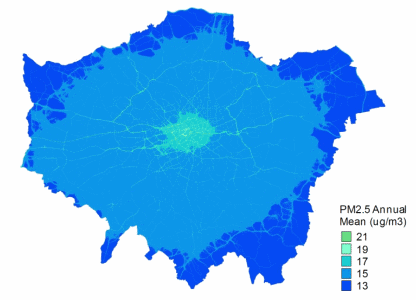
That sounds bad. There's even a map.
The World Health Organisation limit for PM2.5 is 10µg/m³. The map confirms that everywhere in London exceeds 10µg/m³, and almost everywhere exceeds 15µg/m³. Only rural extremities in boroughs like Enfield, Havering and Bromley duck under the 15µg/m³ threshold. The average reading is 16µg/m³. As for central London, and certain main roads, they top 18µg/m³, which sounds appalling.
New data, based on updated 2013 exposure estimates, shows that in central London the average annual levels of PM2.5 are almost double the WHO guideline limits of 10 µg/m³.
Ghastly. Except hang on, these figures aren't exactly new. They're estimates for 2013, first released in 2016, and updated six months ago "due to revised road transport emission factors". To prove how not new the figures are, here's the same data in a Mayoral consultation document from October last year, but coloured differently.
What's intriguing is that one year ago officials weren't anywhere near as worried by the same data.
London is now broadly compliant with legal limits for PM2.5. Annual mean concentrations of PM2.5 are well within the legal limit of 25 µg/m³.
It seems there's been a switch in which PM2.5 threshold is politically expedient. Last October the key measure was the legal limit of 25 µg/m³, and every part of London was comfortably under that. This October the key measure is the WHO target of 10 µg/m³, and every part of London is suddenly toxic.
There was recognition last year that PM2.5 concentrations need to come down.
Further reductions are needed (especially to PM2.5) to protect human health. Although compliance has officially been achieved, by reducing PM2.5 concentrations even more, the health benefits will be even greater.
But blimey, now the goalposts have been changed, how different the message twelve months later.
The Mayor of London, Sadiq Khan, said: "This research is another damning indictment of the toxic air that all Londoners are forced to breathe every day. It’s sickening to know that not a single area of London meets World Health Organisation health standards, but even worse than that, nearly 95 per cent of the capital is exceeding these guidelines by at least 50 per cent."
As an example of how you can prove anything you like using statistics, this is cracking.
In addition, Sadiq appears to be making a big fuss about something he has very little control over.
"I urge the government to devolve powers to me so I can get on with tackling the dangerous toxic air particles – known as PM2.5 – that we know come from construction sites and wood burning stoves. It's measures like these that we need to get on with now to protect our children and our children’s children."
The Mayor of London has relatively few powers, and curtailing the use of wood-burning stoves isn't one of them. Wood-burning isn't even the real problem anyway, not compared to vehicles.
Of the local London PM2.5 sources the biggest contributor by far is road transport, accounting for over half of local contributions.
What's more these aren't the usual issues with exhaust fumes. Instead it's wear and tear from braking and tyres that's most significant, and such particles will emerge whether your car is petrol, diesel or electric. Don't expect the new T-Charge or Low Emission Zone to save us here, they tackle other particulates, not the toxic PM2.5.
The fact that PM2.5 exceeds 10µg/m³ isn't even new, it's been the case for years. Boris could have put out a press release saying "all Londoners live in areas exceeding WHO levels for the most toxic air" several years ago, had he been so minded. This research paper Sadiq is crowing about hasn't discovered anything new, it's simply picked a different threshold.
Meanwhile there's one sentence in the press release which turns out to be more important than all the others, and understates the issue.
Around half of PM2.5 in London is from external sources outside the city.
That's right - the majority of PM2.5 particles in the capital haven't come from London at all, they've drifted in from elsewhere. The press release says "around half", but the associated research paper says something different, and the true proportion is much higher.
A big component of PM2.5 in London comes from regional, and often transboundary (non-UK) sources. In 2013 the background concentration for PM2.5 was 12µg/m³, meaning in 2013 the external contribution to London’s PM2.5 levels alone were above the WHO standard of 10µg/m³.
Let me restate that. What the research paper confirms is that London breaks the WHO 10µg/m³ limit solely thanks to PM2.5 generated elsewhere (12µg/m³), with mainland Europe a major contributor. The extra amount generated by vehicles, construction and wood-burners within the capital averages only around 4µg/m³. Even if Sadiq could cut this to zero, which he can't, PM2.5 levels would still exceed the WHO threshold.
Much of the background emissions come from areas outside of the Mayor’s jurisdiction. This highlights one of the key messages of this report, that London needs national and international support to tackle this issue.
In the research paper's conclusion, the need for broader action well beyond London is apparent.
The Mayor expects PM2.5 emissions to reduce by approximately 41% by 2030 compared to 2013. A key finding of our research is national and international co-operation will be essential in meeting this target.
Without external assistance London's basically at the mercy of whatever PM2.5 drifts in from outside. Those of us living beside main roads may be getting it worse than the rest of the capital, but not hugely worse, because background levels are more significant.
Sadiq can do no more than tinker with the PM2.5 problem without concerted efforts from the UK government and the EU. But it's only become a pressing problem because he's adopted the 10µg/m³ WHO aspiration rather than the 25µg/m³ legal limit.
Sadiq is absolutely right to want PM2.5 levels in London to be as low as they can be. But getting righteously angry about this, in the face of a pollutant he can do little about, is somewhat disingenuous.
Average (urban) PM2.5 by country
Finland 6µg/m³, Sweden 7µg/m³, Spain 10µg/m³, Ireland 11µg/m³, UK 13µg/m³, Germany 15µg/m³, France 16µg/m³, Greece 17µg/m³, Romania 18µg/m³, Italy 21µg/m³, Slovakia 22µg/m³, Poland 27µg/m³, Bulgaria 30µg/m³.
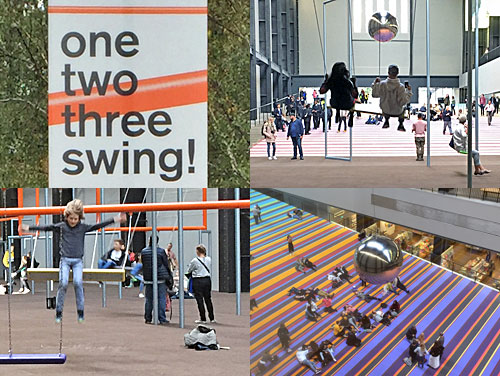
Most years since 2000, the Turbine Hall at Tate Modern has been filled with a whopping art project, with varying degrees of success. This year's is one of the better ones - which, given the underwhelm of the last few years, isn't difficult.
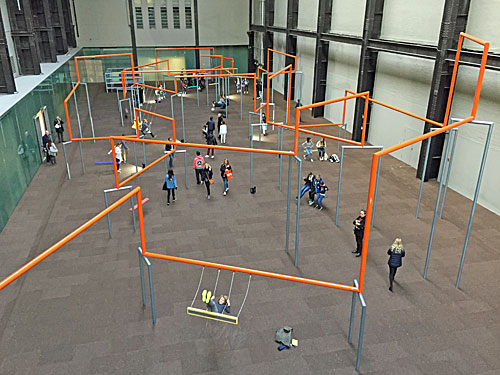
One Two Three Swing! is the brainchild of Danish art collective SUPERFLEX. They've erected a chain of swings across one end of the Turbine Hall, with three-seaters dangling throughout, and hung a giant pendulum above the other. Specifically they've created a work of art you can interact with, and share, although calling it "playfully subversive" is probably going too far.
An orange bar winds in a highly angular manner across a specially padded cork floor. At no point does it touch the ground, except at the very beginning, supported elsewhere on less vibrant grey prongs. The swings vary in height along its length, but what hangs down always has three seats, to make a point about joint action being better than going it alone.
I was expecting the installation to be rammed on the first morning of the six month run, but not so. Instead I managed to locate an empty swing almost immediately, and got to rock alone, rather than having two companions foisted upon me. I'd expect a queuing system of sorts to be in operation at more popular times like weekends.
Swinging, like riding a bike, is something you never forget how to do. It's been a while, but my legs instinctively pushed out to maximise whatever bit of physics makes this work, and tucked back on the return. It's quite liberating, swinging, which is why you enjoyed it so much when you were six.
Top tip 1 - balance yourself. If there's only you don't sit at the end, and if there's two of you leave a gap in the middle, otherwise the ride's not so smooth. Top tip 2 - it's even faster on the swings with the greatest drop, where three people can get up quite a speed if they put their minds to it. Wheee!
The orange bar winds underneath the central platform, where there's a special parent-and-baby swing complete with seat belts, if that's what you need. It breaks out into the other end of the Turbine Hall, and then nips up onto the central platform itself... where there aren't yet any swings, but expect some soon.
The sloping end of the Turbine Hall has a more relaxed vibe, with a large striped carpet covering the floor and a giant pendulum swinging above. The carpet uses the colours of British banknotes, so is striking, and is designed to be sprawled upon so you can look up at the pendulum swinging overhead. A bit of a nod there to the giant sun of 2003's Weather Project, perhaps, but fewer thrills.
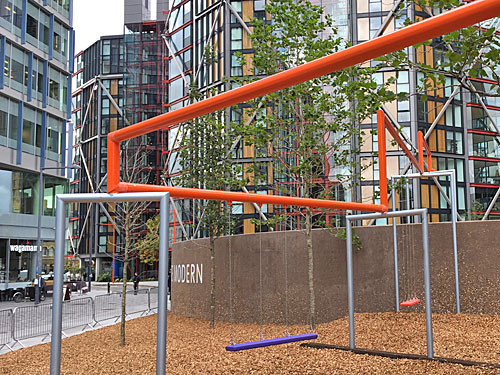
And there's more. The orange pole plunges into the wall and heads outside, or at least it will once complete. At present the swirly courtyard round the back of the extension is a minor building site, with sets of poles awaiting construction, but a small annexe opposite Starbucks is already complete, with two very public swings poised over a sea of wood chippings.
It's nothing high concept, this Turbine Hallcommission, more a genuine crowd pleaser. A bit like Carsten Höller's twirly slides in 2006, all SUPERFLEX have really done is bring the playground to the gallery. What'll be next here after swings, I wonder, roundabouts? Whatever, it's fun enough, so bring some friends or family before April and enjoy oscillating together.
Another collection of paintings by The East London Group is now showing at the Nunnery Gallery in Bow. You may remember From Bow to Biennale a few years back, which everyone loved, so a different selection has been arrayed across the walls. This time the main focus is painter Albert Turpin, one of the motley group of amateurs who came together between the wars to paint, in a new exhibition entitled The Working Artist. Albert was a window cleaner, a fireman, and later Mayor of Bethnal Green, so there are rather a lot of paintings of E2, but E3 also gets a look in amongst the 50 canvases.
Several paintings depict terraced streets, pubs or backyards, reflecting Albert's aim "to show others the beauty in the East End", while others show slum areas devastated by bombing. I successfully recognised the location of a few scenes based on how they look today, especially those along the canal, but developmental flux has wiped away most of the other visual clues. This is how we used to live, in muted palettes of brown and orange, with the odd view of rural Essex thrown in for good measure.
The exhibition has been curated by poet Michael Rosen and film-maker Emma-Louise Williams, both of whom came along to the launch last week. Several other events are taking place before Christmas, including walking tours, a window-cleaning-as-art-plus-gin-cocktails do (tomorrow night) and the launch of the Gentle Author's new book East End Vernacular (next Tuesday). Entrance is free, your visit shouldn't last more than half an hour unless you stop off in the cafe, and the nearest public transport location is Bus Stop M.
London has the finest public transport network in the world. But that doesn't stop us moaning about it, disregarding all the great bits and grumbling instead. So yesterday I took a swift efficient multi-modal journey around east London - something I simply wouldn't have been able to undertake in any other part of the country. And all I'm going to do is gripe about it, ungrateful traveller that I am.
Bus Stop M
I see there are still four timetables missing. I don't understand this yellow diversion notice for the 488, it's only helpful for journeys going the other way. Why is the 276 driver refusing to allow the lady with two pot plants on a trolley onto his bus? I have to walk in the cycle lane to be able to read the Next Bus display in the shelter. I don't care what buses are coming 8th, 9th and 10th. Will someone please collect that bag of recycling, it's getting in the way of people trying to get off the bus.
Bus (25)
It may be London's busiest bus but there are only four of us upstairs. It's like this bus exists solely to transport air. Who left an empty Cherry Coke can at the front of the upper deck? Look, that bike's just jumped the lights at the Bow Roundabout. It would've been almost a minute quicker to go over the flyover. Look, that bike's riding on the pavement rather than in the Cycle Superhighway. I can see so many knocked-down buildings ready to become flats, so many. Look, that bike's just jumped the lights at the top of Abbey Lane. Surely that workman doesn't need to block the Cycle Superhighway with his temporary orange barrier. Why are they playing an announcement to warn passengers there's a bus stop bypass immediately behind this bus stop? Nobody would be that stupid, surely. Look, that same bike's just jumped the lights at the end of Warton Road. The bus stop called Stratford High Street station is a heck of a walk from the station of the same name. You don't need to stick your arm out to stop the bus. I don't believe the 'Next Events' in the Olympic Park can be on 23rd and 30th September. Sigh, temporary lights. Sigh, that 86 has parked up blocking the lane into the bus station. Oh, we're not stopping at the drop-off point outside Stratford station because it's all been fenced off for an upgrade, so we'll have to waste an extra minute by heading round into the bus station itself.
Stratford
Why are there never Countdown displays at bays in bus stations? Grr, there are too many annoying people blundering in the opposite direction. Which idiot installed several electronic survey points asking passengers 'How was your experience at this bus station?' When I try using it, all that flashes up is a choice of Yes or No without revealing what the question was. This touchscreen is useless, it won't let me press either. I think I interrupted someone else's attempt at answering the questions except they walked away partway through. The Evening Standard prints earlier and earlier these days. No I do not want to stop and talk to you about the work of Amnesty International. The lights on the barrier gates have faded, so it's hard to spot which are green for in and which are red for out. I could get to my train easier if you hadn't plonked a barrier in the way.
DLR
Of course everyone piles on at this end of the train, because they can't be bothered to walk down the platform, and so the other end is empty. I hate the way the seating's gone all longitudinal. The poles now get in the way, especially if you insist on sitting there with a big suitcase. Who's eating something smelly? What's the point of having a pushchair section with pop-up seats if you're going to sit on them and then position your pushchair in front? The light green line on this new map is pathetically indistinct. Asking for trouble, it was, calling this station Abbey Road. That advert about there being staff on all DLR trains invites me to search 'TfL improvements' for further information, as if anyone's going to do that... and if I do do that, all I get is a page that links to another page that contains nothing about there being staff on every train, muppets. Oh hang on, everyone piled on at this end of the train because that's where all the exits are at the other stations - bad planning.
West Ham
Crossing from one platform to another is always a hassle here. Come on, keep to the left on the stairs, that's the unwritten rule. But they keep changing which side of the corridor you're supposed to walk on. Sigh, now I have to cross the flow of all the people pouring off the escalator to get to the top of the stairs. Sorry, I didn't mean to walk in front of you, sorry. I'd have caught that train if I hadn't got stuck behind a slow lady with a big bag. Bugger there's now a five minute gap before the next train. This is the Jubilee line, how can there be a five minute gap? There are nowhere near enough benches at the north end of the platform, which is the only efficient place to wait for a train that's only going to Stratford. The Berkeley Homes billboard on the wasteland opposite claims that over 3750 new homes are COMING SOON, but I've checked, and 'soon' actually means 2021. TRAIN APPROACHING definitely flashed up too early. I'm not convinced that was actually five minutes, I bet it was six.
Tube
Grrr, after a five minute gap this train is of course really packed. I'll try sitting on this perch you can't actually sit on. Look, everyone's on their phone. Those poles are yellow, but shouldn't they be grey? Actually some of the trains do now have grey poles, why hasn't this one? Oh, so we're going to sit outside the station for a couple of minutes, are we? And then move forward a bit and wait again? This always seems to happen. Why hasn't the driver made an announcement yet? Ah, finally, here's his announcement... and hilariously, the train starts moving again before he's got to the end of the sentence. That took a bloody long time.
Stratford
Our wave of passengers sweeping up the platform is met by obstructive passengers swarming down. Poor them, they had to try and squint at the teensy Next Train Indicator to work out which train to get on. Nobody cares that the third train from this platform is going to Willesden Green in 21 minutes. Oh god, a busker with a guitar. Don't throw money, it only encourages them. The one-way system is a sure sign that this station can't have been extended sufficiently in 2012. That sign says platform 5 is off to the right, across a stream of people, whereas you can go up to the left avoiding the crowds. This platform smells of talc. Some sadist has replaced the previous benches with some shiny metal curves it's very difficult to sit on. The tannoy announcements give the departure time of the next train but the Next Train indicator merely says how many minutes away it is, how confusing. Meh, I just slipped off the seat.
TfL Rail
Damn, this is one of the super new Crossrail trains, I was hoping for a crappy old train so I'd have something to moan about. Worse, I was going to complain about the lack of forward-facing seats, except there are plenty of those in this carriage and nobody's sitting in them. These armrests aren't going to be popular with obese passengers. I can't read the display from here because it's at a funny angle and all the small text is shifted over to the far side of the screen where the overhead lights reflect. Does anyone really need to know 'Liverpool Street for Spitalfields Market'? Definitely nobody needs to know 'Liverpool Street for Southend Airport', because you could have caught the same train to Southend from the previous station. A man is actually filming the view out of the window, how sad. I forgot to walk through the train to save time at the final destination. I will die before I start calling this the Elizabeth Line.
Liverpool
Street
It's so annoying having to touch out through one set of barriers and then back in at another. Damn, there's a really long wait for my next train. The ticket office has disappeared behind a set of hoardings so it can become yet another row of shops. Who the hell wants an Oliver Bonas anyway? Or a Moleskine? Or yet another TM Lewin? When these shops finally open I bet all these useful seats will be taken away. Several people are treating the seats as litter bins. Ah, a new smaller ticket office is hidden on the other side of the concourse. Some member of staff has jumped on the bandwagon of writing a Thought For The Day on the whiteboard, except it's nowhere near interesting enough to Instagram so I don't know why they bothered. This TfL Visitor Centre is a blatant moneygrabbing tourist trap - you can't even pick up a tube map without queueing (or walking through a gate which says No Entry). Are you wearing that knitted cap for a bet?
Rail
Sheesh this train is old. Our destination's only thirteen characters long but won't fit on the display in one go, so repeatedly flicks between Hertford and East. It's a bit mucky in here. Bit dingy too. I can't see out of that window, it's almost opaque. Why do commuter trains still bother with first class seating, what is the point? If you're going to walk through to the next carriage, have the decency to shut the door behind you rather than leaving it flapping open. The scrolling message says 'Please make sure you have thecorrect ticket for your journey', because I guess nobody proofread it properly. It is not possible to 'read the safety notice at the end of the carriage' without peering over the top of someone's head. Even this part of town is gentrifying. Who'd sit on that balcony with all these trains going past? I hope this door opens when I push the lumpy pad. Let me off rather than trying to board immediately, cheers.
Hackney
Downs
These stairs are a bit steep, and seem to be suffering from an advanced case of rust. That's a lot of orange paint. Please don't stand halfway up the stairs to check your phone, please move on and out of the way. It's a long walk to Hackney Central, isn't it, especially from any platform that isn't platform 1. The pink reader in this long passageway says 'Touch your card here if changing trains', but I don't actually have to do that, do I, I thought pink readers were optional?
Hackney
Central
I just missed a train, so that's a nine and half minute wait, dammit. The pair of line diagrams by the passageway exit show the stations served on each platform, but nowhere does it say whether Platform 1 is this one or the platform opposite. A man actually stops and asks me if this is the right platform for Stratford, that's how ambiguous those signs are. Sigh, now it's raining. This Next Train Indicator supposedly shows trains at Hackney Downs, but has been programmed by miserable jobsworths so that trains mysteriously vanish from the list eight minutes before they depart... despite the fact I've just walked from there in less than five minutes. A crowd's building up now. It's never obvious how far down the platform the train will stop, so everybody dashes down when the train arrives.
Overground
It's packed, it's always packed. They should run these trains more often and then they wouldn't be so rammed. Shift up and I can rest against that pad it's impossible to actually sit on. If you weren't leaning on that central pole people might be able to walk past. That Overground map is awful, isn't it. Just awful. Two people too close to me are making loud boring phone calls. Someone hasn't washed recently. Why are we repeatedly subjected to announcements that 'You must have a valid ticket to travel on this train' when other modes of travel don't get the same? Do you get a different class of fare-dodger on the Overground? The line map I'm facing isn't actually for the line I'm travelling on. Please turn round slightly and move your rucksack out of my face.
Hackney
Wick
Hell, what have they done here now? This is regeneration writ large. Are you seriously expecting me to exit the platform via that temporary wooden elevated walkway? Have you seen how many rickety-looking scaffolding poles are holding it up? When will the new station building finally be finished? This area is going to be unrecognisable as Hackney Wick by the time everyone's finished. Blimey, there are even homeless people begging here in E9 these days. The bagel factory is now the skeleton of a five storey block of flats. It's going to look aesthetically dead round here soon. It almost does already. Someone's left a coffee cup and an empty bottle of vodka rammed down the back of the so-called bench in the bus shelter. The bus map has slumped down inside its case so is pretty much unreadable. It's also three years out of date, like nobody gives a damn.
Bus (276)
Please don't sit there with your leg blocking the aisle. Blimey this bus is so old it rattles. One of the adverts advises passengers what to do if their Freedom Pass expires on 31st March 2015. That is one large shopping trolley, madam. Someone is making a foreign language phone call immediately behind me and doing more than 80% of the talking. A lady with a buggy is trying to manoeuvre her way up the gangway, past the enormous trolley, without falling over. I preferred that building when it was a fire station, not a school. Damn, I appear to be on the bus at school chucking-out time. Do all schoolkids buy chicken and cheesy chips on their way home these days? The lady with the buggy is having trouble getting off because the driver's stopped immediately opposite a lamppost. That boy has been on the bus for just two stops, are today's children too lazy to walk anywhere?
Bus Stop M
A speeding bike almost runs me over as I step off the bus and cross to the pavement. Why didn't they play an announcement warning me there was a bus stop bypass immediately behind this bus stop?
New York has the High Line, an elevated linear park on a railway viaduct. Now Bankside would like to introduce you to the Low Line, a cultural trail at ground level alongside a railway viaduct, linking London Bridge to Waterloo.
They describe it as "an emerging world-class walking route". What's it like to follow? I'll give you a clue - the key word there is "emerging".
"Explore Bankside's hidden and tranquil ways along the mighty Victorian viaducts that crisscross the area."
A word about the originators. Better Bankside are a Business Improvement District, similar to Midtown or the Northbank but with a proper name. It's their job to encourage commerce in their immediate area, which just happens to have several railway viaducts running across it.
"The Low Line encourages greater exploration along its length, revealing new destinations, and celebrating the history and heritage of one of London's oldest neighbourhoods."
A map has been produced, in paperor in pdf, showing the route repeatedly zigzagging beneath the railway. Some sections are marked as "walkable route" but the majority is shown as "alternative route", because it turns out that walking immediately alongside a railway viaduct is difficult. The map's also hard to follow because south is at the top, and because the roads you're supposed to walk along aren't named. Maybe that's why the route's only supposed to take 15 minutes to walk but I got a bit lost and took more like an hour.
Anyway, with cynicism goggles properly adjusted, let's head off.
The route starts on St Thomas Street outside the new entrance to London Bridge station... or at least the map says it does, I found no evidence on the ground. It passes the Georgian frontage of Guy's Hospital and the wonderful Old Operating Theatre Museum, but these don't get a mention because they're not the kinds of attraction Better Bankside trying to promote. Instead it heads straight for the slamdunk tourist trap of Borough Market and meanders through the stalls. I visited midweek at lunchtime and was struck by the cracking atmosphere - a vibrant foodie warren to explore. Turn up at the weekend, however, and the squish can be severe.
Finding the correct way out isn't obvious, at least for those attempting to follow the official route, there being viaducts overhead everybloodywhere. The right road is Park Street, a mid-gentrification demolition hotspot, where you should eventually spot a Low Line plaque and a wall marker. These markers are rather nice, but tend to be positioned along streets rather than at junctions so aren't necessarily useful for wayfinding.
I'd never ventured this far down Redcross Street before, so was charmed to stumble across a remnant from ye olde Southwarke, the Crossbones Graveyard. This paupers' burial ground was rediscovered in the 1990s when the Jubilee line was being dug, revealing a unconsecrated site packed with the remains of 'single women' and their unwanted offspring. An electricity substation for the tube was erected on the eastern half, but the remainder was left undeveloped, which a keen group of volunteers are slowly transforming into a garden of remembrance. There's a limit to what they can plant without digging down, but a fine job has been done so far with raised beds, rockeries and a small pond.
Crossbones is only open to the public between noon and 3pm on weekdays, and certain Saturdays, but makes a nice quiet spot to chill or eat your lunch. Even if you can't gain access up the goosewing walkway, the gatesoutside are well worth seeing, arrayed with a startling assemblage of ribbons. Or come down on the 23rd day of the month for the evening vigil, at 6.45pm for seven sharp. Of all the places I discovered on my Low Line walk, Crossbones was by far the friendliest, and my favourite.
But the Low Line isn't about history, it's about commercial opportunity. The next of these is at Flat Iron Square, a recent intervention beneath the railway viaduct off Union Street. These arches previously served clubbers and the nighttime economy, but now host diverse catering options from 10am daily. Bring your mates and pick from bespoke Portuguese, zingy Vietnamese, baked Turkish or whatever, washed down with craft beer or soda, and maybe play table football if the table's free. I'll not knock it - any gourmet clusterhub is a millennial gathering place these days - but I can't help thinking those nightclubbers had a lot more fun.
Let's get back to following the viaduct, which means America Street, which means taxi workshops under the arches and a pocket garden in a skip. The Low Line then splits either side of the railway, with no suggested preference which side to go. I tried them both, and can confirm neither has great merit, but north just clinches it. Here you'll find a bollard marking the boundary of the Liberty of the Clink, and I found some Better Bankside gardeners on their knees pulling muck out of a wall. Perhaps it'll look less dour when you come by.
I wouldn't have walked along the next long alleyway, marked Private Property, had there not been an official blue marker on the wall. But here at last is what the Low Line's meant to be, a walk alongside the railway viaduct, passing arch after arch after arch. It's just that this section's rather rundown, the arches either shuttered or semi-derelict or stashed with distinctly unglamorous businesses. Beyond the bins is an arch boasting 10 pool table's, then a falafel dispensary, and finally a boxing club Established 1910. Unsurprisingly none of these get a mention on the map or leaflet.
Old Union Yard, beneath the perpendicular viaduct from Blackfriars, proves a complete contrast. These arches behind Great Suffolk Street have been done up by investors, supported by Network Rail, and punters now come to spend their money here. The chief draw used to be the Union Theatre, a fringe venue in a former paper warehouse, but this has been shifted sideways to allow full rejuvenation of the space. What we now find are two restaurants and an aerial fitness centre, plus courtyard cafe culture - the kind of selection a Time Out reviewer might orgasm over. Keep walking down the viaduct and an increasing number of the arches have become offices for swanky businesses like architects, the area's direction of travel self-evident.
Back on the original Waterloo-bound viaduct, we reach Scoresby Street. Here too the arches have been transformed into commercial units, with restaurants specifically in mind. The Blackfriars Wine Bar is well established at one end, with a thriving Nando's at the other plus a sushi offering midway, but plenty of the intervening spaces await take-up. A captive hungry audience exists just around the corner, specifically an HQ-ful of TfL employees at Palestra House, that is if they haven't stopped off at the Lebanese hole in the wall under the viaduct immediately nextdoor.
The Low Line's last hurrah lurks opposite, round the back of (and specifically above) Southwark station. One further run of arches has jumped on the foodie bandwagon, part screened behind a jungle of potplants brought in to give the alleyway a less bleak feel. Isabella Street offers a lounge bar with Brewdog barrels, a Turkish cafe and a Thai restaurant. Just don't walk round the back and view the same businesses from Joan Street, where the ugly reality of backstage delivery is writ large. And this run of arches is where the Low Line abruptly stops, because Better Bankside never had any intention of delivering you to Waterloo, merely showcasing their own territory.
My thanks to the Low Line for opening my eyes to several south London backstreets I'd never walked before, and the marvellous Crossbones Graveyard, but I worry about the project's underlying aim. The final sections traverse recently-upmarketed arches fitted out with refreshment options, where previously had been backwater grime and lockups. This may be what well-off consumers, and Network Rail's commercial director want, but I worry for the future of those employed in the workshops and the boxing club I passed earlier. The Low Line seems to be just another nudge in the relentless emblandening of central London - smothering character in favour of a premium meal or frothy drink. If that is the line Better Bankside are taking, that is indeed low.
5♦ Hampstead/St Pancras Modern day Camden is an amalgamation of three pre-1965 boroughs - Hampstead and St Pancras, as selected here, plus Holborn nearer the centre of the city. One thing fledgling Camden became famous for was its progressive approach to social housing, erecting several architecturally-unusual estates, each focusing on density rather than height. There are dozens, but I went in search of three I'd not visited before, with my reaction ranging from "wow" to "oh".
The Whittington Estate can be found round the back of the hospital of the same name, at Camden's northeastern tip. The first stage of the Highgate New Town development, it was designed in the early 1970s by Hungarian architect Peter Tábori. What we have here are four parallel streets on a sloping site lined by stepped terraces of three or four storeys. If you know your Camden housing, it looks a lot like the Alexandra andAinsworth Estate on the other side of the borough, but this is a sequence of cul-de-sacs rather than one straight-through.
The south-facing flanks are blessed with private sun-loving balconies, many overflowing with bright foliage, others used to stash bikes and other household goods. Every so often a steep-ish narrow staircase rises up to provide access to the upper maisonettes. Meanwhile the northern side of each main building is more practical, generally a flat wall with the front door and main living rooms behind. Lulot Gardens is the quietest of the four streets, while Stoneleigh Terrace is over twice as long as the rest and faces what's technically a main road, with a quieter concrete alley tucked behind.
All the garages are hidden on the level below, allowing each of the main thoroughfares to be pedestrianised. I'm not sure I'd want to park down there, but the effect for those on foot is optimal, even if I did have to nip out of the way at one point to avoid a food delivery moped. Head down to the far end and you reach a sportsball area, and behind that an amazing path which overlooks... the back of Highgate Cemetery. Look down and you can see visitors who've paid £4 for the privilege, admittedly with a much better view of what the gravestones actually say.
The overall effect is retro sci-fi, the kind of buildings a 70s version of the future might have imagined we'd all be living in. We're not, obviously, we're being packed into stacky flats, but Camden's architects showed how high density building could be achieved with something rather more communal. Living inside one of these concrete boxes isn't always as functional as the exterior suggests, of course, and disrepair and decay have been the downfall of many a great architectural concept, but one of the 3 bedroom maisonettes is currently on the market for £825,000 so this looks like a genuine success. [another report][5 photos]
Maiden Lane's a few years younger than the Whittington and rather different in style, but then in Camden that's the way. You'll find it off York Way, where the Overground crosses the mainlines out of St Pancras and King's Cross, just north of the development maelstrom currently engulfing the latter. This time the architects are Benson and Forsyth, who transformed a former goods yard into an expanse of almost 500 residential units. They would have built more but a plan to cover the railway fell through, and the southeastern corner of the site remained stubbornly light industrial.
The housing blocks come in waves, three or four storeys high to the east of the site, dropping to two and eventually one towards the mainline. Many flats have long low balconies, and many buildings have a row of tilted skylights to bring illumination within. A dual aspect duplex design dominates, except on the quieter back alleys where the bungalows hide behind thick slatted screens. Most surfaces are an almost Mediterranean white, indeed from some angles it feels like you could be standing within a Balearic hotel complex, except there's a bright blue playground where the pool should be.
It's easy to get a bit lost wandering around, there being several passageways and a number of levels of walkway threading through. The Community Centre acts as a bit of an anchor, and in a nice touch anyone can go up on the roof to enjoy the view. Elsewhere are the chimneys for the heating system - Camden schemes always seem to have some somewhere - and a single convenience shop outside which small dogs wait patiently. What's especially incongruous is the abrupt contrast between these cuboid homes and their Victorian neighbours on St Paul's Terrace, where some rather more comfortably off residents brush up.
But a big change is underway at Maiden Lane as Camden Council redevelops large parts of the site. They've already replaced the industrial corner with new flats and a 20 storey tower, while the frontage to York Way now resembles more typical London-wide schemes with bland undershops. Scores of families have been decanted while their blocks are replaced, a little taller, with white-framed balconies as a nod to the designs they replace. Their kitchens and heating are now much better, but a substantial element of non-social housing has crept in, and the entire process has been slow and disruptive. Camden's hi-vis army may never get round to replacing the lot, merely refurbishing, but current progress jars. [another report][6 photos]
An agglomeration of bold social housing can be found where Hampstead meets Belsize Park meets Gospel Oak. The largest of these surrounds Lismore Circus, where two really long blocks face one another on opposite sides of a green causeway. But I was heading for the Dunboyne Estate across the road, a relatively compact project which broke the mould as Camden's first high-density low-rise scheme. Architect Neave Brown designed three parallel blocks with a strong modernist aesthetic, each with dual aspect and overlooking paved deck terraces. "The strict geometry of the bright white concrete blocks is an effective foil to the organic, individually-planted gardens", apparently, according to the Grade II listing.
But when I arrived, what I found was a fortress. The entire development has been secured behind a protective boundary, with black metal railings screening what used to be the two public entrances. Keypads protect the pedestrian gates, while the access road at the rear won't open without the right electronic gizmo. A small grocery store remains outside this secure perimeter, because to hide inside would be economic suicide, but the architectural delights of the estate can now only be enjoyed by residents - the architect himself is one. The triumphs of Camden's social housing are increasingly the preserve of a select few.
n.b. Council estate tourism is never going to catch on, nor should it. I felt a bit uncomfortable walking round taking some of these photos, and attempted to be discreet, but how were the residents to know I was only interested in their buildings, not them or their belongings? If you'd like to investigate Camden's cutting edge housing further, including the aforementioned AlexandraandAinsworth (ooh) and the sylvan BranchHill (golly), the best map for doing so has alas sold out. Meanwhile a lavish book has just been published called Cook's Camden, and a number of excellent in-depth reports are available on the Municipal Dreams website.

Another collection of paintings by The East London Group is now showing at the Nunnery Gallery in Bow. You may remember From Bow to Biennale a few years back, which everyone loved, so a different selection has been arrayed across the walls. This time the main focus is painter Albert Turpin, one of the motley group of amateurs who came together between the wars to paint, in a new exhibition entitled The Working Artist. Albert was a window cleaner, a fireman, and later Mayor of Bethnal Green, so there are rather a lot of paintings of E2, but E3 also gets a look in amongst the 50 canvases.