One final irresistable visit as part of London Open House was the opportunity to survey the 2012 Olympic site from above. A special viewing suite has been established on top of Holden Point, a 21 storey tower block in deepest Stratford. The portakabin on the roof is somewhere warm to take VIPs and and engineers when they need an overview of the Olympic Park (and it's a lot cheaper than hiring a helicopter). Various members of the IOC have been up here, as has Chancellor Gordon Brown, and even the Queen paid a visit last year. I rather like the fact that Her Majesty has been to a very ordinary yellow council block in the East End and travelled up to the 21st floor in a slightly-too-small lift, just like many of her loyal subjects suffer every day.
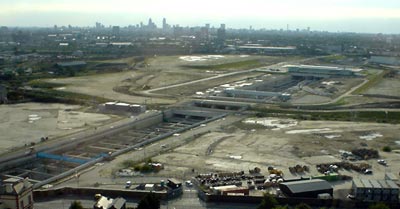
I spent an hour on the roof of Newham, looking out across the future. Directly in front of me was the new StratfordInternational railway station, cut deep in a broad trench running across reclaimed marshland. Eurostar trains will be speeding through here next year, but they won't be stopping for a while because there's nothing surrounding the station shell but a single road and acres of dirt. This dirt will one day be the new Stratford City development, an upmarket office/retail/residential complex (in direct contrast to the existing Poundstretcher/kebab/Woolworths shopping centre to the south). The true Olympic site lay rather further away, somewhere in the middle distance, which was a shame because that made it much harder to see. When the Queen was up here they helped her out by tying big coloured balloons to existing buildings to represent various Olympic proto-stadia. I had to make do with a pair of binoculars and a small map.
As well as enjoying the view out of the window, my group was also informed and entertained by the Olympic Delivery Authority's Head of Stakeholder Engagement. Thankfully his personality was a lot more engaging than his job title. Richard explained, with the aid of a malfunctioning DVD and various maps, how the scene below us would be transformed over the next five years. We're in the middle of a two year planning stage at the moment, which ends next summer when the bulldozers arrive. In July next year, it was confirmed, a big security fence will go up round the perimeter of the site and public access will be closed off. If you want to walk the green spaces of the Lower Lea Valley, or if you're the heron I saw stalking the Pudding Mill River at the weekend, the months are running out.
We spent too much of our hour above Stratford looking in rather than looking out. Maybe that's because there's not yet very much to see apart from the station, no major building work of any great consequence. But in five years time the view from this window will include a Waitrose, an Aquatics Centre and an Olympic Stadium. Within ten years, as the legacy phase kicks in, these should be joined by a giant waterpark and hundreds of acres of affordable housing. The Newham council representatives I met up Holden Point probably still can't believe their luck... just so long as the Olympic Delivery Authority actually delivers. On a good day from up here you can already see the Wembley Arch on the horizon. Let's hope it acts as a wake-up call and not an omen.
My London Open House visits (continued) Editor's note: Please note that I refuse to call the giant millennial cast-off below by its official new brand name. I'll not go into detail here, but I'm happy to debate the issues (with swear words as appropriate) in this comments box... comments (18)
The Dome: As part of the Open Site programme, members of the public were yesterday permitted rare access behind the scenes at the capital's largest white elephant. This was a unique opportunity to glimpse beneath the Teflon-coated roof before the site reopens next year as an entertainment arena, and was therefore a must-visit for devotees of failed government projects. It was strange to see queues again outside the Dome... almost as strange as it would have been to see them when the place was open.
The Open House brochure had promised a "hard-hat tour", but what we got instead was a walk up to the entrance and back with questions answered inbetween. The first thing we saw was the new piazza between the Dome and the tube station, still being laid out with finest granite. On the far side a "Living Wall" was being constructed... which is a bit rich given that the old Millennium Experience had its own Living Wall on the opposite side of the site which has since been left to decay. This new square was a reminder that the tip of the peninsula is now on its second revamp in under a decade, and has had more millions of pounds thrown at it than almost any other spot in the capital. Still, it'll all be worth it next July when you can come here for a cappucino and a cutting edge pop concert.
Standing just under the rim of Lord Rogers' big tent, we were able to peer into the gloom to where several new buildings are under construction. A curved wall straight ahead shields the new central arena (no trapeze artists this time). To the left is a metal shell which will one day house a casino (eventually, even if Greenwich doesn't win the upcoming super casino licence). To the right is a 10 screen cinema, then a live music venue, and between them a street the length and width of Bond Street. Or there will be. The buildings are merely bricks and steel at the moment, at least from the outside, and there was no hint that any single interior was any nearer completion. Still, I'm sure that the new post-Millennium Experience will open bang on schedule, with a complete range of exciting entertainment opportunities. Because London needs more bars and restaurants. And because nothing on this site has ever been known to fail.
Severndroog Castle[photos]: Hidden amidst the trees on Shooters Hill is a three-cornered brick tower, erected in 1784 in honour of a reformed pirate. William James lived a daring and successful life on the high seas off India, returning home a successful and wealthy man, only to drop dead on the evening of his daughter's wedding. His wife Lady James was understandably distraught, and had this quirky belvedere built to honour his greatest naval success. The volunteers at Severndroog can tell you this story in much greater detail, probably whilst wielding a jangly bucket. By the time you've been round the tower to see what all the fuss is about, you'll probably want to throw a few coins in it yourself.
Severndroog Castle is an endangered structure, not through imminent collapse but through political disinterest. Up until 1986 there was a tearoom inside, plus ready access to the roof for an entrance fee of a few pence. And then Maggie dismantled the GLC, and the tower reverted to the control of Greenwich Council. They couldn't afford to maintain the cafe, which rapidly closed, and (more recently) they've tried to sell the tower off as offices. Thankfully a group of volunteers sprang up, peddled their restoration plans on the BBC's Restoration, and the future now looks a little more promising. Admittance is still only possible on this one weekend every year, but this quirky building is worth the effort of a visit. There's an unexpectedly ornate ceiling on the first floor, beneath which Lady James would mourn her late husband, and it's hoped that this room will one day become a space for public meetings. But the finest views are to be had from the roof, from the top of the western turret, where we were permitted precisely five minutes to gaze out across South London. On a good day you can see seven counties, so we were told. I'd recommend visiting this charming folly before the surrounding trees grow so high that you can only see one.
Donnybrook Quarter: One of the newest housing developments in Bow has brought an unexpected splashof Mediterranean white to the streets of the East End. This isn't your usual social housing - it's a high density mini-estate where every residence is afforded its own front door onto the street. The idea is to foster a sense of community - isn't it always - but here in these two streets it might just work. By removing hallways, lobbies and stairwells the amount of indoor living space is maximised, and there's even room for each building to have its own small outdoor courtyard. Yesterday afternoon the development gleamed in bright sunlight, as residents scuttled in and out wondering what all the fuss was about. The architect was on hand to enthuse about his award-winning project, but always with a sense of reality. Every cutting edge architectural project is a real-time experiment, and it'll take longer than six months for the new occupants to decide how this new living space will evolve. [photo] [photo] [photo]
More than five hundred architecturally interesting buildings have been open to the public for free across London this weekend as part of London Open House. Yesterday I managed to visit 1% of them.
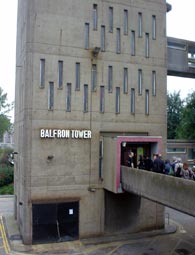
Balfron Tower: West London's Trellick Tower has a less famous older brother on the other side of the capital, just north of the Blackwall Tunnel. Both have a similar silhouette, both were designed by ErnoGoldfinger, and both are admired from the outside by people who'd never dream of living on the inside. The architect himself was an exception. Goldfinger and his wife moved into the Balfron Tower soon after it was built, and spent a couple of months living in flat 130 on the top floor to find out what living here was like. This weekend, as part of Open House, Londoners have the chance to take a look inside a flat just along the corridor.
Residents of the BalfronTower were eyeing up the growing queue outside their front door yesterday morning with a certain degree of bafflement. What were these middle-class arty types doing here on a council estate in Poplar, and why were they willing to wait for hours to get inside. But this building is something special, a brutalist architectural masterwork with a highly original construction. I was lucky enough to be in the first small group of the day to gain entrance. The lifts to the top floor were malfunctioning so we could only ride up as far as the 18th floor before having to climb the remaining six storeys via the staircase. All the stairs and liftshafts are housed in a separate tower, joined to the main apartment block by a series of concrete bridges. We crossed the toppermost connecting walkway, our precarious mid-air state mostly shielded from view, and proceeded along to our target flat.
The owner was pleased to show us around, although he may not be quite so keen by the time the umpteenth group traipses round his living space this afternoon. He's only just moved in and is one of the block's rarer upwardly mobile residents. His flat is fairly compact, and very white, with some tasteful Erno-designed features which elevate this above the usual tower block interior. Best of all, however, were the views... or at least they would have been had London not been cursed by low grey cloud yesterday, obscuring the horizon in all directions. Curses. Canary Wharf was near enough to be obvious, as was a large swathe of East London, but the Gherkin was just a ghostly shape in the distant mist. I can definitely see the attraction of living up here inside a design classic, if only for the opportunity to stare out across the capital with a broad smile. But the tortuous journey back down to civilisation convinced me that maybe I'm better off where I am.
Bromley Hall: One of the joys of Open House weekend is discovering unexpected architectural treats on your doorstep. Bromley Hall looks like a very ordinary building beside the Blackwall Tunnel Approach Road, and I must have been past it scores of times without giving it a second look, but at its heart is the oldest brick house in London. In 1485 this was a hunting lodge with royal connections, located at the tidal limit of the River Lea. Later it became home to a series of successful merchants, each of whom made their mark on the structure and design of the building. The architect responsible for the hall's restoration, Paul Latham, was only too pleased to be able to show eager members of the public around inside his pet project. He knows every inch of the property inside out, from the old woodstained floorboards to the scrap of painted 17th century dado rail in the hallway. Particularly impressive are the patchy remains of a Tudor wall painting of a soldier wielding a crossbow, and a preserved wooden doorway carved with hunting scenes. With so many historical periods represented side-by-side, you get a real sense of domestic architectural evolution. I'm particularly astonished that Bromley Hall survived the 20th century, during which time it was damaged by wartime bombs, a passing motorway and bolted-on advertising hoardings, as well as (most recently) its use as a garage store and a carpet warehouse. All praise then to Leaside Regeneration for the sensitive way they've converted the building back to office space... although it would be tough to choose between working here or inside the pile of red containers stacked up nextdoor.
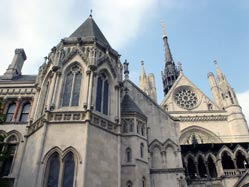
Royal Courts of Justice: If you're particularly naughty you might one day end up here, inside the big gothic building at the top of Fleet Street. The RCJ is the top civil court in the land (with the exception of the House of Lords) and also the criminal Court of Appeal. And until yesterday I'd never quite appreciated from the outside how vast it is inside - a labyrinth of corridors, chambers and court rooms arranged around a long high vaulted hall. The building's open to the public every weekday, but yesterday there were special tours allowing us to tour behind the scenes. It was fascinating to prowl the back corridors and to hear more about the courts and their 8000 staff from some of those who work here. There was even the opportunity to go down into the cells of the Court of Appeal and follow in the footsteps of the country's more famous miscreants. I can now claim to have stood in the VIP holding cell, sat in the back of a 12-seater prison van, and even been taken up to the accused's bench in a dark and dusty courtroom via the back stairs. And next time the Lord Chief Justice gets a mention in the news I'll be able to picture his airy book-lined court room without having to rely on one of those awful artist's impressions.
Also visited • Marx Memorial Library (Clerkenwell): The repository of all things left-ish, including an upper room where Lenin spent a year writing. If you should ever need to refer to a copy of the United Mine Workers Journal (or similar) for research purposes, they'll have it in the basement. • More London (beside City Hall): A new Foster-designed office block overlooking the Thames, with two separate nine-storey wings joined by vertigo-inducing bridges across a central atrium. And filled by a bunch of accountants.
Airport quiz: What is this modern obsession with naming airports after people rather than places? Nobody wants to fly to a dead person's airport, they want to fly to a readily identifiable city or region. But no, civic officials insist on naming airports after local statesmen and celebrities, even if nobody else then has a clue where these airports are. Maybe it's a way to confuse passengers, reduce air traffic and thereby cut carbon emissions. Or maybe it's just self-obsessed madness. Anyway, can you identify which major towns and cities are served by the following re-designated airports? There's a choice of three each time. Answers are in the comments box, but have a go before you peek.
1) Charles de Gaulle International Airport 2) John F. Kennedy International Airport 3) John Lennon Airport 4) Robin Hood Airport 5) George Best City Airport 6) George Bush Intercontinental Airport 7) Ronald Reagan National Airport 8) Dulles International Airport 9) Ben Gurion International Airport 10) Indira Gandhi International Airport 11) Marco Polo International Airport 12) Amerigo Vespucci Airport 13) Franz Josef Strauss International Airport 14) Frédéric Chopin Airport 15) W. A. Mozart Airport
Local news for local people: Bow Road (that's the road, not the station) is due to be semi-closed for resurfacing work starting at 8am this morning. And every weekend from now until the end of October. And overnight every night (7pm-5am) until the first Friday in November. Ouch. The affected section is between Mile End and Bow Church stations, with eastbound traffic particularly badly affected. The promised contra-flow and local diversions should snarl up road traffic (and especially bendy buses) for miles around. I'm predicting chaos.
Rarely does a week go by without some poor unfortunate group of rail travellers ending up trapped on their trains, often for hours at a time, as a result of some sudden and unforeseen circumstance. Sometimes it's signal failure, sometimes it's track failure, sometimes it's engine failure, and sometimes it's a suicide sparked by perceived lifestyle failure. Whatever the case, if you're unfortunate enough to be on a train which gets stuck somewhere outside a station, you and several hundred fellow commuters could be out of circulation for hours.
Some rail travellers live in fear of being trapped on a train. What if they get stuck for an hour or more? What if they miss their connection? What if the bloke sitting next to them turns out to be a nutter? What if they get stuck for two hours or more? What if they miss their flight? What if all the lights go out? What if they get stuck for the rest of the evening? What if everyone in the carriage runs out of food? What if the train never moves again and life on board evolves into a primitive civilisation revolving around cannibalism and sudoku?
I fear none of the above. If my train is ever halted between stations, there's very little that I can do except put up with the enforced quarantine. But I do fear one particular consequence of being trapped on a tube train, and that's to be stuck underground with a full bladder. Imagine the hideous social faux pas which might occur were the delay to continue for too long. A normal tube journey's no problem, even if I've been out drinking beforehand, because I know relief is never too far away. But if my train ever stops in a tunnel for what looks like forever, merely crossing my legs might not ultimately be sufficient. Given sufficient time that mild inner sensation will become a growing feeling, which can develop into a increasing need, which can build into an definite urge, which can escalate into an urgent compulsion, which can mutate into an unstoppable reflex action. Let's say no more about the incontravertible visual and olfactory evidence which might then emerge. In a confined space such as a rail carriage, surrounded by complete strangers with no means of escape, this could be very embarrassing indeed. And this I fear.
So I'd like to offer my own advice to all rail travellers, in direct contradiction to TfL's usual line. Don't take a bottle of water with you on the tube, it can only make a bad situation worse. Instead, always use the facilities provided - be it at home, at the station, at your place of work or in the pub - before embarking on any train journey. Because it pays to travel empty. And then it won't matter how long your journey might be delayed - you need never fear the consequences of inconvenience.
Silver discs(September 1981)
A monthly look back at the top singles of 25 years ago
The three best records from the Top 10 (8th September 1981) Soft Cell - Tainted Love: One of the most enduring singles of the 80s was born two decades earlier, first recorded by Gloria Jones, and kept alive on the Northern Soul circuit. It took two obscure Leeds Poly art students to spot the song's appeal, and a seemingly straight-forward recording session produced magical results. From the opening double-bleep and synth laserfire, the beat defies you to keep still. A debut Top of the Pops performance brought Soft Cell to immediate prominence ("Oh my god, who isthat bloke singing?") and by the time the public realised that Marc Almond was no saint it was too late, they already loved him. Even America lapped up the dark duo, just this once, and the song rode the Billboard chart for a record-breaking 43 weeks. Rarely has perfection been so tainted. [1981 ToTP] [1981 video] [1991 video]
"Sometimes I feel I've got to run away, I've got to get away from the pain that you drive into the heart of me. The love we share seems to go nowhere." Adam and the Ants - Prince Charming: After his highwayman phase, Adam reinvented himself Blackadder-style as a fairytale prince. It's the Cinderella pastiche video that everyone remembers. Not the amateur ugly sister opening, but the grand ballroom scene where dandy Prince Adam swings in on the chandelier. Casting Diana Dors as the Fairy Godmother cemented this three minute pantomime as a work of kitsch genius, that and the brilliantly inane dance. I bet you can still do the dance. Adam may have been turning back the clock by suggesting that men in make-up should take excessive pride in their appearance, but it turns out he was also 25 years ahead of his time. [video]
"Ridicule is nothing to be scared of, don't you ever, don't you ever stop being dandy, showing me you're handsome." UB40 - One InTen: But life in Thatcher's Britain wasn't all about extravagance and dressing up in frock coats. Birmingham's UB40 introduced a note of reggae realism with this song - a litany of the downtrodden, the outcast and the forgotten. Many a serious message can be sneaked into the charts if it's coated with a sugary enough melody. Within months the number of unemployed in the UK workforce would reach one in eight (although admittedly that wouldn't have made for quite so catchy a title). And while unemployment today may be down to one in twenty, old ladies still get mugged, teenagers still commit suicide and third world mothers still starve. The world still doesn't care enough. [live]
"I am the one in ten, even though I don't exist. Nobody knows me even though I'm always there - a statistic, a reminder of a world that doesn't care"
My favourite three records from September 1981 (at the time) Portsmouth Sinfonia - Classical Muddly: It took one very special record to burst 1981's bloated medley bubble, from an ensemble without parallel. The PortsmouthSinfonia were formed in 1970 as a unique orchestra whose members would "embrace the full range of musical competence". It didn't matter whether performers could play their instrument or not, just that they tried their best and attempted to go up and down in pitch sort of approximately. The resulting "cloud of sound" massacred several popular classics over the years, but always endearingly badly. Oh to have been in the Royal Albert Hall on that special evening in 1974 when the Sinfonia performed the 1812 overture and the Hallelujah Chorus to a stunned crowd of thousands. Classical Muddly was the orchestra's attempt to bolt together several well known classical themes, and resulted in an aural collision of monumental proportions. I adored it. Alas I've only ever owned a 7 inch vinyl version of the track, which I can now touch and adore but have absolutely no means of playing. So imagine my delight on discovering this fan's webpage with an mp3 link at the bottom. Ah, sweet discord! But I wouldn't bother downloading it yourself - you'll only ever play it once. [listen to Also Sprach Zarathustra]
"...clap ...pluck ...clap ...puff ...clap ...scrape ...clap ...screech" Heaven 17 - Play To Win: While the Human League were basking in adoration at the top of the chart, their former bandmates - the half more likely to succeed - could do no better than number 46. Heaven 17's album Penthouse and Pavement foresaw (and suitably lambasted) the imminent yuppification of City life, and should have been huge but wasn't. The band had taken their name from a fictional Top Ten chart displayed in a record shop in the film A Clockwork Orange... and therefore narrowly missed being called Johnny Zhivago, Cyclops or even Googly Gogol.
"Suit the movement to the word, reverse and check the action, play to win!" ...and then there was my favourite record of all time. Of which, more next month when it reaches the Top Ten.
"Every time I think of you I know we have to meet"
15 other hits from 25 years ago: Endless Love (Diana Ross and Lionel Richie), Wired For Sound (Cliff Richard), Start Me Up (Rolling Stones), The Thin Wall (Ultravox), Abacab (Genesis), Everybody Salsa (Modern Romance), Souvenir (Orchestral Manoeuvres In The Dark), Hands Up Give Me Your Heart (Ottawan), Slow Hand (Pointer Sisters), Pretend (Alvin Stardust), In And Out Of Love (Imagination), So This Is Romance (Linx), She's Got Claws (Gary Numan), You'll Never Know (Hi Gloss), Europe After The Rain (John Foxx) ...which hit's your favourite? ...which one would you pick?
I can't be bothered to save the planet. Because it's too much effort, isn't it? I know there are lots of things I should be doing to protect our environment for future generations, but somehow I never quite get round to doing them. Sorry. Apologise to your grandchildren for me, won't you?
I did try slightly at the weekend when I visited the Mayor's Future London exhibition at the Truman Brewery in Brick Lane. It took a while to find the astro-turfed entrance round the rear of the building, but I was soon wandering around the vast whitewashed first floor, curtained off into a series of interconnected spaces. Several of the displays spread their content rather thinly, but the emphasis stayed the right side of preaching throughout. And everywhere, questions. Why don't you compost your rubbish? Why don't you buy locally-produced food? Why don't you try car-sharing? All the messages seemed very worthy at the time, but there were rather too many to remember and so I left not quite signed up to anything in particular. If the other 7 million Londoners are like me, the capital is doomed.
So, with the aid of the the free leaflet that accompanies the exhibition, I've decided to shame myself into revealing 10 of the things I'm not doing to save the planet. But I have an excuse for each, see if I don't. They're damned good excuses too. And all highly valid, I'm sure you'll agree.
Home and Energy 1)Leave no appliance on standby: Look, I do at least switch off my TV overnight, so it's usually only on standby during the evening. I would turn off my hi-fi when I'm not using it but I'd have to walk across the room to reach the switch. And surely I don't have to unplug my mobile phone charger for the 164 hours a week when it's not being used - it can't be using up much power if any can it? 2)Use low energy lighting: But I have perfectly functioning ordinary light bulbs thanks. Maybe I'll upgrade them when each one blows. Although the energy saving bulbs are a lot more expensive aren't they? I know they save more in the long term, but it never feels like a good deal up front. 3)Reduce your flush: At the exhibition I picked up one of those magic bags of chemicals that you're supposed to drop into your cistern where it inflates and reduces capacity. Except, well, you know, sometimes even normal capacity isn't quite enough to flush away everything, is it? So if I reduced my flush, I'd surely end up having to reflush more often, and that would be wasteful. 4)Turn off the tap when you brush your teeth: I know I ought to do that, but it's so much hassle isn't it? Because you can't brush your teeth with the tap off, can you? It has to be on at the beginning, and you have to turn it back on again to rinse, and again and again to re-rinse. It's all too impractical (or just too much effort). 5)Recycle your rubbish: My local council is one of the worst in the country at encouraging recycling. If they have any plans for doorstep collections, nobody's informed me about them. There are some communal recycling bins a few minutes walk away, but every time I turn up with a pile of newspapers I find the bin's already full to overflowing. So what's the point?
Food 6)Eat organic: I'm sure it would be much better for me to eat knobbly vegetables and genetically unmodified fruit, and better for the over-fertilised environment too. But it costs far more than normal processed food. And it tastes odd (which probably means it tastes 'real', but I'm not used to real). And to buy it you have to travel miles to yuppie-infested farmers' markets and haggle with bearded ladies. And nobody yet sells organic KitKats. 7)Reduce your food miles: Yes, I know that my last meal probably travelled the equivalent of five times round the globe to reach my plate, destroying the atmosphere in a fog of carbon, but until they print "Food Miles" on the front of every ready-meal I refuse to waste time in the supermarket using an atlas and a ruler. 8)Grow your own food: There's not enough space on my balcony to grow root vegetables or trail a strawberry plant, even if I wanted to. And my balcony never gets any sun anyway. Although I am now self-sufficient in bay leaves, for all the good that does me.
Travel 9)Cycle everywhere: I'm sorry, but even though cycling might be good for my general fitness, in London it's also verging on the suicidal. What's the point in having rippling thigh muscles if you're lying underneath the wheels of a bendy bus? 10)Buy a hybrid fuel car: Except who in London needs a car? I haven't got one. I take public transport everywhere, and I walk a lot. And I keep my thermostat down low, and I never boil too much water in my kettle, and I try not to buy so much food I have to throw half of it away. So maybe I'm not doing too badly after all. Hell, who am I kidding? Sorry.
• The Future London exhibition (Truman Brewery 8-16 Sept, Science Museum 25 Sept - 1 Oct) • The Future London website (it's a bit like visiting the real exhibition, only slower)
Every Autumn, London's Mayor announces next January's fare rises for tubes and buses. Every Autumn, certain sections of the media complain very loudly. Check out the 2007 column of the following tables and you might see why...
Cost of a single central London tube journey
1999
2000
2001
2002
2003
2004
2005
2006
2007
£1.40
£1.50
£1.50
£1.60
£1.60
Oyster
£1.60
£1.70
£1.50
£1.50
Visitor
£2.00
£2.00
£3.00
£4.00
Cost of a single central London bus journey
1999
2000
2001
2002
2003
2004
2005
2006
2007
70p
£1
£1
£1
£1
Oyster
70p
80p
80p
£1
Visitor
£1
£1.20
£1.50
£2
The good news: If you have an Oyster card (and millions of Londoners do), tube and bus fares are still at 2000 prices. The bad news: If you don't have an Oyster card (and the vast majority of visitors and tourists don't), tube and bus prices have doubled in just three years.
The Evening Standard says: "£4 TO GO ONE STOP ON THE TUBE" A rational human being says: Well yes, but you'd have to be pretty stupid to travel one stop on the tube in central London. Or very lazy. Or the sort of Evening Standard reader who doesn't usually travel with the plebs but is sometimes forced against their will to use the tube when there are no taxis. A taxi driver says: Come January, a group of three tourists will be able to take a taxi across town more cheaply than take the tube. Lovely jubbly.
The better news: You can buy an Oyster card online and have it posted to your home address anywhere in the country (offer coming soon to India, Hong Kong, Singapore, Spain, Portugal and the USA) The bottom line: You can't get hold of an Oyster card without paying at least £13 (that's £10 of pre-pay and £3 refundable deposit)
Some background: Cash is now used to pay for only 5% of bus and tube journeys in London. The potentially scary bit: If you have an Oyster card, somebody at Transport for London knows precisely whereabouts in London you were last Saturday morning (and every single day since you bought one). The small print: If you're on pay-as you-go and forget to touch in or out, the amount you'll be charged rises to £4 in November.
The good news: If you have an Oyster card (and millions of Londoners do), tube and bus fares are still at 2000 prices. Which is bloody impressive really.
At first they appeared only occasionally. A small packet of biscuits, or a single tub of something cakelike, whenever there was something to celebrate. A brief email would go round the office announcing their appearance, just so that nobody missed out. We'd partake gratefully, a rare sweet treat to mark a special event, gobbled down with grateful thanks. That's how it used to be. And then things evolved.
Then they appeared slightly more often. A trayful of chocolate chip cookies, or a couple of packs of mini muffins, in honour of someone's birthday or "because it's Friday". They'd sit temptingly on top of a filing cabinet throughout the morning, slowly polished off by passers by as lunchtime approached. Eventually there'd only be one biscuit left, which nobody dared take for fear of looking selfish, which then hung around all afternoon until somebody dared to snaffle it. That's how it used to be. And then things evolved further.
Now they appear all the time. A bucket of chocolate brownies, a packet of segmented flapjacks and a box of rice krispie squares, perhaps with a tray of mini doughnuts thrown in for good measure. Any excuse will do. "Because the cat had kittens", "because it's Tuesday" or even "because I didn't think anyone else would bring anything in". They're no longer special, they're just part of the daily office routine. If by some strange quirk no nibbles have appeared during the morning, somebody is sure to nip out at lunchtime to buy something to fill the communal void. And there's always something left on the filing cabinet at the end of the afternoon, because supply now exceeds demand. One day's leftover cookies and fondant fancies will more than likely stay out overnight and reappear alongside tomorrow's new goodies. That's how it is now. It can't be good for us.
I wonder if it's the same in your workplace at it is in mine? I suspect it might be, because I see the same proliferation of cakes, biscuits and gooey sugary things piled up in every office I visit. And because our local Sainsbury's Local has recently promoted its best selling minibites and flapjacks from some rear aisle to the most prominent shelves at the front of the store, trying to encourage queueing office workers to pick up a pack or three on impulse. Which they willingly do. Supermarkets must be rubbing their hands with glee at people's desire to buy thinly-sliced over-packaged cakes and biscuits at exorbitant prices.
Obviously what's needed is a government campaign, or maybe a Jamie Oliver series, to encourage the nation's office staff to snack more healthily. A tub of sliced carrots would be far healthier at elevenses, and a packet of dried mango strips would be a much better accompaniment to the mid-afternoon cuppa. Maybe supermarkets could hide all their stodgy treats at the back of their city centre stores and place big packets of celery, pine nuts and sliced melon beside their checkouts instead. It's the only way to safeguard the collective waistline of the nation. But don't worry, you'd still be allowed mini jam doughnuts and chocolate treats for special occasions, just like in the old days. Surely the odd fat-packed nibble every now and then couldn't do any real harm, could it?
Next week is London Open House weekend, when hundreds of the capital's architecturally intriguing buildings are open to the public for free. As a taster, here are some photographs I took inside the Gherkin (30 St Mary Axe) as part of London Open House Weekend 2004.
Back in 2004 it took me three and a half hours of queueing to gain access to the Gherkin [report here] but the stunning views from the top floor of the building were well worth the wait. Thousands of (very patient) people made the journey to the 40th floor during that single weekend, and I'm sure none will forget the experience. The Gherkin's open to the public again for London Open House this year, but with visitor numbers dramatically reduced. The organisers are only allowing pre-booked tours, for nine people at a time, so bad luck if you didn't apply for one of the 500 tickets three weeks ago. And this year's visitors are only getting ten minutes at the top, whereas we weren't timed at all and we got to wander round the 17th floor as well.
Next weekend there'll be crowds of people crawling across London, from the City to the suburbs, trying to take a look inside as many buildings as possible. I fear that London Open House is starting to become a victim of its own success. Every year more people find out about the event, so every year the queues get longer, so more people get to visit fewer properties. A greater number of events now require pre-booking, usually the more interesting ones, restricting access and opportunity. It's no longer possible to give away the 72-page event brochure for free - it's now only available by post or download for £4 a time. And simultaneous opening over just one weekend means it's impossible to visit even a tenth of the architecture on show, and most of these buildings won't be open to the public again for another 12 months.
But Open House is still a fantastic event and a rare opportunity. Without it I'd never have been up the Gherkin, or round the Cabinet Office, or inside the old TV studios at Alexandra Palace, or visited any one of a number of other fascinating locations. This will be my fifth year of Open House-ing, and every year it gets harder to decide where to go. Where's left I haven't been to before? Do I concentrate on the centre of town or attempt to tour the suburbs? Will certain buildings be open again next year or is this my only chance to see? Is it worth queueing to see one amazing building or better to spend the time visiting four less crowded ones? I've got a week to decide.
Some recommendations: Foreign Office (off Whitehall), Crossness Engines House (Bexley), Shri Swaminarayan Mandir (Neasden), Freemason's Hall (Camden), Bank of England (arrive early, the queues get really long), Lloyds of London (City), Severndroog Castle (Greenwich), The 02 site tour (North Greenwich), Hackney Empire, Brixton Windmill, City Hall, More London, 19 Princelet Street (Spitalfields), Portcullis House (Westminster) Some more recommendations (except you had to pre-book, and you didn't): the Gherkin (City), Churchill's Underground Bunker (Neasden), Lincoln's Inn (Camden), Mansion House (City), BBC Television Centre (White City), Grims Dyke (Harrow Weald)
Grim TV news: "David Jason is to take on the role of master criminal Des once again as Diamond Geezer returns with a series. The ITV1 comedy drama, which returns for three 90-minute episodes next year, will see Des undertaking huge missions including breaking into Buckingham Palace on behalf of MI6 and stealing 12 million pounds of Russian gold." (reports Digital Spy)
The only reason Tony Blair is still Prime Minister. Is this list.
List of UK Prime Ministers to serve longer than 10 years 1)Sir Robert Walpole [Whig]: 20 years and 314 days (1721-42) 2)William Pitt 'The Younger' [Tory]: 18 years 343 days (1783-1801, 1804-06) 3)Lord Liverpool [Tory]: 14 years 305 days (1812-27) 4)Marquess of Salisbury [Conservative]: 13 years 252 days (1885-86, 1886-92, 1895-1902) 5)William Gladstone [Liberal]: 12 years 126 days (1868-74, 1880-85, 1886, 1892-94) 6)Lord North [Tory]: 12 years 58 days (1770-82) 7)Margaret Thatcher [Conservative]: 11 years 209 days (1979-90) 8)Henry Pelham [Whig]: 10 years 191 days (1743-54) 9)position vacant(1997-2007)
If the Earth went round the Sun a bit quicker, he'd be gone by now.
diamond geezer is four years old today. Who'd have thought? When I started I had no intention of writing quite so much for quite so long, but I'm still here nearly 1500 days later. And one of the main reasons I'm still here is that you're here too. Lovely though it is to write stuff and stick it on the internet, it's even better to know that somebody's actually reading it. Which makes me glad I started four years ago, because it's 200 times more difficult to get noticed today...
Approximate size of the blogosphere
September 2002: ¼ million blogs September 2003: 1 million blogs September 2004: 4 million blogs September 2005: 16 million blogs September 2006: 54 million blogs
When you start blogging, you start out as an insignificant fish in a large pond. If you're lucky, and have a bit of colour about you, you might just get yourself noticed. But with the total number of blogs roughly quadrupling every year, your chance of being spotted decreases with every passing month. Which is a shame, because there are now far more fine blogs than there ever used to be, but nobody has the time to read them all. The blogosphere fishpond is overstocked, and it can only get more crowded.
Four years ago all the important fish used to know all the other important fish. But no longer. The fishpond hasn't just enlarged, it's also fragmented. Look over there, that's all the political blogs flapping about in the Westminster shallows. A school of foodie blogs are nibbling at flakes on the surface, and those bubbles over there are being expelled by a shoal of sex-obsessed blogs ejaculating into deeper waters. It helps to join a themed community for collective support, or else to have your own unique habitat where you have no competition. If you're just an ordinary fish writing about your ordinary life, expect to be overlooked.
And blogging has changed too. Four years ago far more blogs used to be proper "web logs", trawling the pond for websites of interest. If you could write something worth linking to, you got noticed. Nowadays (with the possible exception of political bloggers) most people are much more interested in writing their own content than in linking to others. And when they do link it's almost always to the big fish, not to the sprats and whitebait which never get the opportunity to flourish and grow.
I'm pleased I had the foresight to start blogging when I did, back when the pond was considerably smaller. But if you're thinking of starting today, don't lose hope. If you're good, and if you keep swimming, then the rest of us will try to notice you and welcome you to the community. Just don't leave it for another four years, because it'll be 200 times more difficult by then.
The last ten blogs I bookmarked:•••••••••• (hi, and welcome)
Are your emails killing the planet? Are they much longer than they need to be, thereby wasting unnecessary amounts of electricity and storage space. I'm referring (of course) to the signatures which some individuals and companies insist on adding to the bottom of all their emails. Whilst some signatures are small and appropriate, others are great hulking textual beasts far longer than the email to which they are attached. If left unchecked, signatures build up in thick ugly layers at the foot of email conversations, down where nobody usually bothers to read. But try printing out a long corporate email and you'll almost certainly waste the last sheet of paper on unnecessary signature stodge.
So I though I'd start a campaign to 'out' the worst signature offenders in an attempt to save the Earth before it's too late.
1) Corporate signatures: You can't just write your name at the bottom of a business email any more. Expect an automatic 10-line corporate signature to kick in, complete with your full job title, postal address, telephone number (with international dialling code), email address (I mean, like, what is the point?) and official company strapline. It's all about consistency, and promoting brand image, and presenting stakeholders with key information in a coherent style. But it also looks bloody stupid tacked onto the end of 99% of work emails - those internal gossipy conversations that nobody ever admits to sending. 53 BigTower London EC1A 5XQ, United Kingdom, Europe, The World Tel: +44 3268 4782916 43107 extension 9381 and ask for Janet Globalcorp is an ISO 9000 compliant community corporation Developing growth through customer-facing system efficiency
2) Corporate legal signatures: Never trust your employees. Who knows what business secret or litigious scandal they might accidentally let slip in a careless email. Today's corporate lawyers therefore insist that a lengthy legal disclaimer be added to every email exiting the office, pointing out that each message's contents might in fact be complete rubbish. And that the email might have been sent to the wrong address, in which case please (please!) delete it without reading the contents. These verbose signatures are essentially desperate begging measures, but they clog up business communications with extreme effectiveness. This e-mail (and any attachments) is confidential and may contain personal views which are not the views of Globalcorp unless specifically stated. If you have received it in error, please delete it from your system and notify the sender immediately. Do not use, copy or disclose the information in any way nor act in reliance on it.
3) Promotional signatures: Certain email services insist on adding a little advert at the bottom of all your emails. It may be only tiny, but it always looks highly inappropriate beneath a brief message proclaiming that you've got a new job, or announcing the death of your cat. Still, that's 'free' email for you. How much free photo storage do you get? Store your holiday snaps for FREE with Yahoo! Photos. Get Yahoo! Photos!
4) Self-promoting signatures: Some people love to pollute the end of their emails with little adverts of their own, for themselves. I have no serious problem with a one-liner, say for your own website, because that says who you are. But insisting on listing more than one of your pet web projects to everybody you communicate with is perhaps excessive, and shamelessly plugging your entire online repertoire to all and sundry is verging on the egocentric. I am an angel: iknitsocksforthehomeless.org I have a book out: pleasebuymybookplease.co.uk I am so very talented: myblogisaworkofgenius.com
5) Witty signatures: We've all seen them. Some hilarious Star Trek quote, or a line lifted from your favourite 18th century social economist, tagged on to the end of an email as an open window into the soul of the sender. Alas the message being transmitted isn't "see how erudite I am", it's "I am a tosser". Sorry to have to be the one to tell you. "If The Flintstones has taught us anything, it's that pelicans can be used to mix cement." (Homer Simpson)
So please join me in my campaign to eradicate over-long email signatures from the internet. We don't want to read it, so please don't write it. With a little thought and consideration for others you can easily slim down the verbal spam you attach to the bottom of every email you send, or even eradicate it altogether. Come on, every kilobyte of memory you can free up will help to save the planet. Who's with me?
London's tube map is about to get more complicated, with even more coloured tentacles snaking around the capital than ever before. And this time they're orange. The Mayor announced yesterday that he's found a cunning way of extending the tube network without forking out billions on new tunnels. He's taking a couple of existing rail services - namely Silverlink's North London line and TfL's East London line - and now plans to link the two together by adding in a short stretch of relatively cheap connecting track in the Dalston area. Throw in some new trains and some revamped stations and, hey presto, you have a brand new rebranded railway. Starting in November next year. And it's to be called the "LondonOverground".
It's about time it was easier to travel by rail around non-central London. If you want to get from London outskirts to London outskirts today, you usually have to go right into the middle and back again. Or ride on a ramshackle old line with grim carriages and an infrequent service. Or take the bus. Or even (shudder) get yourself a car. The new London Overground hopes to change all that. From 2010 you'll be able to travel from Croydon to Canonbury, or Wapping to West Hampstead, or any one of hundreds of other improbable journeys, all on one train. Travelling 90 degrees round the capital will never have been easier.
Except that, as is usual with such developments, South London is missing out. Almost all of the new London Overground is north of the river, and the southern extension from Surrey Quays to Clapham Junction is the only part of the project not yet promised funding. Until that can be built, a proper outer orbital railway remains just a pipedream. Half of London will have to continue to endure less regular, less well-connected National Rail services for the foreseeable future. And the whole of London is going to have to put up with a much more complicated tube map, scarred by orange lines that aren't really tube lines at all. The future's Overground. The future's orange.
fivelinks • mindlessly addictive waste of time 1:BowMaster. Fire arrows at advancing armies of medieval soldiers & ogres & stuff [via bblb] • mindlessly addictive waste of time 2:The ESP Game. Collaborate with an unknown partner to label the world's online images (now three years old, but still more fun than Google's new Image Labeller) [via meish] • The Man in Seat Sixty-One explains everything you need to know about affordable rail travel in the UK, or Canada, or Turkey, or Thailand, or... • Wikipedia's lamest Edit Wars - some petty anoraks have too much time on their hands • Clothes for Ferrets. Yes really. Including the lovely Ferret Beret ($4.25), a (hand-washable) Ferret sweatshirt ($7.99), the Ferret Princess hat ($5.99) and the mighty smart Ferret Biker jacket ($12.99). This scares me to the core. [via in4mador]
1) thelondonpaper Born: 4 September 2006 Cost: free Published by: News International (ie Rupert, Sky, the Sun) Given out by: blokes in glitzy lilac, who really weren't trying hard enough modus operandi: "Could you write the paper for us please, because we haven't got enough journalists to do it for you" The editor says: "Every day thelondonpaper.com's team will be bringing you stories about the city you live in, work in and play in. The city you love as much as we do. We'll also have guides to everything – from bars and restaurants to cinemas and the latest exhibitions. We'll have survival guides and the latest London gossip. Oh, and more reviews than there are tourists in Piccadilly Circus." And are there "more reviews than there are tourists in Piccadilly Circus"? no, not unless it's 5am Front cover: clean; well-designed; colourful enough; big photo of Bow Road (but only because Pete Doherty was being sentenced at the court there); seriously patronising weather forecast ("don't forget your umbrella") Plenty of news to read: yes, 17 pages worth, near enough Number of press releases magically transformed into 'news' items: plenty Typical features: "your views" (a quick quote from typical young Londoners); pet of the day; ask the Urban Doc; look good feel good; irrelevant statistic at top of page; thelondonbuzz City news: barely any Sports news: a bit thin, especially on local teams Number of sudoku: 3 Dodgy 'love' columns featuring the phrases "sit on my face", "fat slags" and "rug munchers": 1 Does Sky TV get undue prominence? yes, but not as blatantly as I was expecting What's the website like? not as easy to read as the paper Could you imagine reading this for 30 minutes on the way home? yes, at a push A typical reader: young, goes out a lot, lives for 'fun and mates', concerned about health and the environment, buys stuff (but not newspapers) Is it aimed at me? not really Would I take another copy tomorrow? if I had nothing else to read, yes
2) London Lite Born: 30 August 2006 Cost: free Published by: Associated Newspapers (ie Evening Standard, Metro, Daily Mail) Given out by: several pushy volunteers in cheap purple jackets (on £8 an hour) modus operandi: "You'll never guess what showbiz gossip and fashion tips we uncovered while you were at work today" The editor says: "With so much to do at work and play in London, sitting down for a long read is a luxury. That's why London Lite likes to keep things short and snappy... London Lite is the paper that never likes to come second. What's more it is as exciting and colourful as the vibrant city it covers." And is it "as exciting and colourful as the vibrant city it covers"? no, not unless London is bitty and shallow Front cover: very colourful; not much to read; big plug to article inside about cellulite; pointless claim ("London's first and original free afternoon paper") Quality of newsprint: barely better than thin 1960s toilet paper Plenty of news to read: well, sort of, but with a definite "showbiz" slant Number of press releases magically transformed into 'news' items: plenty Typical features: celeb gossip; celeb photos; Salon Secrets; eat tonight at the best veggie cafes; London tribes; songs to do the washing up to (chosen by wife of former Conservative leader Michael Howard) City news: enough Sports news: enough Number of sudoku: 2 Misuse of the word "bloggers" to refer to people who've sent in reviews of things: 5 Does the Evening Standard get undue prominence? sssh, not a mention What's the website like? exactly the same as the Evening Standard, with the news buried deep beneath entertainment and dining reviews Could you imagine reading this for 30 minutes on the way home? no, maybe 10 A typical reader: young, probably female, dines out, concerned about how and where she's seen, likes her little luxuries Is it aimed at me? not at all Would I take another copy tomorrow? not even if they were giving it away
3) Evening Standard Born: 21 May 1827 Cost: 50p (was 40p until last week) Sold by: glum-looking (and very lonely) news vendors Could anybody in the Holborn area be arsed to buy a copy yesterday? no, they each had two free papers to read instead Doomed then? I shan't miss it
1st: Records show that this is the wettest September day since 2005. 2nd: The Anti-Christ is born to an unemployed couple in Wolverhampton. Apart from a mild power surge at the time, nobody notices. 3rd: The Anti-Christ nearly dies in a freak choking accident, but is resuscitated thanks to the quick action of a midwife. Hurrah for the NHS! 4th: British Gas raise their prices, first at 9am, then at noon, and then third time lucky at 4pm. 5th: The new school year begins. All children are weighed, and the most obese are shipped off to Jamie Oliver's boot camp in Essex. 6th: The Daily Express reveals that Princess Diana is alive and well and running a garden centre in Woking. 7th: John Reid announces that police have thwarted a new (horrendous) terrorist plot involving people speaking in Arabic. 8th: Speaking in Arabic is banned on all flights leaving the UK. 9th: The Anti-Christ survives an assassination attempt when seven hooded monks accidentally go to the wrong Wolverhampton address and are savaged by an alsatian. 10th: Due to a combination of freak circumstances, nothing much happens and there is no news today. 11th: George Bush says he refuses to believe in global warming until God sends him a sign. 12th: Hurricane Helene heads inland to George Bush's Texan ranch, where it stalls overhead and rips the place to shreds. 13th: There are no winners in the midweek lottery, setting up a record-breaking quadruple rollover. 14th: John Reid announces that police have thwarted a new (outrageous) terrorist plot involving pasta mixed with nitroglycerine. 15th: Airline meals are banned on all flights leaving the UK. 16th: Members of a syndicate from the Plaistow Women's Institute become the National Lottery's biggest ever jackpot winners, collecting £37 million. 17th: West Ham United are bought out by the Plaistow Women's Institute, who immediately close down the club because "it's a bit noisy". 18th: The Anti-Christ visits the Bullring in Birmingham for the first time and decides that Armageddon will one day have its epicentre in Mothercare. 19th: McDonalds are awarded the new NHS catering contract. Meanwhile (for proper balance) Burger King get schools and KFC get prisons. 20th: David Cameron proposes the privatisation of the ambulance service, with shareholders given access to a preferential 998 number. 21st: John Reid announces that police have thwarted a (monstrous) terrorist plot involving shirt buttons packed with explosives. 22nd: Clothing is banned on all flights leaving the UK. 23rd: The Anti-Christ is christened "Kyle Finlay Jayden", because "Damien" would be too obvious. 24th: The government announces that ID cards are not flawed, just "unexpectedly complicated", and will cost every UK citizen £666. 25th: At the Labour Party Conference, Tony Blair finally announces the date on which he intends to stand down as party leader. "It'll be a Thursday," he says. 26th: Leak from Social Services computer accidentally reveals the home address of 398 of the country's convicted paedophiles. 27th: 398 confirmed dead following a night of nationwide tabloid-fuelled mass rioting and arson. 28th: John Reid announces that police have discovered the one element common to all recent (diabolical) terrorist plots - passengers. 29th: Passengers are banned from all flights leaving the UK. 30th: The Anti-Christ smiles, gurgles, and rolls over for another nap. Everything's going perfectly.
Last month, you may remember, I went out and explored the street signs down my localstreet. I took lots of photos [album here] and I wrote about them in some depth [post here]. I was particularly impressed by the historical diversity of signage on display, with old metal etchings surviving alongside more modern enamel plates. There can't be many roads in London where you can still see as many as 12 different designs of street sign. Well, make that 13! My local council have been busy over the last couple of weeks erecting several new signs of yet another design, and for no particularly obvious reason. In fact I'm starting to suspect that Tower Hamlets has a Pointless Streetsign Erection Committee with more money than sense. Let me show you why, using the police station on the corner of Bow Road and Addington Road as an example.
Until last year there was only one street sign on the wall here, this blue and gold sign dating back to the late 20th century. It's a proper heritage sign with a bit of character, proudly announcing to anyone willing to squint up close that they are standing in "Bow neighbourhood". But the sign had also seen better days. Years of marker pen abuse had taken their toll, and there were also the remains of a particularly stubborn sticker in the centre. Nothing a good scrub by some council operative couldn't shift, but oh no, that doesn't appear to have been an option. The Tower Hamlets Pointless Streetsign Erection Committee must have had a meeting and decided to introduce a completely different design concept, because last year this new sign appeared in front of the police station railings...
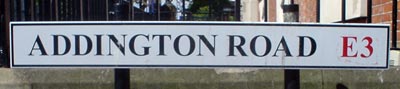
The 2005 sign is very white, very basic and rather nondescript. There's just a road name and a postcode, in two dead ordinary colours, with no additional embellishment whatsoever. Something this ordinary can only have been designed to comply with some all-encompassing legislation on accessibility for partially sighted citizens, allowing the Tower Hamlets Pointless Streetsign Erection Committee to fill in their Fully Diversity Compliant tickbox. But what the council forgot to do was take down the old sign on the same wall. There were suddenly two completely different street signs signs here... and exactly the same on the the opposite side of the road... and exactly the same at several other road junctions around the Bow area. Everywhere one new-style sign on posts, and one old-style sign on the wall. There's true diversity for you. Until very recently, when this new sign appeared as well...
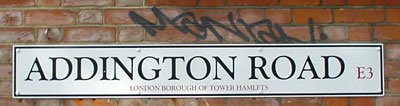
This is an example of the Tower Hamlets Pointless Streetsign Erection Committee's 2006 design. Again it has black writing on a white background with a red postcode, although the black font is lighter and fussier, and the red font is smaller and less distinct. This is so that an extra, crucial piece of information can be squeezed onto each new sign. It's now essential that we be told that this road is in the borough of Tower Hamlets... and not just any old borough of Tower Hamlets but the London Borough of Tower Hamlets. How very useful. And did the council remove both of the old signs before they put this new one up? Did they hell, they only removed the old one with a bit of character and left the bland year-old sign standing. So now we have two virtually-identical street signs on the same wall... and exactly the same on the opposite side of the road... and exactly the same at several other road junctions around the Bow area. Everywhere one new-style sign on posts, and one near-duplicate even-newer sign on the wall. Unless the old street sign was too high up on the wall, that is, in which case the council have left it in place because nobody could be arsed to remove it. In some places, for example at the end of Tomlins Grove, there are now as many as four different street signs visible on the same wall. This isn't coherent heritage retention, it's a total mess.
My local street is now wholly over-signed, and for no particularly obvious reason. I hate to think how much this pointless double replacement exercise has cost me and my neighbours, the local taxpayers. Perhaps if any members of the Tower Hamlets Pointless Streetsign Erection Committee are reading this, they could leave me a reply.
In the last few days, photo-sharing service Flickr has launched a new mapping service for displaying geotagged photographs. And it's really simple to use - much simpler than geotagging used to be. Just drag and drop your photos onto a map and, hey presto, a map covered in photos. Perfect timing too. I thought I'd have a go at mapping my Metroland photographs, and here's the result. Clever, isn't it? Not only can you now see where each photograph was taken, but you also get a really good idea of the shape and extent of Metro-land (which you may not have had before). See, I told you it was a long way from Amersham out to Quainton Road - now you believe me. Except I'm not impressed, and here's why.
Metro-land map: There are lots of good online mapping services out there. Google, for example, have really detailed maps of the UK, right down to satellite shots where I can pick out the individual tourists in Trafalgar Square. Unfortunately Flickr aren't associated with Google, they're associated with Yahoo, and Yahoo maps of the UK are rubbish. I don't know what data they used, but the amount of detail included on these maps is absolutely pitiful. Would you have guessed that Trafalgar Square was here, for example? In Central London the cartographers appear to have invented streets and railways that bear little resemblance to reality, and then randomly joined them all together. I've never seen a road which cuts diagonally across Hyde Park, for example, but Yahoo Maps assures me that it exists. I think not. And you can't zoom in very far on these maps to take a closer look either, so most of the locations on my Metro-land map are merely best estimates. It's like trying to pinpoint a precise location at arm's length whilst wearing steamed-up spectacles. Which is rubbish. See?
Go West map: Last year I went for a twelve mile walk due west from my house and took several photographs along the way. And then I stuck them on a map. To do this I had to "geotag" each one with its exact latitude and longitude, which was remarkably time-consuming. But still worthwhile, because the walk only came alive once you could see it on a map. And hurrah, Flickr have automatically updated my geotags so that you can now follow my Go West walk in the new format. It's really easy to skim through the photographs at each location too, which was never possible before. But there's still a catch, which is that if you want to go and see what I saw, you still can't tell precisely where each photograph was taken. Because a map of a big featureless area called 'London' with no other place names and a few unlabelled semi-imaginary roads isn't very useful, is it? See?
San Francisco map: But there are two countries where Yahoo maps are very good. Not surprisingly one of them is the USA, and the other is neighbouring Canada. So I've been back to my photographs of San Francisco and have dropped each of them onto a map of the city, just to test out the much better Flickr service that Americans get to enjoy. The SF maps are so accurate that I was even able to locate the city's gold fire extinguisher on the correct corner of the correct intersection. Or at least I think I did. San Francisco's not my local town, so I might have got my geography mixed up. That's the other problem with "dropping things on maps" - the general public don't necessarily know (or care) quite how accurate they are. And if they drop photographs from too far up, they'll probably miss. You can find "close-up" photos of the Golden Gate Bridge, for example, bang in the middle of the city, or halfway along the wrong bridge, or even several miles away beside the airport. Even when the maps are great, people aren't. And Flickr/Yahoo maps outside the US really aren't great. Maybe one day.

As part of the Open Site programme, members of the public were yesterday permitted rare access behind the scenes at the capital's largest white elephant. This was a unique opportunity to glimpse beneath the Teflon-coated roof before the site reopens next year as an entertainment arena, and was therefore a must-visit for devotees of failed government projects. It was strange to see queues again outside the Dome... almost as strange as it would have been to see them when the place was open.
Severndroog Castle [photos]: Hidden amidst the trees on Shooters Hill is a three-cornered brick tower, erected in 1784 in honour of a reformed pirate. William James lived a daring and successful life on the high seas off India, returning home a successful and wealthy man, only to drop dead on the evening of his daughter's wedding. His wife Lady James was understandably distraught, and had this quirky belvedere built to honour his greatest naval success. The volunteers at Severndroog can tell you this story in much greater detail, probably whilst wielding a jangly bucket. By the time you've been round the tower to see what all the fuss is about, you'll probably want to throw a few coins in it yourself.
Donnybrook Quarter: One of the newest housing developments in Bow has brought an unexpected splash of Mediterranean white to the streets of the East End. This isn't your usual social housing - it's a high density mini-estate where every residence is afforded its own front door onto the street. The idea is to foster a sense of community - isn't it always - but here in these two streets it might just work. By removing hallways, lobbies and stairwells the amount of indoor living space is maximised, and there's even room for each building to have its own small outdoor courtyard. Yesterday afternoon the development gleamed in bright sunlight, as residents scuttled in and out wondering what all the fuss was about. The architect was on hand to enthuse about his award-winning project, but always with a sense of reality. Every cutting edge architectural project is a real-time experiment, and it'll take longer than six months for the new occupants to decide how this new living space will evolve. [photo] [photo] [photo]
Balfron Tower: West London's Trellick Tower has a less famous older brother on the other side of the capital, just north of the Blackwall Tunnel. Both have a similar silhouette, both were designed by Erno Goldfinger, and both are admired from the outside by people who'd never dream of living on the inside. The architect himself was an exception. Goldfinger and his wife moved into the Balfron Tower soon after it was built, and spent a couple of months living in flat 130 on the top floor to find out what living here was like. This weekend, as part of Open House, Londoners have the chance to take a look inside a flat just along the corridor.
Residents of the Balfron Tower were eyeing up the growing queue outside their front door yesterday morning with a certain degree of bafflement. What were these middle-class arty types doing here on a council estate in Poplar, and why were they willing to wait for hours to get inside. But this building is something special, a brutalist architectural masterwork with a highly original construction. I was lucky enough to be in the first small group of the day to gain entrance. The lifts to the top floor were malfunctioning so we could only ride up as far as the 18th floor before having to climb the remaining six storeys via the staircase. All the stairs and liftshafts are housed in a separate tower, joined to the main apartment block by a series of concrete bridges. We crossed the toppermost connecting walkway, our precarious mid-air state mostly shielded from view, and proceeded along to our target flat.
Bromley Hall: One of the joys of Open House weekend is discovering unexpected architectural treats on your doorstep. Bromley Hall looks like a very ordinary building beside the Blackwall Tunnel Approach Road, and I must have been past it scores of times without giving it a second look, but at its heart is the oldest brick house in London. In 1485 this was a hunting lodge with royal connections, located at the tidal limit of the River Lea. Later it became home to a series of successful merchants, each of whom made their mark on the structure and design of the building. The architect responsible for the hall's restoration, Paul Latham, was only too pleased to be able to show eager members of the public around inside his pet project. He knows every inch of the property inside out, from the old woodstained floorboards to the scrap of painted 17th century dado rail in the hallway. Particularly impressive are the patchy remains of a Tudor wall painting of a soldier wielding a crossbow, and a preserved wooden doorway carved with hunting scenes. With so many historical periods represented side-by-side, you get a real sense of domestic architectural evolution. I'm particularly astonished that Bromley Hall survived the 20th century, during which time it was damaged by wartime bombs, a passing motorway and bolted-on advertising hoardings, as well as (most recently) its use as a garage store and a carpet warehouse. All praise then to Leaside Regeneration for the sensitive way they've converted the building back to office space... although it would be tough to choose between working here or inside the pile of red containers stacked up nextdoor.
Royal Courts of Justice: If you're particularly naughty you might one day end up here, inside the big gothic building at the top of Fleet Street. The RCJ is the top civil court in the land (with the exception of the House of Lords) and also the criminal Court of Appeal. And until yesterday I'd never quite appreciated from the outside how vast it is inside - a labyrinth of corridors, chambers and court rooms arranged around a long high vaulted hall. The building's open to the public every weekday, but yesterday there were special tours allowing us to tour behind the scenes. It was fascinating to prowl the back corridors and to hear more about the courts and their 8000 staff from some of those who work here. There was even the opportunity to go down into the cells of the Court of Appeal and follow in the footsteps of the country's more famous miscreants. I can now claim to have stood in the VIP holding cell, sat in the back of a 12-seater prison van, and even been taken up to the accused's bench in a dark and dusty courtroom via the back stairs. And next time the Lord Chief Justice gets a mention in the news I'll be able to picture his airy book-lined court room without having to rely on one of those awful artist's impressions.
Airport quiz: What is this modern obsession with naming airports after people rather than places? Nobody wants to fly to a dead person's airport, they want to fly to a readily identifiable city or region. But no, civic officials insist on naming airports after local statesmen and celebrities, even if nobody else then has a clue where these airports are. Maybe it's a way to confuse passengers, reduce air traffic and thereby cut carbon emissions. Or maybe it's just self-obsessed madness. Anyway, can you identify which major towns and cities are served by the following re-designated airports? There's a choice of three each time.
Local news for local people: Bow Road (that's the road, not the station) is due to be semi-closed for resurfacing work starting at 8am this morning. And every weekend from now until the end of October. And overnight every night (7pm-5am) until the first Friday in November. Ouch. The affected section is between Mile End and Bow Church stations, with eastbound traffic particularly badly affected. The promised contra-flow and local diversions should snarl up road traffic (and especially bendy buses) for miles around. I'm predicting chaos.
Silver discs (September 1981)
Soft Cell - Tainted Love: One of the most enduring singles of the 80s was born two decades earlier, first recorded by Gloria Jones, and kept alive on the Northern Soul circuit. It took two obscure Leeds Poly art students to spot the song's appeal, and a seemingly straight-forward recording session produced magical results. From the opening double-bleep and synth laserfire, the beat defies you to keep still. A debut Top of the Pops performance brought Soft Cell to immediate prominence ("Oh my god, who is that bloke singing?") and by the time the public realised that Marc Almond was no saint it was too late, they already loved him. Even America lapped up the dark duo, just this once, and the song rode the Billboard chart for a record-breaking 43 weeks. Rarely has perfection been so tainted. [1981 ToTP] [1981 video] [1991 video]
4 of diamonds

 As part of the Open Site programme, members of the public were yesterday permitted rare access behind the scenes at the capital's largest white elephant. This was a unique opportunity to glimpse beneath the Teflon-coated roof before the site reopens next year as an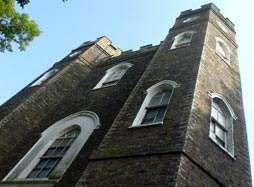


 Residents of the