COUNTRY WALKS (Book One, 1971 edition) Walk 10:Heath and Hill Tattenham Corner to Walton-on-the-Hill (11 miles)
For my second walk from a 1970s copy of London Transport's Country Walks (30p from all good Underground stations), I've jumped ahead through the book to walk number 10. This time I'm in Surrey, exploring the countryside to the south of Epsom and east of Box Hill. It's not somewhere I'd considered walking before, indeed I'd never even heard of Mogador, but the rural experience turned out to be really rather pleasant. Better still the trip proved fully accessible by Oyster, and therefore cheap, what with the whole of the Tattenham Corner line being in Zone 6. But in 1971 that was British Rail's domain, so instead LT's book directed ramblers to travel by Northern line to Morden and thence by 164A bus, a service long since extinct. I was pleased to discover that the remainder of the instructions remained almost word perfect, which is quite some achievement after 43 years. If you'd like to follow along, I've traced out the route for you on this map.[12 new-camera photos]
Tattenham Corner is the closest station to Epsom racecourse, so close that if you step across to the grassy slope alongside there's a really good view of the whole thing. It is a really good view, from the final bend on the track across the Downs to the futuristic grandstand plonked brazenly beside the finishing line. And on Sunday it was a particularly strange view, this being the day after the Derby was run, and the detritus of thousands of racegoers still scattered around the course. A huge flock of seagulls had descended, and were wheeling around the sky attempting to make off with anything the human litter pickers hadn't yet removed. Piles of bottles, black plastic bags and discarded Racing Posts remained, even the occasional fold-up chair, so there were easy pickings. And my walk headed straight across the racecourse, through the middle of the lot.
Yes, a public footpath crosses Epsom racecouse, that is so long as racing's not taking place. It sets off from the refreshment kiosk, and very soon you find yourself passing through a gap in the rails and onto the hallowed turf. It was a surreal experience to stand here less than 24 hours after the Derby had trampled through, and 101 years since Emily Davison lost her life just round the corner. I had to dodge the lorries come to collect the remaining portaloos, and step around the occasional Totepool prefab hut, as still the gulls swooped down for easy pickings. Climbing to the far side of the horseshoe the grandstand grew gradually smaller, and the panorama from Woking round to Wembley more distinct. And on the far side, this time generally unobserved, I got a second opportunity to stand in the path of one of the greatest races on the planet. All in all, a great start.
This is horsey country, so what lay ahead was a landscape I can best describe as paddocks and gallops. A sign on the next hillside warned walkers to keep an eye out for oncoming hooves, and right on cue a rider on a white charger came thundering through. The next mile was a treat, gently ascending an enclosed footpath between fields, the hedgerow bursting with verdant life. I met a pair of cyclists treating this narrow track as a minor assault course, and loving it, but other than that it was just me all the way. On Hurst Road I bumped into what seemed like the entire Mid Surrey branch of the Pony Club, hosting a trials event in fields either side of the footpath. A commentator cheered on Harriet and Araminta in the showjumping, numerous proud Dads strode by, and the Red Cross sat around in case any rider had a nasty fall in the cross country.
My book described the next section of the walk as "uninterrupted track", except that sometime after 1971 civil engineers came along and laid the M25. On my last Country Walk this proved problematic, but here they'd threaded the bridleway through a concrete tunnel under the motorway and the only significant intrusion was aural. My book also alerted me to St Mary's Church, its oak spire currently awaiting refurbishment after coming under attack from woodpeckers, which is the sort of thing a Heritage lottery grant helps with these days. And the text then advised me to turn left at the 'Cock', although this 17th century tavern has recently been transformed into the Headley Hills bar and restaurant, because austerity hasn't damaged the stockbroker belt and one needs a damned good dining establishment more than a boozer.
The Surrey Hills have some of the most challenging gradients close to London, and so my walk soon stumbled upon the highest part of 2012 road race circuit. Olympic cyclists sped through Headley village several times on the Box Hill loop, rising up via the legendary Zig Zag Road, then wheeling back via the incline of Lodgebottom Road. I took a slight detour down Tot Hill to watch the weekend contingent of Sky-clad lycranauts pedalling through, testing their stamina and sweating somewhat. And here I was very nearly witness to a potentially nasty accident. A knackered cyclist pulled out, without looking, across the stop line in front of a van descending Leech Lane. The van driver (and the cyclist's partner) looked on aghast as she blundered on, oblivious to imminent danger. But thankfully the vehicle swerved and braked in time, its driver more shocked than angry, and only the woman's pride was damaged.
My Country Walk offered a two mile shortcut at this point, but stuff that I thought, I'm walking all the way round Headley Heath. Good choice. These 500 acres of downland were saved for the nation by the National Trust in 1956, and are a wonderfully diverse (and hilly) habitat for umpteen animals. Squirrels in particular, and butterflies, and the occasional toasted sunbather. I took the wrong path at one point, making a steep climb immediately after a steep descent, although the view across the chalk dip was glorious and no doubt better than the route I was meant to follow. I was less impressed by the muddy path along the southern edge of the Heath, but north and west were lovely... so if you're ever up Box Hill and feeling energetic, do definitely consider the NT's Box Hill Hike.
Next stop, the scarp of the North Downs. A minor footpath led to a lane which tipped down over the edge and into woodland, where I disturbed a roe deer. There followed a wildlife bonanza, including a fox, a particularly pretty orchid and a slowworm, wriggling ineffectively in the middle of the path. I'd taken the wrong route again by this point, failing to convince myself that steep steps up the escarpment were those described in my book, which meant a significant detour, and a particularly tiring sheer ascent later. But I didn't mind because the lower path traced through a magical natural environment, rightly now part of the North Downs Way, should you ever be passing.
The lane ahead suddenly crossed a different London pseudo-boundary, the M25, this time via a bridge with two entirely unnecessary pavements. Straight ahead was the hamlet of Mogador, which sounds like it ought to be part of Middle Earth, but is instead one of the highest settlements in southeast England. My book told me not to go to the pub, so I ignored it and went to the Sportsman for an extremely welcome pint. I was not alone, although it looked like everyone else had driven in and brought their dogs. Their canine presence was entirely appropriate as the pub building was once one of Henry VIII's hunting lodges, although I can't say I enjoyed the close presence of two Weimaraners as I drank, nor the empty prattle of their owners.
And finally, a hike up the side of the Walton Heath Golf Course. Keeping to the edge of the fairway made navigation easy, as did the over-supply of coal tax posts every few hundred metres or so. It struck me that I'd spent most of my day watching Surrey at play, first on horseback, then riding bikes and now with clubs. I was pleased to reach the end of the walk beside the big village pond in Walton-on-the-Hill, where a heron perched motionless watching for prey. Here I was told to catch the 80A bus back to Morden, but that no longer runs either, so an extra half mile on to Tadworth station sufficed. And if you're still reading about this walk you will never do, thankyou, as I thank whoever compiled the London Transport book of Country Walks back when I was six.
The decisions are about two things - connectivity and saving money.
Connectivity is important because Crossrail 2 is planned to ease congestion.
And saving money is important because we only dream within budget nowadays.
One of the possible tweaks to the originally-proposed route is in Chelsea.
The line might not stop on the King's Road at the site safeguarded for decades.
It might instead stop further west, more in line with Battersea Bridge than Albert Bridge. Chelsea West would be nearer the centre of the rail desert Crossrail 2 was meant to ease.
It would also be nearer to "new developments", a phrase which always makes me nervous.
Or Crossrail 2 might not stop in Chelsea at all.
Who cares that locals have some of the worst access to rail transport in Zone 1?
Who cares that there are already non-stop trains from Clapham Junction to Victoria?
Bypassing Chelsea would speed up journeys for commuters from Tooting, Wimbledon and beyond.
It would also save in the order of £1bn by ironing out a big kink in the route.
But the most complicated new "what if" is to the northeast of town.
Previously it was suggested that the new line would split just beyond Angel.
Previously it was suggested that one branch would go to Dalston and the other to Hackney.
But the new suggestion is that maybe instead the new line should split later.
And then only one of Dalston Junction or Hackney Central would be connected, not both.
This map may or may not make things clear.
I fear not.
So the original plan was
→ Angel → Dalston Junction → Seven Sisters →
→ Angel → Hackney Central → Tottenham Hale →
This would have connected up to all sorts of tube and railway lines in all sorts of directions.
But we might instead get
→ Angel → Dalston Junction → Seven Sisters →
→ Angel → Dalston Junction → Tottenham Hale →
This would mean no direct link from Hackney to the West End.
It would also mean no connection between Crossrail 2 and the east/west Overground.
Or we might get
→ Angel → Hackney Central → Seven Sisters →
→ Angel → Hackney Central → Tottenham Hale →
This would mean no direct link from Dalston to the West End.
It would also mean no connection between Crossrail 2 and the north/south Overground.
Both of these would save another £1bn compared to the original plans.
It's either a better use of available resources, or a failure to think big enough.
Meanwhile, deep in the consultation smallprint are two more sub-options (subject to feasibility).
The first of these adds an extra station to the Dalston-only option
→ Angel → Dalston Junction → Stoke Newington → Seven Sisters →
→ Angel → Dalston Junction → Stoke Newington → Tottenham Hale →
That'd transform connectivity and house prices in north Hackney.
And the second adds an extra station to the Hackney-only option
→ Angel → Hackney Central → Clapton → Seven Sisters →
→ Angel → Hackney Central → Clapton → Tottenham Hale →
That'd transform northeast Hackney, and be a useful connection to the Chingford line.
One of the five options above will get chosen, according to logistics and available budget.
Some parts of Hackney will hit the jackpot, and others will lose out to their neighbours.
Which makes this consultation really quite important in the grand scheme of things.
Or else Crossrail 2 will sit on the drawing board, as it has done for decades, until after you're dead.
Let's hope not, eh?
If you've ever used the Overground station at Shoreditch High Street, you may have wondered why it's a concrete box in the sky. The stations at Hoxton and Haggerston have a view of the skyline, whereas Shoreditch High Street seals you in allowing sight of precisely nothing, the same as if you were underground. And there is a reason, which is that TfL were planning ahead when they built it, and the whole thing will one day be encased within office development.
The development site is enormous, for central London, and covers the site of the Bishopsgate Goods Yard. Originally this was Bishopsgate station, the terminus for trains arriving into London from East Anglia. Its days were numbered when Liverpool Street station opened in 1874, at which point Bishopsgate closed to passenger traffic and was given over to freight. This was a three-level monster, with as many as ten tracks on the upper deck used for the unloading of wagons full of fish, fruit and vegetables. It served London well until 1964 when it was substantially consumed by fire, and then lay derelict until 2003 when it was substantially demolished.
Two sections remain, both of them Grade II listed. The first is the frontage to the goods yard's general offices, which is the brick façade you can see facing onto Shoreditch High Street. And the second is the Braithwaite Viaduct, begun in 1839, originally two tracks wide and supporting a succession of arches on Gothic cross-vaulted piers. 260 metres of the viaduct survives, that's the section from Shoreditch High Street to Brick Lane, making this one of the oldest surviving bits of railway structure anywhere in the world. A major legalbattle kicked off when the Overground extension was proposed, because it looked like the new Shoreditch station would require the viaduct's demolition. But a solution was found where the line swung round to the north, leaving the Victorian structure intact, and the new Shoreditch High Street station running parallel alongside.
And now the developers are moving in. This was always the plan, indeed it's amazing it's taken this long. But a lengthy public consultation for The Goodsyard is now underway, with the masterplan almost complete, and then the area will then start changing utterly. The site's unusual in that it spans two London boroughs, that's Hackney to the west (with the station) and Tower Hamlets to the east. They've been working with developers Hammerson and Ballymore to agree plans for a multi-modal office/retail/residential development, and those plans have been evolving over a couple of iterations as stakeholders explore and interact.
The latest round of consultations is currently underway, with a small marquee set up opposite the entrance to Shoreditch High Street station. It was open on Friday and Saturday, although went almost entirely ignored by the bright young things emerging to shop at Boxpark, and the streetsmart heading to play football with the Powerleague. And then it's open again tomorrow from 2pm to 8pm, if you're interested and want to tell the consultants what you think. You needn't bother, but then don't complain later when some whopping great skyscraper forest emerges and you hate it.
What number comes next?
9, 15, 17, 24, 29, 33, 42, ?
It's 46, obviously. These are the number of storeys in the Goodsyard's planned sequence of residential buildings running east to west. At the Brick Lane end the first block will be 9 storeys high, increasing gradually to a 33 storey giant on Braithwaite Street. The station itself will be swallowed up by two office blocks a mere dozen floors tall. But the next residential building alongside will have 42 storeys, and the final block overlooking Shoreditch High Street will have 46. It'll be the same height as the Broadgate Tower, a little way to the southwest, because what's happening here is the creation of a Shoreditch skyscraper cluster, and the Goodsyard development will be substantially to blame.
The masterplan has had to squeeze in buildings where it can because two-thirds of the site is unsuitable for deep foundations. The 1839 viaduct and the 2008 viaduct are mostly to blame, but the third cuplrit is the Central line which scores a direct hit on Shoreditch High Street station without stopping. Approximately 1400 new homes will be built, an as-yet undetermined number of them to be 'affordable', although I doubt Tower Hamlets will be moving too many families off its waiting list as a result. And then there'll be half a million square feet of office space, as Hackney council rakes in some much needed business rates, and 180,000 square feet of retail space, which'll more than make up for the termination of Boxpark.
But what the developers hope you'll be most excited about are their plans for the Braithwaite Viaduct. They plan to stick a park on top, a full 2.5 acres in size because there's a lot of space up there, complete with trees and grass and a variety of vegetation. It won't be London's answer to New York's High Line, I was told, it's too wide for that, and also too short. But it will be open to the public, not locked away for residents only, and there should be some excellent views up there looking south across the Liverpool Street cutting.
Meanwhile down below, the unique Gothic arches are to be given a different kind of makeover. The future is to be retail, with a variety of boutiques and chains moved in, and a new thoroughfare opened up along the southern edge of the site to link up with Brick Lane. The old basement store rooms are ideally configured for such use, although it will be a bit sad if the only way to admire the Victorian brickwork is to buy a coffee, have a meal or go browsing for designer clothes.
A park on some shops, a lot of offices and some very tall flats - that's the proposed future for the Bishopsgate Goodsyard. Or it is unless the latest round of consultation suggests otherwise, and the developers choose to act. It does sometimes work. Two-thirds of those consulted last time either disliked or really disliked the proposed heights of the buildings, and so the tallest blocks have had eight or twelve storeys lopped off the top in the latest version. They'll still be massive, but not as wilfully oversized as they would have been had not the public spoken up. You can speak up tomorrow. Or you can just wait and go shopping and maybe laze in the park in ten years time.
One week after closing down, a new Foyles bookstore has opened on Charing Cross Road. The doors were opened just after noon on Saturday, at which point the queues to get in stretched past the doors of the old shop and partway round the block. Staff took a rest from the mammoth job of transferring books from one to the other, and turned instead to welcoming customers, giving out goodie bags (to the first 100 lucky visitors) and dishing out maps.
The new flagship store is the largest bookshop to be opened in the UK this century, a business model which flies in the face of all those who predicted the e-reader would kill off sales of the humble paperback. It's built inside the former St Martins School of Arts building, who vacated the area for Kings Cross a couple of summers ago, leaving room for Foyles to leapfrog down the road and take over.
The interior stretches across eight floors, with the cafe and an auditorium on the top two, and a comprehensive selection of books on the six below. Everything's arranged around an airy central atrium, with stairs wrapping around the edge to give access, and some very fast lifts to one side. It's probably best to imagine the structure as eight half-floors, interleaving to front and rear, and rammed full of books.
I wondered what they'd put at the front, and they went for Art, including stacks of trendy design books and a table of concrete, brutalism and architecture. The space at the foot of the atrium is currently given over to two tables of gift-wrapped books, one with ribbons, the other in crisp white paper imprinted with each book's opening line. A few well-presented trimmings, artfully packaged, and even the classics wend their way to the tills pronto.
Head downstairs for the children's department, and all those cookery and travel books you'll be getting for Christmas. Travel's over at the back, with a fully comprehensive selection, and was the source of my first "Would you like a bag with that?" in the new building. I got the sales staff to myself, which was nice, but half a minute later as I climbed the stairs I noticed they'd been besieged.
The adult fiction section, which filled the front of the ground floor in the previous store, is to be found on the first floor of the new (i.e. straight ahead, and up a bit). This department's essentially a ring-shaped balcony, with authors alphabetically on one side, then back round to the stairs via crime and science fiction. I was not alone in failing to resist the colourful display, and soon ended up back at the cashdesk with another purchase.
Up again to music, which remains one of Foyles' great strengths, be that books or CDs or drawers of sheet music. Somebody's positioned the score for John Cage's 4'33" in a prominent position by the till, presumably for a giggle, but I suspect it'll sell well. Meanwhile rest assured that specialist retailer Ray's Jazz survives into the new store, its assistant already besieged by trad and bebop devotees.
Next up, history and the sciences (with all the transport books at the back, if that's what floats your boat). The shelves here on Level 3 are densely packed and more of a warren, in case you worried New Foyles had lost all its character. There's more of an academic buzz amongst the clientèle, with each sub-department attracting its own enthusiasts, so a good place for browsers to bump into a like-minded soul.
The final floor of books is for languages and education, so the ideal place to find a Dutch reading book or Harry Potter in Latin. And then there will be a cafe on the floor above, complete with charming typewriter-key logo, but that's not opening until next week, so a team of workmen are currently busy sawing, cabling and installing to meet the deadline.
The new Foyles is indeed a fine place to browse, a very modern store but also with enough nooks and crannies to explore to make your visit a bit of an adventure. It's a very bold move for the business to have taken, as the industry continues to contract elsewhere, but the Day One experience suggests that an appreciative audience of bookbuyers will continue to visit, enjoy and return.
It's a compact camera with a 20x zoom, made by a company named after a member of the clergy. It may be last year's model, but that means there was £70 off, so that's my kind of deal. I went to a resurrected camera shop in Oxford Street to buy it because a well-known catalogue shop had none in stock. The saleslady was very keen, and whipped out all the photos she took at tennis events last summer to try to convince me. She seemed even happier when I walked out with my new toy.
When I took it out of the box and looked for the instructions, they were a bit brief. They didn't even explain how to thread the camera strap properly, let alone how all the buttons and dials work. I think there's a manual setting and an automatic setting, but I'm not sure because the designers have used lots of buttons and dials with graphics and abbreviations. Several functions that might be really useful seem to be hidden away on menus, but I haven't gone hunting online for the manual yet because I'm assuming I can work out the basics. I may be deluding myself.
I stuck my new camera on charge overnight, because I think that's what the manual would have wanted me to do. And then the next day my Dad came down from Norfolk for a first wander round the post-Olympic Park. I went to take my new camera on its first jaunt, only to discover that it hadn't charged up overnight after all and the battery symbol was still flashing. All I could do was leave my electronic brick at home and go snapping with my cameraphone instead (and it was all a bit overcast out anyway).
I finally took my camera out at the end of the day when I walked my Dad back to the station. I was quite impressed by the zoom, which whizzed in far more convincingly than my phonecam does, and by the sharp legible image on the big screen. I tried a composition with Cycle Hire bikes, and a close-up of Mr Gladstone, and a bit of golden hour sunlight. But when a fox suddenly trotted across the tracks at Bow Church my camera couldn't quite keep up, so that shot I completely missed, which may not bode well.
I took my camera out properly at the weekend, this time on a day trip to Essex. I gave it a quick burst in Stratford, to check the depth of field, but saved the majority of clicking for wandering around my destination. The main attraction turned out to be "photographs not allowed", which is typical really, but the grounds were rather pretty and free from similar restrictions. I'll tell you about my visit at some point, but there is a reason why you haven't heard yet.
When I got home and went to download the photos off my new camera, I suddenly wondered where the connecting lead was. I didn't remember seeing one in the box, and a double-check convinced me there hadn't been one, so I tried to be resourceful. I went back to my previous not-very-good camera and unplugged the cable from that, except it didn't fit because the plug was the wrong shape. Then I went back to my last-but-one not-very-good camera and unplugged the cable from that, except that didn't fit either because the plug was a different wrong shape. And then I was stuck.
I went back and read the specification for the camera again, and discovered that it shipped without a cable to download photos. It seems the camera company expects you to already have one, or to be able to fit the memory card straight into your computer, which I can assure them isn't going to happen. So I had to wait and find a shop that sold the right cable, which took a few days and cost me £10, which has unexpectedly upped the price of my camera.
So that's why it's taken a week from buying my camera to being able to properly look at the results. I think I'm pleased with the end results, which are certainly better than any camera I've previously owned, even if they're not as pin sharp as they could be. I'll show you some more of my handiwork later, if you're interested, now I've finally got round to looking at it myself. And if the assistant in the shop had been a little less keen and a bit more alert, perhaps we could have reached this stage sometime back.
Morden, at the southern tip of the Northern line, definitely isn't one of London's least used stations. Seven million passengers pass through annually, which is above average as busy-ness on the tube goes. But just down the main road, barely half a mile distant, is a station that manages only about 1% of that total. It's Morden South, on the Sutton Loop, and only five railway stations in the capital are used less.
The Sutton Loop is part of south London's swirl of rail lines, the tangled knot that makes the tube map look like child's play. It runs from Streatham round to Streatham, via Wimbledon and (not surprisingly) Sutton. It's where Thameslink trains from Bedford and St Albans have traditionally headed, if they weren't going to Brighton, not that this seems to help passenger numbers much. First Capital Connect admitted last year that "more than 16,000 journeys are made on the loop each weekday", which isn't an especially big total when there are ten stations along the way. The quieter half of the loop is the section from Wimbledon to Sutton, also known as the St Helier line, served only by trains going round and back again. And Morden South is the second station down.
It's a fairly standard suburban station, architecturally, if minimally outfitted. A large metal canopy covers one end of the island platform, while the rest is open to the sky. Underneath the canopy are a handful of vandalproof seats, probably more than enough to cope with the daily rush, half of which are semi-sheltered in case the rain comes in horizontally. A couple of plastic bags dangle from the pillars, collecting precisely as little litter as you might expect from a station like this. There's a help point button in case you get lonely, and a couple of enamelled colour maps which show that trains from both platforms go to Blackfriars. The only thing that changes is the next train indicator, so you can always watch that for up to 29 minutes if you've timed your arrival wrong.
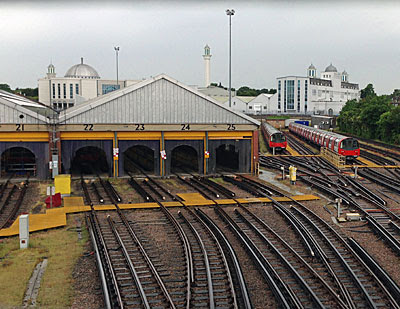
But step beyond the overhang and you might see things a bit differently. The platforms are unusually far apart, and the gap between has been grassed over to create a broad swathe of lawn. This stretches some way into the distance, I make it seven lampposts worth, and is currently replete with daisies should you fancy a picnic. That's not recommended, by the way. And look across the hedge to see the largest mosque in Western Europe, that's BaitulFutuh, its highest minaret rearing up 36m into the sky. Technically it's the largest mosque complex in Western Europe, and was constructed a decade ago out of an Expressdairy, but it's an impressive structure nonetheless. All those worshippers nextdoor, and yet so few ever seem to arrive via Morden South.
The station has no actual buildings, just a set of steps that descends between the tracks to exit at ground level. Someone's written MORDEN SOUTH halfway down the stairs in a font that doesn't look quite right, part of a station "renovation" sometime back which involved slapping a vinyl covering over whatever brickwork and plaster previously showed. A "Meeting Point" has been provided, not that I imagine it gets used much, while a helpful sign reveals that "all trains from Morden South towards London in the morning peak have seats available." No member of FCC staff wastes their time here, they've long been replaced by a ticket machine and a CCTV camera. It's all terribly underwhelming, to be honest, but then maybe it's meant to be.
The main road outside Morden South is the A24, and there are houses just to the left giving the illusion that this is a busy spot. But there aren't many houses in the neighbourhood, and you only have to go a short distance before St Helier station (one down the line) is nearer. Across the road is a large greenspace which looks like it might be popular, but no, Morden Sports Ground is fenced off and inaccessible via any direct route. And immediately beyond the mosque, blocking access from the east, a considerable amount of land is taken up by the one thing that sucked all the life out of this poor station - the Morden Northern line depot.
You can walk across it if you like. An alleyway leads off from London Road, which pretty soon becomes an elevated blue metal footbridge. Many who use this long tunnel are walking home with shopping from Lidl, but if you choose to stop it's easy to peer through the grille at a phenomenal number of tracks, and the sheds where several tube trains spend the night. Officially known as Alstom Transport Morden Metro, this is one of two major depots on the Northern line, with space to stable 25 trains undercover and at least a dozen more on parallel exterior tracks. During the day it's fairly quiet, but first thing in the morning imagine a dripfeed of trains heading out into the cutting below London Road to emerge alongside the platforms at Morden station.
It wasn't supposed to be this way. When the southern end of the Northern line was being built in the 1920s, the intention was to continue beyond Morden to join a new railway being built between Wimbledon and Sutton. The link would have been at Morden South, which would have become a proper tube station and thereby much more popular than it is today. But those extension plans were thwarted in Parliament by the Southern Railway, who managed to keep the whole of the Wimbledon and Sutton Railway line for themselves... not that it did them much good in attracting passengers. The tube extension was duly forced to terminate at Morden, as it does today, with the proposed link used instead to create the Northern line depot. And that leaves poor old Morden South abandoned forever on the wrong side of the divide, a tube station that never was, serving less than 250 passengers a day. [8 photos]
Passenger numbers onthe St Helier line No 38: Wimbledon Chase (389,586) No 12: South Merton (157,632) No 6: Morden South (87,638) No 16: St Helier (192,132) No 26: Sutton Common (323,266) No 24: West Sutton (301,178)
Here's the Underground's latest endangered species which, at time of writing, has less than seven hours left in service.
Officially it's called C Stock. You'll know it as the train that runs on the Circle line and the Hammersmith and City line, except it doesn't any more, and hasn't since February. Instead it survives solely on the Edgware Road to Wimbledon section of the District line, shuttling back and forth until its time is up, which would be about twenty to two this afternoon.
C Stock first entered service in 1970, which makes it the oldest rolling stock currently in service on the Underground. It was introduced with high capacity in mind, hence the provision of plenty of room inside the doorways to permit standing, and a very highratio of entrances to carriage length. Each train is only sixcarriages long (because some of the platforms round the western side of the Circle line are quite short), and each carriage seats 32 people (making 192 seats altogether). A second burst of C Stock arrived in 1977, and the entire fleet was then upgraded in the 1990s to help it linger longer into the future, a future which ends today.
These imminently-obsolete workhorses have gradually been replaced by S Stock trains over the last eighteen months, with approximately one C Stock per week removed and taken by road to Eastleigh to be destroyed. Today only four complete trains survive, three of which had a final outing in general service yesterday. The plan is for just one to take to the rails today, shuttling between Wimbledon and Edgware Road until lunchtime, with the 13.08 from Wimbledon the very final public service. So I thought yesterday would be the best time to make a farewell trip of my own, there being the best chance of a 70s survivor rolling into the platform without too long a wait.
First train in, yes. That familiar red front approached, its destination written in analogue yellow letters, much larger than the font of its successor. A splash of graffiti marked the paint above the driver's window, and there was still a Remembrance poppy stencilled on the nearside, because why clean up a train you intend to scrap? I waited for several passengers to get off and then stepped aboard, pleased to have the choice of somewhere to sit. And then this happened.
Ah, the closing beep and then the satisfying gerklunk of the C Stock's chunky doors. Each of the doors closes at a fractionally different moment to create a brief mechanical fanfare at the moment of departure, which isn't something you get with the electronic precision of more modern trains. Even the rumble of the engines exudes a nostalgic whine, or maybe that's just because I was brought up on the old Metropolitan stock, itself long crushed.
I managed to plonk down in one of the prized end seats with an extra cushioned strip down one side - ideal if you're overweight, have a bag or want to spread out. I stared across the laminate floor at the moquette which looks like someone's splattered purple, green and yellow paint everywhere. I looked up at the door alongside, part of a quaint ancient concept that carriages should be separate from one another. And then I gazed through the end window into the empty drivers cab coupled up alongside, a capsule with levers and recessed buttons that still screams 20th rather than 21st century. There'll be nothing so basic in the replacement trains, so it's hard to know whether the drivers will welcome the increased functionality or miss the simplicity.
C Stock carriages have long been the Underground's very own cattle trucks, and before long my final journey was living down to expectations. Passengers poured in to fill all the available space, shuffling into minimal gaps and attempting to stand upright by hanging onto the yellow grabpoles. Each new S7 train will be able to carry approximately 300 more passengers than these old stalwarts, which'll help no end during busy periods on the Wimbledon branch, indeed already is helping except on these last few survivors. But the new S7s will also be too long for certain stations north of Earl's Court, so good luck squeezing towards the centre of the train to depart.
Many won't be sad to see the old trains go. Their age now really shows, and their design was never a highpoint, why is probably why we've not been inundated with C Stock commemorative souvenirs. But there has already been a special day-longC Stock tour for the aficionados, and one more is planned at the end of the month for the serious stock bashers. Tickets went on sale yesterday at £40 each, for which you get the privilege of shuttling from Moorgate to Hammersmith in a C Stock train, but travelling via Wimbledon and Barking to make an event of it. Two complete trains are being kept in the depot until this very final jaunt on Sunday 29th June, one as a reserve in case the other breaks down, and then even their carriages will be sent to the crusher.
I understand one C Stock car is being kept somewhere for heritage purposes. I also understand that the remaining District line trains, the larger and better-loved D Stock, won't start being scrapped and replaced until sometime next year. But if you want one last ride on a scheduled C Stocktrain you've got until 1.39pm today, after which its beep and gerklunk will be but a recorded memory.
Update: I hope you didn't head down to catch the advertised last train, because the final day's service was terminated four hoursearly. The last C Stock train departed Wimbledon at 09.05, and was then unceremoniously pulled from service at Edgware Road due to "mileage restrictions". It seems that locomotive units can only complete a certain of number of miles before being called in for service, and this particular C Stock unit was perilously close to its limit. It's still needed to run the big tour at the end of the month, and nobody wanted to waste money on an overhaul, so the last train bowedout (rather pathetically) 50 miles early. Thwarted by rules and regulations, it seems, and by a power failure on Sunday that left all the remaining C stock carriages in unplanned locations. Whatever, this gave TfL the opportunity to rush out their "yippee, we've dumped all the C Stock" press release four hours early, increasing the likelihood that the Evening Standard would run with it. They didn't run with it, and the 44-year old rolling stock duly departed with an embarrassed whimper.
30 things I've learnt about sex over the last 30 years
1) Nothing ever prepares you for the first time... 2) ... not even the fact that the biology textbook always falls open at the same page 3) The first time is always a ghastly mistake (I'm extrapolating this from a single occurrence, obviously) 4) The second time isn't much better 5) It does get better eventually, but intermittently 6) Some people need it regularly and crave quantity over quality (oddly enough they're the unlucky ones) 7) Some people don't need it regularly and prefer quality to quantity (oddly enough they're the fortunate ones) 8) People in the former category should wash their sheets more often 9) You should always know where your towel is (ideally within arm's reach) 10) The nagging urge that says you must do it because it'll be excellent is too often wrong 11) You always wish you were doing it more frequently than you actually are 12) Sometimes you can wait for months only for it to last for seconds 13) Remember, the other person's supposed to enjoy the experience at least as much as you are 14) People who you'd really like to do it with generally don't want to do it with you 15) People who'd really like to do it with you, you'd generally not touch with a bargepole 16) You only spot people you'd really like to do it with when it's impossible to make contact with them (eg at a funeral, on the opposite escalator, from the top of a bus, on the way into work) 17) Just because someone's gorgeous doesn't make them compatible 18) Always listen to the small inner voice that screams "no, don't" (because it's invariably correct) 19) Certain very bad things are actually terribly enjoyable 20) Eventually you'll work out how you like to do it best (only to be disappointed how few other people like to do it that way) 21) Unprotected, no other activity can either create a life or destroy it 22) Never do it without considering all the possible consequences 23) Never do it in a single bed and stay the night (your spine will regret it) 24) The internet has made doing it much easier 25) The smartphone has made doing it ridiculously easy 26) Just because it's become ridiculously easy to do, doesn't mean everyone's doing it 27) As you get older, you may still want to do it but fewer people are interested 28) There's nothing worse than waking up next to someone you realise you shouldn't have done it with 29) There's nothing better than doing it, then falling asleep in the arms of the one you love (but only so long as they're thinking the same thing) 30) You'll never forget the first time, but you won't notice it's the last time
10.45James Ward@iamjamesward: Twenty-Five Cows and a Fork-lift Truck
Conference organiser James explained how browsing through a gallery of modular buildings, and trying to date one of the pictures, led to a Twitter conversation about the precise age of a particular model of Mazda. James realised that certain unnecessary fields of knowledge, for example in the fields of cars, music and football, are deemed by society as acceptable enthusiasms. However ITV once devoted a Saturday night show, namely You Bet, to celebrating unacceptable enthusiasms (such as being able to recognise segments of the tube map in black and white, or identifying actors from The Bill from their facial features or recalling 30 London bus route numbers from their endpoints). The series originated from a German format, Wetten Dass, which included classic blindfold stunts such as identifying the colour of crayons by licking them and part-concealment games in which two children named their friends solely from their bellybuttons. Alas, such extreme hobbying has no place on prime time UK TV today.
11.06Martin White@martylog: The Unbelievable Journey In A Crazy Aeroplane
Other than James, Martin was the other man at Boring IV wearing a suit. Travelling from London to Berlin one day in 2005, he noticed that Germans give their films extremely literalistic names, for example 'translating' Nanny McPhee and the Big Bang as Eine Zauberhafte Nanny Knall auf Fall in Ein Neues Abenteuer. The title of his talk is what happened to Airplane once the Germans got their hands on it, while The Cable Guy was downgraded to The Annoying Man. Martin used Chomsky's breakdown by syntactic unit to illustrate Brecht's warnings about "culinary theatre", and blamed Hitler for erasing foreign words from German vocabulary.
11.18Valerie Jamieson@valeriejamieson: Boringology
Valerie works for New Scientist magazine, published locally, and had been charged with investigating the science behind three proverbially tedious scenarios. She visited a Grass Research Centre in Aberystwyth to watch grass grow, and observed one superbreed that you can actually hear extending. More everyday grasses grow 3.5mm an hour, from the bottom up. Ditchwater is not dull if you can see the microscopic zooplankton and diatoms within, as we eventually saw when the appropriate video was sourced from YouTube. Alas we were not able to watch paint dry due to a media fail, but Valerie assured us that all the interesting polymer stuff happens in the first 20 minutes.
11.35Toby Dignum@dignut: Calendars
Toby, whose Powerpoint skills were the most advanced of any of the participants, gave us a quick run through how the Gregorian calendar came to be. He demonstrated that Walkers crisps always reach their sell-by date on a Saturday, and then led us through John Conway's Doomsday Algorithm. This can be used to determine the day of the week of any given date in the calendar, and is rathernifty, although the speedy summary may have overshot several members of the audience.
11.51Ali Coote@alisouthsea: Ice Cream Vans
Instead of the chime round-up that many had been hoping for, Ali instead provided in-depth anecdotal analysis from her two summers whipping in the Guildford area. She'd driven a Whitby MorrisonBedford at the time, but most modern vans are direct drive Merc Sprinters. To be a successful ice cream van operative you need a strong bladder, strong mental arithmetic skills, no social life and the ability to whip up the correct air/mix ratio to avoid the unforgivable sin of cornet droop. Things have changed since the early 90s, with the number of vans down from 22000 to just 5000, and chimes now permitted to be played for 12 seconds rather than 4. A fascinatingly personal peep behind the scenes of the ice cream industry.
12.06Martin Austwick@martinaustwick: Eggz
Martin presented an endearing cartoon paean to the ubiquitous egg, in particular praising its versatility and structural integrity. He also revealed how the #eggchat hashtag had been hijacked by marketeers and how this led indirectly to the creation of the first vegan scotch egg.
12.18George Egg@georgeegg: Hotel Cookery
George is an anarchist comedian, and presented an inventive routine in which he demonstrated how to cook using supplies and equipment available in a typical hotel bedroom. Two upturned ironson a frame of Gideon Bibles, for example, provided a stove on which he proceeded to fry walnut-topped mini-pancakes. Alternative techniques in George's urban foraging cookbook include heating pasta in a shower cap, custard in a cereal bowl bain marie over the kettle, and a vegetable lasagne (sourced from 212 tubs of UHT milk). We didn't have time for those, and hairdrier-heated popcorn didn't work so well, but George certainly takes survivalist cuisine beyond perceived parameters.
Lunch: Top local locations included the Park Cafe in Red Lion Square, and The Fryer's Delight on Theobalds Road.
1.37Rhodri Marsden@rhodri: National Anthems
Conference stalwart Rhodri proposed that the unimaginative national anthem is one of Britain's most successful global exports. Having researched 192 national anthems in search of surprising similarities, he was able to play the final bars of 26 (from Afghanistan to Tuvalu), all of which ended with the same three note sequence. Only nine of the 192 national anthems are in a minor key, while 26 mention the glory of death, and as many as 43 reference the country's flag. One of these is Somalia, formerly the shortest national anthem of the lot and with perfectly uplifting lyrics. For sheer musical joy you want Bangladesh, but that's rather complicated and Rhodri couldn't manage that on his mini organ, so he played us Uganda's instead. [two minute audio snippet]
2.07Andrew Male@AndrewMaleMojo: Eric Clapton's Bookshelf
In what proved the most elegantly constructed argument of the day, Andrew revealed an obsession for Eric's sparse bookshelf, first revealed in the background of an interview scene during a 2010 TV documentary. Its composition concerned him, amplified through further documentary appearances, from the handful of art volumes to a framed cover of a faked Motorsport magazine. By getting some of Eric's books out of the library, Andrew detected the subtext of an artist dwarfed by a more charismatic friend, and deemed the bookshelf at Hurtwood Edge a liminal space in a house of misdeeds.
2.24Ben Target@BenTarget
Ben recounted his family's history whilst eating cream crackers, before spluttering most of the latter out of his mouth, and revealing that the former was a fake. This proved uproarious to some, but was the conference lowpoint for others.
2.35Emerald Paston@EmeraldPaston: My list of all the girls and boys names I could think of
Emerald rescued conference bonhomie by revealing a list she drew up during her pre-teenage years of all the names she could think of. That's 523 girls names (arranged alphabetically from Anna to Zena) and 272 boys names (listed irregularly as she thought of them). Emerald endearingly deconstructed her childhood persona by analysing the repetition, ordering and inclusion of various names (Hatshephut, Waynetta, what was she thinking?), and gave fair warning that any future offspring might be lumbered with one of the dodgier classical titles.
2.44John Grindrod@Grindrod: The Ladybird Book of Modernism
Ah, excellent, time to celebrate the hidden Modernist agenda in Ladybird's output from the 60s and 70s. Seminal titles such as The Story of Houses and Homes and The Public Services: Electricity contained more than their fair share of tall metal frames and sharp concrete corners. Some scenes were unashamedly Brutalist, even Bauhaus, with one particular town planning illustration intrinsically Le Corbusier's vision rendered through the Ladybird prism. Airports, flyovers and cooling towers helped reinforce the modernist message, along with an entire double page devoted to building with reinforced concrete. And if these childhood favourites helped to engender an architectural awakening in their young audience, I don't think any of us who read them back then are complaining. [Ladybird Modernist blogpost 1][Ladybird Modernist blogpost 2]
2.57Marc Isaacs: Lift
Marc couldn't attend due to family illness, so instead we got to watch his seminal 2001 film 'Lift', compiled from footage shot in an East London tower block elevator. As an insight into the mundane trials of millennial life, it's hard to beat. [watch all 24 minutes]
4.00Marc Dean Quinn@markdeanquinn: Inkjet Printers 1999
There's always one speaker at every Boring Conference who misses the point, and is ramblingly tedious rather than interestingly dull, and then goes on painfully longer than his slot deserves. Marc's non-illustrated routine about obsolete printer technology, with ill-advised audience participation and no planned script, was this year's example.
4.20Nathaniel Metcalf@natmetcalfe: Deep Roy
Nat revealed his obsession with the diminutive Indian star, who you may never have heard of but you'll have seen, for example in The Never Ending Story or as every Oompa Loompa in Tim Burton's 2005 remake of Charlie and the Chocolate Factory. By creating a fan site and filling it with movie stills, Nat gained contact with other Deep Roy fans, mainly members of the great man's immediate family.
4.30Helen Zaltzmann@helenzaltzman: Cookery Books of the 50s and 60s
Helen's trawl through postwar cookery books revealed a cuisine that was almost entirely brown, including Devilled Tongues, Kidney Scramble and Liver Risotto. More disturbing was the fairly blatant subtext that a woman's place was in the kitchen, and that conjuring up an offal surprise was the route to personal validation. Meals to prepare for hubby included Sherry Ham, which might earn the cook a new Easter bonnet, and conference favourite Spaghetti on Burgers With Grapefruit. Of the last chocolate-related dessert we shall not speak, but let's just say that racial tolerance has moved on a long way in 60 years.
4.41Vincent Connare@VincentConnare: Comic Sans
And finally, the man who invented Comic Sans came to give a talk on Comic Sans. It emerged thanks to Microsoft Bob, one of the first software packages aimed at the family market, in which users were guided by a dog called Rover speaking in Times New Roman. Vincent thought this a most inappropriate font for a cartoon canine, so was inspired by a Watchman comic to create a hand-drawnfont for use in less formal situations. Comic Sans shipped with Windows 95, and kind of snowballed from there, right up to the moment it was used to announce the discovery of the HiggsBoson in 2012. Vincent now lives in Brixton, and is also the designer of Trebuchet, but didn't mention that because it's not true Boring material. Yes please James, same time next year (but fewer comedians, thanks).

The latest round of consultations is currently underway, with a small marquee set up opposite the entrance to Shoreditch High Street station. It was open on Friday and Saturday, although went almost entirely ignored by the bright young things emerging to shop at Boxpark, and the streetsmart heading to play football with the Powerleague. And then it's open again tomorrow from 2pm to 8pm, if you're interested and want to tell the consultants what you think. You needn't bother, but then don't complain later when some whopping great skyscraper forest emerges and you hate it.
One week after closing down, a new Foyles bookstore has opened on Charing Cross Road. The doors were opened just after noon on Saturday, at which point the queues to get in stretched past the doors of the old shop and partway round the block. Staff took a rest from the mammoth job of transferring books from one to the other, and turned instead to welcoming customers, giving out goodie bags (to the first 100 lucky visitors) and dishing out maps.
I wondered what they'd put at the front, and they went for Art, including stacks of trendy design books and a table of concrete, brutalism and architecture. The space at the foot of the atrium is currently given over to two tables of gift-wrapped books, one with ribbons, the other in crisp white paper imprinted with each book's opening line. A few well-presented trimmings, artfully packaged, and even the classics wend their way to the tills pronto.
Up again to music, which remains one of Foyles' great strengths, be that books or CDs or drawers of sheet music. Somebody's positioned the score for John Cage's 4'33" in a prominent position by the till, presumably for a giggle, but I suspect it'll sell well. Meanwhile rest assured that specialist retailer Ray's Jazz survives into the new store, its assistant already besieged by trad and bebop devotees.
Notes from Boring 2014