TfL's annual farerise was announced yesterday, and for a change there was little new to be annoyed by.
This year's average price rise is only 1.0%, which is much lower than last year's 2.5%, the previous year's 3.1%, and the 7% increase imposed four years ago. Low inflation is in part to thank, along with political caution the year before the next Mayoral election.
Here are some of 2016'sfares in historical perspective, with Ken's years in red and Boris's in blue.
Cost of a single central London tube journey
2006
2007
2008
2009
2010
2011
2012
2013
2014
2015
2016
Oyster
£1.50
£1.50
£1.50
£1.60
£1.80
£1.90
£2.00
£2.10
£2.20
£2.30
£2.40
Cash
£3.00
£4.00
£4.00
£4.00
£4.00
£4.00
£4.30
£4.50
£4.70
£4.80
£4.90
The Zone 1 Oyster tube fare rises 4.3% in January to a new high of £2.40. Pessimists will note that this is 60% higher than when Boris came to power. Optimists will note that the extra 90p is helping to pay for better services, greater capacity and an extended network. Meanwhile anyone still paying by cash continues to pay significantly more, as TfL try ever harder to persuade people to switch to contactless.
Cost of a tube journey from Green Park to Heathrow
2008
2009
2010
2011
2012
2013
2014
2015
2016
Oyster (peak)
£3.50
£3.80
£4.20
£4.50
£4.80
£5.00
£5.00
£5.10
£5.10
Oyster (off-peak)
£2.00
£2.20
£2.40
£2.70
£2.90
£3.00
£3.00
£3.10
£3.10
Cash
£4.00
£4.00
£4.50
£5.00
£5.30
£5.50
£5.70
£6.00
£6.00
Oyster fares for London tube journeys outside Zone 1 aren't rising at all, apart from off-peak journeys in zones 1 and 2 which increase by 10p. Meanwhile all off-peak London tube journeys avoiding zone 1 remain at the rock-bottom fare of £1.50, which isn't bad at all.
Cost of a single central London bus journey
2006
2007
2008
2009
2010
2011
2012
2013
2014
2015
2016
Oyster
80p
£1
90p
£1
£1.20
£1.30
£1.35
£1.40
£1.45
£1.50
£1.50
Cash
£1.50
£2
£2
£2
£2
£2.20
£2.30
£2.40
£2.40
x
x
The pay-as-you-go bus fare also remains unchanged in January, still £1.50. There's a specific reason for this, which is that demand for bus travel has unexpectedly fallen and TfL revenue is suffering. Passenger numbers on the tube may be at record levels, but bus usage has weakened "as a result of road conditions caused by major development happening across London", and customers need to be encouraged back on board.
The biggest headline-grabber affects (accompanied) children under the age of 11. Currently they travel free on TfL services, and certain National Rail lines with a specific agreement. From January they'll be able to travel free on all National Rail services in London, a decision which will bring benefits particularly to south London where tube lines are sparse. But free travel won't apply to any child - they'll need to have a 'Zip' Oyster photocard to qualify. This concession is expected to cost TfL half a million pounds a year (that's the equivalent of 200 Z1-6 annual travelcards, or 5% of a Garden Bridge).
A couple of interesting facts are hidden away in this year's 'Advice to the Mayor' briefing note.
• One relates to the proportion of passengers who ride for free. Only 67% of bus users pay fares, while one in three don't, generally those over 60 or under 11. Meanwhile as many as 95% of Tube users pay fares, with only one in twenty travelling for nothing. This big difference might be because unaccompanied children aren't allowed on the tube without a card, or maybe it's because older Londoners tend to live in the suburbs and don't need to commute.
• Meanwhile a recent trend in fare announcements has been TfL's relentless desire to kill off the One Day Travelcard. There used to be six different types, reduced last year to just two with a corresponding hike in cost. Success. Apparently One Day Travelcard sales have roughly halved since last January, with regular users taking advantage of daily capping and switching to pay as you go instead.
The other big headline isn't new, it was announced in July last year. Stratford's currently in zone 3, but from January it's to be reclassified as boundary zone 2/3, specifically to reflect the eastward shift in London's centre of gravity. Being added to zone 2 means it'll be cheaper to get there from central London. The saving on an Oxford Circus to Stratford tube journey will be 40p (potentially £4 per week for a commuter, or £180 a year), whereas remaining in zone 3 means travelling from outer London will cost the same. TfL doesn't make changes like this lightly, it'll lose them millions in income. But homeowners and developers in E15 and E20 will be delighted, as the perceived value of their property elevates overnight.
And it's not just Stratford. Stratford International and Stratford High Street stations will also be included in the rezoning, because it would be awkward were they not. What's changed is that TfL have thought further about the implications of all this since last year and decided to drag four further stations into the boundary zone as well. Had they not, a Jubilee line journey from Waterloo to Stratford would have entered zone 3 before returning to zone 2, which wouldn't have saved passengers any money at all (and would have been damned awkward to program). So West Ham and Canning Town are also joining the Z2/3 beanfeast, as well as the intermediate DLR stations at Abbey Road and Star Lane. The Lower Lea Valley is a post-Olympic development hotspot and one of the Mayor's priority housing areas, so rezoning creates a simple and effective boost to the area's potential.
But how's the tube map going to change?
Adding seven new stations to the zone 2/3 boundary should simply mean the grey shading of zone 2 edges outwards. Previously the boundary was to the west of the River Lea whereas now it'll be to the east, specifically coinciding with the DLR and Jubilee line. But what happens to the three stations that formerly formed the zone 2/3 boundary, that's Pudding Mill Lane, Bromley-by-Bow and East India? They're definitely not changing zones, otherwise the Mayoral Decision would have said so, which means they'll continue to be in zones 2 and 3 despite not being on the boundary. Will TfL's graphic designers attempt to draw a contorted and rather messy line linking all ten boundary stations, or will they be forced to introduce a transition zone approximately equivalent to the orange area above? Whichever they choose, it'll likely not look lovely, potentially adding yet more clutter to this busy corner of the tube map.
And a footnote. This is Boris's final fare settlement, with next year's due to be implemented by his successor. And whereas Boris has been happy to raise fares to protect investment, at least one of his potential replacements wants a fare freeze for the duration of his four year term. That'd be great for passengers' pockets but less so for the the wider network, as upgrades, expansion and staffing would falter. What's more the government is intent on slashing TfL's funding grant over the same period, if yesterday's reports are to be believed, from £700m per year to zero by the end of the decade. If fares don't rise, several unpalatable choices will have to be made regarding cuts, contraction and commercial activities. Indeed come 2020 we may look back at Boris's reign over the TFL budget as some kind of golden age.
Why are Britons so willing to accept cuts in public services?
Just to clarify, today's post isn't about you, it's about society as a whole. There will always be individuals who want the government to spend less on things, just as there'll always be individuals who want the government to spend more. That's perfectly natural, that's the way of things, that's politics. But the national mood has most definitely swung behind towards those happy to pay less, those who see cuts to public services as inevitable, those who accept austerity rather than rallying against it. And I wondered why.
Over the last century (and more), governments of all hues have built up considerable public infrastructure to support society. This includes the education system, a national transport network, the state pension, local government services, and of course the NHS. Various sectors have been squirrelled off to the private sector over the years, but we retain a core of key services paid for out of taxation. Your children are educated, your bins are emptied, soldiers defend your borders and your local care home is maintained. But more and more we're being told we simply can't afford to fund services at existing levels and that they must inexorably be cut back. And more and more the British public accepts this as reality, deeming it necessary, even essential, to the wellbeing of our nation. How did we get here?
There was a time when taxes went up as well as down. If the country needed to pay for something we dug our collective hands in our pockets and paid for it, even if we didn't especially enjoy doing so, in recognition of the greater good. We expected council tax to rise to pay for things that councils do, we expected that a better NHS required spending money, we expected to build more schools (and better schools) from the public purse, and we expected beer duty to rise and fall according to the proximity of the next election. The left liked it more and the right liked it less, but as a nation we generally backed the notion that governments spend money.
No longer. Our government is fixed on cutting costs faster than any government has cut before, hacking at departmental budgets across the board. Ministers have been forced to decide what to cull and what to keep, while those in charge of delivery attempt to plead their worth. A lot of this has been paraphrased as "making efficiencies", but after five years there's only so much dead wood left to hack, and the latest cuts go well below the surface. And yet the general public seem generally unfussed. A library goes missing and only a minority blink. Transport subsidies are whittled down and people continue to travel. Social security benefits are scaled back and those who don't need them simply nod. There's heartfelt opposition from the usual quarters, sure, but the majority of Britons aren't fussed.
And it's not just making cuts, it's not allowing spending to rise. Local government grants are capped, and elected authorities specifically barred from raising more. The licence fee is frozen to force the BBC to do more with less. Education authorities are obliged to match rising pupil numbers but prevented from opening new schools. The NHS retains notional protection but lacks the funding required to maintain an equivalent level of services. Decisions have been made and laws passed, essentially hardwiring our social infrastructure to drive itself down. And yet society continues to function, the argument goes, so why the hell were we spending such excessive amounts of money in the first place?
The government has successfully embedded acceptance of cuts into the national psyche. The deficit must be tamed, we're told, often enough that we believe it must be true. By driving home the message that public spending was once wildly irresponsible, we've come to yearn for the comfort blanket of spending less. Austerity must be embraced rather than queried, a philosophy repeated at every opportunity, the battle for hearts and minds now won. Living within our means has become the priority, with those in power able to decree a ceiling on acceptable levels of expenditure. Indeed so transformed is the electorate's mindset that even politicians on the left compete these days to prove their cutting credentials. The economic centre of our country has shifted so far that it's now more acceptable to close a library than to open one. What changed?
Many of us still hold exactly the same views as before, either that public spending is beneficial or that public spending is weak. So what must have changed are the opinions of the mainstream; cajoled, encouraged and convinced to believe that spending less is more. We've become a more self-centred society, unwilling to support others when we could keep that money for ourselves. If a dozen fewer fire engines means more money in our pockets, bring it on. If cutting tax credits for others means that our pensions rise above inflation, what's not to like? If we were interested in going to Birmingham we'd drive, so why subsidise the losers on the train? And yes, it might mean longer to wait for medical treatment in the future, but only sick people need the NHS, so spare cash for a daily cappuccino is much more welcome.
This must be a deep-seated shift, because the Conservatives deliberately promised to make swingeing cuts in the run up to the last election and in spite of this were voted back in. Be it economic caution or a desire to pocket more for ourselves, we're much more comfortable with lower public spending these days and we don't mind the consequences, because that's the kind of country we've become. And so the government's plan to roll back the state sector continues generally unopposed, until by the end of the decade several services will have been dismantled beyond the point at which they could ever be reassembled. Unless these cumulative cuts ever hit home and make us reconsider, expect our nation's transformation to continue.
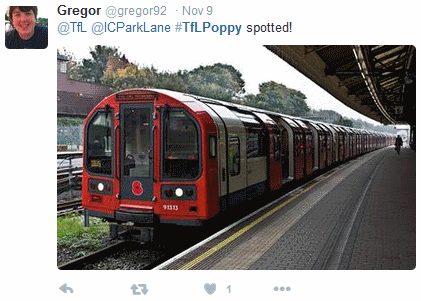
On the first day of Poppytide, TfL gave to me,
an @AspinalofLondon bag.
On the second day of Poppytide, TfL gave to me,
a @TimeOutLondon Card and tickets to @WinterWonderLDN.
On the third day of Poppytide, TfL gave to me,
an afternoon tea @hotelcaferoyal and tickets to @WarHorseOnStage.
On the fourth day of Poppytide, TfL gave to me,
tickets to @TheLondonEye and tickets for @ThamesRIBExp.
On the fifth day of Poppytide, TfL's prize descriptions got a bit longer,
tickets to Sea Life @london_aquarium and an experience on the flight simulator & a ride on @EmiratesAirLDN.
On the sixth day of Poppytide, TfL really caught the sombre mood,
tickets to Bond in Motion@ldnfilmmuseum and one of @PenhaligonsLtd fragrances for ladies or gents.
On the seventh day of Poppytide, TfL's highly appropriate gifts were
go climbing with @archclimbing and tickets to Vogue 100: A Century of Style @NPGLondon.
On the eighth day of Poppytide, TfL's Twitter feed started making value judgements,
a dinner cruise @citycruises – a brilliant river experience - and a Sushi-making class @YOSushi.
On the weekend of Remembrance Sunday, TfL's prize raffle took a rest,
because promoting brands at a time of national reflection would be crass.
On the ninth day of Poppytide, TfL came back with a splash,
a night’s stay & breakfast for 2 at the InterContinental @ICParkLane and a chance to race for free with @RevolutionKarti.
On the tenth day of Poppytide, TfL dug deep into the prize draw barrel,
an amazing prize from @goodlifeeatery and a Street Art Tour with @AlternativeLdn.
On the eleventh day of Poppytide, on the morning of Armistice Day,
TfL's marketing department decided enough was probably enough.
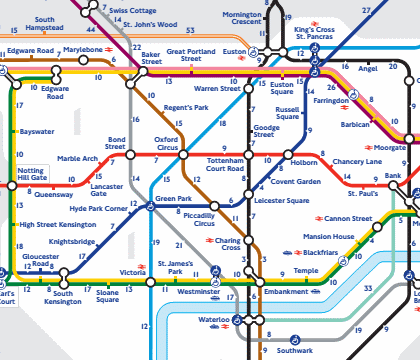
Something long-anticipated has appeared on the TfL website. An official map of walking times between stations.
In reality it's nothing more than the normal tube map cut down to cover zones 1 and 2, with the "approximate time in minutes based on a moderate walking speed" written in the appropriate gap between stations. But it is the official walking tube map all the same. Admit it, you're already itching to click through and see the whole thing.
There have been numerous unofficial attempts at doing this before. A group of St Martin's postgrads came up with the Shortwalk map in 2007, while a health insurance company devised a 'number of steps' map in 2009. But these have usually been wilfully inaccurate, it being quite difficult to determine all of the necessary intervals with accuracy. One reason you can be sure this latest version is official is that they haven't accidentally missed a number out, every adjacent pair of stations has its own data. But be aware that this is not the holy grail map of 'journeys where it would be quicker to walk'. Only adjacent stations on the same line are included, so (for example) Queensway to Bayswater does not appear.
TfL have yet to promote their new map in any way. It's hidden on a page of the TfL website you're unlikely to use regularly - the Walking homepage - where those stumbling across it are invited to "view a map of station-to-station walking times in central London". Google suggests that the map went live last Monday, 2nd November, and that Twitter user @brucemcvean spotted it the following day. A new form of tube map is like catnip to Time Out, and they were the first to circulate the map's existence more widely with a blog post yesterday celebrating the discovery. But their assertion that "the folks at TfL have released a shiny new version of the official walking tube map" misses the important point that there's never been an official walking tube map before.
A little further digging reveals that this wasn't originally TfL's map, it was put together by creative duo Ary Arasen and Joe Watson as part of a suite of ideas to help Londoners get around during a tube strike. They proposed placing signs outside stations showing the walking time to the next, but it was their tube map that went viral, appearing in several national newspapers and spreading to more than 100 countries around the world. This was in July last year, you mustremember, and only now have TfL caught up. And the reason I'm utterly convinced that their official map is based on Ary and Joe's amateur production is that it contains exactly the same gross inaccuracy between Aldgate East and Whitechapel.
Other than the odd gremlin, the walking map is of course inordinately fascinating. You'll turn first to your regular journeys to confirm the data, then open out to scan the network more widely. Locations that seem close are revealed not to be, and the total irregularity of the diagram becomes clear. Times in the outer reaches are much higher than those in the centre, despite network proximity suggesting otherwise. The map strips away Harry Beck's basic premise that distance doesn't matter and reveals the reality beneath. Rather than focusing on stations we are instead encouraged to concentrate on the gaps inbetween, each line reduced to little more than a string of digits.
What's possibly even more interesting is whether the map is actually correct. Almost every number Ary and Joe provided has either been copied across to the official map or tweaked by no more than one minute higher or lower, suggesting a high degree of faith in the original data. But there are also a handful of locations where TfL technicians have seen fit to adjust the original number by a greater amount because of an initial error. Temple to Blackfriars was never 4 minutes - the new map has it at 10 - and Camden Town to Euston can be done in 19 minutes, not a pessimistic 27. Meanwhile no way did Finchley Road to Baker Street take 1 hour 4 minutes, hence the updated figure of 44, and Aldgate East to Whitechapel should clearly be 12 minutes rather than that ridiculous 2.
Ignoring that latter anomaly, here's an 'official' list of The closest tube stations in Zones 1 and 2.
3 minutes: Charing Cross → Embankment (such a short walk, never tube it) 4 minutes: Leicester Square → Covent Garden (the shortest underground, but not quite on the surface); Mansion House → Cannon Street 5 minutes: Cannon Street → Monument (Cannon Street's unnecessarily close to both its neighbouring stations) 6 minutes: Leicester Square → Piccadilly Circus; Marylebone → Baker Street; Moorgate → Liverpool Street; Shepherds Bush Market → Goldhawk Road; Embankment → Waterloo (not sure I believe that); Monument → London Bridge (not sure I believe that either) 7 minutes: Barons Court → West Kensington; Hyde Park Corner → Knightsbridge; Edgware Road → Marylebone; Finchley Road → Swiss Cottage; Marble Arch → Bond Street; Bond Street → Oxford Circus; Leicester Square → Charing Cross; Tottenham Court Road → Goodge Street; Goodge Street → Warren Street; Stockwell → Clapham North; Mile End → Bow Road
On the same theme, the tube line with the most stations less than 10 minutes walk apart is the Northern line, with 14. From Euston down to Waterloo not a single stop exceeds a ten minute walk, and the same is true from Old Street down to Borough. The DLR also has 14 stations on the map that are less than 10 minutes walk apart, indeed the line from Bow Church down to Lewisham is riddled with them. They're the two most densely packed lines, whereas the Waterloo and City and Victoria lines are the most spaced out (because they were deliberately planned as express routes).
Possibly of more interest, here are The Top 10 longest walking times between tube stations in Zones 1 and 2.
1) 76 minutes - Canary Wharf → North Greenwich (the loser by miles, because there's a whopping great river in the way and no direct means to cross on foot) 2) 44 minutes - Finchley Road → Baker Street (because the Metropolitan line misses out the two intermediate stations) 3) 39 minutes - Canada Water → Canary Wharf (it's that river again, although I'd have thought the time should be a lot more) 4) 33 minutes - Bank → Waterloo (the Waterloo & City line is a true timesaver) 4) 33 minutes - Liverpool Street → Bethnal Green 6) 31 minutes - King's Cross St Pancras → Highbury & Islington 7) 30 minutes - Turnham Green → Hammersmith (assuming the Piccadilly line is stopping at Turnham Green) 8) 29 minutes - Highbury & Islington → Finsbury Park (H&I's second appearance in this list) 9) 28 minutes - London Bridge → Bermondsey 10) 27 minutes - King's Cross St Pancras → Caledonian Road
These long treks are very much the exceptions. The vast majority of adjacent stations in Zones 1 and 2 are between 10 and 20 minutes walk apart, equivalent to half a mile to 1 mile. Eminently walkable at ground level, should you so choose, which is of course the entire point of the map. But the story would be very different had stations in zones 3 to 6 been included, with distances increasing inexorably, and the far-flung reaches of the Metropolitan line would require a considerable hike.
Enough of the tube, what of The Top 10 longest walking times between Overground and DLR stations in Zones 1 and 2?
1) 53 minutes - Euston → South Hampstead (they should never have demolished Primrose Hill station inbetween) 2) 45 minutes - Clapham High Street → Denmark Hill (they should never have demolished East Brixton station inbetween) 3) 44 minutes - Wapping → Rotherhithe (seemingly, cough, an ill-advised walk through the Rotherhithe Tunnel) 4) 38 minutes - Surrey Quays → Queens Road Peckham (which is why they're building Surrey Canal Road station inbetween) 5) 36 minutes - Imperial Wharf → Clapham Junction (which is why a privately-funded footbridge is planned inbetween) 6) 31 minutes - Surrey Quays → New Cross 6) 31 minutes - Surrey Quays → New Cross Gate 8) 30 minutes - Clapham Junction → Wandsworth Road 9) 29 minutes - Bank → Shadwell (the only seriously lengthy journey on the DLR) 10) 28 minutes - Gospel Oak → Upper Holloway
I'll be intrigued to see whether or not the map is extended in January when Stratford is pulled into zone 2 - there'd certainly be some interesting walking times out there. I also look forward to seeing that rogue digit at Aldgate East replaced by something more realistic. And perhaps someone can tell me why step-free blobs have been included, and get in the way, when the whole point of the walking map is that it's for able bodied travellers capable of moderate pace. But it's great to see a walking tube map finally given legitimacy through its appearance on the TfL website. It's slightly baffling they haven't publicised it yet, but why delay, why not get out one stop early and do yourself some good?
You'll know it best from the film and television awards held every spring. But there's a lot more to BAFTA than meets the eye, both in its range of charitable activities and in its physical presence. The British Academy of Film and Television Arts is a post-war creation, initially the British Film Academy, and merged with the upstart gogglebox in 1958. The BAFTA moniker came about in 1976, by royal appointment, with a mission to "support, develop and promote the art forms of the moving image". And it was at precisely this point that they moved into their current headquarters at 195 Piccadilly, a few doors down from Fortnum and Mason.
The building once belonged to the Royal Institute of Painters in Water Colours, indeed the name's still chiselled across the top, hence the appearance across the façade of busts of JMW Turner and William Henry Hunt rather than Sir Laurence Olivier. It used to contain a series of art galleries, these since remodelled to create an administrative, screening and social space much larger than the basic address would suggest. From street level number 195 looks like little more than a doorway, admittedly quite grand, and with the academy's abbreviation embedded in golden letters where a welcome mat might be. But step inside and there's a lot more than initially meets the eye. You're just very unlikely to be able to get past the doorman and step inside. [7 photos]
Except this weekend anybody could, within a very limited time frame, so long as you knew in advance that this was allowed. BAFTA hadn't gone out of their way to advertise this to the wider public - there was no poster outside to tempt in random riffraff, nor any confirmatory notice on the counter beside the doorman. But when I mentioned the photography Open Weekend I was allowed to pass, and up the hallowed staircase of the Academy itself. It's very swish. The walls are faced with two types of marble, with a large bronze mask dominating the top of the first flight of steps. This is the face of the famous BAFTA trophy designed by Mitzi Cunliffe in 1955, and further golden replicas await around each bend to give the ascent a suitably portentous vibe.
Main reception negotiated, a second marble-coated staircase leads to the heart of the complex. Off to one side is BAFTA's main screening space, the Princess Anne Theatre, a sloping deck of red plush velvet seating in a digital surround sound auditorium. This isn't where the main awards take place, it's much too small to hold a nation's thespian egos, but members screenings and certain less well known ceremonies are hosted within. The first film to be shown here was Jaws, apparently, while this weekend a trio of photography-related talks were available to paying guests. By carefully arriving after one of these events had emptied out I cunningly, if briefly, got inside for nothing.
The members bar is rather nice, a high-ceilinged twin-level foyer with seats along one window looking down across Piccadilly. I felt too out of place to ask the barman for a cocktail, or a tea, plus the pastries were advertised at £2.50 each so I didn't fancy asking the price of a drink. But several charming folk were sat around sipping and socialising or reading the papers, I suspected proper members rather than the handful of us Open Weekend interlopers. Our job was to look at 78 photographic portraits, these the reason for the limited opening, hung around the walls of the bar and certain other rooms and passageways. Top snappers had been given access to top actors at various Academy events during the year, from Jack O'Donnell to Judi Dench, and the results were rather splendid. Posed against spotlights and on sofas, Hoffman, Cumberbatch & Co were only to be expected, whereas the appearance of Mary Berry and Angela Rippon was more of a pleasant surprise. Prints were available at prices considerably higher than the pastries. I admired and moved on.
Climbing further to the third floor, a glass cabinet contains examples of diverse Academy trophies, revealing the breadth of art forms supported by the charity. They even do a Young Game Designers award ceremony these days, who knew, as the definition of moving image art spreads into new globally profitable forms. I learned this from a looping film in the Run Run Shaw Theatre - a small room with a giant 20-part screen, named after the centenarian martial arts producer who died last year. Another replica bronze mask, this time of red carpet proportions, stood on the mezzanine creating a golden selfie opportunity for visitors. And, golly, the photography trail even led to BAFTA's boardroom, accessed along the balcony above the bar. I wondered what decisions had been made here ("shall we give it to EastEnders or Coronation Street this year?"), and whether the faces of Bagpuss and newsreader Jon Snow usually stared down from the walls.
I spent a fascinating time poking around inside what's normally the private retreat of the upper artistic elite. I always think it's great to get inside a building you're normally not allowed into, and if nothing else it means I can now watch BAFTA's main award ceremonies with greater knowledge of what's been happening behind the scenes. And if you're interested too, my programme notes hint that they'll be opening up again for photographic appreciation on the weekend on 30-31st January next year. Just get here before they close the front doors at 1pm sharp, and the upper rooms revert to a members-only enclave once more.
The outlook from Westminster Bridge has changed considerably since WilliamWordsworth composed his famous poem, but people still flock here for the view. And most of these people are tourists. They come to gaze out across the Thames towards Waterloo Bridge and the London Eye. They come to gain access to the commercial hubbub strung out along the South Bank. But most of all they come to gawp at the Palace of Westminster, and to make sure they get a photo of themselves beaming with Big Ben in the background. And that's why we Londoners never go, because it's packed, or else we make sure to stick to the southern side where fewer crowds mass. Like Tower Hill, M&Ms World and the pavement outside Madame Tussauds, this is very much the preserve of the tourist, and best avoided.
Westminster Bridge has long been the place for a selfie, even before the word was coined. It's simplicity itself to step back far enough to get the whole of the Elizabeth Tower in shot, and then to manoeuvre the grinning faces of everybody in your group into shot. The clocktower's Gothic elevation is ideally suited to portrait format, though less easily constrained into an Instagram square, should this be required. Time it right and there'll be no traffic in shot - this pulses in waves according to the lights, and opens up the only regular void on the bridge. But as for the pavement, this is usually a swirling mass of tourists taking photos, tourists thinking of taking photos, and tourists blundering into other tourists doing one of the above.
And where there are tourists, there are those who would feed off them. The most obvious manifestations of this are the two kiosks on the western bank. One dispenses souvenirs of questionable taste, generally anything you can slap a landmark or a Union Jack on. The other serves crepes and pancakes, essentially the same thing but translated for a wider audience. Here £5.50 buys the traditional 'Londoner' (that's ham, cheese and mushroom, if you were wondering), while forty pence more gets you The Big Ben (banana, nutella and cream, obviously). Again, this is why you never come. Sometimes an alternative food vendor turns up on the far side of the bridge, doling out roasted chestnuts in a cheeky nod to centuries past. But more often the scammers are on their hands and knees, and harder to spot.
They're playing the shell game, otherwise known as spot the ball. Three small metal cups are placed face down on a fabric pad, under one of which is a sponge ball, and repeatedly shuffled. All you have to do, as the willing passer-by, is to identify the cup covering the ball. It's obviously a fraud, and yet it looks suspiciously easy - the number of twiddles is kept low to make this look like an achievable game of skill. You see the ball at the beginning, the cups are clearly visible, and a seven year-old could probably follow its path back and to. But it's still a surprise when the ball isn't under the cup it so obviously should be, or perhaps you missed a spin somewhere, here show me that again.
Adding to the sense of possibility, punters are actually winning money. They tap their foot on a cup, which when upturned reveals the magic ball beneath. By no means does this happen every time, but often enough to ensure observers believe this game is beatable. Both men and women step up and stake their claim, appearing to choose wisely and taking their prize in triumph. Bets are taken in multiples of £20, so there's a lot of purple flashing around, and although £20's a lot of money surely you could beat the system too. But a little thought confirms that the 'winning' punters are actually part of the wider gang, hence merely circulating money rather than acquiring it. A few minutes of theatre ensures the game looks genuine, and then they go off to play at one of the other mats spaced out across the bridge, and no fresh tourist is any the wiser.
I stood watching one particular maestro for a few minutes, trying to work out how his shuffling trick worked. Did the young man switch the cups after one had been chosen (no, seemingly not) or were the players misdirected towards the wrong one? My suspicions swiftly alighted on the ball itself and the matter of its composition - why use sponge instead of something solid, what advantage would this bring? And yes of course, sponge scrunches up so can be easily concealed in the hand, ready to slip in whenever and wherever it's needed to appear. That lift halfway through the shuffle isn't to confirm the ball's location, it's to whip it out of the game. When the chosen cup is tipped up at the end of the game, it's always going to be empty underneath. And when one of the remaining cups is finally revealed as the ball's supposed home, it's been there for no more than a fraction of a second.
And all the time that this is going on, lookouts are poised to ensure the authorities don't spoil the party. They scan the bridge like meerkats, occasionally passing on warning signs to those at pavement level, ensuring that the latest rally can be halted and the various components immediately squirrelled away. The rubber-based mat is folded and placed inside a laptop bag, for added anonymity, while the cups and ball and cash go into separate members' pockets to split the evidence. Indeed this happened while I was watching - a Met Police van passed by on the opposite side of the bridge and paused, causing the scammers to scatter within seconds. The thick crowd made it relatively easy to disappear, in one case all the way to the tube subway entrance, so that when the police got out to investigate there was nothing to see.
Except apparently there was. One unfortunate gang member in a brightly-coloured hoodie had remained on the bridge and was singled out for attention. Officers surrounded him by the parapet and used blue plastic gloves to search his rucksack for evidence, then proceeded to question him for several minutes. Meanwhile his former colleagues had mustered on the Victoria Embankment, just round the back of the souvenir kiosk, and were observing proceedings on the bridge with intent. I recognised the main cup-twiddler and also the older man who'd been playing the part of a successful punter, their fast (non-English) chatter now revealing a much closer tie. And here they stood for at least ten minutes, nervously scanning the unfolding situation, without ever being spotted by the force of law.
Eventually, after much manipulation of notebooks and blue plastic, the police let their suspect go. They should have followed him, because he strode straight over to the Embankment to where his colleagues were standing and gave them the low down on what had occurred. The reunited group chatted for a while and then, rather than returning to their pitches on the bridge, walked away. At twenty pounds a fleece they'd no doubt done well enough to be able to go for a beer or some food, or whatever, before returning to play again later in the day. These con artists are somehow never flushed away, the hand of law either too unfocused or too underfunded to break the routine. And Westminster Bridge will always provide a wealth of customers, dutifully handing over unfamiliar currency because they're not astute enough to realise they're not astute enough. Best avoid this balls-up at all costs.
20 TfL contracts you might like to bid for in the short-to-medium-to-long- term future
09/11/2015 The provision of oils and various lubrications for use on escalators (£500K - £1M) 27/11/2015 The provision of GRP drainage covers (£500K - £1M) 29/01/2016 One Person Operated CCTV system for Croxley Rail Link (£1M - £5M) 18/02/2016 Construction of the Highbury and Islington Transfer Line connecting the North London Line and East London Line (£1M - £5M) 28/02/2016 Detailed Design and construction of a new London Overground station at Surrey Canal Road (£5M - £10M) 01/04/2016 Transcription services to provide both verbatim and summary notes of meetings and recorded interviews on behalf of Human Resources (£1M - £5M) 30/06/2016 Camden Town Station Capacity Enhancement (£100m+) 30/11/2016 Supply of Screwspikes (£500K - £1M) 01/09/2017 Construction of the LO extension from Barking to a new station currently named Barking Riverside (£100m+) 30/09/2017 Holborn Station Capacity Enhancement (£100m+) 31/12/2017 Central Line Door Overhaul Programme (£5M - £10M) 30/01/2018 Elephant and Castle Station Capacity Enhancement (£50M - £100M) 23/09/2018 To provide level access to platforms on the Piccadilly line to meet Rail Vehicle Accessibility Regulations (RVAR 1998) requirements and the requirement for the installation of Platform/PED interface (£100m+) 15/02/2019 The installation of Earthling & Bonding works (£1M - £5M) 01/05/2019 Highway improvement to Shoreditch Triangle Gyratory (£5M - £10M) 31/01/2020 Old Street Station Capacity Enhancement (£50M - £100M) 31/03/2020 Maintenance of Wheel Lathes (£1M - £5M) 01/04/2020 Highway improvement works to Tulse Hill Gyratory (£5M - £10M) 01/01/2021 Highways improvement works around Bow (Bow Vision construction) (£25M - £50M) 22/09/2023 Design, manufacture, install and commission platform edge doors at circa 97 platforms on the Piccadilly line (£50M - £100M)
November 1: National French Fried Clam Day, National Cook For Your Pets Day, National Bison Day November 2: National Deviled Egg Day November 3: National Sandwich Day November 4: National Candy Day November 5: National Doughnut Day (also first Friday in June) November 6: National Nachos Day November 7: National Bittersweet Chocolate with Almonds Day, National Eating Healthy Day November 8: National Harvey Wallbanger Day, Cook Something Bold and Pungent Day November 9: National Scrapple Day November 10: National Vanilla Cupcake Day November 11: National Sundae Day November 12: National Pizza with the Works Except Anchovies Day, Chicken Soup for the Soul Day November 13: National Indian Pudding Day November 14: National Spicy Guacamole Day, National Chicken Day, National Pickle Day November 15: National Spicy Hermit Cookie Day, National Clean Out Your Refrigerator Day, National Raisin Bran Cereal Day November 16: National Fast Food Day November 17: National Baklava Day, Homemade Bread Day November 18: National Vichyssoise Day, National Apple Cider Day November 19: National Macchiato Day, Carbonated Beverage with Caffeine Day November 20: National Peanut Butter Fudge Day November 21: National Cranberry Day, National Stuffing Day, National Gingerbread Cookie Day November 22: National Cranberry Relish Day, National Cashew Day November 23: National Espresso Day November 24: National Sardines Day November 25: National Parfait Day, National “Eat with a Friend” Day November 26: National Cake Day November 27: National Bavarian Cream Pie Day November 28: National French Toast Day November 29: National Chocolates Day, Throw Out Your Leftovers Day, National Lemon Creme Pie Day, National Rice Cake Day November 30: National Mousse Day
(also National Fun with Fondue Month, National Peanut Butter Lover’s Month, National Pepper Month, National Stuffing Month and National Raisin Bread Month)
National Food Days in the United Kingdom June 5: National Fish and Chips Day August 28: National Burger Day
In an unusual turn of affairs, I have been invited to Bonfire Night in the outer suburbs. Not an organised display, oh no, but a proper back garden affair with sausages and bangers. This is how outer London rocks, and it's easy to forget sometimes. When I arrive the house is already full of nephews, home from school and awaiting the evening's entertainment. The kitchen is hectic with activity, as the trolleyful purchased earlier at Asda is transformed into a minor feast. And the garden is very wet, because that's November for you, so we'll eat first if that's OK and hope the cloudburst clears up soon.
There are burgers, because there have to be burgers, topped off by freshly fried onions and slices of cheese, plus self-served squirts of ketchup. There are jacket potatoes, does anybody want a jacket potato, to be filled by grated cheese and a dollop of bubbling baked beans. There's tea and beer, hell why not both, and cans of something sugarier for the youngsters. And there's a whole pile of hot dogs fresh from the grill, surely somebody would like a hotdog, you must have room, here I'll put one on your plate for you. This is how it's meant to be.
It seems the rain has cleared, so the action crosses from inside to out, so put your shoes back on. Granddad's set up a bucket packed with sand at what's technically the far end of the lawn, although is in fact still suspiciously close to the house. A pail of water awaits the remains of the sparklers, and a bag full of pyrotechnics sits just inside on the kitchen table. The neighbours have come round to boost the audience, that's Mum and Dad and young daughter, and have kindly brought their own bag of fireworks too. Something high and sparkly explodes in the sky several back gardens down. And would anyone else like another hotdog while we're waiting?
The first rocket is manhandled into position, and Nephews' Dad attempts to set it alight. This proves problematic, in part because it's a bit windy out, but mostly because the ignition mechanism of choice is a cheap cigarette lighter. Several clicks later nothing has happened, or has it, it's hard to be sure, and guessing wrongly could prove highly regrettable. But look Dad, I think that's lit, something appears to be glowing, stand back! A series of bangs and flashes ensues, at first close to the ground then shooting up into the air, as the spectators cower by the patio doors in case somebody's misjudged. Nope, all's fine, blimey that was rather good.
Firework two is a little less impressive, but still eruptively glittery, then fireworks three and four rather more of a letdown. It appears we may have accidentally set off the best firework first, and the rest of the display might be an anticlimax. But firework five ups the ante again, rising higher into the sky that any competitor in any surrounding garden, then exploding in a fireburst that fills the sky. We agree it looked suspiciously like a professional grade rocket, of the type that you'd see at a paid-for display, only from considerably further back. And we appear to have half a dozen of these, of somewhat questionable provenance, so bring it on.
It takes a while to fully trust the situation, to believe that no potential pyrotechnic is going to career off its trajectory on a collision course and leave you with third degree burns for life. But with each successive ignition we become more blasé, letting our guard down and edging a little closer, that is until one of the lit fireworks topples before firing. It shoots off just above ground level, thankfully not in our general direction, but towards and then just over the fence. Had there been anybody on the pavement on the other side they'd have been both startled and sprinkled with pink cinders, but no yelping or cursing ensues, so we assume all was clear.
The entertainment value of each firework bears little correlation to its size. A big lumpy block the size of a car battery splutters briefly and then fades away, while a small conical canister manages to dispense glowing balls of coloured fire for longer than seems physically possible. This one's maybe ten years old, says Mr Neighbour, so it's no surprise when it fails to do much. But his next offering has one hundred sections, he announces proudly, and that's amazing, firing out fizzing flashes like some kind of demonic attack. In the game of neighbourhood firework oneupmanship, a much coveted local title, this back garden display appears to be winning.
Lighting each fuse continues to be somewhat problematic, and on more than one occasion Granddad has to be urged to withdraw in case his jabbing has indeed caused the wick to glow. A little careful editing, and a less positive conclusion, and next year's Bonfire Night public information film could be playing out before us. As if to tempt fate further Mr Neighbour tires of using a weedy cigarette lighter and pops home to fetch his blowtorch. This is considerably more effective, and results in a speeding up of proceedings, including the occasional double firing because we can. But holding a fiery blowtorch and rushing away from a lit firework across wet leaf-covered grass in a garden full of children is surely pushing our luck to the limit. Our luck holds.
Eventually the sparklers come out of the box, and it becomes clear that most of those present below the age of 12 have never held one before. You only ever hold this end, the adults chorus, and don't wave it near anyone else, and oh can I have one too? After the sparklers half the audience drifts away, either to the kitchen or the room beyond the patio doors, because when you've seen twenty-something fireworks you feel you've seen them all. Grandma's already tidying away the uneaten food and cleaning down her surfaces, because priorities. Middle nephew's going nowhere, however, and continues to record each individual firework on his iPad for future media consumption.
The catherine wheels present a new problem, namely where to nail them in, so Mr Neighbour pops home to collect a long block of wood which Nephews' Dad then mallets into the upper lawn. This practical solution works well for the first couple of seconds before the wheel's momentum causes it to slip loose and fall into a flowerbed, where it gushes smoke in vain. Lesson learned, a second larger wheel is bashed into the post for some considerable time to ensure it can't fly off. It is therefore perhaps no surprise when, once lit, it completely fails to spin. Provoked by this depressing waste, Nephew's Dad pokes the wheel repeatedly with the end of a broom until it eventually starts to turn... and then flings off at speed, the closest shave of the entire night.
By now at least an hour has passed, this backyard show having lasted longer than any public display tonight or over the weekend. The willingness of suburban males to purchase explosive powder in small tubes at this time of year is a phenomenon, especially given how swiftly that hard earned cash turns to ash. Eventually the stockpile is diminished to just two, a decorated brick that dazzles the garden in repeated sequence, and a final industrial-strength rocket. And as its fiery petals dissipate in the sky, that's the lot, and a minor round of applause ensues. Because there's nothing quite so Firework Night as an amateur homegrown display, with all the up-close risk that this entails. And would anybody like a cold hot dog - there appear to be rather a lot left?
And in the eleventh month the angel Gabriel was sent from God unto a city of Galilee, named Nazareth,
To a virgin espoused to a man whose name was Joseph, of the house of David; and the virgin's name was Mary.
And the angel came in unto her, and said, Don't you think it's about time you started stocking up on tins of Quality Street?
And when she saw him, she was troubled at his saying, and cast in her mind what manner of salutation this should be.
And the angel said unto her, I only ask because I see you've not got your Advent calendar up yet; holidays are coming.
The red cups are out; and they've started selling those turkey and cranberry sandwiches you like down at Pret In A Manger.
You must have seen the adverts with the dancing snowmen by now, and heard that Jona Lewie song playing in the market square.
I hear Herod And The Chief Priests came down at the weekend to switch on the lights; it looks ever so seasonal.
All the stalls down there are chock full of party nibbles, boxes of crackers, and slightly overpriced tubes of Pringles.
Then said Mary unto the angel, How can this be, seeing as we've not even had Black Friday yet?
And the angel answered and said unto her, It's never too soon to start buying seasonal provisions, which is why the shops are full of them already.
An early start is important to allow poorer folk, like shepherds, a longer window to stock up on essential festive goods, like tubs of peanuts and chocolate Santas.
Would you like a mince pie? The sell-by date is next week, so I need to finish off the packet before then.
Surely you've been saving up a bit each week for a hamper; that Caesar Augustus could send out a decree to be taxed at any time.
You need to start party planning right now; sourcing a natty little cocktail dress and pre-booking your hotel.
Me and the other angels were even forced to hold our office party at The Bethlehem Inn last night; everywhere else was full.
All this cajoling, it's nothing sinister; just a friendly reminder that the eastern star will be standing over us soon, and you need to be prepared.
That firstborn son of yours surely deserves a must-have present; what if there's a rush on gold and frankincense before the time comes he should be delivered?
For with God no celebratory purchase shall be too premature.
And Mary said, But I'm not due to give birth for another fifty days, for heaven's sake; bah humbug! And the angel departed from her.
THE UNLOST RIVERS OF LONDON Silk Stream Edgware → Hendon (2½ miles)
[Silk Stream → Brent → Thames]
Having rested this feature for four months, and not heard one word of complaint, now seems as good a time as any to bring it back. I'm returning with a walk along an unlost river whose name suggests lush sensuality, but whose reality is quite different. It runs down the western edge of the borough of Barnet, between the A5 and the Northern line, a path well shown on this map of its flood plain. Just for a change I'm going to walk it upstream, allowing me to pick and choose which particular tributary I follow at the top end. But don't expect excitement. [6 especially autumnal photos]
The point where the Silk Stream originally met the Brent is now lost beneath the Welsh Harp Reservoir. It's important for keeping the Grand Union Canal topped up, for yachting and waterfowl, and for flats. Developers are knocking down the council housing at West Hendon and sequentially regenerating it, with waterside plots the first to be infilled. Towers and brick blocks now loom over the reservoir's edge, while the opposite bank remains delightfully unsullied. A twisty path winds between trees and rushes, at one point opening out to reveal a wooden hide overlooking autumnal migration, inside which various potential dodgy phone numbers are scrawled. Best bit of the entire walk, this, which is sad because we're still only on paragraph one, and the river proper hasn't appeared yet. It's first seen round the back of the bowling club, but only if you cross through a clearing covered in woven twigs. Telltale litter suggests that folk were sleeping rough here only recently, the lower Silk Stream acting as their bedroom wall.
The river's first/last mainstream appearance is on the A5 (Edgware Road), although it crosses underneath so you have to be both on the pavement and observant to notice. A more obvious connection is the Silkbridge Retail Park, a minor warehouse triumvirate selling pet food, bikes and DIY, built on the flood plain where no sane developer would place a home. A good twelve feet wide, the Silk Stream is then screened behind a rather large Sainsbury's, and its car park, and a car dealers, and by now you're probably getting the idea. Much of this river's immediate valley has been put to commercial use, and is now the kind of place that Barnet residents drive to to buy multipack crisps and rawlplugs. A giant Homebase completes this unlovely trudge through The Hyde estate, so best move on.
At last the Silk Stream breaks out into the public domain, forming the entire eastern boundary of Rushgrove Park... and yet rather than shine, the closest footpath skirts at some distance. Danger, Keep Away From Banks Of Stream, Flooding May Occur, reads the somewhat neurotic notice that Barnet council have chosen to erect by the water's edge, even though no possible instantaneous inundation could ever cause risk or injury to anyone. Even the former footbridge at the top of the park has been removed, relatively recently, forcing residents of the delightfully named Colin Crescent to detour via the almost as intriguing Colindeep Lane.
Alas Colindeep Lane turns out not to be especially intriguing, with barely a glimpse of the Silk Stream meandering behind back gardens, care homes and a technology park. Indeed I'll struggle to find many good words to say about Colindale, a suburb currently enblandening itself via a particularly virulent blast of regeneration. Bricky glass boxes are rising everywhere, especially up on the Edgware Road, but increasingly now in the vicinity of the river. As recently as 2013 the British Library used to store their newspapershere, their stacks now stacks of concrete floors awaiting final transformation into hundreds of flats. Most ghastly is the so-called 'Pulse'development by the tube station, a soulless enclave of irregular apartment blocks where the promised 'community feel' appears to consist of a muted cafe and an estate agents.
Only those in the know realise there's a tiny footpath round the back of the North London Blood Transfusion Centre, crossing a tributary to enter Montrose Playing Fields. And here at last the Silk Stream is given a chance to roam free, even if only along an engineered ornamental channel. A scattering of golden leaves helps add colour at this time of year, just as they did when John Betjeman visited in black and white for a BBC programme in 1968. He describes the Silk Stream as "the Tiber of Middlesex", with more than a little poetic licence. But a low footbridge by the changing rooms adds character, and the landscape improves further beyond the next street, in Silkstream Park. Created in the 1920s when the surrounding housing estates were laid out, to ensure suitable drainage, it provides a more than pleasant spot for recreation.
The surrounding housing estates comprise Burnt Oak, the London County Council's great suburban hope, now the most deprived corner of Barnet borough. The Silk Stream flows unseen beneath the high street in the vicinity of Ali's Halal Butchery Cash and Carry, though can be followed for a short distance if you slip between the shops down the steps labelled 'Saturday Market'. Once a popular trading magnet, its stalls were locked away when I arrived during what should have been peak hours, the sole trader being a fishmonger set up outside on a table facing the station car park. Following an unlost river can lead you to the most unlikely places.
Alas the next bit of the river's hard to follow. The stream runs along the edge of the Northern line, behind a lowrise housing estate which proves that postwar architecture could also be depressingly dull. It reappears in the grounds of Edgware Community Hospital, a medical nerve centre surrounded by a glum halo of clinics and out-patient departments. And here it also splits, or rather merges, because I'm walking the river in the opposite direction to its flow. Down from the west comes the Edgware Brook, via (in reverse order) Canons Park, Honeypot Lane, Stanmore and Bentley Priory. And down from the northeast comes another tributary, the one I chose to follow, which combines here on NHS property to form the Silk Stream.
THE UNLOST RIVERS OF LONDON Deans Brook Mill Hill Golf Club → Edgware (1¼ miles)
[Deans Brook → Silk Stream → Brent → Thames]
Appropriately it's Deansbrook Road which crosses at the foot of the Deans Brook, though I'm not sure which particular Dean either is named after. Crossing the Underground close to Edgware station the stream heads below depot sidings, all of this out of public view. But there it is again under the alleyway between Brook Avenue and Farm Road, and at the bottom of a surprisingly steep dip. The semis on Farm Road are so low down that one has a small parking bay in its front garden entered at pavement level, but with a sign warning of a seven foot drop beyond. Somewhere behind the mock Tudor frontage another tributary rolls in, this the Edgwarebury Brook, though this is culverted beneath the suburban avenues beyond. The Deans Brook continues in the open, behind the back gardens of the upmarket bungalows in Highfield Gardens, whose residents get to see it and you don't.
The A41 is a massive road, launching at nearby Apex Corner, and crossed by one of those massive footbridges favoured by 80s town planners. But immediately beyond - yes it was worth walking this far - there's Stoneyfields Park. Here the fledgling Deans Brook has been dammed to create an ornamental lake, exited via a cascade of half a dozen weirs. This pretty scene is augmented by swans and other waterfowl, seemingly often fed ripped-up bread by local children in direct contravention of yet another Barnet council regulation. Following the brook's upper course requires passing beneath two adjacent viaducts, one brick for the Midland mainline, the other concrete for the M1. Alas the source is on Mill Hill Golf Course, off limits except to members. But look carefully beyond the viaducts and you might just spot a dingy road past a metal recycling yard - the back entrance to Scratchwood services...
Steam trains of Kent: Romney Hythe and Dymchurch Railway Location: Hythe to Dungeness via New Romney (13½ miles) Gauge: fifteen inches Website:http://www.rhdr.org.uk
At the end of the season, when the year's chuffing is almost done, the steam train fraternity at the RHDR let their hair down. A one-day parade takes place, with all of the railway's functional locomotives in play, as a bit of fun before all the playthings go back in the shed. And very special playthings they are too, specially built for this particularly-narrow gauge railway back in the 1920s, with names like Southern Maid, Hercules and The Bug. Normally they whistle down this lengthy line from almost-Folkestone to Dungeness in compliance with a fairly normal timetable, but on Parade day that's ripped up and some extraordinary rides take place. A triple-header double run, for example.
Steaming up at New Romney begins well before the scheduled departure time. Out come the engines, driven by volunteers in caps and overalls, watched by any paid-up customers who've slipped in earlier than is truly necessary. There are water tanks to fill and chunks of coal to be shovelled - the latter requiring a short trip up a brief siding into the car park. Individual locos are shuffled around the station network utilising tracks alongside empty platforms and occasionally the turntable, manoeuvred into position according to some carefully constructed plan. The first run needs to kick off with Winston Churchill behind Typhoon behind Green Goddess on one train, and Doctor Syn at the head of the other, else the day's schedule might collapse completely within hours.
In the buffet the ham and cheese sandwiches are being buttered, and placed into plastic casing ready to be stacked for lunch. A brood of spiders and cardboard skeletons hangs from the walls, leftovers from the previous day's Hallowe'en special, while the glistening webs hanging from the nameplate on the platform look like they've been spun by the real thing since. Slowly the station fills with visitors, that's those physically capable of getting to the extreme Kent Coast before half past nine on a Sunday morning. Some are enthusiasts with massive lenses, others families with a particularly needy younger member, one even looks suspiciously like the chairman of a major railway company. But most are fairly ordinary folk who know a fun day out when they see one, and that a triple-header double run is not to be missed.
Usually the RHDR stick one locomotive on the front of a train, but for a triple header they stick three. In part this means more oomph for your journey, which is important when there are umpteen small carriages to tow, but also means there can be greater distance between stops for filling up. But that's not the brilliantly bonkers part, which is the double run. Start one triple header on one track and another in parallel alongside and they can chase each other up the line. Even better each can speed up and slow down at irregular intervals, allowing the other to overtake and then undertake all the way to the final destination. This only works if there are no other trains on the network, of course, hence why this is the very first journey of the day. But by allowing two trains to run side by side non-stop from New Romney to Hythe, that's nine full miles of wow for drivers and passengers alike.
Train 1 heads off faster than train 2, then slows to allow train 1 to speed up and overtake, then speeds up again... and repeat. You want to be on the side of the carriage closest to the other train. Fortunately RHDR carriages are very narrow, two seats wide at best, so it's not hard to get a decent view as the other train slips by. Each passing manoeuvre is announced with a whistle or a belch of steam in triplicate, or simply by a stealthy approach at speed. The varied landscape along the line means the switch might take place alongside a marsh grazed by sheep, or might take place round the back of a string of bungalows lined by gnomes. And you can only imagine the surprised looks on the faces of drivers held at level crossings as not one but two trains surge past in the same direction. "Another train is coming if lights continue to flash."
With both halves of the convoy travelling at approximately twenty miles an hour, it can take some time to completely pass the adjacent formation. This means you might occasionally find yourself sitting immediately alongside one of the three drivers in the other train as he shovels or whistles - an up-close view of steam-engineering in motion. But more often it'll be the other carriages passing by, which means meeting and re-meeting the passenger complement of the other train. The bespectacled adolescents with iPhones poised, the retired couple with a bag of sweets, the small boy with the Rail Rovers rucksack, the man crouching on the floor to film the entire event at chassis level, the bored father flicking dispassionately through a copy of The Economist, all will be familiar faces by the eighteenth consecutive pass.
And as the housing estates of Hythe encroach, and the forty minute extravaganza draws to a close, it's time to inhale a few final lungfuls of funnelled steam. Indeed you might even be quite blasé by this point, as if a triple-header double run were the most normal thing in the world. But its full rarity can be established by the width of the smiles on the faces of the drivers at the station, their end of season treat now complete. There'll be much shuffling of locomotives and twiddling of turntables once the uncoupling phase begins and various subsequent services are sent on their way. One such train is even destined for a 21 mile non-stop service, including a spin round the shingleat Dungeness and back, and that's going to be a pretty spectacular ride. But there's always the worry that once you've ridden a steam-powered mini-sized triple-header double run, nothing else will ever quite compare.
Steam trains of Kent: Bredgar & Wormshill Light Railway Location: Warren Wood to Stoney Shaw (½ mile) Gauge: two feet Website:http://www.bwlr.co.uk
On the North Downs south of Sittingbourne, along lanes unserved by public transport, a diminutive steam railway plies its trade. The B&WLR started out in the 1970s, created by enthusiasts on land owned by one of the members. As such it has a minor footprint to play with, but almost half a mile of track has been fitted in, forming a horseshoe shape from the electricity pylon down to the bluebells. There are no bluebells at this time of year, alas, but on Sunday there was thickfog which gave the end of season Steam Gala a particularly magical feel. The main station is at Warren Wood, this round the back of the tearoom and shop, and kitted out in semi-Alpine style. The line then passes a fully functional signal box before bending round between field and forest, descending quite steeply to the terminus at Stony Shaw. If you can find the path you can walk down or walk back, which at this time of year means almost-mud and a carpet of russet leaves.
The balconied carriages used by the railway have been built on site, while the dozen or so engines are from all around the world. There's only room for two or maybe three train formations on the tracks at any time, so a significant proportion of operational time involves shunting and shuffling, which helps to keep the volunteers gainfully occupied. They're a friendly bunch too, aided and abetted by only coming out to play with the public on a handful of dates a year, of which this Sunday's gala was the last. As dusk fell at the end of the day and the electric lamps were lit at top and bottom of the line, it was time to stash each loco back in its appropriate shed. This meant that the turntable got a lot of use, as boilers emptied with a burst of pure steam before winding down for the winter. With the mist swirling atmospherically it was hard to imagine a greater contrast to the sunny RDHR earlier in the day, but both were beautifully special in their own way.
Greater London contains two motorway service stations, the most famous of which is Scratchwood on the M1. Or at least that's what it used to be called, it's now the less memorable London Gateway, and is no longer run by Forte but by Welcome Break. It's located between the motorway and the Midland mainline railway, at approximately the point where the M1 bends west to Watford, on a sliver of land inaccessible except by car. Or at least that's what I'd thought. I was on one of my walks around the suburbs when I spotted an unusual road through the middle of a metal recycling yard. And obviously I broke off from where I'd been intending to go and followed it, and that's how I finally ended up at Scratchwood. Sorry, London Gateway.
Six Scratchwood facts 1) There is an actual Scratch Wood, just to the north, which the London Loop footpath (section 16) passes through. 2) The services are built at the precise spot where M1 junction 3 would have been (a link to the A1 - unbuilt). 3) Cars access the services via the J3 roundabout, which is incomplete (and hence requires some awkward turns) 4) Scratchwood had the country's first AA (member recruitment) kiosk. 5) The service area was forced to close in April2011 when a fire at the aforementioned metal recycling yard melted the M1. 6) The guns of HMS Belfast are trained on Scratchwood services (they really are - Londonist has the story).
So whilst almost everyone accesses London Gateway services from the M1, it turns out there is a separate access road. To find it head for Apex Corner, the big roundabout where the A1 meets the A41 (but not the M1, which skedaddles almost underneath). Then follow Ellesmere Avenue, an ordinary suburban street, to the end where the road bends and a minor track leads off. Two large signs alert cars to think twice before proceeding, including warnings about bumps and traffic enforcement cameras, and most importantly, no vehicles except for authorised vehicles. But pedestrians are fine, as a later red sign confirms, even though the pavement rapidly disappears. Ahead is the concrete viaduct supporting the M1, here elevated to cross a minor stream. And beneath that, to either side of the service road, is Apex Metal Recycling Ltd. At the weekend it's quiet, sealed off by corrugated iron emblazoned with warnings about clamping, and a small girl's bike visible in amongst the stacked-up scrap. There's nothing welcoming here, so don't linger.
The service road then bends to follow the narrow strip between motorway and railway. A quarter mile yomp follows, past the big sign inviting traffic on the M1 to pull off for Waitrose and a Starbucks. Vehicles have more to negotiate, including a rising block barrier at each end of the straight. Technically you're supposed to wait for the green light before passing, but on my visit the block was permanently down and the light permanently green, meaning any old car could drive through. And a small handful did, presumably unthreatened by the cameras pointing down from stalks and the risk of automatic numberplate identification. But it's all perfectly OK on foot, I reassured myself, and indeed it was.
One ugly hotel sits at the end of the drive, within the official service area zone, ideal for anyone who likes to sleep with the hum of motorway traffic. And beyond that is the car park, or as it appeared initially the coach park. A whole row of Travellers Choice coaches were lined up in a state of hiatus, one with a destination of 'Exeter' written in English and Chinese in its front window, while another vehicle had made the long journey from Bulgaria. The cars lay beyond, surprisingly few in number for a Saturday afternoon I thought, but presumably enough to keep the place ticking over. As the last service station before central London, or the first on the way out, Scratchwood has a premium location.
The services themselves are absolutely nothing special. A lowrise building with a mildly swooshing roof summons all within, with Starbucks in pride of place inside the front doors. Two key staples of any such building are to the right, the toilets and the gaming zone, the former the key draw on any long journey. For newspapers, magazines and sweets and stuff there's a WH Smith, while for anything slightly more upmarket there's a Waitrose, of admittedly minor proportions but large enough to buy bunches of flowers and in-car provisions. If it's hot food you're after there's a Subway and a Burger King, these with a shared seating area where slightly glum couples can munch on bread-based meat. But if you're after something more substantial like a meal on a plate, for example the traditional service station cooked breakfast, you've pulled off the motorway probably ten years too late.
If it's nice, and yesterday it was, you can sit outside. There's even a picnic area out front with wooden tables, ideal if you don't mind a waft of carbon monoxide with your sandwich. Someone's planted a palm tree in a garden of pebbles by the main path, with the letters L G W spelled out in extremely minor topiary. And don't worry, parking's free here for the first two hours, not that there seems any reason to stay longer other than perhaps kipping in your car overnight, for which expect to get hit for £12. HGV drivers pay more, not that there were many of these parked up on the other side doing a weekend run, which again gave the place a much quieter feel than I suspect is usual.
The ghost town feel was especially strong at the coach terminal nextdoor. Essentially a large glass-fronted hangar full of chairs, this belongs to Shearings Holidays and is the main hub of their southeast operation. The interchange swings into action just once a day, as feeder coaches bring mostly retired holidaymakers from all corners of Home Counties North ready for simultaneous dispatch at 11.30am. They sit on rows of airport-style seating, or "relax", according to the brochure, and also get the opportunity to "browse the shop". Waitrose it definitely isn't, and the Hot Drinks counter looked distinctively sub-Starbucks to me, in a building clearly constructed with efficiency rather than comfort in mind.
I don't know whether you've ever noticed, but all the M1 junctions south of J5 function in one direction only. Driving south you can turn off anywhere, but head north from Staples Corner and you're stuck on the motorway until at least Watford. That is unless you turn off at Scratchwood, and then sneak out down the service road I walked up. You're not officially allowed, and the barriers might be up in which case you can't, but several north Londoners appeared to be taking full advantage of this escape route yesterday. Perhaps Junction 3 really does exist, and London Gateway is indeed well named.