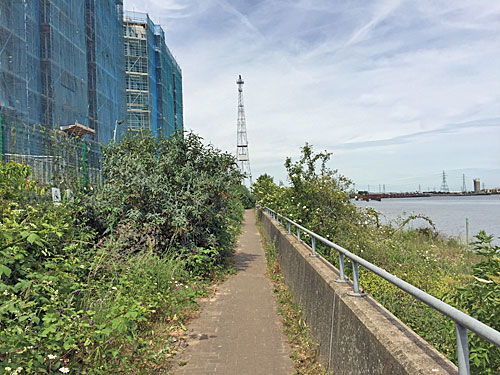
This weekend bus routes 3, 4, 9, N9, 14, 35, 40, 45, 53, 59, 67, 76, 100, 134, 149, 171, 172, 205, N205, 242, 341, 343, 388, 468, 476 and RV1 are changing. It's quite the biggie.
The plan is to cut, extend, divert, tweak and erase bus routes to save millions of pounds, removing excess capacity across large parts of central London. Further details of the changes can be found here, assuming you have the patience to sieve through 1800 words and nine spider map leaflets, and the original consultation with all the background detail is here.
One consequence of these changes is that some very well known roads will no longer receive a bus service. Three of them are even prominent on the Monopoly board. I've been out to ride these streets while I still can, and to see how TfL is alerting passengers that from Saturday no buses will be turning up.
Most of Saturday's changes are because too many buses run down a particular road. This change stands out because route 9's going to be diverted to along the bottom end of Regent Street and the top end of Piccadilly where there's already excess capacity. The reason? To reverse an earlier change that didn't work. After Pall Mall became a two-way street in 2011, TfL re-routed the 9 "to improve public transport accessibility to the surrounding areas of St James’s Park and The Mall which are currently distant from the bus network." But the new stops proved less popular than hoped, reducing the number of trips on route 9 by 2500 passengers a day, so now they're going to switch it back.
There are only two bus stops on the mothballed stretch, not so far from St James's Palace (should Princess Beatrice ever fancy a ride). Both stops have the standard yellow notice that's been slapped up willy-nilly at affected stops across the capital. There is no mention that the 9 (and N9) are being diverted and buses will never stop here again, only an exhortation to check a page on a website where you might unearth the eventual outcome. Printing a bespoke notice would have involved effort and expense, two things TfL's Yellow Brigade have evidently been keen to avoid. The Onboard Messaging Team have done better, with scrolling text that reads "Route 9 changes 15 June" and the occasional audio announcement, although I couldn't distinguish a single word above the Borismaster's thundering aircon.
Road deleted:FENCHURCH STREET Route diverted:40 (currently Dulwich to Aldgate, will be Dulwich to Clerkenwell Green)
Our next imminently-unserved street is in the City, as route 40 is whisked away and diverted somewhere completely different. From Saturday neither route 45 nor route 388 will run between Elephant & Castle and Blackfriars Bridge, so the 40's being sent that way to mop up some of the slack and will terminate at Clerkenwell Green rather than Aldgate. This is a significant shift and will break 2500 trips a day. It will still be possible to get from Elephant & Castle to Monument on the 35 or to Aldgate on an extended 343 (this is all so complicated, what hope does the public have?), but Fenchurch Street entirely misses out and will be busless for the first time since services began. TfL like to call this "simplifying the network", because taking buses away always needs a positive spin.
Fenchurch Street currently has four bus stops, two near the foot of the Walkie Talkie and two near the mouth of the mainline station. The latter pair have posters pointing out that services are changing, but no such posters appear at the first pair, because not only are the Yellow Brigade lazy they are also inept. The eastbound stop by the station is also shrouded in scaffolding, its flag concealed behind a strip of panelling, so the developers have been forced to paste a photograph of the flag on the adjacent hoarding so that passengers know what services actually stop. Let's hope someone changes the photo at the weekend.
Once again boarding a bus and listening provides a better level of information than standing at a bus stop. "Route 40 will be changing from Saturday 15th June. It will no longer run between Elephant & Castle and Aldgate but instead will divert via Blackfriars Bridge and Farringdon to terminate at Clerkenwell Green" is the lengthy message passengers occasionally hear. Meanwhile anyone arriving by train from Southend can always walk an extra couple of hundred metres to catch a different bus, or head to Tower Hill for the tube, or stuff it let's get an Uber and why bother with public transport anyway?
Road deleted:FETTER LANE Route diverted:341 (Waterloo - Meridian Water)
Fetter Lane's a backwater on the western edge of the City, linking Holborn Circus to Fleet Street past Sainsbury's HQ and the historic bit of King's College. Technically it's New Fetter Lane at one end, through a canyon of redeveloped offices, and Fetter Lane proper further down. Route 341 would've followed Chancery Lane if it could, because that's more direct, but the road's too narrow so buses have long been forced to take this detour via Fetter Lane. In future they'll be going via Farringdon Road instead, "providing faster journey times" and "creating new links between Blackfriars and Islington".
This time there are three bus stops, and absolutely no yellow posters at all. One of the stops has a 341 timetable and a map but nothing else, and the other two only have the default undersheet that says "We apologise if the timetable you require is not displayed here at the present time". Nobody waiting in Fetter Lane this week has any reason to suspect that anything is afoot because the Yellow Brigade have given it a complete miss. Even the 341's onboard message is keener to point out that in future the 341 will "terminate at Waterloo station instead of County Hall", instead of the much more significant detour it'll be making along the way. But only 7% of passengers on route 341 will be affected, and the diversion's only a short walk away, so don't expect too many people to be greatly inconvenienced.
Area deleted:COVENT GARDEN Route extinguished:RV1 (Covent Garden - Tower Gateway)
The only bus route to nudge into Covent Garden's Theatreland enclave is the RV1, the most famous casualty of the upcoming bus tweak. This tourist-focused route was introduced in 2002 and meanders close to the Thames between here and Tower Bridge. But long-term road works around London Bridge station made it less attractive, passenger numbers slumped, its frequency was unceremoniously halved last year and now it's being dumped altogether. As the on-board announcement confirms "Route RV1 will be no longer run after Friday 14th June", and that's just three days away. For a deeper analysis of the issues, here's a report I wrote when TfL first announced the route was destined for the scrapheap.
Both of the RV1 bus stops in Covent Garden have been visited by the Yellow Brigade, one in Russell Street where services terminate and the other in Catherine Street where they restart. Again it's the default 'Routes from this stop will be affected' notice, rather than any useful description relevant to local issues. So generic is the notice that it fails to recognise there is only one route from this stop, not 'routes', which makes the whole thing all the lazier. But seriously, Yellow Brigade, if you are going to scrap a bus route at least have the balls to print a poster explaining this to customers rather than concealing the change behind cheap weasel words.
The most significant loss to the bus network when the RV1 disappears will be the backstreets along the South Bank. Here, for this week only, the RV1 edges away from Waterloo towards the London Eye, then dawdles past the back of the Royal Festival Hall (and what used to be ITV's London Studios) on its way towards the Oxo Tower. These backroads aren't choked with traffic but one loose coach can slow things down and this was never a bus to take for its speed. Scrapping the RV1 should save £3.3m a year, TfL have argued, and alternative stops on Waterloo Bridge or on the parallel route 381 are only a short walk away.
Six RV1-only bus stops are to lose their service. The first eastbound stop has a shelter but no pole on which a yellow poster could be stuck, so none has appeared. The second and third eastbound stops are suitably arrayed. But westbound the route's a mess, with two out of three of the stops currently out of use due to different sets of roadworks. The shelter by the London Eye is inaccessible amid a building site, so is already irrelevant. And the shelter by the Oxo Tower displays not one but four interventions by the Yellow Brigade.
Firstly a yellow cover over the bus stop flag saying 'Bus stop not in use'. Secondly a yellow background on the bus stop panel saying 'Bus stop closed'. Thirdly the usual yellow poster saying 'Routes from this stop will be affected'. And fourthly a bespoke poster confirming 'Route RV1 unable to stop here' 'from 0700 Thursday 14 March 2019 to 1800 Tuesday 10 September 2019'. Anyone turning up on spec would assume that the RV1's disappearance is only temporary and it'll be back in three months time. Instead its scrappage was announced just nine days after the diversion started, but nobody from the Yellow Brigade has ever come back to confirm this stop's already closed for good.
So, my final count of doomed stops on doomed roads suggests a 50% success rate, as follows...
9: two stops, both with yellow posters 40: four stops, two with yellow posters 341: three stops, none with yellow posters RV1: six stops, four with yellow posters (one ambiguous)
This weekend the tiles on hundreds of bus stops need to be changed, the timetables along 25 routes need replacing and innumerable spider maps need to be updated lest they show incorrect journeys. What are the chances that the Yellow Brigade will achieve a complete sweep?
They've seen something, read something, watched something or experienced something and their first thought is "well that's not how it should have been done" instead of "that's not how I'd have done it". Disapproval rather than open-mindedness. Certainty rather than speculation. Self-importance rather than objectivity.
It could be something trivial, like wearing a particular brand of trainers, or someone with a tattoo you don't like, or the meal they've ordered at the table next to yours. That's just wrong, you'll say, perhaps hoping for a nod from your companions, rather than recognising that your opinion is irrelevant.
It could be a decision that was out of your control, like a building you don't appreciate, or a football manager making a last minute substitution, or a film you'd have ended differently, or the racket that's number 1 in the pop charts at the moment. That's just wrong, you'll say, perhaps genuinely believing it is, rather than recognising it was never your choice to make.
It could be much more serious, like a woman's right to an abortion, or the pros and cons of immigration, or choices for the future direction of our economy - areas where many people are sure they know what's best. When Michael Gove declared that "people in this country have had enough of experts" he was simply tapping into this groundswell of deep personal certainty. But experts do genuinely know what they're talking about on certain issues, and it's dangerous to ignore them because they're not telling us what we want to hear.
Claiming that something is wrong happens a lot in politics, indeed our national debate is often built on it. Politicians like to point at something - a decision, an economic structure, a health outcome, the status quo, whatever - and denounce it as wrong. It's not necessarily wrong, it's simply not the decision the politician would have made themselves, but labelling it 'wrong' better frames their rhetoric.
If we happen to agree with that politician's viewpoint then we're likely to leap in and think yes, that's wrong, rather than stopping to question the veracity of their claim. Alternatively if we disagree with their viewpoint then we're likely to end up angry, because their assumption is patently incorrect, and the temperature of the discussion ratchets up another notch. Disguising opinion as fact rarely aids debate.
To be clear, it's by no means always the case that "that's wrong" means "I wouldn't have done that". Some things are genuinely wrong because facts are facts. Some things are definitely wrong because they contravene universal rules. Some things are wrong because society says they are, like murder, speeding, fraud, queerbashing and theft. You might not like the laws that enshrine these values but it's not your call to make, it's how things are. Only if a shade of opinion is involved, and the "that's wrong" brigade weigh in, do things get awkward.
This mindset often gives rise to blinkered criticism. That typeface is wrong, people say, when what they really mean is they wouldn't have used it. The behaviour in that story on social media is wrong, they tut, when what they really mean is they'd have reacted another way. That TV news report is wrong, they gripe, when what they really mean is they'd have edited it differently. That change to local services is wrong, they moan, when all they've actually considered is how they themselves will be affected.
It's all too easy to get on your soapbox and complain about a decision when it's not the decision you'd have made. It was somebody's decision to make, and if you'd applied to the company and worked your way through the organisation maybe that person could have been you. But you didn't, and they did, and they probably made the decision based on a far wider range of facts and factors than you ever could.
Too many people assert that something is wrong when in fact they're only making a value judgement. What's more they firmly believe it is wrong, because the idea that other opinions might be valid never enters their mind. One reason public discourse gets so heated is because too few people stop and think before their prejudices kick in.
Use of the word "surely" is often another indicator of inadequate thought. No matter of opinion is ever so cut and dried that "surely" is an adequate response. Describing something as "obviously wrong" should also be avoided, and "clearly wrong" suffers from the same degree of overconfidence. Far better to be self-aware enough to describe something as "probably wrong", recognising that even if you wouldn't have done it like that, somebody else might.
It's crucially important to be able to step back and think about an issue objectively. One reason history and science are in the curriculum is to train us to be critical of facts and to take evidence into account before leaping to conclusions. Our world is hugely complex, and ploughing through it thinking we have all the answers is a profoundly dangerous way to behave.
Something isn't wrong solely because we wouldn't have done it that way ourselves.
Let's go for a three mile walk along the Cromford Canal in Derbyshire. For an unnavigable waterway it sure packs a punch. [7 photos]
I could have started at Ambergate, indeed the canal originally started way back at Langley Mill, but I'm starting at Whatstandwell because I've just been to Crich. Access to the towpath is halfway down the steps between the village and the station. Whatstandwell's most famous daughter is round-the-world yachtswoman Ellen MacArthur (although looking at the water level in the canal I doubt you could get a canoe down it, let alone a boat).
Well this is very pleasant. A group called the Friends of the Cromford Canal have been working to bring the canal back to life since 2002. Their president is Brian Blessed, which puts your local restoration project to shame. The canal opened in 1794, for reasons we will discover later, and was cunningly designed to follow the 275ft contour for six miles in order to save money by not needing any locks.
The Derwent Valley's quite narrow at this stage, and has to accommodate a main road and a railway as well as the canal and the river. Here at Whatstandwell they're threaded in the order river/road/railway/canal, but very soon that switches to road/river/railway/canal, then to road/railway/river/canal and by the time we've finished it'll be road/canal/river/railway. That road is the A6, the main road from Luton to Carlisle, here in one of its less trunky sections.
Suddenly the canal and towpath vanish into a tiny arched portal and enter the Gregory Tunnel. This is 76 yards long, which is just long enough to be disconcerting, but the other end's always visible so try not to let the central darkness put you off. The big house you can't see on the hilltop is Lea Hurst, childhood home of Florence Nightingale (or would have been if it only it had been less cold, so her family rapidly moved to Hampshire and used Lea Hurst as a summer residence instead).
The canal continues between steep wooded slopes, several feet above the level of the bottom of the valley. A very short aqueduct carries it across the railway, just before that plunges into its own tunnel, whereas the waterway sweeps on round a broad thickly vegetated bend. Amid the ferns and nettles you might spot a bright red cardinal beetle or two, flapping from leaf to leaf amid clouds of yellow buttercups. This is still all very pleasant.
The next aqueduct is more impressive, an 80ft span which carries the canal at an angle across the Derwent. Nip across the swingbridge to be on the right side for the Leawood Pumping House, which is the Victorian building supporting that thin brick chimney looming through the trees. Come on the first weekend of the month or a bank holiday and it'll likely be in steam and you can go inside and ogle the beam engine's 15 ton plunger.
High Peak Junction, below Lea Bridge, is a wilfully unlikely transport interchange. Here the Cromford & High Peak Railway bore off from a wharf by the canalside, its purpose to transport goods across what's now the Peak District as the only alternative to a peripheral navigable detour. It kicks off with a 1 in 8 incline, far too steep for trains so originally hauled by stationary steam engines, and which today forms part of a long distance hiking trail and cycle track.
The railway's astonishing history is told amid a few surviving building at the wharfside - just climb aboard the brake wagon and read the panels or walk around the workshop and peruse the tools. They also sell hot drinks and ice cream. It'd be a nicer spot to linger if only there weren't a sewage works on the other side of the railway, but this doesn't appear to stop the visitors coming.
The last mile of the canal has been restored by the Friends so is now navigable, and a single narrowboat does occasional tours a few days a week. Alternatively it's an easy amble onward to Cromford, past a meadowful of sheep, to the final basin at Cromford Wharf. Today the final warehouse building doubles up as a specialist cheese shop and pizza restaurant, because we've finally walked far enough to interface with car-bound tourists and coach parties.
Here finally is the reason why the canal was built - Richard Arkwright's pioneering Cromford Mill. Opened in the 1770s it was the world's first water-powered cotton spinning mill, a technological breakthrough so profound that dozens of similar mills were set up across the Pennines. Employers also adopted Arkwright's intensive factory procedures, including 13 hour shifts for textile workers, and hey presto the Industrial Revolution was on its way.
The mill complex forms a horseshoe offactory buildings surrounding a cobbled courtyard with a millrace thrashing down the centre. Come for the industrial archaeology if you like, and maybe pay to see The Arkwright Experience, but the site now exists to house artisans and creatives. Arrive too late in the afternoon and the antiques sellers will be locking up, the ceramics studio will be emptying and the cafe will be turfing out.
Another of Arkwright's firsts was housing for employees, and the adjacent town of Cromford retains numerous streets of 18th century workers' cottages. It's particularly picturesque across the market place and aroundthe lake, and would be even more delightful if the A6 didn't crawl through on its way to Matlock Bath, which is next up the gorge. But I did Matlock in 2017, and there isn't time to go again, and anyway the canal's already petered out.
In 2001 the Derwent Valley between Cromford and Derby was designated a UNESCO World Heritage Site, because its mills "were the first of what was to become the model for factories throughout the world in subsequent centuries." That's a pretty amazing claim, but this East Midlands valley is a pretty amazing place, indeed some might say Cromford's where modern Britain began.
Once upon a time, for which read the start of the 20th century, the electric tram was a mainstay of urban transport. Those golden days are lovingly recreated at the National Tramway Museum in Crich, Derbyshire, where a substantial collection of preserved vehicles operate for your delectation and delight. [12 photos]
The collection began in the 1950s, rescuing vehicles that'd otherwise have been scrapped and relocating them to a quarry on a hilltop above the Derwent Valley. George Stephenson had built a mineral railway here in the early days of steam, so the place had history. Volunteers laid a mile-long track, added sheds and depots to store what's now over sixty vehicles, and relocated a few heritage buildings to give the place a small-town feel. It makes for a proper (not exclusively transport-focused) day out.
At the ticket desk they give you an old penny to exchange on your first tram ride for a clippie-punched ticket. Trams run all day to the quarrytop and back, and visitors can ride as often as they like so long as there's enough space aboard. In dry weather open-topped vehicles are used, but at the sniff of a shower in the forecast the covered trams come out (which at least means you get decorated ceilings to admire). On my visit trams from Sheffield, Glasgow and Berlin were being given the runaround, each operated by enthusiastic peaked-capped staff.
Trams are the ultimate in inaccessible travel, with a massive step up followed by a vertiginous staircase to the upper deck. It's a wonder these trams ever fulfilled their design brief given the time taken to board and alight, although I suspect 100 years ago there weren't quite so many pensioners and small children trying to descend. Rest assured that one vehicle - the Access Tram - has indeed been fitted with a ramp, and that use of a walking stick wasn't putting everyone off clambering upstairs for the finest view.
The service begins at Town End, alongside a genuine Tardis-style police phonebox and the migrated frontage of Derby Assembly Rooms. Step inside the latter for recognition that modern light transit trams exist, and a wallfull of maps showing every former tram network in every distant corner of the UK. Yes, even Weston-Super-Mare and the Isle of Bute. The Discovery Centre presents a well-judged history of the site and trams in general, including how they saved Britain's streets from becoming a quagmire of horse manure. And then there are the tramsheds.
These are crammed with vehicles, parked just close enough for visitors to squeeze past, tucked out of the way awaiting their day on the tracks. The main display collection is in the Great Exhibition Hall, which is laid out decade by decade to show the development of vehicles from equine-tugged to steam-thrust to electric-powered. Sadly only one vehicle is open for visitors to go inside, and even then only the lower deck - a mild frustration which feels like a missed opportunity.
At the top of the cobbled high street the main tracks narrow to pass beneath a lofty bridge, this shipped in from the Bowes-Lyon estate in Ware. Not only does the bridge provide a useful viewpoint but the width restriction means careful juggling of points and tokens is required to keep the day's timetable on track. A further complication on Thursday was a learner driver taking a Blackpool tram out for a spin under close supervision, either to learn the ropes for the future or as part of one of those moneyspinning Tram Driver Experiences.
Beyond Victoria Park the tracks enter the quarry proper past disused machinery and beneath blasted millstone cliffs. That strange tower on the hilltop is Crich Stand, a memorial to soldiers from the Sherwood Foresters Regiment, which is separately visitable and (on a good day) climbable too. Before long the tram reaches a clearing at Wakebridge, which is also accessible via a separate Woodland Walk should you fancy a different route back. The Walk's much more interesting than it sounds, with proper weaving trackways, viewing platforms looking out across the valley, a selection of humorous wood sculptures and a chunky rock labyrinth.
The overhead wires beyond Wakebridge were repaired during the winter, and there's been a bit of trouble with the connections ever since, so on the morning of my visit services had had to be curtailed. This did at least mean I got to watch a tower wagon inch up the line carrying two practical-looking souls in hardhats wielding toolboxes, beavering away making temporary repairs. I had feared I'd never see the top of the line at Glory Mine, but thankfully their travails eventually succeeded and from mid-afternoon the full service resumed, including panoramic views on the uppermost stretch.
Return tram services deposit passengers outside the village's cluster of refreshment offerings. The Red Lion pub derives from Stoke-on-Trent, and now serves craft ales, sodas and quite a lot of gin. There's also a tearoom (with hot food options), a sweet shop and an ice cream parlour, all good for a gentle sitdown. But it's the trams that are the star of the show, and on the slight off-chance that one or two of my readers might perhaps have a mild interest in public transport I can heartily recommend a visit.
Practicalities
» The nearest station to Crich is the delightfully-named Whatstandwell on the Derwent Valley Line.
» The museum is only a mile away, but when they say it's up a steep hill they are not kidding. The route follows a narrow country lane which bends up the hillside past cute and not so cute cottages, and eventually sheep, affording excellent views across the Derwent Valley. The panorama gets pretty gorgeous pretty quickly. If you're reasonably fit it'll be no problem, but there are gym workouts that'd tire you out less. It's a lot easier on the way down.
» I reached the museum just under three hours after leaving St Pancras.
» A return ticket from London St Pancras to Whatstandwell costs £194.50, or £109.00 if you're happy not to arrive at the museum until midday, or £66.50 if you go at the weekend, or £40 if you book two months in advance and select sub-optimal trains.
» I booked a train to Derby one month in advance using the Megatrain website, then bought a separate return from Derby to Whatstandwell and my total fare was less than £30.
» Admission to the museum is currently £17.50.
» If you show a valid rail ticket at the entry desk they lop £3 off the admission fee. This fact is not advertised in any of the museum's publicity or on its website (but it is mentioned in the Derwent Valley Line's timetable leaflet, thanks).
» This reduced price doesn't include 12 months free entry to the museum, just a one-off visit, but unless you're local that's not going to be a problem.
Let's visit the locations that lie seven miles north, east, south and west from the statue of Charles I in Trafalgar Square. It's not the most thrilling of quartets, but it still beats what eight miles'll have to offer. [1 mile], [2 miles], [3 miles], [4 miles], [5 miles], [6 miles], [map]
SEVEN MILES NORTH: Bounds Green Road, N11 (junction with Warwick Road)
It turns out there is a green in Bounds Green, and here it is, marked by a green sign saying Welcome To The Green. A narrow grassy stripe tapers towards the North Circular, at this end broadening slightly to encompass a cluster of wooden exercise equipment and a retired couple on a bench. He's reading something weighty, she's reading about Heroic Failure. The pub on the corner is The Ranelagh, a free house since 1899, brightened by a rim of lush flowers tumbling over the claret woodwork. The chef's idea of fish and chips is "ale-battered cod with triple-cooked chips and tartare sauce", plus "posh mushy peas" on the side as an optional extra. At the adjacent Sunrise Cafe it's "egg, bacon, tomato, sausage, fried slice and tea" all-in for a fiver. Outside Sonjig's off licence two men from Shutters Ltd have climbed stepladders to wrestle with some improperly-descended metalwork, while the shop assistant brushes fallen detritus towards the kerb.
By my calculations the precise seven mile point is outside the bus shelter opposite, where the 221 pulls up after its brief descent from the tube station. Illuminated posters advertise 7 Up and Muller Light. The bench rattles. Here is where the big houses stop and a sequence of flats intervenes, behind a raised public lawn that would otherwise have been front gardens. The block behind the bus stop is called Warwick Court, which is odd because so is the block on the other side of the road, which is odd because that road isn't Warwick Road it's Passmore Gardens. Its residents held a street party on Sunday, the only trace of which is a permission notice tied to a lamppost. Just beyond is Scout Park, an eight acre compound offering plenty of space for camping cubs, opened in 1928 on the site of a pottery and now offering opportunities for archery, air rifle shooting and climbing. I bet more than one of you has slept here overnight.
SEVEN MILES EAST: ExCel (in the car park, eastern side)
Here we are again Along The Dock Edge, indeed I dropped by on Saturday as part of Anna Gibb's London Festival of Architecture walk. The interior of the ExCel exhibition centre can be pretty desolate during non-conferences, but that's nothing compared to the car park out the back. Its sprawling rectangular grid lies empty behind a lowered barrier, occupied solely by birdlife and the occasional wandering pedestrian. It seems ridiculous that so large a chunk of prime development land lies fallow, but vehicles must be catered for, and at £20 a time (when operational) it's a nice little earner. Mothballed in one corner is a squat black prefab marked with the Avengers logo, this a Marvel "multi-room experience" for die-hard fans packed with suits, screens and props in cases. It closed months back, godawful TripAdvisor reviews perhaps to blame, and awaits transfer to fleece the population of Cardiff.
Look carefully to see a rail embedded in the concrete a few yards back from the water, this a remnant of the tracks once used by dockside cranes. A shorter parallel rail has been preserved slightly further along. In the water are a quartet of paddleboarders, the most athletic of whom has just slipped and soaked himself, to the amusement of his gawkier companions. Three rowers walk past from the direction of the London Regatta Centre, bantering about that time they caught crabs. A bottle of Ribena floats by. A car alarm blares. Every few minutes a DLR train weaves along a viaduct between the Aloft, Premier Inn and Doubletree hotels. Meanwhile across the dock the entire Silvertown Quays lot remains vacant, long pencilled in for intensive mixed use development, but to date home only to a few abandoned 2012 entertainment pavilions.
SEVEN MILES SOUTH: Northborough Road, SW16 (Norbury/Pollards Hill)
Northborough Road breaks off from the main road by Norbury's Wetherspoons and dives deep into Edwardian suburbia. The estate agent on the corner appears to have the monopoly on house sales and flat rentals further up. Initially they're quite terracy, with front gardens barely large enough to hold Croydon's full complement of three bins. Then a few gabled properties intrude, then it gets quite mixed, but always stitched together with no direct rear access. The house numbers are my favourite feature, each embedded in the wall as separate digits on glazed tiles, one brick's length from the edge of the porch. The precise location we're looking for is in the high hundreds, by the stinkpipe, right on the brow of the hill.
The view to the west is remarkably lowrise, with Merton Civic Centre the sole tower along a woody skyline. Lined up to the east are the Crystal Palace TV mast, a church spire and the former WindsorHouse office block. A learner from the Polka Driving School ascends the road with caution, slowing for each hump, trailing a procession of vehicles behind her. The council streetsweeper smiles by, earbuds drooping, although he has yet to reach the fox-ripped bag spilling takeaway trays across the pavement. A family emerges from behind a high hedge in their Eid finest before piling into an estate and driving off to celebrate. Two recycling sacks have been left on a damp pillow at the end of Norton Gardens. A blackbird sings.
SEVEN MILES WEST: Ealing Common, W5 (Gunnersbury Avenue, aka North Circular Road)
When you think of the North Circular you think of a drear dual carriageway, but here in Ealing it's a narrow tree-lined avenue. No planner ever dared encroach upon the common, or deprive the villas along Gunnersbury Avenue of their front gardens. These have highly decorated gables crafted with overlapping terracotta tiles, and intricate arched porches that plead with you to come inside. The two houses guarding the entrance to Crosslands Avenue even have turrets. They're built on the site of Ealing Common Farm, and the estate beyond used to be its orchard. Today's residents perch pots of pansies on their gateposts, and drape hosepipes across their front lawns to refresh their rosebushes, and park their Mini Countrymans beside their BMWs, and live out an idyllic Thirties suburban dream as if in a quiet corner of Chorleywood but in zone 3.
The corner of the common that abuts the North Circular is closed to all traffic but bicycles. One bright orange steed has been left propped up beneath a sycamore, this one of the Chinese-funded Mobike fleet that still attempts to eke out a dockless living across Ealing. The common bristles with rich vegetation, grassy stalks and scattered wildflowers. Follow the sandy track to a bench where you can watch the delivery lorries go by, or spy the tower of the local parish church, or flop back with a podcast and a wrap. Close scrutiny of the horse chestnuts reveals clusters of tiny spiked green cases preparing autumn's conker harvest. Beyond the treeline the Eid In The Park festival is getting underway. Best not rush ahead to eight miles too soon.
Three years ago, just before the referendum, I posted this handy table of Eight Alternative Futures.
1
2
3
4
5
6
7
8
BREXIT
NOT
BREXIT
BORIS
NOT
BORIS
BORIS
NOT
BORIS
TRUMP
NOT
TRUMP
TRUMP
NOT
TRUMP
TRUMP
NOT
TRUMP
TRUMP
NOT
TRUMP
As a commentariat you offered a broad selection of preferences ranging from "I really hope for #1, at least politics etc would be interesting again" to "If we get #1, stop the world, I want to get off." The only option none of you mentioned was number 3.
Within days the Brexit question resolved itself in favour of the left-hand side of the table, and the selection of Theresa May as PM narrowed the choices to either 3 or 4. Then in November the US election fixed the bottom row, and hey presto we were in future number 3.
1
2
3
4
5
6
7
8
BREXIT
NOT
BREXIT
BORIS
NOT
BORIS
BORIS
NOT
BORIS
TRUMP
NOT
TRUMP
TRUMP
NOT
TRUMP
TRUMP
NOT
TRUMP
TRUMP
NOT
TRUMP
Except maybe we're not. Britain may have voted for Brexit but we haven't yet left the EU, and it remains possible we never will. Also Boris's failure to beat Theresa May in 2016 hasn't damaged his long-term chances, and at time of writing he's currently favourite to replace her.
Which means futures 1, 3, 5 and 7 are still very much up for grabs, but with the three rows now in reverse order.
1
5
3
7
2
6
4
8
TRUMP
NOT
TRUMP
BORIS
NOT
BORIS
BORIS
NOT
BORIS
BREXIT
NOT
BREXIT
BREXIT
NOT
BREXIT
BREXIT
NOT
BREXIT
BREXIT
NOT
BREXIT
Even three years later we still have no idea which alternative future will ultimately win out, and attempting to second guess the outcome is as futile as it was before.
OSIs shown as dotted lines on the tube map(ranked by average daily usage)
• Hammersmith/Hammersmith (7360)
• West Hampstead/West Hampstead (5979)
• Shepherd's Bush/Shepherd's Bush (3906)
• Shadwell/Shadwell (3473)
• Canary Wharf/Canary Wharf (3079)
• Tower Hill/Tower Gateway (2199)
• White City/Wood Lane (1889)
• Euston/Euston Square (1117)
• Clapham High Street/Clapham North (1067)
• Camden Town/Camden Road (1030)
• Finchley Road/Finchley Road and Frognal (670)
• Bow Church/Bow Road (426)
• Northwick Park/Kenton (289)
• Archway/Upper Holloway (224)
• Wanstead Park/Forest Gate (170)
• Walthamstow Central/Walthamstow Queen's Road (122)
• Seven Sisters/South Tottenham (119)
• Hanger Lane/Park Royal (65)
• New Cross/New Cross Gate (62)
Dotted lines on the tube map that look like OSIs but aren't(that's naughty)
• Swiss Cottage/South Hampstead
• Caledonian Road/Caledonian Road and Barnsbury
• Manor House/Harringay Green Lanes
OSIs that aren't on the tube map but people are always going on about
• Bayswater/Queensway (94)
• Lancaster Gate/Paddington (76)
• Ickenham/West Ruislip (43)
The Out of Station Interchange, or OSI, is a TfL kindness which allows you to exit one station and enter another nearby without being charged extra. Only certain stations are included (a full list is here/here), and the transfer must be completed in a set amount of time.
For example if you arrive at Hammersmith on the Circle line but want to change to the District, the OSI permits you 20 minutes to cross the main road, maybe buy a coffee, even nip off to the toilet, then continue your journey for no additional fare.
In a recent FoI request, TfL have revealed how many times each of the 130 OSIs was used during a four week period spanning either side of Easter. This is of course extremely interesting, and can be used to list...
The 10 least used OSIs (11th April - 8th May)
0) Hackney Downs ←→ Hackney Central (20 mins) (0 passengers)
Absolutely nobody uses this OSI because it's now obsolete. A 400m walkway connection opened between the two Overground stations in 2015, so nobody now needs to walk out of one set of ticket gates and back in at the other, so nobody does. Let's disregard this one.
1) Marylebone (NR) ←→ Paddington (NR) (40 mins) (9 passengers)
This is the least used OSI that's actually used. Pay as You Go passengers changing between the rail termini at Marylebone and Paddington can do so free of charge so long as they complete their change in 40 minutes (and don't nip onto the tube or a bus inbetween). The walk's three-quarters of a mile, which explains why hardly anybody does it - only nine people over a four week period, which is roughly two a week. For comparison, on a typical day about 500 Oyster users walk between Marylebone and Baker Street, and about 2000 cross the concourse between Marylebone (rail) and Marylebone (tube).
2) Euston (NR) ←→ King's Cross (NR) (40 mins) (42 passengers)
The second least used OSI is also between two mainline termini. Again it only relates to Oyster or contactless users switching between National Rail services (for example an Overground journey into Euston followed by a slow train out to Alexandra Palace), and doesn't include long distance travellers. Another row in the spreadsheet shows that Euston to St Pancras is a bit more popular (972 passengers), but still not very popular.
3) Sudbury Hill ←→ Sudbury Hill Harrow (20 mins) (46 passengers)
Sudbury Hill's on the Uxbridge branch of the Piccadilly line and Sudbury Hill Harrow on the Chiltern line out of Marylebone. The two stations are barely 100m apart so this could be a well used OSI, but instead it's scuppered by Sudbury Hill Harrow only having an hourly-ish service on weekdays and no trains at weekends. Could do better.
4) Tower Gateway ←→ Fenchurch Street (→ 40 mins, ← 20 mins) (55 passengers)
Pop out of Fenchurch Street's back entrance and you can be at Tower Gateway in under five minutes. The reason almost nobody does is that anyone wanting to change between c2c and DLR probably did it back at Limehouse where the two lines share a station, so there's no point doubling back at Fenchurch Street. Note that passengers heading towards Fenchurch Street are allowed twice as long to make their connection as passengers heading towards Tower Gateway, because OSIs are strange like that.
5) Walthamstow Central ←→ Walthamstow Queens Road (25 mins) (67 passengers)
Walthamstow Central to Walthamstow Queens Road is a recommended connection, ever since a connecting path was opened in 2014, so why are passenger numbers so low? The reason is that Overground users at Walthamstow Central have been counted separately from tube users using the Victoria line ticket gates, and the two streams are highly imbalanced. In fact 3357 Victoria line passengers changed between Walthamstow Central and Walthamstow Queens Road, and that's where the real OSI traffic is.
6) Embankment ←→ Waterloo East (→ 40 mins, ← 25 mins) (80 passengers)
Here's another 'but why would you do that?" Every mainline train which stops at Waterloo East also stops at Charing Cross, and that's a much more sensible place to change trains. What we're probably counting here are people who fancied a nice walk across the Golden Jubilee Bridge and just happened to walk into a station on the other side within the requisite time limit. This number equates to approximately three people a day, which is insignificant in the wider scheme of things. Here's a diagram which illustrates the wider scheme of things, including all the OSIs in the vicinity of Charing Cross and Waterloo.
7) Upper Warlingham ←→ Whyteleafe (20 mins) (89 passengers)
Now we shift to the very edge of the capital, and a sub-five minute walk between the Caterham and Uckfield lines. One reason this OSI is barely used is that Upper Warlingham is the last station within the Oyster zone, so only passengers at Sanderstead and Riddlesdown have any practical use for the switch. Again, about three a day.
8) Clock House ←→ Kent House (20 mins) (128 passengers)
The line from London Bridge to Hayes doesn't meet the line from Victoria to Bromley, and this really is the best place to swap. But it's a half mile walk, and a bit of a local secret, so hardly anybody clocks in.
9) Bromley North ←→ Bromley South (30 mins) (131 passengers)
Two key southeast commuter lines cross near Chislehurst without providing any use place to interchange, so why not try this Bromley switcheroo instead? Mainly because the Bromley North spur has a poor service and, more importantly, stops a full kilometre away from Bromley South. A very decent bus service connects the two stations, but if you board a bus you break your journey and the OSI never kicks in. Only five passengers a day, on average, do the walk and gain the benefit.
10) Canary Wharf (E2) ←→ Heron Quays (15 mins) (182 passengers)
And finally, one of the many possible cross-Canary-Wharf connections. I think we need another map. Figures are daily approximations.
Canary Wharf Jubilee line station has two ends and each is a distinct exit, as you'll know if you've ever accidentally walked out of the wrong one. TfL have therefore created OSIs from each end of the station to each of the neighbouring DLR stations, plus an extra OSI to allow anyone to pass freely from one Jubilee exit to the other. The walk-through is quite popular, officially ticking off around 450 passengers a day. Far more popular are the Jubilee/DLR OSIs at the western end of the station, rating several thousand. Unsurprisingly DLR passengers don't generally head to the eastern end of the station, which is how Heron Quays gets to be the final runt in the least used OSI Top Ten. Heaven only knows what'll happen around here when Crossrail arrives.
And for completeness, The 5 most used OSIs (11th April - 8th May) 1) Waterloo (LU) ←→ Waterloo (NR) (1100000 passengers) 2) London Bridge (LU) ←→ London Bridge (NR) (1070000 passengers) 3) Victoria (LU) ←→ Victoria (NR) (1000000 passengers) 4) Liverpool Street (LU) ←→ Liverpool Street (NR) (680000 passengers) 5) Vauxhall (LU) ←→ Vauxhall (NR) (580000 passengers)
Crossness Pumping Station opened on the banks of the Thames in 1865, between what are now Thamesmead and Belvedere. Nobody lived nearby at the time, which made this the ideal location for the outfall of the Southern Outfall Sewer. Here was one endpoint of Joseph Bazalgette's solution to Victorian London's great sanitation crisis, blah cholera, blah the Great Stink, blah yes you've probably heard all this before. But there's nothing quite like reacquainting yourself with the scale of the enterprise, and even though you can't go down the sewers you can still stand in awe of his giant engines.
Expect quite a trek up a lonely road round the back of Southmere Lake, parallel to the huge overground sewer piping its cargo riverward. Most visitors drive, parking before the barrier at the far end, or on special open days they hitch a ride on a special minibus from Abbey Wood. Sunday was one of those special days, when the Thames Water employee at the gate smiles and nods everyone inside what's still a massive water treatment complex, and please stick to the path and keep going until you reach the brick building by the riverside. Try to ignore the faint background smell. You'll get used to it.
Bazalgette's network of pipes were designed to feed effluent from south London's suburbs toward a pumping station in Deptford where it was lifted by twenty feet, then sent under force of gravity via a larger pipe to Crossness. Here it collected in a reservoir with a capacity of 27 million gallons, then needed to be raised again to river level, hence the need for four huge rotative beam engines in a big shed. Nothing cunningly chemical took place, the plan was simply to dump the untreated sewage in the Thames on the ebb tide and let it wash out to sea. London's water quality improved no end, but Erith's tenure as a riverside resort ended overnight.
The Crossness Engines Trust was founded in 1987 to try to bring some of the machinery back to life. Their first battles were raising money and fixing the roof, then restoring one of the engines to working order which they finally achieved in 2002. I last came to look round in 2005, and quite a lot has changed since then including a major upgrade to the museum. The story of Crossness, from cholera to the Tideway Tunnel, is now told across a suite of display blocks scattered across the floor.
It's extremely well done, with a broad spread of information from the historical to the informatively scientific. Be sure to stop and press the touchscreens or you'll miss a lot. You may need to stand very close to the speakers to hear whatever it was I couldn't hear they had to say. This may be easier when the cafe's quieter. Don't expect to follow the displays in the correct chronological order without help (which comes in the form of a small printed map handed out at reception upon which a ridiculously sinuous line is drawn, which you'll likely discard for being unmanageable, and for goodness sake just paint some arrows on the floor). I learned a lot.
When you're ready, don a safety helmet and enter the industrial cathedral. The Engine House is an astonishing space, and I don't say that lightly. No larger beam engine survives anywhere in the world today, and Crossness has four. Come on the right day and you can even watch one in operation, a whopping flywheel spinning to power a 52 ton beam nodding hypnotically overhead. Take the vertiginous iron staircase to the upper level for a closer look.
Even on non-steaming days the building's amazing, courtesy of the structural mesh of ornamental cast ironwork. To the Victorians a sewage works was something to be proud of, even though it'd almost never be seen, so the interior is wilfully over-decorated throughout. The central octagonal lobby is surrounded by a symmetrical pattern of metal leaves and flowers on all sides, plus Metropolitan Board of Works monograms, and is beautifully painted in green, white and red. Those with a penchant for machinery come for the engines, and everyone else ends up worshipping the ironwork.
Other things to see in the helmeted zone include a shiny plaque you must not touch and a cavernous chamber now emptied of machinery. Other things to see back in the museum include a cavalcade of toilet cisterns and a selection of historical loo paper. Things to buy in the shop include fudge, toilet-seat-shaped notepads and owls made from nuts and bolts. The volunteers look like they weighed up every post-retirement option Bexley had to offer and picked the one that looked the most fun.
By next year the Crossness site should have another outside attraction, namely a narrow gauge railway running half a mile along one edge. They already have a loco called Bazalgette, sourced from the National Garden Festival at Stoke-on-Trent, and a trailer-cum-carriage to pull behind. What they need are volunteers to help lay the remainder of the track, which currently peters out into black sheeting beyond the turning loop rather than reaching the car park. But don't wait to come. By rights every Londoner ought to visit Crossness at least once, if only to recognise the extraordinary achievement that helped cleanse the city and make it thrive.
Next Open Days (steaming): June 23, July 21, Aug 25, Sep 8, Oct 20 Next Open Day (non-steaming): July 6 Pre-booked tours: today, June 18, July 2/16/30, Aug 13/27, Sep 10/24, Oct 8/22
Schedule for President Donald Trump's State Visit (top secret)
Monday 3rd June 2019
09.00AM President and First Lady arrive Stansted Airport, Essex, United Kingdom 09.20AM Depart Stansted aboard Air Force Blue Thunder, accompanied by Budgie The Royal Helicopter 09.30AM Refuse to cross M25 until London turns off its 5G network 09.50AM Hover menacingly down the Lea Valley, looking for golf courses to purchase 10.00AM Drop bulk load of Freedom Leaflets over the Caliphate of Whitechapel 10.15AM President and First Lady arrive Buck House, London, United Kingdom 10.16AM HM Queen complains of a migraine, and leaves Charles and Camilla to it 10.45AM Inspection of guard of honour (try not to walk too fast this time) 11.30AM Very beautiful gun salute, most beautiful 12.30PM Lunch in State Dining Room - Big Macs and French Fries (Deliverooed from McDonalds) 01.00PM Glacially slow tour of Royal Art Collection, as punishment for requesting royal visit 03.00PM Excursion to Westminster Abbey to see the big windows, such excellent windows 04.30PM Tea at Clarence House with Charles and Camilla (second-best china) 05.10PM Refuse to listen to lecture on climate change, so leave early (in twelve-car motorcade) 05.30PM Stop by at the Trump Tower Hotel, formerly the Tower of London 06.30PM Secret visit to St Thomas' Hospital to sign contracts for the Trump Health Service 07.30PM Presidential cortège cunningly avoids inflatable blimp floating above Parliament Square 08.00PM State Banquet, dress code white tie/evening wear (baseball caps optional)
— Starter: Russian beetroot soup
— Main course: Mexican tortillas
— Dessert: Müller Light 09.30PM Speech of welcome performed by HM Queen via video link 09.31PM President to deliver rambling stream of paranoid contradictions 09.50PM Excruciating smalltalk and mingling 10.30PM Drive back to U.S. Ambassador's Residence in Regent's Park (avoiding Islamic no-go-zones)
Tuesday 4th June 2019
02.30AM Ivanka Trump still partying at Tiger Tiger 05.45AM Ivanka Trump rolled semi-conscious into armoured stretch limo 06.00AM President wakes early for his daily briefing from Fox News 06.01AM FBI on full alert in case WW3 is triggered by an incendiary tweet 07.00AM Presidential hairdresser arrives with three fluid ounces of glue 08.30AM Business breakfast at St James's Palace (No Deal will be assumed) 08.45AM Spend most of business breakfast discussing golf and redheads with Prince Andrew 09.30AM Arrive at 10 Downing Street for irrelevant talks with Imminently Ex Prime Minister May 10.00AM Break for Homes Under The Hammer 11.00AM Meet with PM Elect Boris Johnson to agree how to carve up the NHS under WTO rules 12.15PM Break for Bargain Hunt 01.00PM Joint news conference with President Elect Nigel Farage, then retire to pub for lunch 01.15PM First Lady and First Children head to Hamleys to buy the fourth floor 02.25PM Speaker confirms House of Commons is too busy to be interrupted by a presidential speech 02.30PMToday's Parliamentary business:
• Driving (Persons with Dementia)
• Wild Animals in Circuses (No. 2) Bill: remaining stages
• Debate on a Motion on The Mineworkers' Pension Scheme
• Transport in Hertfordshire 02.35PM Sneak off for a round of golf with Piers Morgan 04.40PM Tweet break
» Tweet announcing that the wall across Regent's Park is to be made permanent
» Tweet confirming NO COLLUSION!
» Tweet decrying Fake News Media for coverage of state visit so far
» Tweet contradicting all previous tweets 04.50PM ...and back to the golf 07.00PM One of the President's nuclear briefcases goes missing on the North Circular for ten minutes 08.00PM Dinner at the U.S. ambassador's residence (royals in attendance have been chosen by drawing lots) 08.30PM Grits, followed by chlorinated chicken, followed by treat-sized Hersheys 10.00PM Roulette and pole dancing 11.00PM Covfefe
Wednesday 5th June 2019
07.00AM Stash dressing gown with royal crest into suitcase 07.05AM Power nap 09.00AM Confirm that all the Trump children have returned from their overnight shenanigans 10.00AM Fly to Portsmouth, wherever the hell that is 11.00AM Escorted to Southsea Common inside soundproof Hummer 11.05PM Following mass roadside protests, decide to hit Hampshire with extra tariffs 11.30AM D-Day Ceremony is so private that local citizens can only watch it on big screens 11.50AM Introduced to some old guys who were in some war somewhere 12.10PM Say "It's just like the Edinburgh tattoo, but with more boats" 12.45PM Spectacular flypast of RAF aircraft (all for sale, for the right price) 12.50PM Tweet that some of the aircraft looked a bit old 12.55PM Tweet that America is definitely doing this next year, but bigger and better 01.00PM Queen bids a formal farewell to the President and the First Lady 01.02PM President and First Lady depart for Shannon Airport, Republic of Ireland 01.03PM Queen breathes sigh of relief and bans all further state visits by ignorant racists
The London Festival of Architecture, which launched in 2004, is Europe’s biggest annual architecture festival. It lasts a month, and that month is June, so kicked off yesterday. I struggled manfully through the atomised listings trying to find an event that was a) open, b) interesting c) free, and eventually plumped for...
Anna is an architect with a penchant for drawing architecture, so her contribution to LFA2019 is a self-guided walk. This follows the northern edge of the Royal Docks, from the cablecar to the Thames, and is accompanied by a free illustrated guide combining drawings of buildings, a historical timeline, a decent map and a selection of factual nuggets. I collected mine from the reception of the floating hotel beside the Dangleway, but they're also available in an arts centre and a coffee shop at the other end of the trail. Here's Anna explaining a bit more about the project. She's right that it's a lovely thing to do.
I started at the busy end of the Royal Docks, close to Royal Victoria station, closely followed by Noah and his family who were off for an excitable ride on the cablecar (WilkinsonEyre, 2012). If you must ride, try to come at any time other than a summer weekend because the view's the same and you won't be packed in like sardines. But not even June crowds can rescue The Crystal (WilkinsonEyre, 2012), Siemens' financially unsustainable sustainability exhibition. I watched three potential visitors wander away from the entrance having entirely failed to work out what the place was, let alone how much it cost.
This end of the dockside majors in unsparkling places to eat, ideal for guests whose nearby hotel doesn't serve breakfast. Those wibbly-wobbly blancmange-like flats rising in the background are called Hoola (CZWG, 2017), erected just before brick homogeneity kicked in. The cranes towering above the water's edge are from 1962, by Stothert & Pitt, and very much the oldest thing left. They're particularly prominent above Royal Victoria Square (Patel Taylor, 2002), and much admired by delegates wandering outside from whatever's on at ExCel (Moxley Architects, 2000). This weekend nothing much, so it's like an abandoned air terminal in there. Let's walk fast.
The dock is often alive with watersports. On my eastbound hike rather less so, just a manic race between four boatfuls of sea cadets yelping through the water from Millennium Mills to the Connaught Bridge. Croydon rowed home last. Tooting and Balham had brought a gazebo and were barbecuing burgers. It was quite the afternoon out. Across at the London Regatta Centre (Ian Ritchie Architects, 2000) the last rowers of the day had just finished, leaving water bottles, suncream and oars on the dockside before upturning their boat and making tracks to the pub.
Next up is Building 1000 (Auckett Europe, 2004), Newham council's dockside hub which boasts a buzzing jungle atrium on weekdays but a warren of empty hotdesks at weekends. It's at this point that Anna's intended route hiccups - a locked gate means you can walk no further. The next half mile is reserved for the Royal Albert Dock development, a Boris-enabled Chinese-funded business hub you'll be hearing a lot more about shortly. The first phase (Farrells, 2019) consists of a few drab office blocks but there are a heck of a lot to come. The artist's impression on the hoardings suggests that the upcoming district was designed not by an architect but by an accountant attempting to cram in as many cuboids as possible.
Anna's map suggests that the "route through RAD is expected to open during June 2019", which would be brilliant if true, but would also have been the excuse I'd have used if I'd designed a walk called #allalongthedockedge and a long chunk was impassable. Anna suggests hopping on the DLR or walking parallel to the track instead. I can confirm that the latter option is grim, whether you pick the dual carriageway or the back lane, and that a DLR hop is the only sensible option. However by risking a walk I did get an eyeful of the Dock Manager's Office (Vigers and Wagstaffe, 1883) and the Central Buffet (Vigers and Wagstaffe, 1883), both buildings not so much preserved as scrubbed to within an inch of their lives.
At the University of East London Docklands Campus (Cullinan Studio, 1999) it's possible to return to the Thames, so long as you don't mind passing a security guard and walking through a bunch of students. Its dockside pepperpot accommodation is both iconic and appealing, although less so since somebody decided it needed a repaint in on-brand colours. Usually you can stand here and watch City Airport disgorging aeroplanes, but not on a Saturday afternoon or Sunday morning which must be when students get a lie-in.
Beyond the Sir Steve Redgrave Bridge the docks peter out. Here we find one final residential enclave, until recently a handful of lonely flats but now surrounded by a burgeoning cluster of unexpectedly rapid growth. One magnificent dockers pub survives, the Gallions Hotel(Vigers and Wagstaffe, 1883) but otherwise this is a soulless outpost of stacked boxes enjoying the benefit of a waterside setting. Anna lives and works here at Royal Albert Wharf (Phase 1, Maccreanor Lavington, 2019), which is also home to a Bow Arts studios project introduced by the developers to gift this dead-end a bit of culture. It's perhaps no coincidence that her trail deposits you here.
But step a little further, beyond the Co-Op and the final wall of flats, and suddenly you find yourself facing the river Thames. It's not the finest stretch, opposite West Thamesmead, but better than the view everybody else so far has been granted. A refreshingly bleak footpath hugs the shore towards Beckton radar tower - you might know it from Capital Ring section 15 - but before long it'll be just another strip of sanitised waterfront overlooked by Royal Albert Wharf (Phase 2, Feilden Clegg Bradley, 2021).
Do come and look before everything changes forever, and Anna's approach is as fine as any.
Wed 1: I went hunting for lightbulbs, which proved unexpectedly difficult because I wanted bayonet and everywhere only had screw-in. Should've just gone to Tesco, rather than sampling three East End high streets. I am never going back to Wilko in East Ham if I can possibly avoid it. Thu 2: It's always been free to ride the Heathrow Express between terminals, but now ticket barriers have been installed they've had to start providing free tickets from special ticket machines. The tickets are blue, and you can 'buy' as many as you like. Weird, but necessary.
Fri 3: First the pharmacist was surprised I had to pay for my prescription, then he was surprised I was going to pay by cash. I have rarely felt more atypical. Sat 4: Yes, it was Brighton. Sun 5: Climbing a steep narrow rutted lane in the North Downs, I heard the sound of engines growing ever louder behind me. Suddenly I had to scramble out of the way to avoid a motorbike revving up the path, followed by a procession of several more. Their neckerchiefed riders massed threateningly on the hilltop, joined now by quad bikes, before zooming off across the plateau towards the radio mast and disappearing down the other side. The countryside's not without its illicit thrills. Mon 6: The birth of a new royal baby has knocked me even further down the royal line of succession. Tue 7: Walking through the Olympic Park I spotted a UK passport lying on the ground near Carpenters Lock. Now that is careless. I handed it in at the information centre by the Aquatic Centre, and I hope Cameron eventually got it back. Wed 8: The horror book I got out of the library turned out to be about murderous clothing invading Tooting - evil coats, killer cardigans, that kind of thing. I turned the pages with increasing disbelief. Thu 9: I only managed 7337 steps today, because it rained a lot, whereas every other day in May I managed to walk over ten thousand. My average daily total this month is 16000 steps, equivalent to 7 miles a day, which I'm dead pleased with. My weight remains stubbornly unchanged. Fri 10: A brazen squirrel has taken to using the tubs on my balcony to hide his/her stash of winter nuts, and I think that's why half my grape hyacinths have disappeared.
Sat 11: I bought a pint of lager in central London and it cost £5.95. I did not buy a second pint. Sun 12: The Regent's Canal towpath really doesn't cope well at weekends as a combined footpath, cycleway and jogging corridor. Near Haggerston I passed that person half of Twitter hates. Mon 13: Completely failed to find Richard Burton's mausoleum in Mortlake, despite following the sign that supposedly pointed to where it was, which only goes to show the importance of doing your research before leaving the house. Tue 14: The brand new station at Meridian Water was amok with workmen and workwomen, one of whom was unpeeling the station name signs on the platforms. At the time the intention was to open the station within a week, but instead this got postponed, twice, which is very much the story of late 2010s railway development. Wed 15: My Apple earphones broke again, or at least failed in one ear, which is what they always do within a year or two. I didn't want to buy yet another pair that'd do the same, or spend a fortune on chargeable doobries I could all too easily lose half of, so instead I went to Argos and bought a dull but serviceable replacement for less than a third of the price. Thu 16: (I still intend to write about my trip to the Thames waterfront, so eventually it won't be 'unblogged', so I'm not allowed to mention it here) Fri 17: The Museum of the Moon at the Natural History Museum isn't so much a museum as a giant crater-perfect mock-up of the Moon hung from the ceiling of a big room accompanied by a mysterious backing track. Obviously what everybody does is take photos of it, or themselves and it... and a few even linger afterwards to stare properly.
Sat 18: My brother popped in on his way to the Cup Final. He last went in 1984, and was hoping this unexpected opportunity would balance things out somewhat, but it was not to be. He said he's glad he went. We do not mention the score. Sun 19: I went to two annual fetes, one a corporate developer shindig at North Greenwich over-stuffed with refreshment opportunities, the other a longstanding caucus in Dulwich Park which fully recognised the attraction of an all-afternoon dog show. Mon 20: BBC Scotland have started reshowing 1994 sitcom nugget The High Life, so it's now on iPlayer, and I'd forgotten how brilliantly over the top the series was. Had to rewind the opening credits twice and sing along, oh dearie me. Tue 21: The Jamie's Italian at Westfield Stratford is already closed, with a KPMG contact address on a piece of paper stuck to the window. No further Truffle Ravioli, Crispy Squid or Antipasti Planks will be served. Wed 22: Went to Ham House to wave my National Trust membership card because it's all too easy for my direct debit to keep ticking over without me remembering to use it. Most of the visitors appeared to be in the Orangery taking tea. Unfortunately I was a month too early for the lavender.
Thu 23: Went to vote in the European elections. Noticed a lot of red names crossed-through on the electoral roll, including several of my neighbours. The man queueing in front of me was denied a vote for being Spanish (specifically for not having filled in the appropriate form in time). Fri 24: My favourite drawing in the Observed on paper exhibition at the Royal Geographical Society is David Livingstone's 1860 watercolour of the Victoria Falls, including fieldwork measurements of the distances between sub-cataract meanders. Sat 25: I took a ride on the 125 bus, newly extended an extra three miles to Colindale. Unfortunately nobody had updated any of the bus stops along the extension to include tiles or timetables. Unfortunately none of the buses had the correct destination on their blind, so instead the drivers had placed an A4 printed sheet (saying Colindale Station in tiny writing) on the dashboard. Unsurprisingly no passengers realised where the buses were going, so nobody stayed on and nobody boarded, and I was my driver's sole companion for the extra 15 minutes. Sun 26: Went to try out the newly refreshed South Bank exit at Waterloo tube station. Tried following the 'South Bank' signs from the platform but they hadn't been refreshed and sent me completely the wrong way. Eventually re-entered the station via the South Bank entrance except the escalator wasn't working and I had to walk all the way down. Neither of this weekend's public transport debuts were especially impressive.
Mon 27: Birchington, on the rim of Thanet, is a genteel outpost laid out with retirement avenues set back behind stunted chalk cliffs, and boasts a decent fully-functional high street (perhaps because most of its residents wouldn't be the kind to shop online). Its launderette has a brilliant name - Blue Mondays - which may not be funny but scores top marks for cultural pertinence. Tue 28:Years and Years is thrilling TV drama, fast-forwarding into a twisted and painfully-believable dystopian future (although it's always winter, whatever year they're pretending it is, thanks to the practicalities of filming). Wed 29: I'm pleased to report that BestMate was thrilled with his gypsy tarts. His eyes lit up like a happy seven year-old. Thu 30: Walked past a tube station I've never previously been to - never entered, never got off at and never passed at street level. I didn't believe there were any such stations! Now I'm concerned there might be another somewhere. Fri 31: Spotted there's only one London borough I haven't been to this month, which is how I ended up facing off against a fox beside Crossness lighthouse.

OSIs shown as dotted lines on the tube map (ranked by average daily usage)