Postcards from Wapping/Shadwell/Ratcliff/Limehouse
✉ The Prospect of Whitby, on Wapping Wall, is London's oldest riverside pub. Nobody's 100% certain when it was built but it dates from around 1520, making it exactly "around 500 years old" this year. I arrive to find a Greene King lorry has parked on the cobbles outside to unload barrels sufficient to satisfy a slimmed-down post-lockdown clientele. Staff inside are busy giving the stone floor and other surfaces an extra-good clean, perhaps cursing the unhealthy narrowness of the saloon. At least the Riverside Terrace provides additional space for covers, where a Beer Battered Fish and Triple Cooked Chips is now served with a welcome reduction of VAT.
Thepub was originally called The Pelican, but was renamed in the 19th century after a coal ship (The Prospect) (from Whitby) which used to berth here. The narrow alleyway alongside - Pelican Stairs - retains the original name. One person at a time can pass through to reach a set of steps, briefly upwards to surmount the river wall then more lengthily down on the other side. The first dozen are stone, too level to be in any way original, but many a sailor, pirate and mariner trod this way when embarking on many a historic voyage. The last ten steps are weed-encrusted wood, and if the foot of the ladder is showing then you can step out onto the 'beach'.
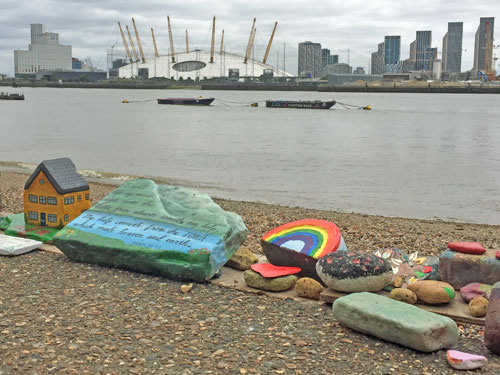
It's a couple of hours after low tide so a broad sandy expanse clings to the river wall. A pair of geese prowl the pebbly ridges above the waterline, happy to leave me be while they watch over their offspring. There's a great view of the pub from down here, its two much-sought-after balconies supported on slippery green pillars. An additional wooden post has been erected a couple of feet from the river wall, from which hangs a rope noose as a nod to Wapping's gruesome history. The actual Execution Dock was quarter of a mile upstream so this display is the pub's very own anachronism, but the 'Hanging Judge' George Jeffries is said to have liked a pint inside. A fascinating spot to stand between the tides, but best not hang around.
✉ Shadwell Fish Market, a failed rival to Billingsgate, is better known today as King Edward Memorial Park. The City Corporation approved the transformation in 1911 with the intent of creating a rare patch of municipal greenspace on the northern banks of the Thames, but it took until 1922 before King George V cut the opening ribbon. The park is much loved but also currently much set upon because Thames Water have nabbed the riverside for construction of their Tideway tunnel. A huge cofferdam has been extended out into the river to aid construction of a 19-storey shaft, an imposition which will eventually become an extension to the park, but it's looking unlikely these mega engineering works will be complete in time for KEMP's centenary.
The Thames Path now meanders around the back of a giant building site, including one section watched over by a traffic marshal where the service road exits across the tennis courts. Huge cranes erupt from behind the hoardings, as do loud thumping noises and a cluster of capacious black silos. Much of the specialist equipment belongs to piling engineers Bachy Soletanche (who sound continental, but are actually based in Lancashire).
The only unaffected stretch of waterfront is alongside the ornate whirl of the Rotherhithe Rotunda, where a handful of joyless benches are frequented by hardhatted sandwich eaters. I got a distinct whiff of exhaust fumes as I walked past, which is because this structure is actually a ventilation shaft for the Rotherhithe Tunnel, indeed it was originally possible for pedestrians to walk inside and descend a staircase before crossing under the river. Sticking to the landward half of King Edward Memorial Park is currently recommended.
✉ At the western end of Narrow Street, farthest from Limehouse's finest, is another spot where direct access to the Thames foreshore is readily available. An unsignposted set of blue railings leads to the top of a dozen concrete steps which end in soft sand (or in water, tide depending). These are the Ratcliffe Cross Stairs, in their time an important access point to the Thames and the embarkation point for a ferry to Rotherhithe, today a historical irrelevance. But it's still a thrill to step down the slipway onto the riverbed, if you time it right, and to watch all the Thames's comings and goings.
Tugs and Thames Clippers float past, occasionally sending a flurry of breakers towards the shore. The ground underfoot becomes muddier and pebblier the further out you walk. Broken tiles mingle underfoot with rounded pebbles and the occasional seashell (my treasure hunt alas revealed nothing especially mudlarkworthy). Damp green timbers protect much of the river wall. A large circular portal emerges from one particularly solid brick flank. Canary Wharf dominates the view to the east, while the riverfront at Rotherhithe (opposite) remains rebelliously lowrise.
I enjoy standing here more than my experience at Wapping at because it feels more private, more concealed and more like being a part of the actual river. My solitude is shaken when I spot foliage falling in a stream from the sky, which turns out to be a resident of Keepier Wharf pruning her windowbox four floors above me. A retired couple are standing on their balcony a few flats along, drinks in hand, enjoying the full blaze of the summer sun. I'm reminded that most of the Limehouse riverside is private land - wharves turned apartments - and that these occasional ungated stairs provide a rare glimpse of the Thames few regularly enjoy.
What makes you buy a new computer? I ask because it's five years today since I unboxed my eighth computer, and I'm not sure when it'll be time for a ninth.
Computer 1:Sinclair ZX81(13th May 1981)
I bought my first computer, or rather my family did, because we didn't own one. Two other boys in my class did - Guy had a PET and Bernie had a ZX80 - but we intended to be particularly cutting edge by buying the brand new ZX81. It took eight weeks to appear, while Sinclair coped with unexpected demand, eventually arriving on an evening when I should have been revising for my O-Levels. Instead I managed to plug it in to our portable TV and spent the evening entering a simple program... which alas proved too long for the minuscule 1KB memory to cope with. But within days I'd successfully created a program that allowed two people to play Snap, even if saving it onto cassette tape proved much more problematic. It was amazing what this little plastic box could do, although by today's standards utterly not in any way amazing at all.
↓ 8 years 7 months
Computer 2:Acorn A3000(22nd December 1990)
I bought my second computer because my first was long obsolete. I hadn't had a proper functioning computer at home for some years, only at work, and decided now was the time to take the plunge. I could see a personal computer being useful, but mainly I could see it being fun, as was proven when my family encouraged me to buy a golf game with the initial purchase and then spent much of the ensuing Christmas playing that. My new computer wasn't cheap, indeed I see it cost about the same as my current laptop, which means in real terms it was twice as expensive, but it served me well.
↓ 6 years 8 months
Computer 3:RISC PC(18th August 1997)
I bought my third computer because I wanted the internet. My old set-up couldn't cope, but Acorn now sold a new machine with its own browser software and that was me hooked. It took a couple of extra days before my modem arrived, so I used the spare time to transfer all my saved data from floppy discs onto the computer's hard drive, and also used the cutting-edge CD-ROM slot to blast Chumbawumba out of the speakers. The speed and convenience were transformational, but it was the internet access that within six months had changed my life. Meanwhile my parents drove over the following week to take computer 2 away so they could play golf and patience themselves, because one man's cast off is another's cutting edge toy.
↓ 3 years
Computer 4:Packard Bell 9770(24th August 2000)
I bought my fourth computer to join the in-crowd. Acorn's hardware niche had already narrowed and a Windows PC was now the place to be. I hadn't been intending to buy one when I woke up that morning but then I saw an advert in my newspaper and decided to drive over to PC World and take the plunge. When I got home my old computer was unceremoniously retired to a side table, and I made space on the floor for my first chunky tower. The new machine again had a floppy disc drive so I was eventually able to transfer over all the photos and csv files I'd accumulated, but all my previous software was now entirely redundant. From this point on it's been Windows all the way.
↓ 1 year 10 months
Computer 5:Dell Dimension 4400(5th June 2002)
I bought my fifth computer because I fancied broadband. I could have tried to access it via my existing PC but that had started getting slower, already, so I thought I'd futureproof myself instead. I had by this time moved to London and sold my car, so this changeover required a van delivery... which arrived five days late courtesy of the Jubilee weekend. There was a lot to unbox, including a weighty monitor, two speakers, a free printer and innumerable discs containing licensed software. The transfer of files was thankfully easier this time because the old PC allowed me to burn them onto a CD, so I was up and running pretty fast.
↓ 3 years 8 months
Computer 6:Sony VAIO PCG-7G1M laptop(19th February 2006)
I bought my sixth computer because the fifth one died. The blue screen of death appeared without warning, further investigation proved that the hard drive was corrupt and (sigh) the most expensive computer I ever bought had bitten the dust. I needed a replacement fast so nipped down to PC World on the bus and lifted a laptop... and that was the end of my desktop era. My new purchase was delightfully compact but took ages to configure the way I wanted, and it also took several weeks for me to get used to how much smaller the screen was. Transferring files wasn't an issue because everything on computer 5 had been lost, but I did manage to copy some across from computer 4 because CD drives were still a feature.
↓ 3 years 10 months
Computer 7:Lenovo T500 Thinkpad(21st December 2009)
I bought my seventh computer because the sixth was slowing down. Its memory capacity wasn't all it could have been, because I'd bought it off the shelf in a hurry, so for my next purchase I went bespoke. Friends recommended Chinese firm Lenovo, so I ticked off a shopping list and they knocked up something more suitable to my needs. It took three weeks to arrive, then failed to boot when I turned it on, but I successfully earned my geek credentials by tweaking the bios. This time transferring old files was a matter of filling a USB stick umpteen times, mostly with photos (and I spent almost as long attempting to re-enter all my previous passwords).
↓ 5 years 7 months
Computer 8:Lenovo T550 Thinkpad(20th July 2015)
I bought my eighth computer because the seventh was full. One of the problems with ordering a bespoke laptop is that you might not perfectly judge all the necessary parameters, and last time round I'd failed to realise how much larger digital photos were going to get. This time I went back to the same manufacturer and upped the spec. I also (correctly) decided I wouldn't need a CD-ROM drive any more, but should have added a couple more USB ports to save repeated unplugging. Transferring old files was dead easy this time, partly because most of them were backed up on an external hard drive, but mainly because I could create a home network and simply wi-fi everything across.
↓ 5 years
I haven't yet bought a ninth computer because the eighth still works perfectly well. I'm not one for consumer churn just for the sake of it, particularly at a thousand pounds a time, but given that my laptop is the gadget I use most I should perhaps be considering an upgrade soon. The sudden death of computer 5 taught me that it's better to undertake succession planning in advance than to find yourself digitally adrift overnight. Computer 3 has also failed recently, I think because its internal battery is exhausted, but computers 4, 6 and 7 still power up successfully. This gives me reassurance that computer 8 should still have plenty of life left in it... but when is the right time to buy a new one?
• Trump finally seen wearing mask in public
• outbreak on Herefordshire farm - 200 in isolation
• mixed messaging on masks
• seven National Trust houses reopen
• immunity from virus may be short-lived
• "countries headed in the wrong direction" (WHO)
• face coverings to be compulsory in shops
• California reimposes indoor restrictions
• winter wave "could be much worse"
• Blackburn could be another Leicester
• PM promises an independent enquiry, later
• Oxford vaccine trial progressing well
• 650,000 jobs lost during lockdown, so far
• Leicester lockdown to be eased
• "anyone may use public transport" (PM)
• "hoping for the best but planning for the worst"
• in future, local not national restrictions
• "significant normality" by Christmas, maybe
• daily deaths data halted for statistical reasons
• 150 new virus clusters in Spain
Worldwide deaths: 560,000 → 600,000 Worldwide cases: 12,600,000 → 14,100,000 UK deaths: 44,798 → 45,273 UK cases: 288,953 → 294,066 FTSE: up 3% (6095 → 6290)
Step out of Pudding Mill Lane DLR and a fairly desolate view awaits. Vast areas of hardstanding surround the station, demolished to provide back-of-house for the 2012 Olympic Games but never subsequently redeveloped. Long term housing plans have yet to kick off, so an unusual company have stepped in with a temporary project to utilise one acre of backlot - the Snoozebox Hotel.
At the end of last year several dozen black metal containers appeared in the compound opposite the entrance to the station. They were stacked in a long row, two boxes high, each with a small portholed door. I was initially mystified, wondering if perhaps someone was providing austere accommodation inside shipping containers for hardhatted workers engaged on local construction projects. I should, as ever, have read the planning application.
A couple of months ago workmen turned up to ready the project for public occupation. They renumbered the pods, spruced up the interiors and added a reception area at the front. One half of this gained a check-in desk and a small bar/kitchen, the other a social space with woodchip ceiling brightened by a cluster of artisanal light bulbs. The company's original plans had also included a roof terrace but this never materialised... which, having seen the surrounding view, I could understand.
The pods are numbered 001-020 on the ground floor and 101-120 upstairs, the top floor accessed via a metal staircase and narrow balcony. Only if you walk round to the other side of the hotel facing Marshgate Lane do you spot a separate numbering from 021-040 and 121-140, because it turns out each container contains east- and west-facing rooms so as to cram in the maximum possible number of patrons.
Each room has an internal area of just 5½m² (apart from the DDA-compliant rooms which have double that). Within that tiny space are a double bed, a single bunk-bed (slotted in at right angles over the top) and an en-suite wet room (which I believe is code for alcove with a sink and a shower). Air-conditioning is provided, because there are no windows, while a TV at the foot of the beds provides digital distraction. The only natural light is what shines in through the porthole in the door, because these are meant as rooms you crash and sleep in rather than somewhere to spend any significant period fully conscious.
Basically it's a budget hotel aimed a clientele who simply want to be in London rather than paying a premium for mints on the pillow and neatly folded toilet roll. Some guests will be international tourists but many will just have driven down from the shires, which is why the far end of the site is taken up by 12 parking spaces. The owners had originally wanted 68 parking spaces, but it seems the planning authority managed to persuade them there was a DLR station nextdoor.
A couple of weeks ago the Snoozebox Hotel took its first paying guests. I haven't seen much action - the place hasn't set Pudding Mill alight - but I did spot a member of staff delivering a coffee to a patron in the lounge area so things are taking off. Indeed the hotel is currently fully booked until 31st July (when a Standard Double En-Suite will set you back £37.90, rising to £62.10 over the bank holiday weekend and £71.10 this time next year). That's pretty good going for a bed inside half a metal box, but only if you're the proprietor and not a paying guest.
I wondered if there were any plans for the much larger vacant expanse alongside, and blimey yes there are!
A company called Aniara intend to build a temporary theatre here, with a 25m-high hexagonal auditorium and seating for 1500, which for what's currently nomansland would be an astonishing intervention. Performances would take place six evenings a week (and two afternoons), with a concourse of food and drink stalls out front to tempt patrons to hang around longer. An 11pm curfew should ensure that Snoozebox patrons get some sleep.
With ghastly economic timing the theatre was granted planning permission on 17th March 2020, just before it became apparent that densely-packed auditoria were amongst the severest casualties of the coronavirus pandemic. If the project does eventually surface it's been given a cut-off date of March 2025, while the hotel has until July 2024 before it has to be taken down. But the dead zone of Pudding Mill is at last springing to life... even if it'll still be many years before anyone properly lives here.
As the PM nudges Londoners back onto public transport, TfL are doing their bit to keep us off it.
If a journey's walkable, why get on the tube?
This is the theme behind a fresh post on the Experience London blog, a digital mouthpiece curated by the TfL Community Team (and liberally splattered with emojis ➡️🚶).
How could walking from Embankment to Piccadilly Circus be 2 minutes quicker than taking the tube? How could travelling two stops on the Northern line take 15 minutes? Where had these peculiar timings come from?
Here's a summary of the claims in the post, several of which appeared to have been massaged, muddled or miscalculated.
Journey
Line
no. of
stops
walking
by tube
Waterloo to Southwark
Jubilee
1
4 min
2 mins
Warren St to Tottenham Ct Rd
Northern
2
12 mins
1 min
Embankment to Piccadilly Circus
Bakerloo
2
14 mins
16 mins
Euston to Tottenham Ct Rd
Northern
3
19 mins
13 mins
Victoria to Westminster
District
2
19 mins
11 mins
Charing Cross to Oxford Circus
Bakerloo
2
20 mins
20 mins
King’s Cross to Camden Town
Northern
2
22 mins
15 mins
Stay with me, because in amongst the errors it turns out a 'new normal' has silently kicked in.
Waterloo to Southwark 🚶4 minutes(only 2 minutes longer than the Tube)
This one sounds fair enough, given that Waterloo and Southwark stations are very close together. But the tube journey actually takes 1 minute, not 2, according to real life and the Journey Planner. More importantly you cannot walk between the stations in 4 minutes. The Journey Planner claims you can, but if you click through and look at a map the given route delivers you to the western ticket hall at Southwark (which has no external public entrance), rather than the actual entrance three streets to the east. Alas '🚶8 minutes (only 7 minutes longer than the Tube)' isn't such an inspiring truth.
Warren Street to Tottenham Court Road 🚶12 minutes(only 11 minutes longer than the Tube)
This time the duration of the tube journey is wrong. It takes 2 minutes according to the Journey Planner, not 1, even though Goodge Street station inbetween is currently closed. It's only a minor discrepancy, but still leaves a whopping 10 minute chasm between walking and tubing.
I think those are genuine errors. But what's really mysterious is why the durations of all the remaining tube journeys in the table are over 10 minutes.
Embankment to Piccadilly Circus 🚶14 minutes(2 minutes quicker than the Tube)
As everyone who knows London knows, this is nuts. It's definitely quicker to get from Embankment to Piccadilly Circus by tube, rather than on foot, unless the Bakerloo line is very seriously compromised. And yet TfL are somehow claiming that a two stop tube journey will take you 16 minutes... what could be going on?
If you ask the Journey Planner to transport you from Embankment to Piccadilly Circus, it now refuses.
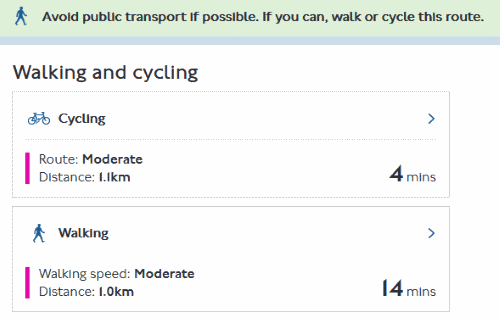
We'd rather you walked or biked this journey, it says, which in current circumstances is fair enough. Why not cycle it in 4 minutes or walk it in 14?
If you insist on taking the tube, which they've made really difficult, a 16 minute itinerary appears.
Seven minutes to 'Transfer to Embankment', whatever that means.
Two minutes on the tube to Piccadilly Circus (which is much faster than walking).
Then seven minutes to 'Walk to Piccadilly Circus' at the other end, despite already being there.
Total 16 minutes, allegedly.
Six months ago the Journey Planner would have said 2.
I've tried to think of reasons why it might take seven minutes to 'Transfer to Embankment'. You might not be at Embankment in the first place, but that's silly because you told the Journey Planner you were. It might take seven minutes to get down to the platforms, except it doesn't, no more than three. It might take an average of seven minutes for a Bakerloo line train to arrive, but that's not the way the Journey Planner works. Or perhaps there are crowd control measures in place, which is plausible, except I've checked this for 8am, noon, 6pm and 11pm and it's always seven minutes.
I'm even more baffled by why it takes seven minutes to 'Walk to Piccadilly Circus' at the other end of the journey. Exiting the station doesn't normally take that long, again maybe three. Social distancing might make this a bit slower, but I still don't see how it could be as high as seven. And previously this walk back to the surface wouldn't have been a matter for the Journey Planner at all - once it delivered you to the Bakerloo line platform that was it.
Here are the remaining four tube journeys in the list and what the Journey Planner now claims (if you really insist).
Euston to Tottenham Court Road 🚶19 minutes(only 6 minutes longer than the Tube) Transfer to Euston: 6 mins Northern line to Tottenham Court Road: 4 mins Walk to Tottenham Court Road: 4 mins Total: 14 mins
Victoria to Westminster 🚶19 minutes(only 8 minutes longer than the Tube) Transfer to Victoria: 4 mins District or Circle line to Westminster: 3 mins Walk to Westminster: 4 mins Total: 11 mins
Charing Cross to Oxford Circus 🚶20 minutes(same time as the Tube) Walk to Embankment: 10 mins Bakerloo line to Oxford Circus: 4 mins Walk to Oxford Circus: 6 mins Total: 20 mins
King’s Cross St. Pancras to Camden Town 🚶22 minutes(7 minutes longer than the Tube) Transfer to King’s Cross St. Pancras: 6 mins Northern line to Camden Town: 4 mins Walk to Camden Town: 5 mins Total: 15 mins
The Charing Cross example is a naughty one to include because Charing Cross tube station is currently closed, so catching the Bakerloo line isn't going to be fast. That said, it definitely doesn't take 10 minutes to walk from Charing Cross to Embankment, that's an absurd number. Likewise 'Transfer to Euston' doesn't take six minutes, exiting Camden Town doesn't take five minutes, indeed all these extra timings appear to be on the over-generous side.
I wondered whether TfL might be padding out tube journey times in the Journey Planner to try to discourage us from riding it. Add a 'Transfer' time at the beginning and a 'Walk to' time at the end and hey presto, a 2 minute tube journey suddenly looks like it takes 16. And whilst it's true that getting into and out of a station does take time, the values given do look vastly inflated.
I've dug deeper and uncovered the 'Transfer' times for several stations on the Northern line (from London Bridge up to Edgware).
3 mins: Angel, Golders Green, Brent Cross, Hendon, Colindale, Burnt Oak, Edgware 5 mins: Moorgate, Camden Town 6 mins: Old Street, Kings Cross St Pancras, Euston, Belsize Park, Hampstead 8 mins: London Bridge
There does seem to be some kind of correlation between how complex a station is and its designated transfer time. All the surface level stations on the Edgware branch score 3 minutes (but so does Angel which has the longest escalator on the network). Belsize Park and Hampstead have lifts, and they're as high as 6. Kings Cross St Pancras and Euston also hit 6 (but so does Old Street which is much more straight-forward). London Bridge has the maximum of 8, perhaps assuming you're transferring from the mainline station, but that would be an inappropriately sweeping assumption to make.
Elsewhere on the network Bow Road has a transfer time of 2 minutes but the very similar Bromley-by-Bow merits 3. Marble Arch (with escalator) has a transfer time of 6 minutes while Holland Park (with lift) has 5. Canary Wharf DLR station has a transfer time of 2 minutes yet Pudding Mill Lane has 3. Emerson Park, a simple halt at the foot of a ramp, somehow has a transfer time of 3 minutes. National Rail stations are also included (Bromley South 2, Purley 3, Surbiton 4, Clapham Junction 5) as well as tram stops (New Addington 1) and Dangleway terminals (2).
In short, TfL's Journey Planner has started adding entry and exit times to every journey you try to plan, using numbers that don't necessarily relate to real life, resulting in journeys appearing to take longer than they used to. This might be to deter extra travellers from piling aboard public transport, or it might be because some digital guru thought it was a 'good idea', but it is a ridiculously subjective imposition. Even if you're a large family with luggage, taking the tube from Embankment to Piccadilly Circus shouldn't take 16 minutes.
It's time for July's "here's a journey I made exactly a year ago but didn't blog about at the time."
On 16th July 2019 I visited the National Trust's new exhibition at Rainham Hall, which I told you about, but then went for a lovely long walk up the Ingrebourne valley. I didn't go into detail because Rainham to Upminster Bridge is section 23 of the London Loop, and I'd blogged that before in 2012. But in the absence of any other rural strolls this summer I thought I'd write about it now. I just wish I'd taken more photos at the time.
WALK LONDON The London Loop[section 23]
Rainham to Upminster Bridge (4 miles)
Two things before I set off. Firstly to follow the route I took my original edition London Loop leaflet with me, circa 2007, rather than printing out a pdf or faffing around with a scrolling file on my phone. Electronic instructions may be cheaper to deliver but a folded piece of large paper is invariably more practical for making decisions en route. Secondly I did this walk in shorts. 16th July was a 27° kind of a day, so I decided this was the ideal time for the annual uncovering of my knees. "If I remember rightly, " I thought, "there won't be any deep undergrowth".
Rainham is a quintessentially atypical London village, set adrift in the Thames marshes. Around its rim are industrial estates, council estates and a sprawling Tesco, but its historic heart is a delight, with a 13th century parish church, a Queen Anne mansion and a stunted clocktower. When I dropped by last year the London in Bloom judges were due, and local resident Sue Ospreay was attempting to drum up some green-fingered civic pride. I'm delighted to say that Rainham ultimately earned a Gold award for Small London Village, as did Ham and Petersham and a corner of Chelsea, although they were all beaten to the ultimate accolade by 'Walthamstow Village in Bloom'.
Escaping to the riverside path isn't as pleasant as it should be, the most obvious route across the meadows being blocked by an arterial road. But eventually there is access, just past the Albion Flaming Grill, and it's time to enter a delightful reclaimed rubbish dump. Ingrebourne Hill is a Forestry Commission project, one of several in the outer reaches of Havering, comprising a landscaped former quarry and various chunks of 21st century woodland. At its heart is a 22m summit plied by mountain bike trails, but also quiet footpaths... not officially part of the London Loop because they were laid after the orbital circuit was devised. I hiked to the top anyway.
22m isn't much but is still noticeably higher than the surroundings so the view is marvellous. From the top I enjoyed a 300° panorama, including clouds scudding above the Thames estuary, acres of buzzing grassland and a wind turbine spinning in front of the distantskyline of the City. Had anyone else been present they'd have loved it too, but thankfully I had the place to myself... which is one advantage of a hot midweek afternoon on a peripheral hilltop just before the schools break up.
Rather than retracing my steps to the official line of the Loop I stepped out across open country between buzzing flowers and the occasional dragonfly. Other parts of the capital were reporting Flying Ant Day but my exposed legs were thankfully uninvolved. It wasn't a lengthy descent, maybe five minutes, but quite the best part of the entire walk. Oh to get back out and enjoy it again.
Eventually I rejoined the official path, a sturdier surfaced track weaving between lakes and woodland (and busier too because it was nearer the car park). The River Ingrebourne was never far away but generally invisible, being a braided thread of lakes and marshy channels behind a screen of trees. This valley is unusual in that no roads cross it for 2½ miles, and only a couple of footpaths too, essentially because hardly anybody lives on the far side. One of the lakes had an information board depicting the birds I might have been able to see, except all the water had evaporated in last summer's heat. My decision not to wear jeans today was proving a wise one.
Hornchurch Country Park is a former RAF airfield, which explains the pill boxes and Tett Turrets that intermittently appear a short distance off the track. It also explains the fibreglass Spitfire that comprises part of the adventure playground further on, and the military tinge to the Ingrebourne Visitor Centre. This building was new to me, having been knocked up since my last wander in 2012, and provides a useful focus for those in need of caffeinated refreshment or sanitation. Spot on for Havering, I thought, particularly as somewhere for the retired to gather (or to entertain their grandchildren).
Walk further and the river finally emerges, and you even get to walk alongside it. The channel's not especially wide, which makes its existence as a transport barrier somewhat inexplicable, but the lack of roads allows the Ingrebourne to meander relatively unspoiled. Eventually a housing estate appears, its outermost residents fortunate enough to face a broad sweep of green flecked with teasels and reeds. There's also a set of outdoor gym equipment here, should that be more their thing. And here's that first road in 2½ miles, Hacton Lane, gateway to one of the remotest corners of Greater London. Not today.
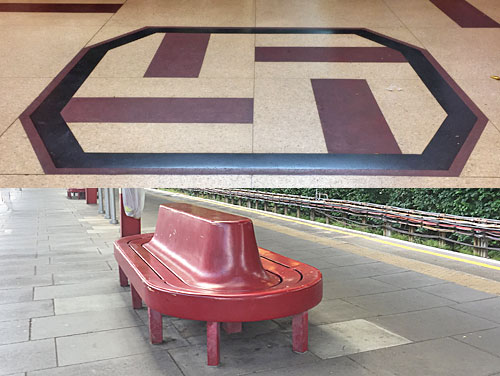
The last stretch of river is a little more urbanised, a watery wedge between two estates... and also the first time a footbridge has allowed the Loop to cross to the eastern bank. The appearance of a group of secondary schoolchildren holding court on some treetrunks reminded me that it was almost four o'clock and I needed to hurry up if I was going to make the off-peak cut-off on the tube. But the path wasn't playing ball, forcing me to divert round the wrong side of Hornchurch FC's minor stadium, and I reached Upminster Bridge (dammit) four minutes too late. It would have been three if I hadn't paused in the ticket hall to snap the obligatoryswastika.
In summary London Loop section 23 is an unexpectedly pleasant hour and a half's walk, mostly on an all-weather surface but still with the feeling of being way out in the wilds. It runs from one zone 6 station to another, so is easily accessed, and showcases some of the mysteries of Havering, possibly London's least understood borough. Wearing shorts is not obligatory.
50 years ago Early Closing was a thing. Shops closed on a particular afternoon to give staff a break. But which day did shops around London close early?
» Early closing was legally a thing in Britain between 1904 and 1994.
» Ian Visits has the full backstory, if you want that.
» South of the Thames Wednesday was a lot more popular than Thursday.
» North of the Thames early closing days were more equally distributed.
» Sidcup and Egham look like real county outliers.
» Leatherhead, apparently, had "no fixed day".
» I'm not sure what was going on in Abbots Langley, Banbury and Virginia Water.
• This table is compiled from the front of several old bus timetables.
• My chief source is page 15 of a 1972 London Country bus timetable.
• I have used the county designations as they appear in that particular list.
• Yes, I know a lot of these counties became part of Greater London in 1965, but it's too late to tell the timetable compiler that.
• I could have thrown in Norfolk, Leicestershire and Wales too, but life's too short.
• I couldn't resist 'Early Closing Days on the Isle of Wight', though.
• My apologies that most of London is missing, but I couldn't find the data on that.
although why wait eleven days although this is an attack on our civil liberties although it's just basic good manners although I refuse to comply with this pathetic attempt at control although if you're not wearing one 'on principle' that's just impolite although nothing would make me less likely to go shopping although it's odd to have waited until now to have this debate although many countries have been wearing then for weeks although the number of cases is going down so it's far too late although everybody in Edinburgh wears them already although it's not a legal necessity yet so I won't thanks although if doctors can wear them for hours then I can too although this is an absolutely monstrous imposition although we all have an inalienable right not be mildly inconvenienced although you can't make me do it although I question a Tory government that tells me how I should dress although I can't breathe properly through one although we should have been told to wear them in March although they told us in March there was no evidence for it although there weren't enough spares for the public in March although it means people will end up touching their faces more often although I'd wear one if you put a poppy on it although very soon you won't dream of going anywhere without one although I bet some people whined about turning their lights off during the Blitz although it'll be like wearing a muzzle although for heaven's sake you're supposed to wear it over your nose although it does make you look like a ninja although the evidence for wearing them is actually quite weak although I'm sure most people will obey the law perfectly happily although I bet Churchill would never have worn one although there are always loudmouth nay-sayers although I'm doing all my shopping online from now on although those of us who can do obviously should do although no way will I bow to this stupidity although going shopping is nothing compared to a long hospital shift although these bloody things will be around for months or even years although do you really want to kill a vulnerable stranger although it must be a free choice although if everyone did this we could drive this epidemic to the ground in six weeks although it's just a plot to restart the economy by getting us all to stand closer together although this is the most authoritarian government of my lifetime although it's not like the virus isn't dangerous this week although it's all just mixed messages although we've never previously made them mandatory during flu season although I cannot believe how much some people are whingeing about this although this'll make it much easier for criminals to hide their identities although it doesn't protect me only you although people don't seem to know how to wear them properly although the low death rate in Japan is conclusive proof they're essential although I get claustrophobic wearing anything on my face although they're just a placebo to get scared people out of the house although I started wearing mine months ago although we just don't have the cultural awareness for it although we should rely on the common sense of the British people although why not sooner although this is a plan to take control of humanity although I have asthma so I reckon I'm exempt although I'm only going to wear a scarf although there's no logic to making them mandatory at this stage although I'll do it if it protects someone more vulnerable than me although I bet most people will avoid the shops now although you could solve all this by printing a St George's flag across the front although our high streets will become dehumanising dystopian hell-holes although it's been proved they're not actually effective although it's still better than being dead although shopkeepers will never be able to enforce this although it can still get in through your eyes although they're so hot and uncomfortable although it'll make it impossible for deaf people to lip read although nobody moans about wearing seat belts these days although Boris is just following Globalist orders to crash the economy although I refuse to embrace the so-called new normal although we should have introduced them already although I will not go into any shop that requires me to wear one although the government urgently needs to get its priorities straight although why would a healthy person with a good immune system need to wear one although the whole point is that nobody knows if they're healthy or not although the science is flaky and inconsistent at best although the virus isn't having ten days off although I'm sure I've had it already although this is the final nail in the high street coffin although tucking it below your chin doesn't count although the People Will Rebel Against This Diktat although what about pubs and restaurants and schools although it's mad that shop workers don't have to wear one although this will just make me feel sick and disconnected although I shall do all my shopping at outdoor markets from now on although it should have been mandatory from day one although it seems rather authoritarian at this stage although I reckon it's just to make the snowflakes feel safer although they decrease oxygen intake and increase toxic inhalation although it should be compulsory in all indoor spaces although 3 micron holes in fabric don't actually stop 1 micron particles although who are these idiots who won't wear one although this is a bigger mistake than lockdown was although I struggle to understand people's reticence here although I'm never voting Conservative again although the mandatory use of nappies on our faces is a step too far although wearing one is such a small thing to do when it can save lives although you will not make me do this although how can people be so selfish?
20 years ago today, on a derelict site beside the Bow Back Rivers, the first contestants entered the first Big Brother House. On the evening of Friday 14th July 2000 ten unknown faces were driven in limos to Three Mills Studios, then ushered out of a back gate and herded across a narrow bridge hauling their suitcases behind them.
On the far side was a compound containing a space-age bungalow, rapidly constructed over the last two months and fitted out with 31 cameras and 26 microphones. The contestants' entry was so low key that Channel 4 didn't screen it live, believe it or not, saving the footage for the official launch show four days later. But within weeks the house's inhabitants were famous, even infamous, and 10 million tuned in to watch Craig's final victory on Day 64.
Peter Bazalgette's production company had scouted several locations for the first Big Brother House, including Radlett, Elstree and Shepperton, but eventually plumped for a scrap of wasteland in Bow. This lay within cabling distance of the back of a major studio complex, and best of all nobody lived anywhere nearby. The precise location was at the fork of two tidal waterways - the Prescot Channel and Abbey Creek - just to the south of the Abbey Mills pumping station and facing the Twelvetrees gasholder cluster. The production team even did the housemates' weekly shopping in my local Tesco, alas just before I moved to E3.
The series returned to Bow in 2001, transmitted slightly earlier in the year so it was all done and dusted by the end of July. Newham council then asked for their land back, with the intention of returning it to natural habitat, so the producers upped sticks and relocated to Borehamwood. The original site has had a chequered history since then, with wildlife certainly not the top priority, and Big Brother superfan sightseers are no longer welcomed. I've been down to the Prescot Channel for an anniversary visit.
I first stepped onto the original site in 2003, wandering through an unlocked gate into an empty field. It was already hard to spot that Channel 4 had ever been here, with even the footprint of the original building entirely indistinct. Grass now grew up across coarse pebbly soil, and a single group of birch saplings thrust through what might have been the bedroom or the chicken run. I had a rush just being here, amid the unobserved seclusion of what two years earlier had been Britain's most scrutinised field. This could have developed into a wildlife refuge or a nice place for a kickabout and a picnic, but alas it never got the chance. [three2003photos]
In 2007 British Waterways announced they needed to close the adjacent footpath in readiness for a grand Olympic project. Three Mills Lock would provide a gateway for the eco-friendly delivery of materials needed to construct the Olympic Park, as well as sealing off prime riverside upstream from the vagaries of tidal water. I headed back before they sealed off the area, stood on Davina's Bridge one last time and then peered through what was now a firmly locked gate. The House had been reclaimed by scrubland, in part, while a broad swathe of mud dominated elsewhere.
Three Mills Lock transformed the Prescot Channel, even if hardly any boats have ever used it for its intended purpose. In 2012 a temporary footbridge was added where the original had been, much higher than before to cater for all those non-existent boats. This should have offered an excellent view of the Big Brother compound, except that this had recently been entirely bulldozed to make way for the Lee Tunnel, a massive sewage-based construction project. Material excavated from its massive shaft was now being stored and stacked where C4's daily drama had taken place, and Newham's dream of creating a nature reserve was officially dead.
The Lee Tunnel, itself the opening salvo of the ongoing Thames Tideway project, was eventually completed in 2016. This meant the footpath round the back of the old site could now be reopened, after the best part of a decade, with access now via a footbridge over Three Mills Lock. It was good to finally be back, if only walking past. But although all of Thames Water's building works had now been cleared away, a huge heap of excavated spoil now covered the area where the House had been, firmly sealed off behind a much sturdier metal fence.
Which is pretty much how things are today. A grassy hump in a quarantined field.
The Long Wall Path which loops round the old House is busier now, being a useful connection between Three Mills Green and the Greenway for walkers and cyclists alike. One side faces a river you can hardly glimpse, screened by trees and the most extensive invasion of Himalayan balsam I have ever seen. On the landward side is the original wooden fence, with a few of its slats missing allowing anyone to slip through, but only as far as the new metal fence which isolates the Big Brother site.
Not only has the first Big Brother House disappeared, but the land on which it sat has been entirely covered over and sealed off. Grass and saplings now colonise the spoil heap, in much the same way that they colonised the underlying soil after the House was first taken down. The footbridge that starred in every eviction episode has been removed to make way for a white elephant Olympic infrastructure project whose lock gates rarely open. And a futuristic dome now caps the shaft of the Lee Tunnel alongside, which has helped to relieve the Northern Outfall Sewer's Victorian engineering. One Bazalgette project lives on, while his great-grandson's groundbreaking media project has been entirely wiped away.
I hope you enjoyed the second weekend of eased lockdown.
The opportunity to get out, do things and meet people again.
It certainly makes a change from how things used to be a while back.
I mean, do you remember when the guidance looked like this?
Actually that is the current government guidance from the top of the gov.uk/coronavirus webpage. We are still being asked to stay at home and work from home where possible, to limit contact with other people and to stay 2m apart if we can.
You might have thought the top level guidance was a bit more relaxed than that by now. I suspect a lot of people do, so are happily following imaginary rules about one metre spacing and "using their common sense". The police won't be prosecuting anyone for not following the guidance, obviously, but I suspect we are now at the stage where most people aren't entirely sure what the official guidance is.
To test this out, let's see how good you are on the current guidance about gatherings.
Here are four houses on an imaginary English street, and their inhabitants.
Barry
Carrie
Garry
Harry
Larry
Dolly
Polly
Andy
Mandy
Sandy
Randi
• Barry and Carrie live in the first house with their children Garry, Harry and Larry.
• Sisters Dolly and Polly live in the second house. They're both over 70.
• Andy, Mandy and Sandy share the house nextdoor.
• Randi lives alone, and has chosen to form a support bubble with Andy, Mandy and Sandy.
Six questions follow.
In each case, look at the group of people meeting up and decide whether the gathering is allowed or not.
Yes or No?
The first three gatherings are indoors.
Allowed or not allowed?
1)
Barry
Carrie
Garry
Harry
Larry Dolly
Polly
2)
Carrie Polly Mandy
3)
Barry
Carrie
Garry
Harry
Larry Andy
Mandy
Sandy Randi
Try judging for yourself, Yes or No, before reading on.
Answers
1) Gathering number one shows seven people from two households meeting up indoors. Two of the people are over 70 but that's fine, there are currently no rules stopping older people from visiting neighbours. It's also fine that seven people are indoors together. Since 4th July it's been OK for members of two households to meet together indoors, ideally practising social distancing while they do so, which means this is a Yes.
2) Gathering number two shows three people from three households meeting up indoors. And this is not OK. At no point has the government allowed more than two households to come together indoors, because gatherings of multiple households would speed up the spread of the virus should one person be infected. Even if Carrie, Polly and Mandy met in a restaurant or down the pub, even with plastic screens everywhere, this is still a No.
3) Gathering number three shows nine people from three households meeting up indoors. Last time three households was a no-no, but this time it's fine because Randi is in a support bubble. Since Friday 13th June "anyone in your support bubble counts as one household", so Randi can hook up with Andy, Mandy and Sandy indoors as often as she likes. It may be the largest gathering on the list, but this is still a Yes.
The next three gatherings are outdoors.
Allowed or not allowed?
4)
Barry
Carrie
Garry
Harry
Larry Andy
Mandy
Sandy
5)
Barry
Carrie Dolly
Polly Andy
Mandy
6)
Barry
Carrie Dolly
Polly Andy
Mandy Randi
Try judging for yourself, Yes or No, before reading on.
Answers
4) Gathering number four shows eight people from two households meeting up outdoors. Again, because it's two households meeting up, this is all fine. Gatherings of more than 30 people are banned by law, indoors and out, but it's highly unlikely that two households combined would ever top that total. In this case, definitely a Yes.
5) Gathering number five shows six people from three households meeting up outdoors. It wasn't OK to have three households meeting up indoors but it is OK outside, so long as no more than six people in total are present. Technically you could have six people each from a different household, for example meeting up for a nice socially distanced picnic in the park. This time, multiple households is a Yes.
6) Gathering number six shows seven people from four households meeting up outdoors. Randi's support bubble means technically this is three households meeting up rather than four. But unfortunately Randi turning up has also tipped the number of people over six, so this particular gathering is not allowed. Outdoors it's people rather than households that makes the difference, with six the maximum permissible, which is why this is a No.
Part of me wonders how many you scored out of six, but part of me is much more interested in how many times you've met up with people in contravention of the official guidance on gatherings, inadvertently or otherwise.
In summary, the underlying rules are actually quite simple:
But if we as a country haven't internalised rules as plainly stated as this, or have chosen to disregard them, what hope do we have with the more complicated stuff?
I have become mildly obsessed by the retail collages outside convenience shops. Reminders that you might want to pop inside and grab some lunch, replenish your larder or stuff your face. Where do these vinyls come from, is there a stock provider and how do they decide what products to include?
This first graphic is from Sanny's Mini Market Premier Express in New Barn Street, Plaistow E13.
The packs of sandwiches are intriguing because two are Tesco Light Choices Ham & Cheese and the other is a Co-Op Classic Chicken. It might be possible to buy one of these inside the Mini Market but certainly not both. A little online digging confirms that the Ham and Cheese Sandwich is an Alamy stock image (ID: C4WKCF), which is starting to suggest that some kind of cottage industry exists for the purpose of knocking out semi-amateur grocery graphics.
Much of the chocolate selection consists of a job lot of multiple Dairy Milk varieties, but the remainder is unexpectedly varied. Bounty and Maltesers come from Mars, KitKat is from Nestlé, and Flake, Double Decker and the box of Roses are from Cadbury. The one true chocolate oddity is a Cadbury's Valentines gift box containing a Curly Wurly, a finger of Fudge and a Freddo, which whilst not unwelcome as presents go would seem highly unlikely to impress anyone's sweetheart long-term.
Beneath the giant Hovis loaf is a brown paper bag overflowing with implausibly stacked items. Slices of unwrapped bacon. The top of a foil-wrapped bottle. Maybe digestives. Possibly a cucumber. A glimpse of a peach. A big pack of aspirational chocolate biscuits from a brand that only lowly independent shops dare to stock. A red pepper that's definitely clipart rather than a genuine photograph. It's just as well nobody ever looks at this stuff too closely.
Finally come the fresh groceries, which inexplicably include sticks of celery propped up against an expensive bottle of olive oil. Four tins are shown, but with their labels missing so shoppers would have to guess what might be inside. Two dozen eggs have been piled up in a bowl and overtopped by a pair of levitating red peppers. To complete the tableau is a huge bottle of Cravendale milk. Absolutely no expert Photoshopping abilities have been used to create this image, should any of you be in need of a new career.
My apologies, I appear to be over-analysing the groceries pictured in a corner shop window on a Plaistow sidestreet.
This is even less an attempt at recreating reality and far more an identity parade of brightly-coloured packaging. Blue backgrounds appear to be the default option, by the way.
Tubs: Dromona Pure Butter, Fage Greek Yoghurt, Whole Earth Peanut Butter Packets: Cricketer Farm Vintage Cheddar, Brown Bag smoked bacon crisps, Altintop salty crisp sunflower seeds, Walkers ready salted, Ruffles cheddar and sour cream, Cheetos crunchy, Pringles BBQ, Jimmy Dean premium regular sausage Bottles: Heinz Mayonnaise, Countrylife milk, Nutri-Boost, Horlicks Tins: Whole Butter Cookies, Heinz Beans, Princes tuna steak, Princes stewing steak, Marmarabirlik Turkish olives, Visciano Polpa a cubetti chopped tomatoes Boxes: Tetley Cherry Bakewell green tea, Brooke Bond Taj Mahal, Brooke Bond Red Label, Typhoo (obscured), Tata Tea Chakra Gold, Nescafe Classic, Nescafe Sunrise, Lavazza Espresso, 8 Mini Nogger Sandwich ice creams, one Cornetto Classico Vanilla, four Almond Magnums Toiletries: Pears soap, Lifebuoy soap, Lux soap, Dove soap, Cinthol soap, Breeze tissues, Pepsodent toothpaste, Colgate Maxfresh, Navratina hair oil, Comfort fabric conditioner, Surf Excel
Sorry, I didn't go out last night, as you can probably tell.
Let's head north to the Caner Supermarket in Odessa Road, Forest Gate. That is a very unusual name for a corner shop, by the way, but I suspect the local catchment area approves.
The big panels to the left feature beer, wine, fruit and vegetables, but it's the giant bottle of Jack Daniels that really stands out. Heading home? Why not nip inside for a bottle of something expensively alcoholic, you know you want to. The Corn Flakes have been presented in a bowl on a serving plate, which seems somewhat excessive for a breakfast staple. Some kind of fizzy tsunami is sweeping across the bottom half of the panel, carrying cans of both Pepsi and Coca-Cola with it, but it doesn't seem to have dampened the selection of periodicals... which are fantastically out of date.
This particular edition of the Evening Standard has a headline about Tony Blair and costs 20p, which means it must be from sometime before 2009 when the paper embarked on free distribution. Gordon Brown grins from the front of the Daily Telegraph, which suggests a similar vintage. But it's the copy of What's on TV magazine that finally gives the game away, with Charlie Stubbs' Corrie baby shocker and Pauline Fowler's criminal love interest dating this window display firmly from February 2006. They don't print 'em like this any more.
Finally this is from the side of the kiosk at the junction of Church Street and New Plaistow Road in West Ham. The shutters came down on this retail outlet a while back.
Large panels for the National Lottery and Oyster wouldn't be the top promotional priority of any shopkeeper today, but the early 21st century was a different world. Those also look like obsolete logos on the cans of Fanta Orange and Sprite. That bag of Rowntrees Fruit Pastilles is somehow reassuringly retro. McVities no longer manufacture Mini Milk Choc Hobnobs in a 125g 'Tear & Share' packet, and Tangy Cheese Doritos are not sold in 180g bags.
But again it's the newspapers that offer the biggest clue to when this particular signage was manufactured. The Guardian hasn't yet shrunk in size, Michael Jackson is still alive and the Daily Express is still obsessed with migrant controls (not that the last of these helps much, sorry). As for the Birmingham Post, that's a really strange choice of local newspaper for a kiosk in the heart of the East End, but this is what you get when you purchase generic signage. And its headline about a plane crash in Coventry places this particular signage definitively in the summer of 2008, like a throwback from a oddly distant era.
Anyway, this is the current extent of my grocery vinyl obsession. I suspect there's a full-on photographyexhibition in it somewhere, one day.
• job centre staff will be doubled
• clap to celebrate the NHS's 72nd birthday
• £1.5bn emergency funding for the arts
• Wales ends 5 mile travel limit
• Northern Ireland reopens beauty salons
• Scotland opens beer gardens and pavement cafes
• 80% of those testing positive have no symptoms (ONS)
• Trump pushes US schools to reopen
• Brazil's President Bolsonaro tests positive
• £30bn budget stimulus for jobs and the economy
• 'Eat Out To Help Out' (50% off in August)
• stamp duty cut with immediate effect
• Chancellor's plans 'not value for money'
• virus may spread by airborne transmission (WHO)
• reopening date set for pools, gyms and nail bars
• UK relaxes quarantine from 75 countries
• ONS estimate - one in 3,900 have the virus
• PM considering mandatory face masks in shops
• Belgium places Leicester on its red zone list
• cases accelerating in several US states
Worldwide deaths: 530,000 → 560,000 Worldwide cases: 11,100,000 → 12,600,000 UK deaths: 44,198 → 44,798 UK cases: 284,900 → 288,953 FTSE: down 1% (6157 → 6095)
Earlier this the week Uber announced it would be sponsoring Thames Clippers. It's not buying them, it's not calling them U-Boats, it's not making them turn up on demand and it's not stopping anyone else from turning up and using them. It is getting naming rights and adding riverboats to the Uber app. The service's new name will be "Uber Boat by Thames Clippers", a mouthful only upright brandingfolk will employ.
That's basically all you need to know. However, a lengthy press release was despatched to coincide with the announcement and various media platforms dutifully regurgitated the contents. I haven't seen that press release, but I thought I'd have a go at piecing it together from four published articles... by the Evening Standard, City AM, Time Out and Secret London. If two of them used a particular word or phrase I've used bold text, if three used it I've underlined and if all four slotted it in somewhere I've added red.
Here's what I get if I compare the four titles.
Uberteams up withThames Clippers to launch Uber Boat in London
You'd expect Uber Boat to appear in all four headings, and it does. Clippers appears only three times but Thames scores the full four. So does launch/launches/launching, because that's the obvious term to use in a story about a new boat service, and because the press release spoonfed it perfectly.
I'll now try to reconstruct the main body of that press release. What might the first sentence have been?
Uber is to launch its firstcommuterboat service in London in partnership with Thames Clippers.
Uber and launch appear again, obviously. Three of the articles make the point that this is Uber's first such service, a statement akin to pointing out that the Dangleway was London's first cablecar. City AM initially blunders by suggesting that this is the world's first Uber Boat, whereas in fact one already exists plying the Croatian coast. The other word that crops up a lot in this opening salvo is partnership, because that's what this is (and because that's what the press release said).
The riverboats will be branded as Uber Boats by Thames Clippers and the service will launch later this summer.
Only one of the four news reports, from Time Out, correctly names the new brand as Uber Boat by Thames Clippers. The Evening Standard adds an 's' on the end of Boat, which just goes to show that cutting and pasting is harder than it looks. City AM and Secret London entirely ignore the second half of the name, which'll have the new brand's asset manager tearing their hair out. Meanwhile three of the four are careful to point out that nothing's happened yet, the official launch date is later this summer, a fact City AM carelessly overlooks.
The fleet of 20 boats will run to a timetable from 23 piers along the Thames from Putney to Woolwich.
Three of the four specifically mention a fleet of 20 boats, three emphasise the fact there's still a timetable and two run with the factual nugget of 23 piers. The two extremes of the current network (at Putney and Woolwich) have also been included to add a little weight to the final article. It's this easy to get newspapers and websites to publish your facts, not their opinions.
Passengers can buy tickets via the Uber app and board using a QR code on their phone, but will still have the option to buy tickets via existing channels or use a contactless or Oyster card.
In this sentence Uber users are made to feel special because they can faff around with a QR code to board the boat, while non-subscribers are simultaneously reassured they'll still be able to wave a card at the reader instead. It pays to cut and paste these kinds of phrases, or at least only lightly tweak them, rather than risk making a factual error.
Uber has trialled boat services before, notably an island-hopping service in Croatia in 2017 and punting trips in Cambridge last summer, but this is the first time it's offered a commuter-style service.
Time Out and the Evening Standard were both interested in lifting this part of the press release, whereas City AM and Secret London ignored it. I think the press release also contained information about Thames Clippers reducing its passenger density from 1.4 passengers per square metre to 0.85, because no hard-pressed journalist comes up with this kind of gobbet by themselves, but only one of the four articles mentioned it so I can't be sure.
Jamie Heywood, Uber’s regional general manager for northern and eastern Europe, said: ‘Many Londoners are looking for new ways to travel around the city, particularly when they start commuting back to work.’
Finally here's the bit where PR teams ensure that newspapers print exactly what they want without editing the words, and that's by shoehorning all the important information into a made-up quote. Three of the articles took the bait.
Thames Clippers co-founder and CEO Sean Collins added: “In our 22nd year of operation it is key that we continue to support London and its commuters with the ease of lockdown and return to work.”
They weren't quite so successful with Sean's quote, which City AM and Secret London ignored and Time Out seriously curtailed, but at least the first half made the cut.
In conclusion, a heck of a lot of what look like news stories are actually words spoonfed by the writer of a press release. All four of the news platforms I studied did a good job of reworking the information for their respective audiences, but still managed to write pretty much exactly what Uber and Thames Clippers wanted them to say. A lot of so-called news isn't news at all.

I have become mildly obsessed by the retail collages outside convenience shops. Reminders that you might want to pop inside and grab some lunch, replenish your larder or stuff your face. Where do these vinyls come from, is there a stock provider and how do they decide what products to include?