If I've been to your borough over the weekend, here's some news from it.
Barking & Dagenham
If you know the Goresbrook Interchange where the A13 meets Ripple Road you'll know the two highly unusual black spikypinnacles in the centre of the roundabouts to either side. You may even call this the Witch's Hat roundabout or worse, Madonna's Bra. But what you may not know is that they're an early work by Thomas Heatherwick, commissioned in 1998 and intended to represent the two rocks Jason and the Argonauts had to pass between, hence the northern boob is called Scylla and the southern boob Charybdis. Charybdis is pictured.
Bromley
I don't know how often they wipe down the handrails on the stairs at Crystal Palace station, probably quite often, but the birds lurking in the mansard roof alas expel deposits vertically at a faster rate.
Croydon
What is it with pink hair in Croydon? Everyone I saw in Croydon had pink hair, every last one of them, all artfully dyed and coiffed in a vibrant shade. This may well be because I only spent ten seconds in the borough while crossing the street so saw only two people, but on the basis of my extensive research Croydon is definitely London's pink hair hotspot. Also everyone has a dog.
Hammersmith & Fulham
It's four years since Hammersmith Bridge closed to vehicular traffic, an amputation that's turned much of Barnes and Castelnau into a sleepy backwater. Pedestrians and wheeled bikes can still cross, but doing so only serves to confirm how shabby and unfixed the main span remains. We're currently at the "1220 pieces of steel welded in Middlesbrough" stage, the next part of the plan being to fit steel supports to the bridge. Engineers will then jack up the saddles, replace the corroded seized bearings, remove the damaged decking for repairs off-site and slide a temporary double-decker crossing within the existing structure supported by the bridge's foundations. But the council's Hammersmith Bridge webpage is noticeably silent on dates so don't expect to be driving over the Thames here for absolutely ages.
Havering
With Valentine's Day imminent, the thoughts of all good Havering folk turn to romance and floral gifts. In Elm Park they trot along to BeauDe Fleur on Broadway Parade where the window display is a riot of hearts and two temporary tables have been covered with identical hand-wrapped plants and gift boxes awaiting collection. I watched the assistant poking another rose into a bagged arrangement, perhaps their 'tall hatbox' special alongside hydrangeas and antirrhinum. Meanwhile in Harold Hill all the action is on Grange Road where Flowers By Tracy has been dispensing beautiful bouquets since 1988. Here red heart-shaped balloons herald the biggest sales day of the year, footfall is healthy and sorry, the Lindt truffles have already sold out.
Kingston
For years the welcome signs at the edge of the borough used to say Linked with Delft but now there's a brand new sign on Burlington Road that says Twinned with Jaffna instead. This comes after councillors decided to honour their Tamil population and make the Sri Lankan city their third 'twin town'. Poor old Oldenburg in Germany never gets a look in.
Lambeth
There's a house in the middle of Leigham Court Road in Streatham, quite a large house, which has three cars out front with personalised DG numberplates. I'm sorry I didn't make a note of the numbers which were something like DG 11, DG 83 and DG 262, but I was too amazed that someone had enough money to afford a DG trio. I briefly considered getting off the bus to take a closer look but then I thought "oh for goodness sake, get a life", so if anyone lives locally and could tell me what they really are that'd be great (although maybe they're only in situ at the weekend and overnight, so don't nip out specially).
Merton
Residents of SW20 are bracing themselves for a lengthy closure of Raynes Park Bridge to enable cycle and pedestrian facility works, starting today and expected to complete on 4th March. As one of the few routes under the railway it's going to be a real pain, and the queues on Grand Drive are usually bad enough at the best of times.
Newham
For details of the BT Street Hub blocking the pavement on Stratford High Street, see yesterday's post.
Redbridge Wangey Road in Chadwell Heath has a pigeon problem. They flock to the wall by the bus stop and strut across the patch of grass underneath in a haughty urban manner, and someone's seemingly been encouraging them by chucking bread. The college admin staff at number 8 have stuck up a notice to try to discourage the practice, although they've since moved out and the premises have been auctioned off for a tidy sum so I hope the new owners are aware of the local pestilence.
Richmond
Great news for music lovers in Richmond! You can now borrow a ukulele for free with your library card in a pioneering project between Richmond Library Service and the London Ukulele Project. Six instruments are available - three soprano ukuleles and three concert ukuleles - and if none are currently available they can be reserved just like an ordinary book.
Southwark
I spent less than ten seconds in Southwark, risking life and limb because nobody had built a pedestrian crossing precisely where I wanted to cross the street. This was mainly because I couldn't be bothered to walk 100m in either direction to a proper crossing, but how typical of the council not to prioritise pedestrians over the ubiquitous car.
Sutton
They've completed the upgrade to the path beside the Wandle between Culvers Avenue and Hackbridge Road - it always did need a cut-through. I spotted Egyptian geese in the river. It's a shame someone's grafittied the Wandle Valley post. If you're planning on attending the Habitat Management day on Thursday with Harry and Robyn please be aware that the meeting point is the Ancient lamppost at the foot of Riverside Way - an infrastructure remnant which inexplicably has a 5-star review on Google.
Tower Hamlets
If you have a pedantic friend you like to chat tediously with, why not bring them to this cobbled street opposite Bow Church station. "It's not cobbled," they will say, "those are actually setts, they're different, setts are flat and cobbles are lumpy, or rather..." Here you will interrupt them by pointing up at the rare 01 telephone number on the dental surgery. "Not so rare," they will say, "I know of several, of course this dates the sign to pre-1990, 6th May 1990 to be precise..." Here you will interrupt them by pointing at the street sign which says Kitcat Terrace. "By rights it should be called Rowntree's Chocolate Crisp Terrace," they will say, and you will rejoice in telling them that it's actually named after the Reverend Henry James Kitcat, rector of St Mary’s Bow from 1904 to 1921, and hopefully that will shut them up.
Wandsworth
Some London places barely exist outside the realm of those who live there. One such area is Furzedown, a residential suburb to the south of Tooting Bec Common which is packed with rather nice Edwardian houses. It must exist because FURZEDOWN is written across nine granite blocks in front of the shopping parade on Thrale Road, plus it still has its own TfL spider map with 'Buses from Furzedown' written across the top. Famous Furzedown residents include Henry Doulton, Buster Crabbe and Mayor of London Sadiq Khan, but I digress. Anyway the news from Furzedown is that Margaret has several very ripe bananas going spare so anyone who fancies making banana loaf should pop round to Corsehill Street.
My apologies if I didn't get to your borough this weekend.
A BT Street Hub has appeared in the middle of the pavement on Stratford High Street at the junction with Abbey Lane. The pavement's nice and wide here, even after a segregated cycleway was added ten years ago, and yet BT have somehow managed to plonk their wifi/advert gizmo in a grossly inconvenient spot bang inbetween a lamppost and some planters. This used to be a "three pushchairs abreast" pavement but BT's inconsiderate positioning has knocked that down to one, in a selfish landgrab that'll blight accessibility for years to come. What idiot at Newham council allowed this, I thought?
But I jumped to conclusions too soon because when I searched Newham's planning portal the application wasn't there. Instead this section of Stratford High Street falls under the auspices of the London Legacy Development Corporation, the post-Olympic umbrella body, despite the Olympic Park lying some way to the north. And hey presto I found all the documentation on their portal under reference 21/00517/FUL. Submitted November 2021, approved August 2022 - Full planning application for the removal of an existing BT Phone box and installation of a BT Street Hub and associated display of advertisement to both sides of the unit.
At least this was a swap rather than an unprompted assault, but still, how on earth had nobody objected? Well that's partly because almost nobody was asked - only TfL, Arup, Newham council and the LLDC themselves. Also TfL did object - this only adds to street clutter they said - but their arguments were discounted because a telephone kiosk was in place before. Indeed the chief reason this sailed through is because BT said they'd plonk their hub exactly where the kiosk used to be, in front of the planters rather than in the middle of the pavement, like so.
But what they've actually done is install it in the middle of the pavement instead. This goes against all the LLDC's agreed permissions, indeed there's nothing in the planning documentation suggesting "oh go on then, two metres to the right" was acceptable. It's possible that subsequent conversations were had, or that engineers discovered some unforeseen issue beneath the pavement, but it seems wrong to go through a strict public planning process and then ignore it, especially when this nudges your advertising portal closer to passing traffic.
This has peeved me, and will continue to peeve me every time I walk past. I shall try not to kick it.
It's been a while since I liveblogged the BritAwards. Here's my time-delayed summary of the first ever Saturday night ceremony, confirming you missed very little.
8.30 This intro will make no sense to anyone who hasn't just been watching the Masked Singer. 8.32 They're playing the Harry Styles card very early (but I suspect he'll be back). 8.37 How long has there been an award for Hip Hop/Grime/Rap Act? (answers own question - since 2021). I have not heard of the winner, Aitch, although I knew three of his fellow nominees. Big up to Adex, Kelvin and my boy Femi, 0161 in the house. 8.41 So far more there's been more "what's coming up" than actual stuff. 8.47International Artist of the Year is Beyoncé, who obviously can't be here because here is North Greenwich and she has a life. 8.50 Becky Hill is best Dance Act, if you call this dance, we had proper dance music in my day, this is just warbling over electronic beats, no decent bpm whatsoever. 8.53 Hurrah for Wet Leg bringing a dollop of deadpan quirk to these over-mainstream awards. I'm glad they performed their big hit and not the one about the tortoise. 8.57 Host Mo Gilligan is attempting banter with celebs - nicking Stormy's beef, talking cocktails with Stanley Tucci and swapping fragrance tips - and if nothing else he is better than Mick Fleetwood and Samantha Fox.
9.04 Having an award combining Pop and R&B encapsulates everything that's wrong with current pop. Harry Styles seems chuffed to have won. So far only two buttons of his shirt are open but that'll increase later. 9.08 Mo accidentally introduces Lewis Capaldi as Sam Capaldi, or maybe that was deliberate to distract from his forgettable performance. 9.13 There are five contenders for New Artist and I have heard of 60% of them. Wow it's Wet Leg, which may be the first time in years a 6Music-friendly artist has won anything. The group are dressed like it's 1975 and look giddily embarrassed. 9.16 Flo have come dressed as different cuts from a brown leather three-piece suite. The Rising Star award they won is barely an afterthought. 9.23 It's the controversial Artist award, which in an attempt to be gender-non-specific has shortlisted only males. Oh it's Harry Styles again, which at least is as genderfluid as the nominations got. Tactfully Harry dedicates his award to five unnominated female acts. 9.26 Lizzo has come dressed as a pink furry bidet. Her voice is even bigger than her costume. She performs a medley of songs from her latest album, or so she says.
9.31 Sam Ryder is both blindingly upbeat and eloquently thankful - he is such a good ambassador for music. 9.38International Group goes to rockers Fontaines DC, most of whom have the sense to be on tour in Australia but sadly the dull one stayed behind to collect the statuette. 9.43 Blimey, Group also goes to Wet Leg so they're now tying with Harry Styles. They get the first [audio muted] of the night, delivered with a knowing smirk. 9.51International Song is the first shortlist where I recognise none of the entries, despite there being nine songs on it, because I am 57. 9.55 As for Alternative/Rock, the Absolute Radio vote goes to The 1975 (who are dressed like it's either 1935 or 2025). 9.59 Nobody wants to hear Ronan Kemp's David Attenborough impersonation, nobody.
10.00 Instead of the massive choreographed opera of recent years, Stormzy chooses to perform a low-key laid back orchestral number. 10.10 They've got Shania Twain to present the award for Song Of The Year, which can only mean she has an album out. Obviously it goes to Harry Styles, because only he still has his finger on the cross-generational button. 10.15 Cat Burns performs, i.e. artfully warbles, backed by a harpist and assorted orchestra. 10.18 Fatboy Slim is wheeled on for the Producer award so he can give it to his friend David Guetta. Mutual backslapping ensues. 10.21 I very much hope that's the last limp at-table attempted interview. 10.28 Sam Smith has been gifted the massive choreographed opera slot this year with a Mad Max gasoline-fuelled crotch-grabbing epic. The song, however, is forgettable.
10.32 'Technical issues' force a recorded repeat of last year's Adele singalong. It goes on a bit. 10.37 Still filling. Desperately filling. Something behind the scenes must be well buggered. 10.40 Finally the final award which is for Album. And the winner is... obviously Harry Styles. A lot of tattooed chest is showing now. Nobody knows when to stop talking. 10.46 David Guetta closes the show with a cast of top singers, a lot of dry ice and writhing rubber hordes. Miming being a DJ seems especially pointless. And we're done, just 10 minutes over time but 10 minutes too many.
Sometimes you just want to go for a nice walk, nothing too taxing, a bit of a stroll, lots to see, pretty views, close to public transport, lots of history, widely contrasting, won't take long. So here's a pleasant mile and a half round Rotherhithe, nowhere near enough to make a day of it but a nice walk all the same.
This self-guided walk comes courtesy of Our Rotherhithe and the Rotherhithe & Bermondsey History Society, to whom I say thanks. It's available as a copiously-detailed booklet dated August 2019, a product of the before-times when full-colour 12-page leaflets were still a thing. Back then it was available at 10 different locations including Debbie Western Flowers and Canada Water Library but I only found it on the counter by the ticket office at Rotherhithe station. They've got lots of copies so that's where to head if you want to follow in my footsteps.
According to the blurb the 1½ mile walk "takes about 2 hours at a leisurely pace", but that would be staggeringly leisurely. I had it all wrapped up in an hour, and that included dawdling, stopping to take 150 photos and chatting to the vicar.
Let's start at Canada Water station, the space age millennial rotunda that's acted as the trigger for enormous amounts of redevelopment. But that transformation's all to the east and south whereas we're going north and west where far less has changed. If you need the loo or a Hilary Mantel before setting off then the extraordinarily angular Canada Water Library will oblige. The walk starts with a brief diversion to see the Deal Porters statue, a tribute to long-extinct timber shufflers, although the sculpture's now marooned by the water's edge amid a levelled building site so don't expect to get close.
We're heading out towards the Dockmaster's Office with its splendid clocktower, this one of the first Surrey Docks buildings to be restored in the Eighties by the LDDC. And then we divert off into proper Rotherhithe, the part they didn't get to tweak so is mainly still council houses. We get to cross King George's Field, one of numerous such-named recreational areas created in the 1930s, this one since extended in size due to local bomb damage. The park gate has a jobsworth notice from Southwark council saying they don't grit the paths during bad weather so "Please think about the risk of slipping before entering the park." This is supposedly for environmental reasons rather than lack of funding, but it does come across as ridiculously patronising.
To approach the properly historic bit of Rotherhithe requires walking through a council estate. Not the Canada Estate, whose tower blocks are loosely protected by 'no trespassing' signs and one-way alligator teeth in the road, but the even lowlier Irwell Estate. I looked in on Mayflower Hall on Neptune Street where Southwark's least appealing table sale was taking place, enticed by a cardboard sign on the door promising "CD's, DVD's, New Mugs, Playstaions, Xbox Games, New Plates, Baby Clothes, Books, Kids Games and Essentials". It also listed Covid safety measures including "Cleaning Station Avaible" and "1 person at a time", although 2 seemed frankly unlikely. If any of the professionals from the flats at Canada Water ever ventured this far and handed over a day's salary, they could transform a life.
We turn right at the undertakers, a company that's pre-Victorian according to the blurb but whose premises scream 1993, and not in a good way. We get to view the Edwardian Pumphouse from a safe distance, it now being private flats. And then we creep up on Albion Street, the local shopping hub with its bolted-shut pub, charity shop and community cafe, plus not one but two Scandinavian churches. The building that looks like a block of flats with a belltower is the splendid FinnishSeaman'sChurch, equipped with a sauna and home to a classic Christmas market. The green-spired church is St Olaf's, a Norwegian asset since 1927, with a delightful sculpture garden out front that's generally unlocked early afternoon. The flats they're currently building between the two churches do neither of them any favours.
It's time to cross the entrance to the Rotherhithe Tunnel, which thankfully is achieved via zebra crossing and thereby a doddle. Look out for the dangling metal strips that prevent anything too tall from gaining access, the arch comprising sections of the original cutting shield and the big gates they close when the tunnel's closed. Anyone fascinated by the evolution of Southwark's pedestrian fingerposts will also find much of interest in the vicinity. We're heading for King's Stairs Gardens, alas the mostly-featureless end, although the first burst of daffodils are doing their best by the railings. Ultimate escape is via Paradise Street which is not well-named. I spotted a fox slinking into the playground round the back of the Bosco nursery but you may not be so lucky.
At last we reach the Thames, and bang on the rim of a bend so the views up- and down-stream are excellent. The square of bumpylawn with a low ruined wall is what's left of Edward III's Manor House, a moated royal hideaway that's hard to picture even with the aid of the interpretation board. Against the river wall is an unusual ensemble of statues titled Dr Salter's Daydream depicting local slum-clearing philanthropists, their daughter and their cat - again read the board for details. And the isolated pub alongside is The Angel whose sign bandies around dates in the 17th century and the middle ages while quietly admitting to being an 1837 rebuild. Drop in for Sam Smiths steak and ale pie with creamy mash or a bowl of Whitby Bay whole tail scampi.
The walk now returns to King's Stairs Gardens but this time Thames-side, where a gilded memorial stands alone on some steps. This is the Jubilee Stone commemorating 1977, 2002 and 2012, unveiled once by the Queen and twice subsequently by the Earl and Countess of Wessex. The path continues under a row of flats to Prince's Stairs, where precipitous foreshore access is available, and then unexpectedly heads back inland. This is to pass a community theatre called London Bubble and a pub called The Ship, the latter looking hospitable in a very Thirties manner except they've used the slogan "There are no strangers here only friends you haven't met yet" outside, twice, so I can't condone entry. After you pass under the Time & Talents arch be sure to turn left into the gardens else you may be greeted by a cheerily condescending volunteer.
Finally we reach peak historical - the heart of old Rotherhithe. Here be workshops, wharves and watchhouses, some almost old enough to be remembered by the Master of the Mayflower. Here be cobbled streets and classic pubs with river terraces, plus the enigmatic Rotherhithe Picture Research Library. Here be lofty St Mary's church (sorry, said the vicar, we're not really open, we've got the builders in). Here be cafes, coffee carts and quirky statues commemorating the departure of the Pilgrim Fathers in 1620. And here too is the legendary Brunel Museum perched atop the pioneering Thames Tunnel, its door propped open beckoning you deep within its shaft. I could write umpteen blogposts about everything I've just skated over, let alone where I've been across the previous paragraphs, but that's the joy of this meandering SE16 stroll.
Here's some transport news for you, in four chunks of decreasing length.
Bus News
I was on a bus in Hayes yesterday... a modern electric bus, only been in operation since December, fake wood-effect stairs, USB charging points, red 'STOP' buttons in the backs of seats, that kind of thing. At the front of the top deck I was pleased to see a new-style LCD screen, not the usual scrolling LED display but something much cleverer and much more flexible. It showed the name of the next stop, the route number and our destination, and interstitially a 'line diagram' showing the next few stops. And down in the bottom right-hand corner was a QR code. I took this as a challenge.
I held my phone up to the display because normally a QR code triggers an onward link, but nothing happened. This might have been because the bus was moving around, might have been because the code was only shown for a few seconds or might have been because I was sitting in the second row and the square was fairly small. I carried on trying. I leant over a bit. I must have tried at least half a dozen times. I was increasingly convinced that anyone sitting behind me must have thought I was mad. But eventually I got lucky, it registered, and I clicked through and got this.
It's a list of all the upcoming stops and the expected time to get there. The list also updates in real time as you progress so you get a constant countdown towards your destination. That's brilliant and a very cunning use of technology. These days I see a lot of bus passengers clutching a list of upcoming stops on their phones like a comfort blanket, so it's great to have a generic version that doesn't rely on having the right app installed. It's just a shame this system doesn't really work unless you walk right up to the screen and point your phone at it, especially given that wandering around on top decks is discouraged.
Intriguingly the webpage is associated to the vehicle's registration plate, my steed being LG72DPV. That means I can now keep an eye on this vehicle, wherever it is, as indeed can you by clicking through to i.navaho.uk/html/index.html?vid=TDUxODE1NQ==. Annoyingly there's no way to navigate from that page to any other vehicle because no menu is provided and it's impossible to guess the code otherwise. And that means I'd need to capture a new link every time I took a ride on the 119 bus which'd be a depressingly impractical task.
Because the link is hardwired to the vehicle and not to the route, these QR codes don't need to be onscreen. They could instead be printed out and stuck around the bus so you always had one nearby. That's probably overkill given how few people would use them, but displaying them in the corner of a digital screen is massive underkill instead. Also imagine how useful it might be if TfL's own app, TfL Go, were able to guide you along your upcoming bus journey... but alas it doesn't, it's still too simplistic, but maybe it could do in the future?
Whatever, watch out for these digital QR codes rolling out on an electric bus near you, one day, maybe, unless you use routes 119 or 264 in which case now.
DLR News
Yesterday the Mayor revealed London's new DLR trains at Beckton depot in front of an audience of trusted media. I wasn't there so here's a photo of an existing DLR train instead. Prepare to wave goodbye to those forward-facing seats.
Cutting and pasting from the press release, the new trains will feature a walk-through design, the latest audio and visual real time travel information, air conditioning and mobile device charge points. As well as three dedicated wheelchair spaces there'll also be three multi-use areas with flip-up seats for accommodating pushchairs, bicycles and luggage. The exterior will be white and turquoise rather than red and blue. The new trains will also feature a brand new moquette called Poplar, which no doubt at some point will be used to make pricey gifts you can buy at the London Transport Museum.
In practical detail, the first of the 54 new trains won't be entering service until next year and they won't all be in use until 2026. In exciting detail, only 33 of the trains are to replace old rolling stock, the other 21 are extra which should mean more frequent services. In unexpected detail, 11 of the trains were paid for by central government funding, causing red wall voters who get three buses a day to tut and cuss. And in contrasting news, the 55 DLR carriages which entered service in 2008 won't be replaced, so don't expect to see a uniform look on the network when the new trains arrive.
Ian Visits has a full report, the BBC did a quickie, Callum was let loose and Geoff will have a video. Just rest assured you'll still be able to sit at the front and pretend to drive the train because some things thankfully don't change.
Dangleway News
A return trip for two on the Dangleway currently costs £20 (or £24 if you insist on paying at the terminal). But if you turn up between 11th and 14th of February you can go for a special Valentine's experience for just 175% more. For your extra £35 you each get a glass of champagne (or non-alcoholic alternative) plus "a delicious dessert box with a selection of sweet treats to share" (halal and gluten-free but not necessarily nut-free). In lesser offers you also get "a voucher for 50% off our personalised memorabilia", which is basically just upselling, plus live music at each terminal (which everyone'll hear, not just those who paid extra). If your beloved chooses to take you on the Dangleway for Valentine's, perhaps query why you're with them.
River News
In belated fare rise news, fares on Thames Clippers will also be increasing on 5th March. Single and return zonal fares will increase by an average of 9.3%, which is well above the 5.9% increase on trains and buses. Meanwhile Roamer tickets will increase by an average of 12%, which is well above even the rate of inflation. Season tickets and the Cross River fare remain frozen, so that's good, but with a single from Westminster to Greenwich now nudging £10 river travel remains a treat rather than an economic way to get around.
It's badly named because it's pretty much the oldest road in Croxley Green, but it was a new road in the 1860s and nobody ever got round to changing the name. It starts near Croxley station, it climbs gently past assorted terraced houses and it ends up on The Green. It's also the road I grew up on so I may start getting a bit nostalgic along the way. This big green street sign is new, they never had it in my day, and is also full of spoilers for what lies ahead.
New Road bears off the main road at The Red House pub which been here almost forever, at least since all this was fields. We never went in the pub, we'd mainly only walk this way if we were catching a train or going to see my grandparents, plus they didn't do quiz nights or Steak Thursdays in those days. The run of cottages on the other side of the road includes some of the oldest and higglediest of the local housing stock, once for farmhands and millworkers and now souped-up commuter stock with an eyewatering price tag. I've always loved the lampposts which are still fundamentally the same but upgraded with something smaller and more energy efficient on top. The pavement was never very wide and still requires onward dodging. It's 20 miles per hour along here these days, though you'd have a job to hit 30.
In amongst the houses were, and occasionally still are, a number of small one-off shops. The CCTV specialists at number 276 occupy a double frontage, one side of which was once Tolley's radio shop and the other Busy Bee confectioners where I remember jars and jars and jars of boiled and chewy sweets. Suzanne's hair salon has become an ordinary house, as have so many New Road shops, whereas the shoe shop somehow lingers on as a pampery new age emporium offering hot stone massage and aromatherapy facials. Also long gone is Evans barbers where I used to get my hair cut in a short back and sides style I had no choice over, and which my parents would later whip out in photo albums to embarrass me.
The Fox And Hounds was always the pub with the common touch so we definitely never went in there. It's still the gathering point for Croxley's sportier drinkers, i.e. it's going all out for the Six Nations crowd this month, and although we've only gone 200 yards that's the second Greene King pub because diversity is not Home Counties style. Wilbee Terrace has a plaque dated 1889 which sounds about right for construction hereabouts. I always loved looking in the window of hardware store W A Carr, or rather above it where the thrillingly futuristic digital clock ticked round. But that clock got taken down a few years ago and on this visit I see the interior's finally been emptied out and the leasehold is up for sale, the company having thrown in the Hertfordshire towel and retreated to Amersham.
The library was roughly the same age as me, architecturally in a good way, until it burnt down over Christmas 1992. It had an airy adult section whose Dewey decimal ordering I could still lead you round, a special children's aisle where the new entrance now is and a reference room you only ever entered with due reverence. It's still the crux of the village but likely a lot less silent. The once exotic China Garden, now Sunny Express, remains New Road's only takeaway. Look, the accountants that became a printer cartridge outlet now does cosmetic surgery because priorities evolve. Sadly I don't really remember the Guildhouse where the papermill workers socialised because it burned when I was a baby. And yes there are still people living in little houses inbetween all this lot, they're just not so worthy of a mention.
We've reached the 'New Road shops', the largest and most central of the village's parades where all our everyday spending took place. The One Stop supermarket was always better known as Budgens, it felt enormous but had such little tills. The charity shop used to be Barclays Bank, an occasional hushed retreat for cash withdrawal. The parade now looks all wrong because Gadsdens butchers (I can still smell the blood and sawdust) has been transformed clodhandedly into a house. Bryants grocers proved superfluous early on and has sequentially morphed into pilates and the Crazy Goat cafe (where incomers now graze on avocado sandwiches and takeaway caffeine). As for Lavells newsagents where I spent much of my pocket money on ice lollies and comics, that's become podiatry and orthopaedics because my word Croxley's changed.
The retail behemoth at the heart of New Road was always the Co-Op. It started as a grocers on the corner of Dickinsons Avenue which is how I remember it, plus being led round the shelves looking up at the tins and bottles before watching the blue stamps spill out of the machine by the till. That bit's now the funeral section, which always feels odd, and the previous undertakers' unit now a barbers, ditto. As for the new supermarket - I say new but it shifted there decades back - this used to be an amazing Aladdins cave selling clothes, household goods and haberdashery. We'd go in and the assistants would hunt through the drawers behind the counter for the right sized vest or the right coloured wool, and maybe once a year the nametags my Mum ordered to darn onto our socks, folded one way for mine and the other way for my brother's.
And that'll do for shops, it's almost all houses from here on. There was a lone greengrocer, Mr Element, who looked so old to my little eyes that it was no surprise when he retired and his shop was replaced by a funny-windowed house. I can even remember the coal merchant out delivering sacks atop his horse and cart, plus the sign for Pink Paraffin at the entrance to his yard. The biggest house hereabouts, owned by a dapper single man with a collie, used to sit alone in an orchard, an orchard that's now 20 houses. As for the older Victorian stock, this often gets described by estate agents as semi-detached but only because it's on a bend - were the road straight it'd be a kosher terrace. I think of my grandmother when I walk this part, with her bowl of cacti on the TV set, her enormous sideboard filling the back room and her ridiculously long garden.
New Road service station used to be the village blacksmiths, perhaps an inevitable evolution. I'm amazed it still has a petrol pump as it did when it was a proper Esso, in much the same way I was amazed when it popped up as the backdrop to a scene in Grange Hill, sadly long after we'd moved away. But the shrine I look at most wistfully is the house that used to be the corner shop at the top of Yorke Road - Mardlings it was called - which was a regular treat stop on the walk home from school. They knew how to tickle our sweet tooth, they sold rhubarb and custard by the quarter pound and Black Jack chews and lemon bonbons and disfigured sugar mice and sherbet dabs and edible necklaces and sweet cigarettes that turned out to be chocolate when you bit through the paper. I hope the current owners didn't spot me salivating retrospectively outside.
The houses get bigger after this point, this being the less working class end of the road, indeed I remember dropping into a friend's house and being amazed that their living room was wider than our house. Biggest of all is The Hawthorns, a proper villa with a studio out back that I remember as a nursery but which was once used to sculpt and store wax models. That's because a century ago the owner was none other than John Theodore Tussaud, the great grandson of Madame Tussaud, whose day job was managing the collection of dummies on Baker Street. Other than Barbara Woodhouse, Fred Housego and EastEnders' Big Ron he may be Croxley's most famous former resident.
The Methodist Church has multiple foundation stones laid in 1892 and a hall out back my parents packed me off to on Mondays for armbanded activities with the Boys Brigade. The lady in the big house two doors up invited all the local children round to her garden once a year so she could empty our Barnardos collecting boxes. The last house, I've just discovered, was the original farmhouse on whose fields the nucleus of modern Croxley was built, which would be New Road, the old road we've just walked up. It ends here on the Green, the impressively lengthy village green after which Croxley Green is half-named, and which you'll have seen in Betjeman's famous Metroland documentary. Here you can go for a pint at The Artichoke, scrutinise the war memorial or take a seat under George V's jubilee oak, or simply reflect on the journey that brought you here.
We all have a New Road in our life, the street where we grew up, which to everyone else is just a road but where so many of our memories bubble to the surface.
If New Road is meaningful in your life you'll appreciate this 27-page(!) history on the outstanding Croxley Green History Project website, and if not then hope and pray that one day someone produces an online resource even half as good about where you've lived.
Where in the UK is the most densely-populated grid square?
That's the highest (resident) population in a single square kilometre.
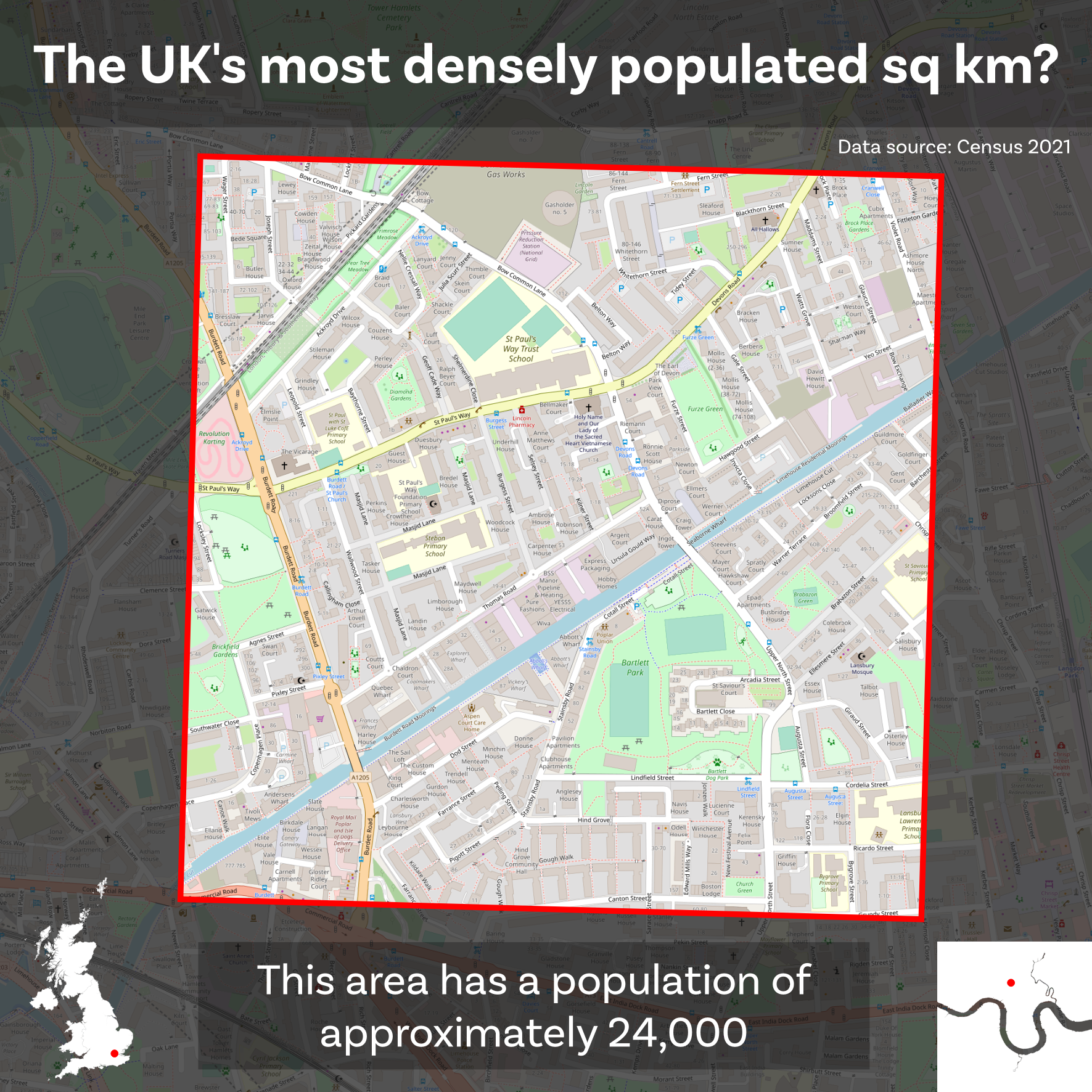
Stats'n'maps expert Alasdair Rae has bashed the latest census data, because that's very much his thing, and confirmed that the most densely-populated grid square is in London. What's more, and what's amazing, is that he's pretty sure it's in Bow.
You can, and should, read his very long explanation of how he found this out because it's really very thorough.
In short he
• drew a 1km×1km grid across the UK
• extracted the population data for 18000 output areas from the 2021 census
• assigned population figures to each grid square
• looked for any grid square with a total population over 20000
When he looked for populations over 15000 this threw up 63 squares in London and one each in Leeds, Birmingham, Leicester and Brighton. But when it came to exceeding 20000 there were only three such squares, all of which were in the capital. One was around Lisson Grove (near Marylebone), one was in Upton Park (north of the station) and the third was in Bow (more specifically Bow Common close to Tower Hamlets Cemetery Park). Even at this early stage Bow was winning.
To be more certain he started again with a different grid, then another and then another, because population doesn't necessarily respect randomly oriented grids. This threw up a slightly different set of winners but Bow Common was still on top, now with a population in excess of 24000. Jiggling the grid slightly to the east allowed him to find an almost-entirely-overlapping square topping 25000 and this appears to be the UK maximum. So I've been to have a look.
This isn't the well-known side of Bow, it's the southern edge nudging into Poplar - the E3/E14 borderlands. The grid square misses all the main roads hereabouts, instead slotted safely inside the triangle made by the A11, A12 and A13. It has very little industry and few significant shops. Amazingly it has no stations, only the Fenchurch Street line clipping one corner, and its chief bus routes are two intermittent single deckers. The most significant feature is probably the Limehouse Cut canal slicing diagonally across the centre. On the face of it there's nothing at all special about Bow Common, it's mostly postwar flats, and maybe that's the secret to its success.
First things first, it doesn't generally look like this.
There are hardly any terraced streets within the grid square, barely enough to count on one hand, because they've almost all been bombed or otherwise demolished. The area was known for its slums before the war and widespread bomb damage subsequently hastened their blanket replacement. Terraces are relatively compact but not as dense as flats so that's what the borough of Poplar chose to build instead. And what they didn't particularly do was build high, at least not round here, so Sleaford House in the photo is one of only two or three proper tower blocks in the square. Relentless low-rise flats, that's what's been built instead.
Many are postwar blocks in long rectangular style. My carousel of photos shows Mollis House (the jagged boundary abutting Furze Green), Gough Walk (connected by walkways, ramps and footbridges) and Augusta Street (a bland wall on the edge of the Lansbury Estate). Each cluster has a certain homogeneity but across the grid square there's considerable variety having been built at different times. A lot of these flats originally had accessible entrances that have since had to be gated and keypadded. The population of Tower Hamlets more than halved between 1945 and 1981 so this level of development was perfectly adequate to house those left behind.
As time went by the types of flats become more mixed. Squat blocks with a central atrium, stacks of hutches with corner balconies, postmodern confections with pastel stripes and peculiar lumps designed on an architect's whim - all were packed in together. Few of these resulted in sprawling nomanslands so there was rarely any need for mass regeneration, only piecemeal replacement in manageable chunks. Over the last 15 years much of the gridsquare has come under the umbrella of housing association Poplar HARCA, a powerful council spin off with over 9000 homes on its books. They've repaired and rejuvenated but also in many cases substantially rebuilt driven by a need for densification, and it may well be down to them that this grid square now packs so many people in.
Another reason is of course household size, because density comes down to not just the number of homes but also the size of the families living inside them. Over half the households in this part of Tower Hamlets contain dependent children which is comfortably above the borough average. My photos show very recent examples of houses attempting to cater for extended families - possibly multi-generational or with a lot of children. Technically they're terraced but also three or four storeys high to pack as many rooms as possible into what's still a narrow footprint. These examples are on Farrance Street and Masjid Lane and not yet commonplace, but they do demonstrate how you can increase density without always having to build flats.
Over the last decade bricky vernacular flats have started to take precedence, as they have elsewhere in inner London. These examples are from the (affordable) Leopold estate to the north of the square and the so-called New Festival Quarter to the south. This 'festival' branding was a shameless marketing wheeze to echo 1951's famous Lansbury Estate but in this case with no architectural flourish whatsoever. Here we find concierges and gyms encroaching on what's generally been a social housing neighbourhood, plus professionals buying apartments rather than families renting, but as yet this approach applies to a tiny fraction of the wider housing stock.
The Limehouse Cut has become a flashpoint for development as the warehouses that used to line the canal are sequentially replaced. Follow the towpath and a motley collection of balconied apartments look down on what was once grim and forgotten but is becoming prestige waterfront, with the height of the towers peaking around the bridge at Bow Common Lane. A few industrial units hold out along Thomas Road, should you need plumbing supplies or wonder where your Gorillaz home delivery bike originates from. But housing will always be the more valuable use of land, indeed the former jobcentre on Dod Street is currently in the process of being flattened to make way for 84 bland canalside flats.
You might expect the densest gridsquare in the UK to be light on open space but that's not the feeling you get if you walk around the area. Chief among the green offerings is Bartlett Park, a substantial recreational space that's been given a mighty spruce up recently and now even includes a coffee shop, a true local rarity. It's worth pointing out that before WW2 the park's footprint contained as many as ten squished terraced streets, so density hereabouts was once even higher. St Saviour's Church in the centre of the park was saved but that of course is now flats, while the loop of ordinary houses around it is merely a reminder that back in the 1980s nobody was trying to pack' em in.
It doesn't feel like the UK's most densely populated gridsquare, more like unfocused residential sprawl, but all those flats and families must add up. What's more there's plenty of scope for the population to rise even higher thanks to the regeneration of Bow Common gasworks on the northern edge of the square. This long vacant brownfield site has recently reached the 'flattening out and masterplan development' stage and is being lined up for another 1450 homes. Only 35% will be affordable, a fact which tends to bring in single professionals and keep families out, but this grid square could easily be knocking on a population of 27000 by the end of the decade.
Of course 25000 is nothing compared to some European cities, notably Paris and Barcelona, with at least one grid square in the latter exceeding 50000 residents. Britain doesn't really pack them in, the country isn't really full, especially if Bow Common is the worst it ever gets. My thanks to Alasdair for bashing the figures, and if you want more stuff like this you should be following him on Twitter or reading his blog.
I hope you had a nice weekend.
I had a nice weekend.
Saturday
Frank F says "whatever the taste experience, chicken must be capable of being more visually appealing."
Indeed. I'm not sure this poster at Beulah Spa was doing the Harvester menu any favours visually, let alone the text staying within the boundaries of factual correctness. It cannot be true that the tastiest chicken in the world is that generated by a chain restaurant rotisserie in Upper Norwood, otherwise Michelin have got their star system all wrong. Also the Harvester menu includes a choice of six different sauces and they haven't deigned to tell us which one takes the crown. I wasn't tempted, I didn't drop in, plus it was too early in the morning for world-beating chicken to be on offer anyway.
I was however intrigued by the location of the restaurant on the Croydon/Lambeth fringe, because it turns out all the Harvester restaurants in Greater London are in Outer London. Those 16 are in Hanwell, Northolt, Edgware, Ponders End, Chingford, Ilford, Goodmayes, Gidea Park, Hornchurch, Sidcup, Bromley, Addington, Eltham, Morden, Sutton and here at Upper Norwood, i.e every single one's in zones 4-6. The Harvester phenomenon, like Toby Carveries, eschews the inner suburbs... perhaps because palates are different or perhaps because it's really important to have a car park.
Ken says "The railway bridge crosses the line between Sutton and Carshalton Beeches, just over half a mile east of Sutton Town centre, and immediately south of a similar bridge between Sutton and Carshalton.
Indeed it is. It clearly wasn't built with modern traffic in mind, nor the needs of pedestrians, particularly given it's the only crossing for over half a mile. Traffic was light so I crossed safely enough but I'm not sure I'd be too keen at night. This narrow bridge on Kings Lane was closed in 2020 as part of Sutton's Low Traffic Neighbourhood scheme, but caused quite the uproar and they rolled it back within a year.
Ken adds "Can't begin to work out what brought you to this neck of the woods though?!"
Indeed, it is a bit off piste. I was trying to get from Carshalton to Sutton but no bus was scheduled for the next 15 minutes so I thought I'd walk via the backstreets. I don't expect I'll ever visit again. Nice crocuses in Hilcroombe Road though.
AndrewR asks "Is the Range Rover located (semi-appropriately) at South Wimbledon station?"
Indeed it is. Of all the places to spot a car with an almost-WOMBLES numberplate this is nigh perfact, although alongside Wimbledon Common would have been better. It's impossible to say whether the driver is a massive fan of local football club AFC Wimbledon, a massive fan of small snout-nosed litterpickers or a member of the Beresford dynasty. I tried to see if Tomsk and Madame Cholet were sitting in the back seat but the tinted windows didn't make that possible.
It was an auspicious weekend for a wombly experience because the very first episode of The Wombles was screened exactly 50 years ago on 5th February 1973. It filled that brief transitional slot on BBC1 between children's programmes and the evening news where the Magic Roundabout often sat. The Wombles was made by Film Fair and Ivor Wood using stop-motion animation and memorably narrated by Bernard Cribbins. The very first episode was Orinoco & The Big Black Umbrella, the tale of a very windy day, and I would definitely have been watching being bang in the middle of the target age group. Within a year Wombles merchandise would be everywhere, including my bedroom wall, and Mike Batt's catchy theme song would be making an assault on the top of the charts.
Sunday
Nobody wrote "That's Croxley station, obviously. What were you doing there?"
Indeed. The entire Metropolitan line was closed all weekend which meant Croxley had a replacement bus service and that allowed the opportunity for a free express journey from Wembley Park. I don't think I've ever ridden a double decker down Batchworth Hill before, indeed the main road between Rickmansworth and London is generally served by no bus routes whatsoever. I spent a pleasant hour wandering around the streets where I grew up and will no doubt be subjecting you to overnostalgic bloggage later in the week.
Cottonsocks said "You should have come in for a cup of tea and a slice of home made lemon drizzle, maybe next time you're in LB Hillingdon."
Indeed, although he said this in December and didn't leave a forwarding address so I had no idea where to go. Also Hillingdon is a very large borough so when I parachuted into Harefield I may not have been at the right end (although I suspect I was). Also my travels tend to be planned at the very last minute which is not conducive to the sharing of tea and cake but thanks for the kind offer (I had an extra-large cuppa when I got home).
The photo shows the duckpond on Harefield Village Green, a rustic corner of a larger open space. It's also a Centenary Field, a British Legion project to commemorate 100 years since the end of WW1 by securing parks and green spaces in perpetuity in memory of those who died. The war memorial obelisk overlooking the duckpond is original but the detailed information board by the roadside is more recent. London's other Centenary Fields are at Grange Park (Old Coulsdon), Harmondsworth Village Green, Ilford War Memorial Gardens, Islington Memorial Green, Kensington Memorial Park and Roding Lane Sports Ground. The idea was to have one in every local authority in the UK but it didn't quite work out like that - Hillingdon and Redbridge have two apiece whereas most London boroughs are bereft.
Andy S says "Last photo looks like where some of Happy Valley was filmed. So maybe a satisfying conclusion to Sunday watching TV."
Indeed it was. These are the streets of Hebden Bridge (as seen from the climb to Heptonstall) in a photo taken five years ago. It's a very independent town, very charismatic, and the surrounding landscape makes the ideal backdrop for a Sally Wainwright drama. I had to go back and watch the first two series of Happy Valley again after I'd visited so I could say "ooh that's under the viaduct in Halifax" and "OMG that's Todmorden".
I loved the third series which was proper apppointment television, with multiple criminal threads you couldn't possibly see tying up by the end but which somehow did. Sarah Lancashire nailed the lead character and the scripts were pitch perfect with understated insight and gentle humour, entirely unlike your usual TV cop drama. I also raise my glass (having had this pointed out) to the perfect connection between the last few minutes of Series 3 Episode 6 and the opening scene of Series 1 Episode 1, the show having opened with Caroline confronting a drunk man doused in petrol... even the bookending sunglasses were the same.
An exciting initiative in Sutton is making it easier to strike up a conversation with a stranger, and could literally save lives.
A simple plaque on a bench in Woodcote Road, Wallington, invites anyone 'happy to chat' to take a seat and receive a little boost to their day. 'Sit here if you don't mind someone stopping to say hello', it adds, in the hope that a kind passer-by will do just that. Any impromptu conversation is far more beneficial than drifting through life in silence, so this new project is a welcome step towards improving our collective wellbeing and self-worth.
Sitting alone on a public bench can be a dispiriting experience, especially when those passing by choose to ignore your presence. And yet the occupant may yearn to say nothing more than hello, or maybe to strike up conversation about the weather, or perhaps to share a little gossip to help the day go by. It's therefore hoped these special plaques will help those with something to say to connect more easily on a day to day basis, thereby helping to lubricate Sutton's social interface.
The inspiration for the 'Happy to Chat' project came from a depressing experience in a Cardiff park when Allison Owen-Jones, 53, spotted an elderly man sitting alone on a bench for 40 minutes. At the time she was too cautious to go over and interact, but she did wonder if the man was lonely and why nobody else seemed to care.
"Wouldn't it be nice if there was a simple way to let people know you're open to a chat," she thought, and so the idea of a notice tied to a bench came into being. The initiative proved remarkably successful, tapping into that innate desire we all have to reach out and connect, and soon spread around the country indeed around the world.
There's now no need for folk in Wallington to sit at home and stew, they can simply head out to their nearest bench and make clear their desire for company. We all need a regular injection of communal time to boost our mood, some even more frequently than others, because what is the human condition if not regularly shared? Just be careful not to sit in front of the sign because an invisible cry for help is no help at all!
News For Introverts
Chatty benches make it harder to get a seat
A thoughtless intervention in Sutton is making it tougher to find somewhere quiet to sit down, and could literally be damaging to your health.
A selfish plaque on a bench in Woodcote Road, Wallington, invites anyone 'happy to chat' to take a seat and await impromptu conversation. 'Sit here if you don't mind someone stopping to say hello', it adds, in the expectation that a misguided passer-by will do just that. But that's not why people take a break, they do it to seek solace and respite from their fellow humans, meaning this bench is now effectively out-of-bounds 24 hours a day.
Imagine the worst case scenario. A reclusive soul is sitting lost in their thoughts when some inconsiderate stranger makes themselves known and wrecks the moment with mindless smalltalk. Nobody needs a inane greeting, nobody's genuinely interested in the weather and nobody wants to hear random opinions on the world around them - these are all anathema to the simple act of sitting quietly.
The wording on the sign is borderline offensive and discriminates against those who would rather hide themselves away than interact with a stranger. Once again the establishment insists on insinuating that gregarious behaviour with regular social top-ups is the norm, whereas in fact only time separated from the masses recharges the soul.
Overnight a portfolio of benches across Sutton has become unusable, sadistically restricting opportunities for recuperation, relaxation and meditation. What's more no "non-chat" benches have been provided, despite the obvious benefits of somewhere peaceful to hide away in designated isolation, as once again the needs of the 'deviant' silent have been cruelly overlooked.
From the wording on the sign it almost sounds as if the bench is under observation from a patrol of well-meaning community do-gooders who intend to magically appear, impose their company and say hello. Sutton's not yet a no-go zone, indeed you can always thwart the chatty bench brigade by sitting in front of the sign so it can't be seen, but when will people finally realise that 'alone' doesn't always mean 'lonely'?
News For Sutton
Small plastic rectangles appear on benches
An intervention in Sutton is hoping to ease loneliness by adding 'Happy to chat' signs to a dozen benches in Beddington and Wallington.
The plaques were installed by the Beddington and Wallington Local Committee using funding from their Public Realm Revenue budget. The total cost to the council was £454. The selected locations for the benches were as follows.
● Wallington North: Wallington Green (near the Dukes Head); Elm Pond; Manor Road (near the station)
● Wallington South: Woodcote Road (outside Old Town Hall); Shotfield (on the new bench); outside Sainsburys on the steps down from Stafford Road
● Beddington South: corner of Lindberg and Mollison Drive; near new Spitfire weathervane; outside the Phoenix Centre
● Beddington North: Beddington Park by the Cricket Green; in the park on the left as you walk from the church; Bandon Hill cemetery
Funding for the plaques was agreed at a committee meeting on 10th March 2020, immediately before lockdown, which was pretty much the worst possible timing for a social scheme encouraging people to sit together. It took until the summer of 2021 before local councillors felt confident enough to recommend using the benches, pointing out that "many have missed those mini-conversations we took for granted... and some people have had almost no one to talk to for much of the pandemic."
The bench in the photo can be found alongside the Blenheim Gardens bus stop on Woodcote Road. This bench lies immediately underneath a big tree so its left-hand end is somewhat splattered, making sitting here for a chat somehow less enticing. Those seeking to sit in peace can always use the red benches in the bus shelter which are unsigned. Do pop down the next time you're feeling excessively solitary, but don't necessarily expect anyone else to stop and say hello.
That's the bus stop where the most passengers board buses.
According to an FoI request it's here.
This is bus stop N outside Brixton station.
It's the stop beside Boots and King of Trainers.
It's used by a lot of people getting off the tube and continuing their journey further south.
According to the data, over 8000 people board a bus here on a typical weekday.
Except that when I turned up to have a look at bus stop N, something looked a bit odd.
And this is why you should always do your research.
There are three southbound bus stops at Brixton station. N: routes 35, 355 and P4 P: routes 45, 59, 109, 118, 133, 159, 250 and 333 Q: routes 2, 3, 196, 415 and 432
It seemed very wrong that the busiest bus stop in London could possibly be the stop served by only three routes, given the other two had so many more.
And it turns out this is because the data in TfL's spreadsheet is for a typical weekday in June 2022, and back then the stops outside Brixton station were organised differently. During the pandemic the number of stops had been reduced to two to aid social distancing, forcing those heading for Tulse Hill to walk a long way to Effra Road instead.
At the time the designation was N: routes 35, 109, 118, 250 and 355 Q: routes 45, 59, 159 and 333
After many localcomplaints, even a petition, these stops were reorganised on 21st June 2022 which must have been just after the survey date. Bus Stop N is not the Bus Stop N it used to be. So we need to disregard Brixton station and ask the question again.
Where is London's busiest bus stop?
This is bus stop R at Marble Arch.
Officially it's called MARBLE ARCH STATION / PARK LANE.
It's at the top of Park Lane facing Speakers' Corner.
It's served by all the southbound buses.
That's routes 2, 6, 13, 16, 23, 36, 74, 137, 148, 390, 414 (and four nightbuses for good measure).
According to the data, over 7500 people board a bus here on a typical weekday.
A lot of them are tourists.
I can't say I'm surprised it's London's busiest bus stop.
Let's do you a full top 10.
London's busiest bus stops 1)[R] MARBLE ARCH STATION/PARK LANE (s/b) (2 6 13 16 23 36 74 137 148 390 414) 2)[H] WOOD GREEN STATION (n/b) (121 141 184 221 232 329 W4) 3)[A] STRATFORD BUS STATION (n/b) (69 158 257) 4)[R] ELEPHANT & CASTLE STATION (s/b) (12 35 40 45 68 136 148 171 176 343 468 P5) 5)[N] WOOLWICH ARSENAL STATION (n/b) (96 99 122 177 180 472) 6)[B] HARROW BUS STATION (w/b) (114 140 X140 395 483 H10) 7)[M] LONDON BRIDGE (n/b) (17 21 35 43 47 133 141 149 344 388) 8)[D] SEVEN SISTERS STATION (n/b) (76 149 243 259 279 318 349 476) 9)[K] BARKING STATION (e/b) (5 62 368 EL2 EL3) 10)[E] ELEPHANT & CASTLE/LONDON ROAD (e/b) (1 53 63 168 172 188 363 453)
I like how varied that list is.
The next 10 busy stops include WIMBLEDON STATION, HANOVER PARK, EDMONTON GREEN BUS STATION, CLAPHAM JUNCTION STATION, SHEPHERD'S BUSH STATION, HAYES TOWN and BRENT CROSS SHOPPING CENTRE.
They also include Bus Stop Q at Brixton station, and I fear it's perfectly possible that the newly rejigged Bus Stop Q ought to be in the Top 10 somewhere, possibly quite high. Which just goes to show you can't simply bash the data, you have to query it too.
It would be fun to ask...
Where is London's least busy bus stop?
...but unfortunately the data isn't up to answering that question.
The spreadsheet contains 117 stops with zero boarders, many of which did have boarders but the model didn't recognise them. This is what happens when you collect data at certain times on certain days then scale it across a week generating meaningless averages to five decimal places, plus when data collection can't cope with Hail & Ride sections, plus when Abbey Wood accidentally scores zero due a data balls-up, and it's all patiently explained in the FoI request but basically you can't trust the zeroes to be zeroes, sorry.
Hopefully you can trust that MARBLE ARCH STATION/PARK LANE is London's busiest bus stop.