Things to do on a sunny Oxford afternoon in Fresher's Week
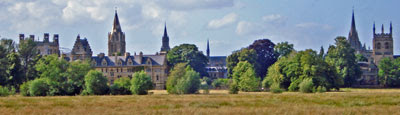
1) Go for a stroll around Christ Churchmeadow There's a great view across the cows, and it won't cost you a penny.
2) Wander round the Botanic Garden If you're a student of botany, you need somewhere to look at plants. And this university's had a botanic garden for nearly 400 years, making it the oldest in the country. There's a more formal walled garden at the front, laid out in neat rectangles with every well-tended specimen duly labelled. A newer section at the rear features a special "autumn walk", brightly blooming even in the middle of October, as well as a herbaceous border, water garden and orchard. Beside the river are densely-stocked glasshouses, home to big cacti and photogenic water lilies and insect-eating plants. It's a real oasis in the city, and ten quid cheaper to get inside than Kew.
3) Enjoy a pie and pint at the Turf Tavern Whenever Inspector Morse needed to drink a pint of real ale in a photogenic pub, he'd often end up in the Turf. It's hidden away down a couple of narrow alleyways, with the fortunate outcome that tourists never stumble across it by mistake and ruin the atmosphere. The Turf is a ramshackle half-timbered pub, a bit of a squeeze on the inside but with several outdoor courtyards where drinking is an absolute pleasure on a sunny day, even in October. Beer connoisseurs will no doubt salivate at the thought of frothing pints of Spuddles County and Wilson's Heritage Brew, or whatever finest ales the landlord's got on tap this month. The menu's damned fine too, and I adored the homemade chicken and mushroom pie they served up yesterday lunchtime. Cheers.
4) Pop into the Pitt Rivers Except you can't at the moment because the museum is closed for refurbishment until the spring. Which is a shame, because the Pitt Rivers Museum is one of the most fabulous collections of eclectic ethnography to be found anywhere. It was founded in 1884 by General Pitt Rivers, one of those Victorian empire builders who went round the world thieving tribal bits and sticking them in display cases. Unforgivable, retrospectively, but absolutely bloody brilliant all the same. Where else would you find cabinets given over to "zithers" and "body painting" and "war quoits"? Or learn about Hawaiian tattooing, or gawp at a giant indoor totem pole? If it was in Central London, everyone would go. As it is, the Pitt Rivers is a rare treat for those in the know.
5) Poke round the Museum of Oxford Enter the limestone doorway round the back of the Town Hall and you might be expecting a glossy interactive experience recounting the delights of academia. But you'd be wrong. This two-floor museum's run by the council, so it's more about town than gown. The local history depicted here runs from a few old Roman pots to William Morris's car factory, with acres of text and photos to scan inbetween. The galleries are sort of interesting, but only because Oxford's a fascinating town, and I got the feeling that the displays haven't been tarted up much for a decade or two. Missable.
6) Take a tour of the Bodleian Library They've got one of every book in the country, they have, and if you're a member you can request anything from a medieval manuscript to Budgie the Helicopter. The tours are led by learned librarians, and you get to climb up to the proper old wood panelled bit inaugurated by Duke Humfrey where many of the most fragile volumes are kept. Which is stunning. But sssh, there are English students doing research and they'd rather not be gawped at.
7) Peruse the Ashmolean That classical-looking building off St Giles is part art gallery, part museum. But more art gallery. It's undergoing renovation at the moment, so trooping from one room to the next can be a bit of a trek. But the paintings are nice (sorry, I'm not an art critic, but you get the idea).
8) Hike up Carfax Tower I like climbing towers, and Oxford has two accessible to the public. This one is all that's left of St Martin's Church, at the main city crossroads, ascendable for a couple of quid via the usual winding staircase. You get a pretty good view of the dreaming spires from the roof, so long as you don't mind the odd department store cooling tank getting in the way. Fingers crossed you get the square beneath the weathervane to yourself, and don't have to squeeze past gangs of grinning tourists taking photos of themselves with pointy limestone spikes behind. The name Carfax, by the way, is derived from 'Quadrifurcus' which is Latin for crossroads. Oxford's a bit intellectual like that.
9) Go back to your old student digs Look, there's my old room on the multicultural Cowley Road, still above the estate agents, still tiny, and probably still extortionately rented. I wonder if this year's batch of student no-hopers are plagued by ants in the kitchen, and whether there are already piles of unwashed plates by the sink because nobody can agree whose name should be next on the cleaning rota. The Co-op supermarket nextdoor is new (it would have been damned useful 25 years ago for buying all those cans of beans and pasta we students existed on). And look, the pelican crossing which used to plague my sleeping hours has been removed, as has the buzzing overnight takeaway across the street (damn, too late). I'd never live here now, but the street still feels very much like home.
10) Go back to your old college Sorry. "Closed to visitors. Fresher's Fair in Hall, 2-3:30pm." And I think they'd have noticed that I was 25 years too late.
You're wearing a condom on your head. An oversized knitted condom, admittedly, but the shape of a prophylactic all the same. What do you look like? You probably think you're wearing a modern trendy cutting-edge fashionable beanie hat, you do. But I think you're wearing a knitted condom on your head. I think you look a right plonker.
I mean, what a sartorial disaster. Even a normal sized beanie hat usually looks misshapen and style-free. But yours is "super massive", probably picked up at Top Man for a tenner, and it droops embarrassingly backwards off your lank gel-soaked hair. It's tight and clingy round your ears, but loose and floppy further back. You look like Noddy, or a pot-smoking pixie, or some white boy attempting to appear hip and Afro. Let me assure you, you've failed.
You wouldn't wear a real condom on your head, would you? Not unless you were very drunk, or showing off in front of your mates, or just interested to see how far it might inflate. But it seems you're perfectly happy to wear this woolly lookalike. It would make a woefully inadequate contraceptive, all over-sized and leaky, and any woman would laugh you out of bed if you tried using it down below. But on your head, where it's patently unfillable, that's just madness.
And why? The weather's not even proper cold yet for heaven's sake, so you have no genuine need for any insulated cranial extension. Are you storing something under there, or did your bell fall off, or are you just following the fashion herd like a depressingly compliant sheep. I shall never understand why men wear hats. More to the point, I shall never understand men's fashion. But, quite clearly, neither do you. Because you're wearing a knitted condom on your head. And you look a complete teat.
An irregular event which you probably weren't thinking of attending on Saturday because you'd never heard about it but might find interesting especially if you're the sort of person who likes London local history (which, if you're reading this blog, you probably are):London Maze 2008 It doesn't happen very often. The City of London organises its local history fair every so often, sort of every two years-ish, ocasionally, to an unpublished timetable. The last one was in 2006, in March, which isn't even a sensible fraction of a decade ago. But it was an event well worth attending, and I'm glad I spotted it was on. The London Maze always takes place at the Guildhall, which is the seat of City government, but up at the historic end rather than in the nasty concrete office bit. It's like a village fair with stallholders laying out their wares in the community centre, except the hall is a medieval listed building and the wares are books and leaflets and historical documents. I can't guarantee what'll happen this year, but last time I got a free plastic bag and filled it with paraphenalia from such august bodies as the London Topographical Society, the East London History Society, Barking & Dagenham Heritage Services, the London and Middlesex Archaeological Society, the Association of London Pumping Heritage Attractions and the Family & Community Historical Research Society. Those sort of stallholders - committed, passionate and most definitely local. Attendees at the last event also enjoyed free admission to the Guildhall Art Gallery, plus the opportunity to pop down to the basement and view theremains of London's Roman Amphitheatre. Hopefully Saturday's event will include all of that plus free walks, and talks, and... well, you already know whether or not you might be interested. And I think you might.
When the Olympic Park is completed, the "Park" bit will be little more than an afterthought. London's 2012 stadium will be surrounded by a plain of artificial astroturf, within an encircling moat of reed-free concrete waterways. Plastic trees will be used to provide instant greenery which looks good on the TV cameras, and a few transplanted rosebushes will be wheeled in so that Sue Barker's to-camera links have a decent floral backdrop. After the Games the Olympic Park will be sealed off for five years so that lots of new houses can be built, and then planners will drop in some riverside terracing and an adventure playground as an afterthought. The Greenway will be also closed off so that it can be transformed into a four-lane bicycle expressway, providing a floodlit cross-river route through the centre of a building site.
Don't worry, almost everything in the above paragraph is untrue. There are no plans to turn the Olympic Park into the Boris Johnson Austerity Housing Estate, but instead plenty of plans to create a world class environmental greenspace. I know this because the planners told me last night, at a consultation event in deepest Hackney. Don't worry, they purred, your 2012 parkland legacy is safe in our hands. And yes, the ODA's finely tuned plans for ecological delivery sound much more convincing once you've heard them direct from the mouths of the experts responsible.
For a start, London's Olympic parkland won't be a tacked-on feature once the Games are complete, it's being engineered into the project from the start. A surprisingly wide expanse of greenery will be at the heart of the central area linking all the stadia together, creating a place to gather while events are taking place inside. Planting starts early, with many shrubs and trees already growing elsewhere ready to be transplanted when required. There'll be six-or-so "frog ponds" to which various endangered species will be returned, and a variety of carefully engineered riverside environments ranging from wet woodland to reedy terraces. Biodiversity is the watchword. And this extensive central parkland should be open to the public very soon indeed after the Games are over, which is good news for all of us locals.
The Olympic Park will be divided into two main zones - north and south. All the pretty and natural-looking stuff will be in the broad parkland to the north, bordering the formerly inaccessible banks of the Lea. The plan is to use landfill from Olympic construction to create a series of interesting angular hills and valleys, with an emphasis on opening up views of the river wherever possible. It could look lovely, eventually, although it might take a few years to iron out the initial atmosphere of raw artificiality. If the post-Games park can attract visitors, this'll be the place to come for a woodland stroll, a game of football or a picnic. But it seems a pity to be spending millions of pounds to eradicate the entire Manor Garden Allotments and the rather adorable Channelsea River, only to replace them both with what might be swathes of under-used unnatural pseudo-landscape.
In the southern half of the park, the emphasis is rather different. The parkland will be more linear, restricted mostly to theriverside, and more somewhere to walk through than to relax. The aim is to create an "urban event" environment around the stadium, which I think is planner's code for "festivals, markets and cultural activities" (but I fear could mean "empty 99% of the time"). A particularly impressive feature should be the London 2012 Gardens - a long thin ornamental strollway planted out in themed sections with sustainable plantlife from around the globe. This'll be open during the Games themselves, and also as a reminder of 2012 for many decades to come. They're planning long term here, for the benefit of grandchildren yet to be born.
Then there's the Greenway, that Victorian masterpiece sewer with a rather smelly footpath on top. The stretch between Hackney Wick and West Ham is in for a major upgrade, and about time too. The plans are to lay two adjacent parallel paths with differing surfaces, one for bikes and one for pedestrians, leaving the remainder of the sewertop for grassy wildness. Additional access points are to be added, not least because 18% of arrivals at the 2012 Olympics are expected to walk in via this route. Two major discontinuities will be removed without the need for extra bridges - a new path will loop under the railway at Pudding Mill Lane, and there'll be a proper pedestrian crossing directly across Stratford High Street. But don't expect street lighting, because after-dark walking only encourages after-dark crime, apparently.
I always thought the Lower Lea Valley had a rundown character and derelict charm all of its own, and it's clear that this is now gone forever. But I'm encouraged that the replacement public realm is being designed by folk who know and care about what they're doing, and might just give the eventual Olympic Park a bit of soul.
One thing about London's art galleries - there are always more that you haven't visited. Or, in the case of the Pump House Gallery, haven't even heard of. Well I hadn't anyway, not until this weekend. I'd heard there was some impressively arty event going on outside the gallery, so I set off for Battersea on a very damp Sunday afternoon to try to find the place. What really, it's in the middle of Battersea Park, on the edge of the boating lake? That must be why I hadn't noticed it before. Cue the smoke.
Umbrella poised, I joined a crowd of South London arty types and intrigued passers-by in the courtyard outside the gallery. We were awaiting the scheduled performance of Landskip by Simon Patterson - a semi-choreographed pyrotechnic display (delayed somewhat while the artist demonstrated safety procedures to a group of dripping volunteers). The artwork involved setting off canisters of coloured smoke amongst the landscape, and was first performed atCompton Verney in 2000. Now Simon got to do something you'd normally get arrested for - setting off flares in a public park, for an hour, and flooding the place with smoke.
If you ever fancy recreating Landskip, the instructions seemed to go something like this. 1) Purchase approximately 50 coloured smoke grenades - preferably in purple, orange, yellow, red, green and blue. 2) Select parkland location (ideally near trees, footpaths and/or lakes). 3) Place each canister on cheap silver tray, of the type pound shops sell for sausage roll buffets. 4) On given signal, ignite canister to send plume of smoke billowing downwind. 5) Watch as the smoke swirls, and coils, and spreads, and flows, and dissipates. 6) Take photographs, because it's not every day you get to take photographs of coloured smoke in a park. 7) Attempt to sell your photographs for £120, because this is art. 8) Pick up spent cartridge using tongs and drop into bucket of water.
A crowd of 40 or so hardy spectators certainly enjoyed the spectacle, although not all of them stuck it out for the full hour. Occasionally the smoke billowed ominously towards us, rather like the special effects in a cheap horror film, and parents had to sweep up their beloved offspring from out of its foggy path. One woman had brought along a comedy greyhound, which insisted on bounding around through the mist and provided my very best photo of the afternoon (worth £120 of anyone's money I think). Simon's performance might have been lovelier in sunny weather, but somehow the grey overcast drizzle added a certain atmospheric gloom to the proceedings.
After the one-off event came an opportunity to look around Smoke - the main exhibition inside the Pump House Gallery. This may not look like a particularly big building, but there are four floors of galleries within and I bet they don't normally see quite so many visitors as crammed inside on Sunday afternoon. The exhibition has been curated by the folk at Implicasphere, who appear to have inhaled something creative, brainstormed the word "smoke" and then gone out and retrieved all the artefacts they scribbled down. A smoky tapestry, for example, or a 1950s smog cartoon, or a photograph of a spurting volcano. More obtuse items include a Smokey Mountain rabbit, some dolls-house-sized smoked salmon and a tobacco enema (honest). There are also several audio-visual displays, ranging from a smoking skinhead to a documentary about coal, plus a rather wonderful 15 minute video compilation of smoky-referenced snippets (ah, the Wicked Witch of the West, and lung cancer warnings, and Mary Poppins, and steam trains, and a Thunderbirds ignition). A right motley exhibition it is, with a genuine feeling of random ephemera.
You may be too late for Simon's outdoor wafting, but the gallery's Smoke can be viewed for free over the next two months. And I may find myself walking through the middle of Battersea Park a little more often in the future.
London's railway infrastructure usually takes an age to construct. The Jubilee line extension was first proposed in the 1970s but not completed until 1999. Crossrail's been on the drawing board for yonks but can't possibly be finished before 2017. And the "Thameslink 2000" project, initiated in 1991, was so woefully optimistically named that it probably ought to be rebranded "Thameslink 2015-ish". So it's a minor miracle to be reporting on a station successfully knocked down, rebuilt and reopened in nigh record time, all within the same calendar year. Welcome to Nu-Shepherd'sBush.
It was only back in February that the good people of W12 were barred from their local Central line station and forced to make alternative tube travel arrangements. A demolition team moved in to raze the original station building to the ground, and tear out the escalators, and rip all the tiles off the platform walls. Gutting, it was. Progress below ground could be viewed every time you passed through the station on a non-stopping train (what a mess, they'll never be finished in time), while above ground a shiny glass/metal box rapidly appeared at the pointy end of Shepherd's Bush Green. Eight months flat from start to finish. And the station reopened yesterday lunchtime.
When I boarded a Central line train at Bank just before noon yesterday, my destination station was still closed. But by the time we departed Notting Hill Gate our driver was able to announce that "Shepherd's Bush station is open", much to the unexpected delight of certain passengers on board. And so it was that a few of us stepped out onto a freshly-reopened station, untouched by public footstep since February, and ventured forth round the curving platform towards the way out. Blimey it looked different [photo]. Last time I was here there was diagonal tiling in a clashing combination of red and green - quite characterful but rather gloomy. And suddenly the tiling had become very white, almost clinical, topped off by columns of inoffensive navy blue. Worth a complaint to the heritage watchdog, maybe... except that white/blue is actually the original design, and red/green merely a mid 80s refurb aberration.
Onward up the platform, past a next train indicator as yet unable to detect the next train, and a trio of TfL operatives discussing CCTV blackspots. When they disappeared through an alcove [photo] to inspect the eastbound platform, I suddenly had the entire westbound to myself, and slowed down to enjoy the subterranean isolation. Things seemed a bit more familiar on the staircase and along the curvingmid-level passageway, although again rather whiter than before. And then smoothly upwards on the refurbished escalators, whose non-urgent upgrade had been completed without additional inconvenience to passengers while the station was closed. No adverts yet, neither here nor down below, which I made the most of but which won't last.
And then the greatest transformation. Where previously there'd been a traditional ticket hall with decoration and clutter, I emerged instead into a giant glass box. Wholly unnecessarily big, to be honest, unless station bosses have plans to position a symphony orchestra at the top of the escalators to serenade passengers, or maybe hang an aeroplane or two from the ceiling.
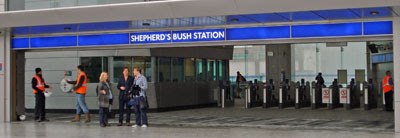
There were scores of TfL operatives in fluorescent jackets standing around beyond the line of ticket gates - temporarily (no doubt) to supervise the handover from construction to operation. Lots more open space too (sufficient to add a gospel choir and helicopter as required), and finally a choice of exits to the street [photo]. I watched as a rail replacement bus trundled past, rendered suddenly unnecessary by the station's reopening. And then I attempted to change trains.
There's another brand new station here, Shepherd's Bush on the Overground, just 100m away across a not-yet busy road. This branch line halt was originally scheduled to open in 2005, but lack of funding, political argument and contractor incompetence delayed the official opening to last Sunday. It's yet another giant glass box, presumably because giant glass boxes are easy and cheap, and because the kind of architectural excellence seen on the Jubilee line extension is now a thing of the past.
"Hello," I said to one of the two men in the bright cosy ticket office. "Sorry, we're closed," he replied. Brilliant. The station's only been open a week, but TfL shut it down all weekend for engineering work. Still, no great loss. This station boasts one of the most pathetic services of any TfL station - one train every 30 minutes Monday to Saturday, and "between one and two trains per hour on Sundays". Not somewhere you'd ever want to turn up on the off-chance without a timetable. Still, at least its platforms are wheelchair accessible, which is more than can be said for the newly refurbished Central line station opposite. Providing step-free access on a Victorian transit system is a logistical nightmare, and not even tens of millions of pounds can sort that in eight months flat.
And why has Shepherd's Bush station been rebuilt so very rapidly? One reason - shopping. Europe's largest in-town shopping centre opens nextdoor at the end of the month, and developers Westfield have contributed 85% of the finance to get these infrastructure improvements delivered. Without the imminent arrival of department stores, coffee shops and luxury retail brand outlets, the good people of Shepherd's Bush would have had to make do with the same old transport opportunities for several years to come. Hell, Westfield London is scheduled to be so financially magnetic that there's yet another brand new station - WoodLane - opening on its north flank next Sunday. It still looks a bit of a mess at the moment, and the shopping centre is similarly incomplete, but never underestimate the power of shopping to make things happen. Even at a time of recession, it's purchasing power that's driving W12's new golden age of transport connectivity.
It's exactly 25 years today since I went to university. 25 years since I left home for the first time. 25 years since I met a whole new circle of friends, most of whom were looking equally lost. 25 years since studying got harder, but more infrequent. 25 years since I discovered that food comes from the supermarket and not from the fridge, that eventually you run out of clothes that smell nice, and that beds don't make themselves if you leave them for long enough. All in all, 25 years since I became vaguely independent.
My university adventure started with a car journey to destiny, and a selection of my worldly belongings packed into the boot. On arrival my Dad struggled to explain to a traffic warden that he did have to park here thankyou, and that hundreds of other parents would be doing so imminently. My Mum coped with her eldest leaving home by unpacking everything and then going shopping for a tray "because it would be useful" (and it was). The halls of residence were full of suitcases (none of them wheelie), parents (proud but anxious) and children (very soon to be adults). Two classmates from my old school turned up to say hello, before heading off to their own new social lives (and I don't think I ever saw them again after that). And then I was on my own.
The first week at university was full of 'getting to know you' moments, both planned and unplanned. On meeting someone new, the conversation invariably followed the same threefold path ("My name is..." "I come from..." and "I'm studying...") after which you hoped you still had something left to talk about. At the Freshers Fair everyone was keen to get you to join things, we thought because they had our student welfare at heart, but in fact because their tinpot university clubs, teams and societies would have collapsed without a fresh injection of bodies and money. I avoided joining anything even vaguely sporty, except for the 'Poohsticks Society' which appeared to exist purely for socialising and drinking, and didn't knock on your door at 7am to demand that you come out on a training run. During that first week our student bar organised what is still the very best new wave 80s disco I've ever been to, helped of course by the fact that it was the 80s at the time.
Three liquids became important. Alcohol was freely available, or at least very cheaply available in the student bar, which saved us ever having to mingle with the real people who lived in the city outside. Coffee became the perfect excuse to sit around and talk into the early hours of the morning, and a means of staying awake to be able to do so. And milk was absolutely essential if you wanted people to come round to your room to drink coffee, so it was a constant battle to make sure that nobody had raided your supplies from the shared fridge.
I gradually made some good friends, not least because my parents had had the sense to pack me off with a kettle and a toaster. I was also one of the few people to own a portable TV so everyone came round to watch it, especially when one of my new friends appeared two days running on this brand new quiz show called Blockbusters. Another of my friends had brought a record deck, another his BBC Micro computer, and all of a sudden things didn't look too bad at all.
University was different in those days. They paid you to go, rather than you paying them. My first term's grant cheque was for £408, which may not sound much nowadays but it's a darned sight better than getting an instant £2765 overdraft. And there were no tuition fees either in those days, which was just as well given how little tuition I think I actually got. But I learnt a lot, even if most of it was more relevant to life than to my increasingly-baffling degree course.
I had been planning to pop back to my alma mater this weekend, just for an anniversary visit to see what had changed in the intervening quarter of a century. But a coincidental work visit back in June provided all the nostalgia I needed, and it turned out that I'd changed rather more than my place of study. So to any of you just starting out at university or college this Autumn, good luck, and I hope you enjoy the experience as much as I did. The rest of your life starts here - enjoy the independence.
The new 2008 tube map includes the following important additional text (in what I calculate to be font size 2):
Borough: Exit only during peak hours Blackfriars: Underground station closed March 2009 until late 2011 Covent Garden: Leicester Square 350m Shoreditch: Limited service Check publicity for information Tower Gateway: Closed until spring 2009
This is clearly insufficient. I therefore propose that we campaign to get the following essential information added to the tube map as soon as possible:
Bank/Monument: Not closed for interchange even though we're pretending it is until summer 2009 Bow Road: Heritage architecture destroyed by greedy Metronet shareholders Canary Wharf: If carrying the contents of your desk in a cardboard box please use the manual gate Clapham South: Last northbound train 0013 Chorleywood: No ticket barrier on westbound platform Crouch Hill: There's only one train every half hour and it'll be packed I really wouldn't bother Down Street: Closed from spring 1932 Ealing Broadway: Anagram of Railway Bondage Heathrow Terminal 5: It takes forever to get out this far High Street Kensington: Next train indicator on platform 2 obscured by "Way Out" sign Ladbroke Grove: Quite busy on August Bank Holiday Monday especially between the hours of 2000 and 2200 Lewisham: Paris Gare du Nord 490000m Mornington Crescent: Rules of famous parlour game printed on reverse of map Neasden: for Adrian's Newsagent Perivale: Turn right outside station for number 297 bus to Ealing Broadway Piccadilly Circus: Beware tourists standing on left on escalator Ruislip Gardens: Most trains don't come out this far so dress warmly when waiting on the platform Russell Square: Retiling work inadequately completed by incompetent contractors St John's Wood: Pub quiz entrants please note, station name shares no letters with the word mackerel Tulse Hill: Sorry, South London doesn't really feature on the tube map Walthamstow Central: Limited service on randomly selected weekends Warwick Avenue: Bet you can't stop humming that Duffy song Waterloo: It's a bloody long walk to/from the Jubilee line West Ham: Don't change here for West Ham Football Ground
It's got worse. The tube map, I mean. London's once great topographic design icon has been getting steadily uglier and more impractical over the last few years, and the latest version is grimmer still. Where will it end, I wonder?
You won't find the new tube map at your local station just yet. TfL will probably be waiting a week or so until the new batch of Shepherd's Bush stations open before unleashing their latest creation upon an unsuspecting public. By the end of the month I suspect there'll be no escaping it. But for the time being you'll only find central chunks of the new map at select updated locations, like the prototype S-stock tube carriage in Euston Gardens. That's where Mackenzie and his camera spotted it, and you might like to have his Flickr set open as I go through the following.
Let's start in W12 with the Underground network's latest stations [map close-up]. Look, there's Wood Lane, which is the first new tube station to be built on an existing line for umpteen years. And there's Shepherd's Bush Market, which used to be plain ordinary Shepherd's Bush until some big cheese decided to rename it after a few stallholders selling cut price tea towels and cleaning products. You'll notice that the former station is wheelchair accessible, and the latter really really isn't (unless you like bouncing uncontrollably down a steep flight of steps). Then there's the fresh duo of Shepherd's Bush stations, one just opened on the Overground after a long-delayed catalogue of woeful construction errors, the other on the Central line about to reopen in barely recognisable form. On the tube map, this entire area is now a barely discernible spectacle in orange and pink.
There are two particular uglinesses I'd like you to note. One is the appearance of diagonal distances to indicate how far it is to walk between pairs of stations. Squint carefully, the text is just about legible at this magnification. The two Shepherd's Bush stations are a mere 100m apart, but this information is apparently worthy of prioritisation on the map. Presumably there are Underground users for whom 100m at ground level across a flat road is an unsurmountable travel obstacle and who need to be warned about this sort of thing, but quite frankly there can't be many. The tube map doesn't warn these passengers that the interchange at Green Park is a lengthy subterranean assault course, or that Bank to Monument is a multi-level semi-shut mountain trek. But White City to Wood Lane, a nice level 250m along the pavement opposite BBC Television Centre, that's apparently also worthy of inclusion. There is no consistency on the tube map, not at all.
And ugliness two is the inconsistent use of interchange symbols. White City didn't used to be an interchange, but a fresh black circle announces that it is now. Change here for Wood Lane... except Wood Lane isn't shown as an interchange. A blue wheelchair blob trumps a black interchange circle, so it's impossible to tell whether a wheelchair blob is an interchange at all. Ditto at Nu-Shepherd's Bush. Could this interchange possibly be depicted in an uglier manner? A doubled-up station name squished into miniature diagonal measurement alongside a nigh-irrelevant British Rail symbol. Would it really have been so terrible to use just one station blob here, or at least to have positioned the two blobs more obviously closer together? This feeble attempt at incorporating distance merely makes the overall information less distinct.
OK, let's head east to Blackfriars [map close-up]. This station's being upgraded and closed for two years, and the new tube map duly mentions this in very tiny writing. But Blackfriars isn't closing until March 2009, so its removal doesn't affect anyone's travel plans for at least five months. Never mind - a premature information campaign is deemed more important than everyday clarity.
And then there's the former East London line [map close-up]. The map design team have finally admitted that the replacement bus service looked far too complex, and have straightened out the former dotted orange wiggle to create something slightly simpler. But not at Rotherhithe [map close-up]. Look how complicated this now-closed station has become. The 381 has become the first ordinary bus route to appear on the tube map, and it's caused this part of riverside London to be displayed in a desperately complicated manner. Canada Water has become an undue mess of step-free stations and step-free buses (except, ludicrously, the buses aren't shown as step-free because a blue blob can only refer to a station). And does Rotherhithe really merit this tangled web? Before it closed this was one of the least used stations on the entire tube network, and located so close to Canada Water that most people could walk there quicker than any bus could drive. But the tube map ignores this practicality in favour of the area's handful of mobility impaired tube travellers - a restricted geographical minority if ever there was one.
Stuff simplicity, it seems TfL now chooses to cater for whichever rail users they deem are deserving of inclusion and 'equality'. Their tube map is optimised for a chosen minority of wheel-bound passengers, rather than the majority of us seeking a broad overview of how to get from here to there. This increasingly complex diagram, crammed onto a tiny rectangular sheet of card measuring 21 centimetres by 14, is no longer visually accessible unless you have eagle-quality eyesight. And as for the 4% of Britons who suffer from colour blindness and can't tell their Central from their H&C, sorry, you're not TfL's disabled minority of choice either, so you're buggered. It's all so woefully ugly, and ill-thought-through, and over-complicated, and desperately inconsistent.
For an in-depth critique of recent tube maps you might like to pop over to Max Roberts' webpage on Information Pollution. Or head down to your local tube station and pick up your own copy of the March 2008 map, the one with a target on the cover and an IKEA ad on the back. Quick, before TfL replaces it and pulps the lot. It may be an impractical design but it's not quite as bad as this new one, or the next one, or the next one. Sorry, but there's no going back to the clean clear lines of the past, and the future can only be uglier still.
New design UK coins I've already received in my small change: 1p, 2p, 5p, 20p New design UK coins I've not yet received in my small change: 10p, 50p, £1
Shepherd's Bush stations opening around now-ish: » Shepherd's Bush (Overground) - Sunday 28 September » Shepherd's Bush (Central) - Sunday 5 October (probably) » Shepherd's Bush Market (Hammersmith & City) - Sunday 12 October (maybe, not sure) » WoodLane (Hammersmith & City) - Sunday 12 October
Cities hoping to be elected host city for the 2016 Olympics (one year from today): Chicago (2 to 1), Tokyo (4 to 1), Rio (4 to 1), Madrid (8 to 1)
People with whom I've exchanged emails in the last 48 hours: My new boss, the great grandson of a Labour leader, Kevan, a recently published author, Great Aunt Annie, some media lady at my local council, a hopeful new blogger, my parents, somebody pretending to live in Woking, a London Underground train supervisor, Vern in Marfa.
London Underground lines fully operational all this weekend: Bakerloo, Piccadilly London Underground lines not fully operational all this weekend: Central, Circle, District, Hammersmith & City, Jubilee, Metropolitan, Northern, Victoria, Waterloo & City
Three-letter UK placenames: Alt, Ash, Ayr, Bix, Bow, Box, Cwm, Dun, Elm, Ely, Esh, Eye, Foy, Ham, Hay, Hoe, Hoo, Hoy, Ide, Kea, Kew, Kyo, Lea, Lee, Lew, Lye, Moy, Old, Ord, Ore, Raw, Rhu, Rye, Uig, Usk, Urr, Van, Wem, Wix, Wye. (anyone else live in one of them?)
Years in which current bendy bus contracts end: 2009: 38, 507, 521 2010: 18, 149, 207 2011: 12, 25, 29, 73 2013: 436, 453 (That's according to this post over at BorisWatch, and comments here. There are more recent announcements suggesting that the 38 will become a very frequent double decker, and the 507 and 521 both costly single deckers - tons of detail here and in this pdf)
I do love a trip to the seaside. The opportunity to get away to the coast and enjoy sun, sea breeze and sand. There's something mighty refreshing about a vista that's half water, and that special feeling of being on the edge of an untameable natural powerhouse. Ah, those endless promenades of salt-splattered buildings, and rows of brightly painted beach huts, and piers and pebbles and donkey rides and candy floss and... Sorry, I may be getting a little carried away there. Because the seaside's not what it was.
When I was very little, one week of every summer would be spent at the seaside. The family would troop off to some guest house or self-service chalet somewhere, always within walking distance of the beach, and I'd spend my days happily patting sand into buckets or dripping ice cream onto a stripy towel. Maybe there'd be a stroll along the dune-tops, possibly a too-brief donkey ride, perhaps an afternoon at the crazy golf failing to hit balls through a drainpipe beneath a spinning windmill. Although it was often a bit damp and chilly, and the bacon and beans weren't quite such a treat by the sixth morning, and when you've seen one floral clock you've seen them all. Ah yes, golden days.
Last month I was walking along the promenade in Herne Bay chatting to an Australian, trying to explain to him that this now quiet resort had once been a bustling summertime hotspot. No really, this place used to be swarming with families, and the B&Bs were full, and that bandstand really had a band in it, and this ice cream van would've had a really long queue waiting for 99s. To be honest, it was quite hard to sound convincing. The Great British Seaside Experience sounded rather tame through Australian eyes. Shouldn't we be out surfing, or swimming, or doing something active and exhilarating in the water? Ah no, we Brits have always preferred dossing about at the water's edge, lying behind a wind break, eating battered cod out of newspaper or going for a pointless stroll to the end of the pier and back. We like our seaside passive.
We used to go to the seaside for a week, and now we go for the day. Bad news for all the promenade hotels and backstreet guest houses, nobody wants to stay overnight in you any more. And even when we do head coastward, we're more likely to spend our time in the local shopping centre than on the seafront. Restaurants have to grab what trade they can at lunchtime because by evening everyone's already buggered off home. Piles of stripy deckchairs remain neatly stacked, amusement arcades stand empty and the Punch and Judy show has long folded. Even the limpets and starfish in countless coastal rockpools now go unprodded. The heyday of the seaside holiday is long gone.
If you miss how it used to be, the National Maritime Museum in Greenwich has just opened a free exhibition entitled Beside the Seaside, and it runs until next Easter. "The exhibition" (and I quote) "brings together photographs, posters and seaside memorabilia to capture the essence of both working life and early tourism along the British coast." It's a fairly small exhibition, not much more than a few photographs stuck on the wall to be honest, but it does provide a nostalgic recollection of UK seaside magic. If you've got a favourite resort, there's probably a black and white snapshot of some old fishermen, or Victorians on the pier, or an impossibly crowded beach. The accompanying text reveals that much of the 19th century growth in seaside holidays was due to the spread of the rail network - once the railway arrived, so did the masses. More evocative is a series of short newsreel snippets depicting beach and promenade life, including some bouncy Blackpool belles whose energetic outdoor pursuits probably attracted many a hot-blooded male to the northwest coast.
The exhibition's not worth travelling miles out of your way to see - you'll be through it in quarter of an hour tops. But, this being the modern multimedia age, there are many ways to enjoy it online. The 45 photographs featured in the exhibition are all readily viewable on the NMM's Flickr account, as well as pinpointed on a handy map of the UK. Meanwhile Anne from I Like has helped to assemble a more modern set of Flickr seaside photos, almost 1000 in total at time of writing, and the resulting slideshow is a colourful cavalcade of beach huts, lidos and lighthouses. Enough to see any coast-deprived landlubber through the long winter months. Ah yes, I must go back to the sea again...
Seaside postcard: Camber Castle Now this is a particularly unhelpful report. Camber Castle is only open to the public on weekend afternoons in July, August and September, so I'm about to tell you about an attraction which won't be accessible until the second half of next year. But it was open for the last time this season on Sunday. And, if you like what you hear, you could always put Saturday 4th July 2009 in your diary now.
A mile out of Rye, in the middle of a very big field, stands one of Henry VIII's most important coastal defences [photo]. Camber Castle is a squat cinquefoil fort with a central tower, hurriedly knocked up to protect the south coast from invading Spaniards. But the Catholic fleet never came, and the cannons probably wouldn't have been accurate enough to sink them anyway. The castle was eventually defeated not by an attack but by a retreat. Its original location was at the end of a long headland sticking out into the vast expanse of Ryeharbour, strategically placed and surrounded on three sides by water. But storms and longshore drift caused the harbour waters to silt up, and within a couple of generations the coast had shifted far southward taking Rye's prosperity with it. Which is how Camber Castle came to be abandoned in an expanse of shingle-ridged marshland, quietly crumbling and nibbled by sheep.
I was relieved to find the front gate unlocked when I arrived, and a slow steady stream of Sunday strollers trickling inside. A husband and wife team from the Rye Marshes Nature Reserve were overseeing affairs - he running the guided tour and she at the entrance collecting the money. Just two quid to get in, now there's a genuine bargain, and the full colour mini-guidebook for £1 was possibly the best value for money I've seen all year. Visitors can explore the inside of the castle on their own but I plumped for the free tour, ably run by a knowledgeable showman who clearly adores being given temporary custody of this ancient structure.
The interior of the castle, or at least what's left of it, is a bit of a maze. There's only one way into the central tower, along a low vaulted underground passageway, cunningly designed to force invading soldiers to duck. Around the perimeter is another circular passage with, if you're shown where to look, a hastily-etched caricature of piggy King Henry scratched into the wall. Our guide delighted in showing us these human historic features - a mason's mark here, a surviving hinge there, and an intricate Tudor Rose carved into a sheltered wall up there. Even the garderobes and bread ovens were described with due awe and reverence, interspersed with the more traditional story of the castle's rise and fall. Indeed it was the 90 minute tour that really brought the place alive - otherwise I could easily have explored every nook and cranny without fully understanding what actually went on here.
I never expected to spend quite so long inside this not terribly big castle. I had been planning on walking further round the bird reserve and maybe even strolling to the coast, but there was no time. Instead I had to walk swiftly back across the reclaimed marshland, across the waters of the former harbour, past sheep and lagoons and flocking birdlife, to ensure that I didn't miss the hourly train home. I'm not convinced the walk would have been quite so idyllic in cloud, mist or driving rain, but on the last day of summer there really was nowhere better.
Seaside postcard: Rye Class. Sheer class. There's nowhere quite like Rye anywhere else on the coast of southeast England - not that I've yet found. I can best describe Rye as a "cobbled timewarp hilltop", and a damned elegant one at that. Indeed the former Cinque Port is so classy that today even the English Channel doesn't come here any more. Now Rye is just a gorgeous place to live, or to visit for the day. And yesterday was a perfect day for a visit.
Rye's not an especially easy place to get to. It's on the Sussex coast between Hastings and Folkestone, and the indirect rail journey from London took me two hours. The last bit of the journey across Romney Marsh is single track, and trains run fairly infrequently so a bit of careful planning is required. You can probably get here much quicker by car, or indeed by boat, but not by ship - the harbour's not what it was back in the 16th century.
You might not be immediately impressed on leaving the station but keep going and, as the ground starts to rise, the cobbled heart of Rye should change your mind. There are several streets of shops, generally of a gifty boutiquie bijou nature, but definitely a better and less pretentious breed than usual. There are also plenty of decent-looking places to eat, from tea and pie shops to hotels and fish restaurants (many of which are celebrating "A Taste of Rye" over the next fortnight). And there's quaint street after quaint street of tightly packed cottages, interspersed with the occasional ancient pub, making a delightful labyrinth of desirable properties to explore. Nigh every building in central Rye is either Grade I or Grade II listed, and it shows.
The most enchanting street in Rye is probably Mermaid Street[photo], which rises steeply from the riverside with barely sufficient space for a car to pass. Some of the cottages have quirky names ("The House With Two Front Doors", "The House Opposite") although you'd have to have a sense of humour to put up with hordes of tourists forever walking past your windows. At the heart of Rye society are the houses around Church Square, all endearing cottagettes and half-timbered loveliness. Indeed it was here that former Mayor of Rye E.F. Benson set his series of "Mapp and Lucia" novels. These intricate comic tales of manners and bitchy social climbing are revered by many, although I remember switching them off when Channel 4 dramatised the stories back in the 80s. Standing here in "Tilling", outside dear Elizabeth's "Mallards", I wished I'd paid more attention.
A board outside St Mary's Church claims that the view from the top of the church tower is the best in Rye. They're not wrong. I bought my ticket from a faintly scary man at the foot of the staircase, then made my way up a series of very narrow stone passages and steep ladders to the belfry, and out onto the roof. Wow. From up here you get a real sense of three things. Firstly how far away the sea is these days - there's now two miles of glistening river to negotiate between here and there [photo]. Secondly how wonderfully preserved the buildings round here are - the homogenous expanse of chimneypotted rooftops to the north was a dazzling sight in the midday sun [photo]. And thirdly how loud the bells sound when you're perched in midair on the hour. If you're ever in Rye on a sunny day, the tower is a must.
And there's plenty more to keep visitors busy. Two museums for a start. One's in a 750 year old stone tower overlooking the river, the other's in the heart of town. Both are a bit amateur, the latter more endearingly so, and both close for an hour at lunchtime to allow the lovely volunteers a break. Down by Strand Quay is the local Heritage Centre, a more modern attraction complete with "town model light show". I didn't grace that with my money, but I did love the old amusement arcade upstairs where you can feed early 20th century slot machines with old pennies. Here the opportunity to see what emerges from The Haunted Graveyard, or view What The Butler Saw, or lose your balls in a mechanical bagatelle.
Rye was positively buzzing yesterday, not least because hundreds of bikers had descended on the car park by the riverside chippie and were busy revving round the ring road and surrounding villages. But hundreds more tourists were clearly making a late season return visit to a unique hilltop town they know well and greatly enjoy. I'm pleased to say I've finally caught up.
Fancy a look at the tube carriageof the future? Over the next few years TfL are introducing new trains on the Metropolitan, Circle, and Hammersmith & City and District lines, and this week you're invited to take a look inside. A big marquee containing a prototype carriage has been erected on the grass outside Euston station, and it's there until Thursday. Pop along and you can watch videos, chat to staff and even sit inside on the new moquette and watch the scrolling "next station" displays. [Just don't turn up today, it's closed today, but back open tomorrow]
I popped along up yesterday. It's not a proper carriage, it's more like the ends of two carriages joined in the middle, and with mirrors at each end to make the whole thing appear longer. They've done well in the presentation - it looks like the train has stopped at Euston Square station, and there's a fake platform alongside to help demonstrate low-floor accessible entry. It's all very bright, and spacious, and above all clean. But will these 191 new air-conditioned trains really be good news for London's commuters? You'd think so, and in most respects absolutely yes, but I doubt that everyone will see them as wholly positive.
Claim 1: Improved reliability Well let's hope so... not that I've noticed the current trains being especially unreliable. You can expect the first über-reliable trains to start appearing on the Metropolitan line from 2010, on the Circle and Hammersmith & City lines from 2011, and on the District line from 2013. So be patient, this is no overnight quick fix.
Claim 2: More capacity Rush hour on the Circle line can be absolute hell, more like climbing into a six carriage sardine can. The new trains should significantly increase the number of passengers who can squeeze inside. There'll be an extra carriage for a start, and wider aisles, and fewer seats. So that's brilliant... apart from the fewer seats. What "more capacity" really means is fewer people sitting and more people standing. Great if you're attempting to travel two stops at 8am, and brilliant if you have a pushchair or wheelchair, but less than ideal if you're travelling into town from Rickmansworth at 10am and have to stay on your feet all the way down. The new carriages have far fewer clusters of seats than Metropolitan travellers are used to - they reminded me more of DLR trains in this respect. But I guess with London's population growing and passenger numbers increasing, the priority has to be space rather than comfort. Welcome to cattle class.
Claim 3: Air conditioning As you may have read, these will be the first air conditioned trains to run on the London Underground, and about time too. There's nothing worse than sweating on the tube in the summer, is there, and these new trains should finally end the spectre of rampant mutual perspiration. Although, I don't know about you, I'm perfectly capable of coping with a bit of excess heat every now and then, on the 20 or so days of the English summer. For the rest of the year air conditioning really isn't very important at all, and tube passengers have completely different grumbles. Plus these new carriages are only entering service on the sub-surface lines, with their broad shallow tunnels, where the problem is far less serious than on the deep level tubes. Bad luck to commuters on the Northern or Central or Piccadilly lines, where there is absolutely zero chance of any cooling breezes being installed any time soon.
Claim 4: Improved access Wider doors will be a boon to travellers on the District line who currently have to squeeze in and out through a single door. Lower carriage floors will be a great help to wheelchair users attempting to get on and off, especially in comparison to some of the nightmare differences in elevation they currently face at certain far-flung stations. But low-floor trains are only useful if you can get your wheelchair down to the platform in the first place. At present there are incredibly few sub-surface stations with step-free access (on the Circle line only two) so it may be some years before this new feature is genuinely useful.
Claim 5: Improved customer information And you know what that means, don't you? "The next station is King's Cross St Pancras change here for the Northern Piccadilly and Victoria lines Eurostar and National Rail services change here for the Royal National Institute for the Blind when leaving the train please take all your belongings with you stand clear of the doors please." It's blessedly quiet on existing Metropolitan line trains, but alas not for much longer.
Claim 6: Better safety and security Which means CCTV, not a supply of knife-proof jackets stashed under the seats. Plus a fresh innovation for the London Underground - all the carriages will be interconnected without doors inbetween. This walkthrough feature helps security, obviously, because you need never feel trapped in one carriage with a nutter. Unfortunately it'll also make it impossible to hide away from a nutter in the carriage nextdoor, and it'll make steaming through the train and nicking everyone's valuables a lot easier too.
So new trains are on their way (morepicshere), and Boris is duly chuffed that they'll be entering service on his watch. Just don't call them bendy trains, however much the concertina-ed interior reminds you of bendy buses. And do try to ignore that fact that Ken announced these new carriages all of two years ago, and all that's really changed this week is that there's a now a prototype you can sit in. Or more probably stand in. All change please, all change.
Good timing, I think. Those two over there are only an inch into their pints, so they won't want another. He's only drinking soft drinks, and doesn't look keen for a top-up. Which leaves two drinks to buy, plus another bottle of Becks for me. What could possibly go wrong?
"So, let me get this right. That's a vodka and diet coke..." (since when did you start drinking vodka and diet coke?) "... and a Fosters shandy" (likewise, I mean, what sort of a drink is that?) (it makes my bottle of Becks look positively masculine, that does). "No don't worry, I won't need any help carrying that lot back from the bar." I exit the West End pavement, past the security bloke on the door and back inside the pub.
There's a bit of queue at the bar. It's what you expect on payday Friday, so I hunt for the point of weakest resistance and stare earnestly towards the bar staff. This could take a while. Loud music pumps away in the background, and there's a steady stream of passers by to keep me alert. Another friend, a latecomer to the social gathering, appears behind me. "So what can I get you then?" The chosen drink this time is a lager, an Amstel please, definitely not a Fosters, definitely not a Carling. No problem, but I'm probably going to need some help with the carrying now, thanks.
I carry on waiting attentively. Some fresh bloke swans in off the street, creeps into an emergent space to my left and gets served immediately. I glare silently at the barman for breaking the golden rule of hostelryship, and wait some more. Eventually a rather small barman I've not seen before makes eye contact, and the game is afoot.
Hmm, which drink shall I kick off my order with? I'd better not start with the "Fosters shandy" in case he gives me two separate drinks by mistake. I'll leave my Becks til last. And maybe not the lager, whatever lager it was, not sure, so not the lager.... I'm being stared at now because I've failed to announce the name of any drink whatsoever within the first five seconds. Erm, OK, I'll start with the "diet vodka and coke".
"Smggll uhhdppel?" Oh bugger, I've got the barman who doesn't speak English very well. I have no idea what he just asked, even though he said it very pedantically. "Smggll uhhdppel?""Smggll uhhdppel?" The loud bass thump from the DJ isn't helping, and I fear the barman could repeat himself for the rest of the evening and I'd still not twig.
"Singal or dowbal?" Ah, gotcha, it's a vodka query! Except I have no idea which of the two options my friend outside wants. Great mate I am. Is it polite to buy a double, or is the default a single? Erm, erm, how the hell do I know? "Go on, double." I hope that's right. "Diercoak?" Hang on while I process that muffled query. Ah yes, that's what I asked for earlier, isn't it? "Diet coke". Isn't it?
My mind has suddenly gone blank on the remainder of the order, so the barman heads off to pour drink number one while I compose my thoughts and try to remember which complex alcoholic beverage comes next. I can't be drunk already, not on two bottles, I must just be having a rough evening. Oh yes, "pint of Amstel".
"Avno Amztall." Oh great. Newly-arrived friend, who's been here many times before, has managed to ask for a drink the pub doesn't stock. And has disappeared. So, erm, I need a valid alternative. Not a Fosters, and not a Stella I think he said. I don't have the luxury of reading back six paragraphs to double check the precise request, and I don't want to get this wrong as well. I stare hopelessly at the barman, knowing that any in-depth conversation is doomed to fail. I give up.
Tell you what, I'll just have the vodka for now. "Just the vodka." I can deliver that outside, confirm what's still needed and come back for the rest of the order later. "Yes, just the vodka. Just vodka." I dunno, three pounds seventy-five for a squirt of spirits in diluted sugar syrup, it's daylight robbery. But hey, my round, whatever.
I head back to the door to return to the pavement clutching one measly drink. The bouncer stops me, pointing to the tumbler in my hand. "Oi, no glass outside!" Oh joy. I wonder if the barman did actually mumble something unintelligible about needing plastic, but I completely failed to notice. The bouncer looks very insistent, and demands that I return to the bar immediately to get the drink poured into something less breakable. He's clearly imagining untold health and safety risks to other patrons if I take even one step forward. I, on the other hand, am thinking swearwords.
I return to the bar with my one solitary defeated receptacle. I note, with mounting disappointment, that the queue is now two deep. The thought of waiting another few minutes to ask for a plastic beaker has become, suddenly, wholly unacceptable. I surrender.
Stuff this for a laugh. I've attempted to order four drinks and not even managed one. Does this place want to provide a service, or are they staffed by incompetents and jobsworths? So much for trying to buy everyone their chosen liquid refreshment. I abandon the undrunk vodka on the bar, and walk back outside past the smug doorman to rejoin my friends.
"My round. Failed. Sorry."
I give up on the evening, and the burgeoning social gathering, and head home. At least I can't go wrong with a drinking chocolate.

2) Wander round the Botanic Garden
4) Pop into the Pitt Rivers
6) Take a tour of the Bodleian Library
8) Hike up Carfax Tower
9) Go back to your old student digs
You're wearing a condom on your head. An oversized knitted condom, admittedly, but the shape of a prophylactic all the same. What do you look like? You probably think you're wearing a modern trendy cutting-edge fashionable beanie hat, you do. But I think you're wearing a knitted condom on your head. I think you look a right plonker.
Olympic update
When the Olympic Park is completed, the "Park" bit will be little more than an afterthought. London's 2012 stadium will be surrounded by a plain of artificial astroturf, within an encircling moat of reed-free concrete waterways. Plastic trees will be used to provide instant greenery which looks good on the TV cameras, and a few transplanted rosebushes will be wheeled in so that Sue Barker's to-camera links have a decent floral backdrop. After the Games the Olympic Park will be sealed off for five years so that lots of new houses can be built, and then planners will drop in some riverside terracing and an adventure playground as an afterthought. The Greenway will be also closed off so that it can be transformed into a four-lane bicycle expressway, providing a floodlit cross-river route through the centre of a building site.
In the southern half of the park, the emphasis is rather different. The parkland will be more linear, restricted mostly to the riverside, and more somewhere to walk through than to relax. The aim is to create an "urban event" environment around the stadium, which I think is planner's code for "festivals, markets and cultural activities" (but I fear could mean "empty 99% of the time"). A particularly impressive feature should be the London 2012 Gardens - a long thin ornamental strollway planted out in themed sections with sustainable plantlife from around the globe. This'll be open during the Games themselves, and also as a reminder of 2012 for many decades to come. They're planning long term here, for the benefit of grandchildren yet to be born.
If you ever fancy recreating Landskip, the instructions seemed to go something like this.
After the one-off event came an opportunity to look around Smoke - the main exhibition inside the Pump House Gallery. This may not look like a particularly big building, but there are four floors of galleries within and I bet they don't normally see quite so many visitors as crammed inside on Sunday afternoon. The exhibition has been curated by the folk at Implicasphere, who appear to have inhaled something creative, brainstormed the word "smoke" and then gone out and retrieved all the artefacts they scribbled down. A smoky tapestry, for example, or a 1950s smog cartoon, or a photograph of a spurting volcano. More obtuse items include a Smokey Mountain rabbit, some dolls-house-sized smoked salmon and a tobacco enema (honest). There are also several audio-visual displays, ranging from a smoking skinhead to a documentary about coal, plus a rather wonderful 15 minute video compilation of smoky-referenced snippets (ah, the Wicked Witch of the West, and lung cancer warnings, and Mary Poppins, and steam trains, and a Thunderbirds ignition). A right motley exhibition it is, with a genuine feeling of random ephemera.
London's railway infrastructure usually takes an age to construct. The Jubilee line extension was first proposed in the 1970s but not completed until 1999. Crossrail's been on the drawing board for yonks but can't possibly be finished before 2017. And the "Thameslink 2000" project, initiated in 1991, was so woefully optimistically named that it probably ought to be rebranded "Thameslink 2015-ish". So it's a minor miracle to be reporting on a station successfully knocked down, rebuilt and reopened in nigh record time, all within the same calendar year. Welcome to Nu-Shepherd's Bush.
When I boarded a Central line train at Bank just before noon yesterday, my destination station was still closed. But by the time we departed Notting Hill Gate our driver was able to announce that "Shepherd's Bush station is open", much to the unexpected delight of certain passengers on board. And so it was that a few of us stepped out onto a freshly-reopened station, untouched by public footstep since February, and ventured forth round the curving platform towards the way out. Blimey it looked different [photo]. Last time I was here there was diagonal tiling in a clashing combination of red and green - quite characterful but rather gloomy. And suddenly the tiling had become very white, almost clinical, topped off by columns of inoffensive navy blue. Worth a complaint to the heritage watchdog, maybe... except that white/blue is actually the original design, and red/green merely a mid 80s refurb aberration.
And then the greatest transformation. Where previously there'd been a traditional ticket hall with decoration and clutter, I emerged instead into a giant glass box. Wholly unnecessarily big, to be honest, unless station bosses have plans to position a symphony orchestra at the top of the escalators to serenade passengers, or maybe hang an aeroplane or two from the ceiling.
There's another brand new station here, Shepherd's Bush on the Overground, just 100m away across a not-yet busy road. This branch line halt was originally scheduled to open in 2005, but lack of funding, political argument and contractor incompetence delayed the official opening to last Sunday. It's yet another giant glass box, presumably because giant glass boxes are easy and cheap, and because the kind of architectural excellence seen on the Jubilee line extension is now a thing of the past.
Let's start in W12 with the Underground network's latest stations [map close-up]. Look, there's Wood Lane, which is the first new tube station to be built on an existing line for umpteen years. And there's Shepherd's Bush Market, which used to be plain ordinary Shepherd's Bush until some big cheese decided to rename it after a few stallholders selling cut price tea towels and cleaning products. You'll notice that the former station is wheelchair accessible, and the latter really really isn't (unless you like bouncing uncontrollably down a steep flight of steps). Then there's the fresh duo of Shepherd's Bush stations, one just opened on the Overground after a long-delayed catalogue of woeful construction errors, the other on the Central line about to reopen in barely recognisable form. On the tube map, this entire area is now a barely discernible spectacle in orange and pink.
I do love a trip to the seaside. The opportunity to get away to the coast and enjoy sun, sea breeze and sand. There's something mighty refreshing about a vista that's half water, and that special feeling of being on the edge of an untameable natural powerhouse. Ah, those endless promenades of salt-splattered buildings, and rows of brightly painted beach huts, and piers and pebbles and donkey rides and candy floss and... Sorry, I may be getting a little carried away there. Because the seaside's not what it was.
Last month I was walking along the promenade in Herne Bay chatting to an Australian, trying to explain to him that this now quiet resort had once been a bustling summertime hotspot. No really, this place used to be swarming with families, and the B&Bs were full, and that bandstand really had a band in it, and this ice cream van would've had a really long queue waiting for 99s. To be honest, it was quite hard to sound convincing. The Great British Seaside Experience sounded rather tame through Australian eyes. Shouldn't we be out surfing, or swimming, or doing something active and exhilarating in the water? Ah no, we Brits have always preferred dossing about at the water's edge, lying behind a wind break, eating battered cod out of newspaper or going for a pointless stroll to the end of the pier and back. We like our seaside passive.
If you miss how it used to be, the National Maritime Museum in Greenwich has just opened a free exhibition entitled Beside the Seaside, and it runs until next Easter. "The exhibition" (and I quote) "brings together photographs, posters and seaside memorabilia to capture the essence of both working life and early tourism along the British coast." It's a fairly small exhibition, not much more than a few photographs stuck on the wall to be honest, but it does provide a nostalgic recollection of UK seaside magic. If you've got a favourite resort, there's probably a black and white snapshot of some old fishermen, or Victorians on the pier, or an impossibly crowded beach. The accompanying text reveals that much of the 19th century growth in seaside holidays was due to the spread of the rail network - once the railway arrived, so did the masses. More evocative is a series of short newsreel snippets depicting beach and promenade life, including some bouncy Blackpool belles whose energetic outdoor pursuits probably attracted many a hot-blooded male to the northwest coast.
The interior of the castle, or at least what's left of it, is a bit of a maze. There's only one way into the central tower, along a low vaulted underground passageway, cunningly designed to force invading soldiers to duck. Around the perimeter is another circular passage with, if you're shown where to look, a hastily-etched caricature of piggy King Henry scratched into the wall. Our guide delighted in showing us these human historic features - a mason's mark here, a surviving hinge there, and an intricate Tudor Rose carved into a sheltered wall up there. Even the garderobes and bread ovens were described with due awe and reverence, interspersed with the more traditional story of the castle's rise and fall. Indeed it was the 90 minute tour that really brought the place alive - otherwise I could easily have explored every nook and cranny without fully understanding what actually went on here.
You might not be immediately impressed on leaving the station but keep going and, as the ground starts to rise, the cobbled heart of Rye should change your mind. There are several streets of shops, generally of a gifty boutiquie bijou nature, but definitely a better and less pretentious breed than usual. There are also plenty of decent-looking places to eat, from tea and pie shops to hotels and fish restaurants (many of which are celebrating "A Taste of Rye" over the next fortnight). And there's quaint street after quaint street of tightly packed cottages, interspersed with the occasional ancient pub, making a delightful labyrinth of desirable properties to explore. Nigh every building in central Rye is either Grade I or Grade II listed, and it shows.
A board outside St Mary's Church claims that the view from the top of the church tower is the best in Rye. They're not wrong. I bought my ticket from a faintly scary man at the foot of the staircase, then made my way up a series of very narrow stone passages and steep ladders to the belfry, and out onto the roof. Wow. From up here you get a real sense of three things. Firstly how far away the sea is these days - there's now two miles of glistening river to negotiate between here and there [photo]. Secondly how wonderfully preserved the buildings round here are - the homogenous expanse of chimneypotted rooftops to the north was a dazzling sight in the midday sun [photo]. And thirdly how loud the bells sound when you're perched in midair on the hour. If you're ever in Rye on a sunny day, the tower is a must.
Fancy a look at the tube carriage of the future? Over the next few years TfL are introducing new trains on the Metropolitan, Circle, and Hammersmith & City and District lines, and this week you're invited to take a look inside. A big marquee containing a prototype carriage has been erected on the grass outside Euston station, and it's there until Thursday. Pop along and you can watch videos, chat to staff and even sit inside on the new moquette and watch the scrolling "next station" displays. [Just don't turn up today, it's closed today, but back open tomorrow]
Claim 2: More capacity
Claim 5: Improved customer information