When it opened in the 1840s, Victoria Park was a social innovation. West London may have had Royal parks aplenty, but this 200 acre site by the Regent's Canal was home to the first proper municipal park in the East End. Many argued that the working classes wouldn't use or respect such elegant open air utilities as a bathing pond, a carriage drive and a bandstand, but they were proved wrong. Even today, for many residents of Bethnal Green, Bow and Hackney, the idea of living without this much-loved green lung on their doorstep is unthinkable.
On a mild sunny weekend in February 2008, the park is still a hive of recreational activity. Several lively football matches are afoot, played out between official goalposts or unofficial jumpers. Families take lunch at the pavilion by the western lake, their Sunday papers spread open while littl'un rides her pink tricycle not too far away. Divorced dads take their occasional offspring to let off steam in the central playground, skidding down the long metal slides with shrieks of delight. Gangs of foul-mouthed kids play hide and seek in the ornamental garden, while leashed dogs strain and yap on the other side of a scrubby hedge. Every face bears a smile.
But, you know, Victoria Park could be nicer. A bit more like the 19th century original and a bit less like a cobbled-together collection of disjoint 20th century updates. So Tower Hamlets council is devising a Victoria Park masterplan in the hope of gaining lottery funding, and they've been running a roadshow over the last week to see what local people think. It's one of those old fashioned consultations consisting of two noticeboards and a stapled questionnaire, moved round from library to library to see what a handful of random residents think. None of this modern online interactive dissemination, oh no, just some laminated boards and a big space to stick some scribbled-on post-its. I managed to bump into the mini-exhibition in Bethnal Green over the weekend, and got to talk to one of the landscape-y architect-y designers responsible for the new plans. She was appropriately excited - especially when the leader of the council popped by, unexpectedly, for a brief look round. Afternoon ma'am.
There are two potential masterplans for the park, labelled (excitingly) A and B. Both are based on the original 1840s design, restoring original features such as the dog statues by the main gate and the water features round the de-fenced Burdett-Coutts fountain. Plan A restores the full-sized central lake to the eastern half of the park, while Plan B creates a new playground-based nucleus around the old boating pond. Both plans try to open up the park by removing fences and adding access points, and attempt to brighten up the two eastern entrances adjacent to the Olympic Park in time for 2012. Expect wild flower borders, and realigned sports pitches, and extra tea-selling facilities - all to make Victoria Park an even more special place to visit.
I'd love to give you a link to the two schemes but, despite promises in print, the masterplan details appear nowhere on the TowerHamletswebsite. So it looks like the future of Victoria Park is down to the 100 or so of us who bothered to fill in a questionnaire (I hope future generations like Plan A, because that was my vote). And then the final decision, by the autumn, will be down to the Heritage Lottery Fund and their board of trustees. Let's hope that they haven't donated so much of their funding to the Olympics that there's nothing left for the Victorian jewel nextdoor.
Seaside postcard: Southend
Southend, on the lower Thames estuary, has long been a place of entertainment and escape. And all oh-so easily accessible by train from East London. What day-tripping cockney geezer could resist?
The Kursaal on Southend seafront is an entertainment venue of legend. Opened in 1901, this was (allegedly) the first theme park to be built anywhere in the world. Stepping beneath its redbrick facade excited punters were guided into 26 acres of rides, gardens and jollity. And then package holidays came along, and the visitors slowed to a trickle, and the Kursaal completely faded away. Ten years ago the main building was fully restored and reopened - at least if you count a bowling alley, casino and themed bars as restoration. Now you can stand beneath the coloured-glass dome and have the entire glazed entrance hall completely to yourself. Outside on the promenade, the petrolheads of Southend drive round in elongated circles to show off their latest souped-up Harley or customised car. Bikers stand and chat on the central reservation in their finest leathers, before revving up and riding round one more circuit. The rest of us, we have to walk.
Southend's Marine Parade is a busy mecca for bleach-blondes and beery blokes, even in February. A series of amusement arcades peddle spinning slots, cuddly-toy grabs and monotone bingo. Lads in stripy tops queue for vinegary chips while their dads attempt to slip into the Foresters for the lunchtime strip show. The shutters at Funland remain resolutely down, and a particularly tacky McDonalds stands empty with its front door firmly locked for the winter. Pick your cafe with care, however, and you could walk away with a piled-high ice cream cornet stuffed with Rossi's finest. Half the crazy golf course has been ripped up and left to rot, but the looping spinning rides at Peter Pan's Playground (now Adventure Island) are still doing brisk business. Let's sit here dear and I'll have a pint while you rest your feet.
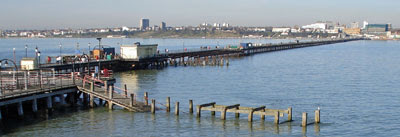
At the foot of the High Street is a freshly landscaped slope with a shiny rotunda lift. Step out along the curving walkway, wait for the doors to open and you can descend gracefully to the pierhead or promenade below. Come on, it's got to be the pier. This is no ordinary wooden jetty, this is the longestpleasurepier in the world. Southend Pier was constructed in the early 19th century to provide paddlesteamers from London with somewhere to tie up to. And because the beach at Southend is mostly mudflats that stretch out into the estuary for more than a mile, so the pier has to stretch out even further. It's an astonishing 1.3 miles long - for most of its length just a thin wooden walkway on iron struts with a single-track railway alongside. And this is possibly also the unluckiest pier anywhere in the world. The shore end pavilion was destroyed by fire in 1959, an ever bigger fire destroyed all the buildings at the far tip in 1976, a passing boat sliced through the middle in 1986, and there were further ferocious burnings in 1995 and 2005. Never fear, ongoing repairs mean it's still possible to walk to the end and back for 50p.
The pier may look long when you step past the ticket booth and out onto the first timber platform, but nothing quite prepares you for the true length of your mid-river stroll. That must be Sheerness and the Isle of Grain in the distance - surely we can't be going that far. Within minutes the seafront is far behind you, with Southend shrinking to a thin residential strip across the horizon. You pass the first of three blue-painted shelters, providing somewhere to hide if any driving rainstorm should buffet the estuary during your crossing. What is the tall building at the far end, could it be a rollercoaster or maybe a mighty pavilion? Stride on across the nailed-down wooden planks, with the high tide Thames lapping beneath your feet. By the time you pass the "1 mile to the shore" sign you may be wishing you'd ridden the railway instead. Try not to stare as several mini-carriages of pensionable passengers go chugging by aboard the Sir John Betjeman. Won't be long now.
Since 2005 the train has been forced to halt several yards before the final station because the intermediate timbers are still either charred or destroyed [photo]. The pub's missing, the gift shop's gone, the amusement arcade's absent, and the replacement toilets are housed inside a big blue metal container. There's still a cafe of sorts, serving hot soup and chips, as well as rows of sea birds perched in parallel rows along a carbonised jetty. And then, at last, to the final unfeasibly large pierhead platform. A broad central space separates out the peripheral sea anglers, surrounding sealed off steps leading down into the turbulent waters below. And the "tall building" turns out to be a two-deck lifeboat station, with a lofty glass observation tower and a free museum, just so that it feels like the walk has been worth the effort. From the top deck you can stare across to Kent, or sit and nibble some sandwiches, or look back towards the coast at Southend. If you get a move on, you could be back on dry land within half an hour.
25 Palindromes » deified » detartrated » Lepers repel » Rise to vote, sir » Do geese see God? » A Toyota's a Toyota » Niagara, O roar again » Six at party trap taxis » Draw pupil's lip upward » Ah, Satan sees Natasha » Madam in Eden, I'm Adam » Smart ewes use wet rams » Was it Eliot's toilet I saw? » Red now, Asia is a wonder » Silly ram ate wet amaryllis! » Star comedy by Democrats » Maiden woos, so owned I am » "Naomi, sex at noon taxes!" I moan » I'm a lasagna hog, go hang a salami » Satan, oscillate my metallic sonatas! » Cigar? Toss it in a can, it is so tragic » Marge, let's send a sadness-telegram » No, Mel Gibson is a casino's big lemon » A Danish custard - drat such sin, Ada » Now, sir, a war is never even — sir, a war is won!
5 foreign palindromes » Saippuakauppias (soap dealer) [Finnish] » Saippuakivikauppias (soap stone dealer) [Finnish] » Subi dura a rudibus (endure rough treatement from uncultured brutes) [Latin] » Dabale arroz a la zorra el abad (The abbot was giving rice to the vixen) [Spanish] » A l'autel elle alla, elle le tua la (To the altar she went, she killed him there) [French]
30 years ago tonight, on Wednesday 8th February 1978, I arrived home from my suburban comprehensive school and settled down to watch a brand new children's TV drama series set in a suburban comprehensive school. The series was Grange Hill, there was nothing else like it on telly at the time, and it's remained one of my favourite programmes ever since. No really. I've watched almost almost every single episode since the show started, right up until last year when it was suddenly demoted to digital and the BBC snuck out the whole series without me noticing. And now suddenly this week, just as the show chalks up its 30th anniversary, the BBC has announced that the next series will be the last. Desklids down, doors slammed, and the staff room door firmly bolted shut. And I for one am extremely sorry.
So which era of Grange Hill do you remember? Trisha and Tucker maybe, or Gonch and Zammo, or perhaps Miss Carver and Mr Hankin? Did your school dinner ladies ever serve up a glowing sausage like that one in the opening credits? Was your school bully called Gripper, Imelda or Mauler? Did you ever wish that Mrs McClusky was your headteacher, or rejoice that Mr Bronson wasn't? Was your PE teacher firm but fair like Mr Baxter, a psychopath like Mr Hicks, or unexpectedly catapulted to headteacherdom like Mr Robson? Were there really ever any children in normal schools with nicknames like Pogo, Ziggy or Tegs? Did your class ever have a bolshy school refuser like Danny Kendall, or a misunderstood kid with Aspergers like Martin Miller (you've not been watching lately, have you?). Was Cartman from South Park based on Row-land Browning, did Boy George ever learn any fashion tips from Suzanne Ross, and would Nancy Reagan ever have learnt to 'Just say No' without Zammo's heroin habit? Ah yes, no central character was complete without some stereotypical medical condition and/or social inadequacy.
I was forever endeared to Grange Hill in 1994 when they filmed a scene betwen Mr Robson and his illicit love interest outside the house I grew up in. This was, however, a sign that the emphasis of the show was moving dangerously away from the lives of the children towards the lives of the staff. Who cared? And then the balance switched back rather too far the other way, concentrating more on extra-curricular romance than the back-row futility of double chemistry. Big mistake. Because Grange Hill's great strength was the mundane everyday world of history homework, field trips and petty bullying. And that's the golden age we all remember.
Five years ago creator Phil Redmond stepped back in to give the flagging series a boost. He resisted crashing a plane into the entire cast, like he normally does, and instead moved the school lock stock and barrel to the north-west of England (and no longer anywhere up the northern end of the Jubilee line). His efforts don't appear to have been enough. No mere mortal TV producer can defeat the towering legislative presence that is the new BBC Trust. They've decreed that the target audience for the CBBC channel is to be 6-12 year olds, and therefore no programme based on 11-18 education may continue. The 31st and final series will therefore "relocate to 'the Grange', a creative learning centre focused on multimedia technology" where various 10 and 11 year olds will have no doubt ripping adventures. But this ghastly committee-driven metamorphosis can't have worked. CBBC schedulers have chosen to delay transmission to the summer when nobody'll be watching, and then pulled the plug altogether on any subsequent episodes.
Grange Hill is a school whose era has been and gone. What was taboo in the 1970s is commonplace today. Kids today no longer say "flipping heck" or join the School Council to protest against school uniform. They shout obscenities across the playground, hide knives in their rucksacks and txt their classmates from underneath the desk during citizenship classes. And, most importantly, they no longer rush home from school to watch TV drama series, not like we did, because the 21st century is full of more exciting alternative distractions. Your children may never be part of a similar shared educational experience, but we will always be the Grange Hill generation.
Can you feel it? There's something different in the London air. Stand outside, take a deep breath and inhale. Mmmm, the atmosphere in the capital is suddenly crystal clear and spring fresh. Our oxygen is no longer tainted with quite so many nasty black sooty particles. The daily lives of children, pensioners and asthmatics are being transformed for the better. Our nostrils have entered a brave new pollution-free world. And we have the London LEZ to thank.
If you don't live round the edge of London you may not have noticed, but as of Monday the entire capital is now encircled by a protective barrier of roadsigns. These environmental sentinels have been set up to repel unwanted polluting vehicles, sending them back to contaminate the Home Counties instead. For at the sign of the Big Green Circle, no diesel-engined belcher may pass. The new Low Emission Zone is our last defence against airborne particulate poisoning. Bugger off all ye heavy diesel-engined vehicles exceeding 12 tonnes Gross Vehicle Weight, including goods vehicles, motor caravans, motorised horseboxes and other specialist vehicles, and do not darken our roads again.
Well that's the plan anyway. And it's cutting-edge stuff. Cameras within the LEZ are already keeping their beady lenses open for unregistered numberplates, and if the TfL database doesn't have your lorry registered then you get fined. Don't worry, they waive the charge the first time they catch you, and all you get is a warning letter. But then it's £200, per day, which is quite a lot compared to the piddly insignificant Congestion Charge. A large enough fine to persuade any violating business to take its fleet off the road, or to clean up its act.
So look, I thought I ought to warn you. Do you have a motorised horsebox that you drive around the North Circular? Or a gritter or a dustcart or a concrete mixer that you ride around on in your spare time? Or maybe a removal lorry or a fire engine that you buff up and drive to IKEA on a Saturday afternoon? Or a minibus that you use to drive old ladies to church on a Sunday morning? Or a Routemaster bus or a vintage coach that didn't have to satisfy pollution requirements back in 1958? Or an ambulance that your charity has bought using hard-earned donations that now needs a ridiculously expensive refit just so that it can carry on doing the good works that last week were perfectly legal? Or a hearse? Travelling around London could be about to get extremely expensive.
Certain vehicles aren't going to be penalised until July this year, or until 2010, or even 2012. And cars and motorbikes, they're not going to be penalised at all. It's only the big belching polluters that are going to have to pay. And hey, it's all for the sake of London's lungs so it's got to be a good thing surely? Just so long as this isn't yet another fund-raising exercise by our environmentally-caring Mayor. Another wheeze that leaves drivers' finances exhausted... even if the rest of us are never exhaust-ed again.
What are you giving up for Lent? West Londoners are giving up travelling to Shepherd'sBush on the Central line. The station (which is used by 11½ million passengers a year) closed on Saturday for an "upgrade", and won't reopen until October. That's nigh nine months of disruption, announced with little prior warning, so that the station can be made ready for the hordes of shoppers due to use the Westfield retail complex when it opens later this year. Local shop owners in W12 are already worried about the impact that this unashamedly aspirational retail development will bring. Now they face the next 250 shopping days without even a tube station to bring in their existing punters. Let's hope that a revamped entrance hall and overhauled escalators are worth the inconvenience.
But the area's crawling with alternative stations, isn't it? Surely it shouldn't be too difficult for local residents and commuters to make alternative travel arrangements. Maybe, maybe not. You can read TfL's advice here. Or you might prefer, with the aid of my stunning hand-drawn map, to use the dg guide to escaping from Shepherd's Bush (Feb-Oct 2008)
By rail • Shepherd's Bush (London Overground) Never fear, because there's a brand new station immediately nextdoor. Except there isn't. It was supposed to open last year, only there was some pathetic row about safety concerns and platform width, so it's still closed. And, even when this new station does finally open, the Overground service still won't be terribly useful. Two or three trains an hour to places as useful as Clapham, Willesden and Watford. I think we can dismiss this one.
By tube • Shepherd's Bush (Hammersmith & City line) Two stations with the same name - that's got to mean they're quite close, surely? Well, about 600m apart, as it turns out, which'll take about 7 extra minutes to walk. But which Central line user is going to want to use the Hammersmith & City line anyway? If you're heading for central London, this slow train (plus an extra change at Paddington or Baker Street) will greatly lengthen your daily commute over the next nine months. Not great. • Goldhawk Road Also 600m from Shepherd's Bush, but with a busy road to cross. So no. • Latimer Road 1.3km from Shepherd's Bush (a quarter hour walk). Forget it. • Wood Lane They haven't finished building thisone yet either. It's another additional station planned to boost access to the Westfield development. And it's not due to open until late this year. Typical eh? There are two new stations due to open in the Shepherd's Bush area over the next few months, but TfL still had to shut down the Central line station before the other two were ready. • Kensington (Olympia): Just over 1000m away, and a fair walk too, and for what? This single plaform halt boasts the District line's most feeble service, to almost nowhere, and only every 15 minutes. Really, don't bother. • White City: Ah, now this station's on the right line, at last. It's also less than 1km away in a straight line, except you can't walk in a straight line because there's a giant shopping centre being built inbetween. So this is another lengthy 1.3km, 15 minute walk. So not a great alternative. • Holland Park: This is the closest Central line station, exactly a kilometre from Shepherd's Bush. It'll take you up to 12 minutes to walk there, but at least when you arrive you'll be able to catch a train to where you want to go. This has to be the dg-recommended option. But it'll still waste you two hours a week, there and back.
By bus • 148: Good old TfL. They're putting on 10 additional buses an hour during the morning peak which'll whisk you (slowly) from Shepherd's Bush to Notting Hill Gate. 10 buses may sound a lot, but together they only have the capacity of one single tube train. • Rail replacement bus service: And yes, there's also a special TfL replacement bus service to shuttle Central line passengers between Shepherd's Bush and White City. It's described as "frequent", but I bet it's not as frequent as the underground trains it replaces. Once waiting time is added in, it may well still be quicker to walk.
So, my final advice to the people of Shepherd's Bush is as follows. Get a grip. It's not going to be fun, but there are plenty of alternative options. It'll be time-wasting, and it'll be inconvenient, but it's not the end of the world. The good people of Crouch End, Camberwell and Collier Row cope perfectly well without a functioning tube station on their doorstep, and have done for a lot longer than nine months. You'll cope.
And the rest of you, even if you don't think this applies to you now, be warned. Because this sort of enforced shutdown could be happening to you next.
Seaside postcard: Margate → Broadstairs
Why take the bus or train from Margate to Broadstairs when you could walk? It's only five miles along the Thanet coast, perfect for a stroll on a sunny winter's afternoon. This is part of the longest stretch of coastal chalk in the country, and there's a choice of cliff-top or cliff-bottom for most of the way. I ventured this way on Saturday afternoon, trying to maintain a decent speed in my race against sunset. And there really was plenty of interest along the way, including several delightful beaches and one gobsmacking surprise.
» Margate Winter Gardens: You could easily miss the the entertainment hub that is Margate's Winter Gardens. It was built in an artificial seafront hollow, almost 100 years ago, with only a covered staircase to lead the way down to the main entrance from the road above. The three mayors of Margate, Broadstairs and Ramsgate each have their own reserved parking space on the beachfront, from which aspect the building's municipal design now looks somewhat salt-encrusted and weatherbeaten. But big name acts still occasionally pack in the crowds - this month, for example, Boy George and Dionne Warwick.
» Cliftonville: Margate spreads eastward for a couple of miles along the clifftop, past increasingly upmarket avenues of retired folk. Their faceless non-bungalows keep an almost-respectable distance from the sea, providing a grassy edge ideal for winter strolls and dogwalking. The beach may be a little concrete-y in places, but at low tide there's plenty of sand for a four-legged runaround. And is that, ooh yes, a chalk stack at the end of Percy Avenue[photo]. What retired geologist could ask for more?
» Kingsgate Bay: You want more? How about a chalk arch too? A proper hole in the cliff [photo] has been carved through White Ness, as seen in all the best geography textbooks. This bay is a proper exclusive residential location, as exemplified by the unexpected castle on the opposite clifftop [photo]. Kingsgate Castle dates back only 250 years, which explains the ostentatious brickiness of it, but has since been divided up into rather ordinary flats.
» North Foreland: If you want an under-visited sandy beach, head for the former smuggler's haunt of Joss Bay (toilets and ice creams summer only). Up the gently-sloping hill, between fields of winter cauliflowers, looms the tall white tower of the North Foreland lighthouse[photo]. A beacon was first lit here in 1499 to warn off ships entering the English Channel, and 500 years later this became the very last UK lighthouse to be fully automated.
» Cliff Promenade: On the 'private' North Foreland Estate, on a strip of grass hugging the cliff edge, I stumbled across an unlocked iron gateway half hidden amongst a clump of bushes [photo]. "THIS TUNNEL IS DANGEROUS" screamed a notice beside the entrance, along with some disclaimer about using it at your own risk. I was through the gate like a shot. In front of me stretched a long uneven staircase, cut deep into the rock, whose function wasn't immediately apparent. A few steps down a gaping rectangular chasm opened up to my left, with a grille at the bottom to stop supermarket trolleys and human bodies being hurled to their doom. On the far side a red metal door had been wrenched from its hinges, allowing unrestricted access down several more steps to an enclosed graffitied landing below [photo]. I half-expected to find local youths wielding blades or sniffing lighter fuel, but reassured myself that this was a respectable Neighbourhood Watch area and therefore such behaviour would be frowned upon. The next flight of stairs doubled back into darkness, at which point I decided that this was no place to stumble unaccompanied and returned regretfully to the surface. I got the sense that this was somewhere special, but it was only when I got home that Google provided the reason why...
Blimey, who'd have thought?! These were The Thirty-nine Steps, as described in the famous adventure novel by John Buchan. He'd been recuperating in a villa called St Cuby at the top of the cliff, immediately opposite this private staircase in the bushes, and decided to immortalise them in prose. Had I ventured three flights down to the bottom I'd have emerged onto the beach below (or been murdered by a passing German spy, one or the other). Oh, and I'd also have descended rather more than 39 steps. There were 78 in Buchan's time, which he conveniently halved to make a better title, but the old oak treads have long since been removed to make way for 108 concrete replacements. The 108 Steps - it's not quite so catchy is it? But, believe me, just as atmospheric.
» Broadstairs: And finally, just before sundown, to a seaside resort best lit at dawn. Not that the bride and groom posing for photos on the beach appeared to mind [photo]. The old town nestles above a chalk-edged bay, from the bandstand round to a castellated homestead now called "Bleak House" [photo]. It was here, in the study overlooking the sea, that Charles Dickens wrote the majority of David Copperfield. In lodgings elsewhere around the town he also penned chapters of the Old Curiosity Shop and Barnaby Rudge, so it's not surprising to find a special museum devoted to him on the seafront [photo]. Don't expect a lot for your £2.30, there's only one room of proper Dickens memorabilia and the remainder is local paraphernalia and contemporary Victoriana. From here for 20p you can pick up a Town Trail leaflet to help guide you round the other historic sites and buildings that this pretty town has to offer. But it's hard to sightsee in the dark, so I headed instead to the station (and my four hour journey home).
Seaside postcard: Shell Grotto, Margate The last thing you expect to find underneath the streets of Margate is a mysterious shell-decorated chamber of indeterminate origin. Indeed, back in 1835 this was the last thing that local man James Newlove expected to find beneath an unmarked field on the outskirts of town. So he bought up the field without telling anybody why, and within a couple of years members of Victorian society were paying good money to troop down into this newly discovered cavern to marvel at its unexplained wonder. Believe it or not, despite science and carbon dating and all sorts of modern stuff, even 160 years later nobody's quite sure when (or how) this underground anomaly got to be here.
Newlove's field has long been built over, so the Shell Grotto now resides between rows of Victorian terraces up an anonymous sidestreet. From the outside all you see is a bland concrete shopfront (is it a curry house? is it a hairdressers?). Ring to enter and family life inside will stop for long enough to let you in. Shell-covered gifts, new age goodies and the Eighth Wonder café await, but maybe on the way out, OK? Pay your £2.50 (everything in Thanet is so reasonably priced compared to London) and pass through into the ante-room named the Mystery Museum. The name is perhaps overhyping things - this is no more than a few cabinets of local paraphenalia plus a wall of laminated speculation regarding what you're about to see next. Down the steps. Mind your head.
The initial roughly-hewn passage is nothing special, but then come the shells. All four and a half million of them, crammed into a grotto less than 70 feet long. The first feature is a circular rotunda, whose inner and outer walls are completely covered with mystical patterns made from carefully-arranged nautilus, scallop and conch. There are rosettes and swirly curves and astrological symbols, and it doesn't take too much imagination to decide that some of them definitely represent *ahem* reproductiveorgans. Round the bend the walls rise up to a shell-rimmed dome through which a patch of daylight intrudes. Next there's a wiggly serpentine passage decorated with yet more mysterious symbols, both fertility and otherwise, leading downward to the final rectangular chamber. This looks like a place of worship, of sorts, with an arched recess on the far wall and a grid of designs constructed from yet still even more shells. Except on the far wall, that is, which was destroyed by bomb damage in WW2. No problem, the other surfaces are impressive enough.
I was fortunate, some would say, that my visit coincided with the presence of the grotto's greatest champion and expert - local historian Mick Twyman. He'd been doing some "measuring up" in the morning, hunting for angles and distances in the orientation of the patterns, but he couldn't resist giving an impromtu tour to the few of us present. Mick believes that the temple dates back more than 2000 years and is pagan in origin. Look at this, he repeatedly exclaimed, pointing out several 82° solstice angles and an imaginary line representing the 2012 Celestial Conjunction. My fellow visitors nodded in amazement as he pointed out one supposed astronomical coincidence after another. How many hours of daylight are there at the winter solstice? Yes, eight, and that's the same as the number of patterns in this subdivided square! What does this squiggly line look like? Yes, a jaguar, and that means that the builders must have visited South America where they worship jaguars! I was sorely tempted to chip in and express my naked cynicism at Mick's increasingly outlandish claims, but he was a master showman and my fellow visitors would have looked at me like I was an ignorant fool.
My money's on the shell-cave being an encrusted decorative folly, previously lost to recorded memory, and not an ancient celestial calculator imbued with cryptic mystic meaning. I mean, this is Margate we're talking about, for heaven's sake. But whatever the case, however wrong one of us is, this is still a fascinating subterranean attraction.
Seaside postcard: Margate Following in the steps of Cockney geezers Chas and Dave, I spent yesterday on a day trip down to Margate. Think Kent, think top right corner, think two hours from London via the fastest train. Margate boasts more then 200 years as a top seaside resort, and many's the family holiday that's been spent on the town's sandy beaches over the years. But far fewer now make the trek down for a full seven days of bucket and spade and winkles, and the town is having to reinvent itself to turn back decades of steady decline.
Step out of the station and you're almost on the beach already. How convenient is that? Margate's main beach is broad and yellow, and north-facing, and rarely completely empty even in February. Only some of the seafront amusement arcades are currently open, while the rest are boarded up awaiting a summer influx that may never come. The most famous of these is Dreamland[photo] - a vast funfair complex packed with swirly loopy rides and various sugary delights. Except that Dreamland didn't open last summer, nor is it anticipated to open again in its current form. A smaller park of 'heritage rides' has been proposed instead, featuring classic attractions rescued from across the UK. In the meantime the huge Big Wheel has been dismantled, the minor rides have been cleared away, and only the Grade II listed ScenicRailway remains. This wooden switchback is the UK's oldest surviving rollercoaster, erected in 1920, although in 2008 it looks a pretty forlorn sight when viewed from the roof of the car park nextdoor [photo]. Let's hope it survives to entrance future generations of thrill seekers.
The centre of Margate, in the winter months at least, feels very much like a seaside town whose time has been and gone. There used to be a Marks and Spencer on the high street, for example, and now there isn't. A once grand-looking pillared shop on the seafront is now a Primark. Stand still for a couple of minutes and you'll probably be passed by both a mobility scooter and a revving boy racer. But council planners are trying to make a difference here by transforming the old town into a CulturalQuarter. They hope to fill the twisty narrow backstreets with alluring cafes, exclusive galleries and tempting boutiques. I found the cafes alright, but also a shop that sold dentures, a long-gone launderette and a firmly-shut museum. This metamorphosis has a way to go yet.
But there is one major arts project which, although years behind schedule, hopes to transform the future of the town. Margate has big plans to capitalise on the fame of its one truly famous resident - the painter JMW Turner - to invigorate local residents and to bring the right sort of people flocking to the town. So what better than a major new art gallery, built to a truly modern design, plonked down on the foreshore close to where he used to live. The site's just a boatyard and carpark at the moment [photo], as it has been for the best part of a decade, but the design is at last finalised and all funding agreed so construction should start soon.
In the meantime the Turner Contemporary project maintains a physical presence inside the tiny Italianate harbourmaster's office close by. It's little more than a couple of well-lit rooms with a temporary gallery space tacked on at the back, but this is the heart of the campaign to get the town involved and inspired. Here I met the lady in charge of spreading the word within Margate and beyond, and she delighted in explaining her vision with evangelical zeal. For half an hour. A six-part gallery of interlocking blocks is planned, clad in opaque milky glass, reflective during the day and brightly illuminated at night. Various travelling exhibitions will make their home here (although, interestingly, Turner's presence seems restricted to name only). The educational outreach programme has already begun, and a series of innovativeartyevents is underway (to which I was cordially and repeatedly invited). There's a real creative drive here and, if anything offers the opportunity to revitalise Margate from within and without, this is it. Why not come back in 2010 to see how it's all worked out?
Town Z: I wasn't planning on being here, in the third of this trio of historic towns. But a missed connection dumped me at the station for 55 minutes, so it seemed churlish to ignore the opportunity to explore. Just long enough to walk the mile down to the town centre and back, if quick. Through suburban avenues where dads and sons are Wii-ing wildly in their dressing gowns. Past the grammar school, past rugby-cheering pubs, past too-early restaurants. Down the high street, beneath blue fairy lights, where only the packed-up market traders remain. Through dim deserted Albert Court where some municipal wit has built a three piece suite out of bricks. It could be any of a hundred small towns across the UK early on a Saturday evening. But step out onto the seafront and a dark watery marina full of bobbing boats presents itself. To the left is the illuminated harbour museum (and a casino). To the right are two layers of tall thin arches, supporting a raft of hotels and houses above the harbour. And, somewhere out in the blackness, the terminal from which ferries once sallied forth. There's no time to explore further, it's back to the station and then two slow hours back to London. There can't be many places as close, but so remote, than it.
Town Y: This town and its near neighbour are like chalk and cheese. Here is rather more genteel, rather more sedate, and rather less kebab shop. This place has a love affair with a famous author who once lived and wrote here, although never in the half-timbered bayfront museum that bears his name. Down on the beach a bride and groom pose for a photo on a sandy dune, her long train billowing in the salty breeze. I've walked round the coast to get here, along chalky clifftops frequented by retired dogwalkers. Out to sea chugged silent container ships, kept at a safe distance by a tall white lighthouse. I've detoured round an unexpected castle, and spotted rock formations my geography teacher would be proud of. And now I'm sat on a freezing station platform, waiting for a delayed train that might connect with the train back to London. It could be a very bitter journey home.
Town X: Go away, gestures the lady behind the desk in the locked Tourist Information Office. It's five minutes into her lunch hour, and she and her colleague are most definitely not interested. I'm left to explore the twisted lanes of the old town, all cafes and solicitors and shuttered-down shops. In the market square sits a single blind pensioner clutching a Primark carrier bag. It's an old person's town, with fresh young problems. Viewed from the top of a deserted multi-storey car park, the famous funfair slowly rusts. An arts centre custodian enthuses, at great length, about the transforming effect her new glass-clad gallery will bring to the local community. And hidden down a flight of stairs, amidst ordinary Victorian terraces, is an astonishing mysterious passageway and temple (although I refuse to believe the temporal pagan drivel spouted by our bearded guide). Time for a bag of greasy vinegary chips, and a long stroll in the winter sunshine.
dg's Moblogged Mystery Tour: I'm sat on a train at a central London terminus, about to set off on a journey of discovery to the end of the line and beyond. I can't believe it'll take more than two hours to get there, but that's lousy rail infrastructure for you. Hopefully my final destination will be worth the effort. It's not a terribly popular tourist spot, not any more, so I'm going to find out if there's still anything worth seeing. On a freezing cold day in February. I must be mad. I'll report back from various locations along the way, via my mobile phone, to let you know how I'm getting on. But I'm not going to tell you where I am, because it wouldn't be a mystery tour otherwise. See if you can guess...
Hurrah, it's leap-February again.
Even better, it's a February with five Fridays! (and that hasn't happened since 1980, and won't happen again until after I've retired)
I gaze with mounting excitement at my beloved. You're finally coming, and not a moment too soon. Through the darkness I can just about make out your firm body and sleek curves, rushing headlong towards a deafening climax. Not long now, my darling.
In my mind's eye you slide to a halt, drawing me inside and smothering me with your steaming breath. Your throbbing vibrations cause me to shake and jerk, involuntarily, like a man possessed. I wait to be enveloped in your fiery embrace. It's a recurring fantasy of mine. It's my favourite train of thought.
Our intimate affair goes back several years. I fancied you the first time I laid eyes on you. I kept details of all your comings and goings in a notebook, and your number was firmly etched on my memory. I made it my business to know exactly where you'd be and when. I used to make tracks to your secluded woodland cutting, just to catch a glimpse of you as you passed by. You never looked back, and neither did I.
And now I have my dirty way with you every weekend. I always dress up for you, because I know you like it that way, and I always use protection. There has to be plenty of foreplay, for several hours if I can wangle it, before I'm willing to perform with you in public. Every Sunday morning I'm down on my knees with the grease gun, adding extra lubrication to ease your passage. Your coupling rods always need a good rub-down, and I love to buff up your double-action pistons. You can see the smile on my face, can't you, because I know I'll have you up against the buffers before the afternoon is out.
I hate having to share you with the other guys. I feel jealous when they wipe their filthy rags all over your body, or blow your whistle, or tighten up your nuts. When I see your shiny funnel, standing tall and erect, I feel like it's spitting white especially for me.
I long for the moment when I can reach out and rub my fingers over your iron belly again. I need to see you, to feel you, and to take dirty photos of you from every conceivable position. I want to climb up on top of you, wield my mighty tool and dig deep within your tender behind. I feel an unstoppable urge to fling open your flaps and fill you with burning fire. The fuel injection I bestow will drive us forward, together, inseparable. I need to stoke you up, to power you with energy, until the pressure within is released in shuddering motion. Soon my darling, soon.
You may be getting on a bit, but you're a lot more than an old boiler to me. I love the time we spend together. When I'm with you, I'm well chuffed. May our relationship never go off the rails.
How not to win a Bloggie: I've not been trying very hard, have I? Voting's been going on for a week now, and as yet I've failed to implore you to rush over to 2008.bloggies.com and cast a vote for your favourite "best european weblog". Instead I've been waffling on about deserted railway stations, canalside walks and IKEA tealights. It's not exactly the right stuff to inspire randomly-arriving international surfers to go away and vote for me, is it?
So, just in time for the last day of voting tomorrow, I'm going to try a completely different tack. I'm going to take a leaf out of the two blogs that have ruled this category for the last few years (girl with a one track mind and my boyfriend is a twat) and write more about emotional and passionate stuff instead. Because none of the four blogs I'm competing against regularly write about love and sex. Chocolate and Arsenal, maybe, which are damned close, but not cuddly relationships and rampant shagging. So I'm evolving in order to improve my potential success criteria. A world audience of mostly-Americans won't be able to resist my new intimate blogging approach, and are absolutely bound to vote for me just like they voted for the two Zoes. Shameless I know. But don't worry, it'll only be for one day. Normal service will be resumed once voting closes. [*cough* over here *cough*]
Somewhere un-famous: Sudbury & Harrow Road station London's most useless railway station is in Brent. It has fewer paying passengers than any of the other 300-or-so stations in the capital. According to official statistics it's used by only 2500 passengers a year. It's no remote halt in the middle of a field, it's in a proper urban location on a busy high street. It's served by trains only during the weekday rush hour, and then only in one direction at a time. It has just nine trains a day - four into town in the morning and five back again in the evening. It is a sorry apology for a station and owners Chiltern Railways clearly treat it with complete indifference. It is Sudbury & Harrow Road. And yes, of course I had to pay a visit.
I wonder if it's a coincidence that the number 18 bendy bus terminates on the Harrow Road precisely outside the entrance to this forlorn station [photo]. Catch the nasty evil articulated bus from here and you could be in Marylebone in less than an hour. Wait for a train and you could be waiting for up to three days. A lone British Rail sign and a tiny purple nameplate mark the station entrance for any would-be passengers. There's no ticket office, just a "Permit to Travel" machine and a pair of freshly-installed Oyster readers [photo]. I suspect that just the one reader would have been sufficient. The bike rack has just four spaces (don't all fight at once). Turn left to enter the dark concrete passage beneath the railway embankment. In a busier station this might smell of urine and sicked-up curry, but not at Sudbury & Harrow Road. I stepped inside, and headed up the central staircase to the station proper [photo].
There are two parallel platforms, a few metres apart, with the top of the stairs forming a small island between the two. If it's raining you can hide beneath the red arched plastic roof, or maybe take a seat on the single central bench. There's room for two, maybe three if you squeeze up close. To the right I spotted a padlocked cupboard containing "Adverse Weather Equipment", and to the left a yellow box labelled "Passenger Help Point" (singular, not plural). Oh, and also a couple of TV display screens transmitting flickering information from Chiltern HQ. These informed me that, not only were there no trains stopping today, there were also no trains running due to planned engineering work. Fantastic, I had this entire remote outpost completely to myself, with no interruptions.
I took a silent stroll from one end of the station [photo] to the other [photo]. Each platform was little more than a long wooden boardwalk, about a metre off the ground, with a spiky slatted fence rising up behind. Between the two lay a forgotten grassy trench, littered with discarded bottles, cans and the odd deflated football. A handful of thin blue lampposts broke the emptiness, on which were stuck scrappy stickers warning the occasional patron not to smoke [photo]. From Platform 1 I had a fine view down into the back gardens of Sudbury, towards rickety sheds and washing lines pegged out with damp undergarments. And down in Harrow Road were scores of people rushing around, buying this and that, rushing hither and thither, and queueing to catch a bus to somewhere else.
It's a shame that so few local residents look up to the embankment for a means of escape, but perhaps not surprising given that this station merits such a pitifully irregular service. 45 trains a week is no way to build up a regular clientèle, and so the vicious underfunded circle of transport decline continues. "The next train to London Marylebone will depart in 2500 minutes." I headed back down the stairs to the bus stop, and the station returned to timetabled hibernation. by tube: Sudbury Town[photo] by bus: 18, 92, 182, 245
Somewhere historic: Grand Union Canal
[A three mile walk from Harlesden to One Tree Hill, Alperton]
Whenever I explore a random borough, I always attempt to go for a long walk. Ideally a long walk that the local council has flagged on its website. Good old Brent Council provided a choice of four, each supplied by the London Ecology Unit. Excellent, I thought, I'll have one of them. So I printed out the map and instructions and prepared myself for a delightful three mile stroll along a 200 year old canal. "London Ecology Unit", eh? I should have spotted the clues before I set out.
I haven't been to Harlesden for almost 25 years, back when I was doing a summer job on the Park Royal trading estate. If you bought any Marks and Spencer clothing during the latter half of 1983, I probably helped to produce the little hole-punched swing ticket that hung from the label. So I subconsciously recognised the first part of the walk from my teenage commute. Right out of the station, round the McVities factory (mmm, Harlesden smells nice) and down onto the towpath. Then past the tied up barge and westward, towards Alperton. My printed pdf advised me to look out for a purple bellflower, some blue tufted vetch and a patch of red campion. Not a sign. All I could see was a grassy green verge with no flowering vegetation at all. I should have guessed that a guided walk produced by the London Ecology Unit would be rather heavier on flowers than on history. And that perhaps such a walk was better suited to July than January. Never mind, ever onward.
Next I was advised to enjoy the "pleasant smells" nearby, probably emanating "from the Heinz factory" on the opposite bank. Erm, there was no Heinz factory on the opposite bank, just a long row of shiny white warehouses containing various non ketchup manufacturing businesses. I was sure I remembered an oppressive grimy factory last time I was here, with big pipes and sheer grey walls. And yes, as it turns out, I was right. But the Heinz Factory closed down in 2000 and the site has since been comprehensively redeveloped. My printed walk was seriously out of date... and with good reason. The London Ecology Unit also breathed its last in 2000, absorbed into the new Greater London Authority. So, I was following a walk that was at least eight years old, and already historically obsolete. Never mind, ever onward.
Two pages of A4 description later and I'd seen almost nothing of what was being described. Just a lot of Park Royal industrial units and a few ducks. There was, however, a bit of a treat ahead as the canal passed over the North Circular Road on an aqueduct. Because aqueducts are cool. But unfortunately the view from this aqueduct was of a stream of rushing traffic and a very modern Travelodge. Even the aqueduct itself [photo], with a magnificent Middlesex Coat of Arms lodged inbetween the twin channels, turned out to be nothing more than a 1993 replacement. There were a few highlights ahead. A couple of quietly puttering narrowboats [photo][photo]. A modernised footbridge being well frequented by locals. An extraordinary tumbledown old shed-like building beneath a Piccadilly line rail bridge [photo]. A swan [photo]. But on the whole this was a canalside walk where the canal was the only thing worth seeing, and not the stuff to either side. Never mind, ever onward.
The walk ended away from the canal, just before the scenery got good. My printed guide apologised for the detour, but the pretty stretch beneath Horsenden Hill was in Ealing, not Brent, and therefore off limits. Instead I was diverted along a busy road and up a lesser hill on the outskirts of Alperton, with semi-screened views over west London and the City. One Tree Hill, as it was called, boasted more trees than strictly permitted under the Trade Descriptions Act [photo]. Wembley Stadium was perfectly visible from the single bench at the summit [photo], as were the stone pinnacles of an astonishing Hindu temple under construction at the foot of the hill [photo]. This was certainly the high point of the journey, in every way, but not a true peak. It had been more an anachronistic stroll than a historic walk. Never mind. by tube: Harlesden → Alperton by bus: 224

On a mild sunny weekend in February 2008, the park is still a hive of recreational activity. Several lively football matches are afoot, played out between official goalposts or unofficial jumpers. Families take lunch at the pavilion by the western lake, their Sunday papers spread open while littl'un rides her pink tricycle not too far away. Divorced dads take their occasional offspring to let off steam in the central playground, skidding down the long metal slides with shrieks of delight. Gangs of foul-mouthed kids play hide and seek in the ornamental garden, while leashed dogs strain and yap on the other side of a scrubby hedge. Every face bears a smile.
The Kursaal on Southend seafront is an entertainment venue of legend. Opened in 1901, this was (allegedly) the first theme park to be built anywhere in the world. Stepping beneath its redbrick facade excited punters were guided into 26 acres of rides, gardens and jollity. And then package holidays came along, and the visitors slowed to a trickle, and the Kursaal completely faded away. Ten years ago the main building was fully restored and reopened - at least if you count a bowling alley, casino and themed bars as restoration. Now you can stand beneath the coloured-glass dome and have the entire glazed entrance hall completely to yourself. Outside on the promenade, the petrolheads of Southend drive round in elongated circles to show off their latest souped-up Harley or customised car. Bikers stand and chat on the central reservation in their finest leathers, before revving up and riding round one more circuit. The rest of us, we have to walk.
At the foot of the High Street is a freshly landscaped slope with a shiny rotunda lift. Step out along the curving walkway, wait for the doors to open and you can descend gracefully to the pierhead or promenade below. Come on, it's got to be the pier. This is no ordinary wooden jetty, this is the longest pleasure pier in the world. Southend Pier was constructed in the early 19th century to provide paddlesteamers from London with somewhere to tie up to. And because the beach at Southend is mostly mudflats that stretch out into the estuary for more than a mile, so the pier has to stretch out even further. It's an astonishing 1.3 miles long - for most of its length just a thin wooden walkway on iron struts with a single-track railway alongside. And this is possibly also the unluckiest pier anywhere in the world. The shore end pavilion was destroyed by fire in 1959, an ever bigger fire destroyed all the buildings at the far tip in 1976, a passing boat sliced through the middle in 1986, and there were further ferocious burnings in 1995 and 2005. Never fear, ongoing repairs mean it's still possible to walk to the end and back for 50p.
The pier may look long when you step past the ticket booth and out onto the first timber platform, but nothing quite prepares you for the true length of your mid-river stroll. That must be Sheerness and the Isle of Grain in the distance - surely we can't be going that far. Within minutes the seafront is far behind you, with Southend shrinking to a thin residential strip across the horizon. You pass the first of three blue-painted shelters, providing somewhere to hide if any driving rainstorm should buffet the estuary during your crossing. What is the tall building at the far end, could it be a rollercoaster or maybe a mighty pavilion? Stride on across the nailed-down wooden planks, with the high tide Thames lapping beneath your feet. By the time you pass the "1 mile to the shore" sign you may be wishing you'd ridden the railway instead. Try not to stare as several mini-carriages of pensionable passengers go chugging by aboard the Sir John Betjeman. Won't be long now.
Grange Hill (RIP)
I was forever endeared to Grange Hill in 1994 when they filmed a scene betwen Mr Robson and his illicit love interest outside the house I grew up in. This was, however, a sign that the emphasis of the show was moving dangerously away from the lives of the children towards the lives of the staff. Who cared? And then the balance switched back rather too far the other way, concentrating more on extra-curricular romance than the back-row futility of double chemistry. Big mistake. Because Grange Hill's great strength was the mundane everyday world of history homework, field trips and petty bullying. And that's the golden age we all remember.
If you don't live round the edge of London you may not have noticed, but as of Monday the entire capital is now encircled by a protective barrier of roadsigns. These environmental sentinels have been set up to repel unwanted polluting vehicles, sending them back to contaminate the Home Counties instead. For at the sign of the Big Green Circle, no diesel-engined belcher may pass. The new Low Emission Zone is our last defence against airborne particulate poisoning. Bugger off all ye heavy diesel-engined vehicles exceeding 12 tonnes Gross Vehicle Weight, including goods vehicles, motor caravans, motorised horseboxes and other specialist vehicles, and do not darken our roads again.
But the area's crawling with alternative stations, isn't it? Surely it shouldn't be too difficult for local residents and commuters to make alternative travel arrangements. Maybe, maybe not. You can read TfL's advice here. Or you might prefer, with the aid of my stunning hand-drawn map, to use the dg guide to escaping from Shepherd's Bush (Feb-Oct 2008)
» Kingsgate Bay: You want more? How about a chalk arch too? A proper hole in the cliff [photo] has been carved through White Ness, as seen in all the best geography textbooks. This bay is a proper exclusive residential location, as exemplified by the unexpected castle on the opposite clifftop [photo]. Kingsgate Castle dates back only 250 years, which explains the ostentatious brickiness of it, but has since been divided up into rather ordinary flats.
» Cliff Promenade: On the 'private' North Foreland Estate, on a strip of grass hugging the cliff edge, I stumbled across an unlocked iron gateway half hidden amongst a clump of bushes [photo]. "THIS TUNNEL IS DANGEROUS" screamed a notice beside the entrance, along with some disclaimer about using it at your own risk. I was through the gate like a shot. In front of me stretched a long uneven staircase, cut deep into the rock, whose function wasn't immediately apparent. A few steps down a gaping rectangular chasm opened up to my left, with a grille at the bottom to stop supermarket trolleys and human bodies being hurled to their doom. On the far side a red metal door had been wrenched from its hinges, allowing unrestricted access down several more steps to an enclosed graffitied landing below [photo]. I half-expected to find local youths wielding blades or sniffing lighter fuel, but reassured myself that this was a respectable Neighbourhood Watch area and therefore such behaviour would be frowned upon. The next flight of stairs doubled back into darkness, at which point I decided that this was no place to stumble unaccompanied and returned regretfully to the surface. I got the sense that this was somewhere special, but it was only when I got home that Google provided the reason why...
» Broadstairs: And finally, just before sundown, to a seaside resort best lit at dawn. Not that the bride and groom posing for photos on the beach appeared to mind [photo]. The old town nestles above a chalk-edged bay, from the bandstand round to a castellated homestead now called "Bleak House" [photo]. It was here, in the study overlooking the sea, that Charles Dickens wrote the majority of David Copperfield. In lodgings elsewhere around the town he also penned chapters of the Old Curiosity Shop and Barnaby Rudge, so it's not surprising to find a special museum devoted to him on the seafront [photo]. Don't expect a lot for your £2.30, there's only one room of proper Dickens memorabilia and the remainder is local paraphernalia and contemporary Victoriana. From here for 20p you can pick up a Town Trail leaflet to help guide you round the other historic sites and buildings that this pretty town has to offer. But it's hard to sightsee in the dark, so I headed instead to the station (and my four hour journey home).
The last thing you expect to find underneath the streets of Margate is a mysterious shell-decorated chamber of indeterminate origin. Indeed, back in 1835 this was the last thing that local man James Newlove expected to find beneath an unmarked field on the outskirts of town. So he bought up the field without telling anybody why, and within a couple of years members of Victorian society were paying good money to troop down into this newly discovered cavern to marvel at its unexplained wonder. Believe it or not, despite science and carbon dating and all sorts of modern stuff, even 160 years later nobody's quite sure when (or how) this underground anomaly got to be here.
The initial roughly-hewn passage is nothing special, but then come the shells. All four and a half million of them, crammed into a grotto less than 70 feet long. The first feature is a circular rotunda, whose inner and outer walls are completely covered with mystical patterns made from carefully-arranged nautilus, scallop and conch. There are rosettes and swirly curves and astrological symbols, and it doesn't take too much imagination to decide that some of them definitely represent *ahem* reproductive organs. Round the bend the walls rise up to a shell-rimmed dome through which a patch of daylight intrudes. Next there's a wiggly serpentine passage decorated with yet more mysterious symbols, both fertility and otherwise, leading downward to the final rectangular chamber. This looks like a place of worship, of sorts, with an arched recess on the far wall and a grid of designs constructed from yet still even more shells. Except on the far wall, that is, which was destroyed by bomb damage in WW2. No problem, the other surfaces are impressive enough.
I was fortunate, some would say, that my visit coincided with the presence of the grotto's greatest champion and expert - local historian Mick Twyman. He'd been doing some "measuring up" in the morning, hunting for angles and distances in the orientation of the patterns, but he couldn't resist giving an impromtu tour to the few of us present. Mick believes that the temple dates back more than 2000 years and is pagan in origin. Look at this, he repeatedly exclaimed, pointing out several 82° solstice angles and an imaginary line representing the 2012 Celestial Conjunction. My fellow visitors nodded in amazement as he pointed out one supposed astronomical coincidence after another. How many hours of daylight are there at the winter solstice? Yes, eight, and that's the same as the number of patterns in this subdivided square! What does this squiggly line look like? Yes, a jaguar, and that means that the builders must have visited South America where they worship jaguars! I was sorely tempted to chip in and express my naked cynicism at Mick's increasingly outlandish claims, but he was a master showman and my fellow visitors would have looked at me like I was an ignorant fool.
Following in the steps of Cockney geezers Chas and Dave, I spent yesterday on a day trip down to Margate. Think Kent, think top right corner, think two hours from London via the fastest train. Margate boasts more then 200 years as a top seaside resort, and many's the family holiday that's been spent on the town's sandy beaches over the years. But far fewer now make the trek down for a full seven days of bucket and spade and winkles, and the town is having to reinvent itself to turn back decades of steady decline.
In the meantime the Turner Contemporary project maintains a physical presence inside the tiny Italianate harbourmaster's office close by. It's little more than a couple of well-lit rooms with a temporary gallery space tacked on at the back, but this is the heart of the campaign to get the town involved and inspired. Here I met the lady in charge of spreading the word within Margate and beyond, and she delighted in explaining her vision with evangelical zeal. For half an hour. A six-part gallery of interlocking blocks is planned, clad in opaque milky glass, reflective during the day and brightly illuminated at night. Various travelling exhibitions will make their home here (although, interestingly, Turner's presence seems restricted to name only). The educational outreach programme has already begun, and a series of innovative arty events is underway (to which I was cordially and repeatedly invited). There's a real creative drive here and, if anything offers the opportunity to revitalise Margate from within and without, this is it. Why not come back in 2010 to see how it's all worked out?
Hurrah, it's leap-February again.
Hurrah, it's February again.
How not to win a Bloggie: I've not been trying very hard, have I? Voting's been going on for a week now, and as yet I've failed to implore you to rush over to 2008.bloggies.com and cast a vote for your favourite "best european weblog". Instead I've been waffling on about deserted railway stations, canalside walks and IKEA tealights. It's not exactly the right stuff to inspire randomly-arriving international surfers to go away and vote for me, is it?
London's most useless railway station is in Brent. It has fewer paying passengers than any of the other 300-or-so stations in the capital. According to official statistics it's used by only 2500 passengers a year. It's no remote halt in the middle of a field, it's in a proper urban location on a busy high street. It's served by trains only during the weekday rush hour, and then only in one direction at a time. It has just nine trains a day - four into town in the morning and five back again in the evening. It is a sorry apology for a station and owners Chiltern Railways clearly treat it with complete indifference. It is Sudbury & Harrow Road. And yes, of course I had to pay a visit.
There are two parallel platforms, a few metres apart, with the top of the stairs forming a small island between the two. If it's raining you can hide beneath the red arched plastic roof, or maybe take a seat on the single central bench. There's room for two, maybe three if you squeeze up close. To the right I spotted a padlocked cupboard containing "Adverse Weather Equipment", and to the left a yellow box labelled "Passenger Help Point" (singular, not plural). Oh, and also a couple of TV display screens transmitting flickering information from Chiltern HQ. These informed me that, not only were there no trains stopping today, there were also no trains running due to planned engineering work. Fantastic, I had this entire remote outpost completely to myself, with no interruptions.
I haven't been to Harlesden for almost 25 years, back when I was doing a summer job on the Park Royal trading estate. If you bought any Marks and Spencer clothing during the latter half of 1983, I probably helped to produce the little hole-punched swing ticket that hung from the label. So I subconsciously recognised the first part of the walk from my teenage commute. Right out of the station, round the McVities factory (mmm, Harlesden smells nice) and down onto the towpath. Then past the tied up barge and westward, towards Alperton. My printed pdf advised me to look out for a purple bellflower, some blue tufted vetch and a patch of red campion. Not a sign. All I could see was a grassy green verge with no flowering vegetation at all. I should have guessed that a guided walk produced by the London Ecology Unit would be rather heavier on flowers than on history. And that perhaps such a walk was better suited to July than January. Never mind, ever onward.
Two pages of A4 description later and I'd seen almost nothing of what was being described. Just a lot of Park Royal industrial units and a few ducks. There was, however, a bit of a treat ahead as the canal passed over the North Circular Road on an aqueduct. Because aqueducts are cool. But unfortunately the view from this aqueduct was of a stream of rushing traffic and a very modern Travelodge. Even the aqueduct itself [photo], with a magnificent Middlesex Coat of Arms lodged inbetween the twin channels, turned out to be nothing more than a 1993 replacement. There were a few highlights ahead. A couple of quietly puttering narrowboats [photo][photo]. A modernised footbridge being well frequented by locals. An extraordinary tumbledown old shed-like building beneath a Piccadilly line rail bridge [photo]. A swan [photo]. But on the whole this was a canalside walk where the canal was the only thing worth seeing, and not the stuff to either side. Never mind, ever onward.