I thought I'd arrive 20 minutes early. It seemed sensible, given that I'd been given a time and no specific instructions other than to print out a piece of paper with a barcode on it and turn up. To the Brunel Museum, which would be fairly straight-forward to reach if only the East London line were running, which of course it wasn't. There'll be no timetabled trains here for several more weeks, and the entire ELL engineering works have had to be suspended for two days to allow these underground visits to take place. All a bit last-minute, all a bit rare, so I guess we'll have to forgive the complete lack of advancepublicity and the ruddy useless ticketing system.
I arrived 20 minutes early, to the Brunel Museum like it said on my ticket. The area around the pumphouse was illuminated, hinting at delights on the terrace behind the fence. Ah, this must be the legendary Fancy Fair, a recreation of subterranean Victorian delights and an opportunity to head down inside the Rotherhitheshaft, how excellent. A bloke in a bowler hat stood near the entrance turning the handle on a barrel organ and playing Beatles tunes, thereby almost adding a bit of period flavour. Stepping through a fake cardboard arch, I showed my ticket to a member of staff. "Have you done the tour yet?" he said. "You'd better do that first. The queue's back at the station."
Back at Rotherhithestation, I joined the queue and waited. A hastily scribbled sign in the window read "sold out", although one jolly man who turned up hoping for tickets didn't spot it and was sorely disappointed. After fifteen minutes we were ushered through into the station ticket hall (now retiled, and reminding me very much of Watford swimming baths circa 1975). I waved my web-ticket again, and had to explain it was for "now" given that nobody had thought fit to print a time on it. By the time all of our group had entered there were, apparently, ten more people present than were actually printed on the official list. Never mind.
There were white latex gloves for all. We looked like the Rotherhithe branch of the Michael Jackson Fan Club, but were really protecting our hands from toxic rat's pee - more specifically Weil's Disease. A health and safety talk followed, warning us about trip hazards underfoot and watching our step, and delivered with a smile which made it all so much easier to take in. And then down the escalators and steps to the platform, and down a mini temporary staircase onto the track. Stand here in two months time and you'll probably be either shouted at or killed (or both). For two days only, this was thestart of a unique underwater walk.
Each group was led by a knowledgeable guide whose job was to relate historical facts and anecdotes at various points through the tunnel, and to speed everyone up so they didn't spend too long hanging back taking photos. It was very tempting to take photos of everything - an arch, some cables, another arch, the tops of people's heads - but a far better use of time was actually looking at the amazing structures all around. Isambard Kingdom Brunel and his father Marc were the first blokes to dig beneath a navigable river using a tunnelling shield, and it's credit to their engineering genius that their handiwork still stands (and remains functional) into the 21st century.
Only at the Rotherhithe end was the original brickwork still visible. The main section of twin-bore tunnel, the quarter mile that's actually beneath the Thames, was encased in concrete to prevent leaks just over a decade ago. Fret not, it's English Heritage approved concrete, sprayed sympathetically so as to retain the structure of key architectural features. Thus it's still possible to imagine these passages in their original form - as a pair of foot tunnels through which one million Londoners promenaded during the first year after opening. When the crowds moved on, and their money faded away, a cross-river railway then proved the saviour of the project.
It was slightly surreal, and yet rather wonderful, to be yomping six metres beneath the Thames following switched-off train tracks. In the connecting arches between the tunnels, from which hawkers and tradesmen had once sold souvenir trinkets, now were automatic signals, switch boxes and emergency radio beacons. Along each track the central 'return rail' had been removed, replaced along one edge by a different electric rail required by Overground trains. And scattered all along were bits of essential railway gubbins - lamps and signs and bolted-down cables, all of which reminded us that we *really* shouldn't be walking here. Fabulous, eh?
The tracks curved gently down, and then back up, until we emerged at Wapping station on the northern side of the river. Here our tour guide had further anecdotes and trivia to relate (Queen Victoria's handkerchief, really?) and we had an ideal view staring down both tunnels from raised scaffolding wedged across the tracks. It was difficult to get a photo without people (indeed, it was difficult to get a shot that wasn't blurred and fuzzy to the point of ambiguity), but everybody with a camera gave it a go. And then we got to walk all the way back again, a bit more blasé this time, but with rather more couples stopping off for a commemorative photo of their loved one in front of a unique concrete-blasted arch.
At Rotherhithe, after well over half an hour down under, it was time to exit the tunnels (look back, long wistful stare, smile). Next time any of are here it'll be on a train, speeding beneath the Thames in one minute flat on our way to Dalston or Croydon or somewhere. As the arches rush by, and the faintest glimpse of red signal whisks past the window, we Thames Tunnellers will be the smug ones who remember what it's like to walk the route instead. No more than two thousand of us, all told, the first paying pedestrians to pass this way in 145 years. If you've not already got a ticket for today, you'll not be joining us.
Huge thanks to whoever it was pulled strings to get the Thames Tunnel (briefly) open. Huge thanks too to the TfL and GLA staff who guided, marshalled and shepherded us around this unique underground adventure trail. But absolutely no thanks whatsoever to whoever cobbled together the ticketing website and its woeful lack of important information. By the time I exited from the tunnels the Fancy Fair (and its shaft-visiting opportunity) had packed up and gone home. There wasn't even anybody left to wave my ticket at and harangue, let alone to ask for a refund for the half of the event I never got to see. Ah well, at least the half I did see was priceless.
I've had a sudden flurry of emails this week from PR folk wondering whether I might be interested in something they're promoting. They often start their emails by telling me how much they like reading my blog, so I guess they must keep missing the posts where I tell PR folk to stop sending me emails. I'm not the sort of blogger who waxes lyrical about ad campaigns and product endorsement - I write about what I want, not what others want. So it's clearly about time I published some more of their desperate requests for publicity, but with all the brand names heartlessly deleted. And I hope it's damned frustrating for all those concerned.
Hi Diamond Geeza! I came across your blog earlier and was really impressed with your piece on <the last thing I wrote> and thought that you would be a perfect person to get in touch with. I’m currently working with the founders and ex-directors of <four><bloody><huge><companies> who are just about to launch a new online ‘lifestyle’ venture and it would be great if you could find some time to get your feedback about it. We are trying to get some of London’s top bloggers along for a breakfast to let you know face to face how it’s going to work and how, hopefully, you and your readers can benefit or be involved. For example, if you, or your readers, suggested the top 5 'most desirable restaurants’ in London we could run that day’s offer in association with your blog or, as recommended by your blog.
I don't know about you, but that concept made me shudder. I am so not interested.
After my first email, I didn’t get receive any response from you. I would like to let you know that we are now offering 40€ to all UK bloggers who sign up and complete our <monetisation platform> campaign. The campaign consists of writing an article about <monetisation platform>, helping us promote our company. Here is a current example: <sample page of fawning drivel>
And you won't be getting any response to your second email either.
Hi there! I’m reaching out to let you know that <appalling name>, the leading men’s lifestyle email newsletter in the U.S. will be launching its London edition on Thursday, March 25th. Edited by veteran writer and London native, <never heard of him>, this free subscription email will arm London’s work-hard-play-hard fellas with targeted editorial recommendations that sift through the crap to find the best in food, drinks, services, gadgets, gear, sports, and travel in the capital.
Adverts masquerading as editorial, by the sound of it. Count me out already.
My name is Marty and I found your site at diamondgeezer.blogspot.com this morning. I like the site and would like to ask about possibly featuring a link to my client's online bingo site.
Sorry to get your hopes up, Marty, but absolutely not.
Hi Diamond Geezer! I just wanted to say how much I enjoyed reading your blog from <thing I wrote about today> to <thing I wrote about last weekend> and <thing I wrote about last week>... To introduce myself, I'm a co-founder of <newly-launched website>, a London based startup that aims to make it easy for local people to find and share the kind of blogs that you have on your site.
Oh Nicola, they're not called blogs, they're called posts. And it sounds like you need me more than I need you.
Dear Sir/Madam, I have just been onto diamondgeezer.blogspot.com and was impressed by your content so I am interested to speak to you about working together in some way; I work for <stationery empire> the UK’s no1 online office supplies company. I feel that we could offer you some great content for your website and/or sponsor some of your existing activities in some way.
A week of ghost-written posts about staplers and ring binders? I think not.
Hi DG, I know that you’re a purveyour of a good night out in London, so I wanted to get in touch about <minor whiskey brand> which I thought would be of interest to your community because you and your readers know your stuff and I’d like to know what you think. I’d like to send you a bottle of <minor whiskey brand> to try and to let us know what you think. Naturally, there is no obligation to write or tweet about it, but if you do, I ask that you disclose I dropped you a line on behalf of <minor whiskey brand>. We’ve had a few bottles in the office over the past few weeks and everyone seems to have their own way of drinking it. Cola, lemonade and ginger ale are popular mixers, but let us know what works best for you.
That last paragraph is particularly clumsy, isn't it? Sorry Matt, but it sounds like drinking in the office has clouded your judgement.
So just to reiterate, if you're a social marketing guru with a product or service to pitch, please take the hint and go whore your goods elsewhere. Many thanks.
Bus 45: St Pancras - Clapham Park Location: London south Length of journey: 13 miles, 70 minutes
Another birthday, another numerically significant bus journey. Three years ago I took the 42 to Dulwich, two years ago the 43 to Barnet, and last year the 44 to Tooting. So this year I thought I'd ride the 45 to Clapham Park. Who said middle-age wasn't exciting?
There are many glamorous destinations to which a man can travel from St Pancras International. Paris, Brussels, even Margate, to name but a few. But instead I took the bus to Elephant & Castle, Camberwell, Brixton and beyond. Given that I was staying on board until the very last stop, it was the "and beyond" bit which unnerved me.
Only handful of buses pull up St Pancras's central concourse on Midland Road. Most travellers exiting the station here are in search of a taxi, a interminable string of which snaked off into the middle distance along the edge of the building. But my chosen driver wouldn't have turned up his nose at "south of the river, mate?", because that was his job, so with a beep I was aboard and up to the top deck. I had one front seat, and a crusty couple with matching multiple nose piercings took the other. Once appropriately huddled, the green-scarfed woman picked up a discarded Daily Mirror from the ledge in front of her. "I don't want to read any of this crap!" she exclaimed, then proceeded to read the paper from cover to cover all the way to Walworth.
From the bustle of King's Cross my 45 then hurtled down the less familiar Gray's Inn Road. Never quite fashionable, this retail backwater was lined by a variety of independent outlets which felt oddly understated for somewhere so close to the City boundaries. We paused at a bus stop near the junction with Guilford Street, allowing us to peer down into Christos Antoniou's tiny tailor's shop. A bespoke fitting was underway between the window display and a cramped workshop out back, clearly revealing the gentleman customer's sprawling shoulder-tattoo to all those on the top deck. On via Holborn to the Lower Fleet Valley, passing demolished and undemolished chunks of Smithfield Market and with a golden glimpse of the dome of St Paul's as we crossed Ludgate Circus.
Twenty minutes into our journey it was Blackfriars Bridge, currently more building site than elegant span, which marked our passage into London South. The chatter on the bus grew louder with each passing stop, my ears especially assaulted by half a mobile conversation a few rows behind. By the time we reached St George's Circus I'd heard everything there was to know about Carol's wedding plans, and by Elephant and Castle the full rundown on current redundancy terms for unwanted architects. Here a local nutter suddenly appeared in the road, failing first to gain entry to a passing bendy bus, then beating on our driver's door in a vain attempt to gain entry. His curses were accompanied by the sweet sound of a band of gospel singers, grinning and swaying as they attempted to save souls in the shadow of the Elephant's new Philishave-shaped skyscraper.
We entered the Walworth Road bus queue - there are no stations at all for the next couple of miles so everybody relies on a steady stream of red four-wheelers. The apartments to either side ranged from dour grey lumps to primary-coloured shoeboxes, before giving way to a High Street no Chelsea shopper would ever frequent. And yet with shoes from the market costing just £5 a pair, and an entire windowful of wigs at Julia Know's Beauty, not to mention the delights of the Mixed Blessings Bakery, it was no wonder so many passengers alighted here. I was joined on the top deck by a West Indian mother and her two children, one tot happily wrapped and gurgling, the elder boy bedecked in bobblehat and dropping Mentos mints on the floor.
Changeover at Camberwell Green, and the opportunity (while we waited) to watch four karate kids kicking and stretching beside an empty playground. Then crowds piled on for the cross-border journey to Lambeth, down Coldharbour Lane (currently closed for roadworks, but I made this journey before those kicked in to avoid a diversion - I plan ahead like that). At last an actual residential street with flats and faded terraces, with even the occasional glimpse of 'cottage'. At Loughborough Junction a plastic bag packed with toilet rolls arrived on board, carried by a lad in a hoodie/beanie/puffa combination. And so the bus twisted on, increasingly packed, to Brixton.
An hour ago we were in the supposed safety of the City, now a plastic bin chained to the police station invited passers-by to "bin your blades here". Past seething shops, street preachers and the freshly-scrubbed expanse of Windrush Square. And then out of the fray, up the gentle incline of Brixton Hill - a broad thoroughfare edged by a grassy strip on one side and a big prison on the other. Those still aboard craned their necks to watch a barely pubescent copper taking down notes from the driver of a stopped car. Then a sharp right turn and we began our final descent into ClaphamPark, amidst whose inter-war council blocks our driver turfed us out. Not living round here, there seemed very little reason not to cross the road and wait for him to rest, reverse and pick me up again.
45 links • Route 45: route history • Route 45: timetable • Route 45: One Bus At A Time • Route 45: YouTube (Grays Inn Road to Farringdon Road)
At twelve noon, precisely, my Mum appeared by the car. She was being carried by one of the staff, and her sudden arrival came as a bit of a jolt. Not in her birthday finest, nor even in an elegant urn, but as a few scoops of ash inside a degradable cardboard tube. The family assembled and followed her down the hillside.
We stepped off the gravel onto the earthy slopes of the burial ground. A few weeks ago this whole area would have been a mudbath, while in a few months it'll no doubt be a carpet of green. For now, however, only the occasional snowdrop and budding crocus reminded us that spring might almost be here.
A sandy hole had already been dug in the topsoil, not too shallow, not too deep. Two of us turned down the unexpected opportunity to fill it, before my brother bravely stepped up to lower the cardboard receptacle into the earth. From Enfield to Norfolk, my Mum's life had reached its final resting place.
We paused to compose ourselves while the cavity was filled in, then returned to the graveside with some flowers and a trowel. I selected something yellow and tried my best to plant it into the ground. She'd have smiled to see me attempt some gardening, and probably pointed out that I'd buried the stems far too deep, but never mind.
By the time we'd all finished, this previously insignificant spot in the wood was marked by a flurry of temporary colour. Eventually there'll be a carved wooden post to mark the spot, although nothing quite so ostentatious as some of the sculpted creatures and chiselled memorials embedded in the surrounding undergrowth.
A cold wind rustled through the pine trees, blowing autumn's last leaves across the forest floor. Nothing in this woodland burial ground is permanent, everything decays, because that's the sustainable funereal future. We trod carefully back to the path and left nature to take its course.
In this Enfield house, precisely 75 years ago today, a baby girl was born. She didn't live here for long - the family moved a short time afterwards - but within these walls were her first breaths, her first gurgles and her first "oh thank goodness she's slept through the night".
I went up to Enfield to visit this house for the very first time last Christmas. It struck me I'd never been before, to what was an extremely important place in my Mum's life, and I thought I ought to finally make the effort. It being less than a week since her death, I may not have been in the most stable emotional state as I walked up the unfamiliar street. I located number 52, then stood on the pavement across the road and looked the two-up two-down up and down. I'd just got my camera out when the front door opened and the current owner emerged. He immediately walked over and demanded to know what I was up to, having spotted a highly suspicious middle-aged man giving his property the once over. I explained that my Mum had been born here, and that she'd very recently died, and undoubtedly sounded a bit weird and quite incoherent. He wasn't interested, except in me moving on as quickly as possible, so it didn't seem worth prolonging the conversation any further. I did at least catch a glimpse of his hallway before the door closed behind him, but a bit of a social disaster all round, truth be told.
Precisely 30 years later, to that same young woman, a baby boy was born. He was her first child, a tiny dark-haired thing, emerging into the world kicking and bawling in the early hours of the morning. Of all the things to be doing on your 30th birthday, giving birth probably doesn't come near the top of the list. But my Mum never complained, even though I was about to grow into the most demanding birthday present she ever had.
Over the years that followed, one of the defining bonds between my mother and I was that we shared the same birthday. When I had my schoolmates round for jelly and candle-cake, she got to slave away in the kitchen sticking sausages on sticks. On the day I hit double figures, her scarier milestone of turning 40 passed relatively unnoticed. For my 21st she drove across country to my university bedsit and attempted to reheat a specially pre-cooked meal on an under-performing utility hob. At 32 I'd failed to complete my deep clean of the bathroom before she came round, so she helped me finish scrubbing before we got round to opening our presents. In more recent years I've always made a point of taking our birthday off work and heading up to Norfolk, because I never knew how many special coincidental birthdays we had left.
This year, alas, is different. Today would have been our joint 120th birthday, except it isn't. Instead I'm headed up to Norfolk to celebrate what would have been my Mum's 75th in a very different way. The family are gathering together somewhere in the vicinity of Norwich, somewhere around lunchtime, to scatter her ashes over somewhere green. Then we're all heading off for the usual (yet not at all usual) birthday meal, at which glasses will be raised and memories shared. For me today is to be one last joint anniversary, one ultimate day together.
And then next year I'll finally get the ninth day of March to myself, a birthday wholly for me, shared with nobody else. That may be how most of your birthdays have always been, but I wonder what it's going to feel like for me. I'd happily have waited to find out.
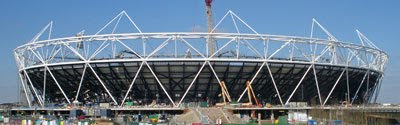
The Olympic Stadium's got taller. A ring of triangular struts was first to appear, folded slightly backwards like the points of a wire-frame crown. Two lighting towers have recently joined them, tall and thin and poking up like rabbit ears. Their appearance lifts the stadium to its final height, so if you can't see it from your kitchen window over the rooftops by now then you never will. The effect is to transform the stadium. The lamps within each tower will floodlight the end of the Opening Ceremony, and all the evening athletics finals, and maybe even some of West Ham's football matches (you never know). Suddenly this looks like an arena where sporting history might happen, rather than simply thousands of builders playing with a geometric construction kit.
Elsewhere in the Olympic Park, venues and other structures are rising fast. The Aquatic Centre's low-swoosh roof is already a landmark, the Olympic Village almost resembles an inner city housing estate, and a ring of curved struts now marks the perimeter of the handballarena. The perimeter road is under construction, including several bridges curving low across the waterways of the Bow Back Rivers. Up in the northwestern corner the International Broadcast Centre is turning out to be vast, if architecturally vacuous, while alongside the Main Press Centre currently resembles two mall-sized multi-storey car parks. This is peak construction time within the park - at this stage very much a multi-acre building site and, as such, still hard to visualise in Games-ready mode.
Up on the Greenway, the raised sewer-top path which passes the Stadium up close, further changes are underway. Where once was an ambling tarmac track surrounded by grass, now there's an arrow-straight twin-surface carriageway to segregate cyclists from walkers. Various items of "furniture" are being added, including space for benches and a series of as-yet-mysterious concrete posts awaiting the attachment of signs or banners or something. Exits are marked by raised iron lettering in the footway, tastefully applied, although prone to vanish at the first sight of snow. Every so often a glassy plaque has been laid in the path to remind walkers that the Jubilee Greenway passes this way (or will do, once HRH passes the magic 60). There are also regular clusters of wedge-shaped stone blocks, each carved with the letters "AOD" and a number (e.g. 9.83 or 10.01) which is, presumably, some sort of distance from somewhere. Down on the West Ham stretch these gleaming white blocks have already proven not to be graffiti-proof, which appears to be asking for trouble.
And there's something more up here that I haven't seen in quite such large numbers before - tourists. There have always been a few interested folk staring at the stadium, occasionally large family groups, even the odd tour party. Now these tour parties are more numerous, as Blue Badge Guides take advantage of public interest and earn cash in return for imparting Olympic information. On Sunday afternoon there were two overflowing clusters of well-wrapped visitors, a small but appropriate distance apart, as their leaders pointed at a lot of buildings and explained the future use of each. I had wanted to take a decent photo of the stadium but these groups had nabbed the best viewing spots, and no amount of waiting seemed to tempt them to disperse. Instead I followed the smell of bacon into the View Tube cafe (also very busy), and failed to get a photo from the locked first floor viewing gallery. [new View Tube website]
A major transformation has occurred in the Lower Lea Valley over the last 2½ years, and there's far more to come over the next 2½. From a backwater everyone could visit but nobody did, to a construction fortress nobody can visit but anybody can watch, to a world stage a handful can visit but everybody will see. Come look.
Seaside postcard: Shoeburyness
Have you ever been to the mouth of the River Thames? The very end, where the river meets the North Sea and the shoreline bends from estuary to coast? Probably not, even though there's a direct train from the City of London. And there's an A Road - the A13 - which is the best way to get here if you're Billy Bragg. But I bet you've never been. To ShoeburyNess.
There's nothing quite like being the only tourist in a seaside resort. Actually 'resort' is a bit strong. Shoeburyness hasn't been one of those for years, not for anyone outside the local area, and in late winter doubly so. But between 1911 and 1939 this was the furthest flung outpost of the London Underground, with District line excursion trains making seasonal journeys to bring holidaymakers to the last halt before Belgium. Many would have stayed at the Shoeburyness Hotel, now boarded up and desolate, its gleamingironwork safe only until some thief or vandal slices it away for scrap.
Across the road a sheet stuck to the window of the Cambridge Press offers up a plaintive "Goodbye" from its former owner. Roy had been working in the family business since 1957, so he tells us, serving the diverse printing needs of the community for more than 60 years. But the advent of ubiquitous colour copiers forced him into retirement earlier this year, and his once proud shop now stands empty. In a High Street that fails to open even on a Saturday afternoon, every business is in danger.
The only people on East Beach are locals. Three teenagers wandering the shoreline, along with two dogs scampering on the exposed mudflats. Another hound plays frisbee with its owner on the common, then refuses to retrieve the disc when it lands in the middle of a particularly wide puddle. The rusting remains of a wartime defence 'boom', erected to keep enemy submarines and ships from entering the Thames, stick out one mile from the beach into the North Sea [photo]. Where it begins, an iron fence blocks the beach. You could easily walk around it at low tide, but a red sign advises otherwise. [Danger / Firing Range / No Entry]
The army moved in beside Pig's Bay during the 1840s, initially for artillery practice, then with rather fiercer weapons. Troops are no longer garrisoned here (which for current recruits is damned good news), and the site is ghost-run by contractors on behalf of the MOD. A little further up the coast is Foulness Island, once selected as the site of London's third airport, now a military nomansland where the public are almost never welcome.
Shoebury's other former garrison is to the south, nearer the Ness. It's currently being transformed from a desolate waste littered with ruined defences into a desirable housing estate plus waterlogged park. There are even plans for an 18-storey 'landmark tower' to mark the far eastern end of the Thames Gateway, but (thankfully) there's no sign yet. A concrete path leads along the foreshore, above the seawall, above the groynes, linking the town to the river's end. This bleak route is somewhere to take the kids cycling, or to give purpose to jogging, or to promenade with your spouse beneath a protective layer of hood, scarf and gloves.
The tip of the Thames is marked by a wooden jetty poking out into the river [photo]. Judge the tide right and there's decent fishing to be had - judge wrong and you'll be dangling your bait in mud. That's Sheerness Docks across the other side of the estuary, and the power station chimneys of the Isle of Grain belching grey into the Kentish sky. What view there is exists only as a thin strip along the horizon, maybe a container ship chugging distantly by, maybe a distant wind farm if you squint carefully enough. England's greatest river dissipates not with bravado and grace but with a turgid whimper.
From Shoebury Ness it's more than 200 miles up the Thames to the source near Cirencester. That may be a gorgeous Arcadian walk, most of the way, but the first 500 metres are grim. Inland is a post-military waste, still heavily fenced off, plus a coastguard tower watching out over the languid waters. Along the shoreline is an unbroken white wall, just about low enough to be climb-over-able, and all that stands in the way of a killer tidal surge from the North Sea which would demolish this corner of Essex. Then comes the 'beach', or rather a patch of sand merging rapidly into mud. Don't try walking along the sand because there's another iron fence blocking that further up, as if somehow the MOD would really rather you weren't here. [photo]
There's a slipway immediately beyond, where you might find local lads pushing a motorised boat down into the water. Ordinary blokes love boats round here - they crave watersport action in the same way that men inland roar around on motorbikes. Retired boatmen are more likely to be found in one of the 700+ beachhuts that line the next strip of coast, or sat outside Uncle Tom's Cabin on the foreshore downing tea and/or hot dogs.
With Southend only a short distance up the coast, the lesser delights of Shoeburyness are likely to stay forever eclipsed. Not quite seaside, not quite popular, not really anywhere you'd travel miles to enjoy. Just rest assured that it exists, with a flat bleak charm all of its own, and that if you never visit you'll not be missed.
You've quite possibly passed through the world's very first under-rivertunnel. You've definitely been through it if you've ever ridden an East London Line train between Wapping and Rotherhithe. You've not ridden through it recently, however, because the ELL is currently cocooned awaiting rebirth (next month?) as part of the revamped London Overground. And you almost certainly won't have walked through it, not unless you're an engineer or TfL employee. But pre-railway this foot tunnel was once so popular an attraction that over half the population of London had promenaded through it. Opened in 1852 and immediately lauded as the eighth wonder of the world, folk found a lamplit stroll beneath the Thames irresistible.
Now, suddenly, there's an incredibly rare opportunity to follow in the footsteps of your Victorian ancestors. The Thames Tunnel will be open to walkers for one weekend only - next weekend - and you'll be able to stroll along the railway tracks from Rotherhithe to Wapping and back again. The event is a late addition to the East Festival - so late in fact that it's not in the programme and takes place well after the rest of the festival has finished. For two days only (that's Friday 12th and Saturday 13th March) there'll be guided tours beneath the river, plus a special "Fancy Fair" at the Brunel Museum in the evenings. You might even be able to book a ticket.
Or you might not. I've despaired at several online booking systems before, but blimey this one's rubbish. For a start, the webpage you need to use for bookings is incredibly well hidden. The event is taking place at the Brunel Museum, so you might expect some information there. But no, their website is currently a one-screen holding page, seemingly designed by an organisation intent on commercial suicide. The place to go is actually the London Transport Museum website... although there's absolutely no mention of this event on their homepage, nor the What's On page, nor the Events calendar, nor indeed anywhere that any inquisitive visitor might ever think to look. Try the secret page instead, however, and there it is.
Even then, there's almost no detail whatsoever about the event you're being invited to attend. The event description consists almost entirely of a safety announcement (no kids, and wear decent shoes or we'll turn you away) and nothing more. Click on the "More information" button and your browser might display more information or it might not. One of the options is for a "Fancy Fair", not that there's any indication on the website of what a "Fancy Fair" actually comprises. For added ambiguity, another event on the same page mentions a "Brunel Fair" instead, which I assume is the same thing. The fair costs a fiver, the tunnel tour costs a fiver, and a combined ticket saves you £2.50... although there's no indication of this pricing anywhere until it's too late. So far so unimpressive.
Although timed tickets are available from 11am through to nearly 10pm on each day, there's no clue on the website as to which slots are already fully booked. Instead you have to try booking via trial and error, using a non-intuitive selection method ... and only after the final stage might you discover that all the tickets have gone. Hit 'back' and try again, you might eventually be lucky. But don't try booking using Firefox or Opera or any non-Microsoft browser, because the system isn't designed for them. If you're not using Internet Explorer the website breaks, the buttons don't work and you'll never be able to book anything.
Locating tickets is one thing, but paying for them is another. TfL insist that you register with their museum before you can proceed, which adds yet another layer of complexity. I'd already done that, having attended a previous event, and I'd been careful to write down my username and password. Unfortunately my password was deemed invalid because, apparently, customer registration passwords need to be changed at regular intervals for security reasons. Yeah right. I requested a password reminder, and an email winged its way (slowly) to my inbox. The special reset link included an 110-character string of alphanumeric gobbledegook, plus the demand that "You must enter the key exactly as it is shown"), which felt incredibly excessive. And then there there was only the trial of Verified by Visa to go, before a ticket was (eventually) mine. Phew.
My ticket is now printed out and ready to use. Brilliantly it tells me the date of my visit but not the all-important time. That crucial detail is in an email, thankfully, otherwise I almost certainly wouldn't be able to remember which was the lucky timeslot in which I finally found a space. I have to say, as atrocious online purchasing experiences go, this amateurish effort surely scores top marks. But who cares when the prize is a ticket to walk through history? Geeks of London, grab your credit cards and cameras, and see you down Brunel's shaft.
Thanks for voting yesterday in my readership survey - more than 700 of you were kind enough to take part! Now I know how my readership has changed over the lastsixyears, and also how very similar it is too. One thing that hasn't changed, according to the 2010 survey results, is that the typical diamond geezer reader is still a 30-something male from the London area. Hello if that's you. And here are those results in a little more detail.
Male or female?
male (523)
76%
female (169)
24%
Hmmm, that's about three male readers to every female, a proportion which has remained almost exactly the same over the last six years. Maybe cyberworld will forever be a very bloke-ish domain, or maybe I'm still not posting enough kittens.
Age
<20 (14)
2%
20s (139)
20%
30s (214)
31%
40s (159)
23%
50s (113)
16%
60+ (60)
9%
My highest readership has always been amongst 30-somethings, and still is. But previously it's been the 20-somethings in second place and now the 40-somethings have overtaken. We're all getting older, I know, and maybe this upward shift merely reflects the passing of time. It's certainly great to have several extra mature readers along for the ride... and if the yoof market wants to spend all its time blathering on Facebook instead, that's fine by me.
Where do you live? (pick one)
London (360)
52%
England (173)
25%
UK (31)
4%
Europe (45)
6%
World (89)
13%
These proportions are incredibly similar to those seen two years ago. Roughly half of my readership comes from London - the city I write about approximately half of the time. Another quarter are from England, so at least have a chance to visit the capital sometimes. But one in six are from well outside Europe (hello world!) so it can't only be my reports from Streatham and Barnet which keep them coming back. It's lucky I write about other stuff and other places too. Half London, half not - that's a good balance, and I shall aim to maintain it.
How often do you read diamond geezer?
daily (476)
68%
often (182)
26%
occasionally (32)
5%
first visit (8)
1%
You're getting more regular. Back in 2004 only half of you came back once a day, and now it's more than two thirds. That's comforting, because I do try very hard to post something every day for you to read. Meanwhile the proportion of readers visiting only occasionally has plummeted - it's all or nothing these days. And a special hello to the eight of you who were making your very first visit yesterday (assuming you ever come back again, that is).
When was your first visit to diamond geezer?
2002/03 (61)
9%
2004/05 (121)
17%
2006/7 (195)
28%
2008 (139)
20%
2009 (147)
21%
2010 (35)
5%
This graph celebrates the longevity of diamond geezer's readers. About a quarter of you claim to have been reading for more than five years, with more and more of you joining in as successive years have passed. But I'm surprised to see that only about half of you were around the last time I ran this survey, which suggests that people are stumbling in here all the time. Thanks to you all for sticking around, however long it's been.
How do you read diamond geezer?
web browser (457)
65%
RSS reader (234)
33%
mobile browser (9)
1%
Here's the new question, as I try to determine how many people are reading my posts somewhere that isn't my blog. The results are slightly flawed because yesterday's vote wasn't clickable in certain feed readers so the figures may be an underestimate. But it sounds like RSS is adding at least 50% to my readership, and quite possibly a lot more. And look, there are even nine cutting-edge readers who follow diamond geezer on their mobile. Bet you that figure rises in two years time.
Do you have your own blog?
yes (216)
31%
no (484)
69%
The proportion of readers with their own blog has dropped again. In fact it's fallen by about 7% each time I've held this survey, now down from over half to under a third, and it's probably heading for only one in four next time around. Is this decline because lots of people who used to blog have given up, or is it because everyone's too busy writing one-line status updates? Or both? Whichever, it's good to know I still have competition from at least 200 of you. I wonder how different things will look by the first week of 2012...
Readership survey(4) : Precisely six years ago I ran a readership survey to find out who was reading my blog. Then four years ago and two years ago I repeated that survey to see what, if anything, had changed. And I suspect a lot's changed since then, so I thought I'd run the survey again. I wonder how different 2010 is to 2008 and 2006 and 2004. Go on, tell me about yourself...
Thanks for all your helpful advice following Monday's news that half of my blog had disappeared. As yet, alas, Blogger hasn't got round to reversing its Auto-Pagination feature which caused 50% of my monthly archives to vanish. There is evidence that they're considering tweaking it, having spotted it makes a complete mess of certain blogs, but there's no certainty that any of the changes will help my particular situation.
A lot of you suggested transferring to Wordpress.com or Wordpress.org, although there were also various hints that this might be time-consuming, costly and/or frustrating. Some of you advised me to try labels or conditional tags, but I'm not doing that for 4000+ posts. One of you suggested hosting my photos away from Blogger, but I've checked and that doesn't make any difference. One of you's been busy tweaking a Blogger layout template to mirror my classic template, thanks, and this might be a possible solution eventually maybe. But a lot of you just told me to get my act together and host my own website, you bloody cheapskate. Nah, I'm making no moves yet, not while there's still hope of staying put.
Like the BBC, diamond geezer's mission is to inform, educate and entertain audiences through services of high quality, originality and value. The public expect diamond geezer to be a wholly reliable source of accurate and impartial news; a tireless supporter of originality and excellence; an upholder of the highest values and standards; and a bit geeky besides. But media is changing profoundly, and diamond geezer must change too. It must articulate its public service mission more clearly than ever before. It must explore new ways of delivering that mission. But it must also recognise the challenges facing other media, and not tread on the toes of upstanding commercial operators such as that nice Mr Murdoch. We love you Rupert, and we hear you.
This strategy directs the DG to do fewer things better; put quality first; make funding work harder; and set new boundaries for itself. You've got too big for your boots, matey boy, and drastic cutbacks are essential.
Doing fewer things better means significant changes to the diamond geezer service portfolio - including by • Halving the number of sections on the site [This target has already been achieved. Last week a 50% cull of DG content was successfully introduced, focusing on the least-read posts at the bottom of pages. Nobody complained, and therefore this repositioning has been 100% successful] • Turning the site into a window on the web by providing at least 53 external links in every post and doubling monthly ‘click-throughs’ [Readers must be forced to read external sites instead, otherwise DG's mission to inform will have failed] • Recommending the closure of the Random Borough feature [Like that other niche channel, Radio 6 Music, the Random Borough feature has minimal public recognition. It must therefore be sacrificed. It is original, distinctive and entertaining, featuring content which cannot be found elsewhere. It must therefore be sacrificed. It costs almost nothing to produce, relatively speaking. It must therefore be sacrificed. It poses no threat whatsoever to entrepreneurs in the commercial arena. It must therefore be sacrificed. QED]
Putting quality first means delivering clear content priorities at higher quality across all of diamond geezer's services — including by: • Reprioritising to higher quality content across everything the DG does [No more wasting readers' time with cheap sniping at TfL press releases. In the new future, London needs more articles about Victorian wigmaking, municipal statues and the Ley Lines of Barnet] • Increasing the quality of local posts [There must be less focus on pan-London issues, and more incisive reporting on the potholes in Campbell Road, and the new pedestrian crossing opposite Bow Police station] • Boosting investment in local news at breakfast, mid-morning and drivetime using resources released by sharing content at other times [After many years of successful breakfast-time publishing, diamond geezer must now diversify into other time periods by shamelessly cutting and pasting content that others have written]
Making funding work harder means cutting corners and hoping nobody notices - including by: • Spending 14% less on the website per year by 2013 [diamond geezer will no longer publish on Sundays, but will instead encourage citizens to purchase a copy of the News of the World and look at the pictures] • Freezing pay and suspending bonuses [There must be no more Creme Eggs purchased using readers' Paypal donations] • Reducing senior management numbers [The DG workforce must be cut... from one to, erm...]
Setting new boundaries means thinking of other companies' shareholders first - including by: • Recognising the lead role commercial blogs play in serving popular information to 30-50 year-olds [There are many blogs, funded by advertising, that pander to the lowest common denominator interests of adults in this age group. They write posts about celebrities, posts about cupcakes and posts about how fabulous West End Musicals are. Everybody in the 30-50 age group will be satisfied by this diet, in precisely the same way that they all like listening to Jamie Cullum and Lionel Richie. Therefore we will abandon middle-aged adults to the commercial sector, and the culturally highbrow ones can bloody well wait until they're 51 until we serve them again] • Prioritising quality over quantity whenever a choice is required [This allows the DG to stop after 100 words and go down the pub for the rest of the evening, so long as those 100 words are ace] • Leaving room for other broadcast media to develop in a digital world by rolling over and giving in [When newspaper proprietors and satellite TV moguls instigate a decade-long campaign of spite and bile against you, concede that maybe they have a point, and castrate your services until they're happy you pose no threat whatsoever to their continued global monopoly]
The DG’s mission is as relevant today as it was nearly 8 years ago: to inform, educate and entertain to fulfil its public purposes at best possible value to the widest possible audience. This strategy is intended to deliver a diamond geezer focused on high-quality content within clearer limits, keeping open a digital public space for all. Not a DG in retreat, oh no, not scared and whimpering at all. Oh go on then, I'll delete everything, if you insist.
It's widely acknowledged that the London Underground tube map is a classic. Maybe not the current version, but the general idea of simplifying a rail diagram to render it more easily understood. For this we must thank draughtsman Harry Beck, whose 1933 redesign brought order and elegance to London's twisted layout. But do his rules work quite so well today with a more complicated network, and are they applicable to other systems in other cities? An academic exhibition, curated by Dr Maxwell Roberts, aims to find out.
To reach Max's exhibition you'll need to head for a station that appears on Beck's original tube map but isn't on the network any more. That's Southend Central - formerly a seasonal outpost of the District line, and rather further out of town than any exhibition about the tube would normally venture. It's a bit of a trek but, on arrival at Southend station, your destination is only a few metres to the north inside big shiny South Essex College. You'll need to collect a visitor's pass from the front desk (which sort of makes you an honorary student for a brief time) and then it's up to the first floor to have a look at some maps.
There are a lot of maps. Big computer-generated maps, some of them based on real diagrams, others best described as topological flights of fancy. You may need to have the order of display explained to you, because it's not immediately obvious where to start, but the first is a pre-Beck map designed by F H Stingemore. See those cartographically-accurate wobbles? Those are what Harry removed, and his map is positioned alongside for contrast. If you're the sort of person who could spend a minute comparing nuances between the two diagrams, then this exhibition is for you.
Next up along the balcony, an experiment. Max is a psychologist by trade, and reckons that maps are really an intelligence test set by their designers. He experimented by presenting people with three different versions of the London Underground map - the present one, a simplified version and a design nightmare - and invited his subjects to try to plan a series of journeys on each. Unsurprisingly the simplified version - one of Max's own - performed best. And that's before you take into account all the daggers, blobs and additional symbols on TfL's current map - all of it information pollution - which would widen the usability gap even further.
Next up, what happens if you change the rules? Beck initially insisted on a 45° angle for all his diagonal lines, but there are examples here of what happens if that angle is changed to 15° (ooh, very wide) or 75° (ugh, that's severe). He also insisted on octolinearity (essentially that's a square grid plus diagonals only), whereas it's perfectly possible to draw maps that are tetralinear, hexalinear or even dodecalinear (no, my spellcheck doesn't recognise those terms either). These make for intriguing alternative tube maps, but none quite so unnerving as the design which rotates London through 90° and sticks Upminster at the top. It'd never be acceptable to the general public, obviously, but I thought that this was the very clearest version of them all.
Off the balcony and through the double doors are some wilder flights of fancy. An Art Nouveau whimsy with curling branches and buds (illustrated above), and a Charles Rennie Mackintosh number that's all elegant and griddy (illustrated above). Max has clearly had a lot of fun knocking up all of these maps, and has been utterly painstaking in their execution. A brief series of foreign metro maps follow, both the official version and a Roberts retweak. In Paris and Madrid, Max argues, carefully sculpted curves could make the network far easier to comprehend. In 1970s Moscow, however, a single circle crossed by intersecting straight lines might have been the most optimal tube map ever.
And finally, of course, Max's legendary curvy tube map. Are its gentle arcs the solution to TfL's 21st century design problems? Or does removing all of the kinks take a familiar map too far? No conclusion is drawn - as with all these maps you're left very much to make up your own mind. But with an extended DLR and Overground about to debut on the official diagram, and later Crossrail to jam forcibly across the centre, maybe the time has come to bend some of Beck's original rules for the greater good.
This isn't the largest exhibition you'll ever see - it's laid out along an architecturally inept balcony and around a couple of ante-rooms. And it's only open for another week, so you'll have to hurry if you want to get there. But if good design, or the psychology behind it, interests you, then a trip to Southend is in order. Go next Saturday and you should meet Max himself, with the added bonus that (unlike last Saturday) there are no rail replacement buses to endure along the way. You might choose to buy a colour copy of some of the maps, four of which are available for you to take home and treasure. Fold and laminate the curvy version and you could even carry it around London in preference to TfL's latest design. Not suggesting, just saying.
No, really, completely vanished. Unreadable. Un-findable. Invisble. Gone.
You probably haven't noticed, because the only bit of the blog you read is fine. There's been no effect on my front page, on my most recent posts, the ones you actually read. But try to delve into my archives and you'll discover that they're not all there. I have 90 monthly archive pages, each of which used to show a complete list of posts published in that month. Now each stops short, cutting off everything after the middle of the month, with no way to access the remainder. Half of everything I've written over the last 7½ years has disappeared. As you might imagine, I'm not best pleased.
Here's an example for you. All of the posts I wrote last month should appear on my February archive page. But they don't. My February archive page cuts out below Valentine's Day, which means that every post between the 1st and the 13th has disappeared. It's no good hunting, you won't find them anywhere. Even if you try jumping to the precise permalink where something used to be (like, for instance, my Winter Olympics quiz), that link goes nowhere. Rest assured that no posts have actually been deleted from my dashboard, but half of February 2010 is no longer accessible by my readers. At all.
This annihilation of my blog's archive is thanks to a new 'feature' which Blogger rolled out quietly last week. It's called Auto-Pagination, and it's been introduced to help to make everyone's blog load more quickly.
There are a lot of bloated blogs out there, and Blogger aren't happy. They want to stop readers hanging around waiting for pages to load, especially pages that are full of big bandwidth-hungry images, because "faster page loads mean more satisfied users". So they've introduced Auto-Pagination, which automatically truncates longer pages once Blogger deems they've got "too big". We bloggers have no control over this cut-off, it's Blogger that decides. Write too much (or, more precisely, include too many pictures), and Blogger chops you off.
And that's why my monthly archive pages have semi-disappeared. Not because I've written too much, but because I've included too many images. Most of these are small, many of them only a few kilobytes, so they download in a flash. But Blogger doesn't care how minimal these pictures are, it merely counts them, and once it's counted about 30 it stops. For example, my March 2005 archive cuts out below March 10th, March 2006 cuts out below March 16th and March 2009 cuts out below March 18th. The most hidden month I've found so far is August 2009, where every single post beneath the 25th has been removed. But you can still read all of November 2002, because I hadn't really discovered pictures back then, so Blogger doesn't automatically curtail anything.
Yes, I know that my monthly archives were a bit huge. Yes, I know that long chains of posts aren't ideal when you're trying to pinpoint an individual post lurking within. Yes, I know that pages of that length aren't in any way Google-friendly. But monthly archives is what I want, and over the last 7½ years I've optimised my blog for this form of legacy storage. Alas, as of this week, monthly archiving no longer seems to be a viable option.
There's a very simple solution to this truncation problem, which is to include a link to "Older posts" at the bottom of every page. Users would read the first half of the monthly archive, click on the link, and then read the rest. Unfortunately Blogger only provides this option for bloggers using modern "Layout templates", which means that those of us still using the older "Classic templates" are stuffed. Indeed it looks like Blogger is about to abandon all support for Classic templates, like they just did with FTP publishing, and so this is a nudge to get people moving over to more modular, more generic Layouts. I hate being nudged. But I fear I'm going to have to jump, somewhere, because this current "half-blog" situation is completely untenable.
Possible solutions: i) I could go back and delete most of the pictures from my previous blogposts. That would work, but it's not really on, is it? ii) I could switch to weekly archives. That would work, except I'd then have nearly 400 archives pages, with various monthly features split across several pages, and nobody would ever find anything any more. iii) I could "upgrade" from my current Classic template to a new Layout template. Blogger offers "over 30 gorgeous, professionally-designed templates", apparently, none of which look anything like my blog's current silvery retro feel. None are quite as tweakable as I'd like, preventing me from fiddling with the HTML under the surface, and they'd all force me to narrowblog inside a fixed-width column. Plus this still wouldn't allow me to have all my monthly archives on one page - it'd just allow people to find Page 2 rather than it being hidden. iv) I could include "Jump Breaks" in all my posts. You know the sort of thing. "To read the rest of this post, click here". But I hate those. They conceal content beneath the surface where nobody ever looks, and I don't write stuff simply to hide it away. v) I could tag all of my posts so that they still linked together appropriately. Except I've written more than 4000 different posts altogether, so do you realise how long that would take? And nobody ever clicks on tags anyway, not without being prompted, so I'd be wasting my time. vi) I could abandon Blogger for being cheap and generic, and upgrade to something more professional like Wordpress or TypePad. Except they're complicated, aren't they? And 'modern'. And expensive, if you want something customisable. And they probably wouldn't let me transfer all my Blogger-hosted images. And all the internal links in previous posts would stop working. And diamondgeezer.wordpress.com has already been taken. And I still wouldn't be able to show a full complete monthly archive, not like Blogger used to do until last week.
It's not only me who's been affected by this decision. Any blogspot blogger with more than 30-ish images on a page is affected, and there are a lot of archivepages that suddenly don't include as much as they used to. Blogger's help forums are full of angry comments from the afflicted, along with much patronising advice from the admins on why it's important to put up and shut up. But it's only we few old-school bloggers with Classic templates who have no workaround, no alternative "older posts" link, just a whole load of missing content. We're stuffed.
This mess brings home how fragile the world of online content is. All it takes is one hosting decision, one hard-drive failure or one corporate takeover, and everything you thought you owned can disappear. It's a sobering thought that if I'd died three months ago, my entire online legacy would now be half a blog (thank you Blogger) with no comments (thank you JS-Kit). We're all only one upgrade away from obsolescence.
So, as things stand, this blog is truly shafted. Unless Blogger reverses this latest rollout, either I'm going to have to upgrade something or else half of my posts are permanently lost. I fear I'm going to have to compromise and move to a format I don't like, simply to allow this blog to continue. Any helpful thoughts you might have would be welcomed. And hurry, because in a fortnight's time this post disappears too...

I arrived 20 minutes early, to the Brunel Museum like it said on my ticket. The area around the pumphouse was illuminated, hinting at delights on the terrace behind the fence. Ah, this must be the legendary Fancy Fair, a recreation of subterranean Victorian delights and an opportunity to head down inside the Rotherhithe shaft, how excellent. A bloke in a bowler hat stood near the entrance turning the handle on a barrel organ and playing Beatles tunes, thereby almost adding a bit of period flavour. Stepping through a fake cardboard arch, I showed my ticket to a member of staff. "Have you done the tour yet?" he said. "You'd better do that first. The queue's back at the station."
Each group was led by a knowledgeable guide whose job was to relate historical facts and anecdotes at various points through the tunnel, and to speed everyone up so they didn't spend too long hanging back taking photos. It was very tempting to take photos of everything - an arch, some cables, another arch, the tops of people's heads - but a far better use of time was actually looking at the amazing structures all around. Isambard Kingdom Brunel and his father Marc were the first blokes to dig beneath a navigable river using a tunnelling shield, and it's credit to their engineering genius that their handiwork still stands (and remains functional) into the 21st century.
The tracks curved gently down, and then back up, until we emerged at Wapping station on the northern side of the river. Here our tour guide had further anecdotes and trivia to relate (Queen Victoria's handkerchief, really?) and we had an ideal view staring down both tunnels from raised scaffolding wedged across the tracks. It was difficult to get a photo without people (indeed, it was difficult to get a shot that wasn't blurred and fuzzy to the point of ambiguity), but everybody with a camera gave it a go. And then we got to walk all the way back again, a bit more blasé this time, but with rather more couples stopping off for a commemorative photo of their loved one in front of a unique concrete-blasted arch.
Bus 45: St Pancras - Clapham Park
Only handful of buses pull up St Pancras's central concourse on Midland Road. Most travellers exiting the station here are in search of a taxi, a interminable string of which snaked off into the middle distance along the edge of the building. But my chosen driver wouldn't have turned up his nose at "south of the river, mate?", because that was his job, so with a beep I was aboard and up to the top deck. I had one front seat, and a crusty couple with matching multiple nose piercings took the other. Once appropriately huddled, the green-scarfed woman picked up a discarded Daily Mirror from the ledge in front of her. "I don't want to read any of this crap!" she exclaimed, then proceeded to read the paper from cover to cover all the way to Walworth.
Changeover at Camberwell Green, and the opportunity (while we waited) to watch four karate kids kicking and stretching beside an empty playground. Then crowds piled on for the cross-border journey to Lambeth, down Coldharbour Lane (currently closed for roadworks, but I made this journey before those kicked in to avoid a diversion - I plan ahead like that). At last an actual residential street with flats and faded terraces, with even the occasional glimpse of 'cottage'. At Loughborough Junction a plastic bag packed with toilet rolls arrived on board, carried by a lad in a hoodie/beanie/puffa combination. And so the bus twisted on, increasingly packed, to Brixton.
In this Enfield house, precisely 75 years ago today, a baby girl was born. She didn't live here for long - the family moved a short time afterwards - but within these walls were her first breaths, her first gurgles and her first "oh thank goodness she's slept through the night".
I went up to Enfield to visit this house for the very first time last Christmas. It struck me I'd never been before, to what was an extremely important place in my Mum's life, and I thought I ought to finally make the effort. It being less than a week since her death, I may not have been in the most stable emotional state as I walked up the unfamiliar street. I located number 52, then stood on the pavement across the road and looked the two-up two-down up and down. I'd just got my camera out when the front door opened and the current owner emerged. He immediately walked over and demanded to know what I was up to, having spotted a highly suspicious middle-aged man giving his property the once over. I explained that my Mum had been born here, and that she'd very recently died, and undoubtedly sounded a bit weird and quite incoherent. He wasn't interested, except in me moving on as quickly as possible, so it didn't seem worth prolonging the conversation any further. I did at least catch a glimpse of his hallway before the door closed behind him, but a bit of a social disaster all round, truth be told.Precisely 30 years later, to that same young woman, a baby boy was born. He was her first child, a tiny dark-haired thing, emerging into the world kicking and bawling in the early hours of the morning. Of all the things to be doing on your 30th birthday, giving birth probably doesn't come near the top of the list. But my Mum never complained, even though I was about to grow into the most demanding birthday present she ever had.Olympic update
And there's something more up here that I haven't seen in quite such large numbers before - tourists. There have always been a few interested folk staring at the stadium, occasionally large family groups, even the odd tour party. Now these tour parties are more numerous, as Blue Badge Guides take advantage of public interest and earn cash in return for imparting Olympic information. On Sunday afternoon there were two overflowing clusters of well-wrapped visitors, a small but appropriate distance apart, as their leaders pointed at a lot of buildings and explained the future use of each. I had wanted to take a decent photo of the stadium but these groups had nabbed the best viewing spots, and no amount of waiting seemed to tempt them to disperse. Instead I followed the smell of bacon into the View Tube cafe (also very busy), and failed to get a photo from the locked first floor viewing gallery. [new View Tube website]
Across the road a sheet stuck to the window of the Cambridge Press offers up a plaintive "Goodbye" from its former owner. Roy had been working in the family business since 1957, so he tells us, serving the diverse printing needs of the community for more than 60 years. But the advent of ubiquitous colour copiers forced him into retirement earlier this year, and his once proud shop now stands empty. In a High Street that fails to open even on a Saturday afternoon, every business is in danger.
Shoebury's other former garrison is to the south, nearer the Ness. It's currently being transformed from a desolate waste littered with ruined defences into a desirable housing estate plus waterlogged park. There are even plans for an 18-storey 'landmark tower' to mark the far eastern end of the Thames Gateway, but (thankfully) there's no sign yet. A concrete path leads along the foreshore, above the seawall, above the groynes, linking the town to the river's end. This bleak route is somewhere to take the kids cycling, or to give purpose to jogging, or to promenade with your spouse beneath a protective layer of hood, scarf and gloves.
There's a slipway immediately beyond, where you might find local lads pushing a motorised boat down into the water. Ordinary blokes love boats round here - they crave watersport action in the same way that men inland roar around on motorbikes. Retired boatmen are more likely to be found in one of the 700+ beach huts that line the next strip of coast, or sat outside Uncle Tom's Cabin on the foreshore downing tea and/or hot dogs.
You've quite possibly passed through the world's very first under-river tunnel. You've definitely been through it if you've ever ridden an East London Line train between Wapping and Rotherhithe. You've not ridden through it recently, however, because the ELL is currently cocooned awaiting rebirth (next month?) as part of the revamped London Overground. And you almost certainly won't have walked through it, not unless you're an engineer or TfL employee. But pre-railway this foot tunnel was once so popular an attraction that over half the population of London had promenaded through it. Opened in 1852 and immediately lauded as the eighth wonder of the world, folk found a lamplit stroll beneath the Thames irresistible.
To reach Max's exhibition you'll need to head for a station that appears on Beck's original tube map but isn't on the network any more. That's Southend Central - formerly a seasonal outpost of the District line, and rather further out of town than any exhibition about the tube would normally venture. It's a bit of a trek but, on arrival at Southend station, your destination is only a few metres to the north inside big shiny South Essex College. You'll need to collect a visitor's pass from the front desk (which sort of makes you an honorary student for a brief time) and then it's up to the first floor to have a look at some maps.
Next up, what happens if you change the rules? Beck initially insisted on a 45° angle for all his diagonal lines, but there are examples here of what happens if that angle is changed to 15° (ooh, very wide) or 75° (ugh, that's severe). He also insisted on octolinearity (essentially that's a square grid plus diagonals only), whereas it's perfectly possible to draw maps that are tetralinear, hexalinear or even dodecalinear (no, my spellcheck doesn't recognise those terms either). These make for intriguing alternative tube maps, but none quite so unnerving as the design which rotates London through 90° and sticks Upminster at the top. It'd never be acceptable to the general public, obviously, but I thought that this was the very clearest version of them all.
And finally, of course, Max's legendary curvy tube map. Are its gentle arcs the solution to TfL's 21st century design problems? Or does removing all of the kinks take a familiar map too far? No conclusion is drawn - as with all these maps you're left very much to make up your own mind. But with an extended DLR and Overground about to debut on the official diagram, and later Crossrail to jam forcibly across the centre, maybe the time has come to bend some of Beck's original rules for the greater good.