London's villages are hard to spot. They might once have been obvious, but centuries of urbanisation have blurred the edges of former residential nuclei, and now Walworth merges into Camberwell, Highgate merges into Hornsey and Greenford merges into Northolt. It's even more complicated in the centre of town. How far does 'Marylebone' actually stretch? Where does the West End end? What is that big area to the west of St Paul's Cathedral called?
For a lot of people, London locations are defined by their nearest station. The tube map defines where things are, even when those station names have no basis in geographic reality. "I'm in the Waterloo area." "Let's go shopping at Clapham Junction." "Yeah, we live in Bow Church". And these definitions are still a bit woolly, because it's by no means clear how far the influence of those station names spreads.
But now a new location paradigm is slipping out - firming up and redefining the way bits of the capital are named. And it looks like Boris's Cycle Hire scheme is leading the way...
I should acknowledge Londonist at this point, for a fine post yesterday pointing out how some of the new Cycle Hire stations have somewhat unexpected names. A bunch of docking stations around Old Street are apparently in "St Luke's", which is a proper old part of town, whereas further south there's a cluster in "Bank", which surely doesn't exist as a genuine placename. Then there's "West End", which is around Trafalgar Square, and "Strand", between Covent Garden and the river, and even "Southwark", which appears to be restricted to the area around the Jubilee line station. Some genuine and ancient, others tentative and artificial, but all given instant legitimacy courtesy of Barclays' two-wheeled revolution.
Thanks are also due to TfL for releasing complete public-facing data on where all the docking stations are and how many bikes/spaces they currently have. Here's the raw-ish data at Borisbikes API, and here's a site with graphs showing how bike use has fluctuated at each docking station over the last 24 hours. But this stream of information really comes into its own with Ollie's real-time map, which visualises station usage spatially and in colour. Red for full, blue for empty, which is a great way to highlight where the awkward gaps in service are. Look, someone's even knocked up a 24-hour speeded-up video showing how the centre of town is a bike cluster by day and a bike desert by night. Hurrah for public-facing open data, because amateur experts have generated far more useful services than TfL's official representation.
Every cycle docking station has a two part address (for example "New Inn Yard, Shoreditch"), the first part of which is the street (or nearby place of interest), and the second part of which is the area. It's those areas which are of interest. There's a full list of them here, so you can see they include Monument, Tower and St James's, but not Charing Cross, Oxford Street or Lambeth. Names you wouldn't normally think of using are sneaking into accepted practice, and with very precise definition. Take the three docking stations to the north of Aldwych, for example. [Kingsway, Covent Garden][Portugal Street, Holborn][Houghton Street, Strand] They're all within a hundred yards or so of each other, yet they're all decreed to be in separate geographic enclaves. Click around Ollie's map and you'll probably discover several other patterns, redefinitions and anomalies.
And the logic behind all this? It's the continuing rollout of the Legible London project, which began as a handful of map-packed miniliths around the Bond Street area a few years back. These smart black information boards have gradually spread around town since 2007, and have been a great way for pedestrians to work out where on earth they are and where the hell they're going. Now add cyclists to that list. All of Boris's docking stations have a Legible London map, and Legible London branding, so it's no surprise that they're using Legible London placename classification.
To aid wayfaring, Legible London has divided the centre of town up into "villages". For example, the two villages to the north of Oxford Street are Marylebone and Fitzrovia, while the two villages to the south are Mayfair and Soho. Holborn is a sprawling swathe to either side of High Holborn, while Clerkenwell curves round like a banana from almost-King's Cross to nearly-Barbican.
There must be, somewhere, a definitive Legible London map which shows precisely where one village ends and the next begins. It ought to be on the Legible London microsite, but no. There was a rough summary once, which lingers on a previous version of the site, and that's about as good as the simple stuff gets. But for anything more detailed you need to dig around a bit. There are the seeds of the 'village' idea on page 24 of the original 2006 wayfinding study (ooh that's a good read). There are some guiding principles on pages 32 and 33 of the Legible London Yellow Book (so's that). There's a lot of more recent stuff throughout TfL's Place Naming Strategy Guidance (notably page 11). And there's a bloody huge basemap on page 26 of the Legible London System Architecture guidance document (such detail). But as for the big picture, that's not really for public consumption, except in small chunks on miniliths and docking stations across the city.
The Legible London system even subdivides its "villages" down into smaller "neighbourhoods" for good measure (for example Covent Garden contains the sub-neighbourhoods of Seven Dials, Neal's Yard and Long Acre). This all helps Londoners to create their own mental maps, apparently. But it's also formalising the unplanned and crystallising the nebulous. Was it a committee, a consultation or a well-meaning administrator who defined the official boundary between King's Cross and Angel, or between Vauxhall, Oval and Kennington? Because whoever drew these accurate dividing lines on the master map has been playing God with centuries of locational evolution. And London may never be seen quite the same again.
NOT-LONDON 2012 Exploring Olympic venues outside the capital 2) Stoke Mandeville
London's Olympic closing ceremony will take place exactly two years from today. But that won't be the end of the show. Three weeks later the other Games kick off, the Games far fewer people follow, the Paralympics. And they have their their roots in English suburbia, 30 miles outside London in deepest Buckinghamshire. So I've been there too. After Wenlock, Mandeville.
The seeds of the Paralympics were unintentionally sown when an Aylesbury hospital was chosen for the treatment of military casualties during World War 2. A specialist spinal injuries unit was set up, whose expertise continued and grew into peacetime under the directorship of Dr Ludwig Guttmann. When London hosted the Olympic Games in 1948, hospital staff organised a special athletics event for 16 disabled ex-soldiers, and the annual Stoke Mandeville Games were born. In 1952 a Dutch team turned up, launching the first international sporting competition for disabled athletes. And in 1960 the competition ventured abroad to Rome, taking place alongside the city's able-bodied Olympics. Known at the time as the 9th Annual International Stoke Mandeville Games, this is the moment when the Paralympics are deemed to have been born. And yes, we came second. Great Britain's very good at coming second in the Paralympics, but we've never yet topped the medal table.
If you want to get to Stoke Mandeville hospital (not via an ambulance), there's one important thing to remember. Don't get off the train at Stoke Mandeville station. They have big signs up on the platforms warning you not to, and to alight at Aylesbury instead. The hospital was originally an isolation unit for cholera sufferers, so was very deliberately built in the nomansland halfway between the two settlements. Aylesbury's long since grown up and swallowed the place, but the hospital retains the name of the small commuter village down the road.
I got off the train at Stoke Mandeville, because I'm like that, although almost nobody else did. This is a sleepy Chiltern backwater, peaceful but not overflowing with character. The Post Office is the sort of place that sells Silvine exercise books and Tunnock's tea cakes. The village hall is the sort of place that hosts the Mid Bucks Rabbit Show. And the bus stop is the sort of place that boasts only five services a day, so I walked to the hospital instead. It was only a mile across the fields towards the big chimney in the distance, past a couple of extremely tame sheep, but there were rather a lot of stiles on the way so I'd never have managed the journey in a wheelchair.
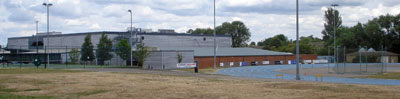
OK, so Stoke Mandeville Hospital looks very much like a modern hospital. A huge organic cluster of rambling buildings, some thrusting and modern, others barely-altered prefabs from the dawn of the NHS [photo]. The Spinal Injuries Unit is one of the more up-to-date wings, with a friendly 'Welcome' scrawled across its roof. But I headed round the bleak northern perimeter road, past several staff car parks, to catch a glimpse of the legendary stadium. There it was through the fence, behind the junior doctors' accommodation block, a ring of eight blue lanes curving off towards a distant hedge. All the usual athletics facilities, by the looks of things, including spaces for chucking things and nets for chucking them into. In fact nothing extra special at all, because this is Sport For All, and round here everyone uses the same track. [photo]
But not every sports track has an Olympic Village attached. Most of it is bungalows, obviously, in a none-too fetching shade of sludge-brown brick surrounded by unkempt shrubbery. The village was built for the one occasion the fledgling Paralympics came to Stoke Mandeville, in 1984, when the hosting honours were shared transatlantically with New York. Nextdoor is the two-storey Olympic Lodge, with a ramp, obviously, which doubles up as an accessible hotel and conference centre. And a big steely sports centre, named after dear old Dr Guttman, within which lurk a badminton hall, swimming pool and (obviously) a gym. Looking at the Aylesburyfolk walking inside to use the facilities, and pumping iron through the smoked glass windows, you'd never guess this place had any special disabled function at all.
But there's a proper hint of the old days across the car park. A row of ramshackle white huts, of the kind that ought to house a pack or three of postwar boy scouts, unsullied by upgrade since their sporting debut [photo]. One's the Shooting Hall, where wheelchair athletes won medals for target practice, and another's the Wallace-Taylor Cuesports Room, where sedentary snooker players potted black for gold. And there's an indoor bowls centre too, even though that's not a Paralympic sport any more, because they used to do things differently here.
Disabled sport has moved on big time since 1948, so that when the Paralympics return to the UK in 2012 they'll have vastly outgrown this pioneering provincial sports centre. But its legacy lives on, both around here and around the world. And it's thanks to Stoke Mandeville that in precisely two years' time the London Games won't be over, there'll still be half the fun to go.
And, apparently, there haven't been enough weekend closures already.
Jubilee line upgrade - weekend line closures
2007 08 Apr WePk→Stan 13 May CWhf→Stfd 10 Jun CWhf→Stfd 16 Jun WePk→Stan 23 Jun NGrn→Stfd 30 Jun WePk→Stan 19 Aug CWhf→Stfd 15 Sep NGrn→Stfd 22 Sep WePk→Stan 29 Sep WePk→Stan 06 Oct WePk→Stan 20 Oct NGrn→Stfd 27 Oct WePk→Stan 03 Nov WePk→Stan 10 Nov WePk→Stan 18 Nov WePk→Stan 24 Nov WePk→Stan 02 Dec CWhf→Stfd 08 Dec WePk→Stan 15 Dec WePk→Stan 16 Dec NGrn→Stfd 22 Dec WePk→Stan
2008 05 Jan GnPk→Stfd 06 Jan WePk→Stan 19 Jan GnPk→Stfd 26 Jan WePk→Stan 02 Feb Grn→Stfd 09 Feb WePk→Stan 16 Feb WePk→Stan 01 Mar NGrn→Stfd 08 Mar NGrn→Stfd 29 Mar NGrn→Stfd 26 Apr Grn→Stfd 10 May NGrn→Stfd 31 May NGrn→Stfd 07 Jun NGrn→Stfd 14 Jun NGrn→Stfd 21 Jun GnPk→NGrn 28 Jun NGrn→Stfd 05 Jul GnPk→NGrn 12 Jul NGrn→Stfd 19 Jul GnPk→Stfd 26 Jul NGrn→Stfd 03 Aug NGrn→Stfd 09 Aug NGrn→Stfd 10 Aug CWhf→Stfd 16 Aug GnPk→CWhf 24 Aug NGrn→Stfd 31 Aug GnPk→Stfd 07 Sep GnPk→Stfd 13 Sep NGrn→Stfd 14 Sep WePk→Stan 20 Sep CWhf→Stfd 27 Sep NGrn→Stfd 28 Sep WePk→Stan 04 Oct NGrn→Stfd 05 Oct Wloo→FiRd 11 Oct GnPk→Stfd 12 Oct Wloo→FiRd 18 Oct GnPk→Stfd 25 Oct NGrn→Stfd 01 Nov Wloo→Stan 08 Nov GnPk→Stfd 15 Nov Wloo→FiRd 22 Oct NGrn→Stfd 29 Nov Wloo→Stan 21 Dec NGrn→Stfd 27 DecStfd→Stan
2009 03 Jan GnPk→Stfd 10 Jan GnPk→Stfd 17 Jan Wloo→Stan 24 Jan Wloo→Stan 31 Jan GnPk→Stfd 07 Feb GnPk→Stfd 14 Feb Wloo→Stan 21 Feb Wloo→Stan 28 Feb GnPk→Stfd 21 Mar GnPk→Stfd 28 Mar GnPk→Stfd 11 Apr Neas→Stfd 18 Apr GnPk→Stfd 25 Apr GnPk→Stfd 02 May GnPk→Stfd 09 May LnBr→Stan 16 MayStfd→Stan 23 May LnBr→Stan 24 May NGrn→Stfd 30 May GnPk→Stfd 31 May GnPk→NGrn 06 Jun GnPk→Stfd 13 JunStfd→Stan 14 Jun GnPk→Stfd 20 JunStfd→Stan 21 Jun GnPk→Stfd 27 JunStfd→Stan 04 Jul GnPk→Stfd 05 JulStfd→Stan 11 Jul GnPk→Stfd 12 JulStfd→Stan 18 Jul WHmd→Stan 25 Jul Wloo→Stan 26 JulStfd→Stan 01 Aug Wloo→Stan 15 Aug GnPk→Stfd 16 AugStfd→Stan 22 AugStfd→Stan 30 Aug WHmd→Stan 05 Sep GnPk→Stfd 06 Sep Wloo→Stan 12 Sep Wloo→Stan 19 Sep Wloo→Stan 26 Sep Wloo→Stan 26 Sep NGrn→Stfd 03 Oct Wloo→Stan 03 Oct NGrn→Stfd 10 OctStfd→Stan 11 Oct WHmd→Stan 17 Oct Wloo→Stan 24 Oct Wloo→Stan 31 Oct Wloo→Stan 07 Nov Wloo→Stan 08 Nov WHmd→Stan 14 Nov Wloo→Stan 21 Nov Wloo→Stan 21 Nov NGrn→Stfd 28 Nov Wloo→Stan 05 Dec WHmd→Stan 12 Dec WHmd→Stan 19 Dec WHmd→Stan 26 DecStfd→Stan
2010 02 JanStfd→Stan 09 JanStfd→Stan 16 Jan WHmd→Stan 23 Jan WHmd→Stan 30 Jan GnPk→Stfd 06 Feb WHmd→Stan 20 Feb GnPk→Stfd 27 Feb WHmd→Stan 06 Mar GnPk→Stfd 13 MarStfd→Stan 20 Mar Wloo→Stan 27 Mar WHmd→Stan 03 AprStfd→Stan 17 Apr NGrn→Stfd 24 Apr Wloo→Stan 01 MayStfd→Stan 16 May Wloo→Stan 23 May WHmd→Stan 29 MayStfd→Stan 12 Jun Wloo→Stan 26 Jun Wloo→Stan 03 Jul GnPk→Stfd 24 JulStfd→Stan 31 Jul WHmd→Stan 01 AugStfd→Stan 07 Aug Wloo→Stan 14 Aug Wloo→Stan 21 Aug Wloo→Stan 29 Aug WePk→Stfd 04 Sep Wloo→Stan 11 Sep GnPk→Wloo 18 Sep GnPk→Wloo 25 Sep WHmd→Stan 02 OctStfd→Stan 23 Oct WHmd→Stan 30 Oct WHmd→Stan 14 NovStfd→Stan 20 Nov WHmd→Stan 27 Nov WHmd→Stan 04 Dec WHmd→Stan 11 Dec WHmd→Stan 27 DecStfd→Stan
2011 and more (probably)
It'll all be finished by 2009, they said. But it wasn't.
We need some additional weekend closures, they said... and then some more... and then some more. There have been more than 130 weekend closures so far, and apparently that's still not enough. The signalling still doesn't work properly, which is why even more weekend closures have been announced, right up to the end of the year (and almost certainly beyond).
I know the upgrade's proving technically difficult, that's blatantly obvious. And I know TfL are still trying to mop up the mess that infraco Tube Lines left them with. But how many times can a deadline slip before management start to look like idiots? And how much longer is this incredibly inconvenient list of closures going to get?
Having said that, the new signalling system is almost ready at the eastern end of the line, so there's scheduled to be a first public trial this weekend between Waterloo and Stratford only. Light at the end of the tunnel maybe?
What's on my dining table? An IKEA tealight holder (minus tealight); a pencil sharpener (one of those enclosed plastic ones, half full); an ancient copy of Photoshop (circa 2002) which I borrowed, but haven't yet had the courage to upload onto my laptop (circa 2009); a red elastic band; a green elastic band; my TV remote control; my Freeview remote control; my DVD-recorder remote control; my video-recorder remote control (unused for some time); the "70% off" label from the last polo top I bought, chopped off just before I wore it; my camera; the stupidly complicated cable with five ends required to attach my camera to my laptop, only two ends of which are actually needed; another cable which used to connect something important, but I can no longer remember precisely what; a scrunched-up screenwipe; a 50p coin; a 20p coin, a 10p coin; a "Permit to Travel" ticket bought at Fishbourne, Sussex; a Lego bus; an old Pritt Stick that's lost most of its stick, but which still sort-of works on the odd occasion I actually need it; an only-slightly-eaten packet of sugar-free Polos; a London 2012 Oystercard holder (which I won't use in case I damage it); a yellow IKEA Oystercard holder (which I won't use, full stop); a ticket to go round Buckingham Palace again sometime before the end of August; a black strengthened-paper Mighty Wallet which I saw at the Design Museum and bought on impulse, but have never used because it's not capacious enough; a box of 1000 Rexel staples (no 16), to fit a tiny blue stapler I've had ever since I was a teenager; an acorn from one of Sevenoaks' seven oaks; two unfranked postage stamps, which I intend to get around to reusing one day; a C90 of songs I recorded off the radio in August 1994 (ooh, ooh, ooh, oh); an application form for the BP Portrait Award 2010; a postcard my Mum sent me from Hunstanton last year; three pads of Post-its; a box of Bryant & May matches (no longer local); two drinks mats in the shape of jigsaw pieces; a radio-controlled outdoor thermometer (which isn't working); the outside sensor for my radio-controlled outdoor thermometer (which doesn't work because the battery's flat, but the unit's rusted up, so I can't undo the screws to replace the battery); a voucher for 50p off a packet of Earl Grey teabags; a free water energy report from the energy saving trust; the official 2009/10 self assessment notice from HMRC demanding that I complete a tax return; Spiritualized tickets; a letter of apology sent to me by my local doctor's surgery (which they forgot to put a stamp on) (and so which cost me £1.30) (and so they had to apologise again); a 12 inch ruler (plastic); a portrait of me drawn on some tracing paper; a return rail ticket to Cromer; a free CD of Abigail's Party; a Green Line coach route map (circa 1967); a pencil desk tidy pot thing (containing several biros that no longer work, some unsharpened pencils, an italic pen, a screwdriver and a yellow highlighter); two rolls of sellotape; my weekend-only watch; a pile of tourist leaflets from the Shropshire area; my special Disney mug; 300 millilitres of tea.
One of the downsides to living near the Olympic Park is that the authorities keep shutting off places you like to go. Huge chunks were sealed three summers ago and they won't open again until the Games, obviously. But occasionally other routes get fenced off - footpaths, roads, cycleways, that sort of thing - with the promise that it's only temporary and we can use them again soon, honest. I'm starting to wonder, in certain cases, just how long 'temporary' is.
I used to like walking along the Greenway north of Stratford High Street. Heading under the green sign by the Yardley Building, along the raised pathway between brambles and convulvulus, and up to the broad viaduct over the City Mill River. Not gorgeous, but a linear oasis of green between a housing development and an Olympic building site. But that was before the blue hoardings went up. No entry at the bus stop end, no entry at the Pudding Mill Lane end, and an annoying indirect detour for anyone walking or cycling between West Ham and Hackney Wick. All essential, though, because the Greenway had to be resurfaced to turn it into a spectator-motorway for hundreds of thousands of Games visitors. And not just that, but Crossrail too. Stratford-bound train tracks are eventually due to emerge from an underground portal around here, so preparation works are required so that they can safely negotiate the Greenway's enormous overland sewer pipes. A necessary closure, they promised, and only for a year.
Well, that was 15 months ago, and if anything the barricade now looks even more blocked off than before. Previously there was a thin hoarding and some concrete blocks, now there's an additional black screen with no obvious reason for its existence. The extended closure could be related to the temporary footbridge due to be built here so that Olympic spectators can walk up and over Stratford High Street rather than across it in 2012. (For those interested, this is Olympic Bridge T12, for which there are two mighty-big planning documents here and here) (and yes, a direct pedestrian crossing is going in too, to be retained in legacy, hurrah!) But construction of this bridge isn't due to start until "mid 2011", so I hope the Greenway isn't being sealed off for an additional intervening year for no good reason. Whatever the unspoken reason, the previous promise of "spring 2010" sounds increasingly hollow, and is increasingly inconvenient.
A bit further down the Greenway near the Abbey Mills Pumping Station, an even longer shutdown is underway. Three and a half years this time, which is a full two years longer than expected. The plan was to seal off the footpath along Abbey Creek while a whopping great tidal lock was constructed, the lock which would allow Olympic building materials to arrive "sustainably" via the Bow Back Rivers. Failure all round, alas. The lock took longer to build than expected, so didn't open until last summer rather than 2008. Embarrassingly, Olympic Park contractors aren't actually delivering building materials by water because they've found other cheaper methods of transport, so this £20m facility is being used by almost no traffic whatsoever. (An ITN report exposing this shameful white elephant here, my report here) And has the footpath been reopened? Has it hell. (It's a famous footpath, this. It's the footpath which ran along the edge ofthe compound used for the Big Brother House in series 1 and 2. Until recently a footbridge crossed the river here, the one over which Davina would lead the evictees towards the studio every Friday evening. Alas, building the lock meant demolishing Davina's bridge, and no upstream crossing was possible until the new Three Mills Lock was complete)
As well as a new footbridge, there's now a lovely new footpath along both sides of Three Mills Lock [photo]. Someone's gone to a lot of effort to install them both, plus appropriate safety barriers, but unfortunately they're both currently useless. On the eastern side the path ends at a locked gate, a few yards before a boarded hoarding, close to where the entrance to the Big Brother compound used to be. And on the western side the path ends at a locked door, bolted top and bottom, plus a padlock bar secured with four screws and five nails (just to be on the safe side). Visitors to Three Mills ought to be able to walk along the edge of the Channelsea River in both directions now that the lock is complete, but they can't because the follow-on footpaths haven't reopened.
At the Clock Mill end, an undated closure notice has been scribbled on by a frustrated rambler. "This towpath has been closed for far too long!" "Get on with it!" Meanwhile at the Greenway end, a fresh new fingerpost points confidently down the path towards Three Mills, although heaven help any passing walker who chooses to believe it. The path's firmly blocked a couple of minutes down, requiring the retracing of steps and a lengthy detour. Meanwhile all the expensive Lea Valley Park tourist maps erected around the area last year clearly show the footpath as open, even though it isn't and shows no sign of ever being. Fancy doing a nice circular walk of the 2012 hinterland, as planned? No chance.
So that's two different Olympic projects where a reopening date was clearly signalled in advance, but where that reopening date has long since passed. And that's two different projects where the original closure notices have all vanished, replaced by nothing, leaving the East End public completely in the dark. I have no idea who's responsible for these extended blockages, be it Newham council, the ODA, British Waterways or Thames Water. But someone's wrecking our right to roam and refusing to reveal how much longer the barriers might last. With even more closures likely as the Olympics approaches, this leaves me pessimistic that anything around here which shuts will ever reopen on schedule. Broken promises, with no excuses forthcoming, don't exactly inspire faith in the future.
11pm update: The Greenway closure appears to be courtesy ofCrossrail, as part of the Pudding Mill Portal enabling works. Starting June 2010, ending September 2013, and with a brief pause in 2012 during the Olympics. Sheesh! It'd be polite if Crossrail admitted this to the general public by sticking a closure and diversion notice on their big black hoarding, or else found a way to keep the public footway clear.
Tuesday update: Crossrail have confirmed (via an email to a reader) that "the section of the Greenway between Marshgate Lane and Stratford High Street will remain closed until late 2014. This section will remain diverted for pedestrians and cyclists while construction works are undertaken for Crossrail." They haven't said this in public anywhere, nor have they mentioned this on the hoardings at either end of the closed-off section. So... closed May 2009, reopened Christmas 2014. Five and a half bloody years. Nice of them to say so.
Herbs and spices quiz
Here are some (mostly-cryptic) clues to 25 herbs and spices.
How many can you identify?
1) wise 2) staff 3) sparely? 4) note sick 5) coinmaker 6) riot for fans 7) head mystic 8) sound period 9) arrogant sort 10) ace, a mother 11) 100 bee homes 12) what you wear? 13) lowland Gwynne
14) Whiley in grass 15) Sybil's husband 16) reform amid rant 17) in changing error 18) truck more unwell 19) not off, me not off 20) swiss chopped liver 21) soap and hesitation 22) tongue a French station 23) copper for sixty seconds 24) evildoer at the start of the week 25) Henry's galleon, stern before bow
My London Open House catalogue arrived in the post on Friday. (What do you mean, you haven't sent off for yours yet? Call yourself a serious Londoner?) (Although £6.50's bloody expensive isn't it, for a catalogue which used to be free?) I'm already flicking through the 70-odd pages trying to locate some fascinating places to visit over the weekend of the 18th and 19th of September. For most of the properties you can just turn up on the day and join the queue, but the more special places (like the BT Tower, Tower 42 and London Underground HQ) need to be booked in advance. (The booking website goes live tomorrow morning at 10am, so have your mouse-clicking fingers at the ready) I would write you a long list of bookable highlights, but Ian's already done that, plus a map. So go read Ian's post instead.
If you're ever thinking of travelling from London up towards the Welsh Borders, say on a lengthy journey to Much Wenlock and back, one way to get there is via the Wrexham & Shropshire Railway. It's one of Britain's littler independent railway companies, running Inter-City services to a smattering of towns with a handful of trains. Why go Virgin, or London Midland, or both, when you can W&S? And what's a mini-scale long distance train operator like? Here's the lowdown.
One thing you have to get right when travelling by tinytraincompany is the time of departure. Wrexham and Shropshire only run four trains a day in each direction, so if you miss one it's a very long wait. First train out of London on a weekday is at 0733, and it reaches far flung Wrexham before the second follows on behind. And the last train back's ridiculously early, heading through Shrewsbury at four o'clock to get back to London by 1915, so if you're planning a day out then that day may not be very long. Weekends run later, if that helps. But of course this isn't really a train service for Londoners to go to Wrexham and Shropshire, it's optimised for folk travelling the other way. Leave on the first train from Wales and you can enjoy almost 12 hours in the capital before having to head home.
OK, so it's not fast. But it ischeap. W&S don't believe in peak fares, so a walk-up-on-the-day return ticket will cost you exactly the same no matter what time you turn up. It's no more than £40 to Telford or Shrewsbury and back, for example, whereas ask Virgin for a similar ticket turn-up-and-go ticket and they'll screw you for more than double that. Just be aware that W&S travel to a very limited list of destinations. They're not allowed to stop anywhere too profitable, because that might annoy Richard Branson. So it's Coventry and Birmingham no, but Gobowen, Chirk and Ruabon yes. England's rail market is still stitched up by the big cartels, which is why the W&S train is grudgingly allowed to stop at Wolverhampton but Londoners aren't permitted to get off.
Wrexham & Shropshire's southern terminus is at Marylebone, because they're only allowed to sneak into the capital via the back way. The first train of the day sits up the end of a far platform, well out of the way of teeming hordes of Chiltern commuters. A sleek greycreature with appropriate branding, yet somehow very obviously not quite new. I walked up to the front and took my seat in the first of four carriages - a bog-standard chunk of old-school rolling stock - and spread out ready for the journey north. So, erm, just me then. In fact I managed to have the entire carriage to myself for more than two hours, all the way to beyond-Birmingham. Surely they can't make a profit like this, I thought.
Eventually I decided to take the plunge and visit the buffet, because I'd heard they sold tasty Wrexham-sourced food. And it was on my way through the train that I discovered lots of previously-hidden passengers sitting at spacious tables in freshly-spruced carriages. Here were the businessmen and businesswomen tapping away on their laptops, and the young couples heading somewhere far distant, all of them enjoying considerably more pleasant conditions inside a revamped grey-black capsule. Regular travellers know never to sit in the plain and simple carriage, it seems, not when most of standard class is comfortabler.
And the food? I could have plumped for twocourses of silver service for £12.50, which I'm told is very good, but instead I headed lower down the menu because it was breakfast time. A bacon and sausage bap, lovingly prepared in front of me (OK, assembled and microwaved, but hey). And yes, it was most definitely yummier than the usual plastic-tasting fare that most train companies churn out. One long sliced sausage with a slightly spicy tang. One thick rasher of bacon freshly-carved since Marylebone. A proper big floury bap, of a size that didn't leave me wanting more. And free ketchup, obviously, because you have to. I never normally buy food on trains, but I'm glad I made the exception here.
Live in London and you'll have limited reasons to travel W&S, especially if you want to head northwest fast. But for travellers who prefer a bit of independentclass, or Borders/Shropshire folk venturing in the opposite direction, what's not to recommend?
<00> The number 39 bus rattles past the last outpost of lowrise council estate. This is Telford, a new town with few redeeming features. You have to pity poor old Thomas, the engineering genius, being lumbered with a namesake like this. I bet they'd never have named Basildon after Churchill.
<01> The bus heads down a wooded slope into a different world. We enter the Ironbridge Gorge - crucible of the Industrial Revolution, and the spot where global warming began. Today there are no soot-black coke smelters on site, but there is a teddy bear gift shop and a Thai restaurant.
<02> The High Street's a bit narrow, so it's lucky we haven't met anything big coming the other way. Oh my word, it's the bridge. THE iron bridge. The first iron bridge in the entire world, right there beside us through the splotchy window. I wasn't expecting to get quite that close, not on a bus journey.
<03> Further up the gorge my view of the bridge is even better - all metal elegance and leafy drop. The river's a lot higher than last week, says Beryl on the front seat to her Freedom Pass friend, although it doesn't look like anything deeper than a toy boat would be able to pass downstream.
<04> Our bus swings round the car park, past the toilet block, and opens its doors. I should get off because I've never been to Shropshire's World Heritage Site before and this is an opportunity too good to miss. But the next bus to Much Wenlock isn't for another two hours, so I daren't. Nobody gets off. Nobody gets on.
<05> We retrace our route back up the High Street. I swap seats to get a better view of the bridge on the return pass. The other four passengers give me a funny look. To them Ironbridge is a pointless detour on an everyday journey home, not an amazingly brief sightseeing opportunity.
<06> I have one more chance to take a decent photo, but at the crucial moment a near-retired couple in matching grey waterproofs stop on the pavement to admire the historic structure, and I snap them instead. Then a row of parked cars gets in the way, and then the bridge is gone.
<07> This time the bus follows the river at the bottom of the hill, nipping between the estate agent and the delicatessen. There are several fascinating museums scattered around the gorge and its environs but we won't be stopping at those. Beryl's glad, because she's got a big bag of shopping to unload before it defrosts.
<08> Finally we cross the Severn over the Jackfield Bridge - a strikingly modern counterpoint to Abraham Darby's ground-breaker upstream. I can't believe I've come all this way and spent only eight minutes in Ironbridge. It's like flying via Hong Kong and never leaving the airport. Next time I'll get off and cross on foot.
NOT-LONDON 2012 Exploring Olympic venues outside the capital 1) Much Wenlock
The Olympic Games won't be coming to Shropshire in 2012. But there'll still be an Olympic Games here on the second weekend in July - the original Games, the one that inspired everything. Because the entire Olympic movement was kickstarted by a Victorian doctor bringing his community together on a West Midlands recreation ground. It's come very a long way since.
Much Wenlock is a proper small town with ten streets and a church, located a long way from anywhere important. OK that's not quite true. Shrewsbury's half an hour up the road, and the Industrial Revolution erupted a few miles away at Ironbridge. But Much Wenlock itself lurks in an isolated self-sufficient spot, packed with a population of only 2600, surrounded by charming rolling hills. Remote enough that it took me five hours to get there from London, and another five home again. Even more unexpected, then, that this should be a place of pilgrimage for those seeking the spark which lit the Olympic flame.
Dr WilliamPenny Brookes was Much Wenlock's very own superhero. As well as being the local doctor, he also took a keen interest in the health and wellbeing of the town's population. Experiments he carried out at the main school proved that physical exercise made children fitter - a finding which helped roll out PT lessons across countless Victorian schoolyards nationwide. He restored the town's Guildhall, enticed the railways to link here and established a society to help local farmers to read. But his enduring legacy came via the Wenlock Olympian Society, an egalitarian sporting guild open to all, which ran contrary to all the elitist ideals of athletics associations of the day. From the 1850s an annual Games was held each year on the Windmill Field, mixing athletics with country sports, and open to allcomers. Pageantry was an important part of the weekend, and most definitely the taking part rather than necessarily the winning.
News of WPB's Olympian Games spread to France, and the ears of a certain Baron Pierre de Coubertin. He had plans for some sort of classical sporting competition back home, and made a special visit to Much Wenlock in October 1890 to see how the experts did it. It rained all day but the townspeople put on a plucky performance for the 27 year-old Baron and he left much inspired. William died a year before the inaugural Olympic revival in 1896, but his ideals live on into 2012 and beyond.
Much Wenlock celebrates its greatest son with an Olympian Trail around the town. It's marked by bronze plaques in the pavement, starting off from the Museum (endearing, Brookes-packed) then heading out via the Corn Exchange, a coaching inn and the Raven Hotel. The trail's nicely done, with free maps and information boards and everything, which'll help you spot William's place of birth and the family grave by the parish church[photo]. Ditto the Windmill Field, which looks much like any other recreation ground with a school and leisure centre nextdoor and a bowling green down the far end [photo]. Spectators used to pay a shilling and sixpence for a seat on the hill to watch the running and 'tilting' and all the other Olympian excitement (although they'd never pay today because a line of tall trees has grown up to block the view). The good Baron himself planted one of the oaks, and a plaque beneath commemorates the event.
Even without the Olympic connection, Much Wenlock's a pleasant place to while away a few hours. You can look around the Guildhall in the summer for a quid, or pay a bit more to look round the ruins of medieval Wenlock Priory. The High Street's short but 'proper', with a delightful first-/second-handbookshop and a family butchers where the queue invariably stretches out onto the pavement. And if all that gets too much, head out west on Victoria Road and you can be up on the hilltops in less than half an hour. A network of footpaths leads up onto WenlockEdge - a limestone escarpment which runs for 15 miles between here and Craven Arms. Initially there are gently-sloping fields, then suddenly you realise you're walking along a high narrow path with a quarry down to one side and steep wooded scarp on the other. Find a gap through the trees and there are wistful views across undulating farmland towards A.E. Housman's blue-remembered hills. [photo]
OK, so Olympia in Greece is the true birthplace of the modern Olympic Games, but I was more than impressed by the Shropshire town whose ideals helped inspire a global movement. They've not forgotten the great William Penny Brookes round here, nor his annual Games, and London 2012's Olympic mascot will help the rest of the world to remember too. Good old Wenlock.
With only two years to go until the Olympics, now is a great time to take your credit card for a spin in the London 2012 shop. Have you been yet? Come on, hurry up, there are only 723 shopping days to the Opening Ceremony.
You'll find the London 2012 shop on the lower concourse at St Pancras International station. It's right next to the Eurostar ticket office, so it's ideally situated for any passing tourist with leftover euros to spend, or any East Midlander heading home. There are three arches-worth of London 2012 goodies, packed with items to suit all budgets. I was tempted inside, no trouble. But as a hopeless consumer who has real difficulty buying anything, would they be able to wheedle any money out of me at all?
Clothes. That's what the bulk of the London 2012 shop is given over to. T-shirts with the logo on, trackies with the logo on, hoodies with the logo on. And Adidas leggings with the logo on, baseball caps with the logo on, even polo shirts (not an Olympic sport, but hey) with the logo on. There's a wide choice of bright colours and styles, but they all have the logo on. And, like you, I'm not 100% convinced by the logo. More importantly, fashionwise, I don't fancy walking around town in something that still makes half the population subconsciously picture Lisa Simpson. Admittedly some of the clothing features more interesting alternativedesigns, where the logo is less dominant, and those products are rather more appealing. But no purchase from me, sorry.
Don't worry, it's not all clothes. £25 will get you a Wenlock, should you (or your child) fancy a cuddly one-eyed mascot-monster. Sorry Mandeville, you're not on the shelves yet. Or maybe a commemorative "two years to go" mug (which'll look pretty pointless in a year's time, let alone two). Perhaps a pictogram towel, or some striking Union Jack bed linen (ooh now that's lovely, apart from the logo). A pack of London 2012 playing cards perchance (a lady customer at the weekend wasn't impressed because they weren't suitably coloured for playing bridge). Or some metal rectangles to slip in your wallet or handbag, including a 2012 bookmark, 2012 spanner, 2012 bottle opener and 2012 fish and chip fork. I kid you not on the latter.
One entire half-wall of the shop has been given over to pin badges. These are an important part of any Olympics (no really), and are much in demand from global collectors. They're all here, including such London classics as the field scabious, the punk safety pin and the set of teapots. Best of all, remember those one-per-borough pin badges I mentioned a while back, they're all here. Even the uncharismatic Barking and Dagenham pin badge, there are eight of those dangling from a hook in the vain hope that somebody somewhere (more likely Tokyo than Becontree) will want one. Hurry now, while stocks last. I bought none of those either.
But one thing in the shop genuinely annoyed me. A sign by the entrance, repeated by every cash till, and also plastered over a series of mouse mats on the shop counter. A sign that said "We are proud to accept only Visa". How selfish. I know that Visa are a long-standing supporter of the worldwide Olympic Movement. I know that the 2012 Games wouldn't be going ahead were it not for the vaultfuls of money piled into them by willing sponsors. And I wouldn't have minded if the sign had said "We are proud to accept Visa", wouldn't have minded at all. But that word "only" really rankled. You're a shop attempting to make a profit for heaven's sake, why would you be "proud" to restrict potential purchasers' range of acceptable payment methods? You call it pride, I call it supercilious financial chauvinism. Yes, I know London 2012 is forced to accept only Visa, because those are the Olympic house rules. But please, stop being so condescendingly smug about it.
Should you be tempted to visit the London 2012 shop, take Visa or take cash. Or for those of you nowhere near St Pancras, why not drop by the virtual shop instead. Great news, you don't have to use Visa there, because they also accept payment by (erm) cheque. All you have to do is follow these eight supposedly simple instructions from the financial Dark Ages, and wait a long time, and they'll send you whatever goodie from the shop you want. You might even spend more than me, which wouldn't be difficult, because I'm a rubbish consumer. And every penny goes towards keeping your tax bill down, so please give generously.
Cyclists of London, get with the programme. Because two-wheeled travel has changed. And we must never call it 'cycling' again.
A fortnight ago London launched the first of two brand new initiatives. Lots of bits of pavement painted blue, and some narrow strips down the side of roads where saddle-weary commuters can feel safe. They're cheap, they're simple, they're the very future of safety-tastic transport corridors. And they're called Barclays Cycle Superhighways. Please, oh please, Londoners get the name right.
These are not Cycle Superhighways, these are Barclays Cycle Superhighways, and the sponsor's name is ever so important. Barclays did bugger all to design and generate these souped-up cycle paths, but they made their impact in a much more important way. They persuaded somebody in City Hall to paint all the Cycle Highways Barclays-blue, thereby generating a permanent bank-brand advert in full public view. And they stumped up wads of cash, thereby protecting valuable core services elsewhere in the Greater London area. Rah rah Barclays, we love you for that, and your name shall be associated with the noble art of cycling in perpetuity.
Then came Barclays Cycle Hire, a radical scheme appearing on a street corner near you. Rows of bright blue bicycle bays, filled with Barclay-branded bikes which anyone can borrow to nip around central London. Again the shade of blue precisely resembles that of the erstwhile financial institution, because we must not forget by whose good grace these two-wheeled saviours have been provided. For Londoners shall never log into TfL's Cycle Hire website, only ever the Barclays Cycle Hire website. It's only proper, and it's only right. Thank you Barclays, your eco-credentials are well secure on this one.
Now you can ride around central London with a broad grin on your face, and a whopping big banking advert across your rear wheel. Plus another banking advert on the front of the basket, and more on the central metalwork, to ensure that good old Barclays get proper recognition no matter what angle a passer-by might be passing by. Because central funding is so old hat. In the bold blue future, no public initiative is complete with the explicit support of big business. Taxpayers can't be seen to fund this sort of thing, there's a recession on, so sponsorship and advertising are the only morally acceptable options forthwith.
So we're proud to announce that, as of next week, uttering the words 'cycling' and 'bicycle' will be prohibited within the Greater London boundary. Use of sponsor-friendly terminology will become mandatory for all things two-wheeled. Londoners will no longer have bicycles, they'll have 'BarclayBikes'. And they won't go cycling any more, they'll go 'Barclays Cycling'. We might even shorten that to Barclaycling once you've got the hang of it. Honestly, this'll become second nature before long, and you won't even notice this imposed alteration to your vocabulary.
"Good sir, what is that fine white steed upon which you ride?" "Why, that's my BarclayBike. I picked it up at the Barclays Cycle Hire docking station, and now I'm off for a spot of Barclaycling down the Barclays Cycle Superhighway."
Londoners take heed, because we'll be rigidly enforcing this new financial-friendly language with on-the-spot fines for slips of the tongue. Our sponsor deserves respect, and we're determined to deliver. Wonder not what possible connection there could be between bike-riding and a major banking organisation. Don't waste your time trying to link free markets with free wheeling. Just go green by turning blue. Think once, think bike, think Barclays.
There'll be a lot of fuss in the media today about the launch of London's first air-conditioned tube train. At last, after 147 years of enforced perspiration in underground tunnels, a brand new coolbox on wheels has finally arrived. When Boris rides the Metropolitan line from Wembley Park out to Watford this morning, he'll be proudly proclaiming a fresh chilled dawn brought about by innovation and investment. But what he won't be mentioning is that the new train's first public appearance isn't today. It made two return trips on Saturday, and anyone in the area (or in the know) could have taken a ride. So I did. The Mayor can catch up later.
Why the dry run on Saturday? Partly to check that everything worked in public before being paraded in front of the media today. Partly so that all the tubegeeks had their 'first train' opportunity early, carefully quarantined from today's City Hall top brass. But mainly because TfL's milestone for launching these trains was 'July 2010', so waiting until August would have been failure. I'm not complaining.
These new trains are officially called 'S Stock' [photo], and they're very different to the Metropolitan's long-serving 1960s workhorses. The front of the train is red, with the destination displayed electronically - Watford [line break] All stations - above a curved cabin window. The doors are red too, with a button on each which looks like it needs to be pressed to gain entrance. But no, the doors pull apart automatically on stopping at each platform, and with a definite swish rather than a clunk. Oh, and there's only one carriage. Technically speaking there are eight, but they're all joined together to create one long articulated snake allowing passengers to walk all the way from one end to the other if they so wish. Welcome to Boris's new bendy train.
Once aboard you'll be struck by the space [photo]. Traditional Metropolitan line carriages are full of places to sit, and these new replacements most definitely aren't. Most of the seats run along the edge, facing away from the windows, and there are only a handful of 4-somes where family groups might choose to locate. Several of the seats flip up to make way for wheelchairs or pushchairs, or to provide additional standing room if things get too crowded. By my calculations there are only 30 seats in each new carriage, compared to more than 50 in the old, which is a brutal reduction of approximately 150 places to sit in each S Stock train. That's not a problem in the centre of town where journeys are brief and crowding is high. But on the commuter run to Amersham, or Uxbridge, or Watford, not having anywhere to sit for up to an hour is going to frustrate hundreds of post-work travellers daily. Once the 57 remaining new trains are rolled out they will not, I think it's fair to say, be pleased.
Another innovation inside the carriages may be more welcome - scrolling displays which tell you the train's destination, and which station's coming up next, and whether the train's fast, semi-fast or not. Automated voice messages are played too, even the dreaded "This train is being held at a red signal and should be moving shortly" which customers on the Met have never previously had to endure. The seats have a smart new moquette, covered in regularly-spaced pairs of pink/purple and yellow/green rectangles. But there are no longer any racks on which to stash your briefcase, nor any hooks on which to hang your overcoat. People of Chorleywood, your new trains are no longer middle class, they're 21st century egalitarian. [photo]
I was particularly pleased because my first journey took me via Croxley, sweet village of my childhood, and there was a certain charm in hearing its name uttered by a disembodied voice for the first time. Round the curve and across the viaduct, the new train ran noticeably more smoothly than the old, and with a rather softer rumble. And then into the terminus at Watford, with a brand new pre-door-opening beep to get used to (a cross between a klaxon and a doorbell, muffled within a cushion, I thought). The train wasn't staying long, so all the genuine passengers departed while the enthusiasts hung around on the platform for a stretch and a photo-opportunity [photo]. After 45 seconds, horror of horrors, all the doors slammed shut. Was the new train about to head off without us already? It turned out no, this is a new feature designed to keep in the heat (or cool, depending), and a simple press of the door button allowed us to regain entrance.
And so back to Wembley Park to complete Saturday's inaugural round trips. Although most on board at Watford were there for a reason, the train slowly filled with everyday passengers as it ran south. Some barely noticed the new layout, like the Neanderthal teen and his silent girlfriend who got on at Croxley. Others stared hard at the sleek new train as it pulled in beside them, breaking into a broad grin as they realised how lucky they'd been. "Fantastic, I didn't think these were in service yet," said the father of one family boarding at Pinner, even if there was already nowhere for all four of them to sit together. And an off-duty ticket inspector seemed particularly pleased at the efficiencies that having no doors between carriages would bring. "My colleague and I will be able to start at each end and work our way through to the middle," he said, "and there'll be nowhere any fare dodger can hide."
On reaching our final destination, the driver switched off the automated female voice and read out all the relevant passenger information himself as we disembarked. Then he slipped the new girl back into Neasden depot, and the rest of us had to take the old train back into town. Oh so very shaky by comparison, but ooh, still so many seats. And what should have struck me, but didn't, was the lack of air-conditioning. It may have been a warm summer's day but the temperature inside the 1960s carriage was perfectly reasonable and not in any way uncomfortable. Because air-con isn't the most important thing about this Metropolitan line upgrade, not at all. Expect Boris to proclaim loudly otherwise, across all major news channels, later on today.
Regular readers will know that August on diamond geezer is local history month. A big all-consuming safari, stretched out over weeks and days, blogged about in enormous detail. Rejoice! (or run away)
I've been doing this every August for the last seven years. In-depth psychogeographic analysis of a series of eclectic London-centric locations, generally linear in nature, with daily posts reporting back on the sights and sounds along the way... » August 2003:Where I live(famous places within 15 minutes of my house) » August 2004:Piccadilly(a walk down Mayfair's most famous street) » August 2005:the River Fleet(tracking the subterranean river)[photos] » August 2006:Betjeman's Metro-land(Baker Street to Verney Junction)[photos] » August 2007:Walk London(following bits of our six strategic walks)[photos] » August 2008:High Street 2012(the Olympic highway from Aldgate to Stratford)[photos] » August 2009:Walking the Lea Valley(50 miles from Luton to Leamouth)[photos] » August 2010: ?????
As for what this year's local history month will bring, I'm revealing nothing yet. But I have chosen a less ambitious project than usual. What with all these lost rivers I've been following, 2010 is already turning out to be local history year, so I don't want to over-exert myself on the blog. And I've decided to head outside the capital for a change, just to be different, to visit places connected by their non-London-ness. Six locations altogether, dripfed throughout August, and probably kicking off later this week. Keep your eyes peeled. Not-London not-local local history month will begin shortly.
Hackney Wicked: Where's the epicentre of East London's creative community? Brick Lane? More a tourist trap than an arts hub. Shoreditch? No longer as cool as it once thought it was. Try Hackney Wick. Its winding streets and graffiti-ed warehouses are home to more contemporary arty folk than you might expect, and this weekend they're throwing their doors open as part of the Hackney Wicked Festival. A damned impressive amount of cultural stuff is on show. More than 600 artists' studios are open (go on, any other part of London, beat that), and you're free to wander around and have a look. Just-painted canvases, quirky sculptures, mucky workdesks with nibbles on, that sort of thing. Some of the old buildings are more interesting than the art (sorry), including the opportunity to walk up three or four floors for a nice view over the Olympic Park. One gallery has bands playing on the roof, plus sofas for slouching in, plus astroturf and beer; another is hosting a fake church fete complete with tea and cakes. There are two main foci, one around Hackney Wick station and the other on Fish Island. In the former, it was great to see the derelict Lord Napier pub opened up, and Queen's Yard given over to a market with livemusic and food [homemade chocolate brownie from endearingly amateur bakers, tick]. In the latter, minor road closures gave rise to impromptu street parties, again with music, crafts and drink much in evidence [plastic beaker of Pimms poured by lady wearing lampshade, tick]. Forman's salmon smokery was open, with access to a roof terrace and the chance to look round their permanent top floor art gallery [smoked salmon bagel cooked by chef in the street, yum]. The whole event was packed with hipsters and beardykids, average age about 30 I'd have said, which made me feel a bit like I wasn't target audience. But I spent far longer looking round than I expected, and got to explore several non-pristine buildings I'd only ever walked past never dreaming I'd get inside. If you go today be warned that Hackney Wick station is closed, and that the event's website frequently collapses due to excessive demand. But never mind, just turn up and collect the excellent programme/map, and you won't miss a thing. Watch out in particular for the Coracle Regatta on the Lea (2-6pm), and a demonstration by the Hackney Wick Cold War Re-enactment Society (noon-3pm), and a closing procession to "Burn the Wicker Man" (ends 9:30pm). And pray that nobody ever sanitises and commercialises this end of town, because it's wicked as it is.

Every cycle docking station has a two part address (for example "New Inn Yard, Shoreditch"), the first part of which is the street (or nearby place of interest), and the second part of which is the area. It's those areas which are of interest. There's a full list of them here, so you can see they include Monument, Tower and St James's, but not Charing Cross, Oxford Street or Lambeth. Names you wouldn't normally think of using are sneaking into accepted practice, and with very precise definition. Take the three docking stations to the north of Aldwych, for example. [Kingsway, Covent Garden] [Portugal Street, Holborn] [Houghton Street, Strand] They're all within a hundred yards or so of each other, yet they're all decreed to be in separate geographic enclaves. Click around Ollie's map and you'll probably discover several other patterns, redefinitions and anomalies.
The seeds of the Paralympics were unintentionally sown when an Aylesbury hospital was chosen for the treatment of military casualties during World War 2. A specialist spinal injuries unit was set up, whose expertise continued and grew into peacetime under the directorship of Dr Ludwig Guttmann. When London hosted the Olympic Games in 1948, hospital staff organised a special athletics event for 16 disabled ex-soldiers, and the annual Stoke Mandeville Games were born. In 1952 a Dutch team turned up, launching the first international sporting competition for disabled athletes. And in 1960 the competition ventured abroad to Rome, taking place alongside the city's able-bodied Olympics. Known at the time as the 9th Annual International Stoke Mandeville Games, this is the moment when the Paralympics are deemed to have been born. And yes, we came second. Great Britain's very good at coming second in the Paralympics, but we've never yet topped the medal table.
But not every sports track has an Olympic Village attached. Most of it is bungalows, obviously, in a none-too fetching shade of sludge-brown brick surrounded by unkempt shrubbery. The village was built for the one occasion the fledgling Paralympics came to Stoke Mandeville, in 1984, when the hosting honours were shared transatlantically with New York. Nextdoor is the two-storey Olympic Lodge, with a ramp, obviously, which doubles up as an accessible hotel and conference centre. And a big steely sports centre, named after dear old Dr Guttman, within which lurk a badminton hall, swimming pool and (obviously) a gym. Looking at the Aylesburyfolk walking inside to use the facilities, and pumping iron through the smoked glass windows, you'd never guess this place had any special disabled function at all.
Olympic update
I used to like walking along the Greenway north of Stratford High Street. Heading under the green sign by the Yardley Building, along the raised pathway between brambles and convulvulus, and up to the broad viaduct over the City Mill River. Not gorgeous, but a linear oasis of green between a housing development and an Olympic building site. But that was before the blue hoardings went up. No entry at the bus stop end, no entry at the Pudding Mill Lane end, and an annoying indirect detour for anyone walking or cycling between West Ham and Hackney Wick. All essential, though, because the Greenway had to be resurfaced to turn it into a spectator-motorway for hundreds of thousands of Games visitors. And not just that, but Crossrail too. Stratford-bound train tracks are eventually due to emerge from an underground portal around here, so preparation works are required so that they can safely negotiate the Greenway's enormous overland sewer pipes. A necessary closure, they promised, and only for a year.
A bit further down the Greenway near the Abbey Mills Pumping Station, an even longer shutdown is underway. Three and a half years this time, which is a full two years longer than expected. The plan was to seal off the footpath along Abbey Creek while a whopping great tidal lock was constructed, the lock which would allow Olympic building materials to arrive "sustainably" via the Bow Back Rivers. Failure all round, alas. The lock took longer to build than expected, so didn't open until last summer rather than 2008. Embarrassingly, Olympic Park contractors aren't actually delivering building materials by water because they've found other cheaper methods of transport, so this £20m facility is being used by almost no traffic whatsoever. (An ITN report exposing this shameful white elephant here, my report here) And has the footpath been reopened? Has it hell. (It's a famous footpath, this. It's the footpath which ran along the edge of the compound used for the Big Brother House in series 1 and 2. Until recently a footbridge crossed the river here, the one over which Davina would lead the evictees towards the studio every Friday evening. Alas, building the lock meant demolishing Davina's bridge, and no upstream crossing was possible until the new Three Mills Lock was complete)
At the Clock Mill end, an undated closure notice has been scribbled on by a frustrated rambler. "This towpath has been closed for far too long!" "Get on with it!" Meanwhile at the Greenway end, a fresh new fingerpost points confidently down the path towards Three Mills, although heaven help any passing walker who chooses to believe it. The path's firmly blocked a couple of minutes down, requiring the retracing of steps and a lengthy detour. Meanwhile all the expensive Lea Valley Park tourist maps erected around the area last year clearly show the footpath as open, even though it isn't and shows no sign of ever being. Fancy doing a nice circular walk of the 2012 hinterland, as planned? No chance.
Herbs and spices quiz
The Olympic Games won't be coming to Shropshire in 2012. But there'll still be an Olympic Games here on the second weekend in July - the original Games, the one that inspired everything. Because the entire Olympic movement was kickstarted by a Victorian doctor bringing his community together on a West Midlands recreation ground. It's come very a long way since.
Dr William Penny Brookes was Much Wenlock's very own superhero. As well as being the local doctor, he also took a keen interest in the health and wellbeing of the town's population. Experiments he carried out at the main school proved that physical exercise made children fitter - a finding which helped roll out PT lessons across countless Victorian schoolyards nationwide. He restored the town's Guildhall, enticed the railways to link here and established a society to help local farmers to read. But his enduring legacy came via the Wenlock Olympian Society, an egalitarian sporting guild open to all, which ran contrary to all the elitist ideals of athletics associations of the day. From the 1850s an annual Games was held each year on the Windmill Field, mixing athletics with country sports, and open to allcomers. Pageantry was an important part of the weekend, and most definitely the taking part rather than necessarily the winning.
Much Wenlock celebrates its greatest son with an Olympian Trail around the town. It's marked by bronze plaques in the pavement, starting off from the Museum (endearing, Brookes-packed) then heading out via the Corn Exchange, a coaching inn and the Raven Hotel. The trail's nicely done, with free maps and information boards and everything, which'll help you spot William's place of birth and the family grave by the parish church [photo]. Ditto the Windmill Field, which looks much like any other recreation ground with a school and leisure centre nextdoor and a bowling green down the far end [photo]. Spectators used to pay a shilling and sixpence for a seat on the hill to watch the running and 'tilting' and all the other Olympian excitement (although they'd never pay today because a line of tall trees has grown up to block the view). The good Baron himself planted one of the oaks, and a plaque beneath commemorates the event.
You'll find the London 2012 shop on the lower concourse at St Pancras International station. It's right next to the Eurostar ticket office, so it's ideally situated for any passing tourist with leftover euros to spend, or any East Midlander heading home. There are three arches-worth of London 2012 goodies, packed with items to suit all budgets. I was tempted inside, no trouble. But as a hopeless consumer who has real difficulty buying anything, would they be able to wheedle any money out of me at all?
A fortnight ago London launched the first of two brand new initiatives. Lots of bits of pavement painted blue, and some narrow strips down the side of roads where saddle-weary commuters can feel safe. They're cheap, they're simple, they're the very future of safety-tastic transport corridors. And they're called Barclays Cycle Superhighways. Please, oh please, Londoners get the name right.
Then came Barclays Cycle Hire, a radical scheme appearing on a street corner near you. Rows of bright blue bicycle bays, filled with Barclay-branded bikes which anyone can borrow to nip around central London. Again the shade of blue precisely resembles that of the erstwhile financial institution, because we must not forget by whose good grace these two-wheeled saviours have been provided. For Londoners shall never log into TfL's Cycle Hire website, only ever the Barclays Cycle Hire website. It's only proper, and it's only right. Thank you Barclays, your eco-credentials are well secure on this one.
These new trains are officially called 'S Stock' [photo], and they're very different to the Metropolitan's long-serving 1960s workhorses. The front of the train is red, with the destination displayed electronically - Watford [line break] All stations - above a curved cabin window. The doors are red too, with a button on each which looks like it needs to be pressed to gain entrance. But no, the doors pull apart automatically on stopping at each platform, and with a definite swish rather than a clunk. Oh, and there's only one carriage. Technically speaking there are eight, but they're all joined together to create one long articulated snake allowing passengers to walk all the way from one end to the other if they so wish. Welcome to Boris's new bendy train.
Another innovation inside the carriages may be more welcome - scrolling displays which tell you the train's destination, and which station's coming up next, and whether the train's fast, semi-fast or not. Automated voice messages are played too, even the dreaded "This train is being held at a red signal and should be moving shortly" which customers on the Met have never previously had to endure. The seats have a smart new moquette, covered in regularly-spaced pairs of pink/purple and yellow/green rectangles. But there are no longer any racks on which to stash your briefcase, nor any hooks on which to hang your overcoat. People of Chorleywood, your new trains are no longer middle class, they're 21st century egalitarian. [photo]
And so back to Wembley Park to complete Saturday's inaugural round trips. Although most on board at Watford were there for a reason, the train slowly filled with everyday passengers as it ran south. Some barely noticed the new layout, like the Neanderthal teen and his silent girlfriend who got on at Croxley. Others stared hard at the sleek new train as it pulled in beside them, breaking into a broad grin as they realised how lucky they'd been. "Fantastic, I didn't think these were in service yet," said the father of one family boarding at Pinner, even if there was already nowhere for all four of them to sit together. And an off-duty ticket inspector seemed particularly pleased at the efficiencies that having no doors between carriages would bring. "My colleague and I will be able to start at each end and work our way through to the middle," he said, "and there'll be nowhere any fare dodger can hide."
Hackney Wicked: Where's the epicentre of East London's creative community? Brick Lane? More a tourist trap than an arts hub. Shoreditch? No longer as cool as it once thought it was. Try Hackney Wick. Its winding streets and graffiti-ed warehouses are home to more contemporary arty folk than you might expect, and this weekend they're throwing their doors open as part of the Hackney Wicked Festival. A damned impressive amount of cultural stuff is on show. More than 600 artists' studios are open (go on, any other part of London, beat that), and you're free to wander around and have a look. Just-painted canvases, quirky sculptures, mucky workdesks with nibbles on, that sort of thing. Some of the old buildings are more interesting than the art (sorry), including the opportunity to walk up three or four floors for a nice view over the Olympic Park. One gallery has bands playing on the roof, plus sofas for slouching in, plus astroturf and beer; another is hosting a fake church fete complete with tea and cakes. There are two main foci, one around Hackney Wick station and the other on Fish Island. In the former, it was great to see the derelict Lord Napier pub opened up, and Queen's Yard given over to a market with live music and food [homemade chocolate brownie from endearingly amateur bakers, tick]. In the latter, minor road closures gave rise to impromptu street parties, again with music, crafts and drink much in evidence [plastic beaker of Pimms poured by lady wearing lampshade, tick]. Forman's salmon smokery was open, with access to a roof terrace and the chance to look round their permanent top floor art gallery [smoked salmon bagel cooked by chef in the street, yum]. The whole event was packed with hipsters and beardykids, average age about 30 I'd have said, which made me feel a bit like I wasn't target audience. But I spent far longer looking round than I expected, and got to explore several non-pristine buildings I'd only ever walked past never dreaming I'd get inside. If you go today be warned that Hackney Wick station is closed, and that the event's website frequently collapses due to excessive demand. But never mind, just turn up and collect the excellent programme/map, and you won't miss a thing. Watch out in particular for the Coracle Regatta on the Lea (2-6pm), and a demonstration by the Hackney Wick Cold War Re-enactment Society (noon-3pm), and a closing procession to "Burn the Wicker Man" (ends 9:30pm). And pray that nobody ever sanitises and commercialises this end of town, because it's wicked as it is.