Overground replacement bus service: Hampstead Heath → Stratford And finally, the granddaddy of TfL rail replacement buses. This one's been running so often over the last few years that local residents must think it's a permanent service. Rest assured it won't be around forever - the engineering works on the old Silverlink line are scheduled to end in May, heralding an improved, more frequent Overground service. But in the meantime, sorry, orbital rail passengers face four-wheeled double deckers for several more weekends yet. They really ought to have arrangements perfectly sorted by now, you'd think. You'd think.
I arrived at Hampstead Heath by Overground - the driver having urged everyone to get off one stop early for the rail replacement bus. Now all I had to do was find one. A poster in the ticket hall told me to go to Bus Stop A in Constantine Street, which was no help, and included a map, which sort of was. I attempted to match the map to my mental image of the surrounding area, and rushed off down the hill. I'd probably have spotted the blue directional signs attached to lampposts quicker if it hadn't been dark. I then had to run the last bit because the bus was about to leave. Some idiot had scheduled the replacement bus to depart almost immediately after the train arrived. Only by being the first person off the platform, and the first person out of the station, and the first person round the correct corner, had I managed to board it on time. Some further research later revealed the reason for this lunacy. Eastbound Overground trains arrive at Hampstead Heath every 15 minutes, but eastbound rail replacement buses depart Hampstead Heath every 20 minutes. There is bugger all attempt to synchronise the two services to assist through-travellers, just two disparate systems existing in mis-timed silos.
I wasn't looking forward to this particular journey because I've made it before. My enduring memory is of battling through the treacly backstreets of Islington trying to get close to a station nobody really wanted to get off at. Good news, TfL have streamlined the route. No jobsworth regulations here insist that buses must stop outside stations. Instead we missed Gospel Oak by seven streets, Kentish Town West by 300 metres and Caledonian Road & Barnsbury by a full mile. Brilliant for those of us passing through, it speeded up the journey no end - but not quite so good for those at bypassed stations attempting to work out where the scheduled bus stop was.
It being dark, and with windows steamed up, it was often quite difficult to work out where the bus was. To assist passengers our driver yelled out the name of each station as we reached it, and the sound just about carried up the stairs. He yelled in a language resembling English, but I was eventually able to decipher "Keshdownwet" and "Durlstenking" after a few seconds thought. Meanwhile the electronic iBus display at the front of the top deck was firmly switched off. Over the last few years we Londoners have got used to being spoilt by instant scrolling displays announcing the name of the next stop, and here it would have been exceptionally useful. I know that not all rail replacement buses have this system fitted but, for those that do, would it really be so difficult to program the route and turn it on?
One thing that struck me was the number of people on their mobiles uttering the immortal phrase "I'm on the bus". They were apologising to friends, mostly, because when they'd set out on their journey they were expecting to be "on the train". But no, they'd completely missed the fact the Overground was suspended until it was too late, so found themselves rumbling slowly towards social events they were going to arrive late for. TfL do try hard to invite travellers to check for service disruptions, especially at weekends, but most people obviously don't. These days there are far too many planned engineering works for even the hardiest geek to remember, so what hope for the general public? They still wander round clutching paper maps of the weekday network, so lengthy bus detours always come as a surprise.
I wish the girl who sat behind me at Dalston Kingsland had been using her mobile for a late apology. Instead she seemed to be having some sort of emotional breakdown, by phone, in public, with someone who was no longer her beloved. By Hackney Central she'd told the top deck how her plans for motherhood were wrecked, by Homerton she was considering pissing off abroad for six months unable to cope, and by Hackney Wick she was blaming it all on her au pair. You don't get this kind of comedy soap opera on trains. I was semi-delusional by this point, so was more than pleased when we finally reached Stratford station. And then, alas, drove straight past it to the official alighting point, so that everyone had a two minute walk back again. Even at the end of ten and a half hours of rail replacement purgatory, there's always one last unpleasant extra. Hampstead Heath → Stratford: normally 32 min, rail replacement bus 76 min (+140%)
Lessons learned 13) On railway lines with a less frequent service, it shouldn't be rocket science to synchronise the replacement buses with the trains. 14) After dark, if the bus's destination is only written on a small piece of cardboard in the front window, that's not very useful is it? 15) If there's a 'next stop' display system aboard a rail replacement bus (and I know there isn't always), please switch it on. 16) Many of the problems here aren't the fault of the bus companies providing the service, they're the fault of whoever it is at TfL that writes their contracts. 17) Those "planned engineering works for the week ahead" posters on display at tube stations are misleading. They show an amalgam of Saturday's and Sunday's closures, not the closures in effect today, which makes them less than practical for instant use. One day in the far future these maps will be on an electronic screen, not a sheet of paper, and that'll help no end. 18) However much TfL tell people there's rail replacement work coming up, people still aren't listening. 19) People of London - if you're travelling at the weekend, always check for planned engineering works first. There's probably a quicker way to get around them if you plan ahead. And, really, you don't want to get stuck on the bus. 20) If anyone ever suggests riding every rail replacement bus in London to see what it's like, query their sanity.
For the second part of my quest to ride every rail replacement bus in London, I headed west. That meant getting from Liverpool Street to Hammersmith - a journey normally possible on one train, but not on Saturday. There was no service of any kind round the eastern half of the Circle line - that's between Edgware Road and Embankment - and no rail replacement buses either. TfL no longer believe in running RRBs through Central London, so leave passengers to find their own way via whatever other tubes (or buses) are running. From Liverpool Street the only escape was via the Central line, hence the platforms were absolutely packed when I came to use them. Carriages too, as if it were the height of the weekday rush hour - the mismatch caused by running only a weekend-level service. Sometimes, TfL, what we need are extra rail replacement trains.
Hammersmith & City line replacement service D: Hammersmith → Paddington "Today this station close" read the scribbled message on the board outside Hammersmith station on Saturday. Not a phrase to raise hopes of high-level communicative ability in either of the two members of staff standing alongside. "Buses all stations to Paddington" said the printed text underneath, before explaining in small type "Not stopping at Wood Lane. Calling additionally at Shepherd's Bush." You had to get up pretty close to read that, which suggests that whoever designs these posters is using an undersized font. Mini-rant: There were two posters, and from a distance the only obvious wording said "BUS STOP →" on one and "BUS STOP W" on the other. The arrow was very definitely pointing around the corner so that's where I went, but instead found Bus Stop Q which didn't have any rail replacement branding at all. Bus Stop W turned out to have been immediately outside the station, back where I'd started, which was frustrating. I pointed out this signage confusion to a nearby member of staff, but he was from the bus company not TfL and quite frankly didn't care. Then when the bus finally arrived it stopped at both bus stops, W and Q, which seemed bafflingly unnecessary. Mini-rant 2: Just after the bus pulled up, the TfL employee standing by the bus stop loudly announced "All stations to Paddington". But it's not is it, I said to him, we're missing out Wood Lane. "All stations to Paddington!" he confirmed, in that smug way people do when they're wrong. The journey to Paddington suffered from a simple problem - one I experienced several times over the weekend. Just because there's a railway line linking a set of stations doesn't mean there's a road. There was no direct road from Latimer Road to Ladbroke Grove, for example, so we had to drive up, across and back down to get from one to the other. There was no direct road from Ladbroke Grove to Westbourne Park either so we had to drive down, across and back up, this time along streets barely suitable for two-way traffic. And there was no direct road from Westbourne Park to Royal Oak (apart from the A40 Westway, which was out of the question) so we had to drive way up, across and back down yet again. These tortuous detours stretched out the journey so much that the bus took more three times as long as the tube journey would have done. Mini-rant 3: And then at the end, one final bit of customer neglect. The bus ejected us halfway down one side of Paddington station, not at the front. We could clearly see a side entrance to the station, but on the other side of very long iron railings and one level below. We were left to our own devices to decide how best to get down there, several minutes walk away, which especially annoyed the elderly passenger and the lady with a suitcase. If you want to feel like a second-class citizen, ride the rail replacement bus. Hammersmith → Paddington: normally 14 min, rail replacement bus 47 min (+240%)
Jubilee line replacement service C: Stonebridge Park → Stanmore You have to feel sorry for the people of Stanmore. They've suffered more than most with the incompetent installation of signalling on the Jubilee line, facing rail replacement bus services at weekends for years. And again this weekend. Not that you'd have known when the bus rolled up at Stonebridge Park, because the destination wasn't visible. If you're not familiar, most rail replacement buses don't have the destination up on the front blind where the destination usually is. That would be too useful. Instead they convey information via a small card plonked behind the windscreen wherever the driver thinks fit. In large font is written the 'letter' of the service (in this case 'C') and alongside that a list of the stations the bus will be stopping at. And the last station on the list invariably disappears, because it slots behind something, so it's impossible to read. In this case 'Canons Park' was the last station name visible, because the word 'Stanmore' had disappeared below the fascia horizon. And this was no one-off. All the buses we passed in the opposite direction had "Stonebridge Park" concealed, leaving "Wembley Park" as the final visible destination. Somebody needs to tell drivers to display these cards properly, consistently, clearly. A serious rethink on front-of-bus signage is long overdue. Wembley Park → Stanmore: normally 11 min, rail replacement bus 24 min (+120%)
Metropolitan line replacement service A: Harrow-on-the-Hill → Wembley Park I had to get one eventually - a not-very-nice double decker rolled out of retirement for the use of weekend engineering nomads. Some lucky folk in the opposite direction got Routemasters, but we got some bog standard 20th century workhorse. If I sat carefully enough, I could just about keep my shoes out of the pool of phlegm on the floor. Throughout the journey, even with headphones plugged in, I was forced to listen to the well-urban conversation of the trainee footballer sitting behind me. "You know what club was interested in me, bruv, Yeovil." "I can't sign anything with Barnet until I get an agent, innit." "Watford was an even worse shithole than Barnet, know what I mean." If only the bus hadn't detoured round the backstreets to Northwick Park I might have been spared the full details of his long-term injury woes. The Road to Wembley is never easy. Harrow-on-the-Hill → Wembley Park: normally 5 min, rail replacement bus 20 min (+300%)
Jubilee line replacement service D: Wembley Park → Finchley Road Four possible rail replacement destinations from Wembley Park, and three empty buses lined up. But which one was which? Not a bloody clue. The crowd mustering impatiently on the pavement wanted to know, waiting for one of the many customer service agents to finally point at one and say yes, get on that. As a prime example of rail replacement directional incoherence, this was hard to beat. When the pack finally swarmed aboard bus number two I ended up on the top deck beside a flapping copy of the Sun and an empty packet of onion garlic potato snacks. There then followed a depressingly slow meander through the streets of northwest London. Beyond Neasden most of the streets along the railway were residential, and deemed too narrow for double decker buses. We therefore took some ridiculous detours merely to ensure that we passed all the same stations that the train would have done [map]. Neasden to Dollis Hill was particularly convoluted, three times longer than it could have been, and delivered us into the hands of some annoyingly bouncy speed humps. Willesden Green to Kilburn was a right pain too, and we ended up stuck in nasty traffic on the Kilburn High Road because our driver wasn't allowed to turn off sooner. What would've really helped would have been an additional Metropolitan replacement express - Wembley to Finchley Road without deviation, repetition, or hesitation. But no, every city-bound passenger got to take the slow route through Jubilee purgatory. I hated this one, never again. Wembley Park → West Hampstead: normally 11 min, rail replacement bus 45 min (+310%) Harrow-on the Hill → Finchley Road: normally 12 min, rail replacement buses 77 min (+540%)
Lessons learned 7) When several lines in Central London are closed, a more frequent service on any parallel lines would help to absorb increased passenger numbers. 8) Simply displaying "Rail Replacement Service" on the front of a rail replacement bus isn't good enough. If the correct destination's on the roller blind, show us that. Please. 9) Tiny cardboard rectangles on the driver's dashboard are not the solution to rail replacement bus signage. They're surprisingly illegible from a distance, inconsistently placed, and the bottom line often disappears from view. Design something bigger and clearer, and use that. 10) Rail replacement buses can be told apart by a single letter code, but members of the public rarely notice this. They're looking for a destination, not a letter. 11) Certain rail replacement bus routes would be much quicker if they passed 'close' to a station, rather than all round the houses to stop right outside. Excessively tortuous routes are a curse, not a blessing. 12) The London borough of Brent was pretty much tube-free yesterday. Do try to coordinate your line closures more carefully, TfL, otherwise residents will think you've got it in for them.
Every weekend, rail travel in the capital is blighted by "planned engineering works". We all know it's essential, but that doesn't make it any less bloody annoying. This weekend three entire Underground lines are closed, four others curtailed, and the DLR and Overground substantially buggered. TfL ran as many as ten rail replacement bus services yesterday, from Harrow in the west to Dagenham in the east. I thought I'd entirely waste my Saturday by travelling on every single one of them, from end to end, to see how dreadful the experience was. My rail replacement safari took me ten and a half hours, so I think you can guess how much fun it wasn't. But hopefully I've learned some useful lessons along the way, which you (or maybe TfL) should take to heart.
District line replacement service B: Mile End → Barking No trains were running, so buses up the Mile End Road were busier than normal. This seemed odd, because most people were crammed aboard buses that cost money, rather than hopping aboard the freebie rail replacements. Fancy travelling to Stratford for nothing, hop on. They don't have Oyster readers on rail replacement buses because it would be too much additional hassle, which is brilliant, because at weekends you can ride all over London for free. OK, so you're supposed to have a valid ticket before boarding, but I rode ten different freebie buses yesterday and wasn't challenged once. Even better, rail replacement buses are express buses. They don't stop everywhere, so you get to sail past normal buses halting every few hundred yards and get to your destination even faster. I hate to think how slow this bus would have been if we'd stopped everywhere. Our driver seemed afraid of exceeding 20mph, occasionally ambling up to green traffic lights just in time for them to turn red. But we still saved time by not going to West Ham, which was a shame because we could have caught a faster c2c train there. And we saved even more time by not going to Plaistow, which TfL cruelly deemed unworthy of any replacement service whatsoever. Free buses aren't for everyone, it seems. Mile End → Barking: normally 17 min, rail replacement bus 38 min (+120%)
District line replacement service C: Barking → Dagenham East Once, when a long strip of tube line was closed down, TfL used to run just one rail replacement bus service. Not any more. Now they split the closure into sections and make you change from one to the other partway. Here the main split was outside Barking station and, I have to say, was appallingly handled. The driver dumped us off the bus from Mile End with no clue as to where to go next. Nothing on the bus stop, no staff waiting helpfully, bugger all. Erm. Eventually I spotted three blue tabards huddled in the station entrance across the road, and managed to attract their owners' attention. I was duly directed down the street to a home-made bus stop with a tiny "rail replacement" sticker on it, where the next bus to Dagenham had just left without me. Another bus soon turned up, but with its destination blinds blank and no helpful route card in the window. "And you're going to...?" No, back to Mile End. Rest assured I made it to Dagenham eventually (at roughly the same speed as the 70 year-old cyclist we got stuck behind). But come on TfL. If you're going to force us to change buses mid-replacement, at least tell us clearly how to do it. Barking → Dagenham East: normally 9 min, rail replacement bus 22 min (+140%) Mile End → Dagenham East: normally 26 min, rail replacement buses 1hr 10 min (+170%)
Catching the rail replacement bus isn't usually the quickest way to get to your destination. At Dagenham East, for example, some whiteboard scribble strongly recommended catching the tube all the way out to Upminster and then the fast c2c train back the other way. So I tried that, and it took just as long to get to Barking as it had done on the slowcoach bus. Getting beyond Barking, however, proved much much faster, which was good. I was even able to confirm that planned engineering work was indeed taking place at several places up and down the line. Track maintenance at Upney, a trainful of ballast further along, and early construction of the Olympic passenger footbridge at West Ham. Londoners, your weekend travel pain is not in vain.
DLR replacement service C: Canary Wharf → North Woolwich They don't want you to catch a DLR replacement bus from Canary Wharf. A sign at the station suggests you hop on the Jubilee line to Canning Town instead and catch the buses there. That's great if you're going further, but no help if you want to head to a station inbetween. I had to guess which Dockland stop the replacement buses were leaving from, five minutes walk away, because directions were non-existent. Thankfully I guessed correctly. The bus took the most ridiculous detour at East India simply to get as close as possible to the station, which involved driving through two security barriers and round a deserted private estate. At Canning Town I was surprised to see as many as ten members of weekend-only support staff hanging around the bus station, although most of them were chatting to each other rather than helping the public. I also spotted a one-carriage test train running on the new bit of DLR they haven't opened yet, which is why half the network was closed to passengers. The remaining two miles of replacement bus after Canning Town seemed unnecessary because there's a perfectly decent scheduled bus, the 474, running along precisely the same route. But it appears that real buses confuse the train-using public, who'd feel lost and cheated if they didn't have a special dedicated parallel service of their own. Is it important to run a "474 Express", or is it a waste of money? Blackwall → King George V: normally 12 min, rail replacement bus 28 min (+130%)
DLR replacement service B: Beckton → Canary Wharf At Beckton bus station, more hopelessness. The replacement bus stood empty, door invitingly open, but with absolutely no members of staff around to help. Several of them were sat across the road in a cosy blue bus having tea, or reading the paper or whatever, while a confused huddle of would-be passengers gathered by the bus stop. One lady asked me where the bus was going, because the information on the front wasn't at all clear. One bloke was waiting to swipe his Oyster because he thought he'd get fined otherwise, and there was nobody there to tell him not to. Only by going over to enquire of a driver on his fag break did one enterprising traveller finally confirm the bus's destination and departure time. No brownie points for customer service here, none whatsoever. At least the journey, when it finally began, was mercifully swift. Beckton → Canning Town: normally 14 min, rail replacement bus 17 min! (+20%)
District line replacement service A: Canning Town → Liverpool Street The District line doesn't go to Canning Town, so who in their right mind would think of catching a replacement bus here? Nobody, which is why I was the only passenger on board for the first bit of the journey. From Canning Town to Bromley-by-Bow in six minutes flat was a fantastic service for an E3 local, if alas only temporary. We sped on, unhindered by the traffic that often blights the Mile End Road. There were hiccups in Whitechapel, however. A lady in a woolly hat had made the mistake of waiting at the bus stop nearest to the station, which is precisely where you might expect a rail replacement bus to stop, but no. Next stop, by the hospital... where our driver was harangued by a posh lady with a suitcase. How dare this bus go to Liverpool Street not Tower Hill, I mean, what sort of District line replacement bus service does that? Point taken, except there were no trains at Tower Hill to connect to, and this was technically a Hammersmith & City replacement bus. By the time the argument had finished the lady in the woolly hat had caught up and clambered aboard, which made me smile. And we still reached Liverpool Street almost as fast as the train would have done, which was damned impressive. Bromley-by-Bow → Liverpool Street: normally 15 min, rail replacement bus 20 min! (+30%)
Lessons learned 1) Every weekend, TfL and local bus companies throw hundreds of staff out onto the streets to assist passengers using rail replacement buses. Some are wonderful, but far too many just stand around passing the time without being of any help whatsoever. Cull them, it'd save money. 2) The weakest link when travelling by rail replacement bus can be trying to find the correct bus stop in the first place. A generic "rail replacement bus service stops here" sign is often inadequately non-specific. Which bus, in which direction, to where? Don't always leave us to ask a member of staff. 3) If TfL want to force people to change replacement buses halfway through their journey, they need to explain how to do it. Don't just dump people somewhere unfamiliar and leave them to work it out for themselves. 4) Just because TfL's laid on a rail replacement bus service, don't act like a sheep and assume it'll be the fastest way of reaching your destination. 5) Some replacement buses are distressingly snail-like, others are expressly speedy. Learn to use the latter and avoid the former. 6) People of London - stop thinking of rail replacement buses as annoying hassle, and start thinking of them as a free way to travel around town.
Seaside postcard: Shoreham-by-Sea Ignoring Hove (which many do), Shoreham's the first major town to the west of Brighton. I don't think I picked the best way to arrive. You can arrive by car along the A27, the South Coast's inland tarmac artery. You can arrive by train, just an hour and ten minutes on the fastest trains from Victoria. You can sail in through the mouth of the River Adur, into the long T-shaped semi-artificial harbour. You can fly in to the centennial airport, of which more later. But I walked in from Hove, up a desolate strip of industrialised beachfront. I'll learn.
Shoreham Port: Shoreham-by-Sea's most important feature isn't the sea, it's the river. The Adur flows down from West Sussex and very nearly reaches the sea, then thinks better of it. A shingle spit has grown up over the years, diverting the mouth of the river about a mile to the east, and creating a haven behind in the process. The old town's not so much Shoreham-by-Sea as Shoreham-by-Harbour, with the English Channel completely blocked from sight by two long flaps of land. On one arm people live, on the other nobody with any sense would even set up a tent. Shoreham's a freight port, for the unloading of timber, steel, aggregates and lots of other dull but necessary things. It's not a place of beauty, not unless you happen to like power stations. There's one here because 100 years ago the people of Brighton didn't want it on their doorstep, but the current incumbent has a huge belching chimney easily visible from afar. It's totally unavoidable from underneath, which made it all the more surprising to find numerous people gathered here on a Wednesday. They'd come for Carats Café Bar, which is a squat concrete hut serving coffee and fry-ups, a mile and a half by road from the nearest civilisation. But not so far for bacon-munchers on foot. A twisting path runs through the docks across two lock gates, which makes for easy access so long as the red lights aren't flashing. They flashed for me, and I had to hang around while some piddly pilot boat rose up through a lock large enough for a far bigger craft.
Shoreham Beach: Residential Shoreham's in two halves - those who live on the mainland proper, and those who live on the spit named Shoreham Beach. This isolated tongue of land used to be home to a haphazard collection of shacks named Bungalow Town, and was also where the UK film industry had its earliest home. Postwar the area was cleared for proper housing (for which read characterless flats and bungalows) assisted by a concrete footbridge across the Adur. It's ridiculously narrow, by modern standards, so if two pushchairs meet in the middle the entire community seizes up (I caused significant problems merely by stopping to take a photograph). A replacement cyclebridge is currently at the planning stage, but there's no news yet as to whether it'll have the same claustrophobic character as its predecessor. I'm told that Chris Evans lives somewhere on Shoreham Beach, so there must be an upmarket nice bit I didn't find. But I did, accidentally, stumble up a footpath to one of the most unusualstreets in Britain. All 40 of the dwellings along Riverbank are houseboats. And not minor tedious houseboats, but a motley collection oflarge bohemian craft. There's a massive grey minesweeper at number 23, for example, with its prow sticking out into the footpath. A few doors up is an astonishing hybrid of passenger ferry and passenger coach dressed up as psychedelic artwork. The windows at the front look like yellow teardrops, and are definitely large enough for the owners to see out at annoying Londoners with cameras lingering slightly too long on the towpath. If you come for a peek, try to make it look as if you're desperately impressed, but just passing.
Shoreham Airport: The oldest licensed airfield in the UK celebrates its 100th anniversary this summer. And it's in Shoreham. It started out in 1911 as a few monoplanes on a meadow, and grew through military and eventually commercial success. Shoreham's location by the Channel was both a blessing and a curse - ideally placed for European flights, but also highly vulnerable to wartime attack. A symbol of its prosperity was the Art Decoterminal building, opened in 1936, and which still stands out across the surrounding countryside. Bold lines and smooth curves, painted creamy off-white, as an echo of the Golden Age of air travel. It's the sort of place ITV would film an episode of Poirot, and indeed have, no doubt keeping the surrounding industrial estate well out of shot. Heathrow Terminal 5 this most definitely is not. There are no commercial flights here any more, for a start. Scheduled services to Alderney ended three years ago, and to northern France more recently than that. The lifeblood of Shoreham (Brighton City) Airport today are the private flyers in small planes, nipping in from wherever then heading home again. The airfield was alive during my visit, quite possibly with millionaire pilots enjoying the good weather. There's also a helicopter school on site (with their very own "Danger low flying helicopter" roadsign, seemingly justified). Suddenly it's easy to understand why Chris Evans might live nearby - it's not the sea that attracted him to Shoreham but the air. For us mere tourists, the Airport boasts a visitor centre and museum, alas only open at weekends. The old terminal building's open for a poke around daily, as is the restaurant, but I didn't realise this at the time so failed to go inside. I'm preprogrammed to think of airport terminal buildings as threatening security-conscious places, and nothing outside gave any indication that mere spectators or gastronomes might be welcome within. You need not be so air-brained.
Shoreham Tollbridge: A short walk upriver of the airport is a gorgeoustimber bridge spanning the Adur. The original's from 1782, and carried the main east/west road for a couple of centuries. A modern replacement took the traffic away, and the bridge was sympathetically refurbished for pedestrians and cyclists a few summers ago. Shoreham town centre: 11th century church; the delightfully named Marlipins Museum (open May to October only); a cobblers called "Heel Your Soles"; totally-out-of-place arts centre; much nicer than Shoeburyness.
Yesterday I took the day off work, because the weather was great, and because I could.
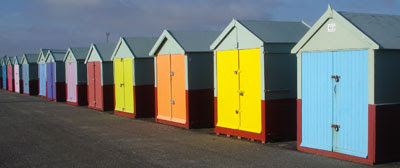
I took the first cheap train to Brighton, wandered down to the seafront (via North Laine and the Pavilion), then walked to the deserted end of thepier and back. I would have bought chips, except they were charging £2.50 per tray, and that's criminal. Then I turned to the west and walked for six miles to Shoreham-on-Sea. The first four miles were along the main promenade, which was surprisingly busy given that it was midweek midwinter. Past the Grand Hotel, past the skeletal remains of the WestPier (it's doomed, isn't it?), past shelters being used as somewhere to sleep. I slipped imperceptibly into Hove, Brighton's symbiotic neighbour, and admired its nearly-500 beachhuts. They're none too fancy, but most are painted a bright jaunty colour from the Dulux swatchbook, and the combined effect was relentlessly cheery. After Hove Lagoon, and the private terrace where Zoe and Norman live, the beachfront suddenly became hugely less desirable. A canal runs parallel to the coast for two miles, leaving a thin strip of land that's only wide enough for a road and umpteen port-related units. Lorries thundered up a private road, the air reeked of decay, and one single lonely dog was being taken for a walk on the pebbly foreshore. I'll tell you more about the Shoreham end of the walk, and Shoreham-by-Sea itself, tomorrow. In the meantime, sorry, I'm knackered, so you'll have to make do with 21 photographs to illustrate the day's walk instead. Ahh, beats work.
I wish they'd put interest rates up. They've been at 0.5% for ages, almost two years now. I know the general consensus is that rock-bottom interest rates are good for the economy, good for hard-working families and for good for Britain, but they're not good for me.
If you borrow money, low interest rates are great. You can borrow lots (assuming your bank will let you), then smile because borrowing costs you very little. If you have a mortgage you're on a winner, because the amount you have to pay back is at a record low. There are no scary financial outgoings when your mortgage payment's peanuts, month after month, year after year. You might even be able to pay off more than the minimum, with ease, so that your debt comes down even faster.
I'm not a borrower. I never racked up large debts through reckless credit card spending. I never stare greedily at some consumer durable I can't afford, then splash out for it anyway. I don't live beyond my means, and if that means not having the latest everything then fine, I'll cope. I see debt as something to avoid, not embrace. I realise that not everybody is like me.
I used to be a borrower. I took out a mortgage on a flat 20 years ago, back when interest rates were in double figures. It was at the limit of what the building society would allow back then, even though today it wouldn't buy a hovel. I paid back over the odds over the years, certainly relative to today's interest rate pittance. And eventually I paid the whole lot off, several years early, thanks to slowly-increasing salary and careful budgeting. I'm not a borrower any more.
I'm a saver now. I add money into the banking system rather than taking it away. At the end of the month I have cash left over, not a gaping financial chasm. It helps obviously not having kids, or a car, or a major drug habit, or an insatiable desire for Bang & Olufsen luxury appliances. I recognise I'm damned fortunate, and I may not be able to live like this forever, but long may it last. I'm a careful, thrifty, responsible member of our economic society. And I'm being shafted.
0.5% is a bloody awful interest rate for savers. Stick £10 in a savings account at 0.5% and by the end of the year you'll have fivepence extra. Even after eighteen years at that rate, your nestegg still won't have reached £11. Meanwhile inflation's currently running at 3.7%. On average that means a £10 kettle would cost £10.40 after one year, and more than £20 after eighteen. The current entrenched disparity between savings and prices means that savers are losing ground, fast.
I'm not earning as little as 0.5%, I'm not stupid. I've got my savings in accounts that pay cosy introductory bonuses, and I've set up reminders to nudge me when they're due to expire. But even these special offers aren't special compared to rates routinely offered in the past. Having money is no longer a licence to print money. The current economic climate favours those with large financial obligations, perverse as it may seem, because the price of debt has never been lower.
I wish they'd put interest rates up. I'm sorry if that would increase your mortgage, force you to default and leave you homeless. I'm sorry if consumer spending would plummet, manufacturing decline and the retail sector collapse. I'm sorry if skyrocketing debt would kick our teetering economy over the brink with dire repercussions for us all. But those of us with savings are already being exploited, eroded, relentlessly, big time. We've been prudent too long, why can't we be greedy for a change?
Somewhere pretty: The Pergola One thing I love about these random jaunts around London is that there's always somewhere I haven't been before, often that I wasn't even aware of until the random borough's name appeared. A locations that's somehow always been off my radar, or that I've seen mentioned but never really engaged with. The Pergola at Inverforth House is one such place. It's a beautiful spot, as it turns out, yet so incredibly easy to have overlooked. And it's all thanks to soap flakes and detergent.
William Lever, the 1st Viscount Leverhulme, was responsible for starting the grocery business that eventually became Unilever. His industrial base was around Port Sunlight in Merseyside, but he also wanted his own house in London. In 1904 he bought up a large family residence on the northern flank of Hampstead Heath, naming it Hill House. And then he set about remodelling the back garden, courtesy of Thomas Mawson the celebrated landscape gardener. Several extensive terraces were laid (using surplus earth from the tunnelling of the Northern line extension to Golders Green, no less). A new ornamental Hill Garden was constructed a short distance from the house. But there was a pesky public footpath inbetween, whose closure Leverhulme couldn't force, so instead he extended a small pergola across it. And extended, and extended, until the mammoth twisted walkway was the dominant feature hereabouts. It still is.
I approached the Hill Garden from the Golders Hill Park Café, which looked a delightful eaterie (but was in the London borough of Barnet so I'm not allowed to tell you about it). Footpaths led up onto the gated heath, where a series of wooded ascents felt somehow more like mid-Wales than north London. Apart from a few preoccupied dog walkers somewhere in the distance, I had the slopes pretty much to myself. And at the top of the hill, with only minor fanfare, was the entrance to the formerly secret garden. This was lovely enough even in January, with twisting contoured paths and a green lawn leading down to an ornamental pool. The latter had a cement mixer and orange cones at one end, which I'm guessing weren't part of the original plans, but added a little midwinter colour. My apologies to the snogging couple on an upper bench whose amorous activities I disturbed.
Then came steps up to the western end of the pergola (that's a shady pillared passageway entwined with woody plants, for non-horticulturalists). This one's elevated, apart from a single hilltop gate where a path heads out onto the Heath, and it's unexpectedly long. A series of classical columns led off along a red-tiled pavement, topped off by a lattice of timber beams. The structure's now old enough that the wisteria looks properly gnarled, if currently leafless. It all made for a charming Romanesque setting - and this was just the first section. A right-angled turn lay ahead, across the footbridge, where there was the clearest view of the house's formal gardens. It's all luxury flats now of course, but with the top of the raised walkway and outer garden still somehow open to full public access. The pergola meandered on and on to a final spiral staircase, interrupted occasionally by a dome or trellis in the roof overhead. I can confirm that the entire structure's Cassiopeia-shaped (now that I've seen it on Google maps) and that, if straightened out, the pergola would be as long as Canary Wharf tower is tall. A shame that Lord Leverhulme died shortly after it was completed - complications from pneumonia prematurely curtailed his pleasure.
Somewhere historic: Keats House A small house in Hampstead is responsible for one of Britain's most prolific outbursts of romantic poetry. John Keats moved in when Wentworth Place was almost new, in 1818, to lodge with his friend Charles Armitage Brown. They shared the semi-detached two-up two-down, relatively uneventfully, until the Brawne family moved in nextdoor the following year. John became increasingly smitten by eldest daughter Fanny, and she inspired a more amorous undertone to his output. Her and the nightingale which used to sing in the garden "...in some melodious plot of beechen green, and shadows numberless". Tuberculosis cut John's life short. He fell sick in 1820, setting up a bed in the downstairs parlour so that he could still view the house's garden. Doctors eventually suggested recuperation in warmer climes, so he sailed to Rome, thereby prematurely ending his burgeoning relationship with Fanny. Keats was only 25 when he died, in a villa on the Spanish Steps, but left behind a lyrical canon acclaimed to this day.
The two houses passed to actress Eliza Jane Chester in 1839, and she knocked down the intervening wall and added a conservatory alongside. It's this enlarged house that visitors get to see today, ninety years after it was first opened to the public. You can't miss it, it's in Keats Grove, appropriately right next to the local library. And it's owned not by Camden Council but the City of London, who own most of the adjacent Heath too. Five pounds paid to the nice ladies round the back will gain you entrance, and for as many subsequent visits as you fancy over the next year.
The gift shop and first rooms are in Fanny's house, and contain period furnishings as well as a glass case of Keatsobilia. Crossing the hallway then brings you to the poet's lodgings. One really nice touch is a portrait of Keats hung in the room where it was painted, with two replica chairs set out on the carpet in precisely the spot they appear in the painting. Very little of the original furniture survives - John was only here for 18 months, and few back then would have thought to conserve his landlord's fixtures and fittings. But you'll certainly absorb the atmosphere of the place, from the upper bedrooms to the cellar kitchen, brought to life by several laminated letters and poems left waiting for visitors to read. Take a look here for a virtual tour around the house, which hopefully will encourage you to see the place for real. And be aware that your annual ticket also allows you to attend a surprisingly varied selection of cultural events. Next Saturday they're reading Keats' epic "The Eve of St Agnes" (two days early), and the following weekend it's card games, dice and dominoes with tea and crumpets. Sounds charming. "Beauty is truth, truth beauty, – that is all ye know on earth, and all ye need to know." by tube: Hampstead by bus: 46, 268
Somewhere famous: Highgate Cemetery The only thing that brings international tourists to Archway station is a dead body. That of Karl Marx, to be precise, who was buried nearby in 1883. There's even a "Karl Marx Tea Rooms" halfway between the station and the cemetery, where an opportunistic pub attempts to relieve weary pilgrims of their cash. Karl's buried in the eastern half of Highgate Cemetery, accessible to respect-payers for £3, and also home to DouglasAdams, Jeremy Beadle and George Elliot. But this is just the overflow. The original interment area is the western cemetery, opened in 1839 on the slopes of Highgate. This was one of the Magnificent Seven cemeteries opened around the perimeter of early Victorian London for private burial, and its hillside location soon made it the destination of choice for wealthy corpses. So that's the half I visited. Sorry Karl, you'll have to wait for another time.
When a group of volunteers took over the upkeep of Highgate in the mid 1970s, the Western Cemetery was in a terrible state. Vaults had been desecrated, tree roots had damaged the stonework and the entire site had been overrun by vegetation. The Friends cleared things up, maintaining the site as "a social history museum in a nature reserve", and now allow visitors inside for guided tours. During the winter that's hourly at weekends, whereas during the rest of the year there's 2pm weekdays too. Make sure you arrive by five to rather than five past, otherwise you'll be locked outside the iron gates to wait for the next tour. Seven quid, brief health & safety spiel, and in you go.
The guides are great, or at least the bloke I went round with was. He stopped every minute or so to point out another grave, explain some Victorian symbolism or show us a historic document from his folder. The first grave past the colonnade, for example, belonged to horse-drawn coach entrepreneur James Selby (London to Brighton return in under eight hours), while halfway up the first path was Charles Cruft (who only ever owned cats, but earned fame by being manager of a dog biscuit company). The occasional monument has "danger"-stamped yellow tape wrapped round it, but most lurk in the evergreen undergrowth at perfectly safe angles. One single snowdrop had reached the budding stage on Selby's tomb, but our guide recommended early spring as the best time to see the woodland environment in all its glory.
There's only time on the one-hour tour to head up to the top of the cemetery and back. But the top of the cemetery is outstanding. An ancient cedar tree on the summit has been surrounded by a ring of sunken vaults, entered up an Egyptian avenue which looks it's straight out of an Indiana Jones film. Only the richest internees could afford a plot here in the Circle ofLebanon. One vault belongs to lesbian novelist Radclyffe Hall, marked by an eye-level plaque and some droopy, sodden, dying flowers. Up above is the cemetery's grandest memorial - the pyramid-topped mausoleum of Julius Beer. He was a Jewish German immigrant who bought up the Observer newspaper in a vain attempt to raise his standing in English society (a bit like a 19th century Robert Maxwell), but achieved dominance only after death. Our guide allowed us to peer through Beer's door at the marble angel and gold-leaf roof, as well as taking us inside the neighbouring catacombs to view a selection of decayed coffins.
The descent back to the entrance took us past a most unexpected intruder. When the cemetery owners were in financial trouble back in the 1960s they sold off three plots of land for housing. One of these was recently rebuilt upon in unapologetically futuristic style, so now there's a glass box with pointed fins overshadowing the Dissenters burial ground. Our guide sensibly offered no comment whatsoever on this architecturalinvasion (and neither will I, because the owner reads this blog), but the rest of the tour party were united in aghast condemnation. "How did that ever get planning permission?" "A bit close to Michael Faraday, isn't it?" "Would be perfectly lovely somewhere else, but not here." They might be dead right, but I bet the view from the living room is stunning. by tube: Archway by bus: C11
Somewhere sporty: Parliament Hill Lido Camden's not renowned for its sport. There are no major (nor even major-ish) football teams here. No important stadia are based within the borough boundaries. Even the 2012 Olympic cycling road race has been shamelessly diverted to run elsewhere. So it's swimming or nothing, most notbaly in the four outdoor swimming pools on Hampstead Heath. Three are up on the Heath proper - three bathing ponds which began their lives as reservoirs in the upper Fleet Valley. One's mixed, one's for men only and the other (the only screened by trees) is for cold-dipper ladies. The hardiest Hampstead souls swim here daily, whatever the water temperature, whereas others only turn up on sweatier summer days to parade in their swimwear. The fourth and final pool is a little more mainstream, and an integral part of the community since 1938. The Parliament Hill Lido.
The lido's one of three built around London at the same time, each to the same design. Victoria Park's is long gone, Brockwell Park's has been upgraded, and only Parliament Hill's looks much as it did. From outside that's a brutalist brick entrance plus a surrounding wall high enough to keep out all potential spectators. The pool itself is massive, measuring 60m by 27m (or roughly quarter of a professional football pitch). That's big enough to contain 2000 paying swimmers at the height of the season (including the paddling pool and the paved surrounds). But all still resolutely unheated. The water's been 4°C this past week, apparently, although that hasn't curtailed the lido's winter opening. I arrived just too late for admission on Saturday to find the entrance firmly shuttered off, almost as if the entire facility had been mothballed. But no, there were still flushed swimmers emerging from the changing rooms after a rapid shower and rubdown, and returning to the car park. Sooner them than me. But hurrah for the all-year, all-weather, open-to-all lido. by Overground: Gospel Oak by bus: C11
Camden's a rum mix. It stretches from bustling Holborn to the heights of Hampstead Heath. It includes cultured Bloomsbury and hip, youthful Camden Town. Its housing stock combines exclusive avenues with Modernist council blocks. Its MPs are called Frank and Glenda. And it's also somewhere I've written about a heck of a lot over the years, because it's one of my favourite boroughs. Here are six more reasons to visit.
Somewhere retail: Camden Markets Something about the Chalk Farm Road draws Europe's youth here in great numbers. It could be the music, what with famous venues like the Roundhouse along its length. It could be the canal, and the opportunity for a waterside slouch. But it's probably the endless succession of outlets selling edgy accessories and offbeat tat. Throw in a wok-load of sizzling ethnic food and you have the perfect post-adolescent mooch zone. Boots on, piercings tweaked, and let's go.
I pity the visitors who discover 'The Camden Market' a few yards north of the tube station and decide to spend all their money there. This is actually Buck Street Market, and its warren of 200 tightly-packed stalls is nothing special. Clothes and jewellery, mostly, plus alleyways narrow enough to persuade even the hardiest shopper to turn round and try somewhere else. The good stuff, relatively speaking, is all to the north of the canal. The renamed Camden Lock Village Market, for a start, hemmed in between the railway viaduct and the towpath. This was ravagedby fire three years ago and has since reopened in a more sanitised style, although at least this makes it easier to walk round. Bit of art for your bedsit wall, maybe? T-shirt splashed with comic character or witty slogan? Or perhaps one of those plastic shoulder bags I used to stuff with gym kit in the 1970s which are suddenly inexplicably trendy. One nice touch is the row of decapitated scooters overlooking the canal, used as somewhere to sit by folk who've just purchased a tray of food.
Camden Lock Market's the famous one. It started in 1974 as a temporary outlet on threatened land, and soon grew into the biggest Sunday attraction for miles. Nowadays it's busy most of the rest of the week too, courtesy of foreign visitors who don't need to skip college to attend. I was expecting crowded mayhem on my visit, but was pleasantly surprised how manageable the place was (Saturday in January? perfect timing). Plenty of space on the quayside, room to circulate on the upper walkway, and circulatory ease in the indoor market halls. Nothing here I felt I had to own, however. Most of the over-40s wandering around still had a trace of alternative youth about them, be that rocker hair, vintage jacket or clompy boots. They still need somewhere to buy Clash artwork and candles, and I guess I don't.
But it was the Stables Market which amazed me. I though Camden already had enough market space but seemingly not. Since I was last here this place has expanded to almost theme-park size, with fibreglasshorses and fake red phone boxes littered around a multi-level maze. Dig deep enough and there are antique stalls, even a second-hand bookstore. But most are here to browse for something they could wear, or carry, or poke through an available orifice. Retro-clothing's big, like those 2003 trainers you can't get any more, as well as accessories for every leftfield occasion. And food. The markets' entire economic model revolves around the fact that everyone stops for food eventually. If you yell hello at enough passers-by and wave a fork of indeterminate gloop in their face, they may just stop and give you cash for noodles. Incidentally "The Best Shop In The World" isn't - no shop that smells of incense could be in my book.
The Stables is probably as far north as most visitors dare to tread. Go much further and you reach Morrisons, which isn't really where the average beardyteen or mohawkgirl wants to end up. No need, there's plenty of room to hang out and be seen in the newly-expanded markets - or at least there is in mid-January. by tube: Camden Town, Chalk Farm
Somewhere random: Where Kenneth Williams lived I wonder how Kenneth Charles Williams would react to the news that his local council have set up a walking trail linking together his former homes. Desperately proud, yet simultaneously hideously embarrassed, I expect (but that's Camden for you, a borough so hip that the Mayordid a DJ setat the Barfly last night). Misunderstood egomaniac Kenneth grew up in the backstreets south of King's Cross, and carried on living there or thereabouts for the rest of his life despite moving house several times. He grew up in Cromer House - a brick tenement which would have been new at the time, and still looks far more appealing than the shiny glass apartments on the opposite side of Cromer Street. It's still a very residential area, though families have more than one room to themselves these days, and it's not quite the poverty-stricken backwater it was pre-war. KW's first school is round the corner - now Argyle Primary. It's very Edwardian, and five storeys high to cram in as many classrooms as possible in a restricted space. Kenneth's first public performance was from the roof, apparently.
The Williams clan later moved 'up in the world' to Marchmont Street, close to what's now the Brunswick Centre in Bloomsbury. Dad Charlie had bought the barber shop at number 57, so the family moved into the rooms above with Kenneth on the top floor. It's still a hairdressers today... but they do waxing, threading and male grooming, which wouldn't have been the Williams style at all. A blue plaque was unveiled above the shampoo-stacked window last autumn, with much pizazz, and with Nicholas Parsons amongst the invited guests. Kenneth's successful radio career enabled him to move out (circa 1956), returning first to Argyle Square and its environs, then further along the Euston Road towards Baker Street. From 1972 onwards he lived alone at 8 Marlborough House, Osnaburgh Street, close to the eastern edge of Regent's Park. There used to be a plaque here too, marking the flat where the manic depressive actor was found dead in 1988, but you won't find it today. The entire block's been knocked down as part of the Regent's Place development - a major landgrab for "office, retail and leisure space", almost but not yet fully complete. On the Osnaburgh Street side there's a new community theatre where a replacement commemorative plaque has been installed, but it's not one that many people will ever see. The entire 18 acre site looks uninspiring and bland, in my opinion, but I guess that's the way Central London's going. Kenneth wouldn't have been impressed, not bona at all. by tube: King's Cross St Pancras, Great Portland Street
Kenneth's south Camden stomping ground isn't an especially well known part of town, so I was relying on my special Camden map to guide me around. Mistake, because the map turned out to be a fairly useless way of working out where the hell I was going, even in conjunction with two pages of written instructions. I think that's because it's merely a snapshot of a guided walk which took place last October, led by actor David Benson. He's written about the walk here, and you can watch snippets in this YouTube summary. Looks informative, looked wryly amusing. There are several more 'Love Camden' walks here, and their associated videos here. Puts your council's website to shame, doesn't it?
There are only a handful of boroughs left to visit. At this stage it's almost like throwing a dice (which is, incidentally, how this whole thing began). Will it be out to the west, to inner Camden, densely-packed Hammersmith & Fulham or suburban Barnet? Or is it finally time to head to the far east, which my jamjar has been unbelievably reluctant to do over the last six years, to see the supposed delights of this side of town? Will I get to spend the day somewhere hip, happening and action-packed? Or will I be boring you next week with tales of attraction-lite outskirts where nothing happens? In midwinter London, these distinctions matter.
Once I've researched my randomly-chosen borough online I'll then head off and visit some of its most interesting places (assuming it has any). As usual I hope to visit somewhere famous, somewhere historic, somewhere pretty, somewhere retail, somewhere sporty and somewhere random. I might even take lots of photographs while I'm at it, if the borough's photogenic enough. Then after I've made my grand tour I'll come back tomorrow and tell you all about it. Let's see where I'm going this time...
Mmm, local Bow news: • The Olympic Marathon's still not coming to Bow, despite muchprotest. On a similar theme, but much smaller scale, one of London 2012's directors took his team for a jog around Bow last week. Past the Bromley-by-Bow Centre, along Roman Road and around Vicky Park, before returning down the Greenway to Three Mills. And he enjoyed running around Bow so much that he blogged about it, at length. Brilliant local stuff. And yet, in praising the wonderfulness of the area for running, simultaneously incredibly bloody tactless. • Keen-eyed viewers of Thursday's EastEnders will have spotted the platforms at Walford East making their very first on-screen appearance as Charlie Slater made his farewell from the series. Keen-eared viewers will have heard "The next station is Bow Road", which seemed finally to confirm the long-held understanding that fictional Walford East takes the place of Bromley-by-Bow on the District line. However, even keener-eyed viewers will have been disappointed to spot a Northern line train rolling into the platform. Alas it seems that all the scenes were filmed at East Finchley, umpteen miles away from E3. • TfL have finally got round to publishing the implementation programme for the installation of Cycle Superhighway 2 between Aldgate and Bow. Worryingly it appears they think they've finished the stretch between Mile End and Bow Road stations (apart from a replacement toucan crossing to be installed next month). Sorry, but if that intermittent unsafe blue strip is supposed to be be finished, then the project's a complete joke. Work from Campbell Road to the Bow Roundabout starts on March 10th (sheesh, for 66 days), and at the roundabout itself on March 29th (for 25). No details of these final two construction packages are yet available, but I hope they're a damned sight more practical than the last attempt. • DLR users between Bow Church and Stratford should be aware the railway will be shut next weekend, and the Sunday after, and the first two Sundays in March, and the following weekend, and the first Sunday in April, and the following weekend, and the whole of the Easter weekend, and the long May Day bank holiday weekend [full dates]. All of this is "due to Crossrail engineering works", more specifically construction of the Pudding Mill Lane Portal, so expect further regular closures between now and September 2013. In better news, Crossrail works will no longer require the diversion of two sewers in Wick Lane, meaning that Grove Hall Park will no longer need to be hijacked as as a construction site.
I think it's time I moaned again about the emails that pluggers and marketing types send me, invariably suggesting that I mention something specific on this blog. It's been six weeks since I last mentioned this, which means lots of fresh requests from hopeful corporate types have landed in my inbox. Sorry folks, it still ain't happening. So below are some of their latest desperate requests for publicity, but with all the brand names heartlessly deleted. I do hope it's damned frustrating for all those concerned.
Morning DG, Greetings from <reputable online luxury retailer> and a happy new year. Loving your work and wondering if you would consider a small commercial enterprise. Just thinking aloud but with the obvious cross fertilisation of our sites, thinking: would you like a sponsor? I’m thinking, small ‘FaceBook’ type advert 165 x 230 pixel top right of your blog, a product link with a commission payment to you against each sale. What do you think?
I think not, Clive. But thanks for not being too overtly disappointed when I said no.
Hi DG, I have noticed that you do a spot of property blogging and we are looking at expanding this area on our <investment web portal> which is growing rapidly in both consumer and financial related professional space. I was wondering if you would be interested in discussing blogging (and/or perhaps content) and we can help profile you/your services/site in return?
You noticed I do a spot of property blogging?!? Sorry Steven, but we must be on different planets.
Please let me introduce myself - my name is Kieron, I am one of the directors of <recently-launched website for foreigners moving to London>. The site is now looking for bloggers of any nationality with excellent written English who live in London and are prepared to write two or three blog entries a week of 300-500 words. The work is unpaid, and is a great way of getting your writing exposed on a regular basis on a growing website.
Good luck finding mugs to write you 1000 words a week for nothing, Kieron.
Hi - just getting in touch as I've a new episode of something called <Yawn> you might be interested in, starring <hip-hop non-entity> and <DJ Zero>. <Yawn> is a co-production between <energy drink> and <video website>, and is a six-part documentary series showcasing a selection of the most innovative and exciting producers in the world, working in the <Energy Drink> Studio London as their creative hub.
Excuse me, Rob, but you appear to have mistaken me for a vacuous moron half my age.
Hi, I am Lodelyn and I work for <international website>. I have placed a link to your interesting website on our quality link pages: http://www.<internationalwebsite>.com/links/other-web.html?page=7 In return we would like to kindly ask you to place a link on your organization’s website to let people know about <international website>.
Seeing as I don't merit a mention until page 7, Lodelyn, don't think I'm returning the 'favour'.
Hello, I'm contacting you from <blog/marketing service>, part of the <aggregator> group, because I think your blog (which I've personally selected - we're not robots!) would be suited to an advertising campaign we are currently working on. All you would need to do for this particular campaign is write an article for which we can pay you £40.00. All articles must include a "Sponsored post" disclaimer - we like the idea of transparency, and hope you do too.
If you've personally selected my blog, Chris, then you can't have been reading for long. Maybe some robots would hit the target more often.
So my message remains the same. If you're a social marketing guru who hasn't taken the hint yet, please stop sending me unsolicited promotional emails. It only makes you look desperate. Many thanks.

"Today this station close" read the scribbled message on the board outside Hammersmith station on Saturday. Not a phrase to raise hopes of high-level communicative ability in either of the two members of staff standing alongside. "Buses all stations to Paddington" said the printed text underneath, before explaining in small type "Not stopping at Wood Lane. Calling additionally at Shepherd's Bush." You had to get up pretty close to read that, which suggests that whoever designs these posters is using an undersized font.
Jubilee line replacement service C: Stonebridge Park → Stanmore
Every weekend, rail travel in the capital is blighted by "planned engineering works". We all know it's essential, but that doesn't make it any less bloody annoying. This weekend three entire Underground lines are closed, four others curtailed, and the DLR and Overground substantially buggered. TfL ran as many as ten rail replacement bus services yesterday, from Harrow in the west to Dagenham in the east. I thought I'd entirely waste my Saturday by travelling on every single one of them, from end to end, to see how dreadful the experience was. My rail replacement safari took me ten and a half hours, so I think you can guess how much fun it wasn't. But hopefully I've learned some useful lessons along the way, which you (or maybe TfL) should take to heart.
DLR replacement service B: Beckton → Canary Wharf
Shoreham Port: Shoreham-by-Sea's most important feature isn't the sea, it's the river. The Adur flows down from West Sussex and very nearly reaches the sea, then thinks better of it. A shingle spit has grown up over the years, diverting the mouth of the river about a mile to the east, and creating a haven behind in the process. The old town's not so much Shoreham-by-Sea as Shoreham-by-Harbour, with the English Channel completely blocked from sight by two long flaps of land. On one arm people live, on the other nobody with any sense would even set up a tent. Shoreham's a freight port, for the unloading of timber, steel, aggregates and lots of other dull but necessary things. It's not a place of beauty, not unless you happen to like power stations. There's one here because 100 years ago the people of Brighton didn't want it on their doorstep, but the current incumbent has a huge belching chimney easily visible from afar. It's totally unavoidable from underneath, which made it all the more surprising to find numerous people gathered here on a Wednesday. They'd come for Carats Café Bar, which is a squat concrete hut serving coffee and fry-ups, a mile and a half by road from the nearest civilisation. But not so far for bacon-munchers on foot. A twisting path runs through the docks across two lock gates, which makes for easy access so long as the red lights aren't flashing. They flashed for me, and I had to hang around while some piddly pilot boat rose up through a lock large enough for a far bigger craft.
Shoreham Beach: Residential Shoreham's in two halves - those who live on the mainland proper, and those who live on the spit named Shoreham Beach. This isolated tongue of land used to be home to a haphazard collection of shacks named Bungalow Town, and was also where the UK film industry had its earliest home. Postwar the area was cleared for proper housing (for which read characterless flats and bungalows) assisted by a concrete footbridge across the Adur. It's ridiculously narrow, by modern standards, so if two pushchairs meet in the middle the entire community seizes up (I caused significant problems merely by stopping to take a photograph). A replacement cyclebridge is currently at the planning stage, but there's no news yet as to whether it'll have the same claustrophobic character as its predecessor. I'm told that Chris Evans lives somewhere on Shoreham Beach, so there must be an upmarket nice bit I didn't find. But I did, accidentally, stumble up a footpath to one of the most unusual streets in Britain. All 40 of the dwellings along Riverbank are houseboats. And not minor tedious houseboats, but a motley collection of large bohemian craft. There's a massive grey minesweeper at number 23, for example, with its prow sticking out into the footpath. A few doors up is an astonishing hybrid of passenger ferry and passenger coach dressed up as psychedelic artwork. The windows at the front look like yellow teardrops, and are definitely large enough for the owners to see out at annoying Londoners with cameras lingering slightly too long on the towpath. If you come for a peek, try to make it look as if you're desperately impressed, but just passing.
Shoreham Airport: The oldest licensed airfield in the UK celebrates its 100th anniversary this summer. And it's in Shoreham. It started out in 1911 as a few monoplanes on a meadow, and grew through military and eventually commercial success. Shoreham's location by the Channel was both a blessing and a curse - ideally placed for European flights, but also highly vulnerable to wartime attack. A symbol of its prosperity was the Art Deco terminal building, opened in 1936, and which still stands out across the surrounding countryside. Bold lines and smooth curves, painted creamy off-white, as an echo of the Golden Age of air travel. It's the sort of place ITV would film an episode of Poirot, and indeed have, no doubt keeping the surrounding industrial estate well out of shot. Heathrow Terminal 5 this most definitely is not. There are no commercial flights here any more, for a start. Scheduled services to Alderney ended three years ago, and to northern France more recently than that. The lifeblood of Shoreham (Brighton City) Airport today are the private flyers in small planes, nipping in from wherever then heading home again. The airfield was alive during my visit, quite possibly with millionaire pilots enjoying the good weather. There's also a helicopter school on site (with their very own "Danger low flying helicopter" roadsign, seemingly justified). Suddenly it's easy to understand why Chris Evans might live nearby - it's not the sea that attracted him to Shoreham but the air. For us mere tourists, the Airport boasts a visitor centre and museum, alas only open at weekends. The old terminal building's open for a poke around daily, as is the restaurant, but I didn't realise this at the time so failed to go inside. I'm preprogrammed to think of airport terminal buildings as threatening security-conscious places, and nothing outside gave any indication that mere spectators or gastronomes might be welcome within. You need not be so air-brained.
William Lever, the 1st Viscount Leverhulme, was responsible for starting the grocery business that eventually became Unilever. His industrial base was around Port Sunlight in Merseyside, but he also wanted his own house in London. In 1904 he bought up a large family residence on the northern flank of Hampstead Heath, naming it Hill House. And then he set about remodelling the back garden, courtesy of Thomas Mawson the celebrated landscape gardener. Several extensive terraces were laid (using surplus earth from the tunnelling of the Northern line extension to Golders Green, no less). A new ornamental Hill Garden was constructed a short distance from the house. But there was a pesky public footpath inbetween, whose closure Leverhulme couldn't force, so instead he extended a small pergola across it. And extended, and extended, until the mammoth twisted walkway was the dominant feature hereabouts. It still is.
Then came steps up to the western end of the pergola (that's a shady pillared passageway entwined with woody plants, for non-horticulturalists). This one's elevated, apart from a single hilltop gate where a path heads out onto the Heath, and it's unexpectedly long. A series of classical columns led off along a red-tiled pavement, topped off by a lattice of timber beams. The structure's now old enough that the wisteria looks properly gnarled, if currently leafless. It all made for a charming Romanesque setting - and this was just the first section. A right-angled turn lay ahead, across the footbridge, where there was the clearest view of the house's formal gardens. It's all luxury flats now of course, but with the top of the raised walkway and outer garden still somehow open to full public access. The pergola meandered on and on to a final spiral staircase, interrupted occasionally by a dome or trellis in the roof overhead. I can confirm that the entire structure's Cassiopeia-shaped (now that I've seen it on Google maps) and that, if straightened out, the pergola would be as long as Canary Wharf tower is tall. A shame that Lord Leverhulme died shortly after it was completed - complications from pneumonia prematurely curtailed his pleasure.
A small house in Hampstead is responsible for one of Britain's most prolific outbursts of romantic poetry. John Keats moved in when Wentworth Place was almost new, in 1818, to lodge with his friend Charles Armitage Brown. They shared the semi-detached two-up two-down, relatively uneventfully, until the Brawne family moved in nextdoor the following year. John became increasingly smitten by eldest daughter Fanny, and she inspired a more amorous undertone to his output. Her and the nightingale which used to sing in the garden "...in some melodious plot of beechen green, and shadows numberless". Tuberculosis cut John's life short. He fell sick in 1820, setting up a bed in the downstairs parlour so that he could still view the house's garden. Doctors eventually suggested recuperation in warmer climes, so he sailed to Rome, thereby prematurely ending his burgeoning relationship with Fanny. Keats was only 25 when he died, in a villa on the Spanish Steps, but left behind a lyrical canon acclaimed to this day.
The two houses passed to actress Eliza Jane Chester in 1839, and she knocked down the intervening wall and added a conservatory alongside. It's this enlarged house that visitors get to see today, ninety years after it was first opened to the public. You can't miss it, it's in Keats Grove, appropriately right next to the local library. And it's owned not by Camden Council but the City of London, who own most of the adjacent Heath too. Five pounds paid to the nice ladies round the back will gain you entrance, and for as many subsequent visits as you fancy over the next year.
The only thing that brings international tourists to Archway station is a dead body. That of Karl Marx, to be precise, who was buried nearby in 1883. There's even a "Karl Marx Tea Rooms" halfway between the station and the cemetery, where an opportunistic pub attempts to relieve weary pilgrims of their cash. Karl's buried in the eastern half of Highgate Cemetery, accessible to respect-payers for £3, and also home to Douglas Adams, Jeremy Beadle and George Elliot. But this is just the overflow. The original interment area is the western cemetery, opened in 1839 on the slopes of Highgate. This was one of the Magnificent Seven cemeteries opened around the perimeter of early Victorian London for private burial, and its hillside location soon made it the destination of choice for wealthy corpses. So that's the half I visited. Sorry Karl, you'll have to wait for another time.
There's only time on the one-hour tour to head up to the top of the cemetery and back. But the top of the cemetery is outstanding. An ancient cedar tree on the summit has been surrounded by a ring of sunken vaults, entered up an Egyptian avenue which looks it's straight out of an Indiana Jones film. Only the richest internees could afford a plot here in the Circle of Lebanon. One vault belongs to lesbian novelist Radclyffe Hall, marked by an eye-level plaque and some droopy, sodden, dying flowers. Up above is the cemetery's grandest memorial - the pyramid-topped mausoleum of Julius Beer. He was a Jewish German immigrant who bought up the Observer newspaper in a vain attempt to raise his standing in English society (a bit like a 19th century Robert Maxwell), but achieved dominance only after death. Our guide allowed us to peer through Beer's door at the marble angel and gold-leaf roof, as well as taking us inside the neighbouring catacombs to view a selection of decayed coffins.
Camden's not renowned for its sport. There are no major (nor even major-ish) football teams here. No important stadia are based within the borough boundaries. Even the 2012 Olympic cycling road race has been shamelessly diverted to run elsewhere. So it's swimming or nothing, most notbaly in the four outdoor swimming pools on Hampstead Heath. Three are up on the Heath proper - three bathing ponds which began their lives as reservoirs in the upper Fleet Valley. One's mixed, one's for men only and the other (the only screened by trees) is for cold-dipper ladies. The hardiest Hampstead souls swim here daily, whatever the water temperature, whereas others only turn up on sweatier summer days to parade in their swimwear. The fourth and final pool is a little more mainstream, and an integral part of the community since 1938. The Parliament Hill Lido.
I pity the visitors who discover 'The Camden Market' a few yards north of the tube station and decide to spend all their money there. This is actually Buck Street Market, and its warren of 200 tightly-packed stalls is nothing special. Clothes and jewellery, mostly, plus alleyways narrow enough to persuade even the hardiest shopper to turn round and try somewhere else. The good stuff, relatively speaking, is all to the north of the canal. The renamed Camden Lock Village Market, for a start, hemmed in between the railway viaduct and the towpath. This was ravaged by fire three years ago and has since reopened in a more sanitised style, although at least this makes it easier to walk round. Bit of art for your bedsit wall, maybe? T-shirt splashed with comic character or witty slogan? Or perhaps one of those plastic shoulder bags I used to stuff with gym kit in the 1970s which are suddenly inexplicably trendy. One nice touch is the row of decapitated scooters overlooking the canal, used as somewhere to sit by folk who've just purchased a tray of food.
I wonder how Kenneth Charles Williams would react to the news that his local council have set up a walking trail linking together his former homes. Desperately proud, yet simultaneously hideously embarrassed, I expect (but that's Camden for you, a borough so hip that the Mayor did a DJ set at the Barfly last night). Misunderstood egomaniac Kenneth grew up in the backstreets south of King's Cross, and carried on living there or thereabouts for the rest of his life despite moving house several times. He grew up in Cromer House - a brick tenement which would have been new at the time, and still looks far more appealing than the shiny glass apartments on the opposite side of Cromer Street. It's still a very residential area, though families have more than one room to themselves these days, and it's not quite the poverty-stricken backwater it was pre-war. KW's first school is round the corner - now Argyle Primary. It's very Edwardian, and five storeys high to cram in as many classrooms as possible in a restricted space. Kenneth's first public performance was from the roof, apparently.
The Williams clan later moved 'up in the world' to Marchmont Street, close to what's now the Brunswick Centre in Bloomsbury. Dad Charlie had bought the barber shop at number 57, so the family moved into the rooms above with Kenneth on the top floor. It's still a hairdressers today... but they do waxing, threading and male grooming, which wouldn't have been the Williams style at all. A blue plaque was unveiled above the shampoo-stacked window last autumn, with much pizazz, and with Nicholas Parsons amongst the invited guests. Kenneth's successful radio career enabled him to move out (circa 1956), returning first to Argyle Square and its environs, then further along the Euston Road towards Baker Street. From 1972 onwards he lived alone at 8 Marlborough House, Osnaburgh Street, close to the eastern edge of Regent's Park. There used to be a plaque here too, marking the flat where the manic depressive actor was found dead in 1988, but you won't find it today. The entire block's been knocked down as part of the Regent's Place development - a major landgrab for "office, retail and leisure space", almost but not yet fully complete. On the Osnaburgh Street side there's a new community theatre where a replacement commemorative plaque has been installed, but it's not one that many people will ever see. The entire 18 acre site looks uninspiring and bland, in my opinion, but I guess that's the way Central London's going. Kenneth wouldn't have been impressed, not bona at all.
Random borough (28): Time yet again for me to take another random trip to one of London's 33 boroughs. As I write I have no idea which one of the six remaining borough names will be revealed when I unfold the slip of paper I'm about to pick from my legendary "special jamjar". I just know it won't be Merton, Islington, Enfield, Sutton, Lewisham, Southwark, Kensington & Chelsea, Hackney, Hillingdon, the City, Bromley, Lambeth, Tower Hamlets, Haringey, Hounslow, Brent, Redbridge, Ealing, Harrow, Croydon, Waltham Forest, Wandsworth, Greenwich, Richmond, Kingston, Westminster or Newham because they're the twenty-seven (dark grey) boroughs I've picked out already.