Overground quiz (2)The longest journey
For today's quiz, we're looking for the longest journey on the Overground.
That's the longest route that doesn't go anywhere twice.
What's the maximum number of different stations you can visit without leaving the network?
You'll want a map for this, and I recommend the London Overground network map here(pdf).
Clarification 1: We're counting stations, not distance or time. Clarification 2: You may only visit each station once. Clarification 3: Only lines and interchanges shown on the Overground map are acceptable. Clarification 4: The only two out-of station interchanges shown are Hackney Downs - Hackney Central and Walthamstow Queen's Road - Walthamstow Central. Example 1: Richmond to Euston would be 11 stations. Example 2: Seven Sisters to Stratford would be 9 stations.
So, how many different Overground stations can you travel through?
Orangewatch (2)Old Oak Common
London's largest development site covers the railwaylands of Old Oak Common at the northern tip of the borough of Hammersmith and Fulham. Hundreds of acres of sidings, sheds, tracks and low-rise industrial units are in line to be transformed into 25000 homes and 65000 jobs, in a flood of rebuilding unseen since the Olympic revolution at Stratford. Although numerous railway lines pass through this redevelopment zone none of them currently stop, but the intention is that some of them will, and big time. [map1][map2][map3]
The Great Western mainline sails straight through, on a four-mile non-stop run between Paddington and Acton, but it's planned that Crossrail will eventually get a station here, say by 2026. HS2 is due to stop here too, right alongside, at a megahub that'll be the only station between London and Birmingham. The Central line nudges the edge of Old Oak Common, but its two Acton stations aren't quite convenient. And that leaves the Overground which, bingo, passes through on two different lines, just to the south of Willesden Junction. And that's why there's currently a consultation underway regarding two new Overground stations within the Old Oak Common development zone, which might just open up within the next ten years. [consultation]
New station 1: Old Oak Common
The first new Overground station would be on the line south from Willesden Junction towards Richmond, about half a mile from the former, alongside Old Oak Common Lane. If TfL get their way it'll look like this.
I went down at the weekend, and can confirm that currently it looks nothing like. Old Oak Common Lane is drab road raised higher than its surroundings, with the Overground on one side and an utter sprawl of railway sidings on the other. If you like railways, there are places round here you can look out and believe London is covered by nothing else. Part of what's down below is GWR's Old Oak Common Depot, another part is where the Heathrow Express marshals its stock, and a significant proportion is going to be home to one of Crossrail's largest train depots. The first batch of new housing will be going in alongside, but oh how much more they could have built if only storing trains wasn't such an uneconomic waste of space.
A couple of car maintenance sheds survive on Old Oak Common Lane, plus some vacant warehouse units, but the adjacent prefab-style greasy spoon has closed. A little up the road is London's first collective block for millennial "co-living", where your room may be tiny but there's a gym, spa and cinema downstairs for an all-inclusive rent. Across the tracks is a small enclave of private housing, somewhat adrift at present, but which may gain an overpass into the new station if built. And further down the road an Edwardian housing estate begins, at the tip of Acton, with posters in windows protesting against the havoc ten years of HS2 construction will bring. These homes will be the 'lucky' recipients of a brand new Overground station on their doorstep, but it isn't for them, it's for the newcomers who will pack out the matchboxes nearby.
If you'd been here yesterday afternoon, or on Saturday, you could have spoken with the Overground project team as part of the official consultation process. Or perhaps you could. The location was The Nadi Park Royal, a Muslim community centre in a former office unit, immediately opposite where the new station's due to go. But there was nothing outside to say a consultation was happening within, and nothing obviously welcoming beyond a closed door, just perhaps some relieved staff sitting beside a plate of uneaten biscuits. I could have tried a little harder to check, but the lack of any signs deterred me, as perhaps was this box-ticking exercise's intention.
New station 2: Hythe Road
The second new station would be on the line south from Willesden Junction towards Clapham Junction, about quarter of a mile from the former, indeed barely any distance at all. It's two miles down to Shepherd's Bush where trains next stop, but none of the existing residents along this hiatus will ever get a new station because they're poor, and the Evening Standard Homes & Property section is not for them.
It's not often I visit a new location and go "Wow, I never knew this was here!" but Hythe Road was one of these. I'd seen the site from the Grand Union Canal towpath, seemingly yet another run of rundown warehouses, but never crossed the footbridge, or thought to follow the uninviting subway from Scrubs Lane under the railway. What greeted me here was a huge trading estate given over mostly to just one commodity - used cars. Cavernous sheds to left and right contain thousands of ready-to-buy vehicles, divided into separate buildings by make, with further cars out front for your perusal. All the poshest cars are indoors, whereas most of the hatchbacks get wet. And it goes on, and on, and on.
This is the Car Giant site, a company who've realised they're sitting on an expanse of land with 'goldmine' potential, and have been hoping to do a deal with housing developers and/or a local football club for years. They'll succeed, but in the meantime London's would-be car owners, and those from the Home Counties, turn up in droves in search of an elusive four-wheeled bargain. They walk round endless windscreens, they peer through an eternity of side windows, they drag their unwilling children along for the ride, and they might even stop off at the Giants Diner for a meal afterwards. I have no idea where 10000+ cars will go once the business closes, but it seems lowbrow commercial activity no longer has any place in Inner London.
The actual site of the proposed station is on the other side of the railway embankment, on what's now Salter Street. The units here once housed Mallandian Corrugated Containers Ltd and the High Frequency Heat Treatment Co, amongst others, but are now fenced off and watched over by guard dogs and a security bloke in a lonely cabin. Across the road is the Triangle Trading Estate, still up and running, but a million miles away from the swish towers and boulevards that'll one day wipe the lot away. The whole area reminded me very much of the Lower Lea Valley before the Olympics came, and in the same way I'm pleased I've seen the place before the whirlwind descends.
A hemmed-in alleyway follows the railway embankment north around the back of a metal recyclers and various other future undesirables. Steps then lead up to a precipitous footbridge which crosses seven railway tracks, including the West Coast mainline, and emerges via an almost-hidden entrance near the back of Willesden Junction station. It's not a pleasant walk, but short enough that the idea of building a new station at Hythe Road looks ludicrous, except to boost house prices. But factor in a five minute walk from Hythe Road to one end of the HS2 station, and ten minutes to the proposed Crossrail platforms, and you can start to see the point. Neither of these two proposed Overground stations are going to be particularly convenient for future interchange, alas, but they'll be a lot better than building nothing at all.
Overground quiz (1)Name that station
Without looking on a map, can you name...
1)2)3)4) The northernmost, easternmost, southernmost and westernmost Overground stations? 5)6)7)8) The four Overground stations in Zone 1? 9) The first Overground station in an alphabetical list? (it's in west London and starts with 'A') 10) The last Overground station in an alphabetical list? (it's in east London and starts with 'W')
Answers are in the comments box, so have a good think before you peek.
And that should give you a score out of 10. Do tell us how you get on.
Orangewatch (1)Ghost train to Battersea Park
London has a secret Overground station, rarely served, and the destination of no more than one train a day. What's more it doesn't appear on diagrams in carriages, nor on anymaps, unless you happen to look at the digital version of one particular timetable and there it is, the connecting track shown with 'Limited service'.
Battersea Park used to be the penultimate stop on South London Line services from London Bridge to Victoria, but these were discontinued in 2012 when the Overground took over and diverted trains to Clapham Junction instead. But the connecting spur still needs to be kept open, and drivers still need to know how to use it, so a parliamentary train service is run very early in the morning and late at night.
Dalston Jn → Battersea Park
Battersea Park → Dalston Jn
Mon-Fri
2206 → 2244
0618 → 0658
2303 → 2345
Sat
(no service)
Sun
0722 → 0813 (to H&I)
I went to ride the only Overground train to Battersea Park, and chose a Friday night to provide a little added frisson.
First up, yes, I can confirm that the final destination is made plain right at the start. It reads Battersea Park on the Next Train Indicator, it says Battersea Park in the announcements, and it states Battersea Park on the displays in the train. Most people at Dalston Junction aren't travelling nearly that far, so would hop on a southbound train whatever it said on the front, but some passengers give the destination a second look. One particular bloke with a bike makes a point of watching the platform display scroll round until he's certain the train will be stopping at Peckham Rye, and only then lugs his wheels on board.
Overground trains via Shoreditch on a Friday night are full of post-drinkers and pre-revellers, resplendent in all the latest on-trend woolly hats and pristine trainers. One has a cased instrument which doesn't quite look like a guitar, one is unwrapping a bouquet of flowers marked with a Reduced sticker, and three are having a loud conversation "so he used to be so like..." etc etc ad nauseam. A smart young lady boards with a large cardboard box full of designer homewares which she plops down on the seat beside me, then drops onto the carriage floor when she stumbles as she disembarks. A bearded youth with a nose piercing wraps the arm of his corduroy jacket around his girlfriend's shoulder and gets a button caught in her hair, which takes until the next station to untangle. All millennial life is here.
At Canada Water it starts to matter that the train's destination is unfamiliar, as lines are soon to divide. The last person to slip through the doors before they close stares agitatedly at the scrolling display, uncertain they're on the correct train, because there are absolutely no clues on board where 'Battersea Park' might be, nor where the train will be stopping on the way. I'm expecting the driver to pipe in and say something at Surrey Quays, but he doesn't, so the recorded announcement that "the next station is Queen's Road Peckham" will have to suffice. At least one passenger near me, a woman in a Hakuna Matata hat, will dash off pretty smartish when we get there having accidentally taken the wrong branch.
The train empties considerably at Peckham Rye, and even more so at Denmark Hill, now down to approximately 30 of us across five carriages. Anybody boarding at Clapham High Street - and there are only two - must only want to go a couple of stops and not to the usual destination of Clapham Junction, because we're not going there. Indeed the Battersea Park ghost train introduces a half hour gap in normal services, which is going to be bad news for anyone waiting at Clapham Junction for a train back the other way.
At Wandsworth Road, the last stop before our train heads off the unusual way, only ten other passengers are still on board. Surely, I think, surely the driver will say something now. He doesn't, relying instead on passengers to make a logical deduction from the automated announcements "this is the train to Battersea Park" and "the next stop is Battersea Park".
I'd like to be able to tell you all about the unique stretch of line this Overground train now takes, slipping off the usual path to rise up and across, but I can't because it was dark outside. I did enjoy a close up view of a train depot, then a bus garage, before passing directly over the platforms at Queenstown Road, but that's my limit. Before 2012 this was the normal line, of course, so you may well have ridden it many times. Indeed what's now the usual Overground route was previously the line taken only by the daily parliamentary train, which goes to show how much 'normal' can change.
At last, one minute from our destination, the driver finally chips in and tells us what's going on. We get all the usual 'this train terminates here' and 'please check your belongings' stuff, plus an additional fact which helps explain why TfL have chosen not to put Battersea Park on the map. It doesn't matter if you caught this train by mistake when you were intending to go to Clapham Junction because another train heading there will be along very soon. Your saviour is the 2247 to Tattenham Corner, which will be departing the adjacent platform in two minutes, and most of those who've just arrived switch across to wait for that.
I join the oddments heading downstairs to exit the station, having deliberately caught the only train of the day to somewhere I actually wanted to go. The pubs and kebabberies of Battersea are in full flow. Meanwhile the driver switches ends ready for the return trip twenty minutes later, in case anyone might want to catch a barely-advertised train late at night from a station it normally doesn't depart from.
When I return to ride home I have the ghost train entirely to myself, as befits its status, at least as far as the first stop where the first bantering twenty-somethings start dribbling in. They have no idea they're on a special train, because in this direction it no longer matters, and business swiftly returns to normal. Only the driver and I know we're aboard something a little bit special, the parliamentary service from Battersea Park, the Overground's unmapped station, and long may it stay that way.
Orbitalgeek (1)Names of lines
We'd better start with this one. When the Overground started there were only three lines, each the same shade of orange, and without any individual identity. As further lines have been added they too have been added to the pool of tangerine spaghetti, and no attempt has been made to give each line a snappy branding of its own. But names are still required, for example on maps or to explain which lines are closed for engineering works this weekend, which leads to over-complicated messes like this.
According to TfL's London Overground webpage, the six lines are called the following:
• Richmond/Clapham Junction to Stratford
• Watford Junction to Euston
• Gospel Oak to Barking
• Highbury & Islington to West Croydon/Clapham Junction
• Liverpool Street to Enfield Town, Cheshunt (via Seven Sisters) and Chingford
• Romford to Upminster
But naming lines after their extremities isn't great, and gets really complicated when there are several branches (as the ridiculous name for the lines out of Liverpool Street makes clear). So should we, and can we, do better? Add your suggestions to the comments boxes below (or, if you have some overall thoughts or suggestions, add them to the usual comments box at the foot of this post).
• Richmond/Clapham Junction to Stratford: North London Line, Line 1, North London Link, Outer Circle North, Regency Line, Nellie comments:
• Watford Junction to Euston: Watford DC Line, Line 2, Watford Line, Northwest Line, Harlequin, Premier, Watston, Wat-Eus, Waterloo, Watford stopper, the Stopper, Bloody Slow Line comments:
• Gospel Oak to Barking: Goblin, Line 3comments:
• Highbury & Islington to West Croydon/Clapham Junction: East London Line, Line 4, Brunel, Outer Circle South, South East London Line, Sellie, Hipster comments:
• Liverpool Street to Enfield Town, Cheshunt and Chingford: Lea Valley Lines, Line 5, Enfield/Chingford, Hackney Lines, Jazzcomments:
• Romford to Upminster: Romford Push and Pull, Line 6, Havering Shuttle, Rominster, Upford, Emerson Line, Emerson Air Linecomments:
Or collectively, e.g. A/B/C/D/E/F, 1/2/3/4/5/6, N/W/B/E/L/U, N1/N2/W/B/E1/E2/E3/E4/L1/L2/L3/U
For several years this blog went totallytubular every autumn with one week's posts entirely devoted to the London Underground. This year I'm going to do the same but for the LondonOverground, in celebration of the orange network's 10th anniversary (which is coming up later this week). It was on Sunday 11th November 2007 that TfL took control of the first routes from Silverlink, and since then the franchise has grown into an outer orbital network the capital can't survive without. Prepare for five days of quizzes, quirks, commentary and obscure statistics, plus reportage on how things are going out there, ten years on. Thank you for travelling with London Overground. Please wait for further announcements.
2♣ City of Westminster Aha, it's my penultimate Inner London playing card, representing one of the most historic quarters of the capital. Before 1965 the City of Westminster only stretched up from the Thames to Oxford Street, not as far as Paddington or Marylebone. It also contains more public statues than any other district in Britain, so that's what I've been out hunting for, with the help of this usefully comprehensive Wikipedia list. There are dozens, but I've picked 10, each with a story behind them. [map]
Erecting a statue to a controversial wartime figure was never going to be popular. Air Chief Marshal Sir Arthur Harris believed in carpet-bombing cities, rather than picking specific strategic targets, so was directly responsible for the deaths of innumerable German civilians. Supporters were convinced the nation owed him "an immense debt", so in 1992 erected a statue outside St Clement Danes in the Strand, the RAF Church, and invited the Queen Mother along to unveil it. Numerous jeering protesters came too, yelling their distaste, and for several years the memorial was attacked by vandals. It looks pristine today, possibly because more people see Harris as a hero than a criminal, but more probably because most Britons have forgotten what he actually did.
Pioneering electromagnetist Michael Faraday was born near Elephant and Castle, but his statue is on the north bank of the Thames below the flank of Waterloo Bridge. It's here because of the building immediately behind, the headquarters of the Institution of Engineering and Technology (and which was home to the BBC's very first radio studios in 1923). The statue is a cast of the marble original from the Royal Institution, and stands within a small immaculately kept garden at the foot of Savoy Hill. The ring in Faraday's left hand is an induction coil, should you ever want to impress a passer-by.
You might expect the Merry Monarch to have a more impressive commemoration that this - a heavily eroded statue in the middle of a path in a lacklustre West End square. But in the 1680s Soho Square was one of the newest and most dazzling public spaces in London, and Charles'sstatue was placed right at the centre, on a pedestal above the basin of an ornate fountain. Tastes change, and Portland stone decays, so in Victorian times the statue was sold off to a private home in Harrow to make way for a timbered gardeners' hut. At Grimsdyke it decayed further, losing both arms, until WS Gilbert's wife sent it back to Soho Square in 1938 and a partial restoration took place. Alas Charles's face now looks more like a mask, his wig remains heavily corroded, and the hut still takes central precedence.
Normally Westminster council insist you've been dead for ten years before you're allowed a statue, but they made an exception for RonaldReagan in the hope that Margaret Thatcher would still be alive to unveil it. She was, as it turned out, but at that stage so frail that William Hague had to do the job instead. The first 'Hollywood' president seems an unlikely candidate for a prime spot in front of the US Embassy but, as the extensive name-dropping text on the memorial makes clear, it seems Ronald ended the Cold War pretty much single handed. After six years it's now impossible to see the plinth on which he stands, thanks to fast-growing shrubbery, and very soon he'll be abandoned altogether when embassy staff move across the river to Nine Elms.
The only statue of a Briton in Belgrave Square is that of Robert Grosvenor, the landowner whose tenure of Belgravia has made his descendants exceptionally rich. Given the number of embassies based in the grand stucco terraces around the perimeter, this foreign twist is most appropriate. The central private garden boasts statues of famous Hispanic personages at its corners, assuming you reckon José de San Martín and Prince Henry the Navigator are famous, some located in publicly accessible indentations, others safely behind the railings. Columbus was a 500th anniversary gift from the Spanish Embassy across the road, waving a bronze scroll in the general direction of the Americas, and with an entirely unconfirmed birth date carved into the pedestal below.
Where did music's greatest genius write his first symphony? In a terraced house at 180 Ebury Street, just off Pimlico Road, during the summer of 1764. Eight year-old Wolfgang was in England for a year as part of a prodigious Grand Tour, playing for royalty and the nobility, with lodgings in Soho until a family illness required relocating to the country. For seven weeks the Mozarts stayed with a doctor in the then-village of Chelsea, and because noisy piano practice was discouraged Wolfgang spent much of his time composing instead. The statue depicts him standing on a sheaf of manuscripts with a violin on his shoulder, and is regularly swallowed up by the Pimlico Farmers' Market every Saturday morning. The house still stands, and is marked by a non-blue plaque.
A quiet stretch of parkland by the Thames, opposite Nine Elms, is an odd place to find a statue of a Liverpool MP. Odder still that he's dressed in classical style, in toga and sandals and with chest exposed, but that's how some 19th century bereaved wives liked to remember their husbands. Huskisson ought to be best known as President of the Board of Trade, but instead is infamous as the first ever casualty of the railways. Stephenson's Rocket ran over his leg at the opening of the Liverpool and Manchester Railway in a freak accident, mainly because nobody yet realised how dangerous locomotives could be, and he died from loss of blood a few hours later. At least in Pimlico he has all his limbs intact, gazing out over a silent lawn in track-free isolation.
One of the first London celebrities, in the almost modern sense, George Brummell made his mark by being sartorially scrupulous. Rising from the middle class through education, then sheer force of personality, Brummell soon came to the attention of the Prince Regent and they became firm friends. He eschewed ornate clothing in favour of well-tailored simplicity, popularising the wearing of suits with neckties, and often spent five hours grooming in the morning to make sure he looked just-so. His come-uppance came through gambling, and the former dandy ended his days penniless in a French asylum. Today's Jermyn Street tailors prefer to remember him in bronze as the ultimate dapper clotheshorse - "To be truly elegant one should not be noticed".
There are ridiculously few statues of women in Westminster, especially those with no connection to royalty, and even this one was an afterthought. Originally only the Guards Memorial stood on the traffic island in Waterloo Place, cast from cannons captured at Sebastapol, but in 1914 this was shifted back to make space for a Crimean threesome. Minister for the War Office Sidney Herbert was brought in from Pall Mall, and a matching plinth (on the left) knocked up to support this nursing superstar. Florence appears in hygienic lacy headgear and with her trademark lamp in her right hand, above a series of reliefs depicting field hospital scenes.
The Fourth Plinth in Trafalgar Square was supposed to be filled by an equestrian statue of William IV, but sufficient funds could not be raised. Instead it stood empty for decades, until a rolling programme of public art was established to fill it with something meaningfully non-imperial. The latest incumbent is David Shrigley's oversized thumbs-up, an emanation of positivity, which is due to be replaced next year by a winged bull made from empty Iraqi date syrup cans as a jolting reminder of cultural destruction. But it's surely an open secret that the plinth is actually being kept available for a statue of our current queen, who will eventually take up this privileged position overlooking the toilets in front of a terrace of levitating Yodas.
Today is Saturday 4th November 2017.
Sunrise was two minutes ago, and sunset is at 4.28pm.
There is a fullmoon today.
It has been raining since late last night, and should carry on until lunchtime.
The temperature outdoors is 12°C.
Tomorrow will be dry but colder.
It is Autumn.
You should consider wearing browns, yellows and oranges, as these are on trend.
It is not cold enough to require a scarf.
Please note that the Docklands Light Railway is closed this weekend between Bow Church and Stratford.
There are no replacement buses, so you may be charged more for your journey.
This is the 18th weekend closure this year.
Thankfully only one more is scheduled.
The Overground between Romford and Upminster is also closed this weekend, but this is unlikely to bother you.
There is sufficient milk in the fridge.
The linen basket is only half full.
The washing up can wait until tomorrow.
No visitors are expected.
ADVERT
Donald Trump did not tweet anything inflammatory overnight.
While you were asleep, your tweet about Boris Johnson got another 31 retweets and 83 likes.
It now stands at 1985 retweets and 3431 likes, with 396,066 impressions.
Apparently the Evening Standard mentioned it yesterday in their Londoner's Diary.
If you are going out today, you may like to know that London's Christmas lights are up.
Due to austerity, there is no need to rush out and Instagram any of them.
» Oxford Street - the same lights as last year (switch on - Tuesday)
» Bond Street - the same lights as last year (switch on - Friday)
» Covent Garden - the same lights as last year (switch on - Nov 14)
» Regent Street - the same lights as last year (switch on - Nov 16)
» South Molton Street - the same lights as last year (switch on - Nov 17)
» Strand - the same lights as last year (switch on - who cares)
London Live is screening the film The Arsenal Stadium Mystery at 10.15am. Talking Pictures TV is showing WH Auden's Night Mail documentary at 7.35pm.
It appears you have not yet read the latest Peter Grant book by Ben Aaronovitch.
This one is about ghosts on the Metropolitan line, so you will enjoy it.
The story only has 118 pages, so you should be able to read it in 53 minutes.
The book is available from nearby bookshops for £12.99.
If you can wait until March, the paperback will be £7.99. Amazon can deliver you a copy on Monday for £14.97.
All copies in Tower Hamlets libraries are currently on loan.
I like a good café, don't get me wrong. But I can walk past a café, indeed café after café after café after café, without ever feeling the urge to go inside.
A lot of people are strangely drawn to cafés, for a drink, for food, for a natter, for company. A whole range of cafés exist to cater for their tastes, from coffeehouses and greasy spoons to plush diners and upmarket patisserie emporia. A shopping parade isn't complete without a café, nor is a museum a going concern. But open as many cafés as you like, in as many convenient or far-flung locations as you dare, and I will not be drawn to pop inside.
I don't get as thirsty as a lot of people do, this is well documented. I know friends who can't go more than a couple of hours without a drink, so swiftly reach a point where whatever we're doing has to pause so that they can go and buy a beverage from somewhere. These are the needy souls who keep cafés afloat, and Starbucks and bottled water companies to boot, because their bodyclock is hardwired to seek the nearest liquid-dispensing outlet whenever an internal signal triggers. I do not recognise this behaviour pattern in myself, nor anything close.
I don't get as hungry as many people do either. You may get to the middle of the day when you're out and crave something warm inside you, but I can take it or leave it, so I generally leave it. I don't need a jacket potato with sidesalad, or bread artisanally sliced with avocado smeared on top, or a nine quid burger with chips. If I've remembered to put a packet of crisps in my pocket or a Kitkat in my rucksack, that'll tide me over fine. I can eat later, I have plenty of stuff in the fridge at home, so why outsource my evening meal to lunchtime?
I never walk round a tourist attraction and afterwards think, you know what would make this visit complete - a trip to the café. I see this room set aside for consumption, and think fine, you lot sit there if you want to, but I have other places to be. If I'm far from home then why would I waste valuable hours in a part of the country I may never see again slouched over a table with a food I could get anywhere? And if I'm nearer home, well, I keep my fridge stocked for a reason, so I might as well hold out for a bit and feast when I get back.
I do, obviously, go to cafés sometimes, but only at someone else's behest. I was in one on Wednesday with BestMate after a nice walk round the Walthamstow Wetlands. Had I been visiting by myself I'd have headed home, but instead we hung around and chatted more over a cuppa. We didn't buy any cake because it was overpriced, the waiting staff didn't seem to have a clue what they were doing, and the tea when it finally arrived was horribly stewed and the bitterest brew I've had to endure all year. When this grim fiasco is a potential café outcome, why would I risk trying it alone?
I see the markup on a café's food and drink and cringe. I know one slice of that sponge can't be worth £3.75, else the entire cake would've cost you £60. I know I could buy a six-pack of Tunnocks in a supermarket for a quid, whereas you're attempting to charge me more than that for one. I know the cost of a teabag and a drop of milk, and it isn't even a hundredth of what you're charging. Yes, I'm very much aware that in a café I'm paying for the staff and their time, and the electricity and the heating and the rent that keeps the whole place ticking over. But five quid for tea and a flapjack is risible, compared to how cheaply I could consume the same at home.
I can generally make a better cup of tea than a café can too. The water from my kettle's proper boiling, whereas theirs may just be recently-hot. More importantly, I have facilities in my kitchen for removing the teabag after it's been in the mug for the requisite amount of time, whereas scooping the bag out from a cup with a stirrer can be difficult, and preventing the leaves inside a teapot from over-stewing isn't generally feasible. I recognise that coffee is an entirely different proposition, and that a professional barista can rustle up a better drink, but with tea it's almost always the opposite, and homebrew is invariably the better way to go.
I also recognise that there are several snacks that cafés can turn out far better than I could ever manage. Nothing beats a café fry-up, with the bacon browned just right and a dollop of mushrooms floating near the beans. I can't bake to save my life, so a lemon sponge oozing moistness on a doily is always going to be better than the artificial stodge in a supermarket alternative. For a just-cooked lasagne or a plated roast, a lamentable chef like myself always needs to look elsewhere for tasty expertise. But if that's the case, there has to be a deeper reason to why I don't go to cafés, more than just the quality of the tea.
A lot of people go to cafés to be sociable. They're ideal places to meet friends or family, especially during the day before the bar scene fires up. For the price of a hot drink (and maybe a treat) everyone can sit together and enjoy some quality time, mulling over the news or what's been happening in your lives in comfort, without the pressure of being imminently moved on. A café rendezvous beats everyone trooping round to someone else's house, which might or might not be in a fit state for a group visit, or a lengthier sojourn in an expensive restaurant. Cafés still perform a vital role in keeping communities coherent... it's just that I never feel the need to join in.
I do not have a life-partner to go to a café with. A lot of couples need things to do to fill the hours they're supposed to spend together, and heading to a café, bar or restaurant often fills that requirement. A trip round the shops may end in a café, a walk round the park may end in a café, a snatched hour while grandma babysits may end in a café. I don't need to fill my time in a café because I have no partner to need to fill it with. Indeed today is the eighteenth anniversary of me exiting my most recent relationship, which is why I thought I'd write a post about cafés today rather than repeat that list about being single I churn out on November 3rd most years.
A lot of single people go to cafés because they need to be sociable. Rather than sitting around at home alone they head out to a café simply to be with others, as a kind of validation of their existence. There's bound to be someone else in the café to chat to, even if it's only the staff behind the counter, or some random lady at a neighbouring table. For many single people the important thing is being in some kind of physical company even if they don't directly engage with it. A coffee and a chocolate brownie, the newspaper spread out and/or some networking on their laptop, and that's half an hour they'll enjoy far more than the loneliness of housebound solitude.
I do not feel the need to go to a café to be sociable. I do not feel the need to be sociable, full stop, it's just the way I am. I can go days without seeing friends or family, even a single acquaintance, without suffering any ill effects. Don't tell me I can't, that a week without personal contact must be damaging to my mental well-being, because it isn't. I am a well-adjusted introvert who can navigate his life without seeking comfort in company, which makes me both surprisingly resilient and a bit dull. It also keeps me out of cafés.
I am not a curmudgeon, a grump or a refusenik. I'll go if you're going, if we're out and the opportunity arises, and if it's what you want to do. I just don't see the need for solo café-ing, nor will I be the one who drags you inside.
Short version: The Metropolitan Line Extension is doomed because costs have increased and there is no money.
Slightly longer version: Since taking over the MLX project, TfL has worked with the supply chain and Network Rail to progress the design and obtain market prices for delivery. The outturn cost of the project will be significantly in excess of £284.4m. The increased project costs weaken the MLX business case. The deteriorating business case and loss of its operating grant mean that TfL is no longer able to bear cost risk above the current £284.4m funding package.
1.1 The MLX project involves the diversion and extension of the existing Metropolitan line from just north of Croxley to a new terminus at Watford Junction. The extension would be routed via two new fully accessible stations, to the existing Watford High Street and Watford Junction Stations. The disused rail corridor would be reinstated and passenger services would cease to operate between Croxley and the existing Metropolitan line terminus, Watford station.
1.2 Initiated in 2011, MLX is a HCC led scheme which at that time had a Department for Transport (DfT) approved funding package of £116m. HCC were responsible for the overall delivery of the project with TfL being responsible for certain defined elements of scope, such as railway systems. The original funding arrangements envisaged no direct TfL financial contribution.
1.3 In 2013, HCC began reporting a steadily worsening position of cost escalation and programme slippage. In 2014 the DfT considered options to close the MLX funding gap and TfL were identified as the preferred delivery agent for the project. DfT led discussions for the transfer of the project to TfL concluded in March 2015 when TfL was directed by the then Mayor to assume full responsibility for delivering the project.
1.4 MD1478, issued on 26 March 2015, directed TfL to:
a. Take over responsibility for delivering the MLX project.
b. Provide up to £46.5m of funding towards the costs for delivering the MLX based on a total project cost of £284.4m (the remaining £238m of costs were to be funded from HCC and DfT, as described in 5.1).
c. Be responsible for any overruns above the project estimate of £284.4m.
1.5 MD1570, issued on 4 November 2015, directed TfL to provide up to a further £2.73m of funding, in addition to the £46.5m, towards the cost of delivering the MLX as a substitute for HCC land contributions with an assumed vale of £2.73m, but with no commercial value to TfL.
1.6 On 20 November 2015 the project transferred to TfL with funding arrangements for £284.4m and the two stage main works design and build contract originally let by HCC was novated from HCC to London Underground Limited (Design & Build Contract). At the point of transfer the estimated final cost of the project was £299m.
1.7 Prior to the project transferring to TfL, the TfL Board noted at its meeting on 1 July 2015 that TfL had not had the opportunity to fully understand the likely cost and delivery requirements associated with the MLX; a project with a known history of cost increases. It was noted that it was then agreed that any cost increases associated with the scheme should be reported back to the DfT.
1.8 Since the transfer of the scheme TfL has undertaken substantial design development and enabling works and completed a thorough review of costs. As work has progressed it has become clear, on the basis of supply chain prices and supplier estimates (including NR), that the outturn cost of the project will be significantly in excess of £284.4m. In June 2017, based on a programme delivery year for completion of 2022, the P50 estimate for delivery of the project was £333m, with a further £24m of cost pressures identified against this total, which TfL cannot afford to finance. The scope of the project has not changed; the additional cost is a reflection of prices and estimates that TfL has received from the supplier market.
Objectives and expected outcomes
2.1 The key objectives for the MLX are to provide a catalyst for regeneration and growth in the Watford area and improve sustainable connectivity between South West Hertfordshire and North West London. The MLX must meet these objectives by providing a capacity enhancement to support London’s growth and offer the best value for public money.
2.2 At the point of transfer the benefit: cost ratio (BCR) for the MLX (calculated in accordance with webTAG guidance) over a 30 year assessment period was 0.4:1 against a cost of £284.4m. The subsequent cost increases further weaken the BCR.
Other considerations
4.1 The effect of this decision is that an alternative source of additional funding will need to be identified to cover the costs above the current funding package of £284.4m. These arrangements will need to be in place to allow TfL to commence the necessary procurement and other activities required for TfL to deliver the MLX.
4.2 If the required funding cannot be secured for the scheme to be delivered, reimbursement of sunk project costs is likely to feature in discussions between the funding partners and TfL. The total amount that will have been spent by the time TfL closes-out its activities on the MLX in accordance with this direction (including previous sunk costs prior to the project transferring to TfL) is estimated to be £71.2m. Of this, £32.4m had already been spent prior to the transfer of the scheme to TfL. Of the £38.8m that has been spent post-transfer, £15.5m has been invested in an additional train, which is already in passenger service.
4.3 If no additional funding can be identified in a timely manner, the Transport and Works Act Order (TWAO) powers and planning permission granted in respect of the MLX which are to be implemented by August 2018 may lapse. The expiry of the TWAO powers would result in new powers and planning permissions needing to be sought before any construction activity in respect of the MLX could commence.
Financial comments
5.1 GLA is party to the grant agreement with DfT and is required under the terms of that agreement to transfer the grant to Transport for London. There are otherwise no direct financial implications for the GLA. Below is a breakdown of the funding package for the scheme:
Department for Transport £109.82m
Transport for London (including fare box borrowing) £49.23m
Hertfordshire LEP £87.85m
HCC & Watford Borough Council £37.5m
TOTAL FUNDING £284.40m
5.2 TfL will continue to provide up to £49.23m of funding towards the cost of delivering the MLX subject to TfL not taking responsibility for any costs above the current £284.4m funding package.
5.3 The escalating costs of the MLX (see 1.8) and low forecast passenger numbers have resulted in a deterioration of the business case. The removal of TfL’s operating grant requires TfL to operate in a sustainable and more efficient manner and ensure that investment in major projects focuses on projects that provide the biggest capacity enhancements to support London’s growth, and offer best value for public money.
5.4 TfL borrowing has to be within the Prudential Code and limits set by the Government. It cannot borrow if its expected income is not sufficient to service its debt. TfL is close to the maximum level of debt it can afford at present. The cost rise on MLX does not raise additional revenue so borrowing more is not an option.
5.5 These factors mean that TfL is no longer able to bear cost risk above the current £284.4m funding package. TfL could still act as the delivery agent for the MLX if alternative funding arrangements for the project costs above the current £284.4m are made available and subject to the TWAO powers and planning permissions remaining extant.
5.6 TfL will close-out its current activities in respect of the MLX, including the completion of the Stage 1 design, in an orderly fashion and will not commence any new activities, including procurement activities associated with the main works, unless and until arrangements to provide additional funding is put in place.
Legal comments
6.3 The proposed extension is promoted by HCC and is outside Greater London. There is no development directly dependant on the MLX because there are no Grampian planning conditions affecting regeneration and growth in the Watford area linked to the proposed MLX.
Planned delivery approach and next steps
7.1 TfL’s programme for delivering the works will be revised if additional funding for the MLX is committed.
7.2 Unless and until such additional funding for the MLX is committed, TfL will close-out its activities in respect of the project. In particular, the stage 1 design works, being completed through the Design & Build Contract and the Network Rail GRIP3 option selection works will be completed to provide a baseline design for the scheme from which the MLX could be taken forward in the future, subject to the relevant powers and a suitable funding package being made available to secure the delivery of the project.
7.3 Were arrangements to be put in place by DfT and/or local funding partners to provide additional funding for the MLX for costs above the current £284.4m funding package, TfL could consider safeguarding the ability to deliver the scheme beyond the August 2018 deadline. This would involve LUL discharging the pre-commencement planning conditions and exercising compulsory purchase powers (under the TWAO) to enable a discrete package of works to be procured and delivered before that date to demonstrate the scheme had been implemented. However, for TfL to be assured that the programme included a prudent level of contingency to cater for delay (bearing in mind this deadline is absolute), the additional funding would need to be secured by 31 December 2017.
7.5 Meanwhile the GLA, with support from TfL, will consider whether the project may be suitable for a bid to the Department for Communities and Local Government’s Housing Infrastructure Fund. TfL will also explore with the local funding partners the possibility of developer contributions.
J♥ Esher/Walton & Weybridge One of two proposed London boroughs which ultimately remained in Surrey, the combination of Esher and Walton & Weybridge is known today as Elmbridge. The northeastern corner is built-up and commutery, and might possibly have been better off in the capital, but the upscale remainder would never have felt at home. For today's post I've taken a four hour walk along Elmbridge's northern boundary, the River Thames, and selected ten places of interest along the way.[8 photos]
If you're following the Thames Path proper, this is the side of the river you never walk because all the good promenading is on the north bank around the edge of Hampton Court Park. On the just-in-Surrey side most of the waterside is inaccessible, unless you live up one of the streets backing onto it or have a boat, which a lot of people round here do. Thames Ditton is a small riverside village which became deeply suburban, its growth boosted by a rail connection to London and a location off the Portsmouth Road. The twisting High Street reveals its age, with the occasional weatherboarded cottage and crooked pub, a cluster of independent shops and a somewhat inward-looking feel. Round the back of Ye Olde Swan an iron footbridge leads to Thames Ditton Island, home to the lucky few, with a locked gate to prevent access for lesser mortals.
To give you your bearings, this is the patch of land opposite the magnificence of Hampton Court, where the River Mole empties into the River Thames. Hemmed in behind Hampton Court station, Cigarette Island earned its peculiar name during the Edwardian era when the banks were rammed with jolly houseboats. The Cigarette was one such pleasurecraft, owned by Sir Henry Foreman (MP and Mayor of Hammersmith), whose 60-footer wasn't the largest of the bunch but clearly captured the public imagination. Most of his neighbours were rather more bohemian, so the stories go, until all the gaiety was expunged in 1931. What remains is a rather dull triangular park whose best feature is the view, and which (most appropriately) still provides a convenient hideaway for fag-smoking pre-teens.
Unusually for the Surrey Thames, this mile of riverbank spreads back to form an unbuilt-up crescent of public parkland. Formerly known as Molesey Hurst it has an amazing recreational history, including possibly England's first ever game of golf, one of Britain's first ever balloon flights, a national renown for bare-knuckle fighting and a major racecourse to boot. The racecourse closed in 1962, with a housing estate built on part of the land and open access established across the rest. Hurst Park's grand for a stroll, with views across to Hampton (not Court) on the opposite bank. The tiny Hampton Ferry has been running since 1514, making it one of Britain's 10 oldest companies, but closed for the winter this week so don't come down specially and wait on the bank.
A surprising amount of the Thames valley upstream from Hampton has been given over to municipal water services. Further back is the mighty Queen Elizabeth II Reservoir, alongside two smaller less regal ponds, while much closer to the river is the Molesey Reservoir Nature Reserve. Walkers on the Thames Path won't be getting inside, nor indeed seeing anything whatsoever beyond half a mile of lofty banks. All they will see, eventually, is a modern sluice gate sucking in water from the Thames for treatment, opposite a old concrete wall imprinted by the Metropolitan Water Board. Thames Water are very proud of the eel screens they've installed in the eleven sluice gates - I watched one such mesh strip whirring quietly round.
Of the dozen or so islands in the Thames between Thames Ditton and Weybridge, this one's unusual because you can cross onto part of it. A high footbridge spans the cut close to the Thames Conservancy cottage, leading to a thickly wooded path lined by low lights encased in black plastic tubes. This illumination is for members of the Middle Thames Yacht Club, whose motorboats are moored up unseen on the Sunbury-facing flank. Technically you can't continue much further along the path because you reach Sunbury Lock, but if the lockkeeper has forgotten to hang the chain you can blunder through and make your illicit way back to the Thames Path across a series of lock gates. Try not to stand on the metal plate immediately outside the lockkeeper's window, however, because the loud noise it makes is a dead giveaway that you're not boat crew and shouldn't be there.
Walton-on-Thames is another old settlement which started up by the Thames and has spread inexorably south towards its station. In the 17th century a riverside wharf was built for the transfer of goods from skiffs and barges, and later all the coal for the Walton Gas Works arrived this way. The Swan is the older of the two pubs beside what's no longer a wharf, and is famous for a 1910 visit by composer Jerome Kern who promptly fell in love with the innkeeper's daughter (and later married her). The riverbanks hereabouts are flush with the homes of those who love boats, on the Walton side larger houses with short steep gardens, and on the far side squatter chalet homes whose owners will wish they had an upstairs the next time the Thames seriously floods.
The only road bridge between Chertsey and Hampton Court crosses the Thames at Walton, and is the sixth incarnation on this spot. The third was bomb-damaged in WW2 and replaced by a 'temporary' Bailey Bridge, augmented in 1999 by a new road bridge which turned out to be structurally inept. The current sixth bridge is its expensive replacement, opened in 2013 to general acclaim, and the first single-arched span on the Thames for those travelling upstream. Elmbridge council were so enthralled by the panorama that they built a silvery-finned cafe on the southern bank, which finally opened (late) last summer, and whose outside terrace was unexpectedly well frequented by supping pensioners when I passed by.
Here's peculiar. In the 1930s a lengthy meander past Shepperton was bypassed by a straight canal, named the Desborough Cut after the baron who was president of the Thames Conservancy Council at the time. This created a new island in the Thames, at 111 acres much larger than the average, and accessible only by road bridges at either end. The western third of the island is water meadow and perfect for dog-walking, assuming owners can find a space in the tiny car park. At the eastern end are a large sports field (where canines must not go) plus a moody Victorian pumping station, and around the sinuous perimeter runs a secluded woody towpath. I thoroughly enjoyed my 30 minute hike round the northern edge, spotting two coal tax posts along the way and revelling in the unexpected remoteness.
But you'll not be getting onto this one, which lies a couple of hundred metres downstream from Shepperton Lock. Gilbert & Sullivan impresario Richard D'Oyly Carte acquired the island in the 1890s, tweaked its shape to resemble an ocean liner and built what he hoped would be a flamboyant hotel. Alas Weybridge magistrates refused to grant him a licence for serving alcohol, so Eyot House became the kind of home that showbiz stars of the day simply hoped to be invited to, and then fell into private hands. It was sold a fewyears ago for £4m - cheap at the price for a 13 bedroom folly with its own boatyard. A seriously steep footbridge now links the island to the shore, resolutely locked and guarded by a none-too fearsome dog.
Ah but I've written about this tiny ferry crossing before, three years ago, so I'll not go into detail again. All I'll say is that it'd make a fine finale to a walk between here and Hampton Court, an all-weather Thames Path stroll along a Surrey riverside which could have been in London, but probably thankfully isn't.
My trip back to Hull, where I once spent a year at uni, got me thinking about all the different counties I've lived in. Turns out I've lived in nine of them. I did some calculations to tot up what percentage of my life I've spent in each county, and I came up with this ordered list.
I've got around, haven't I? Top of the list is the county of my birth, then the four different counties I've had jobs in, then the two counties where I went to university, and finally two counties representing a messy relationship. If I can hang around in the capital until Easter 2022 then London will finally overtake Hertfordshire.
I wondered whether nine counties might be rather a lot.
This is my brother's list, for example...
Norfolk 58%
Herts 38%
Hants 5%
...and this is my Dad's.
Herts 67%
Norfolk 33%
So I wondered what your list would be. Can you work your life out?
n.b. List the counties you've lived in, longest duration first.
n.b. Percentages please, not years.
n.b. It's probably best to round things to the nearest whole number.
n.b. Percentages may not add to 100% due to rounding.
n.b. 'Lived in' means your main home base. Holidays, hotels and brief stopovers are not included.
n.b. I used a spreadsheet to allocate the 631 months of my life so far. But feel free to be more approximate.
n.b. If your life's been particularly globetrotting you may want to list countries rather than counties.
n.b. Please spare us your life history.
Update at 150 responses (thanks!)
» The average DG reader has lived in 4 counties
» Only two readers have lived in more counties than me (Vee Jay Em has lived in 13)
» 81% of DG readers have lived in London at some point (but only 6% have always lived here)
» The average DG reader has lived in London for 39% of their life
» 42% of DG readers have lived outside the UK at some point
» 21% of DG readers cannot put a list in order of size
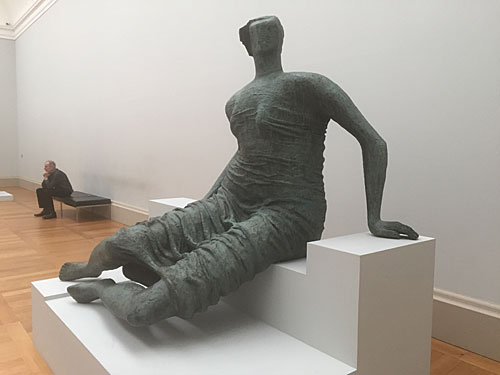
Old Flo is in fact Draped Seated Woman, a bronze sculpture created by Henry Moore in 1957. London County Council purchased her direct from the artist in 1962, at a cost of £7000, with the intention that she take up a prominent position on the Stifford Estate in Stepney. Old Flo was positioned close to one of three new 17-storey tower blocks, enhancing the neighbourhood through art, at least for those residents who liked her modern profile. And here she remained until 1997 when the estate was to be entirely redeveloped, at which point Old Flo was shipped out of the borough to the Yorkshire Sculpture Park.
The story then jumps to 2012, when the Mayor of Tower Hamlets decided to sell off Old Flo at Christie's to raise funds for the cash-strapped council. But his decision was promptly questioned in the courts, with arguments hingeing around which body gained custody of the statue when the LCC was wound up in 1965. By the time ownership had finally been settled Lutfur Rahman had been discredited as Mayor, and the intended sale thankfully never took place. Incoming Mayor John Biggs then decided to bring Old Flo back, but to Canary Wharf where her security could be assured.
She's now in Cabot Square, a raised piazza with a plush fountain and several other modern sculptures to boot, including a similarly robust bronze of an odd-headed couple by Lynn Chadwick. Old Flo looks very much at home, and you can see her here at any time. But what you may not have known is that you could have seen her elsewhere in London for several years before she came back from Yorkshire if you'd known where to look. Here she is, and here she has been, over in Pimlico.
Henry Moore made a total of seven casts of Draped Seated Woman across the period 1958–63. He gave his own personal copy to his daughter, who sold it to a private collector, who in 1989 lent it to the Tate on long term loan. It's currently on display in the Henry Moore Room at Tate Britain, alongside other sculptural classics like Recumbent Figure and Family Group. Four of the other casts are in museums in Melbourne, Jerusalem, Brussels and Connecticut, and the other can be seen outside a public swimming pool at Wuppertal in Germany.
Meanwhile, back in Stepney, no public art is on show. The Stifford Estate was rebuilt at the start of the century in typically Tower Hamlets style - partly flats but mostly three-storey townhouses, back when these were still deemed to be a good use of land. It's not a well-off corner of town but by no means shabby, and home to many a family from the squeezed middle and below. Rows of cars now fill the front gardens of Ewhurst Close, the cul-de-sac on the land where Old Flo once sat, with small private gardens out back leaving no communal space for anything in bronze.
In happier times Old Flo might have been resited to Stepney Green Park, the large grassy expanse immediately adjacent to the former estate, where the local population might once again have enjoyed seeing her, sitting on her and probably jumping off her too. But leaving expensive chunks of metal unguarded in public places is now deemed far too risky, hence Old Flo's move to a bankers' piazza watched over by 24-hour security and CCTV. Henry Moore would have been disappointed by his sculpture's upmarket shift, but at least she's back in the borough where we can all make her acquaintance once again.
7-letter bird quiz
Here are crossword-style clues to 24 birds with seven-letter names.
How many can you identify?
1) caustic north 2) chain of flags 3) bu☆d 4) from Leighton? 5) Greek letter with broken neck 6) orange drink from Illinois 7) golly, a week 8) leave chuck 9) more Harry 10) Titanic character loses child 11) alter skelter 12) circuit annexe
13) fastest steam loco 14) hormone imbalance 15) buried in lost riches 16) vegetable rooster 17) twisted a pencil 18) book or biscuit 19) sp→ 20) gulp! 21) behind every happy dog 22) conflict smear? 23) moon growing around west 24) perhaps knew cry
(Answers in the comments box)
(And, please, no more than ONE guess each)
A reminder that you can follow this blog on Twitter at @diamondgzrblog. It auto-tweets a few minutes after I post something new, which is usually (but not always) around seven in the morning. It only tweets once per post, and it never tweets about anything else, so it won't clog your timeline.
Why not join @diamondgzrblog's 379 current followers, especially if you're a bit forgetful, or if you'd like to be alerted every time I post something extra at an atypical time? Obviously today has been a bit annoying for those 379 followers because they've seen a tweet linking through to a post encouraging them to follow an account they already follow, which is 100% pointless. But if I promise never to do this again, then it won't happen to you.
(Don't follow @diamondgeezer by mistake, that's my personal account, and I almost never tweet about the blog over there. I rarely tweet, in fact, but hey.)