The Severn Beach line is a railway oddity. It's named after a terminus most of its trains don't reach. It's narrowly escaped closure on more than one occasion and is now mostly single track. It runs alongside both the River Avon and the River Severn. It was also once described by a tour company as one of the world's most scenic railway lines, which I must say piqued my interest but turned out to be an entirely ridiculous claim. Unless you like rooftops, tunnels, mud, dockyards and estuarine bleakness, that is, in which case it might be perfectly up your street.
Bristol Temple Meads is the station to begin at, if you're interested, with services departing every 40 minutes. Trains head north into the suburbs of the city, offering extensive views across a dense residential roofscape, before eventually bearing off from the mainline. A steady climb pauses at several suburbs fortunate to have their own station, many brightened with top class street art, by which point the panorama is mostly the interior of a cutting.
Clifton Down is the busiest station along the line, conveniently located for the zoo if not the posh bit and suspension bridge. And then a mile long tunnel descends back to river level, hewn through the rock at enormous expense in the 1870s to connect with the Port of Bristol beyond. No politician would ever agree to such a plan today.
The railway emerges at the end of the Avon Gorge, beside a brimming river or a muddy channel with a less thrilling trickle, depending on the tides. The railway follows the meanders of the river, generally too well screened by trees for a good look, perhaps overtaking traffic queueing on the parallel Portway. There are intermediate stops at Sea Mills and Shirehampton, with plans for a third just beyond, although as yet no visible signs to make a 2019 opening date look credible. Here the M5 whooshes overhead on stilts (this the final bridge over the Avon), and then the industry begins, screening the remainder of the river from view.
I got out at Avonmouth for an unscenic jolt. This is the town which grew up alongside the Port of Bristol, hence was where many of the dockers and their families lived, hence has seen better days. Some semblance of the town's former importance is hinted at by the fact that the A4 trunk road terminates here, at an HGV-friendly roundabout on Crowley Way. The docks are hidden over the backs of fences and walls, with the occasional crane rising above, plus four enormous undemolished grainsilos.
Gloucester Road runs briefly down to the gates, on one side lined by grand Victorian lodgings downgraded to Homes in Multiple Occupation, then a Grade II listed hotel whose rooms start at £25 a night. Avonmouth's main thoroughfare offers a pub, a Co-op and a tattoo bar, each well frequented, while the former Bus Depot is currently up for auction. The town reminded me a little of North Woolwich or Silvertown, as was, but without much hope of major redevelopment.
Most trains on the Severn Beach line terminate at Avonmouth, but one in three continues north, veering now to shadow the banks of the Severn. This is where any claims of a scenic journey completely break down, with the docks to one side and a succession of warehouses, factories and chemical works on the other. Before long the next station is reached, a single platform halt in the shadow of a cement terminal, just past a conveyor belt used to raise coal from the sidings.
This is St Andrews Road - no longer a request stop, whatever the sign on the platform says. Unsurprisingly this is (by some distance) Bristol's least used station, its ridership totals not helped by the adjacent smelting works having closed in 2011. In its place is now a huge Asda distribution depot, which is why two green-jacketed employees hopped off my train, helping to keep the station vaguely alive.
For those still on board, the final few miles showcase further industrial treasures, including an oil refinery, a power station and an abandoned chemical works. The main freight line veers off just after the refinery, which had it been laid first would have obviated the need for that now-oh-so-useful tunnel down from Clifton. The River Severn eventually becomes visible across a marshy fringe, plus an occasional pipe bulging up above sea level, and there's the first glimpse of an international bridge in the distance. And finally, 37 minutes out from Bristol, here we are.
Severn Beach station has apparently been spruced up, so I hate to think what this lone platform looked like before. Local people dash off to one of a dozen roads, or Shirley's Cafe, whereas those of us here for pleasure have a Heritage Trail to enjoy. In the 1920s a local entrepreneur used the opening of the new station to develop a riverfront resort, and crowds came to enjoy a deckchair on the shingle, then refreshment huts and donkey rides, and eventually a funfair and chalets. Severn Beach's centrepiece was the Blue Lagoon, an open air swimming pool, whose Water Carnivals helped contribute to the resort being nicknamed The Blackpool of the West.
Today there's almost nothing left to see, bar the plaques explaining that this point on the sea wall used to be the paddling pool and this caravan park used to be the boating lake. Perhaps the deckchairs come out again in the summer, but in February the grass behind the promenade is mainly somewhere to exercise dogs, meet other people with dogs and hurry home from afterwards. [video]
What's unmissable is the M4 soaring across the estuary on the Second Severn Crossing, which lifts off from the English side a few hundred yards to the north. I love a good major civil engineering project, especially one you can walk right underneath. This cable-stayed bridge was added in 1996 to supplement capacity on the original Severn Bridge, and is now the major motorway connection. It strides out on a sequence of piers across mudflats and a fortuitously located rocky outcrop, with the central pylon-supported span crossing the navigable part of the channel.
The bridge's footprint has a gentle S-shape, providing an ever-changing silhouette as you walk along the foreshore. I paused ever-so-often, repeatedly thinking "oh that looks nice too" and snappingseveralmorephotographs. Drivers get the better elevated view, of course, but I've seen the full wiggle and the maintenance depot underneath. And all of this was for the utterly knockdown fare of £3 return from Bristol - truly one of the UK rail network's greatest bargains.
Weston, as the locals have it, is a seaside resort in North Somerset at the mouth of the River Severn. The Super-Mare bit is a posh way of saying On-Sea, which for a significant proportion of the day is really On-Mud thanks to the Bristol Channel's massive tidal range. To get your bearings, the sea is to the west, the M5 is to the east, and a high ridge of land called Worlebury Hill blocks development immediately to the north. As usual, the town's Victorian growth spurt was entirely thanks to the railways. About 75000 people live here, and an ABCD of people who grew up in the town would include Jeffrey Archer, Richie Blackmore, John Cleese and Jill Dando. The best time to visit Weston-Super-Mare is never a grey weekday morning in February.
Weston has three piers, the most significant of which is the Grand Pier. Originally Edwardian, it's burned down twice, most recently in 2008 (after the fire alarm company failed to ring the fire brigade). The pier's private owners took advantage of £30m compensation to rebuild the pavilion, thereby restoring the town's main attraction. The initial funnel of chips'n'candyfloss merchants is freely accessible, but to get any further requires £1 in a turnstile (or an annual pass). The boardwalk spans a couple of hundred metres of sea, or more likely beach, and has a central covered tunnel in case the weather's foul. I obviously preferred the exterior view, along with helpful labels on the railings pointing out what I might be able to see. Four churches in town, yes. Cardiff's Millennium Stadium, unsurprisingly no.
I hoped to walk right down to the far end, but this was blocked, I suspect for seasonal maintenance. Scores of empty tables, each labelled 'This furniture is provided for our food and beverage customers only', awaited summer's beers'n'burgers crowd. Instead the only sensible option was to enter the main pavilion, essentially a two-storey amusement arcade - a giant palace of paid-for fun. All the usual soft-toy grabs and slots proliferate, plus sit-on rides, an indoor go-kart track and Britain's smallest (track-free) rollercoaster. Top marks for over-excitable branding goes to The Crystal Maze, in reality one of those swingdoor mirrored labyrinths, and not a full-on four-zone challenge. Two Weston families were enjoying the low season's entertainment options, and I walked swiftly round.
Weston's first pier is now a crumbling wreck at the top of the bay, and the only pier in Britain to link to an offshore island. Birnbeck Pier was built to entertain Victorians arriving by ferry, but hasn't seen a daytripper since 1994, nor a lifeboat launch since 2015, and English Heritage aren't the only people worried about it. The third pier seems barely worthy of the name (although I didn't see it when the tide was fully in), and links to the Seaquarium (all the usual marine stuff in a lot of big tanks). Meanwhile KnightstoneIsland is linked to the shore by a short causeway, and now houses a compact luxury housing development, at prices which in any part of London would count as "genuinely affordable".
Other than distant Wales, the most intriguing sight on the horizon is Steep Holm, one of the larger islands in the Bristol Channel. This limestone lump rises from the waves like the top of an enormous head, and trebles in area between low and high tides. Historically considered part of Somerset, and once home to naval defences, today only birds make their home here (although it's possible to take a day trip in the summer). The other geological peculiarity is Brean Down, a long ridged promontory on the southern shoreline, nicely balancing Worlebury Hill to the north. Although it looks easy to reach, in reality it lies on the far side of the estuary of the River Axe via a considerable marshy detour.
Weston-super-Mare hit the headlines in 2015 when Bansky turned up with his Dismalandthemepark. His chosen site was the Tropicana, a former lido gone to seed, whose outdoor pool made a suitably downbeat backdrop for disturbing art. Since then the venue has sprung back to life in a variety of forms - a funfair in the summer and ice skating in the winter, which I watched through the glass being switched over to a half-term skatepark. In February the site feels somewhat out on a limb, its beachfront cafe and tourist information centre generally unbothered, and the neighbouring beachfront shelter packed out with sleeping bags and the bagged possessions of a few of the town's rough sleepers.
The town centre is the usual mix of tiny streets, pedestrianised shopping precincts and one grand manicured boulevard. At the top of the latter is Weston's floral clock, which alas no longer tells the time, but is still planted up every year to celebrate whichever anniversary the Lions Club selects. This flowerbed marks the site of the town's first station, a terminus inserted by Brunel in 1841, but later replaced by a more convenient loop slightly further out. The Town Hall adds gravitas by the mini-roundabout, but a large area between here and the seafront has been reimagined in questionable 21st century format, and a further zone will follow if anyone ever manages to fund more than bleak demolition.
Weston is blessed with several museums, one focusing on Lambrettas (alas "currently in the process of shutting down") and another on helicopters (the world's largest, apparently, with 80 specimens on view almost daily). I only had time for Weston Museum, the official culture repository, inside the former Gaslight Company Workshops. Most weekday visitors come for the cafe, it seems, but I enjoyed the permanent display round the upper floor and a splendid temporary exhibition downstairs - The Art Of Self Expression; Facial Hair and Tattoos Through The Ages. This proved an excellent excuse to pair whiskery Victorian portraits with specially commissioned 2017 photography, and if any Shoreditch gallery were to attempt a similar exposition of hirsute history I'm sure they'd have a hit on their hands.
Random Station: SOUTH GREENFORD
London Borough of Ealing Great Western Railway, zone 4 Hinterland: 2.5km²
Random station number 3 turns out to be the third least used station in London. Don't say I'm not taking you to all the best places. We're heading to West London's runtiest rail connection, the branch line between Greenford and West Ealing, which manages a half-hourly service during the day and shuts down completely on Sundays. It was slightly more useful when trains ran to Paddington, but Crossrail improvements have severed that, and now you can't even get to Ealing Broadway without a change. The line is an obvious candidate for Overgroundisation, apart from the fact that this would bring it to unnecessary prominence across the TfL network and basically, unless you live here, you don't care.
South Greenford station is a proper halt, essentially a couple of bleak platforms bunged in quarter of a century after the line originally opened. It's set on a viaduct, running high above the valley of the River Brent, which meanders out of sight to the south. Access is from the A40 Western Avenue, an unwelcoming spot brimming with particulates, and not ideal for the feeding in of potential passengers. New signs have been added at street level to indicate the line's recent cut back to West Ealing, but the main roadside signs still direct passengers towards stations that trains no longer stop at. On the positive side both platforms have step free access, so long as you can wheel yourself up a long tarmac ramp (currently lined with catkins and discarded bottles).
The southbound platform is the more substantial, remade from concrete rather than the original timbers opposite. Two Oyster readers have been installed, for the rush that almost never comes, plus a GWR network map in case you ever fancied a trip from here to Weston-Super-Mare. A couple of terracotta-effect planters have been added to the railings, long-since emptied, and a halo of spikes prevents anyone climbing to vandalise the loudspeakers and security cameras. Those waiting for their train can hide inside a shiny shelter, or gawp down the (very straight) tracks to see if anything is coming, or peer down through the trees (winter and early spring only) to the adjacent park and running track. On a Sunday it's a particularly forlorn spot, unless you have a sturdy thermos flask and a penchant for freight trains.
On its platform signs South Greenford station is subtitled 'West Perivale', highlighting its somewhat liminal location. A swirl of Perivale's interwar avenues can be accessed via a subway underneath the A40, whereas vehicles can only get in or out through the shopping parade on the far side of the dual carriageway. The Medway Parade on Medway Avenue features lots of shops called Medway Something (including Fish & Chips, Pharmacy and News), and has been jauntily rebranded Medway Village. Its moment of glory came when it was used as a location in the final Doctor Who story of the 1980s, Survival, as were several of the seeminglypeacefulbackstreets. Today's residents no longer have evil alien cats to contend with, and those with any transport nous head round the back of the sports ground to use the Central line instead.
The vast majority of South Greenford's catchment area lies to the southwest of the station, and includes the whole of the Broadway and adjacent shopping streets. Greenford Broadway is an excellent example of a major suburban parade, of late Metroland vintage, comprising two storeys of flats atop a long descending chain of retail units. Boots is one of a handful of survivors from 50 years ago, its painted logo still faintly visible high on a side wall, whereas the cinema-like building opposite has become an amalgam of bingo, slots and snooker. Hot food now makes up a substantial proportion of the Broadway's appeal, from kebabs to pierogi, and many's the schoolkid who nips here by bus at lunchtime for a boxed pizza. But what fascinated me most was an abandoned sweetshop by the main traffic lights - May'sConfectionery.
This time capsule closed around ten years ago, already a leftover from a bygone age, and has somehow survived intact into 2018. The window display consists of several empty chocolate multipacks, emblazoned with long-abandoned logos for Cadbury's Snack, Twix Xtra and Freddo Caramel. The Maltesers boxes have become almost entirely colourless after a decade of sunlit leaching. Peer through the sticky glass and the interior looks much as it must have done after Mr or Mrs May retired, with half-full jars of boiled sweets stacked up on the far shelves and a ride-on coin-operated lion stabled beneath the Lemon and Lime Ice Shake dispenser. Sure, all the greetings cards have disappeared, and there are a heck of a lot of unopened envelopes piled up on a trestle table, but I could still imagine being small and staring up wide-eyed at the treasures on the counter. It's hard to say what amazed me more - that May's has never been snapped up as a takeaway, or that the lights are still switched on inside.
Things nearby which aren't shops... The London Motorcycle Museum: A marvellous collection of powered two-wheelers, racing memorabilia and the ARP sidecar from Dad's Army. I visited in 2008. "The whole place smells of garage, and petrolheads will feel immediately at home." Open Saturdays, Sundays and Mondays. Greenford Hall: Scandi-influenced public hall, opened in 1966 by Dame Edith Evans, and recently refurbished. If you want to host a huge wedding reception with draped ribbons and candelabra, or throw an am-dram panto, get in touch. Perivale Park: Floodplain rec for football, cricket, bowls and golf, which you'll have yomped through on section 8 if you've ever walked the Capital Ring. Ravenor Park: Former farmland, now a park-on-a-hill, featuring a nature reserve, an avenue of white poplars and a rose garden. Litten Nature Reserve: One hectare of woodland, including three ponds, minibeast area and hireable classroom, watched over by conservation volunteers. They probably love it. The gate was firmly padlocked.
I walked to the farthest point of South Greenford's catchment, almost nudging into Southall - the curved parade on Allenby Road. Here were more shops than I thought a place with no name could ever need, bookended by a bathroom showroom that used to be a pub and the building where Ealing's learners check in for their driving test. The car park outside the Roman Catholic church is chained off, to be used only ten minutes before or after each examined circuit. The parade has no butchers as such, only the Rose Meat Shop which specialises in chicken and groceries. Round the bend cashiers watch over grandmothers picking through bowls of fruit, and an internet cafe lingers beside a gated staircase whose sign once said Entrance To Flats.
In the surrounding streets immigrants from Eastern Europe and the subcontinent live side by side, and front porches contain signs saying A Yorkshire Terrier Lives Here, but in Polish. Here builders hurl chunks of bathroom into the back of a van, two lads in sweatshirts joyride down the pavement on a single saddle, and the mid-estate recreation ground is used by seagulls as a landing pad. The real London lurks far from the rail network, oblivious to pop-up cocktail deals, getting by.
It is with regret that I must inform all subscribers that the Diamond Geezer Quality Threshold has been breached.
This has been triggered by twelve consecutive days of posts containing at least one error pointed out by a member of the general readership.
Strict remedial measures will be introduced, commencing with the publication of this report. Compensation will be paid in full.
Day 1: Friday 26th January 2018(Random station project)
✉ Susan emailed to point out a repeated word in the final paragraph ("for every every London station"). The error was corrected within 78 minutes.
Day 2: Saturday 27th January 2018(Random station - Fairlop)
✉ Roger kicked off by pointing out that the last sentence ("the station really isn't very away") needed a 'far' added. A 'far' was added.
✉ Joho queried the adverbial phrase "echoingly similarly", leading to one of the suffixes being deleted.
✉ Rob noted an incorrect spelling of the local neighbourhood, asserting "I think you’ll find it's Fullwell in these parts. Fulwell is near Twickenham." Four occurrences in the text, along with one photo label and three Flickr tags, were surreptitiously updated.
Day 3: Sunday 28th January 2018(Random bus route - 293)
✉ Description of the bus journey suggested that the headgear being worn by a toddler in a buggy was "a woolly hat with endearing dinosaur ears." Milo was swift to query the anatomical veracity of these knitted protrusions. "At the risk of appearing a tad pedantic could you remind us all which dinosaur it was that sported ears? (external ears that is. I assume they had internal ones much like the reptiles/ birds of today)". The general consensus was that the author's anthropomorphic interpretation had been flawed. No rectification has been made.
✉ Despite the word 'Perrinesque' not actually existing, it was misspelt, as Waterhouse promptly noted.
Day 4: Monday 29th January 2018(Apsley House/Wellington Arch)
✉ Injudicious use of the cut and paste function led to the ridiculous claim that the admission price at the Wellington Arch was £5.00 (£11.20 inc. Wellington Arch). This slipshod error was pointed out by four different people, including DG's father, and was not corrected for over an hour because the author was still asleep. More care must be taken when setting posts to auto-publish.
✉ SJM did some proper research relating to the quadriga atop the Wellington Arch. "I don't think it's Nike that's at the reigns, but a boy." Technically they're reins, but SJM was otherwise correct.
Day 5: Tuesday 30th January 2018(Hold the handrail)
✉ It took less than an hour for Martin to query the assertion that the only escalators at Circle & Hammersmith and City line group stations are at Moorgate and Liverpool Street. "There are also short escalators at Paddington on the H&C," he said. Whilst these lead to the Bakerloo line, Martin was technically correct, invalidating several of the subsequent qualitative arguments.
Day 6: Wednesday 31st January 2018(Super blue blood moon)
✉ Andrew chipped in with several points. The post had suggested that a lunar eclipse appears red following lunar reflection, but Andrew knew the effect was due to earlier atmospheric refraction, specifically Rayleigh scattering. He also knew that the albedo of the surface of the moon is low, specifically 0.12, so most of the light is not reflected back. He also queried how New Zealand could ever get a blue moon in February, given that the month has no more than 29 days, but this was never claimed in the post so did not count as a third black mark.
✉ GJ had a more serious query regarding the assertion that the UK had seen a super blue blood moon in December 1982. He provided evidence from NASA that the lunar eclipse had been invisible from London, invalidating the 'blood' aspect, although the claim would of course have been true in Iceland.
Day 7: Thursday 1st February 2018(The Count)
✉ Count number 4 has again been listed as "Number of hours each day I sleep", on this occasion attached to a numerical value of 188. Last year reader B queried how DG could possibly have slept for nearly 200 hours a day, and reader shirokazan said "I suspect he meant to write 'Number of hours slept', omitting the 'each day' bit". This was wise advice, but remained unheeded, hence this year it was reader Sarah's turn to chip in with an incredulous "You sleep 188 hours each day?" Greater attention must be paid to previous complaints, and these must be duly acted upon.
Day 8: Friday 2nd February 2018(Headstone Manor)
✉ Millionaire's shortbread proved predictably controversial regarding the placement of its apostrophe. In an email Neil suggested that the correct positioning was after the final 's', as confirmed by the BBC Good Food website, but other sources omit the 's' completely. Mary Berry is silent on the matter, and Jamie Oliver avoids grammatical conflict by calling them caramel squares.
Day 9: Saturday 3rd February 2018(Hat quiz/Bus cuts)
✉ There were no issues with the hat quiz. If only this had been the sole post of the day, the Quality Threshold would not have been breached. Alas the additional list of bus cuts included a cut and paste error, noted by sharp-eyed reader Greg. Route 230 had of course not received a frequency cut two months running, and the second occurrence should have been a 228.
Day 10: Sunday 4th February 2018(Dull London)
✉ Andrew (not that Andrew, another Andrew) recognised that lorries generally drive across the centre of mini-roundabouts, and this manoeuvre was therefore unworthy of inclusion in the post. "Isn't part of the point of mini-roundabouts that you give way following the same rules as a full-size one but don't religiously have to go round it?" Technically section 188 of the Highway Code states that "All vehicles MUST pass round the central markings except large vehicles which are physically incapable of doing so", so the point is moot, but this nuance should have been more clearly signalled.
Day 11: Monday 5th February 2018(Crowded tube carriages)
✉ It was remiss of the author to make sweeping statements about the passenger density within Hammersmith & City line carriages arriving at Bow Road station during the morning rush hour. Regular user Moogal knows from experience that "there's fewer of them, so in the peaks they're often fuller than the District services." In future empirical evidence must be used to back up sweeping assertions.
Day 12: Tuesday 6th February 2018(Monday morning in E3)
✉ An anonymous commenter immediately spotted a problem with the last bit (in italics) - "Alternatively money can be can donated here..." The extra "can" was deleted before the majority of readers ever saw it.
✉ An occasional reader observed that "There's a redundant 'could have could have' in the middle of paragraph 8." Officially only one of the 'could have's was redundant, but this embarrassing error was swiftly edited.
✉ Andrew (yes, that Andrew again, not the other Andrew) spotted a careless error in the description of park flora. "Were the crocuses open (unfurled) or closed (furled)?" Andrew knew very well that they were closed, and that only someone with a poor grasp of the English language would have written "unfurled", but he still couched his pedantry as a question so as not to appear too big-headed.
✉ Martin apologised for pointing out a infuriating grammatical construction. "Two ladies are sitting, please. Sat is a simple past. You are writing, for vivid effect, in the historic present. They sit. They are sitting. Never they are sat. And for past tenses: They were sitting or they sat. Never 'they were sat'. And certainly not sat sitting or stood standing." This was a particularly egregious blunder, given that other readers have noted similar mistakes in the past. In October 2017 Richard said "Has anyone else noticed that DG has an aversion to the word sitting, eg 'the lady sat beside me was fully settled'." Even as far back as April 2008 Felix said "Can one be sat on a train? I know it is common parlance, but whatever happened to the present participle 'sitting'? It's a bit like saying 'I am ate/eaten my dinner in Coventry'." No matter how poor the grammatical pedagogy of the author's 1970s education, readers must be taken seriously when they repeatedly proffer constructive linguistic advice. This must be the final appearance of the sat/sitting debacle, else further censorial steps will be taken.
Twelve consecutive days of invalid posts is an act of wanton editorial negligence, and the Ombudsman apologises to readers for any offence taken. Refunds will be available through the usual channels.
Rest assured that a probationary period has now been entered into, and the blog's author has been duly chastised for his inadequacies. Please be alert to any further shortcomings, however small.
In particular, IF THERE IS ANY FURTHER ERRORS REPORTED IN TODAYS' COMMENTS, THEN THIS BLOG WILL IMEDIATELY BE PLACED INTO ENFORCED HIATUS.
It is only through the relentless nitpicking of the collective readership that appropriately high standards of 100% perfection can be maintained.
Bow's modern incarnation of a library, off the Roman Road, offers a warm and welcoming place to be. Outside the electronic doors a lady in a wheelchair is having a one-sided chat with a small dog on a mobility scooter. Just inside the entrance a security guard perches on a high chair, lest any departing user should should set off the beeping sensors. I somehow manage to set it off on the way in. Most of the tables in the main lobby are occupied by the elderly - singly and in groups - having a nice chat and/or a cup of something. One lady by the window is reading a red-top tabloid. One man in a wheelchair is holding a shaky latte. The main display of new books includes "Joe and Clara's Christmas Countdown", which it seems is proving hard to shift. A sign on the main desk apologises Sorry we have run out of bags, as the council's recycling provision quietly falls apart.
Some of the shelves are still empty after a recent reshuffle. The long desk amid the fiction section is filled by students of all ages tapping on their laptops, two with chunky headphones poised. My attempt to scrutinise the spines from L to R involves standing rather too close behind some of them, making all of us uncomfortable. I make do with an Alan Bennett and an autobiography instead. Over in science fiction a lady is wrapping her mother in a shawl while relating tales of shootings in the Caribbean over her phone. "Have you got your card?" asks a much younger mother of her small daughter as they emerge from the all-gender toilet. The pair progress slowly to the main counter, where several picture books are scanned, and the library habit is passed on to another generation. I do not beep on the way out.
Monday morning in the park
Now the snow flurry is over, the walled garden is almost quiet. Three grey-bearded men are deep in conversation on one of the benches, one with a walking stick and another surrounded by a ring of carrier bags. On a separate bench a lone drinker sits with bottle in hand, staring forwards, a drooping black hood concealing most of his face. A magpie lands on the railings surrounding the memorial cross, jerks its head a few times, then spots something and flies away. In the far corner a tiny handful of snowdrops foreshadow the passing of winter, while hundreds of purple crocuses have made it out of the ground but remain unfurled. A three-storey skeleton of floors and foundations rises behind, which by the end of the summer will support an array of unaffordable balconies, if the men in their hard hats get a move on.
Here comes a mother in a headscarf, pointing out the signs of spring in the shrubbery to a child too young to be interested. He pulls and tugs, and she leads him off to the playground for a go on the bouncy horse. Council contractors are carrying out drastic chainsaw surgery on some perimeter trees whose branches hang low over adjacent gardens. Their white van and mulcher are blocking the main footpath, which has been temporarily coned off, forcing a crocodile of nursery children onto the grass. They toddle round the obstruction very slowly, holding the hands of their carers in no-more-than-threes, before heading towards the gates. Across the lawn a staffie in a studded collar squats for relief, genitals dangling, while his bagless owner looks elsewhere. Step carefully.
Monday morning in the supermarket
Hurrah, at this time of the morning the supermarket actually has some small trolleys left. Ungrabbed copies of Friday's Evening Standard are piled up in the dispenser beyond the first set of automatic doors, awaiting replacement. A smartly dressed member of staff lurks just beyond the second set, waiting to interest shoppers with a leaflet about the in-store pharmacy. By lunchtime it'll be a lot busier in here with schoolkids and sandwich grabbers, but for now my progress remains mostly unobstructed. Three brands of catfood are on special offer this week. Someone has abandoned a basket of bananas and oranges in the washing powder aisle. Several trays of chicken thighs emerge from the storeroom at the rear. "Where are you then? Where are you then?" shrieks a teenager into his phone as he heads for the exit.
The dried food Reduced to clear section is a mess of leftovers, including an Advent calendar, dozens of commemorative Bisto tins, and a Decorate Your Own Gingerbread Dog Biscuit. Numerous jars of mincemeat have been slashed to 80p, or 40p if you hunt more carefully on a lower shelf. Early Easter eggs are lined up opposite the frozen ready meals, still two months off being discounted. A middle-aged man with a loud hacking cough wheels by, then leads his wife over to the lottery desk for some cigarettes. I hunt down what I'm looking for - pasta, baked beans, tea bags, pasta sauce - and head for the checkout. Self-service has a queue, because some customers prefer to put staff out of work, but I head to an empty conveyor and get served straight away... and enjoy a merry chat.
Monday morning at the food bank
The only exterior clue to this food bank is a chalkboard positioned by the churchyard gate for three hours every Monday. That and an intermittent stream of people going in, and later walking out with extra bags. Two ladies are sat on the bench halfway down, laughing raucously and clutching Iceland carriers. Another lady emerges through the great oak doors and lights a cigarette. I'm not sure quite what I expected to find within, but am amazed by the bustle ahead of me across the main body of the church. There must be fifty people in here, around half of them volunteers, the others taking advantage of free warmth and weekly compassion. Hot drinks to the right, chairs for socialising along the aisle, and a trestle table at which a Legal Aid advisor offers free consultations. Truly this is Food Bank Plus.
I'm funnelled to the far end, where the choirstalls are laid out as if for Harvest Festival, only with more dried goods and fewer fruit and vegetables. Those in need are offered ten items of their choice, from tins and cereals to nappies and shampoo, rather than the pot luck jamboree bag some other food banks offer. I hand over my donations to the lady in the chancel, who's graciously welcoming and genuinely thankful on behalf of those who'll benefit. She also tells me it was a lot busier earlier, because for some nine thirty can't come round soon enough, and nobody is ever turned away. Laid bare within these ancient walls is poverty not usually seen in plain sight, not only the homeless but those in temporary or permanent struggle to make ends meet. I walk out with my eyes more widely opened, and a pride that my local neighbourhood is doing something about it.
Bow Foodbank is a registered charity based at St Mary's Church on Bow Road, supported by a multi-faith and non-faith coalition of local organisations, including a group of student volunteers from Queen Mary University. It opens every Monday between 9.30am and 12.30pm, bank holidays excepted. Non-perishableitems can be delivered to the church between 9-11am, or on Sunday afternoons between 4-6pm. Alternatively money can be donated here... or you could contribute to your own local food bank, because even in 2018 there's bound to be a need for one.
Sometimes when a train arrives in a platform it's really busy at one end and not very busy at the other. This is generally because, further back down the line, more passengers piled aboard at one end of the train than the other. And this in turn is because most passengers don't walk very far down the platform when they arrive.
I see this regularly at Bow Road station, heading westbound into central London. The stairs deposit everyone on the platform adjacent to where the rear of the train will be when it stops, and most people don't walk very far away from this point. Specifically it deposits them adjacent to carriage 6 of a 7 carriage train, and most people wait within the range 5-7. Some people walk down to 1-4, particularly if that gets them closer to the exit at the end of their journey, but most people seem to stay within a range of plus or minus one carriage from the bottom of the steps.
When a District line train arrives, the back of the train is usually busier than the front. If it's the shoulder of the rush hour, or if there hasn't been a train along for several minutes, the last carriage of the train is often standing room only. There can still be several empty seats down the front, where those waiting could have had a more comfortable journey, but because the doors are about to go beep people hop in adjacent to where they're standing, and so the rear of the train gets even busier.
I wondered if there was a good reason why District line trains arrive at Bow Road rear-loaded, and there is, which is a peculiarity of the way the stations further east are laid out. At Upminster the main entrance is at the front of the train, but at the next eight stations the main entrance is at the rear (mostly accessed down a long ramp from the street). That's eight consecutive stations where passengers arrive on the platform at the very back of a westbound train, plus three out of five of the remaining stations, so it's no wonder the back is busier than the front.
Here's a diagram to show you what I mean.
Carriage 1
Carriage 2
Carriage 3
Carriage 4
Carriage 5
Carriage 6
Carriage 7
Upminster
East Ham
West Ham
Upminster Bridge
Hornchurch
Elm Park
Dagenham East
Dagenham Heathway
Becontree
Upney
Barking
Upton Park
Plaistow
Bromley-by-Bow
At three of the stations prior to Bow Road, the entrance to the platform is at the front of the train, indeed right at the front. But at the other eleven it's right at the back of the train, and it's never anywhere in the middle. People do spread down the platform, obviously, which is one reason the middle of the train isn't empty. Another reason is that the new S Stock trains are essentially one long central corridor with seats, so it's easy to shuffle down if the part of the train you're in is overcrowded. Oh, and of course some stations are busier than others...
The busiest stations at the eastern end of the District line, in terms of passengers entering and leaving, are Barking (16m), East Ham (15m) and Upton Park (10m). They each have at least twice as many passengers as the remaining stations, and considerably more than the runts of the litter, which are Upminster Bridge (1m) and Hornchurch (2m). Barking and West Ham are also interchanges, which drives considerably more traffic, but still not enough to make the front of the train more popular than the back. If I add up the number of passengers annually at each of the 'front' stations, and compare it to the total at the 'back' stations, the back comes out around three times busier than the front.
To model this properly, I'd also need to take into account the fact that not every passenger is going all the way. A heck of a lot of people pour out of the train at West Ham to change to the Jubilee line, so never make it as far as Bow Road. Few people starting their journey at Upminster ride the District line all the way into town when they could have taken the fast c2c train instead. The further away someone began their journey, the more likely they never made it this far. But the position of each preceding station's entrance does give a rough and ready explanation of why the back of a District line train pulling into Bow Road is busier than the front.
On the Hammersmith & City line (and short-running Districts) it's different.
Carriage 1
Carriage 2
Carriage 3
Carriage 4
Carriage 5
Carriage 6
Carriage 7
East Ham
West Ham
Barking
Upton Park
Plaistow
Bromley-by-Bow
These trains are less busy overall because they haven't been to any of the eight stations before Barking, so you're more likely to get a seat. They're also more balanced, with the busy station at East Ham and the busy interchange at West Ham having more of an impact up front, relatively speaking. But in the morning rush hour H&C trains do still arrive with a standing crush at the back and room to breathe at the front, and so the pattern persists.
Something similar happens on the Central line at Mile End. I've noticed that when I try to catch a westbound train (outside the morning rush hour), the last carriage often has numerous empty seats even when the front of the train is packed. I wondered if a similar analysis might explain why.
The Central line's a lot more complicated, with numerous routes and starting points, and entrances that aren't all at the front and back. But if I simplify each train to front, middle and back, rather than individual carriages, here's what I get for services arriving from Epping.
FRONT
MIDDLE
BACK
Leytonstone
Leyton
Stratford
Epping
Theydon Bois
Debden
Loughton
Stratford
Woodford
South Woodford
Snaresbrook
Stratford
Stratford's a special case because it has platforms on either side of the train, and passengers arrive all along their length, which spreads things out more. But what stands out here is the triple whammy of Leytonstone, Leyton and Stratford, not just the three busiest stations on the line, but also the last three before Mile End, hence the significant front-loading of an arriving train.
Here's my diagram for trains arriving from Hainault.
FRONT
MIDDLE
BACK
Fairlop
Redbridge
Wanstead
Leytonstone
Leyton
Stratford
Barkingside
Newbury Park
Stratford
Hainault
Gants Hill
Stratford
Again, several stations immediately before Mile End have entrances near the front of the train, while the rear-entrance stations are further away and they're less busy. So it doesn't matter whether a Central line train is arriving from Hainault or from Epping, or from anywhere else along either line, you should be more likely to find space at the back than at the front. That's my experience anyway.
It's possible to apply this kind of analysis to any station on the tube, although the results won't usually be so clear cut. I used the Stationmaster app to tell me where all the entrances were, rather than deliberately traipsing out to all of them to check. And you can of course do this analysis for any station on any line anywhere, not just on the tube, should you be so minded. Most trains departing London mainline termini will be fullest at the back, for example, which is why I usually make the effort to walk all the way up to the front for a quieter life.
TfL and other train companies must model this kind of thing, taking into account precise entrance locations and actual passenger numbers, because it can be a key contributor to overcrowding. But what they can't easily do is change whereabouts each station entrance dumps us on a platform, only nudge us to move along to make everyone's life a little easier. At least Crossrail has been engineered with multiple entrances to balance us all out a little better, but I predict most people will still try to board the train close to the point where they arrive on the platform, rather than understanding the secrets of where might be better.
Sometimes outer London isn't especially interesting, unless you happen to actually live there.
Chingford, E4
This Greggs near the Lea Valley reservoirs was boarded up a few years back. Its decaying signage lingers as a reminder of corporate branding long abandoned. A pet shop in the same parade closed in 2012 citing parking restrictions as the last straw. A McDonalds trades across the street in a former pub. The nearest sausage and bean melt can now be found less than a mile away on Station Road. Planned redevelopment by Waltham Forest Council is expected to include 19 residential units, a Co-operative food store and a Costa Coffee.
Do you live along the Sewardstone Road? Can you tell us more?
Greg says: Sewardstone Road extends out towards Waltham Abbey & is a curious mix of decaying shops, closing pubs & re-opening pubs, & spots of regeneration & new businesses.
James says: Many years ago there was a dodgy chippy on that stretch of Sewardstone Road that was regularly busted by the local health department for selling tainted white fish and pretending it was cod.
Northumberland Heath, DA8
This mini roundabout sits at the five-way junction on the A220. Two centuries ago this was a meeting point of tracks across the heath, until the railway arrived and extensive housebuilding intruded. Lorries generally cross the central painted circle rather than steering round it. The pub on the north side is The Duke, formerly the Duke of Northumberland, and opened in 1863. Its bar is presented in a traditional manner with stripped wood flooring, dartboard and pool area. Regular live music, quiz nights and karaoke are part of the entertainment offer.
Do you live in Northumberland Heath? Can you tell us more?
Nick says: There is a big bakery plant here, and the remnant of the Heath (known by that name since the C13th) is a large green space called Bursted Woods.
Kathryn says: The cemetery has the memorial to the Slade Green munitions disaster by the entrance. The nearby Erith Hospital has a grade II listed underground hospital, built during WW2 and now an X-Ray Department.
Perivale, UB6 Hanwell Town FC have played their home games in Perivale since 1981, at Reynolds Field adjoining the A40 Western Avenue. Stalwarts of the Evo-Stik League South East, Ray Duffy's team once reached the third qualifying round of the FA Cup. Their Powerday Stadium is sponsored by a local waste management & skip hire company and has a maximum capacity of 3000. Yesterday 97 spectators turned up to watch the home team throw away a two goal half time lead against Chalfont St Peter, eventually losing 3-2, with Ryan Haugh scoring the late winner.
Do you support Hanwell Town? Can you tell us more?
Nobody supports Hanwell Town. (Charles supports Chalfont St Peter)
Kingston upon Thames, KT2
The smartly-hedged streets of Canbury ward, to the north of Kingston town centre, are a hotbed of community. Burton Road's street party to honour 2011's Royal Wedding was so well organised that ITV came to film the preparations. At the junction with Kings Road hatched lines have been painted on the road surface as an accident reduction measure. Across the street is the headquarters of 'one-stop-building-shop' D.M. Spragg Ltd, established in 1957 by Donald & Beryl Spragg. St Luke's Church has close ties to the Diocese of South Australia.
Do you live in Canbury? Can you tell us more?
GJ says: There is a Park Road in Canbury that rather confusingly doesn't lead to nearby Richmond Park.
GJ says: During the First World War, Canbury was the home to Sopwith, the aircraft makers, who tested floatplanes on the nearby Thames.
Timbo says: Until 1988 Kingstonian football club's stadium used to be at the north end of Burton Road - now, like the Sopwith factory, given over to modern housing.
Timbo says: Kings Road used to have a parade of shops, from newsagents to DIY to greengrocers to glaziers. Most have also been converted to domestic use - Spraggs is one of the last survivors.
Timbo says: Canbury Ward also has a "lost" river (the Latchmere Stream, which follows Acre Road, cutting the corner between Burton Road and Kings Road) and occasionally floods.
Timbo says: Kings Road saw London's very last trolleybuses in 1962.
Timbo says: The Burton Road street parties have been a regular thing since they were revived for the Golden Jubilee in 2002 (one of my neighbours, now sadly passed away, even remembered the previous one, on VE Day).
Timbo says: The "smart hedges" to which you refer made the local news a few years ago, when the council took an agricultural-type flayer to some of them, making them very-definitely-not smart!
John says: Some of the old aircraft buildings in Canbury Park Road still exist and are now in use as dance studios for the BalletBoyz dance company.
John says: The large listed Regal cinema building at one end of Canbury Park Road is being converted into flats and a restaurant including a conference centre in the old circle space.
Ned says: In the 1940s, London Transport intended to build a bus garage in what was known as the Canbury Clearance Area - this was a triangular site bounded by Richmond Road, Canbury Place and Canbury Passage. The plan was dropped in 1952.
Random Station: HEADSTONE LANE
London Borough of Harrow Overground, zone 5 Hinterland: 4.5km²
My next station is one of the least used on the Overground, on the line out to Watford Junction, and I've written about it before. On this visit I was planning to tour its catchment, walking the quiet suburbs of Harrow Weald, but instead I discovered London's newest museum and spent all of my time there. At odds of 589 to 1 against, that's reason enough to love this random challenge already.
HEADSTONE MANOR Location: Pinner View, Harrow HA2 6PX [map] Open: 10am-4pm (closed Mondays) Admission: free Website:headstonemanor.org Five word summary: medieval moated manorhouse and museum Time to allow: 1-2 hours
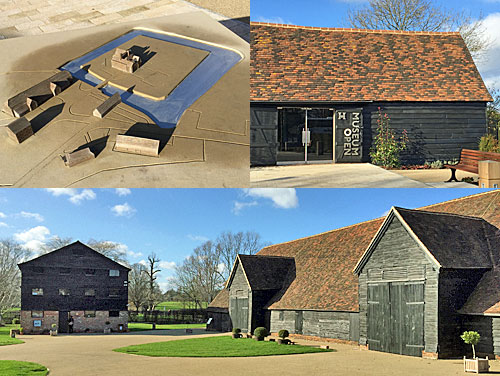
The first time I visited Headstone Manor, in 2008, it was sealed off on its island for urgent renovation. The second time I visited Headstone Manor, in 2013, I went on an eye-opening tour round an empty crumbling relic. Third time lucky. With the aid of a £6m lottery grant and a lot of volunteers' goodwill, the oldest surviving timber framed building in Middlesex reopened in December, triumphantly restored.
The manor was built in 1310, back when the Archbishop of Canterbury owned the land, and is encircled by a proper moat of the same age. Henry VIII owned it for all of eight days, before selling it on, and a succession of wealthy families, then farmers, followed on. Harrow Council eventually ended up in charge, and in 1986 opened a museum here, shifting this into the Great Barn when the need for urgent repairs became apparent. As museums went it was disappointingly lowkey, I thought, but this latest revamp has worked wonders, and highlights not just the history of the site but of the borough.
Entrance is through the Small Barn, again lovingly-scrubbed. Harrow's story is told in an introductory video - short enough to be engaging and informative enough to make residents proud - and a few prehistoric finds are displayed up the back. Stepping out into the main courtyard you'll see the Great Barn, currently being used as a store but soon to be readied again for hire, should you have a summer wedding or celebration you'd like to host in a characterful space. The two-storey Granary contains agricultural implements and various family-friendly activities, and is yours to explore so long as a school party isn't doing its thing. But for the main action, head across the moat via the low-arched bridge, and maybe wave at the ducks as you pass.
The true age of the building is initially shielded by a layer of bricks added by one of the later owners, but various shaky timbers and uneven floors can be seen once you're inside. Having walked round five years ago when surfaces were ropier, and various rooms sealed off lest we put our feet through the floorboards, I was impressed. The parlour is now a meeting and greeting point, and then a trail leads round a warren of rooms upstairs and down. I was surprised that the chosen route works backwards through the history of the place, but I suspect that's to leave the surprise of the biggest room until nearer the end.
Several former residents of the house 'narrate' their story, from the Tudor lady of the house to the farmer's boy watching semi-detached homes rolling in on every side. There is a really nice feature in the Metro-land room where maps of the locale in 1913 and 1935 roll down automatically over an 1895 map of almost entirely fields. As is usual in London the railway was to blame, and the arrival of the London to Birmingham is covered elsewhere, including how it encouraged cookery writer Mrs Beeton to move in and commute.
Various local businesses are showcased, most notably Kodak whose UK factory was at the end of the road, so expect Box Brownies aplenty. Whitefriars Glass moved here in the 1920s, the fire in their furnace originally lit in 1680, and cabinetfuls of their gorgeous decorative ornaments can be found in one of the upper rooms. Hamilton & Co made brushes in Harrow for a century before they decamped to Attleborough in Norfolk, and Winsor & Newton still made paints around here until relatively recently. But mostly the museum tells the story of a house, reflecting turbulent times and workaday ordinariness combined.
All sorts of old wallpapers were uncovered in the restoration, lined up on one downstairs wall for you to peruse. The alphabet wallpaper in a child's bedroom upstairs isn't quite so ancient, but has to come with an explanatory note that the golliwogs represent negative racial stereotypes and are not now socially acceptable. Small visitors will enjoy pretend cooking with plastic vegetables in the bakehouse at the rear, while tall visitors should mind their head on the way down into the Great Hall. What remains is merely the end slice of the original room, which stretched out into what is now the garden, but a sense of its lofty timbered importance remains.
The restored manor and its environs are an amazing resource, and all the better for being so readily accessible. That Heritage Lottery grant made it a condition that the place be free to enter, six days a week, which in this day and age I'd say is remarkable. Such opening hours do require a tireless body of volunteers, however, should you be local and retired and in need of philanthropic direction. The gardening team have thousands of spring bulbs ready to plant, for example, and then there are the May Day celebrations to plan for as the building leaps back to life.
One added extra is the visitor centre deftly positioned just outside, in a building designed to mimic one of the adjacent barns. It's bright and airy, and open daily, and was turning out jacket potatoes and hot drinks even on a weekday in early February. I felt so guilty that nobody had charged me any money for everything I'd enjoyed that I even made sure to sit down with a nice cup of tea and some cake. The full set of nature trails and leaflets was worth the millionaire's shortbread alone. If history's your thing, or you have family who'd enjoy an interactive moated toddle with ducks, head for Headstone.
The UK's first gallery devoted solely to photography opened in Covent Garden in 1971, and more recently moved to a converted warehouse off Oxford Street. It's well hidden, accessed down some steps round the back of Boots, in a grim backstreet where it is easily the standout building. On the ground floor is a cafe frequented by the visually confident, and the basement contains a superbly alluring shop. To get any further up the building, and poke round the galleries, costs £4. But come before noon any day of the week and admission is completely free, so more fool everyone who visits in the afternoon.
The first gallery's two floors up (take the stairwell to your left, or slum it in the lift). At present what's on display are photos of the cast of a groundbreaking Broadway opera, with an all-black cast, from way back in 1934. Intended mostly as publicity shots, the collection is an eye-opening reminder that artistic freedom isn't a recent invention, and brave contemporary work has always had its place. Hike up again, and the fourth and fifth floors feature dozens of polaroids taken by the film director Wim Wenders in the 70s and 80s. The walls are lined by tiny squares of faded Americana, from snapshots of the crowds mourning John Lennon to a bottle of ketchup on a skew-whiff table.
I loved the randomness of his subjects, portrayed in muted shades of yellow and brown. I loved the throwaway nature of the framing, uncommon in an era when every roll of film was precious. But most of all I loved watching a millennial audience walking round agog at how images once used to be captured, then whipping out their phones to upload Wim's blurry images to their own digital cloud. Both exhibitions continue until the end of next week, after which yet another smart take on photography will be displayed in the galleries instead. Arrive after ten but before twelve to enjoy the cheapskate's view.
For fifteenconsecutiveFebruaries on diamond geezer I've kept myself busy by counting things. Ten different counts, to be precise, in a stats-tastic 28-day feature called The Count. You therefore won't be surprised to hear that I intend to do exactly the same again this year, indeed you'd no doubt be disappointed if I didn't. I kicked off this annual exercise way back in 2003, so I now have fifteen years of thrilling historical data to analyse. Expect a post or two of comparisons at the end of the month, if you're vaguely interested, and if you can bear the wait. Here's my selected list of ten countables for February 2018.
Count 1: Number of visits to this blog (Feb 2017 total: 63770) (↑5% on 2016) Count 2: Number of comments on this blog (Feb 2017 total: 752) (↑9%) Count 3: Number of words I wrote on this blog (Feb 2017 total: 33094) (↑6%) Count 4: Number of hours I sleep (Feb 2017 total: 188) (↑8%) Count 5: Number of nights I go out and am vaguely sociable (Feb 2017 total: 6) (↓25%) Count 6: Number of bottles of Becks I drink (Feb 2017 total: 10) (↑900%) Count 7: Number of cups of tea I drink (Feb 2017 total: 122) (↓8%) Count 8: Number of trains I travel on (Feb 2017 total: 108) (↓18%) Count 9: Number of steps I walk (Feb 2017 total: 328070) (↑18%) Count 10: The Mystery Count(Feb 2017 total: 0) (again)
Once again I'll be using an online website called Daytum to keep track of my counts. Daytum is a real-time data tracker which displays numbers in aprettyway, and which somehow hasn't gone offline since I started using it. For a while it'll be displaying last February's totals, but then I'll set everything back to zero and start reporting this year's counts from scratch. I then aim to update my counts on Daytum at least once a day until the 28th of the month, and then I'll come back and tell you how my February went. Who knows, the Mystery Count might even require enumeration this year, although I wouldn't get your hopes up. Stalk away.

The first gallery's two floors up (take the stairwell to your left, or slum it in the lift). At present what's on display are photos of the cast of a groundbreaking Broadway opera, with an all-black cast, from way back in 1934. Intended mostly as publicity shots, the collection is an eye-opening reminder that artistic freedom isn't a recent invention, and brave contemporary work has always had its place. Hike up again, and the fourth and fifth floors feature dozens of polaroids taken by the film director Wim Wenders in the 70s and 80s. The walls are lined by tiny squares of faded Americana, from snapshots of the crowds mourning John Lennon to a bottle of ketchup on a skew-whiff table.
For fifteen consecutive Februaries on diamond geezer I've kept myself busy by counting things. Ten different counts, to be precise, in a stats-tastic 28-day feature called The Count. You therefore won't be surprised to hear that I intend to do exactly the same again this year, indeed you'd no doubt be disappointed if I didn't. I kicked off this annual exercise way back in 2003, so I now have fifteen years of thrilling historical data to analyse. Expect a post or two of comparisons at the end of the month, if you're vaguely interested, and if you can bear the wait. Here's my selected list of ten countables for February 2018.
Once again I'll be using an online website called Daytum to keep track of my counts. Daytum is a real-time data tracker which displays numbers in a pretty way, and which somehow hasn't gone offline since I started using it. For a while it'll be displaying last February's totals, but then I'll set everything back to zero and start reporting this year's counts from scratch. I then aim to update my counts on Daytum at least once a day until the 28th of the month, and then I'll come back and tell you how my February went. Who knows, the Mystery Count might even require enumeration this year, although I wouldn't get your hopes up. Stalk away.