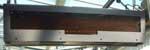
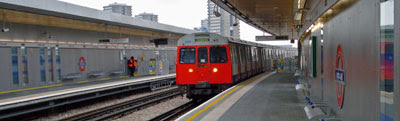
For my third category of well dodgy 'next train' indicators, I'd like to turn to those which present incorrect information. I'm not talking imaginary tube minutes either, I'm talking proper bona fide errors. Here's one such mini disaster area, on the southbound Victoria line at Highbury & Islington. Everything's working fine, except that the left hand side of the display has had the electronic version of a stroke, and the first three characters of every destination have vanished. OK, so that's not too much of a problem on the Victoria line, where virtually every train is going to XTON and only a handful to TORIA. But repairing these semi-broken signs never seems to be a TfL priority. And sometimes the incorrect information can be far more annoying...
NTI uselessness, category 3: Displays giving incorrect information • Seven Sisters (eastbound): Nico says "Often lies outright - sometimes advertises the first 'Stow train as being as much as 14 minutes (14 minutes gap, on the Victoria Line!) away as one comes rumbling in." [photo] [for TfL response, see comments box] • Queen's Park (Bakerloo southbound): I've never known a 'next train' indicator to lie as much as this one. The first train is almost always to Elephant & Castle, which is correct, but its arrival time can be purely fictional. If the time's 11:06, the next train might be given as arriving at 11:07. And then suddenly it'll be 11:08, and then 11:09, and then 11:10, and so the interminable waiting continues. And all because trains can emerge either from the sidings north of the station or from the tracks down from Willesden Junction, and the signalling system rarely seems to have a clue which. • any more? (there must be more)
If you want to see a motley collection of ancient next train indicators, head to Baron's Court. Two thin fingers of platform, each with Piccadilly line services on one side and District on the other, and possibly the easiest interchange on the entire tube network. It's been a very long time indeed since anybody at London Transport installed any new 'next train' indicators here. The two westbound platforms still have those old black lightboxes, one simple, one rather more complex (for everyone who needs to know whether the next train's stopping at Turnham Green or not). And none of these new-fangled digital clocks, oh no, but a proper analogue dial hanging inbetween marked out in Roman numerals. Boris would approve.
But Baron's Court's unsung jewel is the heritage 'next train' indicator on the eastbound Piccadilly line platform. This is how proper station information used to be. A chunky arrow at the top of the sign to indicate on which platform the next service is due. Then 13 glass segments, each with a different destination lurking behind, one of which lights up when a train's on its way. Lovely isn't it. You could almost imagine Trevor Howard and Celia Johnson meeting for a passionate embrace in swirling fog beneath the lightbox. By modern standards, however, this is rubbish. It makes no attempt to mention how many minutes away the next train is. It can't cope with unusual destinations caused by engineering works. And TfL can't scroll important security messages about unattended luggage across the bottom. Actually, I knew there was a reason why I liked it.
There are fewer and fewer of these very old 'next train' indicators on the underground network today. Every time a station gets upgraded (or, in heritage terms, vandalised), these old workhorses are being ripped out to be replaced by something more modern and more functional. And I can see why, because more information has got to be a good thing. But I shall still be sorry to see the last of the old guard go. I hope that this one survives a little longer.
NTI uselessness, category 2: Stations with ancient heritage displays • Upton Park (westbound): This is no ordinary lightbox, this is a burnt-into-the glass lightbox. It doesn't matter whether a train's coming or not, both line options are permanently visible. Look carefully and you may see that one line is more illuminated than the other - that's the service arriving next (sometime). One thing's for sure, however, there'll be no Metropolitan line train trundling down these tracks. There hasn't been for the last 18 years anyway. And any traveller who takes the sign's advice and decides to change for the Metropolitan line at Aldgate East will be sorely disappointed too. As commenter Venichka says, "while one is all for heritage features, accurate non-misleading information is more important." Few objects sum up TfL's cash-strapped-ness better than this particular sign. • along the District/Piccadilly line either side of Hammersmith (including Acton Town) • Uxbridge (they really don't make them like this any more) • Cannon Street • any more? (and no, not Earl's Court, not any more)
Time once again for diamond geezer to go totally tubular, with yetanotherweek devoted to the London Underground. Except this time the week starts on a Tuesday. And, just for a change, I'm devoting the entire series to one particularly annoying station fixture - 'next train' indicators. Because too often they're rubbish. And here's part 1 of why...
Next train: Bow Road
Forgive my indulgence if I kick off a week of ranting about 'next train' indicators by telling you about my local station. In particular, that's the new(-ish) electronic displays at Bow Road. This is the station I use every morning, where I stand expectant and bleary eyed awaiting a train to carry me westward. Sometimes I care about which train is coming next, because it makes a difference whether it's heading for Tower Hill or Kings Cross. Usually I don't care which train's arriving next, because every train on the District and Hammersmith & City lines goes to Mile End, which is where I want to change. But I always care about when it arrives. And there's the problem.
Until three years ago, the eastbound 'next train' indicator at Bow Road looked like this. Standard mid 20th century issue, just a lightbox with illuminable destinations, all black and simple. The indicator on the westbound platform was held together with sticky tape and was even simpler. No destinations here, just an alternating display to tell passengers whether the next train would be on the District line or the Metropolitan line (highly misleading because the Hammersmith and City usurped the Metropolitan out here way back in 1990). And also no overt indication either as to when the next train would arrive. When a westbound train was expected, the box would light up less than a minute before the train rattled into the platform. If the next train was more than a minute away there were no clues, nothing. A blank box could mean two minutes (wait on platform), could mean ten (exit station and walk to Mile End), could mean no trains at all (go home).
So Metronet ripped the old boxes out and installed new state-of the art 'next train' indicators' instead. Huge long dot matrix displays, weakly lit in orange, with updated more detailed scrollable information. Now the westbound indicator could tell us where our trains were going, be it Richmond, Ealing Broadway, Wimbledon or Hammersmith. And, erm, that was it. Still no indication of how far away the next train was, nor any mention of where trains two and three might be going. In short, this expensive upgrade provided virtually no value-added whatsoever. Indeed, given that the new indicators were five seconds slower than their predecessors in announcing the arrival of an approaching train, one could argue they were worse.
Meanwhile, up in the ticket hall, a new 'next train' indicator appeared. It was one of the first of a new breed appearing across the network, listing upcoming destinations to passengers fresh off the street. Alas, this provided no better information than on the platforms. Indeed, with any advance warning being less than a minute, this ticket hall sign usually signalled a train that was already rushing into the platform below. I know, from wearisome experience, that every time I enter the ticket hall to see a westbound train flashed up on the board, I have a less than 50-50 of getting downstairs in time to board it. Sorry TfL, that's not useful information, that's impractical optimism.
And the reason this really annoys me is that at Mile End, one minute down the line, the 'next train' indicators are fully functional. Westbound passengers know precisely where the next three District/H&C trains are heading, not just the next one. And they also know how many minutes away each of those trains is, up to a maximum of six. Hmmm. If Mile End passengers have maximum information, it really shouldn't be rocket science to provide the same half a mile away at Bow Road. It's not as if trains appear or vanish in the tunnel between the two - everything that arrives at Mile End must previously have passed through Bow Road. But no, one station gets the full monty while the station nextdoor merits no monty at all. I feel like a lesser class of traveller.
But there is a reason for TfL's apparent incompetence. It's the signalling that's rubbish, not the displays. Metronet installed the best most appropriate displays available back in 2005, but the District line's signalling system has yet to catch up. Bow Road's 'next train' indicator displays may look modern, but as yet they're incapable of displaying any better 'next train' information than their predecessors. Heritage cabling infrastructure provides only very limited last minute information, and nobody's yet thrown sufficient millions at the signalling problem to fund an upgrade. One day these next train indicators will be able to tell me how long it is until the next three trains arrive, but right now enabling that information is not a priority. I live in hope. But I'm not holding my breath.
NTI uselessness, category 1a: Stations with what look like modern displays, but which await a signalling upgrade
• most of the District line east of Mile End (& especially east of Barking)
• the Metropolitan line west of Rayners Lane: Shiny new displays on both platforms have nothing to report. At Ruislip Manor a carefully positioned leafy branch blocks physical sight of the next train until it's pretty much arrived. Thankfully the lines out here attempt to run to a predictable timetable.
• the Piccadilly line between South Harrow and North Ealing: modern displays, zero information
• Wood Green (southbound): Martin says "the indicator only tells you about the next train as it's pulling into the platform. Apparently this is due to the system's inability to cope with trains which might be emerging from the sidings just to the north of the station (although that doesn't happen very often). The other day it had got the idea that an Uxbridge train was imminent, so that was permanently displayed on the top line, while the train that was actually about to turn up was displayed as the second. Bravo!"
• Turnham Green: Alex says "Big LED screen replacing little light up one with no extra info. Two minutes warning about the next train."
• Ravenscourt Park: Phill says "Only shows the direction of the trains, and occasionally a no smoking flashes up. Even in the ticket hall they have a mini one and all it says is eastbound and westbound. Only been there a year."
• Ealing Common (eastbound): Chloe says "Both platforms only tell you the destination of the approaching train when it's almost in the platform, but the eastbound also flags up "special" at various times in off-peak hours, to indicate that the District Line train pulling into the platform is actually heading for the sidings just past the station, and is just stopping while they alter the points. It's that 'ah, train!...oh, not my train' feeling. And yet someone always walks up to it and presses the button."
• Turnpike Lane
• any more?
NTI uselessness, category 1b: Stations which have no 'next train' indicator whatsoever (awaiting signalling upgrade)
• the Hammersmith & City line between Hammersmith and Paddington (including the newest station on the Underground - Wood Lane). No point in having a 'next train' indicator if the current signalling can't support it. Please listen for announcements.
• West Kensington
• any more?
This is a photo of my Dad. Circa 1939-ish. Having fun with a pram.
Seven decades have now passed. And today this cherubic toddler celebrates his 70th birthday.
I am, of course, nothing like my Dad... I can't paint to save my life. I have no interest in expert gardening. None of my photos has ever won an award. I won't be allowed to retire in my 50s. I don't know a dovetail joint from a mortise. I've never been camping in Italy. I can't bake prize-winning rock cakes. I have been known to break the speed limit. There are no photographs of me in a woggle and short trousers. I have never been a leading national authority on scientific matters. I don't wake up every morning with someone to chat to. I am not a pillar of my local community. I don't have grandchildren. I hate cauliflower. And jazz.
Or maybe we're more similar than I realise... We share a sense of humour. Whenever I sneeze, I think I sound exactly like him. We're both annoyed by the shoddily imprecise and the carelessly misleading. He blogs (and no, I'm not telling you where). We both, independently, bought the same beige sweatshirt from Primark last year. Neither of us have ever voted for... you know, them. We both leave the room when Strictly Come Dancing comes on. Given the choice of a job we believe in or a job that earns more money, we'd both pick the former. I learned my positive outlook on life from him. We're both looking forward to a nice slice of cake this evening.
Before the afternoons darken and the leaves shrivel, there's still time for a glorious autumnal walk in the Surrey Hills. And where better than the peak of the county's chalk uplands, high on the North Downs, at BoxHill? It's not a much-loved visitor-packed viewpoint for nothing. I visited for the first time last Sunday, in surprisingly decent sunny weather, and found the entire experience wholly uplifting. Follow me.
To the car park of the Burford Bridge Hotel. It's unexpectedly simple to get here, via a range of different means of transport, and I'll tell you how at the end of this post. For the time being however, we're off for a hike. It's this hike here, which you can print out and take with with you when you visit. Look up from the A24 and you can see tiny figures ascending the grassy hillside, high above the trees, just a few hundred metres from where we're standing. That's where we're heading, through that gap between the hotel and a hedge, past the National Trust sign. Come on, there are steps, how tough a climb can it be?
Sheesh, that's tough. This is a mighty steep ascent - not exactly mountaineering conditions but still relentlessly upward. It's probably a good idea to stop for a breather before too long, before your heart explodes. Don't worry, you're already so high up that you can turn round and admire the view without looking like you're merely pausing to catch breath [photo]. And continue. The steps peter out after a while to be replaced by a sheer chalk path, and the rocky surface is unexpectedly slippery even in bone dry weather. You might be better off a few metres higher, walking on firmergrassland, striding higher and higher above the Mole Valley. Damned pretty, innit?
At last the contours thin and the path levels out, still climbing but now far more gradually. To the north, across a deep V-shaped ravine, a narrow zig-zag road can be seen clinging to the hillside. It's a mighty testing ascent for cyclists, and a lot of fun for bikers, and probably quite enjoyable in a car so long as you don't meet anything coming the other way. If we keep walking above the cliff edge we'll meet these vehicular travellers at the top soon enough. Onward and upward, then fork left into the woodland past a highly unlikely defensive fortification - Box HillFort. This low concrete and brick structure was built on the hilltop in 1899 as part of London's southern civil defence. It's seems a ludicrous position to defend because any enemy with any sense would march down the valley instead, but that's Surrey for you.
And then, suddenly, civilisation. We've hit a National Trust tourist hub, featuring gift shop, information point and "servery". That's upper-middle-class for café, of course, and it serves up tea and soup and sponge and stuff. Perfect for dismounted muddy mountain bikers and for spotless families recently disgorged from their 4×4 in the nearby car park. Several downland walks kick off from here, the most popular of which is also the shortest - across to the ice cream van and down a grassy slope to the viewpoint[photo]. A huge expanse of green farmland spreads out beneath you, from the nearby town of Dorking way out towards the South Downs in the hazy distance. Double 99 cornet, anyone?
Now for the descent. The path heads into the woods past John Logie Baird's experimental hideaway (before television there was noctivision), before dropping away down a flight of steps. There are a heck of a lot of steps, and you'll get an increasingly smug feeling as you pass wheezing, grimacing, panting visitors making their way oh so steadily upwards. Look, some have even brought toddlers, and pushchairs, and are lugging both impractically up the hillside. Roll on the day when these kids can finally walk unaided without screaming.
And at the bottom, to complete rural perfection, a set of hexagonalsteppingstones lead across the Mole. Wimps who fear slipping into the water can detour via a recent footbridge, but it's far more fun to tread carefully across the stones (minding any dogs scampering energetically between your legs). Pray you don't meet a coach party coming the other way, else you could be waiting on the riverbank for rather a long time. From here it's only a few yards to the main road in the valley, and then a short walk along the pavement returns us to the Burford Bridge roundabout. There are an awful lot of motorbikes on the dual carriageway, aren't there? I wonder why that should be...
How to gethere:
• By car: On the A24 between Leatherhead and Dorking. • By bike: The very best thing about the Burford Bridge car park is Ryka's restaurant[photo]. It's a homespun burger takeaway with a few tables inside (and lots of picnic tables outside), and it's become the major focal point for hordes of southeastern motorbikers. On a sunny weekend afternoon there'll be hundreds of motorcycles parked in the upper car park, some with reverential crowds around them, others revving up for a buzz round the area. You may have to queue for your cheeseburger and chips, but they beat the organic flapjacks at the top of the hill hands down. If only all roadside caffs were as special as this.
• By train: There's a regular service down from London to Box Hill & Westhumblestation, taking less than an hour. Very doable.
• By bus: Believe it or not, you can get to Box Hill on your Oyster card using a London bus. The 465 runs hourly from Kingston on Sundays (every half hour on other days of the week) and drops you off right at the foot of the hill.
• On foot: Go on, make a day of it. I walked to Box Hill from Leatherhead, following the Mole Gap Trail along the river, across the railway and along a high wooded ridge. Great walk, great views, and envious real estate.
As logos go, it's a classic. It's damned simple - just a bar on a circle. It's as iconic as the tube map, or maybe even more so. It's the London Transport roundel. And it's celebrating its centenary this year.
If you're travelling round the Underground today, only a handful of places remain where an original-style roundel can still be seen. One location is at the foot ofthe stairs on the Districtlineplatforms at Ealing Broadway, while another lurks deep beneath the surface at CaledonianRoad. And then there's Covent Garden, right up at the far end of the westbound platform beyond the safety barrier where no mere mortal is permitted to tread. It's a very raw piece of signage, just a blue rectangle across a red enamel disc, with the station name written in some ancient font. But it was a first attempt to introduce consistent visual clarity for passengers, and remains perfectly recognisable to this day. The disc became a loopy circle in 1917, and rapidly spread across the entire network of buses, railways and coaches. I could tell you more, but why bother when the London Transport Museum has put together a perfectly detailed online illustrated history of 100 years of the evolving roundel.
TfL's centenary extravaganza doesn't stop there, oh no. A trio of commemorative roundels have been commissioned - one outside St James's Park station, another at New Shepherd'sBush and a third at Wood Lane. And there's also a celebratory (and rather cheap) exhibition with the catchy title of 100 Years, 100 Artists, 100 Works of Art. The title reveals the concept. The folks at Art On The Underground asked a ton of artists to knock up a bit of art inspired by the roundel. Cost so far, zero. Then they hung all the artworks in a school hall in Shoreditch. Cost so far, probably not much. And (starting tomorrow) they're going to auction off a print of each work in an eBay-style auction. Ultimate profit, probably quite a lot. Value-for-money obsessed Boris is no doubt very proud that these days even heritage contributes to TfL's coffers.
The exhibition's only open for three weeks, so I popped down last night to take a look. Annoyingly the nearest stationdoesn't open for two years, so I faced a considerable trek to reach the backstreets around Arnold Circus. Erm, I think it's around here somewhere, that looks a bit like a Victorian school, where's the way in, and is this door actually open? Ah yes. A welcoming committee of three girls awaited, sat behind a desk piled low with unbought merchandise. And then onward into the high-windowed school hall, a room I had almost to myself. Cue the art.
Ooh, this was a rather diverse selection. The artists have interpreted their brief in a multitude of different ways, some graphic, some literal, some photographic, some abstract and some just wonderfully obtuse. Some looked like the heritage posters of old, while others were considerably more modern. Some made me go "wow, that's clever", and others made me think "pah, I bet they dashed this rubbish off in a few minutes". Proper art, then. But then you can't really go wrong with a roundel. Something circular-ish with something rectangular-ish across it, tarted up a bit, done.
I amused myself by wandering the walls trying to work out which artwork I'd bid for, if I actually did that sort of thing. My eye was taken by the more abstract designs, using the roundel as part of a repeating moquette or as a long distance reveal. Maybe the roundel as a flock of birds, or as a Mobius strip, or as a hole in a sliced loaf. Or maybe the atmospheric landscape in which a shimmering roundel reflected on a tree-shadowed pool. Sir Peter Blake had taken a very colourful geometric approach, which worked strikingly well. But my ultimate favourite was picture number 18 by Henry Coleman, the Venn diagram in which a sea of blue bars morphed effortlessly into a army of red circles. I like my art clever but simple. Which is, essentially, why the adaptable old roundel has survived the century.
Places to go after you've attended Outpatients and been fobbed off with a brusque junior doctor: number 1 The Royal London Hospital Museum (Open Monday to Friday, 10am-4.30pm)
You'd never find it by accident, tucked away in a crypt in a Whitechapel backstreet. Head through hospital reception, across a courtyard garden between wards and clinics, then look around for the swallowed-up church. Down that hidden ramp on the right, past the two off-duty nurses having a crafty fag, and through the big wooden door. It's a bijou museum-ette, detailing the 250 year-old history of East London's premier medical establishment. You might even get the place to yourself, just you and a few old scalpels.
The Royal London's been around a while, long enough to have seen medicine transformed. Operations are no longer carried out using laughing gas and dodgy amputation saws, with staff summoned by a ringing bell. Nurses no longer wear starched hats, or wield shiny pocket watches, or rush off to the trenches to save dying soldiers. And doctors no longer make teeth for George Washington, or minister to the Elephant Man, or mop up after Jack the Ripper. Ah yes, there's some proper history here alright.
Don't come expecting an extensive collection - you'll not be here more than 20 minutes (unless you sit down to watch one of the videos featuring Joseph Merrick or Casualty 1906). And don't come expecting to fork out lots of cash, not unless you're keen to buy something from the little shop (or to leave a donation for the museum's upkeep). But docome if you fancy somewhere little, and a little different, for a poke around inside a dedicated world of social service.
n.b. London has rather more of these medical museums than you might realise - see here for a full list.
I'm still looking for your help. Regarding "next train" indicators. Because too often they're rubbish.
You've already suggested lots of stations at which the next train indicators are unfit for purpose. Thanks for that. Although many are scattered all over the place, it's interesting that others exist in linear clusters. Some are merely awaiting signalling upgrades, whereas the most disturbing displays are blighted by cretinous positioning. Here are the bloody awful next train indicators you've mentioned so far.
District/H&C: Aldgate East, Whitechapel, Mile End, Bow Road, West Ham, Plaistow, Upton Park (westbound), East Ham, Barking (platform 3) Circle: Edgware Road, Paddington, High Street Kensington (northbound), Gloucester Road, South Kensington (eastbound), Cannon Street, Tower Hill (eastbound) Piccadilly: Northfields, Acton Town, Holborn (northbound), Wood Green (southbound) Metropolitan: Wembley Park, all stations west of Rayners Lane Jubilee: North Greenwich (westbound), Bond Street (northbound) Central: Oxford Circus (eastbound), Holborn (eastbound), Mile End Victoria: Finsbury Park (southbound) Northern: Golders Green (southbound) DLR: Canary Wharf
I shall be trundling around the railway network over the next week to investigate these supposed signage disaster areas. But if you know of any more, I'd be much obliged to hear about them. Together maybe we can name and shame TfL into displaying some competence.
Continuity Announcer: Good afternoon boys and girls everywhere. Next on the British Broadcasting Television Service we have a very special programme for you. The first edition of an exciting new children's magazine programme entitled BluePeter...
» Drumroll, followed by jaunty nautical hornpipe played by the Chalk Farm Salvation Army Brass Band
Christopher: Hellay children. Hellay Leila. That's a very nice doll's house you have there. I'm so looking forward to seeing inside. And I've been playing with trains. Would you like to see my layout? Valerie: Our Summer expedition to Ceylon was a great success. And I must say, it came as a big surprise to wake up in my beach hut and find Princess Anne in the bed next to me. John: So Biddy said, "John, you're going to be the first man to parachute handcuffed off the top of Nelson's Column". But she forgot to tell me that Shep would be coming too. Peter: It's that time of year again when we take Freda the tortoise out of her cardboard box, wipe her eyes with a tissue and hope to goodness she's still alive.
» Historical re-enactment in which Lesley dresses up as Florence Nightingale and walks around Hammersmith Park carrying a lamp
Simon: If you're slightly too cool to be watching me interview a school orchestra from Plymouth, you might prefer to switch over to ITV and watch Magpie instead. Tina: And the winner of the Under 5s category, and of the entire competition, is this oil painting by Marcus Parsons from Solihull. Well done Marcus, but we're not stupid and we'll be sending your special prize to Mrs Parsons instead. Sarah: Thank you for all the socks and teaspoons you've been sending in. As you can see, the totaliser is now flashing away at the 4000 mark, which is great news for the starving donkeys of Mozambique. Janet: Sorry Biddy, I appear to be pregnant. Obviously I'll resign immediately.
» Peter tries hard to be John Noakes by riding a motorbike blindfold through a flooded pipe, but the nation is not impressed
Percy: Oh my god no, look what the bastard vandals have done to my Italian Sunken Garden. They'll hang for this, I tell you (sob) Mark: You can see all of our favourite adventures from the last 12 months regurgitated in this year's Blue Peter Annual, which no doubt some well-meaning auntie will buy you for Christmas. Look, that's me on the front cover wearing a chunky-knit tartan tank top. Yvette: What ghostly goings on have haunted the dungeons of this old castle? Ohmigod! WhatWasThat! Something touched my leg... Hang on, sorry, I'm about two decades too early. Anthea: You'd never guess that this rather amateurish looking International Rescuesimulation started out as three squeezy bottles, a box of cheesy triangles and some rubber solution glue.
» Diane-Louise sticks another pin in the map to show the location of a Bring and Buy Sale in a front garden in Dumfries that has raised "an impressive £2.70"
John: After my special flight riding in Concorde's cockpit, I took two of the air hostesses back to my hotel room and showed them the true meaning of supersonic. Stuart: You can make this Advent crown out of two coathangers and some flameproof tinsel, but it might be quicker to re-use any of the umpteen crowns we've urged you to construct over the last few decades. Konnie: Your Blue Peter Badge will get you free entry to hundreds of tourist attractions across the country. I've scooped 100 from a box in the office and I'm selling them for a fortune on eBay. Richard: *cough* no, really, that white powder on my upper lip is just leftover glitter from this Christmas card I made earlier.
» Katy attempts to give a guide dog a wash in a tin bath in the studio, and gets very wet in the process. In universities all across the UK, students set their video recorders.
Matt: Oh damn, the Blue Peter Box for the Year 2000 has let in water and is full of soggy mush. Liz: We asked you what to call our brand new kitten, and your votes said "Kitty". But that's a bloody naff name so we've picked "Mittens" instead. It's OK, nobody'll ever catch us out. Gethin: That's all we have time for, but we'll be back in our next show with a song from McFly, a report on hang-gliding and something cheap to make for Mother's Day out of a matchbox and some sticky-backed plastic. Andy/Helen/Joel: Hey, we may be nobodies at the moment, but one day we'll be as famous as John, Val and Peter. In our dreams.
» Drum'n'bass representation of Barnacle Bill (also available to download as ringtone)
Continuity presenter: Yeah, right, that was great, that was Blue Peter, yeah, massive. And if you want to catch the next programme, it'll be hidden away on CBBC at 10am on a Wednesday, because us modern kids don't watch no TV no more, wicked.
Wood Lane » Station opened: Sunday 12th October 2008 [press release] » It's not the two previous Wood Lane stations: That's the oneontheCentralLine (1908-1947) and the one on the Metropolitan Line (1908-1914 & 1920-1959). Both opened for the Franco-British Exhibition at White City. Neither was on the same spot as the new station. [map][map] » New station mostly funded by:Westfield, the mega-shopping über-retail complex opening at the end of the month, perfectly timed for the nadir of global recession. » Change here for: Westfield (obviously); BBC Television Centre (directly across the road, except there's a barrier and a six-foot drop in the way); White City station (only 250m away, but sorry, we couldn't afford a direct interchange). » The front of the station looks like: a very long metal & glass letterbox [photo] » The ticket hall: doesn't have a ticket office, just a lot of machines. Now that everyone has Oyster, ticket offices are a thing of the past. » The ticket hall feels like: a giant funnel (very broad at the front, fairly narrow at the rear). » Cross to the westbound platform: by passing beneath an atmospheric low brick arch, part of the original railway viaduct [photo] » Passengers in a wheelchair: can pop up to the platform by lift. » The stairs are: light, wide and airy [photo] » The platforms: curve gently out of sight (please mind the gap between the train and the platform edge) [photo] » Seating is: vandal-proof and therefore not terribly comfortable [photo] » The next train indicators are: non-existent (as at all other stations along this stretch of line). » The station is:spacious, clean and efficient.
Shepherd's Bush Market » Station opened: Wednesday 1st April 1914, as Shepherd's Bush. » Station renamed:Sunday 12th October 2008, because all of a sudden there are rather too many other stations named Shepherd's Bush. » New station named after: a long string of characterful stalls beneath the railway viaduct, many of them Sikh-run, selling clothing and Afro-Caribbean food and all the usual market staples, and about as far away from the Westfield megabucks chainstore experience as it's possible to get [photo] » Change here for:Shepherd's BushMarket (obviously); Shepherds Bush Empire (queue here for Cyndi Lauper); proper shops. » The other station which could have been renamed Shepherd's Bush Market (because it's just as close, but at the southern end): Goldhawk Road. » The front of the station looks like: the featureless entrance to a tiled public convenience [photo] » The ticket hall: has a ticket office, some out-of-date maps and a handful of barriers [photo] » The ticket hall feels like: a rather squashed passageway. » The stairs are: enclosed, steep and narrow. » Passengers in a wheelchair: are completely stuffed. » The platforms: have a protective wooden canopy at one end, and nothing much at all at the far end. » Seating is: a series of recently-replaced metal benches. » The next train indicators are: non-existent (as at all other stations along this stretch of line). » The station is: compact, weatherbeaten and outclassed.
WALK HARROW Somewhere pretty: London Loop section 15 Hatch End to Stanmore (5 miles)
One thing Harrow has in spades is open space. A third of the borough is Green Belt, including most of a broad northern strip, and by London standards this is landscape heaven. I chose to follow one of the capital's major strategic walks across fields, through woodland and past an ornamental death pond. And it was all the better because almost nobody else had had the same idea.
To Hatch End station, clutching a pdf printout of London Loop section 15. I would have preferred the proper leaflet, except the folk at Walk London are incredibly protective of their 55 strategic walk leaflets and permit dispatch of only three per online request. I'd soon be extremely lost as a result of their excessive prudence. My reduced-size, mostly-grey, deskjet route map proved to be a hopeless indicator of direction, even within the first few minutes. It is this way, isn't it? Big field, ambiguous wording, too many potential exits, not enough signs. Help, I appear to be stuck on the wrong side of a prickly hedge. But eventually I worked out how to get back on track, and passed through a gate, and... [Sorry, at this point the London Loop crosses into Hertfordshire for about a mile, which isn't Harrow, so I'm not going to tell you about it. Especially the snooty golfers.]
Is this track really called Ass House Lane? Apparently so. And apparently it crosses a pre-historic earthwork called Grim's Dyke, although I'm still not convinced I actually saw it - the shallow earth trench I spotted could have been any other non-ancient feature. The woodland here forms the edge of Harrow Weald Common, and this end was once part of a landscaped garden belonging the famous comic librettist W. S. Gilbert. He lived in Grim's Dyke (the house, not the ditch) for 20 years, and was especially proud of his ornamental lake complete with boathouse and central island. Alas, this lake was to lead to his untimely death. One day in 1911 a young female house guest got into difficulties while swimming, and when Gilbert jumped in to assist he suffered a fatal heart attack. His widow had the lake drained, and it's now just an eerie vegetated hollow in the woods [photo]. Meanwhile Gilbert's gorgeous home, much praised by Betjeman in his Metroland documentary, has become a rather desirable hotel[photo].
Just to the south, along Old Redding, is a large car park with impressive panoramic views over northwest London. I'd never spotted this before, despite having visited the pub nextdoor, and I enjoyed the opportunity to watch the planes landing at Heathrow eight miles away. After dark, however, it wouldn't surprise me if this car park transforms into prime dogging territory - it had that look about it.
My walk returned into the deserted woods, striding along not-quite muddy paths beneath yellowing leaves. Roll on autumn, I say, if it looks like this. And then across a main road into Bentley Priory Open Space. A concrete path skirted the edge of something top secret and secure, which I later discovered was one of the country's most important airforce bases. RAFBentleyPriory was the headquarters of Fighter Command during the Second World War, and the entire Battle of Britain was directed by officers holed up in the manor house. It's an enormous site, barely visible beyond ubiquitous security fences, and currently undergoing a period of enormous change. The RAF station here closed with a flourish at the end of May 2008, and future plans include less exciting things like a museum and lots and lots of luxury apartments. The perfect gated community, I fear.
Next, on my poorly signposted walk, to Stanmore Common. The official route weaved between two tree-fringed ponds [photo], then passed a rugby pitch where 30 overweight blokes were grunting in the late afternoon sunlight. And then, at a nearby residential enclave named 'Little Common' (which oh so definitely wasn't common), I decided to break my journey. The London Loop continues from here to Aldenham reservoir and Elstree, but they're back in Hertfordshire and that was off limits. Instead I headed south down the hillside, through Stanmore Country Park and back to the edge of the tube network. These strategic walks are great for taking you the non-obvious route via the green bits, and my autumnal stroll had shown northern Harrow in a glorious light. by train/tube: Hatch End, Stanmore by bus: H12
Somewhere random: The Answer Lies At The End of The Line Some days it seems that any old reason will do. For modern art, I mean. Whether it's shoving bunkbeds in the Tate Modern to simulate Armageddon, or flooding the roof of the Hayward Gallery as a parodic intervention, it seems modern artists can get away with anything. In the case of Stanmore station, it's all about publishing a book of crosswords. Artist Serena Korda was inspired by the fact that secret wartime codebreakers deciphered Hitler's secrets in a military outpost on the corner of Brockley Hill, and has assembled a collection of interconnected cruciverbalist art. There are eight crosswords altogether, compiled around some very local themes (such as the Royal National Orthopaedic Hospital and the Stanmore Bowls Club). You're supposed to be able to pick up a booklet from Jubilee line stations, but they're so rare that downloading the pdf is likely to be a more profitable pursuit. Go on, you're not doing any real work this afternoon.
If you get stuck on the clues, that's where a trip to Stanmore station comes in [photo]. There are linocut posters at the northern end of the platform giving hints to certain solutions (yes, 12 across really is "QUAGGA") and praising celebrated crossword setter Roy Dean. There are further hints on the stairs (yes, "saw nothing" is an anagram of "WASHINGTON"), although you get funny looks from passing commuters if you pause too long to read them. Still not enough help? Never fear, because the solution for each of the eight puzzles has been painted onto the roof high above the ticket hall, each grid surrounded by ornate swirly artwork. The Answer Lies at the End of the Line. So if you haven't solved Serena's crosswords before the end of January, you'd best travel out here to Zone 5 to take a look. by tube: Stanmore by bus: 142, H12
Somewhere historic: Headstone Manor I wonder how many of Harrow's residents realise that their borough has a museum. It's not especially easy to find, hidden away in a little-known suburb in the middle of a recreation ground, and you wouldn't walk past it by mistake. But there's a reason why the museum's here, because it's housed in a suite of the borough's very oldest buildings. Headstone Manor dates back to the early 14th century and is the only scheduled ancient monument in Middlesex still to have a water-filled moat. Yes, really. Before Saturday I never realised it was here either.
That's Headstone Manor, the old-looking house with the sharp-sided chimneypots almost visible across the water [photo]. It's hard to reach at the moment, with both moat and bridge screened off behind a blue metal wall while lengthy renovation work is being completed. The museum has been running tours of the Manor every weekend during the summer should you want to get closer, but only if you're around at 3pm (and I wasn't). Instead I had to make do with a printed history posted up in the small barn nextdoor. The manor's main claim to fame is that Henry VIII owned it. Having read the smallprint, however, it turns out that he only owned it for six days before selling it on, making a profit of £7337 8s 8d. Not a great claim to fame, but it'll have to do.
The museum proper is housed in the Manor's 500 year-old Tithe Barn[photo]. To be honest, I found the timber framed building considerably more interesting than its contents. Up at one end of the long room was a rather flat exhibition about Tudor life in the borough, which could have been an exhibition about Tudor life anywhere in England (highlight - "Unfortunately there is no evidence to prove that any of the Tudor monarchs visited Harrow."). Further down the barn was a bit of a shop, and a few chairs, and not many exhibits. Plus a man in a kitchen serving up drinks to all the kids and parents frequenting the football pitches nextdoor, whose weekly league action probably keeps the museum's finances afloat.
The one remaining building on site was the Granary, shifted here from a farm elsewhere in the borough, and now housing some old farming equipment. You can just imagine school trips trooping in here during the week for a bit of hands on agricultural history and a chance to learn what great gran's kitchen used to look like. Upstairs were some less child-friendly exhibits remembering important local businesses, such as London's premier Kodak factory (which lingers on just down the road) and the Whitefriars Glass Factory (now departed). Nothing here (or anywhere on site) detained me for long, but I'm genuinely sorry to have missed the tour round the manor. by train: Headstone Lane by bus: H9, H10, H18, H19
Somewhere famous: Heath Robinson's house One of the most celebrated proponents of the art of mechanical whimsy was W.HeathRobinson. He started out as a book illustrator, before progressing into the design of ludicrous yet intricate contraptions for carrying out everyday or slightly surreal tasks. His talented penmanship lovingly conveyed machines for such unlikely tasks as brolly-testing, indoor mountain climbing and even "resuscitating stale railway scones". Robinson moved from Holloway to Pinner in 1908, and his detached house at number 75 Moss Lane[photo] now displays a blue plaque in his honour. Moss Lane is a delightful suburban avenue, very Metroland, very aspirational, although I saw no sign of any automated lawn sprinklers or steam powered grass-mowing devices in any of the gardens.
The William Heath Robinson Trust hold many of his humorous artworks, and plan to showcase them in a new museum at West House in Pinner Memorial Gardens [photo]. But the old mansion requires considerable restoration, at great cost, and completion remains some years off. For now West House remains only partly rebuilt behind graffitied barriers and, to my eyes, appears disconcertingly modern looking. The Pinner Association continues to campaign and fund raise for its completion, and will hopefully provide the town with its first steampunk tourist attraction. by tube: Pinner by bus: 183, H11, H12, H13
see also: • Mrs Beeton's House: Britain's first celebrity chef spent the first five years of her married life at number 2 Chandos Villas in Hatch End. Here she plagiarised recipes for publication in her publisher husband's magazine, and these articles were later compiled into the famous Book Of Household Management. Alas poor Isabella died young, from puerperal fever, at the tender age of only 28. Her house in the Uxbridge Road survived until 1940 when it was destroyed in an air raid, and the site is now home to Hatchets restaurant [photo]. Given that bangers and mash here will set diners back £12.50, I doubt they're still using Isabella's recipes. • Elton John's House: That's 55 Pinner Hill Road where a musical boy called Reg Dwight grew up. For some inexplicable reason a two-year-old photograph of this desperately ordinary semi is my second most viewed photograph on Flickr.
Yesterday my jamjar directed me to the leafy northwestern suburbs, to Harrow. This part of London was almost all fields until the railways came, before morphing rapidly into Betjeman's luxuriant Metroland. ModernHarrow is still full of big houses and wide-open Green Belt spaces. It's London trying to be Hertfordshire. It's the borough with the capital's lowest crime figures. It's far more racially diverse than you might expect. It's not rammed with places of interest, but it's still a very pleasant place to be. Let's start today in Harrow itself, a town in two very different parts.
Somewhere sporting: the playing fields of Harrow There are two Harrows - the elite on the hill and everybody else down below. The famous public school got here early, founded in 1572, and perches atop the summit as befits its perceived importance. The Metropolitan Railway got here relatively late, in 1880, and populated the surrounding fields with upwardly mobile state-school fodder. The contrast between the two areas is considerable.
For the boys at Harrow, on the hill, Saturday's just another school day. Bad luck lads. There are assemblies to attend, and lessons to endure, and of course lots of character building sports to play. The school's famous playing fields are located in broad sweeping meadows at the foot of Harrow hill. They're all decked out for rugby at the moment, although when I passed through first thing yesterday morning the posts stood alone amidst the clearing mist. Things would have been very different come 2.30pm when the Radley College 2nd XV were due to run out for a ruck, along with a myriad of lesser competitive matches on the surrounding pitches. Lots of mud, lots of cracking bones and lots of housemasters yelling critical encouragement at the tops of their voices from the touchline. Three cheers for the gallant losers, rah rah rah. And then for the home team, following every single match (or practice), an absolutely knackering walk up the long steep slope of Football Lane back to the boarding houses on the hilltop. They're clearly evil sadists, these Harrow games teachers.
The school itself is a large collection of motley buildings strung out around the High Street, many of them large, Gothicky and impressive. But this is no exclusive campus - there are shops and restaurants and bijou cottages scattered inbetween, and every now and then a double decker bus thunders right through the middle on its way to Watford. Some of the surrounding lanes are narrow, contoured and gorgeous, and the sort of desirable place to live that's seen more often in the Cotswolds than a mere 10 miles from Charing Cross. At the top of West Street there's a special musty shop where boys can buy cufflinks and hand-sewn name labels, and on the village green another selling sensible shoes, hockey sticks and cricket flannels. Most of the other shops and restaurants seem to be aimed more at pupils' parents, or possibly aspirational sixth formers attempting to spend a little of Daddy's City bonus. This exclusive enclave may jar a little with the world outside, but upper Harrow still has the edge over Eton as an endearing educational establishment.
As I passed through, the street suddenly filled with students exiting whatever mass communal gathering the school insists they attend every Saturday morning. They seemed to be pouring out of the Library, or maybe George Gilbert Scott's grand chapel, and heading back to their boarding houses before lessons began at 11. And it's true, the boys really do wear straw boaters as a matter of course and without a flicker of embarrassment. Attending school here must be really character-building. It looked as if box files and ring binders were also an official part of the Harrow school uniform, because every boy was clutching at least two or three. I decided to get out of the way, because it's not good form to be wandering amongst schoolboys with a camera, and ascended swiftly to St Mary'sChurch at the very top of the hill.
The church is half a millennium older than the school, and always seems to be surrounded by earnest gardeners with secateurs and wheelbarrows. It pays off, the churchyard's immaculate. Lord Byron used to come up here a lot as a schoolboy, inspired by the panoramic views to the west, and a memorial now marks the spot. I can only imagine that the trees have grown quite a lot since his day, because the view's not as clear as it once was. Nearby is the grave of London's first railway accident amputee (one shouldn't laugh, but his epitaph is ridiculously melodramatic). And the hill has one further unfortunate claim to fame - it's the site of Britain's first fatal motorist accident. I descended to the main town with great care. by bus: 258, H17
Somewhere retail: Harrow town centre The shopkeepers of Harrow are worried, and not just by impending economic slowdown. Their metropolitan centre ought to be the retail destination of choice for a million Londoners, with the nearest serious competition far away in Watford, Uxbridge or Brent Cross. But the new Westfield London megaplex, due to open in Shepherd's Bush in a couple of weeks, could prove one lure too many. Harrow's shops are nothing extra-special, just your typical large town department stores and high street chains. Be very afraid.
A metal arch stands over the southern entrance to the main shopping precinct, heralding such delights as a bookies, a pizzeria and an Iceland supermarket. Don't worry, the shops pick up in quality beyond Katie's statue. The Queen unveiled this bronze of a merrily skipping girl to celebrate the borough's golden jubilee, although heaven knows why. All the major chain stores may be present, but St Ann's Shopping Centre has been sucked dry of any ounce of character whatsoever. It's a soulless plastic mall alongside an artificial retail boulevard, and probably last had a buzz when Princess Diana opened the place in 1987. The St George's Shopping and Leisure Centre is a little showier and more decoratively 90s, but also smaller (so they could only rustle up Catherine Zeta Jones). Its first floor balcony seems to be the chosen place to hang out if you're a bored girl in a puffa jacket, however.
I bought nothing in any of these places, but instead took my wallet to the local Gayton Library. Harrow Borough Council are very precious about their five Heritage Trail leaflets and refuse to make them available on the internet, preferring instead to charge 50p for each and restrict their sale to the borough's libraries. I confused the girl at the front desk by asking for the full set. She had to ask where the leaflets were (er, they're in that locked glass cabinet in front of the desk), and then another librarian set off around the building to try to track down the key. Five minutes later she finally found it, and extricated the leaflets, and even took the second copy off the pile of Grimsdykes because the top one was very slightly over-folded. I was desperately impressed. If you live in the area, and especially if you have a family to keep occupied, these colourful and illuminating leaflets would provide a fascinating way to fill an afternoon. You'll be glad to hear that central Harrow is not included. by tube: Harrow-on-the-Hill by bus: anything from H9 to H19
Random borough (19): Time yet again for me to take another random trip to one of London's 33boroughs. As I write I have no idea which one of the 15 remaining borough names will be revealed when I unfold the slip of paper I'm about to pick from my legendary (and as-yet unseen) "special jamjar". I could pick any one of the other London boroughs - inner or outer, urban or suburban, small or large, fascinating or dull. I just know it won't be Merton, Islington, Enfield, Sutton, Lewisham, Southwark, Kensington & Chelsea, Hackney, Hillingdon, the City, Bromley, Lambeth, Tower Hamlets, Haringey, Hounslow, Brent, Redbridge or Ealing because they're the eighteen (dark grey) boroughs I've picked out already.
I'm now well into the second half of my haphazard capital odyssey. There's a fair chunk of East London still to visit, and a swirl of boroughs across west London, plus Croydon, but that's all. Which of these leftovers will be my destination for the day? Will I be treated to the cultural highlights of somewhere central and important, like Westminster or Camden? Or will I be dispatched somewhere rather more peripheral and off-radar, like Barnet or Bexley? Watch this space.
Once I've researched my randomly-chosen borough online then I'll head off and visit some of its most interesting places (assuming it has any). As usual I hope to visit somewhere famous, somewhere historic, somewhere pretty, somewhere retail, somewhere sporty and somewhere random. I might even take lots of photographs while I'm at it, if the borough's photogenic enough. Then after I've made my grand tour I'll come back tomorrow and tell you all about it. Let's see where I'm going this time...
I need your help. It's all about these things - "next train" indicators. Because too often they're rubbish.
They fail to tell you when the next train's arriving. They fail to tell you where the next train's going. They have illegible flickery electronic text. They count using non-mathematical elongated minutes. They're hidden behind "Way Out" signs so you can't read them. They're obstructed by unnecessary security cameras. They're visible from only a fraction of the platform. They're often new, but worse than the ancient indicator they've replaced. Many have clearly been installed by morons.
So it's time to take action. I'm planning to put together a series of posts about TfL's worst "next train" indicators. I'm going to kick off by nominating Bow Road, westbound platform (and in a couple of weeks I'll write a very long whingy post about it). I know of several other incompetent "next train" indicators, and you lot pointed out plenty more signage disasters via my comments last Saturday. But now I want more. If you know of any additional bloody hopeless London-based "next train" indicators, please let me know. I'd prefer some detail in an email, but sticking a brief mention in the comments box would be good enough and then I can go and research the offending station for myself. Together maybe we can name and shame TfL into displaying some competence.

For my third category of well dodgy 'next train' indicators, I'd like to turn to those which present incorrect information. I'm not talking imaginary tube minutes either, I'm talking proper bona fide errors. Here's one such mini disaster area, on the southbound Victoria line at Highbury & Islington. Everything's working fine, except that the left hand side of the display has had the electronic version of a stroke, and the first three characters of every destination have vanished. OK, so that's not too much of a problem on the Victoria line, where virtually every train is going to XTON and only a handful to TORIA. But repairing these semi-broken signs never seems to be a TfL priority. And sometimes the incorrect information can be far more annoying...
If you want to see a motley collection of ancient next train indicators, head to Baron's Court. Two thin fingers of platform, each with Piccadilly line services on one side and District on the other, and possibly the easiest interchange on the entire tube network. It's been a very long time indeed since anybody at London Transport installed any new 'next train' indicators here. The two westbound platforms still have those old black lightboxes, one simple, one rather more complex (for everyone who needs to know whether the next train's stopping at Turnham Green or not). And none of these new-fangled digital clocks, oh no, but a proper analogue dial hanging inbetween marked out in Roman numerals. Boris would approve.
But Baron's Court's unsung jewel is the heritage 'next train' indicator on the eastbound Piccadilly line platform. This is how proper station information used to be. A chunky arrow at the top of the sign to indicate on which platform the next service is due. Then 13 glass segments, each with a different destination lurking behind, one of which lights up when a train's on its way. Lovely isn't it. You could almost imagine Trevor Howard and Celia Johnson meeting for a passionate embrace in swirling fog beneath the lightbox. By modern standards, however, this is rubbish. It makes no attempt to mention how many minutes away the next train is. It can't cope with unusual destinations caused by engineering works. And TfL can't scroll important security messages about unattended luggage across the bottom. Actually, I knew there was a reason why I liked it.
• Upton Park (westbound): This is no ordinary lightbox, this is a burnt-into-the glass lightbox. It doesn't matter whether a train's coming or not, both line options are permanently visible. Look carefully and you may see that one line is more illuminated than the other - that's the service arriving next (sometime). One thing's for sure, however, there'll be no Metropolitan line train trundling down these tracks. There hasn't been for the last 18 years anyway. And any traveller who takes the sign's advice and decides to change for the Metropolitan line at Aldgate East will be sorely disappointed too. As commenter Venichka says, "while one is all for heritage features, accurate non-misleading information is more important." Few objects sum up TfL's cash-strapped-ness better than this particular sign.
Time once again for diamond geezer to go totally tubular, with yet another week devoted to the London Underground. Except this time the week starts on a Tuesday. And, just for a change, I'm devoting the entire series to one particularly annoying station fixture - 'next train' indicators. Because too often they're rubbish. And here's part 1 of why...
Forgive my indulgence if I kick off a week of ranting about 'next train' indicators by telling you about my local station. In particular, that's the new(-ish) electronic displays at Bow Road. This is the station I use every morning, where I stand expectant and bleary eyed awaiting a train to carry me westward. Sometimes I care about which train is coming next, because it makes a difference whether it's heading for Tower Hill or Kings Cross. Usually I don't care which train's arriving next, because every train on the District and Hammersmith & City lines goes to Mile End, which is where I want to change. But I always care about when it arrives. And there's the problem.
Until three years ago, the eastbound 'next train' indicator at Bow Road looked like this. Standard mid 20th century issue, just a lightbox with illuminable destinations, all black and simple. The indicator on the westbound platform was held together with sticky tape and was even simpler. No destinations here, just an alternating display to tell passengers whether the next train would be on the District line or the Metropolitan line (highly misleading because the Hammersmith and City usurped the Metropolitan out here way back in 1990). And also no overt indication either as to when the next train would arrive. When a westbound train was expected, the box would light up less than a minute before the train rattled into the platform. If the next train was more than a minute away there were no clues, nothing. A blank box could mean two minutes (wait on platform), could mean ten (exit station and walk to Mile End), could mean no trains at all (go home).
So Metronet ripped the old boxes out and installed new state-of the art 'next train' indicators' instead. Huge long dot matrix displays, weakly lit in orange, with updated more detailed scrollable information. Now the westbound indicator could tell us where our trains were going, be it Richmond, Ealing Broadway, Wimbledon or Hammersmith. And, erm, that was it. Still no indication of how far away the next train was, nor any mention of where trains two and three might be going. In short, this expensive upgrade provided virtually no value-added whatsoever. Indeed, given that the new indicators were five seconds slower than their predecessors in announcing the arrival of an approaching train, one could argue they were worse.
Meanwhile, up in the ticket hall, a new 'next train' indicator appeared. It was one of the first of a new breed appearing across the network, listing upcoming destinations to passengers fresh off the street. Alas, this provided no better information than on the platforms. Indeed, with any advance warning being less than a minute, this ticket hall sign usually signalled a train that was already rushing into the platform below. I know, from wearisome experience, that every time I enter the ticket hall to see a westbound train flashed up on the board, I have a less than 50-50 of getting downstairs in time to board it. Sorry TfL, that's not useful information, that's impractical optimism.
This is a photo of my Dad.
Before the afternoons darken and the leaves shrivel, there's still time for a glorious autumnal walk in the Surrey Hills. And where better than the peak of the county's chalk uplands, high on the North Downs, at Box Hill? It's not a much-loved visitor-packed viewpoint for nothing. I visited for the first time last Sunday, in surprisingly decent sunny weather, and found the entire experience wholly uplifting. Follow me.
Sheesh, that's tough. This is a mighty steep ascent - not exactly mountaineering conditions but still relentlessly upward. It's probably a good idea to stop for a breather before too long, before your heart explodes. Don't worry, you're already so high up that you can turn round and admire the view without looking like you're merely pausing to catch breath [photo]. And continue. The steps peter out after a while to be replaced by a sheer chalk path, and the rocky surface is unexpectedly slippery even in bone dry weather. You might be better off a few metres higher, walking on firmer grassland, striding higher and higher above the Mole Valley. Damned pretty, innit?
And then, suddenly, civilisation. We've hit a National Trust tourist hub, featuring gift shop, information point and "servery". That's upper-middle-class for café, of course, and it serves up tea and soup and sponge and stuff. Perfect for dismounted muddy mountain bikers and for spotless families recently disgorged from their 4×4 in the nearby car park. Several downland walks kick off from here, the most popular of which is also the shortest - across to the ice cream van and down a grassy slope to the viewpoint [photo]. A huge expanse of green farmland spreads out beneath you, from the nearby town of Dorking way out towards the South Downs in the hazy distance. Double 99 cornet, anyone?
And at the bottom, to complete rural perfection, a set of hexagonal stepping stones lead across the Mole. Wimps who fear slipping into the water can detour via a recent footbridge, but it's far more fun to tread carefully across the stones (minding any dogs scampering energetically between your legs). Pray you don't meet a coach party coming the other way, else you could be waiting on the riverbank for rather a long time. From here it's only a few yards to the main road in the valley, and then a short walk along the pavement returns us to the Burford Bridge roundabout. There are an awful lot of motorbikes on the dual carriageway, aren't there? I wonder why that should be...
• By bike: The very best thing about the Burford Bridge car park is Ryka's restaurant [photo]. It's a homespun burger takeaway with a few tables inside (and lots of picnic tables outside), and it's become the major focal point for hordes of southeastern motorbikers. On a sunny weekend afternoon there'll be hundreds of motorcycles parked in the upper car park, some with reverential crowds around them, others revving up for a buzz round the area. You may have to queue for your cheeseburger and chips, but they beat the organic flapjacks at the top of the hill hands down. If only all roadside caffs were as special as this.
100 years of the roundel
If you're travelling round the Underground today, only a handful of places remain where an original-style roundel can still be seen. One location is at the foot of the stairs on the District line platforms at Ealing Broadway, while another lurks deep beneath the surface at Caledonian Road. And then there's Covent Garden, right up at the far end of the westbound platform beyond the safety barrier where no mere mortal is permitted to tread. It's a very raw piece of signage, just a blue rectangle across a red enamel disc, with the station name written in some ancient font. But it was a first attempt to introduce consistent visual clarity for passengers, and remains perfectly recognisable to this day. The disc became a loopy circle in 1917, and rapidly spread across the entire network of buses, railways and coaches. I could tell you more, but why bother when the London Transport Museum has put together a perfectly detailed online illustrated history of 100 years of the evolving roundel.
The exhibition's only open for three weeks, so I popped down last night to take a look. Annoyingly the nearest station doesn't open for two years, so I faced a considerable trek to reach the backstreets around Arnold Circus. Erm, I think it's around here somewhere, that looks a bit like a Victorian school, where's the way in, and is this door actually open? Ah yes. A welcoming committee of three girls awaited, sat behind a desk piled low with unbought merchandise. And then onward into the high-windowed school hall, a room I had almost to myself. Cue the art.
I amused myself by wandering the walls trying to work out which artwork I'd bid for, if I actually did that sort of thing. My eye was taken by the more abstract designs, using the roundel as part of a repeating moquette or as a long distance reveal. Maybe the roundel as a flock of birds, or as a Mobius strip, or as a hole in a sliced loaf. Or maybe the atmospheric landscape in which a shimmering roundel reflected on a tree-shadowed pool. Sir Peter Blake had taken a very colourful geometric approach, which worked strikingly well. But my ultimate favourite was picture number 18 by Henry Coleman, the Venn diagram in which a sea of blue bars morphed effortlessly into a army of red circles. I like my art clever but simple. Which is, essentially, why the adaptable old roundel has survived the century.
You'd never find it by accident, tucked away in a crypt in a Whitechapel backstreet. Head through hospital reception, across a courtyard garden between wards and clinics, then look around for the swallowed-up church. Down that hidden ramp on the right, past the two off-duty nurses having a crafty fag, and through the big wooden door. It's a bijou museum-ette, detailing the 250 year-old history of East London's premier medical establishment. You might even get the place to yourself, just you and a few old scalpels.
In celebration of the much-loved children's programme's 50th birthday.
Percy: Oh my god no, look what the bastard vandals have done to my Italian Sunken Garden. They'll hang for this, I tell you (sob)
» Station opened: Sunday 12th October 2008 [press release]
» Station opened: Wednesday 1st April 1914, as Shepherd's Bush.
WALK HARROW
One thing Harrow has in spades is open space. A third of the borough is Green Belt, including most of a broad northern strip, and by London standards this is landscape heaven. I chose to follow one of the capital's major strategic walks across fields, through woodland and past an ornamental death pond. And it was all the better because almost nobody else had had the same idea.
Is this track really called Ass House Lane? Apparently so. And apparently it crosses a pre-historic earthwork called Grim's Dyke, although I'm still not convinced I actually saw it - the shallow earth trench I spotted could have been any other non-ancient feature. The woodland here forms the edge of Harrow Weald Common, and this end was once part of a landscaped garden belonging the famous comic librettist W. S. Gilbert. He lived in Grim's Dyke (the house, not the ditch) for 20 years, and was especially proud of his ornamental lake complete with boathouse and central island. Alas, this lake was to lead to his untimely death. One day in 1911 a young female house guest got into difficulties while swimming, and when Gilbert jumped in to assist he suffered a fatal heart attack. His widow had the lake drained, and it's now just an eerie vegetated hollow in the woods [photo]. Meanwhile Gilbert's gorgeous home, much praised by Betjeman in his Metroland documentary, has become a rather desirable hotel [photo].
My walk returned into the deserted woods, striding along not-quite muddy paths beneath yellowing leaves. Roll on autumn, I say, if it looks like this. And then across a main road into Bentley Priory Open Space. A concrete path skirted the edge of something top secret and secure, which I later discovered was one of the country's most important airforce bases. RAF Bentley Priory was the headquarters of Fighter Command during the Second World War, and the entire Battle of Britain was directed by officers holed up in the manor house. It's an enormous site, barely visible beyond ubiquitous security fences, and currently undergoing a period of enormous change. The RAF station here closed with a flourish at the end of May 2008, and future plans include less exciting things like a museum and lots and lots of luxury apartments. The perfect gated community, I fear.
Some days it seems that any old reason will do. For modern art, I mean. Whether it's shoving bunkbeds in the Tate Modern to simulate Armageddon, or flooding the roof of the Hayward Gallery as a parodic intervention, it seems modern artists can get away with anything. In the case of Stanmore station, it's all about publishing a book of crosswords. Artist Serena Korda was inspired by the fact that secret wartime codebreakers deciphered Hitler's secrets in a military outpost on the corner of Brockley Hill, and has assembled a collection of interconnected cruciverbalist art. There are eight crosswords altogether, compiled around some very local themes (such as the Royal National Orthopaedic Hospital and the Stanmore Bowls Club). You're supposed to be able to pick up a booklet from Jubilee line stations, but they're so rare that downloading the pdf is likely to be a more profitable pursuit. Go on, you're not doing any real work this afternoon.
I wonder how many of Harrow's residents realise that their borough has a museum. It's not especially easy to find, hidden away in a little-known suburb in the middle of a recreation ground, and you wouldn't walk past it by mistake. But there's a reason why the museum's here, because it's housed in a suite of the borough's very oldest buildings. Headstone Manor dates back to the early 14th century and is the only scheduled ancient monument in Middlesex still to have a water-filled moat. Yes, really. Before Saturday I never realised it was here either.
The museum proper is housed in the Manor's 500 year-old Tithe Barn [photo]. To be honest, I found the timber framed building considerably more interesting than its contents. Up at one end of the long room was a rather flat exhibition about Tudor life in the borough, which could have been an exhibition about Tudor life anywhere in England (highlight - "Unfortunately there is no evidence to prove that any of the Tudor monarchs visited Harrow."). Further down the barn was a bit of a shop, and a few chairs, and not many exhibits. Plus a man in a kitchen serving up drinks to all the kids and parents frequenting the football pitches nextdoor, whose weekly league action probably keeps the museum's finances afloat.
One of the most celebrated proponents of the art of mechanical whimsy was W. Heath Robinson. He started out as a book illustrator, before progressing into the design of ludicrous yet intricate contraptions for carrying out everyday or slightly surreal tasks. His talented penmanship lovingly conveyed machines for such unlikely tasks as brolly-testing, indoor mountain climbing and even "resuscitating stale railway scones". Robinson moved from Holloway to Pinner in 1908, and his detached house at number 75 Moss Lane [photo] now displays a blue plaque in his honour. Moss Lane is a delightful suburban avenue, very Metroland, very aspirational, although I saw no sign of any automated lawn sprinklers or steam powered grass-mowing devices in any of the gardens.
The William Heath Robinson Trust hold many of his humorous artworks, and plan to showcase them in a new museum at West House in Pinner Memorial Gardens [photo]. But the old mansion requires considerable restoration, at great cost, and completion remains some years off. For now West House remains only partly rebuilt behind graffitied barriers and, to my eyes, appears disconcertingly modern looking. The Pinner Association continues to campaign and fund raise for its completion, and will hopefully provide the town with its first steampunk tourist attraction.
For the boys at Harrow, on the hill, Saturday's just another school day. Bad luck lads. There are assemblies to attend, and lessons to endure, and of course lots of character building sports to play. The school's famous playing fields are located in broad sweeping meadows at the foot of Harrow hill. They're all decked out for rugby at the moment, although when I passed through first thing yesterday morning the posts stood alone amidst the clearing mist. Things would have been very different come 2.30pm when the Radley College 2nd XV were due to run out for a ruck, along with a myriad of lesser competitive matches on the surrounding pitches. Lots of mud, lots of cracking bones and lots of housemasters yelling critical encouragement at the tops of their voices from the touchline. Three cheers for the gallant losers, rah rah rah. And then for the home team, following every single match (or practice), an absolutely knackering walk up the long steep slope of Football Lane back to the boarding houses on the hilltop. They're clearly evil sadists, these Harrow games teachers.
As I passed through, the street suddenly filled with students exiting whatever mass communal gathering the school insists they attend every Saturday morning. They seemed to be pouring out of the Library, or maybe George Gilbert Scott's grand chapel, and heading back to their boarding houses before lessons began at 11. And it's true, the boys really do wear straw boaters as a matter of course and without a flicker of embarrassment. Attending school here must be really character-building. It looked as if box files and ring binders were also an official part of the Harrow school uniform, because every boy was clutching at least two or three. I decided to get out of the way, because it's not good form to be wandering amongst schoolboys with a camera, and ascended swiftly to St Mary's Church at the very top of the hill.
A metal arch stands over the southern entrance to the main shopping precinct, heralding such delights as a bookies, a pizzeria and an Iceland supermarket. Don't worry, the shops pick up in quality beyond Katie's statue. The Queen unveiled this bronze of a merrily skipping girl to celebrate the borough's golden jubilee, although heaven knows why. All the major chain stores may be present, but St Ann's Shopping Centre has been sucked dry of any ounce of character whatsoever. It's a soulless plastic mall alongside an artificial retail boulevard, and probably last had a buzz when Princess Diana opened the place in 1987. The St George's Shopping and Leisure Centre is a little showier and more decoratively 90s, but also smaller (so they could only rustle up Catherine Zeta Jones). Its first floor balcony seems to be the chosen place to hang out if you're a bored girl in a puffa jacket, however.
Random borough (19): Time yet again for me to take another random trip to one of London's 33 boroughs. As I write I have no idea which one of the 15 remaining borough names will be revealed when I unfold the slip of paper I'm about to pick from my legendary (and as-yet unseen) "special jamjar". I could pick any one of the other London boroughs - inner or outer, urban or suburban, small or large, fascinating or dull. I just know it won't be Merton, Islington, Enfield, Sutton, Lewisham, Southwark, Kensington & Chelsea, Hackney, Hillingdon, the City, Bromley, Lambeth, Tower Hamlets, Haringey, Hounslow, Brent, Redbridge or Ealing because they're the eighteen (dark grey) boroughs I've picked out already.

 Until three years ago, the eastbound 'next train' indicator at Bow Road looked like this. Standard mid 20th century issue, just a lightbox with illuminable destinations, all black and simple. The indicator on the westbound platform was held together with sticky tape and was even simpler. No destinations here, just an alternating display to tell passengers whether the next train would be on the District line or the Metropolitan line (highly misleading because the Hammersmith and City usurped the Metropolitan out here way back in 1990). And also no overt indication either as to when the next train would arrive. When a westbound train was expected, the box would light up less than a minute before the train rattled into the platform. If the next train was more than a minute away there were no clues, nothing. A blank box could mean two minutes (wait on platform), could mean ten (exit station and walk to Mile End), could mean no trains at all (go home).