Thank you for your suggestions of possible follow-ups to my Random Borough project. Here's why I'm unconvinced that most of them would work, and why some of them might...
There are too many places to visit, so the task isn't "completable". » Random Mainline Station: There are 357 of these. Even at one a fortnight, that's going to take 15 years. » Random Street: The index of my London A-Z has more than 160 pages of street names. It's so not doable (and very dull). » Random Postcode: There are 242 of these. Some of them are tiny. Even the SE postcode has 28 subdivisions. Something postcode-y might work, but not "random postcode". » Random Park: The Royal Parks are an obvious starting point, but then there are so many more, and then so many smaller green patches after that, and where do you stop? » Random Blue Plaque: There are more than 800 of these in London. And if I picked one at random, it probably wouldn't be anybody interesting.
The list isn't suitably defined, so the task is highly subjective. » Random Bridge: Over the Thames, over other rivers, over railways, over roads, over-many! » Random Roman site: Wikipedia lists just over 100 Roman sites in England. Rather fewer are anywhere near the southeast, and not all of those are accessible. » Random Old London village/district: That's places like Bloomsbury, Spitalfields, Bow, Dagenham, Heath Row... endless! » Random Street Market:Portobello and Walthamstow, obviously. And Shepherd's Bush and Romford. But Earlham Street and Sutton Farmers? And...?
I've been to too many of them already, so it'd be nothing new. » Random County Town: Ah but I've done Winchester, Chichester, Kingston, Oakham, Oxford and Hertford already. Although I haven't done Aylesbury, Bedford, Cambridge, Chelmsford, Lewes, Ipswich or Maidstone yet, to name just the local ones, so maybe there's something to this idea. » Random Tube Line: I've already scrutinised the entire Jubilee, and most of Betjeman's Metro-land, plus all the middle of the Bakerloo. » Random London Boroughs pre 1965: Most modern boroughs are two or three of these put together, so it's unlikely I'd have much more to add. » Random Borough Reprise: Many of you think I should go back to the beginning and visit each of the 33 boroughs again. The trouble is, although some of the places have changed a lot, most won't have done. There'll be just as few interesting places to visit in Harrow as there were then. It is very tempting to go back to Merton, because I gave that short shrift eight years ago. But no, sorry, job done.
The sites are better visited sequentially, rather than randomly. » Random Street (one street per letter): Hmm, an A-Z of London streets. That could be interesting, but not in a random order. » Random Thames Bridge: Definitely of interest, but would be far better done in order.
Too expensive! » Random British City: Good, good, there are only 50 English cities, so this is doable. But if I'm picking them at random, the cost of travel (and in many cases an unexpected overnight stay) would be astronomical. » Random Arrondissement: The Parisian version of Random Borough. Wouldn't that be great? Just entirely impractical.
Not for me » Random London Society: That's so not me, it's far too sociable. Plus, I suspect, difficult to randomly schedule. » Random Pub: That's so not me either. I'd be able to tell you what the lounge bar looked like, but there'd be no critique of the atmosphere or the real ales. » Random National Cycle routes: No bike. End of. » Random Motorway Services: No car. End of.
There's only a limited amount to write about. » Random Tube Termini: This was a very popular choice. Say I stick 11 tube line names in a jar, pick one, and then go and explore the ends of the line. For the Piccadilly line, for example, that's Heathrow, Uxbridge and Cockfosters. Might work. But if I concentrate on the stations, that's a bit limited. And if I wander around outside, then you've probably heard it all before. » Random Railway Terminus: I go to Victoria or Waterloo or wherever, and I take the next suburban train out to the end of the line. Could be Tattenham Corner, could be Hayes, could be Shepperton. It's not sounding like a rich list of possibilities.
Hmm, might work, but I'm not sure people would be interested. » Random Areas Just Outside The London Boroughs: There are 17 Home Counties districts that share a border with London (Three Rivers, Hertsmere, Welwyn Hatfield, Broxbourne, Epping Forest, Brentwood, Thurrock, Dartford, Sevenoaks, Tandridge, Reigate & Banstead, Epsom & Ewell, Mole Valley, Elmbridge, Spelthorne, Slough & South Bucks). It would be a natural continuation of the Random Borough concept to visit them next. Travelling around might be difficult, without the London transport network to rely on. And you'd probably switch off very quickly, not that this usually stops me. But it's the best idea so far. So far...
Random borough (11): It's time once again for me to take another random trip to one of London's 33 boroughs). Can you believe I'm still only a third of the way through the list? As I write I have no idea which one of the 23 remaining names will be revealed when I unfold the slip of paper I'm about to pick from my "special jamjar". I could pick any of London's other boroughs - inner or outer, urban or suburban, small or large, fascinating or dull. I just know it won't be Merton, Islington, Enfield, Sutton, Lewisham, Southwark, Kensington & Chelsea, Hackney, Hillingdon or the City because they're the ten (dark grey) boroughs I've picked out already. Five of the last six boroughs I've visited have been very central, rather small and thereby a bit on the easy side. Maybe today I'll end up somewhere further out, sprawlier and a bit more of a challenge. Or maybe not.
Once I've researched my randomly-chosen borough online then I'll head off and visit some of its most interesting places (assuming it has any). As usual I hope to visit somewhere famous, somewhere historic, somewhere pretty, somewhere retail, somewhere sporty and somewhere random. I might even takelotsofphotographs while I'm at it, if the borough's photogenic enough. Then after I've made my grand tour I'll come back tomorrow and tell you all about it. Let's see where I'm going this time...
Yesterday I ended up in the south eastern corner of London in the randomly selected borough of Bromley. This is the big one. Bromley is the largest borough in the capital, greater in area than the eight smallest boroughs put together. A lot of it is green belt, and the southern fringe is unexpectedly rural and remote. The rest is classic suburbia, filled with two-car households, leafy avenues and the occasional commuter railway. It wasn't easy getting around, but I hope I managed to pick out several interesting parts of the borough all the same.
I SPY LONDON(13) the definitive DG guide to London's sights-worth-seeing Somewhere pretty: ChislehurstCaves Location: Old Hill, Chislehurst BR7 5NB [map] Open: 10am - 4pm (tours on the hour, closed Mondays and Tuesdays) Admission: £5 5-word summary: a lantern-lit underground mine tour Website:www.chislehurstcaves.co.uk Time to set aside: an hour
There may be no tube stations in the London borough of Bromley, but there is an underground. Twenty-two miles of underground tunnels, to be exact, carved into the chalk beneath Chislehurst Hill. Nobody's sure quite how long they've been there, but they're definitely not natural. Maybe the Druids built the tunnels as a temple, maybe the Saxons dug them to extract chalk and lime, or more likely post-medieval Britons came down here in search of flint for weapons. But the end result is a vast labyrinth of artificial catacombs - not so much caves as a network of interconnected mines. And, as you'll discover if you visit, thousands of wartime Britons had good reason to be thankful it was here.
Your underground tour begins beyond the cafe and gift shop (cheques made payable to Kent Mushrooms Ltd) at the entrance to three interlinked cave systems. Adults get a flickering oil-lit lantern to carry, which adds greatly to the whole experience. Not far along the tunnels there's a fully consecrated 'church' (number of baptisms: one) and also a low stone concert stage. A surprising number of famous names once played down here, including Lonnie Donegan, Jimi Hendrix, David Bowie, Pink Floyd and some local lads called (appropriately enough) the Rolling Stones. On, deeper into the chalk hillside, with a succession of shadowy passages leading off in all directions. The guide may know precisely where he's going, but before long you'd not have a hope of finding your way out without him.
At one of the deepest points, 30 metres beneath the local cricket pitch, there's a raised stone alcove which may (or may not) have been a Druidic sacrificial altar. In another cavern there's a pool of crystal clear water, dripped and filtered through the chalk above, which may (or may not) be haunted. And every now and then you pass a sign on a brick wall which reads "Ladies Toilets" or even "Citizens Advice Bureau", or something else equally incongruous. During the Second World War these caves were used as a vast underground shelter, and thousands paid a penny a night to sleep in bunk beds far from the bombs falling overhead. A subterranean settlement the size of a small town grew up, complete with its own canteen, barber shop and even hospital. It was stuffy and it was spooky, but at least it was safe.
I enjoyed my hour-long tour of the caves far more than I was expecting. Most of this was thanks to our tour guide, a young black-clad gentlemen who'd clearly spent far too much of his life in the dark and who kept us entertained with dry wit and drama. It was also a masterstroke to be on the same tour as a group of teenage boys celebrating one of their number's 13th birthday - the perfect age for mixing bravado, awe and downright terror. Judging by the way these lads attacked the gift shop afterwards, I wouldn't be at all surprised if a couple of them started turning goth within weeks, then came back to play real-life role playing games in the tunnels at weekends. If you own some wide-eyed adolescents who need to be kept occupied for an hour, or if you just fancy a bewitching Hallowe'en-tide day out, I'd heartily recommend a visit. by train: Chislehurst by bus: 162, 269
I SPY LONDON(14) the definitive DG guide to London's sights-worth-seeing Somewhere historic: Down House Location: Luxted Road, Downe BR6 7JT [map] Open: 10am - 6pm (closed Mondays and Tuesdays and January) Admission: £6.90 5-word summary: where Charles Darwin created evolution Website:English Heritage Time to set aside: a couple of hours
One of the most important, or most dangerous, houses in the world is located in Downe - a small village on the southeast fringe of London. It was here, five years after his voyage round the world aboard the Beagle, that Charles Darwin set up home [photo]. And it was here that he stayed for 40 years until his death, carrying out experiments which would shape our future. I just wish he'd lived somewhere slightly more accessible.
Getting to Down House by car is easy - it's not far from Biggin Hill off the M25. Buses are rather more infrequent, however, and if you miss one then it's at least an hour until the next. Entrance to the house is via the car park, through the big front door into the hallway and then into the obligatory giftshop. I handed over a small rectangular portrait of Charles Darwin and received £3.10 in change, then entered the ground floor to see where the great man lived and worked. All the fixtures and fittings have been restored just as they would have looked in the late 19th century. An audio guide narrated by David Attenborough provides full background information, both of Darwin's scientific discoveries and of his everyday life here at Down House. You really get the atmosphere of a comfortable but happy Victorian family home in which something extraordinary was being thought through.
The highlight of the tour is the opportunity to stand inside Darwin's wallpapered study. Here he examined thousands of specimens he'd brought back from around the world, using that microscope on the table, and here he mulled over the importance of his many findings, sat in that chair beside the desk. There's the board on which he wrote up his notes, and that's the pen he used for answering his correspondence. Right here is where On The Origin of Species was written, the very spot where men suddenly turned into apes. In this very room evolution was intelligently designed. Even 150 years later Darwin's central argument, created here, still reverberates on.
Charles was a creature of habit and took a walk round his extensive grounds three times each day. He laid out a long tree-lined 'sandwalk' between two meadows to give himself time and space to think, surrounded by the nature he sought to understand. He used his garden as a laboratory, the perfect spot for cultivating earthworms or growing different strains of apple. In his wooden greenhouse he experimented with carnivorous plants and the cross pollination of orchids, experiments which have been recreated today. The grounds of Down House are still both immaculate and productive. I could have come home with a marrow fresh from the kitchen garden, but made do instead with a recently fallen sweet chestnut picked from the lawn. I think I'll plant it round the back of my flat... after all, given where it was born, it's surely fit enough to survive. by train (& bus): Bromley (then 146) or Orpington (then R8)
Somewhere random: Orpington I didn't mean to end up in Orpington, it's just that I missed one bus to Down House and it was a long wait for the next one. [And then when it arrived, blimey, it was just a tiny cross-country minibus]. Just in case you should ever find yourself stuck in this market town with time to kill, here are some random places you could visit. • Orpington used to be in Kent, and it still looks rather more Home Counties than metropolitan. So there are lots of quite ordinary shops. • Orpington Priory was founded in 1032. Many of the old buildings survive beside the library, and there are some nice gardens. • BromleyMuseum is situated in the old Priory. It's probably full of all sorts of thrilling local ephemera, but it has one of those big wooden doors which looks closed and uninviting even when the museum's open, so I gave it a miss. • There's a proper Roman villa next to the station, or at least the remains of one, except it's closed on Saturdays. • In Poverest Road there's an old Roman bathhouse dating back to AD270, but it's not open very often. • The War Memorial is one of the most prominent landmarks in the town, but it's in the middle of the main roundabout and quite dangerous to get to. • There are lots of 1850s coal posts in Orpington - you could go looking for them. • Oh please, hasn't that bus arrived yet? by train: Orpington by bus: anything starting with R
Somewhere famous: The Crystal Palace In the beginning this was plain old Sydenham Hill, and nobody paid it much attention. And then in 1851 the Great Exhibition in Hyde Park opened, and closed, and there was a giant iron and glass building in need of a new home. The CrystalPalace was relocated here on the ridge, high above southeast London, and a new park of entertainment and enlightenment opened up in the surrounding fields. It was a great success, attracting huge crowds by road and rail, although a gradual decline set in after a few decades. In 1936 the palace burnt to the ground in an unexpected and spectacular fire. Head to the top of Sydenham Hill today and you'll find just the artificial terraces where the Italian Gardens once stood [photo], and a few headless statues [photo], and some stone sphinxes [photo]. Be thankful that Bromley Council didn't have their way a few years ago, else there'd now be a 20-screen multiplex cinema and leisure centre on top of the hill in a building resembling an airport terminal. The only thing Londoners can see atop Sydenham Hill today is a giant 200m television mast, built on the site of John Logie Baird's TV studios. Here's hoping nothing uglier is ever slapped down beside it.
Somewhere pre-historic: Crystal Palace Dinosaur park[photo] "Please Mummy, can we go and see the dinosaurs?" "Yes certainly. They're over here in the corner of the park, down by the lake." "But Mummy, that's not a dinosaur, that's a big fibreglass mammal hanging onto a tree." "It's a Megatherium, darling, a giant sloth. And there's a family of Anoplotherium under those trees." "But Mummy, they're not dinosaurs either. Take me over the bridge past that waterfall." "Look dear, there are some artificial rock strata in that artificial cliff-face." "I'm not interested in fake geology, Mummy. I want to see the dinosaurs that Benjamin Waterhouse Hawkins built." "Heretheyare! The Iguanodon is so big that Ben held a 20-strong dinner party inside it when the park opened." "That's just an old wives tale, Mummy. Why has it got a thumb sticking out of its head?" "It's not anatomically accurate, darling. These dinosaurs were designed 150 years ago before scientists knew any better." "And the Icthyosaur has seen better days, and that Megalosaurus has pigeons sitting all down its spine, and those Labyrinthodons are just plain dull." "OK son, I know it's not Jurassic Park, but at least it's free." "They're brilliant, Mummy! Can we come again next weekend?"
Somewhere sporty: Crystal Palace Athletics Stadium[photo] In the beginning there was just a park. But no park is complete without sport, and over the years this park has seen greater sport than most. • WG Grace used to wander over from his house on Crystal Palace Road to play cricket here. • A football ground was built in the park, and all 20 FA Cup Finals from 1895 to 1914 were played right here. More than 120000 spectators watched Aston Villa beat Sunderland in 1913. • The England rugby team's first match against the All Blacks was held at Crystal Palace in 1905. Not atypically, England lost fifteen nil. • Crystal Palace FC was formed here in 1905, and remained until 1914 when the army took over the park. • A race circuit for motorcycles opened around the park in 1927, and was also used for motor racing between 1953 and 1973. Parts of the circuit are still clearly visible today. • The Crystal Palace Athletics Stadium was opened in 1964. It's capable of hosting world class events, although it doesn't get to hold many these days. You can peer down at the tracks from the grassy bank to the south. The surrounding buildings include a 10 storey accommodation block, and are a bit ugly. The sports complex houses London's only 50m swimming pool, and the whole thing will soon be utterly superseded by the new Olympic Stadium in Stratford. by train: Crystal Palace (where else?)
And so, in true Blockbusters style, I've completed a north-south trail of random London boroughs. Thank you Haringey. You'll find this slim parallelogram of a borough at the very heart of North London. It's scythed in two by the mainline railway running straight up the middle - richer to the west, more culturally diverse to the east. This is no tourist paradise either, as the council's official website reveals. But I managed to find several places to visit, and I was almost pleasantly surprised. Eastern half first...
Somewhere retail: Green Lanes, Harringay Let's start by clearing up the name. The residential neighbourhood just north of Finsbury Park is called Harringay (two rs and an ay). Meanwhile the borough, created in 1965, is called Haringey (one r and an ey). Nobody seems to be quite sure why. But no wonder a quarter of the borough's 11 year olds can't spell.
For my Haringey retail experience I headed to Harringay and its central spine road - Green Lanes. The most famous stretch of this old cattle-driving road runs 1½ miles from Turnpike Lane down towards Manor House, with the Piccadilly line rumbling inaccessibly underneath. This is a cosmopolitan shopping street full of hundreds of independent one-off shops, with a Tesco Express the only modern cloned intruder along the Grand Parade. Don't go expecting boutiques or anything bohemian, this is much more down to earth. These shops sell unbranded stuff that never appears in TV adverts, stuff you actually need rather than stuff you don't. Kebabs are a bit of a speciality, along with several other ethnic dishes which may one day enter the English mainstream. There's a definite Turkish presence here, as well as a smattering of Cyprus and Greece. Fancy some lahmacun, pide or tava? Or perhaps sweet delights from a Turkish patisserie? Or just six Polish beers for a fiver. You know where to come. Green Lanes also boasts the usual swathe of laundrettes, hairdressers and clothing importers, plus essential local services like the Cyprus Potato Marketing Board. Halfway down the street is the majestic Salisbury Hotel, now a bar, but with its ornate Victorian interior still very much intact. And there's "North London's oldest furniture store", called Disney's, who've managed not to be sued by American corporate lawyers because they pre-date Mickey Mouse by 15 years. But where are all the crowds? A mile up the road in Wood Green, that's where. They're all milling around the depressingly bland mall at ShoppingCity, busily acquiring products in mainstream chain stores before treating themselves to a Nando's or some Donut Magic. Some people, it seems, don't recognise choice and diversity on their own doorstep. by tube: Turnpike Lane, Manor House by train: Harringay Green Lanes by bus: 29, 141
Two thirds complete, and only one third of my random exploration of the capital to go. A meandering western strip and an eastern chunk are all that remain, although they still form a hugely diverse set of boroughs. I've not picked anywhere in central London for ages, so maybe today I'll finally head back towards the tourist hotspots of Westminster or Camden. Or I could be fated again to tour the attraction-lite outskirts, be that Barnet, Bexley or Barking and Dagenham.
Once I've researched my randomly-chosen borough online I'll then head off and visit some of its most interesting places (assuming it has any). As usual I hope to visit somewhere famous, somewhere historic, somewhere pretty, somewhere retail, somewhere sporty and somewhere random. I might even take lots of photographs while I'm at it, if the borough's photogenic enough. Then after I've made my grand tour I'll come back tomorrow and tell you all about it. Let's see where I'm going this time... (and, after my meridian week, it had better not be Greenwich!)
Somewhere random: Norbiton/Surbiton Two 1970s BBC sitcoms sealed this area's reputation as quintessential suburbia. Both featured stuck-in-a-rut locals turning their back on the rat race, much to the amazement of friends and family. In one the main protagonist faked his own suicide, and in the other a middle-aged couple ploughed up their garden to go self sufficient. I wonder how many Reggies, Toms and Barbaras there are around Kingston today.
Reggie Perrin lived in the fictional suburb of Climthorpe. Its location was never specifically stated, but the opening minutes of episode 1 show Reggie walking through through a succession of residential streets to board the 8:16 at Norbiton station. There was always some reason why his train was 11 minutes late, and the offending disruption was usually at some local station like New Malden or Berrylands, so that's evidence enough. Not that the BBC filmed any of the rest of the series round here. Shots of Coleridge Close, from which Reggie set out every morning, were actually filmed in Beaufort Close in Ealing. His routine walk through the avenues of the Poets Estate was filmed in W5 too, but I guess ending up at Park Royal tube station was never an option.
Norbiton station is a fairly ordinary halt on the Kingston loop, boasting little more than two platforms and a pedestrian subway underneath. One one side of the tracks the residential avenues start straight away, while on the other side there's a car park, a newsagent and a funeral directors. Here too is Hanover House - a squat brown office block that's ugly enough to be a modern Sunshine Desserts. The whole station area is overshadowed by the backside of Kingston Hospital. I discovered later that David Cameron had been inside visiting the maternity unit at precisely the same time I'd been walking by, but all I saw was a lone medical underling sneaked out for a quick fag.
Tom and Barbara Good, meanwhile, very definitely lived in Surbiton. Even the name screams "suburbia", in this the last London outpost before the Thames slips quietly into Surrey. Their house was supposedly in The Avenue, although again the BBC used artistic licence and did all the filming outside a house in Northwood. But a few local scenes were slipped in, notably of Surbiton's unmistakeable station, plus use of a number 71 bus when Lenin the chicken attempted to escape.
Surbiton may have a stereotypical reputation, but I was pleasantly surprised by the place. Independent shopping retains its niche here, from a proper florists by the station to the Regency Bookshop at the foot of Victoria Road. Peering in through the coffee shop windows I spotted several well-to-do couples - modern-day Margo and Jerrys - perhaps preparing to head off to Dollie Mountshaft's Music Society or Mrs Dooms-Patterson's Pony Club. It's easy to see why people might settle here, tempted by near-river terraces or sweeping exclusive drives. But I also noted that the old Woolworths had been taken over by a lowly 99p store, so presumably there are still plenty of Tom and Barbara types ekeing out a less than good life hereabouts. by train: a) Norbiton; b) Surbiton
Somewhere sporty: AFC Wimbledon, Kingsmeadow No, of course Wimbledon football club don't play in Wimbledon. The original team upped sticks to Milton Keynes (where the money was better), while a fresh club continuing the old south London spirit attempted to continue nearby. With no home of their own they crossed into the neighbouring borough and entered a ground-sharing deal with Kingstonian. Several seasons, and promotions, later they're riding high in the Blue Square Premier League and on their way to maybe overtaking their upstart Midlands impostors. But not yet.
AFC Wimbledon's stadium is a non-photogenic arena on the banks of the Hogsmill River. Accessed beneath an arch on Jack Goodchild Way, the outer shell has the look of a row of cheap warehouses on a trading estate. The main stand is sponsored by a roofing company, not that it looks especially sturdy. Far more unlikely a sponsor is the independent record label who've conspired to name this The Cherry Red Records Fans' Stadium. Thankfully 'Kingsmeadow' will do for most users. Not that there were any users when I turned up on Saturday morning. Four hours from kick-off (although admittedly for lesser partners Kingstonian), there wasn't a soul in sight. Nobody tweaking the pitch, nobody firing up the hotdogs and absolutely nobody practising a few last minute ball skills. It'll no doubt be busier on Tuesday night when AFCW host an end-of-season battle against the not-so mighty Grays Athletic. And one day, who knows, even those blessed MK Dons might find their team coach pulling in here. London can but hope. by train: Norbiton by bus: 131, K5
Yesterday my jamjar directed me to the leafy northwestern suburbs, to Harrow. This part of London was almost all fields until the railways came, before morphing rapidly into Betjeman's luxuriant Metroland. ModernHarrow is still full of big houses and wide-open Green Belt spaces. It's London trying to be Hertfordshire. It's the borough with the capital's lowest crime figures. It's far more racially diverse than you might expect. It's not rammed with places of interest, but it's still a very pleasant place to be. Let's start today in Harrow itself, a town in two very different parts.
Somewhere sporting: the playing fields of Harrow There are two Harrows - the elite on the hill and everybody else down below. The famous public school got here early, founded in 1572, and perches atop the summit as befits its perceived importance. The Metropolitan Railway got here relatively late, in 1880, and populated the surrounding fields with upwardly mobile state-school fodder. The contrast between the two areas is considerable.
For the boys at Harrow, on the hill, Saturday's just another school day. Bad luck lads. There are assemblies to attend, and lessons to endure, and of course lots of character building sports to play. The school's famous playing fields are located in broad sweeping meadows at the foot of Harrow hill. They're all decked out for rugby at the moment, although when I passed through first thing yesterday morning the posts stood alone amidst the clearing mist. Things would have been very different come 2.30pm when the Radley College 2nd XV were due to run out for a ruck, along with a myriad of lesser competitive matches on the surrounding pitches. Lots of mud, lots of cracking bones and lots of housemasters yelling critical encouragement at the tops of their voices from the touchline. Three cheers for the gallant losers, rah rah rah. And then for the home team, following every single match (or practice), an absolutely knackering walk up the long steep slope of Football Lane back to the boarding houses on the hilltop. They're clearly evil sadists, these Harrow games teachers.
The school itself is a large collection of motley buildings strung out around the High Street, many of them large, Gothicky and impressive. But this is no exclusive campus - there are shops and restaurants and bijou cottages scattered inbetween, and every now and then a double decker bus thunders right through the middle on its way to Watford. Some of the surrounding lanes are narrow, contoured and gorgeous, and the sort of desirable place to live that's seen more often in the Cotswolds than a mere 10 miles from Charing Cross. At the top of West Street there's a special musty shop where boys can buy cufflinks and hand-sewn name labels, and on the village green another selling sensible shoes, hockey sticks and cricket flannels. Most of the other shops and restaurants seem to be aimed more at pupils' parents, or possibly aspirational sixth formers attempting to spend a little of Daddy's City bonus. This exclusive enclave may jar a little with the world outside, but upper Harrow still has the edge over Eton as an endearing educational establishment.
As I passed through, the street suddenly filled with students exiting whatever mass communal gathering the school insists they attend every Saturday morning. They seemed to be pouring out of the Library, or maybe George Gilbert Scott's grand chapel, and heading back to their boarding houses before lessons began at 11. And it's true, the boys really do wear straw boaters as a matter of course and without a flicker of embarrassment. Attending school here must be really character-building. It looked as if box files and ring binders were also an official part of the Harrow school uniform, because every boy was clutching at least two or three. I decided to get out of the way, because it's not good form to be wandering amongst schoolboys with a camera, and ascended swiftly to St Mary'sChurch at the very top of the hill.
The church is half a millennium older than the school, and always seems to be surrounded by earnest gardeners with secateurs and wheelbarrows. It pays off, the churchyard's immaculate. Lord Byron used to come up here a lot as a schoolboy, inspired by the panoramic views to the west, and a memorial now marks the spot. I can only imagine that the trees have grown quite a lot since his day, because the view's not as clear as it once was. Nearby is the grave of London's first railway accident amputee (one shouldn't laugh, but his epitaph is ridiculously melodramatic). And the hill has one further unfortunate claim to fame - it's the site of Britain's first fatal motorist accident. I descended to the main town with great care. by bus: 258, H17
Somewhere retail: Harrow town centre The shopkeepers of Harrow are worried, and not just by impending economic slowdown. Their metropolitan centre ought to be the retail destination of choice for a million Londoners, with the nearest serious competition far away in Watford, Uxbridge or Brent Cross. But the new Westfield London megaplex, due to open in Shepherd's Bush in a couple of weeks, could prove one lure too many. Harrow's shops are nothing extra-special, just your typical large town department stores and high street chains. Be very afraid.
A metal arch stands over the southern entrance to the main shopping precinct, heralding such delights as a bookies, a pizzeria and an Iceland supermarket. Don't worry, the shops pick up in quality beyond Katie's statue. The Queen unveiled this bronze of a merrily skipping girl to celebrate the borough's golden jubilee, although heaven knows why. All the major chain stores may be present, but St Ann's Shopping Centre has been sucked dry of any ounce of character whatsoever. It's a soulless plastic mall alongside an artificial retail boulevard, and probably last had a buzz when Princess Diana opened the place in 1987. The St George's Shopping and Leisure Centre is a little showier and more decoratively 90s, but also smaller (so they could only rustle up Catherine Zeta Jones). Its first floor balcony seems to be the chosen place to hang out if you're a bored girl in a puffa jacket, however.
I bought nothing in any of these places, but instead took my wallet to the local Gayton Library. Harrow Borough Council are very precious about their five Heritage Trail leaflets and refuse to make them available on the internet, preferring instead to charge 50p for each and restrict their sale to the borough's libraries. I confused the girl at the front desk by asking for the full set. She had to ask where the leaflets were (er, they're in that locked glass cabinet in front of the desk), and then another librarian set off around the building to try to track down the key. Five minutes later she finally found it, and extricated the leaflets, and even took the second copy off the pile of Grimsdykes because the top one was very slightly over-folded. I was desperately impressed. If you live in the area, and especially if you have a family to keep occupied, these colourful and illuminating leaflets would provide a fascinating way to fill an afternoon. You'll be glad to hear that central Harrow is not included. by tube: Harrow-on-the-Hill by bus: anything from H9 to H19
Every London borough hosts a Remembrance event, maybe several.
I picked a borough at random from my jamjar and went to theirs.
The parade lines up outside the museum and awaits the signal. Everyone important's here, all the civic dignitaries apart from those who've been delegated to officiate at the borough's three other memorials. The mayor is bedecked in red robes, a golden chain of office and a tricorn hat, a get-up she wouldn't have dreamed of wearing when she first put herself up for election ten years ago. Accompanying her is the Mayor's chaplain, her official mace bearer and the Representative Deputy Lieutenant, all of whom have been able to wait inside the building until the last minute rather than shivering out on the pavement. The Scouts and the British Legion have brought flags.
On a given signal a steward from Achilleus Security attempts to stop the traffic. The first three cars ignore his hand gesture but a Toyota driver eventually relents and thus enjoys a front row seat. Her sacrifice is the cue for the pipe band to start up, resplendent in their Freedom tartan and fresh from yesterday's warm up outside the library. Their opening drumroll is so evocative that it causes one spectator to bring his heels suddenly to attention, instinctively outing himself as a former member of the military. And with a bagpipe skirl the parade then sets off.
Behind the Caledonians come the British Legion in their green berets, then the civic dignitaries, then the other councillors who've elected to be here. Only a handful of them have gowned up. The bulk of the parade is padded out by the Scouts, particularly the subgroups of Cubs and Beavers, all doing their duty under the supervision of an appropriate number of adults. Five St John Ambulance volunteers follow behind, then a huddle of fully-kitted firemen freshly decanted from an engine down the street. I count 100 participants all told, which is both impressive for a civic event in 2024 and pitiful for a borough with a population equal to that of Hull or Sunderland.
Although multiple police officers are present it's the team from Achilleus Security who oversee the parade's progress, shepherding everyone past the launderette and across the crossroads. Their numbered tabards are colour-coded by superiority, and so many stewards are present that a superfluous dozen are bringing up the rear masquerading as participants. Everyone on the pavement stops to watch the parade as it passes, the majority raising a smartphone to capture an image or a spool of video to share with friends. Even shopkeepers emerge to see what's brought bagpipes to their manor, and the dog at number 554 rests its paws on the garden wall to watch everything with intent. Only ten minutes of traffic will be disadvantaged.
At the big gates the parade troops down to the Town Hall where further dignitaries are waiting on the front steps. The Mayor & Co hide away inside again while everyone else, including assorted spectators, files past the sign saying Marketing Suite This Way towards the war memorial. Someone has thoughtfully covered over the usual hoarding with the image of a field of sunlit poppies. Orders of service are duly handed out - 12 pages, full colour - and the clock on the tower duly ticks round.
A mixed crowd has turned up to bear witness to remembrance. Those with standing in the community take a seat at the front while others of all ages stand reverently behind. A tattooed man has turned up in a black Lest We Forget hoodie liberally emblazoned with poppies on the back. One family are only here because their Beaver took part earlier, and they'll face a losing battle to stop her fidgeting as the service progresses. An elderly gentleman in a brown anorak and tweed cap looks like he may be the only person here who remembers either of the World Wars we're here to remember. The bloke beside me in the skinny jeans has two very discreet lapel badges whose symbols suggest either very right wing or very left wing sympathies - I didn't get close enough to tell. Oh hang on, here comes the Mayor.
The ceremony begins with a few words from the pastor, read into a microphone which either isn't turned on whose speaker hasn't been turned up sufficiently. Thankfully his voice carries but most of those who follow won't be so audible. Barry from the British Legion leads us into what ought to be the Two Minute Silence, but which due to an accident of timing is both three minutes early and one minute too short. Eleven o'clock actually strikes as the Mayor takes to the mike, quietly, her words not in the booklet so quite difficult to follow. The official timekeeper, stood at the back with her eyes on her phone, is starting to look agitated.
Taking his cue from distant nods the pastor tries again and launches us into the proper Two Minute Silence, just as the rest of the country is ending theirs. Local seagulls conveniently cease squawking but the traffic on the main road continues unabated, including one particularly loud double decker bus. Small Beaver is too young to realise why she should be keeping quiet and nearly manages. But remembrance takes place regardless, the borough's fallen and the global death toll all silently reflected upon until the Last Post jolts us all, here as everywhere... just a couple of minutes late.
The laying of wreaths is done in strict order starting with the Mayor and Deputy Lieutenant, then the elected, then the religious and finally everyone else. The local MP has a relatively lowly place in the civic pecking order. The Fire Brigade and British Legion have smart logos in the centre of their wreaths, as do the Labour and Conservative offerings, whereas the Veterans and Humanists have made do with a handwritten card. The final wreathlayer to step up is tabard wearer M324 on behalf of Achilleus Security, a private company ostensibly only here to keep us all safe but instead fully entwined into proceedings.
There's still plenty more ceremony to go, specifically pages 5 to 11 in the booklet. It's mainly poems, all the usual stuff about Flanders Field along with more modern selections, each read by someone who isn't quite loud enough. I wasn't aware that Mayor's Consort was now a thing but apparently they're sisters. The brass band delivers Jerusalem with aplomb and we collectively fail to drown them out. The National Anthem goes better, but I swear at least one of the dignitaries is mouthing Queen when it should be King. Then off they process for whatever they do in the Town Hall afterwards, and off we go back to our everyday lives secured by Those We Lost.
Similar ceremonies will have played out at memorials in boroughs across London, and will continue to play out this morning as some people choose to be silent again. But it's not about where you remember, only that the message is remembered, year in year out lest we forget.
This was going to be my post on 9th September, the day after this blog's 20th anniversary, but the Queen put paid to that. Better late than never.
20 years of blogging takes a lot of filling. Since 2002 I've published 9496 different posts, which is at least one a day for over 1000 weeks (bar a few Christmas breaks in the early days). That's acres of screenspace to pack with maybe six million words, several thousand photos and a ridiculously high number of weblinks. It's fortunate I live in London which is possibly the world's most interesting city, but filling the blog has required an eclectic spread of content, indeed a non-stop torrent of inspiration because an empty template doesn't fill itself.
Here then are 20 of my biggest content-fillers over the last 20 years, i.e. themed series that went on for ages or came back time after time, presented as a clickable index. Maybe bookmark it for a future rainy day.
1) Open House(2002-2022)
London's finest architectural showcase has appeared on this blog every September since 2002 because it's the ideal opportunity to look at, and more importantly inside, hundreds of fascinating buildings. I usually get several posts out of it - the total must be approaching 100 by now - although I've been less enamoured with it of late. The absence of a detailed printed guide and a revamped website with a search facility resembling a brantub has made it much harder to spot this year's bighitters and one-offs, not to mention trickier to knock up an itinerary, plus I've been to a lot of the good ones already and blimey they were great.
» 200220032004200520062007200820092010201120122013201420152016201720182019202020212022
2) Single Life(2002-2019)
This was my first 'hit', a paean to the pros and cons of being coupled up. I wrote it three years after jettisoning from a long-term relationship, and came back and posted a slightly longer version (with added misbehaviour) every year thereafter. I paused after 10 years, having healed a bit, and I post it a lot less often these days. But unless one of you finally gets it on with me in the near future expect to read it again in 2024 for my (sob) 25th anniversary.
3) Quizzes and puzzles(2003-2022)
A recurring theme on this blog is that I like to throw in a quiz or a puzzle every now and then, usually when you're least expecting it. I enjoy how my readership come together to generate a full solution, one guess at a time, sometimes in minutes and occasionally over several hours. There are far too many of these one-off posts to catalogue here, but you can always track them down by going to my annual index post (see sidebar →) where I list all those from each year.
4) The Count(2003-2022)
This was just me countingthings, nothing interesting, although by describing the final tally as 'The Mystery Count' I unintentionally unleashed a beast which continues to bemuse and baffle. It also elevated the humble bottle of Becks to cultural significance, and basically everyone should try counting things for a month every year otherwise how on earth do you discover how your life is evolving?
5) Local History Month(2003-2019)
This is possibly the longstanding series I'm most proud of. A new theme every summer in multiple parts involving a relentless focus on somewhere local, and all without trying to scare the audience away. I particularly enjoyed the long walks following boundaries or lines of latitude and the really long walks following certain rivers. One series which might have helped cement this blog's reputation was my travelogue along the River Fleet, especially because this was back in 2005 when historic internet content was hard to source so it was tricky to be definitive, but I still got a monthsworth out of it. Go local, go deep.
» August 2003:Where I live(famous places within 15 minutes of my house)
» August 2004:Piccadilly(a walk down Mayfair's most famous street)
» August 2005:the River Fleet(tracking the subterranean river)[photos]
» August 2006:Betjeman's Metro-land(Baker Street to Verney Junction)[photos]
» August 2007:Walk London(following bits of London's six strategic walks)[photos]
» August 2008:High Street 2012(the Olympic highway from Aldgate to Stratford)[photos]
» August 2009:Walking the Lea Valley(50 miles from Luton to Leamouth)[photos]
» August 2010:Not-London 2012(Exploring Olympic venues outside the capital)[photos]
» July/August 2012:The OlympicGames(at the end of my street)[photos]
» September 2013:Walking the New River(a 400th birthday stroll)[photos]
» August 2014:London Borough Tops(the highest point in 33 boroughs)[photos]
» August 2015:Round Tower(a walk round the edge of Tower Hamlets)[photos]
» August 2018:51½°N(crossing London on a line of latitude)[photos]
» August 2019:Ten false starts(a clutch of single-post series)
6) Tube Week(2003-2012)
Here's where I started letting my nerdy side run riot. A whole week of tube-related content including reportage, facts and a daily quiz, and then somehow the same again for nine more years. I threw in an Overground Week in 2017 but haven't been back to this feature since, and maybe I should given that some of you would simply salivate at the thought. There must be more alphabetical challenges, quirky gatelines and Next Train Indicators installed by cretins out there by now.
» 2003200420052006200720082009201020112012
7) Riding a bus route(2003-2022)
I spotted early that a great way to blog about London was to describe what you could see from a bus (and the characters aboard it too). I started with a week of Cube Routes (1, 8, 27, 64, 125, 216, N343), followed that up with Square Routes and Prime Movers, then tackled chains of buses across and around the capital. I've also featured an alphabetof buses, London's ten shortest routes, even a trek along the North Circular, but the really fun one is my 'birthday bus ride' which I started at 42 and most recently reached the 57 to Kingston. London's bus routes offer an endless stream of potential content that's nowhere near exhausted.
9) Bow Road Update(2004-2005)
When Metronet arrived to upgrade my local tube station I got somewhat obsessive in recording what they were doing. This soon turned into recording what they weren't doing, because Bow Road was a guinea pig station and Metronet proved to be an entirely incompetent infraco. So slow and substandard was their transformation that I blogged about if relentlessly and eventually Evening Standard journalist Andrew Gilligan rang me up to get the full story. His subsequent expose was dismissed by the Chairman of Metronet thus: "Articles which refer to an unnamed passenger's account having travelled through a station quite frankly are not worthy of any detailed examination", so that told me. But Metronet went bust shortly afterwards so I'm claiming the last laugh there.
10) My new Z470xi mobile (2007)
Oh this was fun. I suddenly accelerated my blogposts by a week, claiming I had a mysterious new phone, and then unfolded an increasingly-desperate tale of impending apocalypse on and under the streets of London. I never told you what I was doing, just left you to work out I'd gone full-on fictional, and at the very end of the month went totally silent as if the worst had come to pass. I'm not sure I could get away with anything like this again, but it was very enjoyable to write.
11) London Loop(2007-2017)/Capital Ring(2011)
I walked both of these walks in short bursts, not necessarily in order, and spread my rambles over a number of years. My reports on each section are therefore all over the place, and the older ones are also much less detailed than the newer ones because I've ramped up the amount I write over the years. What's been useful is that a lot of you have walked these paths too so mentioning 'London Loop section X' provides a useful hook on which to hang many blogposts from the suburbs. Hurry up Ramblers, I'm ready to walk your new routes.
12) AnorakCorner(2007-2022)
I first started taking an interest in Underground and National Rail passenger numbers in 2007, knocking up lists of most- and (more excitingly) least-used stations on each network. Back then these statistics often went unnoticed for days, even weeks, whereas now the release of the annual National Rail passenger count is a full-on bandwagon-rolling press jamboree. I'd like to think that interest in "the least used station in administrative area X" might have started here, but I may just be deluding myself. Latest versions are here (each with links back to all the older versions): [rail][tube][bus]
13) PR emails I have received(2009-2022)
Even though I don't reprocess press releases or pump out sponsored posts, marketing minions still send me emails hoping that I might. I then delight in summarising their weasel phrases, with all brand names withdrawn, and totally ripping the piss. I don't receive as many as I did, thank god, but even last week I received a missive from Gene which ended "Reply something if you're interested. We're humans and love to help each other, don't we?". No Gene, not when they're as lickspittly mercenary as you.
14) Lost Rivers(2010)/Unlost Rivers(2015-2019)
After I totally failed to write a book on lost rivers for Penguin Random House I went ahead and wrote it anyway, but published it in monthly chunks on this blog instead. "Look," I said to myself, "I could have researched and catalogued the Tyburn, Neckinger and Bollo Brook with full pictorial evidence after all." Since then I've also gone on to walk many an unlost unculverted river, from the Dollis Brook to the River Shuttle, and in good news I still have several more to go. London blogging doesn't get much more quintessentially psychogeographical than this.
15) Beyond London(2014-2017)
After I'd emptied my jamjar I went on to explore the 17 local authority areas immediately outside Greater London. I started in Dartford and ended in Thurrock, heading out on a Saturday to visit four sites of interest and then forcing myself to write about them. Travelling was sometimes hard because transport's less good beyond London, but my explorations really helped in knitting together a mental picture of what the inner Home Counties look like. Also I don't think I'd ever have thought to go to Lowewood Museum, Stoke Poges and Titsey Hall otherwise.
2014: Dartford, Sevenoaks, Tandridge, Reigate & Banstead, Epsom & Ewell
2015: Mole Valley, Elmbridge, Spelthorne, Slough, South Bucks
2016: Three Rivers, Hertsmere, Welwyn Hatfield, Broxbourne, Epping Forest
2017: Brentwood, Thurrock
16) Bus Stop M(2015-2017)
My local bus stop should never have reached legendary status, but a chain of muck-ups during the installation of a segregated cycle superhighway lane brought it to unexpected prominence. If only they hadn't closed a bus stop by moving its pole 200m up the road and then forgetting to update all the electronic data that went along with it, maybe 20% of the debacle could have been avoided. I'm pleased to say Bus Stop M's a lot more stable now - it even has its own Countdown display - although nobody's ever replaced the spider map someone removed in 2020, and I'd be much obliged if someone at TfL could print one out and slap it back up.
19) Unblogged(2018-2022)
I've now brought you four years of these snippety summary posts, one per month, listing one thing per day I never told you about at the time. Sometimes it's quite trivial, sometimes it's something that would never have deserved a post of its own and sometimes it's deliberately obtuse because I have no intention of telling you what it really is. A special hello to the misguided optimists who, having read the phrase "questions will not be answered", go ahead and ask one anyway. One day I will learn to write these unblogged posts as the month progresses, but I always seem to end up rushing it all at the end.
20) The Olympics(2002-2022)
I can't finish without mentioning the Olympics, an ultra-local project which tentativelyemerged at the start of my blog, peaked in the middle with the Gamesthemselves and is still reverberating through the Lower Lea Valley today. The 2012 Olympics has undoubtedly generated more column inches on this blog than any other single topic, thanks to the simple accident of me unintentionally living nextdoor, so brace yourself for a lot more. The five-ring circus never goes away.

Random borough (11): It's time once again for me to take another random trip to one of London's 33 boroughs). Can you believe I'm still only a third of the way through the list? As I write I have no idea which one of the 23 remaining names will be revealed when I unfold the slip of paper I'm about to pick from my "special jamjar". I could pick any of London's other boroughs - inner or outer, urban or suburban, small or large, fascinating or dull. I just know it won't be Merton, Islington, Enfield, Sutton, Lewisham, Southwark, Kensington & Chelsea, Hackney, Hillingdon or the City because they're the ten (dark grey) boroughs I've picked out already. Five of the last six boroughs I've visited have been very central, rather small and thereby a bit on the easy side. Maybe today I'll end up somewhere further out, sprawlier and a bit more of a challenge. Or maybe not.
I SPY LONDON (13)
There may be no tube stations in the London borough of Bromley, but there is an underground. Twenty-two miles of underground tunnels, to be exact, carved into the chalk beneath Chislehurst Hill. Nobody's sure quite how long they've been there, but they're definitely not natural. Maybe the Druids built the tunnels as a temple, maybe the Saxons dug them to extract chalk and lime, or more likely post-medieval Britons came down here in search of flint for weapons. But the end result is a vast labyrinth of artificial catacombs - not so much caves as a network of interconnected mines. And, as you'll discover if you visit, thousands of wartime Britons had good reason to be thankful it was here.
At one of the deepest points, 30 metres beneath the local cricket pitch, there's a raised stone alcove which may (or may not) have been a Druidic sacrificial altar. In another cavern there's a pool of crystal clear water, dripped and filtered through the chalk above, which may (or may not) be haunted. And every now and then you pass a sign on a brick wall which reads "Ladies Toilets" or even "Citizens Advice Bureau", or something else equally incongruous. During the Second World War these caves were used as a vast underground shelter, and thousands paid a penny a night to sleep in bunk beds far from the bombs falling overhead. A subterranean settlement the size of a small town grew up, complete with its own canteen, barber shop and even hospital. It was stuffy and it was spooky, but at least it was safe.
One of the most important, or most dangerous, houses in the world is located in Downe - a small village on the southeast fringe of London. It was here, five years after his voyage round the world aboard the Beagle, that Charles Darwin set up home [photo]. And it was here that he stayed for 40 years until his death, carrying out experiments which would shape our future. I just wish he'd lived somewhere slightly more accessible.
Charles was a creature of habit and took a walk round his extensive grounds three times each day. He laid out a long tree-lined 'sandwalk' between two meadows to give himself time and space to think, surrounded by the nature he sought to understand. He used his garden as a laboratory, the perfect spot for cultivating earthworms or growing different strains of apple. In his wooden greenhouse he experimented with carnivorous plants and the cross pollination of orchids, experiments which have been recreated today. The grounds of Down House are still both immaculate and productive. I could have come home with a marrow fresh from the kitchen garden, but made do instead with a recently fallen sweet chestnut picked from the lawn. I think I'll plant it round the back of my flat... after all, given where it was born, it's surely fit enough to survive.
I didn't mean to end up in Orpington, it's just that I missed one bus to Down House and it was a long wait for the next one. [And then when it arrived, blimey, it was just a tiny cross-country minibus]. Just in case you should ever find yourself stuck in this market town with time to kill, here are some random places you could visit.
In the beginning this was plain old Sydenham Hill, and nobody paid it much attention. And then in 1851 the Great Exhibition in Hyde Park opened, and closed, and there was a giant iron and glass building in need of a new home. The Crystal Palace was relocated here on the ridge, high above southeast London, and a new park of entertainment and enlightenment opened up in the surrounding fields. It was a great success, attracting huge crowds by road and rail, although a gradual decline set in after a few decades. In 1936 the palace burnt to the ground in an unexpected and spectacular fire. Head to the top of Sydenham Hill today and you'll find just the artificial terraces where the Italian Gardens once stood [photo], and a few headless statues [photo], and some stone sphinxes [photo]. Be thankful that Bromley Council didn't have their way a few years ago, else there'd now be a 20-screen multiplex cinema and leisure centre on top of the hill in a building resembling an airport terminal. The only thing Londoners can see atop Sydenham Hill today is a giant 200m television mast, built on the site of John Logie Baird's TV studios. Here's hoping nothing uglier is ever slapped down beside it.
"Please Mummy, can we go and see the dinosaurs?"
In the beginning there was just a park. But no park is complete without sport, and over the years this park has seen greater sport than most.
For my Haringey retail experience I headed to Harringay and its central spine road - Green Lanes. The most famous stretch of this old cattle-driving road runs 1½ miles from Turnpike Lane down towards Manor House, with the Piccadilly line rumbling inaccessibly underneath. This is a cosmopolitan shopping street full of hundreds of independent one-off shops, with a Tesco Express the only modern cloned intruder along the Grand Parade. Don't go expecting boutiques or anything bohemian, this is much more down to earth. These shops sell unbranded stuff that never appears in TV adverts, stuff you actually need rather than stuff you don't. Kebabs are a bit of a speciality, along with several other ethnic dishes which may one day enter the English mainstream. There's a definite Turkish presence here, as well as a smattering of Cyprus and Greece. Fancy some lahmacun, pide or tava? Or perhaps sweet delights from a Turkish patisserie? Or just six Polish beers for a fiver. You know where to come. Green Lanes also boasts the usual swathe of laundrettes, hairdressers and clothing importers, plus essential local services like the Cyprus Potato Marketing Board. Halfway down the street is the majestic Salisbury Hotel, now a bar, but with its ornate Victorian interior still very much intact. And there's "North London's oldest furniture store", called Disney's, who've managed not to be sued by American corporate lawyers because they pre-date Mickey Mouse by 15 years. But where are all the crowds? A mile up the road in Wood Green, that's where. They're all milling around the depressingly bland mall at Shopping City, busily acquiring products in mainstream chain stores before treating themselves to a Nando's or some Donut Magic. Some people, it seems, don't recognise choice and diversity on their own doorstep.
Random borough (23): Time once more for me to take another random trip to one of London's 33 boroughs. As I write I have no idea which one of the 11 remaining borough names will be revealed when I unfold the slip of paper I'm about to pick from my legendary (but unseen) "special jamjar". I could pick any one of the other London boroughs - inner or outer, urban or suburban, small or large, fascinating or dull. I just know it won't be Merton, Islington, Enfield, Sutton, Lewisham, Southwark, Kensington & Chelsea, Hackney, Hillingdon, the City, Bromley, Lambeth, Tower Hamlets, Haringey, Hounslow, Brent, Redbridge, Ealing, Harrow, Croydon, Waltham Forest or Wandsworth, because they're the twenty-two (dark grey) boroughs I've picked out already.
Reggie Perrin lived in the fictional suburb of Climthorpe. Its location was never specifically stated, but the opening minutes of episode 1 show Reggie walking through through a succession of residential streets to board the 8:16 at Norbiton station. There was always some reason why his train was 11 minutes late, and the offending disruption was usually at some local station like New Malden or Berrylands, so that's evidence enough. Not that the BBC filmed any of the rest of the series round here. Shots of Coleridge Close, from which Reggie set out every morning, were actually filmed in Beaufort Close in Ealing. His routine walk through the avenues of the Poets Estate was filmed in W5 too, but I guess ending up at Park Royal tube station was never an option.
Tom and Barbara Good, meanwhile, very definitely lived in Surbiton. Even the name screams "suburbia", in this the last London outpost before the Thames slips quietly into Surrey. Their house was supposedly in The Avenue, although again the BBC used artistic licence and did all the filming outside a house in Northwood. But a few local scenes were slipped in, notably of Surbiton's unmistakeable station, plus use of a number 71 bus when Lenin the chicken attempted to escape.
No, of course Wimbledon football club don't play in Wimbledon. The original team upped sticks to Milton Keynes (where the money was better), while a fresh club continuing the old south London spirit attempted to continue nearby. With no home of their own they crossed into the neighbouring borough and entered a ground-sharing deal with Kingstonian. Several seasons, and promotions, later they're riding high in the Blue Square Premier League and on their way to maybe overtaking their upstart Midlands impostors. But not yet.
For the boys at Harrow, on the hill, Saturday's just another school day. Bad luck lads. There are assemblies to attend, and lessons to endure, and of course lots of character building sports to play. The school's famous playing fields are located in broad sweeping meadows at the foot of Harrow hill. They're all decked out for rugby at the moment, although when I passed through first thing yesterday morning the posts stood alone amidst the clearing mist. Things would have been very different come 2.30pm when the Radley College 2nd XV were due to run out for a ruck, along with a myriad of lesser competitive matches on the surrounding pitches. Lots of mud, lots of cracking bones and lots of housemasters yelling critical encouragement at the tops of their voices from the touchline. Three cheers for the gallant losers, rah rah rah. And then for the home team, following every single match (or practice), an absolutely knackering walk up the long steep slope of Football Lane back to the boarding houses on the hilltop. They're clearly evil sadists, these Harrow games teachers.
As I passed through, the street suddenly filled with students exiting whatever mass communal gathering the school insists they attend every Saturday morning. They seemed to be pouring out of the Library, or maybe George Gilbert Scott's grand chapel, and heading back to their boarding houses before lessons began at 11. And it's true, the boys really do wear straw boaters as a matter of course and without a flicker of embarrassment. Attending school here must be really character-building. It looked as if box files and ring binders were also an official part of the Harrow school uniform, because every boy was clutching at least two or three. I decided to get out of the way, because it's not good form to be wandering amongst schoolboys with a camera, and ascended swiftly to St Mary's Church at the very top of the hill.
A metal arch stands over the southern entrance to the main shopping precinct, heralding such delights as a bookies, a pizzeria and an Iceland supermarket. Don't worry, the shops pick up in quality beyond Katie's statue. The Queen unveiled this bronze of a merrily skipping girl to celebrate the borough's golden jubilee, although heaven knows why. All the major chain stores may be present, but St Ann's Shopping Centre has been sucked dry of any ounce of character whatsoever. It's a soulless plastic mall alongside an artificial retail boulevard, and probably last had a buzz when Princess Diana opened the place in 1987. The St George's Shopping and Leisure Centre is a little showier and more decoratively 90s, but also smaller (so they could only rustle up Catherine Zeta Jones). Its first floor balcony seems to be the chosen place to hang out if you're a bored girl in a puffa jacket, however.

 I SPY LONDON (13)
 There may be no tube stations in the London borough of Bromley, but there is an underground. Twenty-two miles of underground tunnels, to be exact, carved into the chalk beneath Chislehurst Hill.
  At one of the deepest points, 30 metres beneath the local cricket pitch, there's a raised stone alcove which may (or may not) have been a Druidic sacrificial altar. In another cavern there's a pool of crystal clear water, dripped and filtered through the chalk above, which may (or may not) be haunted. And every now and then you pass a sign on a brick wall which reads "Ladies Toilets" or even "Citizens Advice Bureau", or something else equally incongruous. During the Second World War these caves were used as a vast underground shelter, and thousands paid a penny a night to sleep in bunk beds far from the bombs falling overhead. A subterranean settlement the size of a small town grew up, complete with its own canteen, barber shop and even hospital. It was stuffy and it was spooky, but at least it was safe.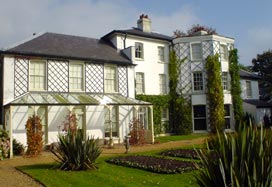
 Charles was a creature of habit and took a walk round his extensive grounds three times each day. He laid out a long tree-lined '
 I didn't mean to end up in Orpington, it's just that I missed one bus to Down House and it was a long wait for the next one. [And then when it arrived, blimey, it was just