Ian Nairn was a talented architectural critic, writer and broadcaster who poured forth his opinions in the Fifties, Sixties and Seventies. He championed the characterful, harrumphed the horrible and railed against the unnecessary replacement of the old. He also loved his drink, hence he died relatively young, but his honest words inspired many, and may even have saved a few buildings. You still can watch his 1972 TV series Nairn Across Britain on the iPlayer, or you might recall the BBC4 Nairn documentary from earlier this year... or you can read his book.
Nairn's London was published in 1966, with a photo on the cover of the author at the wheel of a Routemaster, and swiftly became a classic of its genre. Ian picked 450 of his favourite buildings and places that defined the capital and wrote a few hundred words on each in the style of a gazetteer. They range from abbeys to parish churches, from mansions to cinemas and from pubs to housing estates. The first half of the book sticks to central London, but the remainder stretches out to the suburbs, because Nairn knew his Watfords as well as his Westminsters, and his Romfords as well as his Richmonds. The end result is a glorious collection of vivid text, balancing praise and polemic, with every paragraph another descriptive jewel. And it's been out of print for decades, annoyingly, that is until Penguin republished it last week (now £9.99 rather than eight and six).
Having grabbed a copy I thought I'd revisit some of Nairn's London, almost fifty years on, to see what he'd loved had changed and what was still the same. I picked Chapter 8, Thames-Side East, more specifically NORTH SIDE (pp186-189). Here are just three updated entries.
Nairn's London: North Woolwich
"A twin to the Isle of Dogs, though here the contrasts are wilder and more expressive. The ships in the Albert Dock seem bigger, the little terraces seem cosier, the riverside warehouses are more impressive... This feels right out of England, never mind out of London - something from another planet."
I wonder what Nairn would make of North Woolwich today, the docks long transformed from hive of industry into somewhere to go rowing at the weekend. Since 1966 the thin strip of land between dock and river has evolved, more likely decayed, as those who live here no longer work in the import business, if indeed they even work at all. A handful of Victorian terraces remain, notably along the dead end stump of Woolwich Manor Way which used to deliver traffic to the Thames, and the parallel Bargehouse Road. But the majority of the newer housing is bland and downbeat, even the 21st century stuff hemmed into the corner of Gallions Reach, buzzed by incoming flights to City Airport six days out of every seven. North Woolwich's shopping parade focuses on takeaways and charity, while the pubs (where they survive) serve honest pints to a sparse crowd of Sky-Sports-watchers. Crossrail is scything through the area along the route of the old North London line, a concrete wall newly constructed to either side to prevent passengers and local residents from ever coming eye to eye.
"Oddest of all is the Gallions, a huge pub in Norman Shaw style off Manor Way. It is really bizarre, the Bedford Park Hotel transplanted to haunted mudflats with no other building near, only cranes and funnels."
I turned up fully expecting this to have disappeared, the northern banks of the Royal Albert Dock long since subsumed beneath a rash of modern buildings. The pepperpots of UEL Docklands Campus are the most scenic, the neighbouring student accommodation less so, and that's where I believed the Gallions lay. Not so, it's on the riverward side but hemmed in behind three new pointy silver apartment blocks, so I completely failed to spot that this listed peculiarity survives. Ben's been, it having once been a railway hotel where passengers stayed before boarding their liners. I shall have to go back, perhaps even for a beer.
Nairn's London: St Mark, Silvertown
"A hard punch right in the guts. Sombre and compact, brooding over the bizarre landscape of North Woolwich funnels instead of tree-tops... The church is locked but still used; it must be kept. It is the nearest thing to a mystic's revelation that London has."
Silvertown too has changed out of all recognition, with the Thames waterfront covered by a ragbag of factories and warehouses that nowhere else will have. One is the giant Tate and Lyle factory, still belching sugar, another is the Loon Fung oriental food cash and carry whose Chinese temple-top is a new local landmark. In a diminished community such as this, what need is there for a church? Hence St Mark's was deconsecrated in the 1980s, becoming a repository for pigeons, until it was rescued by the unlikely saviour of the Brick Lane Music Hall. They escaped from Shoreditch in 2001 and set up their cabaret tables within, ideal for groups or coach parties who fancy old time fun plus a three course dinner. Fantastic for the building's survival, but there's still no easy or cheap way to peer again within.
Except, as it turns out, on Remembrance Sunday. The Silvertown war memorial stands in the corner of the grounds just behind the railings, so every second Sunday in November the populace turn up to sit in rows outside and take part in a collective act. I arrived towards the end of the ceremony, as the band played God Save The Queen and the Royal British Legion drooped their flags. The Reverend John Griffiths then explained that this was his fifteenth and final year officiating, not one of which had been plagued by rain, and then the Music Hall owner invited everyone inside the building for tea and biscuits. The crowd duly disappeared within, both young and old, or stood outside for a chat and a post-reverential fag. And I considered following behind to view the "glittering poetry, all knobbly with harsh polysyllables", but decided against because the moment was entirely inappropriate. Sufficient to know that the interior has indeed been kept, and you might see it over a supper club show one day.
Nairn's London: Beckton Gasworks
"Gasworks City, a magic world of plant and pipes, holders and small hills of coal - even wharves and funnels, for good measure, at the far end... it could be stressed to become one of the showplaces of London. All the 'interest' which modern architects try to tickle up in blocks of flats is here for the asking."
Alas Beckton Gasworks has long vanished, almost completely and utterly. The site shut down just three years after Nairn published his book, but lay derelict for a few decades more, providing the perfect cinematic backdrop for films like Full Metal Jacket. Stanley Kubrick demolished some of it, now almost nothing remains except for a pair of gasholders, one up one down, like some sort of rusting mascot for the land's new purpose. The largest replacement is the Gallions Reach Retail Park, an out-of-town sprawl of white-cladsheds from Tesco Extra round to TK Maxx. Architecturally it's entirely vacuous, but the attraction here is goods and services, and the trackie-bottomed ride from miles around to parade up and down the car park. Beyond the gasholder is the main depot of the Docklands Light Railway, conveniently located where the price of land is not at a premium. And somehow the remaining acres of the site remain entirely vacant, presumably because not even the rising value of property can yet offset the costs of cleansing this polluted landscape. If Nairn rewrote his book today, this vacuum wouldn't even merit a dismissive footnote.
Some of you never read my comments, so never notice that I am being taken to task by readers who believe that something in my post is wrong. Sometimes it is indeed wrong, and I apologise and update the text. At other times, well, here are few choice comments from the last few months...
8 Nov 2014 - A walk around Deptford
✉ Pedantic note. I know it's not very helpful, but "forty pages of rainforest" is wrong, though a common mistake. Rainforest wood is too hard to turn into paper. If paper is made from wood (rather than recycled paper and other stuff) then it's going to be softwoods from Norway, Russia, Canada and so on. Not tropical hardwoods from rainforests. Good piece though.
5 Nov 2014 - The A10 bus route
✉ I don't think BP, M&S and IBM are acronyms; an acronym can be pronounced as if it's a word (like NIMBY). I think they're just abbreviations.
✉ Strictly speaking, a series of letters that abbreviate a phrase but is unpronounceable is an initialism, I believe, but it's never used and wouldn't be generally understood. So calling it an abbreviation or an acronym is a matter of choice and I think the trend is going towards the latter, though it wouldn't have been considered correct until fairly recently.
30 Oct 2014 - Chiltern Open Air Museum
✉ Also, Newlands Park would seem now to be no longer part of Bucks New University. It was sold in 2008. The campus is now run by a private educational and residential company: Chalfont Campus
23 Oct 2014 - Life in a Northern Town
✉ Sorry for the pedantry, I know you were channeling The Dream Academy , but Kingston upon Hull has been a city since 1897, "confirmed by Letters Patent issued under the Great Seal dated 18 March 1975" [1]
✉ City status, typically, raises the place above the status of a borough. If Hull were not a city, it would be a borough. As it is a city, it is not a borough. 'Town', prior to 1973, was not a legal status. It was an informal term applied to cities, boroughs and urban districts, and perhaps to some places that were legally just parishes. (Not to mention London Town, which is legally all sorts of things, and is bigger than the City of London.) Since 1973 it has been possible for a place to be legally declared a town and have a town council. However, this does not mean that the historic informal sense has ceased to exist. If it is OK to call Colchester a town, though it is legally a borough, it should also be possible to call Hull a town, though it is legally a city.
21 Oct 2014 - Folkestone Triennial
✉ Lovely blog and photos. Small niggle though, in Kent they are hop gardens, not fields.
18 Oct 2014 - The Radio Times archive
✉ I believe the term Teletext with a capital became a registered trademark when the Daily Mail's Teletext (UK) won the franchise to provide commercial teletext services on Channel 3 (the name never caught on despite a brief rebrand by Tyne Tees as Channel 3 North East) and Channel 4, taking over from Oracle. The BBC's Ceefax, ITV/Channel 4's Oracle, Sky Text and independent satellite / ancillary terrestrial services (4-tel and regional ITV in the 600s) from the likes of Intelfax had happily used the term Teletext for many years. All that changed with the advent of Teletext (UK), forcing any mention of teletext in general terms by those other providers to be lower case.
10 Oct 2014 - The New Tube for London
✉ Like the "New Bus for London" these trains appear to be "air-cooled". It a loose term...and means they will not be "air-conditioned". Some may say that it not important or there are tech reasons for it but the reality is that when people are packed like sardines in the rush-hour it will be they who suffer.
✉ "Air conditioning" is where fresh and recycled air is processed in a central location to specified relative humidity and temperature and then pumped to where needed, as in some office blocks. "Air cooling" is just that, the air is cooled to a specified temperature etc.
8 Oct 2014 - Cody Wilds
✉ Strange how incorrect names get into popular use. "Gasometer" for what is correctly called Gasholder. So common that most people accept it. Wikipedia states that the origin of Gasometer dates back to William Murdock who invented gas lighting and he called his gas container a gazometer, although this term was incorrect as it was a gasholder, the gasometer became the popular name.
18 Sept 2014 - The Untied Kingdom
✉ DG, Sorry to be an utter pedant but only England and Scotland are countries. Wales is a Principality. North Ireland is a Province. I know you like to get these things right.
✉ They're only "Countries" or "Principality" or "Province" through usage and convention - because we choose to call them that. In terms of international treaties, only the UK is a country.
✉ Yes, that's how languages work! So, you're basically saying that I'm right, thanks for the confirmation.
✉ No that's not how language works (usually). The definition of a word is given by how it's used, yes, but it still has overall meaning. For example, the colour "green" is defined by people all (or mostly) using it to refer to things roughly the same colour. But if we commonly referred to the colour of one particular green thing with one word, and the colour of another green thing with another word, etc., it would be reasonable to say "bugger this, they're clearly all just green", and to shoot down anyone that tries to correct us with their "real" colour.
16 Sep 2014 - Contactless
✉ Being extremely pedantic DG will be using a contactless card to travel today because Oyster uses contactless technology.
4 Sep 2014 - East/West Cycle Superhighway
✉ A pedant would note that the Embankment does have one TfL bus route, the N550.
6 Aug 2014 - London Borough Tops
✉ DG - can you perhaps explain why this series is being billed as a 'Local History Month'? Surely the highest point in a borough changes very little over history - any changes would have happened in what is called 'Pre-History'! Sorry for the pedantry.
14 July 2014 - Isle of Man (North)
✉ To be pedantic, the Snaefell cars do not use any form of 'ratchet', and work purely by adhesion. The centre 'Fell' rail is used only for emergency braking.
19 May 2014 - Fawley Hill
✉ Note from Pedant's Corner: the owner is Sir William McAlpine and his wife is Lady McAlpine. It's not correct to call him Lord McAlpine nor, indeed, to call his wife Lady Judy.
They're all part of Discovering Britain, a treasure trove of walks that's free to download, created by the Royal Geographical Society. Wherever you are in the UK, from Margate to Belfast, there'll be one near you.
I thought I'd try Deptford. I don't know the area as well as I should, but it has lots of history, not all of it obliterated. The walk's called District 45, a chance to "travel back in time to London’s Deptford 100 years ago" - a 2½ walk from the High Street to the Thames and back.
Various resources were available to help me along the way. An online map to check the route, complete with 21 pins showing points of interest. A gpx file, in case my device finds that more useful instead. An image gallery to see what I might be enjoying. And a pdf booklet with directions and a shedload of background history and usefulweblinks, which is 40 (FORTY) pages long. Someone's put a lot of effort into all this, although possibly too much because I didn't fancy printing out forty pages of rainforest for half an afternoon's stroll. So instead I went for the audio file option, that's 21 mp3 files in a zip folder, the idea being to listen and enjoy on the way round. It took me the best part of an hour to get the tracks onto my iPhone in a locatable manner, in the course of which I discovered I needed to print out a separate 16 page document or I'd not have the directions. I couldn't possibly describe the entire set-up as straight-forward, but was hopeful that the resulting experience would be rich.
The starting point for this walk is "the large anchor at the end of Deptford High Street, SE8 4AD", which is already a problem because "note: In 2013 the council put the anchor in storage during improvement works to the High Street; whether ot not it will return is unknown." It's not back yet. Instead the High Street, on a non-market day at least, is a raw chain-free shopping street that needs a commentary to bring it to life. The theme of the walk is Deptford at the time of Charles Booth's 1899 poverty map, with plenty of first hand extracts from his notes to flesh things out along the way. Prepare to listen to a lot about what things used to look like, even when there's nothing left of what he saw.
The walk soon heads off up a backstreet, nowhere any normal guided tour would venture, to track down the site of a former ragged school. But by this point I was already struggling to connect what I was hearing with what I could see, a theme which continued at the next few stops beyond the railway, across the council estate and down to Deptford Creek. It was only at this point that I realised my smartphone was on shuffle and had been serving up random historical snippets rather than the sequential commentary intended. Nobody thought to number the tracks, you see, and I spent the rest of the walk repeatedly checking I was on the right track before pressing play.
An architectural treat, if 100 years too late for Charles Booth's pen, is the Trinity Laban Conservatoire, a translucentdance studio behind Teletubby hills. Rather more evocative are the old docks along the Thames foreshore, amply brought to life in the audio commentary, but long gone and now covered by flats. They're faceless flats too, bland late 20th century to the west of the Ravensbourne and fresh slums of the future to the east. The trail points out some unexpected survivors - a jetty, an amazing statue of Peter the Great and a hemmed-in part-medieval church where a stone marks the local death of playwright Christopher Marlowe. I missed the stone, alas - it wasn't in the commentary, only the 16 page instructions, so I only noticed when reading more carefully later.
The streetname Deptford Green merely hints at what this flat-packed neighbourhood must once have been, likewise the brick wall that once held back the cattle market - these amply described by Booth's turn of phrase. By this time the walk is nearly complete but there is the treat of Albury Street to go with its fine run of listed Stuart houses. Deptford would be much better known, and loved, were all its residential stock like this. I blew the finish because St Paul's churchyard was locked, so audio track number 21 played out beside a nailbar rather than at "the Pearl in the Heart of Deptford".
So, all in all, the Discovering Britain walk was a mostly worthwhile experience. I learnt a fair amount about Deptford, although the focus on 1899 meant I felt I barely scratched the surface. The physical highlights were rarer than I'd have liked, but the commentary helped to bring the intervening ordinariness to life. I suspect the trail is best followed on a tablet, with a big screen to show the 40 page document and map all the way round. But you have to admire the thorough research that's gone into this multimedia resource, and all the other geographical trails across the country. If you can cope with the technology, why not seek one out?
I take that back, the best time to see the Blood Swept Lands and Seas of Red was a few weeks ago, before everybody worked out it was brilliant. These ceramic poppies have been here at the Tower of London since the start of August, not initially in such great numbers, although a considerable spectacle all the same. Yet it's only fairly recently that the display in the moat tipped over from centenary artwork to remembrance phenomenon. Maybe the Queen's visit tipped the balance, providing a ripple of publicity that saw visitor numbers snowball. Or maybe it took until a significant proportion of the poppies had been planted to cross some emotional line and make this a proper spectacle.
Whatever, the Tower's been under siege from would-be poppyspotters over the last couple of weeks. Down they've flocked, first flooding the footpath around the perimeter of the moat, then clogging neighbouring roads, then delaying passing buses, then causing chaos at Tower Hill station. TfL have been forced to put up signs encouraging spectators to alight from the tube elsewhere and walk, even as far away as London Bridge, to try and manage crowd control. And still they come. That's not just Londoners, groups are hiring coaches from all across England to come and see the poppies at the Tower, such is the allure of meaningful remembrance. But then when they arrive they find the ring of spectators already several deep, and the surrounding paths partially choked, hence the experience can be somewhat diminished. So go early.
The poppies aren't busy at dawn. There's a reason for that, which is that it's dark. But come shortly afterwards, which at present is just after seven, and you can get the railings almost to yourself. I set my alarm early and stopped by on the way to work, which I realise may be easier for me than for you, and arrived for half past. To be honest, the scene was already busier than I was expecting. About fifty people were milling along the northern edge, more like a hundred as far as the eye could see, and probably several more round the other side. A surprising number had brought proper cameras, with big zoom lenses and everything, as if they'd realised the same temporal truth as me. Come early and you can admire the planted spectacle and not the backs of people's heads.
As a measure of the power of the display a blind lady had turned up, tapping her stick in front of her and holding onto her husband's arm. She won't have seen any of the 888,246 poppies, but at least she was here and experiencing the collective fizz of emotion for herself. The majority of attendees looked like they were on their way to work, probably in the City, plus one or two heading for school. Some had clearly flashed their Freedom Pass, others making a special effort from further away, but all were here to pay their respects. My one regret is not being able to stay fractionally longer to see the sun rise over the horrible hotel to the east, as I'm sure the blood red carpet would have been even more impressive illuminated in the first low rays of sunshine.
By the time I left around quarter to eight the number of attendees had definitely crept up, with choice of viewing position more restricted, and my guess is the entire perimeter would have been claimed well before nine. It's bad news for anyone turning up speculatively mid-afternoon, I suspect, especially those expecting any length of time in prime moat-edge position. And this weekend's going to be totally bonkers, not least with the Lord Mayor's Show just up the road, so expect the temporary crowd control barriers on Tower Hill to be put to good use.
The display closes for good next week, after which all the poppies will be removed, cleaned and distributed for charity, so there is a certain urgency to finding time to visit. Indeed the imminent 11th November deadline has led many politicians and commentators to call for an extension because, they say, it would be unfair to deny the public the opportunity to attend. The Tower however says no, the artwork was always conceived as finite, and they have thousands of volunteers booked to turn up next week and extract the blooms. And I agree - the poppies have already been on display for 2000 hours, and how much more time did you need? You should have come earlier, Or just come early. You have a handful of early mornings left.
Bexley earned its B routes in 1988 as part of the Bexleybus scheme, a deliberately low-cost operation which introduced smaller buses to the borough's backstreets. The Bexley Hoppa ran with blue and white minibuses, at least until industrial unrest and unreliable service contributed to the operator losing their franchise three years later. But Bs Eleven to Sixteen survive, along mostly extended routes, reaching out from Bexleyheath to a variety of far flung spots.
The B12 I've already ridden, so that was off the table, and the thirteen, fourteen and fifteen didn't appeal. So I headed for Bexleyheath bus garage where both of the othertwo routes begin and decided to catch the first that turned up. One slight catch, for which I apologise. I intended to ride three alphabetical buses at the weekend, including an A and a B and one other route inbetween. But dashing all over London delayed me so much that by the time I reached Bexley it was already after four and I realised I'd be doing most of this journey after dark. But which outer reaches wouldn't I be seeing, and so won't you be reading about - Kidbrooke or Thamesmead? The answer soon turned up.
An A-Z of LONDON BUSES
Route B11: Bexleyheath - Thamesmead Length of journey: 9 miles, 40 minutes
The last shop on the parade adjacent to Bexleyheath Bus Garage is an off licence sponsored by The Sun. I merely mention this, it may or may not be a coincidence, but I did spot one driver nipping in while I waited. The B11 kicks off from here with a short run into the town centre, along which stretch I imagine passenger loadings are generally featherlight. But things pick up considerably at the Clock Tower, where the shoppers of Bexleyheath are lining up in their off-the-peg winter jackets to lug the afternoon's purchases home. Most don't want our bus, we're heading for the backwaters, plus there are quicker routes to Thamesmead if that's your goal. By the time we reach the non-pedestrianised bit of the Broadway we've turned left or right more than half a dozen times, and thus the meandering nature of our journey is set.
It's not quite dusk but already the lights are coming on, illuminating the smokers sat shivering outside the wine bar and a row of treadmillers pumping at the gym. Turning right towards the station we pass three successive semis where Sky Sports is blazing a green rectangle across the TV screen, and nobody's yet got round to closing the curtains. A slim slice of pinky blue is visible across the rooftops to the west... and that was probably the last over-florid sentence I'll be able to write about the view before it disappears.
Bexleyheath station is situated annoyingly far from the town centre, just too far to be an easy stroll, but just too close to make waiting for a bus worthwhile. Here we gain the journey's most interesting passenger, a golden retriever called Bryn. He's straining on the end of a pink lead held by his owner, similarly blonde and with a too-thick ribbon in her hair. Poor Bryn is evidently not well, and is whining and whimpering as he boards. He's also intent on exploring every seat within lead-range, so his owner reins him into the wheelchair space and reassures him with a cuddle. "We're going to the doctors to make you better," she says, and hopes that the journey won't be too long. Wrong bus for that, alas.
They're rather nice suburbs outside, I think, but it's becoming increasingly hard to tell. Before long there's a moment where we turn left, and Bryn's owner is surprised because she thought we were going right to Abbey Wood. A fellow passenger has to reassure her that we will indeed be going there, just not yet. Instead we're taking the Lodge Hill Loop, which used to be as far as the B11 went, but when they extended it in 1991 they retained this mile and a half circuit. It's also Hail and Ride along here, which the onboard iBus screen struggles to explain by displaying "Okehampton Crescent/Hail and Ride ends here" for the best part of five minutes. Various shoppers alight, while a bloke with a Lidl bag boards and shovels repeated handfuls of crisps from the depths into his mouth.
They're rather nice suburbs outside, I think, but it's become increasingly hard to tell. Before long there's a moment where we turn right, and Bryn's owner is relieved because the loop is finally closed and we are heading for the PDSA after all. Unfortunately a genuine pushchair has arrived, so Bryn's whimpering has to continue from a nearby seat, from now for as long as it takes. Suddenly a rotating wand emerges from the pushchair, flashing Hallowe'en colours, or whatever it takes to keep a two year old occupied these days. Some ear-piercing yelling also emerges, making Bryn's complaints sound positively stoic.
There is a direct route down the hill ahead but we don't take it, instead taking a parallel route quarter of a mile to the east. The road cuts deep through Lesnes Abbey Woods as it descends, which annoys me because I'd like to have enjoyed its autumn splendour, but get to endure a midnight ambience instead. At the foot of the long slope is Abbey Wood, named after what I haven't just seen, where we pass beneath the flyover and pause to drop off passengers near the station. Until 1999 the B11 went no further, but now Thamesmead beckons, with the leap over the railway marking a very distinct sociological boundary from semi-detached territory to closely-packed flats. Head up, Bryn, we're nearly there.
Except we're not. The PDSA is only 200 metres straight ahead, the way the other four buses go, but the B11 is about to take another lengthy detour round the estate. I swear the bus map I saw way back at the start of the route gave no hint this route was going to be quite so tortuous, but that's topological distortion for you. Thankfully the driver is alert to Bryn's distress and nudges his owner to alight before the detour. It means walking the last bit, and Bryn won't be enjoying that in the rain, but it'll be quicker than the extra half dozen stops we now face. Fingers crossed the Freda Powell Centre sorted him out.
The type, dare I say class, of passenger has definitely changed. Four unaccompanied primary-aged children hop on for our run down Alsike Way, two of them alone (although one hops off shortly afterwards to greet someone who could be his sister, his girlfriend or his mother, it's impossible to tell). We're riding now beneath a run of sixteen tower blocks, one of Thamesmead'squestionablegifts toarchitecture, although all I can see from my window seat is the occasional lit rectangle in the sky. Darkness has focused our passenger experience almost entirely on the lit interior of the bus, and its reflections, reducing the outside environment to naught.
The next bit of the should have been relatively spectacular, up and over the Crossness sewer with views across Southmere, famous for waterside antics in A Clockwork Orange and (more recently) Misfits. I get none of that, just some pretty coloured lights along the underside of the viaduct before... no, again we're not quite going the quick way. One last bobble-hatted boy boards, and a post-match musky footballer alights, and I am by now becoming fairly desperate for this mystery tour to end.
My wish is finally granted at a bus stand beside a glowing Aldi, just shutting down for the night and barring belated shoppers from entering. I'm cast out from the bus into heavy rain, where my options appear to be McDonalds, a scarily SE28 pub or a long wet wait for the next bus out of here. The B11 has delivered me to darkness and misery - if not the quintessential Thamesmead experience, then exquisitely stereotypical all the same.
For my first alphabetical London bus journey, I have no choice. There is only one A bus, now that As only appear at the start of a route number and never at the end. The A10 it is, the bus to the airport, which had me wondering if I might be boarding something snazzy and special. Nope, single decker red bus, as per normal. But speedy too, indeed almost an express.
An A-Z of LONDON BUSES
Route A10: Uxbridge - Heathrow Airport Length of journey: 8 miles, 25 minutes
You can take the slow bus to Heathrow, which from Uxbridge Bus Station is the U3, or you can take the fast bus, which is the A10. When the time is right my A10 emerges from the cavernous portal by the tube station and pulls round towards the first stop on Bakers Road. There ought to be no passengers on board, not straight out of the depot, so I'm surprised to see a bald man already seated up front peering closely at a phone. When did she let him on?
Two of us board, then suddenly a young lad in a nearby doorway throws his cigarette to the ground and trots across. He's wearing a suit, which is considerably better dressed than all the other males around here, and stands out even more thanks to his bright green and blue striped tie. Cabin crew or check-in staff or some other airport-related job, obviously, but I decide against peering too closely at his ID badge to make sure. He takes the seat behind me and plugs in some banging drum and bass, and off we go.
Escape from the town centre involves passing St Andrew's Park, which used to be RAF Uxbridge but is now levelled for flats. Ahead is the Hillingdon Road, a wide suburban dual carriageway once pencilled in for a tram, except it proved too hard to persuade locals they wanted one. On one street corner is Jack's Fish and Chips, a local legend in what was once a pub, with banners now proudly celebrating its '46th anniversary'. And behind that cricket club on Coney Green is a Saxon earthwork, uncovered in the Twenties and containing a few shards of Roman pottery. A lot along this urban clearway isn't quite what it was, if you know where to look.
Although several bus stops are busy nobody seems interested in flagging us down - the A10's quite a specialised taste. But when we turn off down the Harlington Road suddenly we're the only bus in town and off ships our only female passenger. We gain two more shortly afterwards, one a little worse the wear from the weather, the other with immaculately tied hair. "More airport," I decide, and on we go. We pass a 'Station Hand Car Wash', despite the absence of any stations for at least a mile in any direction, old or new. And I don't think I've ever been to Dawley before, although this long-swallowed manorhouse is now remembered by a brief parade boasting minimarket and betting shop. So far so ordinary.
But then we hit Stockley Park. This vast gravel pit and dumping ground was smothered in topsoil in the 1980s and landscaped to within an inch of its life, and is now a seriously hi-tech business estate plus golf course. The A10's allowed in round the back, which means waiting patiently at an electronic barrier, and then meandering through the site past BP, M&S, IBM and other blue chip companies that aren't acronyms. You can tell we're on private land because all the road signs are at thigh height on rectangular panels, and all the bus shelters are squat blue things with Stockley Park branding. There are also ponds and sculptures, because Apple employees deserve nothing less, although it being Sunday the ducks are quacking at nobody.
On reaching the main road we cross to do a brief loop in the other half of the Stockley Park estate, where neatly-tied-hair-woman alights, so I was totally wrong about her. Joining the busy dual carriageway we cross the Grand Union Canal and the Great Western Mainline in very quick succession. And then there's just one last stop before we do something I think no other TfL bus does - we join the motorway! Specifically that's the M4, more specifically the Heathrow Spur (a mile of airport link completed in 1965). This stretch of blue from the Holiday Inn to the Park Inn hotel boasts the UK's first ever motorway bus lane, but today our drivers spurns it as unnecessary and the extra lane remains empty.
Before long we're at the Concorde Roundabout beneath the A4, named after the model British Airways plane that used to sit here, although in 2007 an Emirates Airbus hijacked the spot instead. We're now on the Heathrow perimeter, but well below plane-spotting level and about to head into a tunnel. Six other TfL buses head this way, beneath the northern runway, and it'd much more fun almost skimming the roof in a double decker. Never mind, the A10's speedy dash has brought us inside the airport in double-quick time. How retro-futuristic the whole place now looks, like some Gerry Anderson set from the 60s, all swirling roadways and the occasional jet.
We pull up beside the entrance to Heathrow's coach hub and bus station, more than two miles since the A10's penultimate stop, where the handful of us on board alight. Nobody's brought a suitcase, it's not been that kind of journey, but blue-green-tie-bloke strides off towards Terminal 3 ready for his ground-based shift. Standing nearby is a shivering soul in sombrero, shorts and flipflops, attire which presumably made sense a few hours back, but entirely erroneous now. And as our driver swings round to change her blind to 'Uxbridge' I notice that the bald man is still aboard... and indeed heads back the same way a few minutes later. I can only assume he's the driver's husband, and a round trip to the airport is their way of spending time together at the weekend.
Before the Year of the Bus ends, it's time to do something else to celebrate. Not vintage buses, because they peaked on Sunday with a service of RTsonroute11 through London. Not painted miniature buses, because they're already all over town waiting for you to find them. Not WW1 buses, although TfL's Battle Bus will be appearing thisweekend in the Lord Mayor's Show. No, I'm talking about another pointless feature on this blog which involves me riding lots of buses and then telling you all about them. Don't say you're not excited.
Below is a map showing where these lettered buses run. I've made the size of the letter proportional to the number of bus routes so, for example, there are tons of 'W' buses to the north of London but there's only one 'G' to the south.
But why are they arranged like this? How come there are so many of some letters and not others, how come some parts of the capital have lots of lettered buses and others have none, and how come some letters appear more than once on the map? The answer's complex, but has its roots almost fifty years ago in London Transport's Bus Reshaping Plan, a pioneering project to streamline the system.
Part of the plan was to introduce one-man-operated single deckers on several routes, cutting out the conductor to save some money, removing most of the seats and speeding things up by charging flat fares. The rest of the plan involved remodelling London's bus network from an interleaved web of routes to a "hub and spoke" model. Passengers wishing to travel across town would first catch a single decker from home to a local interchange, then take a speedier double decker to another hub, then catch another single decker out to their intended destination. These shorter routes would have been very heavily alphabetical, indeed the original 1966 planning document suggested the following...
Proposed route renumbering from original 1966 Bus Reshaping plan
Perhaps thankfully this idealised classification was never fully realised, but in 1968 an initial trial kicked off in two suburbs beginning with W. Walthamstow got the W21 circular, an elongated trip up to Chingford Mount and back. Meanwhile Wood Green gained routes W1 to W6, with the W5 and W6 being special Saturday services for shoppers, and the other buses clogging up the streets in such great numbers that they had to be scaled back. Neither 'W' scheme prove terribly reliable, or indeed popular, but the savings generated by moving from two-man to one-man operation meant that project rollout continued. Next in line in 1969 were Ealing (E), Peckham (P), Harrow (H) and Morden (M), of which all but the latter have at least partly survived. Croydon (C) and Stratford (S) followed on a limited basis in 1971, while a more successful remodelling followed later in Bexley (B), Docklands (D), Hounslow (H), Orpington (R) and Uxbridge (U).
So what I'm planning to do is ride an A-Z of London buses. That's complicated by there not being a Z, or a Y, so in fact I'll be riding an A-X, and even that'll have eight further letters missing. I'm not going to ride every single prefixed bus, just one starting with each letter (The Ladies Who Bus did the whole lot, if you're a completist). And I'm doing it in alphabetical order, which means an A bus first, then a B, then a C and so on. My A has to be the A10, but then comes the element of choice in this project as I have to pick from one of the six Bs. You may have some suggestions for which to take, especially from the longer lists like H, R or W. And don't worry, I won't be writing about buses and nothing else - a couple of journeys a week should see me safely through to the end of the year. And yes, like I said, I am still single.
If it's quarter past seven on the morning of the third of November then I've been single for exactly fifteen years. OK, so there was an evening two years back when it looked like I might not be single, but that particular text conversation was never mentioned again, save a few weeks later to say it had been a mistake. I blame Aldgate East, or maybe the staircase pushchair incident.
Fifteen years of singledom would appear to confirm it's not you, it's me. But don't worry, I'm perfectly happy thanks, and you'd never put up with me anyway. Whatever, my fifteenth partnerless year gives me the chance to repeatthefollowing, whichI usedto postannually. After a five year hiatus, I've updated it a bit.
Some might say that we single people are missing out on the joys of coupledom, and maybe we are, but I'm convinced that there are equally many positive points to being single:
Single: You get the whole duvet to yourself. Coupled: You don't need a hot water bottle.
Single: There's half as much ironing to do. Coupled: There's twice as much ironing to do but somebody else might do it.
Single: You can hoover the carpet when you think it needs doing. Coupled: Somebody else hoovers the carpet before you think it needs doing.
Single: Nobody ever tells you that the kitchen must be repainted and the bathroom must be retiled. Coupled: Two people can repaint the kitchen or retile the bathroom far more quickly than one.
Single: You never have to waste a Saturday doing what somebody else wants. Coupled: You never sit around on a Saturday wondering what the hell to do.
Single: You can watch whatever film or boxset you like, without arguments. Coupled: There's somebody else on the sofa to snuggle up to.
Single: You can flood Facebook with photos of your cat. Coupled: You can flood Facebook with photos of your baby.
Single: Nobody complains when you burp, belch or fart. Coupled: Somebody points out when you have dandruff on your shoulder.
Single: The toilet seat is always where you left it. Coupled: The toilet seat isn't always freezing cold.
Single: You never come home to a blazing row. Coupled: You sometimes come home to a cooked meal.
Single: You get to eat the whole ready meal for two yourself. Coupled: It takes just as long to cook for two as it does for one.
Single: You can spend all your money on yourself. Coupled: There are two salaries coming in and only one set of bills.
Single: You can walk away from a flatshare, any time. Coupled: You might be able to afford a mortgage, together.
Single: There are no important birthdays or anniversaries to accidentally forget. Coupled: Somebody actually remembers your birthday.
Single: You never have to buy useless gifts for your partner, just for the sake of it. Coupled: Somebody buys you presents occasionally.
Single: You can take an hour out without needing to give a reason. Coupled: Somebody's genuinely interested in how you're feeling.
Single: Nobody insists on coming over to yours for Christmas. Coupled: Everybody insists on coming over to yours for Christmas.
Single: There are no in-laws to be forced to spend time with. Coupled: Being part of two families is better than one.
Single: You're allowed to flirt with people in the street. Coupled: You don't need to flirt with people in the street.
Single: You can still have a riotous social life in your 40s. Coupled: You can still have a riotous social life in your 60s.
Single: You have no friends to go out with because they've all partnered off and are staying in. Coupled: You don't have to go out with those annoying friends you had while you were single.
Single: You don't catch every sniffle, cold and flu bug off your partner. Coupled: When you suffer a major cardiac arrest, somebody actually notices and dials 999.
Single: You never get left all alone and desolate because your life partner's just passed away. Coupled: When you get old and infirm, you don't end up in a care home because there's nobody to look after you.
Single: If you meet the partner of your dreams, it's not too late to marry them. Coupled: Nobody ever meets the partner of their dreams, so better to get married before it's too late.
Single: Being coupled is restrictive, stifling and a sign of personal weakness. Coupled: Being single is unnatural, lonely and a sign of personal failure.
Single: You don't need to depend on others for your happiness. Coupled: You don't need to rely on yourself for support.
Single: You never get your heart broken. Coupled: You sometimes feel your heart leap.
Single: You can have sex with anyone you like. Coupled: You can have sex whenever you like.
Single: The bathroom is always free. Coupled: The bedroom is always full.
Single: You can lie in bed in the morning for as long as you like. Coupled: There's a very good reason for lying in bed in the morning.
Single: Nobody sees what you look like first thing in the morning. Coupled: Somebody loves you despite what they see first thing in the morning.
Single: You never ring your other half while they're away for the weekend, allegedly in mourning for a dead relative, only for the phone to be answered by the new bloke they're shagging. Not that I'm in any way bitter, you understand...
In the midst of life I found myself in a shoe shop beside Brick Lane in the East End of London.
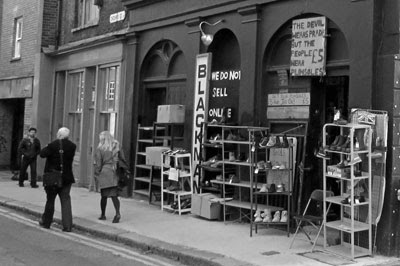
My search for stout and sturdy footwear has brought me to Cheshire Street, a redoubtable thoroughfare of great heritage. Approaching from Brick Lane I pass a selection of upstart boutiques and coffee shops, and several tourists spilling off the main drag in search of fashion. But my destination is the squat black building on the cobbled corner of Grimsby Street, the redoubtable fortress of Blackman's shoe shop. I do so hope that Master Phil Knight is at home.
Since my last visit a glowing blue cloud with sunglasses and teeth has been spray-painted on the wall up the side of the shop, but all is as normal around the front. A painted board with the name of the shop rests vertically against a pillar, alongside a board on which "We do not sell online" has been written in white tape. A rag-tag collection of 20th century shelving units, not one of them the same, is lined up along the pavement. Some are empty, but others support a sparse selection of shoes and boots, and bulging cardboard boxes that may or may not hold more. It is as it always has been.
"Get your plimsoles £5 and jog on!" says the sign by the door. Immediately Blackman's footwear of choice is obvious. "The Devil wears Prada but the people wear plimsoles" is the even larger message above the entrance. At only a fiver a rock-bottom bargain, I'm sure you'll agree. The Knights have always targeted their wares at the East End faithful, hence even the most financially-challenged Spitalfields resident could afford a pair of their finest rubber soles. Another bestseller is pinned to a shelf close by, a single boot labelled "Wellies £8 pair", there being no reason ever to pay more elsewhere. Meanwhile a tattered blue chair has been left immediately outside the front door near the Doc Martens, but my friend is not sitting there. I do so hope that he is inside.
He is! Master Phil Knight is here, holding court in his shoe leather emporium alongside two of his closest business associates. I am greeted as I would be by an old friend. "Hey, you here for shoes? Yeah? So just stand over there for a sec mate." It is always good to see a friendly face.
I take the opportunity to look around. The interior of the shop is dark and musty, yet brightly lit by strip lights and sheer personality. One wall is taken up by a rack on which the shop's complete range of wares is laid out. There's nothing fancy, it wouldn't sell, but here are all the everyday boots and shoes in browns and blacks that any decent market trader might wear. The other walls are stacked high with boxes, each containing part of the limited range in a variety of shades and sizes - one suspects Phil always knows precisely where. And diagonally across the centre of the room is a row of faded cushioned chairs, the last of which is labelled "VIP SEAT" in sellotaped marker pen.
I am directed to sit down, my rights as a genuine VIP confirmed. Phil's kindly gesture suggests that my custom will be taken shortly, as soon as another customer has been served. I listen in on their conversation - she's on her lunch break, it's the third company she's been an intern at, and these shoes will probably do nicely. Phil has witty rejoinders for everything she says, as did his father Lee before him, but then the Knights have always been masters of the cheeky banter.
"What can I get you then geezer?" Suddenly the game is afoot! I explain the workmanlike style that I require, and Phil nips off into the adjacent Aladdin's Cave to locate the box with the perfect match. He's not long. My black lace-ups arrive and I get to try them on, while Phil and the gang return to discussing disreputable customers, last night's football and the state of the nation. The proffered pair is a size smaller than I usually take, and a wider fitting too, but fits perfectly. Here, I think to myself, is a man at the very top of his game.
I am a fraction nervous at this stage because Blackman's takes only cash, and my haul costs over a bullseye. Thankfully I find three score in my pocket and hand it over, which causes Phil to reach for a battered wallet filled with Lady Godivas, one of which is swiftly mine. The young assistant drops the shoebox into a plain blue bag and returns to tidying up the leftover packaging scattered across the floor. My time in the store is nearly at an end.
"See ya guv!" exclaims Phil with a cheery grin as I approach the doorway. "Thanks for your custom and come again!" And in that moment, gentle reader, I make up my mind to return to meet my friends at Blackman's once again. Perhaps it'll be the plimsoles next time.
It used to hold details of London's seven strategic walks, from the Capital Ring to the Lea Valley Walk, including maps and directions and background information. No more - it was stripped of its content last night.
The precise reason for this takedown isn't clear, but it appears that TfL can no longer fund external websites, so are having to bring all of Walk London's information in house. The trouble is they haven't transferred everything across to the new site before pulling the plug on the old, indeed there are signs they won't be transferring everything across at all.
As of today, in fact as of yesterday, all of London's strategic walk info now appears on a subpage of the TfL website. Last week it resided on the memorable walklondon.org.uk, this weekend it's on the rather less memorable tfl.gov.uk/modes/walking/top-walking-routes. On the TfL website you'll find 'Walking' at the top of the page on the 'Ways to get around' tab of the 'More...' submenu, recently promoted from the second column to the first. Well, you might find it anyway, keep looking.
Until last night the Walk London website featured an interactive map showing which of the seven walking routes goes where - a Walk Finder.
It was possible to view each walk one at a time, turn tube lines on and off, highlight the Green Belt, highlight Interesting Places, even zoom in on each quadrant of the map, then click through to the section of your choice. Today there's nothing so useful. The new webpage only has the map below, slightly blurry, absent of all features other than the River Thames and 100% non-interactive. The new graphic doesn't rely on Flash, so can be viewed on a mobile, but other than that represents an entirely retrograde step.
And if you fancy taking yourself off on one of these walks, how does the new website stack up to the old. Not favourably, I'm afraid. Allow me to illustrate this with reference to the last section I walked, which is London Loop section 19.
First of all, the LOOP walk itself. The old Walk London website boasted a 462 word introduction to the LOOP, but the new TfL page offers only 21. Like so...
"Walking the London Outer Orbital Path (the LOOP for short) is a great way to get to know London better. At nearly 152 miles (245 km), some like to think of it as the ‘M25 for walkers’ — but it’s a world away from the motorway and has been thoughtfully divided into 24 well marked, bite-sized stages." (+137 more words)
"The London Outer Orbital Path, or LOOP, almost completely encircles Greater London. Nearly 150 miles are split into 24, bite-sized walks."
Warning about possible diversions
Yes
No
Signage
150 words
-
Further information
Details of published guide.
Mention that route appears on Ordnance Survey Maps.
Invite to view video.
It's a particular shame to lose the user comments. Last month an anonymous commenter said "Where the route crosses a field diagonally just before Chigwell Row water works, it has been ploughed over, leaving no trace of the path. The pointer indicating the direction of the route across the field has been uprooted and is lying on the ground." which is useful not just to walkers but also to those who manage the path. And as recently as Monday, Laurie added "I echo the comments about Bishops Wood - at this time of year, it can also be very muddy. Don't attempt it without proper OS map and compass. If you can find the wooden fence to the right of the path, that is your way out." It's a shame that Laurie's useful tip lasted less than a week before being binned, but the new TfL version of the site looks like being a dry, dull place with minimal background information, and if you get lost in the mud on section 13, so be it.
And what if you click through to Loop section 19, how does that compare? The old Walk London website didn't make this easy, either clicking through "Next Section" 18 times or noticing the drop down menu underneath and remembering to press Go. Having said that, the new TfL website doesn't make it easy either. The sections aren't numbered, so you either have to count 19 bullets down the list or you have to know the walk's endpoints. That'll be Chingford to Chigwell, then...
Easy walking, though the early part may be muddy through Epping Forest, where you pass the historic Queen Elizabeth's Hunting Lodge and cross the Epping Forest Centenary Walk. Later, much of the route follows pavements and tarmac paths through recreation grounds, in one of which is a lake created from a former gravel pit. The section finishes with a long walk beside a road (Chigwell Rise) down to Chigwell.
Section 19 of the LOOP Walk is a fairly short walk through open spaces of forest and meadows.
Sights
-
• Queen Elizabeth's Hunting Lodge
• Ancient oaks in Epping Forest
• Roding Valley Meadows Nature Reserve
Distance
4 miles (6.5 km)
4 miles (6.5 km)
Start
Chingford, Rangers Road (& grid reference)
Chingford
Finish
Chigwell High Road (& grid reference)
Chigwell
Public transport
National Rail: Chingford. LU: Buckhurst Hill, Chigwell (which is in travelcard zone 6). Buses at these points, also at Woodford Green High Road and Loughton Way
Start: Chingford (Rail)
Finish: Chigwell (Tube)
Recommended direction
West to east
-
Terrain and surface
Fairly level all the way with one gentle climb soon after the start and a stepped footbridge at Buckhurst Hill. More than half is on a hard surface. One stile. 1.9km (1.2 miles) beside roads.
Fairly level all the way, although there is one gentle climb soon after the start and a stepped footbridge at Buckhurst Hill. More than half of the route is on a hard surface. There is one stile along this route.
Signage
Signage complete both ways
-
Refreshments and toilets
Pubs at Chingford, Epping New Road, High Road Woodford Green, Loughton Way and Chigwell. Cafés at Chingford and Chigwell. Public toilets at Chingford
-
Links with other walks
Epping Forest Centenary Walk
-
Map required
Explorer 174 (route marked, NOTE at the end of section 19 the LOOP does not go northwards in Roding Valley Meadows Nature Reserve, parallel with the M11, but instead drops down into Chingford - we have contacted OS to correct their error)
I give a pretty convincing thumbs down to the TfL upgrade, which has stripped away most of the useful information about the walk and left the bare bones as bullet points. And I'd be fascinated to know why. Maybe the full set of information was too time-consuming or expensive to transfer across. Maybe only key verifiable information is permitted on the TfL website. Or maybe someone gave the instruction to "keep it simple", which this clearly is to the point of being boring. Let's be honest, this new site is unlikely to inspire anyone to get off the sofa and head for the countryside.
If you want to walk this section, or any other section of any other walk, you'll need directions. That's good, because TfL have kept the directions, indeed exactly the same directions as on the old site but reformatted using bigger text. Previously the directions came on two pages, now they're on three... so you'll need more sheets of paper to print out each set than was previously the case. But I need a map too, because written directions are notoriously difficult to follow without some kind of spatial hint. Bad news, there are no longer any maps of any of the sections of any of the seven strategic walks. That's not just no detailed maps but also no overview maps, indeed no way of seeing where any individual section lies, and that, TfL, is rubbish.
They have promised to provide maps, maybe even better than before, based on the excellent Legible London mapping. But for now there's nothing, no stopgap whatsoever, not even the previous maps rescued and hosted for a few months while the new ones are prepared. In particular there are no links to the Walk4Life maps that exist for every section, indeed that were individually linked from every subpage of the old Walk London website. Here's the walk4life map for Section 19 of the London Loop, for example, which is an extremely useful resource, but alas not printable and take-with-you-able. TfL's walking website links only to the Walk4Life homepage, from which it's nigh impossible to search and find the specific walk you want, so what's the point?
All in all this is a massive downgrade, a proper dumbing down, and a virtual two fingers to the teams who created and supported these seven strategic walks. I suspect some TfL digital overlord is very pleased with the on-brand transfer of intellectual capital to a mobile-first platform, or will be once those missing maps are finally provided. But whoever sanctioned the taking down of the old website before all the resources on the new were ready needs their priorities re-examining. And sorry, but if you fancy going on one of Walk London's excellent self-guided walks in the immediate future, you're on your own.

Ian Nairn was a talented architectural critic, writer and broadcaster who poured forth his opinions in the Fifties, Sixties and Seventies. He championed the characterful, harrumphed the horrible and railed against the unnecessary replacement of the old. He also loved his drink, hence he died relatively young, but his honest words inspired many, and may even have saved a few buildings. You still can watch his 1972 TV series Nairn Across Britain on the iPlayer, or you might recall the BBC4 Nairn documentary from earlier this year... or you can read his book.
An A-Z of LONDON BUSES
The last shop on the parade adjacent to Bexleyheath Bus Garage is an off licence sponsored by The Sun. I merely mention this, it may or may not be a coincidence, but I did spot one driver nipping in while I waited. The B11 kicks off from here with a short run into the town centre, along which stretch I imagine passenger loadings are generally featherlight. But things pick up considerably at the Clock Tower, where the shoppers of Bexleyheath are lining up in their off-the-peg winter jackets to lug the afternoon's purchases home. Most don't want our bus, we're heading for the backwaters, plus there are quicker routes to Thamesmead if that's your goal. By the time we reach the non-pedestrianised bit of the Broadway we've turned left or right more than half a dozen times, and thus the meandering nature of our journey is set.
You can take the slow bus to Heathrow, which from Uxbridge Bus Station is the U3, or you can take the fast bus, which is the A10. When the time is right my A10 emerges from the cavernous portal by the tube station and pulls round towards the first stop on Bakers Road. There ought to be no passengers on board, not straight out of the depot, so I'm surprised to see a bald man already seated up front peering closely at a phone. When did she let him on?