When I set out to visit every postcode district in Greater London this year, I didn't realise it would get this extreme. This quartet are tiny, none of them more than 20 acres in size, created where mostly-Surrey KT postcodes marginally overlap the boroughs of Kingston and Sutton. One's three-quarters of a couple of streets, one's sixteen houses and a cul-de-sac, one's three farmhouses and one's a pub and a row of cottages. Come with me on a sunny safari to the southwesternmost tip of London. [map]
KT17 covers the northeastern chunk of Epsom & Ewell, mostly the Ewell bit. It pretty much halts as London begins but a couple of streets, by a quirk of the pen, manage to straddle both. One is Sparrow Farm Road, a residential buffer running down from the railway line to the main road. If you know the area it's just south of Cuddington Recreation Ground where the Beverley Brook rises, but that's all KT4. This is quintessential interwar suburbia, all gabled semis and bay windows and occasionally pebbledashed. Half the addresses in Richlands Avenue lie inside my target zone but only those on the south-facing flank, the remainder being resolutely Surrey. Live on one side of the road and your council tax goes to Sutton, die on the other side and you contribute to the South East region's mortality rate rather than London's.
It's not just the bins that change, the traffic regulations do too. Sutton demands 20mph and no vehicles over five tons whereas Epsom & Ewell allows 30mph but no parking on the verges. Down by the primary school I had to wait awhile while contractors on a gantry grounded in London sawed through surplus branches on a tree in Surrey. A short run of larger semis on London Road also somehow manages to fall within KT17, one of whose residents I managed to seriously perturb. I'd stopped to take a photograph up her frontage at the precise moment she drove back from the shops, obstructing her access, and after she parked was swift to wind down her windows and shoot me daggers. She continued to glare for a couple of minutes after I walked off sheepishly, and I will not be returning to KT17/Sutton any time soon.
The Bonesgate Stream (great name) generally divides Chessington from Ewell and KT9 from KT19. But at the William Bourne pub the boundary shoots out by about 300m and within that bulge a teensy strip of addresses manages to have the 'wrong' postcode. Numbers 543 to 573 Chessington Road are the outliers, the only houses on this lengthy road to dribble into Greater London. They're never going to get estate agents excited but they're chunky enough, and the bungalows on the corner look to be rather cosier. What's more exciting to the peripheral postcode hunter is that a single cul-de-sac also slips into the outlying district, and this is the only place you'll see KT19 on a Kingston streetsign.
Headley Close is a modern dead end with twin spurs and a long run of separate garages. The houses are of two types, either front-gabled or side-gabled, and the front gardens actually feature a bit of grass and not just hardstanding for parking. At the first house the grape hyacinths in the front lawn are already in bloom and one resident nips between front and back gardens through a cat-shaped hole cut into the gate. At the last house a lofty tree has extraordinary 'bubbles' of greenery amid branches that still haven't burst into leaf. And you have no need to know any of this, nor that the local bus stop is named after this very close, unless you too have a particular fascination with visiting obscure postcode anomalies.
It's time to head to Malden Rushett, the last village before Leatherhead, which is essentially a crossroads with a pub and a garden centre. But not to the village itself because that would be too easy, instead I required a ten minute hike into the rural wilds down one of the aforementioned crossroads' arms. This is the only peripheral postcode I've never passed through before, mainly because no bus route goes this way, although I did get very close when I followed the highly-intriguing ChessingtonCountryside Walk. Rather than taking the appealing footpath across a burgeoning field I instead had to stick to the narrow pavement along Rushett Lane as cars rushed by, so at least it was well named. Before long I crossed the Bonesgate Stream, which is back in the reportage again but this time very close to its source. And eventually a farm entrance opened up, it being one of just three Greater London properties in KT18.
Oakfield Farm is mostly stables and mobile homes and has a wayward vibe, a feeling enhanced by the two dogs who yap overexcitedly behind their five-bar gate should a rare pedestrian go by. Keep going and you eventually reach Glenmire Farm, another architecturally undistinguished amalgam of shedlike buildings, but this time with substantial front gates and warning notices about CCTV. They've even written their postcode on the fence to confirm yes, this really is KT18 7TR. Finally comes Old Glanmire Farm, a timbered-brick pile so hideous it looks like it belongs in one of the tackier bits of Essex, and then the border slices through and suddenly you're in Surrey. Park here for Epsom Common which is sprawlingly marvellous, indeed that proved to be a much nicer walk.
The southwestern corner of Greater London hangs down like an unwieldy epiglottis. And at the dangliest end, a full mile south of the Malden Rushett crossroads, lies The Star public house. It's doggy-friendly and carvery-enabled, and quite the midweek bolthole for pension-spenders enjoying fizz and a grilled chef's special. Even better this is a pub that bothers to explain its history on its website, and so we learn that the long room was once used as a school and that until a boundary change the rates were paid 80% to Kingston and 20% to Mole Valley. But it's also properly isolated, being surrounded on its non-London sides by thick forest and a golf course, so The Star has to rely very much on passing trade and a dozen adjacent cottages.
Not the two houses across the road, they're in Surrey, but the row of motley homes beyond the hedge are serviced by the Kingston dustcart every Tuesday. It feels almost villagey here with a dandelioned verge out front and unkempt gravelly drives, but officially all this comes under the wider umbrella of Chessington parish. The final building before Rushett Common belongs to a Clay Pigeon and Shot Gun Cartridge Supplier, such is the rural economy in these parts, indeed The Star pub also runs its own Shoot every 2nd and 4th Sunday. Best of all you can get here by half-hourly London bus, this enclave of KT22 being approximately halfway along the 465's epic trek from Kingston to Dorking, and that's how I dropped in yesterday. Four extraordinarily tiny KT overlaps duly ticked off.
4 4 23 quiz Using the digits 4 4 2 and 3 in that order can we make all the whole numbers from 1 to 24?
We're looking for the simplest expression using only these digits and common mathematical symbols. Acceptable symbols: + - × ÷ ( ) For example: 15 = 4×4+2-3, 21 = 44-23
West Ham's stadium is in the Olympic Park and used to be at Upton Park, both in Newham. But their training ground is at Rush Green, slap bang on the boundary between Barking & Dagenham and Havering (on the road between Becontree Heath and Romford).
In the last week I have also stood outside Tottenham's training ground at Bulls Cross in Enfield, and that got me wondering where London's training grounds are, and that led to me compiling this list. It includes location, postcode, borough and 'distance from stadium'.
Arsenal - London Colney AL2 1DR (Herts) [13 miles] Brentford - Osterley TW5 0TP (Hounslow) [3 miles] Chelsea - Stoke D'Abernon KT11 3PT (Surrey) [14 miles] Crystal Palace - Beckenham BR3 1RJ (Bromley) [3 miles] Fulham - Motspur Park KT3 6PT (Kingston) [6 miles] Tottenham Hotspur - Bulls Cross EN2 9AP (Enfield) [5 miles] West Ham United - Rush Green RM7 0LU (Havering) [8 miles]
Chelsea's training ground is furthest from its stadium, followed closely by Arsenal. Watford's training ground is alongside Arsenal's but they're not a London team. All the other teams have training grounds within Greater London. Crystal Palace's training ground is closest to their stadium. I apologise to supporters of Division Two teams because I've ignored them. Come back at 4pm for a quiz.
The price of a first class stamp crossed the £1 threshold yesterday.
This is "to ensure the one-price-goes-anywhere Universal Service remains sustainable".
The price of a first class stamp has risen 45% in the last three years.
Percentagewise the largest hike in stamp prices occured in 1975.
Another huge rise took place in 2012 after Ofcom lifted price controls.
The cost of a second class stamp remains capped.
Barking station switched to using a completely new gateline last week. It's not where the old one was. It's part of a massive lengthy upgrade to update the Grade II listed building and improve passenger flow. I went along to have a look.
I shouldn't have bothered. It's a new gateline, it's nothing exciting. It has modern barriers and a row of display boards above it. The only interesting thing about the new gateline is that you can no longer bypass it by using the lift.
The rest of the capacious interior of the ticket hall is almost entirely sealed off behind black hoardings apart from a row of ticket machines and a ticket office. The only interesting thing about the ticket office is that hardly any other Underground stations have one, only those managed by Network Rail.
The outside of the station is a right mess with workmen crawling all over it, including on the roof. It's so temporarily scruffy that the name 'Barking' has been daubed freehand in red paint above the entrance, twice. The only interesting thing about the exterior is that Galia melons are currently £1.50 from the stall outside.
The upgrade should be finished in six months time. Do not waste your day going to look at the station before then, like what I did.
This is one of the Underground's great unbuilt stations, fully planned but never a foundation laid. It was due to be the terminus of an extended Northern line heading three stopsbeyond Edgware, but although Brockley Hill got some viaduct and Elstree South gained a substation nothing whatsoever was built at Bushey Heath. All works on the extension ceased in September 1939 with the outbreak of WW2, and the Town and Country Planning Act 1947 then put paid to the project. With the new Green Belt protecting the surrounding fields the extension now had no purpose and in 1950 it was cancelled forever. To visit the site of the potential terminus is the ultimate in whatiffery.
The proposedlocation was a remote junction on the Watford Bypass, specifically where the A41 crosses Elstree Road. The roads here cross at an acute angle like a pair of scissors, the pivot being a grassy elliptical roundabout. Pedestrians are very much an afterthought, as you'll know if you've followed section 15 of the London Loop which directs walkers across the swirling throng unaided. Paltry pavements follow one side of each of the approach roads, the A41 pair really only suitable for long-distance masochists. After all the rain we've had I had to time my passage carefully to avoid an almighty kersplash.
The station, a classic CharlesHolden design with the inevitable brick tower, was planned to fill the eastern wedge. Passengers would have poured out of two angled exits towards four adjacent bus stops, with burrowing subways connecting to those on the other side of the road. A large car park would have been provided but also segregated cycle tracks because bike safety was key even in the 1930s. Meanwhile the adjacent sides of the roundabout would be gifted significant shopping parades - two dozen units each - and the opposite wedge would host a pub and a cinema because all this was destined to become the heart of a significant suburban neighbourhood.
Instead the 'station' is a squidgy field grazed by a few horses, more Bushey Marsh than Bushey Heath. The northern row of shops is another field, occasionally used for car boot sales, spanned by a line of pylons. And the would-be cinema lies underneath a motorway embankment because what did eventually get built here was the M1. It swoops across Elstree Road shortly after junction 4, a few hundred metres into Hertfordshire, so you've quite possibly driven through. And it only passes this way because the suburb of Bushey Heath was never built so there were still fields to exploit, and so it is that the Underground's loss was the motorist's gain.
These days nobody lives within half of a mile of the proposed station, horses excepted, and residents on the well-off periphery of Bushey are stuck with their cars. The nearest bus stop is called 'Motorway bridge' and on Sundays is lucky to see a service every two hours. But if you stand by the roundabout and close your eyes you can almost imagine the chicken shops and cafes, the families come to buy their weekly groceries and the estate agents flogging the three-bed semis that surround on all sides. The Green Belt giveth, and the Green Belt taketh away.
Composers Park
On the southern edge of the village of Elstree, ideally placed for Elstree South station had it been built, lies the Composers Estate. It comprises an arc of interwar housing, perhaps council, whose streets are all named after famous composers. It's an eclectic mix. The longest road is Sullivan Way, which I assume is for comic opera composer Sir Arthur Sullivan, off which lead Beethoven Road, Schubert Road, Delius Close, Britten Close and Elgar Close. I see no significant local connections. I'm a little more baffled by Coates Road, and the later additions of Webber Close and Rodgers Close who sound more easy listening than classical... but I digress.
Their local greenspace is therefore called Composers Park and has been brightened by a rainbow clef and a metal stave by the main entrance gates. I still haven't worked out what that tune is supposed to be. The park started out as a hay meadow and ten years got ago a lottery boost with the addition of play equipment, interpretation boards and a pond. Hertsmere council have even produced a leaflet to say how marvellous it is, especially the wildflowers, butterflies and other wildlife.
I was therefore tempted inside this sloping haven for a good look around, only to find that the all-weather path gave up after a few metres and the grass was secretly sodden whichever way I walked. I tried escaping across the five-a-side pitch, then up the hill, then behind the plantation, but all I ended up with were increasingly soggy socks... so I retreated and that just made them wetter still. I'm sure it's lovely in the summer.
Moat Mount Open Space
I just missed a bus in Borehamwood so I thought I'd walk back to Edgware down the A1 instead. Barnet Way is a fearsome dual carriageway, as you'll know if you've walked section 16 of the London Loop and had to divert a mile to cross it. I hadn't got far when I reached a layby which was unexpectedly full of cars, recently-parked, many of their owners busy extracting bags and other housewares from the boot. As I continued the cars became more plentiful, now parked all down the verge and with family groups and couples disgorging in large numbers. I followed them south carrying abundant supplies of food, also blankets, chairs and shisha pipes poking out of carrier bags. Some had even parked on the opposite side of the road and were having to vault the lofty central reservation, or duck under it, to get across. And still they came, essentially to the middle of nowhere for some enormous gathering.
I tried to piece together the clues. It looked like a celebration for a culture based overseas, perhaps in the Middle East. The police were clearly aware because they'd sealed off the nearest bus stop and were chatting to folk who'd parked in a stupid place, but they weren't trying to stop the event. One of the cars had a green, white and red flag flying from its roof. And then hurrah, the owner of a large car parked on the verge had chosen the numberplate PF5 1RAN for their Merc, and finally I knew which diaspora was responsible.
Sizdah Bedar is an Iranian festival held annually on the thirteenth day of the new year. It marks the end of the Nowruz holidays and is always held on April 1st or 2nd because that's a dozen days after the spring equinox. It's also known as Nature Day, the day that Iranians leave their houses to picnic together outdoors, play games, dance, drink Sekanjebin, eat lettuce and throw sprouts in moving water (or just some of the above). I think north London's Iranian community celebrates in a different park each year and this year for some reason they'd picked Moat Mount Open Space - ideal for being off-piste but utterly atrocious for parking.
At the point of maximum kerfuffle I finally spied hordes scattered across the wet clearing by the entrance, and much further into the woods too, staked out beside tents, barbecues, coolboxes, portable feasts and a lot of folding chairs. Some years the weather must be perfect, other years borderline inhospitable, with this particular April 2nd tending towards the latter. The New Year climate must be a lot better in Tehran. But it wasn't stopping thousands of Iranians gathering yesterday for a massive outdoor celebration and maintaining a traditional connection with home, in a Barnet nature reserve accessed off an uninhabited stretch of the A1, on Nature Day.
Britain's road numbering system was born 100 years ago on 1st April 1923. This was the date on which the Ministry of Transport published a booklet called "List of Class I and Class II Roads and Numbers", a catchy little tome which alerted the public to these new alphanumeric designations for the first time. Overnight the Uxbridge Road became the A40, Cheadle High Street the A521 and the main road through Withernsea the B1242. These road numbers soon appeared on maps and signposts, which was useful because sales of the booklet had been poor, and they're now embedded in our national psyche.
A selection of road-based media has been celebrating the centenary this weekend, including Highways Magazine, the comprehensive Roader's Digest and the launch of a brand new section on the always-excellent roads.co.uk. Look there for details of the non-intuitive nine sector system, its origins in Napoleon's Routes Impériales and a comprehensive selection of anomalies. I have instead been for a walk.
I chose to walk the Great North Road... or as it's been known for the last the century the A1, the road with Britain's premier alphanumeric code. I didn't walk all the way to Edinburgh, just the first six miles from the City to the obvious place to pause. And rather than regurgitate a familiar travelogue I've chosen to tell the tale of the A1 through the classified roads it meets, from the aforementioned A40 to the downgraded B519.
A40: St Martin's Le Grand A1211: London Wall
The A1 kicks off somewhere understated, the Rotunda roundabout outside the defunct Museum of London. It had a few other starting points in the early days including Bank road junction and the historic edge of the City at Aldersgate Bars, but the arrival of the Ring of Steel in the 1990s shifted it here. This postmodern roundabout has walls of brick and glass, a roof of concrete and a pointless central pavement that loops nowhere. None of the exit roads at this auspicious junction are signposted but one is the A1211 and leads to Liverpool Street, another is the start of the A40 and could take you to Pembrokeshire and one is secretly the road to Edinburgh. The A1 heads north between forgettable office blocks towards the looming hulk of Lauderdale Tower, and those on two wheels are gifted 20 metres of cycle lane before that silently peters out.
B100: Beech Street
At the first junction Britain's first zero-emission street disappears into a tunnel beneath the slab of the Barbican estate. Exhaust-belching is currently permitted while the City consults on making the ban permanent so best enjoy driving down Beech Street while you can. It's also Britain's lowest-numbered B-road and previously blogged, so let's not got through all that again.
A5201: Clerkenwell Road/Old Street
A griffin on a pedestal marks the shift from the Square Mile to the London borough of Islington where we'll be spending the next ten paragraphs. High finance already feels a long way away. The junction with the A5201 is undashably broad and is fronted by a Costa, a Pret, a dead pub and a hospitality furniture supplier called Table Place Chairs. The ex-hostelry ahead is the Hat and Feathers, whose custard yellow Victorian facade conceals the awful truth that it's been 'sensitively converted' into Hotel Indigo Clerkenwell, a bland boxy layover which was an NCP car park the last time I blogged this walk in 2005.
B502: Perceval Street/Lever Street
In barely half a mile the A1 has gone from city hubbub to residential backwater, such are the vagaries of inner Islington. This junction has two mundane corner shops, one of which can't spell its name properly, and also a white bike commemorating a cyclist's death because muted does not equal safe. TfL have ignored the Pear Tree Street bus stop for so long that it has a tile for a bus route that ceased running last summer, a poster for a consultation that ended seven months ago and a warning about strikes that ended last year. Chief amongst the local flats is Turnpike House, immortalised by St Etienne's 2005 album, and the A1 perhaps never gets more lowly than this.
A501: Clerkenwell Road/City Road A401: St John Street
The Angel is a messy circuitous junction across London's inner ring road, and also the place where the A1 first shouts its name. Turn right ahead, says the sign, for the fabled destination that is The NORTH. That squat green clocktower mid-gyratory features the name of J Smith & Sons, once eminent local clockmakers, although their telephone number Clerkenwell 1277 no longer connects. The junction is named after the famous Angel pub which stood on this street corner for three centuries before being replaced by a hotel which has since been occupied by a Co-Op. The Wetherspoons nextdoor has the right name but the wrong building.
B515: Liverpool Road
This looks like the turnoff for Chapel Market but is actually a shortcut for the A1, should you choose to take it, deftly dodging Highbury Corner and half a mile of the Holloway Road. You'll know it's reappeared in the narrative when you spot a photograph featuring Arsenal fans tackling a zebra crossing.
A104: Essex Road
Essex Road once merited a significantly low A-road number because it is indeed heading for Essex, eventually expiring in the midst of Epping Forest. A statue of Sir Hugh Myddelton oversees the fork in the road at the head of Islington Green, where I was fortunate enough to come across two pearly kings, the Mayor of Islington and a crew of cadets gathering to celebrate the RAF's 105th birthday. Each to their own. The A1 instead follows Upper Street, a magnet for middle class hospitality, as evidenced by run of ten consecutive food and beverage businesses sandwiched between a pair of estate agents. Gracie Fields lived above the pizza restaurant (although back then it was a sweet shop).
A1199: St Paul's Road A1200: Canonbury Road
That's the longest walk yet between classified road junctions, all the way to Highbury Corner. These days it has three corners having been switched from a gyratory to a squarish chicane, as is TfL's preferred strategic plan. Deroundaboutification has created a central landscaped greenspace called Highbury Island that passers-by generally ignore, partly because it's a bit muddy and leads nowhere but mainly because it's surrounded by choking traffic. Islington's pigeons seem to like it though. The oldest building around here is The Famous Cock, which reassuringly is a pub, but I see they're currently promoting movie-themed Spicy Spellcruster pizzas that look very much like ordinary pepperoni so maybe avoid it like the plague. Holloway Road now beckons.
B515: Liverpool Road
Here's the other end.
A103: Hornsey Road
Blimey that's an even lower significantly-numbered A-Road and this one's only going to Crouch End. It does however pass Arsenal's stadium along the way, and pretty swiftly too, so is of considerable cultural significance. I arrived on the morning of a big match with home supporters already spilling out of Holloway tube station in search of somewhere to while away a few hours with food and multiple pints. A chancer on the street outside was attempting to flog half'n'half scarves emblazoned with Arsenal at one end and Leeds at the other, plus an 01.04.23 date that'd make any leftovers instantly obsolete, with no takers as yet. And oh look, up there on the railway bridge is an LNER service heading to (*checks app*) Edinburgh, and it'll get there much faster than anyone could drive.
A503: Camden Road/Tollington Road/Parkhurst Road/Seven Sisters Road
This next A-Road crosses Holloway Road twice, once heading one west and then again heading east. The A1 feels properly-proportioned now, a broad two-way boulevard between a string of decent high street shops. At the first crossroads you can choose between Sports Direct, Argos and Waitrose, and at the second Carpetright, slot machines and an evacuated former bank, so economically things are going downhill. Numerous prominent signs on lampposts remind drivers that the speed along here is now only 20mph, but it's been that way since 2018 and the traffic hasn't seized up yet. The A1 is buzzing here, indeed this may be the busiest retail section anywhere along its length.
A400: Junction Road B519: Highgate Hill
It's a long climb up to Archway where a fiveway junction has been massively re-engineered. A complex roadsign advises A1 traffic of the awkward wiggle they need to make ahead, diverting off before the tube station through a pedestrian precinct infested with pigeons. The Lion, once a bustling Irish pub, has been demoted to a Starbucks. The Archway Tavern no longer has pride of place, that honour now falls to a Wenzel's bakery. A brief section of the original A1 has been paved over and on Saturdays hosts a minor market flogging bread, organic veg and dubious art. Many years ago the Great North Road continued straight ahead and climbed Highgate Hill instead, a steep ascent given B road classification in 1923 to discourage use. We're taking the Highgate bypass instead.
(B540: Hornsey Lane)
Here comes the A1's first flyover, namely Archway Bridge, which carries minor Hornsey Lane over what since 1813 has been a deep and convenient cutting. You can't interchange between the two roads by driving, only climb a fairly vertiginous steps on foot instead. The current iron bridge replaced the original in 1897 and the road has been massively widened since with sufficient room for a bus lane in each direction. A splendid view across the city can be enjoyed on the descent, and also on the ascent if you remember to turn round and look behind you like Dick Whittington.
B550: Muswell Hill Road/Southwood Lane
The long climb that started back at Barbican here reaches its peak on the less snobby side of Highgate. We've just passed the A1's last tube station and are about to pass Highgate Wood, but in the meantime there are chemists, charity shops and a number of hair salons to take your money. The former coaching inn on the corner, The Woodman, is owned by sports glove deodoriser magnate Tom Helliwell and these days is more gastro than pub. The Parkland Walk and Capital Ring pass close by because we're now a long way outside central London. And let's do just one more classified junction before drawing this hike to a close.
B519: North Hill A1000: High Road
The B519 was also the road up Highgate Hill, you may remember, because here's where the original Great North Road veers back towards the modern A1. The junction is an elongated one-way loop with six houses and an Esso garage marooned in the middle, after which the two roads diverge again but more substantially. The original headed towards Finchley and Barnet, a historic road than now carries the designation A1000 as a four-figure nod to the past. The A1 meanwhile morphs into a serious dual carriageway and follows the valley of the Mutton Brook towards Henlys Corner and the North Circular, branching off alongside the terribly ordinary shops on Aylmer Parade. When Britain's roads were first numbered these were just fields, not even a dotted line on the map, but road classification has proven flexible enough to accommodate the Barnet bypass and every other upgrade in the century gone by. It's an A1 system, well worthy of a 100th birthday celebration.
Today's post has been written by ChatGPT and illustrated by DALL·E.
It's entirely AI-generated.
A walk along the River Quaggy
The River Quaggy is a small river that flows through southeast London, starting in the Chislehurst area of Bromley and flowing through Lewisham and Greenwich before ultimately emptying into the River Ravensbourne. Despite its relatively small size, the river has a rich history and is surrounded by beautiful natural landscapes and diverse urban communities.
As I set out on my walk along the River Quaggy, I start in the leafy neighborhood of Mottingham, where the river begins its journey. The river here is small and gentle, with crystal-clear water flowing gently over stones and pebbles. The sound of the flowing water is soothing, and the scenery is peaceful and tranquil.
As I walk further along the riverbank, the scenery starts to change, and I pass through several different neighborhoods, each with its unique character and charm. In parts of Lewisham, the river runs through parks and green spaces, such as Chinbrook Meadows and Manor Park, where I encounter joggers, dog-walkers, and families enjoying picnics in the sun.
The riverbank itself is also home to a diverse array of plant and animal life, with tall trees and wildflowers that sway gently in the breeze. The sound of birdsong fills the air, and I spot ducks and swans swimming along the river, their feathers glinting in the sunlight.
Further along the route, the river passes through more built-up areas, and I find myself walking alongside busy roads and under bridges. Despite the hustle and bustle of the city, there is still a sense of peace and tranquility along the riverbank. The sound of the flowing water seems to drown out the noise of the traffic, and the sight of the river provides a welcome respite from the concrete and steel of the city.
One of the most striking sights along the river is the old stone viaduct that spans the river at Hither Green. Built in the 19th century, the viaduct is an impressive feat of engineering, with arches that soar high above the river below. It's a beautiful reminder of the rich history of the area, and I take a moment to appreciate the craftsmanship and design of the structure.
As I continue my walk, I come across several beautiful parks and open spaces that border the river, such as Ladywell Fields and Riverdale Park. Here, the river is wider and deeper, and the sound of the flowing water is louder and more soothing. I pause to watch ducks and swans swimming along the river, and to listen to the gentle rustling of the reeds and grasses that grow along the riverbank.
The River Quaggy is also home to a diverse array of wildlife, from birds and insects to fish and mammals. I spot herons perched on the banks of the river, and I catch glimpses of fish darting beneath the water's surface. It's a reminder that, despite being in the heart of the city, nature is still present and thriving along the river.
As I near the end of my walk, the river starts to widen and deepen, and I know that I'm getting closer to where it flows into the River Ravensbourne. The scenery becomes more industrial, with warehouses and factories lining the riverbanks, but there's still a sense of beauty and peace to be found.
Finally, I reach the point where the River Quaggy meets the River Ravensbourne, and I take a moment to reflect on the journey I've just taken. Walking along the river has given me a new appreciation for the natural beauty that can be found in even the most urban of environments, and has reminded me that nature has a way of thriving in unexpected places.
In conclusion, a walk along the River Quaggy is a wonderful way to experience the beauty and diversity of southeast London. From the leafy suburbs of Mottingham to the industrial heartlands of Greenwich, the river offers a glimpse into the history, culture, and natural landscapes of the area. Whether you're a nature lover or a city dweller, there's something for everyone to enjoy along the banks of this tranquil and beautiful river.
"Tell me more about the Hither Green viaduct."
The Hither Green Viaduct is a stunning structure that spans the River Quaggy in the Hither Green area of Lewisham, southeast London. It was built in 1897 as part of the London, Chatham and Dover Railway Company's expansion plans.
The viaduct is an impressive example of Victorian engineering, with a total of 31 arches spanning the river below. Each arch is made up of 10 to 12 brick piers, with the largest central arch spanning over 40 meters. The viaduct stands around 22 meters tall and is approximately 220 meters in length.
The viaduct was constructed to carry trains on the South Eastern Main Line between Charing Cross and Kent. The line was electrified in the 1920s, and the viaduct remained in use until 1961, when the railway line was rerouted.
After the railway line was decommissioned, the viaduct was abandoned and became dilapidated over time. However, in recent years, the viaduct has been restored and is now an important part of the local community. It was listed as a Grade II* listed building in 1980, which means that it is recognized as a building of exceptional historic and architectural interest.
The restoration of the Hither Green Viaduct was carried out as part of the Green Chain Walk project, which aims to create a network of walking routes that link green spaces across southeast London. The viaduct now forms part of the Green Chain Walk and is a popular spot for walkers and cyclists.
The viaduct is a beautiful and impressive structure, and its restoration has brought it back to its former glory. The arches of the viaduct provide a unique vantage point from which to view the River Quaggy below, and the sound of the flowing water can be heard echoing through the arches. The viaduct is an important part of the area's history, and its restoration is a testament to the importance of preserving our architectural heritage for future generations to enjoy.
Wed 1: Less than a mile into a 100 mile journey I spotted a massive wodge of birdshit on the lapel of my jacket, freshly delivered. An inch to the left and it would have wrecked my shirt, an inch further back and it would have smothered my hair. Thankfully my jacket was waterproof and therefore wipeable but annoyingly I had nothing to wipe it with. My thanks therefore to the kind member of TfL staff who went off to the station office and fetched some tissues, freshly dampened, allowing me to remove the offending deposit. They also let me out through the barriers to chuck the muck away, the station being bin-deficient, and cheers sir that was world-class service. Thu 2: I was deeply saddened to hear of the death today of Christopher Fowler, the quintessential author of London noir. He was diagnosed with a tenacious form of cancer at the very start of lockdown and had been updating readers of his blog with honest candour right up to his final post in January. He leaves a legacy of extraordinary literature, most notably his 20-volume series of Bryant & May crime novels, and I'd been buying everything he wrote since Roofworld came out in 1988. A last work or two may be in the pipeline for future publication, but what a sad premature end to the sparkiest of creative minds. Fri 3: Supermarket update: Sorry to go on about Tesco own-brand choc ices but the price of a box has gone up another 20p since January's rise. They're now 6 for £1.50 whereas 18 months ago they were 8 for £1, a perfect doubling in price (12½p → 25p), and that isn't galloping inflation that's extortion.
Sat 4: I bought some new jeans via click and collect but when I went to Westfield to pick them up the assistant took 5 minutes to find them. She only had four boxes behind the counter to rifle through and my order was right on the top, but sadly she ignored my hint that the package would be jeans-shaped, not trainers-shaped. Sun 5: The tube replacement bus from Hammersmith to Heathrow was 10 minutes faster than the Piccadilly line normally takes, and maybe they should run it more often. Mon 6: Glenn got in touch by email because he's trying to compile a master spreadsheet of all the Radio Times Christmas issues in time for the magazine's centenary later this year. He needed price, volume and issue numbers, number of pages and front cover captions, amongst other data, and was doing well with 1923 to 1960. With my collection I was able to fill in most of his gaps from 1980 to 2022. It's nice to be helpful, and sometimes it just pays to ask. Tue 7: I didn't get any Eurovision tickets but that's because I didn't apply, nor indeed queue frustratingly on an extortionist's website only to have my hopes dashed. It'll be joyous enough on TV.
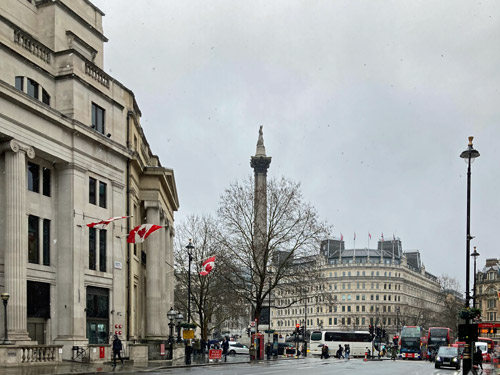
Wed 8: Snow in Trafalgar Square doesn't happen in most Marches. Thu 9: I went upstairs on the 186 bus only to discover that the top deck was empty apart from a scruffy couple and a Rottweiler sprawled across the front seat. Eek! I walked tentatively past and sat further back, relieved that the beast had merely stared. It carried on staring as the woman alongside kept tight hold via a suspiciously thick chain attached to her wrist. I had to walk back past when I alighted, jowls in close proximity, at which point the angry barking started and the woman yanked her lead and I dashed a little faster to escape. I'm pleased to say my birthday day out got better after that. Fri 10: The departure of Ken Bruce from Radio 2, taking Popmaster with him, has forced the launch of a new daily music quiz called Ten To The Top. The questions are similarly tough but the new scoring mechanism (increasing in value with each correct answer) somehow doesn't cut it. The tension isn't there, keeping track of your own score is impractical and people keep ending up with paltry totals. And then yesterday an unassuming lady sailed through the quiz winning maximum points, something I suspect the producers thought might take months, thereby taking an unassailable position on the long-term leaderboard so the whole quiz now feels somewhat flat. Good try, but genius is hard to follow.
Sat 11: I rang the TfL helpline to ask why, two weeks after I paid for an Annual Travelcard, my Gold Card still hadn't arrived in the post. It was also slow last year but previously had always arrived within a week. The lady told me that TfL had "changed their procedures" and Gold Cards now take up to 10 working days to arrive, and could I ring back on Monday if it still hadn't come. I said I'd already lost money and she just apologised and emphasised the "changed procedures". Sun 12: OK probably not, but what if? Mon 13: I could tell the Commonwealth Day wreath-laying ceremony had finished because I spotted black limos with numberplates 1 BAN, 1 PAK, 1 TON and KEN 1 rounding Hyde Park Corner. Tue 14: My Gold Card arrived yesterday after 10 working days, cheers, so today I took it to a central London station to get it added to my Oyster account. They told me I needed to go to a National Rail station and I told them they were wrong and then they looked it up on their magic tablet and said sure, give it here. But they insisted on entering the expiry date one day before it actually expires so that's now 15 days I've been cheated out of.
Wed 15: I see a new community garden has opened on the strip of land between Westfield and the former Olympic Village as a 'meanwhile' use while they decide what to build here. It ought to be uplifting but it describes itself as a co-creation empowerment space, and it recently hosted an equinoctial men's retreat with ice baths and meditation, so I fear it's reflecting a community that's a bit up itself. Thu 16: My gas bill is two-thirds standing charge. Fri 17: I watched Comic Relief and it was good but blimey, only three hours long and the second half of the evening was repeats. The BBC's budget squeeze is really showing. Sat 18: Hurrah, Challenge Anneka is back but on Channel 5 this time. They kept saying the dog centre was in Kent but it's comfortably inside the Greater London boundary in Biggin Hill. It was an uplifting and totally nostalgic watch (but alas C5 are going to be so unimpressed by the viewing figures they'll take the series off mid-run). Sun 19: My family came down from Norfolk to celebrate Mothers Day in a Wetherspoons. More excitingly my Dad got to see my nephew's flat for the first time and take a ride on Crossrail for the first time, which he didn't think he'd ever do. There's now only 30p left on his Oyster card.
Mon 20:WeRoad are advertising their global group safaris all over buses and stations, and every time I see these grinning selfies of random travel companions I think "eek, I'd hate that, imagine being trapped in foreign climes with raving extroverts you didn't know", and then I remember it's not aimed at me, not even me 30 years ago, indeed I'm now way over their upper age limit. Tue 21: I'm pleased to report that GCHQ haven't got back and asked me to take down my photo of their Doughnut HQ in Cheltenham so I think I got away with that, unless instead they put me on a secret hitlist and will be delivering vengeance later. Wed 22: I love Race Across The World and I've missed it post-pandemic. I wasn't convinced a race across just Canada would work but the routing is genius and the couples they've picked are perfect and it totally deserves its promotion to BBC1. Thu 23: How can interest rates now be over 4%, shafting borrowers, but banks have totally failed to reward savers apart from a paltry few products with awkward caveats? I fear the link between savings and interest rates may be permanently severed.
Fri 24: Here's an evocative photo of the colonnade at Golders Green Crematorium, taken during one of those rare hours this month when the sun was actually out. Sat 25: I'm regularly amazed how much stuff my neighbours get delivered. Most days there's a package for them left in the hall and I bring it upstairs and leave it by their front door like a good neighbour, whilst simultaneously wondering what on earth the small thing in the big packet might be this time. Sun 26: I had to go and buy the new Depeche Mode album to go with all my others, reassured by the lead single being excellent. I was however shocked by the price of the CD, and it wasn't even the collector's edition that costs £7 more. At least one other track is excellent but after a few plays I fear a lot of the others may prove to be unmemorable filler. Mon 27:Myddelton House in Enfield is as delightful as ever, its gardens now blessed with roaming pensioners and full-on spring flower vibes, although the meadow that looks totally bluebelled is actually a cloud of scillas.
Tue 28: My new background music obsession is Retro Charts Radio, a streaming service playing "every single UK Top 40 hit from 1952-1999 on elimination random until they’ve all been played." Think Manic Street Preachers followed by the 1982 England World Cup Squad, or the Partridge Family followed by Stool Pigeon, or Helen Shapiro followed by Ace of Base, even Cumberland Gap followed by That's The Way I Like It. You need eclectic tastes to stomach the five decade range, but the genius moments come when a classic number 3 segues into an obscure hit that only reached number 38. Guaranteed no repeats for eight weeks. Wed 29: Back in 2018 I succeeded in riding aboard every London bus route over the space of 20 weeks. That's at least one stop on every single route, including the dead annoying 385, 467 and X68. In 2022 I thought I'd do it again (it took 23 weeks) and this year I started again on 1st January and I'm going to have it all done in 13 weeks. It's a good winter task plus a fabulous way to reacquaint yourself with the whole of London. So far I've done 537 of the 546 routes and I only have the single-digit routes to go. Thu 30: Trying to ride on all the single-digit bus routes as quickly as possible is an interesting challenge. The 5 is a pain because it doesn't run in central London but the others overlap quite well. My 7 was late, my 3 was empty, my 4 got stuck in traffic and I completed my All The Buses challenge by taking the 8 home. Fri 31: Let's see how this year's annual counts are going...
• Number of London boroughs visited: all of them (at least eight times each)
• Number of London postcode areas visited: 230 (which is 95% of the total)
• Number of London bus routes ridden: all (100%)
• Number of Z1-3 stations used: 292 (74%)
• Number of Z4-6 stations used: 3 (1%)
With the ULEZ due to expand in August, TfL have a fresh focus on Outer London.
You can see this in their press releases where the phrase 'in outer London' is now increasingly commonplace. Last month only two press releases referenced outer London but this month's total is ten, which is quite a ramping up. They've also set up a webpage entitled 'Outer London transport', now six months old, although there's no corresponding page for Inner London.
But they haven't defined what they mean by outer London, just occasionally referenced boroughs they say are within it, and using examples which aren't entirely consistent with any of the general definitions.
For example a press release in 2021 stated that Greenwich was an outer London borough and a press release on Monday stated that Newham was an inner London borough. This fits with the statistical definition of Outer London used by the Office for National Statistics and the census. But tfl.gov.uk/outer-London also states that Haringey is an outer London borough, and under none of the general definitions are both Greenwich and Haringey in outer London. The whole thing is a bit of a movable mystery.
And this matters as TfL continue to bang the drum over outer London transport improvements in the run-up to ULEZ expansion and the next Mayoral election. Where exactly are these improvements taking place?
The Outer London transport webpage cites eight different categories of transport improvements so let's see how 'Outer London' they are...
Of those new routes the 378 and 533 were only introduced because Hammersmith Bridge closed, the 304 is only in Outer London if Newham is and the 335 is only in Outer London if Greenwich is. The other eight are unequivocally Outer London routes. The extension of 30 outer London routes and increased frequencies of 65 outer London bus routes might well be true but these claims are unverifiable using existing public data (and the reduction in frequency of wellover100 bus routes is not mentioned).
The text goes on to mention four fresh consultations, two of which are piddly and one of which refers to a route that never leaves Inner London. Previous consultations in Ealing, Haringey, Sutton and Croydon are mentioned (Haringey may or may not be in outer London) as are two proposed routes through the Silvertown Tunnel (which are only in Outer London if either Newham or Greenwich are).
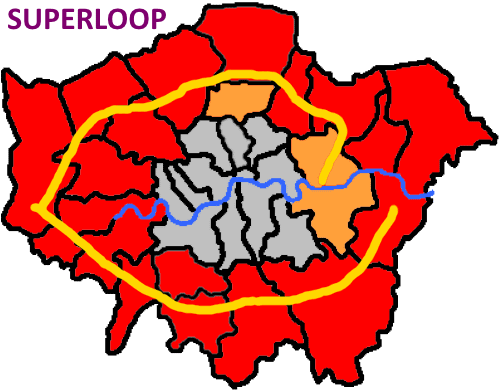
Superloop: This express bus chain is undeniably an Outer London project, as you can see if you draw the proposed loop on a map. The only dubious borough it enters is Newham, and under the definition of 'statutory Outer London' the entire loop would be inside.
Bus Action Plan: These four paragraphs are all generic text which could apply equally to Inner or Outer London (other than a reference to the super-electrfication of route 358 which is properly Outer).
Elizabeth line: Generic text which could apply equally to Inner or Outer London.
New DLR trains: Under the strategic definition of Outer London, as used by City Hall, none of the DLR enters Outer London. But if either Newham or Greenwich counts as Outer London then it does.
New Piccadilly line trains: Generic text which could apply equally to Inner or Outer London.
Barking Riverside: 100% Outer.
Walking and cycling: Only cycling gets a mention, specifically five new Cycleway projects. Of these one is in Islington/Haringey (maybe Outer), one is in Brent (Outer), one is in Hackney (Inner), one is in Greenwich (maybe Outer) and one is in Hounslow (Outer).
I've made that sound much more dubious than it really is because several of these projects genuinely are in Outer London, if only we knew which. But as ULEZ extension and the Mayoral Election draw closer, and TfL's 'Outer London' drumbeat gets louder, remember to take what they say with a dash of scepticism because they've never told us precisely where Outer London actually is.
Definitely Outer London: 18 boroughs Outer London for statistical* purposes: Greenwich Outer London for statutory† purposes: Haringey & Newham Outer London for strategic‡ purposes: Haringey
* e.g. for the census
† i.e. in law since 1963
‡ e.g. for Mayoral planning
(but I'm not sure which of these, if any, is TfL's definition of Outer London)
It's Superloop, supposedly "a network of limited-stop express bus routes that circle the entire capital - connecting outer London town centres, railway stations, hospitals and transport hubs, faster." It's going to be like the Overground but for buses, an orbital network with occasional spokes radiating out.
Ten such bus routes are planned, four of which already exist. They'll form a loop around outer London, in part to mitigate the introduction of the expanded ULEZ. They'll help bus users in the suburbs to get around faster, orbitally at least. They'll be clearly branded on the bus, in timetables and on maps with a multi-coloured roundel. They'll be additional services rather than replacements so should only be an improvement. They'll open up new faster connections, both into the loop and out. I'd happily have used one for a journey I was making yesterday if only it had been running. It's easy to be upbeat.
But they won't "circle the entire capital", they'll skip boroughs and there'll be a gap in the east. They'll mainly benefit those living within a specific ring so those with transport issues elsewhere won't be helped. They might skip past the stop you actually need so won't speed your journey. They'll only link three major hospitals, which on a loop around London isn't great going. One isn't a limited stop service, it's an express, and only runs in one direction for a few hours each day. One won't link up with the rest so doesn't help create part of a useful network. All are being bundled under the Superloop brand when two existing routes are plainly radial and are being included simply to get the name on the sides of buses a bit quicker. It's easy to be cynical.
Most crucially they won't be ready soon, certainly not by August when the ULEZ expands or even this year. Of the seven routes around the loop only two currently exist and the others haven't even reached the consultation stage. Of the missing five just one will have its consultation up and ready by May, best case scenario, and only then will "views be sought on future sections of the orbital network". TfL hope to have the full loop in place by autumn 2024 but that's an aspiration, not a deadline, and so far they can't even confirm where the Superloop will go.
Focusing on the main loop thus far it's only possible to ride limited stop buses from Croydon to Harrow, i.e. the X26 followed by the X140. The Mayor intends to double the frequency of the X26, indeed that's the only practical action he intends to take any time soon, which'll mean a bus every 15 minutes rather than every 30. This is a long-awaited improvement. As for the precise routing of the sections from Bexleyheath to Croydon and from Harrow to the Royal Docks, i.e two-thirds of the circuit, you'll have to wait and see.
Meanwhile the spoke sticking out to the west is the 607, a zippy trek to Uxbridge introduced in 1990 long before any Mayor took charge of the network. It does nothing loopy, it doesn't even start with an X, but has been added solely to give Superloop some stature when it launches. The dashed line downwards from central London to Croydon is the X68, a peak hours commuter service that really shouldn't have been included except it starts with an X so it has. And the isolated boomerang in the middle is the X239, a proposed service through the Silvertown Tunnel with a lunatic three mile express section in the middle, as previously discussed. It's a bit of a dog's dinner.
The Mayor is going to make a lot of fuss about the Superloop as the extended ULEZ approaches, ditto the next Mayoral election. He needs the support of Outer Londoners and also desperately needs something positive to point at as he starts to charge their polluting vehicles. An orbital bus chain isn't going to solve many voters' problems but Sadiq can always mention the Superloop when asked what he's doing, and the project's large enough to look potentially impressive. When the new brand appears on the streets he's counting on the average Londoner not realising that four of the routes already existed and that he only introduced one of them. Look, he'll say, I'm committed to improving transport links in outer London, indeed he's already said just that.
OK, let's dig deeper. Here's the diamond geezer guide to the Superloop loop.
Bexleyheath to Bromley: All we know about this one is that it'll go via Sidcup and Queen Mary's Hospital (which is in Sidcup). This sounds very much like existing route 269 only with fewer stops, suggesting that TfL's intention is to introduce the X269. It also mirrors the former 726, a monster orbital route from Dartford to Heathrow which last saw these roads in 1999 and has its origins in Green Line route 725. That took a slightly more direct route than the current 269 suggesting the X269 might take a few shortcuts, but that's what the upcoming consultation is for. The journey's currently 10 miles long and takes about 50 minutes, so is easily improvable.
Bromley to Croydon: All we know about this one are its start and finish points, nothing about any intended stops inbetween. Several intermediate routes are possible. The former 726 went via Beckenham and Elmers End, a journey which now requires three different buses. But a separate direct route exists via Hayes and West Wickham, the 119, so TfL might instead have the X119 in mind. In the upcoming consultation some intermediate communities will win an express bus service and others will lose out. It would be perfectly feasible for TfL to introduce a combined Bexleyheath to Croydon service rather than two separate routes, but I guess they're aiming for service reliability rather than long distance convenience.
Croydon to Heathrow: This already exists, it is the X26. It's run since 2005, initially hourly and currently half-hourly, and takes up to two hours to complete the 24 mile route. It's a bit of a monster and often disrupted at the whim of congested traffic, so not the most reliable way to get from A to B. But it's also popular and often full, compounded by the need for a significant portion of the lower deck to be taken up by space for airport luggage. Come completion of the Superloop it might be the least efficient section of the orbital ring. But it's also the easiest to brand, given it already operates, plus the Mayor's going for a quick win with an increase in frequency to four buses an hour.
Heathrow to Harrow: This also already exists, it's the X140, which was introduced in December 2019 as part of bus improvements for Crossrail. Its arrival also saw original route 140 curtailed to Hayes & Harlington, so it is possible that the introduction of some new Superloop routes will see existing services tweaked. It's data from the introduction of the X140 that's encouraged TfL to move forward with additional limited stop routes, having seen a 10-15% increase in passenger demand and an increase in customer satisfaction. I've used it several times and what's great is the flexibility to take the 140 for a shorter hop or the X140 for a longer whizz. Here at least the express bus does tend to overtake its slower counterpart, making an X-rated journey properly worthwhile.
Harrow to North Finchley: This is destined to be the first new Superloop route to be introduced, and we know from discussions with the Mayor that it'll be numbered X183. The 183 is already one of Outer London's most frequent buses, a conveyor belt from Pinner to Golders Green via Harrow and Hendon and wholly worthy of expressification. Intriguingly the 183 is a few miles longer than the proposed Superloop route, which would also deviate from its parent at its eastern end. We're promised a consultation for route X183 in May when we'll discover what the proposed route actually is, but it is astonishing that TfL have launched their Superloop brand without even the first detailed plans in place.
North Finchley to Walthamstow: This looks very much like the 34, except starting in Finchley rather than Barnet. We can therefore anticipate the creation of the X34, except shadowing route 221 until it gets to Arnos Grove. This'll be as orbital as orbital gets, being a journey along or quite close to the North Circular Road, which intriguingly is the boundary between the existing and the extended ULEZ. The X34 could also be the fastest of the Superloop routes, traffic permitting, with an emphasis on speedy convenience rather than creating new links.
Walthamstow to Royal Docks: And this is the biggest Superloop mystery, at least in its later parts. From Walthamstow to Ilford it looks very much like being the X123, bringing an express service to several communities but no town centres. Beyond that 'Royal Docks' is a particularly vague destination which could mean Beckton or could mean North Woolwich, but probably means Custom House/Silvertown because the indicative map shows symbols for Crossrail and river services. Numerous possible routes across Newham exist with one of Upton Park or East Ham getting lucky, or maybe even Barking, we'll find out later. But if not the latter then Barking & Dagenham is going to miss out, and Havering definitely will because Superloop won't reach every Outer London borough - at least one gets nothing at all.
Royal Docks to Bexleyheath: And here's the awkward bit, a gap in the Superloop, which it turns out won't be a loop at all. Instead the River Thames gets in the way and TfL have made no attempt to cross it, not even when the Silvertown Tunnel opens. Their previously-announced express route, the X239, leaps all the way from East India to Blackheath so is no use whatsoever in spanning this gap. Instead the fastest connection would be to take Crossrail to Abbey Wood and then the 301 bus, a non-express, so nothing particularly Super at all. Should you have a day spare in 2025 and want to ride the Superloop all the way round, this is where the route will break.
It's possible to introduce a new bus route far quicker than a new railway line, which is part of what makes the humble bus the workhorse of the capital. But a network of orbital routes has been on the drawing board since Boris Johnson's first Mayoral election, just never acted upon, so it is possible that this 'brand new' idea has merely been lifted from an old file and given a 2020s update. But the lack of confirmed detail suggests this is a recent withdrawal, or at least an idea concocted to keep ULEZ miseries at bay, else we'd already know a lot more about how it's intended to operate.
Thus far the Superloop consultation is more a chance to ask questions than offer opinions. You won't learn much by reading it. In the meantime if you'd like to discover what Superloop will be like then go and take a bus ride from Ealing to Southall, or Northolt to Yeading, or Carshalton to Feltham because it already exists, and quite frankly the more the merrier.
In my quest to visit every postcode district in Greater London this year, I recently visited the minor overlaps of EN6, EN8 and EN9. But I skipped EN7 having confidently stated that, although the district seeped marginally into Greater London, no postal address lay within it. Not so fast, you said.
Andrew said "Zoopla reckons there is one property south of the M25 in EN7 5HR (Capel Cottage, 279 Bullsmoor Lane) and one in EN7 5HT (Bulls Cross Lodge, 2 Gilmour Close). The latter is Grade II listed." Rich G then checked theseaddresses on the HMRC website and confirmed they pay their council tax to Enfield, not Hertfordshire.
It may only be two properties but if that meant EN7 existed in London then I had to go. So I went and checked.
To help you get your bearings we are here, near junction 25 on the M25.
Hertfordshire is on the left, and the London borough of Enfield on the right incorporating the motorway itself and the back of Capel Manor College. It's all notionally in EN7, at least from the bridge I'm standing on to the next, but Capel Manor is officially in EN1 because it's accessed from Bullsmoor Lane on the opposite side.
Capel Manor forms the campus of an environmental college, a complex site comprising themed gardens, student workshops and practical spaces. It even has its own little zoo for animal husbandry purposes, which explains the alpacas I saw through a gap in the hedge. A recent planning application confirms that Capel Cottage is a four bedroom house somewhere in the middle, roughly halfway between the ornamental lake and Italianate maze, and the home of the College Principal. And even though you can pay to go round the estate as a tourist attraction, prowling round the boss's house isn't on the agenda so I ruled that out as a way of accessing EN7.
Following the road west brings you to Bulls Cross, a tiny hamlet with a row of characterful cottages and a proper pub, The Pied Bull. King James I kept his hunting dogs here when he lived at Theobalds, if that's the vibe you want while tucking into your cask ale and Triple Challenge Char-grill Burger. It feels borderline rural here, except that just over the back fence is an expanse of 15 grass pitches, a massive gymnasium and a selection of Premiership footballers.
For this is the fabled Tottenham Hotspur Training Ground, the hideaway where the squad practices, learns tactics and keeps fit. The stadium down in N17 is mainly for show - this is where the hard work is put in. Out front is some fiercely manicured grass and a security checkpoint designed to keep over-keen fans at bay. Turn up on a hot news day, as I did, and you might also find a sports presenter talking to camera on the verge outside debating who might replace Antonio Conte as Spurs' manager. All of this alas is in EN2 because the sign for Hotspur Way says so, but the TV support team were parked across the road in Bulls Cross Ride and hurrah, that's definitely EN7.
This is not a lovely road, mainly because it kicks off beside some derelict boarding kennels, now littered with metal containers and stacks of masonry. It also very swiftly hits a line of pylons and an orbital motorway, passing quietly over the top as eight lanes of traffic roar underneath. But there's nowhere to deliver a letter to, not until Bulls Cross Ride lands across the divide in Hertfordshire, and even then not for a while because this is the backway into the Theobalds Park estate.
Two Jewish cemeteries lurk up this private dead end, which must be ideal for those who prefer to be laid to rest within sniffing distance of the M25. I decided against going in, having not brought anything suitable to cover my head. I also failed to be enchanted by the rotting litter discarded along the lane, or to be tempted down the messy embankment leading to the motorwayside public footpath, and then I remembered I don't have to visit the Hertfordshire bit of EN7 so sensibly retreated.
I found one more EN7 street sign on the Greater London side and that's for Gilmour Close. This is a sinister-looking backway squeezed between Capel Manor and the ex-kennels, comprehensively shadowed by trees and doubly inaccessible. First it has a lockable barrier and immediately beyond that temporary railings suggesting nobody's living up there at the moment. This narrow track usedto be the chief northbound country lane before the M25 arrived, at which point Bulls Cross Ride got marginally diverted. And amazingly it used to be part of Ermine Street, one of the principal Roman routes north from London, so hordes of legionnaires had been down there even if I wasn't going to.
Bulls Cross Lodge is early Victorian, L-shaped and described in its listing as "picturesque". I couldn't tell because it's too well screened on all sides, and that's before all the leaves grow back, but I did spot a sliver of cottage with workmen up a ladder fixing the tiles so it definitely exists. As a lodge it's always been part of the Capel Manor estate so comes under their jurisdiction and is accessed across their land, hence the impossibility of getting anywhere close. But it does have a letterbox you can send post to, and the sign at the end of the road definitely says EN7 so that's another peripheral postcode ticked off.

4 4 23 quiz