Local News: South-west Hertfordshire Blimey. Bloody hell, even. The Government's only gone and approved the Croxley Rail Link. That's the severing of the Metropolitan line to Watford and its diversion to Watford Junction via a new viaduct and a revived branch line. The scheme's been on the drawing board for thirty years or more - I remember articles in the local village newsletter when I was a kid. And now they're actually going to build it, subject to all the usual caveats, with £120m of funding provisionally earmarked. Nobody was interested during the boom years but, now we're in recession with a construction industry to kickstart, the Croxley Link's time has come. I never thought I'd see the day. I genuinely thought this was an eternal pipedream trapped on the Home Counties drawing board, but suddenly it's real. If all goes to plan there'll be new stations built at Ascot Road and Watford Hospital, and a new link that takes passengers into the heart of Watford rather than dumping them on the outskirts. Those who live near the existing Watford station won't be happy, because their service will be disappearing. And don't expect top quality design at the new stations either. Funding has been trimmed to get plans past our Treasury overlords - which has meant reducing the size of station buildings, reducing the finish quality, shortening platform canopies and omitting a couple of planned platform extensions. There'll be no expense wasted, but there'll also be up to six trains an hour. And it'll all happen by 2016, maybe, but hugely less maybe than ever before. All change for Watford Junction.
Local News: Tower Hamlets I don't know if you're as excited as me about Tower Hamlets' bid for city status. That's not very excited at all, for the avoidance of doubt. Twenty-six potential cities have nominated themselves as part of a special one-off competition for the Queen's Diamond Jubilee. One of these will get the nod early next year, and the other 25 will grumble, shuffle off and pretend they never asked. Tower Hamlets is up against Bolton, Bournemouth, Chelmsford, Colchester, Coleraine, Corby, Craigavon, Croydon, Doncaster, Dorchester, Dudley, Dumfries, Gateshead, Goole, Luton, Medway, Middlesbrough, Milton Keynes, Perth, Reading, Southend, St Asaph, St Austell, Stockport and Wrexham, many of which look to me like potential cities in a way that Tower Hamlets doesn't. I live in a fantastically historic and diverse borough, don't get me wrong, but nothing about these disparate eight square miles screams "city" to me. Plus we haven't got a hope in hell of winning. The other UK district to earn a plaudit next year is Greenwich, which becomes a Royal Borough no less, and there's no way ministers will award two Jubilee honours to adjacent parts of the capital.
But that hasn't stopped Tower Hamlets promoting their bid big time, and today they're launching a minor PR wheeze. It's called Tower Hamlets Tweets, and everyone from the Mayor downwards will be involved. The idea is to "involve people from across the borough and beyond tweeting the reasons why they believe the borough is a great place to live, work and visit". "Anyone wishing to show their pride in the borough", they say, "can join in by simply finishing their tweets with #cityoftowerhamlets". Even better, because PR folk leave no branding journey to chance, the council website includes a downloadable Word document giving slightly patronising advice for the sorts of things they'd like dutiful citizens to tweet. Things like "Reasons why you think Tower Hamlets is ready to be a city" (It isn't #cityoftowerhamlets). Things like "Interesting facts about the borough that others may not know." (Tower Hamlets has the highest rate of child poverty in London #cityoftowerhamlets). And things like "Your favourite landmarks or places of interest in the borough" (Two cyclists have died recently at the Bow Roundabout #cityoftowerhamlets). The entire event risks inciting apathy or mischief, or both, because not everyone's as optimistic as the folk who dreamt up this campaigning idea. But why not keep an eye on Tower Hamlets' twitterstream today to see how the whole event goes? Just don't expect much joy when the announcement's made next year, because Hamlets ain't no city.
The annual invite to the Christmas party slinks into our inboxes in early autumn. Every year bosses assure us they've listened to the feedback from last Christmas's event, and have devised an outstanding event they know we'll all love. In even-numbered years they tell us that last year's all-singing all-dancing whole company party won't be repeated, and instead we can enjoy smaller gatherings organised on a team by team basis. In odd-numbered years they tell us that last year's smaller gatherings organised on a team by team basis won't be repeated, and instead we can enjoy an all-singing all-dancing whole company party. It being 2011 we get the large-scale megabash, so no doubt 2012 will be thirty of us down the local Pizza Express again. I bet they both cost much the same, head for head.
Anticipation takes several weeks to reach fever pitch. The invitation email encourages us to RSVP, but evidently few people do. It's barely October, we're still wearing short sleeves to work, it's too early to be thinking about midwinter revelry. A reminder email creeps through a few weeks later - don't forget to reply, it'll be an amazing night, please respond. There's a deadline, beyond which festive freezeout applies, so don't be late. The organisers need to confirm numbers with the venue, to ensure there'll be enough waiters serving sufficient canapes and ample wine in a big enough room. The reminder email may also bring first news of the party's dress code. Black tie one year, smart casual another, best party clothes the next. We're on medium bling this year, to the delight of many, and the abhorrence of others.
On the day of the Christmas party, some come to work already attired. What ought to be an ordinary meeting is made extraordinary by the amount of effort evident in certain attendees' apparel. Over-tasteful trousers, a better blouse than usual, perhaps a sparkly brooch on a lapel that'd normally be empty. Some have been out shopping specially at the weekend to pick that perfect party dress, others have grabbed a borderline adequate sports jacket and hoped it'll do. For many the evening's uniform arrives stashed in a bag ready for late-afternoon transformation. A silent signal goes out, an unknown call to arms, and people start sneaking off to the washrooms to get changed. There are lips to redden, whiskers to trim, and fabulous creations to slip into. You can always tell that the Christmas party is imminent because the gents smells of aftershave and the ladies (so I'm told) reeks like the front of Debenhams.
The party's off-site, presumably because hanging tinsel and a few helium balloons in the canteen isn't deemed special enough. Maps are consulted, tube routes planned, taxis ordered ("Have you seen the weather out there! I'm not walking in that wearing this!"). Some attendees are ready promptly, heading out of the front door in good time to arrive for the opening glass of bubbly. These are the folk who don't get invited to many parties so don't realise it's important to arrive fashionably late, else there's nobody to talk to but the unfashionably early. Others dither a little, dashing off a last email or tweaking their errant collar in front of a mirror one last time. Slowly the office empties, until only the slowest dressers and the resolutely anti-social remain.
Seven o'clock passes, and the party must be well underway by now. Trays of food will be emptying, goblets will be on their second refill, and the band hired for the night will be wondering what they have to do to entice anyone onto the floor. Back in the office there are still shrieks and giggles coming from one of the meeting rooms - transformed, temporarily, into a changing room. Eventually the door opens and the girls within emerge one by one, metamorphosis complete. Each is almost unrecognisable, immaculately turned out in a little black dress, with every last strand of hair neatly cajoled into place. Everyone's wearing far more make-up than usual, and sufficient depth of foundation to smooth out any natural contour beneath. A procession on high heels totters carefully to the lift, then swiftly down to a waiting taxi. The girls' entrance at the party may be long overdue, but they aim to make every head turn.
The cleaner arrives. She smiles, she gets her equipment out of the cupboard and she makes a start on clearing up the mess everybody's left behind. She's not been invited to any party, and her clothes aren't anything special, nor indeed does she look like there's a smart little black number hanging up at home. She'd probably make better use of a platter of mini vol-au-vents than the hordes now tucking in down the road, but she'll never get the opportunity. I try to engage her in conversation, but we share a minimal amount of language so it's impossible to get further than good evening and a grin. I turn back to the report I'm writing, with its imminent untimely pre-Christmas deadline.
They'll be talking about last night work's Christmas Party all day today. I'm looking forward to Pizza Express again next year.
We need a new tube map because Kensington Olympia needs a dotted green line. We need a new tube map because the Northern line now stops at Tottenham Court Road again. We need a new tube map because Green Park is now step-free (and, sheesh, what an ugly two-circle mess they've made of that). We need a new tube map because Blackfriars station is now open again (oh, except it isn't, not until the end of February, never mind). But most importantly we need a new tube map to promote an airline. Quite excessively promote an airline, as it turns out.
Emirates have managed to shoehorn their brand name onto the tube map in eight different places. First it's in the key, beneath the London Overground, as "Emirates Air-Line under construction". Secondly it's in the key again, alongside a titchy cablecar graphic labelled "Emirates Air-line". Third and fourthly it's on the map, as two new stations linked by a dotted red line across the river. Both stations appear as blue circles, meaning "step-free access from street to train", even though no wheelchair user can yet access either of them (and there are no trains). Both stations also have a dagger alongside to encourage you to refer to the key (where the name Emirates appears for a fifth and sixth time). Finally there are two mentions in the index on the back of the map, one of which nearly crashes into the final column (because, it appears, "Emirates Greenwich Peninsula" is the longest name of any station on the TfL network). Nowhere on the map does the word 'cablecar' appear - this is solely a branding opportunity for a Middle Eastern sponsor.
All eight mentions appear despite the cablecar still being at the early construction stage. It's not scheduled to open before next summer at the very earliest - beyond the lifespan of this new publication - but that hasn't stopped it appearing on the map. The last new TfL project, the DLR extension to Stratford International, never once appeared on the tube map before it opened. But the Emirates Air-Line has been given special dispensation to appear at least six months early, because they've paid for the privilege, so rules get bent.
This is all part of the creeping commercialisation of the tube map. On the December 2009 map, the only words written on the Greenwich peninsula were "North Greenwich" beside the Jubilee line station. For the new map the bend in the Thames has had to be be widened to fit in more text, first "North Greenwich for the O2" and secondly "Emirates Greenwich Peninsula". The tube network has always included several stations named after commercial entities, such as Arsenal (for the football club) and Elephant & Castle (for the pub). But here we have two multinational companies muscling in on London's geography via the acquisition of sponsored naming rights. You may be happy with that. I wonder where it ends.
And then there are the daggers on the map, thirteen in total. These are for quirks and detail that won't fit on the map, so they go into a separate "Check before you travel" section down the side. Only one lies north of the Central line, only one lies west of Waterloo. Most are concentrated in the DLR corner of the map, and two of these are cablecar related. Surely there's only one thing to "Check before you travel" on the Emirates Air-Line, and that's the certainty that the cablecar isn't yet open. But no. The mapmakers are insistent on telling us something else, twice, something that'll be entirely irrelevant to anyone's journey over the next six months. "Emirates Greenwich Peninsula - Fare zone to be confirmed". "Emirates Royal Docks - Fare zone to be confirmed". Wholly unnecessary daggerisation, surely?
Or maybe not. There is still a big question mark over precisely what fares will be charged to travel on the new ArabFly Dangleway. Oyster will be accepted, but it's not yet clear if there'll be a premium to pay for gliding across the Thames and if so, how much that'll be. TfL are clearly worried that, by slapping the cablecar on the tube map prematurely, people will jump to the wrong conclusion about the fare to be charged. The muttering media and those annoying pernickety bloggers, they might all leap in with an inappropriate assumption and then moan a lot when a journey costs more. At the moment Emirates Royal Docks looks to be firmly in zone 3, while Emirates Greenwich Peninsula sits alongside North Greenwich station on the boundary between zone 2 and zone 3. But I bet passengers will end up paying more than a single-zone fare once the cablecar begins operation, because the daggered comment hints as much.
The December tube map will be replaced in May next year, which is presumably when the special London 2012 Olympic tube map is launched. Expect the Emirates Air-Line to appear in full on that, as an attention-seeking red line, and to stay there until the ten-year sponsorship deal runs out. Because that's what £36m gets you - your brand name eight times on the tube map until December 2021. Why not pick one up today?
With minimum fuss, TfL have taken action to promote cycle safety at the Bow Roundabout. They haven't altered the road layout. They haven't upgraded the traffic lights. They haven't repainted anything. But they have put up some very big signs. Here's one, on the eastbound approach to the roundabout at the foot of Bow Road. [photo]
DRIVERS LOOK OUT FOR CYCLISTS AHEAD. I assume that's a request, rather than a statement. Indeed all the evidence is that drivers haven't been especially good at looking out for cyclists in recent months. Brian Dorling's death occurred a hundred yards down the road because a truck driver wasn't observant enough when turning left at the roundabout. Will this big yellow sign, freshly erected, help to reduce the risk of a repeat tragedy? If not then there's a second sign, aimed at a different category of road user, located further down the road beyond the bus stop. [photo]
CYCLISTS BEWARE VEHICLES TURNING LEFT. I will confess I'm baffled by the spacing in that message. Of course there are vehicles turning left - it's a roundabout! I'm also baffled by the positioning of the sign. The really dangerous thing at this precise point isn't vehicles turning left, it's vehicles ramming bikes from behind. Cycle Superhighway 2 has been skimming along in its own lane, out of the way of other vehicles, when suddenly the blue line veers right to become part of the left-hand lane of traffic. "Cyclists beware, superhighway disappears" more like. For good measure, the yellow sign is repeated a few yards later. [photo]
Here's the spot where cyclists really do want to avoid vehicles turning left - the entrance to the roundabout. It's a much more sensible location for a new sign, although the ghost bike leaning against the traffic light is a far better clue that this isn't the safest junction in London. Ride carefully, because these road markings place you at risk.
No big yellow signs have been installed on either of the slip roads from the A12, so lorries from those directions are free to ride round the roundabout unwarned. But there are another three big yellow signs on the westbound approach, because that's the other road where a vulnerable cyclist has been killed. DRIVERS LOOK OUT FOR CYCLISTS AHEAD comes first, some considerable distance before the roundabout. CYCLISTS BEWARE VEHICLES TURNING LEFT comes next, immediately before a slip road on the left which isn't the left turn the sign is warning about. Installed by cretins, this one [photo]. And then DRIVERS LOOK OUT FOR CYCLISTS AHEAD again, nearer the roundabout, in case drivers didn't get the message the first time. [photo]
To complete the package, TfL have installed another DRIVERS LOOK OUT FOR CYCLISTS AHEAD sign on the westbound slip road as you exit the roundabout. Goodness knows why they bothered. The killer junction is behind you and there's a perfectly decent separate cycle lane for the next few hundred yards. Maybe they had a sign left over.
Will seven big yellow warning signs be sufficient to prevent another tragic death on Barclays' painted stripe? I hope they're only an instant response, a quick sticking plaster, rather than the complete extent of TfL's mitigation of the Bow Roundabout junction. Because there's a heck of a lot still to be done to make this interchange safe for cyclists and pedestrians alike. Erecting signs at a death trap doesn't actually improve anything, it merely highlights how bloody dangerous the design was in the first place.
Concerned that this might be pointlessly addictive. posted by diamondgeezer [10:15 AM Dec 10th, 2006]
I didn't realise what I was getting myself into, I simply signed up because it looked interesting. Twitter didn't take off properly until early 2009, which makes 2006 the digital equivalent of the stone age. Who knew it would become an integral part of daily life for so many?
There weren't many users in those days, and the whole microblogging thing was a bit niche. I was the 54,943rd person to join Twitter, just behind mike (50,113) and well behind Ann (12,496). Join up today and you'll be number 433,187,146. » See London's first Twitter adopters here » Check your own Twitter signup number here
Whatever you think of Twitter, the one thing it's done is to bring millions of people's private lives out into the open. Five years ago I didn't have a clue what you were eating for lunch, which bus you were stuck on, what you thought of tonight's X Factor or how your current relationship was going. Now you tell me everything about your life, sharing intimate details and heartfelt opinions, all broadcast freely like it was the most natural thing in the world. How quickly we evolve.
I'm still not playing the broadcast game, but I appear to be in the minority. I tell you only selective stuff about what I'm doing, which is why I've still only reached a total of 1547 tweets. But some of you are on 5000, or 18000, or 34000, or even more. You're treating Twitter as an internal monologue, or as external conversation, blowing all vestiges of privacy clean out of the water. I bet you never planned to do that when you set out.
One area where the designers of Twitter have been particularly cunning in opening up public conversation is in their belittling of private communication. Sending a Direct Message is easy enough, but Twitter appears to have gone out of its way to ensure the recipient will never notice. No front page indication appears when a message is received - not a flag, not a digit, not a flashing noise, nothing. Even if you think to click through to the messages tab, which you probably won't, the layout ensures that any additional latest message is incredibly hard to spot. So inefficient is the inbuilt DM system that people learn not to rely on it, shifting all private conversations into the public arena. Our collective changed mindset is to "tell the world everything", which is just what advertisers (and stalkers) always hoped.
I'm not sure I'll ever get that far. I've averaged 0.8 tweets a day over five years, which isn't enough to establish any sort of coherent dialogue. I choose not to tweet about my blog very much, because I don't think you need reminding every time I've posted something. I choose not to tweet about where precisely I am, or what I think of that witch on Question Time, or to engage in open conversation, because I don't think that's wise. I don't retweet news stories, because I assume you could have read them elsewhere on the net if you were interested. I'm not playing the game. But thanks ever so much if you're following me, and I hope I occasionally say something interesting enough to make it all worthwhile. » Relive old Twitter, which still functions here and here » OhGod, they're about to completely change the layout again
• Having a nice cup of tea. (10 Dec 06) • Noting with interest the apparent preponderance of geeks and old-school bloggers amongst UK twitterers (14 Dec 06) • Noting that Twitter is fast becoming *the* outlet for pissed-off bloggers to vent their frustration, anger and disappointment "in private" (6 Mar 07) • Hi, diamond geezer. SpammyWebsiteOwner is now following your updates on Twitter. Check out SpammyWebsiteOwner's profile here... [BLOCK] (11 Apr 08) • Damn you Twitter for collapsing during the Eurovision Song Contest. How can we all engage in respectful collective bitching without you? (24 May 08) • Thinking I preferred Twitter when people were talking to everyone, not to each other (8 Jan 09) • omg Twitter just noticed I had two new Tweets to read and told me so. That's new, innit? (9 Nov 09) • Twitter's become less about what people have to say for themselves, and more about what they've seen other people say. (18 Jan 10) • The worst thing about having adverts on Twitter will be the number of sheep who'll retweet them (13 Apr 10) • Let me get this right. Twitter's trending topics now contain a topic that isn't trending, but is merely an advert <sigh> <click> <hide> (20 Jun 10) • Ulp, the new version of Twitter has grasped me by its bony fingers #mandatoryNewTwittertweet (28 Sep 10) • A bit sad that Twitter Search now only goes back a week, if you're lucky, then stops #historybecominginaccessible (14 Jun 11) • I hate New Twitter, I hate it, I hate it, I hate it (and repeat, every time they do it) (15 Dec 11)
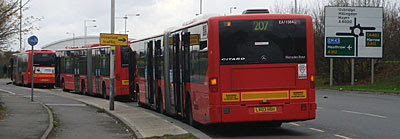
Route 207: White City - Hayes By-Pass Location: London west Length of journey: 9 miles, 60 minutes
London's last bendy bus departs tonight. The articulated fleet has been on our streets for less than a decade but bows out tonight, shipped off to any other town or country who'll have them instead. Many have hated them (long, obstructive, uncomfortable), while others have loved them (fast, accessible, 'free'). Whichever, I've been out to sample one final bendy bus ride before Boris obliterates them from London's roads altogether.
White City bus station hadn't even been built when the first bendy buses plied the streets on route 207. Now the last pull up, every six minutes or so, at the gleaming shelters round the backof Westfield. You'll get a seat if you board here, no trouble, whereas if you queue round the front with everyone else you might not. Expect a diverse band of shoppers to barge on - those heading west towards Acton, Ealing and Southall. And whereas your average double or single decker fills up quickly with designer carrier bags, rest assured that on a bendy there's more space to dangle. My first neighbour has bought something black and furry from DKNY, and sits beside me tapping on her iPhone and trying not to fall asleep. By the time we've negotiated Shepherd's Bush Green the bus is proper full. We've also negotiated the final corner on the entire journey. Seven bends in the first half mile, and then the rest of the Uxbridge Road is relentlessly straight. That linearity is why the 207 was selected to trial bendy buses in the first place. The perfect route, some said... but not for much longer.
You'd not travel this route for its sightseeing value. The main road is lined by a constant chain of non-chain stores, many with a cosmopolitan international flavour. Polish supplies, Nepalese tandoori, Arab fruiterers, the Chili Spice Takeaway - all human life is here. My second neighbour is a West Indian grandfather carrying three tomatoes in an otherwise-empty plastic bag, bound for Acton not far up the road. As he gets off a horde of Morrisons shoppers scramble on, diving for the few remaining seats or hanging defeated from the grab-loops. A third pushchair boards, which'll be damned awkward next week, but the bendy copes admirably and pulls away without delay. Indeed I'm amazed to see how favourably the 207's travel time compares to the 607 express, which follows precisely the same route but with far fewer stops. The 207's only six minutes slower than the 607 to Hayes, according to the timetable, but that'll increase to ten minutes next week because front-entry double deckers are decidedly tardier than multi-door bendies.
The high street nudges slightly upmarket as Ealing approaches, and there's even a welcome stretch of green along the common. The majority of passengers appear to have been heading for the Broadway, where the bus empties out for collective Christmas shopping. Then at the bus stop at the other end of the high street it completely fills up again. Men in woolly hats mingle with women in headscarves, while close by is the distinct smell of someone who believes in drinking more than washing. Soon there are half a dozen people standing in each doorway, resigned to their discomfort because riding's quicker than walking. Even more passengers are crammed into the central concertina, leaning awkwardly on the twisting ridged plastic and taking care not to over-balance. Most of the service's clientèle nip aboard for a fairly short hop, it seems, so they don't mind standing for too long (even though they'd much rather be sitting down).
Ever onward, ever straight. Ah, that now-familiar hydraulic hiss, and the pre-departure beep, and the violent swish-slam of the closing doors. It's hard to imagine anyone getting nostalgic for these sounds in the double decker future, but Londoners won't hear their like again. At Chapel Road, when we pause to pick up passengers, the back half of our bus blocks a stream of emerging traffic. Won't happen next week. We glide on through West Ealing and Hanwell, past soulless office blocks, a Rolls Royce dealer and a Lidl. The road widens considerably beyond the River Brent, and as such would have been ideal had Ken's West London Tram ever got the green light. There'd have been no need at all for bendy buses had these even larger vehicles hit the streets, but not all of the road to Uxbridge is so broad, so inconvenience for car drivers ensured that tramlines never surfaced.
Southall Broadway is all fabric and sparkle. The bus is much emptier now as the end of the journey approaches, but there's still time for two more passengers to take a seat beside me. Neighbour number five is a petite schoolgirl, legs dangling, with a single exercise book in her hessian bag. She's replaced by neighbour number six, fresh from the mosque, enjoying a post-worship bag of crisps during his brief ride home. As far as I can tell, everyone has dutifully swiped their Oyster card on boarding. There are no obvious fare skivers here, even though public opinion would tell you bendies are full of them.
One final surprise is the discovery that this bus doesn't go as far as the Hayes By-Pass, as the destination on the front suggests. Instead every 207 terminates one stop early, at Springfield Road, allowing drivers to run ahead empty to the lay-by beside the roundabout. It's a bit bleak out here, unless you like arterial roads, windswept heathland and shopping parks (with the final posse of passengers preferring the latter). And this barren spot is where London's bendy bus dream will die. The last articulated 207 is due to expire on the outskirts of Hayes at about one o'clock tomorrow morning, followed ten minutes behind by the first of the replacement double deckers. It's cost over a million pounds to acquire new vehicles in advance of the end of the 207's current contract, but that's the price to be paid to rid London's streets of an electoral liability. One Mayoral transport commitment delivered. This bus terminates here.
I've only ever had four jobs. Of those, Job Two and Job Four are those I've had longest - between them almost three quarters of my working career. And this week I've had the incredibly rare chance, as part of Job Four, to go back and visit Job Two. A golden opportunity? Or memories better left undisturbed?
To negotiate my visit to Job Two, I had to make contact with the person who now does the job I used to do. "Oh I've heard stories about you," she said in her second email. "Only good ones," she added in her third, which was a relief, because somebody clearly hadn't filled her in completely. What was particularly strange was communicating with her via email rather than phone or letter. I survived seven years in Job Two without ever sending an email, because the 1990s were like that, but now it's an integral part of her daily routine. A networked PC on every desk, the need to stay alert to a stream of incoming messages and higher expectations of communication. I'm sure I carried out Job Two less well as a result, but nobody knew any better, and nobody ever complained.
Job Two was outside London, so getting there meant taking the train. Such a familiar journey, yet one I've taken so rarely since moving away. On arrival I had time to kill so I went for a walk down the main high street, past the supermarket where I used to do my shopping (which wasn't a supermarket any more) and the Woolworths where I used to buy cheap stuff (which still wasn't anything else). I wondered if I'd bump into anyone I knew, but I didn't because it had been a very long time, and because anyone I might have known would probably been at work anyway. And then I caught the bus, like I always used to catch the bus, although I noticed it didn't run as often as it used to and I'd have had a long wait if I'd missed it. Every stop was naggingly familiar, as you'd expect on a journey I'd made a thousand times before, until I reached the outpost where Job Two lay.
They'd laid on a welcoming committee at the front door. It wasn't any front door I remembered, and the glass was a lot darker, so I didn't spot the multi-person ambush lurking behind until it was too late. First up was an employee who'd retired years ago but somehow never left. She'd heard I was popping in and wanted to say hello, and to give me my Christmas card rather than posting it. It was lovely to see her, but I could have done without the welcoming kiss in front of reception. The boss was also stood waiting, the same boss I'd had when I left Job Two, now ruling an empire hugely greater than before. We shook hands and smiled, in a sort-of gritted teeth manner, happy to get the social niceties out of the way. And then there was his second in command, who earned a much more heartfelt hello. I'd line managed her back in the day, back when "line manage" didn't really mean much, and now here she was nearly running the show. If I'd stayed, I thought, I could be doing your job by now. And then I smiled, because I wasn't.
She invited one of the younger members of the team to take me on a guided tour. I needed a guide because the building had grown exponentially since I was here, and there were extra rooms and knocked-through walls all over the place. My guide wanted to show me the new IT facilities and the accessible lifts, whereas I was more interested in trying to remember what had previously been in all the gaps where the new stuff now was. "Look, that's my old desk!" I said as we passed by on the way to some recent addition, but not surprisingly I was the only one who found that interesting, and we moved on. We ended up by the kettle and the new mugs and the new fridge, which was nice. As my teabag brewed I scanned my eye down the list of current employees, recognising six names, and passing by dozens more. Change is imperceptible when you're part of it, and unmissable when you're not.
And then I got down to doing my Job Four job, because that was the reason I was here. I had to use some of my old Job Two skills, which I was pleased to see I hadn't lost. But most of the time I just stood around watching, and observing, and not quite being part of something I'd once been integral to.
When it was all over, all too soon, I said thanks and wandered back to reception. I hadn't planned anything for the next hour or two in case my former colleagues were so overcome by nostalgia that they wanted to sit down for a chat, or go out for a drink, or whatever. But there were no former colleagues about. The Boss was busy giving Second In Command her annual performance appraisal, which was a procedural chore nobody had even dreamed up back in those halcyon Nineties days. Three other former colleagues were busy working out of sight, out of mind. And the lady at the front desk wasn't the bubbly receptionist I remembered. To her I was just another visitor handing in their badge and signing out, not a valued former member of staff. I wanted to scream "hey, I used to be important here" but I kept quiet because I realised I wasn't any more. Nobody milling around the foyer gave me a second look as I walked out of the front door, sighed a little and closed it behind me. Job Two, job done, dream over.
East London's most infamous series of unsolved murders were undoubtedly those carried out in 1888 by Jack The Ripper, whoever he was. But before that, the benchmark for criminal notoriety was The RatcliffeHighway Murders. Two unexplained massacres took place, twelve days apart, with two families slaughtered in their homes overnight. Even in a part of London renowned for wrongdoing and felony, these murders shocked the populace. And the first took place two hundred years ago tonight, on Saturday 7th December 1811.
In the early 19th century Ratcliffe was an unsavoury neighbourhood lying between Shadwell and Limehouse, close to the docks, and sometimes known as "sailor town". Its slums stood alongside lodging houses, bars, brothels and opium dens, all of which appealed to the transient local population. Charles Dickens wrote of Ratcliffe that "the accumulated scum of humanity gathered here, washed, as it were, from somewhere else". Not somewhere you'd choose to live, but needs must.
Timothy Marr owned a linen shop at number 29 on the Ratcliffe Highway. He was only 24 but had already served time at sea, and had recently married and become father to a three-month-old boy. Work in the shop finished very late in the evening on 7th December, as it might on any normal Saturday back then. Timothy sent the maid Margaret Jewell out to buy some oysters for a late night snack, then on to the bakery to pay a bill. When she returned after midnight with her suppertime treat she found the shop locked and in darkness, and heard footsteps and more disturbing noises from within. She waited outside, then alerted the night watchman to her suspicions, until eventually a neighbour gained access at the rear to try to discover what had happened inside. By candlelight he discovered the dead body of Marr's young apprentice James, his skull smashed by repeated blows from a heavy object. Nearby lay Timothy's wife Celia, her head similarly bludgeoned, and with blood seeping out across the floor. When others gained entrance through the front door to assist, they soon discovered Timothy's mutilated body, then headed downstairs to find his son. They were shocked to find the baby lying in his cradle with his throat cut, his neck sliced and his head severely battered on one side. A chisel lay nearby, while a heavy shipwright's hammer had been discarded in the bedroom. But of the murderer himself, not a sign, he'd slipped clean away.
Ratcliffe Highway looks very different today. The docks have long gone, as of course have the slums. The Western Dock has been filled in and replaced by housing, apart from Tobacco Dock which lingers on as a failed mothballed shopping complex. Meanwhile News International's fortress-like Wapping HQ now covers the site of the North Quay's line of warehouses. I find it intriguing that Rupert Murdoch's tabloid bunker should have set up overlooking one of London's most notorious murder sites, within screaming distance across Pennington Street, but this is merely a macabre coincidence. As for Timothy's shop, you'll search for that in vain. The Highway is a street transformed, now a mix of bland modernity and repurposed heritage warehouses. The site where number 29 once stood has been swallowed up by an architecturally bereft Saab showroom, where salesmen in suits hang around behind plate glass windows - far too public a scene for any repeat crime to be possible. Alongside is the St George's Tavern, a rather better reminder of Ratcliffe's past, except it's currently being gutted to be reborn as a 24 hour hot food takeaway.
Another pub was the site of the second 1811 murder - The King's Arms in New Gravel Lane. The alarm was raised by a lodger at the tavern, late in the evening on the 19th December, scrambling from an upper window and screaming for help. A passing watchman gained entry from the front, which disturbed the murderer who quickly escaped via the rear. The body of publican John Williamson was discovered down in the cellar - battered, throat slit and hanging from a ladder. His wife Elizabeth and their barmaid Bridget had suffered a similar fate, this time in the kitchen, although daughter Kitty somehow remained asleep upstairs during all of this and therefore survived. A suspect for the murders was swiftly found and locked up - a seaman called John Williams - but he committed suicide in prison before his guilt could be confirmed.
New Gravel Lane has since been renamed Garnet Street, and there's properly no sign of the King's Arms or any of the buildings that surrounded it. One long brick dockyard wall survives, behind which are some very average Tower Hamlets townhouses, leading down to a bascule bridge at the entrance to Shadwell Basin. The neighbourhood's risen a long way in two centuries, from extreme slum to an unobjectionable residential backwater. And the crime rate's dropped too, from the days of press gangs, opium dealing and mass slaughter, to minor traffic offences, TV licence evasion and the occasional burglary.
The Ratcliffe Highway Murders remain officially unsolved to this day, even though the main suspects are well known. But the Home Secretary of the day agreed with local magistrates that sailor John was definitely to blame, if only to quell public concern that the series of deaths might continue. His body was paraded through the streets on New Year's Eve 1811, watched by an angry but well-behaved crowd of ten thousand. They watched as the corpse was staked through the heart, then dropped into a ready-dug grave in kneeling position. I'd like to tell you he's still there, near the junction of Cable Street and Cannon Street, but apparently workmen rediscovered his body whilst laying some gas mains so John's long gone. Not a plaque, not a memorial, not a sign. Had not Jack come along later and killed fewer people more brutally, perhaps Ratcliffe's 200-year-old crimes might be more feared, and better remembered.
Hi there, I’d like to see if you are interested in writing about a brand new exhibit opening at <well-known London museum> on <xx>th November... I can offer press pass tickets if you are interested in visiting. Do let me know?
Oh Nicola, get with the programme. You should realise that simply by sending me that email you've guaranteed that I won't write about it. I should perhaps have fleeced you for the free tickets, though.
Hi there, I wanted to share some images with you following last night’s star-studded new <college campus> launch party. The <location>-based breath-taking new campus was filled to capacity with the art and cultural elite... All the imagery from the evening is now available, please do get in touch should you need any additional information. Do you think this is something you can cover?
Would I like to rebroadcast photos of other people enjoying themselves? I'll pass, thanks Matthew.
Hi Diamond Geezer I’m Jack from <PR Company> writing on behalf of alternative (duck feeding, rock climbing, canoeing etc) London-centric dating site <dating.site.com>, to ask if you’d be interested in trying out the premium version of the site for a month or two on us.
All credit to Jack for personally targeting his PR email with a bit of wit, but it wasn't entirely tactful to suggest I ought to use a dating site. Our blossoming relationship split up after a brief exchange of emails.
Hi Guys, It’s that time again where we are running a campaign, this time for London!!!! Please feel free to enter the competition yourself and let your readers know should you think they may be interested! We love London, and to show you how much, we’re giving away a trip for two to this fair city. The full prize for one lucky winner and a friend includes a two-night stay in one of our London hotels...
Because what a London blogger really wants is a (non-transferable) trip to London, isn't it Leah?
Dear Diamond Geezer, Congratulations, your site is one of 15 sites we selected for the opportunity to enter a prize draw collaboration. We really enjoyed reading your travel/tourism pieces that you've written about the UK and would like offer £100 Amazon vouchers as a prize for a competition run on your website. Interested? Here's how to enter: Write a blog post talking about <all-encompassing London-based title>. It can be a travelogue, poem, review or anything you choose, the more creative the better! Enter your details on the <Travel Company> site. Make sure you link to a URL on www.<travelcompany>.com in the post and contact us when the post is live. And we'll pick a winner at random.
So, all that effort to write you a puff piece, and then you pick a winner at random? Thanks for that. And no thanks.
Savvy travellers looking for a low-cost hotel in London in the New Year will be excited to hear that budget hotel chain <Budget Hotel> will be opening its second London property...
Whereas bored bloggers checking their inboxes will be disappointed to see emails arriving from a hotel chain that doesn't understand "Please unsubscribe".
Hi Diamond Geezer, I wanted to invite you to an exclusive <Radio 2-type artist> gig in London on 8th December. The gig is being put on as part of the <Marketing> initiative from <Credit Card> and it would be great if you wanted to come along and find out more about all the cultural events that are being put on by <Credit Card> <Marketing>. The <Marketing> <Radio 2-type artist> gig sees <Credit Card> giving 400 free tickets to lucky cardholders who registered online at the <Marketing> website.
Let me get this right, Rhian. This is an exclusive gig attended by 400 lucky prize winners, but I can come too even though I don't own a <Credit Card> because you want some publicity. Shameless.
So look, I'm sorry to have to say it again on here, because readers are boredofhearingit. But if you're a press officer or marketing guru with an advertorial email ready to send, do me a favour and don't bother. Because I DO NOT PROMOTE ANY STUFF YOU SEND TO ME. Please, stop wasting your time, and bin your promotional message before I do.
Anyone for a new bookabout trains? Ben's written a 142-page tome about some of London's vanished railway stations, entitled Do Not Alight Here, and it's officially published today. This pocket-sized book contains details of 12 guided walks you can follow, along with a few short tube journeys where all you have to do is look out of the window. A nice idea, and, at £6.95, nicely priced too. So I bought a copy at the weekend, and have been out trying to use Ben's book in real life. I thought I'd try following walk number 12, from Shadwell to Bow Church, because it ends at my house with a cup of tea. What a shame there isn't a map, I thought, as I set off. But I suspect I know why there isn't a map now I've finished the walk...
Walk 12 The Real Eastenders: walking the Tower Hamlets (from Do Not Alight Here by Ben Pedroche) Time: "1 hour 30 minutes"
Shadwell station isn't disused, indeed it connects the reopened East London line and a DLR-topped viaduct. But that's OK, because all of Ben's walks start somewhere accessible, so this is perfect. Except I immediately got a bit lost. Ben invited me to "turn right on to Martha Street keeping the rail viaduct on your left", except the rail viaduct was on my right, and it took me a while to realise that reality was correct and the instructions were wrong. Ah well, at the end of the street I did indeed find another Shadwell station, namely Shadwell & St George's East, which I'd never have spotted otherwise. Telltale shuttered doorways hid long-since dormant stairwells, closed in 1941, alongside a modern noticeboard advertising a £4.99 car wash. Good start.
And then a walk. Quite a long walk, almost fifteen minutes, but then railway stations tend to be a non-trivial walking distance apart. Ben doesn't talk much about the walk, because his isn't a book about general East London history. Instead he has something to say about Limehouse station, not that this is disused either, and all he can point at are some mysterious black doors under the bridge. He has nothing to say about the severed viaduct ahead, even though this is very disused, because intra-station architecture isn't what the book's about either. Instead he offers a later diversion to a rail bridge off the main road, where there was once another Limehouse station but isn't now. There's not a sign of it, not from down below, although you'd see more from the DLR were you on board. OK, so it's interesting to know that this backwater street alongside St Anne's Church once merited a railway outlet, but otherwise there's nothing to see here.
Walking on, it's up Burdett Road to Burdett Road station. This is no longer a stop on the Fenchurch Street-Southend line, it disappeared in 1941 when Mile End tube proved more of a draw for passengers. And what's to see here? Ben claims there are "traces" of station under the viaduct, but I couldn't see anything entirely convincing. Today this looks like a bog standard rail bridge beside a go-kart track, so all I got was an imagined view of what might have been here before. Hmmm, so far I'd been walking for an hour and seen only three disused stations, two with negligible evidence of ever being stations at all. Still, never mind, carry on.
I hadn't read ahead carefully, so I thought I was half an hour from home, but no. It was a heck of a long way to the next disused station, as I might have realised if only I'd knocked up this Google map before I left. "Continue along, passing Mile End Park", which is no brief stroll. "Turn left onto Mile End Road", which is in completely the opposite direction to the walk's final destination. And then "after a few minutes" (which meant ten minutes) "turn right onto Globe Road." All in all it was a mile and a quarter to the next station, which felt like an entirely unnecessary detour when there was nothing to see but another redeveloped railway bridge. OK, so there was also what might have been the original entrance to Globe Road station disguised as the doors to a snooker club, and there was also a pub called the Railway Tavern which doesn't serve passengers any more, but this was starting to feel more like a tour of locations than of disused things.
And then (deep breath) another mile and a quarter to the next disused station. Quite an interesting mile and a quarter, from a non-infrastructure point of view, but not ticking any boxes for railway relevance. Eventually Coborn Road delivered something intriguing, courtesy of the original arched entrance to the station alongside a low bridge. You could easily walk past this unassuming boarded-up doorway without noticing it, but look, this unexpected portal was once the fast track to the City. It was getting dark by now, because I'd underestimated how long Walk 12 would take, as it seemed had Ben. It eventually took a total of two hours to reach Bow Road and Bow stations, the former now a William Hill betting shop, the latter an empty space where a car hire firm trades. What with leftover staircases visible overhead and the remains of platforms down below, there were more disused station remnants in the last two minutes of the walk than there had been in the first 118.
Shadwell to Bow Church is less than two miles direct, but Ben's sinuous tour had taken me round the houses for five. That's because East London's disused stations aren't linear, so wandering between them was never going to be easy. But I did get the feeling from my map that Ben had researched some fascinating locations, then strung them together within a not entirely practical walk. I wondered if I'd made an elementary mistake by tackling the final walk in the book, in case that was the leftovers, so I knocked up a map for walk number 1 as well. And, blimey, that was just as impractically tortuous. From Holborn to Tower Hill in seven miles, via Clerkenwell, Aldwych and Waterloo (in that order). If anyone can manage that in the designated 2½ hours, I'll be amazed.
So, is Ben's book worth buying? Absolutely yes, it's packed with in-depth railway history and paints a vivid picture of what there is to see in each location today. Are the various locations worth visiting? Sure, next time you're passing, or if taken in short bursts, although you should be prepared not to see very much because disused stations are like that. And are Ben's walks worth walking? Maybe not. I enjoyed my tour of unfamiliar Tower Hamlets, because I'm like that, but true rail history nuts would have got tired and bored long before the end. Make sure you read each route carefully in advance, maybe even trace a map, else you might be meandering for hours. One for the bookshelf, I think, rather than the road.
Canada Water Library: It might seem somewhat unwise, even downright risky, to open a library in an age of public sector cutbacks. But that's what Southwark council have done this week, opening a so-called super library on the waterside by Canada Water tube station. It's been designed to do so much more than just lend out books, and replaces Rotherhithe Library which was closed to make way last month. The new building has been designed as an inverted pyramid, with four mesh-covered storeys rising from a minimal footprint. You can no doubt guess what's on the ground floor - it's a cafe. The Water's Edge is a proper pastry and caffeine dispensary with chalkboard menu - none of your usual push-button granules here. But you'd probably not guess what else is on the ground floor - it's a theatre. This community-based performance space will host authors and other cultural phenomena, for example Ben Fogle's speaking on Tuesday and a quartet of women writers are in conversation on Wednesday. As for the library itself, that's on the top two floors, accessed either by lift or a gorgeous wood-panelled curving staircase. Borrowers emerge into an airy chamber carpeted in Harlequin-coloured tiles, with bookshelves all around and a gallery above. Children get one corner, teenagers another (between music and graphic novels), and the adults get the big end. The bookshelves have very appealing content, because almost all of the books are freshly acquired. It's a joy to peruse their pristine covers, rather like browsing in your local Waterstones except that every single book can be taken away for free. Three whole shelves of James Pattersons, some morally suspect manga, even two copies of that new book of Londoners everyone's been raving about. The building may have reminded me architecturally of a Tower Hamlets Idea Store, but Canada Water's lending catalogue struck me as vastly superior. All the non-fiction is splayed out around the rim of the gallery, along with rows of angled wooden desks for local learners. All 41 spaces were filled yesterday by note-taking paper-reading water-swilling students and their flipped-up laptops. These are the prize seats, with a wholly distracting view down across the main atrium of the library, and I fear there aren't enough of them for future-proofing purposes. But it's genuinely one in the eye for the Big Society, is Canada Water Library. And your local library isn't as nice (sorry, but I bet it isn't). [exteriorphoto]
Boxpark Shoreditch: It is, allegedly, the world's first temporary shopping mall. That's probably only bluster, depending on your definition of "temporary" and "shopping mall". But there is nothing else quite like it in East London. Trendy shops around Shoreditch, sure, several. Buildings made out of empty shipping containers, sure, several. But the two things combined, nah, unique. Imagine about 40 shipping containers painted black, lined up in parallel. Stick glass doors in one end, facing Bethnal Green Road, and fill with lifestyle brands aimed at hip Silicon City yoofsters. Then add two dozen additional containers on the roof, aligned perpendicularly, with a central alleyway and intermediate grazing spaces. Leave to simmer until the first weekend in December, then open with a rooftop party. That's Boxpark for you. It's located alongside the new Shoreditch High Street station, on a patch of land that's earmarked for building development but not yet. So Boxpark will be here for about five years, and then it can move somewhere else because it's cunningly adaptable like that. The shops are rather thin, but a lot of clothes-style boutiques work quite well on the narrow side. Picture one long wall, maybe two, covered in stuff, and a couple of natty assistants hovering near a till in case someone wants to buy something. DC Shoes are here, and Nike, and Oakley, and Calvin Klein, and Original Penguin, and you get the idea. Farah slacks and Gola shoulder bags have a presence, because this is Shoreditch and the 1970s are retro-trendy again. Local coffee chain Foxcroft & Ginger are here, and they've sensibly taken two neighbouring containers so their dispensing space isn't ridiculously confined. Various food outlets have slipped in, should you fancy Mexican, organic or meat pies. And Amnesty International and "Art Against Knives" have been given boxes, in an attempt to make the whole enterprise no quite so nakedly commercial. I accidentally stumbled on the place a few minutes after opening, and it was rammed. All those Shoreditch characters you thought were stereotypes, they came in large numbers. Bobble hats, flat caps, primary-coloured jeans and trainers, individually stretched earlobes, the lot. They came, they saw, they clustered. In fact you could probably draw rather a convincing "bar graph of cool" according to how large the crowds were outside each individual doorway. Some outlets remained noticeably less desirable, and box number 13 stayed firmly closed because nobody's risked renting it yet. I ventured inside the Dockers container because I need some new trousers for work, only to find a fairly limited range stashed in piles along the right-hand wall. Nicely done, but no sign of the style I was after, plus I wouldn't have fancied changing behind the curtain at the back anyway. I was more interested in Cybercandy upstairs, except they didn't have the right obscure flavour of imported tictacs, and I didn't fancy a Ploppy. Not all of the top floor was accessible, alas, because the opening party was underway. Only those who passed guest list interrogation were allowed through to the soundstage-and-drinks area, and the rest of us had to mill around and along and back down the way we'd come. Were I younger, beardier and more retail-minded, I might well be tempted back for a wardrobe top-up, but I can absolutely live without, thanks very much. I have my doubts how popular Boxpark will be on Wednesday afternoons in February, but its densely-packed low-rent stockpile of must-have brands surely gives traders every chance of success. [photo][53 photos]
Paralympic events with lots of tickets still available » Athletics (17 medal-winning sessions available, £10-£45) (look, tickets available in iconic venue) » Equestrian (11 sessions available, £10) » Football (14 sessions available, plus Olympic Park day pass, £15) » Goalball (23 sessions available, plus Olympic Park day pass, £15) » Powerlifting (20 sessions available, plus ExCel day pass, £15) » Volleyball (sitting) (26 sessions available, plus ExCel day pass, £15) » Wheelchair Basketball (18 sessions available, £15) » Various day passes (Olympic Park/ExCel/Woolwich) (£10)
Paralympic events with some tickets still available » Archery (11 sessions available, £10) » Boccia (12 sessions available, plus ExCel day pass, £15) » Judo (5 sessions available, plus ExCel day pass, £15) » Rowing (only 2 sessions available, £10) » Swimming (15 sessions available, £10-£45) (look, tickets available in iconic venue) » Table Tennis (13 sessions available, plus ExCel day pass, £15) » Wheelchair Fencing (5 sessions available, plus ExCel day pass, £15) » Opening Ceremony (£125-£500) (all the £20.12 and £50 tickets have gone) (see you there?) » Closing Ceremony (£50-£350) (all the £20.12 tickets have gone) (see you there?)
BBC1 schedule during the Olympics(erm, where's the non-Olympic programming?) 0600-0900: Bill Turnbull, Hazel Irvine, Sian Williams or Chris Hollins 0900-1130: Mishal Husain 1130-1345: Matt Baker or Hazel Irvine or Clare Balding 1345-1600: Jake Humphrey or Hazel Irvine or Clare Balding 1600-1900: Sue Barker 1900-2235: Gary Lineker 2235-2400: Gabby Logan
2012 TfL fare rises in excess of 7%(adult single journey) [full list] » Oyster Pay As You Go, zones 1-2: £2.50 → £2.70 (+8.0%) » Underground/DLR/Overground, three zones or less: £4.00 → £4.30 (+7.5%) » Underground/DLR/Overground/Rail, one zone (not Zone 1): £4.00 → £4.30 (+7.5%) » Overground (Euston-Watford), Zone 2-beyond Zone 7: £4.00 → £4.30 (+7.5%) » Oyster Pay As You Go, zones 1-5: £4.10 → £4.40 (+7.3%) » Underground/DLR/Overground, Zones 1-9: £7.00 → £7.50 (+7.1%) » Overground (Euston-Watford), one or two zones: £1.40 → £1.50 (+7.1%)
Stratford has a new chip shop. A new casino to be precise, indeed the largest casino in the whole of the UK. It's located on the top floor of the Westfield shopping centre, because Newham council wanted it in E20 rather than down by the river. It opened yesterday at 12 noon... and if all goes to plan it'll stay open all day every day except Christmas. They'll happily take your money 24/7/364, and who knows, lucky punters might even take some away again.
The main entrance to the casino is up the escalators, up the escalators, up the escalators, near the cinema. On Day 1 there was a red rope out the front to funnel in would-be customers (dress code smart casual), plus a special queueless VIP entrance alongside. But for even less of a wait, and considerably less scrutiny, I'd recommend taking the lift from The Street outside, opposite Nike. Make sure you press the right button because on the second floor the doors open to a blank concrete corridor with a few blue cleaning cloths draped near a single chair. The third floor, however, is a completely different matter.
Stratford's new Aspers Casino covers sixty-five thousand square feet, with decor a cross between a nightclub and a first class airport lounge. The main room is long and relatively thin, with each gambling game clustered in a different part of the floor. Right down the far end is the poker room, which is probably the least glamorous part of the casino, and holds table space for 150 people. Last night I'd say that 98% of those people were men, and fairly everyday men at that, as if hordes of experts who normally play poker online had ventured out into the real world to make real money with non-virtual cards. Non-experts, step away.
Blimey there are a lot of roulette wheels on site. Some wheels are free-standing and operated by humans, with a gaggle of willing punters sat around piling fortunes in chips onto the baize. Is there a recession going on? You'd never have guessed. Other wheels are fully mechanised with surrounding seats, a bit like those bingo machines at seaside amusement arcades, but several steps up the evolutionary ladder. Press the button - Red? 17? Black? - and see if the machine will spit you out a cashback receipt. I was struck by the number of spurious statistics being broadcast above the table - the sequence of recent scores, the most and least common numbers in the last 300 spins, the spatial distribution of recent results. On a fair wheel these statistics mean absolutely bugger all, but the casino clearly wants its punters to believe there's an element of skill to what is actually an entirely random act.
Blackjack's very popular too, each table with a curve of six seats, and a sequence of cards spewing forth from the dealer's automatic shuffler. Here you'll find groups of blokey friends enjoying a punt after a day in the office, and well-dressed couples, and solo geeks trying their hardest not to go bust. Feel free to stand behind and watch - there's no pressure to join in - indeed the casino is aiming very much for the casual shopper as well as the serious punter. For those with almost no gambling nous whatsoever, the easiest game is a big spinning wheel where all you have to do is guess which of six colours will come up. That 50-1 spot is tempting, and even the 3-1 bet attracts chips from smiling optimists, but time and again it's the croupier who rakes in the greatest prize.
In one corner there's a bar, open 24 hours a day, surrounded by sport-related betting terminals. Sky Sports News rolls endlessly on a huge screen behind, especially for those who can't live without knowing the latest Brentford team news in high definition. This I suspect is because Sky Sports viewers are a key target audience for the casino, and I saw plenty throughout, beer in hand. I can also imagine bankers from the City or Canary Wharf ending up here - neither's far away by tube. But the general ambience last night was much more local, much more ordinary, and far from the elitist image of cocktails and diamonds that the word "casino" usually throws up.
The staff are easy to spot in their claret tops, keeping careful watch over each game or standing waiting to be drafted in to an empty table. They're inscrutable, as you'd hope, and quite young, and a well turned-out mix of the sexes rather than an endless parade of dolly dealers. Indeed many have been draftedin from Newham unemployment queues, which is probably the most positive contribution that this casino will make to the local economy. Otherwise you have to wonder why such a nakedly money-grabbing enterprise has been allowed to set up in the very poorest corner of London, and how many nearby residents will end up in the red rather than the black as a result.
Won big on the tables? Congratulations, now queue up at the main desk to cash in your winnings. You'll need a passport or other ID if you've won £1000 or more, those are the rules, and with minimum bets on some games at £5, even £25, one grand's a total you might easily hit. Should you want to celebrate your winnings the casino are only too willing to take them all back off you, via their slightly exclusive Sky Bar and the adjacent Clary's restaurant. They'd like you to come and spend all evening here, or all day, or even all night, and you easily could.
I wandered around observing, mingling and perusing the action, without any implicit discomfort or hassle. And then I thought I really ought to get involved, somewhere, for the full casino experience. I wasn't up for sitting at a table, not without greater skill or moral support, nor for trying my hand at an automated version of one of the main games. So I wandered over to the slots - they have 150 - because surely playing fruit machines couldn't be that hard. Wrong. These were major multi-coloured spinning beasts, with arcane accumulators and impenetrable instructions, perhaps best exemplified by the quartet of towering Sex And The City themed machines. There are no plain and simple button pushers here at Aspers, only feeders for banknotes and cryptic slots for coins.
So I gave up and wandered out - no richer, no poorer, than I'd come in. I think that'll be a rare reaction, given the casino's hypnotic lure of lights and tables. Indeed you and your mates may absolutely love the place. But watch out, because East London's seen nothing like this before, and for some a downward spin awaits.
While you were looking elsewhere yesterday, London 2012 releasedfurther details of the transport disruption the capital can expect next summer. A good day to bury bad news? Not entirely. For a start they'd promised to release this information in November, and there wasn't any more November left. And secondly, it's not all bad news. Just partly bad, with awful bits.
We're still at the "information for businesses" stage. The tone's changed a bit, from "watch out it's going to be dreadful" to "it won't be that bad so long as you plan ahead". TfL want companies large and small to start reorganising deliveries and wondering whether staff could modify their Olympic-time behaviour. Maybe they could work from home, maybe take extended leave, maybe get into work earlier and/or leave later to avoid the rush. And there really will be a rush, in certain places at certain times, which you'll absolutely want to avoid.
» If you want to see how roads will be affected, there are more details here. » For considerably more tube-related information than we've seen before, look here. » And if you want to get the full picture there's a 101-screen Powerpoint presentation here (don't worry, it's a pdf).
On the roads, the full extent of the Olympic Road Network has now been laid bare. Even the last batch of roads they'd been storing up to the end, all those details are now up for consultation. See the Games Lanes through central Stratford and up The Mall and under the Bow Roundabout, for example. TfL are keen to point out that there'll be only 30 miles of Games Lanes out of 9200 miles of London's road network, but then I guess Olympic VIPs were never likely to travel via, say, Appledore Crescent in Sidcup.
What's proper new is that a sequence ofheatmaps has been launched for every day of the Games, plus several of the days on either side. Scary busy roads appear red, while Appledore Crescent and the outer suburbs appear white. Some parts of town, like the roads to Wimbledon or the Lea Valley White Water Centre, they'll only be congested on certain event days. Other parts, well, let's just say I don't think I'll be catching any buses outside my house next summer, it'll be quicker to walk.
And on the trains? Firstly they've published broad brush summaries for congestion on each tube line. The Central will see a high demand throughout the Games, while the Metropolitan will only occasionally be busier than usual when there are events at Wembley. As for the Jubilee, this line so perfectly links six separate Games venues that you might as well forget using the central section completely. Especially between 07:00-09:00 and 16:00-19:30, and from 22:00 until the last train.
But TfL can now tell us much more than that. Someone's been very busy with their spreadsheets, creating ½hr-by-½hr tables to show when the really busy bits are going to be at various stations. There are only 30 stations on the list so far, and nobody's willing to discuss weekends yet, but this does add considerable detail to what might or might not happen. Each station merits two coloured grids - one (worst case) if the public don't modify their behaviour and one (best case) if they do. The important data is all based on queueing times. No extra waiting, that's white, then up to 15 minutes yellow, up to 30 minutes orange, and over 30 minutes red. You really don't want to be waiting for a train for more than half an hour, so take heed.
Oxford Circus: Barely affected. If all goes to plan, there'll be four evenings when there might be a little bit of queueing between 6pm and 7pm. That's nothing. Bond Street: One station up the line, nightmare. Queues of longer than half an hour every weekday evening between 5pm and 8pm, possibly restricted to 5:30-6:30 if the public behave. Blame the busy-ness of the interchange down below keeping regular commuters up above (ditto Green Park, but with a more diffuse congestion pattern). King's Cross St Pancras: This'll be bad in the morning peak but rather smoother later in the day. Canada Water: Very bad in the mornings, still fairly bad in the evenings (whereas at Canary Wharf, just evenings) Greenwich: No matter what happens, Greenwich rail station will be a queueing hotspot on eight specific evenings related to eight specific events. This includes the whole of the evening on Monday 30th July, so just don't. North Greenwich: Horrible unavoidable queueing almost every evening for a three hour period. The Greenwich peninsula's not the easiest place to escape from via any other means, but then aren't most nights at the O2 like that? Embankment: Unexpectedly awful, courtesy of beach volleyball crowds, especially after 6:30pm. Use your head and walk to another nearby station instead. Bank: Very very bad (whereas Monument won't be too bad at all). Liverpool Street/Covent Garden/Tower Gateway: Not especially scary. Stratford: You might expect Stratford to be chocker, given its proximity to the Olympic Park. But in fact there's only one hour (late evening on 9th August) when queues are predicted to be longer than half an hour. It sounds like rebuilding the station and adding new rail connections has paid huge dividends. West Ham: Again, not as bad as you might expect, should you be mug enough to get off here and walk a mile to the Olympic Park. London Bridge: This is the really awful one. This is the one TfL really want you to avoid. Five especially grim mornings, plus hellish queueing every single evening between 5:30 and 8:30. TfL would rather SouthEastern commuters stayed on to Cannon Street or Charing Cross, or walked across the Thames, or caught a bus, or had a nice drink and a meal on the South Bank instead of going home in the evening. Please?
This information is all for business planning purposes, remember. TfL won't be getting round to "communicating directly to Londoners" until some time early next year. There'll be "a campaign of information and advice via ads, posters, emails and a new website offering travel tips". I fear we might expect some seriously patronising behavioural modification posters, if the last ten-or-so slides on their Powerpoint presentation are anything to go by. But let's wait and see. And then, next summer, let's see how long we wait.

Blimey. Bloody hell, even. The Government's only gone and approved the Croxley Rail Link. That's the severing of the Metropolitan line to Watford and its diversion to Watford Junction via a new viaduct and a revived branch line. The scheme's been on the drawing board for thirty years or more - I remember articles in the local village newsletter when I was a kid. And now they're actually going to build it, subject to all the usual caveats, with £120m of funding provisionally earmarked. Nobody was interested during the boom years but, now we're in recession with a construction industry to kickstart, the Croxley Link's time has come. I never thought I'd see the day. I genuinely thought this was an eternal pipedream trapped on the Home Counties drawing board, but suddenly it's real. If all goes to plan there'll be new stations built at Ascot Road and Watford Hospital, and a new link that takes passengers into the heart of Watford rather than dumping them on the outskirts. Those who live near the existing Watford station won't be happy, because their service will be disappearing. And don't expect top quality design at the new stations either. Funding has been trimmed to get plans past our Treasury overlords - which has meant reducing the size of station buildings, reducing the finish quality, shortening platform canopies and omitting a couple of planned platform extensions. There'll be no expense wasted, but there'll also be up to six trains an hour. And it'll all happen by 2016, maybe, but hugely less maybe than ever before. All change for Watford Junction.
Emirates have managed to shoehorn their brand name onto the tube map in eight different places. First it's in the key, beneath the London Overground, as "Emirates Air-Line under construction". Secondly it's in the key again, alongside a titchy cablecar graphic labelled "Emirates Air-line". Third and fourthly it's on the map, as two new stations linked by a dotted red line across the river. Both stations appear as blue circles, meaning "step-free access from street to train", even though no wheelchair user can yet access either of them (and there are no trains). Both stations also have a dagger alongside to encourage you to refer to the key (where the name Emirates appears for a fifth and sixth time). Finally there are two mentions in the index on the back of the map, one of which nearly crashes into the final column (because, it appears, "Emirates Greenwich Peninsula" is the longest name of any station on the TfL network). Nowhere on the map does the word 'cablecar' appear - this is solely a branding opportunity for a Middle Eastern sponsor.
Or maybe not. There is still a big question mark over precisely what fares will be charged to travel on the new ArabFly Dangleway. Oyster will be accepted, but it's not yet clear if there'll be a premium to pay for gliding across the Thames and if so, how much that'll be. TfL are clearly worried that, by slapping the cablecar on the tube map prematurely, people will jump to the wrong conclusion about the fare to be charged. The muttering media and those annoying pernickety bloggers, they might all leap in with an inappropriate assumption and then moan a lot when a journey costs more. At the moment Emirates Royal Docks looks to be firmly in zone 3, while Emirates Greenwich Peninsula sits alongside North Greenwich station on the boundary between zone 2 and zone 3. But I bet passengers will end up paying more than a single-zone fare once the cablecar begins operation, because the daggered comment hints as much.
Route 207: White City - Hayes By-Pass
White City bus station hadn't even been built when the first bendy buses plied the streets on route 207. Now the last pull up, every six minutes or so, at the gleaming shelters round the back of Westfield. You'll get a seat if you board here, no trouble, whereas if you queue round the front with everyone else you might not. Expect a diverse band of shoppers to barge on - those heading west towards Acton, Ealing and Southall. And whereas your average double or single decker fills up quickly with designer carrier bags, rest assured that on a bendy there's more space to dangle. My first neighbour has bought something black and furry from DKNY, and sits beside me tapping on her iPhone and trying not to fall asleep. By the time we've negotiated Shepherd's Bush Green the bus is proper full. We've also negotiated the final corner on the entire journey. Seven bends in the first half mile, and then the rest of the Uxbridge Road is relentlessly straight. That linearity is why the 207 was selected to trial bendy buses in the first place. The perfect route, some said... but not for much longer.
The high street nudges slightly upmarket as Ealing approaches, and there's even a welcome stretch of green along the common. The majority of passengers appear to have been heading for the Broadway, where the bus empties out for collective Christmas shopping. Then at the bus stop at the other end of the high street it completely fills up again. Men in woolly hats mingle with women in headscarves, while close by is the distinct smell of someone who believes in drinking more than washing. Soon there are half a dozen people standing in each doorway, resigned to their discomfort because riding's quicker than walking. Even more passengers are crammed into the central concertina, leaning awkwardly on the twisting ridged plastic and taking care not to over-balance. Most of the service's clientèle nip aboard for a fairly short hop, it seems, so they don't mind standing for too long (even though they'd much rather be sitting down).
Ratcliffe Highway looks very different today. The docks have long gone, as of course have the slums. The Western Dock has been filled in and replaced by housing, apart from Tobacco Dock which lingers on as a failed mothballed shopping complex. Meanwhile News International's fortress-like Wapping HQ now covers the site of the North Quay's line of warehouses. I find it intriguing that Rupert Murdoch's tabloid bunker should have set up overlooking one of London's most notorious murder sites, within screaming distance across Pennington Street, but this is merely a macabre coincidence. As for Timothy's shop, you'll search for that in vain. The Highway is a street transformed, now a mix of bland modernity and repurposed heritage warehouses. The site where number 29 once stood has been swallowed up by an architecturally bereft Saab showroom, where salesmen in suits hang around behind plate glass windows - far too public a scene for any repeat crime to be possible. Alongside is the St George's Tavern, a rather better reminder of Ratcliffe's past, except it's currently being gutted to be reborn as a 24 hour hot food takeaway.
New Gravel Lane has since been renamed Garnet Street, and there's properly no sign of the King's Arms or any of the buildings that surrounded it. One long brick dockyard wall survives, behind which are some very average Tower Hamlets townhouses, leading down to a bascule bridge at the entrance to Shadwell Basin. The neighbourhood's risen a long way in two centuries, from extreme slum to an unobjectionable residential backwater. And the crime rate's dropped too, from the days of press gangs, opium dealing and mass slaughter, to minor traffic offences, TV licence evasion and the occasional burglary.
Shadwell station isn't disused, indeed it connects the reopened East London line and a DLR-topped viaduct. But that's OK, because all of Ben's walks start somewhere accessible, so this is perfect. Except I immediately got a bit lost. Ben invited me to "turn right on to Martha Street keeping the rail viaduct on your left", except the rail viaduct was on my right, and it took me a while to realise that reality was correct and the instructions were wrong. Ah well, at the end of the street I did indeed find another Shadwell station, namely Shadwell & St George's East, which I'd never have spotted otherwise. Telltale shuttered doorways hid long-since dormant stairwells, closed in 1941, alongside a modern noticeboard advertising a £4.99 car wash. Good start.
Walking on, it's up Burdett Road to Burdett Road station. This is no longer a stop on the Fenchurch Street-Southend line, it disappeared in 1941 when Mile End tube proved more of a draw for passengers. And what's to see here? Ben claims there are "traces" of station under the viaduct, but I couldn't see anything entirely convincing. Today this looks like a bog standard rail bridge beside a go-kart track, so all I got was an imagined view of what might have been here before. Hmmm, so far I'd been walking for an hour and seen only three disused stations, two with negligible evidence of ever being stations at all. Still, never mind, carry on.
And then (deep breath) another mile and a quarter to the next disused station. Quite an interesting mile and a quarter, from a non-infrastructure point of view, but not ticking any boxes for railway relevance. Eventually Coborn Road delivered something intriguing, courtesy of the original arched entrance to the station alongside a low bridge. You could easily walk past this unassuming boarded-up doorway without noticing it, but look, this unexpected portal was once the fast track to the City. It was getting dark by now, because I'd underestimated how long Walk 12 would take, as it seemed had Ben. It eventually took a total of two hours to reach Bow Road and Bow stations, the former now a William Hill betting shop, the latter an empty space where a car hire firm trades. What with leftover staircases visible overhead and the remains of platforms down below, there were more disused station remnants in the last two minutes of the walk than there had been in the first 118.
Canada Water Library: It might seem somewhat unwise, even downright risky, to open a library in an age of public sector cutbacks. But that's what Southwark council have done this week, opening a so-called super library on the waterside by Canada Water tube station. It's been designed to do so much more than just lend out books, and replaces Rotherhithe Library which was closed to make way last month. The new building has been designed as an inverted pyramid, with four mesh-covered storeys rising from a minimal footprint. You can no doubt guess what's on the ground floor - it's a cafe. The Water's Edge is a proper pastry and caffeine dispensary with chalkboard menu - none of your usual push-button granules here. But you'd probably not guess what else is on the ground floor - it's a theatre. This community-based performance space will host authors and other cultural phenomena, for example Ben Fogle's speaking on Tuesday and a quartet of women writers are in conversation on Wednesday. As for the library itself, that's on the top two floors, accessed either by lift or a gorgeous wood-panelled curving staircase. Borrowers emerge into an airy chamber carpeted in Harlequin-coloured tiles, with bookshelves all around and a gallery above. Children get one corner, teenagers another (between music and graphic novels), and the adults get the big end. The bookshelves have very appealing content, because almost all of the books are freshly acquired. It's a joy to peruse their pristine covers, rather like browsing in your local Waterstones except that every single book can be taken away for free. Three whole shelves of James Pattersons, some morally suspect manga, even two copies of that new book of Londoners everyone's been raving about. The building may have reminded me architecturally of a Tower Hamlets Idea Store, but Canada Water's lending catalogue struck me as vastly superior. All the non-fiction is splayed out around the rim of the gallery, along with rows of angled wooden desks for local learners. All 41 spaces were filled yesterday by note-taking paper-reading water-swilling students and their flipped-up laptops. These are the prize seats, with a wholly distracting view down across the main atrium of the library, and I fear there aren't enough of them for future-proofing purposes. But it's genuinely one in the eye for the Big Society, is Canada Water Library. And your local library isn't as nice (sorry, but I bet it isn't). [exterior photo]
Boxpark Shoreditch: It is, allegedly, the world's first temporary shopping mall. That's probably only bluster, depending on your definition of "temporary" and "shopping mall". But there is nothing else quite like it in East London. Trendy shops around Shoreditch, sure, several. Buildings made out of empty shipping containers, sure, several. But the two things combined, nah, unique. Imagine about 40 shipping containers painted black, lined up in parallel. Stick glass doors in one end, facing Bethnal Green Road, and fill with lifestyle brands aimed at hip Silicon City yoofsters. Then add two dozen additional containers on the roof, aligned perpendicularly, with a central alleyway and intermediate grazing spaces. Leave to simmer until the first weekend in December, then open with a rooftop party. That's Boxpark for you. It's located alongside the new Shoreditch High Street station, on a patch of land that's earmarked for building development but not yet. So Boxpark will be here for about five years, and then it can move somewhere else because it's cunningly adaptable like that. The shops are rather thin, but a lot of clothes-style boutiques work quite well on the narrow side. Picture one long wall, maybe two, covered in stuff, and a couple of natty assistants hovering near a till in case someone wants to buy something. DC Shoes are here, and Nike, and Oakley, and Calvin Klein, and Original Penguin, and you get the idea. Farah slacks and Gola shoulder bags have a presence, because this is Shoreditch and the 1970s are retro-trendy again. Local coffee chain Foxcroft & Ginger are here, and they've sensibly taken two neighbouring containers so their dispensing space isn't ridiculously confined. Various food outlets have slipped in, should you fancy Mexican, organic or meat pies. And Amnesty International and "Art Against Knives" have been given boxes, in an attempt to make the whole enterprise no quite so nakedly commercial. I accidentally stumbled on the place a few minutes after opening, and it was rammed. All those Shoreditch characters you thought were stereotypes, they came in large numbers. Bobble hats, flat caps, primary-coloured jeans and trainers, individually stretched earlobes, the lot. They came, they saw, they clustered. In fact you could probably draw rather a convincing "bar graph of cool" according to how large the crowds were outside each individual doorway. Some outlets remained noticeably less desirable, and box number 13 stayed firmly closed because nobody's risked renting it yet. I ventured inside the Dockers container because I need some new trousers for work, only to find a fairly limited range stashed in piles along the right-hand wall. Nicely done, but no sign of the style I was after, plus I wouldn't have fancied changing behind the curtain at the back anyway. I was more interested in Cybercandy upstairs, except they didn't have the right obscure flavour of imported tictacs, and I didn't fancy a Ploppy. Not all of the top floor was accessible, alas, because the opening party was underway. Only those who passed guest list interrogation were allowed through to the soundstage-and-drinks area, and the rest of us had to mill around and along and back down the way we'd come. Were I younger, beardier and more retail-minded, I might well be tempted back for a wardrobe top-up, but I can absolutely live without, thanks very much. I have my doubts how popular Boxpark will be on Wednesday afternoons in February, but its densely-packed low-rent stockpile of must-have brands surely gives traders every chance of success. [photo] [53 photos]
Stratford has a new chip shop. A new casino to be precise, indeed the largest casino in the whole of the UK. It's located on the top floor of the Westfield shopping centre, because Newham council wanted it in E20 rather than down by the river. It opened yesterday at 12 noon... and if all goes to plan it'll stay open all day every day except Christmas. They'll happily take your money 24/7/364, and who knows, lucky punters might even take some away again.
Olympic update